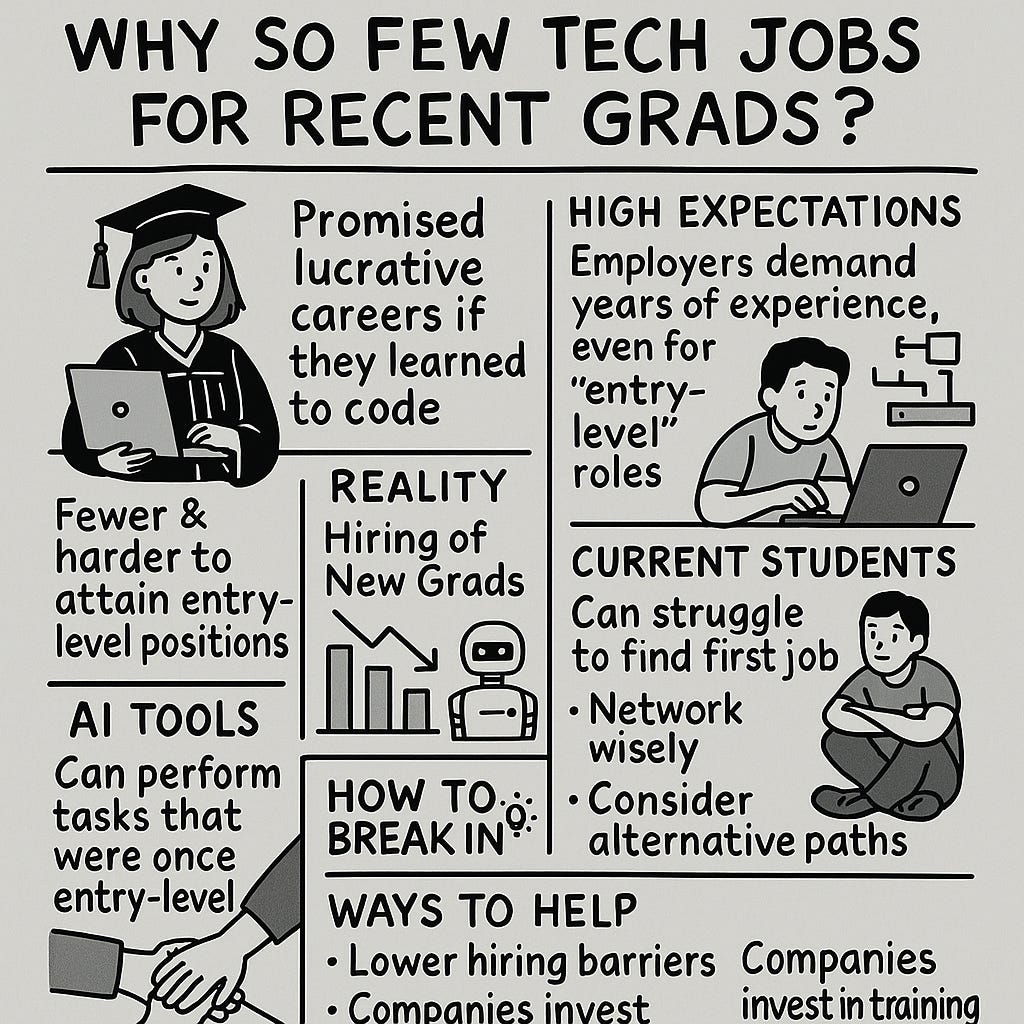
Why So Few Tech Jobs for Recent Grads?
from Minimalist techie Hosted by Sridhar Garikipati
Welcome to Sridhar’s newsletter & Podcast (Click Play button for Audio version of the Post). Appreciate you being here, so we can connect weekly on interesting topics. Add your email id here to get this directly to your inbox. Do subscribe to show Minimalist Techie over Apple Or Spotify Or YouTube podcast (Click on Hyperlinks for Apple Or on Spotify Or on YouTube) or hear it over email you received through my subscription or on my website. This weekly newsletter is mostly about the article, books, videos etc. I read or watch or my views on different topics which revolves around my head during the week. Point discussed in this Podcast, Why So Few Tech Jobs for Recent Grads? • The promise vs. the reality • Data showing how entry-level tech hiring has contracted • Why companies demand high experience from newcomers • Role of AI / tooling in shifting the job landscape • What grads and educational systems can do differently Data Point & Implication * Entry-level hiring by top tech firms dropped by 50% since 2019 San Francisco Standard Implication - The largest tech companies are hiring far fewer fresh grads, undermining the promise of entry-level paths. * The share of tech job ads requiring ≥5 years’ experience rose from ~37% to ~42% from 2022 → 2025 Indeed Hiring Lab Implication - More roles are shifting toward “mid/senior-level only,” squeezing the bottom tier. * Projections show ~317,700 new job openings per year in U.S. tech & IT occupations through 2034 Bureau of Labor StatisticsImplication - The volume is there—jobs exist—but many are not entry-level or accessible. * Reports show that many grads (esp. CS grads) now face unemployment rates over 6% — double some liberal arts majors The Economic TimesImplication - It’s a disruption: even in “hot” fields, grads aren’t guaranteed jobs. * Indications that tech postings are down ~36% vs. pre-pandemic levels Reddit Implication - The number of roles overall has contracted, increasing competition. Why This Gap Is Widening * Raising experience bars: Companies prefer safer bets — hiring those with track records, rather than investing in freshers. (Data: experience requirement rising) * Risk aversion & cost of training: Startup budgets and corporate HR often don’t want or can’t afford ramp-up time for newcomers. * AI & automation’s shadow: • Some entry-level tasks (simple code, scripts, basic data cleaning) are increasingly tackled by AI/ML tools, reducing demand for junior labor. • This doesn’t eliminate the need for human developers — but shifts the requirements higher. * Mismatch of curriculum & industry needs: Education sometimes lags behind tech trends. Graduates might know older languages but not the niche frameworks or cloud / ML / architecture knowledge companies now expect. * Selective hiring & “brand bias”: Companies often prioritize grads from elite universities or known tech schools, exacerbating inequality. * Market cycles & contraction: When the tech bubble deflates or macroeconomic headwinds rise, companies cut or freeze junior hiring first. What Grads / Postgrads Can Do * Build a portfolio of real-world projects • Open-source contributions, personal apps, data projects, internships—even unpaid or side work. • Projects that solve real problems, not toy examples. * Learn the in-demand skills & tools • Cloud (AWS, Azure, GCP), ML/AI basics, infrastructure, modern frameworks (e.g. React, Node.js), DevOps tools. • Certifications, bootcamps, micro-credentials. • Embrace continuous learning—because tech evolves. * Target smaller companies, startups, non-tech firms • These roles may have lower brand prestige but offer more flexibility and opportunities to learn. • Many “non-tech” companies need developers for automation, internal dashboards, ML, etc. * Network aggressively & find mentors • Use LinkedIn, meetups, hackathons. • Reach out to people in your niche, ask for code reviews, mock interviews, advice. * Be flexible in location / remote work • Don’t confine your job search to top-tier cities only. Remote roles open more doors. • Be open to contract / freelance gigs to build experience. * Show results, not credentials • In interviews, emphasize outcomes, metrics, and problem-solving over “courses taken.” • Demonstrate how your work impacted something, however small. * Consider non-traditional entry paths • Apprenticeships, technical residencies, bootcamp-plus internships. • Some tech fellowships let you “earn while learning.” What Institutions & Industry Must Do To make systemic change, certain players must act: * Universities / colleges: • Update curricula quicker; partner with industry; offer more work-integrated learning programs. • Bridge the gap between theory and current tools. * Tech companies / recruiters: • Re-evaluate job descriptions: reduce arbitrary thresholds (years of experience, brand school). • Build robust junior hire programs; commit to “grow-your-own” talent. • Use transparency in hiring pipelines (publish how many fresh grads hired). * Government / policy makers: • Incentivize companies to hire entry-level talent (tax credits, subsidies for training). • Support tech education & apprenticeships. To conclude, The tech industry can’t thrive if new talent is blocked at the door. To preserve innovation, companies must open pathways; graduates must be strategic about learning and positioning themselves. That is all for this week. See you again. Do let me know in comments or reply me over email to share what is your view on this post. So, Share, Like, subscribe whatever these days’ kids say :-) Stay Connected, Share Ideas, Spread Happiness. This is a public episode. If you would like to discuss this with other subscribers or get access to bonus episodes, visit sridhargarikipati.substack.com
Embed this episode
No transcript yet.