
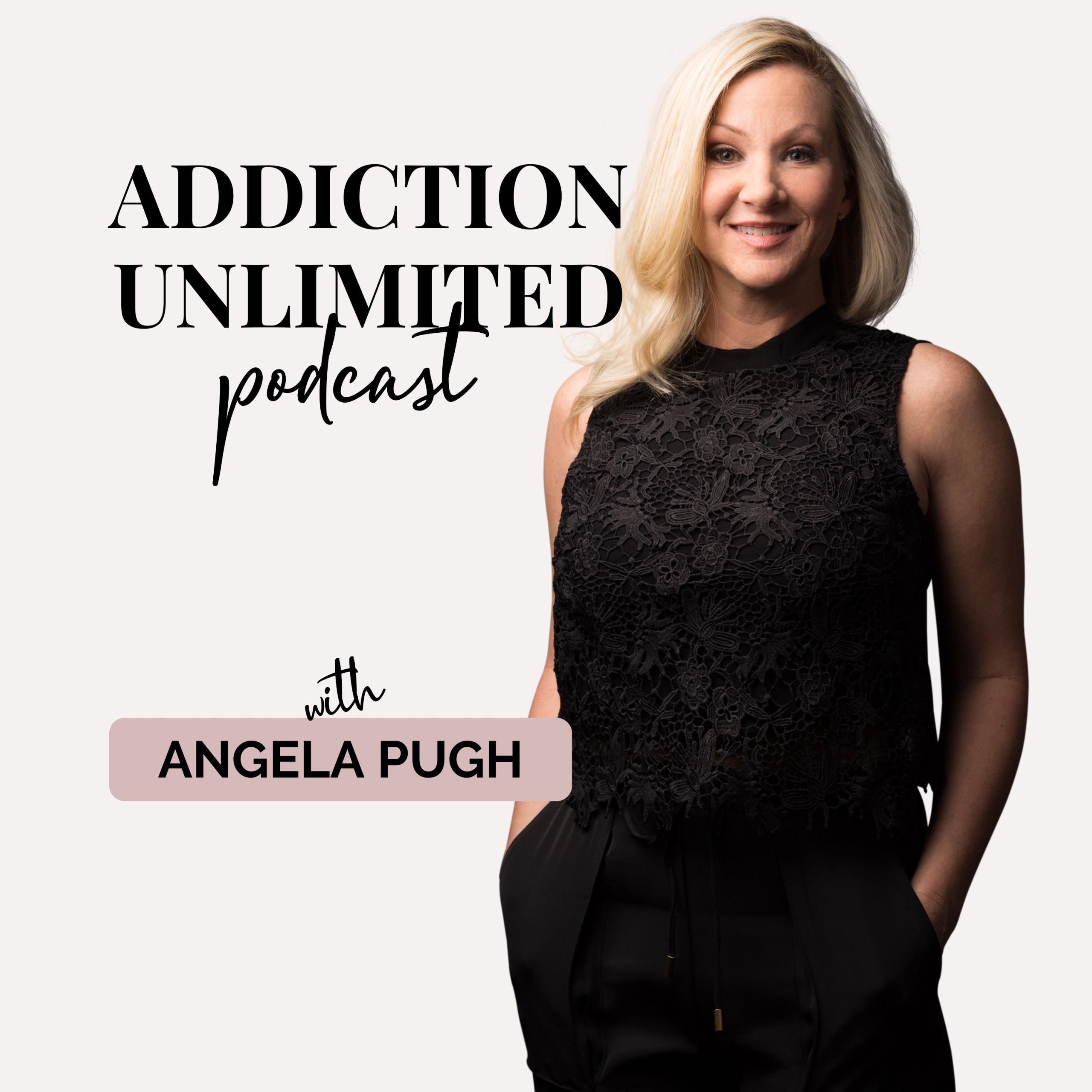
PODCAST · health
Addiction Unlimited Podcast
by Angela Pugh
Are you ready to ditch daily drinking, reclaim your confidence, and create a life of freedom? Each week, Angela combines no-nonsense advice, personal stories, and science-backed strategies to tackle the challenges of sobriety. Angela Pugh is a globally-ranked Life Coach and podcast host, a professional Interventionist, and entrepreneur with more than 18 years of personal sobriety, helping people rebuild their lives since 2008. From navigating relationships to managing triggers, you’ll discover practical tools, empowering insights, and real-world solutions to thrive in sobriety. It’s time to stop feeling stuck and start feeling unlimited. Listen now for the inspiration, tools, and support you need to live a sober, confident, and happy life.
-
200
You Quit Drinking. What Are You Using to Escape Now?
You quit drinking—but what are you using to escape now? When normal things like shopping, dating, food, or work get hard to put down, it may be time to look at what’s really going on.
-
199
The Life Skills Alcohol Kept You From Learning
You stopped drinking. Now you have to learn all the things drinking allowed you not to learn. In this episode, we’re talking about the life skills alcohol can keep you from practicing— Because sobriety isn’t just learning how not to drink. It’s learning how to handle your life without needing alcohol to manage it.
-
198
People-Pleasing Is Costing You More Than You Think
People-pleasing can look like kindness while quietly creating exhaustion, resentment, dishonesty, and isolation. Learn what drives the automatic yes, why other people’s feelings aren’t yours to manage, and how to start saying no without making it weird.
-
197
How to Forgive Yourself for What You Did While Drinking
You stopped drinking. You’ve changed. So why do you still lie awake thinking about the things you did? Self-forgiveness in recovery isn’t pretending the damage didn’t happen—and it doesn’t require everyone you hurt to forgive you, either. In this episode, we’re talking about guilt, damaged relationships, rebuilding trust, and the uncomfortable reality of becoming someone different when other people may still remember the old you. We’ll also dig into the difference between sobriety and recovery, why quitting drinking doesn’t automatically fix every destructive behavior, and a powerful way of making amends that has very little to do with another apology. If you’re tired of letting the worst things you did while drinking define who you are today, this conversation is for you.
-
196
I Don’t Know Who I Am Without Alcohol
When alcohol has shaped your friendships, routines, personality, and idea of fun for years, quitting can leave you wondering who you are without it. This episode is about rediscovering your real identity and building a life you don’t need alcohol to tolerate.
-
195
Are You an Expert at Conversations That Only Happen in Your Head?
Have you ever spent an entire shower, your commute, a dog walk, or a sleepless night having a conversation that will likely never actually happen? Welcome to the club. We have these imaginary conversations in our heads ALL the time. We rehearse what we’re going to say, what the other person is going to say back, what we’re going to say next—and before we know it, we’ve written the entire scene and assigned everybody their lines. But here’s what I want you to notice: How often are YOU the center of the story? They’re upset … you must have done something. They’re being distant… they don’t like you anymore. They didn’t text back… you must have said something wrong. Their energy changed… something changed how they feel about you. And suddenly you’re anxious, overthinking, analyzing every interaction, and trying to figure out what the hell happened. Except… You don’t actually know that anything happened. This is personalization—and it’s one of those sneaky thought patterns that can create a ridiculous amount of emotional chaos over things that may have absolutely nothing to do with us. And for those of us in recovery, there’s an even bigger pattern underneath it that I think is really important to understand. In this episode, we’re digging into why we personalize, what it’s actually doing to us, and how to start catching yourself before your brain takes one tiny piece of information and turns it into an entire story all about YOU. And if you recognize yourself in this? Good. Because this might be one of those things you need to work on next in your recovery.   Links mentioned in this episode: Book A Call With Angela : addictionunlimited.com/call Related Episode: What’s Inside Your Hula Hoop? Follow me on Instagram: @addictionunlimited Facebook Group: https://www.facebook.com/groups/addictionunlimited
-
194
How to Stay Sober: 5 Things I'd Do If I Had to Get Sober Again
If you had to start sobriety over, would you know what to do? I'm sharing five principles that changed my life and help my clients build lasting recovery today.
-
193
Why You Felt So Confident…Then Started Drinking Again
If you can quit drinking but always seem to end up back at Day One, this episode will help you understand why—and what needs to happen next.
-
192
The Real Reason You Drank
Why did you really drink? Most people think alcohol is the problem. But what if alcohol was actually the solution your brain found for anxiety, insecurity, loneliness, trauma, or the constant feeling that you weren't enough?
-
191
The Truth About “Taking a Break” From Alcohol
You've done Dry July. You've done Sober October. You've had a hundred Day Ones. So why does nothing ever actually stick? Taking a break from alcohol isn't the same as deciding to quit. Learn why temporary breaks often lead back to drinking—and what creates lasting sobriety.
-
190
What Happens to Your Body (and Brain) When You Stop Drinking
If you've ever wondered whether alcohol permanently damaged your body—or you've quit drinking and found yourself asking, Why am I so anxious? Why can't I sleep? Why do I still have brain fog?—this episode is for you. Today I'm walking you through what actually happens inside your body after you stop drinking. Not the social media myths. Not the gimmicks. The real biology. You'll learn how alcohol changes your brain chemistry, why early sobriety can feel so intense, and what your body is doing behind the scenes to restore balance. We talk about the science behind sleep disruption, why your liver is one of the most remarkable organs in your body, how alcohol affects your gut, heart, immune system, and hormones, and why so many people begin feeling physically better long before they feel emotionally healed. One of the biggest messages I want you to take away is this: feeling worse after you quit drinking doesn't mean alcohol was helping you. It means your body is recalibrating after years of adapting to alcohol. But we also have an important conversation about what sobriety doesn't magically fix. Trauma, stress, anxiety, menopause, low testosterone, nervous system dysregulation, and emotional healing don't disappear simply because you stopped drinking. Recovery is bigger than removing alcohol—it's learning how to build a life you don't want to escape from. In this episode, you'll learn: 01:25 Your brain: GABA, glutamate & early sobriety 05:56 Alcohol and sleep: why you wake up at 3 AM 13:38 Your liver's incredible ability to heal 19:07 Gut health, nutrient absorption & inflammation 24:22 Your heart, immune system & hormones after alcohol 36:26 Physical healing vs. emotional recovery If you've been wondering whether your body can recover after years of drinking, I hope this episode gives you something so many people desperately need in early sobriety: hope. Your body isn't working against you. It's been fighting for you all along. Links mentioned in this episode: Book A Call with Angela: addictionunlimited.com/call Join Sober Society: addictionunlimited.com/society Related Episode: Worried About Your Health in Sobriety? Here’s How Your Body Heals After Drinking Instagram: @addictionunlimited Facebook Group: https://www.facebook.com/groups/addictionunlimited Prefer to read instead of listen? Here’s the full transcript of this episode. Angela (00:11.96) Hello, my friend. Welcome back to Addiction Unlimited Podcast. I'm your coach, Angela Pugh. If you've ever wondered whether alcohol permanently damaged your body, or you've quit drinking and found yourself asking, like, is this normal? Why am I so tired? Why am I anxious? Why can't I sleep? Why do I still have brain fog after a month? Then this episode is for you. Because here's what I want you to know right from the beginning. Your body wants to heal. In fact, healing begins within hours of your last drink. And while every person's recovery looks a little different depending on how long they drank, how much they drank, age, genetics, nutrition, overall health, the human body is remarkably resilient. Today we're going to walk through what alcohol actually does to different systems in your body, what happens when you remove it, what kind of timeline you can realistically expect. And why some parts of recovery happen on a calendar while other parts happen because of the work you choose to do. Angela (01:24.884) Here's the thing about alcohol that almost nobody explains right. It's not a substance your brain tolerates, it's a substance your brain adapts to. Every single time you drink, your brain has to do damage control. And alcohol is a depressant. And before we go any further, I want to clear up one of the biggest misconceptions about that concept. When we say alcohol is a depressant, We don't mean it makes you depressed or sad. We mean it depresses or slows down the activity of your central nervous system. Think of your central nervous system as the command center for everything your body does. It's your brain and spinal cord communicating with every other system in your body. It controls your thoughts, your reaction time, your breathing and heart rate. Your coordination, your judgment, memory, emotions, everything. Alcohol comes in and starts turning the volume down on that entire system. Your thoughts and reflexes slow down, your reaction time slows down, your coordination gets worse, speech changes, your judgment becomes impaired. That's what a depressant does. It slows the activity of your nervous system. But here's where it gets really interesting. Your brain is obsessed with one thing, keeping you alive. And more specifically, it wants balance. Scientists call this homeostasis. Your brain wants everything operating within a pretty narrow range. So when alcohol keeps slamming on the brakes, Angela (03:13.194) Your brain wants everything operating within a pretty narrow range. So when alcohol keeps slamming on the brakes, your brain doesn't just sit there and accept it, right? It adapts. It starts pressing the gas pedal to compensate. It ramps up excitatory chemicals, mainly glutamate. And over time it becomes less responsive to the calming effects of GABA because alcohol. Has been providing that calming effect artificially. Angela (03:47.384) Think of GABA as your brain's brake pedal and glutamate as the gas pedal. As alcohol continues slowing everything down, your brain pushes harder on the gas just to keep you functioning normally. That's why many people who drink heavily don't necessarily look intoxicated because they've developed tolerance because their brain has adapted. But then one day you stop drinking. Suddenly the artificial breaks disappear. But your brain is still pressing on the gas. That's why early sobriety can feel so physically and emotionally intense. Anxiety, restlessness, racing thoughts, irritabilities, shaky hands, trouble sleeping, feeling like your skin is crawling. Those aren't signs something is wrong. They're signs that your brain is trying to find its balance again. And every day you stay alcohol-free. Your brain begins adjusting in the opposite direction. It gradually turns the glutamate back down, restores its normal response to GABA, and it starts regulating itself without alcohol. That process doesn't happen overnight, right? But it does happen. One of the biggest mistakes people make is believing that because they feel worse after they quit drinking, like alcohol must have been helping them. But that's not what's happening. You're experiencing life without alcohol. You're not experiencing life without alcohol. You're experiencing a brain that's recalibrating after alcohol. Those are two very different things. Angela (05:56.344) So we talked about the brain. Let's talk about sleep. One of the biggest lies alcohol tells us is that it helps us sleep. I cannot tell you how many people say to me, Angela, I have to have a few drinks or I'll never fall asleep. And I get it, I was exactly the same way. It certainly feels that way. Alcohol can absolutely make you fall asleep faster, but falling asleep and getting quality sleep are two completely different things. Think about it this way: if someone put you under anesthesia, Would you call that a great night's sleep? Of course not. You were unconscious, but your brain wasn't cycling through the normal stages of restorative sleep that your body needs. Alcohol works in a similar way. It sedates you, but it disrupts the quality of your sleep. One of the biggest problems is that alcohol suppresses REM sleep. REM stands for rapid eye movement, and it's the stage of sleep. That is incredibly important for learning, memory, emotional processing, and just overall brain health. It's also the stage where most dreaming happens. So even if you've slept for eight hours after drinking, your brain may have missed out on some of the most restorative parts of sleep. Alcohol also causes your sleep to become fragmented. Like you may fall asleep quickly, but as your body metabolizes the alcohol during the night, your brain becomes more active. It gets agitated. That's why so many people wake up at two or three in the morning with their mind racing, heart pounding, feeling Wide awake, even though you're exhausted. Your heart rate stays higher, your body temperature is less regulated, your breathing can become less stable, and your nervous system is working much harder than it should while you're supposed to be recovering. The good news is this starts to improve surprisingly quickly. During the first few days after quitting drinking, sleep sometimes can get worse before it gets better. That's completely normal. Angela (08:03.212) Because your brain is learning how to fall asleep without alcohol, and that recalibration takes time. But over the next few weeks, your sleep architecture, right? The normal pattern of moving through different stages of sleep, all of that starts to recover. Many people begin noticing they're sleeping more deeply, they're waking up fewer times during the night and actually feeling rested in the morning. And that's a huge difference. Because when you were drinking, you may have been unconscious for eight hours, but now you're actually sleeping. And I also want to be really transparent about something because I think we do people a great disservice when we oversimplify recovery. Better sleep is one of the most common benefits of quitting drinking, but it isn't a guaranteed, but it isn't guaranteed on some magical timeline. Right. And I know this firsthand because I've never been a great a great sleeper. Not when I was drinking, and honestly, not long before I ever took my first drink. I've struggled with sleep since I was a young teenager. As I got sober, I started real recovery and healing,...
-
189
Why Dry July Is the Perfect Time to Make a Real Decision
Dry July isn't about proving you can quit. It's about gathering the evidence that leads to acceptance—the moment real recovery begins.
-
188
Why Coping Skills Matter More Than Willpower in Recovery
Think sobriety is about willpower? Think again. Learn why coping skills—not motivation—are the key to managing triggers, regulating emotions, and staying sober long term.
-
187
What Does Life Without Alcohol Really Look Like? | Addiction Unlimited Podcast
What does sober life actually look like? If you're thinking about quitting drinking, one of the biggest fears is the unknown. What will you do for fun? Will you still be yourself? Will your relationships change? Will life ever feel normal again? In this episode, Angela sits down with Casey Davidson from the Hello Someday Podcast for a candid conversation about what happens after alcohol is no longer part of your life. They talk about the fears they had before quitting, what surprised them most about sobriety, why moderation kept them stuck, how friendships changed, and why life often becomes much bigger than you imagined once alcohol is no longer running the show. If you're struggling to picture your future without alcohol, this conversation will help you stop focusing on forever and start focusing on what's possible.
-
186
Should I Go? How to Make Smart Decisions in Early Sobriety
I’ll walk you through five simple questions to ask before you go into any social situation. One of the most common questions people ask in early sobriety is, “Should I go?” Should I go to the birthday party? The barbecue? The wedding? The vacation? The girls’ weekend? The dinner where everyone else will be drinking? And I get it. The world doesn’t stop drinking just because you did. People still invite you places. Life keeps moving. And you don’t want sobriety to feel like a punishment where you hide in your house forever and say no to everything. But here’s the truth: in early sobriety, your job is not to prove how strong you are. Your job is to stay sober. In this episode, I’m helping you stop asking, “Am I allowed to go?” and start asking the question that actually matters: “Can I trust myself to follow my plan when the pressure hits?” Because you can make the most beautiful little sober plan in the world. You can drive yourself, hold your mocktail, stay for 45 minutes, rehearse your exit line, and know exactly what you’ll say if someone offers you a drink. But none of that matters if you abandon yourself in the moment it counts. That moment when someone puts a shot in your face. That moment when your friend says, “Come on, just one.” That moment when everyone else is laughing and loose and you suddenly feel awkward, exposed, and outside the circle. That is where sobriety is decided. We’re also talking about why early sobriety is not the time to test yourself for sport. You are not auditioning for the role of Most Impressive Sober Person. You are learning how to protect something that is still new, still growing, and still becoming solid. I’ll walk you through five simple questions to ask before you go into any social situation. This episode is your permission slip to stop making sobriety harder than it has to be. Sometimes the smartest, strongest, most sober decision is: not yet. Not this weekend. Not with that group. Not at that place. Not while I’m shaky. Not until I trust myself more. That doesn’t mean never. It means you’re honest about where you are right now. And honesty is how you build sobriety that lasts. Your sobriety is worth more than any party, any wedding toast, any awkward conversation, or anyone’s opinion about whether you’re fun. It deserves your attention. It deserves your protection. And so do you. Links mentioned in this episode: Book A Call Here: addictionunlimited.com/call Related Episode: The Small Daily Decisions that Make or Break Your Sobriety Instagram: https://www.instagram.com/addictionunlimited/ Join Facebook Group: https://www.facebook.com/groups/addictionunlimited Prefer to read instead of listen? Here’s the full transcript of this episode. 438 Transcript Angela (00:10.68) Hello, my friend. Welcome back to Addiction Unlimited. I'm your coach, Angela Pugh. Today we're talking about one of the most common questions people ask in early sobriety. Should I go? Should I go to the birthday party? Should I go to dinner with my friends when everyone else is drinking? Should I go on the vacation to the barbecue, to the concert? Should I go to the pool party, the girls' weekend, the neighborhood happy hour? And I get it because the world doesn't stop drinking. Just because you did. Life keeps lifing. People keep inviting you places, birthdays keep happening, vacations still show up on the calendar, and your friends are still your friends. And in early sobriety, all of that can feel really confusing. Mm-hmm. Angela (01:06.412) Because on one hand, you don't want to isolate. You don't want to hide from your house. You don't want to hide in your house forever. You don't want sobriety to feel like a punishment. You don't want to become someone who says no to everything and has no life and no fun and no connection. But on the other hand, you also don't want to put yourself in a situation where you end up drinking and wake up the next morning feeling embarrassed, ashamed, and right back at day one. So people say to me all the time, I'm not sure if I should go. And to be clear, if you're asking the question or wondering, you already know the answer. If your brain is questioning it and whether it's a good idea or whether or not it's sobriety safe, you already know the answer is no. No, you shouldn't go. You're questioning it for a reason. Because when you're in early sobriety, Your whole focus, your entire job right now is not drinking. That's it. That's the job. And every decision you make, including whether or not you go somewhere, gets filtered through that one lens. Angela (02:29.866) Mm. Angela (02:36.482) Not whether your friends will think it's weird, not whether you'll miss out, not whether you can handle it in theory. The question is: can you stay sober if you go? And more specifically, can you trust yourself in the moment that actually matters? And here's what I mean by that. You can make the most airtight plan in the world. Drive yourself, only stay a little while, have your mocktail in hand. So you're never standing there empty-handed. Text a safe person, know exactly what you're gonna say if someone offers you a drink, have your exit ready. That's a solid plan. Love it. But here's the reality: none of that matters if you abandon yourself in the one moment it counts. That plan only matters if you'll actually follow it when the pressure hits. And that moment is. Tiny. It's a split second. Someone walks up to you ready with a shot, or they order your favorite drink without asking. Or they say, come on, just one. It's my birthday. Don't be like that. Or suddenly everyone's doing a toast and you're the only one with a water glass instead of a cocktail glass. And you feel the heat start to rise up in your chest. That's the moment right there. That's the split second. Your plan either holds or it doesn't. And the question you need to answer before you ever leave your house is Do I trust myself in that moment? Can you trust yourself when everyone else is laughing and loose and you feel awkward and exposed and like you're standing outside the circle looking in? Can you trust yourself when your friend says, my God, come on, just have one. It's my birthday. Can you trust yourself when your brain starts whispering, this is stupid, you're fine, you can have one, you've been doing so well. Because that moment is where sobriety is decided. Not in theory, not sitting in your car in the driveway, rehearsing what you'll say, but in that moment with that pressure, with that person, with those feelings. Angela (04:59.062) If the answer is yes, you trust yourself 100% yes, then you have your answer about whether you go. But if there is any hesitation, if any part of you is like, well, I think so, I hope so, probably, then you have your answer too. If you don't trust yourself with 100% certainty in that moment to be able to say, no, I'm not drinking, then you don't go. Period. And that's what we're talking about today. Because early sobriety is not about proving you can handle every situation. It's about learning how to protect your sobriety while you build enough trust in yourself to follow through when it matters. And listen, I know people don't always love hearing that because we want freedom. We want confidence. We want to be able to say, I can go anywhere, I can be around anything, I'm strong, I've got this. And I hear you, I do. But I need you to hear this. You are not trying to prove you're strong. You're trying to stay sober. Those are very different things. And in early sobriety, that mindset can be dangerous, especially if it's coming from ego instead of honesty. There's a big difference between confidence and recklessness, right? Confidence says, I know myself, I know my plan. I know my limits. I know what I'll do if things get uncomfortable, and I trust myself to do it. Recklessness says, I don't want to miss out. I don't want people to think I have a problem. I don't want to admit this situation might be too much for me. I'm just going to tell myself it'll be fine. Those are not the same thing. Going somewhere to prove a point is not a recovery plan. Going somewhere because you want to seem normal. Going somewhere because you want to seem normal, because you don't want to explain yourself, because you don't want to miss out, those are feelings. And feelings are not a sobriety strategy. Angela (07:17.74) And if you're in early sobriety, you have to get really good at knowing the difference because a lot of relapse starts with a lie that sounds like confidence. I'll be fine. I can handle it. It's not a big deal. I'm just going for a little while. I won't drink. And sometimes that's true. But sometimes it's not confidence. Sometimes it's avoidance. Sometimes it's people pleasing. Sometimes it's denial. Sometimes. Angela (07:50.004) Sometimes it's your addiction trying to get you back into a room where alcohol is available, social pressure is high, and your exit plan is weak. And this is why you have to stop asking permission and start assessing risk. That's the first big point today. You're not asking whether you're allowed to go, you're assessing whether this situation supports your sobriety or threatens it. And that assessment has to be honest, not dramatic or fear-based or shame-based, just honest. Angela (08:30.348) Because every social situation is not the same. Going to brunch with two supportive friends who know you're not drinking and chose a place with good food and good mocktails is not the same as going to a bar crawl with your old drinking crew. A family dinner where a few people have wine with dinner is not the same as a family holiday where everyone drinks too much, gets loud, brings up old drama, and you leave feeling like your nervous system got hit by a truck. ...
-
185
The Most Dangerous Phase of Early Sobriety
You survived the first 5 or 7 days of sobriety and you're finally starting to feel better. The anxiety is calming down. You're sleeping again. Your face looks better. The shame isn't screaming quite as loud anymore. And this is exactly where things start getting dangerous. Because once the crisis fades, your brain starts doing what it was trained to do: convincing you that maybe things weren’t really that bad. Maybe you overreacted. Maybe you can handle it differently this time. In this episode, I’m breaking down one of the biggest relapse traps in early sobriety: the moment when fear and consequences stop doing the heavy lifting and recovery becomes a conscious daily decision. I call this phase the plateau. This is the phase where many people start feeling confused because they thought quitting drinking was supposed to fix the problem. They finally feel a little better physically, but now they don’t know what they’re actually supposed to do next. The crisis is over. The urgency fades. And without a real plan for recovery, the thoughts and second-guessing start getting louder. Because most people don’t actually have tools for handling stress, anxiety, boredom, overwhelm, triggers, or emotional discomfort without alcohol yet. So when life starts feeling hard again, they slowly drift back toward the one solution that always felt certain and familiar: drinking. Not because they consciously decided to give up on recovery, but because they were never prepared for what comes after the initial relief. We’re talking about why this happens, why it catches so many high-functioning people off guard, and what you need to do to stay sober long enough to actually build a life you don’t want to escape from. Links mentioned in this episode: Book A Call Here: addictionunlimited.com/call Recovery Starter Kit: addictionunlimited.com/kit Related Episode: 10 Life-Changing Habits You Can Start Today Instagram: @addictionunlimited Facebook Group: https://www.facebook.com/groups/addictionunlimited Prefer to read instead of listen? Here’s the full transcript of this episode. Angela (00:15.128) Hello, my friend. Welcome back to Addiction Unlimited. This podcast is about what it really takes to stay sober. And I'm your coach, Angela Pugh. Thank you for hanging out with me today and listening to the pod. Today I want to talk about a trap. And this trap almost always happens in super early sobriety, like somewhere in day 15 to 30, usually. But it can also happen farther down the road in your recovery. But when you first stop drinking, fear and consequences do all the heavy lifting. The panic keeps you sober. The raw embarrassment keeps you sober. But that crisis energy has an expiration date, and it usually hits well before you even cross the 30-day mark. Whether it takes two weeks for the dust to settle or a full month because you had a massive wreckage to clear, a moment is coming where things just feel okay. The shame spiral stalls out, you're finally sleeping, you look in the mirror and you don't hate who's looking back at you. It feels like a victory. The physical misery stops, the anxiety lifts, and your life starts looking manageable again. And right there in that quiet moment, your brain is gonna whisper, look at that, you're fine, you figured it out. Your brain is gonna try to use that temporary comfort to negotiate you right back to a drink. Today we're exposing that trap. We're talking about why feeling better is not the same as being better. We're gonna talk about what's actually happening in this phase, why it catches so many people off guard, and what you need to do when you hit it, because you will hit it. And when you do, I want you to be ready. So let's start at the beginning because I wanna give credit where credit's due. Those first few days of sobriety are brutal. I mean that. We're talking about waking up in the middle of the night in a full panic, heart pounding, mind racing. Angela (02:39.028) Anxiety, so intense it feels like you're gonna come out of your skin, shaking, sweating. Every sound feels too loud, and every feeling feels too big. And your body is just in full revolt because it doesn't know what to do without alcohol in it. And then there's the emotional side of it, the shame spiral, replaying every decision, every embarrassing moment, every consequence you're now staring down. The fear about what people think, the fear about what comes next, the fear that you've already done too much damage to fix anything. And you go through that. You stay sober through that. That's not a small thing. And then somewhere around day five, maybe day seven, you start to notice something shifting. The anxiety starts to lift. You sleep through the night. You look in the mirror and your face looks different, less puffy, less red or gray. Your energy starts coming back. You make it through a whole day without white knuckling every hour. And for the first time in a long time, life starts to feel manageable. Your body's healing. Your mind is starting to clear. And that feeling of things getting better is legit. And here is what I also need you to understand about that phase. Angela (04:04.876) What powered you through those first few days wasn't willpower. It wasn't discipline. It wasn't a sudden shift in your mindset or a new level of commitment you've never had before. It was crisis energy. Fear, shame, consequences you couldn't ignore, a hangover so bad you swore you'd never do it again, a conversation with your kid or your boss or your spouse that you can't undo. A moment where you looked at yourself and you could no longer deny the truth. That's powerful fuel. And it will absolutely get you sober, but it has an expiration date. Crisis energy burns hot and it burns fast. And when it starts to fade, when the consequences feel less immediate, when the shame starts to dull and the physical misery is behind you, that fuel runs out. And if you don't have something to replace it with, that's when things get dangerous. Because here's the thing about crisis energy: it makes the decision for you. When you're in the middle of it, you don't have to talk yourself into sobriety. The pain does that. But when the pain fades, sobriety becomes a choice you have to make consciously every day without the crisis pushing you. And a lot of people aren't prepared for that. This is the phase I want to name today because I don't think it gets talked about enough. I call it the plateau. You know what a plateau feels like. If you've ever tried to lose weight or get in shape, you're doing the work, you're showing up, and then one day it's like nothing's happening, right? The scale isn't moving, you don't feel like you're making progress. And that plateau is exactly where most people quit. Not because the work stopped working, but because the momentum stopped feeling obvious. For us, we need that reinforcement. We need to see it's working one way or another. Well, recovery has its own version of this, and it's sneakier because the recovery plateau doesn't feel like stalled progress. It actually feels like success. The pain is gone, the chaos has settled. Angela (06:28.696) From the outside and even from the inside, things look good. And that's exactly when sobriety starts to feel confusing. Because in those super early days, the path was clear. Don't drink. Get through the day. That was the whole job. But now you're feeling better and you don't really know what you're supposed to do next. You're not in crisis anymore. So what does recovery even look like now? And here's where it gets really specific to my audience, because so many of you are high functioning. You're professionals, your parents, your people who hold it together. You're not the person in the movie who hits rock bottom in a dramatic, obvious way. You're the person who's been quietly managing a problem that's slowly getting worse. And because you're high functioning, the idea of going to meetings or hiring a coach. starts to feel like overkill. Like, do I really need all of that? Things are feeling pretty okay. Underneath all of this is something I want to bring to the surface because I think it's the real reason the plateau catches people off guard. Angela (07:48.288) Underneath all of this is something I want to bring to the surface because I think it's the real reason the plateau catches people so off guard. You thought quitting drinking was going to fix everything. And I get it, I do. When drinking is the source of so much pain and chaos and shame in your life, it makes total sense that you'd believe removing it would remove the problem. Like if I just stop drinking, everything else will fall into place. So you get sober. You get through the hard part, you start feeling better, and then the initial excitement of feeling better fades. And you realize the anxiety is still there. The relationship stress is still there. The financial stress is still there. The uncertainty about who you are without alcohol is still there. You don't automatically know how to handle your emotions or your triggers. Or your social life or your boredom, right? You removed the substance, but you haven't actually rebuilt anything yet. And that feels frustrating, deeply frustrating, because you did the hard thing. You stopped drinking, and life is still uncomfortable. And you want it to be better now. That's not impatience. That's actually just your brain doing brain things, right? That's your brain doing exactly what it was trained to do. Think about what alcohol did for you. Whatever the problem was stress, boredom, loneliness, anxiety, social discomfort, a hard day, a hard feeling, alcohol made it better now, not tomorrow, not after you worked through it, immediately, right? You felt the relief within minutes. That's a powerful conditioning loop....
-
184
She Didn’t Hit Rock Bottom — But She Knew She Had to Quit Drinking
Making rules, breaking rules, starting over — if drinking takes up too much space in your brain, you'll recognize yourself in this conversation. Not a dramatic rock bottom. Not losing everything. Not waking up one day suddenly certain she had to quit forever. Just years of exhausting negotiation. She tracked sober days on a calendar she bought at Target, crossing off each X with a pen and a ruler. She made rules — only on weekends, only when she went out, never at home — and watched every single one of them quietly expand until drinking had taken over the whole week. She quit for 60 days in the summer of 2019 specifically to prove to herself she didn't have a problem…then went to a Zach Brown concert and hopped right back on. Sound familiar? The hardest part often isn't the drinking itself. It's the obsession. The constant mental debate. The planning, the bargaining, the monitoring, the shame. The promises you make to yourself that somehow never stick. In this episode, we talk about: The mental exhaustion of trying to control something that can't be controlled Why high-functioning people stay stuck for years — and why "I still went to work" isn't the whole story What white-knuckling sobriety actually feels like, and why willpower eventually runs out How connection and community changed everything for Denise What finally helped her stop going it alone What life actually looks and feels like five years in We also talk about the fear of quitting forever, the weird and wonderful things that surprised her in early sobriety, and why the evolution doesn't happen sitting on your couch. This one is honest, funny, and real. If you've ever thought "maybe I can still figure this out" — this episode is for you. Links mentioned in this episode: Book a Call: addictionunlimited.com/call Related Episode: It's Not Your Drinking, It's Your Thinking Instagram: https://www.instagram.com/addictionunlimited/
-
183
What “Doing the Work” in Recovery Actually Means
This is a real conversation about what doing the work in recovery actually looks like beyond just “not drinking.”
-
182
You Can’t Build a New Life With Old Materials
You quit drinking—and now you’re staring at your life like… now what? No one really talks about this part. The part where alcohol is gone, but everything else is still the same—and suddenly, nothing fits. It feels hollow. Disconnected. Like you’re just trying to survive your own evenings. So you start questioning it: “Maybe I’m doing this wrong.” “Maybe sobriety isn’t for me.” That’s not the problem. The problem is you’re trying to build a new life using old materials. In this episode, we’re breaking down why that gap feels so uncomfortable—and what actually needs to happen for sobriety to start feeling like your life, not just something you’re trying to manage. Because nothing changes if nothing changes. And I’m sharing the exact shift that made the difference for me: a simple decision filter that completely rewired how I lived in early sobriety. “Is this what the old me would do?” If the answer was yes—I did the opposite. Not because it felt good. Not because it was easy. But because that’s how you build a new identity—one decision at a time. You don’t need to have it all figured out. You just need to stop letting the old version of you make the decisions. Because you don’t get a new life by cleaning up the old one. You get it by building something completely different. If you’re sober but stuck… this is the episode that shows you what comes next. Book A Call: addictionunlimited.com/call Related Episode: The Real Danger of Your Drunk Identity Find me on Instagram: @addictionunlimited
-
181
How to Survive Holiday Overwhelm Without Compromising Your Sobriety
Practical tools to manage stress, set boundaries, and stay sober during the most overwhelming time of year. In this episode, we’re talking about why the holiday season is such a perfect storm for stress, exhaustion, and relapse risk — and what actually helps you stay grounded, calm, and sober when everything feels like too much. This isn’t about “just don’t drink” or powering through with willpower. It’s about planning ahead, setting real boundaries, managing your energy, and protecting your sobriety like it actually matters — because it does. These tools are timeless and incredibly relevant right now — especially as we head into the final stretch of the year. HERE ARE THE 3 KEY TAKEAWAYS FROM THIS EPISODE: 1️⃣ Holiday Stress Isn’t the Problem — Lack of Planning Is The holidays don’t sneak up on us. They come at the same time every year. When you plan ahead — for your schedule, your energy, and your triggers — you dramatically reduce overwhelm and vulnerability. 2️⃣ Boundaries Are a Sobriety Tool, Not a Personality Flaw Boundaries around time, conversations, commitments, and how long you stay at events aren’t selfish — they’re how you stay regulated, present, and sober when stress is high. 3️⃣ Rest, Connection, and Support Are Non-Negotiable Sleep deprivation, emotional exhaustion, and isolation make cravings louder. Staying connected to your sober support and refueling your energy keeps you strong when willpower runs out. We’re days away from Christmas. If your energy is low and your stress is high, that doesn’t mean you’re failing — it means it’s time to slow down, simplify, and protect what matters most. Take what you learn today and use it. Planning, boundaries, rest, and connection aren’t optional extras. They’re how sobriety lasts. Links Mentioned in This Episode: 👉 Dry January Bootcamp If you’re done white-knuckling your way through the holidays and into January, Bootcamp gives you structure, support, and a clear plan to protect your sobriety and start the new year strong. 👉 Book a CallIf you want personalized support and clarity on next steps, book a call to talk through your options. 👉 Join the Free Facebook GroupConnect with others who get it — support, encouragement, and real conversations about sobriety.
-
180
What ‘Rock Bottom’ Really Means and How It’s Keeping You Stuck
If you're a high-functioning drinker waiting for rock bottom to give you permission to quit, this episode will change everything. Most people think rock bottom is an external event—a DUI, job loss, or divorce. But that's not what rock bottom actually is, and this misunderstanding is keeping you stuck in a cycle that never ends. In this episode, I break down the real meaning of rock bottom and why waiting for external proof is preventing you from taking action on what you already know. You'll learn why comparing your life to other people's disasters keeps you drinking longer, what to listen for in recovery meetings (hint: it's not the external details), and why the question "Do I really need to quit?" is actually your answer. What You'll Learn: Why high-functioning drinkers misunderstand rock bottom and how it keeps them stuck The "I'm not that bad" fallacy and why comparing external circumstances is the wrong measuring stick What rock bottom actually is (internal, not external) and why it changes everything How to recognize rock bottom moments before they become major disasters Why people who don't have a drinking problem never wonder if they need to quit The real reason your brain keeps offering alcohol as a solution when things get uncomfortable How lowering the bar and rationalizing red flags keeps the cycle going Why you don't need to wait for things to get worse to make a change Key Takeaways: Rock bottom is internal, not external. It's not about what happens to you—it's about the moment you realize you can't live like this anymore, even if your life still looks good from the outside. You're comparing the wrong things. When you compare your life to other people's disasters, you'll always feel like you're "not that bad." But when you compare your internal experience—the exhaustion, the mental gymnastics, the constant negotiation with yourself—that's when you recognize the real problem. External events don't create clarity—they force action. Most dramatic rock bottom moments are years in the making. There are a million smaller red flags that get rationalized away before the big event happens. You don't have to wait for the big event. If you're asking the question, that's your answer. People without drinking problems never wonder if they need to quit. They don't think about alcohol constantly, plan their days around it, or spend energy managing and moderating it. If you're here listening to this, you already know. Episode Highlights: [00:12] The common misunderstanding about rock bottom that keeps high-functioning drinkers stuck [02:00] Why "I'm not that bad" only works if rock bottom is external (spoiler: it's not) [05:50] The AA meeting trap: comparing external details instead of internal feelings [09:33] What rock bottom actually is: internal, emotional, and the moment you realize you can't live like this anymore [11:00] My two-year rock bottom and why I waited so long to take action [14:42] If you want to wait until things get worse, they will (and here's what that looks like) [16:30] The small red flags we rationalize away that lead to bigger disasters [17:50] A client's rock bottom moment: choosing a drink over playing with his son [19:19] Why asking "Do I really need to quit?" is actually your answer [21:31] The takeaway: You already know. Stop waiting for permission. 🔗 Links Mentioned in This Episode 💥 Dry January Bootcamp (Free!) Get structure, support, and a clear plan to start your alcohol-free life with power. 👉 addictionunlimited.com/bootcamp 🎯 Book a Private Call Ready to stop screwing around and get real results? Let’s talk. 👉 addictionunlimited.com/call 🧣 Cozy Earth – My Favorite Gift to Give (and Receive!) Bedding + loungewear that calms and elevates your space. Use code ANGELA 👉 cozyearth.com
-
179
Can You Drink Again After Sobriety? The One Test That Tells You Everything
Here's something nobody tells you about long-term sobriety: your brain doesn't forget its relationship with alcohol just because you stop drinking. After 19+ years sober, I can still walk into a restaurant and automatically glance at the bar. I can spend 10 minutes with my best friend analyzing five drinks in a hotel cooler. I notice who's drinking at parties when my non-alcoholic mom never does. And that's exactly how I know - even after almost two decades - that I still can't drink. In this episode, I'm breaking down the ONE thing that tells you with 100% certainty whether you can drink again after sobriety. Spoiler: it's not about time. It's not about willpower. It's about how much mental real estate alcohol still occupies in your brain. What You'll Discover: The "mind space test" - how aware are you of alcohol even when you're not drinking? Why "normal" drinkers never think about alcohol (and why you can't stop) How alcohol becomes your higher power without you realizing it Real stories from my own journey - including that champagne bottle I saved to celebrate 30 days sober (yep, I did that) The difference between your brain and a non-alcoholic brain - and why it matters more than sobriety time Why the fact that you're even asking "can I drink again?" is actually your answer The Bottom Line: Non-alcoholic people don't wonder if they drink too much. They don't count down to their next drink. They don't notice the bar when they walk into restaurants. They don't plan their social lives around alcohol availability. If you're still hyperaware of alcohol - whether that's craving it, avoiding it, or constantly thinking about it - your relationship hasn't changed. Time doesn't fix this. Only honesty with yourself does. Struggling with the starts and stops? Book a free call with Angela to explore your options (not a free coaching session, but a real conversation about what might help): addictionunlimited.com/call Connect: Facebook Group: https://www.facebook.com/groups/addictionunlimited Instagram: @addictionunlimited
-
178
From Witching Hour to Power Hour: Getting Through the Hardest Part of Sobriety
Why 5pm Feels Impossible (And What To Do About It) Let's talk about the hardest part of early sobriety: that predictable window of time when the craving hits like a wave and you're not sure you can ride it out. Maybe it's 5pm on a Tuesday. Maybe it's Friday night when everyone's posting their wine glasses on Instagram. Maybe it's standing in the parking lot at your kid's soccer game watching all the other moms with their Stanley cups. In this episode, I'm breaking down what I call the witching hour—that specific time when staying sober feels almost impossible. But here's the truth: it's not about the drink. It never was. The drink was the solution you were using for something else—exhaustion, overwhelm, loneliness, anxiety, boredom. I'll walk you through the four different types of witching hours, what you're really craving during each one, and most importantly—what to actually DO about it. Because willpower alone won't get you through this. You need a plan. And if you're doing nothing, you're planning to drink. 3 Key Takeaways From This Episode: 1️⃣ The Drink Was Never the Point -- When you say "I want a drink," what you're actually saying is "I'm exhausted and need to turn my brain off" or "I'm anxious and need relief right now." Understanding what you're really craving changes everything. 2️⃣ Different Witching Hours Need Different Tools -- The daily 5pm decompression requires different strategies than weekend FOMO or emotional overwhelm. Once you know your type, you can prepare accordingly. 3️⃣ Doing Nothing IS a Plan—It's a Plan to Drink -- If you know your hardest time is Friday at 5pm and you're sitting back with no strategy, you're not being neutral. You're setting yourself up to give in. Proactive planning is non-negotiable. And, if you're struggling with that daily 5pm crash? I did an entire episode on breaking that specific habit: How to Break the 5PM Drinking Habit Without Losing Your Mind Want structured support to actually implement these strategies? My Recovery Starter Kit walks you through exactly how to set up your environment, calm your mind when triggers hit, build real support, and create a daily rhythm that makes sobriety feel steady instead of shaky. It's $197 for instant access—plus 30 days free in my Sober Society community. Perfect if you're white-knuckling it through the holidays and need more than just willpower. And this Friday, a bonus drop from the Unlimited Life Starter Series --- the 10 most powerful episodes to rebuild your rhythm, structure, and emotional peace. Is Angela the right Coach for you? Book A Call Here to find out Facebook Group: https://www.facebook.com/groups/addictionunlimited MORE FROM ME Follow me on Instagram @addictionunlimited
-
177
From Alcohol to Sugar: Understanding Food Addiction in Recovery
You Put Down the Drink, But Now You Can't Stop Thinking About Food. Here's Why. If you've traded your nightly wine for nightly ice cream binges, you're not alone. And no, it's not just about willpower or "getting your act together." In this episode, I sit down with Ali Shapiro, creator of the Truce with Food methodology, to unpack the real reasons we turn to food and sugar in recovery—and it goes way deeper than you think. Ali shares her personal journey from childhood cancer and pesticide exposure to developing a complicated relationship with food that mirrored so many of the patterns we see in addiction. We dive into the difference between food addiction and disordered eating, why belonging (not hunger) drives most of our food choices, and the four emotional triggers that send us straight to the pantry. This conversation will change how you think about food forever. We talk about the TAIL framework (Tiredness, Anxiety, Inadequacy, Loneliness), why protein is your secret weapon against sugar cravings, and how self-trust—not perfection—is the real foundation of recovery from any substance. If you've ever felt crazy around food, ashamed of your eating habits, or wondered why you can't just "eat normal," this episode is for you. HERE ARE THE 3 KEY TAKEAWAYS FROM THIS EPISODE: 1️⃣ Food Isn't the Problem—Belonging Is — Understanding this invisible string changes everything. 2️⃣ The TAIL Framework Reveals Your True Triggers — When you can identify what job food is doing for you, you can address the real need underneath. 3️⃣ Protein Is Your Anti-Craving Superpower — It's not about willpower—it's about physiology. Resources Mentioned in This Episode: Ready to get serious about transformation? Book a free consultation call to explore how we can work together. Join the Addiction Unlimited Facebook Community — facebook.com/groups/addictionunlimited Explore Angela's Programs + Tools — From courses to coaching, find the right support for your recovery journey. Related Episode: What No One Tells You About Your Eating Habits — Food and fitness expert, Adam Gilbert, sets the record straight on the most common pitfalls of making lifestyle changes and how to overcome them.
-
176
How to Stay Sober When You Can’t Control Your Family: 8 Radical Shifts for the Holidays
How to Stay Sober When You Can’t Control Your Family The holidays don’t threaten your sobriety. Your addiction to control does. In this episode, we’re tossing out the traditional holiday survival guides — no more tips about mocktails or leaving early. Instead, we’re talking about the real threat to your peace: the compulsive need to manage everything and everyone around you. Because if you're honest, it's not just Uncle Bob at the punch bowl stressing you out — it’s your internal pressure to make everything go just right. This isn’t about avoiding triggers. It’s about mastering yourself.You’ll learn 8 things you need to STOP trying to control this season — and the ONE thing you can control that changes everything. If you’re ready to protect your peace and stop abandoning yourself in the name of keeping the peace, this is your guide. 🎯 In this episode: • How trying to control others' drinking is still an addiction behavior• The emotional cost of managing everyone’s comfort but your own• How to set boundaries without apologizing or backtracking• Why “perfect holidays” are a trap — and what success actually looks like• The ONE thing you can control that makes sobriety sustainable This is your permission slip to let go of chaos and reclaim your sanity.You don’t need a strategy. You need ownership. 🎁 Free Resource:Grab the Sober Holiday Podcast Playlist — your go-to episodes on cravings, boundaries, family dynamics, and sober socializing.👉 addictionunlimited.com/holidayplaylist 👥 Join the Facebook Group:A private space for high-level support, real conversations, and structure after sobriety.👉 https://www.facebook.com/groups/addictionunlimited 📞 Book a Free Call with Angela:Ready to stop starting over and get serious about relief and recovery? Let’s talk about your next best step.👉 addictionunlimited.com/call 🚨 BONUS: Don’t miss this Friday’s drop from The Unlimited Life™ Starter Series — 10 powerful episodes to rebuild your rhythm, structure, and emotional peace before the New Year.
-
175
6 Sobriety Traps That Trigger Relapse in Early Recovery
Avoid these traps so your recovery doesn’t become a revolving door. Sobriety is just the beginning… and these 6 traps are the exact reason why so many people relapse even when they’re trying to stay sober. In this episode, Angela Pugh breaks down the most common early recovery mistakes that sabotage your progress, wreck your structure, and chip away at your confidence. You’ll learn how to shift from barely hanging on to leading yourself with clarity, consistency, and personal power. Whether you’re 2 weeks in or 2 years sober — this is a must-listen if you want long-term peace without chaos. 🔑 HERE ARE THE 3 KEY TAKEAWAYS: 1️⃣ Recovery Is Biological — Not Just EmotionalPAWS (Post-Acute Withdrawal Symptoms) can hijack your energy, mood, and motivation for months. Learn how to support your brain and body so you stop spiraling and start stabilizing. 2️⃣ Bartering = Relapse in DisguiseThat inner voice that says “just one won’t hurt”? That’s not logic — that’s addiction bartering. You’ll learn exactly how to shut it down with truth and structure. 3️⃣ Fun Isn’t a Luxury — It’s a RequirementYou won’t stay sober if you hate your life. This episode gives you permission (and strategy) to build joy into your routine — so recovery feels rewarding, not restrictive. 💡 Resources Mentioned in This Episode: 🎁 Free Recovery Recipe™Your personal structure for strong sobriety — built around life domains.Download here → addictionunlimited.com/recipe 🗂️ The 90-Day Focus PlannerBuilt on the life domain structure you heard in this episode — this is your tool for clarity, consistency, and follow-through in sobriety and life.👉 Grab your planner → addictionunlimited.com/planner 🎧 Related Episode:Are You Being Private About Your Recovery… or Keeping It a Secret?Learn the difference between protecting your peace and hiding your truth — and how secrecy can sabotage your growth.👉 Listen here → addictionunlimited.com/are-you-being-private-about-your-recovery-or-keeping-it-a-secret 🧠 Google This Term:Anhedonia — the inability to feel pleasure after quitting drinking. Knowing this one word could explain everything you’re experiencing. 🛠️ Want Support?Book a call with me for private coaching, check out my online course or join the Sober Society community.Learn more → addictionunlimited.com/coaching 🔁 More from Angela: Follow Angela on Instagram → @addictionunlimited Listen to more episodes → addictionunlimited.com/episodes
-
174
Stop Waiting to Feel Ready — Start Living Now
Waiting to Feel Ready? Why Confidence Follows Action — Not the Other Way Around Still waiting to feel ready before you take that next step?Spoiler alert: that moment may never come — and that’s exactly why this episode is here to shake you out of hesitation and into momentum. Inside this powerful episode of Addiction Unlimited, we'll break down: Why readiness is a myth (and how to stop waiting for it), How confidence is built through action, not preparation, And the daily discipline of doing what needs to be done — even when you don’t feel like it. You’ll walk away with clarity, practical tools, and a renewed sense of ownership over your goals, your emotions, and your next move. This episode is your call to stop waiting, start building, and trust that the path reveals itself as you move. 💡 3 Key Takeaways: 1️⃣ Readiness is Built, Not FoundIf you’re waiting to feel ready — for sobriety, a hard conversation, or your next big step — you’re stuck in a cycle that won’t break itself. Readiness comes after action, not before. 2️⃣ Confidence Follows ActionConfidence doesn’t come from thinking. It comes from doing. And the only way to feel more capable is to show up and prove it to yourself, one action at a time. 3️⃣ Discipline is the BridgeMotivation is fleeting. Discipline is how you stay consistent. Angela shares how to build the muscle of follow-through — even when your brain is throwing every excuse in the book. 💬 Mentioned In This Episode: Book a Coaching Call – In honor of Black Friday, I'm offering exclusive bonuses for those ready for serious transformation.🎁 Mention “Black Friday Bonuses” when we talk!👉 addictionunlimited.com/call Cozy Earth Holiday Picks – Use code ANGELA to stack up to 40% off the world’s softest pajamas, blankets, and gifts.👉 Shop Now 🎧 Bonus Drop This Friday:Don’t miss the next drop from the Unlimited Life Starter Series — 10 powerhouse episodes to rebuild rhythm, structure, and emotional peace.
-
173
Why Emotional Intelligence Is Your Secret Weapon After Sobriety
Sobriety gets you stable — emotional intelligence gets you unstoppable. If you’ve ever felt like you got sober… then life got louder, messier, and more emotionally demanding — this episode is your roadmap. I’m joined by my friend and emotional intelligence powerhouse, Noble Gibbens, to break down why EQ isn’t a nice-to-have in recovery — it’s the foundation of building a life you’re actually proud to live. Noble’s story is wild: military, high performer, “business cult,” decades of people-pleasing… and then a full-blown wake-up call that forced him to confront emotional immaturity head-on. What he learned rebuilt his marriage, rewired his relationships, reshaped his career, and transformed his entire identity. And listen — if you’re sober, even for a day, you know exactly why this matters.Alcohol numbed everything. Sobriety brings all of it back.EQ is how you handle it. This episode is loaded with tools, book recommendations, emotional vocabulary tips, and straight-up truth bombs to help you grow stronger, calmer, and more resilient in your day-to-day life. Plus, I created a full companion guide for you — every resource mentioned in this episode is inside it. Here are 3 Key Takeaways From This Episode: 1️⃣ Emotional Intelligence Is a Skill — Not a Personality Trait You weren’t born knowing how to navigate emotions. No one handed you a manual. EQ is learned, practiced, strengthened, and refined over time — and it becomes your competitive advantage in sobriety and in life. 2️⃣ Self-Awareness Is the First Step (and It’s Usually the Hardest) Most people think they’re self-aware… until they start naming their emotions, tracking their triggers, and seeing how much of their behavior is fueled by fear, people-pleasing, or old survival patterns. Awareness is the doorway to freedom. 3️⃣ Growth Requires Discomfort — But Discomfort Builds Power You can’t emotionally mature without running straight into the stuff you’ve been avoiding for years. But the moment you start doing the work, everything shifts — your relationships, your confidence, your boundaries, your entire sense of self. LINKS MENTIONED IN THIS EPISODE: Download the EQ Resource Guide: addictionunlimited.com/eq Book a Free Call with Angela: addictionunlimited.com/call Join the Facebook Group: https://www.facebook.com/groups/addictionunlimited
-
172
Codependency, Control, and the Illusion of Being Needed
The Hard Truth About Being "The Helper" (And Why It's Keeping You Stuck) In this episode, I'm pulling back the curtain on one of the most misunderstood patterns in relationships: codependency. If you've ever felt exhausted from being "the strong one," guilty when you prioritize yourself, or frustrated when someone doesn't take your advice, this conversation is for you. I break down how codependency masquerades as love but is actually a hidden form of control—and how the need to be needed keeps both you and the people you care about stuck. You'll learn to recognize the subtle daily patterns that signal codependency, from checking your phone for someone else's emotional weather to canceling your own plans when someone seems "off." Then, I walk you through the practice of detachment with love—caring deeply while releasing your grip on outcomes. This isn't about being cold or distant. It's about trusting that others have their own path, their own lessons, and their own capacity to grow. I share practical steps like setting real boundaries (yes, you can not respond to every text), tolerating discomfort, and offering support without attachment. Finally, we dive into personal responsibility and emotional independence. You'll discover how to build your own sense of meaning that doesn't depend on being needed, practice self-compassion with the same kindness you give others, and reclaim the energy you've been pouring into everyone else's lives. 🔗 Links Mentioned in This Episode 🎧 Related Episode: Why Your Inner Voice Is So Mean — And How It Affects Your Recovery 💬 Coaching with Angela: Book a Free Solution Call 👥 Community: Join us in the Facebook group
-
171
The One Tool That Transformed My Sobriety (and Still Does)
The Same Tool Used by Olympic Athletes & Top Performers to Change Your Life If you’ve ever wondered how elite athletes, top entrepreneurs, and high-performers create insane results… this is it. And no — it’s not woo, it’s not wishful thinking, and it’s not pretending life is perfect. It’s science. And when you learn to use it to rewire your subconscious, override old limiting beliefs, and shift the way you feel about your life… everything changes. Here’s the wild part: Science says 95% of your brain activity is unconscious. That means almost everything you do — your habits, reactions, decisions, fears, beliefs — is driven by the part of your mind you don’t even realize is in control. It’s running old programs.Old stories.Old beliefs you didn’t choose. So the question becomes: How do you work with your subconscious mind to rewrite those stories so you can get MORE of what you want in life… and LESS of what you don’t? This episode breaks the whole thing down for you. You’ll learn: 👉 The neuroscience behind why visualization works(And why your brain treats imagined events like real ones) 👉 How your Reticular Activating System filters your entire life(And how to reprogram it so it works for you) 👉 Why fear + anxiety are just negative visualizations(and how to interrupt that pattern instantly) 👉 A super-simple visualization process you can start todayNo crystals. No chanting. No drama. Just actual science you can use right now. If you’ve been stuck in the start–stop cycle… doubting yourself… or fighting the same old patterns over and over… This tool changes everything. Grab your headphones and let’s dive in, my friend — you’re going to love this one. 🔗 Links Mentioned Book a Call With Angela: https://addictionunlimited.com/call Join the Private Facebook Group: https://facebook.com/groups/addictionunlimited Grab the Daily Plan Worksheet: https://addictionunlimited.com/plan
-
170
Perfectionism, Procrastination, and Anxiety: The Patterns Keeping You Stuck After Sobriety
You Might Be a Perfectionist (And It’s Stealing Your Peace) If you’re constantly overthinking, procrastinating, or beating yourself up for not doing “enough” — this episode is going to hit home. Because perfectionism isn’t about having high standards.It’s about control, fear, and anxiety — and it’s quietly running your life behind the scenes. In this episode, we’re exposing how perfectionism shows up in real life (even if you don’t think you’re a perfectionist), where it really comes from, and how to start breaking the cycle. If you’ve ever said: “I just want it to be good…” “I’ll start when I feel ready…” “I can’t screw this up…” …then this one’s for you. 🔥 What You’ll Learn: Why perfectionism is actually a coping mechanism for anxiety How it shows up as procrastination, irritability, people-pleasing, and control Why so many high-functioning sober people feel stuck — even years into recovery How to spot the perfectionist pattern before it steals your peace 6 powerful mindset and structure shifts to move forward without the shame spiral You’ll also hear a personal story from me that cracked this wide open — and gave me a whole new lens on my own fear and vulnerability. If this episode called you out in the best way, share it with a friend, and DM me on Instagram! 💥 Mentioned in this Episode: 🔥 Book a Free Call with Angela --> addictionunlimited.com/call 👉 The Daily Plan to Stay SoberYour daily structure to regulate anxiety, create momentum, and keep your head clear — one page, five minutes, every day. 🛍️ Cozy Earth — Early Black Friday Sale!Get up to 40% off sitewide + stack my code ANGELA at checkout.Shop now at CozyEarth.com
-
169
Why You Keep Making Bad Decisions (Even When You Know Better)
You already know better.So why do you keep saying yes to what you’ll regret tomorrow? In this episode, Angela gets brutally honest about why you keep making decisions that don’t align with who you want to be — and how instant gratification is keeping you stuck in the cycle. This isn’t just about drinking.It’s about how you handle discomfort.Fear, frustration, boredom, anxiety — you’ve trained your brain to escape instead of lead. And that habit?It’s wrecking your confidence, your progress, and your peace. Inside this episode: How instant gratification fuels bad decisions (even sober ones) Why your “first thought” is often the wrong one — and what to do instead What real commitment looks like when you want to protect your peace The power of delayed gratification — and how it builds self-trust You don’t need more willpower.You need structure, discipline, and the courage to lead yourself differently. 🔗 Links List 📅 Book a Free Consultation Callhttps://addictionunlimited.com/call 💬 Join the Facebook Group (Sober Society)https://www.facebook.com/groups/addictionunlimited 📝 Download my Free Daily Planhttps://addictionunlimited.com/plan
-
168
If You’re Wondering “Can I Drink Again?”… Listen to This First
If you're thinking about drinking again — that's the clearest sign you still can't. Maybe you’ve been sober for a while… and you’re starting to wonder if you could handle drinking again.If that thought has crossed your mind — I want you to pause right here and hit play on this episode. We’re talking about the subtle signs that tell you everything you need to know about your relationship with alcohol — even now. In this episode, I’m sharing the addict traits that still show up in my life after almost 20 years sober — and how they confirm, without a doubt, that I’m not someone who can ever drink normally. We’ll talk about: The "more" mentality — when enough is never enough Overthinking and rumination (AKA emotional avoidance) Feeling “less than” no matter how much you accomplish Being extra in everyday ways (and what that really means) Why avoiding hard things in sobriety is just as dangerous as numbing them And we’ll bring it all back to the biggest red flag of all:Just how much mental energy you’re spending thinking about alcohol. You’ll hear the truth about the addict personality: how it still shows up in overthinking, overdoing, compulsive patterns, and that constant hunger for “more.” Because if you’re fantasizing, negotiating, or justifying a future where you might drink again... that’s not healing. That’s the addiction, whispering in a different voice. 🔗 Links List 📅 Book a Free Consultation Callhttps://addictionunlimited.com/call 💬 Join the Facebook Group (Sober Society)https://www.facebook.com/groups/addictionunlimited 📝 Download the Free Daily Planhttps://addictionunlimited.com/plan
-
167
The Daily Plan for Sobriety, Structure, and Getting Unstuck
A step-by-step plan to structure your day after quitting drinking. You didn’t just remove alcohol — you removed the thing that used to shape your day, distract your mind, and give you a false sense of control. So what now? If you’re stuck in the cycle of starting over…Or if you’ve been sober for a while but feel like you’re drifting through your days… This episode is for you. I’m walking you through my exact Daily Plan — the structure I use to stay sober, focused, and grounded in my sober power. You’ll learn:✨ What to do when you wake up✨ How to avoid the afternoon crash✨ Why structure creates peace✨ And the #1 mistake that keeps people in relapse loops This isn’t about willpower — it’s about ownership. 🎯 Your Next Step:Don’t just listen — download the free Daily Plan and start putting structure into action.This is where sobriety becomes your strategy. 🔗 Links Mentioned in This Episode 🎯 Download The Daily Plan (Free Tool):addictionunlimited.com/plan 💬 Join the Conversation in the Facebook Group:facebook.com/groups/addictionunlimited 📞 Book a Free Discovery Call with Angela:addictionunlimited.com/call
-
166
Ego, Excuses, and Emotional Sobriety
Why character work never ends -- and how to dismantle the ego patterns and excuses keeping you stuck. You don’t do character work once and ride off into a peaceful sober sunset. You don't quit drinking and magically become the healthiest version of yourself. This work never ends. And if that sentence annoyed you a little -- you're exactly who this episode is for. This episode is a wake-up call if you’ve been sober for weeks, months, or years—and life feels flat, repetitive, emotionally dull, like you're just going through the motions. No joy. No spark. No goals. That's a sign your emotional growth has stalled. You’re not fired up about life. You’re avoiding discomfort instead of growing. And your excuses sound really reasonable… but they’re killing your progress. This is where relapse starts—not always with alcohol, but with chaos, overspending, overeating, overworking, control, drama… anything to feel something. That's why this whole idea that "more time sober = more maturity" is garbage. Character isn't measured in time. It's measured in effort and behavior. And plenty of people have a lot of time sober but stop working on themselves - and they'll get stuck just as quick as someone with 10 days sober. Today, we dig into the real problem: it isn’t alcohol anymore. It’s ego, excuses, and emotional stagnation. 🎧 In this episode: (3:00) Sobriety solves the alcohol problem—not the everything underneath it problem (8:00) What ego really is and why a big ego + low self-esteem are the same thing (16:00) The excuse system: how your mind lies to protect your comfort (23:00) What emotional sobriety actually is (not a meme—real psychology) (30:00) The path forward: emotional fitness tools that create real change Sobriety is the foundation. Character is the house. And character gets built by dismantling ego, eliminating excuses, and developing emotional sobriety—the ability to feel everything without being controlled by it. 🔗 Links mentioned in this episode Book a Call with Angela → https://addictionunlimited.com/call Join the Facebook Group → https://www.facebook.com/groups/addictionunlimited Listen to this related episode: #396 – How to Take Action When You Don’t Feel Motivated → https://addictionunlimited.com/396
-
165
Stop Starting Over: Use Structure to Make Habits Last
If you’re tired of starting back at day one, this episode will show you how to rebuild habits that last — with structure, not willpower. You don’t need more motivation. You need a better system. This is one of the most downloaded episodes I’ve ever released — and for good reason. Because when life gets hard, we fall into old routines. We wait for motivation to magically reappear. And we keep starting over — again and again. In this episode, I’m walking you through the exact structure I use (and teach my clients) to create habits that actually stick. No fluff. No trendy hacks. Just real, brain-based strategies that work. You’ll learn: How habits form in your brain — and why they’re so hard to break What the habit loop actually is (cue → routine → reward) How to identify your weak spots and reinforce them Why reframing your goals makes all the difference Simple ways to change your environment to support your new life And if you want more on the motivation piece — go listen to the last episode: “How to Take Action When You Don’t Feel Motivated.” That link is in the show notes, too. 🔗 Links Mentioned in This Episode 💬 Sober Society MembershipYour private community for accountability, structure, and serious transformation.👉 addictionunlimited.com/membership 📣 Join the Free Facebook GroupConnect with other high-functioning sober humans on the same path.👉 facebook.com/groups/addictionunlimited 📅 Book a Free Clarity CallReady to get serious? Let’s talk about your goals and map out your next steps.👉 addictionunlimited.com/call 🎧 Episode 396 – How to Take Action When You Don’t Feel MotivatedIf you want more support with motivation, don’t miss this one.👉 addictionunlimited.com/396
-
164
How to Take Action When You Don’t Feel Motivated
How To Take Action When You Don't Feel Motivated: 3 Structure Hacks That Actually Work Waiting to feel motivated before taking action? That's the myth keeping you stuck. I used to think successful people had endless motivation — some secret energy source I didn't have access to. I'd wait to feel ready before starting anything: the workout, the journaling, the business tasks. But here's what I learned the hard way: motivation doesn't create action. Action creates motivation. The truth? Motivation is just a mood. Movement is a decision. And if you want to build consistent habits and reach your goals, you need to stop using your feelings as your strategy. In this episode, I'm sharing why waiting for motivation keeps you stuck, the psychology behind emotional reasoning vs. executive function, and the three proven structure hacks I use to take action even when I don't feel like it. In this episode, you'll learn: Why motivation is a terrible strategy for consistent action and productivity How to stop emotional reasoning from sabotaging your goals The 90-Second Rule for overcoming resistance and building momentum How to create daily non-negotiables that anchor your routine Visual trigger techniques to make good habits easier to maintain Why discipline creates freedom (not restriction) How to separate feelings from actions and take control of your decisions Key takeaway: Structure gives your future self a fighting chance. When you stop waiting to feel ready and start moving anyway, everything changes. 🔗 Links Mentioned in This Episode: ✅ Get my Daily Plan (Free Download)Your one-page structure to stay grounded and consistent — even when your mind is spinning.👉 addictionunlimited.com/plan 🧠 Book a Free Coaching Call with AngelaIf you're ready to stop trying to figure it out alone, let’s talk.👉 addictionunlimited.com/call 🛏️ Cozy EarthAngela’s favorite sheets and blanket for calming your nervous system and elevating your 5–9.👉 https://cozyearth.com/ + discount code ANGELA 🎧 Unlimited Life Starter Series3 Surprising Ways You're Still Sabotaging Your Sobriety 👉 addictionunlimited.com/395
-
163
3 Surprising Ways You’re Still Sabotaging Your Sobriety
If you’ve quit drinking but still find yourself frustrated, low-energy, or stuck in “what’s next?” limbo… this episode is exactly what you need. Because... you don’t need another lecture on willpower.You need to understand the real ways you're still sabotaging yourself — even if you're doing everything “right.” In this powerful episode from the Addiction Unlimited archives, I'll break down 3 sneaky patterns that silently kill your momentum in sobriety. These are the mindset traps and emotional blind spots that no one talks about — and they’re probably the reason you still feel like something’s missing. Whether it’s unrealistic expectations, lack of direction, or mistaking emotional overwhelm for alcohol cravings — this episode pulls back the curtain and helps you take your power back. This is the kick-off of the Unlimited Life™ Series — bonus episodes released every Friday through the end of the year — where we bring back the most-loved episodes that laid the foundation for this movement. They’re not just throwbacks.They’re tools to help you build structure, confidence, and personal power in life after alcohol. 🎯 If you’re ready to stop coasting through sobriety and start building something real — this one’s for you. 🔗 Links & Resources from this Episode 📄 Grab the Free Daily PlanStart building structure and focus into your sober life today.👉 addictionunlimited.com/plan 💬 Join the Conversation in Sober Society (Free FB Group)Surround yourself with high-level sober support — connection, clarity, and real talk.👉 Facebook.com/groups/addictionunlimited 🎯 Book a Free Coaching CallIf you're ready to stop surviving sobriety and start leading your life — let's talk.👉 addictionunlimited.com/call
-
162
Why Am I an Alcoholic? The Bio-Psycho-Social Truth About Addiction
Ever found yourself wondering, “Why me?” Why can’t I drink like other people? Did I inherit this? If I’d made different choices, would it have turned out differently? If these questions have kept you up at night, you’re not alone — and this episode is your answer. Inside, I’m breaking down the real, full-picture WHY behind alcohol addiction — not in vague theories or shame-based clichés, but with a powerful, science-backed model that makes everything finally make sense: the Bio-Psycho-Social Model of Addiction. We’re going deeper than “you drink too much.” We’re unpacking what drove you to seek relief in the first place — and how you can finally start to untangle the layers keeping you stuck. If you’ve ever felt confused, exhausted, or like sobriety still isn’t working the way you hoped — this episode is your wake-up call. In this episode, you’ll learn: The truth about addiction: why it’s not just genetics, trauma, or stress — it’s the collision of all three. What most people get completely wrong when trying to stop drinking Why “just quitting” isn’t enough — and what to do instead The exact factors that make some people more vulnerable (and how to take your power back anyway) The one thing I tell every client about where to start when recovery feels overwhelming 🎧 Ready to finally understand your drinking — and start rebuilding from clarity, not confusion? Press play now and discover how to reclaim your power with truth, structure, and ownership. Links Mentioned in This Episode: 📘 The Recovery Starter Kit: A self-paced online course to help you build the foundation of a strong, sustainable recovery lifestyle. Tools for cravings, triggers, boundaries, emotional regulation, and more. → Get instant access here 📄 The Daily Plan: The #1 free resource to help you stay focused, clear, and on track every day — because structure is freedom. → Download it here 🤝 Work with Angela: If you’ve tried everything, you’re exhausted, and you’re ready to get serious — you can always book a call to see if we’re a fit to work together. → Book Your Call here
-
161
When Quitting Drinking Isn’t Enough Anymore
What No One Tells You About Life After Sobriety — Until You’re In It Whether it’s been 10 days or 10 years — if you’ve found yourself stuck in a cycle of blah, you are not alone. You’re not counting days.You’re not struggling to stay sober.But something’s still missing — and you can’t quite put your finger on it. If you've ever thought: “I thought I’d be happier by now…” “What’s wrong with me — shouldn't I be better by now?” “Why do I feel so bored, stuck, or disconnected?” This episode is going to help you breathe a big sigh of relief. Because there’s nothing wrong with you.You’ve just outgrown the survival chapter of your recovery — and now it’s time to build something deeper. This isn’t another episode about early sobriety tips or why alcohol is bad.This is about what comes after — the emotional flatness, the boredom, the floating — and how to get out of it. 🎯 In this episode, you’ll learn: Why that “off” feeling isn’t a setback — it’s an invitation to rebuild The truth about boredom in recovery (and why it’s not what you think it is) Why ownership starts the minute the pink cloud ends How to shift from just being sober… to living with structure, direction, and personal power 💬 If you’re ready to stop circling and start rebuilding… Book a free call with Angela to talk about what’s next for your recovery journey:👉 addictionunlimited.com/call This is where The Unlimited Life™ begins. 🔗 Links Mentioned in This Episode: Book a Free Coaching Call with Angela👉 https://addictionunlimited.com/call Download the Free Daily Plan to Stay Sober👉 https://addictionunlimited.com/plan Join the Facebook Community👉 https://www.facebook.com/groups/addictionunlimited
-
160
Using Sober October to Build Real Change That Goes Beyond Day 31
Using Sober October to Build Real Change That Goes Beyond Day 31 In this episode, I’m getting honest about what “just taking a break” really means. Whether you’re trying to reset, test your willpower, or prove something to yourself, I want to help you go deeper — and actually get what you came here for. I’ll walk you through the two times I took breaks (30 and 60 days), how I convinced myself I was in control, and why both times led to even worse drinking. You’ll learn how to spot when your relationship with alcohol has gone too far, why 30-day challenges don’t create lasting change, and what to do instead if you want to stop starting over. If you're waking up on Day One of Sober October with mixed feelings — hope, fear, uncertainty — this episode will give you a plan and a path forward. HERE ARE THE 3 KEY TAKEAWAYS FROM THIS EPISODE: 1️⃣ Taking a break isn’t proof of control. It’s often a sign you’re already negotiating with something that has too much power. 2️⃣ 30 days won’t fix what alcohol was covering up. The real transformation comes after the “break” ends — when you're building a life that works without alcohol. 3️⃣ You need a plan that holds you. Structure, self-trust, and emotional support are the foundation for lasting change — not just willpower or white-knuckling. RESOURCES MENTIONED IN THIS EPISODE: If you’re serious about making this stick — not just in October, but in real life — you need more than good intentions. 📓 90-Day Focus Planner – Built for sobriety, mental clarity, and next-level focus 💬 Book a Free Call for Private Coaching – 6 weeks of strategy, mindset, and full support 🎧 More Podcast Episodes MORE FROM ANGELA Follow me on Instagram → @addictionunlimited Join the Facebook Group Book a Clarity Call if you're ready to stop spinning and start building SUBSCRIBE & REVIEW Love this episode? Take a second to subscribe and leave a review on Apple Podcasts. Your feedback helps us reach more high-functioning adults who are ready for real change. 🎙 Thanks for listening to Addiction Unlimited. See you next week!
-
159
Why You Drink When You Don’t Want To — And How to Stop for Good
Ever find yourself pouring a drink thinking, “I don’t even want this…”? In this episode, we’re going deep into the neuroscience of cravings, the patterns behind self-sabotage, and most importantly — how to get back in the driver’s seat of your brain. You’ll learn exactly what it takes to interrupt the pattern, rewire your brain, and take back authority over your decisions — even in the hardest moments. Whether you’re early in sobriety or stuck in “start-over” mode, this is your guide to finally feeling clear, confident, and in control of your recovery — without shame and without starting over. This one is packed with science, strategy, and the real-talk I wish I had in early sobriety. You’ll hear: Why your survival brain overrides logic (and how to interrupt it) How to rewire reward loops and stop white-knuckling every craving 3 coaching tools to break the pattern without breaking yourself How to lead yourself with clarity instead of fear And if you’re ready to stop spinning in start-over cycles and finally feel in control of your sobriety — this is your roadmap. 🔗 Links Mentioned in This Episode 💬 Book your free clarity call with Angela Ready for real change and fast results? Let’s get clear on what’s keeping you stuck and map out your next steps together. 👉 addictionunlimited.com/call 🛏️ Shop Cozy Earth + Get 40% Off Upgrade your recovery routine with the bedding that feels like a full-body exhale. Use code ANGELA for 40% off! 👉 cozyearth.com 🎧 Episode #372 – The Real Reasons You Self-Sabotage Your Sobriety (And How to Stop) This episode pairs perfectly with today’s show if you want to go deeper on the patterns that keep you stuck. 👉 Listen here 💬 Rate, Review & Follow on Apple Podcasts If you loved this episode, leave a 5-star rating and review! It helps other listeners find the show and join us on this journey. Just scroll down in Apple Podcasts, tap ⭐⭐⭐⭐⭐, and leave your thoughts! And don’t forget to follow the show — so you never miss a new episode, bonus trainings, or juicy real-talk about recovery.
-
158
Sleep Struggles After Quitting Drinking: Fixing the 3AM Brain Spiral
3am wakeups after quitting drinking? Let’s fix your sober sleep—for good. You jolt awake at 3am.Your heart is racing.Your brain is going 100 miles an hour.You know you’re exhausted—but you’re wired and wide awake. Welcome to the 3AM Club, my friend.It’s not just you. And it’s not just early sobriety. Sleep issues can hit you at any point in recovery—whether you’re 30 days sober or 30 years in. And in this episode, I’m going to show you exactly what’s going on in your brain and body when it happens—and give you real tools to quiet that 3AM mind. Because here’s the truth:This isn’t a “you problem.”It’s a nervous system issue.And you don’t need to panic—you need a plan. In this episode, I walk you through the hidden causes of those middle-of-the-night wakeups (ADHD, anxiety, sugar, trauma, overstimulation… just to name a few), and I hand you my 3AM GET-YOUR-CALM-BACK PLAN—the exact system I use to calm my brain, get grounded, and take my power back. No more shame spirals.No more doom scrolling.Just strategy, structure, and the truth about what’s really happening behind the scenes. 🔊 Here’s what you’ll learn in this episode:(03:22) Why waking up at 3am isn’t just an early sobriety thing (and why it still happens years later)(08:55) The truth about ADHD, anxiety, sugar, and your overloaded nervous system(16:33) How cortisol, trauma, and hangxiety hijack your brain in the middle of the night(25:40) What your brain needs to finally feel safe enough to rest(29:12) My full “3AM Calm-Back Plan” to stop the spiral and get grounded fast(41:20) The biggest mistakes to stop making when you wake up anxious(46:44) How to rewire your beliefs about sleep—and start trusting your body again This isn’t about chasing 8 perfect hours. It’s about regulating your body, reclaiming your calm, and learning to rest without sedation. 👉🏼 Listen now and start building your 3am strategy—because a regulated brain is a rested brain. 🔗 Links & Resources Related Episode: Guaranteed Ways to Make Sleep Easier for You Facebook Group: https://www.facebook.com/groups/addictionunlimited Book A Call With Angela : addictionunlimited.com/call
-
157
Numb… Anxious… or Overwhelmed? What the Hell Is Going On With Your Feelings?
Numb, Anxious, or Overwhelmed: What the F Is Going On With Your Feelings After You Quit Drinking?* The hardest part of sobriety isn’t cravings… it’s the F-word. No, not that one. (Although you know it’s a personal favorite.) I’m talking about feelings. The ones you spent years numbing. The ones that come flooding in after you stop drinking. Or… the ones you can’t seem to feel at all. Whether you feel numb, anxious, totally overwhelmed, or like your emotions are playing hide-and-seek with your brain—this episode is for you. 💥 In this episode, I’ll walk you through: What’s really going on when the Pink Cloud fades Why your emotional overwhelm (or shutdown) is actually a sign of healing What Post-Acute Withdrawal Syndrome (PAWS) has to do with it How emotional avoidance becomes emotional disconnection Why this phase is where many people relapse—not because of cravings, but because they don’t have the tools to deal And 3 powerful tools to help you feel again—without drowning in it You’ll walk away with a deep understanding of why your nervous system is acting up, the real reason you can’t explain how you feel (and why that’s perfectly okay), and my favorite strategies for handling emotions without shutting down, blowing up, or reaching for a drink. This is the work I do every day with my coaching clients. We don’t just “talk about feelings.” We build the emotional skill set that alcohol took away. So if you’re done screwing around… and ready to build real sobriety, confidence, and peace— 📲 Book a free coaching call with me. Let’s talk about what support could look like for you. 🔗 Resources + Links 🎧 Quitting Drinking & Post-Acute Withdrawal 🎧 5 Signs You’re Dealing With PAWS 🎧 The Science of Sobriety & How to Feel Better Faster 👩💻 Book your free call with Angela Facebook Group: https://www.facebook.com/groups/addictionunlimited
-
156
When Life Feels Out of Control, Here’s How to Stay Sober
If you’ve ever caught yourself thinking, “I should be managing this better…”—this episode is for you. Between work, family, caregiving, and trying to keep your sober routine intact, it’s easy to feel like life is spinning and you’re barely holding it together. You’re showing up, doing the work, and still questioning if it’s enough. That’s not failure—it’s a sign you’re at capacity. And your sobriety doesn’t break in those moments. It’s actually being built in them. In this episode, we’re talking about what emotional sobriety looks like in real life—not the highlight reel. You’ll learn how to stay grounded when everything feels out of control, and how to reset without spiraling, starting over, or white-knuckling your way through it. We’ll unpack: What control really looks like in high-functioning sobriety Why over-functioning isn’t strength—it’s survival mode The 3-step emotional reset to reconnect with yourself (without doing 10 things) How to calm the chaos and stay sober without shame Why these messy moments are proof that you’re growing—not slipping This isn’t about checking every box perfectly.It’s about leading yourself with presence, not pressure. Whether you’re 30 days sober or 3 years in, you’ll walk away with tools to breathe again, anchor into your why, and feel strong—even when life is anything but easy. 🔗 Links Mentioned in This Episode: 🎧 Related episode: What to Do When Sobriety Feels Like a Constant Battle 📞 Free call about coaching (2 spots open): addictionunlimited.com/call
-
155
Tired of Starting Over? Why Willpower Isn’t Enough to Quit Drinking
Listen On: You’re not failing—your method is. You’ve already tried harder.You’ve done the dry weeks.You’ve poured bottles down the sink.You’ve promised yourself, “Just weekends. Just one. This time it will stick.” And yet, here you are… back in the same shame spiral, asking yourself: “Why can’t I get it together?” In this episode of Addiction Unlimited, we’re burning down the biggest lie in sobriety: that if you just had more willpower, you’d finally quit drinking for good. 👉 Spoiler alert: willpower is a faulty system. Every. Single. Time. What you actually need is a system—one that gives you structure, support, and solutions so you can stop starting over and finally move forward. Inside this episode, you’ll learn: 🧠 Why willpower fails (and always will) — the science behind anxiety, decision fatigue, and why your brain defaults to alcohol when it’s overwhelmed. ⚙️ The 3 Pillars of Lasting Recovery — my proven framework: Science, Strategy, and Self. 📌 How to design your sober system — calming rituals, accountability, and practical tools that give you relief without a drink. 🚫 The ego trap of “testing yourself” — why it’s total BS and guaranteed to keep you stuck. 💪 Radical personal responsibility — the boundaries you must set with people, places, and yourself to protect your sobriety. By the end, you’ll understand exactly why trying harder has never worked for you—and how to replace the endless loop of Day Ones with a system that actually sticks. 🎧 Hit play now, because you don’t need more motivation. You don’t need another Day One. You need a system. And this is where it starts. 🔑 Resources & Links Mentioned in this Episode: Listen to Ep. 275: Relief Not Relapse Book your free call: addictionunlimited.com/call Cozy Earth — Use code ANGELA for 40% off: CozyEarth.com
-
154
Loneliness in Sobriety: Why It Happens + How to Heal
Loneliness and substance use often go hand in hand. But what most people don’t realize is that loneliness can follow you into sobriety—and if you don’t address it, it can quietly push you toward relapse. Sobriety means growth. It means changing your habits, your identity, and your relationships—and often, that kind of change means losing the people and places that once made you feel connected. And it’s not just about early sobriety. Sometimes it's the next chapter:Maybe your kids are grown and gone, and the house is too quiet.Maybe the marriage didn’t last. Or the friendships didn’t make it.Or maybe… you just don’t feel like you anymore. You’re not drinking. You’re doing the work.But you still feel disconnected—from your people, your purpose, maybe even from yourself. If you’ve ever thought, “Why do I feel so alone in sobriety?”This episode is going to answer that. We’re unpacking the real reasons loneliness shows up in recovery—and exactly what to do about it so you can protect your peace, support your growth, and create a connected, fulfilling life that feels aligned with who you are now. In This Episode, You’ll Learn: ✅ Why loneliness is common in sobriety—even years in✅ How identity shifts, life stages, and personal growth create disconnection✅ 5 powerful ways to rebuild connection in recovery✅ Why waiting to feel better doesn’t work—and what to do instead✅ How to stop relying on old social circles that no longer fit your life✅ The role of community, consistency, and aligned relationships✅ Why being of service is one of the most healing tools you have✅ How to stop living in emotional isolation and start feeling supported again Most people in early sobriety experience loneliness because their life is changing faster than their social circle is. But others feel it later on, when life transitions—like divorce, empty nest, or major growth—create emotional distance from the people they once leaned on. This isn’t a sign you’re doing something wrong.It’s a sign you’re evolving.And that’s exactly why you need a new kind of connection to support who you’re becoming. 🔗 LINKS & RESOURCES FROM THIS EPISODE 🎧 The Identity Crisis No One Talks About in Sobriety (Podcast Episode) 📞 Book a Free Call with Angela – Let’s talk about where you are, what you need, and how I can support you with coaching or other resources. 💻 Join the Addiction Unlimited Facebook Group – A powerful, free community of people just like you.
-
153
The Mental Exhaustion of Trying to Control Your Drinking
If you’ve ever told yourself, “If I could drink in moderation, I would do it all the time,” this episode is going to feel like I’ve been eavesdropping on your thoughts. Maybe you’ve tried switching to beer, only drinking on weekends, skipping alcohol at home, or limiting yourself to “special occasions.” And for a short time, it works—until the rules bend, the “just one more” slips in, and you’re right back where you started. The truth is, you’re not weak. You’re not broken. Your brain is doing exactly what it’s wired to do: protect what feels familiar, even when it’s holding you back. In this powerful episode, I’m breaking down: Why your brain keeps selling you on moderation—even when you know it doesn’t work The hidden mental, emotional, and physical costs of the moderation loop The shift you need to make if you truly want freedom from alcohol We’ll pull apart the survival brain’s “safe compromise” pitch, expose the decision fatigue moderation causes, and talk about how it chips away at your self-trust over time. You’ll see why moderation isn’t about control—it’s about delay—and how it quietly steals your energy, your confidence, and the life you want to live. By the end, you’ll have a new target: freedom, not control. You’ll learn how one clear decision can remove hundreds of tiny exhausting ones, and how to focus on what you’re gaining—not what you’re giving up. If you’re ready to stop starting over and step into real freedom, I can help. Book your free clarity call today at addictionunlimited.com/call. Together, we’ll create a plan that works—without willpower games or endless “rules.” Because you deserve more than managing your drinking. You deserve to be free. Links Mentioned in This Episode: Book your free Clarity Call: addictionunlimited.com/call Join the Addiction Unlimited Facebook Group: facebook.com/groups/addictionunlimited Related Episode — Should I Moderate or Quit? addictionunlimited.com/should-i-moderate-or-quit
-
152
How to Break the 5PM Drinking Habit (Without Losing Your Mind)
If your witching hour feels like a daily emotional ambush—when the stress, noise, and cravings all collide—you are not alone. That 4 or 5PM pull toward wine or alcohol isn’t just a bad habit… it’s a wired-in loop your brain has learned over years. And breaking it takes more than willpower. In this episode of Addiction Unlimited, we’re diving deep into why 5PM is such a trigger—and how to interrupt the craving cycle before it takes over. Angela unpacks what’s really happening when that evening craving hits, from decision fatigue to emotional overload to the brain’s need for relief. This isn’t about being broken—it’s about building a new system that supports you when your brain and body are done. What You’ll Learn: Why your brain cues up cravings before you even leave work The truth about decision fatigue and emotional depletion How to use the “Interrupt Ritual” to break autopilot The 5PM Flip: Replacing your reward without punishment How to identify emotions using H.A.L.T. and stop numbing with alcohol What neuroplasticity means—and why small shifts change everything Angela also shares a powerful story from her early sobriety behind the bar, proving that the craving loop can be broken—even when it’s deeply ingrained. This episode is a real-world, neuroscience-backed guide to help you stop surviving your evenings—and start leading them with intention and power. Links Mentioned in This Episode: 👉🏼 Related Episode: Relief Not Relapse – Ep. 376💥 Want Support? Book a call with Angela: addictionunlimited.com/call Facebook Group: https://www.facebook.com/groups/addictionunlimited
-
151
Thriving in the Mess: The Real Work of Sobriety
Life still throws curveballs — even in sobriety. This episode dives into the real work of sobriety: staying grounded, building coping skills, and thriving through it all.
We're indexing this podcast's transcripts for the first time — this can take a minute or two. We'll show results as soon as they're ready.
No matches for "" in this podcast's transcripts.
No topics indexed yet for this podcast.
Loading reviews...
ABOUT THIS SHOW
Are you ready to ditch daily drinking, reclaim your confidence, and create a life of freedom? Each week, Angela combines no-nonsense advice, personal stories, and science-backed strategies to tackle the challenges of sobriety. Angela Pugh is a globally-ranked Life Coach and podcast host, a professional Interventionist, and entrepreneur with more than 18 years of personal sobriety, helping people rebuild their lives since 2008. From navigating relationships to managing triggers, you’ll discover practical tools, empowering insights, and real-world solutions to thrive in sobriety. It’s time to stop feeling stuck and start feeling unlimited. Listen now for the inspiration, tools, and support you need to live a sober, confident, and happy life.
HOSTED BY
Angela Pugh
CATEGORIES
Loading similar podcasts...
Frequently Asked Questions
How many episodes does Addiction Unlimited Podcast have?
Addiction Unlimited Podcast currently has 50 episodes available on PodParley. New episodes are automatically indexed when they're published to the podcast feed.
What is Addiction Unlimited Podcast about?
Are you ready to ditch daily drinking, reclaim your confidence, and create a life of freedom? Each week, Angela combines no-nonsense advice, personal stories, and science-backed strategies to tackle the challenges of sobriety. Angela Pugh is a globally-ranked Life Coach and podcast host, a...
How often does Addiction Unlimited Podcast release new episodes?
Addiction Unlimited Podcast has 50 episodes. Check the episode list to see recent publication dates and frequency.
Where can I listen to Addiction Unlimited Podcast?
You can listen to Addiction Unlimited Podcast on PodParley by clicking any episode. We provide an embedded audio player for direct listening, and you can also subscribe via your preferred podcast app using the RSS feed.
Who hosts Addiction Unlimited Podcast?
Addiction Unlimited Podcast is created and hosted by Angela Pugh.
URL copied to clipboard!