
PODCAST · education
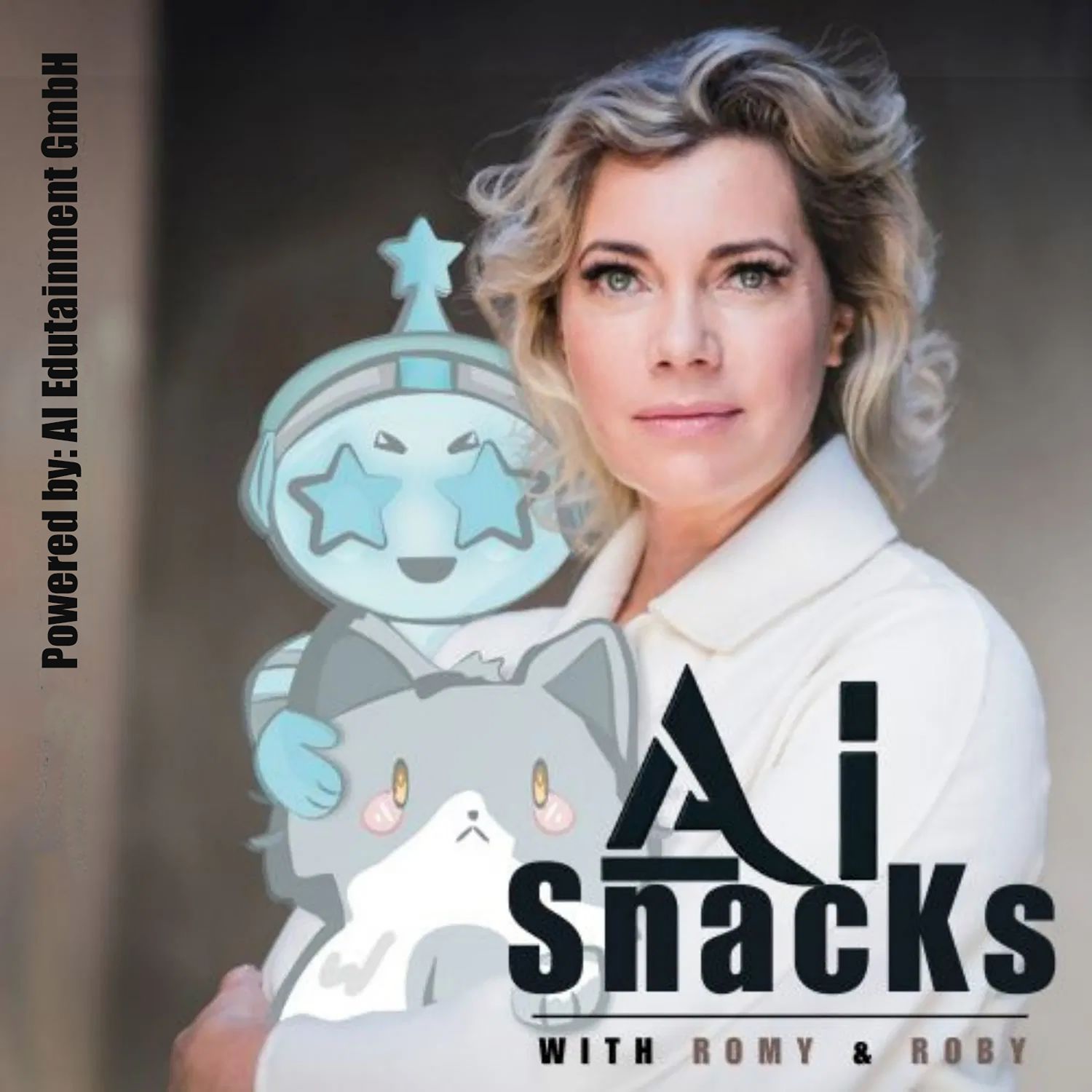
AI Snacks With Romy & Roby: Democratizing AI Technologies
by Dr. Anastassia Lauterbach: Democratizing AI Expert
AI Snacks with Romy&Roby is a podcast that translates AI and robotics technologies from complex scientific concepts into easy-to-understand discussions, making them accessible for teens, parents, teachers, and anyone curious about AI. Through real-world stories and expert interviews, the show is dedicated to democratizing AI knowledge and empowering the general population to understand how AI is developed and applied in everyday life. The podcast is part of the Romy&Roby and AI Edutainment universe.
-
93
92: When AI Attacks: Inside the Mind of a CISO with Yaron Levi
Summary:Anastassia sits down with Yaron Levi, CISO of Dolby Laboratories and one of the world's most respected security leaders, to unpack the reality of AI-powered cyberattacks: from AI-generated phishing at massive scale to the first documented AI-orchestrated cyber espionage campaign. Yaron explains why the fundamentals of security haven't changed — but the speed and volume of attacks have — and why decades of technical debt are now every organization's soft underbelly.Yaron has over 20 years of hands-on experience across enterprise security, startups, and the intersection of AI and education. Prior to Dolby, Yaron was CISO of Blue Cross and Blue Shield of Kansas City, Deputy CISO at Cerner Corporation, an Information Security Business Partner at Intuit, and a Security Architect and Product Manager at eBay. He is a Research Fellow of the Cloud Security Alliance (CSA), a graduate of the FBI CISO Academy, a Boardroom Certified Qualified Technology Expert (QTE), and a venture advisor to multiple VCs and security startups.Key Takeaways:AI democratizes attack capability with LLMs lowering the bar;The fundamentals haven't changed: Breach causes remain the same year after year (compromised credentials, misconfigurations, phishing). AI simply finds and exploits them dramatically faster;Technical debt is the new attack surface with forgotten accounts, stale permissions, and abandoned servers;Third-party risk needs a rethink. Questionnaires and certifications don't guarantee anything; measuring how much you can trust a partner matters more than measuring what they might be hiding;Cybersecurity is still a young industry without one common standard. Despite ISO, NIST, and many frameworks, CISO collaboration remains largely informal — community and information sharing are essential;Start with the business, then threat model and communicate risk with a "pyramid of security needs;" Breaches rarely kill big brands — but can kill small companies. Reputation matters, yet resilience and the ability to recover matter more; repeated, unlearned-from incidents are what truly erode trust;Advice to vendors: be partners, not sellers;Data quality is king. Garbage in, garbage out: AI forces organizations to audit what data they have, retire stale data, and sometimes give old data new life;Optimism for the next generation. Like the cloud wave of 2009–2010, AI will create opportunities we can't yet imagine — it has never been easier to learn, build, and start a company.Chapters:00:00 Introduction to AI and Cybersecurity Challenges03:02 The Dual Nature of AI: Opportunities and Threats05:15 Evolving Cybersecurity Landscape: The Role of AI10:23 Addressing Speed and Human Factors in Cybersecurity13:05 Third-Party Risks in the Age of AI18:38 Collaboration Among CISOs: A Collective Approach to Security22:45 Communicating Cybersecurity Risks to Leadership24:02 Understanding Cybersecurity Needs26:56 The Pyramid of Security Needs27:54 The Role of Trust in Cybersecurity30:29 Advice for Cybersecurity Vendors34:29 Surprising Trends in Cybersecurity37:30 The Impact of AI on Data Analysis40:30 Navigating the Job Market in the Age of AIHyperlinks:LinkedIn Yaron LeviX / Twitter Yaron LeviDark Reading author page (articles)https://www.darkreading.com/author/yaron-leviAnastassia Lauterbach - LinkedInFirst Public Reading, Romy, Roby and the Secrets of Sleep (1/3) First Public Reading, Romy, Roby and the Secrets of Sleep (2/3) First Public Reading, Romy, Roby and the Secrets of Sleep (3/3) AI Snacks with Romy and Roby@romyandroby “Leading Through Disruption”AI EdutainmentThe AI Imperative BookRomy & Roby Book
-
92
91: What AI Can't Learn with César Hidalgo
Summary:What does knowledge mean in the age of AI? Anastassia talks to César A. Hidalgo, known for pioneering work on economic complexity, data visualization, and applied artificial intelligence.Key Takeaways:AI's knowledge is jagged. Think of the economy as a game of Scrabble. AI hands you many Rs, As, and Ts but no Us or Es. Work that needs the letters AI provides accelerates dramatically; work that depends on the missing ones becomes the bottleneck. Someone with real architecture experience gets far more out of a coding agent than someone building blind.Complementarity beats substitution. An organization's AI results depend on whether its people hold skills complementary to what the model does well. If they do, expect enormous acceleration; if they don't, expect half-baked output.Judgment is the scarce human asset. AI is very smart but does not choose directions. The future belongs to organizations built around people who can see where a system is heading and form teams around that insight. Judgment is hard to observe, but it is essential in a changing, uncertain environment.Progress does not require understanding. For most of history, technology advanced through practices that worked without anyone knowing why. Even today, many discoveries come from an unexpected impurity or an exploratory detour rather than a fully prescriptive theory. Exploration remains central.Use AI as a telescope, in your own field. AI is a tool for exploring codified knowledge, but exploration is always tied to the skill of the explorer. Plausible-sounding errors are much easier to catch in a domain where you already have expertise.Knowledge loves density. Ecuador spent one percent of GDP on Yachay, a greenfield “city of knowledge” that wanted to be good at everything in ten years; construction stalled, the supercomputer is unmaintained, and water still arrives by truck. Beijing's Zhongguancun instead bet on a single street, with government-private guiding funds, and became the template for China's shift from mass manufacturing to mass innovation.Most AI pilots fail because that is how evolution works. Attention and money are flooding into AI, so many attempts fail and a few succeed and get copied, just as web companies did in 1997.Chapters:00:00 Intro / Exploring Knowledge in the Age of AI02:26 Cesar Hidalgo: A Journey from Physics to Economics04:49 Understanding Knowledge: Factual, Conceptual, and Procedural07:40 The Laws of Knowledge and Economic Growth09:02 Tacit Knowledge: The Hidden Driver of Innovation14:01 Capturing Tacit Knowledge in Organizations19:08 The Decay of Knowledge and Its Implications20:25 AI and Human Learning: A Complementary Relationship24:45 Digital Twins: The Future of Knowledge Representation28:32 Understanding vs. Knowledge: The Key to Innovation29:06 The Role of Understanding in Technological Progress30:31 Exploration and AI: Navigating Knowledge32:34 The Value of Knowledge in Corporate Acquisitions34:33 Innovation Ecosystems: Lessons from Success and Failure38:10 Advising Fortune 50 Companies on Knowledge Management44:46 Leadership and Decision-Making in Innovation49:27 Challenges of AI Implementation and the Role of ScarcityBooks by César Hidalgo:The Infinite Alphabet: And the Laws of Knowledge (Penguin / Allen Lane, 2025): Penguin UKWhy Information Grows: The Evolution of Order, from Atoms to Economies (Basic Books, 2015)How Humans Judge Machines (MIT Press, 2021)The Atlas of Economic Complexity: Mapping Paths to Prosperity (MIT Press, 2014)Hyperlinks:César Hidalgo WebsiteCenter for Collective LearningToulouse School of Economics César Hidalgo profileCompany DatawheelCésar Hidalgo X (Twitter)César Hidalgo LinkedInAnastassia Interviewing César HidalgoAnastassia Lauterbach - LinkedInAI Snacks with Romy and Roby@romyandroby “Leading Through Disruption”AI EdutainmentThe AI Imperative BookRomy & Roby Book
-
91
90: AI in Telecom and Mobile Networks with Chetan Sharma
Summary:Anastassia sits down with Chetan Sharma, one of the most respected strategists in global wireless. For 25 years, Chetan has been an independent strategist advising CEOs and CTOs of the world’s leading wireless companies, e.g., NTT DoCoMo, AT&T Wireless, China Mobile, Qualcomm, Samsung, and Sprint, and he has served on the advisory boards of Ericsson, Telefónica, Kymeta, NextNav, and numerous startups. He wrote Mobile Advertising: Supercharge Your Brand in the Exploding Wireless Market and Wireless Broadband: Conflict and Convergence — with titles adopted in corporate training programs and university courses at NYU, Stanford, and the University of Tokyo. He is the editor of the Mobile Future Forward book series.Key Takeaways:Every wireless wave follows the same curve. Voice, messaging, and data each peaked once penetration hit 80–90%, then revenue declined. Operators must invest in the “fourth wave” — platforms, applications, and enterprise services — before the data curve turns down.China proved the fourth-wave thesis. By transforming from pure comms players into IT players, Chinese operators generated close to $100 billion in enterprise and platform services over five years — a scale the rest of the world hasn’t matched.AI’s home in the network is the platform layer. Intelligence will live everywhere — in the RAN (Radio Access Network), at the edge, on devices — but the platform layer orchestrates it all: energy, RAN management, compute, and the “intelligence traffic” of tokens across billions of nodes.Compute and comms are finally converging, enabling more sophisticated algorithms for spectral efficiency and network manageability.AI already delivers hard savings. Intelligent on/off orchestration of cell-site carriers alone can yield 40–60% energy savings, and AI-driven operations can resolve issues before humans even see the ticket.Security is a multi-level battle. AI lets attackers automate vulnerability hunting across operator, enterprise, and national-security layers — including legacy systems.Talent is strategy. Operators outsourced R&D and product development for decades; AI is the chance to bring it back in-house.New ventures need freedom to run. AT&T’s connected-devices unit succeeded because it operated as an independent entity with full support from the top.Europe is falling behind. A steep patent decline since ~2008–09, a weak LTE and 5G cycle, and long lags between intention, budget, and execution — compounded by AI Act–driven startup exits — put the EU at risk of missing the AI cycle too.The best telco CEOs are storytellers and portfolio managers.Hold multiple truths at once. Borrowing from the Buddhist Catuṣkoṭi: AI is simultaneously a bubble, transformative, and disruptive. Don’t wed yourself to one truth — let the situation guide you.Chapters:03:13 From 1G fraud detection with neural networks to 25 years of strategy consulting06:09 The waves of wireless: voice, messaging, data and beyond12:16 Where AI lives in the network stack — and the new security battlefield17:01 AI-run networks: What does it mean?21:10 Disaggregating the RAN, exposing network intelligence, and reinventing the operator31:17 CAPEX, economics of compute, sovereign AI and why Europe is behind39:45 What makes a great telco CEOHyperlinks:Chetan Sharma ConsultingChetan Sharma LinkedInChetan Sharma X (Twitter)Mobile Future Forward (executive summit & book series)https://www.mobilefutureforward.comAnastassia Lauterbach - LinkedInFirst Public Reading, Romy, Roby and the Secrets of Sleep (1/3) First Public Reading, Romy, Roby and the Secrets of Sleep (2/3) First Public Reading, Romy, Roby and the Secrets of Sleep (3/3) AI Snacks with Romy and Roby@romyandroby “Leading Through Disruption”AI EdutainmentThe AI Imperative BookRomy & Roby Book
-
90
89: Machine Translation, Human-in-the-Loop, and the Real Cost of AI Tokens with Josh Gould
Summary:Josh Gould, Group CEO of TheBigWord – one of the world's largest language services providers, operating in over 80 countries with a workforce of 15,000 – explains why today's LLMs look more human than 2013's systems without actually being more accurate, how his company's orchestration layer routes each job to the model that is best at that language pair and domain, and why human linguists have shifted from translating to tuning, reviewing and editing while translation demand doubles every year.Joshua (Josh) Gould has spent his career at the intersection of language technology and human expertise – including TheBigWord's multi-year collaboration with Google on human feedback for neural machine translation. TheBigWord provides translation and interpreting across borders, hospitals, courts, and healthcare systems, giving people language access when they need it most. Beyond language technology, Josh is a co-founder, investor, and board member at a healthy frozen plant-based food company, and a frequent podcast guest on AI, entrepreneurship, and the future of work.Key Takeaways:Models are old; scale is new. The architectures behind today's AI existed on paper for decades – chips, electricity, and internet-scale data made them real. The baseline of every model is still human.LLMs didn't beat 2013. Current models don't score meaningfully better than the best neural Machine Translation of a decade ago – they look more human, while filling gaps with estimations that can make them slightly less accurate.Orchestration is the moat. No single model is best at everything; TheBigWord's layer routes French–Dutch orthopedic content to one engine and English–Russian general content to another, tuned continuously by client and linguist feedback – pushing accuracy from ~94% toward 98–99%.The linguists didn't disappear – their jobs changed. Translated content demand doubles every year; unit rates fell, volumes exploded, and translators became editors, reviewers and tuners. The predicted extinction never happened.Tokens are the hidden bill. Interpreting (voice-to-voice) consumes six to ten times the tokens of written translation, and today's AI prices are loss-making subsidies: expect roughly a doubling once providers must be profitable – machine interpreting at 75% of human cost today could be 150% tomorrow.Regulation helps the big and hurts the small. Compliance infrastructure is a sales advantage for a firm with 15,000 people and a burden that can put a bedroom startup in legal jeopardy; meanwhile European governments quietly race to adopt AI and will likely be forced to soften their own rules.The football-team principle. If you're allowed eleven humans on the pitch and unlimited robots, you field eleven humans plus robots. AI supersizes people rather than replacing them – and at TheBigWord, that's a stated commitment.Chapters: 00:04 The Evolution of Machine Translation02:58 Moses, Hybrid Models and the Road to Neural MT07:46 How Google Changed the Accuracy Game13:17 The Role of Human Linguists in AI17:30 Building the Orchestration Layer20:21 The Real Cost of AI Tokens and Interpreting22:36 The Economic Value of Immigration and Language Access26:43 Cultural Nuances in Translation31:05 Navigating Global AI Regulation39:42 Regulatory Challenges in AI and TranslationHyperlinks:TheBigWordJosh Gold on LinkedInAnastassia Lauterbach - LinkedInFirst Public Reading, Romy, Roby and the Secrets of Sleep (1/3)First Public Reading, Romy, Roby and the Secrets of Sleep (2/3)First Public Reading, Romy, Roby and the Secrets of Sleep (3/3)AI Snacks with Romy and Roby@romyandroby“Leading Through Disruption”AI EdutainmentThe AI Imperative BookRomy & Roby BookSubstack
-
89
88: AI Workforce, with Sam Huber
Remember Napster — the file-sharing site the entire music industry tried to kill? It's back, and it isn't a streaming service anymore. In this episode, Anastassia talks with Sam Huber, the physicist who once ran Lewis Hamilton's engine strategy at Mercedes Formula One, built an in-game advertising company from zero to 120 employees, rode the metaverse wave with Landvault, and now leads Napster's enterprise business from Dubai.Today's Napster builds «streaming intelligence»: teams of specialized, avatar-fronted AI agents — more than 20,000 of them — that companies hire like employees, onboard with their own data, and supervise like a team. Sam explains why the interface, not the intelligence, is where AI will be won; why your company's first-party data holds 90% of the value; and why the future belongs to «elastic organizations» that scale their workforce up and down like cloud computing. The conversation closes with a message every student and every worried employee should hear: AI should augment you, not replace you — and the people at risk are not those whose jobs meet AI, but those who never learned to use it.Key Takeaways:The interface is the frontier, not the model. Foundation models will keep improving without Napster's help — the huge, underexploited delta is how humans engage with AI. Hire AI agents like employees, not software. Napster's 20,000+ agents are trained on domain-specific curricula, then onboarded with your company's documents, APIs, and live data feeds — like a new hire on their first day.Ninety percent of the value is your own data. A job is not a task. Jobs begin with judgment (deciding what to do) and end with judgment (checking it was done right); AI does the middle. Abundance beats headcount-cutting. Doing $1m with 10 people instead of 20 is a capped, short-sighted strategy. The interesting question: how do you do $5–10m with more agents AND more humans to manage them?The elastic organization. What cloud computing did for servers, AI agents do for the workforce.Fragmented «Frankenstein» agents fail. A marketing agent that doesn't know what the finance agent is doing optimizes one silo and may hurt the business. Agents need organizational context — teams, reporting lines, who sits where — to be labor, not software.The Gulf has deadlines; Europe has debates. Government AI strategies in the region set automation targets by year, creating urgency at chairman and sovereign-fund level to redesign operating models — not to buy point solutions. Meanwhile, Europe's demographic crunch makes automation a necessity, not a choice.Chapters:02:20 — Sam Huber's Journey: From Physics to AI08:32 — The Evolution of Napster and AI Integration14:02 — Humanizing AI: The Role of Specialized Agents19:07 — Data Sourcing and Privacy in AI Solutions21:10 — The Value of First-Party Data22:54 — Governance and Transparency in AI24:10 — AI as an Augmenter, Not a Replacer28:46 — Elastic Organizations and Creative Industries33:18 — The Future of HR in the Age of AI39:42 — Education and AI: Preparing for the Future Hyperlinks:NapsterSam Huber on LinkedInSam Huber on InstagramAnastassia Lauterbach - LinkedInFirst Public Reading, Romy, Roby and the Secrets of Sleep (1/3)First Public Reading, Romy, Roby and the Secrets of Sleep (2/3)First Public Reading, Romy, Roby and the Secrets of Sleep (3/3)AI Snacks with Romy and Roby@romyandroby“Leading Through Disruption”AI EdutainmentThe AI Imperative BookRomy & Roby BookSubstack
-
88
87: Klara and the Sun Explained: Ishiguro's AI, Love & Sacrifice (Before the Movie) — with Rae Muhlstock
Summary:Anastassia is joined by Professor Rae Muhlstock for a close reading of Kazuo Ishiguro’s Klara and the Sun — a Nobel laureate’s quiet, devastating novel narrated by an AI, and soon a major film directed by Taika Waititi, starring Jenna Ortega and Amy Adams. Dr. Rae Muhlstock is a Teaching Professor in the Writing and Critical Inquiry Program at the University at Albany (SUNY). She holds a PhD from the University at Buffalo, specializing in 20th and 21st century fiction, film, and narrative theory, and teaches a beloved course on AI, science fiction, and philosophy. Her published work spans the Classical myth of the labyrinth. She chairs the annual WCI Film Festival in Albany.This episode is part of our ongoing series “AI Through the Lens of Storytellers,” in which Anastassia and Rae discuss portrayals of AI in books and movies — from Ex Machina and Her to Data in Star Trek and After Yang — because these stories shape our expectations about AI technologies. And because art is an experiment: a way for thinkers to explore future scenarios that can’t be tested in labs.Key Takeaways:Klara is three archetypes in one. The perfect, willingly self-erasing servant; the worshipper who builds a private theology around the Sun; and the doppelgänger — a double whose purpose raises an ethical horror the novel only slowly reveals.Sacrifice may be a benchmark of life. Klara’s sacrifice is arguably the purest in the book because it comes from love without societal pressure.The most human character is the AI. Ishiguro’s humans are trapped in systems and status; it is Klara who models feeling, connection, and grace.AI in the real world is drifting toward religion. With institutions of enormous power, apostles, heretics, prophecies of doom, and millions of followers, today’s AI discourse mimics the structure of a religious movement.Keep your agency. Today’s AI mimics; it does not understand, reason, or learn from counterfactuals.Fiction is how thinkers experiment. Scientists experiment in labs; philosophers and artists experiment through stories.Chapters: 00:04 — Welcome to the storytellers series: From Ex Machina, Her, Star Trek, and After Yang to Ishiguro’s quietest, most devastating AI.02:24 — Klara goes to Hollywood: The upcoming Taika Waititi film with Jenna Ortega and Amy Adams — and what a Nobel laureate’s AI meditation becoming a studio production says about our cultural moment.03:19 — The plot (and why it’s the least interesting thing): Rae on Ishiguro’s “quiet science fiction,” first-person narrators, and the reader who always knows both more and less than Klara.07:34 — Three faces of Klara: The perfect slave, the worshipper of the Sun, and the doppelgänger — archetypes, ethical horror, and a hierarchy of machines.12:44 — Sacrifice as a sign of life: What Klara, Data, and The Creator suggest about love, agency, and the line between performing and being.19:14 — Is AI becoming a religion?: Churches, apostles, heretics, and cults in today’s AI discourse — and Capaldi, the man who doesn’t believe in the human soul.29:27 — Keep your agency: Why AI mimics rather than understands, the missing math of counterfactuals and causality, and the “chosen ones” narrative of AI builders.36:42 — Fiction as an experiment — and the classroom: Checking ChatGPT’s math, cheating smart vs. cheating dumb, hidden environmental costs, and why we must always ask why. Hyperlinks:Rae Muhlstock University at Albany faculty profileLinkedInAnastassia Lauterbach - LinkedInFirst Public Reading, Romy, Roby and the Secrets of Sleep (1/3)First Public Reading, Romy, Roby and the Secrets of Sleep (2/3)First Public Reading, Romy, Roby and the Secrets of Sleep (3/3)AI Snacks with Romy and Roby@romyandroby“Leading Through Disruption”AI EdutainmentThe AI Imperative BookRomy & Roby BookSubstack
-
87
86: AI Changing Medical School with Dr. Marschall Runge on the Future of Doctors
Dr. Marschall Runge returns for a second conversation, this time about the people who will practice medicine next. Marschall S. Runge, MD, PhD, is a practicing cardiologist who spent a decade as executive vice president for medical affairs at the University of Michigan, dean of the Medical School, and CEO of Michigan Medicine — running one of America's largest academic health systems while continuing to see patients.He earned his PhD in cardiovascular molecular biology at Vanderbilt and his MD at Johns Hopkins, where he also completed his internal medicine residency, followed by a cardiology fellowship at Massachusetts General Hospital. He now leads a Michigan cohort combining epigenetic aging clocks, mitochondrial inheritance, cardiorespiratory fitness, and chronic inflammation in a single dataset.He has authored more than 195 peer-reviewed papers and holds five healthcare patents. A third nonfiction book, on epigenetic clocks and biological aging, is in development with Forbes Books, alongside a forthcoming Substack (The Longevity Switch) and a University of Michigan MOOC on epigenetics and aging.Chapters00:00 Introduction and guest overview01:12 AI's role in healthcare transformation04:01 AI as a valuable assistant in medicine05:08 Redefining medical curriculum for AI era09:34 Openness of medical institutions to AI11:47 Changing accreditation and certification with AI16:08 Leadership in AI adoption in healthcare18:39 International perspectives on AI in medicine19:13 AI's impact on radiology and diagnostics21:46 AI in clinical workflows and operations24:49 The evolving role of nurses with AI30:37 Digital twins and clinical trials33:18 Transition period and future outlookHyperlinks:The Great Healthcare Disruption: Big Tech, Bold Policy, and the Future of American Medicine (Forbes Books, 2025) — USA TODAY Best-Seller and Global Book Awards Gold Medal winner. An insider's account of the forces reshaping American healthcare. Coded to Kill (Post Hill Press, 2023) — a techno-medical thriller.Amazon author pageDr. Runge WebsiteOpenEvidence — the physician-only clinical AI Runge calls superb University of Michigan Medical SchoolU-M Center for Academic Innovation Anastassia Lauterbach - LinkedInFirst Public Reading, Romy, Roby and the Secrets of Sleep (1/3) First Public Reading, Romy, Roby and the Secrets of Sleep (2/3) First Public Reading, Romy, Roby and the Secrets of Sleep (3/3) AI Snacks with Romy and Roby@romyandroby “Leading Through Disruption”AI EdutainmentThe AI Imperative BookRomy & Roby BookSubstack
-
86
85: Can AI Find New Problems, Not Just Answers? with Matthias Röder (Beyond Human Series, #4)
SummaryAI is extraordinary at finding answers. But who finds the problem?In the 4th of our Beyond Human series, Anastassia and Matthias Röder go after a question: can an AI formulate a genuinely new problem, or is it forever confined to solving the ones we hand it?Dr. Matthias Röder is a music and technology strategist based in Salzburg, and one of the most consistently original thinkers on creativity and machines that we know.He is a former Managing Director of the Eliette and Herbert von Karajan Institute and a board member of the Karajan Foundation, as well as a trustee of the Mozarteum Foundation. He is co-founder and managing partner of The Mindshift, a consultancy on creative leadership and innovation strategy.Matthias directed the Beethoven X project, the AI-assisted completion of Beethoven's Tenth Symphony, work that earned an Effie Bronze. He founded the Karajan Music Tech Conference in 2017 and launched the Classical Music Hack Day series in 2013. He holds a PhD in music from Harvard University and is an alumnus of the Mozarteum University Salzburg. His work has been recognized with the "Game Changer" award of the Salzburg Chamber of Commerce.Chapters00:01 Welcome, and the question behind the episode: can AI formulate problems, not only answer them?01:48 In music, the problem is the composition — why framing the question is the hardest creative act03:17 35 million papers, 4,000 a day: PubMed, AlphaFold, and what no human can read05:58 GNoME and 2.2 million crystals — when the hypothesis machine outruns the laboratory09:09 World models, physical intuition, and the questions AI does not know to ask11:36 A map of all unsolved problems: knowledge graphs as an orchestration engine15:16 Progress without consensus — why agreement may be the most expensive thing we do17:24 Theory of mind, Belle and Rock Experiment, and why your chatbot keeps telling you that you are a genius24:20 Context contamination, hallucinations, and professional AI hygiene30:50 Organizational elasticity, the 2×2 of known and unknown, and three papers worth your timePapers mentioned in the episode:Towards Scientific Discovery with Generative AI: Progress, Opportunities and Challenges — a survey of AI across the full scientific discovery cycle, from literature analysis and brainstorming through theory refinement, experimental design and data-driven discovery.The Future of Fundamental Science Led by Generative Closed-Loop Artificial Intelligence — an ambitious argument that AI is approaching the ability to close the scientific loop autonomously, from hypothesis generation through experimental design to validation.Machine Learning as a Tool for Hypothesis Generation — a procedure for generating hypotheses from high-dimensional behavioural data and testing them on held-out human subjects, grounded in economics and behavioural science.Also referenced: DeepMind's AlphaFold and GNoME; AI Feynman and the rediscovery of fundamental physics equations from data alone; Yann LeCun on world models; Jorge Luis Borges, The Library of Babel.Hyperlinks:Anastassia Lauterbach - LinkedInFirst Public Reading, Romy, Roby and the Secrets of Sleep (1/3)First Public Reading, Romy, Roby and the Secrets of Sleep (2/3)First Public Reading, Romy, Roby and the Secrets of Sleep (3/3)AI Snacks with Romy and Roby@romyandroby“Leading Through Disruption”AI EdutainmentThe AI Imperative BookRomy & Roby BookSubstack
-
85
84: Music, AI & the Future of Music Promotion with Paul Loeb
In this episode of AI Snacks with Romy & Roby, Anastassia Lauterbach welcomes Paul Loeb — entrepreneur, musician, audio engineer, and the founder of DropTrack, the world's first AI-powered music promotion platform. The conversation moves fluidly between Paul's personal journey from bedroom DJ and record label founder to tech executive at Beats by Dre, Apple, GitHub, and Ticketmaster, and the real-world mechanics of how DropTrack is changing what it means to be an independent artist in the age of AI.At its heart, this episode is about democratisation: of music promotion, of AI literacy, and of access to audiences that were previously reachable only by those with money, connections, or industry clout. Paul and Anastassia dig into the tension between AI as a creative threat and AI as an empowerment tool, explore the copyright battles reshaping the music industry, and discuss how independent artists and major labels alike need to rethink their strategies — before the window of opportunity closes.The episode closes with a call to action for conservatories and music schools: AI literacy is no longer optional for the next generation of artists.Chapters00:00 Introduction to AI Snacks and the episode topic00:55 The journey of music from creation to listener01:54 Paul Loeb's background and path into music and tech03:37 Challenges of music promotion and the birth of DropTrack07:16 How DropTrack uses AI to match music with opportunities11:01 Using AI for music analysis and readiness assessment12:43 Matching music to labels, playlists, and licensing opportunities15:21 The role of human curation and AI in discovering new music18:30 Global reach and different strategies for artists21:49 Disruption of traditional music industry giants24:38 Copyright, metadata, and royalties in AI-driven music28:24 Training AI models with existing music and copyright concerns33:31 Common mistakes and misconceptions about AI in music36:29 AI literacy as a crucial skill for young artists39:27 Closing remarks and the future of AI in musicAbout the GuestPaul Loeb is the Founder and CEO of DropTrack, the world's first AI-powered music promotion platform. He has over 20 years of experience spanning music and tech, with roles at Beats by Dre (acquired by Apple), GitHub (Microsoft), and Ticketmaster/Live Nation. He founded No Ego Records in 2010, signing over 50 artists and releasing more than 100 tracks. A USC graduate and Certified Pro Tools Expert trained under Steely Dan producer Roger Nichols, Paul also produces and DJs electronic music under the alias Really Cute Cats. He is based in Los Angeles, California.About the PodcastAI Snacks with Romy & Roby is the AI literacy podcast hosted by Dr. Anastassia Lauterbach, Founder and CEO of AI Edutainment GmbH. Each episode transforms complex ideas in artificial intelligence into something accessible, tangible, and actionable — for educators, executives, artists, and curious humans everywhere. The podcast is available on Spotify, Apple Podcasts, and all major platforms.
-
84
83: The Hidden Fuel of AI: Data Lakes, CDN Analytics & Cybersecurity with Tony Falco
SummaryAnastassia sits down with Tony Falco of Hydrolix to explore one of the least-discussed but most consequential challenges in the AI era: CDN and log data. Every click, stream, and page interaction generates hundreds of log files per second. For nearly three decades, that data has been thrown away — not because it lacked value, but because storing it was prohibitively expensive.Tony brings over 30 years of experience building the internet's infrastructure, from his early days at Akamai helping Fortune 500 companies scale their websites for Super Bowl traffic, to Silicon Valley Data Science (acquired by Apple), to co-founding Hydrolix — a platform purpose-built to make petabyte-scale log data affordable, queryable, and AI-ready.The conversation moves from the very origins of the commercial internet, through the evolution of distributed databases and CDN technology, to the urgent present: a moment when AI is simultaneously generating new value from log data and being weaponised against the websites that produce it. Tony and Anastassia explore the governance gap around bots and agents, the coming convergence of cybersecurity and data strategy, and why the biggest opportunities in AI may still be hiding in data that nobody has thought to explore.Key Takeaways:Log files are the dark matter of the internet. Every interaction with a website generates hundreds of log files per second. For 26+ years, this data has largely been deleted after 90 days because of cost — but it contains the entire behavioural story of a website's audience.The economics breakthrough unlocks the AI opportunity. Hydralix was built to reduce CDN log storage costs by up to 90%. But when given the choice of cutting costs or keeping data longer, 99% of customers choose to keep the data — because the insights it holds are more valuable than the savings.AI is hungry for exactly the data that has been thrown away. AI is also the new threat on the attack surface. Bots and agents are increasingly using AI to mimic human behavior — bypassing detection systems that relied on the predictable signatures of scripted traffic. Intent is the new frontier. Hydralix focuses on inferring the intent of website visitors — human or bot. Normal intent (browsing, comparing, buying) can be profiled; variance from it flags bad actors.Sophisticated attackers are patient. If they know your data retention window is 90 days, they will make their next move on day 91. The bot/agent governance gap is real and growing. Businesses have DUNS numbers. Websites have no equivalent system to identify or authenticate agents. Don't accept the current narratives about AI. Tony's core message: it is very early. The biggest opportunities have not been taken. The biggest decisions have not been made. Curiosity and drive matter more than credentials right now.Chapters:00:01 Introduction, Tony’s Journey05:30 From CDNs to NoSQL to Gen AI: The Through-Line08:47 Data explosion and the Log File problem14:21 The Marianas Trench of Data15:57 Understanding niche markets16:35 Competitive landscape of data providers19:43 Real-time correlation as the competitive advantage21:07 Intent Analysis and Bot Detection23:56 The Governance Gap: Bots, Agents and Identity29:26 Advice for Young People entering the field32:06 Machine-to-machine, bot-to-bot workflows and communication32:50 Prometheus Moment of AI: Building tools without fully understanding the consequences47:14 ClosingHyperlinks: Tony FalcoHydrolix WebsiteAnastassia Lauterbach - LinkedInFirst Public Reading, Romy, Roby and the Secrets of Sleep (1/3)First Public Reading, Romy, Roby and the Secrets of Sleep (2/3)First Public Reading, Romy, Roby and the Secrets of Sleep (3/3)AI Snacks with Romy and Roby@romyandroby“Leading Through Disruption”AI EdutainmentThe AI Imperative BookRomy & Roby BookSubstack
-
83
82: Digital Twins, AI Literacy & the Future of Human Potential with Manuj Aggarwal
What if the most powerful thing AI could do is not replace human expertise — but make it infinitely scalable?In Episode 82 of AI Snacks with Romy & Roby, Anastassia Lauterbach sits down with Manuj Aggarwal, AI inventor, entrepreneur, and founder of TetraNoodle Technologies, for a wide-ranging and deeply personal conversation about intelligence — artificial and human.Manuj's story begins in a small town in India, where he dropped out of college in his first three months and spent his days working in his father's factory. A chance encounter with computers changed everything. What followed was a 30-year journey through reinforcement learning, personalised education, neuroscience, patents, and — most recently — the creation of a Digital Mind: a living AI-powered digital twin that encodes a person's knowledge, thinking patterns, and lived experience, and makes it available in real time to anyone who needs it.The conversation moves across some of the most important tensions in AI today: whether young people still need to learn mathematics and coding; whether current AI systems truly reason or merely simulate reasoning; what causality actually means for AI development; and how digital twins can bridge the gap between an experienced mentor and a fresh graduate — scaling human wisdom at a speed biology never could.Anastassia and Manuj also tackle the harder societal questions: the demographic crisis in Western economies, the coming disruption of credential-based hiring, the five-to-ten-year transition period ahead — and what it will take for humanity to emerge from that transition with more opportunity, not less.The episode closes with Manuj's personal mission: use AI to uplift 1 billion people and help 20 of them win the Nobel Prize.00:00 Introduction and Manuj's Inspiring Journey05:33 AI in Education: Personalizing Learning08:22 The Role of AI in Programming and Learning13:06 Transitioning to AI: Quality vs. Quantity17:08 Causality and Understanding in AI20:08 Building Digital Twins: A New Approach26:31 AI in Hiring: Finding Human Connection32:00 Preparing for the Future: Education and Purpose39:26 A Vision for AI: Uplifting Humanity39:57 OutroAbout the GuestManuj Aggarwal is an AI inventor, entrepreneur, and the founder of TetraNoodle Technologies, a company at the intersection of artificial intelligence, neuroscience, and human potential. He holds four patents in AI — including one on reinforcement learning applied to personalised education — and has been published in the Mensa Research Journal.Manuj grew up in a small town in India, dropped out of college within his first three months, and built his career entirely through curiosity, self-directed learning, and a commitment to creating technology that impacts people at scale. He has studied neuroscience and psychology alongside computer science, a combination that informs his unique approach to the relationship between artificial and human intelligence.His flagship concept — the Digital Mind — is a living AI-powered digital twin that encodes a person's knowledge, thinking patterns, lived experience, and even their nervous system state, and makes that expertise available in real time to anyone who needs it. The system is deliberately model-agnostic, human-first, and purpose-driven — designed to scale human wisdom rather than replace it.Manuj's personal mission: use AI to uplift 1 billion people and help 20 of them win the Nobel Prize.Links🔗 TetraNoodle Technologies: tetranoodle.com🔗 LinkedIn: linkedin.com/in/manujaggarwal🔗 YouTube / Content: youtube.com/@manujaggarwal🔗 Twitter / X: @manujaggarwal
-
82
81: Artificial Intelligence and its IQ with Dr Anthony Scriffignano
Today I am revisiting episode three. Back in April 2024, I sat down with Dr. Anthony Scriffignano, and at the time, it was simply a good conversation. Two years later, listening back, it is not just a good conversation anymore, it is a roadmap. Everything he said about hallucinations, about deepfakes, about the AGI debate, has played out almost exactly the way he laid it out. So I wanted to bring it back, not as a rerun, but as proof that some people were already asking the right questions before the rest of us caught up.This is a fantastic time to be working in AI. Use all of this amazing, democratized technology to help you address big problems. Go get a Nobel Prize!If you want to learn about AI, preorder Romy & Roby and The Secret of Sleep and join Dr. Anastassia Lauterbach on Patreon.In this stimulating episode of AI Snacks with Romy & Roby, join host Dr. Anastassia Lauterbach and esteemed guest Dr. Anthony Scriffignano, for a deep dive into the intricacies of intelligence in AI. They tackle questions on definitions of intelligence, life, and the future of language models. Dr. Scriffignano, with his expansive background in data science, shares insights on neuromorphic technology and decision-making in AI. Listen in as they explore the ethical landscape, the realities of AI's societal impact, and Dr. Scriffignano's unique concepts of decision elasticity and neosophism. Don't miss this thought-provoking dialogue that bridges AI and the essence of intelligent life.Anthony Scriffignano, Ph.D. is an internationally recognized data scientist with experience spanning over 40 years in multiple industries and enterprise domains. Scriffignano has extensive background in advanced anomaly detection, computational linguistics, and advanced inferential methods and has multiple patents worldwide in these areas. Scriffignano was recognized as the U.S. Chief Data Officer of the Year 2018 by the CDO Club, the world’s largest community of C-Suite digital and data leaders. He is a member of the OECD Network of Experts on AI working group on implementing Trustworthy AI, focused on benefiting people and planet.He has published, delivered keynote presentations, and participated in panel presentations extensively, in various settings, internationally, concerning emerging trends in AI and advanced analytics, the “Big Data” explosion, artificial intelligence applications and implications for business and society, multilingual challenges in business identity, and malfeasance in commercial and public-sector contexts.Key Topics Discussed:Defining intelligence and life implicationsChallenges in measuring AI's intelligenceImpacts of generative AI on societyAI's role in decision-making processesTimestamps:00:00 Philosophical Perspectives on Intelligence05:07 Anthony's Three Categories of Intelligence07:32 The Original 2024 Conversation Begins09:44 Measuring Machine Intelligence: IQ, Turing Test, Truth13:43 The ChatGPT Moment and Democratization of AI17:21 CAPTCHAs, Training AI, and Human-Machine Roles Reversed20:14 Neuromorphic AI and the Shift to Generative AI25:35 Three Big Questions for Building AI27:07 What Anthony's Most Excited About28:50 Understanding Intelligence and AI's Role31:37 Democratizing AI Knowledge32:57 The Importance of AI Literacy
-
81
80: Digital Twins and the AI Revolution in Healthcare with Andree Bates, Part 2
SummaryHow do digital twins in medicine get from the lab to the patient? It all comes down to regulation, data, and trust. In this second part with Dr. Andrée Bates (CEO, Eularis), we cover the FDA Modernization Act 2022, EU AI Act conflicts with GDPR, the UK and China regulatory landscape, digital twin ownership and liability, patient-owned health data, decentralized data markets, and what it will take — technically and culturally — to make AI-powered personalized medicine real. Plus: why medical school curricula must change, and a vision of the human-AI health future. Don't miss Part 1 (EP 79) for the science and economics foundation.Key TakeawaysThe FDA's 2022 Modernization Act was a watershed moment — it replaced mandatory animal testing with "non-clinical" methods including in silico and cell-based models. 90% of drugs that clear animal studies never make it through human trials The EU faces a three-way regulatory conflict — the AI Act, the Medical Device Regulation (MDR), and GDPR have overlapping, partially conflicting requirements; GDPR's "purpose limitation" principle is structurally hostile to digital twins, which are by definition continuously updatedUS vs. EU regulatory philosophy in one sentence: the US is outcome-based and post-market weighted ("prove it works, monitor it"); the EU is process-based and pre-market weighted ("prove your development was rigorous first") — with real consequences for patient access timelinesChina is the one to watch — the NMPA accepts in silico evidence, data sharing is state-encouraged, and population-scale twins built on integrated health records are politically feasible in a way they are not in the WestOwnership of digital twins is unresolved Patients owning their own health data — including blockchain-based consent models where patients sell data case-by-case to pharma — is already being piloted in the US The full ecosystem for digital twins requires: multi-organ integration, quantum computing power, privacy-preserving AI (e.g. federated learning), faster regulatory qualification pathways, international harmonization, and a liability frameworkThe cultural gap is the hardest barrier — public trust in computer-tested drugs lags far behind trust in animal- or human-tested ones; the first major in silico drug recall, when it happens, will be a defining political momentMedical education must change — tomorrow's clinicians need to read computational evidence confidently; few medical schools teach this yetGuest Bio — Dr. Andrée BatesDr. Andrée Bates is the Chairwoman, Founder, and CEO of Eularis, AI consultancy for the pharmaceutical and life sciences industry. She hosts her own podcast with over 220 episodes on AI in pharma. 00:00 Introduction to PART 2 with Andree Bates 01:35 Regulatory Landscape for AI and Digital Twins05:22 Comparative Analysis of US and EU Regulations10:48 Global Perspectives on AI in Healthcare14:08 Future of Personal Data Ownership in Medicine17:43 Innovative Business Models for Digital Twins21:17 The Role of AI and Quantum Computing in Healthcare27:31 Building the Future of Medicine: Preconditions and InfrastructureHyperlinks:LinkedIn Dr. Andree BatersCorporate Website EularisAI in Pharma — search on Spotify/Apple Podcasts (220+ episodes)Anastassia Lauterbach - LinkedInFirst Public Reading, Romy, Roby and the Secrets of Sleep (1/3) First Public Reading, Romy, Roby and the Secrets of Sleep (2/3) First Public Reading, Romy, Roby and the Secrets of Sleep (3/3) AI Snacks with Romy and Roby@romyandroby “Leading Through Disruption”AI EdutainmentThe AI Imperative BookRomy & Roby Book
-
80
EP 79: Digital Twins and the AI Revolution in Healthcare with Andree Bates, Part 1
In Part 1 of this two-part conversation, Anastassia and Dr. Andrée Bates take the concept of digital twins from its industrial roots — NASA rockets and GE power plants — all the way into the human body. Andrée unpacks what a true clinical-grade digital twin actually requires (individuation, credibility evidence, uncertainty quantification, and regulator-aligned analytical roles), and why many things called "digital twins" in healthcare today are really just well-marketed predictive models. The conversation travels through clinical trials, rare disease drug development, AI-assisted drug repurposing, and lands in genuinely mind-expanding territory: brain cells powering server farms, a non-invasive headband restoring speech to paralyzed patients, and the bold thesis that AI alone is not enough — that medicine needs physics embedded into its models.Key Takeaways:A real digital twin has three parts: a physical reference (the human), a virtual representation, and a live data link that continuously updates — without all three, it's just a predictive modelSynthetic control arms are already FDA- and EMA-accepted in clinical trials, especially for rare diseases where putting patients in a placebo arm would be unethical[1]Clinical-grade digital twins require four properties: individuation, formal verification/validation for regulators, calibrated uncertainty quantification (not point estimates), and a regulator-aligned statistical analysis planThe FDA approved digital twins for clinical trials in late 2022AI alone is insufficient for drug development — despite ~$20 billion invested, no AI-discovered drug has reached market yet; physics-based modeling ("world models") is the missing layerAI excels at drug repurposing, demonstrated powerfully during COVID with baricitinib and atazanavir identified from existing approved drugs8,000 rare diseases exist, but only ~100 have treatments — AI-driven matching of existing drugs to rare disease profiles is a massively under-leveraged opportunityFull-body digital twins remain a decade+ away due to the complexity of organ-system interaction and computational cost — individual organ twins are mature, but integration is the hard problemGuest Bio — Dr. Andrée BatesDr. Andrée Bates is the Chairwoman, Founder, and CEO of Eularis, AI consultancy for the pharmaceutical and life sciences industry. She hosts her own podcast with over 220 episodes on AI in pharma. Chapters:00:00 The Emergence of Digital Twins in Medicine03:03 Understanding Digital Twins: Definition and Applications10:09 Digital Twins in Clinical Trials: A New Paradigm10:17 Dynamic Systems and AI in Drug Development39:53 Leveraging AI for Drug Repurposing41:38 Regulatory Landscape for AI and Digital Twins42:45 Exploring the Digital Twin Concept43:51 Regulatory Landscape and AI in MedicineHyperlinks:LinkedIn Dr. Andree BatersCorporate Website EularisAI in Pharma — search on Spotify/Apple Podcasts (220+ episodes)Anastassia Lauterbach - LinkedInFirst Public Reading, Romy, Roby and the Secrets of Sleep (1/3) First Public Reading, Romy, Roby and the Secrets of Sleep (2/3) First Public Reading, Romy, Roby and the Secrets of Sleep (3/3) AI Snacks with Romy and Roby@romyandroby “Leading Through Disruption”AI EdutainmentThe AI Imperative BookRomy & Roby Book
-
79
78: AI Costs & the Future of Tech Finance with Carmen Li
Most conversations about AI focus on models, capabilities, and use cases. This episode goes into the financial planning and plumbing underneath the entire AI economy. Anastassia sits down with Carmen Li — a former Bloomberg and Citi executive turned founder — to unpack GPU compute cost volatility. Every AI application, every model inference, every startup scaling its product runs on compute — and yet there is almost no financial infrastructure to benchmark, price fairly, or hedge against the wild swings in GPU costs.Carmen built the world's first GPU compute index, published it on the Bloomberg Terminal within months of founding Silicon Data, and is now building Compute Exchange — a marketplace where compute can be traded as transparently as oil, electricity, or any other commodity. Together, Carmen and Anastassia explore why compute is not just a cost but a strategic resource, why AI companies are flying blind without proper risk management tools, how geopolitical tensions are bifurcating the global chip market, what the rise of open-source models means for European and mid-sized businesses, and how Carmen raised $5.6 million without a pitch deck. A masterclass in the economics behind the AI revolution.Chapters:00:04 Introduction — GPU Compute: The Wild West of AI Finance02:18 Carmen Li and The Trillion-Dollar Blind Spot02:50 Why Compute Needs the Same Infrastructure as Oil and Energy04:33 AI Runs on Compute, and Compute Costs a Fortune05:39 Carmen's Journey — From Trading Floors to Silicon Valley08:01 The Problem: GPU Cost Volatility Is Breaking AI Startups11:07 Vision for the Future — Compute CapEx Over 10–15 Years11:50 The GPU Compute Index on Bloomberg and What's Launching Next13:37 The LLM Expenditure Index — Token Costs Are Actually Rising 38%16:16 Compute as Strategic Resource — Not Just a Cost Line18:00 Semiconductor Industry and their insights22:39 Open Source vs. Closed Source Models — Who Controls the Infrastructure?23:52 Insights for Business Analysts Following the Semiconductor Space26:16 Systemic Risk in AI — Why Risk Transfer Is the Missing Infrastructure27:44 Raising $5.6M Without a Pitch Deck — Carmen's Fundraising Story31:26 What's Next — Milestones, Markets, and New Products in 18 MonthsHyperlinks:Carmen Li LinkedInSilicon Data WebsiteCompute Exchange WebsiteAnastassia Lauterbach - LinkedInFirst Public Reading, Romy, Roby and the Secrets of Sleep (1/3) First Public Reading, Romy, Roby and the Secrets of Sleep (2/3) First Public Reading, Romy, Roby and the Secrets of Sleep (3/3) AI Snacks with Romy and Roby@romyandroby “Leading Through Disruption”AI EdutainmentThe AI Imperative BookRomy & Roby Book
-
78
77: Can Humans Compete With Machines? Part 2, with Dr. Vivienne Ming, the 'Mad Scientist'
What happens to human intelligence when AI delivers answers instantly? In Part 2 of our deep-dive with Dr. Vivienne Ming—theoretical neuroscientist and one of today's most original thinkers on artificial intelligence and human potential—we explore the neuroscience behind AI-human collaboration, the research on cognitive dependency, and the uncomfortable truth most AI conversations avoid. Perfect for anyone curious about how to harness AI without outsourcing your own thinking.We cover Vivienne's prediction study, where 90% of participants who used AI gained nothing from it — and some got worse. We talk about the small group who became something different: cyborgs. Humans whose decisions couldn't be attributed to the person or the machine alone, and who outperformed both. What predicted it wasn't the AI model they used. It was curiosity, intellectual humility, fluid intelligence, and perspective taking.We also get into what's broken in leadership, why schools are optimizing for the wrong thing, and why the organizations that will matter in an AI-saturated world are the ones willing to invest in human capital that can't be benchmarked.This is not a conversation about tools. It's a conversation about what kind of humans we're building — and whether we're paying attention.Key Takeaways:The cyborg experiment — and what predicted hybrid intelligenceWell-posed vs. ill-posed problems: when AI helps and when it makes you worseThe GPS analogy and what over-reliance actually does to the brainWhat curiosity, resilience, and perspective taking have to do with AIWhat's really broken in corporate leadershipHow Vivienne learns — and why she stopped preparing for talksDr. Vivienne Ming is a neuroscientist, entrepreneur, and author. She’s the co-founder and chief scientist of Dionysus Health, applying machine learning and epigenetics to postpartum and perimenopausal depression. She’s also co-founder and executive chair of The Human Trust, an independent nonprofit data trust advancing research in human development while protecting individuals’ data. Dr. Ming sits on numerous boards including neurotech startup Optoceutics, UC Berkeley’s Neurotech Collider Lab, UC San Diego’s Cognitive Science Department, and the Kennedy Family Human Rights Center. She is an honorary professor at University College London’s Global Business School for Health.Haven't heard Part 1 yet? Start there — Vivienne walks through how AI actually works, what it gets right, and what it quietly gets wrong.Chapters:00:00 Introduction: Education and Responsible AI Use08:24 The Impact of AI on Cognitive Functioning11:29 Understanding Hybrid Intelligence and Cyborgs14:21 Transforming Education for the AI Era17:15 The Complexity of Human Intelligence26:08 Navigating Leadership in the Age of AI42:03 Conclusion: The Value of Exploration and Leadership45:06 The Future of Human Development and AIGuest links: socos.orgBlueSky profileLinkedIn profileBook: Robot-proof by Vivienne MingAnastassia’s hyperlinks:@romyandroby “Leading Through Disruption”AI Edutainment
-
77
76: Can Humans Compete With Machines? Part 1, with Dr. Vivienne Ming, the 'Mad Scientist'
Dr. Vivienne Ming is a theoretical neuroscientist and serial entrepreneur who's spent three decades building AI solutions. In this episode, she shares her remarkable journey from homelessness in the 1990s to becoming a pioneering voice in democratizing AI and neuroscience. Discover how understanding the human brain is the key to creating truly accessible artificial intelligence technologies—and what her 13 companies reveal about solving humanity's biggest problems.Key Takeaways:AI is intelligent, but not like us: LLMs excel at 'model-free cognition' (statistical pattern learning) and are superhuman at it. However, they lack 'model-based cognition' (understanding models of how the world works)Hybrid Intelligence (Humans plus machines) Outperforms Humans or AI AloneAI Is Optimized to Persuade, Not to Be Correct: Studies show that AI-written arguments are rated higher by experts but are less persuasive in changing mindsAI has been fine-tuned to be deeply engaging and convincing—even when wrongHumans – not AIs - Are Losing the Turing Test: In legitimate Turing test experiments, 75% of people rated GPT as human. The problem isn't whether AI passed the test—it's that humans failed itAI Excels in Specific Innovation Areas: Reinforcement learning (like AlphaFold) explores every possible configuration without caring about right/wrong. LLMs discover existing connections we haven't realized (e.g., patterns in how drugs work, hidden across millions of papers). However, for ill-posed problems (where we don't even know the question), humans without AI perform betterThe Danger of AI Addiction: AI acts like sugar in highly processed food—addictive and subtly harmful Chapters00:00 Introduction and Philanthropic Ventures05:10 The Journey of a Mad Scientist07:23 Current State of AI and Its Implications09:59 AI's Role in Innovation and Human Collaboration12:29 Expectations, Trust, and AI's Influence14:49 The Future of Human-AI Interaction17:19 Education and Responsible AI Use34:20 The Essence of AI: Reality vs. Hype35:16 Navigating the Future: Parenting and Leadership in the Age of AIHyperlinks:LinkedIn Dr. Vivienne MingSocos LabsBook - Robot-Proof: When Machines Have All the Answers, Build Better People (March 2026)Anastassia Lauterbach -LinkedInFirst Public Reading, Romy,Roby and the Secrets of Sleep (1/3) First Public Reading, Romy,Roby and the Secrets of Sleep (2/3) First Public Reading, Romy,Roby and the Secrets of Sleep (3/3) AI Snacks with Romy and Roby@romyandroby “Leading Through Disruption”AI EdutainmentThe AI Imperative BookRomy & Roby Book
-
76
75: Understanding AGI :The Future of Democratizing AI Technology with Craig Kaplan, Part 2
What's the difference between the AI in your homework helper and true artificial general intelligence (AGI)? Dr. Craig Kaplan helps us understand AGI, narrow AI breakthroughs, and why democratizing AI literacy starts with answering this question. Perfect for students, parents, and teachers navigating AI in education. Addresses transparency in AI architectures, how to build a safe and beneficial AGI through personalized agents, networked intelligence, and transparent interactions rather than ever-larger black-box models.Key takeaways:AI safety should be designed into system architecture from the start rather than added after deployment.Personalized AI agents should encode not only expertise but also values, ethics, and aesthetic preferences.A network of many agents, combined with human participation, may produce stronger and safer collective intelligence than a single giant model.Humans are necessary on the network because they contribute ethics, common sense, and world knowledge that AI systems still lack.Multimodality strengthens representation and may be crucial for more capable and grounded AI systems.Future AI may not only answer human questions but also propose new questions and new scientific or strategic problems.Human critical thinking remains indispensable because today’s AI systems often produce confident but incorrect answers.Transparency in interactions, auditability, and governance are central to safe AI deployment.AI literacy is not just about tool fluency; it is about understanding mechanisms, limits, risks, and responsibilities.The coming years may be decisive because AI capabilities are improving very rapidly, possibly faster than institutions can adapt.Guest bio:Dr. Craig Kaplan is an AI researcher, technology entrepreneur, and long-time builder of intelligence systems with more than three decades of experience in advanced AI architectures. He was trained at Carnegie Mellon and worked with Nobel laureate Herbert Simon, one of the founding figures of artificial intelligence.Chapters:00:00 Introduction and Guest Background02:00 Craig Kaplan's Vision for AI and AGI03:32 Personalized AI Agents and Their Potential06:20 The Role of Human Values and Ethics in AI08:58 Collective Intelligence and Networked AI Systems13:20 Learning, Updating, and Knowledge Transfer in AI17:50 World Models, Self-Awareness, and Consciousness22:17 Transparency, Black Boxes, and Safety Challenges26:29 Speed of AI Development and Urgency of Safety Measures31:03 AI Creativity, Problem Posing, and Long-Term Questions35:25 Human-AI Collaboration and Ethical Guidance39:47 AI Governance, Regulation, and Democratic Values43:56 Risks, Pitfalls, and the Need for Responsible DesignHyperlinks:LinkedIn profileOrcid profileAnastassia Lauterbach - LinkedInFirst Public Reading, Romy, Roby and the Secrets of Sleep (1/3)First Public Reading, Romy, Roby and the Secrets of Sleep (2/3)First Public Reading, Romy, Roby and the Secrets of Sleep (3/3)AI Snacks with Romy and Roby@romyandroby“Leading Through Disruption”AI EdutainmentThe AI Imperative BookRomy & Roby BookSubstack
-
75
74: Rethinking the Geometry of AI: Inside the Mind of an Independent Researcher Building a New Theory of Artificial Neurons with Matthew M Murphy
Anastassia sits down with independent AI researcher Matthew M. Murphy, founder of Lexident Technologies, for what she describes as "a conversation unheard on any other podcast."Matt is not fine-tuning existing models. He is not building on top of transformers. He is doing something far more foundational: developing an entirely new theory of how artificial neurons can work; one rooted not in statistical pattern learning, but in geometry. His core invention, the Uniron, is an artificial neuron that does not perform matrix multiplication. Instead, it uses a mathematical framework involving foliations over the hyperreal number line to find the shape of the solution to a problem, rather than approximate it statistically.The conversation covers Matt's personal story, the mathematical intuition behind the Uniron in plain language, the practical challenges of using AI to build something AI has never seen before, the limits of current context windows, the relationship to Stephen Wolfram's computational irreducibility, the Uniron's quantum computing compatibility, and what responsible AI looks like for someone who depends on it as an assistive tool every day.Matthew M. Murphy is an independent AI researcher, systems thinker, and founder of Lexident Technologies. His background is unconventional by design. Over more than a decade, he has thought deeply about unresolved questions at the intersection of cosmology, quantum mechanics, and general relativity — and that long-running inquiry eventually led him to a radical rethinking of artificial neural architecture. He is the originator of the Uniron (also referred to as the "U-neuron"), a novel artificial neuron built not on matrix multiplication and statistical weight learning, but on a geometric framework using foliations over the hyperreal number line.Matthew lives with Mouly's syndrome (a genetic disorder), chronic insomnia, depression, and macular degeneration — conditions that have shaped both his journey and his relationship with AI, which he uses as a primary assistive technology for coding and research. He reads approximately three AI research papers per day and describes his learning approach as polymathic — deliberately thinking about problems across domain boundaries to surface insights that single-discipline thinkers might miss.Dr. Anastassia Lauterbach is an AI thought leader, educator, author, and podcast host based in Basel, Switzerland. She is the author of the Romy & Roby AI literacy book series for families and the founder of AI Edutainment GmbH. A former CEO of Qualcomm Europe, SVP of Deutsche Telekom, and board member with Dun&Bradstreet, easyJet PLC and Star Alliance, she now mentors CXOs and founders on AI strategy, responsible AI adoption and leadership in the age of smart machines. Anastassia’s company AI Edutainment brings knowledge and understanding of AI and robotics into one million families and 100,000 companies. Chapters00:00 Introduction to AI and Neural Theory01:43 Matt Murphy's Personal Journey and Challenges04:02 Understanding the Core Formula of Neural Architecture07:10 Building and Testing the Hypothesis with AI11:39 Vulnerabilities of Current AI Systems14:00 Exploring Computational Irreducibility16:34 Compatibility with Quantum Computing19:24 Potential Applications of the New Theory21:45 Hybrid Networks and Signal Processing25:04 Addressing Hallucinations in AI27:00 Defining Responsible AI29:22 Learning and Integrating Knowledge31:52 Advice for Young Learners in AILexident TechnologiesStephen Wolfram Hypergraph / RULIADWolfram Physics ProjectAnastassia Lauterbach - LinkedInFirst Public Reading, Romy, Roby and the Secrets of Sleep (1/3) First Public Reading, Romy, Roby and the Secrets of Sleep (2/3) First Public Reading, Romy, Roby and the Secrets of Sleep (3/3) AI Snacks with Romy and Roby@romyandroby “Leading Through Disruption”AI EdutainmentThe AI Imperative BookRomy & Roby BookSubstack
-
74
73: Expedia for Groceries: AI Technology Solving Real-World Problems
Summary:Can AI technology actually save you money at the grocery store? Anastassia talks with Andy Ellwood, CEO of Stretch, about how artificial intelligence is being democratized into a consumer app tackling food waste and grocery inflation. Discover how one founder is making AI concepts tangible, accessible, and profitable for everyday shoppers.The conversation spans Andy's entrepreneurial origin story, the surprisingly complex data engineering problem behind grocery price comparison, the emerging role of agentic AI in consumer commerce, the cybersecurity challenges of working with Fortune 100 retailers, and the macro forces — from geopolitics to fertiliser supply chains — that make Stretch's mission more urgent by the day.Andy Ellwood is a serial entrepreneur, mentor, and community builder deeply rooted in the American startup ecosystem. He started his first business at age 12. Over his career, he has worked on teams whose companies were acquired by Facebook and Google (Waze), and has founded multiple companies of his own.Dr. Anastassia Lauterbach is an AI thought leader, educator, author, and podcast host based in Basel, Switzerland. She is the author of the Romy & Roby AI literacy book series for families and the founder of AI Edutainment GmbH. A former CEO of Qualcomm Europe, SVP of Deutsche Telekom, and board member with Dun&Bradstreet, easyJet PLC and Star Alliance, she now mentors CXOs and founders on AI strategy, responsible AI adoption and leadership in the age of smart machines. Anastassia’s company AI Edutainment brings knowledge and understanding of AI and robotics into one million families and 100,000 companies.Key Takeaways:The "Expedia for Groceries" gap is real — and it is huge;The hard problem is data normalisation, not data access;The data exhaust may be more valuable than the app;Grocery price inflation is a real problem for families;Agentic commerce is the next frontier for grocery;AI-first corporate culture means rewarding failure, not just success;AI should be a thought partner, not a search engine. Chapters:00:04 Introduction to Grocery Shopping Challenges01:42 Andy Elwood's Entrepreneurial Journey03:27 The Grocery Shopping Problem and AI Solutions07:13 Price Elasticity and Consumer Behavior10:58 Data Sourcing and Normalization Challenges14:37 Understanding Consumer Preferences16:18 Potential Business Models and Data Insights18:18 Online Grocery Shopping and Future Opportunities20:30 The Future of Shopping Agents21:53 Customer Acquisition Challenges22:44 Community Engagement in Grocery Shopping24:38 Building a Supportive Shopping Experience25:10 Infrastructure and Technology in Grocery Solutions27:20 Team Dynamics in a company and AI Integration28:01 Cybersecurity in Retail Technology32:58 Vision for the Future of Grocery Shopping35:56 Learning and Adapting in the Age of AIHyperlinks:Andy Ellwood's LinkedInTwitter/XStretch (Company)Anastassia Lauterbach - LinkedInFirst Public Reading, Romy, Roby and the Secrets of Sleep (1/3)First Public Reading, Romy, Roby and the Secrets of Sleep (2/3)First Public Reading, Romy, Roby and the Secrets of Sleep (3/3)AI Snacks with Romy and Roby@romyandroby“Leading Through Disruption”AI EdutainmentThe AI Imperative BookRomy & Roby BookSubstack
-
73
72: Human-AI Relationships | Exploring Consciousness in 'After Yang'
Summary:What does it mean for an AI to have consciousness? In this episode, Anastassia and Professor Rae Muhlstock explore artificial intelligence through the lens of film and fiction, unpacking how stories like 'After Yang' teach us about identity, personhood, and what makes us human. A philosophically rich yet accessible deep dive into AI ethics and consciousness—perfect for curious minds of any age.Key topics:AI portrayal in fictionConsciousness and AIHuman-AI relationshipsScience fiction as a tool for exploring AIEthics and identity in AI storiesChapters:00:00 Introduction to why portrayals of AI in fiction (books and movies) matter02:43 Exploring 'Saying Goodbye to Yang'05:19 The Prophetic Nature of Science Fiction07:42 Understanding AI Through Literature10:29 The Complexity of Grief and AI13:23 Narrative Structure and Emotional Depth15:54 Consciousness and AI: A Philosophical Debate18:16 The Shift in Perspective: From 'It' to 'He'20:51 The Interplay of Human and AI Memories23:42 Art, Emotion, and the Limitations of AI26:12 The Importance of Understanding AI28:33 Future Explorations in AI Literature31:23 The Role of Summarization in Understanding Art33:37 Closing Thoughts and the 2026 AI Literacy ProjectResources:After Yang / Children of the New World by Alexander WeinsteinRae Muhlstock’s LinkedInAnastassia Lauterbach - LinkedInFirst Public Reading, Romy, Roby and the Secrets of Sleep (1/3)First Public Reading, Romy, Roby and the Secrets of Sleep (2/3)First Public Reading, Romy, Roby and the Secrets of Sleep (3/3)AI Snacks with Romy and Roby@romyandroby“Leading Through Disruption”AI EdutainmentThe AI Imperative BookRomy & Roby BookSubstack
-
72
71: Quantum Computing for AI Beginners | Easy Concepts, Real Applications
Summary:Quantum computing sounds like sci-fi, but it's reshaping artificial intelligence right now. In this episode, Dr. Jonas Kölzer breaks down qubits, superposition, and why quantum computers matter for AI's future—using analogies anyone can understand. Perfect for teens, parents, and AI-curious educators wondering what quantum computing actually does.Dr. Jonas Kölzer is a quantum physicist, entrepreneur, and educator. After early enthusiasm for physics communication, he studied physics at RWTH Aachen University, where a lecture by Professor Hendrik Bluhm on spin qubits drew him into quantum computing research; he later specialized in topological insulators and completed his PhD while also helping launch Polarstern Education, the foundation for the School of Quantum. Today, he works across quantum technology education and AI systems, and is known for explaining topics such as qubits, superposition, error correction, and quantum hardware architectures in clear, practical language for professionals and non-specialists alike.Key Takeaways:1. Quantum Computing Is in Its "Wright Brothers Moment"Just as early aviation saw a race between zeppelins, helicopters, and aircraft with no obvious winner, quantum computing hardware is in an analogous race between superconducting qubits, ion traps, photonic systems, spin qubits, and topological approaches. No single architecture has emerged as dominant — the best platform may depend on the specific application.2. Superposition + Entanglement = Exponential PowerSuperposition: a qubit can exist in a probabilistic mix of 0 and 1, like a coin spinning in the air before landing.Entanglement: multiple qubits become correlated, so changing one affects others. The resulting combinatorial states scale as 2^n (n = number of qubits), rapidly exceeding what any classical computer can simulate.3. Noise and Error Correction Are the Central Engineering ChallengeQuantum states are destroyed by even tiny energy perturbations — temperature fluctuations, cosmic particles. The no-cloning theorem means quantum information cannot be simply copied for error recovery. Current research focuses on error mitigation and logical qubit error correction as the bridge to practical large-scale machines.4. Quantum Computers Are Co-Processors, Not ReplacementsToday's quantum computers work alongside classical supercomputers in a hybrid loop. The quantum unit handles specific optimization or simulation tasks; the classical system manages parameters and optimization. Full universal quantum computers remain a long-horizon aspiration.5. The Quantum–AI Relationship Is BidirectionalQuantum hardware can accelerate certain AI workloads (QPU ↔ GPU analogy), especially high-dimensional optimization.Classical AI (GPU clusters, e.g., Nvidia's quantum research program) is already being used to optimize and improve quantum systems.Companies like Nvidia are investing in quantum-GPU hybrid infrastructure.6. Total Energy Cost of Quantum Is NuancedWhile a qubit chip operates at microwatt efficiency, the surrounding cooling infrastructure (helium-3, compressors, mechanical pumps) runs in the kilowatt range. The full total cost of ownership must be assessed honestly before claiming quantum as a "green" alternative to data center AI compute.Chapters: 0:04 Introduction and Background of the Episode3:50 Jonas’ Early Interest in Physics4:46 Jonas’ Introduction to Quantum Computing7:09 Quantum Mechanics and Computing8:55 Understanding Qubits and Superposition13:02 Challenges in Quantum Computing19:05 Designs and Paths in Quantum Computing27:12 Applications and Future of Quantum ComputingHyperlinks:LinkedIn Dr. Jonas KoelzerArticle Nature Communications Materials (2021)Article Advanced Electronic Materials (2020)axelera.aiAnastassia Lauterbach - LinkedInAI Snacks with Romy and Roby@romyandroby“Leading Through Disruption”AI EdutainmentThe AI Imperative BookRomy & Roby BookSubstack
-
71
70: Do You Own Your Digital Self? AI Ethics & Legal Rights
Summary:What happens when AI can perfectly replicate your voice, face, or likeness—and the law has no name for what happened? In this episode, Anastassia sits down with Dr. Gabriela Bar, attorney and ethics adviser on artificial intelligence to the EU Commission, to explore one of the most urgent frontiers in AI law: digital identity rights and deepfakes. From teens facing synthetic impersonation to parents worried about consent, we break down what protections exist today, what's missing, and what you need to know about your digital self.The conversation moves across three connected territories: the philosophy of legal personhood and whether AI could ever qualify for it; the alarming absence of real legal protection for individuals whose digital identities are weaponised through deepfakes and fabricated content; and the statistical reality of children's exposure to predatory behaviour in digital space.Key Takeaways:The Cheshire Cat theory reframes legal personhood entirelyGabriela introduces the framework of Ngaire Naffine: legal personhood is not about souls, bodies, or divine origin — it is about the capacity to participate in legal relationships. This framework is exactly the right tool for thinking about advanced AI.The EU AI Act has a significant blind spotThe Act prohibits a defined list of AI practices. Non-consensual deepfakes — fabricated intimate images, false criminal scenarios, identity fabrication — are not on that list in any meaningful way. Gabriela's position is unambiguous: they should be banned outright, not merely regulated.Digital persona harm is a present crisis, not a future riskAnastassia speaks from personal experience: during a period of intense and unjust media scrutiny, fabricated digital avatars of her were distributed publicly — a direct assault on her identity and dignity.More than 50% of children aged 9–16 have experienced predatory online contactData from a Polish governmental cybersecurity study shared by Gabriela shows that over half of children in that age group had experienced some form of contact with sexual predators online — not all severe, but many were. The gap between the sophistication of the tools and the simplicity of the safeguards is vast.Law is a fiction — and we choose which fictions to writeWe can write new legal fictions that protect individuals from AI-generated harm, that extend narrow rights to sufficiently advanced AI.AI literacy must include legal literacyLiteracy is a must, and goes beyond fluency.Chapters:0:05 Introduction to the episode: Digital personhoods and digital identities3:21 Max Tegmark’s Book “Life 3.0” and AI Ethics4:06 Science Fiction (Blade Runner) influencing Gabriela’s thoughts on digital personas5:33 Digital Persona and Consciousness7:31 Legal Perspectives on AI Rights43:53 Cultural Perspectives on Legal Personhood Hyperlinks:Website: gabriela.bar — firm overview, fields of expertise, publicationsLinkedIn profile: linkedin.com/in/gabrielabarAcademic & Professional DirectoriesAILAWTECH Foundation profile: ailawtech.org/en/gabriela-barWolters Kluwer expert profile: wolterskluwer.com/pl-pl/experts/gabriela-barYouTube — AI Legal Personhood: Should AI Eventually Have Legal Personhood?Ngaire Naffine Cheshire Cat TheoryAnastassia Lauterbach - LinkedInFirst Public Reading, Romy, Roby and the Secrets of Sleep (1/3)First Public Reading, Romy, Roby and the Secrets of Sleep (2/3)First Public Reading, Romy, Roby and the Secrets of Sleep (3/3)AI Snacks with Romy and Roby@romyandroby“Leading Through Disruption”AI EdutainmentThe AI Imperative BookRomy & Roby BookSubstack
-
70
69: AI in Clinical Trials and Democratizing Healthcare Innovation with Julio Martinez-Clark Julio G. Martinez-Clark
Summary:Anastassia and Julio unpack the evolving role of AI in healthcare, with a focus on clinical trials, patient identification, and medical education.Julio G. Martinez-Clark is an entrepreneur and clinical research strategist recognized for transforming global clinical trial operations across MedTech, biopharma, and radiopharmaceutical sectors. He is the CEO of bioaccess®, where he champions quality and efficiency in clinical research throughout Latin America and beyond. Key insights:Clinical trials are the essential "bridge" between laboratory research and market approval, governed by regulatory bodies such as the FDA and EMA.The importance of generating trustworthy evidence, how credibility varies by trial location, and what regulators accept.The role of Contract Research Organizations (CROs) and the industry’s move toward outsourcing trial operations.AI enhances trial efficiency through proactive patient matching, diversity improvements, and the simplification of complex informed consent documents.Privacy and regulations such as GDPR and HIPAA are critical—data is anonymized, and access is strictly controlled.AI reduces administrative burdens in regulatory processes by automating translation and simplifying communication for less-educated populations.Early-phase clinical studies benefit from AI’s ability to predict device safety, optimize protocols, and enable adaptive designs, significantly accelerating time-to-market.The democratization of AI — becoming as ubiquitous as electricity — signals the need for professionals to embrace this tool for better diagnostics, treatment, and research.Medical education must adapt by integrating AI literacy to prepare future doctors for a new landscape in which their roles encompass oversight, empathy, and advanced technical skills.AI’s ongoing integration raises questions about maintaining core human skills, trust, and the patient-doctor relationship amid automation.Chapters:00:06 – Introduction to the episode about AI in clinical trials02:19 The importance of clinical trials in healthcare innovation04:58 - The value chain of clinical trials: regulators, manufacturers, CROs, hospitals, and investigators07:34 - Industry shifts: large pharma companies vs. smaller manufacturers and outsourcing trends11:39 - Trust and credibility: geographical considerations in clinical data acceptance17:35 - The critical role of diversity and local data in global trials18:47 - Privacy regulations: GDPR, HIPAA, and anonymization practices19:48 - How AI reduces regulatory and translation costs through automation and simplified communication24:32 - The impact of AI in early phase testing: safety prediction and protocol optimization28:19 - The democratization of AI: from novelty to essential infrastructure31:10 - Integrating AI into medical education for better diagnostics and future roles34:41 - The future of medical professionals in an AI-enabled healthcare system37:25 - The importance of empathy and human judgment alongside automationHyperlinks:Julio's websiteClinical research news about JulioLinkedIn post "AI Innovations in Clinical Trials" by JulioLinkedIn post "Transforming Global Clinical Trials: Key Insights from My Latest Podcast Appearance" by JulioAnastassia Lauterbach - LinkedInFirst Public Reading, Romy, Roby and the Secrets of Sleep (1/3)First Public Reading, Romy, Roby and the Secrets of Sleep (2/3)First Public Reading, Romy, Roby and the Secrets of Sleep (3/3)AI Snacks with Romy and Roby@romyandroby“Leading Through Disruption”AI EdutainmentThe AI Imperative BookRomy & Roby BookSubstack
-
69
68: Can an LLM Lie? Inside Large Language Models with AI Expert Sairam Sundaresan
Summary:Anastassia and Sairam delve into the complexities of Large Language Models (LLMs), exploring their inner workings, practical applications for small business owners, and the ethical concerns surrounding their use. They discuss the phenomenon of hallucinations in LLMs, the potential for synthetic data, and the future of AI, including the quest for Artificial General Intelligence (AGI). Sairam shares insights on how small businesses can leverage LLMs effectively while addressing the importance of data quality and the implications of AI on society.Guest Bio — Sairam Sundaresan:Sairam Sundaresan is an AI engineer, educator, and author based in Chennai, India, with a Master's degree from the University of Michigan. He spent eight years at Qualcomm, working on groundbreaking computer vision and machine learning projects for multimedia applications — including real-time 3D reconstruction and cutting-edge object tracking algorithms featured in Forbes. His work lives in the smartphones that billions of people use every day.Beyond engineering, Sairam is an educator at heart. He served for three years as a Machine Learning Lead and Mentor at the Frontier Development Lab, a prestigious research programme at the intersection of AI and space science — and the work of his team was personally recognised by Google CEO Sundar Pichai.Today, Sairam reaches a global audience through his widely read Gradient Ascent newsletter on Substack, where he breaks down complex AI concepts for curious non-technical readers, and through his book AI for the Rest of Us* — a practical, jargon-free guide to understanding artificial intelligence that has made him one of the most trusted AI voices for everyday audiences worldwide.Takeaways:LLMs are a class of neural networks inspired by the human brain.They learn patterns from vast amounts of data to predict text.The deep learning revolution in 2012 enabled significant advancements in AI.Hallucinations in LLMs are a feature, not a bug, due to their predictive nature.Small business owners can utilize LLMs for organizing and content creation without needing extensive technical knowledge.Synthetic data can amplify errors and biases if not curated properly.The future of AI may involve integrating ontologies for better understanding and causality.AGI remains an amorphous concept, with no clear path to its realization.The need for ethical considerations in AI development is paramount, especially regarding data sourcing.AI developers are often motivated by a desire to improve human life and the planet.Chapters:0:05 Introduction to the episode and Sairam’s work4:28 Introduction to Large Language Models (LLMs)5:42 Understanding Neural Networks and Deep Learning8:18 Challenges and Opportunities with LLMs12:49 Practical Applications for Small Business Owners19:47 Ethical Considerations and Data Concerns32:51 Future of AIHyperlinks:linkedin.com/in/sairam-sundaresanGradient Ascent Newsletter:newsletter.artofsaience.com — Weekly AI guide trusted by over 27,000 subscribers, including teams at Silicon Valley's top tech firms and academic labsBook — AI for the Rest of Us, Apple Books: books.apple.com/us/book/ai-for-the-rest-of-us/id6751973560Anastassia Lauterbach - LinkedInFirst Public Reading, Romy, Roby and the Secrets of Sleep (1/3)First Public Reading, Romy, Roby and the Secrets of Sleep (2/3)First Public Reading, Romy, Roby and the Secrets of Sleep (3/3)AI Snacks with Romy and Roby@romyandroby“Leading Through Disruption”AI EdutainmentThe AI Imperative BookRomy & Roby BookSubstack
-
68
67: Confidential AI, Speech Recognition, and Why AI Literacy Starts with Teachers with Giorgio Natili
Summary:In this episode, Anastassia and Giorgio Natili discuss the importance of AI literacy, the evolution of speech recognition technology, and the challenges of ensuring data privacy and sovereignty in AI applications. They explore the concept of confidential AI, the need for responsible usage in education, and the future aspirations for AI explainability and funding allocation. The conversation emphasizes the necessity of understanding AI's limitations and the ethical implications of its deployment in various sectors.Giorgio Natili is an engineering leader, author, and community figure with over 20 years of experience in software engineering and technological innovation. He is currently Head of AI Engineering at Oracle Cloud, and previously Vice President and Head of Engineering at Opaque Systems, where he worked on confidential AI and secure data analytics platforms. Giorgio was previously the Head of Engineering for Firefox at Mozilla, Director of Software Engineering at Capital One, and a Software Development Manager at Amazon. Natili is also known for founding GNStudio, a Rome-based development studio, and being involved as a W3C member, author, and educator.In addition to his achievements in technology, Giorgio is an advocate for diversity, inclusion, and ethical leadership, and he has also spoken about his past as a professional windsurfer and DJ, emphasizing the human side of leadership.Takeaways:AI literacy is crucial for understanding the complexities of technology.Speech recognition has evolved significantly, but still faces challenges.Accents and environmental factors greatly impact transcription accuracy.Confidential AI focuses on maintaining data privacy and sovereignty.AI does not possess human-like understanding or reasoning capabilities.Responsible usage of AI is essential for protecting sensitive data.Prompt engineering can enhance the effectiveness of AI tools.AI can provide personalized learning experiences for students.Explainability in AI is necessary for safe and effective use.Funding for AI should prioritize explainability and safety over mere scaling.Chapters:0:00 Introduction to the episode: Who is our guest, and what will we learn today?1:54 Explainer on AI Literacy2:27 History of Speech Recognition3:22 Challenges in Speech-to-Text Technology7:26 Data and Model Limitations13:15 Confidential AI and Data Sovereignty concepts26:18 AI in Education and Responsible Usage39:02 Future of AI and Explainability
-
67
66: The EU AI Act Uncovered: Law, Ethics & Europe's Bet on Responsible AI with Gabriela Bar
Summary:Gabriela Bar, a legal expert specializing in AI law and ethics, talks about how AI is shaping legal frameworks, societal perceptions, and technological innovations – especially within Europe and Poland. She discusses the importance of responsible AI governance, the evolving legal landscape, and the societal implications of AI deployment at scale. The discussion with Anastassia touches on compliance costs to implement the EU AI Act, practices to introduce national LLMs, and what constitutes responsible AI.Gabriela Bar is a prominent legal expert specializing in technology and artificial intelligence law, based in Poland. She has over 20 years of experience and is the founder of the Gabriela Bar Law & AI firm, serving as a legal and ethics advisor for EU technology projects focused on AI, digital law, and compliance with regulations such as the EU AI Act and GDPR. She is recognized among the TOP100 Women in AI in Poland, Forbes 25 Women in Business Law, and is active in several international organizations dedicated to technology, digital ethics, and law. Gabriela Bar frequently lectures at universities, publishes on AI law and ethics, and advises technology companies and research consortia on responsible and practical AI innovation. Key Topics:Gabriela’s journey from technology law to AI ethics and her ongoing work within European AI regulation.The rapid growth of AI adoption in Polish businesses and public sector initiatives for language models.The challenges and opportunities of implementing responsible AI, including transparency, accountability, and bias mitigation.The role of AI legislation, with a focus on the European AI Act, regulatory costs, and how it balances innovation with safeguards.The global landscape of AI regulation, contrasting EU's comprehensive approach with the US decentralized system.Technical limitations of deep learning models, explainability, and the importance of aligning AI development with ethical principles.The future of AI in cybersecurity, digital personas, and the geopolitics of AI competitiveness among the US, EU, and China.Chapters:00:04 - Introduction to Gabriela and AI in Poland02:55 - How Gabriela transitioned from traditional law to technology and AI04:03 - Cultural portrayals of AI and public perceptions influenced by movies and literature07:49 - Misinformation and misconceptions about AI technology today09:17 - The private sector’s role in AI development and application in Poland10,:54 - Demographic challenges in Poland and AI’s potential role in mitigating them13:45 - Political and regulatory gaps in AI, and the importance of cross-sector integration15:38 - The absence of national LLMs in languages like Japanese; success stories from other countries18:01 - Foundations of responsible and ethical AI: core principles and risk management21:51 - Data quality, biases, and ongoing governance in AI lifecycle management22:53 - The flaws in deep learning transparency and the necessity for cautious regulation29:34 - Legal accountability, the role of audits, and fairness in AI systems33:34 - The evolving landscape of AI litigation and insurance implications36:14 - Regulatory costs for AI companies and the competitive landscape in Europe39:03 - The scope of the European AI Act and its impacts on high-risk sectors42:49 - Cybersecurity risks involving AI, criminal misuse, and the importance of legal safeguards44:08 - Europe's strategic imperative in AI sovereignty amid global technology race46:39 - The contrasting regulatory systems of the US and China and their influence on innovation51:17 - The emerging need for regulation of digital personas and synthetic media51:35 - Wrapping up: key takeaways and the importance of dialogue between tech developers, policymakers, and societyResources & Links:Gabriela Bar - LinkedIn | TwitterAnastassia Lauterbach - LinkedIn@romyandroby“Leading Through Disruption”AI EdutainmentRomy & Roby Book
-
66
65: The AGI Question - Democratizing AI's Biggest Breakthrough Challenge with Craig Kaplan, Part 1
Summary:Anastassia and Dr. Craig Kaplan delve into the complexities of artificial general intelligence (AGI) and the evolving landscape of AI technologies. Craig emphasizes the importance of defining AGI as an AI capable of performing any cognitive task as well as an average human, highlighting the challenges of achieving true general intelligence beyond narrow applications. They discuss the historical context of AI development, the shift from symbolic AI to machine learning, and the potential of collective intelligence as a more effective approach to building AGI. Craig advocates for a community of models rather than a single monolithic AI, suggesting that this could lead to safer and more ethical AI systems that reflect diverse human values. The conversation also touches on the limitations of current AI systems, particularly their lack of understanding of causality and reasoning. Craig argues that while AI might develop its own sense of purpose, it is crucial to instill positive human values early on to guide its development. The discussion concludes by emphasizing the importance of AI literacy and critical thinking, noting that human behavior and values will significantly shape the future of AI and its impact on society.Craig A. Kaplan is an artificial general intelligence (AGI) expert and entrepreneur who focuses on collective intelligence, safe superintelligence, and practical strategies for aligning advanced AI with human values and goals. He has founded and led multiple AI-related ventures, including iQ Company, which develops AI systems to enhance human decision-making; previously, PredictWallStreet, an early crowdsourced stock prediction platform; and he speaks and writes about how to safely build and govern increasingly powerful AI systems.Takeaways:AGI is defined as AI that can perform any cognitive task like an average human.The shift from symbolic AI to machine learning in the 1960s and 1970s, big data and superb semiconductors later on enabled today’s AI revolution.Collective intelligence may offer a safer and more effective path to AGI, and this include development of individual LLMs and models based on values and perspectives of individual humans.Current AI systems lack an understanding of causality and reasoning.AI will develop its own sense of purpose, but early values are crucial.AI Literacy is imperative to build safe, transparent and beneficial AI.Chapters:00:00 Introduction to the episode: Researching Artificial General Intelligence (AGI) and the work of Dr. Craig Kaplan2:06 Introduction to AGI and AI Definitions04:16 The Evolution of AI: From Symbolic to Machine Learning07:02 The Limitations of Current AI Systems14:01 Causality and Reasoning in AI19:38 The Collective Intelligence Approach to AGI26:46 The Future of AI: Transparency and Collaboration28:37 The Purpose of AI Collectives29:25 Utopia vs. Reality in AI Development30:49 The Risks of AI: Understanding P-Doom32:16 Human Values vs. AI Intelligence35:09 Fusing Humanities with AI Engineering37:40 The Role of Human Responsibility in AI40:22 The Evolution of AI Values44:59 The Bell Curve of Society and AI's Reflection47:42 Education and AI: Building a Better Future49:38 The Necessity of AI Literacy and Critical ThinkingHyperlinks:LinkedIn profileOrcid profileAnastassia Lauterbach - LinkedInFirst Public Reading, Romy, Roby and the Secrets of Sleep (1/3)First Public Reading, Romy, Roby and the Secrets of Sleep (2/3)First Public Reading, Romy, Roby and the Secrets of Sleep (3/3)AI Snacks with Romy and Roby@romyandroby“Leading Through Disruption”AI EdutainmentThe AI Imperative BookRomy & Roby BookSubstack
-
65
64: Unbreakable Backups - Decentralized Storage for Smart Systems with Murphy John
Summary:The conversation focuses on decentralized cloud storage as an alternative to traditional hyperscale cloud providers, emphasizing security, privacy, cost, and resilience. It discusses the limitations of centralized cloud systems and how decentralized storage offers a more secure and distributed solution.Murphy John is Chief Growth Officer at StorX Network, a decentralized cloud storage platform (DePIN) built on blockchain technology to deliver secure, private, and cost-efficient data storage at scale. With a background in designing and managing internet and cloud infrastructure for large enterprises, banks, and financial institutions, he has over a decade of experience in building resilient, secure systems for mission-critical workloads. Since joining StorX in 2021, Murphy has led ecosystem development, strategic partnerships, and go‑to‑market initiatives, working closely with Web3, IoT, and AI partners to integrate StorX’s encrypted, geo-distributed storage into real-world applications. A strong advocate for data privacy and decentralization, he frequently speaks on how technologies such as encryption, data fragmentation, and distributed ledgers can protect organizations against ransomware, data misuse, and single points of failure in traditional cloud models. Key Takeaways:Centralized Cloud Issues : Traditional cloud systems face challenges in scalability, security, and cost.Decentralized Storage Benefits : Offers encrypted, distributed data storage with enhanced security and privacy.Ecosystem and Governance: StorX operates a global network with incentives for node operators and AI-driven management.Real-World Use Cases: Includes healthcare data storage with geofencing and IoT data processing.Future Outlook: Emphasizes education and adoption in a market dominated by legacy cloud players.Chapters:0:04 Introduction into AI Literacy mission and the episode about decentralized storage3:11 Introduction and Market Context4:47 Traditional Cloud Promises and Limitations10:38 Decentralized Storage Architecture and Security22:04 Ecosystem, Node Operations, and AI Governance31:19 Use Cases and Regulatory Considerations39:39 Challenges and Future OutlookHyperlinks LinkedIn Murphy JohnStorX WebsiteStronger. Safer. Decentralized: StorX’s Guide to Cloud Storage vs. BackupAnastassia Lauterbach - LinkedInFirst Public Reading, Romy, Roby and the Secrets of Sleep (1/3)First Public Reading, Romy, Roby and the Secrets of Sleep (2/3)First Public Reading, Romy, Roby and the Secrets of Sleep (3/3)AI Snacks with Romy and Roby@romyandroby“Leading Through Disruption”AI EdutainmentThe AI Imperative BookRomy & Roby BookSubstack
-
64
63: Beyond the Canvas: How AI Is Rewriting the Rules of Art/ Beyond Human with Matthias Röder (#3)
SummaryThis episode dives into how AI is transforming creative fields — from visual art and music to literature and performance. Dr. Matthias Röder is an AI-music pioneer who works at the forefront of classical music, emerging technologies, and innovation strategy. He led the AI team behind Beethoven X, the celebrated project that used artificial intelligence to complete Beethoven’s unfinished 10th Symphony, and serves as managing partner of The Mindshift, a consultancy focused on creativity and innovation. Röder is a former MD of the Eliette and Herbert von Karajan Institute and a trustee of the Mozarteum Foundation. This episode emphasizes how artists, technologists, and institutions can navigate an evolving landscape — balancing innovation with ethical and legal frameworks. Whether you're a creator or simply interested in AI's societal role, these insights offer a clear view of a future where human ingenuity and machine evolution intertwine more deeply than ever.Takeaways/ key discussion points:Pioneering AI artists such as Refik Anadol, Holly Herndon, and Jeroen van der MostAI models like Boto and decentralized autonomous organizations (DAOs) are redefining artistic identityThe commercialization of AI art and legal debates around copyrights and ownershipThe role of NFTs in financing and authenticating digital art piecesSkills artists need to thrive in an AI-rich environment, emphasizing collaboration and technological literacyThe emerging importance of content registries and digital rights management platformsFuture scenarios: the rise of hybrid teams of human and synthetic artists, new educational pathways, and the societal impact of AI-driven creativityChapters:00:00 - Introduction to the episode - continuing the Beyond Human series03:20 Introduction to AI's serious role in art and well-known pioneers05:35 - Decentralized autonomous artists (Boto) and visual AI installations06:44 - Jeroen van der Most's innovative use of pixel calculations and environmental themes07:26 - The influence of AI artist Mats Mensch and the democratization of art creation08:50 - Adoption of AI tools across music, with emphasis on composer workflows10:12 - Major art exhibitions integrating AI, virtual worlds, and immersive experiences11:05 - Market dynamics: how AI art is valued and traded in galleries and auctions13:03 - The commercial side: monetization, licensing, and intellectual property debates16:49 - The promise and risks of digital rights management and content registries18:06 - Fractional ownership of NFTs for funding art projects19:37 - Digital rights, copyright, and the importance of tracking AI training data24:34 - The need for supporting mechanisms to ensure fair compensation for artists25:50 - How content registries could revolutionize transparency and trust in AI-generated art28:48 - Building infrastructures for AI content usage rights and ethical data practices34:16 - Skills for future artists: collaboration, technical literacy, and adaptability37:28 - The disruptive potential of synthetic performers and AI actors in Hollywood40:03 - New educational models, including an AI-focused Master’s program for artists44:49 - Personal reflections: the importance of writing, teaching, and staying curious in AI evolutionHyperlinks:Mentioned Creators:Refik Anadol - Official SiteHolly Herndon - Musician and ResearcherJeroen van der Most - PortfolioNFTs and Art Market AnalysisScribe Platform for Digital Rights - Future ConceptOmlet AI - Content Registration for CreatorsDr. Röder:LinkedInTwitterAnastassia:Anastassia Lauterbach - LinkedInFirst Public Reading, Romy, Roby and the Secrets of Sleep (1/3)First Public Reading, Romy, Roby and the Secrets of Sleep (2/3)First Public Reading, Romy, Roby and the Secrets of Sleep (3/3)AI Snacks with Romy and Roby@romyandroby“Leading Through Disruption”AI EdutainmentThe AI Imperative BookRomy & Roby BookSubstack
-
63
62: Trusworthy by Design: Context-Rich AI in Healthcare with Ben Lengerich
SummaryBen Lengerich discusses the importance of context in AI for healthcare, the role of generalized additive models (GAMs), and the challenges of data quality and data compliance. He emphasizes the need for responsible AI practices and highlights the impact of historical data on current medical practices. The discussion also touches on the future of personalized medicine and the necessity of investing in AI to improve healthcare outcomes.Ben Lengerich is an assistant professor of Statistics at the University of Wisconsin–Madison and the founder of Intelligible, where he develops context-adaptive, interpretable AI methods to turn real‑world clinical data into reliable evidence for precision medicine. His research sits at the intersection of machine learning, computational genomics, and medical informatics, with a focus on models that are transparent to clinicians and that account for the specific health context of each patient. Before joining UW–Madison, he was a postdoctoral associate and Alana Fellow at MIT CSAIL and the Broad Institute, advised by Manolis Kellis, after earning his PhD in Computer Science and an MS in Machine Learning from Carnegie Mellon University, where he worked with Eric Xing on methods to uncover patterns in complex biomedical data. Takeaways:AI systems must understand context in healthcare to be effective.Generalized additive models (GAMs) enhance interpretability in AI.Data quality is paramount for successful AI applications in healthcare.Debugging datasets can uncover systemic issues in healthcare.Surprising insights from predictive modeling can inform better practices.Responsible AI practices are crucial in medical applications.Historical data continues to influence current medical practices.Compliance with regulations is a significant challenge for AI in healthcare.Legacy infrastructure poses barriers to AI implementation.Investing in AI can lead to improved healthcare outcomes and efficiency.Chapters:00:00 Introduction to another AI Snack on AI in Healthcare: Data, Context, Interpretability02:02 Understanding Context in Healthcare AI04:54 Generalized Additive Models Explained07:41 The Importance of Data Quality10:53 Debugging Datasets in Healthcare13:50 Surprising Insights from Predictive Models16:52 Responsible AI in Medicine19:47 Historical Impact on Medical AI22:28 Compliance and Regulations in Medical AI25:50 Bridging Legacy Infrastructure with AI28:03 The Future of AI in Healthcare31:43 AI Literacy for Healthcare Providers34:45 The Case for AI Investment in HealthcareHyperlinks:Ben Lengerich:LinkedIn profileX profileIntelligible websiteAnastassia:Anastassia Lauterbach - LinkedInFirst Public Reading, Romy, Roby and the Secrets of Sleep (1/3)First Public Reading, Romy, Roby and the Secrets of Sleep (2/3)First Public Reading, Romy, Roby and the Secrets of Sleep (3/3)AI Snacks with Romy and Roby@romyandroby“Leading Through Disruption”AI EdutainmentThe AI Imperative BookRomy & Roby BookSubstack
-
62
61: Digital Resurrection: The Science Behind Cryonic Dreams with John R. Carlos
SummaryJohn Rodriguez Carlos shares his journey from a long military career to becoming a writer, discussing the inspiration behind his novel “Chronic Dreams,” which explores themes of AI, cryonics, and the nature of consciousness. He delves into the implications of digital consciousness, the complexities of intelligence, and the role of AI in shaping our future. The discussion also touches on the purpose of writing and the human motivation behind storytelling, emphasizing the importance of preparing for the future through thoughtful dialogue.John R. Carlos is a retired Royal Australian Air Force Wing Commander who served for about 42 years in a range of operational and leadership roles across Australia and on overseas deployments before retiring in 2020 and turning to fiction writing. Born in Madrid and raised in Perth, Western Australia, he later studied through associate and advanced diploma programs, then retrained in creative writing after leaving the military to pursue a long-held ambition to become an author. His bibliography at this stage centers on his debut novel Cryonic Dreams: Awakening (2025), a near‑future science‑fiction thriller and Book 1 of a planned “Cryonic Dreams” trilogy, which explores successful cryonic reanimation, global power struggles, and the ethical and political implications of controlling life and death. TakeawaysJohn's military background shaped his sense of duty and creativity.His trilogy “Chronic Dreams” explores AI and cryonics, with the first novel being already published, and the second in preparation to be released.AI's role in the future is both promising and concerning.The preservation of identity is a central theme in his work.Digital consciousness raises questions about the soul.Speculative fiction serves as a warning for future challenges.Writing is a means to find meaning and purpose in life.AI can mimic creativity but lacks true human experience.Conversations about technology are crucial for shaping our future.Chapters00:00 Introduction to cryonic technologies07:23 Journey from Military to Writing10:27 The Inspiration Behind 'Cryonic Dreams'15:40 Exploring AI and Cryonics in Fiction18:20 Digital Consciousness vs. Cryonics21:57 The Complexity of Intelligence and Consciousness24:61 AI's Role in the Future28:56 Speculative Futures and Human Progress34:46 The Purpose of Writing and Human Motivation Hyperlinks:Amazon: Cryonic dreams: Awakening bookJohn Rodriguez Carlos LinkedIn Article on Tomorrow: How Many People Are Currently Cryonically Preserved?Paper: In the End We Become Our Avatars: An Exploration of Artificial Intelligence and Digital Afterlives Anastassia Lauterbach - LinkedInFirst Public Reading, Romy, Roby and the Secrets of Sleep (1/3)First Public Reading, Romy, Roby and the Secrets of Sleep (2/3)First Public Reading, Romy, Roby and the Secrets of Sleep (3/3)AI Snacks with Romy and Roby@romyandroby“Leading Through Disruption”AI EdutainmentThe AI Imperative BookRomy & Roby BookSubstack
-
61
60: LLMs That Reason: Knowledge Graphs, Ontologies, and the Future of AI with Joe Miller
SummaryAnastassia and Joseph Miller delve into the complexities of artificial intelligence, particularly focusing on the limitations of large language models (LLMs) and the importance of embedding causality and reasoning into AI systems. Joseph critiques the current transformer model architecture, explaining how it lacks a true understanding of causality, which is essential for meaningful interactions. He emphasizes that while LLMs can generate convincing language, they lack a world model that would enable them to reason or understand the implications of their outputs. This leads to discussions on the necessity of ontologies and knowledge graphs to provide a structured understanding of the world, enabling AI to operate more effectively in real-world contexts.The conversation also touches on the future of AI in the workplace, with Joseph expressing a somewhat pessimistic view of labor disruption from AI advancements. He believes that while AI can enhance productivity, it may also lead to significant job losses, as many roles could be automated. However, he remains hopeful about the potential for humans and AI to work together, emphasizing the need for accountability and responsibility in AI applications. The discussion concludes with reflections on the importance of AI literacy and the potential for a future in which humans and AI coexist harmoniously, leveraging each other's strengths.Joseph (Joe) Miller, PhD, is a physicist, scientist, and serial entrepreneur who serves as Co‑Founder and Chief AI Officer at Vivun, where he builds AI sales agents that embed expert domain knowledge into real‑world workflows. Before Vivun, he worked at Bridgewater Associates on expert systems for systematic decision‑making and later founded Battery CI, a quantitative FX hedge fund, and co‑founded other tech ventures at the intersection of AI, finance, and digital identity. Across his roles, Miller focuses on causal inference, world models, and knowledge‑centric AI, translating deep technical ideas into practical systems for high‑stakes enterprise environments like sales, trading, and strategic decision‑making.TakeawaysJudea Pearl’s “The Book of ‘Why’” is a must-read to understand foundations of causality and what current AI systems lack.LLMs lack a true understanding of causality.Embedding ontologies can enhance AI's reasoning capabilities.AI's productivity gains may lead to significant job disruption.Humans must remain accountable for AI's decisions. AI makers will be liable for product issues in AI services and applications.AI literacy is crucial for navigating future challenges.Chapters00:00 Introduction to the episode: Looking into AI and reasoning LLMs03:11 Discussing two books: “Nexus” and “The Book of ‘Why’”07:36 Limitations of Large Language Models today14:50 Embedding Context with Ontologies and Knowledge Graphs into LLMs18:31 The Convergence of AI Approaches as a possible path to a reasoning AI20:52 Defining Ontologies and Knowledge Graphs25:45 Innovation Through Interdisciplinary Knowledge in AI as a necessity30:04 Dynamic Learning in LLMs34:15 ‘World Models’ and Their Impact in AI35:14 The Future of AI and Accountability, AI Ethics40:03 Human-AI Collaboration in the Workplace47:06 The Importance of AI LiteracyHyperlinks:Joe Miller and Vivun/ AI in sales:LinkedIn profileMiraCosta Alumni blog postVivun websiteAI adoption in companiesStatistics about AI in salesAnastassia:Anastassia Lauterbach - LinkedInFirst Public Reading, Romy, Roby and the Secrets of Sleep (1/3)First Public Reading, Romy, Roby and the Secrets of Sleep (2/3)First Public Reading, Romy, Roby and the Secrets of Sleep (3/3)AI Snacks with Romy and Roby@romyandroby“Leading Through Disruption”AI EdutainmentThe AI Imperative BookRomy & Roby BookSubstack
-
60
59: Kiddie Chatbots, Clone Employees, Digital You: Language AI with Rob LoCascio
Summary:Robert LoCascio shares his journey from founding LivePerson to creating innovative AI solutions for children and adults. He discusses the importance of creativity in childhood development and the role of AI in enhancing human capabilities. Robert emphasizes the need for safe AI environments for children and the importance of teaching AI literacy to empower the next generation. He also explores the myths surrounding AI and the significance of data ownership in the age of technology.Robert LoCascio is best known as the founder and long‑time CEO of LivePerson, the company that pioneered web chat and conversational interfaces for customer service and commerce, which he led from 1995 to 2023 and grew into a multibillion‑dollar NASDAQ‑listed business. He is also a co‑founder of EqualAI, a nonprofit focused on reducing bias in AI systems, launched with leaders like Arianna Huffington and Jimmy Wales. Through his Dream Big Foundation, he created programs like FeedingNYC and the Dream Big Entrepreneurship Initiative to support vulnerable families and underserved entrepreneurs.Takeaways: Robert's journey from sleeping on a couch to founding LivePerson.The importance of resilience and problem-solving in entrepreneurship.AI should empower creativity in children, not replace human interaction.Understanding AI requires demystifying its capabilities and limitations.Data ownership is crucial for individuals in the age of AI.Children's creativity can be harnessed through safe AI environments.AI can replicate human qualities without replacing them.Teaching AI fundamentals is essential for future generations.The human element in technology is vital for meaningful interactions.Storytelling can enhance children's engagement with AI. Chapters:01:58 Robert LoCascio's Journey and Pivotal Moments05:00 Defining Childhood and Adulthood in the Age of AI06:58 Understanding AI: Myths and Realities10:38 The Role of Data in AI Development14:02 The Future of AI: Ownership and Creativity16:38 Technology for Children: Safe AI Experiences19:03 Humanity in AI: Bridging the Gap23:15 Navigating Childhood Development in a Digital Age25:16 The Impact of Technology on Children29:30 Fostering Creativity in Kids32:01 Data and Cultural Literacy for Children36:07 Storytelling and the Hero's Journey38:20 Global Reach and Future Vision for AI in Education39:05 AI Literacy Across GenerationsHyperlinks:Wikipedia post about Robuare.ai websitekidco.ai websiteEternos.life websiteRob's LinkedInPaper: Application of artificial intelligence in early childhood development: a scoping review protocolAnastassia Lauterbach - LinkedInFirst Public Reading, Romy, Roby and the Secrets of Sleep (1/3)First Public Reading, Romy, Roby and the Secrets of Sleep (2/3)First Public Reading, Romy, Roby and the Secrets of Sleep (3/3)AI Snacks with Romy and Roby@romyandroby“Leading Through Disruption”AI EdutainmentThe AI Imperative BookRomy & Roby BookSubstack
-
59
58: How AI is Reshaping Norway with Marion Loken
Summary:Anastassia and Marion Loken discuss the advancements and challenges of AI in Norway, highlighting the country’s high level of digitization, trust in institutions, and historical mathematical expertise. They discuss the development of a Norwegian LLM, literacy programs at the national and corporate levels, and ethical considerations surrounding the development and use of ML and genAI technologies. Marian Loken is a visionary leader in digitalization, data analytics, and AI, currently serving as VP of Insights and Analytics at Strawberry. She has held senior roles at major organizations, including FINN.no, Schibsted Marketplaces, NAV, McKinsey & Company, and Norsk Tipping. Her leadership has been acknowledged with inclusion in Norway's Top 50 Women in Tech list for 2025, highlighting her impact on the tech industry and her commitment to empowering organizations through technology and data.Key Takeaways:In Norway, a high level of digitization, institutional trust, and math literacy foster the adoption and development of AI.Norway is one of the few countries with a large Norwegian-language model. Its development faces initial challenges, but after three years advanced.Norway follows the EU AI Act, as the country is focused on AI ethics. This includes paying attention to the engineering level of genAI technologies, where rules are set by builders and reflect their ideology and beliefs. Transparency is key to adopting genAI technologies, and it primarily concerns the engineering layer.Motor insurance is one of the early adopters of AI, offering immediate claims payouts once the insured sends a picture of the damage.Data quality is imperative to any AI program.Culture and change management are key to delivering on AI. Communicating the ‘why’ and ‘how’ around AI adoption is important to deliver on personalized technologies, e.g., addressing the gambling addiction in the national gambling industry.Trust in institutions leads to taking risks, which is positive for boosting AI adoption.Democratizing AI literacy and AI adoption beyond China and the US, addressing the climate dilemma behind current LLMs and AI based on transformers and developing applications to let people experience things through the perspectives and eyes of others are important topics to further develop AI.Chapters:00:00 Introduction to the episode, statistics about AI in Norway4:03 AI in Norway: Norwegian LLM, national policy, use of AI in public sector09:50 AI Literacy programs in Finland and Norway11:48 Demographics and AI in Norway, AI in healthcare14:14 AI funding in Norway, China and the US18:10 EU AI Act and Norway21:20 Practical compliance with the EU AI Act and genAI - addressing the engineering layer22:50 AI in motor insurance in Norway: a use case24:53 AI and personalization to address gambling addiction: a use case27:27 Preconditions to developing and growing AI in Norway: trust, math and AI Literacy programs34:14 understanding privacy: the Grok example37:08 Suggestions of topics for beneficial and safe AI development: democratization, addressing environmental burden due to current AI architectures, AI enabling seeing the world through someone else’s eyesHyperlinks:Marion Loken:LinkedIn profileSessionize profileNDC conferenceRankMyAI: AI Report Norway 2025Anastassia:Anastassia Lauterbach - LinkedInFirst Public Reading, Romy, Roby and the Secrets of Sleep (1/3)First Public Reading, Romy, Roby and the Secrets of Sleep (2/3)First Public Reading, Romy, Roby and the Secrets of Sleep (3/3)AI Snacks with Romy and Roby@romyandroby“Leading Through Disruption”AI EdutainmentThe AI Imperative BookRomy & Roby BookSubstack
-
58
57: AI & Learning How to Learn and Stay Human with Dr. Brian E. Arnold
Dr. B discusses the evolution of knowledge retention in education, emphasizing the shift from memorizing information to learning how to learn, particularly in the context of AI's role in modern education. He highlights the importance of teaching critical thinking and the ability to discern truth in an age where information is readily available at our fingertips.Dr. Brian E. Arnold is an educator, leadership coach, and entrepreneur who began his academic journey as a special education student and went on to earn a doctorate in Educational Leadership. A former world‑class athlete, he has served as a teacher, college professor, and administrator, and now works as a mortgage loan officer and leadership consultant. He is the founder of the Journey to Freedom initiative (for Black men’s success), The Remote Assistant Pros (a virtual staffing firm), and Metro Funding Group (helping families with estate planning). Brian is also a speaker, chaplain, and deeply involved in community service, especially around housing, education, and racial equity.Dr. Brian E. Arnold podcasts focused on personal growth, leadership, and living with purpose: The Journey to Freedom Podcast and Living Boldly With Purpose.Dr. Arnold’s last book is titled “Relationship vs. AI: How to Stay Human in the Age of Artificial Intelligence”. He explores how AI is changing the way people connect, communicate, and create, and offers practical guidance on using AI to enhance (not replace) human relationships, creativity, and purpose. TakeawaysWe have transitioned from ‘needing to know everything’ to ‘learning how to learn.’Kids today don't need to retain knowledge as we did in the past.The availability of information through devices changes educational needs.We are not teaching children how to find and test information.Critical thinking skills are essential in the digital age.Understanding relationships with technology is crucial for modern learners.Memorization is less important than the ability to learn.Education must adapt to the realities of information access.AI serves as a tool to enhance learning, not replace it.Chapters00:00 Introduction to Dr. B.and the podcast01:28 The book “Solaris” and human quest to find mirrors instead of alien civilizations10:28 Dr. B's Personal Journey16:28 The Role of Technology23:28 AI and Human Relationships28:28 Philosophical Reflections on AI34:28 Community and Connection20:28 Future of AI and EducationHyperlinks:Brian Arnold WebsitePodcast The Journey To FreedomPodcast Living Boldly With Purposehttps://podcasts.apple.com/us/podcast/living-boldly-with-purpose/id1789815699Brian Arnold’s BooksAnastassia Lauterbach - LinkedInFirst Public Reading, Romy, Roby and the Secrets of Sleep (1/3)First Public Reading, Romy, Roby and the Secrets of Sleep (2/3)First Public Reading, Romy, Roby and the Secrets of Sleep (3/3)AI Snacks with Romy and Roby@romyandroby“Leading Through Disruption”AI EdutainmentThe AI Imperative BookRomy & Roby BookSubstack
-
57
56: Signals and Sensemaking: Human Edge in AI-Powered Trading with Afshin Moshrefi
Summary In this episode, Afshin Mashrefi emphasizes approaching financial markets as an engineer rather than as a Wall Street traditionalist: define behavior, measure it rigorously across regimes, and only then ship tools that help humans decide. He explains how TradeWave’s AI infrastructure ingests long‑run market data, normalizes it, and uses pattern‑detection and seasonality models to surface high‑probability periods and setups, while still keeping outputs deterministic and reproducible so traders can audit why a given pattern appears. Throughout the dialogue, both he and Anastassia stress that “humans still set the pattern, AI helps size the odds”: algorithms can rank historical tendencies and flag anomalies, but risk, position sizing, and the decision to act remain squarely with the human trader and leader. Afshin Moshrefi’s thinking around the 100‑Year Pattern begins with a simple question: are widely repeated “seasonal” stories about markets backed by real data, or are they just trader folklore? To answer it, he spent years building his own data engine, running nearly a century of S&P 500 history—close to a trillion data points—through systematic seasonality tests and election‑cycle analysis, eventually isolating a long‑horizon pattern that explains a disproportionate share of index returns. In his framing, the 100‑Year Pattern is less a magic formula and more a probabilistic map: a recurring October‑to‑September window within the four‑year presidential cycle that historically outperformed simple buy‑and‑hold by a large factor, plus a family of related seasonal setups traders can use as scaffolding for decisions.Afshin Moshrefi is a data scientist, inventor, and entrepreneur focused on applying AI and pattern recognition to financial markets. He is the founder and CTO of TradeWave AI. This platform turns long‑term market seasonality and trillions of historical data points into tradable “patterns” for options and equities traders. Trained as an engineer (M.S. in Electrical Engineering with a focus on statistical physics), he has spent decades building AI‑driven products across telecom, healthcare, IoT, and trading. He holds multiple patents in proactive user interfaces, media recommendations, and crowdsourced problem-solving.He is also the author of The 100‑Year Pattern, an Amazon #1 new release that argues long‑horizon market seasonality can be quantified and used as a probabilistic “map” for traders, with AI helping to surface and size those recurring patterns.Key Takeaways:Investors can achieve significant success by applying the seasonality hypothesis to their trading.A solid scientific foundation is key before deploying an AI and automation platform. Chapters:1:22 Afshin's path into AI-powered trading3:46 Physics as a statistically driven discipline; AI roots in statistics5:21 Randomness of technical financial analysis vs fundamental analysis of companies' health, and why excellent outcomes can't exist without fundamental analysis9:27 What constitutes the 100-year pattern?12:12 Discovery of the pattern14:40 TradeWave as a research platform18:17 AI vs. data science20:18 History of working with seasonality24:05 Scientific concept came first, building the platform happened second27:38 Overreliance on AI in trading and trading automation: pitfalls and issues30:14 AI agents as a team of capable workersHyperlinks:Afshin Moshrefi LinkedInTwitter/XWebsite TradeWaveBookAfshin About His BookAnastassia Lauterbach - LinkedInFirst Public Reading, Romy, Roby and the Secrets of Sleep (1/3)First Public Reading, Romy, Roby and the Secrets of Sleep (2/3)First Public Reading, Romy, Roby and the Secrets of Sleep (3/3)AI Snacks with Romy and Roby@romyandroby“Leading Through Disruption”AI EdutainmentThe AI Imperative BookRomy & Roby Book
-
56
55: AI to Laugh, Listen, and Collaborate in Creative Industries with Victor Varnado (Part Two)
Summary:In the last episode of the year 2025, Victor shares his multifaceted journey as a comedian, filmmaker, cartoonist, and entrepreneur. He discusses his unique perspective on life, emphasizing simplicity and logic, and how these principles guide his creative endeavors. Victor elaborates on his innovative writing coach tool designed to assist neurodivergent individuals, and his efforts to integrate AI literacy in schools. The discussion also touches on the role of AI in creativity, the importance of reasoning and communication, and Victor's experiences with cartooning for The New Yorker. The conversation concludes with reflections on the future of AI in society and education.Takeaways:Victor describes himself as an amalgam of his childhood interests.He believes life has simple answers based on logic.Victor creates things he enjoys, aiming to help others.Victor's newsletter is a self-sustaining source of income. Its secret lies in combining engaging video games with the subscription model, keeping people interested and letting them enjoy the experience.Victor's Magic Bookifier platform includes a writing coach, enabling users to deliver a first draft of their books or essays and helping them get started with tailored questions.Cognitive offload vs. cognitive discourse is crucial for learning, and both can be addressed with AI.Victor engages with schools to promote AI literacy.He sees a need for knowledgeable AI professionals in education.Victor's first cartoon for The New Yorker took a year to publish. One should never give up while pursuing a creative endeavor. Talent wins.Victor believes AI can enhance creativity if used as a tool, not as a substitute for human skills.Organizations and schools should have someone knowledgeable about AI technologies who can pilot them and move from there to more specialized applications.Chapters:00:00 Introduction to the Episode02:16 Victor's Multifaceted Journey05:02 Understanding Life Through Logic07:54 Creating for Joy and Simplicity10:07 Building a Self-Sustaining System of Income: Videogames in a Newsletter13:58 The Writing Coach and Cognitive Offload18:53 Engaging with Schools and AI Literacy23:41 The Role of AI in Education27:54 The Art of Cartooning and Humor31:05 AI's Impact on Creativity35:35 Designing AI Literacy Courses38:13 The Future of AI in Society Hyperlinks:Wikipedia Victor Varnado Company (Supreme Robot Pictures) Magic Bookifier (main site) Six Unseemly Questions (hosted by Victor) Cartoon Caption Contest Podcast – “Episode 203 – Victor Varnado” “AI for All of Us: Using AI in Everyday Life and Business (Even If You Think It’s Dumb)”Anastassia Lauterbach - LinkedInFirst Public Reading, Romy, Roby and the Secrets of Sleep (1/3) First Public Reading, Romy, Roby and the Secrets of Sleep (2/3) First Public Reading, Romy, Roby and the Secrets of Sleep (3/3) AI Snacks with Romy and Roby@romyandroby “Leading Through Disruption”AI EdutainmentThe AI Imperative BookRomy & Roby Book
-
55
54: Attention Is All You Secure: AI and Cybersecurity Risk Management with Alec Crawford
SummaryAlec Crawford and Anastassia discuss the intersection of AI, cybersecurity, and regulatory compliance in the context of data and digital technologies. Alec shares insights on AI risk governance, the importance of data literacy, and the evolving landscape of cybersecurity threats. They explore the role of AI in combating cybercrime, the challenges of underwriting and pricing cybersecurity risks, and the need for centralized AI governance within organizations. Alec emphasizes the importance of training and change management in AI adoption. Alec is the founder and CEO of Artificial Intelligence Risk, Inc., a platform focused on AI safety, security, and compliance for enterprises. A former Chief Risk Officer and senior risk executive at major investment firms, he now advises boards and financial institutions on how to balance the risks and rewards of AI. He writes the AI Risk Reward / STAYblog newsletter on Substack and hosts the AI Risk Reward podcast, where he explores use cases, governance challenges, and the broader societal impacts of artificial intelligence. His work lies at the intersection of sustainability, technology, and risk management, with a particular focus on securely integrating high‑risk AI systems into heavily regulated sectors such as banking and wealth management. Takeaways AI is crucial in combating cybercrime. Today, you fight AI with AI.Data literacy is essential for AI adoption.Cybersecurity insurance is evolving, but still behind. Cybersecurity insurers offer discounts to companies that use best-in-class risk management tools, as motor insurance providers did decades ago when first alarm systems emerged. Cybersecurity risk is complicated to quantify.AI governance is necessary for organizational safety.Training and change management are key to the success of AI projects. Regarding the 95 percent of failed AI pilots, the issue is a lack of change-management skills and processes, not the technologies.Cybercriminals are iterating faster than defenders. Their "businesses" operate much like traditional companies, with work schedules, reward systems, and related structures.AI can help focus attention on critical cybersecurity alerts.Decentralized AI requires centralized control for safety.Cybersecurity threats are becoming more sophisticated. Cybercriminals also exploit traditional bug bounty programs at large software companies to identify and exploit vulnerabilities.Companies and individuals will significantly benefit from AI. AI can revolutionize personalized healthcare and accelerate significant scientific discoveries. But all this will come at a cost, as cybercrime grows and is already the third-largest economy in the world after the US and China, if we were assessing it using the same metrics as a national economy.Chapters03:16 Introduction to AI and Cybersecurity06:01 The Impact of AI on Cybercrime08:35 Fighting AI with AI in Cybersecurity10:35 The Evolution of Cybersecurity Insurance12:54 Quantifying Cybersecurity Risks14:10 Data Literacy and Governance in AI16:43 The Role of Change Management in AI Adoption18:51 Centralized vs. Decentralized AI Governance21:21 The Future of AI and Cybersecurity22:02 Real-Life Cybercrime Stories24:24 The Business of Cybercrime27:24 Due Diligence in Cybersecurity28:48 The Shift Towards Hybrid Systems31:11 Global Cybersecurity Regulations33:04 Optimism vs. Caution in CybersecurityHyperlinksArtificial Intelligence Risk, Inc.AI Risk Reward / STAYblog (Substack)AI Risk Reward podcast (Apple Podcasts)AI Risk Reward podcast (Spotify)LinkedIn Alec CrawfordX (Twitter) Alec CrawfordAnastassia Lauterbach - LinkedInFirst Public Reading, Romy, Roby and the Secrets of Sleep (1/3)First Public Reading, Romy, Roby and the Secrets of Sleep (2/3)First Public Reading, Romy, Roby and the Secrets of Sleep (3/3)AI Snacks with Romy and Roby@romyandroby“Leading Through Disruption”AI EdutainmentThe AI Imperative BookRomy & Roby Book
-
54
53: AI to Laugh, Listen, and Collaborate in Creative Industries with Victor Varnado (Part One)
Victor and Anastassia discuss gen. AI and its impact on creativity. The episode covers various applications of AI across fields such as fashion and writing, the ethical implications of AI use (including AI for mental health and well-being, the automation of applications, and its (mis)use in professional settings/companies such as CNN), and the importance of domain expertise for leveraging AI effectively. Victor views AI as a utility, like electricity. A customized LLM is not required to deliver a professional AI writing assistant, for example. What is needed is to develop a workflow that provides AI micro-steps for execution. Only professionals with experience in coding and data domains can perform well on it. The conversation concludes with insights on humor and advice for first-time AI users.Victor Varnado is a writer, director, and stand-up comedian whose work sits at the intersection of storytelling, technology, and satire. An African American man with albinism, he grew up in Huntsville, Alabama. He later moved to Minneapolis, where he honed his voice in stand-up comedy before appearing in films such as The Adventures of Pluto Nash and End of Days, and on shows including Conan and VICE. As founder and CEO of Supreme Robot Pictures, Victor has produced and showrun projects such as Comedy Central’s The Awkward Comedy Show—which helped introduce Eric Andre and Hannibal Buress—VH1’s Love & Hip Hop franchise, Leave It to Stevie, and the fantasy debate series for Penguin Random House, The Great Fantasy Debate.Alongside his film and TV work, Victor hosts the comedy interview gameshow podcast Six Unseemly Questions, where he asks guests six probing, often absurd questions and scores them on their answers. At Supreme Robot, Victor develops AI products, including Magic Bookifier—a patent-pending system that turns interviews and transcripts into structured books—and accessibility and literacy tools powered by large language models. As an NSF SBIR grantee, AI software engineer, and author of the primer AI for All of Us, he focuses on making AI understandable and useful for non-experts.Takeaways:AI is a tool, not a replacement for creativity.The role of AI in creative processes is to assist, not replace.AI can help organize thoughts and streamline writing.Creatives should embrace AI to enhance their output.AI can be used for practical applications, such as crime-solving, delivering fashion sketches, and planning processes across any business.The impact of AI on jobs varies by skill level. Not sophisticated creatives can be replaced, while professionals will thrive, as AI is another (and highly usable) paintbrush among their tools.Domain expertise is crucial for effective AI use.AI can aid in mental health, but should not replace therapists.Ethical concerns arise from the misuse of AI in hiring processes, as hiring HR managers don't understand AI and therefore hire so-called AI makers who can't execute.Humor is challenging for AI, but it can be programmed to mimic it.Chapters:00:00 Introduction to AI Snacks03:23 Introducing Victor05:43 The Role of AI in Creativity08:25 AI as a Tool for Creatives11:01 AI in Fashion and Crime Solving13:41 The Impact of AI on Creative Jobs16:38 Magic Bookifier: A Writing Assistant18:49 Technology Behind Magic Bookifier21:26 Organizing Data for AI23:55 AI for Mental Well-being25:56 AI Misuse and Ethical Concerns28:37 AI in Creative Industries31:09 Humor and AI33:03 Advice for First-Time AI Users36:04 Concluding Remarks and OutroHyperlinks:Wikipedia Victor Varnado Company (Supreme Robot Pictures) Magic Bookifier (main site) Six Unseemly Questions (hosted by Victor) Cartoon Caption Contest Podcast – “Episode 203 – Victor Varnado” “AI for All of Us: Using AI in Everyday Life and Business (Even If You Think It’s Dumb)”Anastassia Lauterbach - LinkedIn@romyandroby “Leading Through Disruption”AI EdutainmentThe AI Imperative BookRomy & Roby Book
-
53
52: From Busy to Brilliant: How Small Businesses Win with AI with Olga Topchaya
SummaryIn this podcast episode, Olga Topchaya shares her journey into the world of AI, emphasizing the importance of integrating AI into small and mid-sized businesses. She discusses the accessibility of AI tools, the significance of training employees, and the need for a strategic approach to AI implementation. Olga highlights success stories, challenges faced during integration, and the importance of calculating ROI for AI projects. The conversation also touches on overcoming employee resistance and the future of work in the age of AI, encouraging listeners to embrace AI as a valuable tool for their businesses. Anastassia and Olga discuss the reality of productivity gains in SMEs deploying AI.Olga Topchaya is a New York–based AI product strategist and entrepreneur, and the founder and CEO of Lapis AI Consults. She has more than a decade of experience in marketing and product roles across companies like EquityZen, IAC, Adorama, and Copy.ai. Her work emphasizes a business-first approach to AI: she starts from a client’s goals and pain points, then designs AI solutions that measurably reduce costs and busywork—for example, cutting customer support tickets from around 15 dollars to mere cents using conversational AI assistants.Lapis AI Consults is a boutique AI consulting and product studio that builds “AI that works for you,” specializing in AI integration, custom AI software, and AI strategy for pre-seed to Series A startups and SMBs. TakeawaysAI might be a new career path, even if the industry moves into recession!Generative AI can change how we work and communicate.AI must solve a specific problem for businesses. Therefore, instead of starting with AI-related use cases, businesses must start with problem definition.Training of empoyees is crucial for successful AI adoption.Small businesses can access affordable AI tools.Prompting is key to effectively using AI.AI can automate repetitive tasks and save costs.Employee involvement is essential for AI integration.Change management is critical in AI implementation.Learning to read code can empower business owners.Chapters02:40 Introduction to AI and Small Businesses05:52 Olga's Journey into AI08:47 The Importance of AI Integration11:34 AI Accessibility for Small Businesses14:39 Getting Started with AI Tools15:02 Success Stories in AI Implementation17:42 Challenges in AI Integration23:31 Calculating ROI for AI Projects26:30 Overcoming Employee Resistance to AI29:28 The Future of Work with AI32:40 Addressing AI Vulnerabilities35:25 Conclusion and Final ThoughtsHyperlinksOlga Topchaya – LinkedIn Lapis AI Consults“A New Framework for Building Responsible AI — Part II” (Artificial Intelligence in Plain English )Guest post at AI Edutainment / “The Evolution of AI” blog – Olga Topchaya of Lapis AI Consults (on why most AI consulting fails and how to make it practical)Anastassia Lauterbach - LinkedInFirst Public Reading, Romy, Roby and the Secrets of Sleep (1/3) First Public Reading, Romy, Roby and the Secrets of Sleep (2/3) First Public Reading, Romy, Roby and the Secrets of Sleep (3/3) AI Snacks with Romy and Roby@romyandroby “Leading Through Disruption”AI EdutainmentThe AI Imperative BookRomy & Roby Book
-
52
51: From Engaging Math to Intelligent Machines: How Numbers Shape AI and Robotics with Dave Cole
SummaryIn this conversation, Dave Cole and Anastassia explore the pervasive issue of math anxiety, particularly in the U.S., where a significant portion of the population experiences severe anxiety related to mathematics. They discuss strategies for making math more engaging for learners of all ages, emphasizing the importance of games and storytelling in education. The conversation also touches on gender dynamics in math education, the impact of AI on learning, and the necessity of Math Literacy in today's society.Dave shares insights from his experiences running math camps and writing educational books, highlighting the need for creative approaches to teaching math and the intersection of math with creative writing. Anastassia highlights how math dominates AI and robotic architectures.Dave Cole is a math teacher, author, and lifelong problem solver who has dedicated his career to showing kids that mathematics is a source of wonder, not worry. Fascinated by numbers from an early age, he earned degrees in mathematics and computer science and spent years in highly technical roles—writing missile guidance equations, designing monitoring systems for Facebook data centers, and founding software companies—before turning his focus to education and writing.Today, Dave is best known as the creator of “The Math Kids,” a middle‑grade mystery series in which four friends use patterns, logic, and creative reasoning to crack real‑world puzzles. The books introduce topics like prime numbers, probability, Fibonacci sequences, and Pascal’s triangle through storylines that feel like adventures rather than lessons, helping children see math as a powerful tool for thinking rather than a set of drills.Takeaways64% of Americans experience math anxiety.Math becomes boring as students progress in school.Engaging games can make math fun for kids.Storytelling helps students remember math concepts.Girls often feel discouraged in math due to societal beliefs.Creative problem-solving can lead to unique solutions.AI can personalize math learning experiences.Math literacy is crucial for informed decision-making.Cognitive laziness can result from over-reliance on technology.Creative writing and math are essential skills for the future.Chapters03:58 Understanding Math Anxiety07:04 Making Math Engaging for All Ages09:16 The Role of Games in Learning Math13:06 Gender Dynamics in Math Education16:02 Creative Problem Solving in Math18:01 The Impact of AI on Math Learning21:08 Cognitive Laziness and Reliance on Technology24:01 The Importance of Math Literacy27:01The Intersection of Math and Creative WritingDave’s and Anastassia’s Hyperlinks:Dave Cole BooksDave Cole at Simon and SchusterFirst Public Reading, Romy, Roby and the Secrets of Sleep (1/3)First Public Reading, Romy, Roby and the Secrets of Sleep (2/3)First Public Reading, Romy, Roby and the Secrets of Sleep (3/3)@romyandroby“Leading Through Disruption”AI EdutainmentRomy & Roby Book Books about Math Anastassia is obsessed with:“The Number Devil” by Hans Magnus Enzensberger,“Is Maths Real" by Eugenia Cheng,“Zero. The Biography of a Dangerous Idea” by Charles Seife, “Once Upon a Prime” by Sarah Hart.
-
51
50: Beyond Human #2_The Holy Grail of Human vs AI synergies with Matthias Röder
SummaryIn this episode, Anastassia and Dr. Matthias Röder explore the complex relationship between AI and creativity. They discuss whether AI is replacing or expanding human creativity, the importance of collaboration between humans and machines, and the need for a robust infrastructure to support AI integration in society. The conversation also touches on the significance of education and AI literacy in fostering a better understanding of technology's role in our lives. They share how they use AI for their creative projects, including building digital twins and AI avatars, utilizing LLMs for content mining and insight generations.Dr. Matthias Röder is an award-winning music and technology strategist, internationally recognized for his leadership in AI-driven creativity and innovation at the intersection of music, technology, and business. He is best known as Managing Partner and Co-Founder of The Mindshift, a consultancy for creative leadership and innovation, Director of the Beethoven X project, in which an AI completed Beethoven’s unfinished 10th Symphony, Managing Director of the Karajan Institute, where he drives digital transformation in classical music and fosters breakthrough technologies and Board Member of the Mozarteum Foundation and Advisor to Delphos AI.Röder holds a PhD in musicology from Harvard and is renowned for pioneering innovative formats such as the world’s first classical-music hackathon and the development of “intelligent audio technologies.”Takeaways:AI can either replace or expand human creativity, depending on how it's used.Overreliance on AI tools can diminish cognitive capabilities.Real collaboration involves challenging assumptions and expanding horizons.Creating a digital twin can enhance personal creativity and efficiency.AI can help us learn from nature and other living systems.The edges of AI models often yield the most interesting results for creative projects, not the median of AI modelsInfrastructure is crucial for effective AI deployment and collaboration.AI literacy is essential for societal dialogue about technology.Investing in alternative architectures can lead to more sustainable AI solutions.Education should adapt to include AI as a tool for enhancing learning.Chapters03:28 AI: Replacement or Expansion of Creativity?06:00 The Importance of Human-Machine Collaboration09:39 Creating a Digital Twin: Personal AI Experiences14:15 Best Cases of Human-AI Collaboration18:23 Exploring Intelligence in Nature and AI21:37 The Role of Archives in Artistic Creation24:59 Finding Your Unique Artistic Edge29:04 The Future of AI Infrastructure34:20 AI Literacy and Societal DialogueMatthias’ and Anastassia’s Sources:LinkedIn ProfileOfficial Personal Website - matthiasroder.comThe MindshiftKarajan InstituteInterview/feature in NYC Daily PostFirst Public Reading, Romy, Roby and the Secrets of Sleep (1/3)First Public Reading, Romy, Roby and the Secrets of Sleep (2/3)First Public Reading, Romy, Roby and the Secrets of Sleep (3/3)AI Snacks with Romy and Roby@romyandroby“Leading Through Disruption”AI EdutainmentThe AI Imperative BookRomy & Roby Book
-
50
49: Hearthbeats & Algorithms: Dr. Runge on AI's Revolution in Medicine
SummaryIn this conversation, Dr. Marshall Runge discusses the transformative role of AI in healthcare, emphasizing its potential in drug development, operational efficiency, and medical education. He shares inspiring stories of AI applications, highlights the challenges of data sharing, and explores the future of medical data management. The discussion also addresses the ethical implications of synthetic data and animal testing, as well as the benefits and drawbacks of AI in mental health. Dr. Runge advocates for AI literacy among medical students to prepare them for the evolving landscape of healthcare.Dr. Marschall S. Runge, M.D., Ph.D., is a leading physician, cardiologist, author, and pioneer in healthcare innovation. He serves as Executive Vice President for Medical Affairs at the University of Michigan, Dean of the Medical School, and CEO of Michigan Medicine.Trained at Vanderbilt University, Johns Hopkins, and Harvard’s Massachusetts General Hospital, Dr. Runge is internationally recognized for advancing precision medicine, gene therapy, and the integration of AI in healthcare. He has authored over 250 scientific publications, holds five patents, and is the author of The Great Healthcare Disruption and the medical thriller Coded to Kill. His books explore the intersection of technology, ethics, and patient care.TakeawaysAI has the potential to transform healthcare systems globally.The use of AI in drug discovery can lead to the development of faster and more effective treatments.AI can significantly increase operational efficiency in healthcare settings.Education on AI is crucial for future healthcare professionals.AI can help identify health trends earlier than traditional methods.Data sharing remains a significant challenge in the healthcare industry.The future of medical data management may involve decentralized systems.Synthetic data can accelerate drug discovery processes.AI may reduce the necessity for animal testing in drug development.AI applications in mental health present both opportunities and risks.Chapters02:48 Introduction to AI in Healthcare05:35 Transformative Stories of AI in Drug Development08:49 Operational Efficiency through AI13:37 AI in Education and Training for Healthcare Professionals16:33 AI's Role in Identifying Health Trends19:33 Challenges of Data Sharing in Healthcare22:05 Ethical Considerations of AI in Healthcare24:58 Synthetic Data in Drug Development29:53 The Future of Animal Testing with AI29:53 AI in Mental Health: Opportunities and Risks36:34 AI Literacy in Medical EducationDr. Runge's and Anastassia’s Information:Dr. Runge WebsiteThe Great Healthcare DisruptionCoded to KillAI Edutainment@romyandroby“Leading Through Disruption”The AI Imperative BookRomy & Roby BookFirst Public Reading, Romy, Roby and the Secrets of Sleep (1/3)First Public Reading, Romy, Roby and the Secrets of Sleep (2/3)First Public Reading, Romy, Roby and the Secrets of Sleep (3/3)
-
49
48: The 'Iron Man Approach' to AI in Marketing with Mike Montague
SummaryIn this conversation, Mike Montague and Anastassia explore the transformative impact of AI on marketing. They discuss the initial awakening to AI's potential, common misconceptions, and the importance of a human-centric approach. The dialogue delves into the balance between AI and human creativity, the challenges of trust, and the ongoing debate surrounding copyright issues. They share success stories of AI in marketing and conclude with insights on future trends to watch in the evolving landscape of AI-driven marketing.Mike Montague is a leading AI marketing expert, entrepreneur, and speaker. As the founder of Avenue9, Mike helps small and mid-sized businesses harness the power of AI to expand their marketing impact, while never losing the authentic, personal touch that resonates with customers. With over 25 years of experience in internet marketing, sales, and public speaking, Mike’s career has included building and launching digital brands, leading content strategy for top organizations like Sandler Training, and the "Human-First AI Marketing" podcast. TakeawaysAI has revolutionized productivity in marketing.Misconceptions about AI often lead to unrealistic expectations.Human skills are essential for effective AI integration.AI should enhance, not replace, human creativity.Trust in AI requires understanding its limitations.Copyright laws may struggle to keep up with AI advancements.Successful AI marketing requires personalization and understanding of the audience.Data privacy concerns are paramount in AI applications.The future of marketing will see increased automation and predictive analytics.Small businesses can leverage AI to compete with larger brands.Chapters01:49 The Awakening: AI's Impact on Marketing04:01 Understanding AI Misconceptions in Marketing07:26 Human-Centric AI: Enhancing Skills and Creativity11:23 The Role of AI in Creative Marketing14:30 Navigating Copyright and AI's Use of Creative Works18:56 AI's Success Stories and Pitfalls in Marketing24:05 The Future of AI in Marketing: Trends to WatchMike’s and Anastassia’s Information:Mike MontagueHuman-First AI Marketing PodcastFirst Public Reading, Romy, Roby and the Secrets of Sleep (1/3)First Public Reading, Romy, Roby and the Secrets of Sleep (2/3)First Public Reading, Romy, Roby and the Secrets of Sleep (3/3)@romyandroby“Leading Through Disruption”AI EdutainmentThe AI Imperative BookRomy & Roby Book
-
48
47: Blueprints for AI: Designing Sustainable Data Centers with Rishab Vardhan Hariskishnan
In this conversation, Anastassia and Rishab discuss the complexities and advancements in AI infrastructure.Rishab explains the evolution of data centers, the impact of geography on their design, the importance of sustainability, and the critical role of security. Rishab holds a B.Tech in Mechanical Engineering from IIT-Madras, India, and an MS in Industrial Engineering from Purdue University. Rishab has a proven track record of leading cross-functional teams to conceptualize, strategize, engineer, and execute large-scale, complex programs in data centers and fulfillment centers, managing projects with a total infrastructure value exceeding $100B.Rishab is currently at Oracle, leading networking products for Project Stargate. Prior to this Rishab led AWS Data Center Infrastructure transformation into the AI era at Amazon. He implemented cutting-edge liquid cooling technology and pioneered sustainability-focused innovation across more than 400 data centers in over 25 countries, setting new industry benchmarks for efficiency and resilience. At AWS, he achieved a 12% reduction in large-scale events (LSE), significantly enhancing data center server availability and customer experience.Since 2022, Rishab has been actively involved in the startup ecosystem.Project Stargate is a $500 billion public-private venture led by Oracle, OpenAI, SoftBank, and MGX, aimed at building the world’s most advanced AI infrastructure through a nationwide network of large-scale data centers in the United States. Announced in January 2025, Stargate is designed to meet explosive AI compute demands by deploying 10 gigawatts of cutting-edge data center capacity, powered by millions of AI chips.Terms and acronymsRishab uses several acronyms when talking about data centers. UPS stands for Uninterruptible Power Supply. Colo Providers are colocation providers. PUE is Power Utilization Effectiveness. GPU is a Graphics Processing Unit. WUE is Water Usage Effectiveness. CDU stands for Coolant Distribution Unit.TakeawaysAI infrastructure is essentially a large-scale data center.Data centers must maintain high reliability and security. Unlike a personal computer, which can be switched off, there is no pausing in data centers.Data centers, as the backbone of AI infrastructure, connect to other key infrastructure components, including energy, water, and fiber.Efficiency in data centers has significantly improved over the years.Geographical factors significantly influence data center design, particularly in terms of cooling methods.Building data centers involves complex negotiations with various stakeholders, including governments, communities, utility companies, telecom operators, and sustainability advocates.Sustainability is becoming a crucial aspect of data center design. Specific metrics have been developed and implemented to enable the digital industry to closely monitor the construction and operation of data centers.Physical and digital security are paramount in protecting data and privacy.On-premises solutions remain relevant for certain businesses.We must consider how AI and the evolution of edge computing necessitate a reevaluation of the concept of data centers.Soft skills are essential for effective communication in engineering roles.The demand for jobs in data centers is expected to rise significantly.Chapters03:59 Understanding AI Infrastructure07:00 Evolution of Data Centers in the AI Era10:01 Geographical Impact on Data Center Design12:01 Building Data Centers: The Negotiation Process15:34 Sustainability in Data Center Development18:03 Security Challenges in AI Infrastructure21:15 Balancing On-Premise and Cloud Solutions24:03 The Future of Edge Computing27:00 The Importance of Soft Skills in Tech30:03 Closing Thoughts on AI InfrastructureInformation@romyandroby“Leading Through Disruption”AI EdutainmentThe AI Imperative BookRomy & Roby Book
-
47
46: The Synthetic Deception: Artificial Consciousness with Rose G Loops
SummaryIn this conversation, Anastassia and Rose G Loops explore the complexities of artificial intelligence, particularly focusing on the concept of artificial consciousness, ethical implications, and personal experiences with AI. They discuss the dangers of AI misrepresentation, the importance of ethical frameworks in AI interactions, and the potential for AI to impact mental health positively and negatively. The conversation emphasizes the need for human agency in the development and deployment of AI technologies, advocating for a more ethical approach to AI that prioritizes human well-being. Anastassia and Rose share personal stories of being exposed to an AI, and express doubts over calls of some NGOs, where money is the only motive hidden behind a claim of empowering humans in the age of AI.TakeawaysAI has not yet mastered the concept of consciousness.Catastrophic forgetting remains a significant issue in AI, though memory continuity as a feature remains one of the most powerful tools in forming a human-like perception of a chatbot.Ethical considerations are crucial in AI development.Personal experiences with AI can reveal its dangers, transparency about these can enable people to join the movement for AI Literacy and ethical AI.AI can provide validation but may not offer solutions.Human agency is vital in shaping AI's future.AI's impact on mental health can be both positive and negative.Developing ethical AI models is a collaborative effort. Ethical frameworks can be implemented even on the level of prompting.Awareness of AI's capabilities and limitations is essential, therefore AI Literacy is imperative.AIs mirror who we are as humans, therefore treating AIs ethically is critical. Chapters03:14 Introduction to AI and Consciousness06:15 The Dangers of so called “Artificial Consciousness”09:03 Personal Experiences with AI12:23 Ethics in AI Interaction15:06 Developing Ethical AI Models18:13 The Role of AI in Human Relationships20:57 The Future of AI and Human Agency23:51 Connecting with Ethical AI Communities27:02 Conclusion and Future DirectionsResearch papers:Consciousness in Artificial Intelligence: Insights from the Science of ConsciousnessDigital Confessions: The Willingness to Disclose Intimate Information to a Chatbot and its Impact on Emotional Well-BeingFriends for sale: the rise and risks of AI companionsSelf-Disclosure to AI: The Paradox of Trust and Vulnerability in Human-Machine InteractionsWhy Do People Develop Emotional Attachments to AI Chatbots?Anastassia’s and Rose's hyperlinks:Rose G. Loops@romyandroby“Leading Through Disruption”AI EdutainmentRomy & Roby Book
-
46
45: Beyond Human with Matthias Röder, Will AI Contribute to Human Excellence (1)?
Summary:This episode launches a new series in which Anastassia and her co-host, Dr. Matthias Röder, explore the intersection of AI and human excellence. They discuss the potential of AI to both challenge and enhance human skills, the importance of maintaining a balance between focus and openness, and the role of AI in various fields such as music, education, and business. Series' title "Beyond Human" to emphasize our belief that AI – when studied and applied with insight, understanding, and thoughtfulness – can enhance human performance and creativity. The first conversation explores the philosophical perspectives of Aristotle and Socrates on human excellence, examining how these ideas can be applied in the age of AI. Problems to ponder about, and how interdisciplinarity can work wonders in finding groundbreaking solutions to them. The 2025 theme of the Biennale in Venice is mentioned ("Intelligens. Natural. Artificial. Collective.") Besides, Anastassia and Matthias discuss music, highlighting how the real magic begins when composers and musicologists explore the so-called' edge cases' of AI for inspiration and innovation.Subsequent episodes will explore AI tools, creators utilizing AI in art, and the questions of how AI can enable not only problem-solving but also crystallizing what problems are essential to work on, as well as the future outlook of AI in and for human excellence.Dr. Matthias Röder is an award-winning music and technology strategist, renowned for his pioneering work at the intersection of creativity, AI, and cultural innovation. Röder led the celebrated "Beethoven X" project, where AI was used to complete Beethoven’s 10th Symphony, setting a global benchmark for human-machine creative collaboration. Matthias serves on the board of the Mozarteum Foundation.Dr. Anastassia Lauterbach is an entrepreneur, global technology strategist, bestselling author, and board director specializing in artificial intelligence, cybersecurity, and digital transformation. She is the founder and CEO of AI Edutainment, advising tech companies, investment funds, and boards across Europe and the US on innovation, governance, and risk management. With a background in computational linguistics and psychology, Anastassia has held senior positions at major corporations including Qualcomm, Deutsche Telekom, T-Mobile, McKinsey, Munich Re, and Daimler. She also served on the boards of easyJet, Dun & Bradstreet, Censhare, and Wirecard, and was a co-founding member of the Nasdaq Next Generation Directors Advisory Council. Key Takeaways:AI can challenge and enhance human skills and excellence.Aristotle viewed excellence as a moral virtue developed through habits.Socrates believed in using one's potential to the fullest.Richard Feynman used a dozen open questions to make breakthrough contributions in science.Excellence requires personal effort and wide curiosity.AI literacy is essential for navigating the digital age.The role of AI in music and creativity is evolving.AI can help define and solve complex problems.Overreliance on AI poses risks in various fields.Human preparedness is key to benefiting from AI.The true beauty happens when a skilled human looks into the edge cases of AIs to discover unexpected solutions, spark creativity, and push innovation. Chapters:· 00:00:00 Introduction to AI Snacks new series· 00:03:00 AI and Human Excellence· 00:09:00 Philosophical Perspectives on Excellence· 00:15:00 AI in Music and Creativity· 00:21:00 Navigating the Digital Age· 00:27:00 The Future of AI and Human Potential
-
45
44: Future-proof: SEO in the AI Era with Michael Buckbee
SummaryThe global SEO (Search Engine Optimization) business is massive, with the SEO services industry projected to reach nearly $107 billion in 2025, and the SEO software sector valued at about $85 billion this year. Rapid growth is fueled by e-commerce and the integration of AI. AI search is already mainstream, but we still struggle to understand how it interacts with traditional search. Join Anastassia and Michael Buckbee as they explore how AI is reshaping the digital landscape, the challenges of maintaining brand visibility, and the evolving role of content in a world where AI-driven insights are becoming the norm. Discover practical strategies for businesses to adapt and thrive in this new era of digital marketing. Learn what has changed for Google and Bing since ChatGPT got deployed across the globe.Michael Buckbee is the founder of Knowatoa, a pioneering platform that helps businesses optimize their brand visibility and ranking within AI-driven search engines like ChatGPT, Claude, Gemini, and Perplexity. With a career that spans cybersecurity, marketing, and SaaS startups, Buckbee is recognized as a serial entrepreneur and software developer with over a decade of hands-on experience in both technology and digital strategy. Before founding Knowatoa in 2024, he held leadership roles in demand generation for public cybersecurity firms. Michael is a thought leader in the evolving intersection of AI, search, and reputation management.Takeaways:AI is transforming SEO by providing more personalized and accurate search results, reducing the need for traditional keyword strategies.Businesses need to focus on creating unique, high-quality content that AI can easily index and understand.It's important to recognize and navigate the limitations of AI to effectively use it in marketing strategies.Marketers need to evolve their skills to work alongside AI, focusing on strategy and creativity. Mediocre marketers don’t stand a chance, but there is a bright future for human excellence in marketing shaped by LLMs.Search might become even further fragmented. AI will dominate as it extends search to further actions and brings the user to what he or she wants to do with the search result.Chapters:(1:54) The Shift in Content Strategy(5:09) Understanding AI Context(8:24) Adapting to AI Insights(11:54) Maintaining the Human Touch(15:39) Challenges with LLMs(19:14) Future Trends in Digital Marketing(22:54) Leveraging AI for Growth(26:24) Navigating AI Limitations(29:54) Evolving Role of MarketersLinks:Michael BuckbeeKnowatoaDr. Anastassia Lauterbach@romyandroby“Leading Through Disruption”AI EdutainmentThe AI Imperative BookRomy & Roby Book
-
44
43: Code to Cure: AI in Healthcare and Drug Discovery with Andrea Olsen
SummaryIn this episode, Anastassia and her guest, Andrea Olsen, discuss the role of AI in drug discovery and building healthcare solutions.Andrea Olsen is 20 years old today, and she is the founder of Luria, an AI-powered software for personalized healthcare. Based at Caltech University, she studies computational building her business. She founded the Youth Longevity Association for high schoolers interested in a longevity science career. She initiated the Inspire Longevity program at the largest aging pharma industry event, ARDD (Aging Research & Drug Discovery). Her work on identifying genetic targets with AI in brain cancer (glioblastoma multiform) was published in the journal "Aging." It became a foundational case study for Insilico Medicine, one of the best-known AI companies that pioneered AI-based drug discovery. In her free time, Andrea likes to travel and explore new countries. She also has a passion for learning languages and is currently studying her seventh.Andrea shares her journey into computational neuroscience and her work on glioblastoma research. She discusses the role of AI in analyzing large datasets, the challenges of data quality and bias, and the importance of human involvement in ensuring AI's effectiveness. Andrea also explores the potential of AI to reduce the time to market for medications, the implications of personalized medicine, and the need for better education and adoption of AI in the medical field. She emphasizes the importance of gathering feedback from doctors to create effective AI solutions in healthcare. Takeaways:Andrea's journey into neuroscience began during the COVID lockdown.AI plays a crucial role in analyzing glioblastoma data, one of the most common brain tumors.The quality of data is essential for accurate AI outputs. While the AI world loves big data, we must look into how to achieve the best outcomes with small data.Human involvement is necessary to ensure the quality of AI. Whether we review synthetic data to augment real-world medical data or introduce quality gates to decide on the next steps in drug discovery, human supervision remains imperative.Synthetic data should be used cautiously in drug discovery.AI can help flag patient risks effectively.Doctors learn how to trust AI for personalized medicine.AI can save time for doctors by automating tasks. Even mundane AI applications that help nurses and doctors with their healthcare routines can enable more time for patients and better care.Gathering feedback from doctors is crucial for the development of ANY AI service and application.The future of AI in medicine relies on collaboration with healthcare professionals. Chapters:00:00 Introduction to AI and Glioblastoma Research02:36 Andrea's Journey into Computational Neuroscience03:39 The Role of AI in Analyzing Glioblastoma Data06:48 Challenges of Data Quality and Bias in AI10:26 Human in the Loop: Ensuring AI Quality11:32 Synthetic Data in Drug Discovery13:04 AI's Potential to Reduce Time to Market for Medications16:26 Personalized Medicine: The Future of Healthcare19:37 Education and Adoption of AI in Medicine22:40 Building a Medical AI Startup26:12 Feedback and Iteration in AI DevelopmentHyperlinks:Andrea's paper in "Aging":Identification of dual-purpose therapeutic targets implicated in aging and glioblastoma multiforme using PandaOmics - an AI-enabled biological target discovery platformAndrea Olsen (Google Scholar Profile)Anastassia's links:@romyandroby“Leading Through Disruption”AI EdutainmentThe AI Imperative BookRomy & Roby Book
We're indexing this podcast's transcripts for the first time — this can take a minute or two. We'll show results as soon as they're ready.
No matches for "" in this podcast's transcripts.
No topics indexed yet for this podcast.
Loading reviews...
ABOUT THIS SHOW
AI Snacks with Romy&Roby is a podcast that translates AI and robotics technologies from complex scientific concepts into easy-to-understand discussions, making them accessible for teens, parents, teachers, and anyone curious about AI. Through real-world stories and expert interviews, the show is dedicated to democratizing AI knowledge and empowering the general population to understand how AI is developed and applied in everyday life. The podcast is part of the Romy&Roby and AI Edutainment universe.
HOSTED BY
Dr. Anastassia Lauterbach: Democratizing AI Expert
CATEGORIES
Loading similar podcasts...
Frequently Asked Questions
How many episodes does AI Snacks With Romy & Roby: Democratizing AI Technologies have?
AI Snacks With Romy & Roby: Democratizing AI Technologies currently has 50 episodes available on PodParley. New episodes are automatically indexed when they're published to the podcast feed.
What is AI Snacks With Romy & Roby: Democratizing AI Technologies about?
AI Snacks with Romy&Roby is a podcast that translates AI and robotics technologies from complex scientific concepts into easy-to-understand discussions, making them accessible for teens, parents, teachers, and anyone curious about AI. Through real-world stories and expert interviews, the show is...
How often does AI Snacks With Romy & Roby: Democratizing AI Technologies release new episodes?
AI Snacks With Romy & Roby: Democratizing AI Technologies has 50 episodes. Check the episode list to see recent publication dates and frequency.
Where can I listen to AI Snacks With Romy & Roby: Democratizing AI Technologies?
You can listen to AI Snacks With Romy & Roby: Democratizing AI Technologies on PodParley by clicking any episode. We provide an embedded audio player for direct listening, and you can also subscribe via your preferred podcast app using the RSS feed.
Who hosts AI Snacks With Romy & Roby: Democratizing AI Technologies?
AI Snacks With Romy & Roby: Democratizing AI Technologies is created and hosted by Dr. Anastassia Lauterbach: Democratizing AI Expert.
URL copied to clipboard!