
PODCAST · history
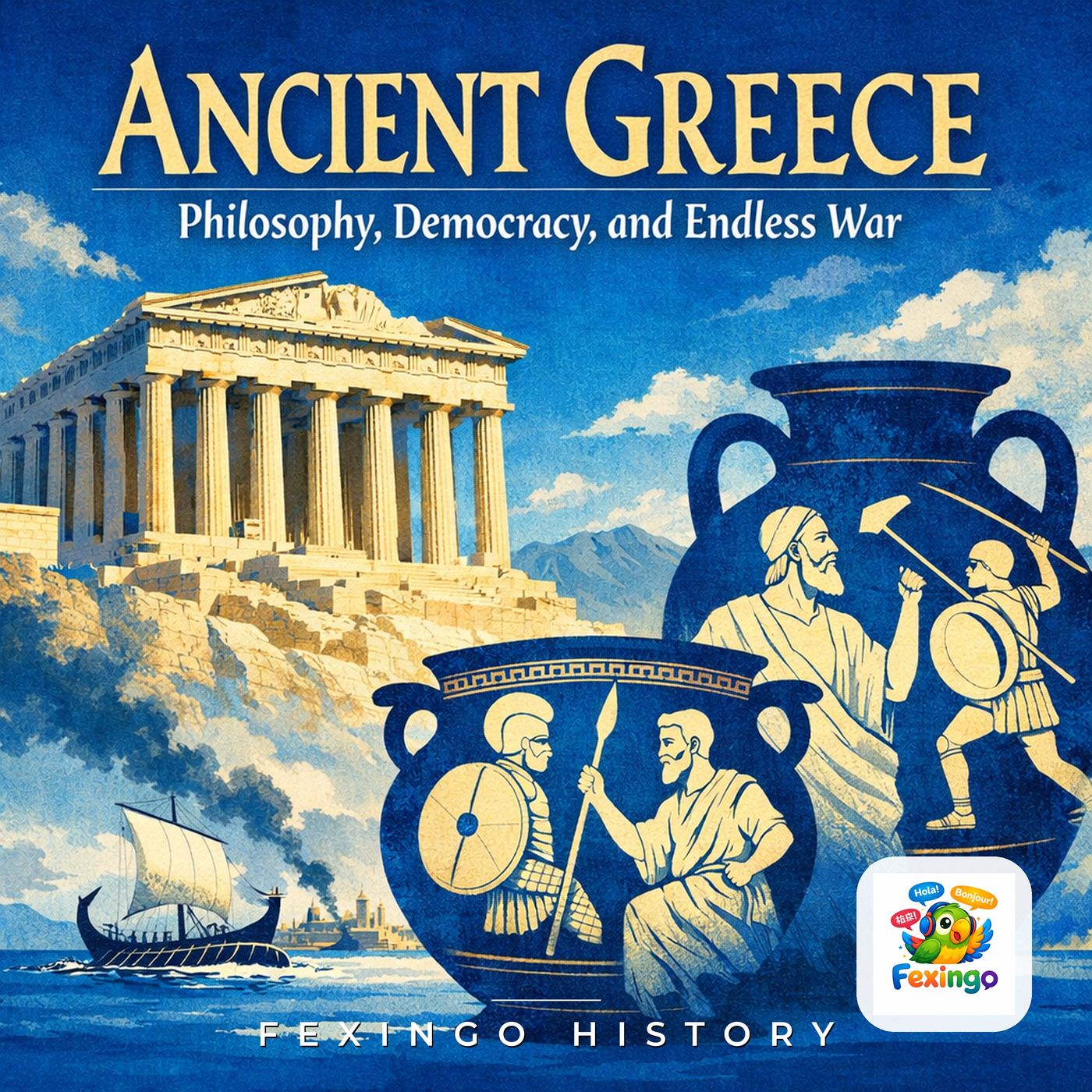
Ancient Greece: Philosophy, Democracy, and Endless War — Fexingo History
by Fexingo
Ancient Greece: Philosophy, Democracy, and Endless War plunges into the crucible of Western civilization, where city-states clashed, thinkers questioned everything, and democracy was born—and died. From the Mycenaean palaces of the Bronze Age to the rise of Athens under Pericles, hosts Lucas and Luna guide you through the Persian Wars, the Peloponnesian War that tore Hellas apart, and the campaigns of Alexander the Great that stretched from the Ionian Sea to the Indus. Explore the intellectual revolutions of Socrates, Plato, and Aristotle, whose ideas still shape how we reason and govern. Witness the brutal realities of the Delian League, the Spartan helot system, the plague of Athens, and the trial and execution of Socrates. Delve into daily life in the agora, the roles of women and slaves, the Olympic Games, and the mysteries of the Eleusinian cults. This show treats Greece not as a marble ideal but as a vibrant, often violent, world of competing visions—oligarchy vs. democracy, Athe
-
34
Thrasybulus and the Restoration of Athenian Democracy
In 404 BCE, after Athens' catastrophic defeat in the Peloponnesian War, a brutal oligarchy called the Thirty Tyrants seized power with Spartan backing. This episode focuses on Thrasybulus, the exiled democratic leader who refused to surrender. From his base at Phyle, a small fortress in northern Attica, he gathered a band of exiles and launched a resistance that culminated in the Battle of Munychia and the restoration of democracy in 403 BCE. We explore the political maneuvering, the amnesty decree that prevented civil war, and how Athens rebuilt its institutions. Along the way, we discuss the roles of Critias, the violent leader of the Thirty, and the Spartan king Pausanias. This is a story of resilience, compromise, and the fragile nature of democratic governance. #Thrasybulus #ThirtyTyrants #AthenianDemocracy #Phyle #Munychia #Critias #Pausanias #Sparta #PeloponnesianWar #Amnesty #403BCE #Ekklesia #Boule #AncientGreece #FexingoHistory #History #GreekHistory #Athens Keep every episode free: buymeacoffee.com/fexingo
-
33
Alcibiades: Athens' Most Dazzling and Dangerous Man
Alcibiades was the most charismatic, ambitious, and controversial figure of ancient Athens. A brilliant general, a shameless turncoat, and the man who almost single-handedly turned the Peloponnesian War into a personal drama. In this episode, Lucas and Luna explore his life: his youth under Pericles' guardianship, his wild political rise, the fateful Sicilian Expedition he championed, his astonishing defections to Sparta and Persia, and his final, murky end at the hands of assassins. Along the way they touch on his influence on Socrates (who saved his life at Potidaea), his manipulation of Athenian democracy, and his legendary acts of betrayal. This is not just a biography — it's a case study in how one man's brilliance and cynicism could shape the fate of an empire. Plus, why so many ancient historians — Thucydides, Plutarch, Nepos — couldn't stop writing about him. #Alcibiades #PeloponnesianWar #SicilianExpedition #Sparta #Athens #Socrates #Thucydides #Plutarch #Nicias #Hermai #Potidaea #Decelea #AncientGreece #History #FexingoHistory #Generals #Betrayal #Democracy Keep every episode free: buymeacoffee.com/fexingo
-
32
The Lamian War: Athens' Last Stand for Freedom
In 323 BCE, news of Alexander the Great's death sparked a desperate rebellion in Athens. Led by the mercenary general Leosthenes and the orator Hypereides, the Athenians rallied other Greek states to throw off Macedonian rule. This episode unpacks the Lamian War — named after the siege of Lamia — and Athens' final bid for independence. We explore the political maneuvering in the Ekklesia, the role of the Athenian navy, the crushing defeat at Krannon, and the brutal reprisals that followed. Figures like Antipater, Phocion, and Demades take center stage. The war ended with Athens losing its democracy and a Macedonian garrison installed at Piraeus. A tragic but pivotal chapter often overlooked in the shadow of Alexander. #LamianWar #Leosthenes #Hypereides #Antipater #Phocion #Demades #Athens #Macedonia #Krannon #Lamia #323BCE #Hellenistic #GreekHistory #AncientGreece #AthenianDemocracy #Mercenary #WarHistory #FexingoHistory Keep every episode free: buymeacoffee.com/fexingo
-
31
The Ekklesia and the Kleroterion: Random Selection in Athenian Democracy
In this episode, Lucas and Luna explore the machinery of Athenian direct democracy: the Ekklesia (the citizen assembly) and the kleroterion (the allotment machine). They discuss how random selection was used to fill most public offices, from jurors to magistrates, and how this system aimed to prevent corruption and ensure broad civic participation. Lucas explains the role of the boule (the council of 500), the prytaneis (the executive committee), and the process of sortition versus election. The episode also touches on the tensions between lottery and elite influence, the reforms of Cleisthenes, and the philosophical debates about democracy recorded by Aristotle and Plato. Specific terms include the kleroterion, the boule, the prytaneion, allotment, sortition, and the dikasteria (jury courts). The hosts connect these ancient practices to modern ideas of random selection in citizen assemblies. #Ekklesia #Kleroterion #AthenianDemocracy #Sortition #Cleisthenes #Aristotle #Plato #Boule #Prytaneis #Dikasteria #Lottery #AncientGreece #DirectDemocracy #CivicParticipation #PoliticalInnovation #Athens #History #FexingoHistory Keep every episode free: buymeacoffee.com/fexingo
-
30
The Cylon Conspiracy: Athens' Bloody Curse and the Alcmaeonids
Long before Cleisthenes reformed democracy, Athens was haunted by a bloody religious curse that shaped its politics for generations. This episode traces the Cylonian conspiracy of 632 BCE, when an Olympic victor attempted a coup, and the subsequent massacre of his followers by the Alcmaeonid family. We explore how this act of sacrilege — the killing of suppliants at Athena's altar — created a hereditary stain (the 'Cylonian miasma') that enemies used to discredit Alcmaeonid politicians like Pericles for over a century. Lucas and Luna discuss the political machinations behind the curse, its role in the exile of Cleisthenes, and how Sparta used it as a pretext to invade Athens in 508 BCE. Along the way, we touch on the Athenian archonship, the Areopagus, Solon’s reforms, and the uneasy intersection of religion and politics in ancient Greece. #Cylon #CylonianConspiracy #Alcmaeonidae #Alcmaeonids #Pericles #Cleisthenes #Athens #AncientGreece #AthenianCurse #Sacrilege #Solon #Areopagus #Archonship #Megacles #Miasma #History #FexingoHistory #GreekHistory Keep every episode free: buymeacoffee.com/fexingo
-
29
The Boeotian League: Federalism Before Its Time
When we think of ancient Greek politics, we usually imagine Athens' radical democracy or Sparta's rigid oligarchy. But there was a third way: federalism. The Boeotian League, led by Thebes, created a sophisticated system of regional governance where member cities shared power, raised armies together, and minted common coinage. This episode explores how the league worked—its federal council, the Boeotarchs who commanded its forces, and the rotating military districts that balanced Theban dominance with local autonomy. We focus on the 4th century BCE, when the league, under Epaminondas and Pelopidas, defeated Sparta at Leuctra and briefly made Thebes the leading power in Greece. We also examine how the league handled border disputes, hosted the Panathenaea-style festivals, and why its federal model later inspired the Achaean and Aetolian Leagues. But it wasn't perfect—internal tensions, especially with cities like Orchomenus and Plataea, showed the fragility of unity. And its ultimate failure to stand against Philip II of Macedon at Chaeronea in 338 BCE marked the end of Greek independence. Join us as we unpack a forgotten chapter of Greek political innovation. #BoeotianLeague #Thebes #AncientGreece #Federalism #Epaminondas #Leuctra #Pelopidas #Orchomenus #Plataea #Boeotarch #Chaeronea #PhilipII #SacredBand #Hellenica #Xenophon #PoliticalHistory #History #FexingoHistory Keep every episode free: buymeacoffee.com/fexingo
-
28
The Parthenon Marbles: Beauty, Plunder, and a 200-Year-Old Dispute
In this episode, Lucas and Luna explore the story of the Parthenon Marbles—the magnificent sculptures that once adorned the Parthenon on the Athenian Acropolis. They trace the marbles' creation under the direction of Phidias in the 5th century BCE, their survival through centuries of transformation (from temple to church to mosque), and their controversial removal by Thomas Bruce, the 7th Earl of Elgin, in the early 1800s. The conversation dives into the legal and ethical debates surrounding the marbles' current home in the British Museum, the Greek campaign for their return, and the cultural significance of the sculptures as symbols of Greek heritage. Along the way, they touch on the Acropolis Museum's modern role in displaying the originals alongside casts, and the shifting public opinion on repatriation. This episode assumes some familiarity with ancient Athens but offers a focused look at a living controversy that bridges ancient history and modern politics. #ParthenonMarbles #ElginMarbles #BritishMuseum #AcropolisMuseum #Phidias #Athens #Greece #Repatriation #CulturalHeritage #ClassicalSculpture #AncientGreece #Acropolis #ThomasBruce #LordElgin #MuseumEthics #HistoryDebate #FexingoHistory #History Keep every episode free: buymeacoffee.com/fexingo
-
27
The Athenian Agora: Politics, Trade, and Everyday Life
In this episode, Lucas and Luna explore the Athenian Agora, the bustling heart of classical Athens. They discuss its role as a political, commercial, and social hub, from the Stoa Poikile where Zeno taught Stoicism to the tholos where the prytaneis dined. They cover the archaeology of the site, including the Panathenaic Way and the boundary stones that marked the Agora's limits. The conversation touches on the everyday life of Athenians—shopping for fish, hearing court cases, and gossiping in the stoas. They also delve into the Agora's role in ostracism, where citizens scratched names on pottery shards called ostraka. Key figures like Socrates and Pericles are mentioned in the context of their Agora activities. The episode ends with a reflection on how this space embodied Athenian democracy and culture. #AthenianAgora #AncientGreece #Agora #StoaPoikile #Stoicism #Zeno #Tholos #Prytaneis #PanathenaicWay #Ostraka #Ostracism #Socrates #Pericles #GreekDemocracy #AncientMarket #Athens #History #FexingoHistory Keep every episode free: buymeacoffee.com/fexingo
-
26
The Athenian Ostracism: When Democracy Exiled Its Own
In this episode, Lucas and Luna explore the fascinating practice of ostracism in ancient Athenian democracy. Unlike modern exile or imprisonment, ostracism was a uniquely democratic tool — a once-a-year vote where citizens could banish any politician for ten years, without trial or accusation of a crime. We trace its origins to the reforms of Cleisthenes in 508 BCE, examine the famous ostraca (pottery shards) inscribed with names like Themistocles and Aristides the Just, and discuss the political machinations behind the votes. Why did Athens exile its most capable general, Themistocles, just after his victory at Salamis? How did a illiterate voter ask Aristides to ostracize himself? We also look at the less-known 'last ostracism' of Hyperbolus in 417 BCE, which backfired when rival factions united against him. This episode reveals how ostracism acted as a safety valve for democratic tensions — and sometimes as a weapon of political vendetta. Join us as we sift through the shards of Athens's most peculiar institution. #AncientGreece #AthenianDemocracy #Ostracism #Cleisthenes #Themistocles #Aristides #Hyperbolus #Agora #Ostraka #Kerameikos #Alcibiades #Nicias #Ekklesia #PeloponnesianWar #History #FexingoHistory #GreekHistory #PoliticalExile Keep every episode free: buymeacoffee.com/fexingo
-
25
Aspasia of Miletus: The Woman Who Shaped Periclean Athens
We all know Pericles — the general, the orator, the man who turned Athens into a democracy. But behind him stood a woman who was arguably the most influential intellectual in Athens: Aspasia of Miletus. A foreigner, a metic, and a woman in a city that excluded women from public life, Aspasia ran a salon that attracted Socrates, Sophists, and the city's elite. She taught rhetoric, shaped Pericles' speeches — including the famous Funeral Oration — and was so powerful that comedians mocked her as a brothel-keeper and politicians blamed her for wars. But what do we actually know about her? The sources are thin, hostile, and written by men. In this episode, Lucas and Luna sort the facts from the slander. They explore her role as a teacher, her relationship with Pericles, the citizenship law that made her an outsider, and why she remains a symbol of female intellect in a deeply patriarchal world. Plus: the lost dialogues that might have preserved her voice, and the ancient graffiti that calls her 'the new Omphale.' #AspasiaOfMiletus #Pericles #AncientGreece #AthenianWomen #Metic #FuneralOration #Socrates #GreekRhetoric #Plutarch #Comedy #CitizenshipLaw #Omphale #History #FexingoHistory #GreekPhilosophy #ClassicalAthens #WomenInHistory #Miletus Keep every episode free: buymeacoffee.com/fexingo
-
24
Themistocles at Salamis The Naval Genius Who Saved Greece
In 480 BCE, the Persian Empire under Xerxes I descended on Greece with an overwhelming force. While most Greeks looked to Sparta for land defense, one Athenian politician saw that the future lay at sea. Themistocles, the brilliant and controversial figure from earlier episodes, masterminded a naval strategy that would culminate in the Battle of Salamis. This episode explores how he convinced the Athenians to build a fleet, tricked the Persians into fighting in narrow straits, and won a victory that preserved Greek independence. We examine the trireme tactics, the role of Aristides, the deception of Sicinnus, and the aftermath where Themistocles' foresight reshaped the balance of power. We also confront the darker side: the evacuation of Athens, the destruction of the Acropolis, and the casualties of war. A story of strategy, courage, and the birth of Athenian naval dominance. #Themistocles #BattleOfSalamis #Xerxes #PersianWars #Trireme #NavalWarfare #AncientGreece #Aristides #Sicinnus #AthenianNavy #StraitOfSalamis #Herodotus #Aeschylus #Phocaean #Psyttaleia #GreekHistory #History #FexingoHistory Keep every episode free: buymeacoffee.com/fexingo
-
23
Socrates and the Corruption of Athenian Youth
In 399 BCE, the Athenian philosopher Socrates was put on trial and executed for impiety and corrupting the youth. This episode explores the political and personal context behind his conviction. We look at his accusers—Meletus, Anytus, and Lycon—and their motivations, from resentment over Socrates's association with the Thirty Tyrants to his relentless questioning of democratic leaders. We discuss the amnesty of 403 BCE after the fall of the Thirty, which protected former oligarchs, and how Socrates's indictments may have been a way to attack him indirectly. The trial itself, preserved in Plato's Apology, reveals a man who refused to compromise his principles, even when offered a chance to flee. We also touch on the role of the sophists, the Athenian jury system, and the legacy of Socrates as a martyr for free thought. This is not a rehash of his philosophy, but a look at the gritty legal and political maneuvering that ended his life. #Socrates #AthenianTrial #399BCE #Plato #Apology #Meletus #Anytus #ThirtyTyrants #Amnesty #Impiety #CorruptingYouth #AncientGreece #Philosophy #Democracy #Athens #History #FexingoHistory #FreeSpeech Keep every episode free: buymeacoffee.com/fexingo
-
22
Athens' Silver Windfall That Built a Navy
In the early 480s BCE, Athens discovered an immense vein of silver at the Laurion mines. This windfall sparked a fierce political debate: should the city distribute the wealth to its citizens or invest it in something far more ambitious? Lucas and Luna explore how a single proposal by a controversial leader transformed the silver into a fleet of 200 triremes, setting the stage for the Persian Wars and eventual Athenian naval dominance. They examine the role of slave labor in the mines, the engineering of the trireme, and the political maneuvering that led to this historic decision. The episode also touches on the social impact of mining, the innovations in shipbuilding, and how this naval buildup forever altered the balance of power in Greece. Listeners will gain a fresh perspective on a pivotal moment that is often overshadowed by more famous battles and leaders. #Laurion #SilverMines #AthenianNavy #Trireme #Themistocles #PersianWars #AncientGreece #MaritimeHistory #SlaveLabor #ClassicalAthens #NavalWarfare #SilverTrade #AthenianDemocracy #AncientEconomy #FexingoHistory #History #PeloponnesianWar #GreekHistory #Athens #Sparta Keep every episode free: buymeacoffee.com/fexingo
-
21
Pheidippides: The Run That Created a Legend
This episode peels back the myth of the marathon to uncover the real Pheidippides — not the dying messenger of popular imagination, but a long-distance runner dispatched by Athens to Sparta before the Battle of Marathon in 490 BCE. Lucas and Luna explore what Herodotus actually wrote: Pheidippides covered nearly 150 miles in two days to beg for Spartan help, then vanished from the historical record. They trace how his story morphed over millennia — from a footnote in Persian Wars history to the centerpiece of a modern Olympic event invented by French classicist Michel Bréal. Along the way, they discuss Spartan religious scruples, the cult of Pan, the Athenian phalanx, and why a 26.2-mile race commemorates a run that probably never happened. This is an episode about how history becomes myth, and how a real man's extraordinary feat got swallowed by a better story. #Pheidippides #Marathon #BattleOfMarathon #Herodotus #AncientGreece #Athens #Sparta #Pan #Phalanx #Olympics #MichelBrAl #PersianWars #Darius #GreekMyths #LongDistanceRunning #History #FexingoHistory #Podcast #AlexanderTheGreat #Pericles Keep every episode free: buymeacoffee.com/fexingo
-
20
The Delphic Oracle: Inside Ancient Greece's Most Powerful Prophecy
In this episode, Lucas and Luna explore the Delphic Oracle, the most influential prophetic institution in ancient Greece. They trace its origins at the sanctuary of Apollo near Mount Parnassus, describe the enigmatic Pythia—a woman who delivered cryptic prophecies in a frenzied state—and examine the political and personal consultations that shaped history. The conversation covers the geological theories behind the oracle's trance (ethylene gas, according to recent research by de Boer and Hale), the role of the Delphic priesthood in crafting ambiguous responses, and key episodes such as Croesus's test of the oracle in the 6th century BCE, the oracle's advice to Sparta before the Persian Wars, and its controversial stance during the Peloponnesian War. They also touch on the decline of Delphi under Roman rule and the legacy of the oracle's pithy sayings like 'know thyself.' This episode offers a concrete, science-informed look at a cornerstone of Greek religion and statecraft. #DelphicOracle #Pythia #AncientGreece #GreekReligion #Apollo #Delphi #Prophetesses #Oracles #Croesus #PersianWars #PeloponnesianWar #EthyleneGas #DeBoerHale #KnowThyself #GreekHistory #FexingoHistory #History #Podcast #Athens #Sparta Keep every episode free: buymeacoffee.com/fexingo
-
19
The Real Cleisthenes: How Athens Invented Democracy
Cleisthenes is often called the father of Athenian democracy, but his reforms were less about noble ideals and more about breaking the power of aristocratic clans. This episode unpacks the messy, pragmatic origins of demokratia in 508/507 BCE. We explore how Cleisthenes, an exiled Alcmaeonid, outmaneuvered his rival Isagoras with the help of the Athenian demos, then redesigned the city's tribal system — replacing the old four Ionian tribes with ten new ones based on demes, trittyes, and phylai. This re-organization diluted clan loyalties and created a new civic identity. We also discuss the role of the Boule of 500, the Prytaneis, ostracism (first used later against Hipparchus), and the surprising continuity of Cleisthenes' system for nearly two centuries. Why did this fragile experiment succeed where earlier reforms failed? And what did 'democracy' actually mean when women, slaves, and metics were excluded? Join Lucas and Luna as they trace the birth of the institution that reshaped the Western world — one pragmatic power grab at a time. #Cleisthenes #AthenianDemocracy #AncientGreece #Isagoras #Alcmaeonid #508BCE #Boule #Prytaneis #Deme #Trittys #Phyle #Ostracism #AncientAthens #AthenianPolitics #History #FexingoHistory #Demokratia #GreekHistory #Athens #Sparta Keep every episode free: buymeacoffee.com/fexingo
-
18
Plato's Academy and the Invention of Higher Learning
In this episode of Ancient Greece: Philosophy, Democracy, and Endless War, Lucas and Luna explore the founding of Plato's Academy around 387 BCE in Athens. They discuss how Plato, inspired by Socrates' death and his travels to Syracuse, established the first institution of higher learning in the Western world. The episode covers the Academy's curriculum—astronomy, mathematics, philosophy—and its famous students, including Aristotle. They delve into the controversy over Plato's alleged sale of the philosopher Speusippus into slavery, the Academy's survival for nearly 900 years until it was closed by Emperor Justinian, and its lasting legacy in shaping Western education. The dialogue also touches on the differences between Plato's Academy and modern universities, the role of women (like Axiothea and Lastheneia), and the famous 'Let no one ignorant of geometry enter' inscription. #Plato #Academy #Athens #AncientGreece #Philosophy #Aristotle #Socrates #HigherEducation #Mathematics #Astronomy #Speusippus #Xenocrates #Akademeia #Hecademia #Justinian #Axiothea #FexingoHistory #History #Sparta #AlexanderTheGreat Keep every episode free: buymeacoffee.com/fexingo
-
17
Alexander the Great: The Siege of Tyre That Shaped an Empire
In this episode, Lucas and Luna explore Alexander the Great's legendary seven-month siege of Tyre in 332 BCE. They break down how Alexander used a mole (causeway), siege towers, and naval tactics to capture the seemingly impregnable island city. The conversation covers the Tyrians' desperate defense, Alexander's motivation to secure his supply lines and eliminate the Persian fleet, and the brutal aftermath. They also touch on Alexander's deployment of hypaspists and the role of his engineer Diades. The episode challenges the myth of Alexander's invincibility by highlighting the cost and strategic brilliance behind this pivotal campaign. #AlexanderTheGreat #SiegeOfTyre #MacedonianEmpire #AncientWarfare #SiegeCraft #Diades #Hypaspists #PersianEmpire #DariusIII #MediterraneanHistory #HellenisticPeriod #Phoenicia #Causeway #SiegeTowers #NavalTactics #History #FexingoHistory #ClassicalAntiquity #AncientGreece #Athens Keep every episode free: buymeacoffee.com/fexingo
-
16
Thucydides: The General Who Wrote History as a Science
In this episode, Lucas and Luna explore the life and work of Thucydides, the Athenian general whose account of the Peloponnesian War transformed history writing. They discuss his decision to document the war as it unfolded, his rigorous methodology—relying on eyewitness testimony and cross-examination—and his famous analysis of power, justice, and human nature in the Melian Dialogue. The conversation also covers Thucydides' exile, his unfinished manuscript, and why his History remains a cornerstone of political realism. Specific terms include the Peloponnesian War, Athens, Sparta, Pericles, Cleon, Brasidas, the plague, the Melian Dialogue, and the concept of κτῆμα ἐς ἀεί (a possession for all time). This episode does not rehash earlier biographical details of Socrates or Pericles but focuses on Thucydides as a historian and thinker. #Thucydides #PeloponnesianWar #HistoryWriting #AncientGreece #Athens #Sparta #MelianDialogue #Pericles #Cleon #Brasidas #PlagueOfAthens #PoliticalRealism #Historiography #AncientHistorians #GreekHistory #WarAndPeace #FexingoHistory #History #AlexanderTheGreat #Socrates Keep every episode free: buymeacoffee.com/fexingo
-
15
Pisistratus and the Birth of Athenian Tyranny
Before Cleisthenes and democracy, Athens was shaped by the tyrant Pisistratus. In this episode, Lucas and Luna explore how he seized power three times, transformed the city's economy, and laid the groundwork for Athenian greatness. They discuss his use of popular support, the Panathenaic Festival, state-sponsored art, and the first standardized coinage. They also examine the ambiguous legacy of tyranny in Greek political thought — how Pisistratus's autocratic rule paradoxically strengthened the demos and set the stage for the reforms of Cleisthenes. Along the way, they touch on sources like Herodotus and Aristotle's Constitution of the Athenians, the roles of Solon and Megacles, and the archaeological evidence from the Agora. It's a nuanced look at a pivotal figure who doesn't fit neatly into modern categories of ruler and reformer. #Pisistratus #AncientGreece #Athens #Tyranny #GreekHistory #Panathenaea #Solon #Cleisthenes #Herodotus #Aristotle #ConstitutionOfTheAthenians #ArchaicPeriod #Democracy #HomericPoems #AthenianCoinage #Peisistratids #History #FexingoHistory #Sparta #AlexanderTheGreat Keep every episode free: buymeacoffee.com/fexingo
-
14
Aspasia: The Woman Who Shaped Pericles' Athens
In this episode of Ancient Greece: Philosophy, Democracy, and Endless War, Lucas and Luna explore the life and influence of Aspasia of Miletus, one of the most remarkable yet often overlooked figures of the Golden Age. Arriving in Athens around 450 BCE, Aspasia became the companion of Pericles, the city's leading statesman. As a metic (resident alien) and a woman, she had no political rights, yet she was renowned for her intellect and rhetorical skill. Plato's 'Menexenus' credits her as the author of Pericles' famous Funeral Oration, and she is said to have taught Socrates himself. But Aspasia was also a target—comedians like Aristophanes mocked her as a manipulative courtesan, while her enemies accused her of corrupting Athenian women and even provoking the Peloponnesian War. Lucas and Luna untangle the fact from the fiction, drawing on sources from Plutarch to Old Comedy. They discuss her probable role as a hetaera, her salon of intellectuals, and the trial for impiety (asebeia) that threatened her life. Was Aspasia a feminist icon ahead of her time, or a convenient scapegoat? This episode offers a nuanced portrait of a woman who navigated the strictures of Athenian society to become a power behind the throne. #Aspasia #Pericles #Athens #AncientGreece #GoldenAge #Miletus #Hetaera #Socrates #FuneralOration #OldComedy #Aristophanes #Plutarch #Plato #PeloponnesianWar #Asebeia #Metic #WomenInHistory #FexingoHistory #Sparta #AlexanderTheGreat Keep every episode free: buymeacoffee.com/fexingo
-
13
The Real Socrates: Gadfly, Martyr, or Political Pawn
Socrates is often called the father of Western philosophy, but who was the man behind the legend? In this episode, we peel back the layers of myth to examine the historical Socrates — not the Plato-sanitized version, but the real Athenian citizen who walked barefoot through the Agora, questioned everyone, and was eventually sentenced to death by his own city. We explore his early life as a stonemason, his military service at Potidaea and Delium alongside the historian Xenophon, his relationship with the Delphic oracle and the famous 'Socratic ignorance,' and the political context of his trial in 399 BCE. Why did Athens, fresh from the Peloponnesian War and the bloody rule of the Thirty Tyrants, choose to silence its most famous critic? We examine the accusers — Meletus, Anytus, and Lycon — and the charges of impiety and corrupting the youth. Was Socrates truly a threat, or was he a convenient scapegoat for Athens's post-war anxieties? We also discuss the conflicting portraits from Plato, Xenophon, and the comic playwright Aristophanes, whose play The Clouds may have poisoned the well. Finally, we consider his legacy: how the man who wrote nothing became the most influential philosopher in history. #Socrates #AncientGreece #Athens #Philosophy #GreekHistory #TrialOfSocrates #Plato #Xenophon #Aristophanes #DelphicOracle #ThirtyTyrants #PeloponnesianWar #Potidaea #Delium #Meletus #Anytus #History #FexingoHistory #Sparta #AlexanderTheGreat Keep every episode free: buymeacoffee.com/fexingo
-
12
The Athenian Ostracism: Exile by Popular Vote
In 5th-century Athens, ostracism wasn't a punishment for crimes—it was a political tool to exile perceived threats without trial. Each year, citizens could vote to banish someone for ten years by writing a name on a pottery shard (ostrakon). This episode explores the origins, mechanics, and controversies of ostracism, from the first known exile of Hipparchus in 487 BC to the famous case of Themistocles, who was ostracized around 471 BC after his victory at Salamis. We discuss how ostracism prevented tyranny but also targeted popular leaders like Aristides, who was reportedly ostracized because voters tired of hearing him called 'the Just'. The practice faded after the Peloponnesian War. We'll also examine surviving ostraka—over 10,000 have been found in the Athenian agora—and what they reveal about ancient Greek politics, literacy, and even humor. Join Lucas and Luna as they dig into the shards of democracy's most peculiar institution. #Ostracism #AthenianDemocracy #AncientGreece #Aristides #Themistocles #Hipparchus #Ostrakon #Agora #Cleisthenes #Kerameikos #PeloponnesianWar #Tyranny #OstracismAthens #GreekHistory #FexingoHistory #Podcast #History #ClassicalGreece #Athens #Sparta Keep every episode free: buymeacoffee.com/fexingo
-
11
The Peloponnesian War's Final Act: Lysander and Athens' Fall
In this episode, Lucas and Luna explore the final years of the Peloponnesian War, focusing on the Spartan admiral Lysander and his decisive campaign that shattered Athenian power. They discuss Lysander's rise, his cunning diplomacy with Persia, the devastating naval battle at Aegospotami in 405 BCE, and the brutal siege that led to Athens' surrender in 404 BCE. The episode covers the destruction of the Long Walls, the installation of the Thirty Tyrants, and the war's legacy—how Athens' brief experiment with radical democracy was extinguished, only to be restored a year later. Drawing on sources like Xenophon's Hellenica and Diodorus Siculus, Lucas and Luna unpack the strategic genius of Lysander, the role of Persian gold, and the human cost of total war. They also touch on the controversial trial of the generals after Arginusae and the culture of sycophancy that plagued Athens in its final years. This is a story of hubris, betrayal, and the brutal calculus of empire. #PeloponnesianWar #Lysander #Aegospotami #Athens #Sparta #ThirtyTyrants #Xenophon #DiodorusSiculus #LongWalls #Arginusae #PersianGold #CyrusTheYounger #AncientGreece #GreekHistory #NavalWarfare #Democracy #FexingoHistory #History #AlexanderTheGreat #Pericles Keep every episode free: buymeacoffee.com/fexingo
-
10
The Plague of Athens and Its Fallout
In 430 BCE, as Athens was locked in the Peloponnesian War, a devastating plague struck the city, killing perhaps a third of its population, including Pericles. This episode explores the outbreak's origins, symptoms as described by Thucydides, the social breakdown it caused, and its long-term political consequences. Lucas and Luna discuss how the plague undermined Athens' democratic institutions, fueled internal strife, and contributed to the city's eventual defeat. They also touch on recent scientific attempts to identify the pathogen and the eerie parallels to modern pandemics. #PlagueOfAthens #Thucydides #Pericles #PeloponnesianWar #AncientGreece #Athens #Epidemiology #Democracy #History #FexingoHistory #Piraeus #Hippocrates #Typhus #Ebola #SocialBreakdown #430BCE #Sparta #GreekHistory #AlexanderTheGreat #Socrates Keep every episode free: buymeacoffee.com/fexingo
-
9
The Real Life of a Greek Hetaira: Power and Prejudice
In this episode, Lucas and Luna explore the life of Neaira, a hetaira in 4th century BCE Athens, through the lens of the famous court case Against Neaira by Apollodoros. They discuss the blurred lines between hetairai, pornai, and pallakai, the legal and social constraints on women in Athens, and how Neaira's trial reveals the double standards of Athenian democracy. From her early life as a slave in Corinth under Nikarete to her partnership with Stephanos and the accusation of falsely claiming citizenship, this episode uncovers a rare female voice from antiquity. The conversation also touches on the role of sycophants, the importance of citizenship in Athens, and the legacy of the case for understanding gender and class in ancient Greece. #Neaira #Hetaira #AncientGreece #Athens #Apollodoros #AgainstNeaira #GreekWomen #Prostitution #Citizenship #4thCenturyBCE #Corinth #Stephanos #GreekLaw #Sycophants #GenderRoles #AthenianDemocracy #History #FexingoHistory #Sparta #AlexanderTheGreat Keep every episode free: buymeacoffee.com/fexingo
-
8
The Spartan Mirage: How Helot Labor Built a Warrior State
Episode 9 of Ancient Greece: Philosophy, Democracy, and Endless War peels back the myth of Sparta. While popular imagination conjures elite warriors and Spartan mothers, the reality rested on a brutal foundation: the helots, a vast enslaved population subjugated through terror and state-sanctioned violence. Lucas and Luna explore the helot system—how it shaped Spartan society, the infamous Krypteia death squads that kept helots in check, and the constant fear of rebellion that dictated Spartan foreign policy. They unpack the Messenian Wars, the Tainaron sanctuary where helots could seek asylum, and the strange institution of the Helot as a literal bogeyman for Spartan children. How did a city with one of the largest slave populations in Greece maintain control for centuries? And what does the helot economy reveal about the 'Spartan mirage'—the idealized image of Sparta that still influences Western thought? This episode challenges listeners to see Sparta not as a land of free warriors, but as a society built on systemic oppression that ultimately contributed to its decline. #Sparta #Helots #MessenianWars #Krypteia #Tainaron #AncientGreece #GreekHistory #SpartanSociety #HelotRebellion #Lycurgus #HelotEconomy #SpartanMyth #ClassicalGreece #History #FexingoHistory #AncientSlavery #Peloponnese #Tyrtaeus #Athens #AlexanderTheGreat Keep every episode free: buymeacoffee.com/fexingo
-
7
The Mysteries of Eleusis: Ancient Greece's Secret Cult
In this episode, Lucas and Luna explore the Eleusinian Mysteries, ancient Greece's most famous secret religious rites. They discuss the myth of Demeter and Persephone, the telesterion hall, the roles of the hierophant and mystai, and the sacred kykeon drink. They touch on how the mysteries offered hope of an afterlife and were celebrated by figures like Plato, Aristotle, and even Roman emperors. The conversation also delves into the little-known site of Eleusis, the Greater and Lesser Mysteries, and the theory that the kykeon contained a psychedelic ergot. Learn why these rites were shrouded in secrecy and how they influenced later spiritual traditions. #EleusinianMysteries #Demeter #Persephone #Telesterion #Hierophant #Kykeon #Ergot #AncientGreekReligion #MysteryCults #Eleusis #GreaterMysteries #LesserMysteries #Afterlife #Plato #Aristotle #GreekMythology #History #FexingoHistory #AncientGreece #Athens Keep every episode free: buymeacoffee.com/fexingo
-
6
Sophocles and the Birth of Greek Tragedy
This episode of Ancient Greece: Philosophy, Democracy, and Endless War turns from politics and warfare to the theatre. Lucas and Luna explore how Athenian tragedy emerged from religious festivals, focusing on the revolutionary playwright Sophocles. They discuss the origins of tragedy in dithyrambic choruses, the innovation of the third actor, and how Sophocles' plays like Oedipus Rex and Antigone explored timeless themes of fate, justice, and human fallibility. They also touch on the civic role of theatre in 5th-century Athens, the competition at the City Dionysia, and how the plays reflected contemporary anxieties about democracy and empire. Along the way, they mention key figures like Aeschylus and Euripides, and technical terms like mimesis, catharsis, and the deus ex machina. The episode provides a fresh angle on Athenian culture, showing how theatre was not mere entertainment but a vital part of democratic discourse. #Sophocles #GreekTragedy #AthenianTheatre #OedipusRex #Antigone #CityDionysia #Aeschylus #Euripides #Catharsis #Mimesis #DeusExMachina #Athens #GoldenAge #Drama #GreekCulture #History #FexingoHistory #AncientGreece #Sparta #AlexanderTheGreat Keep every episode free: buymeacoffee.com/fexingo
-
5
Alcibiades: The Most Dangerous Man in Athens
This episode dives into the dazzling and destructive career of Alcibiades, the Athenian aristocrat who defected to Sparta, then Persia, and back to Athens—all within a decade. We explore his role in the Sicilian Expedition, his manipulation of the Hermai mutilation scandal, and how his personal ambition repeatedly reshaped the Peloponnesian War. Lucas and Luna discuss his charisma, his strategic mind, and why Thucydides called him a man whose private vices mirrored public catastrophes. We touch on his relationship with Socrates, his exile, and his eventual assassination in Phrygia. A story of betrayal, brilliance, and the fragility of democratic loyalty. #Alcibiades #PeloponnesianWar #SicilianExpedition #Athens #Sparta #Persia #Tissaphernes #Thucydides #Socrates #Hermai #Mutilation #Democracy #Oligarchy #Phrygia #AncientHistory #GreekHistory #FexingoHistory #History #AncientGreece #AlexanderTheGreat Keep every episode free: buymeacoffee.com/fexingo
-
4
Pericles and the Golden Age of Athens
In this episode of Ancient Greece: Philosophy, Democracy, and Endless War, we explore the pinnacle of Athenian power under Pericles. From his rise to prominence in the 450s BCE to his death from plague in 429 BCE, Pericles transformed Athens into a cultural and imperial giant. We discuss his citizenship law of 451 BCE, which tightened the definition of who was Athenian; his use of Delian League funds to build the Parthenon and other monuments; his strategy of walling Athens to the sea; and the tensions that led to the Peloponnesian War. Along the way, we meet his contemporaries like the sculptor Phidias, the playwright Sophocles, and the historian Thucydides, whose account of Pericles' Funeral Oration remains one of history's most famous speeches. We also grapple with the contradictions: Athenian democracy was a direct democracy for citizens, but women had no political rights, and the empire was brutally maintained. This episode offers a nuanced look at a man and an era that shaped the Western imagination. #Pericles #GoldenAgeOfAthens #AthenianDemocracy #Parthenon #DelianLeague #PeloponnesianWar #AncientGreece #Phidias #Sophocles #Thucydides #FuneralOration #CitizenshipLaw #Acropolis #DirectDemocracy #ClassicalGreece #History #FexingoHistory #AncientHistory #Athens #Sparta Keep every episode free: buymeacoffee.com/fexingo
-
3
The Delian League: From Alliance to Athenian Empire
In the aftermath of the Persian Wars, Athens transformed a voluntary alliance of Greek city-states into a maritime empire. This episode explores the Delian League's founding in 478 BCE, its shift from defense to domination, and the mechanisms of control—tribute, garrisons, and cleruchies. We discuss key figures like Aristides the Just, who set the initial tribute assessments, and Cimon, the conservative general who expanded the league before his ostracism. The episode also covers the pivotal revolt of Naxos (c. 469 BCE) and the transfer of the league treasury from Delos to Athens in 454 BCE, marking the open assertion of Athenian hegemony. We examine the financial exploitation through the tribute quotas (phoros) and the use of league funds for Athenian building projects like the Parthenon. The tension between democracy at home and imperialism abroad is a central theme, raising questions about power, freedom, and the tragic arc of Athenian ambition that would culminate in the Peloponnesian War. #DelianLeague #AthenianEmpire #AncientGreece #PersianWars #AristidesTheJust #Cimon #NaxosRevolt #TributeSystem #Cleruchy #Parthenon #Thucydides #Pentecontaetia #AthenianDemocracy #GreekHistory #Imperialism #History #FexingoHistory #ClassicalGreece #Athens #Sparta Keep every episode free: buymeacoffee.com/fexingo
-
2
Themistocles and the Wooden Walls: Building Athens' Navy
In this episode, Lucas and Luna dive into the rise of Themistocles, the Athenian leader who transformed Athens into a naval power before the Persian Wars. They explore the discovery of silver at Laurion in 483 BCE, the political battle over how to use the windfall, and Themistocles' controversial proposal to build 200 triremes. The conversation covers the trireme's design and tactical role, the ostracism of political rivals like Aristides, and the strategic thinking behind the 'wooden walls' oracle at Delphi. Lucas explains how this naval buildup set the stage for the Battle of Salamis and shaped the Delian League, making Athens the dominant power in the Aegean. The episode reveals how Themistocles' foresight and political maneuvering were as decisive as any battle in Greek history. #Themistocles #AthenianNavy #Trireme #LaurionSilverMines #PersianWars #BattleOfSalamis #WoodenWallsOracle #Delphi #Ostracism #Aristides #Xerxes #DelianLeague #AncientGreece #NavalHistory #MilitaryStrategy #FexingoHistory #History #Podcast #Athens #Sparta Keep every episode free: buymeacoffee.com/fexingo
-
1
Miltiades at Marathon: The Battle That Saved Athens
In 490 BCE, a Persian fleet of 600 ships landed on the plain of Marathon, just 26 miles from Athens. The Athenian assembly, led by the polemarch Callimachus and the strategos Miltiades, voted to march out and meet the invaders. Outnumbered nearly two to one, the Greek hoplites charged across a mile of open ground — and won. Lucas and Luna explore the tactical genius of Miltiades, the controversial role of the Plataeans, the mysterious absence of Sparta, and the legend of the runner Pheidippides. They discuss the political stakes: the Alcmaeonid family's suspected sympathy with Persia, the exile of Aristides, and the trial of Miltiades himself a year later. This episode also examines what the battle meant for Athenian democracy — how a citizen army's victory over an imperial power cemented the idea of free men fighting for their own city. And they ask: did Marathon really save Western civilization, or is that just a story we tell ourselves? #Marathon #Miltiades #PersianWars #AncientGreece #AthenianDemocracy #Hoplite #BattleOfMarathon #Pheidippides #DariusI #Plataea #Alcmaeonidae #Aristides #Callimachus #ClassicalGreece #MilitaryHistory #History #FexingoHistory #Podcast #Athens #Sparta Keep every episode free: buymeacoffee.com/fexingo
-
0
Socrates' Athens: The Birth of Western Thought
Lucas and Luna open the series in 399 BCE, with the trial of Socrates. They explore how a single radical thinker's refusal to stop asking questions changed everything. From the Delian League to the Peloponnesian War, from the sophists to Plato's academy, this episode lays the groundwork for philosophy, democracy, and the unending conflicts that defined ancient Greece. Lucas explains how Athens became a crucible of ideas—and how its downfall shaped Western civilization. Along the way, they touch on the oracle at Delphi, the Spartan mirage, and the art of rhetoric. A grounded, humanizing look at a world that still haunts our own. #Socrates #AncientGreece #Athens #Philosophy #Democracy #PeloponnesianWar #Plato #DelphicOracle #Sparta #Pericles #Sophists #DelianLeague #399BCE #GreekHistory #ClassicalGreece #WesternThought #History #FexingoHistory #AlexanderTheGreat #Aristotle Keep every episode free: buymeacoffee.com/fexingo
We're indexing this podcast's transcripts for the first time — this can take a minute or two. We'll show results as soon as they're ready.
No matches for "" in this podcast's transcripts.
No topics indexed yet for this podcast.
Loading reviews...
ABOUT THIS SHOW
Ancient Greece: Philosophy, Democracy, and Endless War plunges into the crucible of Western civilization, where city-states clashed, thinkers questioned everything, and democracy was born—and died. From the Mycenaean palaces of the Bronze Age to the rise of Athens under Pericles, hosts Lucas and Luna guide you through the Persian Wars, the Peloponnesian War that tore Hellas apart, and the campaigns of Alexander the Great that stretched from the Ionian Sea to the Indus. Explore the intellectual revolutions of Socrates, Plato, and Aristotle, whose ideas still shape how we reason and govern. Witness the brutal realities of the Delian League, the Spartan helot system, the plague of Athens, and the trial and execution of Socrates. Delve into daily life in the agora, the roles of women and slaves, the Olympic Games, and the mysteries of the Eleusinian cults. This show treats Greece not as a marble ideal but as a vibrant, often violent, world of competing visions—oligarchy vs. democracy, Athe
HOSTED BY
Fexingo
Loading similar podcasts...
Frequently Asked Questions
How many episodes does Ancient Greece: Philosophy, Democracy, and Endless War — Fexingo History have?
Ancient Greece: Philosophy, Democracy, and Endless War — Fexingo History currently has 35 episodes available on PodParley. New episodes are automatically indexed when they're published to the podcast feed.
What is Ancient Greece: Philosophy, Democracy, and Endless War — Fexingo History about?
Ancient Greece: Philosophy, Democracy, and Endless War plunges into the crucible of Western civilization, where city-states clashed, thinkers questioned everything, and democracy was born—and died. From the Mycenaean palaces of the Bronze Age to the rise of Athens under Pericles, hosts Lucas and...
How often does Ancient Greece: Philosophy, Democracy, and Endless War — Fexingo History release new episodes?
Ancient Greece: Philosophy, Democracy, and Endless War — Fexingo History has 35 episodes. Check the episode list to see recent publication dates and frequency.
Where can I listen to Ancient Greece: Philosophy, Democracy, and Endless War — Fexingo History?
You can listen to Ancient Greece: Philosophy, Democracy, and Endless War — Fexingo History on PodParley by clicking any episode. We provide an embedded audio player for direct listening, and you can also subscribe via your preferred podcast app using the RSS feed.
Who hosts Ancient Greece: Philosophy, Democracy, and Endless War — Fexingo History?
Ancient Greece: Philosophy, Democracy, and Endless War — Fexingo History is created and hosted by Fexingo.
URL copied to clipboard!