
PODCAST · education
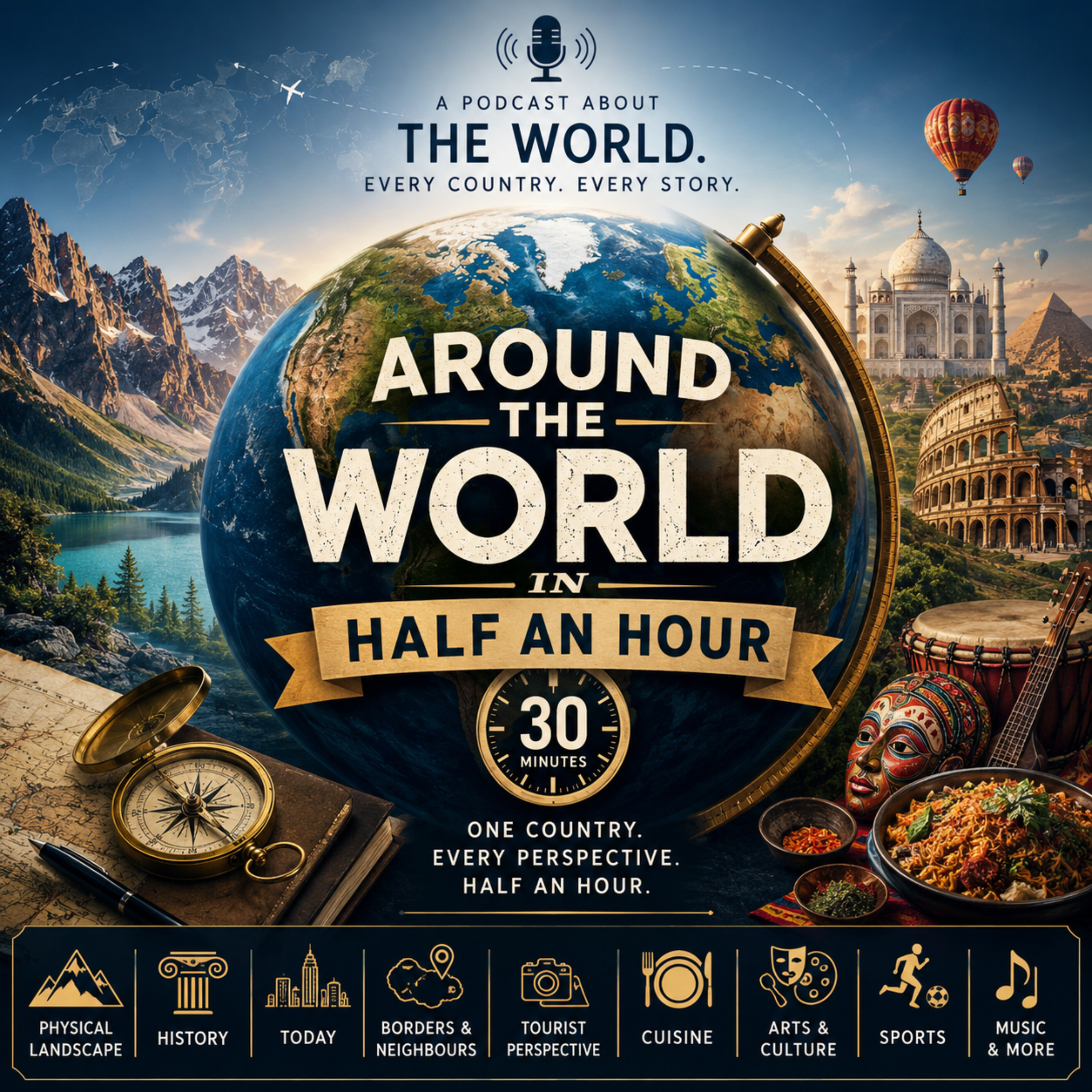
Around the World in Half an Hour
by Ray Z
I'm Ray, and I'm spending my Mondays trying to actually understand every country on Earth, not the postcard version, the real one. Geography, history, food, the people who made it what it is. I research each one properly before I write a word, then record it myself and figure out the mixing as I go. No writers' room, no big budget - just genuine curiosity about a country I probably knew three facts about last week. New episode every Monday, 7pm. If you like learning things you didn't know you wanted to know, come along.
-
13
Episode 12: The Bahamas — Seven Hundred Islands, One Ocean
Quick geography check: what ocean is the Bahamas in? If you said Caribbean, you're in good company and also wrong — the entire archipelago of roughly 700 islands sits in the Atlantic Ocean, which never technically touches these islands at all. This episode covers Christopher Columbus's actual first Americas landfall here in 1492, the 40,000-strong Lucayan population wiped out entirely by Spanish slavers within a generation, Nassau's brief and genuine run as a functioning pirate republic complete with Blackbeard, and Pompey's 1830 Exuma slave uprising. We bring it up to the present with Hurricane Dorian, the Category 5 storm that stalled directly over Grand Bahama in 2019 and is still reshaping government policy seven years later, the Sand Dollar digital currency it produced, Sam Bankman-Fried's 2022 arrest in Nassau, and Prime Minister Philip Davis's early-2026 election, called specifically to avoid hurricane season. Plus Sidney Poitier's historic Best Actor Oscar, Junkanoo's genuinely disputed origins, cracked conch, swimming pigs, pink sand beaches, and why a country spread across nearly 700 islands somehow fits, by total land area, inside the footprint of a single mid-sized American city.
-
12
Episode 11: Azerbaijan — The Land of Fire
Thirty kilometers outside Baku, a hillside has been on fire, continuously, for at least a few thousand years — natural gas seeping up and igniting on contact with air, ancient enough that Zoroastrian priests built shrines around it. It's part of why Azerbaijan's name translates to "Land of Fire," and it's a fitting image for a country that produced over half the world's oil supply by 1901. This episode covers the Azerbaijan Democratic Republic of 1918, the first secular democracy in the Muslim world and among the first anywhere to grant women the vote; the Sumgait and Baku pogroms of 1988-1990; Black January, the Soviet military crackdown Azerbaijan marks as a national tragedy every year; and the other side of the Nagorno-Karabakh story we covered from Armenia's perspective back in episode eight, including exactly where the 2025 peace treaty with Armenia stands today and what's still holding up a final signature. We also get into the Aliyev family's two decades in power, today's press-freedom record according to international monitors, Garry Kasparov's cosmopolitan Soviet-era Baku childhood, mud volcanoes, UNESCO-listed Mugham music and carpet weaving, and F1 racing through downtown streets. Presented factually throughout, without taking sides on the contested parts.
-
11
Episode 10: Austria — The Empire That Became a Coffeehouse
Try this: picture the most Austrian song you know. If it's "Edelweiss," that's actually an American Broadway song written in 1959 — not the real, 200-year-old Austrian carol "Silent Night" that barely registers internationally by comparison. This episode uses that gap between Austria's image and its reality as a throughline: the Habsburg dynasty that ran a chunk of Europe for six centuries under rulers like Maria Theresa, the 1938 Anschluss, Austria's postwar "first victim" narrative, the 1986 Waldheim Affair that cracked that narrative open. We bring things up to the present with the country's unprecedented three-party coalition, built specifically to keep a resurgent far-right party out of government, and three straight years of recession behind a still genuinely wealthy economy. Plus Mozart, Freud, Klimt, Empress Sisi, and Arnold Schwarzenegger's improbable journey from an Austrian village to the California governor's office; Sachertorte and Vienna's UNESCO-listed coffeehouse culture; Alpine skiingistory legends from Toni Sailer to Marcel Hirscher; and why Salzburg's biggest tourist draw is a movie most Austrians shrug at.
-
10
Episode 9: Australia — The Oldest Story on Earth
Aboriginal Australians have been on this continent for roughly 65,000 years — the oldest continuous human culture on Earth. Then, 238 years ago, a fleet of British ships arrived and rewrote the story in about a century and a half. Australia is simultaneously one of the oldest human stories and one of the youngest nation-states on the same landmass, and it hasn't entirely figured out how those two truths sit next to each other.Ray gets past the postcard version — Sydney Harbour, Uluru, kangaroos — and into the parts that don't fit as neatly on a tourism brochure: the legal fiction of terra nullius, the frontier violence of the 19th century, the Stolen Generations, and the 2023 Voice referendum that Australians voted down nationally and in every state. Along the way: the Great Barrier Reef, the strangeness of a country where a "quick trip" between cities can mean a longer flight than London to Rome, Cathy Freeman's lap of the Sydney Olympic track in 2000, and the legal case that finally overturned two centuries of settler law.Also: Vegemite, meat pies, a barbecue culture built into public parks by default, and the platypus — an animal so strange that British scientists initially assumed the first specimen was a hoax.New episodes every Monday at 7pm. Next week — Austria.
-
9
Episode 8: Armenia — Where Stone Remembers
There is a monastery in Armenia where, on a clear morning, you can see Mount Ararat rising across the horizon — the mountain on Armenia's national emblem, the mountain Noah's Ark is said to have landed on, sitting entirely inside Turkey since 1921. Armenians wake up every day and see their most sacred symbol on the wrong side of a closed, hostile border.Armenia was the first nation on Earth to adopt Christianity as its state religion, in 301 CE. In 405 CE, a monk named Mesrop Mashtots invented an alphabet that would keep Armenian identity alive through fifteen centuries without a state.Ray takes you through the ancient kingdom of Urartu, the golden age of the Bagratuni dynasty and the lost city of Ani, the ongoing tragedy of Nagorno-Karabakh — most recently the 2023 displacement of its entire Armenian population. We meet Aram Khachaturian, whose Sabre Dance became one of the most recognisable pieces of music on Earth. We meet Charles Aznavour, a refugee's son who became one of the biggest stars in French music history. We eat khorovats grilled over open coals, lavash baked in an underground clay oven, and khash — the dawn soup that Armenian men swear cures a hangover and mends a friendship in the same bowl.We stand at Khor Virap, looking at a mountain that isn't theirs anymore. And we ask what it means for a nation to survive on memory alone, for a while, and then decide to keep going anyway.The mountain is still there. So are they.New episodes every Monday at 7pm. Next week — Australia.
-
8
Episode 7: Argentina — Where Passion Became a Country
A Nobel Prize-winning economist once said there were four kinds of countries: the developed, the underdeveloped, Japan, and Argentina. He meant it as a puzzle — how does a country with some of the finest farmland on Earth, the world's greatest beef culture, and a population that produces Borges and Messi and Piazzolla keep finding new ways to make itself poorer?Argentina is the eighth-largest country on Earth. The Andes run its entire western edge, home to Aconcagua — the highest mountain in the Western Hemisphere. The Pampas feed a hundred million cattle. Patagonia stretches cold and empty to the tip of the continent. And at the northeastern corner, Iguazú Falls — 275 cascades across 2.7 kilometres — are the largest waterfall system on Earth.Ray takes you through the full sweep: the gauchos and the immigration wave that made Buenos Aires the Paris of South America; the rise and fall and return of Juan Perón; Evita — dead at 33, mythologised ever since; the Dirty War in which 30,000 people were disappeared; the Falklands; the 2001 economic collapse that produced five presidents in ten days. And the 2022 World Cup, which ended 36 years of hurt and produced what witnesses described as the largest spontaneous human gathering in the history of the Southern Hemisphere.We meet Borges, who invented ideas that philosophers and computer scientists are still working through. We meet Maradona — the Hand of God and the Goal of the Century in the same five minutes. We meet Messi. We meet Astor Piazzolla, who turned tango into concert music. And we eat asado — not a recipe, a religion — and dulce de leche and empanadas and drink Malbec from the vineyards of Mendoza.And we learn what the pause in a tango actually means.New episodes every Monday at 7pm. Next week — Armenia.
-
7
Episode 6: Antigua and Barbuda — Where Every Beach Has a Story
There is a beach in Barbuda called Princess Diana Beach. It is pink-tinged, quiet, and so beautiful that Diana called it the finest she had ever seen — three months before she died. In 2017, Hurricane Irma destroyed 95 percent of Barbuda's structures. The beach survived. The island had to be rebuilt.This is Antigua and Barbuda. Two islands. 442 square kilometres. A population of 98,000. And a history of sugar, slavery, cricket, and hurricane that is both particular to this corner of the Caribbean and entirely universal to the story of the Atlantic world.Ray takes you through 350 years of British colonial rule — the enslaved people who worked the sugar estates, the resistance of Prince Klass who planned an uprising and paid for it with his life, the labour movement of 1939 that produced V.C. Bird and eventually independence in 1981. We trace the story of cricket as identity — how a game imported by colonisers was transformed into an instrument of pride by the colonised, producing from a country of under 100,000 people four of the greatest players in the history of the sport: Andy Roberts, Viv Richards, Richie Richardson, and Curtly Ambrose.We meet Jamaica Kincaid, whose essay A Small Place is the most honest book ever written about what Caribbean tourism costs and who pays. We eat fungee and pepperpot, ducana and saltfish, and Barbudan lobster grilled on the beach. We sail into English Harbour — where Nelson called it a vile hole and is now UNESCO-listed. And we stand at Codrington Lagoon as thousands of frigate birds wheel overhead.Know what you're standing on.New episodes every Monday at 7pm. Next week — Argentina.
-
6
Episode 5: Angola — Where Oil and Blood Fed the Same Soil
More enslaved Africans left Angola's shores than from any other territory on the continent. An estimated five to six million people, shipped to Brazil, the Caribbean, and North America over three centuries. The rhythms they carried — Semba — became Samba in Brazil. And Kizomba, born in Luanda's streets during the civil war years, is now danced in studios in Paris, Tokyo, and Buenos Aires.Angola is the seventh-largest country in Africa — oil fields offshore, diamond mines inland, one of the continent's greatest waterfalls hidden in its interior, and a national symbol, the giant sable antelope, that was believed extinct during the war and came back.We eat muamba de galinha — chicken slow-cooked in palm oil and okra, served over cassava funje. We taste cocada amarela, the golden coconut custard that is Angola in a spoon. We stand at the edge of Kalandula Falls as the mist rises. And we learn that the music the world dances to on a Friday night has roots in this soil, in this history, in this people.Angola is still standing. Still dancing. And the queen never surrendered.New episodes every Monday at 7pm. Next week — Antigua and Barbuda.
-
5
Episode 4: Andorra — Where the Mountains Made a Country
It has no airport, no army, and no coastline. It is ruled by two princes, neither of whom is Andorran, neither of whom has ever lived there. And it has survived, unbroken, since 1278 — through the Hundred Years' War, the Napoleonic Wars, the Spanish Civil War, and two World Wars raging on both sides of its border.Andorra is the last surviving example of a medieval co-principality, tucked into the eastern Pyrenees between France and Spain. Ray takes you through how a 13th-century property dispute created one of the strangest governments on Earth — one where the French President and the Spanish Bishop of Urgell still share the throne today, entirely by historical accident.We trace how complete obscurity became Andorra's greatest asset, how a population of 85,000 now hosts 8 million tourists a year, and how a country with no natural resources beyond mountain pasture became one of Europe's wealthiest nations per capita. We eat Escudella, the stew that's really a philosophy. We ski Grandvalira. And we ask what it means to be a sovereign nation that has, for 700 years, succeeded mainly by being left alone.New episodes every Monday at 7pm. Next week — Angola.
-
4
Episode 3: Algeria — Where the Desert Meets the Sea
It is the largest country in Africa. More than four-fifths of it is the Sahara Desert. And painted on the walls of its ancient sandstone plateaus are the memories of a world ten thousand years gone — elephants and giraffes and the people who hunted them, preserved in the dry Saharan air long after the land turned to dust.Algeria is a country of staggering contrasts. A Mediterranean coastline of white cities and ancient harbours. A mountainous north where Amazigh Berber culture has survived for millennia. And then the Sahara — vast, silent, extraordinary — where Roman cities lie half-buried in the sand and prehistoric rock art covers the cliffs of Tassili n'Ajjer.Ray takes you through all of it. The history — from the ancient Numidian kingdom and the Roman province that gave the world Saint Augustine, through Ottoman corsairs and 132 years of French colonialism that changed the world's understanding of colonialism and ended with a nation dancing in the streets in July 1962. We meet Abd al-Qadir — the warrior-philosopher who has a town named after him in Iowa. We meet Albert Camus, who won the Nobel Prize and never stopped being Algerian. We meet Zinedine Zidane. And we meet Cheb Khaled — the King of Raï, the bestselling Arabic-language singer in history, whose voice rose from the cabarets of Oran to the top of the charts in Paris, London, and Mumbai.We eat couscous, merguez, chorba, and Deglet Noor dates so good they're called fingers of light. We watch the sunrise from the Ahaggar Mountains. We stand in the Roman city of Timgad, unchanged for 1,900 years. And we listen to Raï — the music that said the things nobody else would say.The desert remembers everything.New episodes every Monday at 7pm. Next week — Andorra.
-
3
Episode 2: Albania - The Eagle's Country
It is one of the smallest countries in Europe. For 46 years, it was the most isolated nation on Earth. And it is one of the most beautiful, strangest, and least-known destinations on the continent.Albania sits on the western edge of the Balkans, facing Italy across a narrow strip of Adriatic Sea, with beaches that rival Greece, mountains that rival Switzerland, and a history layered with ancient Illyrian roots, Byzantine cities, Ottoman centuries, and a communist dictatorship so paranoid that it built over 170,000 concrete bunkers — one for every four citizens — to defend against an invasion that never came.Ray takes you through it all. The dramatic geography, from the turquoise Albanian Riviera to the Accursed Mountains of the north. The full sweep of history — from the ancient colony of Apollonia to the 15th-century warrior hero Skanderbeg, who held the Ottoman Empire at bay for 25 years, to Enver Hoxha's sealed, bunker-riddled police state, to the chaotic, remarkable rebirth of the 1990s.We meet Mother Teresa, whose Albanian parents gave the world one of its greatest humanitarians. We meet Ismail Kadare, who wrote masterworks of world literature under a dictatorship. We meet Dua Lipa and Mira Murati — a global pop icon and a former CTO of OpenAI — both proudly Albanian.We eat Tavë Kosi — the baked lamb and yogurt dish once ranked the best traditional dish on the planet. We drink raki before noon without apology. We listen to iso-polyphonic singing, an ancient choral tradition so extraordinary UNESCO protects it. And we walk the cobbled streets of Berat and Gjirokastër, two UNESCO cities of stone and Ottoman windows that most of the world has never heard of.The eagle's country. Come and meet it.New episodes every Monday at 7pm. Next week — Algeria.
-
2
Episode 1: Afghanistan - Where Empires Came to Rest
We begin our alphabetical journey around the world with one of the oldest, most storied, and most misunderstood countries on the planet — Afghanistan.Long before the headlines, there was a civilisation. A land where lapis lazuli was mined and traded to the pharaohs of Egypt. Where Alexander the Great fought the hardest campaign of his military career and fell so deeply under the country's spell that he married a Bactrian princess. Where Buddhism and Greek philosophy fused into something entirely new. Where the city of Herat was, in the 15th century, the Florence of Central Asia — a gathering place of poets, painters, and astronomers that rivalled any court in the world.In this episode, Ray takes you through the dramatic geography of the Hindu Kush — some of the most formidable mountains on Earth — and down into the desert south, the fertile northern plains, and the remote Wakhan Corridor where Afghanistan touches China at its very tip. We trace 5,000 years of history, from ancient Bactria to the Silk Road empires, from the Islamic golden age to the British invasions, from the Soviet war to the present day.We meet Rumi — born in Balkh in 1207, still one of the best-selling poets in the world. Ahmad Shah Massoud, the Lion of Panjshir, who resisted every invader until the day he was assassinated. Khaled Hosseini, whose novel The Kite Runner made the world see Afghanistan as a place of fully human lives. Ahmad Zahir — the Afghan Elvis — whose voice still fills every Afghan wedding, in every city where Afghans have settled.We cook Kabuli Pulao — the slow-braised rice dish with caramelised carrots, raisins, and lamb that is, quite possibly, one of the finest rice dishes in the world. We watch horsemen play Buzkashi. We stand in the empty niches at Bamiyan where the great Buddhas once stood. We swim in the impossible turquoise lakes of Band-e-Amir.And we try — genuinely try — to see Afghanistan as it is: ancient, cultured, generous, and still here.New episodes every Monday at 7pm. Next week — Albania.
-
1
Episode 0: Intro — Where the Map Begins
Most of us can point to maybe a dozen countries on a map and actually explain what's going on there — everywhere else is a flag and a headline. Around the World in Half an Hour is one host's attempt to close that gap properly: one country per episode, in alphabetical order, starting with Afghanistan and working straight through to the other end of the alphabet, new episodes every Monday at 7pm. Every episode gets genuinely researched before a word gets written — real geography, a real history rather than a highlight reel, what the country actually looks like today, the people it's produced, the food, the music and art, the sports it takes seriously, and how the rest of the world's image of the place compares to the reality on the ground. When a country's history gets difficult — colonisation, war, genocide, the parts a lot of places would rather smooth over — this show doesn't smooth them over either, though it also won't tell you what to think about the genuinely contested stuff; you get the facts and both sides where there are two, and you're trusted to do something with them. The goal every week is a place with an actual personality, not an encyclopedia entry read aloud — funny some weeks, heavy others, often both in the same thirty minutes. If South Asia's more your speed, there's a companion show too, Around India in Half an Hour, working through India's states the same way. This one supports, alphabetically, with Afghanistan.
We're indexing this podcast's transcripts for the first time — this can take a minute or two. We'll show results as soon as they're ready.
No matches for "" in this podcast's transcripts.
No topics indexed yet for this podcast.
Loading reviews...
ABOUT THIS SHOW
I'm Ray, and I'm spending my Mondays trying to actually understand every country on Earth, not the postcard version, the real one. Geography, history, food, the people who made it what it is. I research each one properly before I write a word, then record it myself and figure out the mixing as I go. No writers' room, no big budget - just genuine curiosity about a country I probably knew three facts about last week. New episode every Monday, 7pm. If you like learning things you didn't know you wanted to know, come along.
HOSTED BY
Ray Z
CATEGORIES
Loading similar podcasts...
Frequently Asked Questions
How many episodes does Around the World in Half an Hour have?
Around the World in Half an Hour currently has 13 episodes available on PodParley. New episodes are automatically indexed when they're published to the podcast feed.
What is Around the World in Half an Hour about?
I'm Ray, and I'm spending my Mondays trying to actually understand every country on Earth, not the postcard version, the real one. Geography, history, food, the people who made it what it is. I research each one properly before I write a word, then record it myself and figure out the mixing as I...
How often does Around the World in Half an Hour release new episodes?
Around the World in Half an Hour has 13 episodes. Check the episode list to see recent publication dates and frequency.
Where can I listen to Around the World in Half an Hour?
You can listen to Around the World in Half an Hour on PodParley by clicking any episode. We provide an embedded audio player for direct listening, and you can also subscribe via your preferred podcast app using the RSS feed.
Who hosts Around the World in Half an Hour?
Around the World in Half an Hour is created and hosted by Ray Z.
URL copied to clipboard!