
PODCAST · arts
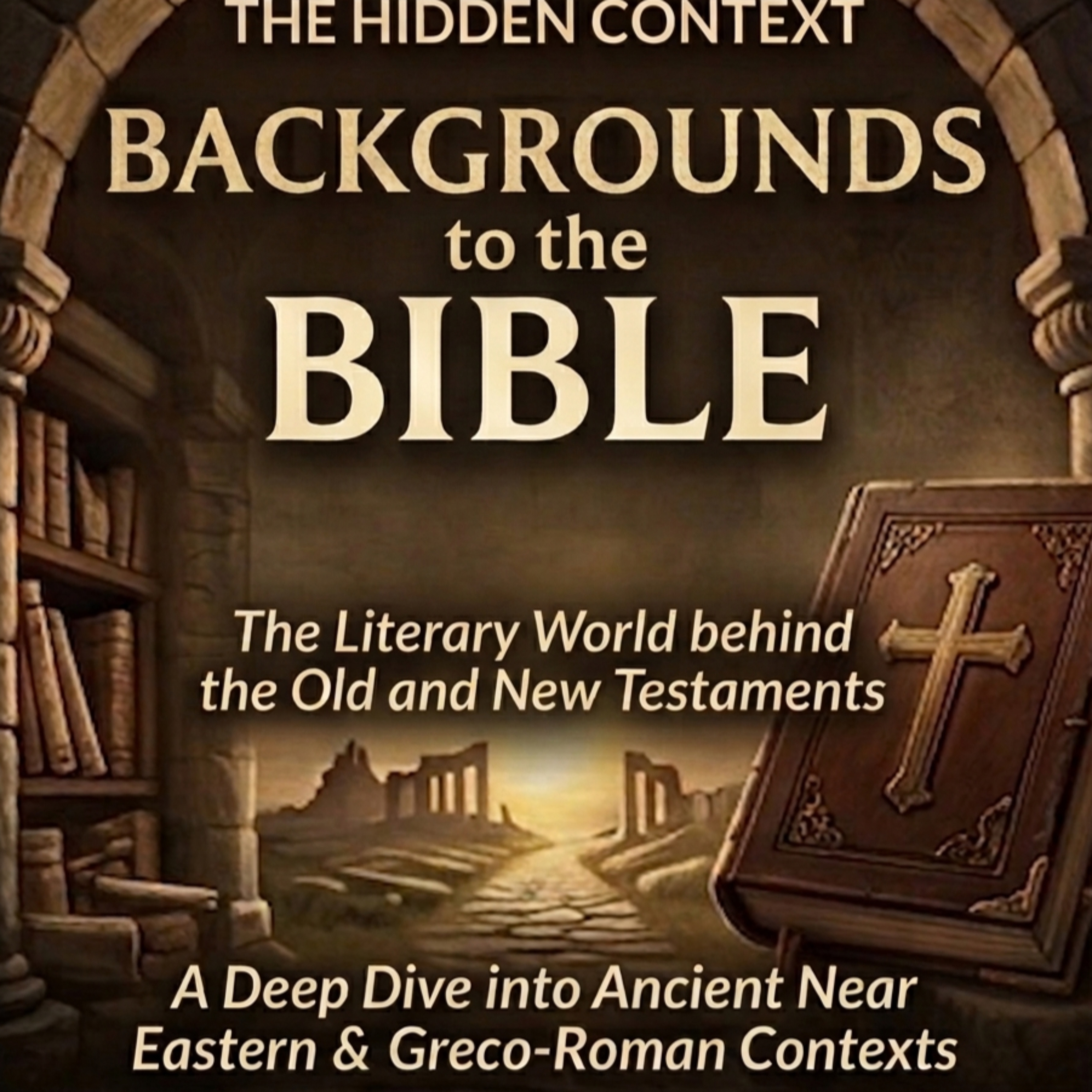
Backgrounds to the Bible
by Jonathan Wolters
Reading ancient literature in light of Scripture.This podcast was created with the assistance of AI.
Episodes
-
Flavius Josephus: The Wars of the Jews, Book 5 — How Jerusalem Destroyed Itself in 70 CE
Understanding the socio-political collapse, Roman siege tactics, and factional civil war within Jerusalem during the First Jewish-Roman War provides essential historical context, Ancient Near East awareness, and Greco-Roman background for canonical biblical theology, historical exegesis, primary...
-
Flavius Josephus: The Wars of the Jews, Book 4 — Jerusalem Burns, Civil War, and the Rise of Vespasian
Understanding the internal factional strife, civil chaos, and imperial dynamics of Second Temple Judaism provides essential historical context, Ancient Near East awareness, and Greco-Roman background for canonical biblical theology, historical exegesis, primary sources, ancient texts, and textual...
-
Flavius Josephus: The Wars of the Jews, Book 3
Understanding the military tactics, geopolitical maneuvers, and defensive strategies of the Roman counter-offensive in Galilee provides essential historical context for interpreting the Greco-Roman background, primary sources, and textual background of the New Testament. Examining Flavius...
-
Flavius Josephus: The Wars of the Jews, Book 2 — Socio-Political Causes of the Revolt
Understanding the socio-political dynamics, imperial administration, and revolutionary movements of First-Century Judea provides crucial historical context for interpreting the Greco-Roman background and Ancient Near East setting of the New Testament Gospels. Examining the transition from…
more -
Flavius Josephus: The Wars of the Jews, Book 1 — Hasmonean Decline and Herodian Rise
Understanding the sociopolitical shifts and imperial interventions of Second Temple Judaism provides essential historical context for interpreting the world of the New Testament and the historical background of the Gospels. In this episode of "Backgrounds to the Bible," we examine Book 1 of…
more -
Flavius Josephus: The Antiquities of the Jews — The Edifice and the Eschaton — a bridge to The Jewish War
Examining primary sources, ancient texts, and the textual background of Second Temple Judaism provides indispensable historical context, Ancient Near East awareness, and Greco-Roman background for canonical biblical theology and rigorous exegesis. In this episode of "Backgrounds to the Bible," we...
-
Flavius Josephus: The Antiquities of the Jews — Intersections with the New Testament
Examining primary sources, ancient texts, and the textual background of Second Temple Judaism provides indispensable historical context, Ancient Near East awareness, and Greco-Roman background for canonical biblical theology and rigorous exegesis. In this episode of "Backgrounds to the Bible," we...
-
Flavius Josephus: The Antiquities of the Jews (Books 11-20) — Empire, Priesthood, and Providence
Understanding the intertestamental period through primary sources and ancient texts provides indispensable historical context and textual background for biblical theology, exegesis, and Greco-Roman background studies. In Books 11–20 of Antiquities of the Jews, Flavius Josephus bridges the...
-
Flavius Josephus: The Antiquities of the Jews (Books 1-10) — How Josephus Rewrote the Hebrew Bible
Josephus, the New Testament, and Redemptive History This episode examines Books 1 through 10 of Flavius Josephus's Antiquities of the Jews in light of New Testament revelation and canonical biblical theology. We analyze how Josephus recasts Old Testament history for a Roman audience, comparing…
more -
Flavius Josephus: The Antiquities of the Jews — The Man, the Motive, and the Monumental Text
The Man, the Motive, and the Monumental Text In this episode, we examine the life, historical context, and primary motivations behind Flavius Josephus and his monumental work, Antiquities of the Jews. Josephus was a priestly Pharisee and Jewish general who became a Roman captive and historian....
-
The Hellenistic Philosophers: Philo of Alexandria — Questions and Answers on Genesis
Philo of Alexandria provides a vital window into Hellenistic Judaism, showing how Septuagint exegesis and classical philosophy shaped early biblical theology. By applying allegorical interpretation to Genesis 1-3, his reading of the Logos influenced both the Alexandrian school and Patristic...
-
The Hellenistic Philosophers: Philo of Alexandria — On the Incorruptibility of the World, That Every Good Man is Free , On Providence
Examining the intersection of Jewish monotheism and classical philosophy demonstrates how Alexandrian scholars defended scriptural authority within the Greco-Roman Mediterranean. Understanding Philo of Alexandria, Hellenistic Judaism, and Septuagint exegesis offers essential context for studying...
-
The Hellenistic Philosophers: Philo of Alexandria — On the Contemplative Life and (Apology for the Jews
Understanding the historical context, textual background, and literary environment of Second Temple Judaism and the Ancient Near East provides crucial illumination for biblical theology, exegesis, and canonical interpretation. In early Roman Egypt, Jewish thinkers engaged their surrounding...
-
The Hellenistic Philosophers: Philo of Alexandria — Against Flaccus (In Flaccum) and On the Embassy to Gaius (Legatio ad Gaium)
Philo of Alexandria provides vital evidence regarding Roman provincial governance, Alexandrian civic strife, and First-Century Jewish identity. His treatises demonstrate how Hellenistic Judaism engaged classical philosophy, Septuagint exegesis, and imperial political power during the reign of...
-
The Hellenistic Philosophers: Philo of Alexandria — De Migratione Abrahami, De Congressu Eruditionis Gratia, De Fuga et Inventione, Quis Rerum Divinarum Heres Sit, De Mutatione Nominum, and De Somniis
The intersection of Middle Platonic thought and Second Temple Jewish exegesis provides a foundational perspective for reading the patriarchal narratives of Genesis. Philo of Alexandria integrates classical philosophy with Septuagint exegesis to demonstrate how dream visions function as vehicles…
more -
Hellenistic Philosophers: Philo of Alexandria — Primeval History
Philo of Alexandria, an aristocratic Jewish philosopher writing in the first century, produced a significant cycle of seven treatises that interpret the primeval history of Genesis 6–11 through the lens of Hellenistic Jewish allegory. By synthesizing Jewish covenantal faith with Greek…
more -
Hellenistic Philosophers: Philo of Alexandria — Allegorical Works
An analysis of Philo of Alexandria’s allegorical treatises—specifically On the Birth of Abel and the Sacrifices Offered by Him and by His Brother Cain (De Sacrificiis Abelis et Caini), Allegorical Interpretation (Legum Allegoriae, Books I, II, and III), That the Worse is Wont to Attack the Better...
-
Hellenistic Philosophers: Philo of Alexandria — On the Decalogue , On the Special Laws , On Rewards and Punishments , On Virtues
This episode explores the works of Philo of Alexandria, a first-century Jewish thinker who sought to harmonize the Mosaic Law with the heights of Greek philosophy. Philo’s legal treatises systematically reframe the Decalogue as the universal "heads" of all legislation, arguing that the Ten...
-
The Hellenistic Philosophers: Philo of Alexandria — Abraham and Joseph
Philo of Alexandria’s treatises on Abraham and Joseph serve as a bridge between Jewish covenantal tradition and Hellenistic philosophy, reframing the patriarchs as living laws who naturally embodied divine virtue before the written Torah existed. By employing a systematic allegorical method…
more -
The Hellenistic Philosophers: Philo of Alexandria — The Life of Moses
In this episode on Philo of Alexandria’s De Vita Mosis, the hosts explore how a prominent Jewish aristocrat reframed the life of Moses as a philosophical and political ideal to defend his faith against Roman-Hellenistic prejudice. The text is structured as a two-part biography that first presents...
-
The Hellenistic Philosophers: Philo of Alexandria — Creation — Philo’s Cosmic Blueprint: Reading the Alexandrian Creation Account Beside the Word Made Flesh
This episode analyzes Philo of Alexandria’s De Opificio Mundi, a landmark treatise that harmonizes the biblical account of Genesis with Hellenistic philosophy. Written to defend Jewish tradition against Greco-Roman skepticism, the text reinterprets the creation narrative as a manifestation of...
-
The Hellenistic Philosophers — Middle Platonism
This episode provides an analysis of Middle Platonism, a philosophical movement that served as a vital intellectual bridge between classical Greek thought and the development of early Christian theology. The text explores how this era’s focus on a transcendent, unapproachable God and the use of...
-
The Hellenistic Philosophers: The Pyrrhonist Revival
This episode examines the work of Sextus Empiricus and the historical Pyrrhonist Revival, a movement that utilized ancient skepticism to challenge certainties during the European Reformation. The text explores the skeptical method of suspending judgment to achieve mental peace, contrasting this...
-
The Hellenistic Philosophers: The Academics — academic skepticism finds its necessary correction in God's covenant faithfulness
This episode provides a historical and theological analysis of Hellenistic Academic Skepticism, tracing its evolution from a questioning phase of Plato’s Academy to its eventual critique by biblical and patristic thought. The text is structured as a systematic study that first defines the…
more -
The Hellenistic Philosophers: Stoicism — rational self-reliance and emotional detachment vs. divine grace and resurrection hope
This episode examines Stoicism by tracing its historical development in the Greco-Roman world and contrasting its core tenets with biblical theology. The text details how Stoic thinkers sought internal security through rational self-reliance and emotional detachment, categorizing the world into...
-
The Hellenistic Philosophers: Epicureanism — The Ancient Bargain: How Epicurus Traded God for Peace, and Why Paul Said No
This episode provides a comprehensive examination of Epicureanism, tracing its historical emergence in the Hellenistic era as a philosophy of individual ethics and psychological peace designed to combat cultural insecurity. The text outlines the movement’s foundational shift away from public life...
-
The Hellenistic Philosophers: Early Pyrrhonism
This episode provides an analysis of Early Pyrrhonism, an ancient Greek philosophical movement founded by Pyrrho of Elis that advocates for a life of suspension of judgment to achieve mental tranquility. The text systematically traces the school's origins—notably Pyrrho's encounters with Indian...
-
The Pre-Socratics: Pythagoras — Jesus Christ is the true source of cosmic cohesion
This episode provides an overview of Pythagorean philosophy, examining its historical origins in the 6th-century BC and its core belief that numerical harmony governs the universe. The text contrasts the Pythagorean view of a cyclical, dualistic existence—where the soul is trapped in the body and...
-
The Pre-Socratics: Zeno of Elea
Zeno of Elea utilized a rigorous logical method known as reductio ad absurdum to defend the radical monism of his teacher, Parmenides, arguing that the existence of motion and plurality is a deceptive illusion. By presenting famous paradoxes such as Achilles and the Tortoise, he sought to prove...
-
The Pre-Socratics: Thales of Miletus
This episode explores the life and legacy of Thales of Miletus, the Greek thinker credited with transitioning human thought from mythological narratives to rational inquiry. The text identifies Thales’ two foundational claims—that water is the primary substance of all things and that matter is...
-
The Pre-Socratics: Parmenides of Elea
This podcast examines the philosophical work of Parmenides of Elea, an ancient Greek thinker who argued that reality is a singular, static Being and dismissed the physical world of change as a mere illusion. The text explores the literary structure of his poem, On Nature, which uses deductive…
more -
The Pre-Socratics: Heraclitus of Ephesus — how the gospel provides a definitive resolution to the perpetual flux and strife that the philosopher could only observe but never fully resolve
This episode explores the life and philosophy of Heraclitus of Ephesus, an ancient thinker whose enigmatic views on the Logos, cosmic fire, and the unity of opposites profoundly influenced Western thought. The text is structured as a multi-step investigation that moves from his historical…
more -
The Pre-Socratics: Empedocles of Acragas — a critique of ancient dualism, replacing the weary cycle of reincarnation with a hope anchored in divine grace and bodily resurrection
This episode explores the life and philosophy of the ancient Greek thinker Empedocles of Acragas, examining how his four eternal roots (earth, air, fire, and water) and the opposing forces of Love and Strife shaped early natural science. The text functions as a comprehensive bridge between...
-
The Pre-Socratics: Democritus of Abdera — a comparative study between atomistic determinism and the spiritual purpose found in scriptural revelation
This episode explores the philosophical system of Democritus, an ancient Greek thinker who proposed that the universe is composed of indivisible atoms moving through a boundless void. The text systematically outlines his materialistic worldview, contrasting his reliance on intellectual reason…
more -
The Pre-Socratics: Archelaus of Athens — justice and morality are mere human conventions
This episode explores the historical and philosophical significance of Archelaus of Athens, a pivotal figure who bridged the gap between Ionian natural science and Socratic ethics. The text details his physical theories, such as the spontaneous generation of life from mud through thermal forces,...
-
The Pre-Socratics: Anaximander of Miletus — the roots of rationalism
This episode explores the life and thought of Anaximander of Miletus, an early Pre-Socratic philosopher who transitioned Western thought from mythological storytelling to rational, naturalistic inquiry. The text details his revolutionary concept of the apeiron—an eternal, boundless, and…
more -
Plautus: Truculentus — Ancient Roman Greed and Biblical Grace
Plautus’ Truculentus is a cynical masterpiece of Roman comedy that depicts a world where human affection is entirely replaced by mercenary transaction and predatory deceit. Structured around the ruthless schemes of the courtesan Phronesium, the play dramatizes the systematic financial ruin of…
more -
Plautus: Trinummus — stewardship, accountability, and the desire for the restoration of order upon a master's return
This episode analyzes the Roman comedy Trinummus ("The Three-Coin Day") by Plautus, exploring its historical, literary, and theological dimensions. Set against the backdrop of the Roman Republic’s expansion, the play follows the financial ruin and ultimate restoration of a noble household through...
-
Plautus: Rudens — the universal human longing for true sanctuary and restored identity
This episode explores Plautus’ Roman comedy Rudens, a play that uniquely blends humor with an elevated moral tone centered on divine justice and the protection of the vulnerable. The text outlines a narrative structure where a cosmic prologue by the star Arcturus frames the human drama—a…
more -
Plautus: Pseudolus — deceit and human commodification vs. truthfulness and inherent human dignity
This episode analyzes Plautus’s Roman comedy Pseudolus through a multi-layered framework that examines its historical performance in 191 BC alongside its complex literary and communicative structures. The text highlights how the play utilizes metatheatrical self-awareness and the trope of the...
-
Plautus: Persa — elaborate disguise and fraud are used to purchase a lover’s freedom
This episode offers an in-depth historical, literary, and theological analysis of the Roman comedy Persa by Titus Maccius Plautus, examining it through the lens of Middle Republican Roman culture and biblical worldview. Structurally, the source moves from a scholarly breakdown of the play’s plot...
-
Plautus: Mercator — domestic and generational friction that erupts in paternal-filial rivalry
This episode provides a multifaceted analysis of Plautus’ Roman comedy, Mercator ("The Merchant"), examining the play through historical, literary, and theological lenses. The text is structured as a progressive study that begins with the historical and legal realities of the Roman...
-
Plautus: Menaechmi — Twins, Trickery, and the Search for Something Truer
This episode examines Plautus’ ancient Roman comedy, Menaechmi, through a multidisciplinary lens that bridges historical context, literary structure, and biblical theology. The text systematically explores how this farce of mistaken identity reflects the social anxieties and legal realities of…
more -
Plautus: Curculio — The Ring That Cannot Lie
Plautus’ Curculio is a classic Roman New Comedy that explores themes of identity, deception, and social mobility within the rapidly changing landscape of the second-century BCE Republic. The plot centers on a clever parasite who uses a stolen signet ring to facilitate a fraudulent transaction, an...
-
Plautus: The Captives — loyalty, sacrifice, and familial restoration
Titus Maccius Plautus’ Roman comedy, The Captives, is a unique "serious comedy" that explores the profound moral themes of loyalty, sacrifice, and familial restoration during the Mid-Roman Republic. The narrative follows an elder named Hegio who, desperate to ransom his son captured in war,...
-
Plautus: Bacchides — When Rome’s Funniest Comedy Reveals Humanity’s Deepest Need
This comprehensive analysis explores Titus Maccius Plautus’ comedic play Bacchides, a work of Roman theater from the early 2nd century BC that adapts Greek New Comedy for a Roman audience. The source provides a multifaceted study of the play, examining its historical framework of shifting Roman...
-
Homer: Odyssey — Myth, Memory, and Modernity: Reimagining Homer in Christopher Nolan’s The Odyssey
This episode analyzes Christopher Nolan’s 2026 film adaptation of The Odyssey, exploring how the director transforms Homer’s ancient epic into a modern psychological drama. By stripping away the whimsical influence of the gods and the episodic structure of the original poem, Nolan redefines the...
-
Plautus: Aulularia — The Miser's Buried God: What Plautus's Aulularia Reveals About the Human Heart
This source provides a multifaceted academic and theological analysis of Titus Maccius Plautus’ Roman comedy, Aulularia (The Pot of Gold), examining how the play’s depiction of a paranoid miser reflects the socio-economic anxieties of the Mid-Roman Republic. By moving through historical…
more -
Plautus: Asinaria — When the Slave Rides the Master: What Rome’s Favorite Farce Reveals About a World Without Grace
This episode provides an analysis of Plautus' Roman comedy, Asinaria, moving through historical, literary, and theological lenses to evaluate the play’s cultural significance. The text begins by establishing the historical setting of the Middle Roman Republic, explaining how the play’s Greek...
-
Plautus: Amphitryon — When a God Comes Down to Deceive vs. the True Incarnation
This master document presents a multifaceted theological and canonical analysis of Plautus’ Roman comedy Amphitryon, systematically contrasting the play’s pagan worldview with biblical principles from the Old and New Testaments. Through a structured sequence of seven analytical steps, the text...
We're indexing this podcast's transcripts for the first time — this can take a minute or two. We'll show results as soon as they're ready.
No matches for "" in this podcast's transcripts.
No topics indexed yet for this podcast.
Loading reviews...
Loading similar podcasts...
Frequently Asked Questions
How many episodes does Backgrounds to the Bible have?
Backgrounds to the Bible currently has 147 episodes available on PodParley. New episodes are automatically indexed when they're published to the podcast feed.
What is Backgrounds to the Bible about?
Reading ancient literature in light of Scripture.This podcast was created with the assistance of AI.
How often does Backgrounds to the Bible release new episodes?
Backgrounds to the Bible publishes regularly with 147 episodes available. Check the episode list for the typical release schedule.
Where can I listen to Backgrounds to the Bible?
You can listen to Backgrounds to the Bible on PodParley by clicking any episode. We provide an embedded audio player for direct listening, and you can also subscribe via your preferred podcast app using the RSS feed.
Who hosts Backgrounds to the Bible?
Backgrounds to the Bible is created and hosted by Jonathan Wolters.
URL copied to clipboard!