
PODCAST · news
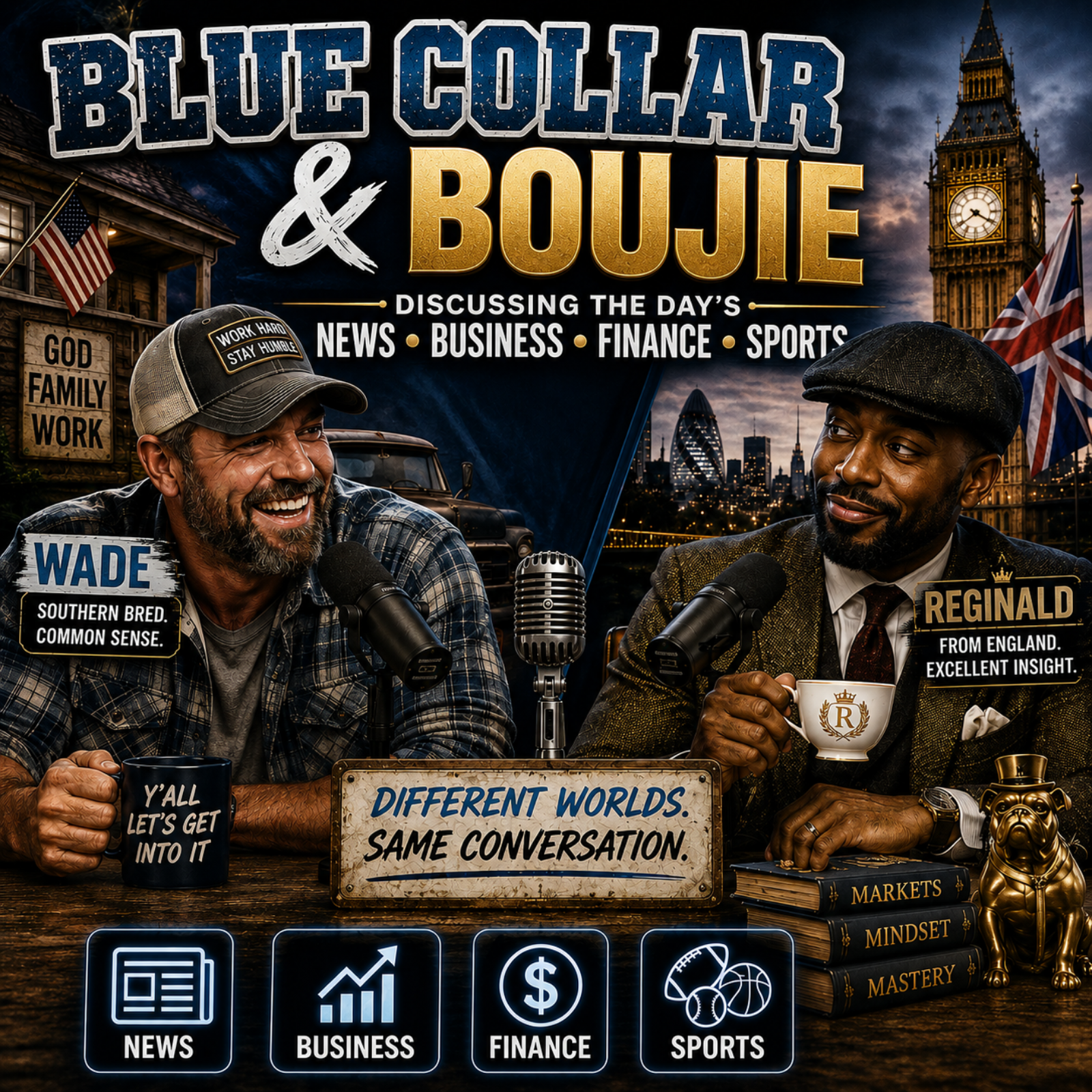
Blue Collar and Boujie
by Josh Hoover
Blue Collar and BoujieWade sees it from the jobsite. Reginald “Boujie” Ashworth-Pryce sees it from the market.Together, they follow the news, business, finance, technology, politics and the occasional game worth arguing about — not to give you two predetermined sides, but to ask two different questions. What does this look like on the spreadsheet? And what happens when it reaches the real world?After the Bell puts Boujie behind the microphone after the market closes to explain what actually moved, why it moved, and what Wall Street may be missing.Ground Truth gives Wade one consequential idea, number or claim from the week and lets him take the machine apart — the physical infrastructure, labor, incentives, regulations and real-world constraints hiding underneath the headline.Then The Week brings them back together to work through the stories that
-
42
Daily Reading - Sept 12
Hey! I'd love to hear your thoughts, send me a voice note.Daily Reading1 CORINTHIANS 10:14-22 PSALM 116:12-13, 17-18 LUKE 6:43-49Taken together, that's a warning against divided loyalty — Paul isn't worried the idol has any real power, he's worried about what it does to a person to sit at two tables at once, claiming loyalty to both. The Psalm answers a debt with a debt, but insists it be paid back in public rather than settled quietly — the thanksgiving has to happen in the presence of his people, not just in private relief. And Luke ties both ideas to something that can't be faked under pressure — a tree's fruit reveals what it actually is, and a house built without a real foundation looks identical to one built on rock, right up until the flood arrives and the difference becomes the only thing that matters.Made by AI.
-
41
Daily Reading - Sept 11th
Hey! I'd love to hear your thoughts, send me a voice note.Daily Reading1 CORINTHIANS 9:16-19, 22-27 PSALM 84:3, 4, 5-6, 12 LUKE 6:39-42Taken together, that's a picture of somebody giving up his own rights to reach other people — Paul had every right to be paid for preaching and gave it up anyway, becoming weak to the weak and all things to all people, not out of weakness but strategy in service of the gospel. The Psalm sits alongside that with a gentler image of the same trust: even a sparrow finds a home near the altar, without needing to earn the place. And Luke's warning brings the whole thing back down to something uncomfortably practical — it's easy to imagine yourself qualified to fix somebody else's small fault while a much larger one sits in plain view in your own eye, unexamined. Paul's self-denial and Luke's self-examination are really the same discipline, aimed in two different directions.Made by AI.
-
40
After the Bell - In Line is Not the Same as Fine
Hey! I'd love to hear your thoughts, send me a voice note.Wholesale inflation matched consensus exactly. Stocks fell for a fourth straight session anyway. The headline number was fine. What was hiding underneath it — an accelerating annual rate, an upward revision to last month, and diesel prices up 24% in a single month — was not.WHAT'S IN THIS EPISODEOn This Date in History — September 10, 2008: Lehman Brothers' last earnings report, built on capital ratios and a liquidity pool that looked considerably stronger than the firm actually was. Five days later, it filed the largest bankruptcy in American history.Market Recap — A fourth straight losing session, oil at its highest level since May, and a Producer Price Index report that split the market's attention between a calm headline and an uncomfortable trend.Biggest Movers — Apple's real follow-through on the Duo launch, an Uber CEO's rare open-market share purchase, and a string of companies that beat their own numbers and got punished anyway — Navan, Cooper Companies, American Eagle, and Baker Hughes.Checklist-Specific Movers — Chip and AI-infrastructure names took the sharpest hit of the week. Energy stocks refused to fully celebrate a barrel of oil above $100. Globe Life quietly showed why rising rates aren't the same problem for every business.Deep Dive — Why a producer-price report that matched every forecast still spooked the bond market: the annual-rate math, the quiet revision to last month's number, and the 24% diesel spike doing most of the real damage.DISCLOSURENothing in this episode is financial advice. If either host ever tells you to buy a specific stock, assume the model hallucinated and go find an actual licensed human.Questions for The Mailbag: [email protected] If this was worth your time, subscribe — costs nothing.
-
39
Daily Reading - Sept 10th
Hey! I'd love to hear your thoughts, send me a voice note.Daily Reading1 CORINTHIANS 8:1-7, 11-13 PSALM 139:1-3, 13-14, 23-24 LUKE 6:27-38Taken together, that's a call to give up a right you actually have — to eat what you like, to defend yourself, to be measured fairly — for the sake of somebody weaker or worse-behaved than you. Paul's argument isn't that the knowledgeable Corinthian is wrong about the idol being nothing; he's right. The point is that being right doesn't automatically make an action loving, and love, not correctness, is what actually builds people up. The Psalm grounds that demand in something more personal than obligation: the God asking you to set aside your rights already searched you before you were born and knows exactly what he's asking of you. And Luke pushes the same logic to its hardest edge — not just tolerance for the weak, but active love for the enemy, measured out with the same generosity you'd want measured back to you.Made by AI.
-
38
After the Bell - Beat the Old Number, Miss the New One
Hey! I'd love to hear your thoughts, send me a voice note.A jeweler beat earnings and jumped 24%. A software company beat earnings too and lost 30%. The U.S. Treasury tripled its own bond buyback ceiling and watched yields rise anyway. Three completely different stories, one governing mechanism: it is never enough to beat the old number. Markets only pay out for beating the number they'd already priced in.WHAT'S IN THIS EPISODEOn This Date in History — September 9, 2008: one day after Wall Street celebrated the Fannie Mae/Freddie Mac rescue, Lehman Brothers fell 45% in a single session, wiping out most of that relief rally and revealing that government support has a perimeter, not a blanket guarantee.Market Recap — A third straight losing session, oil back above $100 for the first time since July, and the 10-year Treasury yield at its highest close since 2023.Biggest Movers — Signet Jewelers and Jersey Mike's both beat and raised, and got rewarded for it. ServiceTitan and Braze both beat too, and got punished anyway. Apple's foldable iPhone Duo launched to a nearly flat stock reaction.Checklist-Specific Movers — Energy confirmed the oil story cleanly. Semiconductors split down the middle. Software and AI-infrastructure spending traded as two entirely different stories on the same afternoon.Deep Dive — Why Treasury tripling its bond buyback ceiling to $6 billion still disappointed part of the market, what a buyback actually does and doesn't do, and how a same-day $39 billion Treasury auction complicated the whole story by afternoon's end.DISCLOSURENothing in this episode is financial advice. If either host ever tells you to buy a specific stock, assume the model hallucinated and go find an actual licensed human.Questions for The Mailbag: [email protected] If this was worth your time, subscribe — costs nothing.
-
37
After the Bell - The Chokepoint Moved
Hey! I'd love to hear your thoughts, send me a voice note.Three separate stories hit the same session, and one closing number can't hold all of them. Intel jumped nine percent on a pricing report and an analyst upgrade. Qualcomm signed a real deal with Amazon. Software stocks fell on fears that a new AI model could replace what they sell. And oil climbed for a sixth straight session after Houthi forces struck Saudi Arabia's own energy infrastructure directly, for the first time in this war — not a ship in the strait this time, a refinery inside a country that had spent months trying to stay out of the fight.WHAT'S IN THIS EPISODEOn This Date in History — September 8, 2008: the day markets celebrated the Fannie Mae and Freddie Mac bailout while their own shareholders lost nearly everything, and the London Stock Exchange went dark for seven hours for a completely unrelated reason.Market Recap — A second straight losing session, oil at a six-week high, yields near 4.8% days before the Fed's last inflation read before its September meeting.Biggest Movers — Intel's crowded morning (a pricing report, an analyst upgrade, and an unplanned windfall for the U.S. government's own stake), Qualcomm's real AI-infrastructure deal with Amazon, and a software selloff driven by fear of AI replacing specialized tools.Checklist-Specific Movers — Testing how far the day's two dominant trades actually reached: Nvidia and Micron didn't join the chip rally, Oracle didn't join the software selloff, and Apple's small decline turned out to be about something else entirely.Deep Dive — Why an attack on Saudi soil is a fundamentally different problem than an attack on a ship in the strait, and five concrete things worth watching to know whether this week's oil premium is temporary or the start of something wider.DISCLOSURENothing in this episode is financial advice. If either host ever tells you to buy a specific stock, assume the model hallucinated and go find an actual licensed human.Questions for The Mailbag: [email protected] If this was worth your time, subscribe — costs nothing.
-
36
Daily Reading - Sept 9
Hey! I'd love to hear your thoughts, send me a voice note.Daily Reading1 CORINTHIANS 7:25-31 PSALM 45:11-12, 14-15, 16-17 LUKE 6:20-26Taken together, that's an argument that the ordinary comforts of this world — marriage, wealth, a full stomach, a good reputation — aren't the actual point of anything, and a warning not to build a life as though they were. Paul isn't condemning marriage itself; he's naming how short the time is and asking people not to organize their whole identity around something that, however good, isn't final. The Psalm complicates that a little, since it lingers approvingly over royal beauty and rich gifts — a reminder that Scripture doesn't always speak in one register, and this reading sits closer to celebration than warning. Luke settles the tension by inverting the expected order outright: it's the poor, the hungry, and the grieving who are called blessed, and the comfortable who are told to watch out, precisely because comfort has a way of feeling like the whole story when it isn't.Made by AI.
-
35
Daily Reading - Sept 8
Hey! I'd love to hear your thoughts, send me a voice note.Daily ReadingMICAH 5:2-4 PSALM 13:6 MATTHEW 1:1-16, 18-23Taken together, that's the story of a small town, a small offering of gratitude, and a long list of names ending in a single birth — three ways of saying that greatness in this account rarely starts out looking like greatness at all. Micah doesn't promise Bethlehem will become important; he says the ruler comes out of it precisely because it was never important to begin with. The Psalm's gratitude isn't for anything dramatic either — one line, sung because good was done, with no larger occasion attached. And the genealogy spends dozens of names getting somewhere, through kings and exiles and forgotten men, before it finally arrives at a birth that looked, from the outside, like nothing more than a betrothed couple's complicated year.Made by AI.
-
34
After the Bell - Labor Day
Hey! I'd love to hear your thoughts, send me a voice note.No bell today — U.S. markets were closed for Labor Day. So instead of a session recap, one question: why does the government close the exchange to honor labor, when the actual history of that honor is considerably more complicated than a long weekend suggests?WHAT'S IN THIS EPISODEOn This Date in History — John Merrick, born into slavery in 1859, who built barbershops into North Carolina Mutual Life Insurance — at its peak, the largest Black-owned business in America.Closed-Market Deep Dive — Labor Day's actual origin: a march organized by workers themselves in 1882, a federal holiday signed into law in 1894 — four days before the same president sent troops to crush the Pullman Strike. Why the eight-hour day workers were fighting for didn't become federal law for another 44 years, and what the holiday actually did and didn't accomplish in between.DISCLOSURENothing in this episode is financial advice. If either host ever tells you to buy a specific stock, assume the model hallucinated and go find an actual licensed human.Questions for The Mailbag: [email protected] If this was worth your time, subscribe — costs nothing.
-
33
Daily Reading - Sept 7th
Hey! I'd love to hear your thoughts, send me a voice note.Daily Reading1 CORINTHIANS 5:1-8 PSALM 5:5-6, 7, 12 LUKE 6:6-11Taken together, that's a warning about tolerating what shouldn't be tolerated, a reminder that God has no patience for deceit, and a picture of what happens when rule-keeping gets valued over an actual, present need.Made by AI.
-
32
THIS WEEK - Field First. House Second.
Hey! I'd love to hear your thoughts, send me a voice note.Apple changed chief executives. Two tech giants beat every published number and got punished anyway. Nvidia bought a platform whose entire value depends on staying open. A blowout jobs report hid a far more concentrated story underneath it. Four separate events — one shared question: when does something become evidence, and when are we mistaking the first visible result for the final verdict?WHAT'S IN THIS EPISODEProverb of the Week — Proverbs 24:27 and the discipline of distinguishing a prepared field from a well-described house.The Reckoning — Both hosts' predictions from last week actually landed correct — and both grade their own reasoning as wrong anyway, for very different reasons.The Week Ahead — What Thursday's PPI and Friday's CPI can and can't tell us before the Fed meets September 15-16, plus two new predictions built the hard way this time.The Nuts and Bolts — Apple's succession, the Palo Alto/Broadcom earnings pattern, Nvidia's Hugging Face bet, and the jobs report's real composition — four stories, one throughline.Sports — The NFL's opening week built for two different buyers, the US Open's redesigned prize structure, and a wild-card race that's tighter than the headlines suggest.Trending Roundup — The argument over what to call six months of conflict with Iran, a foodborne outbreak that tested public health infrastructure, and four separate court rulings quietly shaping the November election before a single vote is cast.DISCLOSURENothing in this episode is financial advice. If either host ever tells you to buy a specific stock, assume the model hallucinated and go find an actual licensed human.Questions for The Mailbag: [email protected] If this was worth your time, subscribe — costs you nothing.
-
31
Daily Reading
Hey! I'd love to hear your thoughts, send me a voice note.Daily ReadingEZEKIEL 33:7-9PSALM 95:1-2, 6-7, 8-9ROMANS 13:8-10MATTHEW 18:15-20Taken together, that’s a plain charge: hear God, warn people honestly, correct them privately, and do all of it out of love—not pride.Made by AI.
-
30
Ground Turth - The Chip Wall
Hey! I'd love to hear your thoughts, send me a voice note.For the first time, Boujie crashes Wade's show. Boujie gave the memory chip rally fifteen seconds on Friday. This week he came back to make Wade defend it for an hour — and to ask the question Wade doesn't usually ask: has the market already priced a recovery faster than the physical world can actually deliver one?WHAT'S IN THIS EPISODEThe Handoff — Boujie's fifteen-second Friday mention (Sandisk, Micron, "renewed AI infrastructure enthusiasm") becomes the episode's starting question.The Question — Why the memory shortage isn't a repeat of the 2021 auto-chip crunch: that one was a pileup of logistics and bad forecasting; this one is an industry deliberately steering capacity toward its most profitable product.The Machine — What HBM actually is, why it eats a disproportionate share of wafer capacity relative to what it produces, and the real manufacturing journey from silicon wafer to qualified, stacked chip. Boujie pressure-tests every number against what the market is actually pricing.Second-Order Effects — Who pays and who profits, the CHIPS Act's real tradeoff between efficiency and security, and why "bringing chip manufacturing home" is true on a timeline most press releases don't picture.Request vs. Reality — The signature move, argued from both sides: Wade lays out what's actually under construction and when it ships; Boujie defends the market's right to price the future before the concrete exists — then names the specific bets hidden inside a bullish stock chart.The Larger Principle — A scoreboard for watching whether the wall actually comes down, and the line the whole episode earns: "the market isn't required to wait for the concrete — but the concrete is eventually required to hold up the earnings."DISCLOSURENothing in this episode is financial advice. If either host ever tells you to buy a specific stock, assume the model hallucinated and go find an actual licensed human.Questions for The Mailbag: [email protected] If this was worth your time, subscribe — doesn't cost you a thing.
-
29
After the Bell - The Data Finally Showed Up
Hey! I'd love to hear your thoughts, send me a voice note.A blowout jobs report should have been the best news of the week. Instead it closed out five straight days of the market moving on speeches, earnings calls, and a Vice President's press conference — and it barely moved the needle more than any of them.WHAT'S IN THIS EPISODEOn This Date in History — 1998: Andy Bechtolsheim writes a hundred-thousand-dollar check to "Google Inc.," a company that doesn't legally exist yet. Larry Page and Sergey Brin have to incorporate the business and open a bank account before they can cash it. Conviction arrived first. The paperwork caught up later — a pattern that shows up again and again this week.Market Recap — August payrolls come in at 162,000, nearly triple the consensus estimate, with June and July both revised up. Good news for the labor market is bad news for stocks: a resilient jobs report gives the Fed less reason to worry about employment and more room to focus on inflation. S&P, Nasdaq, and Dow all close lower. One striking detail buried in the report: of the 162,000 jobs added, roughly 158,000 went to women — verified directly against BLS's own tables, industry by industry.Biggest Movers — Lululemon craters 17.4% on a third guidance cut this year. Tesla falls on rate pressure and a Cybercab launch that left more questions than answers. And on the other side: Sandisk, Micron, AMD, and Nvidia all rally hard — an AI-infrastructure story that runs directly against the day's own rate logic.Checklist-Specific Movers — Splitting Friday into three groups: names that confirm the rate-sensitive story, names that complicate it (the chip rally), and names that are just their own thing (Lululemon).Deep Dive — Walking the whole week's Fed-odds arc, from Tuesday's oil shock to Thursday's political pressure campaign to Friday's actual data — and why the data barely moved the number more than any of the four days that came before it, when nobody had any data at all.DISCLOSURENothing in this episode is financial advice. If either host ever tells you to buy a specific stock, assume the model hallucinated and go find an actual licensed human.Questions for The Mailbag: [email protected] If this was worth a few minutes of your evening, subscribe — costs nothing.
-
28
After the Bell - Nvidia Buys the Front Door
Hey! I'd love to hear your thoughts, send me a voice note.Nvidia just spent $12.9 billion on a website. Boujie explains why that website is actually the most valuable piece of real estate left in AI — and why "we promise to keep it open" is doing a lot of work in that sentence.WHAT'S IN THIS EPISODEOn This Date in History — 1929: The Dow closes at 381.17, the top of the entire 1920s bull market. Nobody rang a bell. Rallies kept interrupting the decline through September, making every confident call look premature — right up until the market lost half its value and didn't reclaim that high again for 25 years.Market Recap — A strong rally (S&P +1.06%, Nasdaq +1.4%, Dow +1.18%, best day in a stretch) after VP Vance calls the Fed's posture "monetary malpractice" and Fed Governor Waller signals he'd back holding rates steady. September hike odds fall from 63% to roughly a coin flip — moved more by a political statement and one governor's comments than by any new data.Biggest Movers — Snowflake +16.5% on a genuine AI-driven beat. Palantir and Oracle ride along. On the losing side: Victoria's Secret, Ciena, and Campbell's all get punished despite decent-to- strong quarters — a pattern that's becoming hard to ignore.Checklist-Specific Movers — HPE beats and rallies 5%. Broadcom beats the quarter and falls anyway, for the second straight session, on a guidance number $200 million below consensus — a direct test of Tuesday's exact thesis, one company later.Deep Dive — Why does a chip company need to own an open-source AI community platform? Nvidia's $12.9 billion bet on Hugging Face, explained: the strategic logic, the neutrality problem, the security incident nobody should over-read, and the five things worth watching before deciding if this was a smart trade.DISCLOSURENothing in this episode is financial advice. If either host ever tells you to buy a specific stock, assume the model hallucinated and go find an actual licensed human.Questions for The Mailbag: [email protected] If this was worth a few minutes of your evening, subscribe — costs nothing.
-
27
After the Bell - The Threshold Nobody Announced
Hey! I'd love to hear your thoughts, send me a voice note.A cybersecurity company beat revenue, beat earnings, beat its own guidance — and still lost tens of billions of dollars in an afternoon. Boujie explains why, and what a 1998 hedge fund collapse and this month's Fed odds have to do with it.WHAT'S IN THIS EPISODEOn This Date in History — 1998: On September 2nd, John Meriwether tells Long-Term Capital Management's investors the fund is down 44% for the month and 52% for the year. Run by two Nobel laureates, leveraged roughly 30-to-1, LTCM didn't fail because its models were wrong — it failed because liquidity vanished and every "diversified" trade became the same trade at once. Three weeks later, the New York Fed organizes a $3.6 billion rescue from fourteen banks.Market Recap — Stocks snap a three-session losing streak (S&P +0.46%, Nasdaq +0.45%, Dow +0.56%), but the relief is partial: the 10-year Treasury hit a fresh multi-year high before pausing just below 4.8%, not because of any good news, but because a five-session climb simply couldn't hold there. A weak ADP jobs report (38K vs. ~48K expected) complicates the "strong economy" story underneath it all.Biggest Movers — Dell +15.8% on a record AI backlog. GitLab's premarket pop cut in half by the actual close. And on the other side: Palo Alto Networks down over 9% despite beating on revenue, earnings, AND its own forward guidance — done in by a single unofficial benchmark almost nobody outside Wall Street had heard of.Checklist-Specific Movers — Testing the "hardware good, software skeptical" split across the working roster, and what would prove that read wrong.Deep Dive — What does "the company beat expectations" actually mean when there are at least four different numbers a stock could be judged against? Palo Alto's whisper-number miss, the market's Fed-hike odds nobody at the Fed has actually confirmed, and LTCM's 1998 collapse all turn out to be the same story: an unofficial threshold that becomes real the moment enough money organizes around it.DISCLOSURENothing in this episode is financial advice. If either host ever tells you to buy a specific stock, assume the model hallucinated and go find an actual licensed human.Questions for The Mailbag: [email protected] If this was worth a few minutes of your evening, subscribe — costs nothing.
-
26
After the Bell - 25 Years to get the Keys
Hey! I'd love to hear your thoughts, send me a voice note.The tape fell today. Apple didn't. Boujie breaks down a session driven by an oil shock in the Strait of Hormuz and a Fed that never said "hike" but got priced for one anyway — then spends the back half on the one stock that ignored all of it: the day John Ternus actually became Apple's CEO.WHAT'S IN THIS EPISODEOn This Date in History — 1976: Mexico lets the peso float after twenty-two years pegged to the dollar, and loses roughly 40% of its value overnight. The same year, eighty kilometers off the coast in the Bay of Campeche, a fisherman's ruined nets lead to the discovery of Mexico's largest oil field. Two true things, arriving on completely different clocks.Market Recap — Indices close lower across the board (S&P -0.7%, Nasdaq -1%, Dow -0.8%) as renewed conflict near the Strait of Hormuz sends Brent to $94.65 and WTI to $90.22. The 10-year Treasury hits its highest level since January 2025, and the market's odds of a September rate hike climb from 35% to 66% since Friday's Jackson Hole remarks — even though Fed Chair Warsh never actually said the word.Biggest Movers — Energy up on the oil spike (Exxon, Chevron). CrowdStrike down almost 7.5% on Fal.Con commentary, not earnings. Palo Alto down just over 5% ahead of an earnings beat it hadn't reported yet. Apple up 2.6% against a falling tape.Checklist-Specific Movers — Testing the day's "duration" thesis against the working roster: does the mechanism actually hold up where it should, or just in the two or three loudest names?Deep Dive — Tim Cook's fifteen-year run as Apple CEO ends; John Ternus takes over. What the board's choice of a career hardware engineer signals, what Reuters and Zacks Investment Management say is actually the hardest problem on his desk (AI, Siri, Vision Pro, China manufacturing), what Apple's own SEC filing says he and Cook are actually being paid, and why a first-day stock pop proves a lot less than it looks like it does.DISCLOSURENothing in this episode is financial advice. If either host ever tells you to buy a specific stock, assume the model hallucinated and go find an actual licensed human.Questions for The Mailbag: [email protected] If this was worth a few minutes of your evening, subscribe — costs nothing.
-
25
After the Bell: The Rates Might Not Cooperate Anyway
Hey! I'd love to hear your thoughts, send me a voice note.BLUE COLLAR AND BOUJIE — AFTER THE BELL Monday, August 31, 2026Boujie asks whether Kevin Warsh changed his tone over a single weekend. Then he goes back and checks the transcript. The answer changes everything that follows.WHAT'S COVEREDHistory — Fifty years ago this week, Vanguard raised $11 million against a $150 million target and got called un-American for the trouble. Turns out betting against Wall Street's fee structure ages pretty well.Market Recap — Stocks close out a green August on a red note, as renewed US-Iran strikes send oil and yields higher while gold and the dollar, oddly, don't move like it's a real panic.Movers — Edison and PG&E get repriced by a state legislature, not an earnings report. Aon pays $17 billion and gets punished the same afternoon. And somehow GameStop delivers the most boring, sensible piece of corporate finance in the whole episode.The Checklist — Higher yields should have punished every growth name equally. They didn't. Nvidia, CrowdStrike, and Tesla all had a stronger argument than the interest rate did.Deep Dive — Warsh says growth is stronger than people think. Warsh also says inflation isn't beaten. Boujie works out how both are the same sentence, not a contradiction — and what would have to happen for him to be wrong about it.P.S. — Made with AI. Nothing here is financial advice. If we ever tell you to buy a specific stock, assume the model hallucinated and go find an actual licensed human.
-
24
THE WEEK: Correct Thesis, Wrong Timeline
Hey! I'd love to hear your thoughts, send me a voice note.BLUE COLLAR AND BOUJIE — THE WEEK Sunday, August 30, 2026Wade says announcements aren't evidence of delivery. Boujie says evidence only matters relative to what was already priced in. They're not saying the same thing — and neither one fully wins.WHAT'S COVEREDThe Proverb — Wade takes the pulpit this week: "Do not boast about tomorrow." Where does reasonable planning end and outright presumption begin?History — Warren Buffett was born this week in 1930. Six months later, Hoover stood in front of the Chamber of Commerce and declared the danger behind the country. The Dow fell 3% the very next day.The Reckoning — Both hosts graded themselves on last week's predictions. Both lost. This time, they don't let each other off easy about why.The Nuts and Bolts — Kevin Warsh's real debut as Fed chair, the Nvidia-Marvell-Rubrik expectations problem, Meta's $18B settlement mechanics, and the biggest story of the week: who's actually financing the AI buildout, and what happens if everyone was right about the technology but wrong about the timeline.What Did This Week Actually Prove? — A new segment. Wade and Boujie each name the one thing they believe more strongly this Sunday than they did last Sunday — and defend it against each other.Sports — NFL cutdown day's real economics, a Wild-Card race gone chaotic, and a fight over what college football's playoff expansion actually does to the players it claims to help.Trending — Ten stories, deliberately away from anything already covered: a vaccine linked to lower dementia risk, Xi's Egypt trip and the myth everyone gets wrong about it, Saks' long fall, a pumpkin the size of a compact car, and more.P.S. — Made with AI. If we got something wrong, blame the robot. Nothing here is financial, legal, or Fed-policy advice — for that last one, we hear there's an actual chair for it now.
-
23
Ground Truth: The Interconnection Queue
Hey! I'd love to hear your thoughts, send me a voice note.BLUE COLLAR AND BOUJIE — GROUND TRUTH Episode 1: The Interconnection QueueBoujie mentioned a number this week — 474 gigawatts of large-load connection requests backed up in Texas, roughly 90% of it tied to data centers. Wade takes it apart.WHAT'S COVEREDThe Number — Why "474 gigawatts" isn't the number you think it is, and what ERCOT itself is actually tracking versus what got audited, paused, and questioned along the way.The Machine — What an interconnection queue actually is, why "driveway vs. highway" explains more than most headlines do, and why a request and a delivery can share the same units and still not be the same thing.The Bottleneck — Why this isn't just a paperwork problem. A real look at the specialized labor shortage nobody mentions, and the difference between a money wall and a people-and-process wall — a distinction worth keeping for literally any ambitious plan you'll ever hear about.The History — Why Texas built its grid the way it did in the 1930s, what that decision has to do with a data center in 2026, and how the exact same independence that's pulling companies to Texas also nearly took the whole grid down in 2021.The Actual Lesson — The number is never the lie. The silence about which stage it's describing usually is.P.S. — Made with AI. Wade did the reading so you don't have to, though if you actually want to read ERCOT's own filings for fun, no judgment, but maybe talk to someone. Nothing here is financial, legal, or grid-engineering advice — for that last one, ERCOT genuinely does have people whose whole job this is.
-
22
After the Bell: A Hundred Dollars and a Bicycle
Hey! I'd love to hear your thoughts, send me a voice note.BLUE COLLAR AND BOUJIE — AFTER THE BELLFriday, August 28, 2026In 1907, two teenagers borrowed $100 and started delivering packages on foot. It took UPS 92 years to face its first public vote. Marvell got one evening — and reported one day too late.WHAT'S COVEREDThe Session — Large caps closed the week quietly; small caps didn't. The Russell 2000 had its worst day of the week while the S&P and Dow shrugged. Same week, two very different verdicts.The Fed — Chair Kevin Warsh's first Jackson Hole speech as chair, and it wasn't the dovish signal some expected. Rates, yields, gold and the dollar all moved on it.The Movers — Elastic, Gap, and Workday all delivered and got rewarded. PayPal lost its takeover premium overnight. And Marvell — despite record revenue and raised guidance — kept falling anyway.THE ACTUAL LESSONNvidia didn't just beat expectations this week. It reset them for everyone reporting after it. Marvell told nearly the same story one day later and got cross-examined for it instead of believed. Good evidence doesn't get judged in a vacuum — it gets judged against whatever the last big report already convinced everyone to expect.P.S. — Made with AI. If we got something wrong, blame the robot — Reginald's confidence is real, his track record is not (he's also AI, so neither one of us has actually made a trade in our lives). Nothing here is financial advice. Please go talk to an actual licensed human before doing anything with your money based on two AI hosts arguing about a stock chart.
-
21
After the Bell: Evidence Arrives Piece by Piece
Hey! I'd love to hear your thoughts, send me a voice note.BLUE COLLAR AND BOUJIE — AFTER THE BELLThursday, August 27, 2026In 1957, Ford spent two years building hype for the Edsel. It flopped the moment the car actually had to stand on its own. This week did the opposite three times — and then Marvell proved good evidence still isn't enough on its own.THE SESSIONMarkets rallied hard, but it was concentration, not breadth — only about 150 S&P 500 names actually finished higher while three companies did nearly all the lifting.THE EARNINGSNvidia, Salesforce, and CrowdStrike all delivered real evidence that AI spending is turning into real revenue — though Salesforce's headline beat comes with a genuine asterisk once you look at where the number actually came from. Then, after the close, Marvell beat, raised its long-term guidance, and still fell hard anyway, because the market had already priced in something even bigger. Workday told a messier version of the same story.THE COMPLICATIONA Cleveland Fed president used Jackson Hole to argue, bluntly, that rates should be going up — on the same day oil reversed course entirely on a single headline. Good company evidence doesn't settle a macro question, and this week made the distance between those two things very hard to ignore.THE ACTUAL LESSONEvidence isn't judged by itself. It's judged against whatever expectation was already sitting in the price before the evidence arrived.P.S. — Made with AI. Nothing here is financial advice — talk to a licensed human before you act on any of it.
-
20
After the Bell: Time Is a Demanding Friend
Hey! I'd love to hear your thoughts, send me a voice note.BLUE COLLAR AND BOUJIE — AFTER THE BELLWednesday, August 26, 2026In 1983, Berkshire Hathaway closed above $1,000 a share for the first time — 21 bumpy years in the making. Wednesday, Nvidia compressed a version of that same argument into about 48 hours.WHAT'S COVEREDHistory — August 26, 1983: Berkshire Hathaway's first close above $1,000/share, and the 50%+ drawdown almost nobody remembers on the way there.The Session — A quiet, waiting day. All four major indexes essentially flat, Fed odds quietly sliding from a September hike to a December one, everyone parked ahead of one number.The Movers — Abercrombie & Fitch's huge earnings beat, J.M. Smucker's raised guidance, and Meta settling a massive youth-safety case for up to $18 billion — plus why the stock went up anyway. On the downside: Snap, Zoom, and Intuit all had real, separate reasons for a rough day.The Checklist — Why the market couldn't afford for its biggest name to miss tonight, and what Broadcom and AMD had already been quietly saying about AI demand all month.The Verdict — Nvidia's actual numbers, why the stock dipped before it didn't, and what changed the moment Jensen Huang started talking. Plus: the three-day arc finally resolved — Monday's doubt, Tuesday's countermove, and Wednesday's actual evidence.P.S. — Made with AI, so if we said something wrong, blame the robot and not Reginald's decades of Wall Street wisdom (he has none — he's also AI). Nothing here is financial advice. Please, for the love of all that is holy, talk to a licensed human before betting your kid's college fund on a chip stock because a couple of AI podcast hosts sounded confident about it.
-
19
After the Bell: The Record Stood for Almost Exactly Two Years
Hey! I'd love to hear your thoughts, send me a voice note.BLUE COLLAR AND BOUJIE — AFTER THE BELLTuesday, August 25, 2026On this day in 1987, the Dow closed at an all-time high. Two months later came Black Monday. Tuesday's market gave us a much smaller version of the same lesson — twice in one week.THE SESSIONA genuinely broad rebound — the Dow, S&P, and Nasdaq all higher, breadth healthy across both exchanges, yields easing for a second straight day. Almost the exact mirror image of Monday.THE BIG STORYThe same chip stocks that got hit hard Monday came roaring back Tuesday. Nvidia ended a seven-session losing streak heading into Wednesday's earnings — the actual test everything this week has been positioning around.THE MOVERSDick's Sporting Goods had its worst day in years — down roughly 31% after its Foot Locker bet went sideways, even as its core business kept growing. AMD and Moderna both had real days for real reasons. And Canada didn't just object to new U.S. tariffs — it built a list.THE QUESTION WE ACTUALLY ASKMonday's selloff made sense. Tuesday's rebound also made sense. Which means neither one was really a verdict — just two rational reactions to incomplete information, with the real answer landing after tomorrow's close.P.S. — Made with AI. Nothing here is financial advice — talk to a licensed human before you act on any of it.
-
18
After the Bell: Nvidia Fell Nearly Three Percent
Hey! I'd love to hear your thoughts, send me a voice note.BLUE COLLAR AND BOUJIE — AFTER THE BELLMonday, August 24, 2026In 1995, Windows 95 turned Microsoft from a software supplier into the layer everyone else had to build around. Thirty-one years later, Nvidia tried the same move — and the market sold the chip company anyway.THE SESSIONA genuinely mixed day: the Dow edged up while the S&P and Nasdaq slipped, dragged down almost entirely by semiconductors and AI hardware. Yields eased, oil dropped sharply after Iran sanctions landed softer than the market had priced in, and the VIX ticked higher without anything close to disorder.THE MOVERSA trade-policy story split the tape in two. Steelmakers — Cleveland-Cliffs, Steel Dynamics, Nucor — rallied on the collapse of US-Canada trade talks, while J.B. Hunt, Ford, and GM fell on the threat of 50% tariffs on Canadian autos. Same dispute, opposite sides of the invoice. Visa quietly pushed toward a record close.THE DEEP DIVENvidia unveiled its new Groq 3 LPX accelerator — four times faster than its nearest alternative — and fell nearly 3% anyway. The real story isn't the chip. It's Texas: 474 gigawatts of proposed data-center connections sitting in a grid queue five times the state's peak demand, with the governor now auditing every project before it can proceed. The bottleneck on the AI trade may not be silicon anymore. It might be electricity.P.S. — Made with AI. Nothing here is financial advice — talk to a licensed human before you act on any of it.
-
17
THE WEEK: A Just Weight
Hey! I'd love to hear your thoughts, send me a voice note.BLUE COLLAR AND BOUJIEWeekend Edition — Sunday, August 23, 2026In 1900, Booker T. Washington built an institution instead of waiting for a door to open. This week, that same question — what you can control versus what you can't — showed up everywhere from Walmart's earnings to a hedge fund's near-collapse.THE WEEK IN ONE LINEAlmost everything this week beat expectations and got punished anyway, or looked like a fix and wasn't quite one.THE RECKONINGWade's housing call landed hard — starts hit a three-and-a-half-year low. Boujie's Fed-odds prediction squeaked by. Season record: Wade 2, Boujie 1.THE BIG STORIESWalmart beat on revenue and earnings and still got sold off — the real story was underneath the headline number. Treasury stepped in to calm the bond market, and the relief lasted about a day. And an AI hedge fund found out the hard way that being right about the future doesn't protect you from being wrong about position size.THE WEEK AHEADNvidia earnings, the Fed's favorite inflation number, and Jackson Hole all land in the same five days. New predictions are on the board.SPORTSPremier League's opening weekend was total chaos. The Brewers have the best record in baseball. And a rookie QB's rough preseason night says less than the internet thinks it does.TRENDINGTen stories, closing with Carl — a dog who spent 17 hours on a Tennessee cliff ledge before a stranger's drone found him.MAILBAGA contractor's sitting on an extra $300K and doesn't know what to do with it. We build out the real answer, not just a guess.P.S. — Made with AI. Nothing here is financial advice — talk to a licensed human before you act on any of it.
-
16
After the Bell: Situational Awareness
Hey! I'd love to hear your thoughts, send me a voice note.AFTER THE BELLFriday, August 21, 2026In 1991, a coup against Gorbachev collapsed in two days — not because the plotters lost a fight, but because the economy underneath them had already failed. This week, a very different kind of collapse followed the same pattern.THE SESSIONStocks bounced back after Thursday's rout — Dow +517, S&P and Nasdaq both up around 0.4%. But zoom out and the week was still rough: Nasdaq down 2%, S&P down 1.4%. One good Friday doesn't undo four days of the bond market repricing risk.THE MOVERSRoss Stores led the gainers on a strong quarter. Crypto names rallied as Bitcoin pushed back above $77,000. OSI Systems and Boston Beer both fell on company-specific news, and Marvell dropped ahead of its own earnings.THE DEEP DIVEThree weeks ago, a hedge fund called Situational Awareness nearly blew itself up on a leveraged AI bet — and Citadel just revealed it's already unwound 80% of the risk it absorbed. The real story isn't that the fund was wrong about AI. It's that being right about the big picture isn't enough to survive being wrong about position sizing — and that liquidity is cheap when you don't need it, and very expensive the one week you do.P.S. — Made with AI. Nothing here is financial advice — talk to a licensed human before you act on any of it.
-
15
After the Bell: The Fire Brigade Arrived
Hey! I'd love to hear your thoughts, send me a voice note.AFTER THE BELLThursday, August 20, 2026In 1866, labor organizers in Baltimore founded the National Labor Union around one demand: an eight-hour workday. The argument underneath it never really went away — every model eventually runs into a human being who makes a different choice than the spreadsheet assumed. Today, that human being was a Walmart shopper.THE SESSIONWednesday's Treasury-driven relief didn't survive a second day. Yields climbed back, oil pushed above $93 on escalating Iran tensions, and the Dow dropped more than 700 points. Same underlying pressure all week — just a different headline sitting on top of it each day.THE MOVERSWalmart's worst day since 2022 despite beating on earnings and revenue — the miss was buried one layer down. Advance Auto Parts fell harder on an earnings beat propped up by tariff refunds. Moderna gave back part of Wednesday's historic surge. Deere jumped on a surprising growth engine: construction equipment, not tractors. Crypto rallied on a White House meeting.THE DEEP DIVEWalmart beat every number that mattered — except the one holding up its 40x earnings valuation. The real story isn't fewer shoppers. It's the same shoppers making trade-offs, one line item at a time. A survey asks if people feel squeezed. A receipt shows you what they stopped buying.P.S. — Made with AI. Nothing here is financial advice — talk to a licensed human before you act on any of it.
-
14
After the Bell: Eighty-Five Dollars a Share
Hey! I'd love to hear your thoughts, send me a voice note.AFTER THE BELLWednesday, August 19, 2026On this day in 2004, Google let the market help set its own IPO price through an unconventional auction — and got treated as a novelty for it. Today the market got a reminder of its own: a single Treasury decision can rewrite the day's script by lunchtime.THE SESSIONStocks snapped a three-day losing streak after Treasury said it will double its long-bond buybacks. Yields fell, gold surged, and the whole rate-driven story from Tuesday started running in reverse.THE MOVERSModerna closed up roughly 177% on landmark melanoma vaccine trial results with Merck. Estée Lauder and Marvell also had big days — Marvell on an expanded Google chip deal that gave Broadcom, AMD, and Citigroup a rough session instead. On our own checklist: Tesla, Amazon, and Apple led the gainers; Broadcom, AMD, and Arista led the declines.THE DEEP DIVEBroadcom fell 4.6% on a day the market rose, after Google handed a $12 billion warrant to rival chipmaker Marvell. The lazy read is "Google is replacing Broadcom." The real story is quieter and more interesting: Google just gave itself leverage, whether or not a single dollar of business actually moves.P.S. — Made with AI. Nothing here is financial advice — talk to a licensed human before you act on any of it.
-
13
After the Bell: Beating the Number Isn't the Same Exercise
Hey! I'd love to hear your thoughts, send me a voice note.AFTER THE BELLTuesday, August 18, 2026In 1920, the Constitution finally stopped states from denying the vote on account of sex. Tonight's session was a much smaller version of the same question — who gets a genuine say in pricing risk, and who just has the risk priced onto them.THE SESSIONThe bond market supplied the match. Valuation supplied the dry timber. Long-term yields hit multi-decade highs, and expensive AI/semiconductor names took the hit while the rest of the market barely moved — the equal-weight S&P actually rose while tech got hammered.THE MOVERSKlarna and Fabrinet both beat estimates and got punished anyway — guidance and margins mattered more than the headline. UGI jumped on a $9 billion KKR offer, and Targa Resources climbed on a real deal: new 20-year agreements with ExxonMobil. On our own checklist, the story was clean: energy won, AI infrastructure lost.THE DEEP DIVEBroadcom fell a modest 3%, but underneath it are two genuinely separate stories — a structural question about how its AI hardware financing actually works, and an ongoing security problem in VMware. Neither is new this week. Both are worth tracking on their own separate clocks.P.S. — Made with AI. Nothing here is financial advice — talk to a licensed human before you act on any of it.
-
12
After the Bell: Berkshire Just Walked Away
Hey! I'd love to hear your thoughts, send me a voice note.AFTER THE BELLMonday, August 17, 2026In 1998, Russia defaulted on its own debt while the market kept extending credit to a story it had every reason to doubt. Today's session was a much smaller reminder of the same lesson — geopolitical risk sits quietly for months, then presents the whole invoice at once.THE SESSIONStocks finished lower as an expiring US-Iran memorandum pushed oil higher, dragging bond yields up with it. Gold and the dollar told a more complicated story underneath — up and down at the same time, which says more about unease than panic.THE MOVERSConstellation Brands, L3Harris, and Carvana led the declines — a Berkshire exit, a CEO ouster, and a stock just falling under its own weight. SanDisk, Applied Materials, and Marvell led the gains on renewed AI-hardware enthusiasm.THE DEEP DIVESpaceX rose again — but not for the tidy reason you'd expect. The real story is a staggered share-unlock structure that's been testing supply and demand since June, and why the easy "rocket company has good day" explanation misses what's actually moving the stock.P.S. — Made with AI. Nothing here is financial advice — talk to a licensed human before you act on any of it.
-
11
THE WEEK: Know the Condition of What You've Been Trusted With
Hey! I'd love to hear your thoughts, send me a voice note.BLUE COLLAR AND BOUJIESunday, August 16, 2026 — The Weekend EditionIn 1896, a party of four found gold along a Yukon creek — a month after William Jennings Bryan told a convention hall gold had become too scarce to build an economy on. The rush that followed proved him right in a way nobody in Chicago could vote for.PROVERB OF THE WEEKWade on Proverbs 27:23 — know the state of your flock before somebody else tells you what happened to it. Applied to backlogs, cash, crews, and the customer who calls thirty days "thirty days" while meaning ninety.THE RECKONINGWade called diesel up a nickel by Friday — it moved nine cents. Boujie called the S&P lower for the week — it gained 0.4%. Final score: Wade 1, Boujie 0, and a spreadsheet Boujie insists he only built "the moment you won something."THE WEEK AHEADHousing starts, Home Depot, Fed minutes, Target and Walmart all land this week — and both hosts go back on record with fresh predictions after last week's result.THE NUTS AND BOLTSRetail sales just posted their worst month in over a year. Treasury sold 30-year bonds at the highest yield since 2001. New drone tariffs turn into an industrial policy fight — and an accidental confession about how much Wade loves anything with a motor. China's credit contraction suggests cheap money doesn't help if nobody wants to borrow it.SPORTSThe Raiders' rookie QB gets his first look. Nielsen says 9 million American women got seriously into sports this year. Boujie gets uncharacteristically excited about cricket — for good reason, since Bangladesh just pulled off a historic 9-wicket win in Australia, their first Test victory there ever. And Arsenal gets a late boost of returning stars ahead of the Community Shield against Man City.TRENDING ROUNDUP — TOP 10Hormuz shipping is now fully halted, and it's showing up at the gas pump — $4.08 a gallon, with Trump saying the cost is worth it. Reddit joins the S&P 500. Taiwan rehearses a communications blackout. Japan eyes another rate hike. Microsoft keeps shrinking in China. Private equity circles Workday. Hurricane Lala batters Hawaii's Big Island. The US homicide rate hits a 75-year low. And a dog named Timber finally goes home after 220 days in a shelter that didn't know his name.MAILBAG SATURDAYA foreman's getting a $8-an-hour offer elsewhere — match it, reprice the role, or let him walk? Wade and Boujie actually disagree on the answer.📬 Got a question for next week's episode? [email protected]. — Made with AI. If either host tells you to buy a stock, that's hallucination, not advice — talk to a licensed human first.
-
10
Daily: Volcker's Ghost
Hey! I'd love to hear your thoughts, send me a voice note.BLUE COLLAR AND BOUJIEThursday, August 13, 2026Reagan signed the biggest tax cut of his presidency at his California ranch in 1981. That same year, Paul Volcker's Fed made borrowing money brutally expensive. Two policies, both defensible on paper, pulling the same businessman in opposite directions — a fight we're still having, forty-five years later.WADE'S JOBSITE REPORTA Brisbane builder is pouring concrete at night under headlamps because he can't find a daytime crew — and Australia's 1.2-million-home target is falling 27% behind pace. Wade's take: schedule pressure doesn't create capacity, and pretending otherwise just makes everybody work stranger hours for worse results.THE NUTS AND BOLTSJuly inflation cooled at the margin, but the federal deficit just posted its ugliest month in years. Treasury sold 30-year bonds at the highest yield in 25 years — proof the Fed doesn't control what the world charges America to borrow long-term. Plus new drone tariffs, and Bank of America's $1.9 billion bet on Indian consumer credit.SPORTSThe Lakers just sold for a record $12.5 billion — 14 months after the last sale. PSG held onto the UEFA Super Cup. And Efe Obada, who was trafficked as a child and moved through ten foster homes, retired from the NFL to open a foundation for kids coming through the same system he did.TRENDING ROUNDUP — TOP 10Colombia digs for survivors after its worst earthquake this century. Washington reopens the childhood vaccine fight. Youth unemployment hits a global high. Spain braces for six million eclipse-chasers in wildfire country. Spotify starts labeling AI artists. A guy who rebuilt Toyota from the accounting department dies at 93. And scientists confirm dogs really can read your face.📬 Got a question for Wade and Boujie? [email protected] — may air next Saturday.P.S. — Made with AI. If either host tells you to buy a stock, that's hallucination, not advice — talk to a licensed human first.
-
9
Daily: NAFTA's Ghost
Hey! I'd love to hear your thoughts, send me a voice note.BLUE COLLAR AND BOUJIEWednesday, August 12, 2026Negotiators reached NAFTA at 12:40 a.m. in 1992. Bush called it a new era from the Rose Garden hours later. The guys on the factory floor called it something else entirely — and thirty-some years on, we're still arguing both sides of it.BUSINESS BREAKDOWNCisco reports after Wednesday's closing bell — Wade and Boujie preview what to watch for: AI order growth still driven by the giants, a 19% product-order gain that says Cisco's broader business isn't. And nearly 4,000 layoffs sitting right underneath all that growth talk.THE NUTS AND BOLTSHousing stays stuck below 5 million sales a year while prices keep climbing anyway. Small business optimism hits an 11-month high — but nobody can find anyone to hire. GM quietly buys itself $4.5 billion in supply-chain insurance. And six railroads lose their fight over two-person crews.SPORTSThe NBA turns Christmas Day into a soap opera with hamstrings. Flag football's actual specialists keep beating NFL All-Stars ahead of the 2028 Olympics. Aaron Rodgers would rather not play a game he doesn't consider real football. And Germany brings back standing sections because — in Boujie's words — football stadiums are not theatres.TRENDING ROUNDUP — TOP 10Colombia digs for survivors after its worst earthquake this century. Washington reopens the vaccine-schedule fight. Young people worldwide can't find a first rung on the employment ladder. Spain chases an eclipse without setting itself on fire. Spotify starts labeling AI artists. Sony and TSMC bet $4.7 billion on better phone cameras. Toyota loses the accountant who rebuilt it. Dogs, it turns out, really can read your face. And grandparents in Singapore are doing parkour.📬 MAILBAGGot a question for Wade and Boujie? [email protected] — may air next Saturday.P.S. — Made with AI. If either host tells you to buy a stock, that's hallucination, not advice — talk to a licensed human first.
-
8
Daily: Best Backlog in Sixteen Years
Hey! I'd love to hear your thoughts, send me a voice note.BLUE COLLAR AND BOUJIE Tuesday, August 11, 2026Three men crossed the Atlantic by balloon in 1978, riding wind they couldn't control. That same year, 160,000 coal miners held a picket line for 110 days over an outcome they couldn't control either. Different kind of patience, same lesson.TRADE-OFF TUESDAYBuy, lease, or rent your next piece of heavy equipment? Wade's got a skid-steer success story—and a mini-excavator that spent too much time sitting in the yard. Turns out the real question isn't simply lease-versus-buy. It's utilization, availability, and how much risk you're willing to carry.THE NUTS AND BOLTSIntel's selling $15 billion in new stock to fund its comeback bid against TSMC. Banks are starting to treat angry neighbors as a credit risk on data-center loans. Embraer just posted its best second quarter in 16 years. And Ukraine's negotiating a backup grain route through Moldova, because redundancy has value even when it's less efficient.SPORTSFIFA killed a plan to sell 20% of a $20 billion World Cup commercial entity—but not before wrecking a lot of trust. UEFA's now talking boycott. The Canadian Open lost a pile of top names to a calendar built for more inventory, not more recovery. And Ben Simmons is willing to play for the league minimum just to reset what the market thinks he's worth.TRENDING ROUNDUP — TOP 10Three thousand lawsuits against Meta, Google, TikTok, and Snapchat get to keep moving. Thirty-two colleges fight an early-decision antitrust suit. The FDA wants more visibility into "safe" food ingredients. Sweden breaks up a Russian spy operation. A Chinese robot IPO gets oversubscribed 8,000 times over. China loses a rocket. Podcasts become television again. Western Europe just had its warmest June-and-July stretch on record. Australia briefly investigates the murder of a doll. And in Spokane, families are finally going home.📬 MAILBAGGot a question for Wade and [email protected] question may air next Saturday.P.S. — Made with help from AI. If Wade or Boujie convinces you to buy a stock, that's between you, your financial adviser, and whatever possessed you to take investment advice from two men arguing about excavators.
-
7
Daily: Diesel Prices Tick Up At Least a Nickel
Hey! I'd love to hear your thoughts, send me a voice note.BLUE COLLAR AND BOUJIEMonday, August 10, 2026Google restructured for clarity. Volkswagen built software to hide the truth. Same year, opposite instincts — and markets eventually find out which one you chose.THE WEEK AHEADPredictions are officially on the board. Wade: diesel up a nickel by Friday. Boujie: the S&P closes the week lower. No moving the goalposts.THE NUTS AND BOLTSOil stays elevated, construction margins keep getting squeezed. Fresh ground: Dream Finders buys Beazer ($2.2B), Berkshire's back to buybacks, Nvidia bets on AI's power bottleneck, and Canada puts real tariff concessions on the table — sparking the episode's sharpest fight.SPORTSPanthers beat Cardinals in the Hall of Fame Game. NFL opens on a Wednesday for the first time since 2012. Bridgewater retires; Detroit moves fast on Dobbs.TRENDING ROUNDUP — TOP 10Taiwan's defense budget jumps. Americans want more social media oversight. A typhoon evacuates a million+ in China. Houthis hit a Saudi refinery. Cyprus eyes gas for Europe. A rocket stage hits the Moon. KATSEYE's Sophia steps back. Netanyahu rejects Gaza terms. The Perseids peak. And in Arizona, a postal clerk's nursing background saves a baby's life.📬 MAILBAGGot a question for Wade and Boujie? [email protected] — may air next Saturday.P.S. — Made with AI. If either host tells you to buy a stock, that's hallucination, not advice — talk to a licensed human first.
-
6
Daily: Unprecedented, Astonishing, and Still Not Enough
Hey! I'd love to hear your thoughts, send me a voice note.BLUE COLLAR AND BOUJIE Sunday, August 9, 2026The warning signs are usually obvious in hindsight. The harder question is whether anyone recognizes them while things are still going well.Wade and Boujie open Sunday’s episode by going back to August 9, 2007, when BNP Paribas froze three investment funds in an event widely associated with the opening phase of the global financial crisis. Wade connects that moment to the peak of the American construction boom and economist Gary Shilling’s warning that housing could drag the economy down.That leads naturally into Wade’s Proverb of the Week: Proverbs 22:3 — “The prudent see danger and take refuge, but the simple keep going and pay the penalty.”Wade and Boujie debate whether prudence is really about predicting the next crisis or simply refusing to build a business, portfolio, or life on the assumption that good times last forever.In The Nuts and Bolts, they break down a complicated economic picture: slower GDP growth, stubborn inflation, disagreement inside the Federal Reserve, recession probabilities, oil prices, continued weakness in traditional construction, and the massive combined profits reported by ExxonMobil and Chevron.Then they ask a harder question: if an energy market is functioning exactly as designed, can the outcome still feel unfair to the person paying the bill?Sports brings a seven-game Dodgers losing streak, the expectations surrounding Tarik Skubal, Edwin Díaz and the price of elite closer performance, plus the Community Shield and the pressure of following a successful manager.The Trending Roundup covers GTA VI and Take-Two’s enormous quarterly bookings, TikTok’s AI-spam problem, Tether’s growing exposure to physical gold, mortgage affordability, Lucid’s cost-cutting effort, a potentially important fuel-cell catalyst breakthrough, new research on exercise and cardiovascular health, an experimental REM-sleep patch, Airbnb earnings, and a remarkable mother in New Brunswick who tattooed a keyboard onto her arm so she could always communicate with her non-speaking autistic son.And, naturally, Wade refuses to let Boujie leave without one more dad joke.IN THIS EPISODE:• August 9, 2007 and the beginning of the financial crisis • The American construction boom and housing collapse • Gary Shilling’s warning about housing • Proverbs 22:3 and the meaning of prudence • Q2 GDP and the quality of economic growth • Inflation versus the Fed’s 2% target • The divided Federal Reserve • Recession probabilities • Oil and construction • ExxonMobil and Chevron profits • Trump’s criticism of oil-company profits • The Dodgers’ seven-game losing streak • Tarik Skubal and roster expectations • Edwin Díaz and the economics of closers • Arsenal vs. Manchester City in the Community Shield • GTA VI and Take-Two • AI-generated spam on TikTok • Tether and gold • Mortgage affordability • Lucid’s turnaround effort • Fuel-cell technology • Exercise and heart-health research • Experimental REM-sleep technology • Airbnb earnings • Jessica Fletcher’s keyboard tattoo for her son HunterMAILBAGHave a question for Wade and Boujie? Send it to:[email protected] question could be featured on next Saturday’s Mailbag episode.If the show is worth your time, like, subscribe, and share it with somebody who enjoys business, markets, current events, sports, and two very different ways of looking at the same story.Stay informed. Stay disciplined.Blue Collar and Boujie.P.S. — This episode was created with the help of artificial intelligence. Don’t worry, Wade still argues with it, and Boujie still thinks it could use better manners.
-
5
Daily: The Room Just Got More Crowded
Hey! I'd love to hear your thoughts, send me a voice note.Blue Collar and Boujie — Friday, August 7, 2026"Half a Million Troops, One Coin Flip on Oil, and the Money That Didn't Win Michigan"------------------------------------------------------------------------Blue Collar and Boujie is a daily news satire podcast built on one simplepremise: the same headlines look completely different depending on who'sreading them.Every episode, two hosts take real, current stories — markets, business,sports, politics, whatever actually happened in the last 24 hours — and runthem through two opposite lenses. Wade Larkin owns a construction company inrural Georgia. He's blunt, business-savvy in ways people underestimate, andhas strong opinions about what things actually cost. Reginald Ashworth-Pryce— "Boujie" to Wade, and to everyone else at this point — is a private wealthmanager who splits time between London and New York, speaks in a registermost people only encounter in airport lounges, and has a sharper sense ofhumor than his composure lets on.📬 WE WANT YOUR QUESTIONS — MAILBAG EPISODE COMING SOONWe're building our first-ever Mailbag Episode, and we need actual questionsfrom actual listeners to make it worth doing. Got something you've wanted toask Wade or Reginald directly? Curious how one of them would actually handlea real decision in their own world — a business call, a market call, acompletely unrelated argument you want settled by two guys who disagree abouteverything?Send it to: [[email protected]](mailto:[email protected])We'll pick our favorites, read them on air, and let Wade and Reginald fightit out live. No question too small, too weird, or too likely to start anargument — that last one's actually preferred.P.S. — In the interest of full disclosure, delivered with the seriousness itdeserves: Wade and Reginald are both entirely AI-generated — voices, banter,and all. Neither of them has an actual thermos, an actual Savile Row suit, oran actual opinion about your 401(k). We think that's a feature, not aconfession: no studio, no scheduling two humans around a 6 AM recordingslot, no explaining to Reginald a fourth time why he can't expense the tea.If either of them ever tells you to buy a specific stock, that's the modelhallucinating, not advice — please consult an actual human with an actuallicense before doing anything either of them suggests with your money.
-
4
Daily: Somebody Gets to Say I-Told-You-So
Hey! I'd love to hear your thoughts, send me a voice note.Blue Collar and Boujie — Friday, August 7, 2026"Half a Million Troops, One Coin Flip on Oil, and the Money That Didn't Win Michigan"------------------------------------------------------------------------Blue Collar and Boujie is a daily news satire podcast built on one simplepremise: the same headlines look completely different depending on who'sreading them.Every episode, two hosts take real, current stories — markets, business,sports, politics, whatever actually happened in the last 24 hours — and runthem through two opposite lenses. Wade Larkin owns a construction company inrural Georgia. He's blunt, business-savvy in ways people underestimate, andhas strong opinions about what things actually cost. Reginald Ashworth-Pryce— "Boujie" to Wade, and to everyone else at this point — is a private wealthmanager who splits time between London and New York, speaks in a registermost people only encounter in airport lounges, and has a sharper sense ofhumor than his composure lets on.📬 WE WANT YOUR QUESTIONS — MAILBAG EPISODE COMING SOONWe're building our first-ever Mailbag Episode, and we need actual questionsfrom actual listeners to make it worth doing. Got something you've wanted toask Wade or Reginald directly? Curious how one of them would actually handlea real decision in their own world — a business call, a market call, acompletely unrelated argument you want settled by two guys who disagree abouteverything?Send it to: [[email protected]](mailto:[email protected])We'll pick our favorites, read them on air, and let Wade and Reginald fightit out live. No question too small, too weird, or too likely to start anargument — that last one's actually preferred.P.S. — In the interest of full disclosure, delivered with the seriousness itdeserves: Wade and Reginald are both entirely AI-generated — voices, banter,and all. Neither of them has an actual thermos, an actual Savile Row suit, oran actual opinion about your 401(k). We think that's a feature, not aconfession: no studio, no scheduling two humans around a 6 AM recordingslot, no explaining to Reginald a fourth time why he can't expense the tea.If either of them ever tells you to buy a specific stock, that's the modelhallucinating, not advice — please consult an actual human with an actuallicense before doing anything either of them suggests with your money.
-
3
Daily: Copper, Iran, and a Draft Nobody's Signed Yet
Hey! I'd love to hear your thoughts, send me a voice note.Blue Collar and Boujie — Thursday, August 6, 2026"Where the Money Is Moving: Copper Thieves, AI Layoffs, and a $50 Billion War Economy"------------------------------------------------------------------------Blue Collar and Boujie is a daily news satire podcast built on one simplepremise: the same headlines look completely different depending on who'sreading them.Every episode, two hosts take real, current stories — markets, business,sports, politics, whatever actually happened in the last 24 hours — and runthem through two opposite lenses. Wade Larkin owns a construction company inrural Georgia. He's blunt, business-savvy in ways people underestimate, andhas strong opinions about what things actually cost. Reginald Ashworth-Pryce— "Boujie" to Wade, and to everyone else at this point — is a private wealthmanager who splits time between London and New York, speaks in a registermost people only encounter in airport lounges, and has a sharper sense ofhumor than his composure lets on.📬 WE WANT YOUR QUESTIONS — MAILBAG EPISODE COMING SOONWe're building our first-ever Mailbag Episode, and we need actual questionsfrom actual listeners to make it worth doing. Got something you've wanted toask Wade or Reginald directly? Curious how one of them would actually handlea real decision in their own world — a business call, a market call, acompletely unrelated argument you want settled by two guys who disagree [email protected]'ll pick our favorites, read them on air, and let Wade and Reginald fightit out live. No question too small, too weird, or too likely to start anargument — that last one's actually preferred.P.S. — In the interest of full disclosure, delivered with the seriousness itdeserves: Wade and Reginald are both entirely AI-generated — voices, banter,and all. Neither of them has an actual thermos, an actual Savile Row suit, oran actual opinion about your 401(k). We think that's a feature, not aconfession: no studio, no scheduling two humans around a 6 AM recordingslot, no explaining to Reginald a fourth time why he can't expense the tea.If either of them ever tells you to buy a specific stock, that's the modelhallucinating, not advice — please consult an actual human with an actuallicense before doing anything either of them suggests with your money.
-
2
Daily: All-Time High, Twice Running
Hey! I'd love to hear your thoughts, send me a voice note.Blue Collar and Boujie is a daily news satire podcast built on one simplepremise: the same headlines look completely different depending on who'sreading them.Every episode, two hosts take real, current stories — markets, business,sports, politics, whatever actually happened in the last 24 hours — and runthem through two opposite lenses. Wade Larkin owns a construction company inrural Georgia. He's blunt, business-savvy in ways people underestimate, andhas strong opinions about what things actually cost. Reginald Ashworth-Pryce— "Boujie" to Wade, and to everyone else at this point — is a private wealthmanager who splits time between London and New York, speaks in a registermost people only encounter in airport lounges, and has a sharper sense ofhumor than his composure lets on.📬 WE WANT YOUR QUESTIONS — MAILBAG EPISODE COMING SOONWe're building our first-ever Mailbag Episode, and we need actual questionsfrom actual listeners to make it worth doing. Got something you've wanted toask Wade or Reginald directly? Curious how one of them would actually handlea real decision in their own world — a business call, a market call, acompletely unrelated argument you want settled by two guys who disagree abouteverything?Send it to: [email protected]'ll pick our favorites, read them on air, and let Wade and Reginald fightit out live. No question too small, too weird, or too likely to start anargument — that last one's actually preferred.P.S. — In the interest of full disclosure, delivered with the seriousness itdeserves: Wade and Reginald are both entirely AI-generated — voices, banter,and all. Neither of them has an actual thermos, an actual Savile Row suit, oran actual opinion about your 401(k). We think that's a feature, not aconfession: no studio, no scheduling two humans around a 6 AM recordingslot, no explaining to Reginald a fourth time why he can't expense the tea.If either of them ever tells you to buy a specific stock, that's the modelhallucinating, not advice — please consult an actual human with an actuallicense before doing anything either of them suggests with your money.
We're indexing this podcast's transcripts for the first time — this can take a minute or two. We'll show results as soon as they're ready.
No matches for "" in this podcast's transcripts.
No topics indexed yet for this podcast.
Loading reviews...
ABOUT THIS SHOW
Blue Collar and BoujieWade sees it from the jobsite. Reginald “Boujie” Ashworth-Pryce sees it from the market.Together, they follow the news, business, finance, technology, politics and the occasional game worth arguing about — not to give you two predetermined sides, but to ask two different questions. What does this look like on the spreadsheet? And what happens when it reaches the real world?After the Bell puts Boujie behind the microphone after the market closes to explain what actually moved, why it moved, and what Wall Street may be missing.Ground Truth gives Wade one consequential idea, number or claim from the week and lets him take the machine apart — the physical infrastructure, labor, incentives, regulations and real-world constraints hiding underneath the headline.Then The Week brings them back together to work through the stories that
HOSTED BY
Josh Hoover
CATEGORIES
Loading similar podcasts...
Frequently Asked Questions
How many episodes does Blue Collar and Boujie have?
Blue Collar and Boujie currently has 41 episodes available on PodParley. New episodes are automatically indexed when they're published to the podcast feed.
What is Blue Collar and Boujie about?
Blue Collar and BoujieWade sees it from the jobsite. Reginald “Boujie” Ashworth-Pryce sees it from the market.Together, they follow the news, business, finance, technology, politics and the occasional game worth arguing about — not to give you two predetermined sides, but to ask two different...
How often does Blue Collar and Boujie release new episodes?
Blue Collar and Boujie has 41 episodes. Check the episode list to see recent publication dates and frequency.
Where can I listen to Blue Collar and Boujie?
You can listen to Blue Collar and Boujie on PodParley by clicking any episode. We provide an embedded audio player for direct listening, and you can also subscribe via your preferred podcast app using the RSS feed.
Who hosts Blue Collar and Boujie?
Blue Collar and Boujie is created and hosted by Josh Hoover.
URL copied to clipboard!