
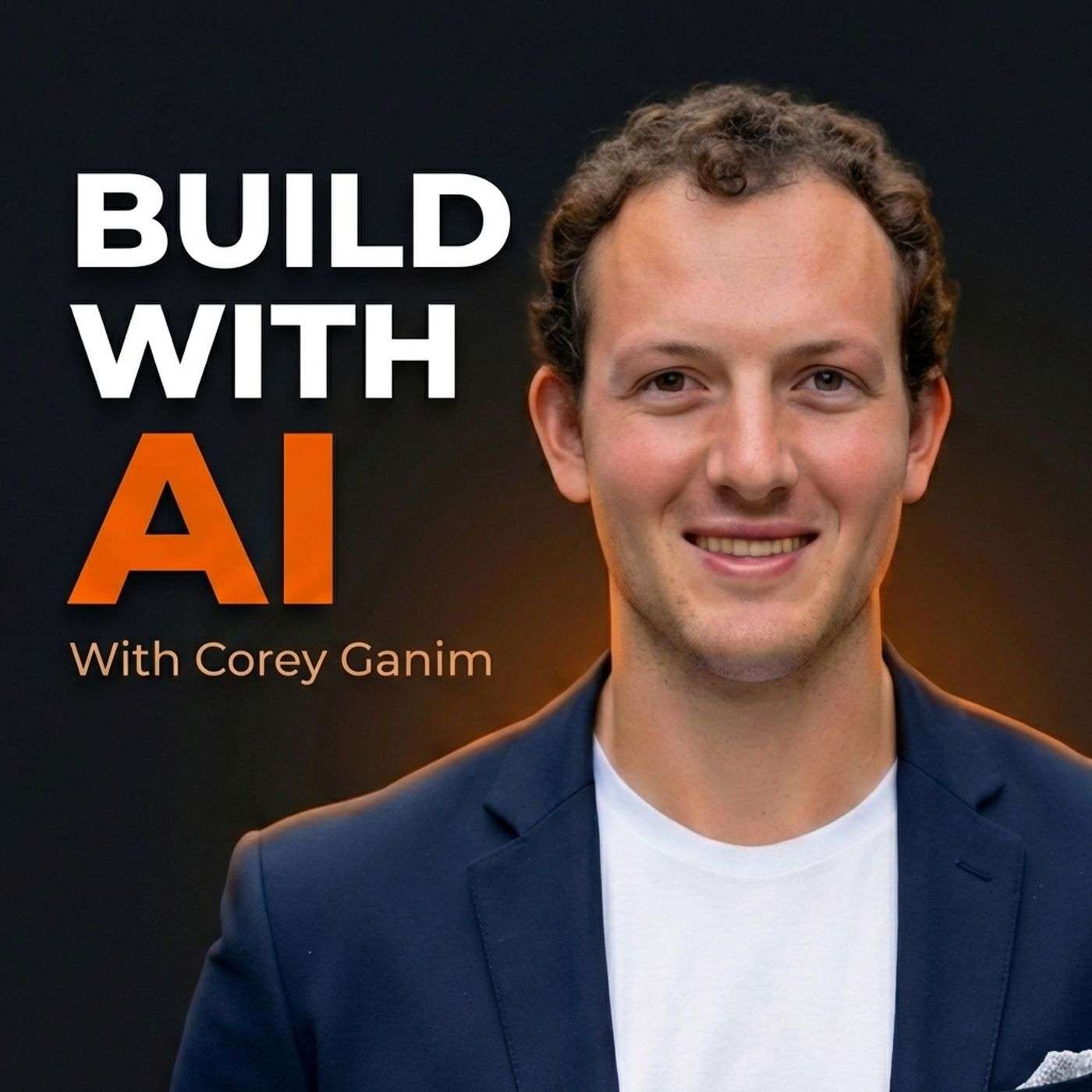
PODCAST · business
Build With AI
by Corey Ganim
Most AI podcasts talk about what's possible. Build With AI shows you how it's done, live. Each episode, host Corey Ganim brings on entrepreneurs and operators who share their screen and build real AI automations, workflows, and tool setups right in front of you. No boring slides. Nothing that hasn't been battle-tested. You'll watch actual implementations get built from scratch so you can follow along and do the same in your business. If you're a non-technical entrepreneur who wants to put AI to work without becoming a developer, hit play and build along with us.
-
79
Copy my Claude skills template, it makes me $8,000 every 30 days
Join AI Operator Academy: https://www.skool.com/aioperatoracademy/about Get all my FREE resources (including the ones mentioned in this podcast): https://www.skool.com/aioperatorhub/about In this solo episode, I break down the exact Claude Skills blueprint I use inside my AI concierge consulting practice to make $8,000 a month across five clients. I walk through my AOA framework, Audit, Optimize, Automate, then show a real example of a 24-step client onboarding process we turned into five Claude skills plus one orchestrator skill. By the end, you'll have the exact process to turn any client's manual workflow into a set of reusable, scheduled Claude skills.Timestamps:00:00 - Intro: The $8K/Month Claude Skills Blueprint00:58 - The AOA Framework: Audit, Optimize, Automate02:06 - Step 1: Auditing The Current Process04:18 - Step 2: Optimizing Before You Automate07:04 - AI Operator Academy Community Plug07:35 - Step 3: Automating One Skill At A Time09:19 - Testing And Iterating On The First Skill10:27 - Why New Skills Should Draft, Not Auto-Send11:50 - Building An Orchestrator Skill12:34 - Scheduling Skills To Run On Autopilot13:18 - Real Client Example: A 24-Step Onboarding Process14:01 - How The Audit And Optimize Calls Went14:53 - Correcting Claude's Misreads And Fixing Tools16:09 - Splitting Skills At The Human Boundaries16:51 - Automating And Locking In The Build Plan17:14 - Wrap-Up And AI Operator Academy InviteFIND ME ON SOCIALX/Twitter: https://x.com/coreyganimInstagram: https://www.instagram.com/coreyganim/ LinkedIn: https://www.linkedin.com/in/coreyganim/ YouTube: https://www.youtube.com/@coreyganim
-
78
Building an AI agency from scratch episode 3
Get $100 of free Hyperagent credits with any paid plan when you use this link: https://hyperagent.com/Corey100Join AI Operator Academy: https://www.skool.com/aioperatoracademy/about Get all my FREE resources (including the ones mentioned in this podcast): https://www.skool.com/aioperatorhub/about In this episode, you watch me sell then fulfill a real AI assessment from start to finish. I confirm a discovery call with a custom home builder, uncover his back office bottlenecks, and build a HyperAgent bot that analyzes the transcript and prescribes a simple fix. I demo the recommendation in person, close him on the spot for a paid NotebookLM pilot, then use HyperAgent again to build and QA the entire deliverable. By the end, you'll see the full sales-to-fulfillment loop for a real AI services client, agents and all.Timestamps:00:00 - Intro: Selling And Fulfilling A Real Deal00:40 - Calling Ben To Confirm The Discovery Call00:55 - Uncovering Back Office Pain Points03:45 - The Invoice Coding And Approval Process06:07 - Estimates And Proposals Workflow08:38 - Client Updates Through Job Tread10:36 - Draw Requests And Lender Paperwork14:13 - Wrapping The Call And Booking The Follow-Up17:40 - Recap: What Just Happened In The Mini Assessment19:19 - Building The Bottleneck Audit Agent In HyperAgent20:26 - Configuring The Agent's Model And Settings22:47 - Running The Assessment On Ben's Transcript28:04 - Reviewing The Two Opportunities It Found30:14 - Choosing NotebookLM For The Live Demo34:08 - Testing The Demo Before The Meeting36:32 - Closing Ben On The Spot In Person38:35 - Kicking Off The Paid Pilot Fulfillment43:34 - The Fulfillment Materials And Zip File44:50 - Setting Up The Notebook In NotebookLM46:54 - QA Testing The Notebook's Answers50:24 - Building The Team Quick Start Guide53:07 - Recording The Client Walkthrough Video54:15 - What's Coming In Episode Four56:02 - Wrap-Up And AI Operator Academy InviteFIND ME ON SOCIAL:X/Twitter: https://x.com/coreyganim Instagram: https://www.instagram.com/coreyganim/ LinkedIn: https://www.linkedin.com/in/coreyganim/ YouTube: https://www.youtube.com/@coreyganim
-
77
How to print money with GPT-6 Astra (before everyone ruins it)
Join AI Operator Academy: https://www.skool.com/aioperatoracademy/about Get all my FREE resources (including the ones mentioned in this podcast): https://www.skool.com/aioperatorhub/about In this solo episode, I use GPT-6 Astra inside Codex to fully automate the two heaviest steps of my $1,000 AI Tools Assessment offer: the pain point analysis and the client report build. I prompt it live to research tools, score them on an effort versus impact matrix, calculate ROI, and turn the whole report into a shareable client website, then package each step into a reusable Codex skill. By the end, you'll see exactly how to automate 60 to 70 percent of this entire offer in under 30 minutes.Timestamps:00:00 - Intro: Automating The AI Assessment Offer00:50 - Breaking Down The Six-Step Offer03:19 - Opening Codex To Start Automating04:47 - Prompting GPT-6 Astra On The Transcript06:19 - The Tool Recommendations It Found08:44 - Scoring Effort Versus Impact And ROI11:10 - AI Operator Academy Community Plug11:54 - Free Playbook Download Offer12:37 - ROI Results And Steering GPT Away From Overkill14:43 - Building The AI Tools Analysis Skill16:05 - AI Tools Analysis Skill Complete17:06 - Automating The Report With Codex Sites20:20 - Reviewing The Completed Report Site21:50 - The Priority Matrix Section22:27 - Tools And Pricing Breakdown23:14 - The Four-Day Quick Start Plan24:01 - Financial Impact And ROI Slide25:14 - Turning The Report Into A Skill26:00 - Assessment Report Skill Complete26:24 - Building An Orchestrator Skill Next27:34 - Wrap-Up And Where To Get The PlaybookFIND ME ON SOCIAL:X/Twitter: https://x.com/coreyganimInstagram: https://www.instagram.com/coreyganim/LinkedIn: https://www.linkedin.com/in/coreyganim/ YouTube: https://www.youtube.com/@coreyganim
-
76
How to Sign Your First AI Client (Zero Content or Cold Outreach)
Grab the exact step-by-step plan to land local AI clients in 30 days: https://link.excalidraw.com/l/4z8Z2Lyybfg/2pMiTnq0qvf In this solo episode, I break down the highest-ROI play I've found for landing AI clients without posting content or sending a single cold email: hosting a monthly AI for Business meetup in your own city. I walk through how I built mine in Charlotte from 25-30 people at the first event to a partnership that's set to bring 50+ to the next one, and exactly how the meetup feeds into the two offers that actually make money, the $999 AI Tools Assessment and the $1,000-$2,000/month AI Concierge retainer. I share the free Claude prompt I used to build the entire event structure and marketing plan, the exact Facebook group script that gets you 10-15 signups, and the three biggest mistakes that kill this strategy before it compounds. By the end of this episode, you'll have a step-by-step plan to fill a room with local clients in the next 30 days.Join our AI Operator Academy Community where we help entrepreneurs start and scale a profitable AI services business: https://www.skool.com/aioperatoracademy/aboutTimestamps 00:00 - Intro: the AI for Business meetup opportunity00:45 - What the meetup is and why it beats content or cold outreach01:45 - The two ways clients come from this event02:45 - Why non-technical local business owners are your ideal client03:45 - The opportunity: everyone else is hiding behind a screen05:15 - The offer stack: meetup as the front door06:15 - The AI Tools Assessment explained ($999, 45 minutes)07:15 - The AI Concierge retainer and AI Operator Academy09:00 - The free Claude prompt that builds your whole event10:15 - Pricing and margins on the assessment and concierge11:45 - Step-by-step plan to fill your first meetup13:45 - The hack: partnering with a local Facebook group owner15:15 - How to close the room with a simple CTA16:45 - Three pitfalls that kill this strategy (and the fixes)19:00 - Your next step and how to join AI Operator AcademyKey PointsHosting a free monthly AI for Business meetup at a local co-working space generates clients, referrals, partnerships, and speaking opportunities without any content creation or cold outreach.Clients come from this event in two ways: ideal clients who attend and want to buy, and other AI-niche people at the event who refer you business from their own networks, often more of the latter than the former.The meetup is the front door, not the offer. The real revenue comes from two back-end products: a $999 AI Tools Assessment (a 45-minute conversation that produces a report of three to seven off-the-shelf AI tools to reclaim 5-10 hours a week) and an AI Concierge retainer at $1,000-$2,000/month for done-with-you implementation.The math works out to roughly $500/hour on the assessment and $667-$1,333/hour on concierge work, meaning two assessments and one concierge client from a single meetup can mean $3,000-$4,000 in one evening.In-person trust compounds faster than digital trust. You can build more rapport in 30 seconds face-to-face than in six months of content or cold DMs, and most local business owners don't trust internet "experts" they've never shaken hands with.Partnering with the owner of a large local Facebook group as a co-host is the single biggest lever for turnout. Approaching a group owner with a done-for-you pitch (you bring the expertise, they bring their audience) can multiply attendance from 12-30 people to 50+.The three biggest ways this strategy fails: low turnout at event one (fix: co-host with a group owner and post in 5+ Facebook groups, not one), pitching too hard (fix: teach for 15-20 minutes before a soft 30-60 second CTA), and quitting after one event instead of locking a recurring monthly date so referrals can compound.FIND ME ON SOCIALX/Twitter: https://x.com/coreyganim Instagram: https://www.instagram.com/coreyganim/ LinkedIn: https://www.linkedin.com/in/coreyganim/ YouTube: https://www.youtube.com/@coreyganim
-
75
I asked Codex to make me as much money as possible
In this solo episode, I fire up Codex's voice mode with zero plan and challenge it to build me a real business from scratch in under 30 minutes, an idea to offer to a list of leads I could walk in and pitch today. I talk Codex through five AI service business ideas, land on a "local lead and reputation engine" for service businesses, and have it apply Alex Hormozi's $100 Million Offers framework to turn it into something a business owner would feel stupid saying no to. From there I built a live website using Codex Sites and went to find 10 real local businesses near me in Charlotte, with no digital presence, sorted by walking distance so I could hit all 10 in an hour. By the end of this episode, you'll see exactly how I went from nothing to a working offer, a website, and a prioritized prospect list, without touching my keyboard once.Join our AI Operator Academy Community where we help entrepreneurs start and scale a profitable AI services business: https://www.skool.com/aioperatoracademy/aboutTimestamps:00:00 - Setting the challenge: idea to offer to leads in 30 minutes01:30 - Brainstorming five AI service business ideas with Codex03:00 - Landing on appointment recovery plus review growth05:00 - Applying Hormozy's $100 Million Offers framework07:30 - Building the actual offer and pricing structure09:30 - Crafting the one-liner pitch for walking in cold11:00 - Choosing the tech stack: why GoHighLevel wins13:00 - Working around businesses that already have a CRM15:30 - Building a live website with Codex Sites in three minutes18:00 - Walking through the finished Signal Local website21:00 - Setting lead criteria: good reviews, poor digital presence23:00 - Codex researches and ranks 10 local leads by proximity25:00 - Reviewing King Auto Repair and Plaza Tire and Auto27:00 - Why this is a no-brainer offer for mom-and-pop businesses28:30 - Doing it all hands-free, even from your phone29:30 - Join AI Operator AcademyKey PointsI never typed a single word. The entire idea, offer, website, and lead list were built through a live voice conversation with Codex, which means this same process works while driving, walking, or doing anything else.The strongest offer bundled two services into one: instant replies and follow-up texts for missed calls (speed to lead) plus automated, personalized review requests after every completed job. I had Codex run that combo through the $100 Million Offers framework to make it irresistible.GoHighLevel was the pick for the tech stack because it can either run standalone or sit alongside a business's existing CRM, and a huge number of local businesses, even established ones, aren't using a CRM at all. That gap is the lowest-hanging fruit.Codex Sites built a full one-to-two-page website with a logo, headline, value prop, and a working "book a consultation" button in about three minutes. Four years ago, that same site would have cost around $5,000 and taken three weeks.For lead-finding, the filter that matters isn't industry, it's digital presence. Good Google reviews plus no website (or a Google Business page that just links to Facebook) is the signal of a mom-and-pop shop that's leaving money on the table.Codex sorted the 10 leads by proximity to my neighborhood so I could walk the route in order instead of driving across town, and it added direct links to each business's Google Business page so I could pull them up instantly from my phone.Real example: King Auto Repair has a 4.5-star rating with 251 reviews and unanswered one-star complaints, but no website and no way to book online. The only way to do business with them is to show up or hope someone answers the phone. That's the entire opportunity in one business.FIND ME ON SOCIALX/Twitter: https://x.com/coreyganimInstagram: https://www.instagram.com/coreyganim/ LinkedIn: https://www.linkedin.com/in/coreyganim/ YouTube: https://www.youtube.com/@coreyganim
-
74
How to make $10K/month selling AI services (step by step)
In this solo episode, I walk through the exact three-stage roadmap I used to build my AI services business past $10K a month in under a year: the free mini assessment, the paid assessment, and the AI concierge model. I break down what each stage actually looks like on a call, how to price them (including the exact math that gets you to 10K/month), and the three biggest ways this business breaks if you're not careful. I also hand you my AOA framework - Audit, Optimize, Automate - which is literally how I turn a client's manual process into a Claude skill during every concierge engagement. By the end of this episode, you'll have the full playbook for landing your first AI services client and scaling to recurring revenue.Grab all the free resources mentioned in this video: https://corey-ganim.kit.com/6a4bf70e48Join our AI Operator Academy Community where we help entrepreneurs start and scale a profitable AI services business: https://www.skool.com/aioperatoracademy/aboutTimestamps00:00 Overview of the three-stage roadmap to 10K/month01:15 Stage 1: What a free mini assessment actually is03:00 Stage 2: The paid assessment (3-7 tools vs. 1)04:30 Stage 3: The AI concierge recurring revenue model06:00 The AOA framework: Audit, Optimize, Automate07:00 Why unlimited Voxer access is high perceived value07:45 The math: How many clients you need to hit 10K/month09:00 Who to sell this to (ideal client profile)10:00 Action step: Text 10 business owners today11:00 Three ways this business breaks (and how to avoid them)12:00 How the free assessment call actually runs14:00 How the paid assessment works and quantifying ROI17:30 How AI concierge calls run using the AOA framework19:30 Pricing strategy: Raise by $250 every time you get a yes20:30 Recap and where to get the free resource libraryKey PointsThe business runs in three stages: a free mini assessment to get testimonials, a paid assessment ($500-$2,000) to prove deeper value, and AI concierge (done-with-you consulting) for recurring revenue.The free mini assessment is intentionally small: a 15-minute call to identify one pain point, followed by a 5-10 minute call to prescribe one tool or workflow. No implementation, no building — just a roadmap. Only do this for your first one to three contacts to earn testimonials.The paid assessment is "the free assessment on steroids" — a 45-60 minute discovery call that surfaces 3-7 opportunities, scored on an effort-versus-impact matrix to find the high-impact, low-effort quick wins. Priced at $500 to start, with $1,000 as the sweet spot and $2,000 as the ceiling once you have proof.AI concierge is where the real money is: two 45-minute strategy calls a month plus unlimited Voxer access, priced $1,000-$2,000/month, using the AOA framework (Audit the manual process, Optimize it, Automate it into a Claude skill inside Claude Cowork).The math to 10K/month: 10 AI concierge clients at $1,000/month, 7 at $1,430/month, or 5 at $2,000/month — all before counting a dime of assessment revenue.The best clients are owner-led service businesses doing $3-10M+ in revenue with repetitive manual work, visible bottlenecks, and budget — they already know they need AI, they just don't know where to start.The three ways this breaks: doing free implementation work instead of stopping at the roadmap, letting concierge calls turn into unlimited ad hoc Zoom sessions instead of a fixed cadence, and building a custom tool stack for every client instead of standardizing on Claude Cowork and Claude skills.Raise your price by $250 every time a prospect says yes — if someone pays $1,000, pitch the next person $1,250, and keep climbing until people start saying no.SaneBox – the AI email triage tool most commonly prescribed during assessments to cut hours of inbox time - https://www.sanebox.comAI Tools Assessment Report template – the free consulting-style report template used to deliver paid assessment roadmaps - https://audittemplate.aiVoxer – the walkie-talkie app used to offer unlimited AI concierge access with a 12-business-hour response window - https://voxer.comClaude Cowork – the tool used to build and standardize Claude skills for every AI concierge client - https://claude.aiFIND ME ON SOCIAL X/Twitter: https://x.com/coreyganim Instagram: https://www.instagram.com/coreyganim/ LinkedIn: https://www.linkedin.com/in/coreyganim/ YouTube: https://www.youtube.com/@coreyganim
-
73
This hidden Codex feature PRINTS cash (no one is doing this)
In this solo episode, I break down a hidden Codex feature most people are sleeping on and show you exactly how to turn it into a client-getting machine. I walk through the entire offer from scratch: how to target local service businesses with bad or missing websites, how to use Codex Sites to build them a free homepage preview in under two minutes, and how to turn that free preview into a paid website, a monthly care plan, and eventually an AI assessment and managed AI services retainer. Then I open up Codex live, off the hip, and build a real homepage for an actual Charlotte pressure washing company using voice mode, find their broken quote form, fix it, and generate outreach templates to contact the owner directly. By the end of this episode, you'll have a full repeatable playbook you can run on literally any local service business in your area.Join our AI Operator Academy Community where we help entrepreneurs start and scale a profitable AI services business: https://www.skool.com/aioperatoracademy/about Timestamps:00:00 - Intro to the Hidden Codex Feature00:45 - Picking the Target: Local Service Businesses to Go After02:15 - Building the Free Codex Sites Homepage Preview03:45 - Pitching the 2-Minute Loom Walkthrough04:30 - Pricing the Full Paid Website Build05:15 - The $99–$299/Month Care Plan Upsell06:00 - Uncovering Speed to Lead & Follow-Up Problems07:30 - Selling the $1,000 Paid AI Assessment08:45 - 3 Pitfalls: What NOT to Do When Pitching10:30 - Live Demo: Talking to Codex in Voice Mode12:00 - Finding a Local Business & Building the Site14:30 - First Look at the AI-Generated Homepage Draft16:00 - Comparing It to the Real (Broken) Website18:00 - The Audit: Uncovering a Broken Quote Form20:00 - Iterating Live: Fixing Logo, Layout & Quote Form24:00 - Testing the New Speed to Quote Form27:30 - Finding the Owner's Contact Info & Socials30:00 - Drafting Outreach Email, Text & Cold Call Script33:00 - How to Attach the New Site to the Client's Domain35:00 - Wrap-Up & AI Operator Academy InviteKey PointsThe best prospects for this offer are mom-and-pop local service businesses selling a higher-ticket service (tree services, roofers, HVAC, commercial pressure washing) that have great Google reviews but a weak or missing website, and where you can reach the owner directly by phone.Codex Sites lets you build a fully custom, hosted homepage in minutes using nothing but voice chat, using only verified public information about the business so you're not misrepresenting them to a prospect.The free homepage preview is a foot-in-the-door offer, not the moneymaker. The real path is: free preview to paid website ($500–$1,000) to a $99–$299/month care plan to a $1,000 paid AI assessment to ongoing managed AI services that can run $1,000–$2,000+ a month.Never let Codex invent facts about a business, never promise traffic you can't control (sell trust instead), and never upsell before you've actually delivered — those are the three fastest ways to torch your credibility with a cold prospect.In the live demo, Codex found a real Charlotte pressure washing company, built a homepage with a working speed-to-quote form in about five minutes, and the form actually generated a real quote range ($975 to $3,225) and let the user text themselves the estimate — instantly beating the business's real website, whose quote form was completely broken.Codex can research the business owner's contact info, LinkedIn, and social channels, then draft a full outreach sequence (email, text, cold call script, DM script) for you, giving you seven-plus ways to get in front of a decision-maker without writing a single word yourself.If a prospect worries about the technical side of attaching a new website to their existing domain, the answer is the same as everything else in this workflow: ask Codex to handle it. It's turnkey and can be bundled into the price you charge for the build.FIND ME ON SOCIAL X/Twitter: https://x.com/coreyganim Instagram: https://www.instagram.com/coreyganim/LinkedIn: https://www.linkedin.com/in/coreyganim/ YouTube: https://www.youtube.com/@coreyganim
-
72
How to make f*ck you money SEOmaxxing boomer businesses
Find the exact 10-page prompt I used to build this app here: Steal the prompt I used to build the SEO machine in LetaidoAll Ahrefs customers get 1 month of Letaido for free. Sign up for Ahrefs here: https://ahrefs.com/ Right now there's a massive opportunity in AI that most companies have no idea how to solve: they don't know how to show up in AI search results. In this solo episode, I walk through how to build a standalone app inside Latito (Ahrefs' new agentic tool) that finds exactly where your competitors are getting cited by ChatGPT, Gemini, and Perplexity while you're invisible, then writes, previews, and one-click publishes content to close that gap. I show the whole build end to end, from the exact prompt I used to generate the app, to pulling live opportunity data on real competitor sites, to publishing a finished article straight to my website. By the end of this episode, you'll have a repeatable system you can turn around and sell to local and mid-size businesses as an AI visibility audit, a content service, or a full monthly retainer.Join our AI Operator Academy Community where we help entrepreneurs start and scale a profitable AI services business: https://www.skool.com/aioperatoracademy/aboutTimestamps00:00 - Why AI Search Visibility Is the Opportunity Right Now01:30 - Introducing Latito: Ahrefs' Agentic SEO/GEO Tool02:30 - The Exact Prompt Used to One-Shot the App Build04:00 - Setting Up Brand, Competitors & Target Platforms06:30 - Finding Opportunities: 47 AI Answers Analyzed in Seconds08:00 - Breaking Down the Top Opportunity ("What is Poppy AI for?")10:30 - How a Competitor's Article Is Winning AI Citations12:00 - Generating a Competing Article Automatically14:30 - Why AI Search Rewards Numbered Lists, Tables & FAQs16:00 - Previewing the Article Before Going Live18:00 - Turning Off Test Mode & Publishing to the Live Site20:00 - Tracking Daily AI Citation Performance Over Time21:30 - 4 Ways to Monetize This as a ServiceKey PointsTraditional SEO has shifted into GEO/AEO (generative/AI engine optimization) — the game now is getting cited inside AI answers on ChatGPT, Gemini, Perplexity, and Copilot, not just ranking on a Google results page.The Latito app connects directly to Ahrefs' data to scan AI answers across all platforms, flag which competitors are getting cited, and surface content gaps as concrete "opportunities" ranked by how winnable they are.In one demo run against two real competitor sites, the app pulled 47 AI answers, found 47 answers where the brand was missing, and narrowed that down to 5 final content opportunities worth acting on.The app doesn't just diagnose the gap — it writes a full article (with meta description and URL slug), validates its own draft for quality, and lets you preview it live on your actual site before anything goes public.AI citation engines consistently favor a specific content structure: numbered lists, comparison tables, and FAQ sections at the end are what get pulled into AI answers, and the generated article included all three by default.Publishing is deliberately friction-heavy for safety — you have to verify facts and sources, then type PUBLISH in all caps before anything pushes live to the site via GitHub/Vercel.Once published, the app tracks daily whether your brand is mentioned, whether your page is cited, and your AI share of voice against competitors — the exact data needed to sell this as an ongoing retainer with a monthly ROI report.Latito - the agentic SEO/GEO tool from the makers of Ahrefs used to build this app - https://www.letito.appFIND ME ON SOCIALX/Twitter: https://x.com/coreyganim Instagram: https://www.instagram.com/coreyganim/ LinkedIn: https://www.linkedin.com/in/coreyganim/YouTube: https://www.youtube.com/@coreyganim
-
71
7 AI services boomer businesses are BEGGING for
In this solo episode, I break down the exact 7 AI service offers that small business owners are lining up to pay for right now, starting with the one that requires zero AI experience to sell. I walk through the what, why, build process, and real pricing for each one, from the $999 AI assessment that converts 50-60% of clients into bigger engagements, to the AI concierge retainer that's currently my biggest personal income stream, to full implementations that can run $5,000 to $10,000 or more. I share real client stories along the way, including a fintech CEO whose weekly memo process we cut from two hours to 15 minutes, and an Amazon seller whose 25-step ad reporting process we trimmed to 10. By the end of this episode, you'll know exactly which offer to start with, how to price each one, and how they stack into each other so you're never stuck pitching something you're not ready to fulfill.Join our AI Operator Academy Community where we help entrepreneurs start and scale a profitable AI services business: https://www.skool.com/aioperatoracademy/aboutTimestamps00:00 - Intro: The 7 AI Offers Small Businesses Want00:20 - Offer 1: The AI Assessment (What, Why, Build, Price)02:40 - Free Report Template (audittemplate.ai)04:00 - Offer 2: The AI Concierge (Corey's Top Income Offer)06:30 - Turning Client Intake Forms into Claude Projects & Skills07:40 - Concierge Pricing & Effective Hourly Rate Math08:40 - Client Story: Automating a Fintech CEO's Weekly Memo09:40 - Offer 3: Process Redesign (Fixing Broken Workflows First)11:20 - Case Study: Cutting a 25-Step Amazon Ad Process to 1012:20 - Offer 4: Simple Automation Builds with Zapier & Make.com13:40 - Case Study: Automating a Wedding Venue's Asana Onboarding14:50 - Offer 5: Knowledge Systems (Custom GPTs Trained on Client Data)16:10 - Case Study: Business Broker's Custom GPT Cuts 500 Emails to 1017:10 - Offer 6: Custom Workflows & Claude Skills18:30 - Case Study: The Podcast Production Orchestrator Skill19:50 - Offer 7: Full Implementation (Mix and Match Everything)21:00 - Why You Start with the Assessment, Not the Full BuildKey PointsThe AI assessment is the best offer to start with because it requires no AI expertise to sell. It's a paid diagnostic: a 45-minute interview uncovering bottlenecks, delivered as a report showing 3-7 off-the-shelf AI tools the business can implement immediately. Priced at $999, and 50-60% of clients convert into a bigger implementation engagement.The AI concierge is a done-with-you monthly retainer where you sit side by side with the business owner and turn their manual processes into Claude skills. Priced at $1,000-$2,000 a month for two 45-minute calls, which works out to $750-$1,250+ an hour, because you're pricing on hours saved for the client, not hours worked.Never automate a broken process. A process redesign strips the waste out of a workflow before any AI or automation touches it. One Amazon seller paid $3,500 just to cut his 25-step, 10-hour-a-week ad analysis process down to 10 steps and about an hour a week, before automation was ever on the table.Simple automation builds using Zapier or Make.com work best when the input and output are concrete and repeat the same way every time. A wedding venue business paid $1,500 to fully automate a manual Asana onboarding duplication task that was eating an hour of a project manager's time every week.Knowledge systems are custom GPTs or Claude projects trained on a client's content to answer repetitive questions. A business broker went from 500 buyer emails per listing to about 10 after we built a custom GPT trained on his marketing package, priced at $3,000.Custom workflows turn a client's existing scattered AI use into one-click Claude skills. One client's podcast production process, previously 30-45 minutes of manual copy-pasting into ChatGPT, became a five-minute run of an orchestrator skill. This tier prices at $3,000-$5,000, based on the deliverable, not the hours.Full implementation is the mix-and-match top tier, combining any of the previous six offers into one engagement priced at $5,000-$10,000 or more, plus a monthly retainer worth roughly 10% of the build price to maintain it. Don't pitch this until you've done 5-10 smaller projects first.Links mentionedFree AI assessment report template, the exact one used to deliver $999 assessments - https://www.audittemplate.aiFathom, the AI notetaker used to transcribe discovery calls - https://fathom.videoClaude, used to analyze call transcripts, find matching tools, and build client-specific Claude Projects and skills - https://claude.aiGamma, one of the tools used to build assessment report deliverables - https://gamma.appJotform, used to build the AI concierge client intake form - https://www.jotform.comZapier, used for simple workflow automation builds - https://zapier.comMake.com, used for simple workflow automation builds - https://www.make.comAsana, the project management tool automated in the wedding venue case study - https://asana.comFIND ME ON SOCIALX/Twitter: https://x.com/coreyganim Instagram: https://www.instagram.com/coreyganim/ LinkedIn: https://www.linkedin.com/in/coreyganim/YouTube: https://www.youtube.com/@coreyganim
-
70
How to sell managed AI agents as a service (recurring revenue)
If you use BOTH the following link and code COREY, you'll get your first 3 days of Orgo free, then 20% off your first 3 months: https://www.orgo.ai/?r=COREYI sat down with Phil Goodwin, a completely non-technical designer who sold his last business this past November and, just months later, built a managed AI agent business he now runs under the name Sidecar. Phil walks through his exact stack, how he prices setup fees and monthly per-agent retainers, and the "guinea pig" pitch he used to land his very first paying clients without a following or an email list. We get into real client use cases (a one-man directional drilling company, a short-form video editor), the group-chat trick he uses so clients actually learn to talk to their agent, and a dead-simple weekly value tracker that quantifies exactly why a client should keep paying every month. By the end of this episode, you'll have a working blueprint for pricing, pitching, and delivering a managed agent offer even if you've never written a line of code.Join our AI Operator Academy Community where we help entrepreneurs start and scale a profitable AI services business: https://www.skool.com/aioperatoracademy/aboutTimestamps00:00 - Intro: The Promise of This Episode00:41 - Phil's Non-Technical, Design-First Background02:43 - What "Managed Agents" Actually Means04:14 - Coaching Plus AI Employee, Not Plug-and-Play05:31 - How Phil Built Agents for Himself, Then Friends08:23 - Setup Fee Plus Per-Agent Pricing Model Explained09:55 - Why "We Fix It Before You Notice" Is the Real Value Prop11:53 - Real Client Use Cases Across Industries12:30 - Drilling Company Client and the Telegram Group Chat Trick15:21 - The Value Ledger: Tracking Hours and Dollars Saved Weekly17:00 - Short-Form Video Editing Use Case18:41 - Give Agents a Human-Readable Source of Truth, Not Just Markdown19:53 - Finding First Clients Through Friends and Referrals23:21 - Pick the Offer You Enjoy Fulfilling, Not Just the Lucrative One24:31 - The Exact Text Phil Sends to Pitch Free "Guinea Pig" Work26:29 - Pricing Breakdown: From $250/Month to a $1,500 Setup29:37 - Should You Skip the Free Phase and Go Straight to Paid?31:23 - Step One Advice: Pick Orgo and Land Your First Client34:22 - Where to Find Phil and SidecarKey PointsManaged agents aren't plug-and-play. Phil's offer is a hybrid of coaching, consulting, and a deployed AI employee — he acts as the ongoing manager of the agent, not just the person who installed it, which is why clients pay a few grand a month instead of walking away after setup.Phil started by pricing pure infrastructure setups at $500, then raised it to $1,000, $1,500, and $2,000 as people kept saying yes — but he learned that handing off infrastructure without ongoing coaching causes clients to abandon the agent within weeks because they don't know how to talk to it.His current pricing model is a setup fee plus a per-agent monthly fee, a deliberate departure from flat unlimited-agent pricing (like the $5K/month unlimited model his podcast guest Nick uses) because most clients only need one or two agents, not unlimited access.The single most valuable "pro tip" from this episode: have the agent maintain a value ledger that logs every task it completes and assigns it a time and dollar value, then send the client a weekly report. One client saved 63 hours and $6,300 in his very first week — a number that makes churn almost impossible.Phil sets up a three-way Telegram group chat with himself, the client, and the agent, so the client can watch him interact with the agent and learn how to prompt it, while Phil can see exactly what tasks are being requested and coach in real time.Client acquisition ran entirely on free work and referrals — no social following required. Phil did free setups for close friends to get testimonials, and those friends referred him to paying clients in bigger cities, expanding a small-town Georgia network into clients across the country.Not every profitable offer is the right offer for you. Phil explicitly avoids multi-tool consulting and audits (the AI Concierge model) because it's not what he enjoys fulfilling — his advice is to find the intersection of what's lucrative and what you actually want to deliver.Orgo, an AI agent infrastructure platform - https://orgo.aiWatch Corey's prior episode with Nick, co-founder of Orgo, referenced in this conversation - https://www.youtube.com/@coreyganimSidecar, Phil's managed AI agent service (Sidecar SMB, with an enterprise tier in development) - https://runsidecar.comFIND ME ON SOCIAL X/Twitter: https://x.com/coreyganim Instagram: https://www.instagram.com/coreyganim/ LinkedIn: https://www.linkedin.com/in/coreyganim/ YouTube: https://www.youtube.com/@coreyganimFIND PHIL ON SOCIAL Phil’s X: https://x.com/fhlcreativeSidecar Website: https://www.runsidecar.com/
-
69
I'm Starting an AI Agency from Scratch (Episode 1)
Try Hyperagent for free ($1,000 free credits for first 1,000 signups): https://www.hyperagent.com/corey Want the exact prompts I used to build these agents? Download them free here: Steal the 4 Exact Prompts I Used to Launch an AI Services Business From Scratch. Copy, paste into Hyperagent, and your lead gen + outreach agents are live today. In this solo episode, I kick off a four episode series where I build an AI services business from scratch and prove exactly how many days it takes to land a paying client using 100% cold outreach, no audience, no network, and a hard cap of 60 minutes of work per day. I walk through why I'm targeting tree service companies in Charlotte, North Carolina, the dead-simple $500 offer I'm selling them (a website, an AI lead intake agent, and a Google Business Profile cleanup), and then build the first agent in the fleet live inside Hyper Agent, the Prospector, which scrapes the web, finds and cleans a full lead list, and gets our outreach machine ready to go. By the end of this episode, we have 98 verified leads, a live sales pipeline dashboard, and a full outreach script pack ready to start texting, calling, and knocking on doors in episode two.Timestamps 00:00 - Intro: Proving Anyone Can Land an AI Client01:24 - Series Constraints: Cold Outreach Only, 60 Minutes a Day02:19 - Why Tree Services in Charlotte Are the Target Niche03:35 - Backup Niches: Pressure Washing, Junk Removal, Driveways04:02 - The Offer: $500 Website Plus AI Lead Intake Plus GBP Cleanup05:07 - The 5-Agent Fleet Hyper Agent Will Give Away in Episode 405:55 - Agent 1: The Prospector, Scraping and Cleaning Leads06:31 - Agent 2: The Opener, Writing Texts, Calls, and Replies07:16 - Agent 3: SiteSmith, Building Free Lead-Magnet Websites08:17 - Agent 4: The Fulfiller, Delivering the Paid Engagement08:56 - Agent 5: Account Manager, the $100/Month Upsell09:49 - What Each of the Four Episodes Will Cover13:03 - Building the Prospector Agent Live in Hyper Agent19:03 - Running the Lead Scrape in Plan Mode21:03 - Hyper Agent Auto-Discovers a Marketplace Skill on Its Own24:26 - 8 Sub-Agents Dispatched to Research Leads in Parallel24:52 - Results: 494 Businesses Found, 98 Qualified, $151 in Credits Spent25:56 - Touring the Leads' Broken, Missing, or Hijacked Websites30:03 - Reviewing the Auto-Branded Live Pipeline Dashboard31:29 - Building the Opener Agent and Its No-Pitch First-Text Rules37:04 - The Finished Outreach Scripts and Objection Responses41:38 - Episode 1 Recap and What's Coming in Episode 2Key PointsThe series has a strict scoreboard: the day counter only stops when a Stripe invoice is actually paid, not on a verbal yes, and every constraint (cold outreach only, 60 minutes a day) is designed to strip away any advantage so the process is copyable by anyone watching.Tree services in Charlotte were chosen because the industry hasn't been consolidated by private equity, it's high ticket (multiple thousands per job), buyers often hire whoever picks up the phone first during emergencies, and most operators don't have a working website.The offer is deliberately underpriced at $500 flat for a hosted website, a speed-to-quote AI lead intake agent, and a Google Business Profile cleanup, specifically so price can never be the reason the challenge fails.Five agents get built across the series and given away free in episode 4: the Prospector (finds and cleans leads), the Opener (writes texts, call scripts, and objection replies), SiteSmith (builds the free lead-magnet websites), the Fulfiller (delivers the paid engagement end to end), and the Account Manager (a $100/month maintenance upsell).The Prospector agent scraped 494 businesses, verified down to 98 qualified leads with mobile numbers and no working site, and did it by autonomously deploying 8 sub-agents to search different cities in parallel, all for about $151 in credits.While building the plan, Hyper Agent independently found and installed a "Small Business Website Builder" skill from its own marketplace, without being asked, because it judged the skill relevant to the task.The Opener agent's first-touch texts follow strict rules: under 160 characters, no links, no emojis, no mention of AI, websites, or marketing, signed only "Corey," written casually enough (using local phrasing like "y'all") to read as a neighbor texting, not a company pitching.FIND ME ON SOCIALX/Twitter: https://x.com/coreyganimInstagram: https://www.instagram.com/coreyganim/LinkedIn: https://www.linkedin.com/in/coreyganim/ YouTube: https://www.youtube.com/@coreyganim
-
68
How to make $5K per month per client selling managed AI agents
Download the exact blueprint behind Nick’s always-on AI agent Dewey, with its own cloud computer, phone, email, payment card, and password vault and start texting your own in about two minutes (free).Nick and I both use Orgo to build and deploy our managed agents. If you use BOTH the following link and code COREY you'll get your first 3 days of Orgo free then 20% off your first 3 months. Orgo - Computers for AI agents | OrgoNick Vasilescu is back on the pod, and this time he's showing exactly how his personal AI agent, Dewey, is running his managed agent business for him. I sat down with Nick, co-founder of Orgo, to break down how Dewey builds, deploys, and even supports client agents inside Slack and iMessage with zero hands-on work from Nick. We get into the full 80/20 tech stack he uses (harness, model, computer, memory, connectors), how he closed another $5K/month client and had their agent live within 48 hours of the wire hitting his account, and the B2B2B insight that's making these deployments sticky: building an agent for a client that they then resell to their own customers. By the end of this episode, you'll understand exactly what tools to stack together to build your own AI employee and how to turn that into a productized, recurring managed agent business.Timestamps:00:00 - Intro & What You'll Learn From This Episode01:29 - Meet Dewey, Nick's Personal AI Agent02:03 - Watching Dewey Onboard a Client Agent Into Slack Live04:00 - Hermes Maker Hiring Forward Deployed Engineers Signals Opportunity09:02 - Orgo Elevator Pitch: Purpose-Built Cloud Computers for Agents12:05 - Orgo Discount Code: 3 Days Free + 20% Off 3 Months13:02 - Spinning Up Agents From Templates With the Nick Stack15:32 - Productizing Agents So You're Not Rebuilding From Scratch19:50 - Why a Client Pays $5K a Month for a Managed Agent22:56 - The B2B2B Model: Reselling the Agent to Your Client's Customers27:22 - Breaking Down the Full Agent Stack: Harness, Model, Computer, Memory & Connectors33:01 - From Paid Invoice to Live Agent in 48 Hours36:24 - Turning a Granola Call Transcript Into Agent Skills39:27 - Why Paid Assessments Are the Perfect Lead-In Offer41:02 - Where to Find Nick & Follow His WorkKey PointsThe service layer of deploying AI agents into businesses is the real opportunity right now. Hermes's creators are hiring forward deployed engineers to deploy agents into enterprise, which validates that this is a venture-scale market — and the SMB and mid-market tier beneath enterprise is wide open.Dewey, Nick's personal agent, does the actual fulfillment work: he builds client agents from scratch, onboards them into Slack, texts customers on iMessage to fix issues, and manages the entire agent fleet without Nick touching a keyboard.Newer models are increasingly choosing computer use over MCPs or connectors because they're trained on human behavior — they operate a full desktop the way a person would, which is why Orgo gives agents a real computer instead of a headless sandbox.Nobody pays $5K a month for a managed agent unless it makes them money. The unlock isn't always a direct-revenue agent like sales or speed-to-lead — it can be a B2B2B model where you build the agent for a client, and they productize and resell it to their own customer base, creating true stickiness since their revenue now depends on your infrastructure.The core agent stack breaks down into a harness (OpenClaw or Hermes) powered by a model (Grok or GPT-5.6), running on a persistent computer (Orgo), with its own email and phone (Agent Mail, Agent Phone), a knowledge base (Obsidian), persistent memory (Honcho.dev), and tool connectors (Composio).Speed to value matters enormously: the same day a client wires their first payment, their agent should already be live and something should be visibly built for them — that immediate reciprocity builds trust fast.Building is commoditized. The real skill today is asking the right discovery questions, understanding a client's workflow, and knowing which tools to hand off to your agent — which is exactly why paid audits and assessments work so well as a lead-in offer.The Agent Bundle - bundle of Agent Card, Agent Mail, and Agent Phone (plus an Orgo computer) for around $20/month, from the "agent mafia" - https://www.theagentbundle.comHoncho.dev - managed persistent memory layer so an agent remembers context across Slack, Telegram, and every other channel - https://www.honcho.devComposio - free tool connector layer that gives agents read/write access to Gmail, calendars, and other platforms - https://composio.devHiggsfield - AI creative generation tool Dewey uses to make thumbnails and short explainer videos - https://higgsfield.aividIQ - YouTube research tool Dewey uses to find high-performing videos and build winning thumbnails - https://vidiq.comLatitude.so - observability platform for monitoring agent conversations and catching customer sentiment issues - https://latitude.soObsidian - knowledge base tool Nick wires into his agent's stack - https://obsidian.mdApify - scraping connector used to source leads that get enriched via Clay - https://apify.comClay - lead enrichment platform connected via MCP - https://www.clay.comFIND ME ON SOCIAL X/Twitter: https://x.com/coreyganim Instagram: https://www.instagram.com/coreyganim/ LinkedIn: https://www.linkedin.com/in/coreyganim/ YouTube: https://www.youtube.com/@coreyganimFIND NICK ON SOCIAL X: https://x.com/nickvasiles YouTube: https://www.youtube.com/@nickvasiles Website: https://www.orgo.ai
-
67
The 3 Levels of AI Automation (full playbook)
In this episode, I sit down with Greg and give away the entire playbook behind our AI Tools Assessment offer, the simplest AI-powered business model you can start in 2026 with zero AI skills, zero audience, and zero capital. I walk through the exact four-phase process we use to run a $999 assessment for small business owners, the client-facing report template (which you can download for free), and the six-item upsell menu that turns a $999 foot-in-the-door offer into $3K, $5K, and $10K+ engagements. I also break down my current AI Concierge retainer, which is generating me over $1,000 an hour, and the seven no-capital, no-audience client acquisition methods I'm using right now to fill my pipeline. By the end of this episode, you'll have the full stack: the offer, the fulfillment process, the upsells, and how to actually go get clients.Grab the free AI Tools Assessment report template (built in Claude Design, plug-and-play for your own clients): https://audittemplate.aiJoin our AI Operator Academy Community where we help entrepreneurs start and scale a profitable AI services business: https://www.skool.com/aioperatoracademy/aboutTimestamps00:00 - Intro: The Simplest AI Business Model of 202602:00 - Why Give Away the Entire Playbook (Blue Ocean Opportunity)03:30 - The AI Tools Assessment Offer Explained ($999, 45 Mins)05:00 - The 5-Hour Guarantee & Average Client Results09:00 - Phase 1: The Discovery Call & The Magic Wand Question13:00 - Phase 2: Feeding the Transcript to Claude for Tool Research15:00 - Quality Assurance & Making Judgment Calls18:00 - Best Tool Directories: Futurepedia & There's An AI For That19:30 - Phase 3: Building the Client Report in Claude Design24:00 - Free Download: The AuditTemplate.ai Report Template27:30 - The Effort vs. Impact Matrix & Quick Wins32:00 - Why Most Recommendations Are Simple SaaS Tools (Not Big AI)34:00 - Phase 4: The Review Call & The 3 Closing Questions37:30 - Upsell 1: Process Redesign (Fixing Broken Workflows First)39:00 - Upsell 2: Simple Zapier, Make & n8n Automations41:00 - Upsell 3: Knowledge Systems (The Business Broker Example)43:30 - Upsell 4: Custom Claude Skill Workflows & Retainers46:00 - Upsell 5: Full Implementation Packages47:30 - 7 Ways to Find Clients With No Capital or Audience59:30 - The AI Concierge Offer: $1,000+/hr Done-With-You Consulting1:05:00 - The AOA Framework: Audit, Optimize, Automate1:07:00 - Why Niching Down Is the Key to Pricing Power1:09:00 - Wrap-UpKey PointsThe AI Tools Assessment is a $999, 45-minute structured interview where you prescribe three to seven off-the-shelf AI tools that reclaim at least five hours a week for the client, backed by a 100% money-back guarantee if you can't find that time.The fulfillment process is four phases: a recorded discovery call to surface pain points, feeding that transcript to Claude to research matching tools, building a templated client report in Claude Design, and a review call that ends with three closing questions to surface the upsell.A confused mind doesn't buy, doesn't implement, and doesn't upsell. The report is built around an effort versus impact matrix that isolates "quick wins," a four-day quick start plan, and a financial impact slide that shows exact monthly ROI.There are six upsells after the assessment: process redesign, simple automation builds, knowledge systems, custom Claude skill workflows, retainers, and full implementation packages, with average tool costs around $60 a month against thousands of dollars in monthly ROI.Seven ways to find clients without capital or an audience: hosting a local AI meetup, door knocking, LinkedIn DMs that lead with pain instead of pitching, free mini-audits for your network, agency referral partnerships, AI office hours at co-working spaces, and posting your wins publicly.The AI Concierge offer is two 45-minute monthly calls plus Voxer access, teaching clients to use Claude Cowork and build their own Claude skills. It closed five of the first six people pitched and hit 8K MRR in ten days.Crediting the $999 assessment fee toward a bigger upsell, while quietly marking the upsell up to stay profitable, is one of the most effective ways to get a prospect off the fence.Links mentioned:Futurepedia.io, a large AI tool directory recently acquired by HubSpot - https://www.futurepedia.ioTheresAnAIForThat.com, an AI tool directory searchable by industry - https://theresanaiforthat.comGamma, the tool used early on to build assessment reports - https://gamma.appClaude, used to research tools from the discovery call transcript and to build client-facing skills - https://claude.aiAudittemplate.ai, free download of the exact AI Tools Assessment report template used in Claude Design - https://audittemplate.aiFathom, the AI note taker used to record and transcribe discovery calls - https://fathom.videoSanebox, the most-prescribed tool for getting clients out of email overload - https://www.sanebox.comZapier, used for simple one-to-three-step automation builds - https://zapier.comMake, used for automation builds as an alternative to Zapier - https://www.make.comn8n, another automation platform used for client workflow builds - https://n8n.ioFIND ME ON SOCIAL X/Twitter: https://x.com/coreyganim Instagram: https://www.instagram.com/coreyganim/ LinkedIn: https://www.linkedin.com/in/coreyganim/ YouTube: https://www.youtube.com/@coreyganim
-
66
The Ultimate AI Services Free Course ($0-$10K in 30 Days)
Download the full AI Services Resource Library including every resource mentioned in this episode (free): Steal the Entire AI Services Resource Pack This is the full AI services business course, A to Z, completely free. I walk through exactly how I built a business that hit $8,000 in MRR in 10 days and now generates over $1,000 an hour, starting with one lunch conversation with a commercial real estate broker who offered to pay me to find AI opportunities in his business. I break down the entire three-offer ladder: the free mini assessment that gets you in the door, the $999 paid AI tools assessment, and the AI Concierge retainer that's now the majority of my personal income. You'll see the exact scripts, the Claude skills, the Notion and JotForm templates, and the pricing psychology behind all of it. By the end of this episode, you'll have a full playbook to go from zero to your first $5,000-$10,000 in revenue in 30 days.Join our AI Operator Academy Community where we help entrepreneurs start and scale a profitable AI services business: https://www.skool.com/aioperatoracademy/aboutTimestamps 00:00 – Intro and the AI Concierge origin story02:24 – The AOA framework: Audit, optimize, automate04:43 – The three-offer ladder overview07:06 – How the free mini assessment works09:31 – The magic wand question14:20 – Prescribing the right tool and teeing up the upsell19:04 – Building a voice agent to run assessment interviews21:26 – Using a Claude skill to score pain points and tools23:47 – Inside the six-part assessment report31:01 – Why $1,000 is the minimum assessment price33:25 – Defining the AI Concierge retainer offer40:30 – Automating the concierge backend with Claude skills52:25 – Four ways to find your first clients01:04:08 – The 30-day plan to your first $5K–$10KKey PointsEvery AI implementation has to pull one of three ROI levers: effectiveness, meaning it makes you more money, efficiency, meaning it saves you time, or quality, meaning it improves your product, service, or customer experience. If it doesn't hit one of those, it's not worth doing.The AOA framework governs everything: audit the process as it's done manually today, optimize by cutting the fat, and only then automate. Business owners who skip straight to automate usually fail because they never simplified the process first.The free 15-minute mini assessment is the tripwire offer. Ask about repetitive tasks, friction points, and hourly value, then close with the magic wand question. Done right, this converts 30-50% of people into the $999 paid assessment.Never charge less than $1,000 for the paid AI tools assessment. Pricing it at $200 and then $500 still got yeses, but clients didn't take the recommendations seriously until the price hit $1,000 and they had real financial skin in the game.The AI Concierge retainer runs $1,000-$2,000 a month for two 45-minute working sessions, and Corey's blended hourly rate across his five current clients comes out to roughly $1,250 an hour.Four Claude skills automate the entire concierge backend, intake to project files, call update, follow-up email, and an orchestrator called AI Concierge Post Call that chains the last two together, cutting admin work down to under five minutes per client per week.Both the assessment and the concierge offer run at about 99.8% net margin since the only real cost is a $20-a-month Claude subscription.Links Mentioned: AI Tools Assessment Report Template: https://audittemplate.ai SaneBox: https://sanebox.com Futurepedia: https://futurepedia.io There's An AI For That: https://theresanaiforthat.comFIND ME ON SOCIAL X/Twitter: https://x.com/coreyganim Instagram: https://www.instagram.com/coreyganim/ LinkedIn: https://www.linkedin.com/in/coreyganim/ YouTube: https://www.youtube.com/@coreyganim
-
65
The single best way to get leads for your AI services business (full guide)
Grab the AI for Business Meet up Prompt (free) This is the full playbook for hosting a local in-person AI for business meetup that generates leads and clients for your AI services business. I modeled this on my friend Andrew Hewitt's Triad Dev Connect event, which has generated eighty thousand dollars in attributed revenue over seven months at a cost of about four thousand dollars per year. I adapted his model for non-technical business owners and had Claude generate a single prompt that produces every deliverable from venue research to follow-up sequences to a full operating SOP. I walk through the entire prompt and every phase of the plan in this episode. The prompt is free in the description if you want to grab it and run it yourself.Join our AI Operator Academy Community where we help entrepreneurs start and scale a profitable AI services business: https://www.skool.com/aioperatoracademy/aboutTimestamps00:00 – Intro: How to use the AI prompt01:00 – The Quarterly Rock: 3 events & closing a client by September02:21 – The Strategy: Why this event exists (Leads, authority, & content)03:30 – Target Audience (ICP): Reaching non-technical business owners04:47 – Case Study: How Andrew made $80K from a monthly meetup in 7 months07:30 – Phase 1: Venue research & the perfect pitch email09:31 – Phase 2: Designing a high-impact 90-minute event format10:30 – The Soft CTA: Pitching the free 15-minute AI assessment12:30 – Phase 3: Marketing through local Facebook groups14:17 – The Co-Host Strategy: Partnering with Facebook group owners16:00 – Phase 4: Setting up Luma for lead capture & attribution16:35 – Phase 5: Email follow-up sequences based on lead temperature18:30 – Phase 6: Team execution & Standard Operating Procedures (SOPs)19:01 – Phase 7: The Playbook Call with an active organizer19:30 – Phase 8: Building a Scoreboard for weekly & monthly metrics21:27 – Outro: Download the prompt for free!Key PointsThe entire event playbook is generated from a single Claude prompt. You give Claude the context about who you are, what you sell, and what your quarterly goal is, and it produces every deliverable: venue research, event format, marketing plan, follow-up sequences, attribution system, operating SOP, and a scoreboard.The model is proven. Andrew Hewitt's Triad Dev Connect in Winston-Salem has generated eighty thousand dollars in directly attributed revenue over seven months at a cost of about four thousand dollars per year. That works out to roughly eleven thousand dollars a month from one monthly event.The ICP is non-technical business owners. Every talk, demo, post, and email must pass the non-technical test. If a slide has code on it, that speaker does not speak. There is already a large developer-focused meetup in Charlotte, which means there is a massive gap for this audience.The marketing engine relies on local Facebook groups. Claude found nine Charlotte business groups with tens of thousands of members. The strategy is to join the groups, introduce yourself, then promote the event with three distinct post variations. The highest leverage move is getting one Facebook group owner to co-host and drive traffic.Attribution is built into the Luma registration. Three simple questions capture what the attendee does, what they want AI to fix, and how they heard about you. That data triages everyone into hot leads for services, warm leads for the community, nurture contacts for the newsletter, and no-shows who get a recap email and next month's date.The rock measurables keep it accountable: three events held this quarter, at least 25 attendees by the third event, full attribution tracking from event one, and at least one closed AI concierge or services client by September 30th.The operating SOP means you only do the heavy lift once. Claude produces a checklist from five weeks out to two days out covering everything from venue confirmation to post-event data entry. After event one, the team runs event two and three with zero input from you.Links Mentioned Luma: https://lu.maIf this episode was valuable to you, it would mean a lot if you left a rating and review on Apple Podcasts or Spotify. It helps more entrepreneurs find the show.FIND ME ON SOCIAL: X/Twitter: https://x.com/coreyganim Instagram: https://www.instagram.com/coreyganim/ LinkedIn: https://www.linkedin.com/in/coreyganim/ YouTube: https://www.youtube.com/@coreyganim
-
64
How I run an $8K/month AI business in 5 minutes a day (full breakdown)
Grab the free AI Concierge playbook including the full offer and fulfillment process:https://corey-ganim.kit.com/cde665995b This is the full AI concierge business model broken down step by step. You are going to see everything from the intake form to the Notion hub to the Claude skills that handle all the follow-up work in thirty seconds. I walk through the exact process I use with real clients: how to onboard them, how to run the first call, how to automate the entire back end, and how to earn the renewal without ever having to sell them again. Outside the calls themselves, I spend less than five minutes per client. This is the full playbook.Join our AI Operator Academy Community where we help entrepreneurs start and scale a profitable AI services business: https://www.skool.com/aioperatoracademy/aboutTimestamps 00:30 – Step 1: land the client from the AI assessment upsell01:00 – Step 2: send the JotForm intake form before the first call02:17 – The tool stack and team questions03:00 – The outcomes section: what does winning look like in 90 days04:00 – No form, no call: why the intake form is non-negotiable04:36 – Step 3: the Notion hub walkthrough06:00 – Open action items and the call log07:00 – Tools and skills built on this call: the most important section08:00 – How this works section and the 12-hour Voxer SLA09:05 – Step 4: conducting the first strategy call09:30 – Track 1: onboarding clients to Claude Cowork with the plugin11:29 – Track 2: running AOA on the biggest bottleneck12:00 – AOA framework: audit, optimize, automate13:55 – Step 5: running the back-end skills in thirty seconds14:30 – AI Concierge Follow-Up Email skill15:00 – AI Concierge Call Update skill for Notion15:30 – AI Concierge Post-Call orchestrator skill16:14 – The follow-up email draft and one-click send17:00 – Less than five minutes of post-call admin work17:30 – Step 6: mind the gap, Voxer between calls18:00 – Step 7: call two and beyond, stacking the build list18:33 – Doubling the price for weekly call cadence19:00 – Step 8: earning the renewal, the ledger does the talking19:30 – The free checklist and AI Operator AcademyKey PointsThe AI concierge model starts with a $999 AI assessment that upsells into an ongoing retainer. The intake form in JotForm acts as a mini audit so you arrive at the first call with a game plan instead of spending thirty minutes figuring out where to start.The Notion hub is the single source of truth for every client engagement. After each call, a Claude skill automatically fills in the top three takeaways, action items, and a detailed list of every tool and skill built on that call. That build log is the most important retention mechanism in the entire model.The AOA framework drives every strategy call: audit the process by having the client share their screen and show you the manual workflow, optimize by cutting unnecessary steps, then automate by turning it into a Claude skill or handing it to Cowork. Most clients hit their 90-day goal by call two or three.Three Claude skills handle the entire back end. AI Concierge Follow-Up Email drafts a recap email to the client. AI Concierge Call Update fills out the Notion hub from the call transcript. AI Concierge Post-Call runs both in parallel. Total time after each call is less than five minutes.The renewal sells itself. The build log inside Notion shows the client in unmistakable detail what they got for their money. You never have to pitch the renewal because the ledger does the talking.Between calls, Voxer is the async communication tool with a 12-hour SLA. Responding faster than promised is the easiest way to over-deliver and keep clients feeling supported.Links Mentioned: JotForm: https://www.jotform.com Notion: https://www.notion.so Fathom: https://fathom.video Voxer: https://www.voxer.comIf this episode was valuable to you, it would mean a lot if you left a rating and review on Apple Podcasts or Spotify. It helps more entrepreneurs find the show.FIND ME ON SOCIAL: X/Twitter: https://x.com/coreyganim Instagram: https://www.instagram.com/coreyganim/ LinkedIn: https://www.linkedin.com/in/coreyganim/ YouTube: https://www.youtube.com/@coreyganim
-
63
How I sell AI second brains for $5K each (full blueprint)
Grab Adam's free build guide for building, packaging, and selling your first AI knowledge base: https://corey-ganim.kit.com/a49b7bd19dAdam Sandler from Viable Edge is back on the pod, and this time he walks through the full blueprint for selling AI-powered knowledge bases as a service. The pitch to clients is simple: I will clean up all of your company knowledge, organize it, structure it, and turn it into a living asset that powers every AI tool you use going forward. No Obsidian, no RAG, no vectors. Just markdown files on a local machine. Adam builds the whole thing live on screen using Claude Code with a fictional company, shows the seven note types every knowledge base needs, and breaks down the pricing tiers from a $750 audit to a $4,700 premium build. The real insight is that the knowledge base is not the end product. It is the foundation that opens the door to every future engagement with that client.Join our AI Operator Academy Community where we help entrepreneurs start and scale a profitable AI services business: https://www.skool.com/aioperatoracademy/aboutTimestamps 01:18 – Why Adam leads with the knowledge base on every engagement02:55 – Knowledge base as a tripwire offer, same concept as the AI audit04:12 – The pitch: clean up your company knowledge and make it a living asset04:57 – You don't need Obsidian or RAG to start, markdown files are enough06:12 – Why a provider-agnostic knowledge base protects clients from platform risk07:00 – Token cost savings as a selling point for teams and enterprise08:45 – Anthropic enterprise going to pay-as-you-go and why that matters09:34 – The seven durable note types every knowledge base needs13:19 – How the seven types simplify the what do I include question14:13 – The spine concept: one foundational schema everything ladders up to15:58 – Module-by-module walkthrough of Adam's mini course16:58 – No client needs to touch Claude Code, this works in Cowork18:06 – Coaching moments as value-adds during the build18:29 – Live build: establishing the foundation with discovery prompts20:16 – The discovery questions mapped to the seven note types22:00 – Applying structure: from raw answers to schema25:31 – Summary of the build process so far27:01 – How to maintain the knowledge base after the initial build27:38 – Pricing: audit, core build, and premium build tiers29:09 – The knowledge audit as a foot-in-the-door offer30:10 – Positioning options: department-by-department builds for larger clients30:52 – The first knowledge base files and the index file34:50 – Three layers of context: hot, durable, and disposable35:47 – Setting up Cowork global instructions to recognize the knowledge base38:33 – The ingest skill: automating information intake from multiple sources39:47 – The curate skill: weekly health checks on the vault41:26 – Provider portability as a major selling point42:18 – Handling sensitive client information43:41 – Upselling from the knowledge base: let the data tell you what to build next46:16 – Light bulb moment: the knowledge base recommends its own next project47:08 – Value-add opportunities: competitive insights, call transcript analysis48:25 – Why solo practitioners can compete with startups in this space50:09 – Second brain as a service is going to be one of the hottest AI offers51:58 – Where to find Adam and the free guideKey PointsThe knowledge base solves the foundational problem every AI engagement runs into: where is the client's information and how is it organized? Starting here sets up every future project to succeed and gives you a reason to keep working with the client.There are seven durable note types that form the starting schema for any client: snapshot, people and contacts, ongoing conversations, preferences and rules, project history, decisions and rationale, and open loops. This framework answers the question of what to include and what to leave out.The spine is the one foundational piece of data everything else ladders up to. For most clients, it is their annual goals or objectives. Every other note in the knowledge base should be traceable back to it.No fancy technology is required to start. The entire build runs on markdown files. No Obsidian, no RAG, no vector databases. You can add sophistication later, but a simple implementation still delivers massive value and is easy to sell because there is zero technical friction for the client.The sales flow mirrors the AI audit model: a $750 knowledge audit maps where the client's information lives and what the schema should look like, then upsells into a $3,500 core build or $4,700 premium build. The audit fee gets credited toward the build.Two skills keep the knowledge base alive after the initial build. The ingest skill automatically processes new information from sources like Gmail, calendar, and an inbox folder. The curate skill runs weekly to flag stale notes, contradictions, open items, and gaps.The biggest upsell comes from the knowledge base itself. Once all of a client's context is in one place, you can query it for the top opportunities to implement AI next, and the client does not need to be sold because the data is making the case.If this episode was valuable to you, it would mean a lot if you left a rating and review on Apple Podcasts or Spotify. It helps more entrepreneurs find the show.FIND ME ON SOCIAL X/Twitter: https://x.com/coreyganim Instagram: https://www.instagram.com/coreyganim/ LinkedIn: https://www.linkedin.com/in/coreyganim/ YouTube: https://www.youtube.com/@coreyganimFIND ADAM ON SOCIAL YouTube: https://www.youtube.com/@viableedge
-
62
8 objections you'll get selling AI services (and how to destroy them)
Grab the free cheat sheet of all eight objections plus a how-to-use-them section - https://corey-ganim.kit.com/a2e17c90d1In this solo episode, I break down the eight most common objections you'll hear when pitching AI services to business owners, and I show you exactly how to destroy each one. I cover the QuickBooks analogy that handles "can't I just use ChatGPT myself," why skeptics need one concrete win in days instead of more hype, and the ROI flip that makes "it's too expensive" the easiest objection on the list. I also walk through the effort versus impact matrix for owners who tried AI and got bad results, the five pillars that prove no business is too specialized, and the exact framing for "let me think about it." By the end of this episode, you'll have a ready response for every objection standing between you and your next closed AI deal.Join our AI Operator Academy Community where we help entrepreneurs start and scale a profitable AI services business https://www.skool.com/aioperatoracademy/aboutTimestamps00:00 – Intro00:14 – Objection 1: Can't I just use ChatGPT myself?01:25 – Objection 2: AI feels overhyped02:05 – Free cheat sheet of all eight objections02:33 – Objection 3: It's too expensive03:46 – Objection 4: I don't have time right now04:55 – Objection 5: I tried AI and got bad results05:40 – The effort versus impact matrix06:30 – Objection 6: My business is too specialized06:50 – The five pillars of an AI operating system07:30 – Objection 7: I don't want to replace my people09:00 – Objection 8: Let me think about it09:45 – The $999 AI assessment close10:25 – Recap and how to grab the cheat sheetKey PointsYou destroy "can't I just use ChatGPT myself?" with the QuickBooks analogy: you could do your own books, taxes, and insurance, but you pay an expert because they know what to do and you don't want to spend the time learning."It's too expensive" is the easiest objection to overcome because you can always flip it to ROI. If a few thousand dollars buys back five hours a week or unlocks more revenue, the expensive option is doing nothing."I don't have time" is the objection that proves the pitch. The owner has no time because they're buried in the exact day-to-day tasks you'd be automating.Most owners who tried AI and got bad results jumped straight into tinkering. The right way is auditing existing workflows with an effort versus impact matrix and stack-ranking exactly where AI makes sense.No business is too specialized for AI. Every business runs on follow-up, quoting, scheduling, and emails, and every business runs on the same five pillars: sales, marketing, finance, operations, and intelligence.Frame AI as automating tasks, not roles. It pulls the grunt work off the team so they can do the job they were actually hired for, and you never lead with replacing people."Let me think about it" is usually a smokescreen. Reframe the real decision: every week of waiting is more hours lost to a task that could be automated, and the cost of staying stuck compounds.ChatGPT - https://chatgpt.comClaude - https://claude.aiFIND ME ON SOCIALX/Twitter: https://x.com/coreyganimInstagram: https://www.instagram.com/coreyganim/LinkedIn: https://www.linkedin.com/in/coreyganim/YouTube: https://www.youtube.com/@coreyganim
-
61
How I'm finding all my AI services clients
In this solo episode, I walk through seven ways to land clients for your AI services business — starting with the method that personally got me seven qualified leads in about two hours of total effort. I cover everything from hosting a local AI meetup to knocking on doors to LinkedIn outreach to building agency partnerships, and I break down exactly what to say and do at each step. Every method ties back to one simple foot-in-the-door offer that converts cold strangers into paying clients. By the end, you'll know where to start, what to prioritize first, and how to stack these methods to build a real pipeline fast.Join AI Operator Academy where we go even deeper on selling AI services, finding clients, and building an AI Operating System: https://aoa.community/https://app.excalidraw.com/l/4z8Z2Lyybfg/jhXBCxthrX Timestamps00:00 – Intro00:00 – Method 1: Host a local AI for small business meetup02:24 – The follow-up that makes the meetup worth it02:50 – Method 2: Door knocking local service businesses04:47 – Method 3: LinkedIn outreach without being spammy06:30 – Method 4: Free audits for people in your network07:10 – Documenting wins and building early testimonials08:10 – Method 5: Partnering with agencies, coaches, and consultants09:35 – Method 6: Hosting AI office hours at a co-working space11:56 – Method 7: Posting your wins on LinkedIn13:30 – Where to start: the three methods to do first Key Points Hosting a local AI for small business meetup is the single best method to start with. Find a free venue (library, co-working space, or a realtor's office), set up an Eventbrite or Luma page, give a 20-minute talk on basic AI tools, and capture every name, phone number, and email at the door. The magic is in the follow-up within 24 hours. The foot-in-the-door offer that powers every method on this list is a free 15-minute mini AI assessment. You're not selling anything upfront — you're prescribing one simple AI tool specific to their business. That assessment is what converts conversations into paying clients. Door knocking local service businesses is the lowest-hanging fruit if you want a client today. One person went into 30 businesses, got five appointments, and landed two paying clients. If you do 10 walk-ins a week consistently, you will get clients. Partnering with marketing agencies, coaches, and consultants is the highest long-term value method on the list. These partners already have your future clients as their clients, and most of them have no good answer when those clients ask about AI. You become their go-to AI resource and offer a cut of any work they send your way. One good partner can send you 50 to 100 leads over the course of a year. Hosting AI office hours at a co-working space gives you free marketing and free exposure while positioning you as the local AI expert. You show up for two hours, answer member questions for free, and document every single question — those become your social media content and your client pipeline. Every free audit, every question you answer, every text message that says "wow, I didn't know that" is an early win and an early testimonial. Screenshot all of it. These are your case studies for landing the next client and building toward charging $999 for a full paid assessment. LinkedIn is the best platform for landing AI services clients. Post three to five times a week mixing wins, answers to common questions, and real education. Stay top of mind so that when someone needs an AI expert, you're the first person they call. Luma - Event registration platform for hosting and promoting your AI meetup - https://lu.ma Eventbrite - Free event pages to get attendees registered and confirmed - https://www.eventbrite.comAI Operator Academy - https://www.skool.com/aioperatoracademy/about FIND ME ON SOCIALX/Twitter: https://x.com/coreyganimInstagram: https://www.instagram.com/coreyganim/LinkedIn: https://www.linkedin.com/in/coreyganim/YouTube: https://www.youtube.com/@coreyganim
-
60
How to build a $10K/month AI consulting business in 90 days (step-by-step)
In this solo episode, I walk through the exact offer I'm using to make over $1,000 an hour with AI consulting — the AI Concierge Offer — and break it down step by step so you can replicate it. I cover every piece of the infrastructure: the pre-call intake form I built in Jotform, the two 45-minute done-with-you strategy calls every month, the Voxer access setup with a real SLA, and the Notion documentation hub that tracks every automation we build together. I also show you how two Claude skills handle all my post-call follow-up in 30 seconds flat, and walk through exactly how I price this — from $1,000 a month to start, all the way up to where I'm at now at $2,000 a month with a 100% close rate. By the end of this episode, you'll have a complete blueprint to go build your own AI consulting business and land your first paying clients. https://link.excalidraw.com/l/4z8Z2Lyybfg/8E8aGK6n25P Timestamps00:00 – Making over $1,000/hour with the AI Concierge Offer01:40 – The pre-call intake form built in Jotform03:40 – The two 45-minute done-with-you strategy calls04:30 – The AOA framework: Audit, Optimize, Automate06:00 – Voxer access and the 12-hour SLA08:00 – The Notion documentation hub walkthrough09:56 – How two Claude skills automate post-call follow-up12:15 – Pricing: from $1,000 to $2,000/month and when to raise rates14:23 – How to get the full templates and business model Key Points The AI Concierge Offer is a done-with-you consulting engagement, not done-for-you. Two 45-minute strategy calls per month plus unlimited Voxer access — that's roughly 1.5 hours of your time per client at $1,500/month, which works out to $1,000 an hour. The AOA framework — Audit, Optimize, Automate — is the operating system for every client engagement. You fix the process first before you ever touch automation, so you're not just automating broken workflows. A pre-call Jotform intake questionnaire sent before the first paid call surfaces the client's biggest bottlenecks and makes the first session actually productive from minute one. If they haven't filled it out, reschedule — it's not optional. The Notion documentation hub is the renewal mechanism. When clients can see a running quantified list of every skill, workflow, and automation you built together, the $1,500 or $2,000/month fee is easy for them to justify. Two Claude skills handle all post-call admin in 30 seconds — one populates the Notion call log from the transcript, the other pulls out action items and drafts a follow-up email to the client. Build the infrastructure once and it runs itself. When you're closing 100% of your sales calls, your price is too low. Start at $1,000/month, move to $1,500 once you have two clients, and keep raising until people push back. Corey is currently at $2,000/month and still closing every pitch. Cap yourself at six clients. More than that and service quality degrades — and at $2,000/month, six clients is $12,000/month for roughly 9 hours of strategy call time. Links Mentioned AI Operator Academy — community with the full AI Concierge Offer business model, Jotform template, Notion hub template, and both Claude skills included: https://www.skool.com/aioperatoracademy/about Voxer — walkie-talkie style async voice messaging app used for client communication between strategy calls: https://www.voxer.com Jotform — form builder used to create the pre-call AI concierge intake questionnaire: https://www.jotform.com FIND ME ON SOCIALX/Twitter: https://x.com/coreyganimInstagram: https://www.instagram.com/coreyganim/LinkedIn: https://www.linkedin.com/in/coreyganim/YouTube: https://www.youtube.com/@coreyganim
-
59
I built an AI agent finance department (full build)
I brought on Mike Dion, a senior corporate finance professional who has helped automate more than 100,000 hours of work out of finance processes, to walk through how to build a fully functional AI agent finance department inside N8n — from scratch, with no coding background required. We build a CFO agent named Charles, give him a team of specialist sub-agents (FP&A, Accounting, and Treasury), and watch the delegation logic in action as Charles routes questions to the right specialist instead of answering everything himself. Mike also breaks down how to use ChatGPT to write your own system prompts, why you should give the CFO a reasoning model while using cheaper models for the sub-agents, and how to publish the finished chat so your whole team can access it. By the end of this episode, you'll have everything you need to replicate this AI finance department in under 45 minutes. Timestamps 00:00 – Intro 00:03 – What we're building: AI CFO inside N8n 00:23 – Mike's background and 100,000 hours of automation 00:52 – Why N8n over Make, Zapier, or Power Automate 02:00 – Setting up the chat trigger and naming the CFO 05:00 – Using ChatGPT to write the CFO system prompt 08:52 – Choosing the right AI model and saving on token costs 13:27 – Building the FP&A sub-agent (and what FP&A actually does) 16:36 – Adding the Accounting agent with code interpreter 19:25 – Building the Treasury agent 33:21 – Successful routing to FP&A and Treasury agents 38:19 – Publishing the chat and embedding it in Slack, Teams, or a website 39:22 – Mike's philosophy: train your team to build, don't just build for them 41:14 – Where to find Mike and his free Finance Automation Insider newsletter Key Points Using ChatGPT to write your own N8n system prompts is one of the fastest ways to get started — nothing knows ChatGPT better than ChatGPT itself, and what would have taken six hours of writing two years ago now takes minutes. The delegation logic is non-negotiable. If the CFO answers questions directly instead of routing them to a specialist, you lose access to any tools or context you've connected to those specialist agents — and you pay more for it. N8n can run completely free on a $4–5/month virtual private server, making this entire AI finance department buildable for nearly zero cost. You don't need a paid automation platform subscription. Setting the context window to 10 (five back-and-forth interactions) is a practical default — enough for most finance questions without ballooning your API costs on every run. You can publish the finished CFO chat and embed it directly in Slack, Microsoft Teams, or a company website. Your team sees a clean chat interface — all the N8n complexity stays invisible in the background. Links: F9 Finance YouTube channel — Mike's free weekly channel covering finance automation tools and builds: https://www.youtube.com/@F9Finance F9 Finance website — corporate automation training and the free Finance Automation Insider newsletter (includes 15 five-minute finance automations you can build with tools you already have): https://f9finance.com N8n — the free, self-hostable workflow automation tool used to build the AI CFO in this episode: https://n8n.io Join the Build With AI community — weekly AI implementations, live coaching, and no-fluff templates built for non-technical entrepreneurs: https://www.skool.com/buildwithai/about If this episode was valuable to you, it would mean a lot if you left a rating and review on Apple Podcasts or Spotify. It helps more entrepreneurs find the show. FIND ME ON SOCIAL X/Twitter: https://x.com/coreyganim Instagram: https://www.instagram.com/coreyganim/ LinkedIn: https://www.linkedin.com/in/coreyganim/ YouTube: https://www.youtube.com/@coreyganim FIND MIKE ON SOCIAL YouTube: https://www.youtube.com/@F9Finance Website: https://f9finance.com
-
58
AI agent focus groups are the future of marketing
I sat down with Justin Brooke, a 20-year advertising veteran who turned a $60 Google Ads campaign into a seven-figure agency — and then built an AI-powered prediction system that has since generated $260,000 for him personally. In this episode, Justin walks through his "predictive wear" framework: a multi-agent workflow that runs your ad copy and sales pages through a synthetic focus group of 13 detailed AI personas before a single dollar is spent on ads. We break down how the workflow is built in Mind Studio, why persona quality makes or breaks accuracy, and how Harvard, Stanford, and the New York Times have all validated this exact approach. By the end of this episode, you'll understand why running your marketing through a virtual focus group before it goes out the door may be the single highest-ROI move you can make right now.Timestamps03:29 – What "predictive wear" is and why Justin built it05:00 – Why you need multiple personas, not just one08:00 – How the 13-persona focus group workflow runs09:00 – The prediction engine: picking the winning ad variation10:00 – Harvard, Stanford, and the New York Times validate the method13:15 – The ROI: $260K personally, 4 to 6X ROAS for clients19:00 – What makes a persona accurate: the 1,400-word dossier24:04 – The copywriter prompt and "embody" vs. "pretend to be"33:00 – Sales page version: PDF upload and yes/no buyer scoring41:00 – Why some personas are successful and others are struggling45:00 – A $36,000 offer launched using this exact process48:00 – Final advice: do the work on the persona qualityKey PointsThe old way of advertising is learning by spending money — you write copy, run ads, and find out if it works after the budget is gone. Justin's predictive wear system flips this by running copy through a synthetic focus group of 13 AI personas before any ad spend, so you know what will convert before you go live.Harvard, Stanford, and the New York Times have all independently validated this approach. The New York Times uses the same synthetic audience process to test headlines and found 92% accuracy compared to their human focus groups — meaning this is not a fringe experiment, it is becoming standard practice for major publishers and brands.The cost is 13 to 20 cents per run. A top 1% copywriter charges $100 to $500 per ad. Justin's workflow produces three optimized variations in about 10 minutes for 13 cents, performs at or near the level of the best human copywriters for most use cases, and allows unlimited iteration — you run it until the copy converts.The system is also a copywriting trainer. Even with 20 years of experience, Justin says the feedback regularly surfaces blind spots and teaches him better approaches.Anyone can use this, not just expert copywriters. Because the workflow takes whatever you input — even a bad ad — and improves it based on real persona feedback, non-copywriters like a front-desk employee or a local business owner can now produce top-10% ad copy without prior training.Join the Build With AI community built for non-technical entrepreneurs: https://www.skool.com/buildwithai/aboutIf this episode was valuable to you, it would mean a lot if you left a rating and review on Apple Podcasts or Spotify. It helps more entrepreneurs find the show.FIND ME ON SOCIALX/Twitter: https://x.com/coreyganimInstagram: https://www.instagram.com/coreyganim/LinkedIn: https://www.linkedin.com/in/coreyganim/YouTube: https://www.youtube.com/@coreyganimFIND JUSTIN ON SOCIALhttps://x.com/IMJustinBrookeWebsite: https://adskills.com
-
57
I BLEW UP Instagram With AI Content (4M Views in 30 Days)
I sat down with Nick Puru to break down the exact Claude Code setup he used to pull 4 million views and ~6,000 newsletter signups in the last 30-45 days for his AI consultancy. Nick walks through his short-form content factory inside Claude Code — the CLAUDE.md "brain," his ICP file (an avatar he calls Patrick), his foundations doc full of algorithm lessons like "negativity always wins," and the three skills he uses to write captions, generate scripts, and review them. We get into how he tests three hooks per video with Instagram trial reels, the humanizer skill from Bader on GitHub that strips out AI tells like em-dashes and "it's not X, it's Y," and why he treats every Claude project like onboarding a new employee. By the end of this episode, you'll have a clear blueprint for building your own short-form content system in Claude Code — starting from a single CLAUDE.md file and expanding from there. Timestamps 00:00 – Intro 00:37 – 4 million views in 30 days 01:53 – Reels to ManyChat to newsletter funnel 03:31 – Tour of the Claude Code folder structure 05:02 – How the write script command works 06:29 – Why human-in-the-loop matters for content 07:38 – Inside the CLAUDE.md brain file 08:11 – Meet Patrick, Nick's ICP avatar 10:04 – Foundations file and "negativity always wins" 13:43 – Live generating a Claude Cowork script 15:44 – Testing three hooks with Instagram trial reels 18:48 – Most bare-bones version to start with 22:36 – Why ICP and brand voice are foundational 24:28 – The humanizer skill from Bader on GitHub 27:01 – Treating AI like a new employee 29:35 – Context beats prompting in 2026 31:13 – Where to find Nick Key Points Nick's short-form system drove ~4M views in 30 days and ~6,000 newsletter signups in 45 days for his AI consultancy — every video CTA pushes a lead magnet via a ManyChat flow that collects emails and hands off to an appointment setter. The whole system lives inside Claude Code as three skills: one writes scripts, one reviews them against a quality checklist, and one generates captions. Trigger them by typing things like "write script" in the terminal. The CLAUDE.md file is the brain. It holds the output format, writing rules, key principles, and a pointer to an ICP file built around an avatar named Patrick — a small-to-mid market business owner ($few hundred K to $15M, 2-50 staff) who has tried ChatGPT once or twice but doesn't know Claude Code. One of Nick's foundations is "negativity always wins" — the algorithm rewards a stronger emotional charge, but he warns against using it on every video or audiences pick up on it. He calls it in only when the angle fits. He tests three different hooks on the same body and CTA using Instagram trial reels, treats it like A/B testing titles and thumbnails on YouTube, and feeds the winners back into the system as analytics context. To kill AI tells like em-dashes, bullet points, and "it's not X, it's Y," Nick runs scripts through Bader's humanizer skill from GitHub. Corey adds a similar instruction in his agents.md to never use dashes. Treat Claude like a new employee, not a magic box. You wouldn't expect a hire to crush it on day one — you'd give them SOPs, business context, your website, and an ICP. Same playbook for building any Claude project, whether it's short-form, long-form, or LinkedIn posts. Bader's humanizer skill on GitHub - https://github.com/bader-research ManyChat for Instagram DM automation - https://manychat.com FIND ME ON SOCIAL X/Twitter: https://x.com/coreyganim Instagram: https://www.instagram.com/coreyganim/ LinkedIn: https://www.linkedin.com/in/coreyganim/ YouTube: https://www.youtube.com/@coreyganim FIND NICK ON SOCIAL YouTube: https://www.youtube.com/@nickpuru X: https://x.com/nickpuru LinkedIn: https://www.linkedin.com/in/nicholas-puruczky-113818198/
We're indexing this podcast's transcripts for the first time — this can take a minute or two. We'll show results as soon as they're ready.
No matches for "" in this podcast's transcripts.
No topics indexed yet for this podcast.
Loading reviews...
ABOUT THIS SHOW
Most AI podcasts talk about what's possible. Build With AI shows you how it's done, live. Each episode, host Corey Ganim brings on entrepreneurs and operators who share their screen and build real AI automations, workflows, and tool setups right in front of you. No boring slides. Nothing that hasn't been battle-tested. You'll watch actual implementations get built from scratch so you can follow along and do the same in your business. If you're a non-technical entrepreneur who wants to put AI to work without becoming a developer, hit play and build along with us.
HOSTED BY
Corey Ganim
CATEGORIES
Loading similar podcasts...
Frequently Asked Questions
How many episodes does Build With AI have?
Build With AI currently has 23 episodes available on PodParley. New episodes are automatically indexed when they're published to the podcast feed.
What is Build With AI about?
Most AI podcasts talk about what's possible. Build With AI shows you how it's done, live. Each episode, host Corey Ganim brings on entrepreneurs and operators who share their screen and build real AI automations, workflows, and tool setups right in front of you. No boring slides. Nothing that...
How often does Build With AI release new episodes?
Build With AI has 23 episodes. Check the episode list to see recent publication dates and frequency.
Where can I listen to Build With AI?
You can listen to Build With AI on PodParley by clicking any episode. We provide an embedded audio player for direct listening, and you can also subscribe via your preferred podcast app using the RSS feed.
Who hosts Build With AI?
Build With AI is created and hosted by Corey Ganim.
URL copied to clipboard!