
PODCAST · technology
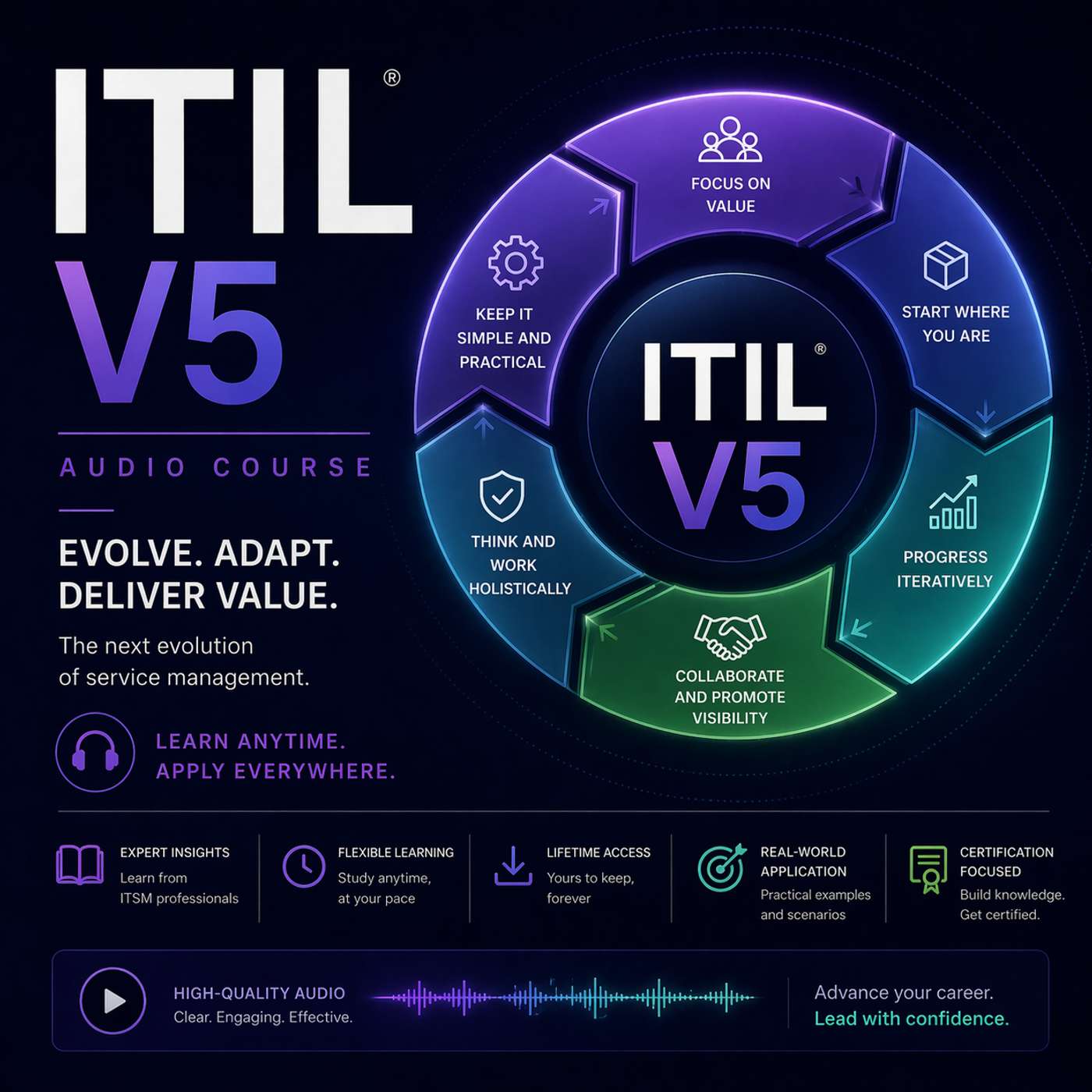
Certified: The ITIL Foundation Version 5 Audio Course
by Jason Edwards
Certified: The ITIL Foundation V5 Audio Course is a practical, audio-first study experience for listeners who want a clear entry point into modern service management without getting buried in jargon. It is built for early-career IT professionals, service desk and support staff, operations analysts, project coordinators, team leads, and career changers who need to understand how digital products and services are planned, delivered, supported, and improved. Because ITIL Foundation remains the starting point in the qualification path, this course assumes interest and professional curiosity more than deep prior expertise. You do not need years of process work behind you to benefit from it. You need a willingness to learn the language, connect the ideas, and hear how the framework helps organizations create value in a more consistent way. You will learn the core concepts and structures that shape ITIL Foundation V5, including the ITIL Value System, the guiding principles, the four dimensi
-
61
Welcome to the Service Management Audio Course!
The ITIL audio course is built for busy people who learn best by listening. Each episode breaks down the ITIL syllabus in clear, structured language so you can follow it while commuting, working out, or taking a walk. You get the why behind the terms, not just a glossary readout, so concepts actually stick.Instead of wandering through theory, the course stays exam-focused. You learn the purpose of service management, how value gets created and protected, and how the ITIL practices and concepts fit together. The goal is to help you recognize what the question is really testing and avoid answers that sound right but miss the ITIL intent.Use the audio course as your daily baseline: consistent reps that keep you moving forward even when you only have small pockets of time. It is the fastest way to build familiarity, tighten your vocabulary, and develop the mental model you need before you shift into heavier reading and practice.
-
60
Episode 60 — Integrate Products and Services into One End-to-End Value Model
This episode concludes the series by showing how products and services are integrated into one end-to-end value model, which is a fitting final topic because it pulls together the major themes of ITIL Version 5 into one coherent way of thinking. For the exam, you need to understand that products and services should not be managed as separate worlds, since value depends on the coordinated design, operation, support, governance, and improvement of both. Products provide the enabling capabilities and structures, while services shape how those capabilities are delivered, experienced, and supported in context, and ITIL brings them together through lifecycle thinking, value streams, dimensions, practices, and continual improvement. Scenario questions often reward candidates who can see this whole system instead of focusing narrowly on one team, one process, or one stage of work. In real practice, integrating products and services into one value model helps organizations reduce fragmentation, improve accountability, and make decisions that strengthen stakeholder outcomes across the full digital operating environment. Produced by BareMetalCyber.com, where you’ll find more cyber audio courses, books, and information to strengthen your educational path. Also, if you want to stay up to date with the latest news, visit DailyCyber.News for a newsletter you can use, and a daily podcast you can commute with. And dont forget Cyberauthor.me for the companion study guide and flash cards!
-
59
Episode 59 — Improve Digital Experience Across the Lifecycle and the Stakeholder Journey
This episode focuses on improving digital experience across the lifecycle and the stakeholder journey, showing why experience is not a single interface issue but an end-to-end result shaped by design, delivery, support, change, and improvement decisions. For the certification exam, this matters because ITIL increasingly emphasizes that stakeholders judge value through their actual experience, not just through technical measures such as uptime or completion rates. You will examine how onboarding, service clarity, request handling, issue resolution, communication, and ongoing usability all contribute to digital experience across time. Questions may test whether you can identify where an experience breakdown truly begins, which is often earlier in the lifecycle than the visible complaint suggests. In real organizations, improving digital experience requires teams to look across handoffs, support models, information quality, and operational readiness so they can remove friction and create interactions that feel coherent, reliable, and useful from the stakeholder’s point of view. Produced by BareMetalCyber.com, where you’ll find more cyber audio courses, books, and information to strengthen your educational path. Also, if you want to stay up to date with the latest news, visit DailyCyber.News for a newsletter you can use, and a daily podcast you can commute with. And dont forget Cyberauthor.me for the companion study guide and flash cards!
-
58
Episode 58 — Govern AI Responsibly with Trust Transparency and Value Across Products and Services
This episode examines how to govern AI responsibly with trust, transparency, and value across products and services, which is important because modern ITIL recognizes that useful technology still requires responsible oversight. For the exam, you should understand that responsible AI governance means defining clear ownership, setting decision boundaries, monitoring outcomes, managing risk, and ensuring that AI-supported actions remain aligned with stakeholder needs and organizational objectives. Trust depends on more than technical accuracy; it also depends on whether people understand how AI is being used, whether its outputs can be challenged, and whether the organization can explain and manage the consequences of its use. Exam scenarios may involve automation, recommendation engines, or AI-assisted service operations where the strongest answer preserves accountability and transparency instead of chasing efficiency alone. In real practice, responsible AI governance helps organizations gain the benefits of speed and insight while protecting service quality, user confidence, and the long-term value of the digital products and services they operate. Produced by BareMetalCyber.com, where you’ll find more cyber audio courses, books, and information to strengthen your educational path. Also, if you want to stay up to date with the latest news, visit DailyCyber.News for a newsletter you can use, and a daily podcast you can commute with. And dont forget Cyberauthor.me for the companion study guide and flash cards!
-
57
Episode 57 — Understand How AI Supports Better Product and Service Decisions
This episode explains how artificial intelligence can support better product and service decisions within an ITIL context without replacing the need for governance, judgment, or accountability. For the exam, the goal is to understand AI as a practical capability that can improve forecasting, service insights, incident analysis, prioritization, automation, and user experience when it is applied thoughtfully and aligned to value. You will examine how AI can help organizations detect patterns in operational data, surface recommendations, improve response speed, and support decision makers with more timely information, while also recognizing that poor data quality or weak oversight can make those benefits unreliable. Scenario questions may test whether AI is being used as a helpful enabler or misused as a substitute for clear roles, controlled processes, and human review. In real-world environments, better ITIL decisions happen when AI is introduced to support flow, consistency, and insight while remaining transparent enough for teams to trust, question, and govern the outputs it produces. Produced by BareMetalCyber.com, where you’ll find more cyber audio courses, books, and information to strengthen your educational path. Also, if you want to stay up to date with the latest news, visit DailyCyber.News for a newsletter you can use, and a daily podcast you can commute with. And dont forget Cyberauthor.me for the companion study guide and flash cards!
-
56
Episode 56 — Rehearse Value Stream Mapping Concepts for Faster End-to-End Recall
This episode rehearses value stream mapping concepts so you can recall them more quickly and apply them more confidently during the exam. Rather than introducing new material, it strengthens your ability to hear a scenario and recognize the key flow elements, including trigger points, activities, delays, dependencies, handoffs, and the measures that show whether the stream is producing value efficiently. You will review why value stream mapping matters in ITIL, how it differs from looking only at isolated processes, and how it supports improvement by making hidden friction visible. Exam questions may present a service that seems technically sound but performs poorly in practice because the overall flow contains waiting, rework, or unclear ownership, and this review helps you spot those conditions faster. In real organizations, repeated practice with value stream concepts improves diagnosis, communication, and improvement planning because teams learn to think in terms of how value actually moves instead of how work is supposed to move on paper. Produced by BareMetalCyber.com, where you’ll find more cyber audio courses, books, and information to strengthen your educational path. Also, if you want to stay up to date with the latest news, visit DailyCyber.News for a newsletter you can use, and a daily podcast you can commute with. And dont forget Cyberauthor.me for the companion study guide and flash cards!
-
55
Episode 55 — Bring Lifecycle Practices and Dimensions Together Through Value Stream Thinking
This episode brings lifecycle stages, management practices, and the four dimensions together through value stream thinking, which is a powerful way to prepare for the exam because it connects several major ITIL concepts into one operational picture. A value stream shows how work moves from need to outcome, while lifecycle stages explain where products and services are in their broader journey, practices provide structured ways to do the work, and the dimensions reveal the organizational, technological, supplier, and process conditions shaping performance. You will see how these ideas reinforce one another in realistic service scenarios where success depends on more than one framework element at a time. Exam questions often reward this integrated understanding because the right answer is rarely about one topic alone; it is usually about how multiple parts of ITIL work together to support value. In practice, value stream thinking helps teams stop treating structure, governance, tooling, support, and improvement as separate conversations and instead manage them as connected factors in end-to-end performance. Produced by BareMetalCyber.com, where you’ll find more cyber audio courses, books, and information to strengthen your educational path. Also, if you want to stay up to date with the latest news, visit DailyCyber.News for a newsletter you can use, and a daily podcast you can commute with. And dont forget Cyberauthor.me for the companion study guide and flash cards!
-
54
Episode 54 — Manage Value Streams for Better Flow Visibility and Measurable Outcomes
This episode explains how to manage value streams for better flow, stronger visibility, and measurable outcomes, which is important because ITIL treats value creation as something that must be actively managed rather than merely documented. On the exam, this topic matters because knowing how a value stream is mapped is only the first step; you also need to understand how teams monitor flow, identify bottlenecks, adjust responsibilities, and measure whether changes improved speed, quality, or stakeholder experience. You will examine the importance of visibility into queue time, handoffs, work-in-progress, and dependency points, along with the need to connect operational measures to outcomes that actually matter. Exam scenarios may describe organizations that have documented processes but still struggle with missed expectations, inconsistent delivery, or weak responsiveness because no one is managing the full stream. In real-world settings, value stream management improves coordination and performance by helping teams see work as a living flow of activity that can be measured, refined, and aligned to outcomes over time. Produced by BareMetalCyber.com, where you’ll find more cyber audio courses, books, and information to strengthen your educational path. Also, if you want to stay up to date with the latest news, visit DailyCyber.News for a newsletter you can use, and a daily podcast you can commute with. And dont forget Cyberauthor.me for the companion study guide and flash cards!
-
53
Episode 53 — Map Value Streams to Expose Delays Waste and Hidden Dependencies
This episode focuses on mapping value streams to expose delays, waste, and hidden dependencies that often remain invisible when teams only look at their own local tasks. For the exam, you need to understand that a value stream shows the end-to-end flow that turns demand into value, making it a powerful tool for identifying where work slows down, loops back, waits on approvals, or depends on people and suppliers who were never clearly recognized. You will explore how value stream mapping reveals the difference between necessary steps and accumulated friction, and why a process that looks acceptable inside one department may still create poor outcomes for the overall service. Scenario questions may ask you to identify why a service remains slow or inconsistent even after one team improves its work, with the best answer often pointing to broader flow problems or hidden dependencies. In real organizations, mapping value streams helps leaders and practitioners reduce waste, improve handoffs, clarify accountability, and make changes that improve the full stakeholder journey rather than one isolated metric. Produced by BareMetalCyber.com, where you’ll find more cyber audio courses, books, and information to strengthen your educational path. Also, if you want to stay up to date with the latest news, visit DailyCyber.News for a newsletter you can use, and a daily podcast you can commute with. And dont forget Cyberauthor.me for the companion study guide and flash cards!
-
52
Episode 52 — Review Continual Improvement as the Thread Running Through All Learning
This episode reviews continual improvement as the thread running through all ITIL learning, helping you understand that improvement is not one chapter of the framework but a principle that connects nearly every other concept. For the certification exam, this is important because value systems, lifecycle stages, guiding principles, dimensions, and management practices all become stronger when they are regularly reviewed and adjusted based on evidence. You will revisit the idea that improvement can happen at strategic, tactical, and operational levels, and that organizations need both discipline and humility to keep learning from experience instead of defending outdated ways of working. Exam questions may present improvement as a separate initiative, but the stronger interpretation often recognizes that improvement should be embedded in planning, design, support, governance, and daily decision making. In practice, seeing continual improvement as a unifying thread helps teams avoid stagnation, respond more effectively to changing stakeholder needs, and build a culture where refinement is expected rather than treated as an admission that something failed. Produced by BareMetalCyber.com, where you’ll find more cyber audio courses, books, and information to strengthen your educational path. Also, if you want to stay up to date with the latest news, visit DailyCyber.News for a newsletter you can use, and a daily podcast you can commute with. And dont forget Cyberauthor.me for the companion study guide and flash cards!
-
51
Episode 51 — Measure Progress Learn from Feedback and Sustain Better Outcomes
This episode explains how ITIL expects organizations to measure progress, learn from feedback, and sustain better outcomes instead of assuming that completed work automatically equals improvement. For the exam, this matters because continual improvement depends on evidence, and evidence comes from selecting meaningful measures, reviewing results in context, and using feedback from stakeholders, teams, and service performance to guide further action. You will examine the difference between activity measures and outcome measures, why trend analysis is more useful than one isolated number, and how feedback helps reveal whether a change improved experience, efficiency, resilience, or value in practice. Scenario questions may test whether a team is tracking the wrong thing, reacting too quickly to incomplete data, or failing to capture lessons after a change or service issue. In real operations, organizations sustain better outcomes when they create repeatable ways to review performance, challenge assumptions, refine controls, and keep improvements alive after the first visible success. Produced by BareMetalCyber.com, where you’ll find more cyber audio courses, books, and information to strengthen your educational path. Also, if you want to stay up to date with the latest news, visit DailyCyber.News for a newsletter you can use, and a daily podcast you can commute with. And dont forget Cyberauthor.me for the companion study guide and flash cards!
-
50
Episode 50 — Turn Improvement from Occasional Projects into a Daily Operating Habit
This episode explains how to turn improvement from occasional projects into a daily operating habit, which is a major theme in modern ITIL and an important exam concept. Improvement is strongest when it becomes part of normal work rather than something saved for annual reviews, crisis moments, or special transformation programs. That means teams regularly observe friction, gather feedback, review performance, test better approaches, and adjust their methods without waiting for permission to notice obvious problems. Exam questions may test whether you can recognize improvement as an ongoing capability embedded across the lifecycle, the value chain, and management practices rather than a one-time initiative. In real settings, organizations that normalize improvement are more resilient because they catch issues earlier, learn faster, and strengthen service quality over time through many small, evidence-based changes instead of relying only on large and disruptive corrective efforts. Produced by BareMetalCyber.com, where you’ll find more cyber audio courses, books, and information to strengthen your educational path. Also, if you want to stay up to date with the latest news, visit DailyCyber.News for a newsletter you can use, and a daily podcast you can commute with. And dont forget Cyberauthor.me for the companion study guide and flash cards!
-
49
Episode 49 — Apply the Refined Continual Improvement Model to Real Organizational Change
This episode applies the refined continual improvement model to real organizational change, showing how ITIL turns improvement into a disciplined sequence rather than a vague intention. For the exam, you need to understand the model as a practical approach for identifying the current state, defining the desired state, deciding what must be done, taking action, and evaluating whether results actually improved value. The refined model matters because it provides structure in environments where people often jump to solutions before they understand the problem, or launch changes without clear measures of success. You will examine how this model supports both large organizational initiatives and smaller operational fixes, and why evidence, prioritization, and feedback are critical throughout the effort. In practice, teams that use a structured improvement model are better able to align stakeholders, reduce wasted effort, manage resistance, and convert broad ambitions for change into visible, measurable, and sustainable progress. Produced by BareMetalCyber.com, where you’ll find more cyber audio courses, books, and information to strengthen your educational path. Also, if you want to stay up to date with the latest news, visit DailyCyber.News for a newsletter you can use, and a daily podcast you can commute with. And dont forget Cyberauthor.me for the companion study guide and flash cards!
-
48
Episode 48 — Review Practice Concepts So the Terminology Stops Feeling Fragmented
This episode reviews core practice concepts so the terminology stops feeling fragmented and starts making sense as a connected operating language. Many learners initially experience ITIL practice terms as a long list of labels, but the exam rewards candidates who understand the shared logic underneath them, including purpose, scope, roles, actions, information flow, measurement, and alignment to value. You will revisit the basic pattern that practices follow and see how that pattern helps you interpret unfamiliar scenarios more effectively. Instead of trying to memorize every detail separately, you will focus on how practices help organize work, reduce ambiguity, and support controlled improvement across service environments. In real-world application, this way of thinking makes it easier to compare practices, explain their value to others, and understand why a team may have recurring issues when expectations, ownership, or process signals are weak. That deeper pattern recognition is what turns ITIL terminology from a memory burden into a practical decision aid. Produced by BareMetalCyber.com, where you’ll find more cyber audio courses, books, and information to strengthen your educational path. Also, if you want to stay up to date with the latest news, visit DailyCyber.News for a newsletter you can use, and a daily podcast you can commute with. And dont forget Cyberauthor.me for the companion study guide and flash cards!
-
47
Episode 47 — Connect Practices to Governance the Value Chain and Daily Delivery Decisions
This episode connects management practices to governance, the value chain, and daily delivery decisions so you can see how practices function inside the larger ITIL system. For the exam, this is important because practices are not meant to stand alone; they support value chain activities, operate within governance boundaries, and help teams make more reliable choices in real work. A practice may influence planning, design, support, improvement, or control depending on the context, and strong exam performance depends on recognizing those relationships rather than seeing practices as isolated labels. You will examine how governance sets direction and boundaries, how the value chain organizes activity, and how practices provide the working methods that allow teams to carry out those activities consistently. In real environments, this understanding improves coordination because people can see why a practice exists, how it supports value creation, and when it should shape day-to-day decisions about service quality, change, risk, and stakeholder outcomes. Produced by BareMetalCyber.com, where you’ll find more cyber audio courses, books, and information to strengthen your educational path. Also, if you want to stay up to date with the latest news, visit DailyCyber.News for a newsletter you can use, and a daily podcast you can commute with. And dont forget Cyberauthor.me for the companion study guide and flash cards!
-
46
Episode 46 — Use Problem Change and Incident Management Terminology with Confidence
This episode builds confidence with problem, change, and incident management terminology, because these are core service management terms that exam candidates must distinguish accurately. An incident is an unplanned interruption or reduction in service quality that needs restoration, a problem is the underlying cause or potential cause of one or more incidents, and change management focuses on assessing and controlling modifications to products, services, or supporting components. These terms are related, but they are not interchangeable, and exam questions often depend on your ability to separate restoration from root-cause analysis and both of those from controlled change activity. You will work through examples where teams confuse symptoms with causes or treat every operational issue as if it should be solved through the same process. In practice, precise terminology improves communication, speeds response, reduces blame-driven confusion, and helps organizations handle disruption, risk, and long-term improvement with greater discipline and clarity. Produced by BareMetalCyber.com, where you’ll find more cyber audio courses, books, and information to strengthen your educational path. Also, if you want to stay up to date with the latest news, visit DailyCyber.News for a newsletter you can use, and a daily podcast you can commute with. And dont forget Cyberauthor.me for the companion study guide and flash cards!
-
45
Episode 45 — Learn Why Practice Guides Matter for Roles Actions Inputs Outputs and Measures
This episode explores why practice guides matter by showing how they clarify roles, actions, inputs, outputs, and measures in a way that makes work more understandable and more manageable. For the exam, you should know that a practice guide is useful because it turns a broad operating area into something teams can actually apply with consistency and accountability. Roles help define who is responsible or involved, actions explain what needs to be done, inputs and outputs show how information and work move through the practice, and measures provide evidence of performance or improvement. Questions may test whether you recognize which element is missing when a team has confusion, rework, poor visibility, or weak control. In real environments, this structure helps people move from vague expectations to operational clarity, making it easier to onboard staff, align teams, compare performance, and refine work based on evidence instead of assumptions or personal preference. Produced by BareMetalCyber.com, where you’ll find more cyber audio courses, books, and information to strengthen your educational path. Also, if you want to stay up to date with the latest news, visit DailyCyber.News for a newsletter you can use, and a daily podcast you can commute with. And dont forget Cyberauthor.me for the companion study guide and flash cards!
-
44
Episode 44 — Separate the 34 Management Practices into Their Two Official Groups
This episode explains how the 34 management practices are separated into their two official groups and why that classification matters for exam clarity. The two groups are general management practices and service management practices, and understanding the distinction helps you organize the syllabus into a more usable structure. General management practices support broader organizational management needs that are not limited to service work, while service management practices focus more directly on the design, delivery, support, and improvement of services. For the exam, this topic matters because grouping practices correctly makes it easier to interpret scenario questions and avoid treating every practice as if it exists for the same purpose. You will also see that the grouping is a study aid, not a wall between categories, because real organizations often apply both types of practices together when making decisions about value, risk, workflow, and service quality. In practice, this structure helps learners and practitioners build a more organized mental model of how ITIL supports both enterprise management and daily service operations. Produced by BareMetalCyber.com, where you’ll find more cyber audio courses, books, and information to strengthen your educational path. Also, if you want to stay up to date with the latest news, visit DailyCyber.News for a newsletter you can use, and a daily podcast you can commute with. And dont forget Cyberauthor.me for the companion study guide and flash cards!
-
43
Episode 43 — Understand Management Practices as Practical Guides for Consistent Work
This episode introduces ITIL management practices as practical guides for doing important work consistently, not as abstract categories to memorize without context. For the exam, you need to understand that practices are structured sets of organizational resources designed to perform work, achieve objectives, and support value creation in repeatable and adaptable ways. They help teams define responsibilities, establish methods, manage information, and create a more reliable operating pattern across changing conditions. You will explore why practices matter in environments where good intentions are not enough, because consistency, clarity, and shared expectations reduce confusion and improve decision quality. Exam questions may describe incidents, changes, service quality issues, or governance concerns and ask which practice perspective best fits the situation. In real use, management practices help organizations avoid reinventing basic operating disciplines every time a problem appears, while still leaving room for context, judgment, and continual improvement. Produced by BareMetalCyber.com, where you’ll find more cyber audio courses, books, and information to strengthen your educational path. Also, if you want to stay up to date with the latest news, visit DailyCyber.News for a newsletter you can use, and a daily podcast you can commute with. And dont forget Cyberauthor.me for the companion study guide and flash cards!
-
42
Episode 42 — Revisit the Lifecycle Stages Until the End-to-End Story Feels Natural
This episode revisits the lifecycle stages so the full end-to-end story becomes easier to understand, recall, and apply during the exam. Rather than memorizing stage names in isolation, you will hear how discovery, design, sourcing or build choices, transition, operation, delivery, support, and improvement connect into a continuous flow of value creation and protection. The exam often tests this integrated understanding by describing a problem in one stage that was actually caused by weak decisions in an earlier stage, or by asking which stage should take the lead in a given situation. You will practice recognizing how information, readiness, ownership, and stakeholder expectations move through the lifecycle and why success depends on the quality of those handoffs. In real-world settings, the more natural this lifecycle story becomes, the easier it is to diagnose failure points, coordinate across teams, and make decisions that improve the whole service rather than one isolated moment of activity. Produced by BareMetalCyber.com, where you’ll find more cyber audio courses, books, and information to strengthen your educational path. Also, if you want to stay up to date with the latest news, visit DailyCyber.News for a newsletter you can use, and a daily podcast you can commute with. And dont forget Cyberauthor.me for the companion study guide and flash cards!
-
41
Episode 41 — See How the Lifecycle Unites Product and Service Communities Around Value
This episode explains how the lifecycle unites product and service communities around a shared value objective rather than leaving them to operate as separate camps with different language, priorities, and measures of success. For the exam, this matters because ITIL Version 5 expects you to understand that product thinking and service thinking are not competitors; they are complementary perspectives needed to design, deliver, support, and improve digital offerings across time. You will examine how product-oriented work often emphasizes evolution, capability, and roadmap direction, while service-oriented work emphasizes reliability, experience, support, and outcome realization, and why both are necessary to sustain value. Scenario questions may test whether you can identify breakdowns caused by weak coordination between build-focused and run-focused teams. In real organizations, lifecycle thinking helps bridge that gap by giving both communities a common end-to-end model for planning, transition, support, governance, and continual improvement. Produced by BareMetalCyber.com, where you’ll find more cyber audio courses, books, and information to strengthen your educational path. Also, if you want to stay up to date with the latest news, visit DailyCyber.News for a newsletter you can use, and a daily podcast you can commute with. And dont forget Cyberauthor.me for the companion study guide and flash cards!
-
40
Episode 40 — Run Operate Deliver and Support as Connected Value-Generating Activities
This episode explains why operate, deliver, and support should be understood as connected value-generating activities rather than separate teams doing unrelated work. For the certification exam, this is important because ITIL emphasizes end-to-end service thinking, where ongoing operation, customer-facing delivery, and support response all influence whether stakeholders actually experience value. Operation keeps the product or service functioning in a stable and controlled way, delivery ensures agreed capabilities reach the user in practice, and support addresses issues, questions, and friction that would otherwise reduce trust and usefulness. Exam scenarios may test whether you can see how a failure in one of these areas affects the others, such as poor support masking deeper operational weakness or delivery targets being met while user experience still degrades. In real environments, treating these activities as one connected system improves resilience, communication, and service quality because teams can align around the shared goal of reliable outcomes instead of protecting narrow functional boundaries. Produced by BareMetalCyber.com, where you’ll find more cyber audio courses, books, and information to strengthen your educational path. Also, if you want to stay up to date with the latest news, visit DailyCyber.News for a newsletter you can use, and a daily podcast you can commute with. And dont forget Cyberauthor.me for the companion study guide and flash cards!
-
39
Episode 39 — Navigate Transition with Less Friction Better Handoffs and Stronger Readiness
This episode covers the transition stage of the lifecycle, where products and services move from preparation into live use and where many organizations either build confidence or create avoidable instability. Transition matters on the exam because it sits between design or build activity and ongoing operation, making it the point where readiness, handoffs, documentation, training, support alignment, and validation all become visible. You will examine how weak transition planning leads to confused support teams, unmet expectations, release delays, early incidents, or workarounds that become permanent because the service was never truly ready. Scenario questions may test whether you can identify missing readiness activities or recognize why a technically complete solution still failed when it entered service. In practice, smoother transition depends on strong communication, realistic testing, clear support ownership, operational preparation, and a shared understanding that going live is not merely a technical cutover but a managed shift into real stakeholder use. Produced by BareMetalCyber.com, where you’ll find more cyber audio courses, books, and information to strengthen your educational path. Also, if you want to stay up to date with the latest news, visit DailyCyber.News for a newsletter you can use, and a daily podcast you can commute with. And dont forget Cyberauthor.me for the companion study guide and flash cards!
-
38
Episode 38 — Choose Wisely Between Acquire and Build in Modern Digital Environments
This episode examines the acquire and build decision in modern digital environments, a topic that matters because the exam expects you to understand that organizations create value through a mix of internal capability and external sourcing rather than a single default approach. Building may offer stronger customization, closer control, or strategic differentiation, while acquiring may improve speed, reduce internal effort, or leverage proven vendor capability. Neither choice is automatically better, and ITIL encourages evaluating context, risk, support requirements, integration needs, lifecycle cost, and stakeholder outcomes before deciding. Exam questions may ask you to identify the most balanced reasoning when choosing between purchasing a capability, developing it internally, or combining both approaches. In real-world settings, wise acquire-versus-build decisions improve resilience and sustainability because teams consider not just initial delivery speed, but also long-term maintainability, governance, supplier dependence, support readiness, and the organization’s actual capacity to own what it creates or adopts. Produced by BareMetalCyber.com, where you’ll find more cyber audio courses, books, and information to strengthen your educational path. Also, if you want to stay up to date with the latest news, visit DailyCyber.News for a newsletter you can use, and a daily podcast you can commute with. And dont forget Cyberauthor.me for the companion study guide and flash cards!
-
37
Episode 37 — Move with Purpose Through Discover and Design Before Work Accelerates
This episode focuses on the discover and design stages of the lifecycle, showing why early clarity matters before delivery work accelerates and becomes harder to redirect. Discovery is about understanding needs, opportunities, constraints, stakeholders, and the broader context in which the product or service must succeed, while design turns that understanding into a workable structure for value creation, support, control, and experience. For the exam, this matters because ITIL expects you to see that rushed or shallow early-stage work often creates downstream problems that no amount of operational effort can fully correct. You will explore examples where poor discovery leads to solving the wrong problem, and where weak design produces fragile handoffs, unclear support models, or misaligned expectations. In practice, purpose-driven work in these stages improves prioritization, reduces rework, and makes later lifecycle stages more stable by ensuring that the organization is building or sourcing something that actually fits stakeholder needs and operating realities. Produced by BareMetalCyber.com, where you’ll find more cyber audio courses, books, and information to strengthen your educational path. Also, if you want to stay up to date with the latest news, visit DailyCyber.News for a newsletter you can use, and a daily podcast you can commute with. And dont forget Cyberauthor.me for the companion study guide and flash cards!
-
36
Episode 36 — Master the Eight-Stage Product and Service Lifecycle Model End to End
This episode introduces the eight-stage product and service lifecycle model end to end, which is important for the certification exam because it gives structure to how digital products and services move from idea through operation and ongoing value delivery. The model helps you understand that value is shaped by a sequence of connected stages rather than a single launch event, and that weaknesses early in the lifecycle often surface later as support issues, adoption problems, or reliability gaps. You will work through the overall logic of the lifecycle so you can see how discovery, design, sourcing or build decisions, transition, operation, support, and improvement fit together into one system. Exam questions may test whether you can recognize which lifecycle stage is most relevant to a scenario or explain how one stage prepares the ground for the next. In real-world work, mastering the lifecycle helps teams coordinate across strategy, engineering, operations, and service management so that products and services remain usable, supportable, and aligned to stakeholder outcomes over time. Produced by BareMetalCyber.com, where you’ll find more cyber audio courses, books, and information to strengthen your educational path. Also, if you want to stay up to date with the latest news, visit DailyCyber.News for a newsletter you can use, and a daily podcast you can commute with. And dont forget Cyberauthor.me for the companion study guide and flash cards!
-
35
Episode 35 — Review the Guiding Principles as a Practical Decision-Making Playbook
This episode reviews the guiding principles as a practical decision-making playbook so you can use them as a connected set of judgment tools on the exam instead of memorizing them as isolated slogans. The principles help teams focus on value, start where they are, progress iteratively with feedback, collaborate and promote visibility, think and work holistically, keep it simple and practical, and optimize and automate in ways that reinforce one another. You will revisit how each principle shapes real choices about design, improvement, governance, workflow, and service support, and why the best exam answers often reflect several principles at once. A scenario about a stalled rollout, for example, may involve value focus, iteration, visibility, and simplicity all at the same time. In practice, using the principles as a decision framework helps leaders and practitioners respond more consistently to uncertainty, competing priorities, and operational friction without defaulting to habit, politics, or one-dimensional process thinking. Produced by BareMetalCyber.com, where you’ll find more cyber audio courses, books, and information to strengthen your educational path. Also, if you want to stay up to date with the latest news, visit DailyCyber.News for a newsletter you can use, and a daily podcast you can commute with. And dont forget Cyberauthor.me for the companion study guide and flash cards!
-
34
Episode 34 — Optimize and Automate Without Losing Judgment Ownership and Trust
This episode explores the guiding principle optimize and automate, showing why the exam expects you to see automation as an enabler of value rather than a substitute for thought, ownership, or accountability. Optimization comes first because teams must understand and improve the work before automating it; otherwise, they risk making bad processes faster and harder to correct. Automation can improve flow, consistency, speed, and data quality, but only when it is introduced in ways that preserve transparency, control, and human judgment where judgment still matters. Exam scenarios may test whether you can identify the right balance between efficiency and oversight, especially in cases involving approvals, incident handling, customer communication, or risk decisions. In real environments, this principle helps organizations use automation to remove repetitive effort and reduce error while keeping trust intact through clear ownership, understandable logic, and escalation paths for exceptions, failures, and changing business needs. Produced by BareMetalCyber.com, where you’ll find more cyber audio courses, books, and information to strengthen your educational path. Also, if you want to stay up to date with the latest news, visit DailyCyber.News for a newsletter you can use, and a daily podcast you can commute with. And dont forget Cyberauthor.me for the companion study guide and flash cards!
-
33
Episode 33 — Keep It Simple and Practical When Complexity Starts Taking Over
This episode explains the guiding principle keep it simple and practical, a concept the exam uses to test whether you can distinguish useful control from unnecessary complication. Simplicity in ITIL does not mean being careless or incomplete; it means using only the steps, controls, and detail needed to achieve the objective effectively in the real operating environment. You will learn how complexity often grows through extra approvals, overlapping tools, inflated documentation, and processes designed for rare edge cases instead of normal work. Exam questions may present attractive but overly elaborate answers, while the stronger choice is usually the one that accomplishes the goal clearly, consistently, and with less friction. In real-world application, this principle helps teams reduce delays, improve adoption, and make services easier to understand and support, especially when rapid change, staffing limits, or stakeholder pressure create a temptation to solve every problem by adding another layer of process. Produced by BareMetalCyber.com, where you’ll find more cyber audio courses, books, and information to strengthen your educational path. Also, if you want to stay up to date with the latest news, visit DailyCyber.News for a newsletter you can use, and a daily podcast you can commute with. And dont forget Cyberauthor.me for the companion study guide and flash cards!
-
32
Episode 32 — Think and Work Holistically Across Teams Technology and Outcomes
This episode focuses on the guiding principle think and work holistically, which is essential for the certification exam because ITIL repeatedly emphasizes that services succeed or fail as whole systems, not as disconnected tasks. Thinking holistically means considering people, tools, suppliers, workflows, governance, and stakeholder outcomes together when making decisions, rather than fixing only the most visible local issue. You will examine how a service may look healthy in one area while hiding deeper problems in experience, supportability, dependency management, or lifecycle flow. Questions on the exam may describe a narrow operational problem but expect you to identify the broader system condition that caused it, such as a design decision that created recurring support burden or a governance gap that allowed risk to accumulate. In practice, holistic thinking helps teams avoid creating new bottlenecks while solving old ones and leads to better choices about design, staffing, automation, measurement, and improvement across the end-to-end value model. Produced by BareMetalCyber.com, where you’ll find more cyber audio courses, books, and information to strengthen your educational path. Also, if you want to stay up to date with the latest news, visit DailyCyber.News for a newsletter you can use, and a daily podcast you can commute with. And dont forget Cyberauthor.me for the companion study guide and flash cards!
-
31
Episode 31 — Collaborate and Promote Visibility to Break Silos and Surface Reality
This episode examines the guiding principle collaborate and promote visibility, which matters on the exam because ITIL assumes that better decisions come from shared understanding rather than isolated work and partial information. Collaboration means the right people contribute at the right points with clear responsibilities, while visibility means work, risks, dependencies, and performance are made visible enough for action and learning. You will explore how silos form when teams optimize for local goals, hide operational pain, or communicate only during failure, and how that behavior weakens value creation across the lifecycle. Exam scenarios may ask you to identify why delays, misaligned priorities, or repeated incidents persist even when individual teams appear competent, with the best answer often pointing to poor collaboration or weak visibility. In real environments, this principle improves handoffs, speeds issue resolution, reduces duplicate effort, and helps leaders respond to reality instead of assumptions or incomplete reporting. Produced by BareMetalCyber.com, where you’ll find more cyber audio courses, books, and information to strengthen your educational path. Also, if you want to stay up to date with the latest news, visit DailyCyber.News for a newsletter you can use, and a daily podcast you can commute with. And dont forget Cyberauthor.me for the companion study guide and flash cards!
-
30
Episode 30 — Progress Iteratively with Feedback to Learn Faster and Reduce Rework
This episode explores the guiding principle progress iteratively with feedback, showing why ITIL prefers smaller, learnable steps over oversized efforts that assume everything can be designed correctly in advance. For the certification exam, you need to understand that iteration helps reduce uncertainty, surface issues earlier, and make adjustment easier before time and money are heavily committed. Feedback provides the evidence that tells teams whether they are improving, drifting, or solving the wrong problem. You will consider situations such as service design updates, process changes, or rollout plans where breaking work into smaller increments creates faster learning and less expensive correction. Exam questions may present tempting answers that promise total transformation in one move, but ITIL usually favors approaches that deliver value gradually while maintaining visibility and control. In real practice, iterative progress improves quality, user adoption, and team confidence because it turns change into a managed learning cycle rather than a single high-risk bet. Produced by BareMetalCyber.com, where you’ll find more cyber audio courses, books, and information to strengthen your educational path. Also, if you want to stay up to date with the latest news, visit DailyCyber.News for a newsletter you can use, and a daily podcast you can commute with. And dont forget Cyberauthor.me for the companion study guide and flash cards!
-
29
Episode 29 — Start Where You Are Before You Reinvent What Already Works
This episode examines the guiding principle start where you are, which is important for the exam because it encourages realistic improvement based on current evidence rather than assumptions, impatience, or a desire to rebuild everything at once. The principle means that before designing a new process, buying a new tool, or launching a major transformation, teams should understand what already exists, what performs well, and what can be reused or refined. That does not mean settling for weak practices; it means making informed decisions grounded in the current state. Exam scenarios may test whether you can distinguish between thoughtful assessment and blind attachment to the past, since ITIL supports change but warns against ignoring useful assets, knowledge, or capabilities. In real organizations, this principle helps reduce waste, shorten implementation time, and preserve proven strengths while still making room for improvement where the current environment truly falls short or no longer matches stakeholder needs. Produced by BareMetalCyber.com, where you’ll find more cyber audio courses, books, and information to strengthen your educational path. Also, if you want to stay up to date with the latest news, visit DailyCyber.News for a newsletter you can use, and a daily podcast you can commute with. And dont forget Cyberauthor.me for the companion study guide and flash cards!
-
28
Episode 28 — Focus on Value When Priorities Compete and Tradeoffs Get Real
This episode focuses on what it means to stay centered on value when priorities compete and tradeoffs become unavoidable, which is one of the most practical skills the exam is trying to build. ITIL does not assume that teams operate with unlimited time, perfect information, or zero constraints, so a value-focused mindset helps determine which action best supports desired outcomes within real limits. You will explore examples where speed conflicts with control, user convenience conflicts with standardization, or low cost conflicts with resilience, and you will learn how to evaluate those tensions using stakeholder outcomes, risks, and longer-term service health. Exam questions may present several technically valid options, but the strongest answer is often the one that best preserves value in context rather than the one that sounds most efficient in isolation. In practice, this approach improves prioritization, helps teams explain difficult decisions, and reduces the habit of chasing local wins that damage trust, service quality, or sustainability elsewhere in the system. Produced by BareMetalCyber.com, where you’ll find more cyber audio courses, books, and information to strengthen your educational path. Also, if you want to stay up to date with the latest news, visit DailyCyber.News for a newsletter you can use, and a daily podcast you can commute with. And dont forget Cyberauthor.me for the companion study guide and flash cards!
-
27
Episode 27 — Rehearse the Value System Until the Moving Parts Click Together
This episode is a structured review of the ITIL Value System designed to make the moving parts feel clear, connected, and easier to recall under exam pressure. Rather than introducing new terms, it reinforces how inputs such as opportunity and demand move through a governed system shaped by principles, supported by practices, organized through the value chain, and strengthened by continual improvement. That full picture matters because the exam may present pieces of the system indirectly, requiring you to understand how the pieces fit rather than simply define them in isolation. You will practice hearing the system as one narrative: what comes in, what guides decisions, what work gets performed, what control exists, and how learning feeds back into future action. In the real world, this kind of systems understanding helps practitioners avoid local optimization, clarify why certain activities matter, and explain to others how service management is meant to support better outcomes instead of creating extra layers of disconnected process. Produced by BareMetalCyber.com, where you’ll find more cyber audio courses, books, and information to strengthen your educational path. Also, if you want to stay up to date with the latest news, visit DailyCyber.News for a newsletter you can use, and a daily podcast you can commute with. And dont forget Cyberauthor.me for the companion study guide and flash cards!
-
26
Episode 26 — Connect Guiding Principles Practices and Continual Improvement Inside the Value System
This episode connects guiding principles, practices, and continual improvement inside the ITIL Value System so you can understand how ITIL works as an integrated method for decision making and action. The guiding principles provide broad recommendations for behavior and judgment, practices offer structured ways to perform important kinds of work, and continual improvement ensures that the system keeps learning and adjusting instead of becoming stale. For the exam, this matters because questions may ask you to identify which element is being applied in a scenario or how these parts reinforce each other when an organization is trying to improve delivery, reduce risk, or respond to change. You will see that principles influence how teams choose, practices support execution, and improvement helps validate whether those choices actually produced better outcomes. In real life, organizations gain the most from ITIL when they do not treat these elements as separate study terms, but as connected tools that shape culture, workflow, decision quality, and long-term service performance. Produced by BareMetalCyber.com, where you’ll find more cyber audio courses, books, and information to strengthen your educational path. Also, if you want to stay up to date with the latest news, visit DailyCyber.News for a newsletter you can use, and a daily podcast you can commute with. And dont forget Cyberauthor.me for the companion study guide and flash cards!
-
25
Episode 25 — Understand the Simplified Value Chain Without Losing the Big Picture
This episode explains the simplified value chain so you can understand how ITIL organizes work into connected activities without losing the larger picture of value creation. The value chain is important for the exam because it shows how organizations respond to opportunity and demand through activities such as planning, improving, engaging, designing and transitioning, obtaining or building, and delivering and supporting. You do not need to think of these activities as a rigid sequence used the same way every time; instead, you should understand them as flexible building blocks that combine differently depending on the context. Exam questions often test whether you can see how activities support one another and how a failure in one area, such as poor engagement or weak planning, can reduce the effectiveness of the whole system. In practice, the simplified value chain helps teams move beyond siloed work by showing how strategy, design, delivery, support, and learning all contribute to the organization’s ability to create, protect, and improve value over time. Produced by BareMetalCyber.com, where you’ll find more cyber audio courses, books, and information to strengthen your educational path. Also, if you want to stay up to date with the latest news, visit DailyCyber.News for a newsletter you can use, and a daily podcast you can commute with. And dont forget Cyberauthor.me for the companion study guide and flash cards!
-
24
Episode 24 — Place Governance Where It Belongs in Modern Digital Product and Service Decisions
This episode focuses on governance and where it belongs in modern digital product and service decisions, a topic that matters because the exam distinguishes governance from day-to-day management while still showing how closely the two are connected. Governance sets direction, defines authority, monitors performance, and ensures that organizational actions remain aligned with objectives, policies, and stakeholder expectations. It is not the same as operational control or team-level execution, even though those activities depend on governance to establish boundaries and priorities. On the exam, you may face questions where the correct answer depends on recognizing whether an action is about guiding and evaluating the system or simply running part of it. In real environments, placing governance correctly prevents two common failures: leadership becoming too detached from delivery, or operational teams being overloaded with strategic decisions they are not meant to own. Good governance creates clarity, accountability, and trust without becoming a bottleneck that slows useful work. Produced by BareMetalCyber.com, where you’ll find more cyber audio courses, books, and information to strengthen your educational path. Also, if you want to stay up to date with the latest news, visit DailyCyber.News for a newsletter you can use, and a daily podcast you can commute with. And dont forget Cyberauthor.me for the companion study guide and flash cards!
-
23
Episode 23 — Translate Opportunity and Demand into Value with Stronger Structural Thinking
This episode explains how opportunity and demand are translated into value through stronger structural thinking, which is important because the exam expects you to understand that value creation does not happen by accident. Opportunity reflects a chance to improve, grow, solve a problem, or meet a need, while demand is the expressed need or desire for products and services. ITIL teaches that these inputs must be interpreted, prioritized, and routed through a structured operating model so the organization can respond in a way that is practical, governed, and aligned to outcomes. You will examine why weak structure leads to reactive work, duplicated effort, or investments that do not produce meaningful results, even when the original opportunity was valid. In practice, better structural thinking helps teams turn ideas and requests into well-managed action by clarifying decision paths, resource use, service design implications, and the measures that show whether the organization actually converted need into stakeholder value. Produced by BareMetalCyber.com, where you’ll find more cyber audio courses, books, and information to strengthen your educational path. Also, if you want to stay up to date with the latest news, visit DailyCyber.News for a newsletter you can use, and a daily podcast you can commute with. And dont forget Cyberauthor.me for the companion study guide and flash cards!
-
22
Episode 22 — Understand the Value System as the Engine of Value Creation
This episode introduces the ITIL Value System as the overall structure that explains how all the major parts of ITIL work together to create value. For the certification exam, this is a core concept because the value system connects principles, governance, the service value chain, practices, and continual improvement into one operating model rather than a disconnected set of definitions. You will learn that the value system takes opportunity and demand as inputs and turns them into value through coordinated action, guided decisions, and feedback. That means the exam may ask you to identify how one element influences another, such as how governance shapes direction, how principles guide choices, or how practices support value chain activities. In real organizations, the ITIL Value System helps leaders and practitioners avoid fragmented thinking by providing a shared way to understand how strategy, operations, improvement, and control fit together when delivering digital products and services in a changing environment. Produced by BareMetalCyber.com, where you’ll find more cyber audio courses, books, and information to strengthen your educational path. Also, if you want to stay up to date with the latest news, visit DailyCyber.News for a newsletter you can use, and a daily podcast you can commute with. And dont forget Cyberauthor.me for the companion study guide and flash cards!
-
21
Episode 21 — Review the Four Dimensions Through Realistic End-to-End Listening Scenarios
This episode reviews the four dimensions through realistic end-to-end scenarios so you can hear how they interact in ways the exam is likely to test. Instead of treating organizations and people, information and technology, partners and suppliers, and value streams and processes as isolated topics, you will apply them to situations such as a new service launch, a recurring support failure, or a change initiative that stalls because teams only optimized one part of the system. The exam often hides dimension problems inside practical examples, so you need to recognize when a weak process is really a people issue, when a supplier problem is really a governance gap, or when a tooling issue is actually caused by poor information quality. Working through full-service scenarios helps you practice tracing causes across the operating environment rather than accepting the first obvious explanation. In real-world settings, this approach leads to better diagnosis, more balanced decisions, and fewer improvement efforts that fix one bottleneck while creating another somewhere else. Produced by BareMetalCyber.com, where you’ll find more cyber audio courses, books, and information to strengthen your educational path. Also, if you want to stay up to date with the latest news, visit DailyCyber.News for a newsletter you can use, and a daily podcast you can commute with. And dont forget Cyberauthor.me for the companion study guide and flash cards!
-
20
Episode 20 — Map Value Streams and Processes to Reduce Friction and Increase Clarity
This episode introduces value streams and processes as practical ways to understand how work moves from demand to outcome, and why that understanding matters for both the exam and daily operations. A value stream describes the end-to-end flow of activities that create value for a stakeholder, while a process is a structured set of activities designed to achieve a particular objective in a consistent way. For exam purposes, you need to recognize that processes are important, but ITIL expects you to see them in the broader context of value flow, where handoffs, delays, approvals, rework, and unclear ownership can damage speed and service quality. You will work through how mapping a value stream can expose hidden dependencies, duplicated effort, and failure points that are not obvious when teams focus only on their own local tasks. In real practice, this helps organizations reduce friction, improve visibility, and make more effective improvement decisions because they can finally see how separate activities combine into the stakeholder’s actual experience of service delivery. Produced by BareMetalCyber.com, where you’ll find more cyber audio courses, books, and information to strengthen your educational path. Also, if you want to stay up to date with the latest news, visit DailyCyber.News for a newsletter you can use, and a daily podcast you can commute with. And dont forget Cyberauthor.me for the companion study guide and flash cards!
-
19
Episode 19 — Work Effectively with Partners and Suppliers Across Shared Responsibilities
This episode examines the partners and suppliers dimension, which reminds you that modern digital products and services often depend on external capabilities, contractual relationships, and shared responsibilities that shape service outcomes. For the certification exam, you need to understand that organizations rarely operate alone, and value can be improved or damaged by how well they select, manage, and coordinate with suppliers and partners. You will explore issues such as dependency management, service expectations, communication pathways, governance boundaries, and the need to align external contributions with internal goals and operational realities. Questions may test whether you can see the difference between outsourcing accountability and collaborating with external parties while still retaining clear ownership of value, risk, and stakeholder outcomes. In the real world, effective partner management reduces confusion during incidents, clarifies escalation paths, improves change coordination, and helps prevent a service from failing simply because one organization assumed another was handling a critical responsibility. Produced by BareMetalCyber.com, where you’ll find more cyber audio courses, books, and information to strengthen your educational path. Also, if you want to stay up to date with the latest news, visit DailyCyber.News for a newsletter you can use, and a daily podcast you can commute with. And dont forget Cyberauthor.me for the companion study guide and flash cards!
-
18
Episode 18 — Use Information and Technology to Enable Better Decisions and Better Flow
This episode covers the information and technology dimension, showing how data, knowledge, tools, platforms, and technical architecture support better decisions and smoother flow across the lifecycle. On the exam, this topic matters because ITIL does not treat technology as valuable on its own; it matters when it helps teams coordinate work, understand performance, reduce friction, and support stakeholders with accurate and timely information. You will look at how poor data quality, fragmented systems, weak visibility, or overcomplicated tooling can slow delivery, increase support effort, and weaken confidence in service decisions. Strong information practices help organizations move from guesswork to evidence, while appropriate technology choices improve automation, tracking, integration, and responsiveness without creating unnecessary complexity. In real-world environments, success in this dimension often depends on using the right level of tooling for the context, maintaining trustworthy information flows, and ensuring that technology choices support people and processes instead of forcing work into awkward or brittle patterns. Produced by BareMetalCyber.com, where you’ll find more cyber audio courses, books, and information to strengthen your educational path. Also, if you want to stay up to date with the latest news, visit DailyCyber.News for a newsletter you can use, and a daily podcast you can commute with. And dont forget Cyberauthor.me for the companion study guide and flash cards!
-
17
Episode 17 — Strengthen Organizations and People for Reliable Digital Product and Service Management
This episode explores the organizations and people dimension, emphasizing why structure, culture, skills, communication, and accountability are central to reliable digital product and service management. For the exam, you need to understand that successful services are not created by process diagrams alone; they depend on whether people know their roles, have the right capabilities, can collaborate effectively, and operate inside a culture that supports learning, service quality, and responsible decision making. You will examine how poor role definition, weak leadership support, skill gaps, and siloed communication can undermine even well-funded initiatives with strong technical foundations. Scenario questions may ask you to identify why a service is underperforming despite adequate tools and documented processes, with the best answer often pointing to organizational friction or unclear responsibilities. In real practice, strengthening this dimension improves continuity, resilience, adoption of change, and the ability to handle incidents, improvements, and stakeholder expectations without constant confusion or escalation. Produced by BareMetalCyber.com, where you’ll find more cyber audio courses, books, and information to strengthen your educational path. Also, if you want to stay up to date with the latest news, visit DailyCyber.News for a newsletter you can use, and a daily podcast you can commute with. And dont forget Cyberauthor.me for the companion study guide and flash cards!
-
16
Episode 16 — See the Four Dimensions as One System Rather Than Four Topics
This episode introduces the four dimensions of service management as one integrated system rather than four separate study topics, which is a critical mindset for the certification exam. The dimensions of organizations and people, information and technology, partners and suppliers, and value streams and processes are best understood as interdependent lenses that shape how a product or service actually performs. A weakness in one dimension often creates problems in another, such as strong tooling with poor role clarity, or efficient processes that depend on suppliers who cannot meet the needed level of responsiveness. Exam questions often test this integrated view by describing a problem that appears technical or procedural on the surface but is really caused by imbalance across multiple dimensions. In real operations, teams that treat the dimensions as a connected system make better decisions because they recognize that reliable value creation depends on people, information, external relationships, and workflow design working together rather than being optimized in isolation. Produced by BareMetalCyber.com, where you’ll find more cyber audio courses, books, and information to strengthen your educational path. Also, if you want to stay up to date with the latest news, visit DailyCyber.News for a newsletter you can use, and a daily podcast you can commute with. And dont forget Cyberauthor.me for the companion study guide and flash cards!
-
15
Episode 15 — Reinforce Value Co-Creation Concepts for Faster Recall and Better Judgment
This episode reinforces value co-creation concepts so you can recall them quickly during the exam and apply them more accurately when faced with practical decisions. The central lesson is that value is not manufactured by a provider and then handed over in complete form; instead, it emerges through the combined actions, expectations, capabilities, and context of multiple stakeholders. You will revisit why consumers help realize value through adoption, usage, feedback, and decision making, while providers influence value through design, support, communication, governance, and improvement. For exam success, this review helps you distinguish answer choices that focus too narrowly on outputs, internal targets, or provider effort from those that reflect shared outcomes and stakeholder realities. In real-world service management, this concept encourages teams to ask better questions about usability, readiness, onboarding, support burden, and business context, rather than assuming that delivering the service exactly as planned is enough to guarantee success. Produced by BareMetalCyber.com, where you’ll find more cyber audio courses, books, and information to strengthen your educational path. Also, if you want to stay up to date with the latest news, visit DailyCyber.News for a newsletter you can use, and a daily podcast you can commute with. And dont forget Cyberauthor.me for the companion study guide and flash cards!
-
14
Episode 14 — Follow the Service Journey to See How Stakeholders Experience Value
This episode follows the service journey to show how stakeholders experience value across time rather than at one isolated point of delivery. On the exam, this matters because ITIL increasingly emphasizes end-to-end thinking, which means understanding that perception of value is shaped before, during, and after the service is used. You will examine how discovery, onboarding, access, support, change, issue resolution, and ongoing improvement all contribute to the stakeholder’s view of whether a service is useful and trustworthy. A well-designed technical solution can still produce a poor overall experience if requests are slow, expectations are unclear, support is fragmented, or transitions between teams create confusion. Scenario-based exam questions may test whether you can identify the true problem in a service journey, especially when the failure is not in the core technology but in the surrounding interactions and processes. In real organizations, mapping the service journey helps expose friction points, improve coordination, and align operational work with the way people actually encounter and judge value. Produced by BareMetalCyber.com, where you’ll find more cyber audio courses, books, and information to strengthen your educational path. Also, if you want to stay up to date with the latest news, visit DailyCyber.News for a newsletter you can use, and a daily podcast you can commute with. And dont forget Cyberauthor.me for the companion study guide and flash cards!
-
13
Episode 13 — Bring Experience and Sustainability Into the Conversation About Value
This episode brings experience and sustainability into the conversation about value, showing why ITIL expects a broader perspective than cost control or service availability alone. Experience refers to how stakeholders perceive the quality, clarity, usability, and reliability of the product or service across their journey, while sustainability concerns whether the organization can create and maintain value in ways that remain responsible, resilient, and practical over time. For exam purposes, these ideas matter because modern service management is not limited to technical delivery; it must also consider human outcomes, long-term viability, and the effects of decisions across a wider system. A service may technically function, yet still fail if users find it confusing, support interactions are frustrating, or the operating model creates waste, burnout, or unsustainable dependence on fragile workarounds. In practice, teams that account for both experience and sustainability make better decisions about design, support, supplier relationships, staffing, automation, and improvement priorities because they judge success through a longer and more realistic lens. Produced by BareMetalCyber.com, where you’ll find more cyber audio courses, books, and information to strengthen your educational path. Also, if you want to stay up to date with the latest news, visit DailyCyber.News for a newsletter you can use, and a daily podcast you can commute with. And dont forget Cyberauthor.me for the companion study guide and flash cards!
-
12
Episode 12 — Recognize the Roles of Service Providers Consumers and Stakeholders
This episode focuses on the roles of service providers, service consumers, and stakeholders, which is essential for the certification exam because ITIL relies on clear role awareness to explain how value is created, managed, and evaluated. A service provider offers and manages the product and service capabilities, while service consumers may act as customers, users, or sponsors depending on their relationship to the service and the decisions they influence. Stakeholders include all parties who affect or are affected by the service, which may include internal teams, suppliers, regulators, executives, and partners. On the exam, you may need to identify which role is responsible for defining requirements, approving funding, using the service, or judging whether value was achieved in context. In real-world settings, confusion between these roles often leads to poor communication, mismatched expectations, weak accountability, and service designs that meet technical targets but fail to satisfy actual business needs. Produced by BareMetalCyber.com, where you’ll find more cyber audio courses, books, and information to strengthen your educational path. Also, if you want to stay up to date with the latest news, visit DailyCyber.News for a newsletter you can use, and a daily podcast you can commute with. And dont forget Cyberauthor.me for the companion study guide and flash cards!
We're indexing this podcast's transcripts for the first time — this can take a minute or two. We'll show results as soon as they're ready.
No matches for "" in this podcast's transcripts.
No topics indexed yet for this podcast.
Loading reviews...
ABOUT THIS SHOW
Certified: The ITIL Foundation V5 Audio Course is a practical, audio-first study experience for listeners who want a clear entry point into modern service management without getting buried in jargon. It is built for early-career IT professionals, service desk and support staff, operations analysts, project coordinators, team leads, and career changers who need to understand how digital products and services are planned, delivered, supported, and improved. Because ITIL Foundation remains the starting point in the qualification path, this course assumes interest and professional curiosity more than deep prior expertise. You do not need years of process work behind you to benefit from it. You need a willingness to learn the language, connect the ideas, and hear how the framework helps organizations create value in a more consistent way. You will learn the core concepts and structures that shape ITIL Foundation V5, including the ITIL Value System, the guiding principles, the four dimensi
HOSTED BY
Jason Edwards
CATEGORIES
Loading similar podcasts...
Frequently Asked Questions
How many episodes does Certified: The ITIL Foundation Version 5 Audio Course have?
Certified: The ITIL Foundation Version 5 Audio Course currently has 50 episodes available on PodParley. New episodes are automatically indexed when they're published to the podcast feed.
What is Certified: The ITIL Foundation Version 5 Audio Course about?
Certified: The ITIL Foundation V5 Audio Course is a practical, audio-first study experience for listeners who want a clear entry point into modern service management without getting buried in jargon. It is built for early-career IT professionals, service desk and support staff, operations analysts,...
How often does Certified: The ITIL Foundation Version 5 Audio Course release new episodes?
Certified: The ITIL Foundation Version 5 Audio Course has 50 episodes. Check the episode list to see recent publication dates and frequency.
Where can I listen to Certified: The ITIL Foundation Version 5 Audio Course?
You can listen to Certified: The ITIL Foundation Version 5 Audio Course on PodParley by clicking any episode. We provide an embedded audio player for direct listening, and you can also subscribe via your preferred podcast app using the RSS feed.
Who hosts Certified: The ITIL Foundation Version 5 Audio Course?
Certified: The ITIL Foundation Version 5 Audio Course is created and hosted by Jason Edwards.
URL copied to clipboard!