
PODCAST · education
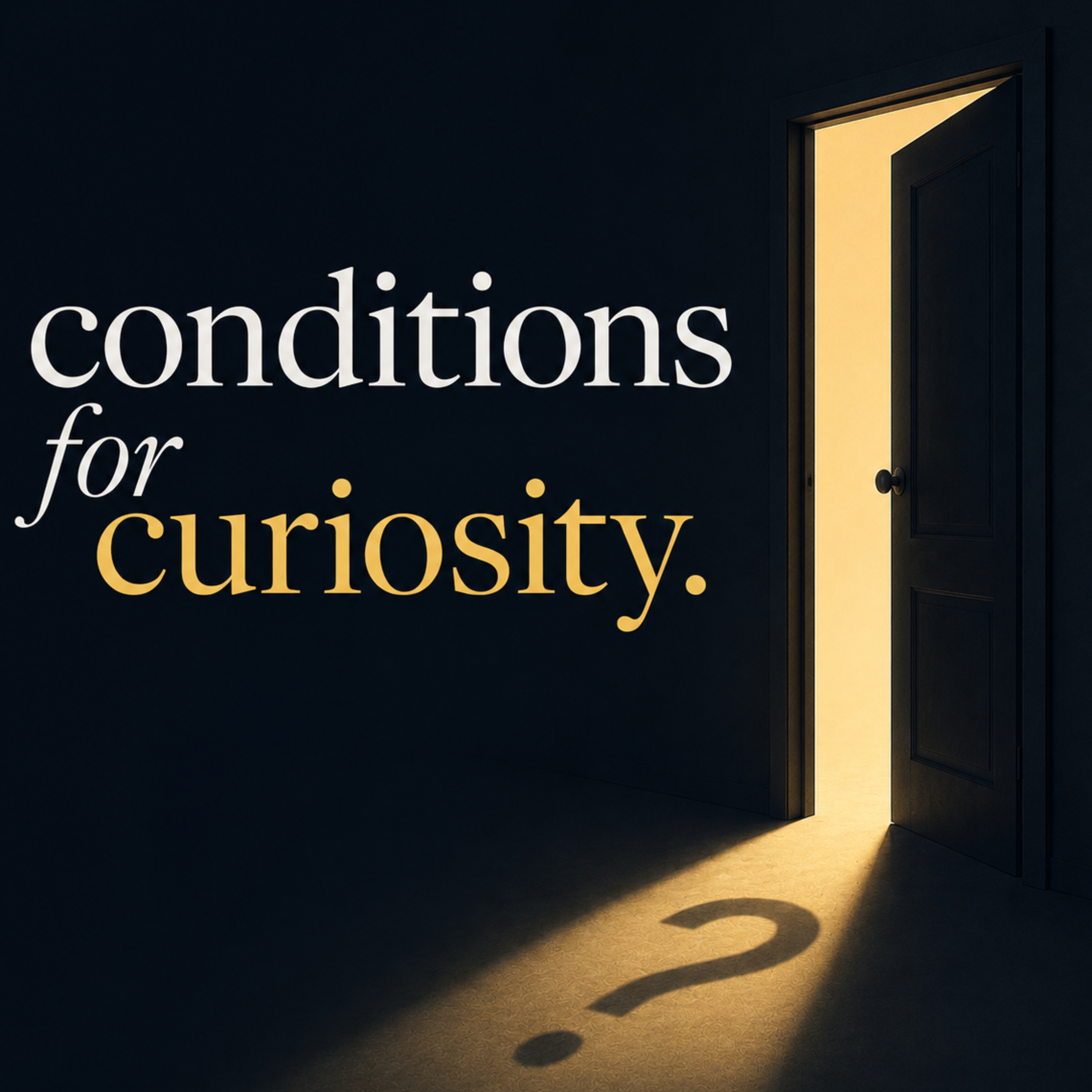
Conditions for Curiosity
by Kevin O'Neil
Curiosity isn't something people have or don't have—it's something environments create. If you're a teacher, parent, coach, or leader who's watched curiosity appear and disappear in real rooms, this season explores the conditions that make it more likely to emerge, and how to intentionally design for it. Based on nearly twenty years in classrooms and the research that explains why great teaching practices actually work.
-
8
I'm Curious - What Were You Thinking?
This is the finale. And it starts with three minutes of silence.A Zoom call. A manager stalling so a second person can join the waiting room. Eighteen hours before an international flight. By the time the call actually starts, I already know — the way you know a meeting needs a witness — that this isn't good news.That's where Season 1 ends: not with an answer, but with something I'll never fully know. Whether being honest, on a stage in Denver, cost me something I can't name.From there, this episode does three things. It finally names the move this whole season has actually been teaching — five words, said a dozen different ways, across eight episodes, never once said out loud until now. It brings in research from Susan Engel at Williams College that proves, with real data, something I could only ever show you through stories: curiosity doesn't fade with age — it gets structurally suppressed the moment a room starts rewarding finishing over wondering. And it goes back to Episode 1's Curiosity Sphere, to close a loop that's been open since June.If this season did anything for you, a rating on Apple or Spotify genuinely helps people find the show. That's the whole ask.I'm also building something new — a way for an adult and a kid to ask one real question a night, and actually see what comes back. Not public yet. If you want in early, or just want to keep tabs on where this goes, join the list at conditionsforcuriosity.com — or DM me. I'd rather hear from you than have you fill out a form.Season 2 is already forming.Stay curious.
-
7
Cultivating Curious Environments
You designed it, you're standing in it, and it's live. Now what?A kid says "I don't know" before you've finished the question, and what you hear is "didn't try." That takes about half a second, and it's a complete conclusion reached before you asked anything. This episode is about how fast certainty arrives, why it gets faster the better you get at your job, and what it costs in the room. Three stories from my own practice, all of them the same mistake at different sizes.
-
6
Finding the Sweet Spot
My students weren't apathetic about exit tickets. They were reading the room, and the room said I was grading, not curious.So I made one shift that cost nothing. Before I scored a single paper, I named out loud what I noticed. Same task, same difficulty, completely different response the next day.Which brings us to the Curiosity Curve, and why the gap between what a learner knows and what they need to figure out is never the only variable. Knowledge, novelty, uncertainty, challenge, safety. A recipe that fails two cooks in opposite directions. What Tom Sawyer understood about a fence.You can't build the perfect gap for every person. But you can change how it feels.
-
5
Curiosity is Contagious
You are the variable. Your curiosity—or the narrowing of it—directly impacts what you can see in young people. Episode 5 explores why authentic wondering is structural, not optional, and what happens when it spreads. Featuring research on social influence and wisdom from Dan Meyer on what we actually call 'mistakes.'
-
4
When Curiosity Doesn't Happen
When you deliver great lesson and it absolutely tanks, your brain spirals: did I break it? Here's the thing - the failure isn't a design problem. It's diagnostic. There are two completely different reasons a lesson can fail, and they look identical from the outside. Only one is actually fixable. In this episode, we diagnose the difference, tell a real story from a Nashville classroom, and figure out where your actual leverage really is.
-
3
The Information Gap
Curiosity doesn't appear randomly. It is triggered by a gap between what we know and what we want to know. In this episode, we explore George Loewenstein's Information Gap Theory through the lens of Dan Meyer's revolutionary 3-Act Math framework, proving that great practitioners often discover what researchers later explain. You'll learn the three key moves to design gaps that spark curiosity: start with incompleteness (not confusion), make it recognizable, and size it so it's reachable. We'll test these ideas with real examples you can rate and apply to your own classroom, home, or team. But, even with a perfectly designed gap, curiosity doesn't always emerge. That's what we tackle next week.
-
2
The Engineer's Job
You can't control whether a kid wakes up curious. But you can absolutely control three things that make curiosity more likely to emerge. In this episode, we break down the three levers adults actually hold: the room itself, the trust you build, and whether you show up authentically present. And we'll dig into why the question, "how was your day?" so often falls flat.
-
1
Curiosity Isn't Magic
You walked into a classroom that looked perfect. So why did learning feel lifeless? In this episode, we're ditching the myth that curiosity is something people have—and exploring what it actually is: something environments create. If your students (or kids, or team) seem checked out, the problem might not be them. It might be the conditions you've designed. Let's talk about how to fix that.
We're indexing this podcast's transcripts for the first time — this can take a minute or two. We'll show results as soon as they're ready.
No matches for "" in this podcast's transcripts.
No topics indexed yet for this podcast.
Loading reviews...
ABOUT THIS SHOW
Curiosity isn't something people have or don't have—it's something environments create. If you're a teacher, parent, coach, or leader who's watched curiosity appear and disappear in real rooms, this season explores the conditions that make it more likely to emerge, and how to intentionally design for it. Based on nearly twenty years in classrooms and the research that explains why great teaching practices actually work.
HOSTED BY
Kevin O'Neil
CATEGORIES
Loading similar podcasts...
Frequently Asked Questions
How many episodes does Conditions for Curiosity have?
Conditions for Curiosity currently has 8 episodes available on PodParley. New episodes are automatically indexed when they're published to the podcast feed.
What is Conditions for Curiosity about?
Curiosity isn't something people have or don't have—it's something environments create. If you're a teacher, parent, coach, or leader who's watched curiosity appear and disappear in real rooms, this season explores the conditions that make it more likely to emerge, and how to intentionally design...
How often does Conditions for Curiosity release new episodes?
Conditions for Curiosity has 8 episodes. Check the episode list to see recent publication dates and frequency.
Where can I listen to Conditions for Curiosity?
You can listen to Conditions for Curiosity on PodParley by clicking any episode. We provide an embedded audio player for direct listening, and you can also subscribe via your preferred podcast app using the RSS feed.
Who hosts Conditions for Curiosity?
Conditions for Curiosity is created and hosted by Kevin O'Neil.
URL copied to clipboard!