
PODCAST · business
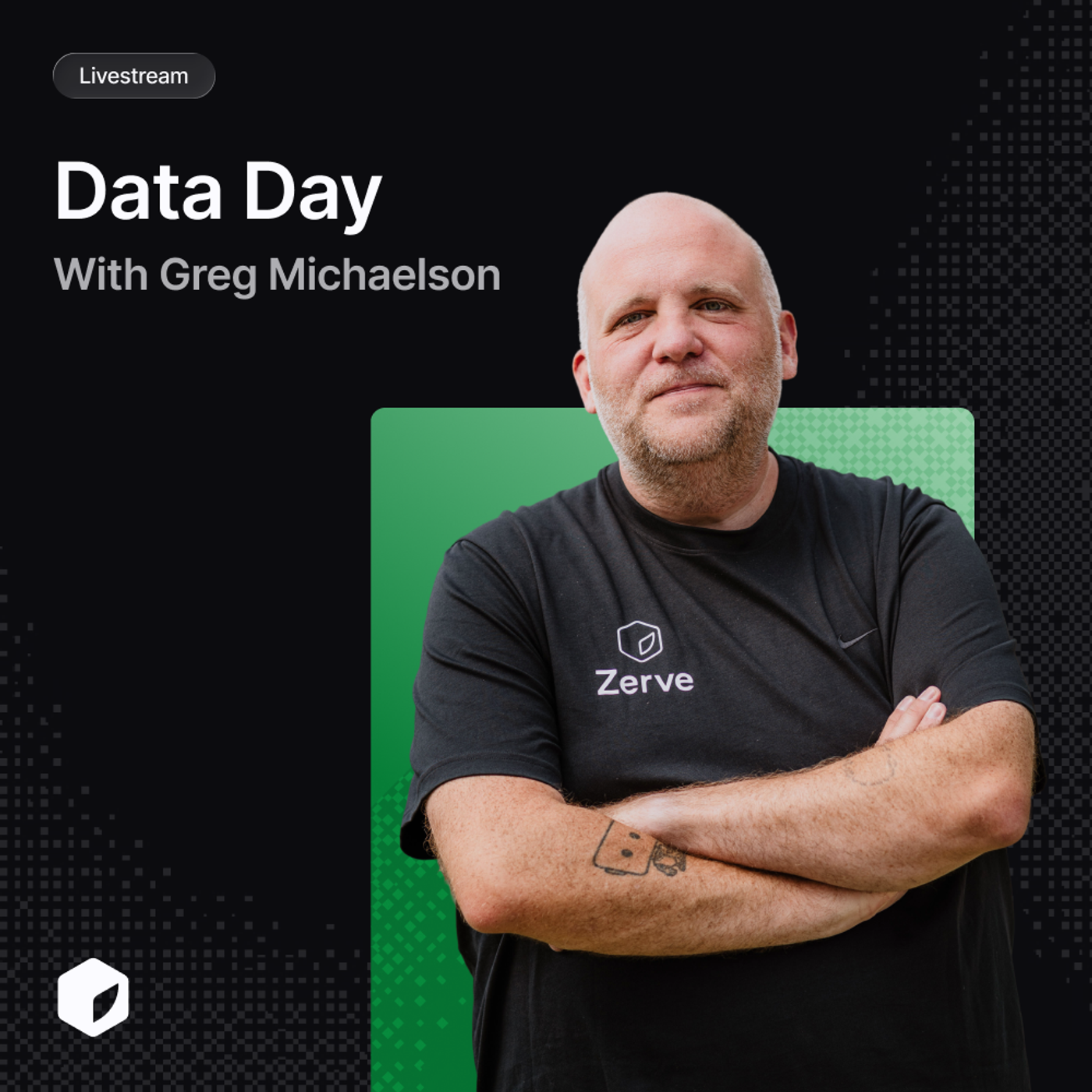
Data Day with Greg Michaelson
by Greg Michaelson
DataDay with Greg Michaelson is a podcast about the real lives of people who work with data and AI every day. Not the polished conference-talk version, but the messy, clever, practical, human side of analytics work. Each episode sits down with someone who’s in the trenches building models, shipping dashboards, wrangling pipelines, or experimenting with agentic AI to get actual work done.Host Greg Michaelson digs into how these practitioners think, how they solve problems, and the quirks that make each of them unique. Learn about the shortcuts they swear by, the habits they can’t break, the tools they love, the ones they avoid, and the weird constraints that shape their day-to-day.You’ll hear stories about debugging agents at 2AM, designing workflows that survive contact with real users, navigating organizational chaos, and figuring out how to stay curious while the field changes under your feet. It’s a practical, grounded conversation about doing data and AI wor
-
27
Raheem Bell - Building the Autonomous Operating Room
Raheem Bell is a surgical resident at Northwestern and the CEO of Operative Insights, a startup developing an autonomous operating room lighting system designed to help surgeons see better, work more efficiently, and improve patient outcomes. In this episode, Raheem shares how years in the operating room led him to identify a surprisingly common problem: surgeons constantly adjusting lights during procedures. We discuss how computer vision, robotics, and AI can be used to create intelligent lighting that follows the surgical team, eliminates shadows, and adapts to the needs of each operation. Raheem also talks about the challenges of building a medical device startup, navigating FDA approval, raising capital, assembling a multidisciplinary team, and balancing entrepreneurship with the demands of surgical training. It's a fascinating look at how innovation often starts with a simple frustration and grows into a mission to transform an entire industry.
-
26
Tony Medrano - AI, Peptides, and the Future of Personalized Longevity
In this episode of Data Day with Greg Michaelson, Greg sits down with Tony Medrano to explore the rapidly evolving intersection of AI, wearable health data, peptides, and personalized longevity optimization.Tony shares his journey from founding one of the earliest AI startups in 2016 to helping scale a molecular diagnostics company from zero to $1 billion in revenue during the COVID era, serving organizations like NASA, Google, the NFL, and the NBA. The conversation dives deep into:What peptides actually are and how they workThe science behind compounds like BPC-157, GHK-CU, MOTS-c, and tesamorelinAI-driven “digital twin” health optimizationWearables, HRV tracking, and personalized biometric analysisThe difference between supplements, peptides, and pharmaceutical drugsLongevity strategies for athletes, executives, and people over 40Why most longevity advice online is noisy, biased, or incompleteThe future of AI-powered health coaching and preventative medicineTony also explains how Longevity Plan AI combines wearable data, peptide protocols, physician oversight, and AI modeling to create personalized health optimization plans designed to improve recovery, metabolic health, energy, sleep, and performance. If you’re interested in biohacking, longevity, AI-driven healthcare, performance optimization, or the future of personalized medicine, this episode is packed with fascinating insights and practical discussion.
-
25
John Kane - Building AI Trading Systems for Sports Prediction Markets
In this episode of Data Day with Greg Michaelson, Greg sits down with John Kane to explore the rapidly growing world of sports prediction markets and the AI systems powering next-generation quantitative trading.John explains how his company, Lazy Edge, applies quantitative finance techniques to live sports trading, using massive real-time data streams, simulation engines, and AI-driven modeling to identify market inefficiencies during games as they unfold.The conversation dives into:How prediction markets like Polymarket and Kalshi actually workWhy live sports trading resembles quantitative stock trading more than gamblingUsing simulations, AI agents, and “digital twins” to model game outcomesReal-time NBA event prediction and market movement analysisHow bots trade sports markets automatically through APIsThe future of prediction markets, regulation, and AI-driven trading systemsWhy chaos modeling matters in live game forecastingJohn also shares how tools like Zerve help accelerate experimentation and backtesting by allowing rapid iteration on complex predictive models and simulations.If you’re interested in AI, quantitative finance, trading systems, simulation modeling, or the intersection of sports and machine learning, this episode is a fascinating look at a space that’s evolving incredibly fast.
-
24
Gaurav Jain - Developer Intent in the Age of AI Agents
In this episode of Data Day with Greg Michaelson, Greg sits down with Gaurav Jain to explore one of the hardest problems in modern developer tooling: understanding developer intent. They dive into how technical buyers actually evaluate products, why traditional B2B funnels break down when selling to engineers, and how reo.dev tracks developer behavior across GitHub, docs, package managers, MCPs, and AI agents to help companies understand when users are truly ready to engage. The conversation also explores the rise of agent-driven discovery, the decline of documentation traffic, MCPs as the future interface layer for AI systems, and what happens when developers stop browsing websites and start delegating research to AI.
-
23
Tom Coyle - From CIA Operations to AI-Powered Cancer Care
Tom Coyle’s career path sounds fictional until you realize it’s all true. West Point graduate, Army officer, CIA operations specialist, AI strategist, startup founder, and now health tech entrepreneur focused on improving cancer outcomes through nutrition and data.In this episode, Tom shares stories from his time tracking enemy mortar patterns in military simulations, helping intelligence teams think differently about finding Osama bin Laden, and eventually joining DataRobot during the rise of enterprise AI. He explains how pattern recognition, predictive analytics, and human behavior shaped his career long before modern AI tools existed.We also dive deep into his current company, Science Cella, an AI-driven nutrition platform designed to help cancer patients manage symptoms, improve treatment outcomes, and give dieticians scalable tools for personalized care. Tom talks candidly about surviving cancer himself, the realities of healthcare innovation, startup fundraising, clinical trials, and why he believes “food as medicine” deserves serious scientific validation.This conversation covers military technology, intelligence work, AI, startups, healthcare, nutrition, entrepreneurship, and the lessons learned from building products in high-stakes environments.
-
22
Bhaskar Sunkara - Building the Next Generation of Analytics
In this episode of Data Day, I sit down with Bhaskar Sunkara, co-founder and former CTO of AppDynamics, to unpack the evolution from application performance monitoring to AI-driven business analytics.We go deep on how AppDynamics redefined monitoring by focusing on business transactions instead of infrastructure metrics, why self-serve was a game-changing GTM move, and the behind-the-scenes story of their near-IPO turned Cisco acquisition.Then we shift to what comes next. Bhaskar shares how his new company is rethinking analytics with always-on agents that detect, explain, and act on business signals before you even ask the question. We dig into what actually makes AI systems useful in production, where coding agents are already replacing engineering work, and why the real bottleneck has shifted from writing code to designing the right system.If you’re building in AI, data, or modern SaaS, this is a clear look at where things are going and what actually matters.
-
21
Todd Person - The Internet Is Becoming Agents Talking to Agents
I sat down with Todd Persen from Hydraulics to unpack observability, log data, and what actually happens behind the scenes when your apps, streams, and infrastructure are running at scale. We get into how systems are monitored, why logs are exploding in size and complexity, and why LLMs struggle once the data gets truly massive. The conversation takes a turn into the future, where agentic traffic may outnumber humans, and what it means to tell good bots from bad ones. We also get into real-world use cases from CDNs, streaming, and even what happens when AI starts doing your grocery shopping for you.
-
20
Darius Sabas - From Marketplaces to Machine Learning
In this episode of Day to Day, Greg reconnects with Darius Sabas to unpack his journey from DataRobot to leading analytics teams across European marketplaces. Darius shares lessons from scaling data organizations, building modern data stacks with tools like Snowflake and Mixpanel, and navigating the transition from basic reporting to predictive modeling and AI-driven products.The conversation dives into the realities behind marketing mix models, the challenges of balancing data rigor with business politics, and why marketplaces are a goldmine for data science use cases. They also explore the growing role of LLMs in both work and personal life, from agentic workflows to the future of personalized AI, data privacy, and trust in an AI-generated world.
-
19
Saad Ansari - From Hajj to Humane AI: Building Tech That Optimizes for People
Saad Ansari has had one of the more unusual paths in AI.He shares what it was like serving as an advisor inside the Saudi Ministry of Hajj and Umrah, helping guide digital transformation for one of the largest recurring events in the world. We talk about how AI intersects with government systems, why execution looks different across countries, and what it takes to modernize legacy infrastructure.Then we shift to his new company, Partake.ai, where he’s focused on reinforcement learning that optimizes for human outcomes rather than engagement metrics.We cover:Why today’s AI systems optimize for attentionWhat “human-aligned” AI might actually meanPokémon Go as the most successful fitness app everWhether AI can nudge people toward healthier behaviorEdge inference and privacy tradeoffsAnd whether companies can build something that is both profitable and goodIt’s a thoughtful conversation about AI, incentives, and what kind of systems we actually want to live with.
-
18
Julien Simon - Software Engineering After AI: What Changes and What Doesn’t
Julien Simon has spent years explaining cutting-edge tech to the world — first at AWS, then Hugging Face, and RCAI.In this conversation, he shares how he moved from CTO roles into tech evangelism, what it was like pushing for honest benchmarking inside big tech, and why trust matters more than marketing.We get into:The real role of a tech evangelistWhy benchmarking caused internal frictionThe flood of AI-generated content and what it means for trustWhether software engineering as we know it is overHow AI coding assistants are changing workflowsWhy young engineers may want to rethink their career pathsJulien also talks about his move into private equity and helping portfolio companies adopt AI at scale.This one is candid, sharp, and forward-looking.
-
17
Adam Davis - SEO, GEO, and the Future of Content in an AI World
Adam Davis has been in content marketing for over a decade, and he’s spent the last year testing AI tools full time.We talk about how AI is changing content workflows — not by replacing marketers, but by forcing them to rethink process and positioning.We cover:Why SEO isn’t dead, but evolvingWhat GEO actually meansHow Reddit influences AI training dataWhy authenticity is becoming the only moatHow small startups should think about branding differently than big companiesWe also talk about the difference between creating content and managing content in 2025.If you’re building online, this conversation is grounded and practical.
-
16
Roey Zalta - Agentic Companies and the Rise of AI Employees
Roey Zalta has worked at the forefront of enterprise AI deployment, including multi-agent systems in production environments.In this episode, we discuss:What “agentic companies” really meanMulti-agent systems deployed in HebrewWhy evaluation (evals) is the hidden key to enterprise AIThe risks of automating broken business logicVoice AI agents replacing call centersMicrosoft’s long-term AI strategyWe also zoom out to the broader questions:How AI affects education and human learningWhether LLMs will reshape social interactionThe privacy tradeoffs of Apple IntelligenceAnd what happens when AI-generated content dominates the internetIt’s part technical, part philosophical, and very grounded in real-world deployment.
-
15
Thomas Dinsmore - AutoML, Agents, and the AGI Debate
Greg reconnects with former DataRobot “Director of Competitor Annihilation” Thomas Dinsmore to unpack what’s happened in the AutoML world, the rise of AI agents, and whether generative AI is truly disruptive or just another buzz cycle. They discuss Domino’s governance-first platform, the future of predictive analytics, AGI skepticism, and why “don’t trust—verify” still applies in the AI era.
-
14
Razi Raziuddin - Why Feature Engineering Is the Real Bottleneck in AI
In this episode, Greg and Razi revisit their DataRobot roots and discuss what still hasn’t been solved in data science. FeatureByte’s data science agent tackles the messy 90% of the ML workflow: feature engineering, pipeline management, and production deployment. They debate tabular foundation models, agentic frameworks, and whether feature stores are actually being used in the real world.
-
13
Andrew Engel - Building AI to Detect Concussions
Greg reconnects with Andrew Engel to talk about leaving the LLM SaaS wave behind and building something tangible. After years in the data science startup ecosystem, Andrew is now co-founding Nyst.ai, using computer vision and movement analysis to detect concussions from a mobile phone. They discuss startup realities, prompt engineering skepticism, remote work, and what it’s like to move from employee to founder.
-
12
Satadru Sangupta - Automating an Entire Industry
What happens when you apply agent-native AI to one of the most fragmented industries in America? Greg and Satadru explore the evolution from enterprise AI at DataRobot to building automation infrastructure for home service providers. They discuss workflow automation, AI-generated quoting and payments, cold-start marketplaces, and why “point solutions” fail in complex industries.
-
11
Ray Mi - From Statistics to Agentic AI
In this episode of Day to Day with Greg Michaelson, Greg sits down with Ray Mi, former DataRobot leader and AI solutions expert, to explore how data science is evolving in the age of generative and agentic AI. They discuss AI-native companies, digital twins, virtual simulations, privacy, education, and what the data scientist role looks like over the next decade. If you’re wondering where AI is really headed and how to stay relevant, this conversation is for you.
-
10
John Forrest - Firefighting, Trust, and the Future of AI Support
In this episode, Greg sits down with longtime colleague John Forrest to talk about what really matters in technical customer support. Drawing on years of experience across startups and enterprise software, they explore trust, customer relationships, AI, vector databases, agentic memory, and why human judgment still matters even in an AI-driven world.
-
9
Dennis Oleksyuk - Inside building real AI agents for the messy world of air-freight logistics.
On this episode of Data Day, Greg Michaelson sits down with longtime friend and former DataRobot colleague, Dennis Oleksyuk, co-founder and CTO of AirCon, to unpack what it really takes to put AI agents into production in a weird but massive industry: air freight.Dennis shares his unconventional path from growing up in one of the coldest inhabited places on earth, to applied math in a Soviet-style university, to telecom engineering, and eventually into machine learning and AI infrastructure. He explains how AirCon’s agents read freight emails, build viable multi-leg routes, talk to a zoo of carrier APIs, and autonomously generate and book quotes for freight forwarders, all while dealing with a million messy corner cases that never appear on the public internet.Greg and Dennis dig into the reality of agentic coding in production: why generic agent frameworks often fall apart, why software engineering fundamentals matter more than “prompt wizardry,” how context windows really work, and why fine-tuning is usually limited by training data, not tooling. Along the way they touch on hidden operational knowledge in every industry, the myth of microservices as a default, and Dennis’s infamous “get on a plane, B” bug story.If you care about AI agents, real-world automation, infrastructure, or just want a peek behind the curtain of how your stuff actually gets around the world, this one is for you.
-
8
The Zerve AI Notebook: Faster, Cleaner, and Built for AI
Notebooks for data haven’t meaningfully changed in more than a decade, so we rebuilt them completely, based on how data work is actually done. We're introducing a major evolution of the Zerve app in a clean, streamlined UI that brings the fluidity of notebooks together with the power of agentic execution, reproducible canvases, and real cloud compute.Join the founders, Greg Michaelson, Phily Hayes, and Jason Hillary, for a live look at what’s new, why we built it, and how it unlocks a smoother, more intuitive workflow for everyone who works with data. We'll demo the new app, answer your questions live, and share behind-the-scenes insights.What You'll LearnHow the new Zerve Notebook improves stability, collaboration, and speedUnderstand why Zerve is blending notebook familiarity with agentic execution and reproducibilityWatch a live demo showing faster workflows, better clarity, and smoother iterationHear directly from the founders about the design decisions, roadmap, and what’s coming next
-
7
Joel Grus
Notebooks were made for people, not for AI. Zerve rebuilt them for both. In this livestream, Greg Michaelson, Zerve Co-Founder and Chief Product Officer, chats with data science guru Joel Grus (of “I don’t like notebooks” fame), and unveils the latest Zerve release: a new kind of notebook where agents and humans collaborate in real time to go from question to deployed solution 10x faster. Learn how Zerve carries ideas from exploration to live apps and APIs — no rewrites, no orchestration tools, no context switching.
-
6
The Cursor Moment for Data Science
Data science isn’t the same as software engineering. The difference is context. In this livestream, we’ll unpack what “context” really means, why it matters for data science, and how it transforms how teams work. You’ll hear how leading companies use context-aware workflows to cut wasted effort, streamline collaboration, and move faster from idea to impact. We’ll also demo Zerve, the first AI development environment for data science, with context at its core.Key takeaways: - Why context is the missing ingredient in traditional AI coding assistants- Real-world examples of context-aware workflows boosting productivity- How context-aware AI agents keep hypotheses, data, and code aligned to avoid wasted cycles- A live demo of Zerve’s context-first, agentic approach
We're indexing this podcast's transcripts for the first time — this can take a minute or two. We'll show results as soon as they're ready.
No matches for "" in this podcast's transcripts.
No topics indexed yet for this podcast.
Loading reviews...
ABOUT THIS SHOW
DataDay with Greg Michaelson is a podcast about the real lives of people who work with data and AI every day. Not the polished conference-talk version, but the messy, clever, practical, human side of analytics work. Each episode sits down with someone who’s in the trenches building models, shipping dashboards, wrangling pipelines, or experimenting with agentic AI to get actual work done.Host Greg Michaelson digs into how these practitioners think, how they solve problems, and the quirks that make each of them unique. Learn about the shortcuts they swear by, the habits they can’t break, the tools they love, the ones they avoid, and the weird constraints that shape their day-to-day.You’ll hear stories about debugging agents at 2AM, designing workflows that survive contact with real users, navigating organizational chaos, and figuring out how to stay curious while the field changes under your feet. It’s a practical, grounded conversation about doing data and AI wor
HOSTED BY
Greg Michaelson
CATEGORIES
Loading similar podcasts...
Frequently Asked Questions
How many episodes does Data Day with Greg Michaelson have?
Data Day with Greg Michaelson currently has 22 episodes available on PodParley. New episodes are automatically indexed when they're published to the podcast feed.
What is Data Day with Greg Michaelson about?
DataDay with Greg Michaelson is a podcast about the real lives of people who work with data and AI every day. Not the polished conference-talk version, but the messy, clever, practical, human side of analytics work. Each episode sits down with someone who’s in the trenches building models, shipping...
How often does Data Day with Greg Michaelson release new episodes?
Data Day with Greg Michaelson has 22 episodes. Check the episode list to see recent publication dates and frequency.
Where can I listen to Data Day with Greg Michaelson?
You can listen to Data Day with Greg Michaelson on PodParley by clicking any episode. We provide an embedded audio player for direct listening, and you can also subscribe via your preferred podcast app using the RSS feed.
Who hosts Data Day with Greg Michaelson?
Data Day with Greg Michaelson is created and hosted by Greg Michaelson.
URL copied to clipboard!