Episodes
-
2.55: Derech Hashem B'Iyun Book 2 Chapter 3 Part 10
Rabbi Shulman explains Ramchal’s presentation of reincarnation as an expression of divine mercy: an opportunity to repair earlier failures, without erasing responsibility for them. He distinguishes between the circumstances assigned to a person and the ultimate judgment of that person’s choices,...
-
2.54: Derech Hashem B'Iyun Book 2 Chapter 3 Part 9
Rabbi Shulman examines how suffering accepted with love can benefit not only an individual but an entire generation—and, at the highest levels, humanity across history. He distinguishes punishment understood as satisfying justice from suffering understood as actually cleansing the world and...
-
2.53: Derech Hashem B'Iyun Book 2 Chapter 3 Part 8
Rabbi Shulman explains how the Jewish people’s spiritual interconnectedness allows individuals to benefit from the merits of others—and enables exceptionally righteous people to suffer for the benefit of their generation. Building on Ramchal’s discussion of mutual responsibility, he distinguishes...
-
2.52: Derech Hashem B'Iyun Book 2 Chapter 3 Part 7
Rabbi Shulman continues learning Ramchal (Derech Hashem, Chelek II, Perek 3), developing the idea that Divine providence over an individual is interwoven with family lineage, future descendants, and one’s generation/community. He explains that these factors shape a person’s “obstacle course” in...
-
2.51: Derech Hashem B'Iyun Book 2 Chapter 3 Part 5
Episode Notes Notes go hereRabbi Shulman continues learning *Derech Hashem* and clarifies two fundamentally different kinds of ייסורים: punitive suffering that cleanses sin, and “ייסורים של התעוררות,” afflictions meant to awaken a person to תשובה before punishment becomes necessary. He then...
-
2.50: Derech Hashem B'Iyun Book 2 Chapter 3 Part 4
Rabbi Shulman continues learning Ramchal, developing the idea that divine providence in a person’s life is shaped by that person’s choices: good deeds tend to generate conditions that facilitate further mitzvot, while misdeeds can create obstacles that make future spiritual growth harder. He...
-
2.49: Derech Hashem B'Iyun Book 2 Chapter 3 Part 3-4
Rabbi Shulman continues developing the idea of **השגחה אישית** as Hashem’s individualized guidance, framing a person’s life circumstances as tailored tests aligned with their unique spiritual mission (“מזל” in a higher sense). He contrasts this with the Gemara’s “אין מזל לישראל,” explaining that...
-
2.48: Derech Hashem B'Iyun Book 2 Chapter 3 Part 1-2
Rabbi Shulman explains that Hashem intentionally designed avodat Hashem with enormous diversity—across mitzvot, life circumstances, and even moment-to-moment emotional states—so that our relationship with Hashem can be multi-faceted rather than one-dimensional. Each person receives a unique...
-
2.47: D_H biyun 2-2-8_3-1
Rabbi Shulman continues studying the Ramchal’s framework of divine justice, distinguishing between deeds that become eternal assets in עולם הבא and deeds that are “cashed out” in this world. He explains a troubling middle category: people who do have a share in eternity, yet many of their מצוות…
more -
2.46: D_H biyun 2-2-5_6_7
Rabbi Shulman explains the Ramchal’s view that יסורים are not merely “payment” demanded by strict דין, but a rehabilitative process that repairs the רוחני damage created by עבירות. He develops how actions concretely reshape a person’s גוף and נפש—good deeds build זוהר and שלמות, while sins embed...
-
2.45: Derech Hashem B'Iyun Book 2 Chapter 2 Part 4
Rabbi Shulman explains the Ramchal’s framework of **השגחה כללית** as a system of spiritual “accounting” that ensures every deed is addressed, enabling true דביקות with Hashem in עולם הבא. He develops how Divine justice and kindness require multiple “arenas” of payment—this world, Gehinnom (and...
-
2.44: D_H biyun 2-2-1_2
Rabbi Shulman outlines the Ramchal’s framework for understanding השגחה: since humanity’s purpose is to earn דבקות בה׳ in עולם הבא, the entire arrangement of עולם הזה is designed as preparation for that ultimate end. Rabbi Shulman explains that this preparation operates on two parallel “axes”—an...
-
2.43: D_H 1-5-8_9
Rabbi Shulman explains the philosophical problem of how “evil” can exist if Hashem is the source of all goodness, developing the Rambam’s model that evil begins not as a created substance but as the withdrawal of divine revelation (hester panim). He then adds a second stage: once that “absence”...
-
2.42: D_H 1-5-5_6_7
Rabbi Shulman explains how human free will can “move” higher spiritual powers upward, triggering an inevitable, determined flow back downward into the world. He clarifies that not only actions, but also speech and thought, generate uniquely calibrated effects—varying by intensity (*שיעור*) and by...
-
2.41: Derech Hashem B'Iyun Book 1 Chapter 5 Part 4
Rabbi Shulman explains the Ramchal’s model that most events originate “above” in the higher, spiritual powers and descend into the physical world as cause-and-effect. The major exception is human free will: through bechirah a person can initiate change from below to above, impacting the higher...
-
2.40: Derech Hashem B'Iyun Book 1 Chapter 5 Part 3
Rabbi Shulman continues the Ramchal’s discussion of how Hashem structured reality as a system of “roots and branches,” where higher spiritual powers are the roots and the physical world is their downstream expression. He explains the metaphor of **השתלשלות** as a chain of worlds in which the...
-
2.39: Derech Hashem B'Iyun Book 1 Chapter 5 Part 2
Rabbi Shulman explains the Ramchal’s distinction between human beings and animals: although both possess a physical life-force, only man is a true composite of two utterly different creations—body and a supernal soul. He develops how this makes man the “ladder” connecting spiritual and physical...
-
2.38: Derech Hashem B'Iyun Book 1 Chapter 5 Part 1
Rabbi Shulman explains Ramchal’s taxonomy of creation as divided into two overarching realms—גשמי (physical) and רוחני (spiritual)—and then carefully traces the subdivisions within each. He clarifies what “perceivable by the senses” means (including perception aided by tools), and why the…
more -
2.37: Derech Hashem B'Iyun Book 1 Chapter 4 Part 11
Rabbi Shulman explains the Ramchal’s step-by-step “mechanism” of spiritual growth: a mitzvah brings a person closer to Hashem, that closeness yields greater גילוי (revelation/“הארת פנים”), and that revelation produces human perfection—because Hashem is the source of all שלמות. He contrasts this...
-
2.36: D_H biyun 1-4-9_10
Rabbi Shulman explains that the Ramchal describes three distinct modes of engaging Torah—reading Written Torah, understanding the revealed Torah (Gemara and halachah), and understanding *סתרי תורה*—and that each produces spiritual growth in a different way. He highlights the Ramchal’s precise…
more -
2.35: Derech Hashem B'Iyun Book 1 Chapter 4 Part 9
Rabbi Shulman explains that while love and fear of Hashem are powerful internal “vehicles” for spiritual growth, Hashem gave an even higher external כלי: תלמוד תורה. He outlines two (and then a heightened third) levels within Torah study—simple reading, analytical understanding, and finally...
-
2.34: Derech Hashem B'Iyun Book 1 Chapter 4 Part 8
This dvar Torah develops a “hack” for generating “limitless mitzvot”: everyday, non-mitzvah actions can become spiritually elevating when they are necessary for avodat Hashem, permissible, and done with proper kavanah. It then pivots to a core inner avodah in Derech Hashem: strengthening אהבה and...
-
2.33: Derech Hashem B'Iyun Book 1 Chapter 4 Part 5-7
This dvar Torah learns Derech Hashem’s framework that mitzvot are not external rules imposed on man, but the very “boundaries and relationships” (גבולים וסדרים) custom-designed for human perfection and דביקות בה׳. It then defines the root of all avodah as a constant orientation toward the…
more -
2.32: Derech Hashem B'Iyun Book 1 Chapter 4 Part 4
This dvar Torah develops a central Ramchal idea: Hashem embedded *גבולים* (definitions) and *סדרים* (relational structures) within the physical world so that human engagement with physical objects can become a vehicle for spiritual growth rather than distraction. When a person uses the world...
-
2.31: Derech Hashem B'Iyun Book 1 Chapter 4 Part 3
This dvar Torah traces the Ramchal’s argument that a human being is immersed in physicality on three fronts: our bodies, our world, and our daily involvements. That physical immersion creates an “asymmetrical” struggle: the body is compulsory and immediate, while spirituality is not forced upon…
more -
2.30: Derech Hashem B'Iyun Book 1 Chapter 4 Part 2
This dvar Torah (learning session) develops the Ramchal’s description of the נשמה entering the גוף as an inherently asymmetrical struggle: even when the powers are “balanced,” the battlefield is the body’s “home court,” so the soul experiences exile in a foreign environment. Because the soul-body...
-
2.29: Derech Hashem B'Iyun Book 1 Chapter 4 Part 1
This dvar Torah frames Perek 4 as an investigation into the human condition in this world through two lenses: the inner structure of the person and the external environment in which he lives. Using the Gemara’s language of **“שאור שבעיסה ושיעבוד מלכויות”**, it connects these two forces to Pesach:...
-
2.28: Derech Hashem B'Iyun Book 1 Chapter 3 Part 13b
Outline: https://danielggordon.github.io/ateresami/dh-biyun-1-3-13b-20260324-141501-outline-20260324-141618.pdf
About this show
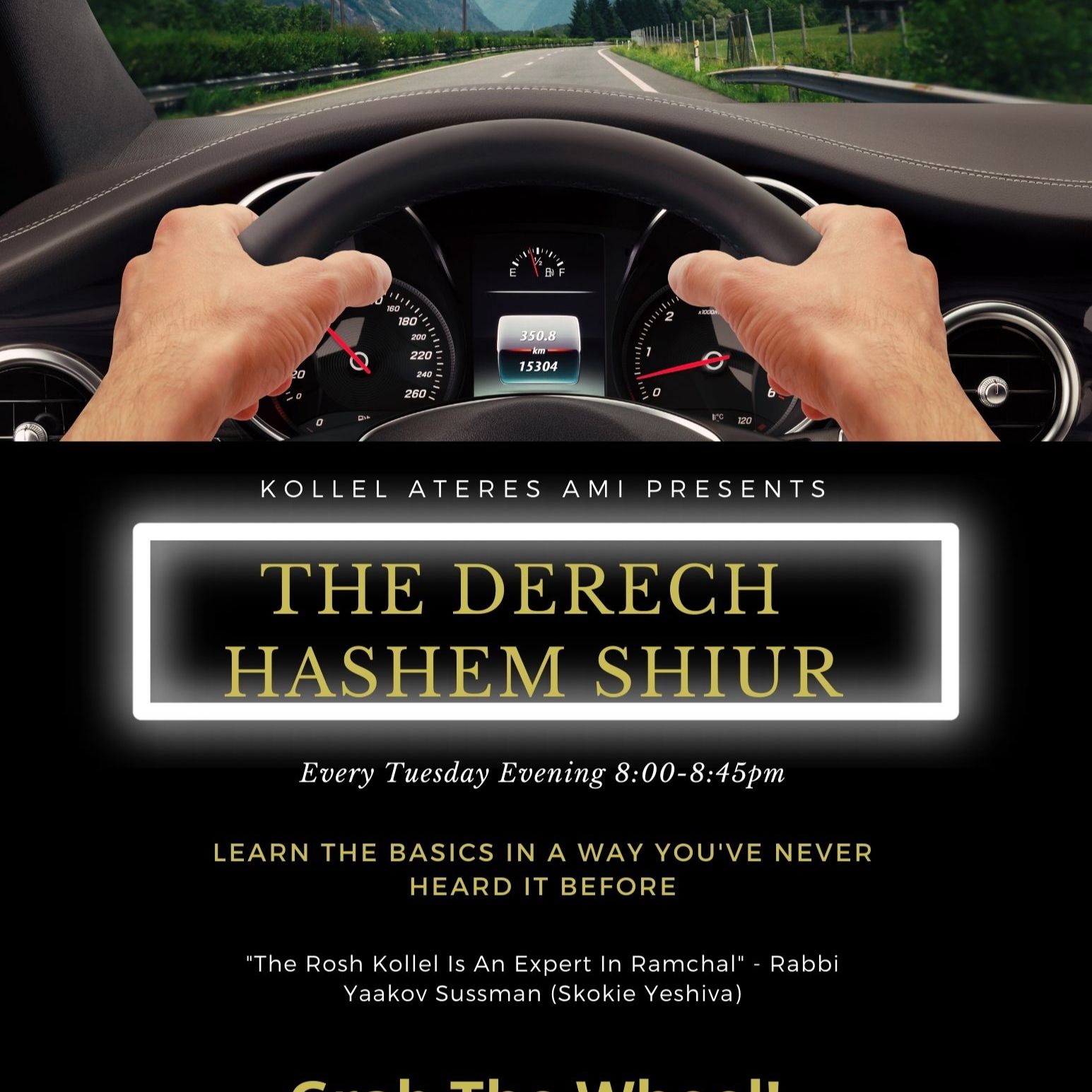
Join Rabbi Aryeh Shulman, Rosh Kollel Ateres Ami, as he explores this classic text with his trademark clarity and depth.
Hosted by
Rabbi Aryeh Shulman
Categories