
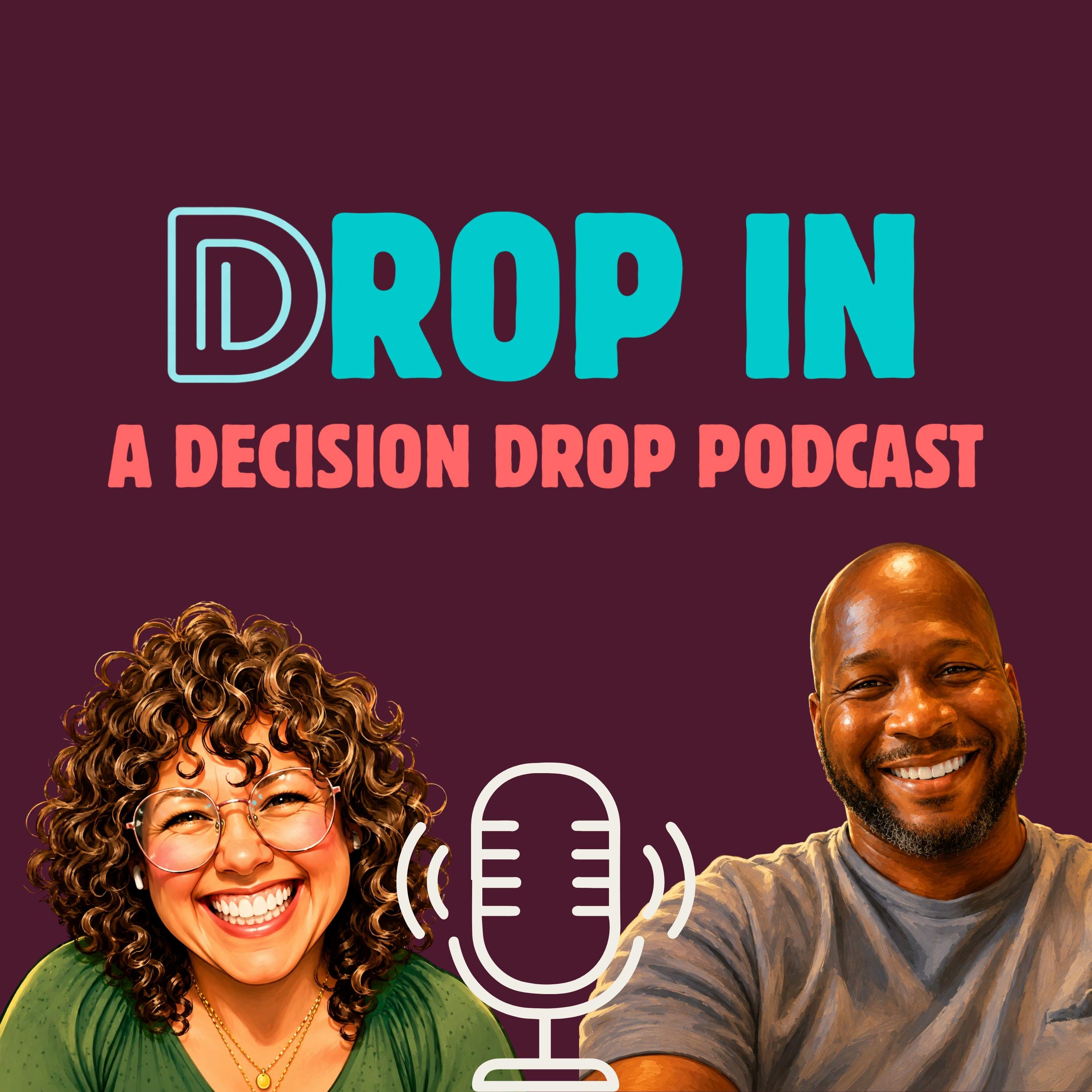
PODCAST · education
Drop In: A Decision Drop College Admissions Podcast
by Lisa Clay and Josh Hudley
The college process feels like chaos. Endless deadlines, conflicting advice, and pressure from every direction. Drop In cuts through it. Hosted by Lisa and Josh, two college admissions experts with over 25 years of experience each, this show delivers real talk on essays, GPA, financial aid, college lists, resumé, and everything in between. No jargon. No fear-mongering. Just honest, insider guidance that keeps your student's voice front and center. Each episode ends with a Hot Take or Hard Truth and a Drop the Mic moment you'll actually remember. New episodes every week-DROP IN and find your place.
-
13
EP13: How Much Should Parents Help With College Applications?
In Episode 13 of Drop In, Lisa and Josh welcome their very first guest, Mary O’Malley, Co-Head of Admissions Advising at Union Hall Advising and author of the Admitted-ish Substack, to tackle one of the hardest questions parents face during application season:How much should I actually be helping my kiddo with their college applications?Should parents edit the college essay? Can they fill out the Common App? When does helpful feedback become rewriting? And how do you support a stressed-out teenager without accidentally taking over the entire process?Mary brings experience from college admissions, independent school admissions, college counseling, enrollment management, financial aid, and reading applications for highly selective universities. Together, Lisa, Josh, and Mary break down what authentic student voice actually looks like, why ordinary essay topics can be incredibly effective, and why a teenager’s application should still sound like a teenager wrote it.They also talk about how parental involvement should look different from student to student, why families may want to schedule dedicated “college check-ins” instead of talking about applications constantly, and why one of the best things a parent can do is give their student room to have an opinion before offering their own.Because helping does not always mean fixing.Sometimes the most loving thing you can do is let your kiddo do part of this imperfectly.And as Mary reminds families, a college acceptance letter is not a parenting report card.In this episode:• How much parents should help with college applications• Why a college application needs to sound like the student• What admissions officers actually mean by “student voice”• Why an essay does not need a dramatic or extraordinary topic• Helpful parent feedback vs. rewriting a student’s essay• Why parents should ask permission before reading an essay• Whether parents should fill out the Common App• How students can own their application while still receiving support• Why different kiddos need different levels of help• How to keep college admissions from taking over every family conversation• Why parents should let students react to college visits and decisions first• How comparison can steal the joy from senior year• Why an admissions decision is not a verdict on a student’s worth• Why a college acceptance is not a parenting report card• How the college application process can build independence before collegeParents, you absolutely have a role in this process. It is a big one.But your job is not to create the perfect application.Your job is to help your kiddo build the confidence to own theirs.Love your kiddo more than you love the outcome.Need help guiding your student through essays, applications, college lists, deadlines, and strategy without taking over the process? Visit decisiondrop.com/contact to learn more about working with Lisa and Josh at Decision Drop.And be sure to check out Mary O’Malley’s Admitted-ish Substack for more smart, practical, hysteria-free college admissions advice.
-
12
EP12: You Got Into College. Now What?
In Episode 12 of Drop In, Lisa and Josh tackle one of the best problems a student can have: more than one college saying yes.After months of applications, waiting, and admissions committees making decisions about you, the choice is finally yours. So how do you actually decide which college to attend?Lisa and Josh break down the two biggest pieces of the final college decision: fit and finances. They talk about why admitted student days feel different from regular college visits, what to look for when you return to campus, and why the most recognizable name is not automatically the school where you will be happiest or most successful.Then they get into the money.What does that financial aid offer actually mean? Which parts are real gift aid? How should families compare grants and scholarships with loans and work study? And how do you calculate the real cost of attending each college instead of getting distracted by the headline number on an award letter?They also talk about merit scholarships, the strategy of choosing a less selective school for significantly more money, and why honors colleges at large public universities can sometimes offer students the best of both worlds.Because the goal was never to collect the most impressive acceptance.The goal is to choose the college where you can learn, grow, find your people, be happy, and build the life you actually want without ignoring the financial reality of getting there.In this episode:• How to compare multiple college acceptance offers• Why admitted student days matter before making your final decision• How to evaluate college fit beyond rankings and name recognition• Prestige vs. fit and why the “better known” school is not always the better choice• How to read and compare financial aid award letters• Grants and scholarships vs. loans and work study• How to calculate your real net cost at each college• Why travel and other hidden college costs matter• How merit scholarships can completely change your college decision• When choosing the less expensive college can be the smarter move• Why honors colleges at large universities are worth considering• How to narrow your choices to your true finalists• What to remember about the May 1 college decision deadline• Why your gut feeling gets a vote once the fit and finances make senseThe name on the sweatshirt will get a reaction for about 30 seconds.You have to live there for four years.So do the real math. Go back and visit if you can. Picture an ordinary Tuesday or Thursday on campus, not just the polished version you see on Admitted Student Day. And then trust what you have learned about yourself throughout this process.Choose the place where you can grow. Choose the place where you can belong. And choose the place that works for the people helping make all of this possible.Need help comparing college offers, understanding financial aid, or figuring out which school actually fits your student? Visit https://decisiondrop.com/contact to learn more about working with Lisa and Josh at Decision Drop.
-
11
EP11: Accepted, Denied, Deferred: What to Do Next
The college decisions are starting to arrive. Accepted. Denied. Deferred. Waitlisted. Four words that can completely change the mood in your house.In Episode 11 of Drop In, Lisa and Josh break down what each college admissions decision actually means, what students should do next, and what parents need to remember when the answer is not the one everyone was hoping for.They cover what to do after an acceptance, why you should not rush to commit before comparing financial aid offers, what a deferral really means, when to send a Letter of Continued Interest (LOCI), and how to approach a college waitlist without putting your life on hold.They also tackle the harder part of decision season: disappointment.Because a denial is not a verdict on your worth. A deferral is not a secret rejection. And a waitlist is a maybe you cannot build your life around.Plus, Lisa and Josh talk directly to parents about the first few minutes after a college decision arrives, why your reaction matters more than you may realize, and why sometimes the best thing you can do is skip the strategy and simply lead with love.In this episode:• What to do after a college acceptance• Why you should compare financial aid before committing• What a college deferral actually means• When and how to send a Letter of Continued Interest• How midyear grades can affect a deferred application• What to do after a college denial• How to handle a college waitlist• Why students should not put their lives on hold for a “maybe”• What parents should say — and NOT say — when decisions arrive• How to keep one college decision from defining the rest of your senior yearWhatever word shows up on that screen, remember: it is information, not a verdict. You can feel disappointed and still be okay. Both things can be true at the exact same time.Want to dig deeper? Read our blog post here for a closer look at how to make the most of the waiting period.Need help navigating the wait, understanding your decisions, and ultimately finding the right fit? Visit https://decisiondrop.com/contact to learn more about working with Lisa and Josh at Decision Drop.
-
10
EP10: What to Do Between Submitting Your Applications and Hearing Back
The wait is not dead time. It is a window.In Episode 10 of The Drop In, Lisa and Josh tackle the part of the college process nobody warns you about: the long stretch between hitting submit and hearing back in March. What can you actually do during the wait? Does demonstrated interest really matter? And how do you keep a great application from unraveling before decisions even arrive?We dig into what demonstrated interest actually looks like, and why it works completely differently at a small school like Pitzer College than it does at a giant flagship like the University of Wisconsin, or a hidden-gem liberal arts school like Austin College in Sherman, Texas. We talk about why visiting a campus in the actual winter cold matters so much more than a glossy fall visit, because climate is a real fit factor and there might still be snow on the ground in March.Then we get into everything else you can be doing right now: keeping your grades up, submitting your mid-year report, watching your portals and email, taking optional interviews, and finishing your financial aid paperwork so you can compare offers calmly when they come.And Lisa shares her hot take on the one thing coming for every single senior. No one is immune.Because the wait is not something to survive. It is something to use.In this episode: What demonstrated interest is and why it matters. How demonstrated interest differs by school size and type. Pitzer, University of Wisconsin, and Austin College. Why you should visit campuses in the winter. Climate as a college fit factor. What to do while you wait for decisions. Mid-year reports and senior grades. Why senioritis can cost you an acceptance. Watching your application portals and email. FAFSA and CSS Profile follow-up. How to stay sane between now and March.Want to dig deeper? Read our blog post here for a closer look at how to make the most of the waiting period.Need help navigating the wait, understanding your decisions, and ultimately finding the right fit? Visit https://decisiondrop.com/contact to learn more about working with Lisa and Josh at Decision Drop.
-
9
EP9: Early Decision vs. Early Action: The Strategy, Deadlines & Mistakes That Matter
Early Decision is a commitment. It is not a hack.In Episode 9 of The Drop In, Lisa and Josh break down the alphabet soup of college admissions: Early Decision (ED), Early Action (EA), Restrictive Early Action (REA), and Regular Decision (RD). What does each application plan actually mean? Is Early Decision really an admissions advantage? And how do you know if applying ED is the right strategy for your student?We dig into why higher Early Decision acceptance rates do not automatically mean ED will make an uncompetitive applicant competitive, the difference between ED1 and ED2, and the two questions every student should ask before making a binding commitment.Then we tackle the other thing that can derail even a great college application: organization.From building a college application spreadsheet and tracking financial aid deadlines to working backward from your earliest deadline, submitting before 11:58 p.m., checking that your application actually went through, and keeping track of all those passwords, we share the systems that can make application season a whole lot less stressful.Because the spreadsheet is not beneath you. The spreadsheet is your best friend.In this episode:Early Decision vs. Early ActionWhat makes Early Decision bindingWhether applying ED increases your chances of admissionRestrictive Early Action and Regular DecisionED1 vs. ED2Early Decision and financial aidCollege application deadlinesHow to organize your college applicationsFAFSA and CSS Profile deadlinesWhy students should submit applications earlyHow to confirm your college application was submittedWant to dig deeper? Read our blog post for a closer look at how these options work and what families should consider before choosing an early application strategy.Need help deciding where and when to apply, building your college list and timeline, or managing the application process? Visit decisiondrop.com to learn more about working with Lisa and Josh at Decision Drop.
-
8
EP8: Letters of Recommendation
On this week's episode of The Drop In, Josh and Lisa unpack the one piece of the college application that students can't fully control: the letter of recommendation. They break down why only about 11-12% of colleges say recommendations carry considerable weight in admissions decisions, why requirements vary wildly by school (UC schools discourage them, Florida's public universities don't use them at all, UT Austin actually encourages letters from outside the high school), and why "optional" rarely means skip it.The conversation goes deep on what separates a forgettable recommendation letter from one that moves the needle: specific, real moments over vague compliments, a teacher who truly knows the student over one who just gave them an A, and a recommendation that adds a new dimension to the application instead of repeating the essay or activities list.Josh and Lisa also cover the practical side parents and students ask about most: who to ask, why junior year is the sweet spot, how to give a teacher useful context without handing them a script, and why a simple thank-you matters more than families realize.Want Josh and Lisa to help your kiddo build the kind of relationships that lead to strong recommendation letters, and make sure every part of their application tells one authentic story? Head to decisiondrop.com to connect.
-
7
EP7: Extracurricular Activities for College Admissions
More clubs, more leadership titles, more lines on the résumé… that must mean a stronger college application, right? Not necessarily. In Episode 7, Lisa and Josh challenge one of the biggest myths about extracurricular activities: that more is always better.They explain why colleges care far more about depth, initiative, growth, and impact than the number of clubs a student joins. They break down what makes an activity meaningful, why part-time jobs and family responsibilities absolutely count, and how self-directed experiences can reveal genuine curiosity and motivation.Lisa and Josh also share practical ways students can make their activities list stronger, from using numbers to show impact to explaining what they led, built, changed, learned, and contributed. And they remind families that the activity itself is only part of the story. What matters most is the student behind it.The bottom line: stop collecting activities just to look busy. Explore what genuinely interests you, commit to what matters, and let your experiences show colleges who you are becoming.Want Josh and Lisa to help your kiddo find meaningful ways to get involved, build on the interests they already have, and tell their story authentically? Visit decisiondrop.com/contact.
-
6
EP6: Test Optional, Test Blind, or Test Required? When Do You Submit?
Standardized testing has become one of the most confusing parts of the college admissions process. Test optional, test blind, test required, SAT, ACT, CLT, middle 50% ranges, scholarship requirements. Just when families think they understand the rules, another college changes its policy.In Episode 6 of Drop In: A Decision Drop Podcast, Lisa and Josh break down what these testing policies actually mean and answer the question families ask constantly:Should I submit my test score?The honest answer is still, “It depends.” But by the end of this episode, you will understand exactly what it depends on.Lisa and Josh explain how to compare your score to a college’s admitted student range, when a score below the median may still strengthen an application, and why intended major and merit scholarship policies can change the decision. They also discuss the growing role of the Classic Learning Test, or CLT, and why families need to check each college’s testing policy every year.In this episode:• The difference between test required, test blind, and test optional• When submitting an SAT, ACT, or CLT score makes sense• How to use a college’s middle 50% score range• What to do when your score falls in the gray zone• Why testing expectations may vary by major or program• How scores can affect merit scholarship eligibility• Why the CLT may be worth exploring• What the University of California testing debate could mean for future applicantsThe biggest takeaway: a test score is not a verdict on your intelligence. It is one piece of a much larger application.Stop asking, “Is this a good score?” Start asking, “Will this score help me at this specific college, for this specific program, during this specific application cycle?”Need Josh and Lisa to help with your testing plan? Visit decisiondrop.com/contact.
-
5
EP5: Supplemental Essays Explained: How to Write “Why Us,” “Why Major” & Short Answers
Supplemental essays. The 250-word ones buried in the application portal that students look at on a Friday night, decide they have all weekend to write, and then somehow end up finishing in a Sunday night panic spiral. Sound familiar?In this episode of Drop In, Lisa and Josh break down every major type of supplemental essay: what colleges are actually asking, what admissions officers are actually looking for, and how to write answers that sound like a specific human being instead of a Google search with a word count.They cover the "Why Us" essay (it's a love letter, not a thank-you note), the extracurricular essay (your activity list already told them what you did, and now tell them why it matters), the perspectives essay (it's not asking you to win, it's asking you to grow), and the "Why This Major" essay (show evidence your interest exists outside the classroom). Plus...the sneakiest challenge in the entire supplemental process: those super short 50-word prompts that look easy until you're staring at a blank box for 45 minutes.Real examples from Texas A&M, Georgetown, the University of Florida, Wake Forest, and UT Austin. And Lisa shares a story from her recruiting days that every student needs to hear before they hit submit.New episodes every week. Follow Drop In on Spotify, Apple Podcasts, and YouTube.📲 Work with Lisa & Josh: decisiondrop.comChapters:00:00 Welcome to Drop In!03:23 Episode 5 Intro: Supplemental Essays Are Not What You Think05:33 The "Why Us" Essay: How to Write One That Actually Works10:06 Texas A&M and Georgetown: Real "Why Us" Essay Examples11:36 The Extracurricular Essay: Show Don't Tell (University of Florida)13:21 The Perspectives Essay: How to Write About Different Viewpoints15:25 The "Why This Major" Essay: Show Your Curiosity Outside the Classroom16:52 UT Austin and the "Why This Major" Essay: Specific Examples19:41 Super Short Supplements: The Sneakiest Challenge in College Applications20:20 Wake Forest and the 50-Word Essay: How to Write Less and Say More22:51 Hot Take: The "Why Us" Essay Is a Love Letter, Not a Thank-You Note25:49 Drop the Mic: Every Supplemental Essay Is a Conversation27:05 Read the Mission Statement Before You Write a Single Word27:42 Next Week: Standardized Testing, Test-Optional, and What It All Really Means
-
4
EP4: College Admissions Essay Tips: Authenticity, Voice, and AI
A beautifully written college essay that tells us nothing about the student is not a good essay. In Episode 4 of Drop In, Josh and Lisa are talking about what actually makes a college essay work: Voice Perspective Reflection Authenticity The problem is not always the lesson. The lesson may be completely true. The problem is that thousands of students explain that lesson in exactly the same way.An admissions reader does not just need to know that you learned perseverance after a sports injury or gratitude after a mission trip. They want to understand what that experience actually did to you. What did you notice that someone else might have missed? How did you react? What changed specifically for you?This is the reframe we give our students:Write as if you already trust the reader, not as if you are trying to impress them.When you're trying to impress someone, you perform. You reach for bigger words, the most dramatic moment, or the version of the story that makes you sound the most accomplished.But when you trust someone, you simply talk to them. You tell them what actually happened and what it actually meant to you.That is where your real voice shows up.Parents, please do not edit the kiddo out of the essay.And AI? It can be a great tool for brainstorming, organizing ideas, and helping students think more deeply about why a story matters. But it should never sand down their voice until the essay sounds like everyone and no one at the same time.At the end of the day, the essay should sound like the best version of the student. Not the parent. Not a polished fake adult. And definitely not a robot.The student's voice should always stay at the center of the college essay.Want to work with Josh and Lisa? Head to decisiondrop.com/contact.#CollegeEssay #CommonAppEssay #CollegeAdmissions #CollegeApplicationTips #CollegeCounseling #CollegeEssayTips #StudentVoice #AuthenticWriting #AIAndEducation #CollegeAdmissionsAdvice #DecisionDrop #DropInPodcast
-
3
EP3: How to Build a College List: Reach, Target & Likely Schools Explained
Building a college list shouldn't cause panic; it should build confidence. In this episode of Drop In, Josh and Lisa break down how to build a college list based on fit, not just names.Most families start with a "panic list" of dozens of schools thrown on with no real strategy. Josh and Lisa reveal the framework they use with every Decision Drop family to turn that chaos into a focused, confidence-building college list built on reach, target, and likely schools.You'll learn:Why "safety school" might be the wrong term, and what to say insteadWhy fit matters more than reputation, and how to find a campus where your student will thriveHow many schools actually belong on a balanced college list (it's more personal than formulaic)How to weigh campus size, location, and major availability in your college list strategyWhy financial fit and merit aid deserve a seat at the table early, not after acceptances arrivePerfect for parents and students feeling overwhelmed by a college list with no plan behind it, or anyone ready to stop playing the numbers game and start building a list with real, confident options.The name on the diploma doesn't guarantee happiness. Fit does.New episodes of Drop In drop every week, subscribe so you don't miss the next one.Ready to build your student's college list the right way? Schedule a free intro call: decisiondrop.com/contact#collegeadmissions #collegelist #collegeapplications #realtalk #hottakes #micdrop #reachlist #balancedlist #paniclist #dropinpodcast #decisiondrop
-
2
EP2: GPA...The Number Behind the Number
Episode 2 is here AND this one is all about GPA. What it really means, how colleges read it, and why context matters way more than most families realize. We break down how GPA gets recalculated, why your school profile matters, and why chasing the “easy A” can actually hurt you in the long run. Plus, we talk about senior grades, grade inflation, and why your GPA is just one part of your story.If you’ve ever stared at a transcript and wondered, “Is this good enough?” — this episode is for you.#GPA #collegeadmissions #highschoolstudents #collegecounsling #realtalk #hottakes #dropthemic #dropinpodcast #decisiondrop
-
1
EP1: Who We Are & Why We Started Decision Drop
Episode 1: Who We Are & Why We Started Decision DropThe college process can feel like a roller coaster. Overwhelming. Exhausting. And full of conflicting advice. In this first episode of Drop In: The College Admissions Podcast, Lisa and Josh introduce themselves, share why they started Decision Drop, and break down what to expect from the show.You'll learn:Lisa and Josh each bring over 25 years of expertise in college and high school admissionsWhat makes Decision Drop different from other independent consultantsWhy fit matters more than prestigeWhat this podcast covers every week: essays, GPA, financial aid, resumé, college lists, and moreThis week's Hot Takes:The college with the biggest name is not always the best college for your kid.Rest is part of the process.DROP IN each week for new episodes.FOLLOW @thedecisiondrop on Instagram & TikTokLearn more or work with us: http://decisiondrop.com#CollegeAdmissions #CollegeApplications #CollegePrep #CollegeCounseling #DropInPodcast
We're indexing this podcast's transcripts for the first time — this can take a minute or two. We'll show results as soon as they're ready.
No matches for "" in this podcast's transcripts.
No topics indexed yet for this podcast.
Loading reviews...
ABOUT THIS SHOW
The college process feels like chaos. Endless deadlines, conflicting advice, and pressure from every direction. Drop In cuts through it. Hosted by Lisa and Josh, two college admissions experts with over 25 years of experience each, this show delivers real talk on essays, GPA, financial aid, college lists, resumé, and everything in between. No jargon. No fear-mongering. Just honest, insider guidance that keeps your student's voice front and center. Each episode ends with a Hot Take or Hard Truth and a Drop the Mic moment you'll actually remember. New episodes every week-DROP IN and find your place.
HOSTED BY
Lisa Clay and Josh Hudley
Loading similar podcasts...
Frequently Asked Questions
How many episodes does Drop In: A Decision Drop College Admissions Podcast have?
Drop In: A Decision Drop College Admissions Podcast currently has 13 episodes available on PodParley. New episodes are automatically indexed when they're published to the podcast feed.
What is Drop In: A Decision Drop College Admissions Podcast about?
The college process feels like chaos. Endless deadlines, conflicting advice, and pressure from every direction. Drop In cuts through it. Hosted by Lisa and Josh, two college admissions experts with over 25 years of experience each, this show delivers real talk on essays, GPA, financial aid, college...
How often does Drop In: A Decision Drop College Admissions Podcast release new episodes?
Drop In: A Decision Drop College Admissions Podcast has 13 episodes. Check the episode list to see recent publication dates and frequency.
Where can I listen to Drop In: A Decision Drop College Admissions Podcast?
You can listen to Drop In: A Decision Drop College Admissions Podcast on PodParley by clicking any episode. We provide an embedded audio player for direct listening, and you can also subscribe via your preferred podcast app using the RSS feed.
Who hosts Drop In: A Decision Drop College Admissions Podcast?
Drop In: A Decision Drop College Admissions Podcast is created and hosted by Lisa Clay and Josh Hudley.
URL copied to clipboard!