
PODCAST · true crime
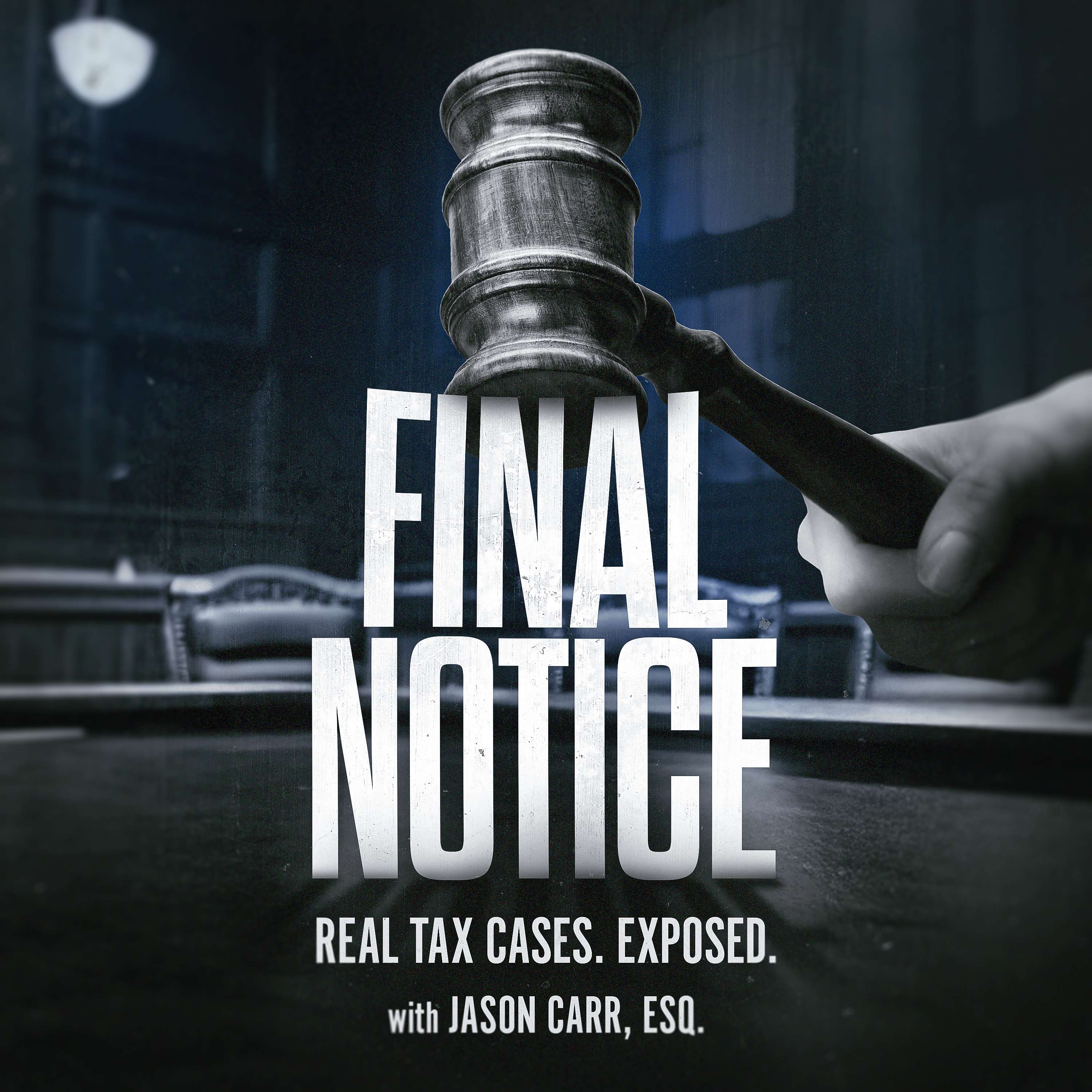
Final Notice
by Jason Carr, Esq.
Final Notice s a weekly podcast where tax attorney Jason Carr breaks down real tax fraud prosecutions and reveals what should have been done to avoid them. New episodes every Friday at carrtaxlaw.com.
-
21
The Check Churning Gambler
Eric Brian Rosenberg, publicly known as “E. Brian Rose,” operated GC Wire, a digital news publication on the Mississippi Gulf Coast, and ran for Congress in 2018. He owed federal income taxes for calendar years 2004 through 2016. When the IRS assigned a revenue officer to collect in April 2016, Rosenberg did not negotiate. Instead, he began draining his bank account by repeatedly purchasing cashier’s checks, holding them, and redepositing them only when he needed cash, a cycle designed to keep his balance near zero so IRS levies would come back empty. In 2021, he escalated by forming a corporation, opening a nominee bank account, and continuing the same check churning through the corporate entity without disclosing it to the IRS.During this entire period, Rosenberg spent more than $1 million gambling at casinos.On August 19, 2026, Rosenberg pleaded guilty to one count of tax evasion under 26 U.S.C. § 7201. Prosecutors recommended a sentence of two years in prison, three years of probation, and $2,317,528.91 in restitution. Sentencing is scheduled for December 16, 2026.Jason explains the critical distinction between evasion of assessment and evasion of payment, how “check churning” works to defeat IRS bank levies, why casino spending is both lifestyle evidence and a disqualifier for civil resolution, and what Rosenberg should have done the moment the revenue officer showed up: engage, disclose, and negotiate.Key TakeawaysTax evasion under Section 7201 covers two types of conduct: evasion of assessment (hiding income) and evasion of payment (hiding assets from collection). Both carry up to five years in prison per count.“Check churning” is a specific technique to defeat IRS bank levies by keeping account balances near zero through repeated cashier’s check purchases.Simply not paying taxes is not criminal. The government must prove the taxpayer took affirmative steps to prevent collection.Opening nominee accounts and failing to disclose them to the IRS are classic affirmative acts of evasion.Spending over $1 million at casinos while owing $2 million to the IRS destroys any viable civil resolution and provides powerful evidence of willfulness.When the IRS assigns a revenue officer, the time to act is immediately: file missing returns, prepare accurate financial disclosures, and negotiate a resolution through counsel.Attorney-client privilege is critical in collection cases. Statements made to the IRS or to non-attorney advisors are not protected.Resources MentionedDOJ guilty plea announcement (Aug. 20, 2026): https://www.justice.gov/opa/pr/mississippi-man-pleads-guilty-evading-2m-taxes26 U.S.C. § 7201 (Attempt to evade or defeat tax)IRS Form 433-A (Collection Information Statement for Wage Earners and Self-Employed Individuals): https://www.irs.gov/forms-pubs/about-form-433-aIRS Form 433-B (Collection Information Statement for Businesses): https://www.irs.gov/forms-pubs/about-form-433-bIRS Form 656 (Offer in Compromise): https://www.irs.gov/forms-pubs/about-form-656The Law Office of Jason Carr, PLLC: https://carrtaxlaw.comDisclaimerThis video is for informational and educational purposes only and does not constitute legal or tax advice. Viewing this video does not create an attorney-client relationship between you and The Law Office of Jason Carr, PLLC. The discussion is based on publicly available information and is not a complete analysis of any person’s legal rights, defenses, tax obligations, or case facts. Any commentary about what a taxpayer, business owner, or advisor “should have done” is general educational discussion only and may not apply to your situation. If you have a specific legal or tax question, consult a qualified attorney or tax professional licensed in your jurisdiction.Comment PolicyPlease do not post confidential, sensitive, or personally identifiable tax information in the comments. We do not provide individualized legal or tax advice in the comments or social media replies.
-
20
The Phantom Schedule C
Ann Quach ran a tax preparation business in Thousand Oaks, California, under the names AQ Financial and A2Z Tax Solutions. From 2011 to 2024, she prepared 1,734 false Form 1040 returns for her clients. Her method was distinctive: she fabricated entire businesses her clients never owned, placed them on Schedule C, and loaded them with fictitious losses to offset the clients’ real W-2 income. She then layered false medical and charitable deductions on top. The result was inflated refunds that kept clients coming back, year after year, while causing multi-million-dollar losses to the U.S. Treasury.On August 6, 2026, U.S. District Judge Sherilyn Peace Garnett sentenced Quach to 27 months in federal prison and ordered her to pay $6,481,731 in restitution. Prosecutors noted this was not “a brief lapse in judgment” but a years-long scheme in which Quach exploited her tax expertise.Jason explains how Section 7206(2) works (the federal statute targeting preparers who aid in filing false returns), why the IRS watches Schedule C more closely than any other individual form, how pattern analysis catches high-volume preparer fraud, and what the 1,734 affected clients should do now: amended returns, preparer misconduct affidavits, and why the signature on every Form 1040 is the taxpayer’s responsibility.Key TakeawaysFabricating businesses on client returns is a federal felony under 26 U.S.C. § 7206(2), punishable by up to three years in prison per count.Section 7206(2) does not require proof that the client knew the return was false. The preparer’s conduct is independently criminal.Schedule C is the most commonly audited form on individual returns because it relies on self-reporting with no third-party verification.When a preparer is convicted, the IRS typically reviews the full client list. Affected clients owe back taxes, penalties, and interest on the fabricated deductions.Clients who did not know about the fabrication can argue reasonable cause to abate fraud penalties, but they still owe the underlying tax.Filing Form 14157 and Form 14157-A (Preparer Fraud or Misconduct Affidavit) tells the IRS you are cooperating and were a victim of preparer misconduct.Never sign a return you have not reviewed. Your signature under penalties of perjury is your responsibility, not your preparer’s.Resources MentionedDOJ sentencing announcement (Aug. 6, 2026): https://www.justice.gov/usao-cdca/pr/ventura-county-tax-preparer-sentenced-more-2-years-federal-prison-filing-more-170026 U.S.C. § 7206 (Fraud and false statements, including subsection (2) on aiding and assisting)26 U.S.C. § 7201 (Attempt to evade or defeat tax)IRS Form 14157 (Complaint: Tax Return Preparer): https://www.irs.gov/forms-pubs/about-form-14157IRS Form 14157-A (Tax Return Preparer Fraud or Misconduct Affidavit): https://www.irs.gov/forms-pubs/about-form-14157-aIRS Form 1040-X (Amended U.S. Individual Income Tax Return): https://www.irs.gov/forms-pubs/about-form-1040xThe Law Office of Jason Carr, PLLC: https://carrtaxlaw.comDisclaimerThis video is for informational and educational purposes only and does not constitute legal or tax advice. Viewing this video does not create an attorney-client relationship between you and The Law Office of Jason Carr, PLLC. The discussion is based on publicly available information and is not a complete analysis of any person’s legal rights, defenses, tax obligations, or case facts. Any commentary about what a taxpayer, business owner, or advisor “should have done” is general educational discussion only and may not apply to your situation. If you have a specific legal or tax question, consult a qualified attorney or tax professional licensed in your jurisdiction.Comment PolicyPlease do not post confidential, sensitive, or personally identifiable tax information in the comments. We do not provide individualized legal or tax advice in the comments or social media replies.
-
19
The Exit Tax
Justin Ryan Schmidt founded Translunar Crypto LP, an Austin-based hedge fund focused on cryptocurrency investments. Between 2019 and 2022, he earned at least seven million dollars from his fund but reported income of five thousand dollars or less on each of his federal tax returns. He held millions in undisclosed foreign bank accounts, never filed an FBAR, and failed to pay the income taxes he owed.In March 2022, Schmidt renounced his U.S. citizenship at the American Embassy in Kingston, Jamaica. When he filed Form 8854, the expatriation statement required by the IRS, he reported his net worth as twenty-five thousand dollars. Court records established that his net worth exceeded two million dollars. He also falsely certified that he had complied with his tax obligations for the preceding five years.After expatriating, Schmidt purchased a home in Snowmass Village, Colorado, for 5.8 million dollars and sold it three months later for approximately nine million dollars. He submitted false documentation to prevent FIRPTA withholding on the sale and did not report the gain.On July 27, 2026, U.S. District Judge Robert Pitman sentenced Schmidt to 37 months in federal prison and ordered him to pay approximately 3.4 million dollars in restitution.Jason explains how the IRS exit tax works under IRC Section 877A, why renouncing citizenship triggers a final tax accounting rather than ending one, and what Schmidt should have done instead: voluntary disclosure, accurate expatriation filings, FBAR compliance, and proper FIRPTA procedures.Key TakeawaysRenouncing U.S. citizenship does not end your tax obligations. It triggers a final accounting under IRC Section 877A, including a potential exit tax on unrealized gains.Form 8854, the expatriation statement, is filed under penalty of perjury. False statements on this form carry criminal consequences.Foreign bank accounts exceeding $10,000 must be disclosed annually on an FBAR. Willful failure to file is a separate federal crime.FIRPTA requires withholding on real property sales by foreign persons. Submitting false documents to avoid withholding is a prosecutable offense.Voluntary disclosure and amended returns, filed through a tax attorney, can eliminate criminal prosecution risk when the facts are addressed early.Expatriation tax planning is a legitimate practice area with legal structures available at every step. The crime is choosing the illegal version of a legal process.Resources MentionedDOJ sentencing announcement: https://www.justice.gov/opa/pr/expatriated-hedge-fund-manager-sentenced-prison-tax-evasionDOJ indictment announcement: https://www.justice.gov/opa/pr/hedge-fund-manager-indicted-tax-fraud-chargesIRS-CI guilty plea announcement: https://www.irs.gov/compliance/criminal-investigation/hedge-fund-manager-pleads-guilty-to-tax-evasion-in-austinIRS Expatriation Tax guidance: https://www.irs.gov/individuals/international-taxpayers/expatriation-taxIRC § 877A (Tax responsibilities of expatriation): https://www.law.cornell.edu/uscode/text/26/877AIRC § 7201 (Tax evasion): https://www.law.cornell.edu/uscode/text/26/7201 31 U.S.C. § 5314 (FBAR filing requirements)Oleg Tinkov case (DOJ, October 2021): https://www.justice.gov/archives/opa/pr/founder-russian-bank-pleads-guilty-tax-fraudThe Law Office of Jason Carr, PLLC: https://carrtaxlaw.comDisclaimerThis video is for informational and educational purposes only and does not constitute legal or tax advice. Viewing this video does not create an attorney-client relationship between you and The Law Office of Jason Carr, PLLC. The discussion is based on publicly available information and is not a complete analysis of any person’s legal rights, defenses, tax obligations, or case facts. Any commentary about what a taxpayer, business owner, or advisor “should have done” is general educational discussion only and may not apply to your situation. If you have a specific legal or tax question, consult a qualified attorney or tax professional licensed in your jurisdiction.Comment PolicyPlease do not post confidential, sensitive, or personally identifiable tax information in the comments. We do not provide individualized legal or tax advice in the comments or social media replies.
-
18
The Ghost Companies
Steven T. Loo had every advantage: eight commercial properties across Washington and California, a stack of LLCs, and a net worth prosecutors pegged at around $43 million. What he didn't have was any intention of paying his taxes. For years, Loo directed his property managers to send building profits into two bank accounts held by shell companies that had been dormant since 1999, spent the money on himself and his family, and never reported it. He didn't even tell his tax preparer the income existed. Viewed across two decades, his returns claimed he owed nothing and sometimes claimed a refund.A federal jury convicted Loo of six counts of tax evasion and six counts of filing false returns. In July 2026 he was sentenced to 20 months in prison, a $250,000 fine, and three years of supervised release, after prosecutors sought 51 months and called his motive simple greed.In this episode, Jason Carr explains the affirmative-act rule that separates a civil audit from a felony under IRC § 7201, why filing a false return under § 7206(1) is its own crime, and how IRS Criminal Investigation used property-management records, bank records, and the preparer's own testimony to close the "honest mistake" door. He also walks through the fork in the road every taxpayer faces when a criminal investigator shows up, and the voluntary-disclosure and compliance path that could have kept this an IRS matter instead of a DOJ case.Key TakeawaysOwing tax is civil. Building a structure to hide income is what makes it criminal. Concealment is the line.Routing income through shell companies or inactive entities is a classic "affirmative act" of evasion under Spies v. United States.Hiding income from your own tax preparer destroys the "my accountant did it" defense and helps prove willfulness.IRS-CI builds these cases on paper: third-party property records, bank flows, and the gap between income earned and income reported.When a criminal investigator knocks, improvising an explanation creates new evidence. Get counsel and protect privilege.If prior years are wrong, voluntary disclosure and amended returns through counsel beat waiting to be caught, especially when you can afford to pay.Resources MentionedDOJ / U.S. Attorney's Office, W.D. Wash., "Seattle real estate investor sentenced to 20 months in prison for $4.7 million tax evasion scheme" (July 17, 2026): https://www.justice.gov/usao-wdwa/pr/seattle-real-estate-investor-sentenced-20-months-prison-47-million-tax-evasion-schemeUnitedStatesv.Loo, No. 2:24-cr-00072 (W.D. Wash.) — indictment returned April 24, 2024.526 U.S.C. § 7201 — Attempt to evade or defeat tax (felony evasion).26 U.S.C. § 7206(1) — Fraud and false statements / filing a false return.Spiesv.UnitedStates, 317 U.S. 492 (1943) — felony evasion requires an affirmative act of concealment, not mere failure to file or pay: https://supreme.justia.com/cases/federal/us/317/492/Cheekv.UnitedStates, 498 U.S. 192 (1991) — willfulness and the limits of a good-faith defense: https://supreme.justia.com/cases/federal/us/498/192/The Law Office of Jason Carr, PLLC: https://carrtaxlaw.comDisclaimer This video is for informational and educational purposes only and does not constitute legal or tax advice. Viewing this video does not create an attorney-client relationship between you and The Law Office of Jason Carr, PLLC. The discussion is based on publicly available information and is not a complete analysis of any person’s legal rights, defenses, tax obligations, or case facts. Any commentary about what a taxpayer, business owner, or advisor “should have done” is general educational discussion only and may not apply to your situation. If you have a specific legal or tax question, consult a qualified attorney or tax professional licensed in your jurisdiction.Comment PolicyPlease do not post confidential, sensitive, or personally identifiable tax information in the comments. We do not provide individualized legal or tax advice in the comments or social media replies.
-
17
No Employees, No Credit
Regina Durkin, of New River, Arizona, pleaded guilty to one count of conspiracy to file false claims after court records indicated that she and others submitted false quarterly employment tax returns to the IRS.The claims sought refunds based on the Employee Retention Credit and the paid sick and family leave credit, pandemic-era credits designed to help qualifying employers. According to court records, the companies were not operating at the time, had no employees, and paid no wages.In total, Durkin and others submitted fourteen fraudulent claims requesting more than $7.7 million in tax refunds. Sentencing is scheduled for September 11, and the offense carries a maximum penalty of ten years in prison.Jason explains the line between an unsupported ERC claim and a criminal false-claims case, why payroll records matter, how IRS-CI follows employment tax filings, and what taxpayers and tax professionals should do before a questionable refund claim becomes an IRS-CI problem.Key TakeawaysPayroll credits require payroll. If there are no employees and no wages, the claim fails at the foundation.A weak ERC claim may create a civil IRS problem. A fabricated payroll story can create criminal exposure. Forms 941 and payroll records are not administrative details. They are evidence.Tax professionals should verify source records before preparing or supporting ERC, paid leave, or other payroll credit claims.If an unsupported claim has already been filed, move quickly to assess withdrawal, amendment, repayment, penalty defense, and privilege-sensitive communications.Resources MentionedDOJ case source: https://www.justice.gov/opa/pr/arizona-woman-pleads-guilty-77-million-tax-refund-fraud-s chemeIRC § 3134, Employee Retention Credit:[https://uscode.house.gov/view.xhtml?req=(title:26%20section:3134%20edition:prelim)](h ttps://uscode.house.gov/view.xhtml?req=(title:26%20section:3134%20edition:prelim)18 U.S.C. § 286, conspiracy to defraud the government with respect to claims: https://uscode.house.gov/view.xhtml?req=(title:18%20section:286%20edition:prelim)%20 OR%20(granuleid:USC-prelim-title18-section286)&f=treesort&edition=prelim&num=0&ju mpTo=truel26 U.S.C. § 7206, fraud and false statements: https://www.law.cornell.edu/uscode/text/26/7206IRS ERC FAQs: https://www.irs.gov/coronavirus/frequently-asked-questions-about-the-employee-retentio n-creditThe Law Office of Jason Carr, PLLC: https://carrtaxlaw.comDisclaimer This video is for informational and educational purposes only and does not constitute legal or tax advice. Viewing this video does not create an attorney-client relationship between you and The Law Office of Jason Carr, PLLC. The discussion is based on publicly available information and is not a complete analysis of any person’s legal rights, defenses, tax obligations, or case facts. Any commentary about what a taxpayer, business owner, or advisor “should have done” is general educational discussion only and may not apply to your situation. If you have a specific legal or tax question, consult a qualified attorney or tax professional licensed in your jurisdiction.Comment PolicyPlease do not post confidential, sensitive, or personally identifiable tax information in the comments. We do not provide individualized legal or tax advice in the comments or social media replies.
-
16
The Queen’s Refund
Queen Naja, also known as Renata Winifred Ince and Naja Talibah Zahir, was sentenced to 165 months in prison for conspiracy to commit mail fraud after court records and trial evidence showed a scheme to use a legal trust, false tax documents, and a fraudulent payment to obtain a refund from the IRS.The IRS issued a Treasury check for $1,010,561.26, and the court later found additional false returns and fraudulent payments tied to refunds issued to Naja’s mother. The court also determined that additional attempted fraudulent payments would have caused another $428,732,324.56 in losses if successful.Jason explains why trusts are legitimate planning tools, why fake payment documents are criminal evidence, how IRS-CI proved the case through records and interviews, and what taxpayers should do before a questionable refund claim becomes a DOJ case.Key TakeawaysA trust is legitimate only when the records, control, income, payments, and tax reporting match reality.A refund claim must be based on a real payment, credit, withholding, or overpayment.The line between civil tax risk and criminal exposure is often the fabricated document.IRS-CI cases are built through records: checks, vouchers, transcripts, returns, bank records, and statements.If IRS-CI is involved, privilege matters before the taxpayer tries to explain the facts.Large refund claims should be reviewed before filing, especially when trusts, payroll tax vouchers, or credits are involved.Resources MentionedDOJ case source: https://www.justice.gov/usao-mdal/pr/pennsylvania-woman-sentenced-nearly-14-years-prison-role-2-million-fraud-schemeIRS-CI conviction source: https://www.irs.gov/compliance/criminal-investigation/pennsylvania-woman-convicted-in-million-dollar-government-fraud-schemeCourt record, recommendation on motion to suppress: https://ecf.almd.uscourts.gov/cgi-bin/show_public_doc?2024cr0437-8418 U.S.C. § 1341, mail fraud18 U.S.C. § 1349, attempt and conspiracy26 U.S.C. § 7206, fraud and false statementsBeckwith v. United States, 425 U.S. 341 (1976): https://www.law.cornell.edu/supremecourt/text/425/341Cheek v. United States, 498 U.S. 192 (1991): https://www.law.cornell.edu/supremecourt/text/498/192The Law Office of Jason Carr, PLLC: https://carrtaxlaw.comDisclaimer This video is for informational and educational purposes only and does not constitute legal or tax advice. Viewing this video does not create an attorney-client relationship between you and The Law Office of Jason Carr, PLLC. The discussion is based on publicly available information and is not a complete analysis of any person’s legal rights, defenses, tax obligations, or case facts. Any commentary about what a taxpayer, business owner, or advisor “should have done” is general educational discussion only and may not apply to your situation. If you have a specific legal or tax question, consult a qualified attorney or tax professional licensed in your jurisdiction.Comment PolicyPlease do not post confidential, sensitive, or personally identifiable tax information in the comments. We do not provide individualized legal or tax advice in the comments or social media replies.
-
15
The Twin Shell Game
Dennis March and Greg March, twin brothers from Berlin, Maryland, each pleaded guilty to tax evasion for concealing income and failing to pay business and individual taxes.According to their guilty pleas, the brothers owned and controlled business entities and ventures including Elite Marketing Group LLC, Elite MG LLC, and Principal Law Group. The government said they concealed income by arranging payments to a shell entity they controlled, treating those payments as business expenses or costs when they were effectively distributions of income to themselves.Jason explains how related-party payments can cross the line from planning to concealment, why business expenses need real substance, how IRS-CI follows entity and bank records, and what business owners should do before missing returns and disguised distributions become criminal tax evidence.KeyTakeawaysA shell entity does not make owner income disappear.Related-party payments need real services, real contracts, reasonable pricing, and clean tax reporting.A business expense must be ordinary and necessary, and the label does not override the economic reality.Large cash withdrawals, missing returns, and real estate purchases can help prosecutors tell the money-trail story.If prior filings are wrong, the cleanup should start before IRS-CI or the DOJ controls the timeline.Privilege matters when the facts involve concealed income, shell entities, missing returns, or potential willfulness. Resources MentionedDOJ case source: https://www.justice.gov/usao-md/pr/maryland-brothers-plead-guilty-tax-evasionIRS Publication 334, business expenses: https://www.irs.gov/publications/p334IRS online payment agreements: https://www.irs.gov/paymentplansThe Law Office of Jason Carr, PLLC: https://carrtaxlaw.comCase Source26 U.S.C. § 7201: Attempt to evade or defeat tax. The statute provides felony penalties for any person who willfully attempts in any manner to evade or defeat tax or payment of tax.IRS Criminal Investigation Manual, IRM 9.1.3: Explains § 7201, including the requirement of an affirmative act and examples of conduct that may show an attempt to evade or defeat tax.Spiesv.UnitedStates, 317 U.S. 492 (1943): The Supreme Court distinguished passive failure to file or pay from felony evasion and identified examples of conduct that may show an attempt to evade or defeat tax.Cheekv.UnitedStates, 498 U.S. 192 (1991): The Supreme Court described willfulness in criminal tax cases as a voluntary, intentional violation of a known legal duty.IRS Publication 334, business expenses: The IRS explains that a deductible business expense must be ordinary and necessary, with “ordinary” meaning common and accepted in the business field and “necessary” meaning helpful and appropriate.Disclaimer This video is for informational and educational purposes only and does not constitute legal or tax advice. Viewing this video does not create an attorney-client relationship between you and The Law Office of Jason Carr, PLLC. The discussion is based on publicly available information and is not a complete analysis of any person’s legal rights, defenses, tax obligations, or case facts. Any commentary about what a taxpayer, business owner, or advisor “should have done” is general educational discussion only and may not apply to your situation. If you have a specific legal or tax question, consult a qualified attorney or tax professional licensed in your jurisdiction.Comment PolicyPlease do not post confidential, sensitive, or personally identifiable tax information in the comments. We do not provide individualized legal or tax advice in the comments or social media replies.
-
14
Slow Jamz, Faster Levies
Carl Mitchell of Crete, Illinois, known professionally as Twista, pleaded guilty on June 24, 2026, to five counts tied to willfully failing to pay income tax for 2019 through 2023. Court records and statements made in court indicate Mitchell earned income from performances, album sales, streaming, and royalties, and that both the IRS and Mitchell’s accountants repeatedly informed him of his tax debts and obligation to pay. Rather than paying the taxes owed, the government said Mitchell entered into third-party royalty advance agreements knowing the IRS could not levy those funds and made large lifestyle purchases, including at least four luxury vehicles.Jason explains the line between civil tax debt and criminal exposure, how IRS-CI proves willful failure to pay, why accountant and IRS warnings matter, and what taxpayers with irregular income should do before the IRS problem becomes a DOJ problem.Key TakeawaysTax debt is often a civil collection problem. Warnings, luxury spending, and collection avoidance can change the case. The IRS can follow creative income streams, including performances, streaming, royalties, licensing, and advances.Accountant warnings can become powerful willfulness evidence.Royalty advances and other financing tools can be legitimate, but the purpose matters when IRS collection is active. Taxpayers with irregular income should set aside tax reserves and make estimated payments.If the facts include possible intent evidence, privilege should be structured before casual explanations are given. Resources MentionedIRS-CI case source: https://www.irs.gov/compliance/criminal-investigation/recording-artist-twista-pleads-guilty-to-tax-crimesThe Law Office of Jason Carr, PLLC: https://carrtaxlaw.comDisclaimer This video is for informational and educational purposes only and does not constitute legal or tax advice. Viewing this video does not create an attorney-client relationship between you and The Law Office of Jason Carr, PLLC. The discussion is based on publicly available information and is not a complete analysis of any person’s legal rights, defenses, tax obligations, or case facts. Any commentary about what a taxpayer, business owner, or advisor “should have done” is general educational discussion only and may not apply to your situation. If you have a specific legal or tax question, consult a qualified attorney or tax professional licensed in your jurisdiction.Comment PolicyPlease do not post confidential, sensitive, or personally identifiable tax information in the comments. We do not provide individualized legal or tax advice in the comments or social media replies.
-
13
Own Nothing, Control Everything
A federal jury convicted Marcia Predmore, Roderick Prescott, Suzanne Thompson, and Weldon Wulstein for their roles in an abusive layered trust tax shelter that DOJ says helped business owners evade federal income tax on up to 98 percent of business profits. The shelter used a business trust, family trust, charitable trust, and private family foundation, and was marketed with the phrase “own nothing, control everything.” Jason explains how abusive trust structures cross the line, why warnings from attorneys, CPAs, financial professionals, and IRS guidance matter in criminal tax cases, and what legitimate business owners should do instead when they need tax planning, asset protection, estate planning, or charitable giving advice. Key Takeaways A trust is not a device for making taxable income disappear. Asset protection and estate planning are legitimate goals, but they need real legal substance and clean tax reporting. Personal expenses do not become deductible because they move through a trust. Charitable deductions require real charitable transfers, substantiation, and loss of personal control. Tax professionals should be cautious when a promoter asks them to prepare returns based on a packaged tax shelter. If the plan depends on a slogan like “own nothing, control everything,” get independent tax counsel before signing or paying. Resources Mentioned DOJ case source: https://www.justice.gov/opa/pr/four-abusive-tax-shelter-promoters-found-guilty-40m-nationwide-tax-evasion-scheme The Law Office of Jason Carr, PLLC: https://carrtaxlaw.com Disclaimer This video is for informational and educational purposes only and does not constitute legal or tax advice. Viewing this video does not create an attorney-client relationship between you and The Law Office of Jason Carr, PLLC. The discussion is based on publicly available information and is not a complete analysis of any person’s legal rights, defenses, tax obligations, or case facts. Any commentary about what a taxpayer, business owner, or advisor “should have done” is general educational discussion only and may not apply to your situation. If you have a specific legal or tax question, consult a qualified attorney or tax professional licensed in your jurisdiction.Comment PolicyPlease do not post confidential, sensitive, or personally identifiable tax information in the comments. We do not provide individualized legal or tax advice in the comments or social media replies.
-
12
Under the Table, Over the Limit
Vinh Q. Ho and Thanh Lan Do owned and managed a nationwide nail salon business operating under Anthony Vince Nail Salons, Prive Nail Spas, and Zen Nail & Spas. Prosecutors said the business paid a significant portion of nail technician compensation in cash, omitted that cash from year-end tax forms, trained salon managers to operate the under-the-table payroll, prepared false Forms 1099, and instructed employees to keep the true payroll hidden. In this episode, Jason explains how cash payroll becomes criminal tax exposure, why false information reporting is dangerous, how worker classification should be analyzed, and what a business owner should do before a payroll tax issue becomes an IRS-CI investigation. Key TakeawaysCash compensation still has to be reported.A Form 1099 does not make a worker an independent contractor if the actual relationship points the other way.False payroll forms can become evidence of concealment.Training managers to hide payroll turns a tax problem into a system problem.Payroll cleanup should start before IRS-CI is involved.Privilege matters when a business owner is trying to understand serious tax exposure.Case Source DOJ: Owners of Nationwide Nail Salon Business Plead Guilty to Tax Crimes IRS-CI: Owners of nationwide nail salon business plead guilty to tax crimes Disclaimer This video is for informational and educational purposes only and does not constitute legal or tax advice. Viewing this video does not create an attorney-client relationship between you and The Law Office of Jason Carr, PLLC. The discussion is based on publicly available information and is not a complete analysis of any person’s legal rights, defenses, tax obligations, or case facts. Any commentary about what a taxpayer, business owner, or advisor “should have done” is general educational discussion only and may not apply to your situation. If you have a specific legal or tax question, consult a qualified attorney or tax professional licensed in your jurisdiction.Comment PolicyPlease do not post confidential, sensitive, or personally identifiable tax information in the comments. We do not provide individualized legal or tax advice in the comments or social media replies.
-
11
Trust Me, It Was Fraud
A trust can be a legitimate estate planning tool. In this case, prosecutors said purported trusts became the vehicle for a multimillion-dollar tax refund fraud scheme.Brandon Hunt, his father David Hunt, his twin brother Baylon Hunt, and his half-brother Corey Burt were convicted at trial for their roles in a scheme to file false tax returns in the names of trusts they controlled. Prosecutors said the defendants sought more than $8.5 million in refunds, received over $1.7 million from the IRS, and used the proceeds to buy luxury goods, furniture, cryptocurrency, a Cadillac Escalade, and a house in Mississippi.Jason explains why trusts do not create refunds by magic, how IRS warning letters can become a major aggravating fact, and what taxpayers should do when a trust, refund claim, or prior filing starts to look indefensible.Key TakeawaysA trust is a legal structure, not a refund generator.A refund claim must be supported by real income, real payments, real deductions, and real documentation.IRS warning letters should be treated as an escalation point, not background noise.Continuing after a warning letter can turn a bad filing position into a much more serious case.Tax professionals should slow down when a client presents a trust strategy that produces an unusually large refund.If prior returns are wrong, the correct path depends on willfulness, timing, and whether the IRS has already identified the issue.Voluntary disclosure may help address willful noncompliance only if the disclosure is truthful, timely, and complete, and made before key IRS enforcement triggers occur.Case SourceDOJ press release: Final Defendant Sentenced to Prison in Multimillion Dollar Tax Refund Fraud SchemeIRS-CI press release: Final defendant sentenced to prison in multimillion dollar tax refund fraud schemeResources MentionedDOJ case source: https://www.justice.gov/opa/pr/final-defendant-sentenced-prison-multimillion-dollar-tax-refund-fraud-schemeIRS-CI case source: https://www.irs.gov/compliance/criminal-investigation/final-defendant-sentenced-to-prison-in-multimillion-dollar-tax-refund-fraud-schemeIRS Form 1041: https://www.irs.gov/forms-pubs/about-form-1041IRS Voluntary Disclosure Practice: https://www.irs.gov/compliance/criminal-investigation/irs-criminal-investigation-voluntary-disclosure-practiceLearn more: https://carrtaxlaw.comDisclaimer This video is for informational and educational purposes only and does not constitute legal or tax advice. Viewing this video does not create an attorney-client relationship between you and The Law Office of Jason Carr, PLLC. The discussion is based on publicly available information and is not a complete analysis of any person’s legal rights, defenses, tax obligations, or case facts. Any commentary about what a taxpayer, business owner, or advisor “should have done” is general educational discussion only and may not apply to your situation. If you have a specific legal or tax question, consult a qualified attorney or tax professional licensed in your jurisdiction.Comment PolicyPlease do not post confidential, sensitive, or personally identifiable tax information in the comments. We do not provide individualized legal or tax advice in the comments or social media replies.
-
10
The $35,000 Lie
John Kungu owned a successful business, Advanced Nursing Care, in Townsend, Delaware. He also owed the IRS nearly $1.2 million, and he decided to lie his way out of it. In this episode of Final Notice, tax attorney Jason Carr breaks down how Kungu ran his scheme on two fronts: filing false personal and corporate returns that disguised hundreds of thousands of dollars in personal spending as business expenses, then submitting multiple false sworn statements to the IRS during collections claiming he couldn't pay. The defining moment: Kungu offered to settle his entire tax debt for $35,000, said he'd need a loan to do it, and was holding more than $5.1 million in hidden accounts the whole time. He was sentenced to 18 months in federal prison, three years of supervised release, a $75,000 fine, and full restitution of $1,186,573.62. Jason explains the legitimate tools Kungu ignored: the Offer in Compromise, installment agreements, currently-not-collectible status, penalty abatement, and real tax planning, and why every one of them starts with honest, fully disclosed financials. This episode is for business owners, taxpayers facing IRS collections, bookkeepers, enrolled agents, CPAs, and tax preparers who want to understand exactly where an unpaid tax bill turns into a criminal case. Key Takeaways The IRS will settle a tax debt for less than you owe, but only through an Offer in Compromise built on fully disclosed, honest financials. Lying on a sworn collection statement is what converts a civil collections problem into a federal criminal case. Running personal spending through your business as "expenses" is not a deduction. It is evidence. Hiding records from your own bookkeeper or tax preparer is the moment to call a tax attorney, not to dig deeper. What you tell a tax attorney is privileged. What you tell your bookkeeper is not. A large unpaid tax bill is a solvable problem. The solution is disclosure plus strategy, never a sworn lie. Resources Mentioned DOJ / IRS-CI case source: https://www.justice.gov/usao-de/pr/delaware-business-owner-sentenced-18-months-federal-prison-multi-year-tax-evasion-scheme The Law Office of Jason Carr, PLLC: https://carrtaxlaw.com Disclaimer This video is for informational and educational purposes only and does not constitute legal or tax advice. Viewing this video does not create an attorney-client relationship between you and The Law Office of Jason Carr, PLLC. The discussion is based on publicly available information and is not a complete analysis of any person’s legal rights, defenses, tax obligations, or case facts. Any commentary about what a taxpayer, business owner, or advisor “should have done” is general educational discussion only and may not apply to your situation. If you have a specific legal or tax question, consult a qualified attorney or tax professional licensed in your jurisdiction.Comment PolicyPlease do not post confidential, sensitive, or personally identifiable tax information in the comments. We do not provide individualized legal or tax advice in the comments or social media replies.
-
9
Credit Where Credit Isn't Due
Congress created the Employee Retention Credit to help struggling businesses keep workers on payroll during the pandemic. Candies Goode-McCoy of Las Vegas treated it like an ATM. From approximately June 2022 through September 2023, Goode-McCoy conspired with others to file more than 1,200 tax returns for her own businesses and for others, claiming the Employee Retention Credit and the paid sick and family leave credit, and seeking refunds totaling more than $98 million. The IRS paid out roughly $33 million before the scheme was stopped. Goode-McCoy personally received over $1.3 million in fraudulent refunds and about $800,000 more from clients, spending the proceeds on luxury cars, vacations, and gambling. She pleaded guilty to one count of conspiracy to defraud the government with respect to claims and was sentenced to 54 months in prison, three years of supervised release, and more than $26 million in restitution to the IRS. Jason explains why refundable credits like the ERC draw intense IRS scrutiny, how high-volume claims create unmistakable data patterns, and what a business should do if it already claimed an ERC it can no longer defend, including the ERC Voluntary Disclosure Program, claim withdrawal, amended returns, audit defense, and penalty relief. This episode is for taxpayers, small business owners, tax preparers, bookkeepers, enrolled agents, CPAs, and anyone trying to understand where an aggressive credit claim crosses the line into criminal tax fraud. Key TakeawaysA refundable credit is the most heavily scrutinized money in the tax code. A refund that sounds too good to be true usually is. The ERC was a legitimate program with specific eligibility rules: a government-ordered shutdown or a significant decline in gross receipts in qualifying periods. High-volume claims with repeated credits create detectable patterns. The IRS shifted most of its exam staff to audit ERC claims. Lifestyle that doesn't match reported income is a classic red flag investigators follow every time. Tax preparers should build practices on eligibility analysis, documentation, and defensible positions, not refund size. If you already claimed a credit you can't support, voluntary correction through the ERC Voluntary Disclosure Program or claim withdrawal is far better than waiting for the IRS to find it. The goal is to keep the matter in the civil tax resolution lane, through amended returns, audit defense, and penalty relief, before it becomes a criminal case. Resources Mentioned DOJ sentencing release: Business Owner Sentenced to Over Four Years in Prison for $100M COVID-19 Tax Credit Scheme DOJ District of Nevada release: Business Owner Sentenced to Over Four Years in Prison for $100M COVID-19 Tax Credit Scheme DOJ guilty plea release: Nevada Woman Pleads Guilty to Fraudulently Seeking Nearly $100M in COVID-19 Employment Tax Credits Related co-conspirator (IRS-CI): Nevada businesswoman pleads guilty to multimillion dollar scheme to fraudulently claim COVID-19 tax credits The Law Office of Jason Carr, PLLC: https://carrtaxlaw.com Disclaimer This video is for informational and educational purposes only and does not constitute legal or tax advice. Viewing this video does not create an attorney-client relationship between you and The Law Office of Jason Carr, PLLC. The discussion is based on publicly available information and is not a complete analysis of any person’s legal rights, defenses, tax obligations, or case facts. Any commentary about what a taxpayer, business owner, or advisor “should have done” is general educational discussion only and may not apply to your situation. If you have a specific legal or tax question, consult a qualified attorney or tax professional licensed in your jurisdiction.Comment PolicyPlease do not post confidential, sensitive, or personally identifiable tax information in the comments. We do not provide individualized legal or tax advice in the comments or social media replies.
-
8
The One-Dollar Doctor
Dr. Pankaj Merchia controlled several sleep medicine companies and, on paper, looked like a Harvard-educated success story. Federal prosecutors said he was running a shell game. From 2017 to 2019, Merchia billed insurers millions for sleep apnea machines former patients hadn't used in years, some of which had already been returned, and used the proceeds to buy a $2.1 million home. He billed an insurer over $390,000 for treating his own brother, and when told he couldn't, set up a new business under a nominee to keep the payments flowing. The tax scheme used the same playbook. From 2009 to 2019, Merchia hid more than $6.5 million in income by claiming his businesses were owned by a co-conspirator, fabricating a 2008 "sale" backed by a $30 million appraisal, and claiming roughly $2 million in deductions a year for fifteen years. When the IRS audited, he produced a backdated promissory note the metadata exposed and claimed he earned just $1 a year, "much like the founders of Google and AOL." After a ten-day trial in which he represented himself, a Boston jury deliberated about four hours and convicted him on all counts. Jason explains where legitimate succession planning, Section 197 amortization, entity structuring, and the IRS Voluntary Disclosure Practice could have solved Merchia's real problems, and why lying during an audit, not the audit itself, is what turns an IRS case into a DOJ case. This episode is for physicians, business owners, CPAs, enrolled agents, and tax professionals who want to understand exactly where aggressive planning crosses into criminal tax fraud. Key TakeawaysYou cannot just put a "stand-in" or nominee owner on a business to avoid taxes while keeping total control. The IRS focuses on who actually signs the checks, runs the show, and spends the money (like paying personal credit cards and student loans directly from business accounts).A messy or aggressive audit is usually a civil issue settled with back taxes, penalties, and interest. What turns an audit into a federal criminal indictment is lying, inventing stories (like the "Google founder" defense), and feeding fabricated documents to investigators.Modern tax fraud is easily exposed by digital fingerprints. Backdating a promissory note or a sales agreement to make a transaction look old will fail because file metadata reveals exactly when the document was actually created.If you are exposed during an audit, the goal is containment, not doubling down on the lie. Utilizing the IRS Voluntary Disclosure Practice or filing amended returns can keep a case civil. Fabricating new documents completely destroys that option.Strategies like asset protection, income shifting, and Section 197 amortization deductions are perfectly legal. However, they require real ownership transfers, actual transactions, and verifiable records—not manufactured forms with zero substance.Self-representation in a federal fraud trial rarely ends well. Taxpayers facing serious audits need to bring in defense counsel early to protect themselves with attorney-client privilege and let an objective expert make the cold strategic calls.Resources MentionedIRS-CI press release: Former Brookline doctor convicted of health care fraud and tax fraud DOJ press release: Doctor Convicted at Trial for Defrauding IRS and Health Care Insurers DOJ (District of Massachusetts): Former Brookline Doctor Convicted of Health Care Fraud and Tax Fraud The Law Office of Jason Carr, PLLC: https://carrtaxlaw.com Disclaimer This video is for informational and educational purposes only and does not constitute legal or tax advice. Viewing this video does not create an attorney-client relationship between you and The Law Office of Jason Carr, PLLC. The discussion is based on publicly available information and is not a complete analysis of any person’s legal rights, defenses, tax obligations, or case facts. Any commentary about what a taxpayer, business owner, or advisor “should have done” is general educational discussion only and may not apply to your situation. If you have a specific legal or tax question, consult a qualified attorney or tax professional licensed in your jurisdiction.Comment PolicyPlease do not post confidential, sensitive, or personally identifiable tax information in the comments. We do not provide individualized legal or tax advice in the comments or social media replies.
-
7
Trust Fund, Broken Trust
Harry Lamar Curtis III owned Information Advisory Group LLC, a cybersecurity and IT company based in Houston. He was also a former certified public accountant. According to the Department of Justice, Curtis was required to withhold and pay over employment taxes from employee paychecks, including federal income taxes, FICA taxes, and employer matching amounts. As part of his plea, Curtis admitted that he failed to file business tax returns for Information Advisory Group since 2016 and improperly withheld $1,647,142 that was due to the IRS. He also admitted he had not filed individual tax returns for himself since 2008. In this episode of Final Notice, Jason explains why payroll tax cases are different, why withheld taxes are not business operating cash, and what business owners should do if payroll tax problems begin to stack up. The episode covers payroll tax compliance, unfiled business returns, unfiled personal returns, trust fund exposure, IRS-CI referral risk, civil tax resolution options, and why attorney-client privilege matters when payroll tax facts become serious. Key Takeaways Payroll taxes are not business cash. When a business withholds taxes from employee wages, that money must be paid over to the government. File the returns even if the business cannot pay in full. Unfiled returns make collection and resolution harder. Payroll tax debt needs immediate triage. The business must become current on new deposits before old debt can be addressed effectively. Trust fund payroll taxes can create personal exposure for responsible persons, including owners and decision-makers. A civil resolution plan may include compliance cleanup, installment agreements, penalty abatement, payroll controls, restructuring, or winding down the business. Privilege matters when payroll tax issues involve years of non-filing, withheld taxes, missing deposits, or potential false statements. Resources Mentioned DOJ case source: https://www.justice.gov/usao-sdtx/pr/houston-business-owner-sent-prison-failing-pay-over-16-million-taxes IRS-CI plea source: https://www.irs.gov/compliance/criminal-investigation/houston-business-owner-admits-to-failing-to-pay-over-1-point-6-million-in-taxes The Law Office of Jason Carr, PLLC: https://carrtaxlaw.com Disclaimer This video is for informational and educational purposes only and does not constitute legal or tax advice. Viewing this video does not create an attorney-client relationship between you and The Law Office of Jason Carr, PLLC. The discussion is based on publicly available information and is not a complete analysis of any person’s legal rights, defenses, tax obligations, or case facts. Any commentary about what a taxpayer, business owner, or advisor “should have done” is general educational discussion only and may not apply to your situation. If you have a specific legal or tax question, consult a qualified attorney or tax professional licensed in your jurisdiction.Comment PolicyPlease do not post confidential, sensitive, or personally identifiable tax information in the comments. We do not provide individualized legal or tax advice in the comments or social media replies.
-
6
Beyond a Reasonable Blockchain
David Gebhardt was a Tennessee-licensed attorney from Brentwood. According to DOJ, he bought cryptocurrency, used decentralized exchanges and nominees to conceal income, and failed to report millions of dollars in income from cryptocurrency sales and his consulting business. From March 2018 through December 2022, DOJ says Gebhardt withdrew approximately $6.6 million from cryptocurrency sales. Despite being warned by his accountants to report all cryptocurrency income, he failed to do so, and on his 2020 through 2022 returns he indicated that he did not engage in virtual currency transactions when he had. Jason explains why the digital asset question on Form 1040 matters, how crypto records can become evidence, and why “I didn’t receive a tax form” is not a defense to failing to report income. The episode also covers the better path: transaction reconstruction, Form 8949, Schedule D, amended returns, payment planning, penalty strategy, and keeping serious tax problems in the civil IRS lane whenever possible. This episode is for taxpayers, business owners, crypto investors, attorneys, accountants, enrolled agents, CPAs, and anyone who has digital asset activity that has not been properly reported. Key Takeaways The IRS digital asset question must be answered accurately. Taxpayers must answer “Yes” or “No” to whether they received, sold, exchanged, or otherwise disposed of a digital asset during the year. Digital asset income must be reported on the federal tax return. Sales, exchanges, and other dispositions of digital assets held as capital assets generally belong on Form 8949, with totals summarized on Schedule D. Ordinary income from digital assets, including forks, staking, and mining, generally belongs on Schedule 1. Taxpayers must report digital asset income, gains, or losses whether they receive Form 1099-DA or not. When accountants warn a taxpayer to report income, that warning can become a major fact if the taxpayer later files false returns. A prior filing problem is usually easier to fix before IRS-CI is involved. Resources Mentioned DOJ case source: https://www.justice.gov/usao-mdtn/pr/brentwood-attorney-pleads-guilty-tax-fraud IRS digital assets page: https://www.irs.gov/filing/digital-assets IRS digital asset reporting reminder: https://www.irs.gov/newsroom/reminders-for-taxpayers-about-digital-assets The Law Office of Jason Carr, PLLC: https://carrtaxlaw.com Disclaimer This video is for informational and educational purposes only and does not constitute legal or tax advice. Viewing this video does not create an attorney-client relationship between you and The Law Office of Jason Carr, PLLC. The discussion is based on publicly available information and is not a complete analysis of any person’s legal rights, defenses, tax obligations, or case facts. Any commentary about what a taxpayer, business owner, or advisor “should have done” is general educational discussion only and may not apply to your situation. If you have a specific legal or tax question, consult a qualified attorney or tax professional licensed in your jurisdiction.Comment PolicyPlease do not post confidential, sensitive, or personally identifiable tax information in the comments. We do not provide individualized legal or tax advice in the comments or social media replies.
-
5
Schedule C for Make-Believe
Kerwin Aldric Jordan was a California tax preparer who operated The Jordan Corporation and Jordan and Jordan A Financial Conquest. Prosecutors said he held himself out as a tax attorney and certified public accountant, even though he was neither. In this episode of Final Notice, Jason Carr breaks down how Jordan used non-existent businesses and fake business losses to reduce clients’ taxable income. The episode also covers the COVID relief loan side of the case, where prosecutors said Jordan received PPP and EIDL funds after falsely reporting that companies had employees when they had none. Jason explains why fake Schedule C losses create obvious audit and criminal exposure, how high-volume preparer patterns can create a data trail, and what taxpayers should do if they discover a preparer filed returns claiming businesses, losses, credits, or expenses that were not real. This episode is for taxpayers, small business owners, tax preparers, enrolled agents, CPAs, bookkeepers, and anyone who wants to understand where aggressive tax preparation crosses into criminal tax fraud. Key TakeawaysA real business loss needs a real business.A Schedule C is not a place to park fictional expenses. Large preparer fees tied to large refunds should raise questions. Taxpayers should understand the return before signing it. Preparers should document intake, verify business activity, and refuse unsupported deductions. Fake credentials are a serious warning sign. If someone claims to be a tax attorney or CPA, verify it. If prior returns include false businesses, false deductions, or fake credits, review the exposure before contacting the IRS. When facts involve false returns, COVID relief applications, or fake records, privilege matters. Resources Mentioned DOJ case source: https://www.justice.gov/opa/pr/california-tax-preparer-pleads-guilty-filing-false-returns-and-fraudulently-obtaining-covid The Law Office of Jason Carr, PLLC: https://carrtaxlaw.com Disclaimer This video is for informational and educational purposes only and does not constitute legal or tax advice. Viewing this video does not create an attorney-client relationship between you and The Law Office of Jason Carr, PLLC. The discussion is based on publicly available information and is not a complete analysis of any person’s legal rights, defenses, tax obligations, or case facts. Any commentary about what a taxpayer, business owner, or advisor “should have done” is general educational discussion only and may not apply to your situation. If you have a specific legal or tax question, consult a qualified attorney or tax professional licensed in your jurisdiction.Comment PolicyPlease do not post confidential, sensitive, or personally identifiable tax information in the comments. We do not provide individualized legal or tax advice in the comments or social media replies.
-
4
Shell Game in Steel-Toe Boots
Rene Mauricio Escobar and Juana Nelida Escobar operated Escobar Plastering in Orlando, Florida. Federal prosecutors said they used the company to help construction subcontractors pay workers off the books, avoid payroll taxes, and avoid workers’ compensation insurance premiums. According to the DOJ, the defendants caused certificates of insurance in Escobar Plastering’s name to be sent to construction contractors, representing that subcontractors’ workers were employed by and covered under Escobar Plastering. Prosecutors said the insurance policies were actually based on applications showing only a handful of employees and minimal payroll. The government said thousands of payroll checks totaling approximately $148,760,824 were deposited into Escobar Plastering bank accounts. The defendants then withdrew cash to pay workers after keeping a 7% to 8% fee, while no one withheld or paid over payroll taxes to the IRS. Rene Escobar was sentenced to four years and nine months in federal prison. Juana Escobar was sentenced to two years. The court ordered them to pay $37,174,388 in restitution to the IRS for unpaid payroll taxes. Jason explains how construction payroll fraud unravels, why cash payroll leaves a paper trail, and what business owners should do instead: classify workers correctly, use real payroll systems, file Forms 941, make employment tax deposits, reconcile wage reporting, and get privilege-protected advice early when the facts show possible willfulness. This episode is for business owners, contractors, subcontractors, payroll companies, bookkeepers, tax preparers, CPAs, enrolled agents, and anyone who wants to understand how payroll tax problems become IRS-CI cases. Key Takeaways Payroll is evidence. Checks, deposits, cash withdrawals, Forms 941, W-2s, insurance certificates, and bank records all tell a story. Off-the-books payroll can create tax, insurance, immigration, labor, and fraud exposure. Employers generally must withhold federal income tax, Social Security tax, and Medicare tax from employee wages and pay the employer share of Social Security and Medicare taxes. Employers use Form 941 to report federal income tax withheld from employees’ paychecks and both the employer and employee shares of Social Security and Medicare taxes. Using a payroll provider can help administratively, but IRS instructions warn that employers generally remain responsible for tax filings, deposits, and payments even when a third party performs payroll functions. If a payroll problem involves false documents, cash payments, sham subcontractor structures, or multi-year noncompliance, attorney-client privilege matters. The goal is to keep payroll tax problems in the civil IRS lane whenever possible through clean filings, corrected returns, current deposits, installment agreements, penalty analysis, and documented compliance cleanup. Resources MentionedDOJ case source: https://www.justice.gov/usao-mdfl/pr/two-orlando-residents-sentenced-148-million-construction-payroll-scheme-defrauded-irs IRS Form 941 information: https://www.irs.gov/forms-pubs/about-form-941 IRS employment tax deposit rules: https://www.irs.gov/taxtopics/tc757 IRS Criminal Investigation Voluntary Disclosure Practice: https://www.irs.gov/compliance/criminal-investigation/irs-criminal-investigation-voluntary-disclosure-practice The Law Office of Jason Carr, PLLC: https://carrtaxlaw.com Disclaimer This video is for informational and educational purposes only and does not constitute legal or tax advice. Viewing this video does not create an attorney-client relationship between you and The Law Office of Jason Carr, PLLC. The discussion is based on publicly available information and is not a complete analysis of any person’s legal rights, defenses, tax obligations, or case facts. Any commentary about what a taxpayer, business owner, or advisor “should have done” is general educational discussion only and may not apply to your situation. If you have a specific legal or tax question, consult a qualified attorney or tax professional licensed in your jurisdiction.Comment PolicyPlease do not post confidential, sensitive, or personally identifiable tax information in the comments. We do not provide individualized legal or tax advice in the comments or social media replies.
-
3
The Golf Course Gambit
Michael Kirouac owned or controlled four companies: HK Manchester, HK Loudon, HK Hudson, and HK Pelham. Prosecutors said he applied for and obtained more than $1 million in Economic Injury Disaster Loans, certifying that the money would be used solely as working capital and not for personal expenses or business relocation. But when Kirouac wanted to purchase Angus Lea Golf Course and could not obtain financing from banks or private lenders, prosecutors said he used approximately $600,000 of EIDL funds intended for HK Manchester and HK Loudon to help buy the course. He also obtained a $260,500 EIDL for HK Hudson after he had already agreed to sell that business, without disclosing the sale agreement to the SBA. Kirouac pleaded guilty to wire fraud on October 3, 2025, and was sentenced on February 19, 2026, to 15 months in prison and one year of supervised release. Jason explains why restricted government relief funds are not flexible deal money, how EIDL misuse can become a criminal case, and what business owners should do before moving loan proceeds into acquisitions, personal expenses, related entities, or new ventures. Key TakeawaysRestricted funds must be used for restricted purposes. Loan certifications are evidence, not administrative clutter. A failed financing search does not justify using government relief money as acquisition capital. If a business owner has already misused restricted funds, the first move is to stop, preserve records, and get privileged legal review before creating more documents. The goal is to fix the issue while it can still be handled as a civil tax, loan, or administrative problem whenever possible. Resources MentionedDOJ sentencing release: https://www.justice.gov/usao-nh/pr/pembroke-man-sentenced-misusing-cares-act-funds-purchase-angus-lea-golf-course IRS-CI sentencing release: https://www.irs.gov/compliance/criminal-investigation/pembroke-man-sentenced-for-misusing-cares-act-funds-to-purchase-the-angus-lea-golf-course The Law Office of Jason Carr, PLLC: https://carrtaxlaw.com Disclaimer This video is for informational and educational purposes only and does not constitute legal or tax advice. Viewing this video does not create an attorney-client relationship between you and The Law Office of Jason Carr, PLLC. The discussion is based on publicly available information and is not a complete analysis of any person’s legal rights, defenses, tax obligations, or case facts. Any commentary about what a taxpayer, business owner, or advisor “should have done” is general educational discussion only and may not apply to your situation. If you have a specific legal or tax question, consult a qualified attorney or tax professional licensed in your jurisdiction.Comment PolicyPlease do not post confidential, sensitive, or personally identifiable tax information in the comments. We do not provide individualized legal or tax advice in the comments or social media replies.
-
2
The SCOTUSblog Gamble
Thomas C. Goldstein was one of the best-known appellate lawyers in the country. He argued more than 40 cases before the United States Supreme Court and co-founded SCOTUSblog, a widely read source for Supreme Court coverage. He was also, according to federal prosecutors, a high-stakes poker player who frequently played in games involving tens of millions of dollars. In this episode of Final Notice, Jason Carr, tax attorney, breaks down how Goldstein’s gambling activity, personal debts, law firm finances, and mortgage applications became a federal criminal tax case. Prosecutors said Goldstein concealed millions of dollars in poker wins and losses, diverted legal fees payable to his law firm into his personal bank account to satisfy poker-related debts, directed people to pay his creditors instead of paying him directly, and used law firm assets to satisfy poker debts that were falsely classified as “legal-fee” expenses on the firm’s books. The case also included mortgage fraud allegations. In 2021, Goldstein sought financing to purchase a $2.6 million home in Washington, D.C., and submitted mortgage applications that required him to list his liabilities and debts. Prosecutors said he omitted millions in liabilities, including more than $14 million owed on two promissory notes and taxes owed to the IRS, and that his false statements enabled him to obtain a $1.98 million loan. Jason explains how personal financial chaos becomes criminal tax exposure when business books are used to disguise personal expenses, when income gets routed around normal reporting channels, and when debts are hidden from lenders. He also explains what Goldstein should have done instead: separate personal and business finances, properly report gambling income, classify owner payments correctly, amend inaccurate returns, address unpaid taxes through civil IRS resolution tools, and involve a tax attorney early when the facts raise possible criminal exposure. This episode is for business owners, law firm owners, high-income professionals, tax preparers, CPAs, enrolled agents, bookkeepers, gamblers with significant winnings or losses, and anyone who wants to understand how an IRS balance-due problem can become an IRS-CI and DOJ problem. Key TakeawaysGambling income is taxable. Large swings, informal accounting, private games, and personal debts do not eliminate the reporting obligation. Business accounts should not be used as personal clearing accounts. If a business pays a personal expense, the payment needs to be classified correctly. Calling a personal expense a business expense does not make it deductible. Prosecutors said Goldstein used law firm assets to pay poker debts and caused those payments to be falsely classified as legal-fee expenses. Third-party creditor payments can still create tax issues. A taxpayer generally cannot avoid tax consequences just because money is routed to a creditor instead of paid directly to the taxpayer. Mortgage applications create a separate paper trail. Prosecutors said Goldstein omitted millions in liabilities, including more than $14 million owed on two promissory notes and taxes owed to the IRS. When tax problems overlap with false books, false deductions, diverted income, and lender statements, privilege matters. A tax attorney can help evaluate exposure before the taxpayer, preparer, or accountant creates avoidable risk. The goal is to keep a tax problem in the civil IRS lane whenever possible, using amended returns, collection alternatives, penalty relief, audit defense, and clean documentation. For tax professionals, the warning sign is pressure. If a client asks you to classify personal debts as business expenses, route income around the business, or report only part of the picture, stop and document the issue. Resources MentionedDOJ case source: https://www.justice.gov/opa/pr/prominent-lawyer-convicted-trial-tax-evasion-and-mortgage-fraud IRS-CI case source: https://www.irs.gov/compliance/criminal-investigation/prominent-lawyer-thomas-goldstein-convicted-of-tax-evasion-and-mortgage-fraud The Law Office of Jason Carr, PLLC: https://carrtaxlaw.com Disclaimer This video is for informational and educational purposes only and does not constitute legal or tax advice. Viewing this video does not create an attorney-client relationship between you and The Law Office of Jason Carr, PLLC. The discussion is based on publicly available information and is not a complete analysis of any person’s legal rights, defenses, tax obligations, or case facts. Any commentary about what a taxpayer, business owner, or advisor “should have done” is general educational discussion only and may not apply to your situation. If you have a specific legal or tax question, consult a qualified attorney or tax professional licensed in your jurisdiction.Comment PolicyPlease do not post confidential, sensitive, or personally identifiable tax information in the comments. We do not provide individualized legal or tax advice in the comments or social media replies.
-
1
The Magician of the Bronx
Rafael Alvarez built a high-volume tax preparation business in the Bronx. Prosecutors say he also built one of the largest tax fraud schemes ever committed by a return preparer. In this episode of Final Notice, Jason Carr, tax attorney, breaks down how Alvarez and ATAX New York allegedly prepared tens of thousands of false federal income tax returns using bogus itemized deductions, made-up capital losses, phony business expenses, and fraudulent tax credits. Alvarez became known to customers as “the Magician” because of his supposed ability to make tax burdens disappear. But federal prosecutors said the “magic” caused $145 million in tax loss to the IRS and generated approximately $12 million in fraudulent proceeds for ATAX. Jason explains how a preparer fraud case like this unravels, why inflated refunds create audit and criminal exposure, and what taxpayers should do if they discover that a preparer filed inaccurate or fraudulent returns on their behalf. This episode is for taxpayers, small business owners, tax preparers, bookkeepers, enrolled agents, CPAs, and anyone who wants to understand where aggressive tax preparation crossesthe line into criminal tax fraud.Key TakeawaysA large refund is not proof that a preparer did good work. It may be a red flag if the refund depends on deductions, credits, expenses, or losses the taxpayer cannot support.Taxpayers are responsible for the return they sign, even when a paid preparer completed it.Tax preparers should build their practices around documentation, review procedures, accurate intake, and defensible positions, not refund size.High-volume tax preparation businesses create detectable patterns when the same unsupported items appear across large numbers of returns.If a taxpayer discovers that prior returns were inaccurate, voluntary correction is usually better than waiting for the IRS to find the issue.If the facts are serious, privilege matters. A tax attorney can help evaluate the issue before the taxpayer creates unnecessary risk through careless communications.The goal is to keep the matter in the IRS civil tax resolution lane whenever possible, through amended returns, audit defense, penalty relief, and compliance cleanup.Resources MentionedIRS-CI case source: https://www.irs.gov/compliance/criminal-investigation/bronx-tax-preparer-sentenced-to-prison-for-filing-tens-of-thousands-of-false-tax-returns-causing-145-million-in-fraudulent-tax-lossDOJ sentencing release: https://www.justice.gov/usao-sdny/pr/bronx-tax-preparer-sentenced-prison-filing-tens-thousands-false-tax-returns-causingDOJ guilty plea release: https://www.justice.gov/usao-sdny/pr/bronx-tax-preparer-pleads-guilty-filing-tens-thousands-false-tax-returns-causing-145The Law Office of Jason Carr, PLLC: https://carrtaxlaw.comDisclaimer This video is for informational and educational purposes only and does not constitute legal or tax advice. Viewing this video does not create an attorney-client relationship between you and The Law Office of Jason Carr, PLLC. The discussion is based on publicly available information and is not a complete analysis of any person’s legal rights, defenses, tax obligations, or case facts. Any commentary about what a taxpayer, business owner, or advisor “should have done” is general educational discussion only and may not apply to your situation. If you have a specific legal or tax question, consult a qualified attorney or tax professional licensed in your jurisdiction. Comment PolicyPlease do not post confidential, sensitive, or personally identifiable tax information in the comments. We do not provide individualized legal or tax advice in the comments or social media replies.
We're indexing this podcast's transcripts for the first time — this can take a minute or two. We'll show results as soon as they're ready.
No matches for "" in this podcast's transcripts.
No topics indexed yet for this podcast.
Loading reviews...
ABOUT THIS SHOW
Final Notice s a weekly podcast where tax attorney Jason Carr breaks down real tax fraud prosecutions and reveals what should have been done to avoid them. New episodes every Friday at carrtaxlaw.com.
HOSTED BY
Jason Carr, Esq.
CATEGORIES
Loading similar podcasts...
Frequently Asked Questions
How many episodes does Final Notice have?
Final Notice currently has 21 episodes available on PodParley. New episodes are automatically indexed when they're published to the podcast feed.
What is Final Notice about?
Final Notice s a weekly podcast where tax attorney Jason Carr breaks down real tax fraud prosecutions and reveals what should have been done to avoid them. New episodes every Friday at carrtaxlaw.com.
How often does Final Notice release new episodes?
Final Notice has 21 episodes. Check the episode list to see recent publication dates and frequency.
Where can I listen to Final Notice?
You can listen to Final Notice on PodParley by clicking any episode. We provide an embedded audio player for direct listening, and you can also subscribe via your preferred podcast app using the RSS feed.
Who hosts Final Notice?
Final Notice is created and hosted by Jason Carr, Esq..
URL copied to clipboard!