
PODCAST · health
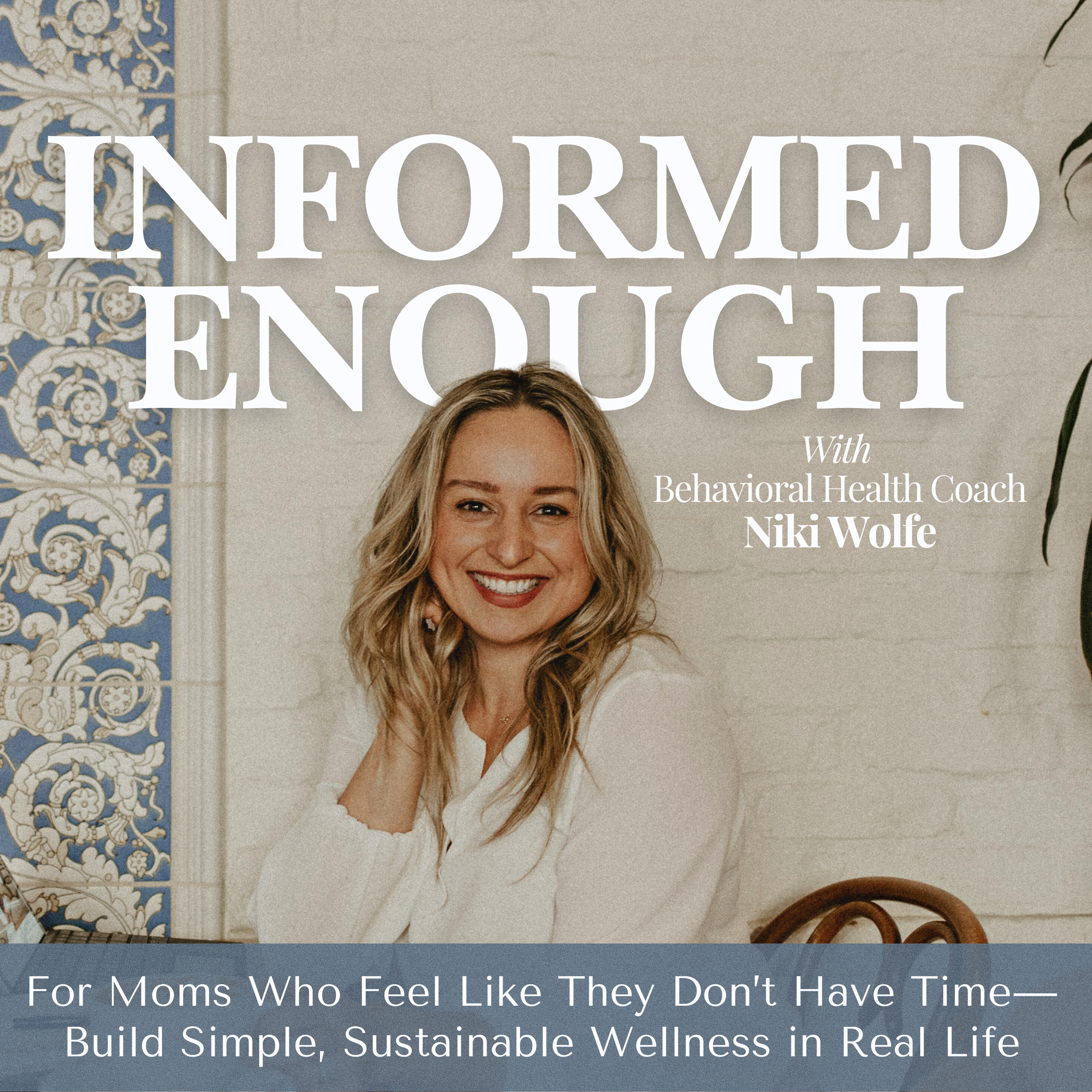
Informed Enough: Health, Motherhood & Real-Life Wellness
by Niki Wolfe | Behavioral Health Coach
Modern life is full of noise—especially when it comes to health, motherhood, and everyday decisions. You know what to do, but following through feels impossible when you don’t have time, your schedule is unpredictable, and life keeps shifting.Informed Enough is a podcast for women who want simple, sustainable wellness that actually works in real life. Hosted by Behavioral Health Coach Niki Wolfe, this show helps you stop starting over and start building consistent, healthy habits through practical systems, flexible rhythms, and real-life strategies.We cover topics like holistic wellness, n
-
23
36 | You’re Not Eating Meals… You’re Just Snacking All Day (Why You’re Always Hungry & Low Energy)
If you stopped and actually thought about what you ate today… would it feel like real meals?Or was it more like:A bite hereFinishing your kid’s foodA protein bar in betweenCoffee carrying you throughAnd somehow… you’re still hungry. Still low energy. Still not satisfied.I see this all the time with moms.You’re not sitting down and eating meals—you’re just snacking all day long without realizing it. And that’s exactly why:you’re always a little bit hungryyour energy keeps dippingyour mood feels off by the end of the dayand dinner feels chaoticNot because you don’t know what to eat.But because you don’t have any structure around it.In this episode, I break down:Why snacking all day is keeping you stuck (even when you’re trying to eat healthy)What’s actually missing (hint: it’s not discipline or willpower)And the simple method I use to build meals that actually satisfy youI’ll walk you through the PLATE method—a no-overthinking way to build meals with protein, carbs, fats, and vegetables so you can stop piecing food together all day and finally feel full, energized, and done thinking about food.Because you don’t need to eat less.You need to eat in a way that actually satisfies you.When your meals are solid and complete:you stop thinking about food all dayyour energy stabilizesyour mood improvesand everything else gets easier—If this is exactly where you’re at, I offer a 60-minute Reset Session where we fix this for your real life this week.No meal plans. No overhaul. Just a simple system you’ll actually follow.Book here: nikiwolfe.com/reset
-
22
35 | Overwhelmed by Vaccine Decisions? Start Here (Before You Spiral)
If you’re feeling overwhelmed by vaccine decisions, conflicting information, and pressure from doctors or family… this episode is your starting point.We’re breaking down how to research vaccines without spiraling, how to think through vaccine decisions as a mom, and how to move from confusion → clarity → confidence without needing hours of research.Because the truth is—you don’t need more information.You need a better way to process it and decide what’s right for your family.Why vaccine decisions feel so overwhelming for moms todayHow to avoid analysis paralysis when researching vaccinesWhere to actually start (without going down a rabbit hole)How to use critical thinking in health decisionsThe difference between being informed vs. overloadedWhat to do when a pediatrician is pushing vaccinesA simple framework to help you pause and think clearly (instead of reacting)How to build confidence in your decisions—even if you don’t have all the answersYou’re a mom trying to make informed vaccine decisionsYou feel confused by conflicting vaccine informationYou don’t want to blindly follow recommendations—but don’t know where to startYou feel pressure from doctors, family, or social mediaYou want to feel confident, calm, and clear in your health decisions
-
21
34 | Stop Skipping Workouts: What to Do When You Only Have 5 Minutes
If you feel like you never have time to work out, you’re not alone.Most women think they need a full workout, a structured plan, or a full hour in the gym to make it “count.” But when your days are packed, your kids need you, and your schedule is unpredictable… that kind of routine just doesn’t work.So you end up doing nothing.In this episode, we simplify everything and show you what to do when you only have 5–10 minutes — so you can finally stay consistent with movement, even on your busiest days.We talk about:why you don’t need a full workout to see progressthe real reason you keep skipping workoutshow to stay consistent with exercise when you have no timehow to use small pockets of time throughout your daythe 5 basic movement patterns your body actually needshow to build a quick workout at home with no equipmenthow to stop overthinking workouts and just startYou’ll learn a simple approach using:squatspush movements (like pushups)pull movements (like rows)hinge movementscarrying weightAnd how to fit them into your real life:while your coffee is brewingwhile your kids are playingbetween tasks during your daywithout needing workout clothes or a perfect routineThis episode is perfect if you’ve been searching:quick workout for busy moms5 minute workout at homehow to work out with no timesimple workout routine for beginnershow to stay consistent with workoutsno equipment workout ideasBecause the goal isn’t to do everything perfectly.It’s to prove to yourself that you can still show up — even in the smallest moments.If you’re thinking, “I still don’t know where this fits into my day,” let’s figure it out together.Book a free discovery call:www.nikiwolfe.com/discoveryWe’ll look at your real schedule and build something that actually works for your life.Call to Action
-
20
33 | Labor Isn’t Progressing? What It Actually Means (Before You Agree to Interventions)
If you’ve ever heard a provider say, “labor isn’t progressing” or “things are stalling,” you know how quickly that moment can create fear.Suddenly it feels like something is wrong… and like you need to make a fast decision.But what if those slower moments in labor aren’t always a problem?In this episode, we break down what can actually be happening when labor slows down — so you can walk into birth feeling more informed, more confident, and less reactive in those high-pressure moments.We talk about:what it means when labor is not progressingwhy labor can naturally slow down or pausehow a baby moves through the pelvis during birthwhy positioning and rotation can temporarily slow laborhow hormones like oxytocin impact labor progressionhow stress, fear, and environment can slow contractionswhy hospital timelines don’t always match your body’s timelinehow movement (walking, squatting, hands and knees) can help labor progressYou’ll also learn why:a “stall” doesn’t always mean something is wrongyour baby may simply be adjusting positionyour body and baby are working together — not failingThis episode is especially helpful if you’ve been searching:labor not progressing what does it meanwhy did my labor slow downstalled labor causeshow baby moves through pelvis during birthdo I need Pitocin if labor slowshow to avoid unnecessary interventions during birthBecause in the moment, when someone says “labor is stalling,” it can feel urgent.But understanding what’s actually happening can completely change how you respond.If you want to feel prepared for these moments before you’re in labor, check out:Home Birth in a Hospital Prep Planner→ www.nikiwolfe.com/plannerThis guide walks you through:how labor actually workscommon hospital conversationshow to build your birth planhow to prepare your birth teamSo you’re not hearing everything for the first time during contractions.Resource Mentioned
-
19
32 | "It’s Not a Good Time" — It’s the Story You Keep Telling Yourself About Your Health
If you’ve ever caught yourself thinking, “That works for her, but my life is different,” this episode is for you.A lot of women tell themselves their health goals can’t happen right now because life is too chaotic. Maybe it’s kids, a demanding job, travel, moving, lack of sleep, money, schedule changes, or just feeling like this season is too full.But that thought pattern is exactly what keeps women stuck.In this episode, we talk about:why saying “it’s not the right season” keeps you from making progresshow busy moms and busy women can still make health work in real lifewhy the problem usually isn’t lack of time — it’s how you think about your circumstanceshow to stop waiting for life to calm down before startingwhat to do when your schedule is unpredictable or chaotichow to rebuild trust with yourself by showing up in small waysWe also walk through real-life examples of how to make movement and healthy habits work even when:you have very little marginyou travel for workyour kids are youngyour schedule changes all the timeyou feel exhaustedIf you’ve been thinking:“I don’t have time to focus on my health”“my life is too chaotic right now”“it would work if my situation were different”“I just need to wait until things calm down”this episode will help you see what’s actually keeping you stuck — and what to do instead.Because the goal is not to have a perfect routine.The goal is to stop using your circumstances as the reason you never start.If you’re ready to stop overthinking and build a simple, personalized health plan that fits your real life, book a free discovery call here:www.nikiwolfe.com/discovery
-
18
31 | Why Labor Slows Down: What You Need to Know Before Interventions Are Suggested
If you’re planning a hospital birth, this is something you need to understand before you go into labor.Because here’s what often happens:Labor slows down…things don’t follow a perfect timeline…and suddenly, interventions start getting suggested.Not always because something is wrong—but because there’s a timeline being followed.And if you don’t understand what’s actually happening inside your body, it’s easy to feel like something has gone wrong.In this episode, we break down:👉 how your baby actually moves through the pelvis during laborNot in a straight line—but through a curved, rotating, adjusting pathway.And this matters more than you think.Because sometimes when labor slows down, it’s not a problem…It’s your baby finding the right position to keep moving forward.You’ll learn:why labor doesn’t always follow a predictable timelinehow your baby rotates and navigates through the pelviswhat contractions are actually doingwhy labor can “stall” (and when that’s normal)how movement and position changes can support progressThis is the kind of knowledge that helps you:stay calm when things don’t move quicklyunderstand what’s happening instead of panickingask better questions when interventions are suggestedadvocate for the kind of birth you actually wantBecause when you understand what’s happening…you’re not just going along with the process.You’re part of it.If you want to walk into your hospital birth feeling prepared—not reactive—The Home Birth in a Hospital Prep Planner walks you through:how labor actually workswhat decisions come up (before you’re in the moment)how to prepare your birth teamhow to create a calm, low-intervention experience👉 www.nikiwolfe.com/planner🔗 HOME BIRTH IN A HOSPITAL PLANNER
-
17
30 | Stop Standing in Front of the Fridge: What to Eat When You Have Zero Energy
If you’ve ever opened the fridge at 5pm and just… stood there—this episode is for you.Kids are hungry. You’re exhausted. You know you should make something healthy… but nothing sounds good, and your brain is done for the day.So you snack.You piece things together.Or you give in and order something easy.And by the end of the night, you’re thinking:“Why did I do that again?”I call this the 5pm food spiral—and it’s not because you don’t know what to eat.It’s because you’re trying to make decisions when your brain has nothing left to give.In this episode, I’m breaking down:Why meal planning keeps failing you (even when you try to “be organized”)What’s actually happening in that 5pm momentAnd the simple system I use to build meals without thinkingNo recipes. No complicated plans. No starting over Monday.Just a way to open your fridge and actually follow through—even when your day didn’t go as planned.Because you don’t need more ideas.You need something that works when you’re tired.—If you’re ready to stop overthinking food and actually have a plan that works in your real life, I offer a 60-minute Reset Session where we map out exactly what this looks like for your week.No meal plans. No overhaul. Just simple, doable systems you’ll actually use.Book here: nikiwolfe.com/reset
-
16
29 | First Time Giving Birth? Hospital Labor Explained: Cervical Checks, Monitoring, and Pitocin
Most women spend months preparing for labor and birth — learning about contractions, breathing techniques, and pain management.But the part many women don’t prepare for is how the hospital system actually works during labor.When you arrive at the hospital, there are often:• nurses coming in and out of the room• shift changes• monitors and equipment• routine procedures• timelines hospitals use to track labor progressNone of these things are inherently bad — hospitals are designed to manage birth safely for many patients at once.But if you don’t understand how these systems work ahead of time, it can feel overwhelming to hear about cervical checks, fetal monitoring, IV placement, or Pitocin for the first time while you're in the middle of contractions.In this episode, we walk through what actually happens during hospital labor so you can feel more prepared and confident going into birth.We talk about:• common hospital birth procedures• what cervical checks actually tell doctors (and what they don’t)• how fetal monitoring works during labor• why some hospitals use continuous monitoring vs intermittent monitoring• when IV placement and Pitocin are typically offered• how hospital timelines for labor progression work• the difference between routine procedures and true emergencies• questions you can ask to slow down decisions during labor• how to stay involved in birth decisions while in a hospital settingUnderstanding these procedures ahead of time can completely change how your hospital birth experience feels.Instead of hearing everything for the first time during labor, you can recognize what’s happening and ask thoughtful questions like:Is this urgent?What happens if we wait?How would this change the plan?Sometimes the answer will still be yes — but now the decision happens with you, not around you.If you're preparing for a hospital birth and want a calm, low-intervention experience, I created a resource to help you think through these moments before labor begins.Home Birth in a Hospital Prep PlannerA 90+ page interactive workbook designed to help you prepare for hospital birth while creating a calmer, more supportive environment.It covers:• building your birth team• understanding common hospital procedures• questions to ask during labor• preparing your partner and support team• creating a calmer hospital birth environmentYou can find it here:https://www.nikiwolfe.com/planner
-
15
28 | No Time to Work Out? This Simple 5-Move Plan Works in 20 Minutes
If you feel like you never have time to work out, this episode is for you.You wake up tired. Your schedule is packed. Your kids need you. Work is nonstop. And even if you want to exercise, it feels like there’s no realistic way to fit in a full workout.So you skip it… and tell yourself you’ll try again tomorrow.But tomorrow looks the same.In this episode, I’m showing you how to break that cycle with a simple, realistic workout plan that actually fits into your day — even when you’re busy, tired, and short on time.We talk about:why most workout plans don’t work for busy womenhow to stay consistent with workouts when you have no timethe 5 essential movement patterns your body actually needshow to build a simple full body workout at homehow to work out in 20–30 minutes (or less)how to stop overthinking your workouts and just starthow to modify workouts based on your energy and scheduleYou’ll learn a simple framework using 5 movements:squathingepushpullcarryAnd how to turn that into a quick home workout you can do:at homewith minimal equipmentwith kids aroundor broken up throughout your dayThis is perfect if you’ve been searching for:quick workouts for busy moms20 minute workout at homesimple workout plan for beginnershow to work out with no timehow to stay consistent with exercisefull body workout without a gymBecause the goal isn’t to follow the perfect plan.It’s to finally have something that actually fits your real life — so you can stay consistent.If you’re still thinking, “I don’t even know where this would fit into my day,” let’s figure it out together.Book a free discovery call:www.nikiwolfe.com/discoveryWe’ll look at your real schedule and build a plan that actually works for your life.Call to Action
-
14
27 | Why You Lose Control with Food in the Late Afternoon (And How to Fix It)
If you feel like your whole day falls apart around 3–5pm… this episode is for you.You know the moment:You’re tired.You haven’t eaten enough.Your kids are asking for snacks.You’re trying to figure out dinner.And suddenly you’re grabbing whatever is in front of you — and by the time dinner comes, you’re not even hungry anymore.It feels like you “messed up” again.But the truth is — this isn’t a discipline problem.It’s a timing problem.In this episode, we break down:why late afternoon hunger leads to overeating and snackingwhat’s actually happening with your blood sugar and energywhy willpower isn’t the issueand a simple way to build meals so this stops happeningIf you’ve ever thought:“I lose control with food in the afternoon”“I snack all evening and don’t know why”“I just need more discipline”this episode will completely change how you see it.Because nothing is wrong with you.You just waited too long to make a decision.If this is the part of your day that always feels chaotic…I want to help you fix it.I offer free discovery calls where we can talk through:what your afternoons and evenings actually look likewhere things are breaking downwhat you’re eating (and when)and how to build something simple that actually worksSo you don’t feel out of control with food anymore…and you can finally feel consistent in your eating.Book here:👉 www.nikiwolfe.com/discovery🔗 FREE DISCOVERY CALL
-
13
26 | The All-or-Nothing Trap: Why You Skip Workouts When You Don’t Have Time (and How to Stay Consistent) | The Minimum Effective Dose
If you feel like you’re constantly starting over with your health, workouts, or eating habits—this episode will show you exactly why.So many women get stuck in the all-or-nothing mindset:if they can’t do a full workout, they skip itif they eat one “off” meal, the whole day is ruinedif life gets busy, everything falls apartAnd then the cycle repeats:start strong → fall off → start over → repeatBut this isn’t a motivation problem.It’s a consistency problem rooted in unrealistic expectations.In this episode, we break down:why the all-or-nothing mindset keeps you stuckwhy you keep falling off your workout routine or healthy eating planhow busy schedules and lack of time impact consistencythe real reason you “start over every Monday”how to build sustainable habits that actually fit your lifeYou’ll learn how to shift from:“If I can’t do everything, I’ll do nothing”to“What can I still do today?”Because consistency isn’t built in perfect conditions.It’s built on the days when life is messy, busy, and unpredictable.If you’ve ever searched:“why do I keep starting over with my health”“how to stay consistent with workouts”“all or nothing mindset fitness”“how to stop falling off track”“how to be consistent when busy”this episode will give you a completely different way to approach your health.If you feel like you keep falling off track and restarting…Let’s figure out why.On a free discovery call, we’ll look at:your real daily schedulewhere things keep breaking downwhat’s actually realistic for your life right nowand build a plan that you can actually stick to.No pressure. No perfect plan. Just something that works.👉 www.nikiwolfe.com/discovery🔗 FREE DISCOVERY CALL
-
12
25 | Why You Overeat in the Afternoon (Blood Sugar Crashes, Snacking & How to Fix It)
If you find yourself overeating in the late afternoon, constantly snacking, or feeling out of control with food around 3–5pm, this episode will help you understand why—and how to fix it.Many women experience a late afternoon hunger crash, especially when they haven’t eaten enough earlier in the day. This often leads to overeating, mindless snacking, and blood sugar imbalances, leaving you feeling frustrated and like you “messed up” again.But this isn’t a discipline problem.It’s a timing and blood sugar problem.In this episode, we break down:why late afternoon hunger leads to overeating and snackinghow blood sugar crashes impact cravings and energywhy you feel out of control with food in the eveninghow to build simple, balanced meals that keep you fulla realistic approach to healthy eating for busy moms and women with no timeYou’ll learn how to structure your meals using a simple system of:vegetablesproteincarbohydrateshealthy fatsso you can reduce cravings, stop snacking all afternoon, and feel more in control of your eating.If you’ve ever searched:“why do I overeat in the afternoon”“why am I always hungry at 4pm”“how to stop snacking all day”“blood sugar crash symptoms”“healthy eating for busy moms”this episode will connect the dots.Because nothing is wrong with you.You just waited too long to eat.If your afternoons and evenings feel chaotic around food and you’re tired of starting over…I offer free discovery calls where we can talk through:your eating patternsyour daily schedulewhat’s causing your hunger and cravingsand how to build a simple plan that actually worksSo you can feel in control of your eating again—without overthinking it.Book here:👉 www.nikiwolfe.com/discovery
-
11
24 | Why Birth Plans Don’t Always Work in Hospitals (And What Actually Helps)
Almost every pregnant woman is told to create a birth plan.You can find templates online, Pinterest lists of preferences, and long checklists of things like delayed cord clamping, skin-to-skin contact, lighting in the room, or movement during labor.Birth plans can be incredibly helpful.But something many women don’t realize until they are actually in labor is that birth plans don’t always function the way they expect inside a hospital setting.Hospitals operate differently.Labor unfolds through many small conversations and decisions over time, not just one moment when you hand a birth plan to your nurse.In this episode, we talk about how hospital birth actually works during labor and why preparing your birth team may matter even more than the document itself.We talk about:• why birth plans don’t always work the way women expect in hospitals• how hospital labor decisions actually unfold during birth• why shift changes and new providers can affect your birth experience• how to prepare your partner, husband, or doula to advocate for you• why recognizing the moments when decisions happen changes everything• how to make sure your preferences stay part of the conversationBecause once labor becomes intense, your job is to labor, not to manage medical conversations.That’s where preparing your birth team ahead of time becomes incredibly important.If you're planning a hospital birth and want to prepare for these moments ahead of time, I created a resource called:Home Birth in a Hospital Prep PlannerA 90+ page interactive workbook designed to help moms prepare for a calm, low-intervention hospital birth.It helps you:• create your birth plan• prepare your birth team• understand common hospital procedures• recognize decision moments during labor• prepare questions to ask your providersYou can find it here:https://www.nikiwolfe.com/plannerResource Mentioned
-
10
23 | What Is Pitocin? What It Does During Labor and Why Some Women Avoid It
If you've spent any time reading about birth or talking to other pregnant women, you've probably heard the word Pitocin.Some women say it was helpful during labor.Others say they hoped to avoid it.But many women don’t fully understand what Pitocin actually does in the body.In this episode, we break it down in a simple, clear way so you can understand exactly how Pitocin works during labor, why doctors may suggest it, and why some women choose to avoid it.We also walk through the physiology of labor so you can see how everything connects — from hormones to contractions to cervical dilation.We talk about:• what oxytocin is and how it drives natural labor• how contractions move the baby down and help the cervix open• why labor doesn’t always move in a straight line• what Pitocin is (and how it mimics oxytocin)• how Pitocin affects contractions during labor• why Pitocin contractions can feel stronger and more intense• why some women choose a low-intervention or unmedicated birth• how Pitocin can lead to increased monitoring in the hospital• why Pitocin is sometimes used after birth to reduce bleedingUnderstanding what’s happening in your body during labor can make conversations about interventions feel much less overwhelming.Instead of hearing a word like “Pitocin” and feeling unsure, you’ll understand what it does, why it’s suggested, and how to think through your options.If you’re preparing for a hospital birth and want to better understand things like Pitocin, cervical checks, monitoring, and the conversations that come up during labor, I created a resource called:Home Birth in a Hospital Prep PlannerA 90+ page interactive workbook designed to help you prepare for a calm, informed, low-intervention hospital birth.It helps you:• understand common hospital procedures• create your birth plan• prepare your birth team• know what questions to ask during labor• feel confident walking into the hospitalYou can find it here:https://www.nikiwolfe.com/plannerResource Mentioned
-
9
22 | Flu, RSV, or Just a Cold? (The ‘Magic School Bus’ Guide to What’s Actually Happening in Your Child’s Body)
When Your Kid Gets Sick… This Is What You Actually Need to KnowIf your child spikes a fever, starts coughing, or gets congested…Your brain goes straight to:“Is this RSV?”“Is this the flu?”“Do I need to go to the doctor?”And most of the time…👉 that panic doesn’t actually help you make a better decision.Think of this like a “Magic School Bus” version of your child’s immune system—simple, clear, and easy to understand.So instead of guessing or Googling in a spiral…you actually know what’s happening.how to tell the difference (without overthinking it)why the label doesn’t actually change what you dowhat symptoms actually matterfever = the body fighting infectionmucus = trapping germscoughing = clearing it out👉 these are not problems👉 they are part of the healing processSimple, realistic support (not overwhelming)hydration (electrolytes, fluids)rest (this is huge)saline (for congestion + lungs)nebulizer (for deeper respiratory support)magnesium baths (Epsom salt)onions + garlic (simple home remedies)Clear signs to watch for:dehydration (no pee, no tears, dry mouth)difficulty breathingrespiratory distress (retractions, fast breathing, blue lips)👉 when to stay home👉 when to go inconfidence instead of panica simple plan (not 50 different remedies)clarity on what actually matterstools to handle sickness at homeflu vs RSV vs cold symptoms in kidswhat to do when toddler has fevernatural remedies for sick kidswhen to take child to ER for feverhow to help child with cough and mucus👉 this episode is for youYou don’t need:more informationmore labelsmore panicYou need to understand:👉 what your child’s body is already doingBecause when you understand that…You stop reacting…and start respondingKeep these on hand:salinenebulizerEpsom saltonions + garlicelectrolytes👉 simple, not complicated👉 actually usable in real lifeWhat This Episode Will DoWhat We Cover (Simple + Practical)🦠 Flu vs RSV vs Cold in Kids🧠 What’s Happening in the Body🛠 What To Do When Your Kid Gets Sick🚨 When to Actually WorryWhat You’ll Walk Away WithIf You’ve Ever Googled…The Big ShiftQuick Prep List (Before Your Kid Gets Sick)
-
8
21 | How to Create a Calm Hospital Birth Environment (Doula Tips for Natural, Low-Intervention Labor)
Most women spend a lot of time preparing for birth—the provider, the hospital, the birth plan—but one thing that can have a huge impact on labor is the environment you give birth in.In this episode, I’m joined by birth doula Katharine Wingert, who serves families in the Murrieta and Temecula area of California. Katharine is a mom of three who has experienced three very different births herself—including medicated and unmedicated births—and now supports women through pregnancy and labor as a doula.Together we talk about how to create a calm hospital birth environment that helps your body feel safe, supported, and able to labor naturally—even inside a hospital setting.Katharine shares practical doula insights and birth preparation tips that can make a huge difference in how women experience labor.We discuss:• why the birth environment affects how the body labors• how lighting, sound, smell, and stimulation impact labor progress• why hospital rooms can sometimes make labor more difficult• how to create a “home birth in a hospital” feeling• how doulas help support a calm and confident birth experience• the role of your birth team, partner, and support people• practical labor tools like playlists, fairy lights, essential oils, and heating pads• what actually helps during labor (and what you can skip)• why staying home in early labor can support a low-intervention birthKatharine also shares her own birth stories and how those experiences shaped the way she now supports families as a birth doula.If you’re preparing for a hospital birth, hoping for a more natural labor experience, or simply want to feel more calm and confident heading into birth, this conversation is packed with practical guidance.My Home Birth in a Hospital Prep PlannerA step-by-step guide to help you create a calm, supported hospital birth experience.https://www.nikiwolfe.com/plannerKatharine Wingert — Gem of the Valley Doulahttps://www.gemofthevalleydoula.comInstagram: @gemofthevalleydoulaChildren’s Book by Katharine Wingert:Ruby the Doula of the Valleyhttps://www.amazon.com/Ruby-Doula-Valley-Katharine-Wingert/dp/B0FHG1DR88Essential Oil Nasal InhalersWorkbook:Navigating Pregnancy and Birth with Confidence
-
7
20 | Should You Work Out or Rest? How to Know When Your Body Needs Recovery
Every woman who cares about her health eventually asks this question:Am I actually exhausted… or am I just making excuses?When life is full—kids, work, responsibilities—it can be incredibly difficult to know whether your body needs rest or discipline.Some women push through exhaustion and run themselves into the ground.Others feel overwhelmed and stop moving altogether.The healthiest rhythm actually lives somewhere in the middle.In this episode, I walk through a simple framework I use to decide when to rest and when to push forward, especially during chaotic seasons of life.This framework is called the FILTER Method, and it helps you make thoughtful health decisions without getting stuck in overthinking or guilt.We talk about:• how to know if your body needs rest or movement• the difference between laziness and true exhaustion• why many women struggle with burnout and decision fatigue• the problem with both hustle culture and healing culture• how to make health decisions when life feels chaotic• how to stay consistent with exercise even when you're tired• why small actions like walking can still move the needle• how to stop overthinking and start making clear decisions about your healthI also explain the FILTER Method, a decision-making framework I use to cut through overwhelm:F — Focus on the real decisionI — Gather basic information from your bodyL — Look at the decision through your values and season of lifeT — Translate the decision into actionE — Execute the planR — Release the outcomeThis method helps women move forward without needing perfect certainty.Because consistency isn't built through perfect decisions.It's built through clear decisions repeated over time.If you're someone who constantly feels stuck between pushing too hard and burning out or feeling overwhelmed and stopping completely, this episode will give you a simple way to think through those moments.Sometimes the answer is rest.Sometimes the answer is movement.The key is learning how to tell the difference.
-
6
19 | Why Anxiety Feels Like a Heart Attack: Nervous System Overload and Panic Attacks Explained
Have you ever suddenly felt lightheaded, shaky, or like your heart is racing, and your first thought was:Am I having a heart attack?For many women, anxiety and panic attacks feel extremely physical. Your chest tightens, your breathing changes, your heart races, and it can genuinely feel like something medically dangerous is happening.But often what’s actually happening is nervous system overload.In this episode, I share a real moment when my nervous system suddenly flipped into stress mode in the middle of a crowded Costco store. Nothing dangerous was happening—but my body reacted like it was an emergency.We talk about:• why anxiety can feel like a heart attack or medical emergency• how the nervous system triggers panic attacks• why crowded environments and overstimulation can trigger anxiety• the difference between real danger and a false alarm stress response• why modern life keeps many women stuck in fight-or-flight mode• a simple mental tool that can help stop panic from spiralingYour nervous system is essentially your body’s alarm system. It constantly asks one question:Am I safe right now?When the brain perceives danger—even if the threat isn’t actually real—it activates the stress response:increased heart raterapid breathingdizziness or lightheadednesschest tightnessoverwhelming fearThese are classic panic attack symptoms, and they often happen when the nervous system becomes overloaded from constant stimulation, stress, noise, and mental load.In this episode I also share a simple question that helped me stop anxiety from escalating in the moment:Is this possible… or is it actually probable?Understanding how your nervous system and stress response work can completely change the way you respond to anxiety.Instead of assuming something is medically wrong, you can begin to recognize when your body is simply overwhelmed—and learn how to bring it back to safety.If you’ve ever experienced:panic attacks in publicanxiety that feels like a heart attackfeeling overstimulated in busy environmentssudden waves of physical anxietythis episode will help you understand what may be happening in your body and how to begin calming your nervous system.
-
5
18 | Adrenal Fatigue Symptoms in Women: Why You’re Tired, Wired, Anxious, and Burning Out
If you feel exhausted but can’t fall asleep, wake up tired no matter how much you sleep, crash in the afternoon, or rely on caffeine just to function—you’re not alone.Many women assume their hormones are completely broken when these symptoms show up. But often what’s actually happening is that the body’s stress response system has been running too hard for too long.In this episode, we talk about adrenal health, chronic stress, and why so many women today feel tired, wired, anxious, and burnt out.Your adrenal glands help regulate cortisol, adrenaline, and your body's response to stress. These hormones are essential for energy, focus, and resilience—but modern life keeps this system activated constantly.Between work, kids, mental load, constant stimulation, and lack of recovery, many women end up stuck in a low-level stress response that leads to symptoms like:• feeling wired but exhausted• difficulty falling asleep• afternoon energy crashes• relying on caffeine to function• anxiety or feeling overstimulated• constant fatigue despite sleepingThis episode breaks down why adrenal fatigue symptoms happen and what your body may actually be asking for: recovery.We also cover simple ways to support adrenal health and regulate your nervous system without complicated protocols, including:• consistent sleep rhythms• morning sunlight to reset circadian rhythm• balanced meals that stabilize blood sugar• walking to regulate the nervous system• reducing constant stimulation and noise• learning when to push and when to restStrong women are not the ones who push nonstop.Strong women learn how to read their bodies and create rhythms of recovery.If you’ve been feeling burnt out, anxious, overstimulated, or exhausted lately, this episode will help you understand what may be happening in your body—and how to start restoring balance.
-
4
17 | How to Stop Overthinking Health and Life Decisions and Start Taking Action: The FILTER Method for Decision Fatigue
Do you ever feel like you’re taking in so much information—podcasts, Instagram, Google, doctors, influencers, ChatGPT—but still not actually moving forward?This episode is for the woman who feels stuck in analysis paralysis, drowning in options, overthinking every decision, and constantly wondering if she’s making the “right” choice.Because the truth is, most women today do not need more information. They need a way to cut through the noise, stop spiraling, and actually take action.In this episode, I break down my FILTER Method, a simple framework I use to make decisions about health, family, work, and life when there are too many opinions, too many options, and too much noise.We cover:why too much information often leads to procrastination disguised as productivityhow overthinking keeps smart, capable women stuck for yearswhy the issue usually is not laziness or lack of motivation, but decision fatiguehow to define the real decision in front of you instead of spiraling emotionallyhow to gather enough information without getting trapped in endless researchhow to filter decisions through your faith, values, and current season of lifewhy communication is often the part that keeps women frozenhow action builds momentum and confidencewhat it means to release the outcome to God instead of obsessing over whether you chose perfectlyThe FILTER Method stands for:F — FocusI — InformationL — LensT — TranslationE — ExecuteR — ReleaseIf you are constantly stuck between multiple good options, second-guessing your decisions, or researching instead of doing, this episode will help you simplify the process and move forward with more clarity and peace.This is for the woman asking:Why do I overthink every decision?How do I stop analysis paralysis?How do I make confident health decisions?How do I know what the right choice is?How do I stop researching and finally take action?Sometimes the thing you need most is not more information.It is a framework that helps you move.
-
3
16 | What to Make for Dinner When You’re Exhausted: A Simple Healthy Meal System for Busy Moms
Every mom knows the 5pm text thread.“What are you making for dinner tonight?”When life is full—kids, work, laundry, activities—figuring out what to make for dinner can feel like the most overwhelming part of the day. The internet makes healthy eating look like a Pinterest production: weekly meal plans, complicated recipes, perfectly prepped dinners.But real life doesn’t work that way.In this episode, we talk about how busy moms can feed their families healthy meals without complicated meal plans or hours in the kitchen.Instead of trying to follow perfect Pinterest meal planning systems, I share a simple balanced plate method that helps you build healthy meals quickly using four basic components:• protein• carbohydrates• healthy fats• vegetablesThis approach helps you create quick healthy dinners for your family, even when you’re short on time and juggling a full plate.We also talk about:• why most meal planning systems fail busy moms• how to build simple healthy meals without counting calories or macros• the easiest way to batch prep protein, carbs, and vegetables for weeknight dinners• why frozen vegetables are one of the best healthy dinner shortcuts• how to stop overthinking food decisions using the Filter MethodIf you’re constantly asking:what should I cook for dinner tonighthow do I make healthy meals for my family when I’m busywhy does meal planning always fall apartthis episode will help you build a simple dinner system that works inside real life.Healthy eating doesn’t require complicated recipes or perfect planning.It just requires simple food, simple systems, and consistency.
-
2
15 | When Your Child Has a Fever: What to Do, When to Worry, and How to Support It Naturally
If your child spikes a fever and you immediately go into panic mode, this episode is for you.So many moms have been taught to see a fever in kids as the problem — something dangerous that needs to be brought down right away. But what if a fever is actually something the body is doing on purpose?In this episode, I’m joined by Becca Regnerus, a mom of six who teaches moms how to support their children’s health more naturally. We break down what a fever actually is, why the body creates one, and how to support your child in a way that feels calm, informed, and aligned with how the body was designed to heal.We talk about:what a fever in children actually iswhy the body raises temperature during illnesswhy a fever is often part of the healing process, not the problemwhy many moms panic when their child gets a feverwhen to worry about a fever and when not tosigns of dehydration, lethargy, and when to go to the hospitalwhy some moms choose to avoid Tylenol or Motrin for feverwhat fever reducers do in the bodynatural ways to support a fever at homehow to keep your child comfortable while letting the fever do its jobBecca also shares practical natural fever support tools like:magnesium flake bathshydration and electrolyte supportcold wet sockshow to help a child rest during a feverwhat symptoms are truly concerning vs what can look scary but be normalIf you’ve ever searched:when should I worry about my child’s feverhow to support a fever naturallywhat does a fever doshould I give Tylenol for a fevernatural fever remedies for toddlerswhen to take a child with fever to the ERthis episode will give you a much calmer and more confident way to think about it.Because the goal isn’t just to react fast.It’s to understand what your child’s body is doing — and support it wisely.Becca’s fever guide: Trust the FeverYou can also connect with her here:Instagram: becca.naturally
-
1
14 | No Time to Work Out? You Can Still Lose Weight — You’re Overlooking This
If you feel like you don’t have time to work out… but still want to lose weight, this episode is going to shift how you think about movement.Because the problem isn’t just your workouts.It’s what’s happening during the rest of your day.In this episode, we break down:why traditional workouts aren’t the main driver of resultswhat most women are overlooking when it comes to fat losshow to move your body without needing more timeand the simple shift that can actually help you start seeing changesIf you’ve been thinking:“I don’t have time to work out”“I’m doing workouts but nothing is changing”“I feel stuck in my body”you’re likely missing this one piece.And once you see it, you can’t unsee it.If you’re ready to stop guessing and actually build a plan that works for your real life…I offer free discovery calls where we can talk through:what your day actually looks likewhat’s been missingand how to build something simple and sustainableSo you can lose weight and feel confident in your body…without living in the gym.Book here:👉 www.nikiwolfe.com/discovery🔗 FREE DISCOVERY CALL
-
0
13 | Analysis Paralysis to Action: How to Stop Overthinking, Get Clear on Your Values, and Finally Move Forward (with Lisa Autry)
If you feel stuck in analysis paralysis—researching everything, saving posts, listening to podcasts, weighing every option—yet still not making progress, this episode is for you.So many women aren’t failing because they lack information. They’re stuck because they have too much information, too many competing opinions, and not enough clarity on what actually matters most. That’s what keeps you trapped in overthinking, second-guessing, and starting (then stopping) every new plan.In this episode, I’m joined by Lisa Autry (author, speaker, and coach) who helps faith-filled women move from overwhelm to action by identifying their core values, setting boundaries, and building simple rhythms that create follow-through—especially in busy seasons like motherhood.We talk about:Why “more research” doesn’t fix feeling stuck (it often makes it worse)How overstimulation leads to big to-do lists, inconsistent follow-through, and guiltThe real reason you keep pivoting from plan to plan (and why it kills progress)How knowing your values creates instant clarity on what to say yes/no to“Discipline equals freedom” and why boundaries actually protect your energyWhy you don’t need the full plan—just the next step (A → B → C)A simple daily framework to help you follow through even when life is chaoticIf you’re ready to stop consuming information and start making decisions you can actually stand behind, start here.Take Lisa’s Values Quiz (free program + assessment):https://lisaautry.thrivecart.com/align/After you take it, pick one small action this week that aligns with your values. You don’t need perfect clarity—you just need enough clarity to take the next step and trust God with the rest.
-
-1
12 | Christian Women’s Wellness Community: Accountability, Healing, and Stewardship (The Almost Confident Village)
So many women are trying to get healthier—learning, researching, listening to experts, and doing “all the right things”—but they’re doing it alone. In this episode, we talk about why wellness isn’t meant to be done in isolation and how community and accountability can change the way women make health decisions and actually follow through.I’m joined by Nelly Saylor, certified health coach and founder of the The Almost Confident Village, a faith-based wellness community built to help women steward their health with support, clarity, and Christ at the center.We cover:Why “more information” isn’t the problem—isolation and overwhelm areHow accountability and community increase follow-through and consistencyThe “mental hurdle”: how belief, identity, and past words keep women stuckWhy faith and health aren’t separate—biblical stewardship of the bodyWhat the Almost Confident Village actually includes: community, coaching, devotionals, tracking tools, movement guidance, and moreHow women can get help with deeper root issues (including inner healing support and mental health)Why boundaries, rest, and real self-care are essential for moms (not optional)The difference between free awareness, accountability, and coaching tiers—and who each tier is forIf you’re tired of piecing together your health journey alone, and you want a faith-based space where women walk with you—this episode is for you.Listener discount: Use code INFORMEDENOUGH for 30% off your first month in the Stewardship membership tier (includes a free 20-minute consult).
-
-2
11 | Why Your Workouts Aren’t Working (And How to Finally Stay Consistent) | Fitness Motivation for Busy Moms
You don’t actually need a new workout plan.If you’ve tried Pilates, running, lifting, Peloton rides, home workouts, or the latest fitness trend — and still feel like nothing “works” — this episode explains why. The problem isn’t the workout. It’s constantly switching before results have time to happen.This is for the woman in her 30s or 40s who isn’t chasing six-pack abs anymore — you just want to feel strong, comfortable in your clothes, have energy for your kids, and finally stick to something without starting over every few weeks.In this episode, Niki talks about:Why shiny new workouts keep you stuckThe real reason busy moms struggle with workout consistencyHow social media fitness trends create decision fatigueWhy consistency matters more than optimizationHow to choose a realistic workout routine you’ll actually follow through onSimple ways to make exercise a non-negotiable (even during chaotic seasons)This isn’t about finding the perfect workout. It’s about proving to yourself that you can show up — one workout, one week, one win at a time.
-
-3
10 | Who Should Be in the Room During Labor? Setting Up Support So You’re Not Doing Everything Yourself
Who should be in the room with you when you give birth — and how should those people actually support you during labor?In this episode, we talk through how to set up support during a hospital birth so you’re not managing conversations, explaining preferences, or trying to advocate while you’re in labor.This conversation is about people, not policies — and why who’s in the room often shapes your birth experience more than the setting itself.We cover:Who should be in the room during a hospital birthWhy labor is not the time to explain yourself or make decisionsHow to prepare your husband or primary support person for laborWhat different support roles can look like during birthHow family members or friends can help without adding stressWho should talk to hospital staff and who should stay focused on youHow planning support ahead of time keeps the room calm and groundedHow to create a “home birth in a hospital” feeling through preparationThis episode isn’t about fighting the hospital system.It’s about setting up support ahead of time so you can stay in your body and focus on labor.To access the Home Birth in a Hospital Prep Planner, head over to www.nikiwolfe.com/planner
-
-4
9 | Hospital Birth Protocols Explained: Understanding Routine Labor Procedures, What’s Optional, Cervical Checks, and Informed Consent
Hospital births often follow routine protocols — but that doesn’t mean every procedure is required, urgent, or the right fit for every labor.In this educational episode, we break down common hospital birth routines and protocols so expectant mothers can understand what’s standard, what’s flexible, and how to make informed labor decisions with clarity instead of fear.We cover:Common hospital birth protocols and why they existWhat cervical checks are used for — and when they may or may not be necessaryMonitoring during labor: continuous vs intermittent optionsTiming decisions around interventions and why labor naturally has pauses and surgesThe role of informed consent in maternity careHow to ask questions, pause, and respond confidently during laborWhy patient empowerment matters in hospital birth settingsThis episode is not about rejecting hospital care.It’s about understanding your options, knowing your rights, and participating in decisions about your body and your birth.When you understand hospital birth protocols, you’re better equipped to plan intentionally, communicate clearly, and stay grounded throughout labor.
-
-5
8 | Glucose Test Alternatives in Pregnancy: Do You Have to Take the Glucose Drink for Gestational Diabetes Screening?
Do you have to take the glucose drink during pregnancy — or are there other options?Most pregnant women are scheduled for the glucose test without much explanation of what the test is actually measuring, why pregnancy affects blood sugar, or whether glucose test alternatives exist.In this episode, we break down glucose screening in pregnancy in a clear, simple, and practical way so you can understand what’s happening in your body and what options may be available depending on your provider.We cover:What the glucose test is checking during pregnancyWhy insulin resistance naturally increases in pregnancyHow gestational diabetes screening worksThe standard glucose drink and why it’s commonly usedDye-free and cleaner glucose drink alternativesFinger-prick blood sugar monitoring as a glucose test alternativeShort-term continuous glucose monitoring (CGM) during pregnancyFood-based glucose test alternatives when approved by a providerHow to talk with your OB or midwife about glucose test optionsThis episode is not about avoiding gestational diabetes screening.It’s about understanding the purpose of the glucose test, knowing what alternatives may exist, and making informed decisions that fit your pregnancy and your care.
-
-6
7 | Postpartum Anxiety in Naturally Minded Moms: When Holistic Isn’t Enough and Why That’s Not Failure
If you’re someone who tends to overthink decisions or second guess yourself, this episode will help you approach things in a more grounded, steady way.We talk about what actually drives clarity (and what doesn’t), how your nervous system plays into decision-making, and why feeling “certain” isn’t always the goal.In this episode, I break down:Why your nervous system matters more than having the “perfect” planWhat’s actually happening when you feel stuck or overwhelmedA simple way to move forward without spiraling or overthinkingHow to make decisions that feel aligned instead of pressuredThis isn’t about doing everything right.It’s about learning how to move forward with clarity and steadiness—even when things feel uncertain.If you’re currently thinking through birth decisions or trying to create a more calm, intentional hospital experience, I also put together a step-by-step resource to walk you through it.📌 How to Have a Home Birth in a Hospital — Interactive WorkbookDesigned to help you feel prepared, confident, and supported walking into your birth.
-
-7
6 | Hospital vs Home Birth: Why a Hospital Birth May Be the Best Choice for Naturally Minded Moms | Physiological Birth, Nervous System Safety & Faith-Based Birth Decisions
Are you a crunchy, naturally minded mom trying to decide where to give birth? Home birth is often glorified online, but sometimes the safest, most peaceful, and even most physiological birth can happen in a hospital setting—and that’s okay.In this episode, I break down:How birth hormones like oxytocin and adrenaline impact laborWhy your nervous system matters more than locationThe Filter Method for making confident, faith-based birth decisionsHow to communicate your choices kindly with your partner, family, and doctorsPractical tips to create a low-intervention, calm hospital birth environmentIf you’ve ever felt anxious about making the “right” birth choice or worried about how your naturally minded approach fits in a hospital setting, this episode will help you feel confident, informed, and aligned with your body and faith.💡 Bonus: I also share a powerful closing reflection/prayer to center your mind and body before labor.📌 Resources mentioned in the episode:Home Birth in a Hospital
-
-8
5 | How to Start Working Out Again (When You Have Zero Motivation) | Fitness Motivation for Busy Moms
You keep telling yourself you’re going to start working out again. The Peloton is right there. The weights are literally collecting dust. And somehow every day ends with, “Okay… tomorrow for sure.”Meanwhile, you’re managing work, kids, schedules, texts you forgot to answer, and everyone else’s needs — so by the time you think about doing something for yourself, you’re tired and the idea of a full workout feels overwhelming. And if you’re honest? Part of you avoids starting because you remember how strong and consistent you used to be… and it’s uncomfortable not being there anymore.This episode isn’t about motivation or finding the perfect fitness plan. It’s about why starting feels so hard now, how all-or-nothing thinking keeps you stuck, and how to rebuild self-trust with a simple five-minute reset that actually works in real life.If you’ve been waiting for more energy, more time, or the “right” Monday — this is your sign to just start again.
-
-9
4 | What Do You Actually Do When Anxiety Shows Up — Nervous System Tools for Overthinking and Panic
What do you actually do when anxiety shows up — not in theory, but in real life?In this episode of Informed Enough, we’re talking about anxiety in a way most people don’t. Not just mindset shifts or “calm down” advice, but what’s actually happening in your body when anxiety hits — and how to respond in a way that helps your nervous system settle instead of spiral.If you’ve ever felt your heart race out of nowhere, your thoughts go into overdrive, or your body react even when nothing is “wrong,” this episode is for you. We break down the physiology of anxiety in simple, mom-to-mom language, explain why fighting anxiety often makes it worse, and walk through practical tools you can use in the moment — without needing to escape, fix, or avoid.You’ll learn:Why anxiety is a nervous system response (not a personal failure)What’s happening in your body during fight-or-flightWhy reassurance and avoidance can backfireSimple tools to respond to anxiety instead of reacting to itHow to reduce rumination and regain a sense of controlWhat it looks like to take action even when you feel uncomfortableThis episode is for women who are tired of overthinking, tired of spiraling, and ready to move from understanding anxiety to actually handling it when it shows up.You don’t need more information — you need tools you can apply.This episode will help you go from knowing… to doing.
-
-10
3 I Don’t Have Time to Work Out (For Busy Moms)
Most moms don’t lack time.They lack clean, uninterrupted hours — and most workout advice assumes that’s what you need.In this episode, we break down why that standard is the real problem, how scattered minutes still work physiologically, and why ten consistent minutes inside a busy life will outperform waiting for ideal conditions.If you keep telling yourself you’ll start when things calm down, this episode will change how you think about time.
-
-11
2 | Let me explain the name Informed Enough (because it's not what you think)
Why “Informed Enough”?In this episode, I explain why I named the podcast Informed Enough — and what I actually mean by it. This isn’t about knowing less or caring less. I love learning, digging into health, wellness, faith, and asking better questions. But at some point, I realized I was using learning as a way to stall.I kept researching. Tweaking. Saving things for later. Waiting until I felt more confident, more ready, more sure — and nothing changed.In this episode, we talk about:why learning can quietly turn into delayhow gathering more information doesn’t always lead to actionwhat it looks like to recognize when you’ve learned enough — and it’s time to moveThis podcast is pro-learning, pro-discernment, and very pro asking hard questions — especially around health and wellness. But it’s also about knowing when information has done its job, and the next step is follow-through.If you’ve ever felt stuck even though you’ve “done your homework,” this episode is for you.Support Beyond the PodcastIf you want to be more consistent with your health — whether that’s moving your body, eating in a way that feels supportive, or keeping small habits going — but keep getting pulled in different directions and don’t really have people around you doing this with you, The Almost Confident Village has been the structure and community that helped so many women finally follow through.It’s a faith-centered wellness community focused on learning, support, and staying consistent when real life makes it hard.Learn more here.Use code informedenough for 30% off your first month of the Stewardship Membership.
-
-12
1 | Overthinking Everything? How to Make a Decision and Take the Next Step
If you're in a season where every choice feels heavier than it used to -- this episode is for you. Whether it's health, work, family, or the life you're trying to build, there's so much information coming at us that it's hard to know what to trust or where to start. So we keep thinking. We keep tweaking. We keep waiting for clarity.In this episode, we talk about how overload turns into paralysis, how to recognize when you're informed enough to move, and how clarity actually comes after action -- not before. This isn't about rushing decisions. It's about doing what's in your control, letting go of what isn't, and taking the next step instead of staying stuck.
-
-13
Glucose Test Alternatives in Pregnancy: Do You Have to Take the Glucose Drink for Gestational Diabetes Screening?
Do you have to take the glucose drink during pregnancy — or are there other options?Most pregnant women are scheduled for the glucose test without much explanation of what the test is actually measuring, why pregnancy affects blood sugar, or whether glucose test alternatives exist.In this episode, we break down glucose screening in pregnancy in a clear, simple, and practical way so you can understand what’s happening in your body and what options may be available depending on your provider.We cover:What the glucose test is checking during pregnancyWhy insulin resistance naturally increases in pregnancyHow gestational diabetes screening worksThe standard glucose drink and why it’s commonly usedDye-free and cleaner glucose drink alternativesFinger-prick blood sugar monitoring as a glucose test alternativeShort-term continuous glucose monitoring (CGM) during pregnancyFood-based glucose test alternatives when approved by a providerHow to talk with your OB or midwife about glucose test optionsThis episode is not about avoiding gestational diabetes screening.It’s about understanding the purpose of the glucose test, knowing what alternatives may exist, and making informed decisions that fit your pregnancy and your care.
-
-14
From Knowing to Doing
Informed Enough is a podcast for women who carry a lot of mental tabs — and feel stuck between knowing what to do and actually doing it.Each episode blends research, lived experience, and faith to bring clarity to real-life decisions across different seasons. We focus on taking the next right step, and trusting the rest with God — without overthinking, pressure, or perfection.You’re informed enough to move forward.
We're indexing this podcast's transcripts for the first time — this can take a minute or two. We'll show results as soon as they're ready.
No matches for "" in this podcast's transcripts.
No topics indexed yet for this podcast.
Loading reviews...
ABOUT THIS SHOW
Modern life is full of noise—especially when it comes to health, motherhood, and everyday decisions. You know what to do, but following through feels impossible when you don’t have time, your schedule is unpredictable, and life keeps shifting.Informed Enough is a podcast for women who want simple, sustainable wellness that actually works in real life. Hosted by Behavioral Health Coach Niki Wolfe, this show helps you stop starting over and start building consistent, healthy habits through practical systems, flexible rhythms, and real-life strategies.We cover topics like holistic wellness, n
HOSTED BY
Niki Wolfe | Behavioral Health Coach
CATEGORIES
Loading similar podcasts...
Frequently Asked Questions
How many episodes does Informed Enough: Health, Motherhood & Real-Life Wellness have?
Informed Enough: Health, Motherhood & Real-Life Wellness currently has 38 episodes available on PodParley. New episodes are automatically indexed when they're published to the podcast feed.
What is Informed Enough: Health, Motherhood & Real-Life Wellness about?
Modern life is full of noise—especially when it comes to health, motherhood, and everyday decisions. You know what to do, but following through feels impossible when you don’t have time, your schedule is unpredictable, and life keeps shifting.Informed Enough is a podcast for women who want simple,...
How often does Informed Enough: Health, Motherhood & Real-Life Wellness release new episodes?
Informed Enough: Health, Motherhood & Real-Life Wellness has 38 episodes. Check the episode list to see recent publication dates and frequency.
Where can I listen to Informed Enough: Health, Motherhood & Real-Life Wellness?
You can listen to Informed Enough: Health, Motherhood & Real-Life Wellness on PodParley by clicking any episode. We provide an embedded audio player for direct listening, and you can also subscribe via your preferred podcast app using the RSS feed.
Who hosts Informed Enough: Health, Motherhood & Real-Life Wellness?
Informed Enough: Health, Motherhood & Real-Life Wellness is created and hosted by Niki Wolfe | Behavioral Health Coach.
URL copied to clipboard!