
PODCAST · health
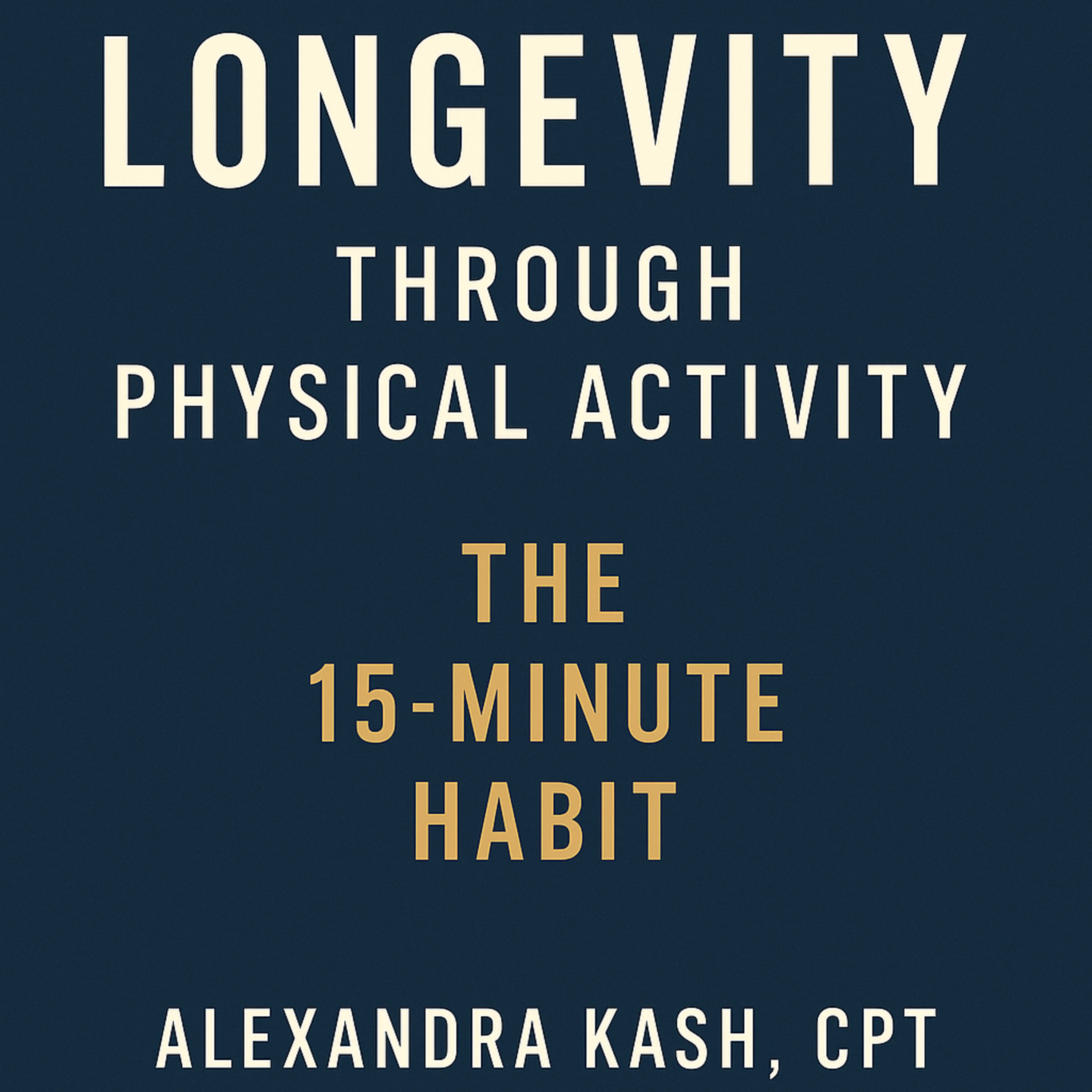
Longevity Through Physical Activity: The 15-Minute Habit. Alexandra Kash, CPT
by Alexandra Kash
Welcome to my podcast.I’m Alexandra Kash, BCS, CPT — Behavior Change Specialist, Certified Personal Trainer, and author of “Longevity Through Physical Activity: The 15-Minute Habit.”This show expands on the science and ideas from my book, exploring how movement enhances brain performance, strengthens the body, and supports long-term vitality.Each episode translates research into real-life action — showing that just fifteen minutes a day can improve focus, boost energy, and extend the quality of your life.
-
25
Pain Is Not the Problem — It’s the Signal
Most people try to silence pain.A pill. Then another one. Stronger if needed.But pain is not random — it’s a signal.Often, it’s the result of how the body adapted to stress, injury, or lack of movement over time. And instead of restoring function, we just try to suppress the symptom.In this conversation, we look at why pain becomes chronic — and what actually helps break the cycle.Not by masking it, but by teaching the body to move and recover properly.Based on ideas from Longevity Through Physical Activity: The 15-Minute Habit by Alexandra Kash, Behavior Change Specialist and Certified Personal Trainer. Available on Amazon.Because the goal is not just less pain —but a body that no longer returns to it.
-
24
Loop Bands: Harder Than They Look — And That’s Why They Work
Most workouts are too predictable.Same movements. Same directions. Same patterns.And over time, the body adapts… and stops changing.But real life doesn’t happen in straight lines.Your body is built to move in multiple directions, react to changing forces, and stay stable under unpredictable conditions. That’s where real strength is developed — not just in muscles, but in coordination, control, and the nervous system.Loop bands introduce a different kind of challenge.Continuous tension. Multi-directional resistance. Constant need for control.They don’t just make exercises harder — they make movement smarter.When used correctly, loop bands activate stabilizers, improve coordination, and train the body as an integrated system rather than isolated parts.This approach is based on principles from Longevity Through Physical Activity: The 15-Minute Habit by Alexandra Kash, Certified Personal Trainer and Behavior Change Specialist. The book is available on Amazon.
-
23
How the Pelvic Floor Controls Strength, Posture, and Movement
Most people never think about their pelvic floor.Until something goes wrong.But what if this hidden system is the real foundation of your strength, stability, and movement?The pelvic floor is not just about one function or one muscle group. It’s deeply connected to how your body stabilizes, transfers force, and maintains control during every movement you make. When it works well, your body feels strong, supported, and efficient. When it doesn’t, the body starts to compensate — and that’s where tension, imbalance, and even pain begin.In this conversation, you’ll discover why the pelvic floor plays a much bigger role than most people realize, how it affects posture, breathing, and movement, and why training it correctly is essential for long-term strength and longevity.This episode is based on ideas from Longevity Through Physical Activity: The 15-Minute Habit by Alexandra Kash, Certified Personal Trainer and Behavior Change Specialist. The book is available on Amazon.Because real strength doesn’t start where you think it does.It starts at the foundation.
-
22
The Diagonal Secret of the Human Body — Why Your Training Should Follow It
Most fitness advice treats the body like a machine made of separate parts: train the abs, strengthen the biceps, stretch the hamstrings. But the human body was never designed to work that way.Real movement happens through connections.In this conversation, we explore the hidden web of strength inside the body — the diagonal movement patterns that link muscles, fascia, and joints into one integrated system. These natural chains, often called myofascial slings, allow the body to transfer force, stabilize joints, and move with fluid power.When these connections are trained, something remarkable happens:movement becomes smoother, strength becomes more functional, and even long-standing tension can begin to disappear.This episode is inspired by the book Longevity Through Physical Activity: The 15-Minute Habit by Alexandra Kash, CPT, Certified Personal Trainer and Behavior Change Specialist. The book explores how small, intelligent movement practices can rebuild the body for lifelong strength, stability, and vitality.The book is available on Amazon.If you’ve ever wondered why some people move with effortless coordination while others struggle with stiffness, pain, or imbalance — this episode will change the way you think about training your body.Because your body is not a machine.It’s a symphony of connections.
-
21
The Anti-Aging Workout for Your Brain
Your brain doesn’t thrive on routine. It thrives on surprise.Research shows that dynamic, unpredictable movement — especially activities that challenge both the body and the mind — can significantly improve balance, coordination, attention, memory, and processing speed. These so-called dual-task movements force the brain to constantly adapt, react, and reorganize.That’s exactly what the brain loves.When movement becomes slightly unpredictable — catching a ball, reacting to a partner, adjusting to changing patterns — the nervous system engages more deeply. Key regions such as the cerebellum and its Purkinje cells begin working as high-speed processors, refining coordination while also supporting cognitive functions like learning, focus, and emotional regulation.These ideas are explored in greater depth in Longevity Through Physical Activity: The 15-Minute Habit by Alexandra Kash, Certified Personal Trainer and Behavior Change Specialist, available on Amazon. The book explains how movement can be used not only to strengthen the body, but also to stimulate the brain and support long-term vitality.Because true fitness is not just about stronger muscles.
-
20
Why Stabilizers Matter More Than Big Muscles — And What It Takes to Build Them
Most people chase strength in their arms, legs, and visible muscles. But real power doesn’t start at the surface — it starts at the center.Inspired by the book Longevity Through Physical Activity: The 15-Minute Habit by Alexandra Kash, Behavioral Change Specialist and Certified Personal Trainer, available on Amazon.This episode explores stability as the true foundation of movement. Proximal stability in the spine, pelvis, and shoulder girdle determines how efficiently the rest of the body performs. When that foundation is weak or poorly coordinated, compensation patterns appear, energy leaks develop, and pain often follows.Stability is not about stiffness or restriction. It is about intelligent control guided by the nervous system. The discussion outlines targeted exercises designed to activate deep stabilizers, restore alignment, and improve coordination — building strength that is efficient, sustainable, and resilient over time.When the center is organized, movement becomes stronger, safer, and more controlled. And without stability, strength simply doesn’t last.
-
19
The Immune System: A Living Intelligence
Your immune system is not a single organ. It is a dynamic, adaptive network that learns, responds, and evolves based on how your body lives and moves.Most people think immunity is about avoiding germs. But science shows something deeper: how you move directly impacts how well your immune system performs.Inspired by Longevity Through Physical Activity: The 15-Minute Habit by Alexandra Kash, Certified Personal Trainer and Behavior Change Specialist, this episode explores the powerful connection between exercise and immune function. Research demonstrates that properly dosed physical activity can reduce upper respiratory infections, improve immune surveillance, lower systemic inflammation, enhance vaccine response, support gut microbiome health, and even slow immune aging.Especially during seasons when illness spreads more easily, understanding immunity as an active, trainable system changes the conversation. Movement is not just about muscles — it is about cellular communication, resilience, and long-term protection.This topic is part of the broader longevity framework presented in Longevity Through Physical Activity: The 15-Minute Habit, available on Amazon.
-
18
Your Slouch Isn’t About Muscles — It’s a Protective Pattern
Slouching is often blamed on weak muscles or poor habits.But what if your posture isn’t a failure — what if it’s protection?Inspired by Longevity Through Physical Activity: The 15-Minute Habit by Alexandra Kash, Certified Personal Trainer and Behavior Change Specialist, this episode reframes poor posture as a brain–body pattern shaped by the nervous system. Collapsed alignment, rounded shoulders, and a forward head position are often the body’s response to stress, perceived threat, or long-standing compensation — not simply a lack of strength.This episode explains how posture reflects nervous system regulation, breathing behavior, and coordination rather than isolated muscular weakness. It also explores why forcing “better posture” rarely works, and how targeted exercises can help retrain alignment by restoring balance, stability, and a sense of safety in the body.By understanding slouching as a protective pattern, it becomes clear that posture can change — not through correction, but through reorganization. When the system is addressed as a whole, the body can return to a more efficient, resilient, and upright state over time.
-
17
Are You Breathing Too Much?
Most people assume that breathing more means getting more oxygen.More air. More effort. More benefit.But what if the opposite is true?This episode explores why frequent breathing can actually be inefficient for the body, how it affects oxygen utilization and the nervous system, and what can be done to restore a more functional breathing pattern. The discussion is based on the One-Minute Breathing Test and explains why learning to breathe less — through efficiency, not force — matters for overall health.This topic is drawn from Longevity Through Physical Activity: The 15-Minute Habit by Alexandra Kash, Certified Personal Trainer and Behavior Change Specialist — a book focused on practical, science-based strategies to improve how the body functions, adapts, and ages. Breathing is one of many interconnected elements explored in the book, alongside movement, posture, strength, and long-term resilience.Longevity Through Physical Activity: The 15-Minute Habit is available on Amazon.
-
16
Why Fit Men Have Protruding Bellies: The Role of the Male Pelvic Floor
How can someone train regularly, lift weights, stay lean — and still struggle with a protruding belly?This episode explores a question many men quietly ask themselves but rarely hear answered.Inspired by Longevity Through Physical Activity: The 15-Minute Habit by Alexandra Kash, Certified Personal Trainer and Behavior Change Specialist, this episode looks beyond calories, crunches, and effort. The focus shifts to a part of the body most men never think about: the pelvic floor.The male pelvic floor plays a critical role in how the core functions, how posture is maintained, and how force is transferred through the body. When this deep support system isn’t doing its job, the body compensates. The abs work harder. The glutes disconnect. The spine shifts. And over time, the belly begins to push forward — even in strong, athletic bodies.This episode breaks down why “training harder” often doesn’t fix the problem — and why the solution isn’t more ab exercises. Instead, it introduces a smarter, systems-based way of thinking about strength: one that starts from the inside and works outward.By understanding how the pelvic floor integrates with the core, hips, and spine, it becomes clear why true strength isn’t just about visible muscles. It’s about support, coordination, and balance — the kind that holds up over time.
-
15
Upper Crossed Syndrome: What’s Really Behind Rounded Shoulders
Upper Crossed Syndrome is one of the most common — and often misunderstood — postural imbalances in modern life.Inspired by Longevity Through Physical Activity: The 15-Minute Habit by Alexandra Kash, Certified Personal Trainer and Behavior Change Specialist, this episode explores what Upper Crossed Syndrome is, why it develops, and how it affects posture, breathing, and movement efficiency.The episode also outlines a clear, structured approach to addressing this imbalance, focusing on restoring muscular balance, improving alignment, and supporting long-term, pain-free movement and strength.
-
14
How Post-Workout Cognitive Exercises Support Longevity
The New Year is a perfect moment to rethink how we train — not just the body, but the brain as well.This episode is inspired by Longevity Through Physical Activity: The 15-Minute Habit by Alexandra Kash, Certified Personal Trainer and Behavior Change Specialist.In her book, Alexandra emphasizes a key principle of longevity: physical training should be followed by a short cognitive exercise to support brain adaptation. Movement prepares the nervous system for change, and when cognitive tasks are introduced immediately after a workout, the body and brain are trained as one integrated system.This episode explores why post-exercise cognitive exercises can enhance focus, memory, coordination, and long-term brain health. Listeners will hear examples of simple, accessible cognitive practices designed to follow physical training — not as an extra burden, but as a natural extension of movement.Alexandra Kash’s approach to longevity goes beyond intensity and volume. By combining physical effort with mental engagement, this method supports a stronger body, a sharper mind, and a more resilient system overall.
-
13
How the Pilates Method Restores Stability, Control, and Long-Term Strength
Strength doesn’t begin with effort — it begins with alignment.Before you can move better, you have to organize your body. And Pilates is one of the most powerful methods for doing exactly that.Pilates isn’t about burning calories or pushing harder. It’s about conscious control — the kind that teaches your spine, pelvis, shoulders, and breath to work together instead of fighting each other. When your foundation is stable, movement becomes efficient, pain-free, and deeply strengthening.Drawing on insights from Longevity Through Physical Activity: The 15-Minute Habit by Alexandra Kash, Certified Personal Trainer and Behavior Change Specialist, this conversation explores how Pilates activates the small stabilizing muscles that rarely show up in a mirror — but completely change the way your body feels and performs. You’ll learn why slow, intentional movement can offer more benefit than intensity, how breath becomes your internal guide, and why honesty in posture is the key to long-term strength and longevity.This is your reminder that strength isn’t hidden in how much you do — it’s hidden in how aligned you are when you do it.
-
12
From Anxiety to Clarity: How Movement Restores a Foggy, Depressed Mind
Movement isn’t just about muscles — it’s one of the brain’s most powerful tools for clearing anxiety, lifting depression, and breaking free from chronic brain fog. Drawing on insights from Longevity Through Physical Activity: The 15-Minute Habit by Alexandra Kash, Certified Personal Trainer and Behavior Change Specialist, this conversation explores how even small, intentional movement can reshape your emotional landscape. You’ll discover why the brain depends on physical activity to regulate stress hormones, support neuroplasticity, and restore cognitive clarity — and how simple daily practices can help you feel more grounded, more focused, and more alive. This is a reminder that your brain isn’t failing you — it’s asking you to move.
-
11
The BOLT Test: How One Breath Predicts Your Resilience
Most of us think we breathe “just fine.” But the truth is—many people walk around every day slightly stressed, slightly tired, slightly unfocused… simply because their breathing is off.This episode dives into the part of health almost no one pays attention to:how you breathe when you aren’t thinking about it. Drawing on concepts from Longevity Through Physical Activity: The 15-Minute Habit by Alexandra Kash, CPT and Behavior Change Specialist, the conversation breaks down why functional breathing is the foundation of calmness, focus, and long-term resilience. You’ll hear why the BOLT test reveals more about your nervous system than any smartwatch, how low CO₂ tolerance mimics anxiety, and why the diaphragm—not the chest—should be doing most of the work.And most importantly, you’ll learn how small adjustments in your everyday breathing can instantly change the way your whole body feels. If you’ve ever wondered why your mind races, why your body tenses, or why stress sticks longer than it should—this episode offers a clear, practical path back to balance through the simplest tool you already have: your breath.
-
10
“The Synergy of Movement: Unlocking Your Body’s Full Potential”
Most workouts focus on isolating muscles. But your body was never designed to work in pieces — it was designed to work as one.In this episode, inspired by “Longevity Through Physical Activity: The 15-Minute Habit” by Alexandra Kash, CPT and Behavior Change Specialist, we explore why true strength, balance, and longevity come from integrated, multi-plane movement — not from training muscles separately.You’ll learn why isolation creates imbalances, why compensations build up even in people who train consistently, and how full-body, chain-based movement restores efficiency, power, and joint integrity.We break down how the body functions as a unified mechanism — like a system of interconnected gears — and what happens when even one part stops pulling its weight.This episode reveals how simple, coordinated patterns can transform the way you move, whether you’re climbing stairs, lifting groceries, or training at the gym.Because when all parts of the body work together, everything becomes easier, lighter, and more powerful.
-
9
“Move Unpredictably, Think Sharply. ”
Your body moves — your brain changes.Every step, every twist, every unpredictable motion is a spark for neuroplasticity — the brain’s ability to grow, adapt, and stay young.In this episode, we explore how movement does more than strengthen muscles — it rewires the mind. Drawing on the science from “Longevity Through Physical Activity: The 15-Minute Habit” by Alexandra Kash, Certified Personal Trainer and Behavior Change Specialist, we discuss how dynamic, cognitively engaging activities boost neurochemicals like BDNF, enhance gray matter, and improve memory, focus, and emotional balance.You’ll learn why predictable workouts aren’t enough for brain health, and how “open-skill” activities — the ones that challenge your reaction, coordination, and creativity — can keep your brain sharp, resilient, and alive with possibility.Because longevity isn’t just about moving longer — it’s about thinking, feeling, and living with clarity at every age.
-
8
“The Truth About Back Pain: It’s Not Weakness, It’s Compensation”
Back pain isn’t just a sign of aging — it’s often your body’s way of saying, “I’ve lost my balance.”In this episode, we explore how chronic tension, poor posture, and repetitive habits silently weaken the spine, draining energy and mobility over time.Drawing from the book “Longevity Through Physical Activity: The 15-Minute Habit” by Alexandra Kash, Certified Personal Trainer and Behavior Change Specialist, this conversation reveals a new way to approach spinal health — not through endless workouts or strict routines, but through mindful, balanced movement that reconnects the brain and body.You’ll learn how to find your neutral spine, awaken deep stabilizing muscles, and rebuild mobility step by step.Because real strength isn’t about lifting more — it’s about moving better, breathing deeper, and restoring the natural rhythm that keeps your spine resilient for life.
-
7
«Interoception: The Inner World We Forgot to Feel»
Interoception: The Inner World We Forgot to Feel Long before the mind reacts, the body already knows.In this episode, we explore interoception — the body’s inner sense that allows us to feel and interpret what’s happening within. Drawing from Alexandra Kash’s book “Longevity Through Physical Activity: The 15-Minute Habit,” this discussion reveals how internal body awareness shapes emotional balance, decision-making, and resilience.You’ll discover how the autonomic nervous system, the vagus nerve, and the fascia communicate our emotional states before we can put them into words. Through heartbeat awareness and diaphragmatic breathing, we can train the nervous system to shift from stress to calm — restoring inner equilibrium and reconnecting with the world within.
-
6
«The Fight-or-Flight Posture: Elevated Shoulders, Stiff Neck, and Shallow Breathing»
Posture isn’t just about standing tall — it’s a reflection of your internal state.In this episode, we explore the neuromuscular and emotional roots of posture, as discussed by Alexandra Kash, author of “Longevity Through Physical Activity: The 15-Minute Habit.”Discover how elevated shoulders, rounded backs, and shallow breathing often stem from chronic low-grade stress — not weakness. Learn how your body unconsciously adapts to modern life’s tension and how simple daily movement rituals can help you break that cycle.From the fight-or-flight response to conscious awareness, this episode bridges science and practice — helping you restore alignment, improve breathing, and reclaim balance in both body and mind.
-
5
“5 Surprising Reasons Your Core Isn’t Engaging”
Most people think core strength means abs — but real stability begins much deeper. In this episode, we uncover five surprising reasons your core feels weak and your back hurts — from poor breathing patterns and postural imbalances to stress, lifestyle habits, and even how your brain communicates with your body.You’ll learn how reconnecting your breath, posture, and brain-body coordination can awaken the deep stabilizing system — the diaphragm, pelvic floor, and core muscles that protect your spine and influence the way you move, age, and feel.This conversation goes beyond fitness. It’s about understanding your body’s intelligent design, restoring balance, and building true, functional strength that supports longevity and vitality — one mindful movement at a time.
-
4
«Why Your Pelvic Floor Shapes Longevity»
You can’t see it in the mirror. You rarely hear it talked about. Yet this hidden system quietly determines your strength, posture, confidence, and even how you age. It’s the pelvic floor — your body’s silent supporter.This conversation dives deep into why so many struggles — from back pain to incontinence to the feeling of being “disconnected” from your own body — trace back to a weakened or neglected pelvic floor. Drawing from Longevity Through Physical Activity: The 15-Minute Habit by Alexandra Kash, we explore the science, challenge the myths, and reveal practical strategies to reconnect with and strengthen this powerful foundation.If you care about moving freely, aging gracefully, and living with vitality — this is where the journey begins.
-
3
«The Lower Crossed Syndrome»
Lower Crossed Syndrome often creeps in silently — tight hips, weak glutes, subtle shifts in posture. In this episode, we dig into what causes this imbalance, how it affects the way you move and feel, and simple, realistic ways to start correcting it. You’ll learn:Why prolonged sitting is one of the main driversWhich muscles are overactive vs underactiveEveryday strategies and movement tweaks to restore balanceWhether you’re managing back discomfort or just want to move with more ease, this episode gives you tools you can use today.
-
2
«Brain-Balanced Training»
Balance is more than standing on one leg — it’s a symphony between body and brain. This episode explores brain-balanced training, where proprioception, vision, vestibular awareness, and mechanoreception unite to build stability, clarity, and resilience. Discover how retraining these systems can unlock ageless vitality and sharpen both body and mind.
-
1
"Addressing Forward Head Posture: A Path to Alignment and Clarity”
Ever catch yourself leaning forward at your screen? You’re not alone — it’s called Forward Head Posture, and it’s become way too common. In this episode, I’ll share why it happens, how it affects your energy and confidence, and a simple four-step plan to bring your body back into balance. Think of it as a quick reset for your posture — and your mood.
We're indexing this podcast's transcripts for the first time — this can take a minute or two. We'll show results as soon as they're ready.
No matches for "" in this podcast's transcripts.
No topics indexed yet for this podcast.
Loading reviews...
ABOUT THIS SHOW
Welcome to my podcast.I’m Alexandra Kash, BCS, CPT — Behavior Change Specialist, Certified Personal Trainer, and author of “Longevity Through Physical Activity: The 15-Minute Habit.”This show expands on the science and ideas from my book, exploring how movement enhances brain performance, strengthens the body, and supports long-term vitality.Each episode translates research into real-life action — showing that just fifteen minutes a day can improve focus, boost energy, and extend the quality of your life.
HOSTED BY
Alexandra Kash
Loading similar podcasts...
Frequently Asked Questions
How many episodes does Longevity Through Physical Activity: The 15-Minute Habit. Alexandra Kash, CPT have?
Longevity Through Physical Activity: The 15-Minute Habit. Alexandra Kash, CPT currently has 25 episodes available on PodParley. New episodes are automatically indexed when they're published to the podcast feed.
What is Longevity Through Physical Activity: The 15-Minute Habit. Alexandra Kash, CPT about?
Welcome to my podcast.I’m Alexandra Kash, BCS, CPT — Behavior Change Specialist, Certified Personal Trainer, and author of “Longevity Through Physical Activity: The 15-Minute Habit.”This show expands on the science and ideas from my book, exploring how movement enhances brain performance,...
How often does Longevity Through Physical Activity: The 15-Minute Habit. Alexandra Kash, CPT release new episodes?
Longevity Through Physical Activity: The 15-Minute Habit. Alexandra Kash, CPT has 25 episodes. Check the episode list to see recent publication dates and frequency.
Where can I listen to Longevity Through Physical Activity: The 15-Minute Habit. Alexandra Kash, CPT?
You can listen to Longevity Through Physical Activity: The 15-Minute Habit. Alexandra Kash, CPT on PodParley by clicking any episode. We provide an embedded audio player for direct listening, and you can also subscribe via your preferred podcast app using the RSS feed.
Who hosts Longevity Through Physical Activity: The 15-Minute Habit. Alexandra Kash, CPT?
Longevity Through Physical Activity: The 15-Minute Habit. Alexandra Kash, CPT is created and hosted by Alexandra Kash.
URL copied to clipboard!