
PODCAST · religion
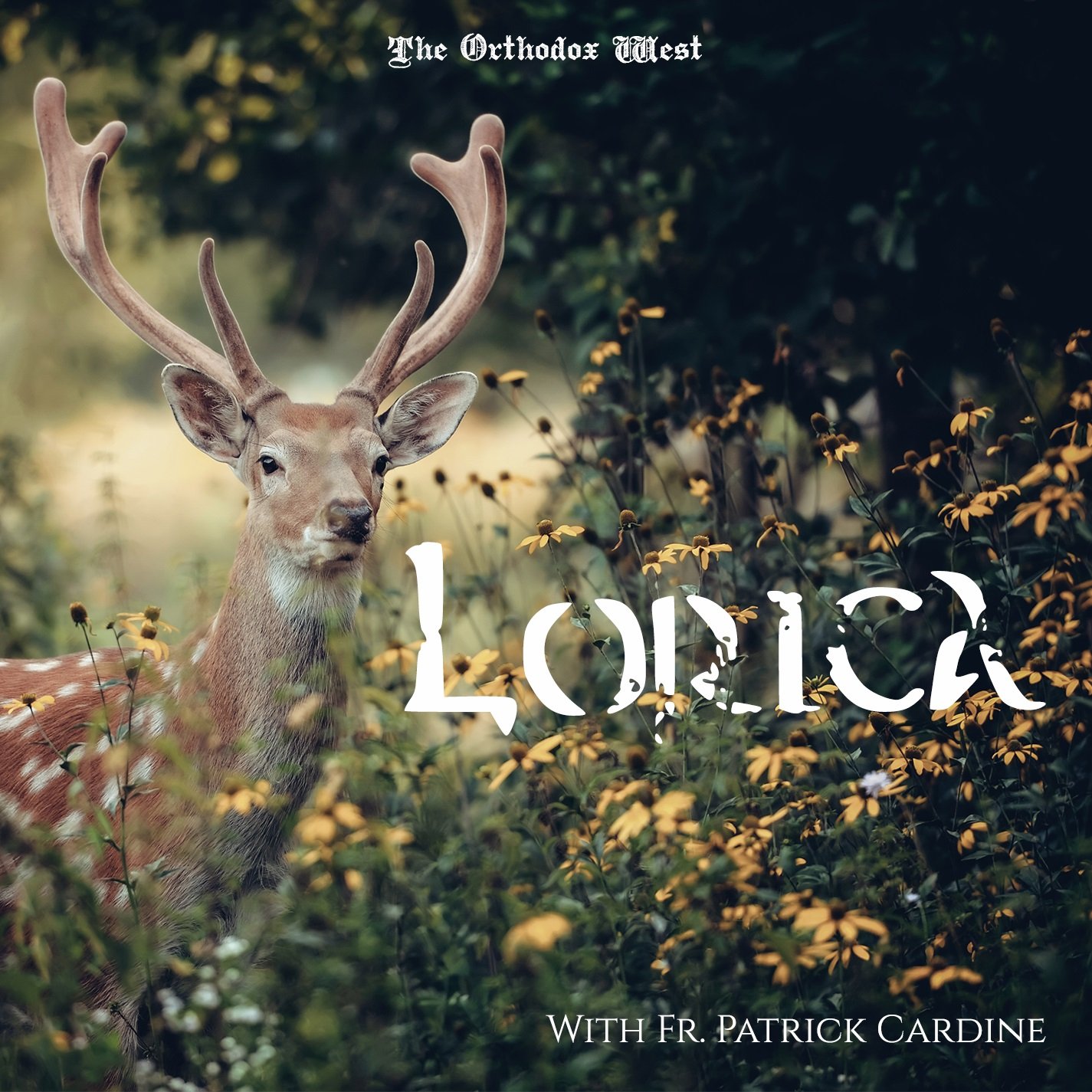
Lorica
by Fr. Patrick Cardine
A Lorica is a prayer recited for protection in which the petitioner invokes the power of God as a safeguard against evil. lōrīca originally meant “armor” or “breastplate.” The title is taken from St. Patrick’s Breastplate, his much loved prayer written in 433 A.D.
Episodes
-
Episode 330 - Behold Your Mother
From the cross, Christ sees his mother and gives her to the beloved disciple—and to us. As the Church bears and nourishes us, Mary becomes the face of that motherhood: loving, interceding, and leading us toward her Son. We are given a mother who shares our trials and draws us into Christ’s life.
-
Episode 329 - One Calling: Love
Our gifts differ, but our calling is one: to love and build up Christ’s body in unity. That love is patient with one another and steadfast against the sin that breaks our peace. We submit to one another in reverence for Christ, and grow together toward his fullness.
-
Episode 328 - The Low Seat
We belong in the low seat, knowing that every dignity we have is God’s gift. Christ takes that place before us, emptying himself in humility; in love, God calls us up to share his life. We surrender the grasp for control and wait for the invitation that only grace can give.
-
Episode 327 - Come Up Higher
Christ calls us to take the lowest seat, not as a clever means of gaining honour, but in recognition that all we have comes from God. When we grasp at control, seeking to be masters of our own lives and others, we take what is not ours. But when we humble ourselves, following the example of…
more -
Episode 326 - Where Your Treasure Is
Where our treasure is, there our heart will be also. When our hearts are fixed on earthly things, our vision grows dark and our lives become burdened with worry. But Christ calls us to seek His kingdom, to see with the eyes of faith, and to know that we are loved. In Him, we find the freedom of...
-
Episode 325 - Your Faith Has Made You Whole
In this homily, Fr. Patrick explores the connection between faith and love through Christ’s healing of the ten lepers. Fr. Patrick details how the Samaritan’s thanksgiving manifested his faith and opened him to true spiritual wholeness. We are called to stop merely taking and begin giving…
more -
Episode 324 - Inheriting Eternal Life
In this homily, Fr. Patrick discusses how the Good Samaritan reveals Christ’s love and mercy toward fallen humanity, calling us to love God and our neighbor wholeheartedly. Through the Holy Spirit, Christ gives us the strength to overcome weakness, take up our cross, and love others as He has…
more -
Episode 323 - Everything Was Going According to Plan
In Fr. Patrick's feast of St. Joachim homily, hear the story of Saints Joachim and Anna, their faithful prayer and suffering, and the miraculous birth of the Virgin Mary, the Mother of God. Fr. Patrick's homily explores the Nativity of the Theotokos, the Archangel Gabriel, the Presentation of…
more -
Episode 322 - Beware a Thief
Two men go up to the temple to pray, returning at last to the place from which Adam had been cast out. But only one of them truly prays. The Pharisee trusts in himself, speaking to himself and about himself, while the publican can scarcely lift his eyes from the ground. He has nothing to present...
-
Episode 321 - My House Is a House of Prayer
Christ weeps over Jerusalem before He enters the temple and casts out those who have made His house a den of thieves. Their sin is older than the temple itself: from Lucifer to Adam, from Judas to us, fallen man reaches out his hand and takes. We grasp because what God has given somehow seems not...
-
Episode 320 - You Give Them Something to Eat
Six times the Gospels tell of the miraculous feedings, and six times we are invited to see beyond the bread. The crowds are hungry, and Christ has compassion on them — but the miracle is a sign of a deeper hunger, and of the only food that can finally satisfy it. Christ gives us His own flesh and...
-
Episode 319 - At Your Word
We stand beside two ordinary fishing boats and discover that God builds His kingdom not apart from the common work of our hands, but through it. Christ calls fishermen to become the foundation of His Church, not because the path before them will be easy, but because His grace makes even the...
-
Episode 318 - Faith is Knowing You Are Loved
We are the sheep that wander, the coin that cannot lift itself, and the child who finally turns toward home. Yet before any step is taken, the Shepherd is already searching, the Father is already running, and heaven is already preparing to rejoice. Repentance is not the anxious effort to persuade...
-
Episode 317 - Become What You Receive
The mystery of Corpus Christi does not end at the altar—it unfolds within the lives of those who receive it. The eternal Son took our flesh so that He might give us His flesh, drawing us into communion with Himself and making us partakers of the divine nature. The Bread from heaven is no mere...
-
Episode 316 - True Food Indeed
On the Feast of Corpus Christi, Christ turns our vision right side up. Since the fall, we have mistaken shadows for reality, believing that earthly things are the source of life while overlooking the One who is Life itself. When Jesus declares, “My flesh is meat indeed, and my blood is drink...
-
Episode 315 - Our Image, Our Likeness
On Trinity Sunday we do not simply confess a doctrine—we behold the mystery of what it means to be human. From the beginning God declared, “Let us make man in our image, after our likeness.” Yet humanity could never fully understand itself until the Triune God revealed Himself. The outpouring of...
-
Episode 314 - Today the Harvest is Reaped
Pentecost is the great harvest of God's saving work. What began in the Incarnation, passed through the Cross, the Resurrection, and the Ascension, now reaches its glorious fulfillment as the Holy Spirit is poured out upon the Church. The promise is complete: God not only comes to dwell among His...
-
Episode 313 - Where Christ Is
The Ascension is not the departure of Christ from the world, but the completion of His saving work. The eternal Son descended into our humanity so that, as the Son of Man, He might ascend again, carrying our nature into the very life of God. He did not return to the Father empty-handed. He…
more -
Episode 312 - That Your Joy May Be Full
As the Church draws near to Ascension and Pentecost, our hope is still reaching toward its fulfillment. Christ has conquered death, yet His work flowers fully in the gift of the Holy Spirit, who brings the life of the risen Lord into His people. These days of waiting teach us to live in holy...
-
Episode 311 - The Spirit of Truth
As the Church turns her face toward Ascension and Pentecost, we are reminded that the Resurrection is not the end of Christ’s work but its unfolding. The risen Lord ascends so that the Holy Spirit may be poured out upon the world. What was accomplished in Christ is made present in us through the...
-
Episode 310 - One Flock One Shepherd
The risen Christ reveals Himself as the Good Shepherd: the One who gathers, nourishes, and protects His flock. Against all the forces that scatter and divide, He calls His people into communion, making many into one. He lays down His life for the sheep—not as a defeated shepherd, but as the...
-
Episode 309 - Be Not Unbelieving, But Have Faith
A week after Easter, the Church gathers again in the presence of the risen Christ. The joy of Pascha has not diminished, though our enthusiasm sometimes has. The victory has been won, death has been conquered, and yet we discover that faith is still required. The apostles themselves struggled to...
-
Episode 308 - The Sabbath is Over
The first words of Easter are not merely a timestamp but a proclamation: the Sabbath is over. The old order of shadows and waiting has passed away. Mourning gives way to joy, fasting to feasting, and the long night of death to the dawn of a new creation. Christ has risen just as He promised, and...
-
Episode 307 - Let No One Go Forth Hungry
At the Great Vigil of Pascha, we hear the radiant words of John Chrysostom calling all people to the feast. The invitation is astonishingly wide: those who fasted and those who did not, those who came early and those who arrived at the eleventh hour, the rich and the poor alike. No one is turned...
-
Episode 306 - He Trod the Winepress Alone
Today we behold a mystery that appears in two forms. The prophet sees a mighty warrior striding forth from battle, his garments stained with blood; the Gospel shows us a bruised and abandoned man carrying a cross. Yet they are the same Lord. The One who seems weakest is accomplishing the greatest...
-
Episode 305 - Fresh From the Battle of Edom
The prophet lifts the veil, and what appears to the world as weakness is revealed as war. We behold Christ covered in blood, striding from the enemy’s land in glorious apparel — not stained with the blood of others, but with His own. The cross is not defeat but vengeance against death itself, the...
-
Episode 304 - When He Hid His Identity
Christ does not merely feed the five thousand — He tests the hearts of those closest to Him. He asks questions He already knows the answer to. He sends His disciples into storms, waits while they strain at the oars, and sometimes even walks beside them unrecognized. Again and again, He allows…
more -
Episode 303 - Hear Him on the Mountain
We are taken up the mountain just after the great confession — You are the Christ — and just before the great scandal — You will suffer and die. The light of His glory is revealed not apart from the cross, but in its shadow, as if to say: this is who He is, even when you cannot understand what...
-
Episode 302 - Not By Bread Alone
We follow Him into the wilderness — not as observers, but as those being led into the same quiet battle. Weakness is not an accident here, but a setting: a place where the truth can be revealed. The tempter comes not with chaos, but with a logic that feels almost reasonable — take control, prove...
-
Episode 301 - Ashes for Treasure
We begin with ashes — a sign as old as repentance itself. They mark the truth of what we bring: weakness, sin, mortality, and a heart in need of turning. Yet these outward signs mean nothing if the heart remains proud. The fast we enter is meant to be quiet, sincere, and interior — a realignment…
more -
Episode 300 - Run So as to Win
We stand at the edge of Lent and hear a warning carried on both Gospel and Epistle: do not presume. The vineyard stretches from Adam to Christ, from dawn to the eleventh hour, and those who labored longest are not guaranteed the prize. Envy felled angels. Presumption cut down a chosen people. The...
-
Episode 299 - The Wine of the World to Come
A wedding in a small Galilean village — a boy, a girl, the turning of water into wine — becomes the first sign of a deeper unveiling. In this sign we glimpse not only divine power, but divine memory: the world as it was meant to be, transparent with God. The miracle points to more than the wine,...
-
Episode 298 - Infant Martyr Flowers
How can we be so bold — to call this massacre a feast? To crown the slain children of Bethlehem with palms and praise? And yet the Church dares. Because the Cross has transfigured all suffering — even this. The swords that fell upon them are now their toys; the blood they shed is their baptism....
-
Episode 297 - Everything is Contained in Everything
On this feast of the Nativity, we see the eternal Word become flesh — and with Him, the meaning of all things made visible. The Christ child, born of Mary, is not only the Redeemer, but the very structure and center of all creation. In Him all things hold together; without Him, nothing can be...
-
Episode 296 - Who Are You?
The question echoes — from the mouths of priests, from Pilate, from us. Who are you? The answer is not always spoken, and rarely heard by those who will not first repent. John the Baptist stands at the threshold, wild and holy, pointing not to himself but to the One already among us…
more -
Episode 295 - Are You the One
John is in prison. Christ is healing the blind, the deaf, even the dead. But when John sends to ask, “Are you the one who is to come?” — Jesus does not answer. He says only: “Tell him what you see. Blessed is he who is not offended in me.” This is not doubt. It is Gethsemane. We are meant to see…
more -
Episode 294 - The Day Is at Hand
We stand again at the turning of the circle — where the liturgical year ends, and begins anew. Not with sentiment, not with celebration, but with a summons. The old year closed with a warning: the end will come, and all will be judged. And the new year opens with the same cry. This, we are told…
more -
Episode 293 - Together, Toward the One
There is no such thing as a solitary salvation. St. Paul says, “Imitate me,” not in pride, but in witness — for he himself is imitating Christ, and calls us to do the same, not alone, but together. The Church is not a scattered people with private beliefs. It is a body, moving as one, conformed...
-
Episode 292 - Seventy Times Seven
How important is forgiveness in the Christian life? Christ tells us not with answers but with the shape of a story — a man forgiven much, who then refuses mercy to another. We are left to reckon with the “as” of the Lord’s Prayer: forgive us our trespasses, as we forgive those who trespass…
more -
Episode 291 - King of Kings and Lord of Lords
From the garden to the throne, the story is one of kingship — of rule offered, lost, and restored. We begin with Adam, shaped in the image of the Christ who was to come, a king in a walled garden who failed to defend his realm. We end with the white horse and the Rider, flame-eyed and crowned…
more -
Episode 290 - A Sacrifice of Praise
At the heart of the Mass — the center of all things — is thanksgiving. Eucharist. We were made for this: to give thanks, to praise the God who gives Himself to us in grace, in glory, in utterance and knowledge and gift. In Christ, by the Spirit, we are not just blessed — we are made partakers of...
-
Episode 289 - They Do Not Know the Law
The commandment is clear: love God with all your heart, soul, and mind. But in this moment, it becomes clear that the experts in the law — the very ones who tested Christ — have never kept it. They know the letter, but not the lawgiver. They quote the prophets, but cannot see the one of whom they...
-
Episode 288 - Because He Loves Us - And We Him
He did not heal in secret. He waited until their eyes were fixed on him — hostile, watching — and then he opened himself, wounded himself, for love. The Lord of the Sabbath entered the lion’s den not with vengeance, but with vulnerability, because even his accusers were beloved. This is not a…
more -
Episode 287 - We Should Be Happy
The Cross we exalt today is not a symbol alone — it is a relic of time and earth. Discovered by Helena, lifted by Constantine, lost to the Persians, and recovered again, it moves through history as it moves through us: hidden, revealed, wounded, victorious. Eusebius saw its triumph in crumbling...
-
Episode 286 - Only One Returned
Ten cried out. Ten were healed. But only one came back — fell down, gave thanks, was made whole. This is not just a healing; it is the pattern of all redemption. We have all received, all been touched by mercy, all walked away with skin made new. But have we returned? There is a difference…
more -
Episode 285 - The Garment of Skin
He was a man without guile — transparent, true, already half-turned toward glory. And yet even he bore the skin of death, like Adam after the fall. In the icon, he stands holding it: his own flesh, flayed and offered, not in defeat but in exchange — the garment of mortality for the robe of divine...
-
Episode 284 - He Declares Power in Pity
God, whose power hung the stars and split the sea, declares His might not by force, but by mercy. He comes not in thunder, but in the quiet cry of a sinner bowed low in the temple. We recall the Pharisee and the publican: one proud in righteousness, the other poor in spirit — and it is the poor…
more -
Episode 283 - Play the Man
When the world demanded treasure, St. Lawrence pointed to the poor. When they burned his body, he offered laughter. His martyrdom was not somber resignation but cheerful defiance — not because he felt no pain, but because he saw Christ beyond it. He faced the fire as if it were a feast. This is…
more -
Episode 282 - Moneybags That Do Not Grow Old
The steward was unjust — and yet he was praised, not for his virtue, but his vision. He saw the end coming and acted shrewdly. Christ does not tell us to admire his dishonesty, but his clarity: the world is passing away, and what we do with what we’ve been given matters eternally. What if even…
more -
Episode 281 - By Their Fruits
Holiness is not the same as goodness. It is not moralism, nor merely clean hands. It is union — with the One who alone is holy. And this holiness has a shape: not spin, not pretense, but fruit. The fruit of confession, of quick repentance, of humble honesty. The false prophet — and the false...
We're indexing this podcast's transcripts for the first time — this can take a minute or two. We'll show results as soon as they're ready.
No matches for "" in this podcast's transcripts.
No topics indexed yet for this podcast.
Loading reviews...
ABOUT THIS SHOW
A Lorica is a prayer recited for protection in which the petitioner invokes the power of God as a safeguard against evil. lōrīca originally meant “armor” or “breastplate.” The title is taken from St. Patrick’s Breastplate, his much loved prayer written in 433 A.D.
HOSTED BY
Fr. Patrick Cardine
CATEGORIES
Loading similar podcasts...
Frequently Asked Questions
How many episodes does Lorica have?
Lorica currently has 325 episodes available on PodParley. New episodes are automatically indexed when they're published to the podcast feed.
What is Lorica about?
A Lorica is a prayer recited for protection in which the petitioner invokes the power of God as a safeguard against evil. lōrīca originally meant “armor” or “breastplate.” The title is taken from St. Patrick’s Breastplate, his much loved prayer written in 433 A.D.
How often does Lorica release new episodes?
Lorica publishes regularly with 325 episodes available. Check the episode list for the typical release schedule.
Where can I listen to Lorica?
You can listen to Lorica on PodParley by clicking any episode. We provide an embedded audio player for direct listening, and you can also subscribe via your preferred podcast app using the RSS feed.
Who hosts Lorica?
Lorica is created and hosted by Fr. Patrick Cardine.
URL copied to clipboard!