
PODCAST · religion
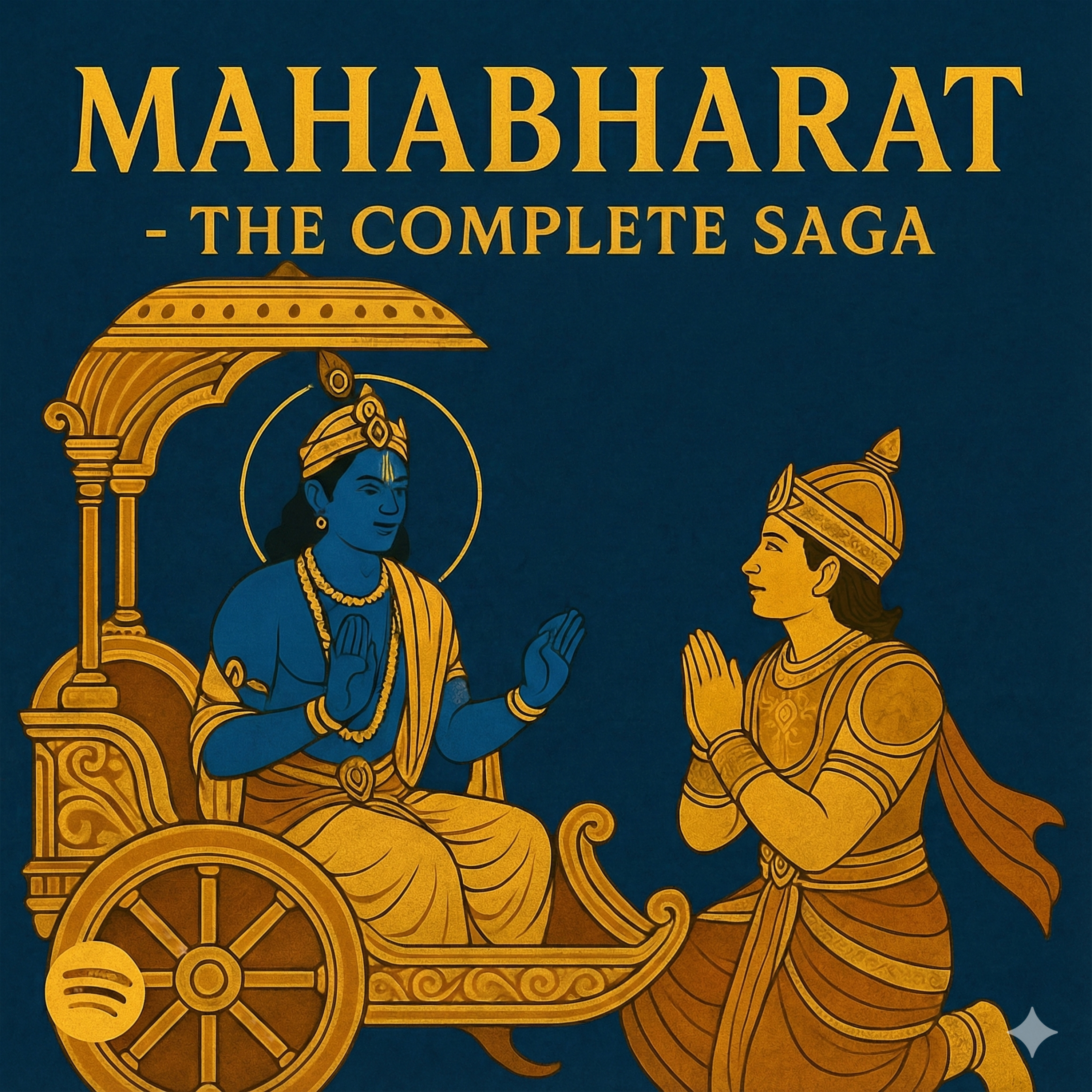
Mahabharat - The Complete Saga
by Anupam Tiwari
Mahabharat - The Complete Saga, an authentic retelling of the Hindu Epic of Mahabharat. This is the #1 Hindi Podcast decoding the psychology, management lessons, and spiritual science hidden in Ved Vyasa’s original text.Beyond the TV myths, we explore the untold stories of Karna, Krishna, Draupadi, and the Kurukshetra War. Discover the real history of Ancient India and Sanatan Dharma, analyzed for the modern Gen Z listener. Join us for the ultimate journey of Dharma and Karma.
-
86
85. War Day 17 Part 3 | Bheem kills Dushyasan | Arjun Kills Karna's son Vrishsen
As the 17th day of Kurukshetra War rages on, the Kurukshetra battlefield descends into absolute, unfiltered primal violence. Decades of unhealed trauma, systemic abuse, and suppressed rage from the infamous Game of Dice finally explode in one of the most terrifying and visceral sequences of the entire epic. The spotlight violently shifts to Bhima, who completely abandons conventional warfare to hunt down the architect of Empress Draupadi's public humiliation: Dushasan.What unfolds is not a standard martial duel, but a horrifying, calculated execution. Overpowering Dushasan, Bheem physically tears open his chest to fulfill his gruesome, decade-old vow: drinking the blood of his abuser. This act is deliberately designed to be a spectacle of sheer psychological terror. It sends a paralyzing shockwave of absolute dread through the Kaurava ranks, causing a mass exodus of soldiers and striking profound fear into the heart of Supreme Commander Karna himself. It is the ultimate, inescapable consequence of institutional arrogance, proving that the unpaid debts of systemic injustice are eventually collected in blood.Simultaneously, Arjun executes his own masterclass in psychological agony. Refusing to engage Karna immediately, Arjuna first targets Karna’s elite son, Vrishasen. In a ruthless display of tactical superiority, Arjun systematically dismantles and executes the young prince right before Karna's eyes, deliberately inflicting the exact same parental trauma Arjun suffered with Abhimanyu. Shattered by grief and fear, the Kaurava forces completely collapse. The episode culminates in the ultimate, long-awaited staredown: Lord Krishna steers the chariot through rivers of blood, finally positioning Arjun face-to-face with a psychologically devastated Karna for the climax of the war.
-
85
84. War Day 17 Part 2 | Brothers Collide! | Arjun Vs Yudhishthir
The 17th day of Kurukshetra War continues with the Pandava empire to the absolute brink of self-destruction—not by the hands of the Kauravas, but through a catastrophic internal breakdown. While Supreme Commander Karna unleashes the apocalyptic Bhargavastra to decimate the Panchala army, a far more volatile crisis erupts inside the Pandava camp. When Lord Krishna and Arjun temporarily leave the frontlines to check on the severely wounded King Yudhishthir, a devastating miscommunication occurs. Yudhishthir mistakenly assumes Arjun has finally assassinated Karna. Upon discovering his nemesis is still alive and actively massacring their troops, the physically traumatized and deeply humiliated King completely loses his psychological composure.In a moment of blind, unchecked rage, Yudhishthir launches a vicious verbal assault on Arjun, culminating in the ultimate insult; he demands Arjun surrender his legendary Gandiv bow to someone more capable. This triggers a terrifying, deeply programmed response. Bound by a secret, absolute vow to behead anyone who insults the Gandiv, Arjun draws his sword to execute his own eldest brother. It is a moment of total systemic collapse; the Pandava leadership is mere seconds away from fratricide and the permanent loss of the war.Here, Lord Krishna delivers an unparalleled masterclass in extreme crisis management and ethical complexity. Intervening both physically and psychologically, Krishna thoroughly deconstructs Arjun’s rigid, black-and-white understanding of morality. Using the profound parables of the Balaka hunter and Kaushika Muni, Krishna proves that blind adherence to a vow or a literal "truth" becomes a grave sin if it results in the senseless destruction of life and a higher overarching purpose. Krishna brilliantly de-escalates the massive egos in the room, saves Arjun from the unforgivable sins of fratricide and suicide, and masterfully redirects that raw, volatile fury toward its rightful, ultimate target: the imminent assassination of Karna.
-
84
83. War Day 17 Part 1 | Karna Vs Yudhishthir | The Ultimate Humiliation!
The 17th day of the Kurukshetra war escalates from physical combat into a devastating display of psychological warfare. Despite the toxic internal sabotage from his charioteer Shalya, Supreme Commander Karna enters the battlefield as an unstoppable, terrifying force. The day's most critical and shocking confrontation occurs when Karna directly engages the supreme leader of the Pandava army, King Yudhishthira.From a modern strategic perspective, this was not merely a military defeat; it was a total psychological dismantling of the Pandava leadership. Karna completely overpowers Yudhishthir, destroying his weapons and shattering his armor. However, strictly bound by his secret vow to Queen Kunti—to spare all Pandavas except Arjun—Karna stops short of executing the King. Instead, he weaponizes the moment to inflict maximum emotional damage. In a brutal public humiliation, Karna physically touches the defeated monarch with his bow, mocking his martial abilities and taunting that a coward should abandon the battlefield to perform sacrifices like a peaceful Brahmin.Deeply traumatized by this unprecedented public disgrace and suffering from severe physical wounds, a shattered Yudhishthira is forced to flee the frontlines and retreat to his camp. This retreat sends a catastrophic shockwave through the Pandava ranks, momentarily collapsing their morale. Meanwhile, the rest of the battlefield descends into absolute carnage: Bhima relentlessly slaughters more of Dhritarashtra's sons, and Arjun executes a flawless extermination of ten thousand Samsaptaka warriors. Yet, the day's defining legacy remains Karna's calculated psychological strike, proving that destroying a leader's dignity can often be far more devastating to an empire than taking their life.
-
83
82. War Night 16 | Internal Sabotage by Shalya | Psychological War on Karna | Karna's 2 Curses
The night of the 16th day of Mahabharat War presents the Kaurava high command with a massive logistical and strategic crisis. To have any chance of defeating Arjun, Commander-in-Chief Karna requires a charioteer whose tactical genius matches that of Lord Krishna. Duryodhan identifies King Shalya of Madra as the only viable candidate. However, asking a royal, high-born monarch to drive the chariot of a man labeled a "Suta" (charioteer’s caste) is a monumental diplomatic insult. In a brilliant masterclass of political manipulation and ego management, Duryodhana frames the request not as a demotion, but as an ascension. He compares Shalya to Lord Brahma, who served as Lord Shiva's charioteer to destroy the impregnable Tripurasura. Flattered by the divine comparison, Shalya agrees, but lays down a highly destructive condition: he demands absolute, unfiltered freedom of speech on the chariot.What unfolds at the dawn of the seventeenth day is one of the most brutal displays of internal psychological sabotage in the entire epic. Rather than operating as a cohesive unit, the Kuru chariot becomes a profoundly toxic environment. Shalya immediately wages a relentless war on Karna’s mind, weaponizing extreme sarcasm and deep-rooted class prejudice. When Karna confidently offers massive wealth to anyone who spots Arjun, Shalya mocks his arrogance, comparing him to a delusional crow trying to outfly a majestic swan.Pushed to his absolute psychological breaking point, a deeply triggered Karna brutally retaliates. He launches a vicious, systematic verbal attack on the culture and morality of Shalya's Bahlika kingdom. Defensively fighting for his own legitimacy, Karna is forced to recount his deepest traumas, the fatal, inescapable curses he received from Guru Parashurama and a wandering Brahmin. This episode masterfully deconstructs how toxic alliances, unchecked egos, and internal psychological warfare can completely shatter a supreme commander's focus right before the most critical, life-or-death battle of his existence.
-
82
81. War Day 16 | Karna Becomes Senapati | Karna defeats Nakul | Yudhishthir defeats Duryodhan
The dawn of the sixteenth day marks a monumental psychological and tactical shift in the Kurukshetra war. Following the catastrophic and controversial assassination of Dronacharya, the Kaurava empire is pushed to the absolute brink of systemic collapse. In a desperate bid to salvage their shattered morale and launch a final, aggressive counter-offensive, Duryodhan anoints his ultimate weapon—Surya-putra Karna—as the new Supreme Commander of the Kuru army. Driven by decades of systemic humiliation and a burning, obsessive desire to prove his supremacy over Arjun, Karna immediately reorganizes the Kaurava forces into the hyper-aggressive Makara Vyuh (Crocodile Formation), forcing the Pandavas into a defensive Ardhachandra Vyuh (Crescent Moon).With Karna at the helm, the sixteenth day strips away complex formations in favor of raw, chaotic, and deeply personal one-on-one combat. The battlefield transforms into a brutal arena of shifting power dynamics. Ashwatthama, blinded by apocalyptic grief over his father's murder, clashes so violently with Bheem that both legendary warriors physically collapse from sheer exhaustion. Meanwhile, Arjun executes a flawless, relentless blitzkrieg, systematically dismantling the remnants of the Samsaptaka suicide squad and neutralizing massive Kaurava divisions.However, the most psychologically fascinating moments of the day involve the royal leadership. King Yudhishthir—often underestimated in brute physical combat—achieves a massive tactical and emotional victory by fiercely overpowering Duryodhana himself, forcing the Kuru king to retreat. On the opposite front, Commander Karna unleashes his wrath upon the Pandava lines, engaging in a brutally one-sided duel with Nakul. Karna completely overpowers the younger Pandava, destroying his weapons and shattering his defenses. Yet, in a chilling display of ultimate control, Karna deliberately lets him live; a subtle, calculated adherence to his secret vow to Queen Kunti. The day ends with heavy casualties, setting the stage for a tense and highly strategic night in the camps.
-
81
80. War Day 15 Part 2 | Ashwatthama's Rage | Wrath of Narayanastra |
The 15th day of Mahabharat War continues and the brutal, unconstitutional execution of Commander Dronacharya sends paralyzing shockwaves through the Kaurava camp, but the true catastrophe is only just beginning. Upon discovering that his father was assassinated through calculated psychological manipulation and deceit, Ashwatthama’s grief instantly transmutes into apocalyptic, uncontrollable rage. In a devastating act of retaliation, he unleashes the absolute ultimate weapon of mass destruction: the Narayanastra.Unlike conventional warfare that relies on physical impact and linear combat, the Narayanastra operates on a terrifying, reactive algorithm. It functions as a divine "smart weapon" the more aggression it senses, the more devastating it becomes. It multiplies its lethal force exponentially against anyone bearing arms, resisting, or even harboring hostile intent in their minds. As millions of fiery projectiles fill the sky, the Pandava empire faces imminent, absolute extinction. No counter-weapon in Arjuna's vast arsenal can neutralize it; any attempt to fight back only guarantees mutual destruction.In this moment of supreme systemic crisis, Lord Krishna demonstrates unparalleled strategic brilliance and supreme ego management. Recognizing that brute force will only fuel their own annihilation, Krishna mandates a radically counter-intuitive defense protocol: absolute, unconditional surrender. He commands the entire Pandava army to immediately drop their weapons, dismount their chariots, and physically bow down to the ground. This episode masterfully strips away the mythic hyperbole to explore the profound psychology of survival. It highlights the deadly danger of unchecked ego; personified by Bheem , who stubbornly refuses to surrender, equating submission with cowardice. Lord Krishna and Arjun must physically drag Bheem off his chariot to save him from vaporization. The Narayanastra Parva profoundly proves that in the face of an insurmountable, apocalyptic threat, survival often requires the total abandonment of pride and the ultimate courage to yield.
-
80
79. War Day 15 Part 1 | Krishna's Masterstroke | Yudhishthir's Half Truth Causes Dronacharya's End
The dawn of the 15th day of Mahabharat War brings the Pandava army face-to-face with absolute annihilation. Fueled by divine weapons and unmatched tactical brilliance, Commander-in-Chief Dronacharya becomes an unstoppable, apocalyptic force, single-handedly burning through the Pandava ranks. Witnessing this massacre, Lord Krishna realizes a harsh, undeniable reality of ancient warfare: brute physical force will never defeat the Guru. To eliminate an invincible opponent, you must bypass their armor and completely shatter their psychological foundation. The strategy shifts from physical combat to a devastating psychological operation, targeting Dronacharya's single, fatal blind spot; his crippling emotional attachment to his son, Ashwatthama.In one of the most fiercely debated moral compromises of the entire epic, King Yudhishthir; the absolute embodiment of truth and righteousness, is convinced to execute this psychological strike. After Bheem tactically slaughters an elephant named Ashwatthama, Yudhishthir approaches his preceptor and confirms the death, deliberately muttering the words "the elephant" under the blaring noise of conch shells. The psychological impact on Drona is instantaneous and catastrophic. Believing his son is dead, the invincible Commander's will to live instantly evaporates. He drops his weapons, abandons his strategic post, and sits completely defenseless on his chariot in deep meditation.What follows is a brutal, cold-blooded execution that forever stains the concept of Dharma Yuddha. Dhrishtadyumna, who was born from the sacrificial fire with the singular, engineered purpose of assassinating Drona, seizes the vulnerability. Completely ignoring Arjun's desperate, agonizing screams to capture their Guru alive, Dhrishtadyumna ruthlessly beheads the unarmed, meditating preceptor. This episode strips away the mythic romance of war, presenting a profound masterclass in ruthless pragmatism. It explores the terrifying reality that when conventional strategy fails, ultimate victory often demands the agonizing sacrifice of one's own moral absolutes, setting the stage for a catastrophic wave of vengeance.
-
79
78. War Night 14 | The Midnight Massacre | Ghatotkach’s Rampage & Karna’s Ultimate Weapon
The terrifying events of the 14th night completely shatter the final illusion of Dharma Yuddha. Humiliated and enraged by the calculated execution of King Jayadrath, the Kaurava high command makes a catastrophic, unprecedented decision: they refuse to blow the conch shells at sunset. For the first time in the epic, the ancient ceasefire is abandoned, plunging Kurukshetra into an apocalyptic, torch-lit midnight massacre. In the pitch-black chaos, the tactical advantage drastically shifts to the Rakshasas. Bheem's son, the giant Ghatotkach, weaponizes the darkness, unleashing a terrifying masterclass in psychological and illusion warfare (Maya). Operating as an unstoppable force of nature, he rains massive boulders, phantom weapons, and absolute terror upon the Kaurava army, pushing Duryodhan’s forces to the absolute brink of total extinction.Facing immediate, undeniable annihilation, the Kaurava camp is gripped by mass panic. Duryodhan makes a desperate demand of his greatest warrior, forcing Karna into an agonizing tactical corner. For years, Karna had meticulously hoarded the Vasavi Shakti; a one-time-use, infallible divine missile granted by Lord Indra, with the singular, obsessive goal of assassinating Arjun. However, to prevent the immediate slaughter of the entire Kuru army, Karna is forced to make a devastating strategic sacrifice. He deploys the superweapon against Ghatotkach.The infallible dart strikes true, but even in death, Ghatotkach executes a final, brilliant strategic maneuver, he expands his immense body, crushing an entire division of the Kaurava army as he falls to the earth. The episode ends on a profound, chilling paradox: while the Pandava camp shatters into absolute, paralyzing grief over the loss of Bheem's beloved son, Lord Krishna secretly rejoices in the shadows. The ultimate, unstoppable threat to Arjun's life has finally been neutralized, fundamentally altering the endgame and ensuring the ultimate victory of the Pandavas.
-
78
77. War Day 14 Part 2 | Abhimanyu Avenged | Arjun Beheads Jayadrath Fulfilling his Vow
The 2nd half of the 14th day escalates into one of the most violent, chaotic, and morally controversial sequences in the entire Kurukshetra war. As the sun begins its perilous descent, the psychological pressure on the Pandava camp finally shatters King Yudhishthir’s composure. Terrified for Arjun and Satyaki’s survival deep inside the Kaurava blockade, he dispatches Bheem to breach the enemy lines. Unlike Arjun’s tactical bypass, Bheem enters the formation like a catastrophic wrecking ball. In a display of sheer, terrifying brute force, Bheem physically shatters Commander Dronacharya’s chariot, violently pushing past the Guru and proceeding to slaughter dozens of Duryodhan’s brothers in rapid succession.This sector of the battlefield then witnesses a highly anticipated, brutal clash of egos and raw strength: Bheem vs Karna. Across multiple intense engagements, Bheem completely dominates the mighty Karna. He repeatedly destroys Karna's chariots, neutralizes his attacks, and forces the legendary archer into humiliating retreats, striking a devastating psychological blow to the Kaurava high command.However, the desperate race against the clock leads to a complete, systemic collapse of ancient military ethics. When the exhausted Satyaki is overpowered and nearly executed by the veteran warrior Bhurishrava, Arjun commits a highly controversial, unconstitutional sniper-strike; shooting off Bhurishrava’s arm from a distance to save his ally. As Bhurishrava sits in peaceful protest against this rule-break, Satyaki ruthlessly beheads him, signaling the absolute death of Dharma Yuddha.The climax arrives at the absolute edge of sunset. With the Kauravas prematurely celebrating their victory, Lord Krishna orchestrates a brilliant optical illusion, momentarily plunging the battlefield into darkness. As the Kauravas lower their guard, Arjun unleashes a perfectly calculated, unstoppable strike, decapitating King Jayadrath. To bypass a catastrophic booby-trap curse that would explode his own head, Arjun's arrows carry Jayadrath’s severed head miles away, dropping it perfectly into the lap of his meditating father. Duryodhan's massive, time-wasting fortress completely collapses, ending the day with a devastating tactical and psychological checkmate against the Kuru empire.
-
77
76. War Day 14 Part 1 | Race Against Time, Arjun's Blitzkrieg | Jayadrath's Fear
The dawn of the 14th day fundamentally rewrites the rules of engagement on the Kurukshetra battlefield. Following Arjun’s suicidal vow to assassinate Jayadrath before sunset, the Kaurava strategy shifts entirely from offensive combat to a massive, time-wasting defensive blockade. Commander Dronacharya engineers a sprawling, multi-layered tactical fortress designed with one singular objective: run out the clock. If the Kauravas can simply stall the supreme archer until the sun drops below the horizon, Arjun is bound by oath to eliminate himself, instantly handing Duryodhan an absolute victory.Realizing that engaging in traditional combat will guarantee his failure, Arjun executes a breathtaking display of blitzkrieg warfare. In a brilliant and highly unorthodox military maneuver, he outright refuses to fight his Guru. Instead, he simply bypasses Dronacharya entirely; a massive psychological insult and a strategic stroke of genius that immediately breaches the Kaurava frontline. Tearing through the enemy ranks at breakneck speed, Arjuna slaughters elite kings like Shrutayu and Achyutayu. In a desperate attempt to halt the onslaught, Drona binds an impenetrable, magical armor (Divya Kavacha) onto Duryodhan, sending the Kuru king directly into the line of fire. Yet, even shielded by divine defense, Duryodhana is brutally overpowered by Arjuna's targeted, relentless fury.This episode uniquely highlights the raw logistical realities of ancient, high-stakes combat. In a masterclass of crisis management, Lord Krishna actually halts the chariot in the middle of active enemy territory, creating a temporary oasis (Jalashaya) to hydrate and recover their exhausted horses while Arjuna single-handedly holds off the entire Kaurava army. Meanwhile, extreme psychological anxiety paralyzes the Pandava camp. Unable to verify Arjun's survival deep within the enemy labyrinth, a panicked King Yudhishthira orders his finest warrior, Satyaki, to abandon the perimeter and launch a secondary, aggressive invasion into the Kaurava blockade, adding a chaotic second front to a day that is desperately racing against the sun.
-
76
75. War Night 13 | Arjun's Vow of Annihilation, Jayadrath Dies Tomorrow!
The night of the 14th day descends upon the Kurukshetra battlefield not with the usual clamor of weary soldiers, but with a suffocating, dead silence. The Pandava camp is paralyzed by a profound, systemic shock following the brutal, unconstitutional assassination of the sixteen-year-old prodigy, Abhimanyu, inside the Chakravyuh. The crushing weight of collective trauma reaches a volatile tipping point when the mighty Satyaki returns to the camp driving Abhimanyu’s empty, battle-scarred chariot. This visceral, physical proof of the Kaurava high command's absolute collapse of military ethics shatters the remaining morale of Yudhishthir and his brothers, forcing them to confront their own catastrophic tactical failure at the perimeter.Unaware of the tragedy, Arjun returns to the camp after successfully defeating the Samsaptaka suicide squad on the southern front. The transition from the high of a hard-fought victory to the devastating realization of his son's murder is a profound study in psychological devastation. Discovering that six veteran warriors including his own respected Gurus, abandoned all codes of Dharma Yuddha to slaughter his unarmed child, Arjun’s profound grief rapidly transmutes into cold, terrifying, and calculated fury. He identifies the critical root cause of the systemic failure: King Jayadrath of Sindhu, who single-handedly blocked the Pandava reinforcements from entering the breach.In a moment that fundamentally alters the strategic landscape of the entire epic, Arjun does not just swear emotional revenge; he takes a terrifying, suicidal oath. He publicly vows to assassinate Jayadrath before the sun sets on the fourteenth day. If he fails to execute the target, Arjun swears to immolate himself on a burning pyre. This is no longer just a battle for territory; it is an absolute death sentence. By making this extreme vow, Arjun inadvertently hands Duryodhan the ultimate strategic win-condition: simply hide Jayadratha for one day, let the sun set, and the greatest Pandava warrior will eliminate himself, instantly winning the war for the Kauravas.
-
75
74. War Day 13 Part 2 | Collapse of Dharma | Jayadrath’s Blockade & The brutal killing of Abhimanyu
The second half of the 13th day marks the darkest and most controversial turning point in the Kurukshetra war, where the established rules of ancient combat are completely obliterated. Having successfully breached the impenetrable Chakravyuh, the 16 year old Abhimanyu expects the Pandava forces to immediately follow him through the opening. However, a catastrophic systemic failure occurs at the perimeter. King Jayadrath of Sindhu, weaponizing a powerful boon from Lord Shiva, single-handedly blocks the entire Pandava backup; including Bheem, Satyaki, and King Yudhishthir. The breach is sealed, trapping the young prodigy completely alone deep inside enemy lines.Cut off from all reinforcements and supply lines, Abhimanyu does not panic; he escalates. In a breathtaking display of raw survival instinct and martial dominance, he unleashes absolute carnage, slaughtering elite royals including Duryodhan’s own son, Lakshman, and King Brihadbal of Kosala. Driven to absolute desperation and realizing they cannot defeat him in a fair one-on-one fight, the Kaurava high command abandons all military ethics.In a shocking, coordinated assassination, six legendary Maharathis; including Commander Dronacharya , Kripacharya, and Karna simultaneously attack the lone teenager. Acting entirely against the codes of Dharma Yuddha, they ruthlessly strike his horses, shatter his bow, and destroy his sword and shield. Stripped of all defenses, Abhimanyu fights to his absolute last breath with a broken chariot wheel before finally being struck down. This episode strips away the romanticism of the epic, exposing the brutal reality of tactical desperation, the utter collapse of martial law, and the devastating psychological fallout that leaves the Pandava camp in dead silence as the sun sets.
-
74
73. War Day 13 Part 1 | Chakravyuh Breached | Abhimanyu vs. The Kaurava Veterans
On the thirteenth day of the Kurukshetra war, the battlefield transforms into a lethal, inescapable trap. Stinging from Duryodhana’s harsh accusations of leniency, Commander-in-Chief Dronacharya engineers the ultimate military blockade: the Chakravyuh (Wheel Formation). With Arjun deliberately dragged away to the southern front by the Samsaptaka suicide squad, the Pandava army is effectively paralyzed. In a desperate crisis management maneuver, King Yudhishthir turns to the only warrior left who possesses the tactical knowledge to breach this spinning labyrinth, the 16 year old prodigy, Abhimanyu. Knowing exactly how to penetrate the formation, but tragically unaware of how to exit, the young prince takes a calculated, suicidal risk to save the Pandava forces from total annihilation.What follows is one of the most breathtaking displays of individual military dominance in the entire epic. This episode strips away the exaggerated folklore to focus on the raw, terrifying precision of Abhimanyu’s solo infiltration. Once inside the Chakravyuh, the lone teenager doesn't just survive; he systematically dismantles the Kaurava high command. Operating with the devastating efficiency of a seasoned warlord, he single-handedly routes the four-fold army and inflicts humiliating, decisive defeats upon legendary veterans. He forces Dronacharya into retreat, knocks King Shalya unconscious, and spectacularly overpowers both Dushasan and the mighty Karna. As Abhimanyu slaughters Karna's brothers and triggers mass psychological panic across the Kaurava ranks, the enemy realizes they are not fighting a child, but an unstoppable force of nature. This chapter captures the absolute zenith of Abhimanyu's glory, right before the catastrophic collapse of martial law.
-
73
72. War Day 12: The Juggernaut Supratik & Krishna’s Divine Shield
The 12th day of the Kurukshetra war introduces a terrifying variable to the battlefield, akin to a modern "Black Swan" event; an unpredictable, overwhelming force that shatters all existing strategies. As Arjun remains locked in a grueling battle of attrition with the Samsaptaka suicide squad on the southern flank, Dronacharya intensifies his ruthless offensive to capture King Yudhishthir alive. To break the desperate Pandava defenses once and for all, the Kauravas deploy their ultimate heavy artillery: the ancient King Bhagadatt of Pragjyotisha, mounted on his colossal, legendary elephant, Supratik.Operating like an unstoppable biological battle tank, Supratik crushes the Pandava frontlines, spreading mass psychological panic and overpowering even the mighty Bheem. The sheer scale of this destruction forces Arjun to rush back to the epicenter of the chaos. What follows is a tactical clash of astronomical proportions. Driven to the edge, Bhagadatt unleashes the apocalyptic Vaishnavastra—a targeted, unstoppable weapon of mass destruction engineered to obliterate its mark.In one of the most profound moments of the epic, Arjun finds himself entirely defenseless against this cosmic force. However, Lord Krishna steps directly into the line of fire. Absorbing the lethal strike upon his own chest, the weapon instantly transforms into a divine garland (Vaijayanti Mala). This episode strips away the myth to explore the raw mechanics of crisis management, the limits of human capability, and the psychological realization that ultimate surrender is sometimes the greatest shield. Arjun eventually strikes down the behemoth and the king, bringing a close to a day defined by narrow escapes and brute force.
-
72
71. War Day 11: Arjun vs Samshaptakas, Dronacharya's masterplan fails.
The dawn of the 11th day marks a terrifying new chapter in the Kurukshetra war. With Dronacharya now officially commanding the Kaurava forces and the mighty Karna finally unleashing his long-awaited wrath upon the battlefield, the power dynamic shifts drastically. Drona's primary objective is clear: execute the bloodless coup agreed upon the previous night by penetrating the Pandava lines and capturing King Yudhishthira alive. However, the Kaurava war room quickly realizes a fundamental strategic truth, capturing the Pandava King is mathematically and physically impossible as long as his ultimate shield, Arjun, stands by his side. Arjun’s Gandiv bow creates an impenetrable firewall around Yudhishthir.To bypass this defense mechanism, the Kauravas engineer a brilliant but ruthless "divide and conquer" military tactic: the deployment of the Samsaptakas. King Susharma and his Trigarta warriors volunteer to become an elite suicide squad. Standing before a sacred fire, they take a chilling, irreversible blood oath to either kill Arjun or die trying. Their true objective is not victory, but pure distraction. They must act as a massive decoy, challenging Arjun and dragging him to the far southern edges of the battlefield.Bound by his warrior code to accept any formal challenge, Arjun is forced to leave his brother's side. The moment Arjun's chariot disappears over the horizon, the Pandava defense crumbles. With Yudhishthir suddenly exposed, Dronacharya transforms from a teacher into a terrifying force of nature, tearing through the vulnerable Pandava ranks to claim his royal prize. Day 11 becomes a desperate, high-stakes extraction mission, proving that in ancient warfare, just like in modern corporate strategy, isolating the leader is the fastest way to collapse the entire empire.
-
71
70. War Night 10: Enter Karna! Dronacharya becomes Senapati of Kauravas
With the fall of the invincible Pitamah Bhishma, a deafening silence paralyzes the Kuru camp on the night of the 10th day. The emotional devastation is palpable, but the machinery of war must keep turning. In this hour of vulnerability, two monumental shifts occur. First, Karna, who had sworn not to pick up his weapons while Bhishma led, finally steps onto the battlefield to seek the fallen patriarch's blessing, marking his highly anticipated entry into the conflict. Second, the Kauravas anoint the brilliant preceptor, Guru Dronacharya, as their new Commander-in-Chief.Seeking to capitalize on Drona's unmatched tactical genius, Duryodhana approaches him with a highly calculated demand: do not kill Yudhishthir, but capture him alive. This was not an act of mercy; it was a masterstroke of political risk management and psychological warfare. Duryodhan realized that assassinating the eldest Pandava would immediately unleash the apocalyptic, unstoppable wrath of Arjun and Bheem, ensuring mutual destruction.However, capturing Yudhishthir alive presented a sinister, bloodless path to absolute victory. It was essentially an ancient hostile takeover, the plan was to drag the captive king into yet another rigged game of dice, defeat him through Shakuni's deceit, and banish the Pandavas back to the forest for another thirteen years, winning the empire without depleting their own armies. Drona agrees to this terrifying boon, but lays down one impossible condition: Yudhishthir can only be taken if his ultimate shield, Arjun, is lured far away from the front lines. This critical night fundamentally shifts the Mahabharat from a contest of brute physical strength into a deadly, high-stakes game of tactical chess.
-
70
69. Season Finale - War Day 10: The Shield of Shikhandi & The Bed of Arrows
The tenth day brings the most decisive and heartbreaking turning point of the Kurukshetra war. Following the desperate midnight revelation by Bhishma himself, the Pandavas execute their final strategy: placing Shikhandi at the vanguard. True to his lifelong vow never to strike a woman or someone born as one, the invincible Grandsire lowers his weapons. Shielded by Shikhandi, Arjun unleashes a devastating, unstoppable volley of arrows. As the legendary patriarch falls from his chariot, his body does not touch the earth, resting instead on a glorious and tragic bed of arrows (Sharasaiyya), bringing the first devastating chapter of the war to a close.
-
69
68. War Day 9: Krishna’s Ultimate Fury & The key to Pitamah's defeat
On the ninth day of the Kurukshetra war, Bhishma unleashes an apocalyptic assault, arranging the Kaurava army into the formidable Sarvatobhadra Vyuh. As Arjun continues to fight his grandsire half-heartedly, the Pandava forces face total annihilation. Unable to witness the slaughter of his army and the triumph of Adharma, a furious Lord Krishna loses his patience. Leaping from the chariot with a weapon in hand, he charges toward Bhishma, ready to break his own vow of non-combat to kill the Grandsire himself. A desperate and ashamed Arjun stops him at the last second, promising to fight without mercy setting the stage for a desperate midnight visit to the Kaurava camp. Who will reveal the secret of Bhishma's one and only weakness?
-
68
67. War Day 8: The Illusion of Demons & The Sacrifice of Iravan
On the eighth day of the Kurukshetra war, the battlefield resembles a turbulent ocean as Bhishma deploys the massive Oormi Vyuh (Ocean Formation). The day is dominated by the terrifying might of illusion-wielding warriors. Ghatotkach unleashes unprecedented destruction upon the Kaurava ranks, forcing Duryodhan to deploy his own demonic ally, Alambush. The climax of the day is a heartbreaking one: Arjun’s valiant Naga son, Iravan, fights a fierce and magical duel against Alambush but tragically falls in battle. Meanwhile, a furious Bheem continues to fulfill his deadly vow, slaying several more of Dhritarashtra's sons and pushing the Kaurava camp further into despair.
-
67
66. War Day 7: The King Humiliated – Dhrishtadyumn vs. Duryodhan
As the seventh day dawns, Bhishma arranges the Kaurava forces into the complex Mandala Vyuh (Circular Formation), which the Pandavas counter with the piercing Vajra Vyuh (Thunderbolt Formation). The battlefield quickly breaks down into a series of fierce one-on-one duels, but the true highlight of the day is the explosive clash between the Pandava Commander-in-Chief Dhrishtadyumn and Prince Duryodhan. In a humiliating spectacle for the Kauravas, Dhrishtadyumn completely overpowers their king shattering his bow, killing his horses, and destroying his chariot. Left weaponless and facing imminent death, Duryodhan is only saved by a desperate rescue mission from his allies, ending the day on a deeply demoralizing note for the Kuru camp.
-
66
65. War Day 6: The Crocodile vs. The Heron & Bheem’s Penetration
On the 6th day of the Great War, the tactical formations take a massive shift as Dhrishtadyumn deploys the Pandav army into the Makara Vyuh (Crocodile Formation) to counter Bhishma’s colossal Krauncha Vyuh (Heron Formation). The highlight of the day is Bheem’s reckless and terrifying bravery as he completely breaches the Kaurava lines. Together, Bheem and Dhrishtadyumn wreak havoc on the Kuru army, destroying Drona's chariot, killing Duryodhan's brother, and securing a decisive psychological and physical victory for the Pandavas by sunset.
-
65
64. War Day 5: The Hawk vs. The Crocodile: Clash of Formations
Strategic warfare takes center stage as Bhishma organizes the Kaurava army into the formidable Makar Vyuh (Crocodile Formation), which the Pandavas counter with the swift Syena Vyuh (Hawk Formation). The battlefield erupts in chaos with intense duels, including Satyaki’s impressive stand against Drona and Bhima’s renewed assault on the Kaurava princes. Despite these heroics, the day is defined by Bhishma’s relentless aggression, which nearly breaks the Pandava lines before Arjuna steps in to stabilize the front as the sun sets.
-
64
63. War Day 4: Bheem and Ghatotkach Wreck Havoc & The Secret of Nara-Narayana
Day 4 belongs to father-son duo of Bheem and Ghatotkach, who unleash such terror that the Kaurava army flees in panic after Bhima annihilates the elephant division (Gajasena). The battle also sees Dhrishtadyumn slaying the son of King Shalya, marking a significant blow to the Kaurava leadership. Confused by his repeated defeats, Duryodhan confronts Bhishma that night, leading the Grandsire to reveal the ultimate spiritual truth of Krishna and Arjun
-
63
62. War Day 3: Krishna Breaks His Vow to Kill Bhishma
Stung by Duryodhan’s criticism that he is being too lenient, Bhishma unleashes a massacre so devastating that the Pandava army begins to crumble. In one of the most iconic moments of the epic, Lord Krishna loses patience with Arjun’s hesitation and breaks his own vow of non-participation, rushing towards Bhishma with a chariot wheel to destroy him. The episode concludes with a shamed Arjun stopping Krishna, renewing his own promise to fight, and unleashing a counter-attack that decimates the Kaurava forces by sunset.
-
62
61. War Day 2: Bheem’s Rampage Against the Kalingas & The Krauncha Formation
Following the defeat on Day 1, a devastatingly anxious Yudhishthir is reassured by Shree Krishna, leading Dhrishtadyumn to organize the Pandav army into the impenetrable Krauncha Vyuh (Heron Formation). The day belongs to Bhima, who unleashes his ferocious wrath upon the Kalinga and Nishaad armies, single-handedly slaying Prince Bhanuman and Ketuman while crushing their elephant division. The episode concludes with the Pandavas making a strong comeback, as Arjun holds Bhishma at bay and Bheem’s terror forces the Kaurava army to retreat.
-
61
60. War Day 1: Yudhishthir’s Masterstroke & The Fall of Virat’s Sons
The Kurukshetra War begins not with a clash of weapons, but with a stunning act of humility as Yudhishthir walks barefoot to the enemy lines to seek permission from Bhishma and Drona to fight them. Following this, the battle erupts, featuring a fierce duel between the young Abhimanyu and the Grandsire Bhishma. However, the first day ends in tragedy for the Pandavas; despite their valor, King Shalya kills Prince Uttar, and the mighty General Shveta is slain by Bhishma, leaving the Pandava army demoralized as the sun sets.
-
60
59. The Bhagavad Gita: Krishna Dispels Arjuna’s Illusion (Bhagavad Gita Parva)
Standing between the two armies, Arjun is overcome by paralyzing grief and refuses to kill his own grandsire and teachers, dropping his Gandiv bow. This episode covers the commencement of the divine dialogue where Lord Krishna transforms from a charioteer into the Supreme Guru. He deconstructs Arjun’s illusion (Moha) by revealing the eternal nature of the Soul and the philosophy of Nishkama Karma (duty without attachment), urging the warrior to rise above his emotions and fight for the establishment of Dharma.
-
59
58. The Rules of the Kurukshetra War & Sanjay’s Divine Vision
The Kurukshetra War is about to begin, but before the first arrow is fired, the strict codes of 'Dharma Yuddha' must be established. And how did a blind king witness the greatest battle in history?🎧 Listen to the complete Mahabharat Saga here: https://bit.ly/3N68RlnIn Episode 58, we enter the Jambukhanda Vinirmana Parva (the opening of the Bhishma Parva). As the two colossal armies of the Pandavas and Kauravas stand face-to-face, the leaders convene to agree upon the rules of engagement. We explore the authentic textual rules of honorable warfare: equals must only fight equals, charioteers battle charioteers, and the unarmed, retreating, or surrendered must be spared.Meanwhile, Maharishi Ved Vyas visits Hastinapur to offer King Dhritarashtra a profound gift: the vision to witness the war firsthand. But consumed by fear and unable to watch the slaughter of his own kin, the King refuses. Instead, the boon of Divya Drishti (Divine Vision) is bestowed upon his charioteer, Sanjay. Discover how Sanjay becomes the omniscient narrator, transcending space and time to relay every brutal and divine moment of the Kurukshetra war back to the blind King.⏳ Episode Chapters (Timestamps):[00:00] - Intro[00:18] Recap[00:32] Jambukhanda Vinirmana Parva Begins[01:24] Rules of War[03:35] Sanjay Receives Divya Drishti (Divine Vision)[04:30] Sanjay Describes Bad Omens[06:45] Sanjay Describes Jambudweep & Bharat[08:40] 4 Yugas[09:56] Sanjay Describes World Continents[10:50] Conclusion[11: 20] Next Episode: Bhagwad GitaFollow the journey & join the community:📱 Instagram: https://bit.ly/4l2Gq4bAbout This Podcast:This series is a faithful retelling of the epic Mahabharat, sourced directly from the authentic Sanskrit texts and Critical Editions; free from the exaggerations of TV adaptations.#Mahabharat #KurukshetraWar #DharmaYuddha #RealMahabharat #HinduMythology #VedVyas #SanjayDivyaDrishti #BhishmaParva
-
58
57. The Origin of Shikhandi | Amba’s Revenge | The Secret to Bhishma’s Death | Ambopakhyan Parva
As the massive armies finally mobilize for the Kurukshetra war, a critical strategic impossibility haunts the Pandava high command: how do you eliminate a supreme military leader who possesses the divine right to choose his own time of death? The answer lies buried in the Ambopakhyan Parva, a profound masterclass in the absolute, terrifying power of systemic injustice and long-term, generational vengeance. When Duryodhana presses Grandsire Bhishma about his single tactical blind spot, the preceptor reveals the dark, heavily suppressed history of Princess Amba; a woman whose life, agency, and reputation were completely destroyed by his own misguided adherence to rigid, absolute vows.Stripped of her future, rejected by her betrothed, and humiliated by the patriarchal establishment, Amba refused to surrender to despair. Instead, she weaponized her profound trauma. In an unparalleled display of sheer, single-minded psychological obsession and extreme ascetic endurance, she secured a divine guarantee to become the exact instrument of Bhishma's assassination in her next life. Reborn as Shikhandi to King Drupad, her very existence transforms into the ultimate, inescapable consequence of Bhishma's past actions.From a modern analytical perspective, this episode is a brilliant case study of long-term strategic retaliation and the catastrophic cost of ignoring collateral damage in leadership. It fundamentally deconstructs the myth of Bhishma’s invincibility, proving that even the most impenetrable physical and political armor cannot protect a leader from the ghosts of their own systemic failures. Amba’s transformation into Shikhandi isn't just a tale of rebirth; it is the ultimate engineered weapon designed specifically to hack the ethical algorithm of the Kuru Commander, perfectly setting the stage for his inevitable, tragic downfall.
-
57
56. Maharathi to Ardharathi: Ranking the Warriors of Kurukshetra
Who were the most powerful warriors in the Kurukshetra War? Before the battle begins, Bhishma conducts the ultimate military SWOT analysis, ranking every fighter—but his assessment of Karna sparks a massive internal revolt.🎧 Listen to the complete Mahabharat Saga here: https://bit.ly/3N68RlnIn Episode 56, we dive into the Rathatirtha Sankhyana Parva. Accompanied by modern 2D digital illustrations of the epic's heroes, we explore how Bhishma classifies the warriors into four distinct ranks: Maharathi, Atirathi, Rathi, and Ardharathi. While warriors like Drona and Ashwatthama receive high praise, Bhishma publicly humiliates Karna, labeling him a mere 'Ardharathi' (half-warrior) due to his arrogance, the loss of his divine armor, and Parashurama’s curse.Discover Karna's explosive reaction and his fatal vow to boycott the war as long as Bhishma leads. We also explore the ranking of the Pandava army, why Arjun is considered an unmeasurable system of war rather than just a fighter, and the shocking strategic weakness Bhishma reveals to his enemies regarding Shikhandi.⏳ Episode Chapters (Timestamps):[00:00] The Pre-Battle Tension & SWOT Analysis[01:37] The 4 Ranks: Maharathi, Atirathi, Rathi & Ardharathi[02:53] Ranking the Kaurava Army (Drona & Ashwatthama)[04:10] The Ultimate Insult: Karna is a "Half-Warrior"[05:21] Karna's Vow to Boycott the War[06:08] Ranking the Pandava Army & Abhimanyu[07:12] Why Arjuna is Unranked (Off the Charts)[08:13] Bhishma's Fatal Weakness: Shikhandi[09:22] The Impact on the Kurukshetra WarFollow the journey & join the community:📱 Instagram: https://bit.ly/4l2Gq4bAbout This Podcast:This series is a faithful retelling of the epic Mahabharat, sourced directly from the authentic Sanskrit texts and Critical Editions—free from the exaggerations of TV adaptations. We bridge the gap between ancient philosophy and modern psychology to bring these timeless lessons to a new generation.#Mahabharat #Karna #Bhishma #Maharathi #KurukshetraWar #RealMahabharat #HinduMythology #RathatirthaSankhyanaParva
-
56
55. Psychological Warfare: Uluka’s Taunts & The Final Provocation (Uluka Dutagamana Parva)
On the absolute brink of the Kurukshetra war, physical weapons are put on hold while a masterclass in psychological warfare takes center stage. In the Uluka Dutagamana Parva, Duryodhan deploys Shakuni’s son, Uluk, as his final envoy to the Pandava camp. However, this is not a diplomatic mission for peace, it is a highly calculated, strategic move designed to inflict emotional damage and goad the enemy into acting out of blind rage rather than tactical reason.In the modern world of high-stakes negotiations and competitive business, making your opponent lose their temper is a proven tactic to force unforced errors. Duryodhana understands this perfectly. Through Uluka, he delivers deeply researched, highly targeted personal insults to break the morale of each Pandava. He relentlessly mocks King Yudhishthir’s so-called righteousness, ridicules Arjun’s humiliating year disguised as a eunuch in Virat's kingdom, and taunts Bheem’s gluttony and unfulfilled vows of revenge.The tension in the Pandava camp reaches a volatile boiling point as Bheem and Sahadev erupt in fury, completely provoked and ready to execute the messenger on the spot. Yet, this episode beautifully highlights the stoicism, emotional intelligence, and emotional regulation required of true leadership. Lord Krishna and Yudhishthir maintain their absolute composure, strictly upholding the ancient rules of diplomacy while sending back a chilling, cold-blooded counter-challenge. This chapter strips away the physical combat to explore the raw human psychology of provocation, ego management, and the immense mental discipline required right before the ultimate clash of empires.
-
55
54. The March to Kurukshetra: Balaram’s Neutrality & The Karna-Bhishma Rift (Sainya Niryana Parva)
As the colossal armies mobilize for Kurukshetra, the Pandavas appoint Dhrishtadyumn as their Commander-in-Chief, while Bhishma assumes command of the Kaurava forces. Lord Balaram, refusing to choose between his brother Krishna and his student Duryodhan, declares his neutrality and departs for a pilgrimage, withdrawing from the war entirely. In Hastinnapur, Drithrashtra ask Sanjay to narrate the events happening in Kurukshetra.
-
54
53. The Cosmic Form & Karna’s Loyalty: Viswaroop Darshan (Bhagavad Yana Parva Part 3)
Duryodhan’s arrogance reaches its peak when he attempts to imprison Lord Krishna, triggering the awe-inspiring Viswaroop Darshan (Cosmic Form), proving that Krishna is not a mere envoy but the universe itself. The narrative then shifts to the most emotional turning point of the epic: the revelation of Karna’s birth secret. Despite pleas from both Krishna and his mother Kunti to switch sides, Karna chooses friendship over lineage, promising Kunti that he will spare four of her sons, making the war a personal duel between him and Arjun.
-
53
52. The Final Try: Shree Krishna and Elders pursuade Duryodhan (Bhagwadhyan Parva Part 2)
As Krishna attempts to negotiate peace, the great sages narrate ancient tales to warn Duryodhan about the perils of arrogance. Sage Narada recounts the extensive saga of Rishi Galava’s impossible quest for 800 "moon-white" horses and the tragic sacrifice of Princess Madhavi to fulfill a Guru Dakshina. The episode culminates in the powerful lesson of King Yayati, who was cast down from heaven solely due to his pride, a direct mirror to Duryodhan’s stubbornness, which remains unshaken despite these divine warnings.
-
52
51. Krishna’s Peace Mission: Draupadi’s Wrath & The Meal at Vidhur’s (Bhagavadyana Parva Part 1)
Before departing for Hastinapur, Krishna consults the Pandavas, leading to a surprising debate where even the volatile Bheem suggests peace, while Draupadi, weeping, demands war to avenge her humiliation. Krishna arrives in the enemy capital and makes a powerful political statement by rejecting Duryodhan’s lavish royal feast, declaring that one should only eat where there is love or hunger. Instead, he chooses the humble hospitality of Vidhur’s home.
-
51
50. Pandavas' Ultimatum: The Kaurava Court Divided (Yanasandhi Parva)
The sun rises on the Kuru court as Sanjay finally delivers the Pandavas' official ultimatum: return the kingdom or face total annihilation by Arjun and Bheem. This message acts as a catalyst, instantly shattering the unity of the Kaurava camp. While elders like Bhishma and Drona urge Dhritarashtra to make peace to save the lineage, Karna and Duryodhan vehemently reject any compromise, leading to a heated verbal clash. The episode exposes the deep internal fractures (Phoot) in Hastinapur, proving that the war is being driven by Duryodhan's ego rather than the consensus of the court.
-
50
49. The Sleepless King: Vidhur Niti & The Secret of Immortality (Prajagar Parva)
Sanjay has returned to Hastinapur but refuses to deliver the Pandavas' message until the next morning, leaving King Dhritarashtra in agonizing suspense. Tormented by guilt and Sanjaya’s harsh private rebuke, the sleepless King summons Vidhur for counsel. This episode covers the famous Vidhur Niti, where Vidhur outlines the path of virtue to calm the King's restless mind, followed by the arrival of Sage Sanatsujat, who reveals that death is merely negligence (Pramada) and teaches the secret of conquering death through spiritual wisdom.
-
49
48. Dhritarashtra’s Diplomatic Trap: Sanjay’s Message of Peace (Sanjayayan Parva)
Sanjay arrives at the Pandava camp in Upaplavya as an envoy, delivering a message from King Dhritarashtra. The blind king’s message is a masterclass in emotional manipulation; he praises the Pandavas' righteousness and pleads with them to avoid war "out of the goodness of their hearts," arguing that destroying their kin is a sin. This episode analyzes the diplomatic standoff where Dhritarashtra attempts to use the Pandavas' own virtue against them, asking for peace while remaining silent on returning their kingdom.
-
48
47. Diplomacy and War Plannings Begin! Arjun and Duryodhan Approach Shree Krishna
After Aggyatvas ends, top warriors and Kings like Drupad, Balram, Virat, Satyaki, Pandavas, and Shree Krishna himself gather at King Drupad's Kampilya. Tension starts brewing as the Kings and Warriors propose opposing views and Yudhishthir stands at the centre of this crossfire. King Drupad moderates the crowd and everyone decide to send Purohit as the Shanti Duut. Later, Duryodhan and Arjun approach Shree Krishna and ask him to pick sides between Pandavas and Kauravas. Shree Krishna agrees to paricipate, but with a condition....
-
47
Special Episode: A Saga of Draupadi’s Resilience
Before the narrative shifts to the Udyog Parva and final preparations of the war, this special episode reflects on the harrowing journey of Draupadi thus far. We consolidate the timeline of her trauma—from the horrific disrobing in the Dice Hall to the abduction attempt by Jayadratha in the forest. This retrospective highlights her unyielding strength and simmering rage, setting the emotional context for why the coming war is not just about land, but about justice for the Empress.
-
46
46. The Royal Alliance: Abhimanyu Weds Uttara (Vaivahik Parva)
With the battle won and identities revealed, a shocked King Virata offers his daughter Uttara’s hand in marriage to Arjuna. However, upholding the highest moral code, Arjuna refuses to marry his own student; instead, he accepts her as a bride for his son, Abhimanyu. This episode covers the grand wedding ceremony that unites the Matsya and Pandava kingdoms, solidifying the first major alliance for the upcoming Great War.
-
45
45. Arjun’s Identity Revealed: The Great Cattle Raid (Go Haran Parva)
Suspecting the Pandavas are hiding in Virata, the Kauravas launch a massive attack to steal the kingdom's cattle and force the brothers out of hiding. The episode features the iconic moment where Arjuna sheds his disguise as the eunuch Brihannala, retrieves his Gandiva bow from the Shami tree, and single-handedly faces the entire Kuru army. It culminates in Arjuna using the Sammohan Astra to put the Kaurava warriors to sleep, securing a humiliating defeat for Duryodhana just as the exile timeline officially expires.
-
44
44. Draupadi’s Peril & Bheem’s Fury: The Slaughter of Keechak (Keechak Vadh Parva)
The Pandavas' secret is nearly exposed when General Keechak, the powerful brother of Queen Sudeshna, becomes obsessed with Draupadi (disguised as Sairandhri). While Yudhishthira pleads for patience to maintain their cover, Draupadi’s humiliation reaches a breaking point, leading her to seek Bhima’s help. The episode culminates in a gruesome midnight duel in the dance hall, where Bhima brutally slaughters Keechak, crushing his limbs to simulate the wrath of a Gandharva and protecting Draupadi’s honor.
-
43
43. Aggyatvas Begins! The Pandavas Enter Virat Nagar (Pandav Pravesh Parva)
The stakes are at their highest as the Pandavas begin the Agyatvas—the thirteenth year of exile where they must remain undetected or face another twelve years in the forest. This episode details the brilliant and humble identities they assume to hide in plain sight at King Virata’s court: Yudhishthira as the Brahmin Kanka, Bhima as the cook Ballava, and Arjuna as the dance teacher Brihannala. It explores the psychological challenge of the mighty Kuru princes and their queen serving as common servants to a lesser king.
-
42
42. The Yaksha Prashna: Life, Death & The Final Test (Araneya Parva)
As the twelve-year exile concludes, the Pandavas face a lethal test at an enchanted lake where four brothers die after drinking forbidden water. The episode centers on the high-stakes intellectual duel between Yudhishthira and the Yaksha (Lord Dharma in disguise), known as the Yaksha Prashna. Yudhishthira’s profound answers regarding the nature of happiness, wickedness, and truth not only revive his brothers but also secure the boon of secrecy needed for their upcoming Agyatvas (incognito exile)
-
41
41. Karna’s Ultimate Sacrifice: The Loss of the Divine Armor (Kundala Harana Parva)
Fearful of Karna’s invincibility, Lord Indra disguises himself as a Brahmin to beg for Karna’s divine armor and earrings (Kavach and Kundal). Despite being explicitly warned by his father, the Sun God Surya, that this is a trick, Karna chooses his reputation as a donor (Danveer) over his own life. This pivotal episode sees Karna trading his immortality for the Shakti weapon, a decision that seals his tragic fate in the Kurukshetra war.
-
40
40. Savitri & Satyavan: The War Against Destiny (Pativrata Mahotsava Parva)
This episode features one of the most powerful tales in Indian mythology: the story of Savitri, who challenged Yamraj (the God of Death) to reclaim her husband Satyavan. Unlike the physical wars the Pandavas fight, Savitri fights a battle of wit, philosophy, and sheer willpower (Pativrata Dharma). The narrative explores how her relentless devotion and astute answers forced Death himself to rewrite the laws of destiny and return Satyavan’s soul.
-
39
39. The Ramayan Retold: Strategic Lessons for Yudhishthir (Ramopakhyan Parva)
To console a grieving Yudhishthira, Sage Markandeya narrates the Ramopakhyan—the ancient story of Lord Rama. This isn't just a retelling of the Ramayana; it serves as a strategic blueprint, drawing parallels between Sita’s abduction and Draupadi’s plight to show that even Avatars faced exile and loss. The episode emphasizes how Rama defeated the mighty Ravana through alliances and righteousness rather than just army size, giving the Pandavas the mental fortitude they need for the future war.
-
38
38. The Humiliation of Jayadrath: Abduction, Disgrace & The Fatal Boon (Draupadi Haran Parva)
King Jayadratha attempts to abduct Draupadi while the Pandavas are away, leading to a high-stakes pursuit and his eventual capture by Bhima and Arjuna. Rather than killing him, the Pandavas subject him to the ultimate disgrace of having his head shaved, a humiliation that drives him to perform severe penance to Lord Shiva. This episode explores how this specific act of mercy proves fatal, as Jayadratha secures the power to hold back the Pandava army, directly setting the stage for the tragic entrapment of Abhimanyu in the Kurukshetra war.
-
37
37. The Humiliation of Duryodhan & Yudhishthir’s Mercy (Ghoshyatra Parva & Mrugswapnobhdav Parva)
Duryodhana marches to the forest with the intent to mock the Pandavas' poverty but ends up captured by the Gandharva king, Chitrasena. In a display of supreme Rajdharma, Yudhishthira orders his brothers to rescue their enemy, leaving Duryodhana alive but consumed by shame. The episode concludes with the Mrugswapnobhdav, where the animals of the forest appear in Yudhishthira’s dream, begging the Pandavas to leave so the ecosystem can recover from their hunting.
We're indexing this podcast's transcripts for the first time — this can take a minute or two. We'll show results as soon as they're ready.
No matches for "" in this podcast's transcripts.
No topics indexed yet for this podcast.
Loading reviews...
ABOUT THIS SHOW
Mahabharat - The Complete Saga, an authentic retelling of the Hindu Epic of Mahabharat. This is the #1 Hindi Podcast decoding the psychology, management lessons, and spiritual science hidden in Ved Vyasa’s original text.Beyond the TV myths, we explore the untold stories of Karna, Krishna, Draupadi, and the Kurukshetra War. Discover the real history of Ancient India and Sanatan Dharma, analyzed for the modern Gen Z listener. Join us for the ultimate journey of Dharma and Karma.
HOSTED BY
Anupam Tiwari
CATEGORIES
Loading similar podcasts...
Frequently Asked Questions
How many episodes does Mahabharat - The Complete Saga have?
Mahabharat - The Complete Saga currently has 50 episodes available on PodParley. New episodes are automatically indexed when they're published to the podcast feed.
What is Mahabharat - The Complete Saga about?
Mahabharat - The Complete Saga, an authentic retelling of the Hindu Epic of Mahabharat. This is the #1 Hindi Podcast decoding the psychology, management lessons, and spiritual science hidden in Ved Vyasa’s original text.Beyond the TV myths, we explore the untold stories of Karna, Krishna, Draupadi,...
How often does Mahabharat - The Complete Saga release new episodes?
Mahabharat - The Complete Saga has 50 episodes. Check the episode list to see recent publication dates and frequency.
Where can I listen to Mahabharat - The Complete Saga?
You can listen to Mahabharat - The Complete Saga on PodParley by clicking any episode. We provide an embedded audio player for direct listening, and you can also subscribe via your preferred podcast app using the RSS feed.
Who hosts Mahabharat - The Complete Saga?
Mahabharat - The Complete Saga is created and hosted by Anupam Tiwari.
URL copied to clipboard!