
PODCAST · society
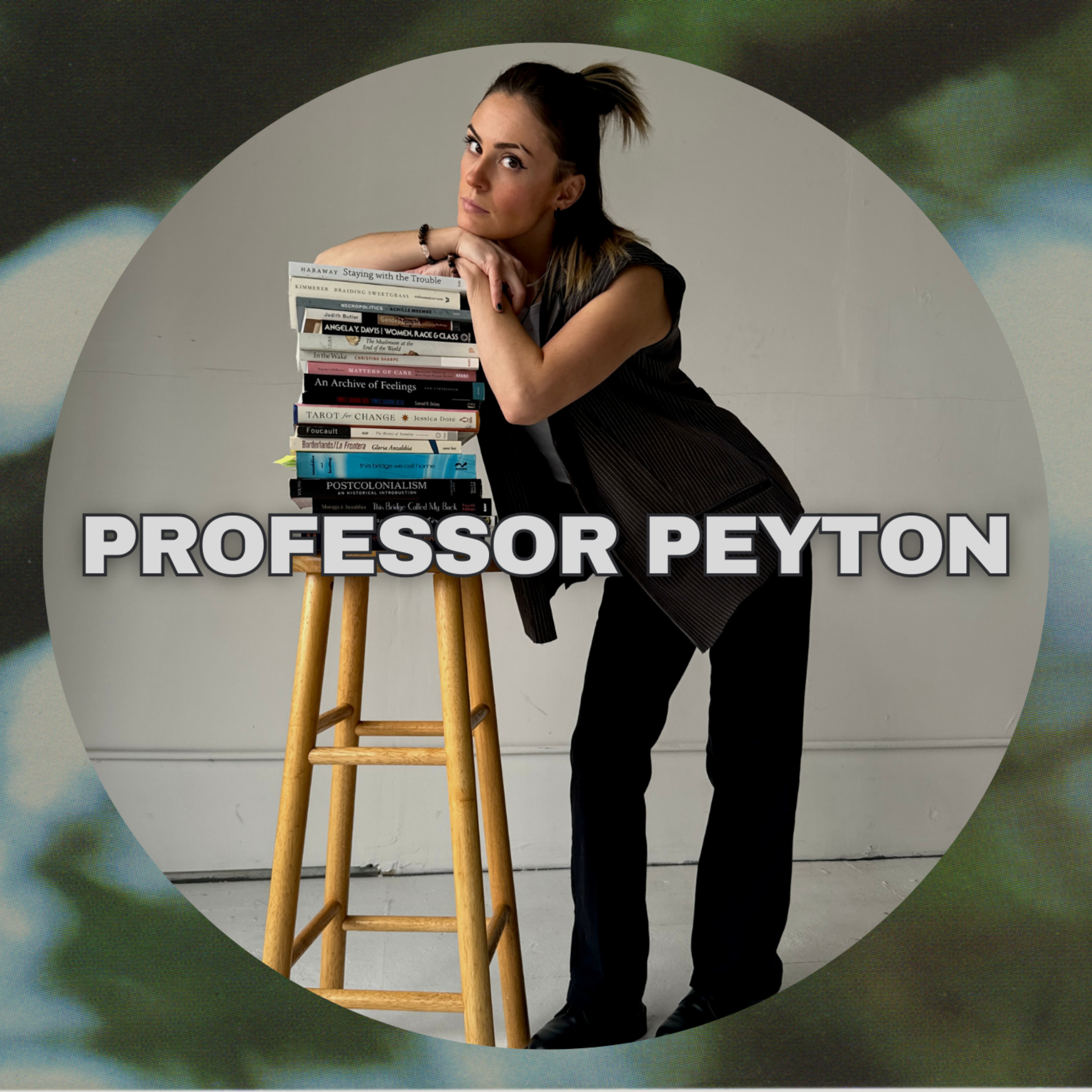
Professor Peyton's Podcast
by Dr. Peyton Del Toro
Dr. Peyton Del Toro (also known as Dr. Del Tarot) is a Chicana lesbian from metro Detroit with a doctor of philosophy and a tarot deck.
-
26
What Border Art Teaches Us About Identity: Borderlands, Nepantla, and the "Chicana" Artist
In this episode, we explore the complex layers of identity, spirituality, and borderlands inspired by Gloria Anzaldúa’s groundbreaking work. Discover how borders—both physical and psychological—shape our sense of self and community, and why exploring them can be a powerful act of reclaiming your roots in a world obsessed with labels. If you've ever felt torn between cultures, identities, or histories, this episode will challenge how you see belonging and transformation.We dive deep into Anzaldúa’s concept of Nepantla—the liminal space where contradictions coexist—and how it applies not only to border regions but also to personal and collective identities. You’ll learn about the ways art, appropriation, and cultural recovery are intertwined with struggles against neocolonialism and commodification. We unpack her critique of how indigenous symbols and figures like La Llorona are reappropriated and how this reflects broader issues of cultural resilience and healing.Key insights include: how border art exposes the ongoing psychosis of cultural erasure, the power dynamics of labeling identities like “border artist” or “Chicana,” and the importance of acknowledging both our ancestral ties and our current realities. This episode is essential listening for anyone grappling with questions of racial, cultural, or spiritual identity, especially in a society that often seeks to box in what it means to belong. Whether you're an artist, thinker, or someone looking to understand your place in a fractured world, you'll walk away with new frameworks to interpret your own borderlands—mental, cultural, and spiritual—and the tools to navigate them authentically.
-
25
Imagination, Spirituality, & Reality
This episode dives into Gloria Anzaldúa's transformative spiritual and political insights, revealing how embracing spiritual practices and decolonizing our perceptions of reality can ignite profound societal change, starting within you. Discover how symbols operate within spiritual and ontological tools like tarot cards, and explore why breaking binary ways of thinking can open pathways to expanded consciousness and new ways of perceiving reality.
-
24
How Bush's 9/11 Response Shaped Today's Political Landscape
Gloria Anzaldúa’s teachings from over 20 years ago remain startlingly relevant as we grapple with the aftermath of 9/11, ongoing wars, and systemic trauma. In this episode, Dr. Peyton Del Toro distills Anzaldúa’s powerful insights into how confronting collective and personal shadows can be the doorway to healing, spiritual awakening, and radical change.
-
23
Writing and Spirituality with Gloria Anzaldúa
This episode is about Dr. Del Toro's journey to spirituality through feminist theory, specifically the work of Gloria Anzaldúa. Here, we focus on the preface of Light in the Dark by Gloria E. Anzaldúa, and we'll work through the book together in the following episodes.
-
22
Renee Nicole Good, ICE, and the Borders Anzaldúa Warned About
This episode delves into Gloria Anzaldúa's "Borderlands/La Frontera" and its relevance to the tragic death of Renee Nicole Good. Professor Peyton explores the themes of mestiza consciousness, the historical and ongoing impact of borders, and the constructed nature of belonging and identity. The discussion highlights how Anzaldúa's work provides a framework for understanding the complexities of cultural intersections and the systemic violence perpetuated by borders.Chapters:00:00:00 Introduction to Borderlands00:03:00 Historical Context of US-Mexico Border00:09:00 Mestiza Consciousness and Identity00:15:00 Renee Good's Death and Border Violence00:21:00 Anzaldúa's Framework for UnderstandingTo take a class with Professor Peyton or learn more about how to work with her 1:1, head to www.thedelvioninstitute.com. Follow Professor Peyton @peytondeltoro on all socials and @thedelvioninstitute on Instagram.
-
21
Sapphic Nuns & Forbidden Letters: The Queer World of Sor Juana Inés de la Cruz
This conversation delves into the life and works of Sor Juana Inés de la Cruz, a 17th-century Mexican nun, poet, and proto-feminist. The discussion highlights her challenges against patriarchy, her intellectual pursuits, and her (queer?) relationships, particularly with María Luisa. It explores her poetry's critique of male hypocrisy and her theological debates, culminating in her response to patriarchal authority and her lasting legacy as one of the earliest advocates for women's rights and intellectualism.
-
20
The Politics of Gay Acceptance (And Who It Really Serves)
Professor Peyton delves into the political context of Heated Rivalry and Boots, two popular queer shows right now. This episode is about understanding homonationalism and the alignment of (certain) queer subjects with state power. Also discussed: queer representation and war legitimization, homo-nationalism and queer bodies, neoliberal politics and trans rights, necropolitics and sovereignty, war as a collective trauma, colonialism and land conquests, analysis of Heated Rivalry and Boots, capitalism and mobilization efforts, and queerness and national identity.
-
19
There Is No Outside: Karen Barad, Quantum Theory & Radical Responsibility
Welcome to Revolutionary Readings with Professor Peyto, where we take theory off the shelf and put it where it belongs: in the streets, in our bodies, and in our breath.This episode: Meeting the Universe Halfway by Karen Barad (https://www.dukeupress.edu/meeting-the-universe-halfway)Physicist, feminist, philosopher Karen Barad asks us to rethink everything we’ve assumed about reality, science, and our place in the world.We’ll explore:— What it means to live in a universe of entanglements— Why objectivity is a myth and observation is always ethical— The difference between interaction and intra-action— How quantum physics becomes a queer feminist ethics of care— And how reading this book during my Saturn return has become a spiritual practice for me personallyThis episode isn’t just about theory, it’s about accountability. About showing up in a world where we are never separate, never neutral, never untouched. Barad doesn’t give us easy answers, they offer a method. A practice. A way of meeting the universe... halfway.Theory is survival. Entanglement is sacred. Learning never ends. 🔔 Subscribe for weekly revolutionary readings, queer theory breakdowns, and poetic political education with Professor Peyto.Follow me on TikTok: https://www.tiktok.com/@professorpeytonFollow me on Instagram: www.instagram.com/peytondeltoro
-
18
Reading Queer YA: Juliet Takes a Breath
✨ Episode 1: Juliet Takes a Breath by Gabby RiveraIn this episode, Professor Peyton dives into a coming-of-age novel that doesn’t flinch from the messy intersections of queerness, race, family, and feminist betrayal.We talk: - What happens when your mother doesn’t see you- What white feminism gets wrong- Being Boricua and queer in Portland- The heartbreak of looking for liberation and finding performance- The sacred act of writing yourself back into existenceFrom Juliet’s whispered coming out in the kitchen to the library girl on a motorcycle, from disappointment to divine rage, from liberal feminists to Gloria Anzaldúa, this episode is a journey through theory, tenderness, and queer becoming.Juliet says, “reading would make me brilliant, but writing would make me infinite.”🔔 Subscribe for weekly book club episodes + revolutionary theory breakdowns.
-
17
Audre Lorde’s “Master’s Tools” and “Uses of the Erotic”
Welcome to class with Professor Peyton, where we take theory off the shelf and put it where it belongs: in the streets, in our bodies, and in our breath. Today, we’re doing the Lorde’s work! This episode dives into two of Audre Lorde’s most powerful essays: “The Master’s Tools Will Never Dismantle the Master’s House” and “Uses of the Erotic: The Erotic as Power." We’ll talk about why liberation can’t come from the same systems that oppress us, what the “master’s tools” really are, and how reclaiming our feelings, our bodies, and our pleasure is part of the revolution.We also explore how Lorde’s work speaks to trans and nonbinary experiences—even if her language predates that visibility—and why the erotic is not indulgent, but necessary. #AudreLorde #QueerTheory #FeministTheory #ProfessorPeyton #RevolutionaryReadings #TheMastersTools #UsesOfTheErotic #TheoryIsSurvival #QueerFeminism #BlackFeminism
-
16
The Myth of Sisyphus by Albert Camus
Albert Camus’The Myth of Sisyphus explores the concept of the absurd, or the conflict between humanity’s search for meaning and the universe’s indifference. Sisyphus, condemned to push a boulder up a hill for eternity, becomes a symbol of this struggle. Rather than viewing his fate as despairing, Camus argues that he must be imagined as happy, embracing his task despite its futility. This perspective challenges conventional notions of purpose and suggests that meaning can be found in the act of resistance itself.Marx’s analysis of capitalism highlights alienation, particularly in labor. Camus extends this critique by exploring existential alienation—the sense that human efforts may be meaningless in an indifferent world. This can deepen discussions on how revolutionaries sustain hope and action despite systemic resistance.#camus #sisyphus #philosophy
-
15
On the Jewish Question by Karl Marx
The Professor Peyton podcast is a space for deep dives into radical ideas, literature, and theory, making complex texts accessible, engaging, and relevant to our world today.This episode is part of the Revolutionary Reading Series, where we explore foundational political and philosophical works that have shaped movements for justice and liberation. Whether you’re a student, an activist, or just curious about revolutionary thought, this series invites you to think critically, challenge dominant narratives, and imagine new possibilities for the future.Tune in, take notes, and join the conversation, because reading is resistance!
-
14
The Communist Manifesto by Karl Marx & Friedrich Engels
Karl Marx and Friedrich Engels' The Communist Manifesto is one of the most influential political texts in history. It begins with a powerful assertion: human history is the history of class struggle. From ancient times to modern capitalism, societies have been divided into those who own the means of production (the bourgeoisie) and those who sell their labor to survive (the proletariat).Capitalism, while highly productive, is fundamentally exploitative. Workers generate immense wealth but see little of it, while the ruling class profits. This system, though treated as inevitable, is not natural—it was created, and it can be dismantled. The Manifesto argues that capitalism’s contradictions will lead to its downfall and that workers, uniting across borders, have the power to overthrow it and build a more just society.Even today, we see these dynamics play out. Billionaires hoard wealth while workers struggle to make ends meet. The climate crisis, gig economy, and rising inequality are symptoms of a system that prioritizes profit over people. But as Marx and Engels remind us: "The proletarians have nothing to lose but their chains. They have a world to win."🔥 Follow for more Revolutionary Readings!#CommunistManifesto #Marx #Revolution #Capitalism #Socialism #ClassStruggle
-
13
#13 LOVE AS AN ACT OF WILL: Rethinking Connections with bell hooks in a Capitalist World
LOVE AS AN ACT OF WILL: Rethinking Connections with bell hooks in a Capitalist WorldThis is the fifth lecture for the 2024 Fall session of ENGLISH 1110 for The Ohio State University, taught by PhD Candidate Peyton Del Toro. This lecture delves into the ideas presented in the first two chapters of bell hooks’ All About Love, where she critiques the lack of a clear, universal definition of love in society. Hooks contends that love is often misunderstood or misrepresented, distorted by systems of domination—especially capitalism. Drawing on her insistence that love is not just a feeling, but an action rooted in care, commitment, and trust, this lecture will explore how capitalist culture undermines these values by turning love into a commodity.
-
12
#12 PLAYFULNESS & LOVING PERCEPTION: Maria Lugones' Concept of World-Traveling
This is the fifth lecture for the 2024 Fall session of English 1110 for The Ohio State University, taught by PhD Candidate Peyton Del Toro. Today, we’re talking about Maria Lugones’ “world-traveling” and how it connects with the ideas of Robin Wall Kimmerer and Gloria Anzaldúa. We’ll explore how shifting perspectives can reshape the way we think and write, much like Kimmerer’s lessons on reciprocity with the earth and Anzaldúa’s reflections on language and identity. It’s about expanding how we relate to ourselves, others, and the world. By weaving together these thinkers, we examine how writing and thinking become transformative acts. Join us as we reflect on what it means to navigate and write from and for multiple worlds.
-
11
#11 THE PRICE OF PRODUCTIVITY: Reclaiming Imagination in a Capitalist World
This is the fifth lecture for the 2024 Fall session of ENGLISH 1110 for The Ohio State University, taught by PhD Candidate Peyton Del Toro. In this lecture, we dive into Mark Fisher's book Capitalist Realism: Is There No Alternative? and how neoliberal capitalism impacts daily life. We explore how capitalism co-opts strategies and movements of opposition, turning women’s empowerment (for example) into a hustle, “girl boss” narrative that often perpetuates existing modes of power and oppression. By critiquing the pressures of constant productivity and success, we examine the ways this impacts social justice and environmental issues, imagination, and mental health. How do we begin to imagine—let alone create—an alternative way of existing in this world? How do we “fight back” when we feel psychologically defeated and are instead filled with existential dread?
-
10
#10 WILD TONGUES: Language, Identity, & Resistance in Writing
This is the fourth lecture for the 2024 Fall session of ENGLISH 1110 for The Ohio State University, taught by PhD Candidate Peyton Del Toro. This episode explores the intersections of language, identity, and power through the lens of Gloria Anzaldúa's essay "How to Tame a Wild Tongue." Beginning with a personal poem inspired by Anzaldúa's work, I reflect on the complexities of cultural assimilation, language barriers, and the personal impact of colonial history. Drawing on Anzaldúa's insights, we delve into how writing can serve as both a tool of resistance and a means of reclaiming identity, ultimately challenging dominant narratives and creating new spaces for understanding.
-
9
#9 LISTENING TO THE LAND: Information Literacy Beyond Academia
This is the third lecture for the 2024 Fall session of ENGLISH 1110 for The Ohio State University, taught by PhD Candidate Peyton Del Toro. By looking to nature for models of design, as in the practice of biomimicry, Kimmerer argues that Western science is beginning to catch up to the wisdom Indigenous peoples have long held—wisdom that has been marginalized or dismissed by academic institutions for centuries. This brings us to an important aspect of information literacy: questioning whose knowledge is valued and whose is ignored. Historically, Western academia has privileged certain voices, particularly those aligned with Eurocentric, scientific, and colonial worldviews, while excluding Indigenous thought, language, and ways of knowing. Native science, for example, was often dismissed as "unscientific" or irrelevant to modern knowledge systems. However, as Kimmerer points out, Indigenous knowledge offers invaluable insights into sustainability, ecology, and the interconnectedness of life—insights that are increasingly being recognized as essential to addressing today’s environmental challenges.This history of exclusion teaches us to be critical of the structures and systems that determine which information is deemed credible and which is not. Information literacy, then, is not just about finding reliable sources—it’s also about interrogating the power dynamics that shape our understanding of what constitutes "reliable" information in the first place. For a deeper dive on the “Skywoman Falling” section of the book, check out my very first episode titled “SCI-FI AS RE-STORY-ATION.”
-
8
#8 RESEARCH AS RELATIONSHIP: An Ethics of Inquiry
This is the second lecture for the 2024 Fall session of ENGLISH 1110 for The Ohio State University, taught by PhD Candidate Peyton Del Toro. In the process of writing or creating anything, inspiration often comes from various sources—personal experiences, the experiences of our families and communities, observations in popular culture, interactions with others, or even random moments of insight. The creative process involves capturing these fleeting moments and transforming them into something tangible and ever-lasting. Your work becomes a gift to others, inviting them to engage with it, find meaning, and even be inspired themselves. This process of creating and sharing reflects the idea of passing along gifts and trusting that what you put into the world will have a reciprocal effect. You take in ideas and experiences (inhale), produce work based on them (exhale), and then receive feedback or see the impact of your work on others. This cycle is continuous, and the act of sharing your creations can lead to new ideas and inspirations, perpetuating the cycle of creativity. Integrating Kimmerer’s ideas into academic writing involves a shift towards practices that honor both rigorous scholarly standards and the ethical responsibilities and accessibility to the communities we engage with. It’s about creating a dialogue between academic principles and the values of connection, gratitude, and reciprocity. I think Kimmerer’s work opens a door for thinkers of all disciplines to reimagine the way they put forth their knowledge into the world. Our work—whether in the realm of academia or in our daily communication—is deeply intertwined with our responsibilities to our communities and the natural world. Instead of viewing academic work as an isolated endeavor, Kimmerer’s insights encourage us to integrate local knowledge, address real-world issues, and reflect on how our research serves broader societal needs.For a deeper dive on the “Skywoman Falling” section of the book, check out my very first episode titled “SCI-FI AS RE-STORY-ATION.”
-
7
#7 WRITING AS AN OFFERING: Robin Wall Kimmerer’s Braiding Sweetgrass
This is the first lecture for the 2024 Fall session of ENGLISH 1110 for The Ohio State University, taught by PhD Candidate Peyton Del Toro. Here, we focus on Robin Wall Kimmerer’s beautiful contributions to the world with her book on indigenous stories and the science of ecology, titled Braiding Sweetgrass. We’ll start with the “Planting Sweetgrass” section of the book! For a deeper dive on the “Skywoman Falling” section of the book, check out my very first episode titled “SCI-FI AS RE-STORY-ATION.”
-
6
#6 WORLDING: Haraway, Kimmerer, Fisher, Anzaldúa, & More (Course Wrap-Up)
This is the sixth and final lecture for the 2024 summer session of ENGLISH 3372 for The Ohio State University, taught by PhD Candidate Peyton Del Toro. This lecture breaks down the viewing of the week: “Worlding” (https://newmaterialism.eu/almanac/w/worlding.html) by Helen Palmer and Vicky Hunter, & “SF: Speculative Fabulation and String Figures” (http://bettinafuncke.com/100Notes/033_A5_Haraway.pdf ) by Donna Haraway. We also revisit previous readings, such as Braiding Sweetgrass by Robin Wall Kimmerer and Capitalist Realism by Mark Fisher. Terrapolis is a metaphor for a space where many species and elements interact and change together. It’s not just about existing in the world, but about how everything is constantly influencing and reshaping each other. Haraway uses complex math (like equations involving multiple dimensions) to illustrate how these interactions and processes are beyond simple visual or conceptual understanding. It’s about grasping a world where many things happen simultaneously and affect each other in intricate ways. Stories—whether rooted in origins, fictional worlds, or lived experiences—are pivotal to the pursuit of ecological justice. The lecture emphasizes that our prevailing narratives, such as the market economy invented by Europeans, have led to uneven human well-being and environmental devastation. The notion of worlding encourages us to be imaginative and speculative in our thinking, drawing on insights from science fiction, queer theory, and other alternative perspectives. These approaches help us envision new possibilities and reconsider what might be achievable in the face of current and future challenges. By integrating diverse viewpoints and creative practices into our understanding, we can better navigate and address the pressing issues of our time.
-
5
#5 WHO CAN “DO” SCIENCE/FICTION? A Decolonial Reading of Beasts of the Southern Wild
This is the fifth lecture for the 2024 summer session of ENGLISH 3372 for The Ohio State University, taught by PhD Candidate Peyton Del Toro. This lecture breaks down the viewing of the week: Beasts of the Southern Wild directed by Benh Zeitlin. The Bathtub is a fictional place in a fictional moment that represents a multitude of places and temporalities. It is not necessarily any particular area, nor is it any particular hurricane. The film’s director, Benh Zeitlin, and his crew immersed themselves in Louisiana bayou communities to capture the unique culture, landscape, and challenges faced by the residents. But rather than a quick news story with fleeting relevancy that brings attention as quickly as it moves onto the next, this fictional story is timeless. In Louisiana, unless a city is significantly impacted, hurricanes often receive minimal attention and support. Jason Farman has written extensively about how digital media and mobile technologies have transformed our engagement with news and information. The advent of digital and mobile technologies has led to a demand for immediate news updates through real-time reporting on social media platforms, which has changed how news is gathered and disseminated. Furthermore, Farman has articulated the way the “attention economy” has impacted what is deemed worthy of attention, or in other words, what will people keep watching so that the platform’s revenue increases. The competition for viewers' attention in a saturated media environment has led news organizations to focus on sensationalism and clickbait headlines to drive traffic and engagement, often resulting in a compromise in the depth and quality of news reporting. But rather than a quick news story with fleeting relevancy that brings attention as quickly as it moves onto the next, the fictional story of Beasts of the Southern Wild remains timeless. It is a story of always-becoming indigenous to an ever-changing Earth, finding community amongst all beings in the midst of precarious times.
-
4
#4 KINSHIP: Relations of Reciprocity in More-Than-Human Worlds
This is the fourth lecture for the 2024 summer session of ENGLISH 3372 for The Ohio State University, taught by PhD Candidate Peyton Del Toro. From bashful encounters with trees to the history of pigeons, this lecture is all about shameless kinship with the more-than-human world. This lecture breaks down the theoretical “reading” of the week: A For the Wild Podcast with Dr. Patricia Kaishian. We’ll also be working with Robin Wall Kimmerer’s chapter called “A Mother’s Work” from Braiding Sweetgrass and a short story called “Nature’s Morte” by Etan Nechin. In “A Mother’s Work,” Kimmerer discusses her experience trying to create a swimmable pond for her kids near her home. In the process of attempting to clean out the pond for her kids, she realized the amount of lives that were destroyed: Short, single-cell lives were ended because I wanted a clear pond. I’m bigger, I have a rake, so I win. That’s not a worldview I readily endorse. . . I was so quick and single-minded about what I was doing that I forgot to look. I forgot to acknowledge that creating the home that I wanted for my children jeopardized the homemaking of other mothers whose intents were no different from mine (90-92). At the core of this section is Kimmerer’s hopes of “being a good mother,” where she uses ecology to unpack anthropocentric understandings of motherhood. Her kids are getting old, starting to leave the home, and when they asked for a swimmable pond, she wanted to deliver: “The word ecology is derived from the Greek oikos, the word for home. I could use ecology to make a good home” (85).But rather than continuing to mindlessly take the lives of single-cell lives and tadpoles, her perspective changes. Through the relationship she built with this pond, her role as a mother is able to continue long after her human children “left the nest,” so to speak—“There are grandchildren to nurture, and frog children, nestlings, goslings, seedlings, and spores, and I still want to be a good mother” (97). The antidote to sovereignty and the path towards revolution is in decolonial acts of caring and building queer posthumanist kinship. As mycologist Patricia Kaishian articulates in a For The Wild podcast, “To be imaginative about solutions to conservation, I think would be to invoke these philosophical, romantic, and personable relations that we have the capacity of having with other organisms, and be shameless about them.” We must take shameless pride in our intra-species relations of reciprocal care.
-
3
#3 MONSTERS & GHOSTS: Sci-Fi Figures Queering the “Human” in Arts of Living on a Damaged Planet
This is the third lecture for the 2024 summer session of ENGLISH 3372 for The Ohio State University, taught by PhD Candidate Peyton Del Toro. This lecture breaks down the theoretical reading of the week: Arts of Living on a Damaged Planet by Heather Swanson, Anna Tsing, Nils Bubandt, and Elaine Gan. Monsters and ghosts, according the sections we are reading, are conceptualized in a broader ecological and cultural context rather than in a strictly supernatural or fictional sense. Monsters can be understood as entities that emerge from ecological disturbances, such as invasive species or environmental catastrophes. They embody the unexpected and often unsettling consequences of human actions on the planet. Ghosts, on the other hand, are symbolic of the lingering presence of past environments, species, and cultures that have been lost or displaced due to human activities. They represent the haunting legacies of environmental destruction and serve as reminders of the interconnectedness of all living beings and the enduring impact of human actions on the planet. Science fiction frequently delves into speculative scenarios where humanity's actions have profound and often unintended consequences on the environment and the broader ecosystem, through the use of ghosts and monsters. These scholars are, essentially, urging for a queering of knowledge production. In this case, queerness isn't just about rejecting heteropatriarchy; it's about challenging the very framework of oppositional binaries. Science fiction embodies this queer ethos by inviting us to imagine beyond traditional boundaries between reality and imagination.
-
2
#2 WHAT IS REAL? Capitalist Realism, Storytelling, and the Literacy Crisis
This is the second lecture for the 2024 summer session of ENGLISH 3372 for The Ohio State University, taught by PhD Candidate Peyton Del Toro. This lecture breaks down the theoretical reading of the week: Mark Fisher’s book, Capitalist Realism: Is there no alternative? Peyton begins by explaining what capitalism is, and how it is connected to the history of colonization. Fisher articulates the reflexive impotence—the general feeling of powerlessness—that locks us into believing that capitalism is the only viable option for economic and political systems. He mentions the harmful effects capitalist realism has on mental health and community well-being, and Peyton extends that conversation through the lockdown of March 2020 and the rise of TikTok. This lecture lays out an argument that children aren’t necessarily addicted to screens; rather, they are desperate for community and connection. They want to hear stories, and they want someone to listen to theirs. A literacy crisis is affecting our youth at alarming rates—what does that mean for literature? For storytelling?
-
1
#1 SCI-FI AS RE-STORY-ATION: Origin Stories, Truth/truth, & Indigeneity in The Anthropocene
This is the first lecture for the 2024 summer session of ENGLISH 3372 for The Ohio State University, taught by PhD Candidate Peyton Del Toro. This lecture cites the opening excerpt, “Skywoman Falling,” from Robin Wall Kimmerer’s book Braiding Sweetgrass. In that excerpt, Kimmerer puts the Western origin story of Eve in conversation with the indigenous origin story of Skywoman. She asks, can we—a nation of immigrants living on Turtle Island—use Skywoman’s origin story as instructions for becoming indigenous to/with our local environments? Peyton introduces the Ancient Greek philosophers Protagoras and Plato, which came into Western thought during the Reinaissance. This time period was when Western thinkers returned to ancient Greco/Roman texts, and Peyton traces that strain of thought through to modern educational systems that separate science from the humanities. Protagoras and Plato are mentioned as a way of understanding objective Truth studied in science versus subjective truth taken up in the humanities. In this lecture, Peyton puts feminist science and technology scholars like Donna Haraway in conversation with humanities-based theorists such as Gloria Anzaldúa as a practice of interdisciplinarity/postdisciplinarity. By refusing to put science and story at odds with each other, we arrive at the transformative potential of science fiction. Sci-Fi, as a literary genre, offers a way for us to blur the lines between science and fiction, between imagination and reality. “I am not concerned with whether any specific origin story is True; rather, I am interested in the cultural truths produced through such stories. It’s not about whether or not they happened, or how they came to be—it’s that the stories themselves exist, and they inform the way we understand the various other stories we hear and tell throughout our lifetime.” “In this class, we are not listening to one story and not another. In this class, we will always listen to multiple stories at once, even (and especially) when they contradict each other. We will find the ways each story helps us understand the next, or perhaps, how our understanding of some stories collapses when we are introduced to a new story. We will talk about science, and we will talk about fictional stories, and we will talk about science fiction stories. Sometimes those will be the same thing, sometimes those will be at odds with each other. But we must remain flexible and willing to push past the pain of hurt egos and changing worldviews.” “Read into the science, and read into the fiction. Read the science as fiction, read the fiction as science. Get playful with your reading practice.”
We're indexing this podcast's transcripts for the first time — this can take a minute or two. We'll show results as soon as they're ready.
No matches for "" in this podcast's transcripts.
No topics indexed yet for this podcast.
Loading reviews...
ABOUT THIS SHOW
Dr. Peyton Del Toro (also known as Dr. Del Tarot) is a Chicana lesbian from metro Detroit with a doctor of philosophy and a tarot deck.
HOSTED BY
Dr. Peyton Del Toro
CATEGORIES
Loading similar podcasts...
Frequently Asked Questions
How many episodes does Professor Peyton's Podcast have?
Professor Peyton's Podcast currently has 26 episodes available on PodParley. New episodes are automatically indexed when they're published to the podcast feed.
What is Professor Peyton's Podcast about?
Dr. Peyton Del Toro (also known as Dr. Del Tarot) is a Chicana lesbian from metro Detroit with a doctor of philosophy and a tarot deck.
How often does Professor Peyton's Podcast release new episodes?
Professor Peyton's Podcast has 26 episodes. Check the episode list to see recent publication dates and frequency.
Where can I listen to Professor Peyton's Podcast?
You can listen to Professor Peyton's Podcast on PodParley by clicking any episode. We provide an embedded audio player for direct listening, and you can also subscribe via your preferred podcast app using the RSS feed.
Who hosts Professor Peyton's Podcast?
Professor Peyton's Podcast is created and hosted by Dr. Peyton Del Toro.
URL copied to clipboard!