
PODCAST · health
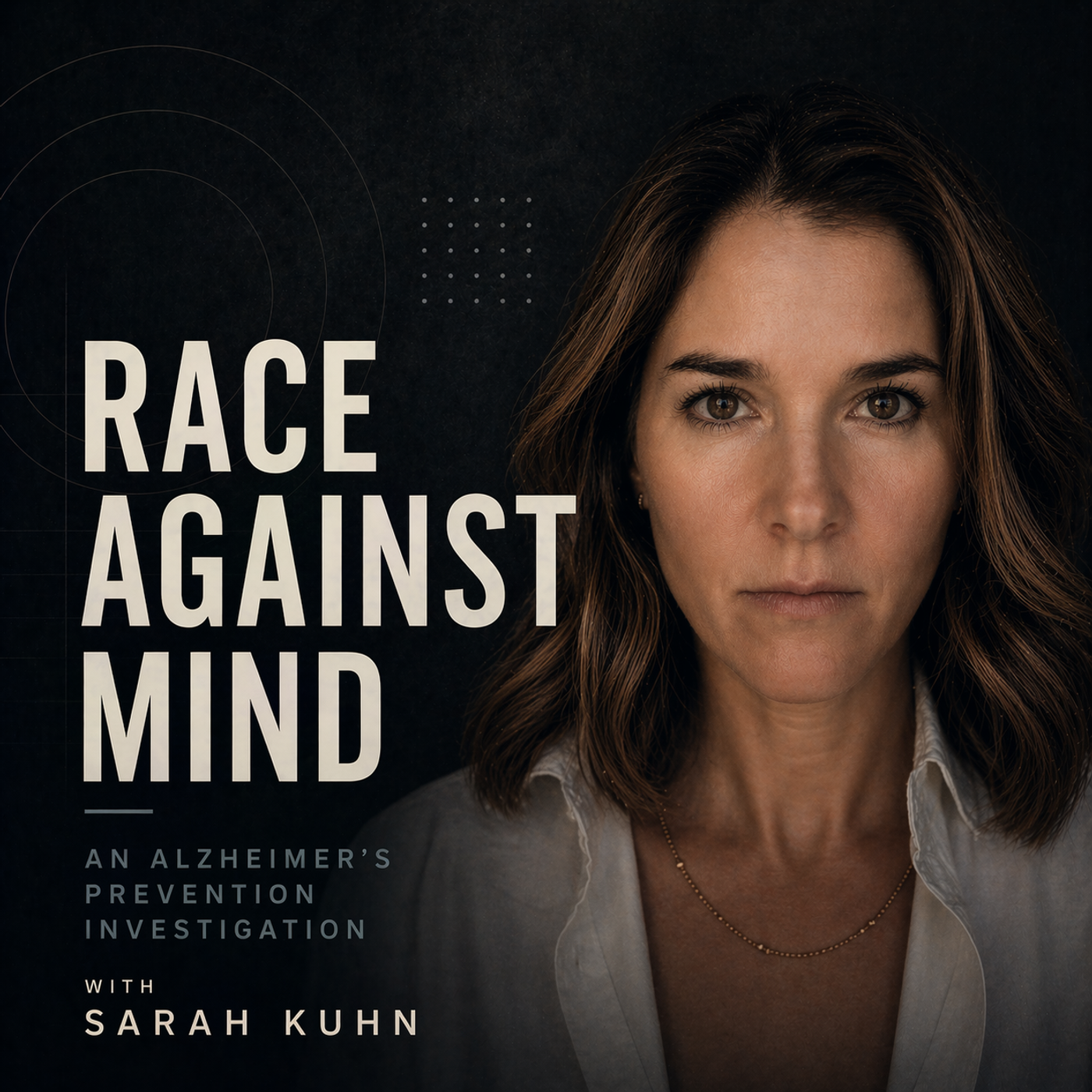
Race Against Mind: An Alzheimer's Prevention Investigation
by Sarah Kuhn
Race Against Mind is an Alzheimer's prevention investigation hosted by Sarah Kuhn, a double APOE4 carrier with a family history of early-onset Alzheimer's disease. Instead of waiting, Sarah started asking a different question: what does the research actually say, and what happens when you take it seriously?Each episode goes deep on one piece of the prevention puzzle: exercise, sleep, metabolic health, alcohol, hormones. Sarah breaks down the science, examines how strong it really is, and shares what she did with that information in her own life. What worked, what didn't, and what she changed her mind about along the way.If you carry APOE4, have a family history of Alzheimer's, or simply refuse to leave your brain health to chance, this show is for you.
-
9
Ep. 12 Does Botox Touch the Brain? What the Research Shows for APOE4
I've been getting Botox on and off since I was 38. I never once thought about what it might mean for my brain until another APOE4 carrier asked me directly. So I went looking for the research. What I found wasn't the verdict I expected in either direction, it was a genuine gap. This episode walks through what the actual studies say, where they contradict each other, why dose and route matter more than headlines suggest, and how I made a decision without getting the certainty I wanted.This episode breaks from the usual protocol format, there's no clean "here's what works" takeaway. Instead I trace how I went looking for evidence that cosmetic Botox affects the brain in someone with my genetics, and ended up with a research gap instead of an answer. I cover the biological reasons APOE4 carriers have a different baseline worth asking about, walk through the specific studies that pointed in different directions, explain how dose and exposure route changed my read of the evidence, and get honest about the fact that vanity, not brain safety, is what actually got me back in the chair.Show Notes
-
8
Ep. 11 The Accumulation: What I Do When the Research Doesn't Give Me an Answer
This episode is different. No protocol, no experiment, no takeaways in the usual sense. Instead, I'm sitting with what happens when APOE4 research keeps getting more specific and doesn't hand me anything to actually do about it.I walk through a new study on how APOE4 disrupts a backup fuel system in aging neurons, my own spiral into APOC1 research after a confident claim from a longevity doctor turned out to be more complicated than advertised, and what it's actually like to keep learning about a gene that touches nearly every system tied to Alzheimer's risk. This one is about the accumulation, not the answer.Show Notes
-
7
Ep. 10 Chronic Stress, Cortisol & Alzheimer's Risk: The APOE4 Vulnerability No One Talks About
Chronic stress is one of the most underappreciated risk factors for Alzheimer's disease and for APOE4 carriers, the relationship between stress hormones and neurodegeneration is not just additive. It's amplified through a distinct biological mechanism that operates independently of every other pillar in your prevention protocol.In this episode, Sarah walks through three years of personal HRV data that told her something her protocol wasn't accounting for, the research on why APOE4 carriers are fundamentally more vulnerable to the effects of chronic cortisol elevation, and what the science actually supports when it comes to stress reduction and Alzheimer's prevention. This is also the episode where the show's format changes and why.This episode covers: what HRV actually measures and why longitudinal trends matter more than daily scores, the APOE4-specific stress vulnerability equation, the odds ratio for Alzheimer's from chronic stress that rivals almost every other modifiable risk factor, the mitochondrial mechanism that makes cortisol more damaging in APOE4 brains, what the FINGER trial found about who benefits most from lifestyle intervention, and what Sarah is currently exploring.Show Notes
-
6
Ep. 9 The Perimenopause-Alzheimer’s Connection: HRT, APOE4, and Why Timing Changes Everything
Women account for two-thirds of all Alzheimer’s cases. For a long time, the explanation was simple: women live longer. But that doesn’t fully account for the gap. What the research is now pointing to is that something happens during the perimenopausal transition that changes the brain’s trajectory : and for APOE4 carriers, that transition isn’t just uncomfortable. It may be the highest-leverage window in the entire prevention timeline. And it has a closing date.Last summer I started getting headaches I’d never had before. I was waking at 4am again : but differently than the nocturnal glucose drops I tracked in Episode 4. My CGM showed flat lines. My mood in the week before my period was something my husband noticed before I did. My cycles were shortening. I got my hormones tested. Everything came back normal. A month later I tested again : and the numbers were completely different.That second test is when I stopped telling myself it was stress.This episode covers what I found when I went into the research, covering the neuroprotective role of estrogen and progesterone, the FSH finding that changes how the field thinks about hormonal risk, the critical window hypothesis, the WHIMS study and what it actually tested, why the breast cancer scare was driven by the wrong formulation, and what all of it means specifically for APOE4 carriers. Then what I personally did: two hormone panels, bioidentical progesterone in November, transdermal estradiol in January, and what happened.I’m 42. I’m a double APOE4 carrier. This is not a future episode topic anymore.Shownotes
-
5
Ep. 8 The Alzheimer's Risk Factor Hidden in Your Nightly Glass of Wine
I was having a glass of wine most nights when I got my Oura Ring. Not a lot, or so I thought. Within weeks the data told a different story. My HRV baseline runs in the nineties. On mornings after drinking, even one glass, it dropped to the thirties or forties. Every time. Without exception.That data started a three-year experiment I didn't plan to run. And on December 31st, 2024, I eliminated alcohol entirely.What I expected was clarity. What I got instead, and what eventually led me to the p-tau217 test, a reinfected root canal, and a completely different understanding of why a clean baseline matters, is the story this episode tells.The research on alcohol and Alzheimer's has shifted significantly in the last few years and most people haven't caught up to it. The apparent protective effect of moderate drinking has largely collapsed under methodological scrutiny. The 2025 ALBION study found that light-to-moderate drinkers had nearly three times the odds of amyloid-beta positivity compared to abstainers. Not heavy drinkers. People who would never describe themselves as having a drinking problem. For APOE4 carriers specifically, one prospective study found that drinking at least once a month was associated with seven times the dementia risk compared to never drinking. Same behavior. Completely different biological outcome depending on what's in your DNA.This episode covers what the research actually says, why the APOE4 picture is categorically different from the general population, what eighteen months of not drinking actually cost me socially, and the thing I least expected to learn about why elimination matters beyond optimization.Show Notes
-
4
Ep.7 Blueberries, Coconut Oil, and the Mediterranean Diet: What the Nutrition Research Actually Says
Someone told me to give my mom coconut oil after her Alzheimer's diagnosis. My mom couldn't remember I was pregnant at the time. The person meant well. The advice was wrong. And for someone with APOE4 genetics — which both my mom and I carry — it wasn't just wrong. It was potentially the opposite of what the research supports.That moment is where this episode starts. Because the problem isn't people giving bad advice. The problem is an information ecosystem built to capture attention rather than convey evidence. Confident nutrition claims travel faster than careful ones, and for APOE4 carriers specifically, some of what's circulating online isn't just unhelpful, it's working against you.This is the third and final episode in the Race Against Mind nutrition series. Episodes 5 and 6 covered the personal cholesterol arc and the APOE4 lipid mechanism. This episode covers the broader nutrition research: what the science actually says about coconut oil, MCT oil, blueberries, the Mediterranean diet, omega-3s, B vitamins, ketogenic diets, and more. What's signal, what's noise, and what the internet consistently gets wrong.The structure is deliberate: myths first, nuanced middle, then what actually has evidence. Because knowing what to be skeptical of makes the things that are genuinely supported land differently. If you've been eating well for years and wondering why nutrition advice keeps disappointing you — this episode is for you.Show Notes
-
3
Ep. 6 APOE4, Cholesterol, and Alzheimer's Risk: What Your Lipid Panel Is Missing
In February of last year, I woke up with brain fog so severe I started researching how to get a brain scan. I was convinced I had amyloid accumulating. I wanted data, not reassurance. It turned out to be a reinfected root canal. But that fear led somewhere useful — to a p-tau217 baseline test and a consulting engagement with an Alzheimer's prevention company that finally gave me the answer I'd been missing for twenty years.Sitting down to write a research paper on cholesterol and Alzheimer's risk, something clicked: of course my cholesterol is high. My APOE4 genotype makes lipid handling harder. That's not a diet failure. That's a design problem.This episode is the science companion to Episode 5. Where Episode 5 was the lived experience of five years of dietary intervention that barely moved the needle, this episode is the explanation — why cholesterol is a fundamentally different problem for APOE4 carriers, what it actually does in the brain, and why the standard lipid panel isn't giving you the full picture.We cover: what APOE4 actually does to lipid transport, amyloid clearance, neuroinflammation, and tau vulnerability. Why ApoB matters more than LDL for APOE4 carriers — and what the garbage bag analogy actually means for your cardiovascular and brain risk. What Lp(a) is and why you need to test it at least once. Why the connection between cardiovascular risk and Alzheimer's risk isn't two separate conversations for people with this genotype — it's one. And why understanding the mechanism finally made the statin decision obvious.Sarah is six weeks into a statin as of this recording, with no post-statin labs yet. She also has a p-tau217 baseline in — and explains why one result doesn't tell you much, but a trend over time could tell you everything.Show Notes
-
2
Ep. 5 Why Keto Backfired: MCT Oil, APOE4, and the Cholesterol I Couldn't Fix With Diet
I've had high cholesterol since I was nine years old. I know, because my mom took away my chicken nuggets and put me on a diet. Three months later it came back to normal. Problem solved — or so I thought.It took until I was twenty-seven, two years into being vegetarian, to see a normal reading again. Total cholesterol of 139. I remember thinking: I finally figured it out. That one number became my proof of concept for the next 15 years.In this episode, I walk through five years of serious dietary intervention after getting my APOE4 result and a baseline LDL of 220. High Fiber Keto. Bulletproof coffee with MCT oil. KetoFlex 12/3. Extended fasting. Paleo. Plant-based. Supplements. And as of August 2025 — after all of it — my LDL was 149. Still high. Still not where it needs to be for someone with my risk profile.So I started a statin.This episode is about what that journey revealed — about the APOE4-specific reasons keto and MCT oil backfired, about why plant-based eating barely moved my numbers, and about what it looks like when the pillar you believed in most turns out not to be the lever you thought it was. I also get into why someone who's been eating well for twenty years shouldn't expect the same results from dietary intervention as someone who hasn't — and why that distinction matters more than most nutrition advice acknowledges.Note: this is the first of three nutrition episodes. Episode 6 covers the cholesterol mechanism and why APOE4 carriers have a fundamentally different lipid problem than most people. Episode 7 covers the broader nutrition and Alzheimer's prevention research — blueberries, the Mediterranean diet, omega-3s, and what the science actually says.Show Notes
-
1
Ep. 4 The Case for Taking Sleep Seriously: What the Research Says and How to Use Your Data
Sleep is the most underrated lever in brain health. The research is unusually clear: what happens during deep sleep directly affects your risk of cognitive decline, the hormones that regulate hunger, your cardiovascular recovery, and your body's ability to clear the metabolic waste that accumulates in your brain every single day. Most people know sleep matters. Far fewer understand what's actually breaking it.This episode covers the science of why sleep is especially high-stakes for anyone thinking about long-term brain health, what the research says about glymphatic clearance, HRV, the sleep-eating cycle, and circadian consistency, and how tracking your own data can reveal the specific variables disrupting your sleep in ways general advice never will.The personal thread: three years of sleep data, a fasting protocol that accidentally improved sleep architecture, the discovery that alcohol and late eating affect sleep through completely different mechanisms, and what a continuous glucose monitor revealed about a 4am waking pattern that took months to explain.Show Notes
-
0
The Exercise Research Every APOE4 Carrier Needs to Hear
This episode goes deep on the exercise pillar. The four mechanisms connecting movement to brain health, including a 2026 UCSF study that identified a liver enzyme that repairs the blood-brain barrier and what it reveals about why consistency matters at a molecular level.We also get into why getting stronger is different from lifting consistently, what the SMART trial found when it measured both strength and aerobic capacity in the same participants, and why VO2 max may be the most important fitness number you are not tracking.Plus my parents as a natural experiment, where my own protocol stands after two years of deliberate changes, and four questions to audit whether what you are already doing is actually building what your brain needs.The research. The mechanisms. What I changed. What the data showed.Show Notes
-
-1
How to Build a Baseline and Understand Your Risk
For APOE4 carriers, knowing your risk is only useful if you know what to do with it. In this episode, Sarah walks through her path to developing a baseline, and discusses the labs that actually matter, fasting insulin, homocysteine, hs-CRP, Vitamin D etc. Sarah also discusses why standard functional medicine isn't specific enough for APOE4 biology, and how to interpret baseline data without losing your mind in the process.Whats in this episode: What APOE4 actually is, and what it isn'tWhy the "nothing you can do" frame is the most expensive mistake APOE4 carriers can makeThe research caveat problem: why so many studies don't apply to people like meHow I built my first baseline with blood work and cognitive testing before changing anythingWhy I started with Parsley Health and then moved to Dale Bredesen's PreCODE programWhat my PreCODE report revealed across metabolic, inflammatory, and cognitive domainsWhy my cognitive scores required more context than just a number on a page (ADHD, breastfeeding, medication status)Three practical takeaways for anyone at the beginning of this journeyWhy exercise leads Season 1, even though it wasn't where I startedShow Notes & References
-
-2
APOE4 Positive and Alzheimer's Risk: One Woman's 5-Year Brain Health Protocol
Sarah is homozygous APOE4, the highest genetic risk profile for Alzheimer's disease. Her grandmother had it. Her mother was diagnosed at 58. When she got her own results, she didn't wait.In this first episode, she traces how a family legacy of Alzheimer's became a five-year personal research project and why the window for meaningful intervention is decades earlier than most people think. She breaks down what carrying two copies of APOE4 actually means, where the science is solid and where it falls short, and how she built a protocol around the pillars most likely to move the needle: nutrition, sleep, fitness, alcohol, and hormones. This is where it all starts.Show Notes & References
We're indexing this podcast's transcripts for the first time — this can take a minute or two. We'll show results as soon as they're ready.
No matches for "" in this podcast's transcripts.
No topics indexed yet for this podcast.
Loading reviews...
ABOUT THIS SHOW
Race Against Mind is an Alzheimer's prevention investigation hosted by Sarah Kuhn, a double APOE4 carrier with a family history of early-onset Alzheimer's disease. Instead of waiting, Sarah started asking a different question: what does the research actually say, and what happens when you take it seriously?Each episode goes deep on one piece of the prevention puzzle: exercise, sleep, metabolic health, alcohol, hormones. Sarah breaks down the science, examines how strong it really is, and shares what she did with that information in her own life. What worked, what didn't, and what she changed her mind about along the way.If you carry APOE4, have a family history of Alzheimer's, or simply refuse to leave your brain health to chance, this show is for you.
HOSTED BY
Sarah Kuhn
Loading similar podcasts...
Frequently Asked Questions
How many episodes does Race Against Mind: An Alzheimer's Prevention Investigation have?
Race Against Mind: An Alzheimer's Prevention Investigation currently has 12 episodes available on PodParley. New episodes are automatically indexed when they're published to the podcast feed.
What is Race Against Mind: An Alzheimer's Prevention Investigation about?
Race Against Mind is an Alzheimer's prevention investigation hosted by Sarah Kuhn, a double APOE4 carrier with a family history of early-onset Alzheimer's disease. Instead of waiting, Sarah started asking a different question: what does the research actually say, and what happens when you take it...
How often does Race Against Mind: An Alzheimer's Prevention Investigation release new episodes?
Race Against Mind: An Alzheimer's Prevention Investigation has 12 episodes. Check the episode list to see recent publication dates and frequency.
Where can I listen to Race Against Mind: An Alzheimer's Prevention Investigation?
You can listen to Race Against Mind: An Alzheimer's Prevention Investigation on PodParley by clicking any episode. We provide an embedded audio player for direct listening, and you can also subscribe via your preferred podcast app using the RSS feed.
Who hosts Race Against Mind: An Alzheimer's Prevention Investigation?
Race Against Mind: An Alzheimer's Prevention Investigation is created and hosted by Sarah Kuhn.
URL copied to clipboard!