
PODCAST · religion
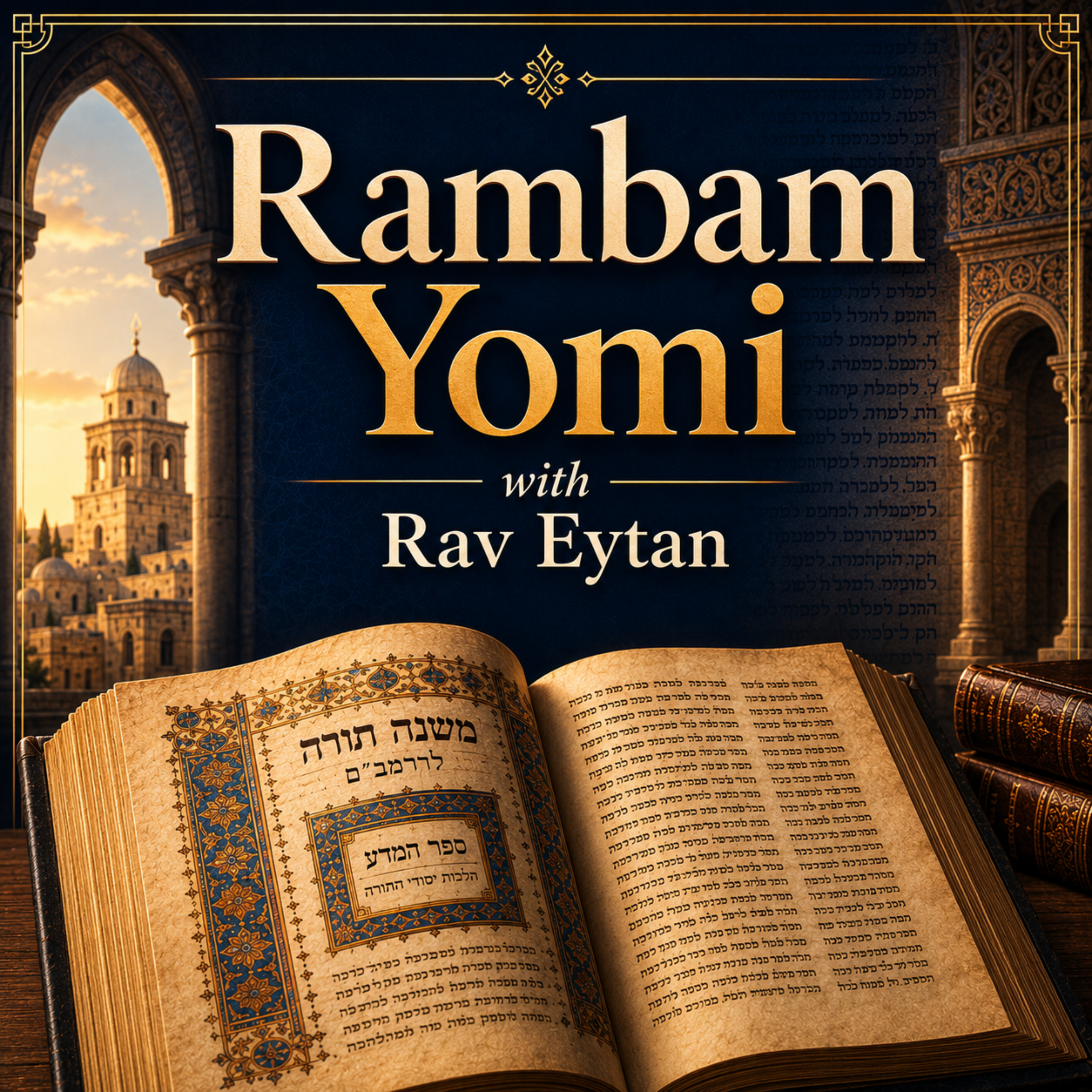
Rambam Yomi with Rav Eytan
by Eytan Kleinberg
Join me for a short daily shiur as we make our way through the Rambam's Mishneh Torah, one Perek at a time.The Mishneh Torah is Rambam's monumental code of Jewish law, presenting the entirety of Torah SheBe'al Peh in a clear and organized format. In these short daily sessions, we'll explore the text inside, focusing on understanding the Rambam's language, structure, and practical insights.
-
90
Hilchot Milah - פרק ב
Perek ב: What's Permitted Around the BritHaving established that the circumcision itself can override Shabbat, this Perek draws the line around it, what preparatory actions are and aren't permitted, from preparing tools to handling the aftercare, and where the leniency for the Mitzvah stops.
-
89
Hilchot Milah - פרק א
Perek א: A Brit That Overrides ShabbatThis opening Perek establishes circumcision as one of the most severe positive commandments in the Torah, carrying the penalty of Karet if left unfulfilled, and covers who is obligated, whether father, master, or court. It works through an extensive set of cases for exactly when circumcision overrides Shabbat, premature births, doubtful gestation, a sick or discolored infant, and when a family has already lost children to complications.
-
88
Hilchot Brachot - פרק י״א
Perek י״א: Brachot Before Doing a MitzvahThe Rambam closes Hilchot Brachot with the category of Brachot recited before performing a commandment, Tefillin, Mezuzah, Sukkah, and more, along with the general principles for when such a Bracha is said and what happens when it's skipped.
-
87
Hilchot Brachot - פרק י
Perek י: Gratitude for the UnexpectedThis Perek turns to Brachot that mark life's turning points: Shehecheyanu for new and joyous occasions, Hatov VeHametiv when good news benefits others too, and the Bracha recited by someone who has survived danger.
-
86
Hilchot Brachot - פרק ט
Perek ט: The Brachot of FragranceScent is a pleasure the soul enjoys without the body benefiting, and the Chachamim required a Bracha before enjoying it just as before food. This Perek details the specific Brachot for different sources of fragrance, wood, herbs, oils, and spice blends, and the conditions under which a pleasant smell requires a Bracha at all.
-
85
Hilchot Brachot - פרק ח
Perek ח: Getting the Bracha RightThis Perek tackles the finer points of food Brachot: the order of precedence when several Brachot could apply to what's in front of you, what happens if you recite the wrong blessing by mistake (and whether it still counts), and the rules for when foods eaten together need separate after-Brachot versus one that covers them all.
-
84
Hilchot Brachot - פרק ז
Perek ז: Setting the TableFrom the etiquette of breaking bread to the order in which guests wash their hands before grace, this Perek captures the small rituals that structure a proper meal, why salt is served first, and the practice of Mayim Acharonim before Birkat HaMazon.
-
83
Hilchot Brachot - פרק ו
Perek ו: Washing & EatingThis Perek details the ritual handwashing required before eating bread, the method, the obligation both before and after the meal, and the Halachic reasoning the Chachamim gave for a practice that isn't really about cleanliness at all.
-
82
Hilchot Brachot - פרק ה
Perek ה: Benching Together, as a GroupWhen three or more people eat bread together, a formal invitation to bless, the Zimun, precedes Birkat HaMazon. This Perek defines who can be counted for a Zimun, how the responsive formula works, and the special version recited with a Minyan present.
-
81
Hilchot Brachot - פרק ד
Perek ד: The Choreography of a MealFrom the wine served before the meal to the wine that follows it, this Perek walks through the practical sequencing of Brachot across an entire meal, including when a single Bracha covers everyone at the table and when each guest must bless for themselves.
-
80
Hilchot Brachot - פרק ג
Perek ג: Bread, Grain, and Everything BetweenNot all grain products are equal. This Perek works through the tricky cases, when something counts as bread requiring a full meal blessing, and when it's a 'lesser' Mezonot food, based on how it's prepared and eaten.
-
79
Hilchot Brachot - פרק ב
Perek ב: The Fine Print of GraceWhen exactly does the biblical obligation to bless HaShem after eating kick in, and how much food triggers it? This Perek details the structure of Birkat HaMazon itself, its four blessings and their sources, and the special additions for Eretz Yisrael and Jerusalem woven into the text.
-
78
Hilchot Brachot - פרק א
Perek א: A World That Isn't FreeEverything we eat and drink belongs to HaShem, so partaking without a blessing is like taking something consecrated. This opening Perek establishes the biblical and rabbinic sources for blessings before and after eating, introduces the hierarchy of food blessings, and explains why a single blessing over the primary food can exempt everything served alongside it.
-
77
Hilchot Tzitzit - פרק ג
Perek ג: Who Wears Them, and On WhatThis closing Perek addresses who is obligated in Tzitzit and who is exempt, including the discussion around women’s obligation, the rules about mixing wool and linen (Shatnez) in a Tzitzit garment, and a parent’s duty to train their children in the Mitzvah from a young age.
-
76
Hilchot Tzitzit - פרק ב
Perek ב: The Dye of the SkyWhat is Techelet, and why does its exact shade matter so much? This Perek explores the source and preparation of the sky-blue dye the Torah requires, the criteria for a Kosher batch, and what happens to Tzitzit when Techelet isn’t available.
-
75
Hilchot Tzitzit - פרק א
Perek א: Making the FringesEvery four-cornered garment carries a quiet reminder of the Mitzvot. This opening Perek explains how Tzitzit are constructed, the white strands and the strand of Techeilet wound around them, the required number of strands and knots, and the deeper purpose the Torah gives for wearing them.
-
74
Hilchot Tefillin, Mezuzah & Sefer Torah - פרק י
Perek י: What Disqualifies a ScrollThis closing Perek gathers twenty distinct factors that can invalidate a Torah scroll, and turns to the deep respect owed to a Kosher scroll, how it must be handled, stored, and treated as an object of genuine holiness.
-
73
Hilchot Tefillin, Mezuzah & Sefer Torah - פרק ט
Perek ט: The Structure of the ScrollContinuing the discussion of scribal form, this Perek addresses the broader architecture of a Kosher Torah scroll, its columns, its layout, and the conventions that give the scroll its unmistakable, unchanging shape across generations.
-
72
Hilchot Tefillin, Mezuzah & Sefer Torah - פרק ח
Perek ח: Open and Closed PassagesThe Torah is divided into 669 sections, each written in one of two distinct forms. This Perek explains the difference between a Petucha and Setuma passage, the spacing rules that define them, and the exceptional layouts used for Az Yashir and Ha'azinu.
-
71
Hilchot Tefillin, Mezuzah & Sefer Torah - פרק ז
Perek ז: The Craft of a Torah ScrollWriting a Torah scroll is an exacting art. This Perek covers the physical form the letters must take, the spacing of words and columns, and the artistry the Chachamim praised in a scroll written beautifully and precisely.
-
70
Hilchot Tefillin, Mezuzah & Sefer Torah - פרק ו
Perek ו: Fixing the Mezuzah in PlaceWhere exactly does a Mezuzah go, and why? This Perek details its placement on the doorpost, the height and positioning that Halacha requires, and closes with the deeper idea that the Mezuzah is meant to keep a person's awareness of HaShem at the entrance to daily life.
-
69
Hilchot Tefillin, Mezuzah & Sefer Torah - פרק ה
Perek ה: Writing a MezuzahThis Perek turns to the Mezuzah: how the two passages of Shema and V'haya are written on a single parchment, the acceptable and unacceptable forms, and why a Mezuzah may not be repurposed from a worn Torah scroll or Tefillin.
-
68
Hilchot Tefillin, Mezuzah & Sefer Torah - פרק ד
Perek ד: Putting On the TefillinBeyond how Tefillin are made lies the question of how they're worn. This Perek covers the obligation to don Tefillin, the correct order and positioning, and the specific circumstances, distraction, impurity, disrespect, that require removing them.
-
67
Hilchot Tefillin, Mezuzah & Sefer Torah - פרק ג
Perek ג: Eight Unbending RequirementsThe Rambam lists eight structural requirements for Kosher Tefillin, from their square shape to their stitching, all transmitted as Halacha Moshe Mi'Sinai. This Perek walks through each requirement and what happens when even one is not met.
-
66
Hilchot Tefillin, Mezuzah & Sefer Torah - פרק ב
Perek ב: Writing the Parshiyot of TefillinHow exactly are the four passages inside Tefillin written? This Perek details the precise spelling, order, and layout of the Parshiyot for both the head and arm Tefillin, including the letters that require special crowns, and explains why any deviation disqualifies the Tefillin entirely.
-
65
Hilchot Tefillin, Mezuzah & Sefer Torah - פרק א
Perek א: The Sanctity of the Written WordThis opening Perek introduces the five Mitzvot at the heart of this section: wearing Tefillin on the head and arm, affixing a Mezuzah, and writing a Torah scroll. It lays down the foundational rules for any sacred scribe, who may write these texts, the intent required when inscribing HaShem's name, and why a single flawed letter can invalidate the entire article.
-
64
Hilchot Tefilla - פרק ט״ו
Perek ט״ו: Who May Not BlessNot every Kohen can step forward to bless the congregation. This closing Perek details the six factors that disqualify a Kohen from Nesiat Kapayim, from physical concerns to matters of conduct, rounding out the laws of Tefilla.
-
63
Hilchot Tefilla - פרק י״ד
Perek י״ד: Birkat KohanimNesiat Kapayim, the Priestly Blessing, is unpacked here: when in the service it's recited, the procedure the Kohanim follow, and why it's reserved for certain Tefillot and left out of others.
-
62
Hilchot Tefilla - פרק י״ג
Perek י״ג: A Year of TorahHow does the yearly reading cycle actually work? This Perek traces the annual progression through the Torah, the special readings for festivals and fasts, and the layered calendar that determines what's read and when.
-
61
Hilchot Tefilla - פרק י״ב
Perek י״ב: Reading the Torah in PublicThe structure of Kriyat HaTorah takes center stage here: the required times for public reading, who is called to the Torah and in what order, and the rules that keep this cornerstone of communal life running smoothly.
-
60
Hilchot Tefilla - פרק י״א
Perek י״א: Building a 'House for Prayer'Every community needs its own Shul. This Perek explores the Halachic requirements for building one, its ideal location and structure, and the layer of sanctity that transforms a physical building into a place set apart.
-
59
Hilchot Tefilla - פרק י
Perek י: When Things Go WrongMistakes happen mid-Tefilla, so what then? This Perek works through the practical rules for errors in the Amidah, when the individual or the Chazzan must go back and repeat, and how missed Tefilla can sometimes be made up later.
-
58
Hilchot Tefilla - פרק ט
Perek ט: Following the ChazanWhat exactly happens when the chazan steps up to lead? This Perek walks through the choreography of public prayer, from Kaddish and Barchu to the Kedusha recited only in the presence of a minyan, and the congregation's responsibility to answer along the way.
-
57
Hilchot Tefilla - פרק ח
Perek ח: Why Daven With a Minyan?A prayer offered alone and a prayer offered with nine others are not treated the same. This Perek explains the unique power of communal prayer, defines what constitutes a minyan, and introduces the chazan's essential role in repeating the Amidah aloud for the congregation.
-
56
Hilchot Tefilla - פרק ז
Perek ז: A Hundred Brachot a DayFrom the moment you open your eyes to the moment you fall asleep, the Rambam maps out a blessing for nearly everything: waking, dressing, standing, walking, even leaving the bathroom. This Perek catalogues the morning blessings one by one, explains the Chachamim's requirement to recite 100 Brachot daily, and lays out the full order of Shacharit, Mincha, and Maariv from start to finish.
-
55
Hilchot Tefilla - פרק ו
Perek ו: Why We Need a MinyanTefilla with a community carries a different weight than prayer alone. This Perek introduces the value the Rambam places on the role of the Chazan and the different pauses one must take in their daily activities in order to Daven.
-
54
Hilchot Tefilla - פרק ה
Perek ה: Body and Mind in PrayerWhere do you face? How do you stand? This Perek explores the physical postures of prayer and the inner focus the Rambam considers essential, not optional, for the Amidah to count.
-
53
Hilchot Tefilla - פרק ד
Perek ד: Getting Ready to Stand Before HaShemBefore you can pray, there's preparation. This Perek details the physical and mental readiness the Rambam demands: washing the hands, a clean body and place, appropriate dress, and the famous list of conditions for approaching prayer properly.
-
52
Hilchot Tefilla - פרק ג
Perek ג: Who Prays, and WhenThree times a day, but not for everyone equally. This Perek covers the obligations of men, women, and those with exemptions, the windows of time for Shacharit, Mincha, and Maariv, and what happens when those windows are missed.
-
51
Hilchot Tefilla - פרק ב
Perek א: The Structure of Shemoneh EsreiWhy nineteen blessings, in this order, with this content? This Perek walks through the architecture of the Amidah blessing by blessing, and explains why the text had to be fixed rather than left to each person's own words.
-
50
Hilchot Tefilla - פרק א
Perek א: Where Does Prayer Come From?Is daily prayer a Torah obligation or a rabbinic one? The Rambam opens with a surprising answer, then walks through the history of how Ezra and the Anshei Knesset HaGedolah standardised the text of prayer after the exile, when Hebrew itself was slipping away from the people.
-
49
Hilchot Kriyat Shema - פרק ד
Perek ד: Impurity, Interruptions, and ExceptionsCan someone who is impure still read Shema? What happens if you're interrupted mid-verse? This closing Perek works through the practical edge cases, including the halachic history of Ezra's decree and its reversal, rounding out the laws of when and how Kriyat Shema can be fulfilled.
-
48
Hilchot Kriyat Shema - פרק ג
Perek ג: Where You Can't Read ShemaKedusha demands the right setting. This Perek explores the physical conditions that disqualify a reading of Shema altogether, from unclean places to bad odors, and why the Rambam treats the environment around you as inseparable from the Mitzvah itself.
-
47
Hilchot Kriyat Shema - פרק ב
Perek ב: Reading With PrecisionSaying Shema isn't just about the words, it's about how you say them. This Perek covers the Rambam's rules for careful pronunciation, not swallowing letters, pausing correctly between words and phrases, and why intent (Kavana) on the first Passuk carries a weight of its own.
-
46
Hilchot Kriyat Shema - פרק א
Perek א: The Mitzvah of twice dailyWhy do we declare HaShem's oneness morning and night, and where does that obligation actually come from? This Perek lays the foundation of Kriyat Shema, tracing its source to the Torah itself, defining the time windows for reading it each day, and clarifying who is obligated and who is exempt.
-
45
Hilchot Teshuva - פרק י
Perek י: Serving God Out of LoveThe Rambam closes Hilchot Teshuva with his ultimate goal: serving HaShem not from fear of punishment or hope of reward, but from love. This final Perek describes how contemplating HaShem's wisdom and creation leads to that love, the highest level a person can reach.
-
44
Hilchot Teshuva - פרק ט
Perek ט: Reward, Punishment, and This WorldIf Olam Haba is spiritual, what do all the physical blessings and curses in the Torah actually mean? This Perek explains the Rambam's approach to material reward and punishment as tools for serving HaShem properly in this world, distinct from the ultimate reward still to come.
-
43
Hilchot Teshuva - פרק ח
Perek ח: What Is Olam Haba?What actually awaits the righteous in the World to Come? The Rambam offers his boldest and most debated formulation: a purely spiritual existence, without bodies, without eating or drinking. This Perek unpacks what that reward looks like and why it defies physical description.
-
42
Hilchot Teshuva - פרק ז
Perek ז: The Power of ReturnHere the Rambam turns from law to praise. Teshuva doesn't just erase the past, it elevates a person, in some ways beyond someone who never sinned at all. This Perek explores the closeness to God that Teshuva makes possible, and why the ultimate redemption depends on it.
-
41
Hilchot Teshuva - פרק ו
Perek ו: When Teshuva Is Taken AwayCan a person lose the ability to repent? Building on the free will discussion, this Perek looks at cases like Pharaoh's hardened heart, where Teshuva itself is withheld as a consequence for certain grave choices. A sobering look at what's at stake in our decisions.
We're indexing this podcast's transcripts for the first time — this can take a minute or two. We'll show results as soon as they're ready.
No matches for "" in this podcast's transcripts.
No topics indexed yet for this podcast.
Loading reviews...
ABOUT THIS SHOW
Join me for a short daily shiur as we make our way through the Rambam's Mishneh Torah, one Perek at a time.The Mishneh Torah is Rambam's monumental code of Jewish law, presenting the entirety of Torah SheBe'al Peh in a clear and organized format. In these short daily sessions, we'll explore the text inside, focusing on understanding the Rambam's language, structure, and practical insights.
HOSTED BY
Eytan Kleinberg
CATEGORIES
Loading similar podcasts...
Frequently Asked Questions
How many episodes does Rambam Yomi with Rav Eytan have?
Rambam Yomi with Rav Eytan currently has 50 episodes available on PodParley. New episodes are automatically indexed when they're published to the podcast feed.
What is Rambam Yomi with Rav Eytan about?
Join me for a short daily shiur as we make our way through the Rambam's Mishneh Torah, one Perek at a time.The Mishneh Torah is Rambam's monumental code of Jewish law, presenting the entirety of Torah SheBe'al Peh in a clear and organized format. In these short daily sessions, we'll explore the...
How often does Rambam Yomi with Rav Eytan release new episodes?
Rambam Yomi with Rav Eytan has 50 episodes. Check the episode list to see recent publication dates and frequency.
Where can I listen to Rambam Yomi with Rav Eytan?
You can listen to Rambam Yomi with Rav Eytan on PodParley by clicking any episode. We provide an embedded audio player for direct listening, and you can also subscribe via your preferred podcast app using the RSS feed.
Who hosts Rambam Yomi with Rav Eytan?
Rambam Yomi with Rav Eytan is created and hosted by Eytan Kleinberg.
URL copied to clipboard!