
PODCAST · health
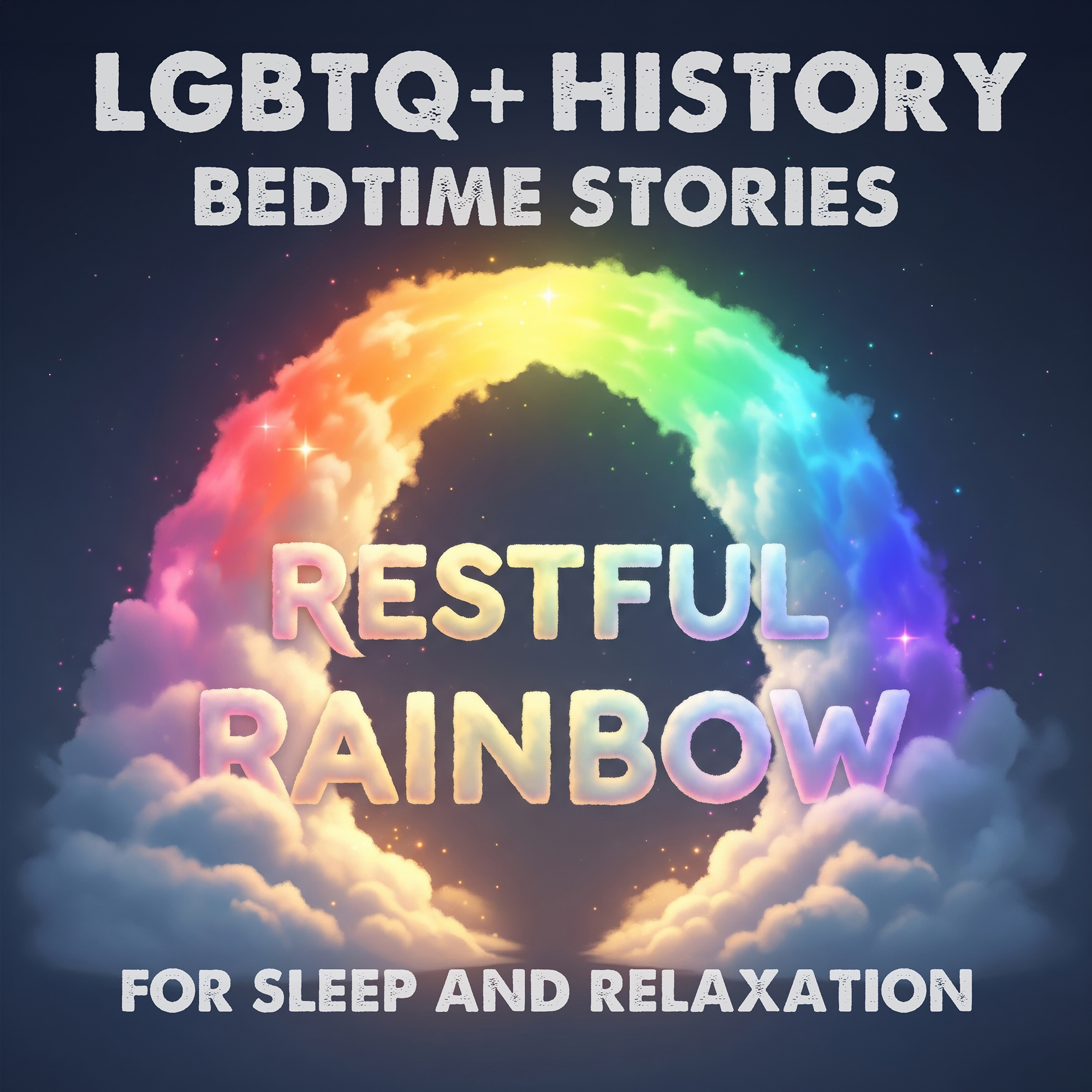
Restful Rainbow
by Ducky Media
LGBTQ+ History bedtime and relaxation stories, aiming to offer comfort, representation, and a touch of magic to listeners drifting off to sleep.https://restful-rainbow.captivate.fm/support
-
131
The Stones That Remembered: Hawaii's Māhū Healers of Kapaemahu
Drift off to sleep learning about the Healer Stones of Kapaemahu, four boulders on Waikīkī Beach that have held a suppressed truth for five centuries.Long before the reign of chief Kakuhihewa in the 1500s, four healers sailed from Tahiti to Oʻahu: Kapaemahu, Kahaloa, Kapuni, and Kinohi. They were māhū, people of dual male and female spirit, and in Hawaiian understanding, that duality was the source of their healing power. Beloved for their gentle ways and miraculous cures, they were honored at their departure with four great stones moved by thousands of people on the sacred night of Kāne, imbued with the healers' names and mana after a month of ceremony. Princess Kaʻiulani laid seaweed lei on the stones before her morning swims. Then missionaries arrived, the word māhū fell into forced silence, and in 1941 the stones were buried under a bowling alley. Unearthed in 1963 and restored in 1997, the monument's signage still erased the healers' identity, until Kumu Hinaleimoana Wong-Kalu and filmmakers Dean Hamer and Joe Wilson brought the story back with the Oscar-shortlisted animated film "Kapaemahu" (2020), narrated in ʻŌlelo Niʻihau, a Bishop Museum exhibition, and a new bronze plaque dedicated October 24, 2023, the first signage ever to name the healers' dual male and female spirit.Tonight's story is told twice: once at a natural pace, then again slowly, with longer pauses, to guide you gently into sleep.Support the show: https://restful-rainbow.captivate.fm/support and if not, no need at all, sleep well either way.
-
130
The Sun of Tabriz: Rumi & Shams and the Love That Created 40,000 Poems
Drift off to sleep with the most famous love story in the history of poetry. In November 1244, a wandering dervish named Shams of Tabriz stopped a professor's mule in the streets of Konya and asked him a question, and Jalal al-Din Rumi, a respected scholar who had never written a verse, became the poet whose words are still read in a hundred languages tonight. When Shams vanished in the winter of 1248, Rumi's grief became more than 40,000 verses of love poetry, gathered under his beloved's name, the Divan-e Shams-e Tabrizi, with thousands of poems signed "Shams" instead of "Rumi." Tonight we travel through the meeting in the market street, the forty days of seclusion, the whirling that began among goldsmiths' hammers, the searches through Damascus, and the December night in 1273 that Konya still celebrates as Shab-e Arus, the Wedding Night.As always, the story is told twice, once at a natural pace, then again slowly, with long pauses, to carry you into sleep. You are part of a long, beautiful history. And you are safe here.Support the show (only if you'd like, no need at all, sleep well either way): https://restful-rainbow.captivate.fm/support
-
129
The Emperor Who Cut His Sleeve for Love: Ancient China's 2,000-Year-Old Love Story (Emperor Ai & Dong Xian)
An emperor wakes from an afternoon nap to find the man he loves asleep on his sleeve. Rather than wake him, he calls for a blade and cuts the sleeve off. Two thousand years later, "the cut sleeve" is still how the Chinese language remembers love between men.Tonight we travel to Han dynasty China, around 4 BCE, into the lacquered halls and plum-blossom courtyards of the Weiyang Palace in Chang'an, where Emperor Ai fell in love with a young official named Dong Xian. Recorded plainly in the Book of Han, theirs is one of the oldest documented love stories between men anywhere in the world: the shared naps, the extravagant devotion, the rise of Dong Xian to the highest office in the empire at twenty-two, the banquet where the emperor mused about giving him the throne itself, and the single act of tenderness that outlived the dynasty, the empire, and every critic who wrote it down.As always, the story is told twice: once at a natural pace, then again slowly, with longer pauses, to guide you gently into sleep. You are part of a long, beautiful history, and you are safe here.Support the show (only if you'd like, no need at all): https://restful-rainbow.captivate.fm/supportTopics: LGBTQ+ history, queer history, gay history, Chinese history, Han dynasty, Emperor Ai, Dong Xian, the cut sleeve, duanxiu, the bitten peach, sleep story for adults, bedtime story, relaxation.
-
128
Apology Accepted: The Lavender Scare and the First White House Picket (1950–2009)
They fired thousands for who they loved, and the fired found each other on the sidewalk. Tonight: the Cold War purge history nearly forgot, the ten people who walked a silent circle at the White House on April 17, 1965, the attic where every picket sign waited fifty years, and the June morning in 2009 when the U.S. government finally said sorry, and one man answered, "Apology accepted."Told twice, as always: first at a natural pace, then slowly, with longer pauses, to carry you into sleep.Along the way: cherry blossoms on Pennsylvania Avenue, hand-lettered signs on wooden sticks, a coat held for a friend, and seventy thousand pieces of one stubborn life resting safe in the Library of Congress.☕ Restful Rainbow is independent and listener-supported: https://restful-rainbow.captivate.fm/supportRelated episodes: Frank Kameny: The Astronomer Who Reached for Justice · A Mystic Bond (ONE Magazine) · Quiet Courage (Daughters of Bilitis) · Barbara Gittings, The Librarian Who Changed the World
-
127
Looking at the Stars: The Rise, Fall & Vindication of Oscar Wilde (1854–1900) | LGBTQ+ History Sleep Story
Drift off to sleep learning about Oscar Wilde, the most famous wit in the English language, and one of the most beloved figures in LGBTQ+ history. Born in Dublin on October 16, 1854, to surgeon Sir William Wilde and the poet "Speranza," Oscar conquered Oxford, lectured across America in 1882, married Constance Lloyd, told fairy tales like The Happy Prince to his sons, and filled London's West End with The Picture of Dorian Gray, Lady Windermere's Fan, An Ideal Husband, and The Importance of Being Earnest, which opened in a snowstorm on Valentine's Day 1895 at the peak of his fame. Four days later the Marquess of Queensberry, father of Wilde's lover Lord Alfred "Bosie" Douglas, left a misspelled card at his club. Wilde's doomed libel suit led to his arrest at the Cadogan Hotel and two trials for "gross indecency," where his speech defending "the love that dare not speak its name" drew applause from the public gallery. Convicted May 25, 1895, he served two years' hard labour, writing De Profundis in Reading Gaol as prisoner C.3.3. He died in Paris on November 30, 1900, with Robbie Ross at his side, the devoted friend who paid off his debts, moved him to Père Lachaise beneath Jacob Epstein's winged monument, and in 1950 was laid inside the tomb beside him. Today the tomb sits behind glass to protect it from thousands of lipstick kisses, and in January 2017 Wilde was posthumously pardoned under the Alan Turing law.Tonight's story is told twice, first at a natural pace, then again slowly with longer pauses to carry you gently into sleep. Along the way you'll sit in a Dublin salon, watch snow fall over a glowing London theatre, find the stars through a high cell window, and walk the golden evening avenues of Père Lachaise.🌙 Perfect for: sleep, relaxation, LGBTQ+ history, queer literary history, bedtime stories for adults, gay history, mindful rest☕ Restful Rainbow is independent and listener-supported. If these stories help you rest, you can support the show here: https://restful-rainbow.captivate.fm/support💜 Subscribe for more LGBTQ+ history sleep stories, and tell us in the comments: what's your favorite Wilde line?Related episodes:The Gentle Genius: Alan TuringMichelangelo's Secret LoveJohn Addington SymondsThe Unfolding Garden: André Gide"We are all in the gutter, but some of us are looking at the stars." — Oscar Wilde, Lady Windermere's Fan (1892)#OscarWilde #LGBTQHistory #SleepStory #QueerHistory #BedtimeStory #GayHistory #TheImportanceOfBeingEarnest #DorianGray #PereLachaise #ReadingGaol #DeProfundis #LoveIsLove #PrideHistory #Relaxation #SleepMeditation #CalmHistory #IrishHistory #VictorianLondon #DeepSleep #RestfulRainbow
-
126
Equal Dignity: The Love Story Behind Obergefell v. Hodges | LGBTQ+ History Sleep Story
Jim Obergefell and John Arthur were together for twenty years before the law learned the word for it. Tonight: the medical jet on a Maryland tarmac, the wedding that lasted only minutes, the blank death certificate that started a lawsuit, and the June morning in 2015 when the Supreme Court made marriage equal in all fifty states, "equal dignity in the eyes of the law."Told twice, as always: first at a natural pace, then slowly, with longer pauses, to carry you into sleep.Along the way: a New Year's Eve party in Cincinnati, a ring warmed by a July afternoon, a hushed marble courtroom, and the White House glowing in rainbow light against the summer dark.☕ Restful Rainbow is independent and listener-supported: https://restful-rainbow.captivate.fm/supportRelated episodes: A Quiet Revolution (Section 377) · Canada Marriage Equality 2005 · The First Same-Sex Marriages in the Netherlands · A Mystic Bond (ONE Magazine)
-
125
One Sentence That Changed Everything: ONE Magazine & the First Gay Supreme Court Victory (Jan 13, 1958) | LGBTQ+ History Sleep Story
Drift off to sleep learning about ONE Magazine, the first openly gay magazine sold on American newsstands, and One, Inc. v. Olesen, the 1958 Supreme Court ruling that made it legal to send gay writing through the U.S. mail.Founded in October 1952 by members of the Los Angeles Mattachine Society, including Dale Jennings, Martin Block, Don Slater, and Dorr Legg, ONE took its name from a line by Thomas Carlyle, "a mystic bond of brotherhood makes all men one", and put the words "The Homosexual Magazine" on its cover. The first issue appeared in January 1953 for twenty-five cents. Letters poured into its office on Hill Street from readers across the country who thought they were alone. In August 1953 the Post Office held and then released an issue headlined "Homosexual Marriage?"; in October 1954 Los Angeles Postmaster Otto Olesen declared the issue "obscene, lewd, lascivious and filthy" under the 1873 Comstock Act, objecting to a short story called "Sappho Remembered," a satirical poem, and an advertisement. ONE's pro bono attorney, 28-year-old Eric Julber, whose own article "You Can't Print It!" appeared in that very issue — sued, lost in federal district court in March 1956, lost again at the Ninth Circuit in February 1957, and paid his own way to Washington to file a petition with the Supreme Court. On January 13, 1958, without hearing argument, the Court reversed in a single sentence citing Roth v. United States, the first time the U.S. Supreme Court ever ruled in favor of gay people. Jim Kepner's clippings file from the ONE office grew into the ONE Archives at USC, today the largest LGBTQ+ archive in the world.This episode is told twice, first at a natural pace, then again slowly with long pauses to guide you into sleep. Imagery includes a downtown newsstand at dawn, a two-room office above a shop with a coffee percolator always on, sacks of letters, the post office loading dock, and a plain brown envelope in a small-town mailbox.🌙 Perfect for: sleep stories, LGBTQ+ history, Supreme Court history, free speech, 1950s gay history, bedtime meditation, queer history podcast💜 If Restful Rainbow helps you sleep, subscribe, and tell us in the comments: what was the first thing you ever read that told you that you weren't alone?💜 Support the show: https://restful-rainbow.captivate.fm/supportRelated episodes:The Society of Fools: Harry Hay and the Mattachine Society (122)Frank Kameny: The Astronomer Who Reached for Justice (066)Barbara Gittings, The Librarian Who Changed the World (060)Quiet Courage: The Birth of the Daughters of Bilitis (068)"A mystic bond of brotherhood makes all men one." Thomas Carlyle, the line ONE Magazine was named for#ONEMagazine #OneIncVOlesen #LGBTQHistory #SleepStory #QueerHistory #GayHistory #BedtimeStory #SleepMeditation #SupremeCourt #FreeSpeech #MattachineSociety #EricJulber #DonSlater #JimKepner #ONEArchives #LosAngeles #1950s #LGBTQPodcast #RestfulRainbow #PrideHistory
-
124
The Society of Fools: Harry Hay & the Mattachine Society, America's First Gay Rights Group (1950) | LGBTQ+ History Sleep Story
Drift off to sleep learning about the Mattachine Society, the first lasting gay rights organization in the United States, and Harry Hay, the man who called it into being in a Silver Lake living room.Born April 7, 1912, in Worthing, England, and raised in Los Angeles, Harry Hay learned to organize in the theater, the labor movement, and the Communist Party, which would have expelled him had it known he was gay. In 1948 he drafted "The Call" after a half-joking idea for "Bachelors for Wallace," and on November 11, 1950, five men, Hay, his partner Rudi Gernreich, Bob Hull, Chuck Rowland, and Dale Jennings, held the first meeting of what they first called the Society of Fools. Renamed the Mattachine Society after the masked medieval French dancers who could mock the powerful with impunity, it was built in secret cells with a hidden leadership called the Fifth Order. In 1952 co-founder Dale Jennings was arrested by an undercover vice officer in Westlake Park; instead of pleading guilty he went to trial, admitted he was homosexual, denied the charge, and the jury deadlocked, the first known victory of an organized gay rights group in an American courtroom. Membership surged, ONE Magazine launched in January 1953, and then the McCarthy-era panic over Communist founders forced Hay and the original leadership out at the 1953 conventions. Hay met his life partner John Burnside, the kaleidoscope inventor, in 1963; they were "loving companions" for 39 years and co-founded the Radical Faeries in 1979. Hay died October 24, 2002, aged 90. The Mattachine Steps in Silver Lake were dedicated in 2012.This episode is told twice, first at a natural pace, then again slowly with long pauses to guide you into sleep. Imagery includes a hillside above the Silver Lake reservoir, a circle of chairs in a curtained living room, a mimeograph turning at midnight, and a fire on an Arizona mountain.🌙 Perfect for: sleep stories, LGBTQ+ history, gay rights movement, 1950s history, homophile movement, bedtime meditation, queer history podcast💜 If Restful Rainbow helps you sleep, subscribe, and tell us in the comments: who first told you that you were part of a people?💜 Support the show: https://restful-rainbow.captivate.fm/supportRelated episodes:Frank Kameny: The Astronomer Who Reached for Justice (066)Quiet Courage: The Birth of the Daughters of Bilitis (068)José Sarria's Quiet Courage in a World of Shadows (053)The Stonewall Uprising: A Gentle Wave of Change (058)"A call to me more important than life." Harry Hay, on founding the Mattachine Society#MattachineSociety #HarryHay #LGBTQHistory #SleepStory #QueerHistory #GayHistory #BedtimeStory #SleepMeditation #GayRights #HomophileMovement #DaleJennings #RudiGernreich #RadicalFaeries #SilverLake #LosAngeles #1950s #ONEMagazine #LGBTQPodcast #RestfulRainbow #PrideHistory
-
123
That's God's Job: Dolly Parton, LGBTQ+ Ally (1946–2026) | A Sleep Story Tribute
Drift off to sleep learning about Dolly Parton, the Queen of Country Music, and one of the LGBTQ+ community's most steadfast allies, in this gentle memorial sleep story recorded the week of her passing.Born January 19, 1946, in a one-room cabin in Locust Ridge, Sevier County, Tennessee, the fourth of twelve children, Dolly Rebecca Parton rose from the Great Smoky Mountains to the Grand Ole Opry, the Porter Wagoner Show, and worldwide fame with "Jolene," "I Will Always Love You," "Coat of Many Colors," and "9 to 5." But this episode follows a quieter thread: the decades she spent standing with queer people when it cost something. Her 1991 song "Family" put the word "gay" warmly into a country song. Her Oscar-nominated "Travelin' Thru," written for the 2005 film Transamerica, told a trans woman's story on the Academy Awards stage. In 2009 she publicly backed marriage equality, years before Obergefell, joking that gay couples should be allowed to "suffer just like us heterosexuals." In 2011 she personally apologized after a Dollywood Splash Country employee made a visitor cover a marriage-equality T-shirt, declaring the park "a place for all families, period." She spoke out against North Carolina's anti-trans bathroom law, gave to the fight against HIV/AIDS, and famously lost a Dolly Parton lookalike contest to a drag queen at a West Hollywood gay bar. When asked how her Christian faith squared with all of it, her answer never changed: "If people want to pass judgment, they're already sinning... That's God's job." Dolly Parton died in Nashville on August 25, 2026, at the age of 80.The story is told twice, first at a natural pace, then again slowly with longer pauses, and carries you through mountain fog, a tin roof in the rain, rhinestones under stage light, a Halloween drag contest on Santa Monica Boulevard, butterflies at Dollywood, and a mailbox at the end of a gravel road, before dissolving into a closing meditation on grace, glamour, and the family she made room for.🌙 Perfect for: sleep stories, LGBTQ+ history, Dolly Parton tribute, bedtime meditation, queer icons, country music history, guided relaxation for sleep💜 Subscribe for a new LGBTQ+ history sleep story every week. What did Dolly mean to you? Share a memory in the comments, we read every one.☕ Restful Rainbow is made independently. If you'd like to help keep it going, you can support the show here: https://restful-rainbow.captivate.fm/support and if not, no need at all. Sleep well either way.Related episodes:Freddie Mercury: A Quiet CadenceGeorge MichaelCole Porter: Moonlight, Satin & Secret ChordsElton John (coming soon)"If you're the fine Christian that you think you are, why are you judging people? That's God's job." Dolly Parton, 2017#DollyParton #DollyPartonTribute #SleepStory #LGBTQHistory #BedtimeStory #SleepMeditation #QueerHistory #LGBTQAlly #CountryMusic #Dollywood #Jolene #Transamerica #TravelinThru #RestfulRainbow #GuidedSleep #ASMRSleep #Pride #QueerIcons #RIPDolly #SleepStoriesForAdults
-
122
I Stop Somewhere Waiting for You: Walt Whitman, America's Queer Poet (1819–1892) | LGBTQ+ History Sleep Story
Drift off to sleep learning about Walt Whitman, the poet of Leaves of Grass, and the most openly homoerotic voice in nineteenth-century American literature.Born May 31, 1819, at West Hills on Long Island, Whitman left school at eleven to work as a printer's apprentice in Brooklyn, taught in one-room schoolhouses, edited newspapers, and rode the Fulton Ferry and the Broadway omnibuses for the love of the crowds. In July 1855 he self-published Leaves of Grass, twelve poems, no rhyme, no author's name on the cover, and Ralph Waldo Emerson wrote to tell him, "I greet you at the beginning of a great career." In 1860 he added the Calamus poems, celebrating what he called "adhesiveness" and "manly love," and published them under his own name. When his brother George was wounded at Fredericksburg in December 1862, Whitman went to Washington and stayed through the Civil War, visiting wounded soldiers in the hospital wards almost daily with oranges, writing paper, and tobacco in his coat pockets. There, on a stormy night in early 1865, he met Peter Doyle, a 21-year-old horsecar conductor and former Confederate soldier: "We were familiar at once, I put my hand on his knee, we understood." They were inseparable for eight years, and Doyle kept Whitman's letters for the rest of his life. In June 1865 Interior Secretary James Harlan fired Whitman for writing "that book"; his friend William O'Connor got him a new job the next day and wrote the pamphlet that named him The Good Gray Poet. After a stroke in 1873 Whitman moved to Camden, New Jersey, bought the small house at 328 Mickle Street in 1884, received Oscar Wilde and Edward Carpenter and a stream of young admirers, and in 1890 refused John Addington Symonds's direct question about Calamus, while designing his own granite tomb at Harleigh Cemetery. He died at home on March 26, 1892, and more than a thousand people came to the house.This episode is told twice, first at a natural pace, then again slowly with long pauses to guide you into sleep. Imagery includes the tidal flats of Long Island, a Brooklyn print shop, the lamplit Civil War wards of Washington, a horsecar in the rain, and a cluttered front room in Camden with the door left open.🌙 Perfect for: sleep stories, LGBTQ+ history, gay poets, American literature, Civil War history, bedtime meditation, queer history podcast💜 If Restful Rainbow helps you sleep, subscribe, and tell us in the comments: which line of Whitman's did you find first?💜 Support the show: https://restful-rainbow.captivate.fm/supportRelated episodes:John Addington Symonds (081)Edward Carpenter's Path to a Fuller Life (045)Emily Dickinson and Susan Gilbert's World of Words (052)Catullus and the Poets of Rome (113)"I stop somewhere waiting for you." — Walt Whitman, Song of Myself, 1855#WaltWhitman #LeavesOfGrass #LGBTQHistory #SleepStory #QueerHistory #GayHistory #BedtimeStory #SleepMeditation #AmericanPoetry #CivilWar #PeterDoyle #Calamus #SongOfMyself #GayPoets #QueerPoets #Camden #Brooklyn #LGBTQPodcast #RestfulRainbow #PrideHistory
-
121
The Most Talked-About Woman in the World: Christine Jorgensen (1926–1989) | LGBTQ+ History Sleep Story
Drift off to sleep learning about Christine Jorgensen, the shy Bronx photographer who became, overnight and without her consent, the most famous transgender woman in the world, and who spent the next thirty-six years refusing to be ashamed of it.Christine Jorgensen was born in the Bronx on May 30, 1926, to a Danish-American family, served about a year as an army clerk at the end of the Second World War, and trained as a photographer in a darkroom her father built for her. In her early twenties she researched endocrinology herself in medical libraries, obtained estrogen, and tracked down the Danish endocrinologist Christian Hamburger, sailing for Copenhagen in 1950 and taking her own research with him. Hamburger treated her without charge; the first surgery took place in September 1951, with permission from the Danish Ministry of Justice, and a second the following autumn. She chose the name Christine in his honour. In June 1952 she wrote to her parents that the real her had not changed, that nature had made a mistake which had now been corrected, and that she was now their daughter, and her family accepted her. Then, on December 1, 1952, while she was still recovering in Copenhagen, someone leaked the story and the New York Daily News ran it on the front page: "Ex-GI Becomes Blonde Beauty," with photographs taken from her family's letters. Three hundred reporters met her plane at Idlewild Airport on February 13, 1953. She responded by selling her own story on her own terms, building a Las Vegas nightclub act that reportedly paid $12,000 a week, and taking audience questions about her life at the end of every show. She published her autobiography in 1967, lectured on campuses into the 1980s, preferred the word "transgender" decades before it entered common use, and died in California on May 3, 1989. Harry Benjamin wrote that without her, the field of transgender medicine might never have advanced as it did.This story is told twice: first at a natural, comfortable pace, then again more slowly with longer pauses to guide you gently into sleep. Let the safelight glow red. Let the snow go past the window. Let the picture come up slowly in the dark.🌙 Perfect for: transgender history, Christine Jorgensen, 1950s America, LGBTQ+ history bedtime stories, trans pioneers, sleep meditation, insomnia relief, calm narration☕ Restful Rainbow is made independently. If you'd like to help keep it going, you can support the show here: https://restful-rainbow.captivate.fm/support💜 If this channel helps you rest, subscribe, and tell me in the comments which piece of queer history you'd like told as a bedtime story next.Related episodes:A Journey Through Transgender HistoryThe Corner of Turk and Taylor: The Compton's Cafeteria RiotMagnus HirschfeldThe Unfolding Story of Elliot Page"I thank you all for coming, but I think it's too much." — Christine Jorgensen, Idlewild Airport, 1953#ChristineJorgensen #TransgenderHistory #TransHistory #LGBTQHistory #QueerHistory #SleepStory #BedtimeStory #1950s #Copenhagen #Bronx #SleepMeditation #CalmNarration #TransPioneers #WomensHistory #HistoryPodcast #InsomniaRelief #RestfulRainbow #TransVisibility #LGBTQ #TransRights
-
120
She Who Makes Her Meaning Known: Audre Lorde (1934–1992) | LGBTQ+ History Sleep Story
Drift off to sleep learning about Audre Lorde, the self-described "Black, lesbian, mother, warrior, poet" whose essays and poems gave a generation the language it was missing.Audre Lorde was born in Harlem on February 18, 1934, the youngest of three daughters of Caribbean immigrant parents, so nearsighted she was legally blind and so late to speak that her family worried. She began writing poetry at twelve, when she could no longer find existing poems that said what she needed to say, and published her first poem in Seventeen magazine while still at Hunter High School, after her own school magazine rejected it as too romantic. A year at the National University of Mexico in 1954 confirmed her as both a poet and a lesbian. She worked as a librarian, earned a master's from Columbia in 1961, married Edwin Rollins in 1962 and had two children before their 1970 divorce, and published her first collection, The First Cities, in 1968, the same year a grant took her to Tougaloo College in Mississippi, where she discovered teaching and met her partner of twenty-one years, Frances Clayton. Her essays reframed a generation's politics: "Poetry Is Not a Luxury," her 1977 declaration that "your silence will not protect you," and the 1979 line that "the master's tools will never dismantle the master's house." She co-founded Kitchen Table: Women of Color Press, the first U.S. publisher devoted to women of color. As a visiting professor in West Berlin from 1984, she catalysed the Afro-German movement, urging May Ayim and Katharina Oguntoye to write the first book by Afro-Germans. She wrote about living with cancer in The Cancer Journals (1980) and A Burst of Light (1988), served as New York State Poet Laureate from 1991, and died in St. Croix on November 17, 1992, aged 58, having taken the name Gamba Adisa: warrior, she who makes her meaning known.This story is told twice: first at a natural, comfortable pace, then again more slowly with longer pauses to guide you gently into sleep. Let the library lamps come on early. Let the cicadas start up in the trees. Let the sea move somewhere out beyond the window.🌙 Perfect for: Audre Lorde, lesbian history, Black history, poetry, LGBTQ+ history bedtime stories, sleep meditation, insomnia relief, calm narration☕ Restful Rainbow is independent and listener-supported. If these stories help you rest, you can support the show here: https://restful-rainbow.captivate.fm/support💜 If this channel helps you rest, subscribe, and tell me in the comments which piece of queer history you'd like told as a bedtime story next."Your silence will not protect you." — Audre Lorde, 1977#AudreLorde #LesbianHistory #BlackHistory #LGBTQHistory #QueerHistory #SleepStory #BedtimeStory #Poetry #BlackFeminism #SisterOutsider #SleepMeditation #CalmNarration #Harlem #AfroGerman #GambaAdisa #WomensHistory #HistoryPodcast #InsomniaRelief #RestfulRainbow #BlackLesbian
-
119
Someone Will Remember Us: Sappho of Lesbos (c. 630–570 BCE) | LGBTQ+ History Sleep Story
Drift off to sleep learning about Sappho of Lesbos, the greatest lyric poet of the ancient world, the only woman in the Alexandrian canon of nine, and the origin of the word "lesbian", and the astonishing story of how the small surviving portion of her work came back to us out of an Egyptian rubbish dump.Sappho was born around 630 BCE at Eresos or Mytilene on the island of Lesbos, into a wealthy family probably involved in the wine trade. She had brothers named Charaxus and Larichus, may have had a daughter named Cleis, and was exiled to Sicily around 600 BCE, an event recorded on the Parian Marble and very nearly the only documented fact of her life. She composed songs to be sung to the lyre, and she turned Greek poetry inward, away from epic and toward the first-person experience of desire, jealousy and longing. Plato is said to have called her the tenth Muse; Mytilene minted coins with her face for nine hundred years after her death. The scholars of Alexandria collected her work into nine books, roughly ten thousand lines. Almost all of it was lost, not burned, as legend claims, but simply left uncopied as papyrus decayed and her Aeolic dialect fell out of fashion. By the nineteenth century only one complete poem survived, alongside fragments quoted by ancient grammarians. Then in 1897 Bernard Grenfell and Arthur Hunt began excavating the thirty-foot rubbish mounds of Oxyrhynchus in Egypt, and Sappho started coming back, from ancient garbage, and from cartonnage, the recycled wastepaper packed around the dead. Today we have perhaps five percent of what she wrote. It was enough. She gave us the word "sweetbitter" for love, and one four-word fragment that turned out to be a correct prediction: someone, in time to come, will remember us.This story is told twice: first at a natural, comfortable pace, then again more slowly with longer pauses to guide you gently into sleep. Let the wind turn the olive leaves silver. Let the lamps burn low. Let the apple stay on the highest branch.🌙 Perfect for: lesbian history, Sappho, ancient Greece, classical poetry, LGBTQ+ history bedtime stories, sleep meditation, insomnia relief, calm narration☕ Restful Rainbow is independent and listener-supported. If these stories help you rest, you can support the show here: https://restful-rainbow.captivate.fm/support💜 If this channel helps you rest, subscribe, and tell me in the comments which piece of queer history you'd like told as a bedtime story next.Related episodes:Catullus and the Poets of RomeThe Face in Every City: Hadrian and AntinousSacred Band of ThebesEmily Dickinson and Susan Gilbert's World of Words"Someone, in time to come, will remember us." — Sappho, fragment 147#Sappho #LesbianHistory #AncientGreece #LGBTQHistory #QueerHistory #SleepStory #BedtimeStory #Lesbos #ClassicalPoetry #Oxyrhynchus #SleepMeditation #CalmNarration #GreekPoetry #WomensHistory #SapphicPoetry #HistoryPodcast #InsomniaRelief #RestfulRainbow #TenthMuse #QueerAntiquity
-
118
The Face in Every City: Hadrian and Antinous (130 CE) | LGBTQ+ History Sleep Story
Drift off to sleep learning about Hadrian and Antinous, the Roman emperor who lost the young man he loved in the Nile in October of 130 CE, and answered his grief by founding a city, declaring him a god, and putting his face in every province of the empire.Antinous was born around 110 CE at Bithynion-Claudiopolis in the province of Bithynia, in what is now northwestern Turkey, and joined Hadrian's court in the mid-120s. In October 130, while the imperial flotilla was travelling up the Nile near Hermopolis during the festival of Osiris, he drowned; Hadrian recorded it as an accident, while Cassius Dio, the Historia Augusta and Aurelius Victor all pass on the rumour of a voluntary sacrifice. The Historia Augusta says only that the emperor wept like a woman. On 30 October 130 Hadrian founded Antinoöpolis on the east bank of the Nile. He had Antinous deified as Osiris-Antinous, founded games at Antinoöpolis, Athens, Mantineia and Bithynion, and announced a new star in the constellation Aquila, a constellation named Antinous that stayed on star charts until the twentieth century. More than a hundred ancient portraits of Antinous survive, more than for nearly any figure of antiquity outside the imperial family. The cult outlived Hadrian by centuries; at Delphi, devotees buried his cult statue upright to save it from destruction, and French archaeologists brought it back into daylight, intact, in 1894. From Winckelmann and the Grand Tour to the coded drawing rooms of Victorian England, the name Antinous became one of the oldest passwords in queer history.This story is told twice: first at a natural, comfortable pace, then again more slowly with longer pauses to guide you gently into sleep. Let the flood go down. Let the marble hold the day's warmth. Let the river give it back.🌙 Perfect for: ancient Rome, LGBTQ+ history bedtime stories, Hadrian, classical art, queer antiquity, sleep meditation, insomnia relief, calm narration☕ Restful Rainbow is independent and listener-supported. If these stories help you rest, you can support the show here: https://restful-rainbow.captivate.fm/support"He wept like a woman." — Historia Augusta, on Hadrian#Hadrian #Antinous #AncientRome #LGBTQHistory #QueerHistory #SleepStory #BedtimeStory #RomanEmpire #Antinoopolis #ClassicalArt #SleepMeditation #CalmNarration #AncientEgypt #NileRiver #GayHistory #HistoryPodcast #InsomniaRelief #RestfulRainbow #Delphi #QueerAntiquity
-
117
I Know My Own Heart: Anne Lister of Shibden Hall (1791–1840) | LGBTQ+ History Sleep Story
Drift off to sleep learning about Anne Lister, the Yorkshire landowner, traveller and diarist often called "the first modern lesbian," who recorded her entire life in a secret code and waited two hundred years to be read.Born in 1791 and mistress of Shibden Hall above Halifax, Anne Lister wrote roughly five million words of diary across her lifetime, and about a sixth of it in what she called her "crypthand," a cipher built from the Greek alphabet and algebraic symbols, invented as a teenager to write to her first love, Eliza Raine, at school in York. In those coded pages she wrote, in January 1821, "I love, and only love, the fairer sex," and in 1823, "I know my own heart." She ran her own estate, sank coal pits, climbed Mont Perdu in 1830 and made the first official ascent of the Vignemale in 1838, and was known unkindly around Halifax as "Gentleman Jack." On Easter Sunday, 30 March 1834, she and Ann Walker of Crow Nest took communion together at Holy Trinity Church, Goodramgate, York, an act they understood as their marriage, and which is now widely called Britain's first lesbian wedding. Lister died of a fever at Kutaisi in Georgia on 22 September 1840, aged 49; Ann Walker brought her body home across the Caucasus, the Black Sea and Europe over roughly seven months, and she was buried at Halifax Parish Church in April 1841. The diaries were decoded in the 1890s by John Lister and Arthur Burrell, who advised burning them, instead they were hidden behind a panel at Shibden Hall until after John Lister's death in 1933. Helena Whitbread transcribed and published them as "I Know My Own Heart" in 1988. In 2011 they were added to the UNESCO Memory of the World register.This story is told twice: first at a natural, comfortable pace, then again more slowly with longer pauses to guide you gently into sleep. Let the Yorkshire rain come across the valley. Let the candle burn down. Let the pen keep moving.🌙 Perfect for: lesbian history, Anne Lister, Gentleman Jack, Regency England, LGBTQ+ history bedtime stories, sleep meditation, insomnia relief, calm narration💜 If this channel helps you rest, subscribe, and tell me in the comments which piece of queer history you'd like told as a bedtime story next.Related episodes:The Quiet Victory of Section 28Emily Dickinson and Susan Gilbert's World of WordsRadclyffe HallThe Two Katharines"I know my own heart." — Anne Lister, 1823#AnneLister #GentlemanJack #LesbianHistory #LGBTQHistory #SleepStory #BedtimeStory #QueerHistory #ShibdenHall #Halifax #Yorkshire #SleepMeditation #CalmNarration #HelenaWhitbread #AnnWalker #RegencyEngland #WomensHistory #InsomniaRelief #RestfulRainbow #HistoryPodcast #CrypthandCode
-
116
The Corner of Turk and Taylor: The Compton's Cafeteria Riot (August 1966) | LGBTQ+ History Sleep Story
Drift off to sleep learning about the Compton's Cafeteria riot, the transgender uprising that happened three years before Stonewall, on a hot August night in 1966, at the corner of Turk and Taylor in San Francisco's Tenderloin district.Gene Compton's Cafeteria was a 24-hour diner at 101 Taylor Street, open since the mid-1950s, and for the transgender women, drag performers, hustlers and street kids of the Tenderloin it was the one place in the city that stayed lit all night. "Everybody that lived in the Tenderloin ate at Compton's," remembered Amanda St. Jaymes. But female impersonation was a crime in 1966 San Francisco, lipstick, mascara, buttons on the wrong side of a blouse could all mean a night in a cell, and the cafeteria's management called the police to clear the queens out again and again. That summer, young people from the neighborhood organized as Vanguard out of the basement of Glide Memorial Church, published a mimeographed magazine, and picketed Compton's on July 19, 1966. Weeks later, when an officer grabbed a trans woman by the arm, she threw her coffee in his face, and the room erupted. Tables went over, plate-glass windows shattered, a police car was damaged and a sidewalk newsstand burned. The next night they came back and picketed again. No newspaper covered it. The exact date has never been found. The riot survived only in a short 1972 account by Raymond Broshears and in the memories of those who were there, until historian Susan Stryker found the thread in the GLBT Historical Society's archives in the 1990s and made the Emmy-winning documentary Screaming Queens with Victor Silverman in 2005. What followed the riot was real: Elliott Blackstone's work inside the SFPD, COG in 1967, the National Transsexual Counseling Unit in 1968, the first peer-run trans support organization in the world, a granite plaque set into the sidewalk in 2006, Gene Compton's Cafeteria Way named in 2016, the Transgender District founded in 2017 by Honey Mahogany, Janetta Johnson and Aria Sa'id, city landmark status in 2022, and listing on the National Register of Historic Places in 2025.This story is told twice: first at a natural, comfortable pace, then again more slowly with longer pauses to guide you gently into sleep. Let the fog come down over the streetlights. Let the coffee urns gleam. Let the light in that window stay on all night.🌙 Perfect for: transgender history, LGBTQ+ history bedtime stories, San Francisco history, pre-Stonewall queer history, sleep meditation, insomnia relief, calm narration💜 If this channel helps you rest, subscribe, and tell me in the comments which piece of queer history you'd like told as a bedtime story next.Related episodes:The Stonewall Uprising: A Gentle Wave of ChangeThe Trans Women Who Mothered Pride (Rivera & Johnson)José Sarria's Quiet Courage in a World of ShadowsA Journey Through Transgender History"Everybody that lived in the Tenderloin ate at Compton's." — Amanda St. Jaymes#ComptonsCafeteria #TransgenderHistory #LGBTQHistory #SleepStory #BedtimeStory #QueerHistory #SanFrancisco #Tenderloin #BeforeStonewall #TransHistory #SleepMeditation #CalmNarration #ScreamingQueens #TransgenderDistrict #LGBTQPride #HistoryPodcast #InsomniaRelief #RestfulRainbow #Vanguard1966 #TurkAndTaylor
We're indexing this podcast's transcripts for the first time — this can take a minute or two. We'll show results as soon as they're ready.
No matches for "" in this podcast's transcripts.
No topics indexed yet for this podcast.
Loading reviews...
Loading similar podcasts...
Frequently Asked Questions
How many episodes does Restful Rainbow have?
Restful Rainbow currently has 16 episodes available on PodParley. New episodes are automatically indexed when they're published to the podcast feed.
What is Restful Rainbow about?
LGBTQ+ History bedtime and relaxation stories, aiming to offer comfort, representation, and a touch of magic to listeners drifting off to sleep.https://restful-rainbow.captivate.fm/support
How often does Restful Rainbow release new episodes?
Restful Rainbow has 16 episodes. Check the episode list to see recent publication dates and frequency.
Where can I listen to Restful Rainbow?
You can listen to Restful Rainbow on PodParley by clicking any episode. We provide an embedded audio player for direct listening, and you can also subscribe via your preferred podcast app using the RSS feed.
Who hosts Restful Rainbow?
Restful Rainbow is created and hosted by Ducky Media.
URL copied to clipboard!