
PODCAST · religion
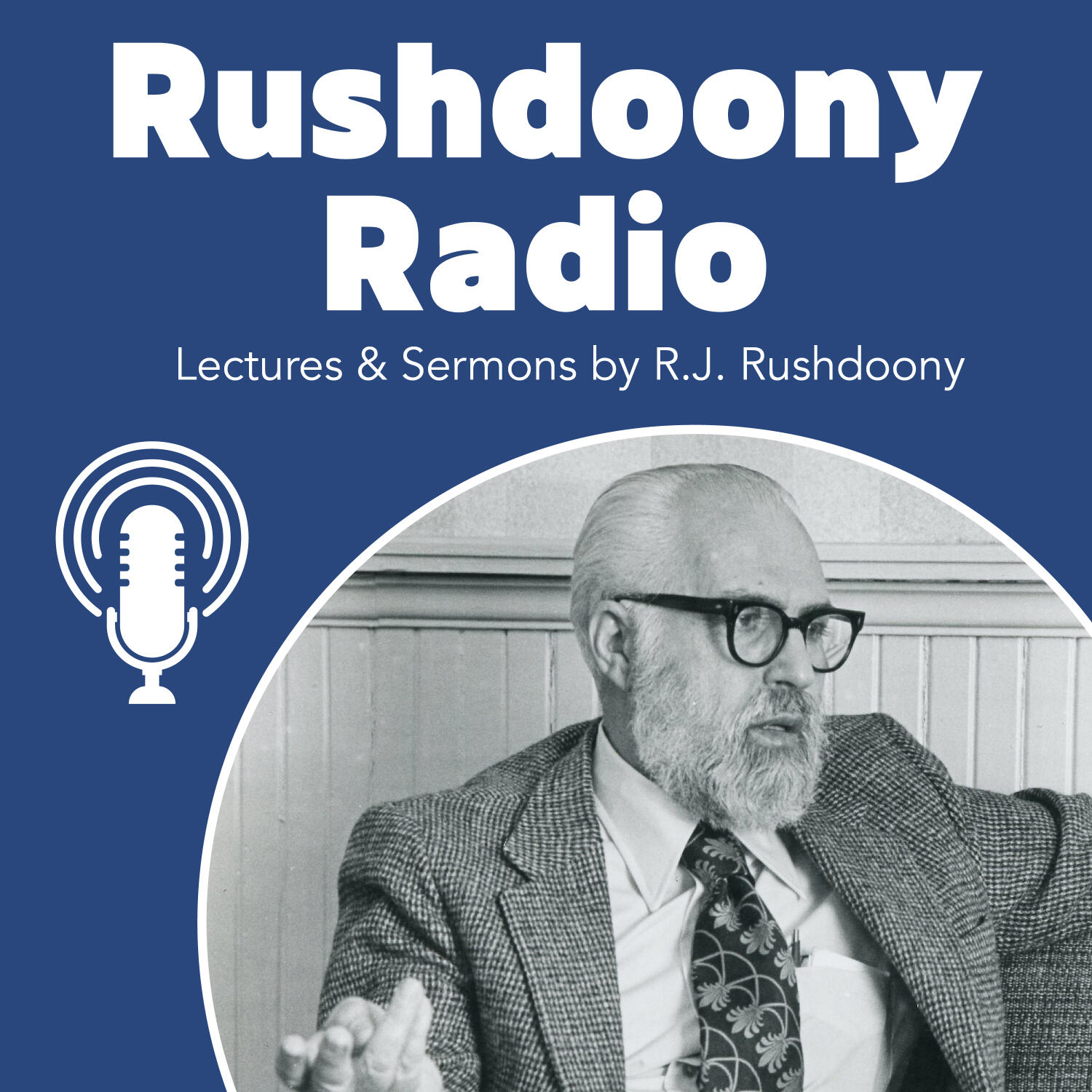
Rushdoony Radio
by R.J. Rushdoony
Welcome to Rushdoony Radio, your gateway to a wealth of wisdom and insight from the teachings of R.J. Rushdoony.
-
187
Reconstructing the Church
Reducing the church to an institution — defined only by preaching, sacraments, and discipline — strips it of the power that made early Christianity an empire within the Roman Empire. Calvin practiced a faith that governed every sphere of life, creating schools, hospitals, and refuges, yet his heirs shrank his legacy to five doctrinal points and handed all authority to pastors and elders. The early Christians, a persecuted handful without church buildings, provided welfare, ransomed captives, and saved abandoned children because they served a present King, not a future one. Reconstructing the church means recovering its identity as Christ's embassy with extraterritorial rights — His army to bring every area of life and thought into captivity to the King of kings.
-
186
Reconstructing the Church
The modern Green movement is not science — it is the revival of pagan Gaia worship, replacing the Creator with nature as the source of law and truth. From the Enlightenment's natural law to Darwin's mindless evolution to the deified state, Western man traded revelation for revolution — and the endpoint is Earth First calling for ninety percent of humanity to be eliminated. Christians alone hold a creation mandate for true stewardship of the earth.
-
185
Neo-Platonism vs. Christianity: Part II (Remastered)
This passage exposes escapism as a defining sickness of modern culture, tracing how the flight from reality has moved from the arts into the university, politics, and revolutionary ideology. It argues that true progress comes from facing reality honestly, while modern escapists especially political radicals seek to remake the world without first confronting the sinful nature of man, replacing responsibility with utopian dreams enforced by power. Using Marxism as a chief example, the piece shows how denial of original sin leads inevitably to tyranny, as abstract visions of equality and freedom collapse into despotism, terror, and the destruction of individuality, family, and productivity. Drawing on Dostoyevsky, Scripture, and history, it warns that every attempt to escape creaturehood and “be as gods” is not merely unrealistic but suicidal a flight from life itself. The conclusion is stark and biblical: only in Jesus Christ is man restored to his true calling under God; all other escapes from reality end in chaos, judgment, and death (Prov. 8:36).
-
184
Neo-Platonism vs. Christianity: Part I (Remastered)
This excerpt confronts modern relativism as a deliberate “flight from knowledge,” tracing how thinkers like Oliver Wendell Holmes Jr. and others helped popularize a pragmatic, positivistic mindset that denies absolutes, distrusts certainty, and replaces the pursuit of truth with the pursuit of utility and control. It argues that this spirit now dominates education, philosophy, semantics, and even the church shifting learning from knowing reality to manipulating it, and turning religion into a tool for personal success or social engineering rather than worship and submission to God. At bottom, the author contends, relativism is not intellectual humility but a strategy to evade the inescapable testimony of creation and conscience to God: because every fact is God-created, true knowledge inevitably points to Him (Ps. 19:1–3; Rom. 1:19–20). The result is social unraveling hatred of law, responsibility, family, and loyalty because the “self as god” cannot tolerate binding obligations, only relationships of use without duty. The piece closes with a stark conclusion: men cannot escape God or the knowledge of Him (Ps. 139:7–12), and the end of the flight from knowledge is either repentance and true understanding in Christ or the unavoidable knowledge of judgment, when every knee bows and every tongue confesses Jesus Christ as Lord (Phil. 2:10–11).
-
183
Flight From Knowledge (Remastered)
Modern life, Rushdoony argues, is marked by escapism—a flight from reality into dream-worlds—seen first in the arts and especially in the university, where many flee the demands of work, family, and Christian morality for a quasi-monastic, anti-Christian “aesthetic” order; but politics has become an even more dangerous refuge, because the political escapist tries to abolish reality by legislation and revolution rather than accept biblical personal responsibility and the need for heart-change. He uses Marxism as the clearest case: its utopian promises (citing the 1903 party manifesto’s lofty language about liberty, rights, and labor protections) produced the opposite—totalitarian terror—because Marxism denies original sin and therefore trusts concentrated power in supposedly perfectible man, treating illusion as inevitable “historical truth” and punishing citizens for “sabotage” while the state itself wrecks productivity. The same unreality, he says, infects academia and liberalism, and even non-Christian conservatisms, whenever they assume man’s basic goodness. Drawing on Dostoevsky’s warning that limitless freedom in radical schemes ends in limitless despotism, he describes the socialist dream as a bid to become gods: a small ruling elite with “unbounded power,” the masses reduced to herd-like equality through absolute submission, the destruction of family bonds and property desires, and the loss of individuality. The root of every such program is theological: a refusal of creaturehood—Satan’s temptation to “be as gods”—so apart from Christ men attempt to incarnate their fantasies into law and society, producing chaos; therefore every flight from reality is ultimately a flight from life, while true restoration comes only as man is re-centered under God in Jesus Christ, who returns him to dominion as man-under-God, not man-as-god. #Escapism #Reality #Rushdoony #BiblicalWorldview #OriginalSin #TotalDepravity #PersonalResponsibility #UniversityCulture #PoliticalReligion #Marxism #Utopianism #Totalitarianism #Revolution #Dictatorship #Dostoevsky #ThePossessed #Humanism #Statism #Family #Property #LibertyAndDespotism #Creaturehood #BeAsGods #ChristTheAnswer #Wisdom #Proverbs836 #KingPriestProphet #CulturalCritique
-
182
Flight From Life (Remastered)
In this opening lecture on Neoplatonism and Christianity, the speaker contrasts biblical faith with a Greek, dialectical worldview that split spirit and matter and treated the body as the source of evil, a mindset that seeped into the early church and produced extreme ascetic “sainthood” marked by self-mortification, contempt for ordinary life, and spiritual pride. Through vivid historical examples, he argues that this is not Christianity at all: Scripture teaches that the whole man (body and soul) fell into sin and the whole man is redeemed in Christ, culminating in the resurrection of the body so the problem is not matter but sin, and the Savior is not the mind but Jesus Christ and His atoning blood. He traces how Neoplatonism turns “holiness” into an upward escape from creatureliness, prayer into lofty meditation detached from real needs, and love into a sentimental substitute for truth, ultimately paving the road to humanism where man’s reason becomes the “savior” and God is rivaled or denied. The lecture closes by calling believers back to the plain corrective of God’s Word, urging them to reject this false gospel, embrace Christ’s lordship over the whole of life, and grow in grace through faithful obedience and service.
-
181
Preaching Q & A
In this Q&A, Rushdoony and Foster argue that “third world” crises are tragic yet often compounded by sinful leadership, war, and anti-Christian barriers that fear the Gospel’s implications for government under Christ; Christians should provide real relief where doors open (they cite Somalia as an example of staggering human cost) while insisting the long-term cure is changed character through the Gospel and the rebuilding of self-government, enterprise, and productivity—undermined, they say, by Marxism and “liberation theology.” They warn that anti-mission propaganda (including a story about hostile anthropologists and the murder of missionary Chet Bitterman) fuels persecution and implicates Western governments, so believers must pair global mercy with domestic “housecleaning,” including informed political engagement. On strategy, Rushdoony rejects a sentimental “be nice” model: Christ was salt and light, sometimes sharply confrontational, so removing destructive humanists from office by voting is presented as a moral duty while still evangelizing all men. They touch on cooperation across end-times views (even premillennial “occupy till I come” Christians can labor together), distinguish “civil religion” as a modern liberal construct from genuine Christian foundations, and explain “parachurch” work as legitimate kingdom labor alongside the institutional church’s ministry of grace—especially as the IRS tries to narrow “church” to worship-only. Rushdoony also frames law and grace through covenant: every covenant is gracious yet inherently legal, so obedience (including tithes plus offerings) is sanctification, not salvation; sacrificial laws are fulfilled in Christ, but God’s moral order still binds, and even Romans 13 obedience is always “in the Lord,” never above God’s Word. #Rushdoony #MarshallFoster #ChristianReconstruction #Dominion #Evangelism #Missions #ThirdWorldCrisis #Somalia #LiberationTheology #Marxism #ChetBitterman #PoliticalEngagement #SaltAndLight #BiblicalWorldview #CivilReligion #Parachurch #ChurchAndState #IRS #ChristianEducation #CovenantTheology #LawAndGrace #Tithing #Sanctification #Romans13 #ObeyGodRatherThanMen #KingdomOfGod
-
180
Preaching
Rushdoony thunders: Gospel (evangelion) Roman imperial ""good news"" of Caesar's victory stolen & fulfilled in Christ!True Emperor: Jesus King of kings, Lord of lords total dominion!Preaching: Royal proclamation Law-Word binding all spheres.No compromise: Humanism's fiat salvation exposed state god, cradle-grave ""security.""Biblical: Dominion mandate + Great Commission conquer nations, every area!Christ's victory church army marches!Timeless challenge proclaim total Lordship!Powerful imperial theology Kingdom advances! #GospelVictory #ChristKing #BiblicalDominion #Rushdoony
-
179
Evangelism
Rushdoony opens by reframing “evangelism” as evangelion—the imperial-era “good news of victory” that demanded life be reordered around the enthroned ruler—and argues the New Testament deliberately seizes Rome’s imperial vocabulary to proclaim a counter-empire: the true “beginning of everything” is not Caesar but Jesus Christ, so the Gospel is inherently a public, world-ordering declaration that challenges every statist claim (“Caesar is Lord” vs. “Jesus is Lord,” “King of kings”). He ties this to the Great Commission and dominion mandate: Christians are not a neutral “Red Cross” on history’s sidelines but an army under Christ’s kingship summoned to bring persons, nations, and every sphere—church, family, vocation, education, law, arts, sciences, and even modern technology and media—into obedience to Christ, financed not by coercive state taxation but by God’s people tithing to build institutions (schools, missions, communications) that extend His reign. From this perspective, Reformed faith (Calvin’s stress on God’s sovereignty, predestination, and vocation) fuels courageous, non-Erastian resistance to modern Caesars and energizes missions and cultural action: dominion is evangelism in practice, evangelism is dominion in motion, and the “good news” is that Christ’s victory is certain and comprehensive—therefore believers must think offensively, reclaim territory (education, broadcasting, public life), and expect future victories because “this is the victory… even our faith.” #Evangelion #GospelOfVictory #JesusIsLord #KingOfKings #ImperialTheology #DominionMandate #GreatCommission #ReformedFaith #Calvinism #SovereigntyOfGod #Vocation #ChristianReconstruction #KingdomOfGod #CulturalEngagement #MediaForChrist #ChristianEducation #Missions #MoreThanConquerors #FaithOvercomesTheWorld
-
178
John Milton: Part 2 (Remastered)
In 17th-century England corrupt monarchy, moral collapse Oliver Cromwell forged a godly order.Puritans: Backbone defending against Catholic Spain post-Armada, crown betrayed them.Cromwell: Overthrew absolutism justice, prosperity, disciplined army (no beggars/criminals).Marxists obsess: Closest modern godly society predestination fueled doers/energy.People rejected responsibility called back debauched Charles II.Rushdoony: Family/church central state limited.Cromwell's vision: Spiritualized England all prophets, Lord's people.Legacy: Defeated king-god tyranny future godly governance.Revival echoes reconstruct Kingdom!Timeless challenge choose godly order! #OliverCromwell #BiblicalCommonwealth #ChristianReconstruction #Rushdoony
-
177
John Milton: Part 1 (Remastered)
Milton exposes a key Reformation weakness: Protestants expanded education but often didn’t reform it theologically, so classical Greek/Roman humanism stayed in the curriculum; Milton could define education’s goal superbly (repair the Fall by knowing God and pursuing virtue) yet still prescribed “the old learning,” producing an eclectic mind and helping explain why the Commonwealth’s liberty collapsed into public craving for license rather than true freedom. The lecture links this to Milton and Cromwell’s dilemma—how to sustain a godly order with ungodly rulers—hence their push for maximum freedom of the press (Areopagitica) while wrestling with the still-unsolved problem of liberty of conscience without biblical boundaries. Milton’s spiritual-political grief then runs through Paradise Lost (evil as a will to pervert; “better to reign in hell”) into Paradise Regained where Christ, the second Adam, defeats Satan in the wilderness and founds a “fairer Paradise,” calling believers to advance His victory in every sphere; the Q&A adds that Milton’s blindness cause is unknown (sensational claims debunked) and that hostile biographies distort his family life and marriages. #JohnMilton #ChristianEducation #Reformation #Worldview #ClassicalHumanism #Areopagitica #FreedomOfThePress #LibertyOfConscience #Commonwealth #Cromwell #ParadiseLost #ParadiseRegained #SpiritualWarfare #Dominion #ChristIsLord #PostmillennialHope
-
176
Oliver Cromwell (Remastered)
In corrupt 17th-century England profligate kings, collapsing morals Oliver Cromwell rose to restore godly commonwealth.Puritans: Backbone against Spanish threat post-Armada, crown betrayed them.Cromwell: Defeated absolutism (church/state) established justice, prosperity, disciplined army (never beggar/criminal from his men).Marxists study era obsessively: Closest modern godly order predestination fueled energy/doers.Yet people chose debauchery called back Charles II.Rushdoony: Family/church central state limited.Cromwell's dream: Spiritualized England all Lord's people, prophets.Legacy: Blueprint reconstruct via faith, Law-Word!Revival possible Kingdom advances through godly stewards!Powerful history future ours in Christ! #OliverCromwell #BiblicalCommonwealth #ChristianReconstruction #Rushdoony(Share awaken to godly governance!)
-
175
Richard III (Remastered)
Rushdoony frames Richard III as a classic “loser” smeared by the winners—Tudor propagandists (amplified by Shakespeare) shaped the enduring villain myth—yet argues the historical Richard was neither hunchback tyrant nor proven murderer, and even his enemies’ behavior (notably Elizabeth Woodville’s later trust of him) undermines the nephew-murder charge. Set in a brutal Renaissance England of collapsing feudal loyalties, corrupt churchmen, and extravagant nobles grinding the poor, Richard’s brief reign is presented as an attempted Christian reconstruction: statutes in English, early printed laws, strong protections for justice, decentralizing power to local rule under God’s law, curbing abuses, aiding the middle class, equitable taxation, and a king who toured to hear common appeals—so that, the lecture claims, ordinary people “never had it so good” as under his three years. His personal piety and moral exhortation contrast with court decadence, but loneliness, tragedy, and political betrayal at Bosworth (Stanley and others joining late) lead to his death and the rise of Henry Tudor, ushering in a harsher, more centralized regime; nevertheless, Wycliffe’s Bible and Lollard influence persist underground, preparing later renewals of reform and liberty. #RichardIII #EnglishHistory #TudorPropaganda #Shakespeare #WarOfTheRoses #ChristianReconstruction #BiblicalLaw #Justice #Liberty #Decentralization #Wycliffe #Lollards #Renaissance #ChurchCorruption #BosworthField #HenryVII #Providence #Dominion
-
174
John Wycliffe (Remastered)
In the corrupt 14th century church moral decay, papal tyranny, externalism John Wycliffe rose as Morning Star of Reformation.Bible as God's Law-Book translated for people.Dominion doctrine: Every righteous man lord over sensible world stewardship, not fiat power.Condemned 1382: Attacked transubstantiation, papal supremacy, friars, private religions.Yet: ""Government of people, by people, for people"" under God's Law (preface to Bible Lincoln misused!).Lollards carried torch underground Bible movement influenced Puritanism, America.Rushdoony: Wycliffe unleashed dominion mandate family, law, future under Scripture.Enemy fears godly order revival underway!Stand with Wycliffe reconstruct in Christ's name! #JohnWycliffe #BiblicalDominion #GodsLaw #ChristianReconstruction #Rushdoony
-
173
The Battle (Remastered)
Jude 17–25 calls believers to perseverance in the ongoing battle of the last days, reminding them that mockers, false teachers, and ungodly influences were foretold by the apostles and are marks of the entire era between Christ’s resurrection and His return. Jude contrasts those who separate themselves in sensual, Spiritless autonomy with Christians who must actively build themselves up in the most holy faith through prayer, dependence on God’s mercy, and a constant awareness that salvation is wholly by grace, not entitlement. The church is commanded to respond discerningly, showing compassion to some who can be rescued while exercising holy fear toward others, recognizing sin as contagious and never treating moral corruption lightly. Jude concludes with one of Scripture’s great benedictions, grounding the believer’s confidence not in human strength but in God’s preserving power, who alone keeps His people from falling and will present them faultless with exceeding joy. Against every form of ancient and modern gnosticism that despises moral law and elevates self-defined spirituality, Jude affirms that truth is ethical, Christ-centered, and guarded by God Himself, whose glory, dominion, and power endure forever. #Jude #TheBattle #LastDays #Perseverance #ContendForTheFaith #GraceAndMercy #SpiritualDiscernment #Antinomianism #PreservationOfTheSaints #ChristOurSavior
-
172
Righteous Judgment (Remastered)
Jude unleashes a scathing rebuke against false teachers infiltrating the church filthy dreamers defiling flesh, despising authority, slandering dignities.Even Michael the archangel restrained: ""The Lord rebuke thee!"" yet these rail against what they ignore, corrupting like brute beasts.Woe! They follow Cain (unrighteousness), Balaam (greed), Korah (rebellion).Spots on love-feasts empty clouds, fruitless trees twice dead, raging waves foaming shame, wandering stars reserved for eternal darkness.Enoch prophesied: Lord comes with thousands execute judgment on ungodly deeds & hard speeches!Murmurers, complainers, lust-walkers, swollen words for advantage.Rushdoony exposes: Irreverence core pretentious ""higher"" wisdom masks rebellion.Righteous judgment God's prerogative leaders exercise; we restrain tongue.Contend fiercely ungodly within deadliest threat!Timeless call discern, rebuke, stand in truth! #JudeWarning #RighteousJudgment #ApostasyExposed #Rushdoony
-
171
Examples of Apostasy (Remastered)
Examples of Apostasy (Enemies in the Church) https://cr101radio.com/podcast/examples-of-apostasy-enemies-in-the-church Jude 4–7 warns the church to earnestly contend for the faith once delivered by setting before us three stark examples of apostasy: Israel after the Exodus, the fallen angels, and Sodom and Gomorrah, all of whom were richly privileged yet judged for unbelief, rebellion, and moral corruption. Jude makes clear that apostasy is not an intellectual failure but a moral revolt, a refusal to live gratefully and obediently under God’s authority, a temptation heightened when false teachers cloak unbelief in the prestige of philosophy, science, or cultural sophistication, as the Gnostics did then and as modern ideologies do now. Israel presumed upon grace, the angels abandoned their appointed calling in pursuit of autonomy, and Sodom turned prosperity into arrogance and sexual perversion, each illustrating that privilege increases responsibility rather than excuses disobedience. Jude’s message is therefore timeless: the church must not reinterpret God’s revelation to fit the “wisdom” of the age but must defend its priority against every rival worldview, recognizing that the city of man always exalts its own word above God’s Word. The call is not to accommodation but to faithfulness, gratitude, and holy resistance, lest the church repeat the sins of those who believed themselves advanced yet fell under judgment. #Jude #ContendForTheFaith #Apostasy #BiblicalWarning #FaithOnceDelivered #CityOfMan #WorldlyWisdom #MoralRebellion #FalseTeaching #AuthorityOfScripture
-
170
The Enemy (Remastered)
Jude, brother of Jesus and James, sounds a powerful alarm in his short but explosive epistle: Ungodly infiltrators have crept into the church unnoticed twisting God's grace into license for sin and denying Christ's absolute Lordship.These false teachers claim ""higher"" spirituality, but Jude exposes them: They pervert the gospel, turning freedom into lawlessness (antinomianism) while posing as enlightened leaders.From ancient Gnosticism to modern neo-orthodoxy, new age fads, and evolutionary ""wisdom"" the pattern repeats: A façade of agreement masks a radical remake of the faith.The true gospel needs no improvements it was once for all delivered to the saints. Our calling? Earnestly contend for it defend, preserve, apply!Rushdoony's timeless exposition reveals: The fallen world hates Christ and His people, always seeking to capture and corrupt biblical faith.Today, the enemy adapts subtle, ""respectable,"" intellectually superior but the threat is the same.Awake! Contend boldly the faith is worth fighting for!Powerful call to vigilance share and stand uncompromised! #JudeWarning #ContendForTheFaith #BiblicalVigilance #Rushdoony"
-
169
The Biblical Doctrine of Civil Government (Remastered)
This talk argues that the Christian is not an anarchist but a believer in God’s government, and that modern speech about “the government” wrongly treats the state as ultimate, when Scripture places the real “seats of government” first in self-government under God’s Word, then the family, then church, school, vocation, and community, with the state only as civil government—limited and subordinate to the “Supreme Governor.” It insists biblical law remains God’s binding instruction (Torah) for sanctified living, rejecting both law-as-justification and law-as-condemnation for the believer while affirming law as the path of holiness and social order. The lecture highlights biblical justice as restitution and restoration, not prisons, and stresses that the family holds society’s key powers—children (the future), property, inheritance, education, and welfare—which explains the state’s hostility toward intact households. On taxation, it contrasts the Bible’s minimal civil levy (a flat “covering” tax) with the central divine “tax” of the tithe, which historically funded worship, education, health, and mercy through godly institutions; when Christians stop tithing, the state expands, taxes rise, and those funds are turned against the people. The practical summons is simple: reclaim government under God by rebuilding family authority and faithful tithing, thereby financing schools, courts, missions, hospitals, and aid without statist control—an agenda that can “gut” the modern state’s pretensions and restore the social order to covenant obedience. #BiblicalGovernment #GodsLaw #Torah #SelfGovernment #FamilyGovernment #CivilGovernment #RestitutionNotPrisons #Tithing #KingdomEconomics #ChristianReconstruction #ChristIsLord #CovenantFaithfulness
-
168
Prophet, Priest, King & Education (Remastered)
This address defends Christian education as obedience to Christ’s total lordship, rejecting the charge that it “deflects from the gospel” by insisting that no area of life or knowledge is neutral and that Christ, not the state, is Lord. Because all creation belongs to God, every subject—science, mathematics, medicine, language, and the arts—must be taught in submission to His Word, not treated as autonomous or secular. Humanistic education falsely claims neutrality, redefines freedom apart from Christ, treats all problems as social rather than theological, and turns schooling into a rival system of salvation aimed at self-realization rather than the glory of God. By contrast, Christian education flows from Christ’s kingship and the believer’s calling to be priest, prophet, and king: priests who dedicate every subject to God, prophets who interpret all knowledge by Scripture, and kings who exercise dominion under Christ. The lecture argues that Christian schools are raising leaders rather than rebels, that humanism inevitably produces barbarism even among the highly educated, and that compromise reduces the gospel to mere “fire insurance.” Faithful education therefore proceeds from necessity, not preference, advancing the Kingdom with confidence that the Church is on the offensive and that the gates of hell cannot hold out against Christ’s lordship. #ChristianEducation #ChristIsLord #NoNeutralFacts #BiblicalWorldview #PriestProphetKing #AgainstHumanism #Dominion #KingdomOfGod #EducationAndFaith #GatesOfHell
-
167
The Biblical Approach to Economics (Remastered)
This lecture presents economics as inherently religious, showing that humanism begins in Genesis 3:5 with man’s desire to be his own god and expresses itself today through fiat law, fiat money, and fiat economics, all of which create inflation, disorder, and false wealth. In contrast, biblical economics flows from the dominion mandate of Genesis 1:26–28 and rests on four foundations: faithful obedience and godly character, knowledge as an aspect of the image of God, productive labor as a blessing rather than a curse, and capital built through patience, saving, and intergenerational stewardship. Economic decline follows when faith collapses, envy replaces discipline, and productivity is destroyed, while humanistic systems substitute political power and “works of law” for real work, producing unemployment and social decay and demanding state control of education and knowledge. Christians are therefore not called to pursue wealth as an end in itself, but to use wealth as a tool of stewardship, bringing every area of economic life into submission to God rather than to man-made authority. #BiblicalEconomics #DominionMandate #NoFiatMoney #FaithAndWork #ChristianWorldview #Stewardship #AgainstHumanism #GodsLaw #EconomicsAndFaith #BiblicalAuthority
-
166
History as a Theological Science (Remastered)
This session argues that faith reshapes every area of life, so education cannot be neutral: Christianity produces “history” (meaningful, ordered, God-governed events), while humanism produces “social science” (man’s attempt to control and predestine society without God). True history assumes God’s sovereign acts—Creation, Incarnation, and the Second Coming—as the frame and direction of all events, so providence turns even man’s wrath to God’s praise and all things to good for God’s people; humanism, denying that order, treats events as chance and therefore demands total state planning, making “freedom obsolete” because an experiment requires control. History must therefore be taught as a theological science with Scripture as its basic framework, including its essential chronology, and even terms like “Renaissance” and “Enlightenment” are shown as humanistic propaganda describing a long revolution “from Christ to Adam,” i.e., from supernatural man to natural man. The lecture contrasts Isis’s veil-over-the-future with Christ as Alpha and Omega, insists that God and His Word judge all things (not the other way around), and frames the conflict as total war between God-as-absolute and man-as-absolute, with Psalm 2 as the biblical philosophy of history: nations conspire, God laughs, the Son reigns, and rulers are commanded to submit. In Q&A, Lincoln is described as a Deist reshaped by reading systematic theology but not clearly converted; the Reformation is presented as largely anti-Renaissance because the Renaissance papacy was openly humanistic; modern humanism is linked strongly to Plato and Aristotle’s state-centered ethics; and both Franklin and Jefferson are sharply criticized as overrated Deists, while Patrick Henry is held up as a decisive, openly Christian statesman whose faith and strategic action secured America’s westward future. #HistoryAsTheologicalScience #NoNeutralEducation #BiblicalWorldview #Providence #Predestination #AgainstHumanism #Psalm2 #ChristianEducation #SocialScienceVsHistory #ChristIsLord
-
165
Mathematics (Remastered)
This session argues that mathematics is inherently religious, not neutral, because every fact, number, and law of logic exists within a God-created order and bears witness to its Creator. Rejecting the Enlightenment myth of autonomous reason, it shows that mathematics depends on the biblical solution to the problem of the one and the many, resolved only in the doctrine of the Trinity, without which numbers collapse either into meaningless unity or chaotic plurality. Modern “new math” and relativistic science are exposed as deliberate attempts to deny a pre-established world, enthroning man as creator and reducing mathematics to a mental game detached from reality, truth, and meaning. Against this, the Christian position insists that the order of the human mind corresponds to the order of the physical world because both are created by the same sovereign God, making mathematical truth possible, intelligible, and applicable. The conclusion is stark and practical: mathematics must be taught as part of God’s revealed order, not as an atheistic abstraction, because when numbers are divorced from God, they lose meaning, coherence, and ultimately their power to explain or govern the world. #BiblicalWorldview #PhilosophyOfMathematics #NoNeutralFacts #TheOneAndTheMany #TrinitarianFoundation #ChristianEducation #AgainstNewMath #GodCreatedOrder #FaithAndReason #AllTruthIsGods
-
164
Economics, Money, and Hope: Part III (Remastered)
This session contends that economics rises or falls with the strength of the trustee family, not with state policy or abstract theory, exposing the Enlightenment myth that “reason” and social order exist only apart from God as ideological nonsense designed to justify hostility toward any institution not created by human fiat. Drawing on Zimmerman and Unwin, the argument shows that civilizations flourish when the family governs property, inheritance, children, welfare, and education, weaken when the state intrudes, and collapse when the atomistic family replaces covenantal continuity, sexual discipline erodes, and loyalty to past and future is severed. The trustee family is presented not merely as a household but as a corporate, covenantal entity—a living trust that outlasts individuals and serves as the primary engine of capitalization, productivity, and social energy, explaining both why totalitarian systems seek to destroy it and why disciplined Christian families consistently produce the most resilient, productive citizens. The remedy is practical and strategic: recover family-held property, strengthen community and trust structures, reclaim education and welfare from the state, and recognize that the reconquest of society through economics begins not with centralized power but with restored families exercising dominion under God. #TrusteeFamily #BiblicalEconomics #FamilyAsPowerCenter #Recapitalization #ChristianReconstruction #CovenantalOrder #AgainstStatism #PropertyAndInheritance #Dominion #KingdomEconomics
-
163
Economics, Money, and Hope: Part II (Remastered)
This session exposes inflation as a moral disease before it is an economic one, rooted in fiat money, statist power, and a humanistic belief that value can be created by decree rather than by work, thrift, and godly character. When money is severed from real wealth, it becomes a tool of theft, rewarding debtors, punishing the faithful, and financing cultural decay—from foreign Marxist regimes to domestic moral revolutions—while quietly enslaving nations through unpayable loans. Inflation is shown not as an accident or policy mistake, but as institutionalized larceny, driven by bad theology, antinomianism, and the rejection of God’s law-order. Yet the message is not despair: the lecture insists that true recovery comes through recapitalization of people, beginning with repentance, Christian education, disciplined households, and the rebuilding of character-capital that can sustain a godly economy. As statist systems rot under their own madness, a counter-movement is already rising—Christian families, schools, and churches preparing to reclaim the future because the earth, and its wealth, still belong to the Lord. #MoneyAndMorality #InflationIsTheft #FiatMoney #BiblicalEconomics #DebtSlavery #AgainstStatism #ChristianReconstruction #CapitalAndCharacter #LawOfGod #FaithAndFinance #Chalcedon #TheEarthIsTheLords
-
162
Economics, Money, and Hope: Part I (Remastered)
This opening session argues that economic collapse is not accidental but moral, the predictable fruit of a statist, fiat-driven world that has abandoned God’s created order. Using Christ’s parable of the steward, the teaching confronts Christian other-worldliness and insists that faithful stewardship of money is a spiritual requirement, not a worldly distraction. Humanistic economics treats reality as something man can remake by decree—fiat money, fiat law, fiat planning—but Scripture declares a law-governed universe where debt enslaves, inflation punishes thrift, and judgment is built into disobedience itself. The modern debt mountain—personal, corporate, and governmental—is portrayed as borrowing against a future that is now running out, making inflation the false “salvation” of a bankrupt order. Yet this crisis is framed as a salvation-judgment: God clearing the ground for reconstruction. The Christian hope is not political tinkering but recapitalization—material, moral, and spiritual—through hard money, thrift, work, character, and obedience to God’s law, laying the foundation for a renewed Christian social order. #BiblicalEconomics #ChristianReconstruction #DebtAndJudgment #AgainstFiatMoney #Stewardship #GodsLawOrder #EconomicCrisis #HardMoney #ThriftAndWork #FaithAndEconomics #Chalcedon #HopeThroughObedience
-
161
Abraham and Sarah: A Normative Marriage (Remastered)
This session presents Abraham and Sarah as Scripture’s model—or “normative”—marriage, not because it was easy or sentimental, but because it was forged through responsibility, obedience, and costly decision-making under God. Sarah, whose very name signifies authority, was no passive figure; she commanded decisively when right and submitted faithfully when obedience to God required it, even in terrifying circumstances like Egypt. Abraham’s much-criticized decision is reframed as an act of covenant responsibility, not cowardice—choosing life, calling, and the messianic promise over suicidal idealism. The lesson cuts against modern chivalric myths and romanticized marriage: biblical manhood is not self-destruction for emotion’s sake, but burden-bearing leadership accountable to God, while biblical womanhood is neither silence nor domination, but faithful alignment with God’s order. Together, Abraham and Sarah show that marriage is refined through trial, discipline, and maturity, revealing that true authority is never abdicated, never autonomous, and never separated from obedience to God’s redemptive purposes. #AbrahamAndSarah #NormativeMarriage #BiblicalMarriage #AuthorityAndResponsibility #CovenantLife #HeadshipUnderGod #SarahAsModel #BiblicalManhood #BiblicalWomanhood #FaithUnderFire #ResponsibilityMatters #MarriageAndCalling
-
160
Marriage and Property (Remastered)
This session delivers a forgotten truth with explosive relevance: in Scripture, marriage and property are inseparable, because God owns the earth and entrusts stewardship not to the state or the individual, but to the family. Biblical property is future-oriented, covenantal, and stabilizing—designed to capitalize God’s Kingdom through responsible households and godly heirs. The dowry system forced maturity, patience, restitution, and accountability, protecting women, children, and marriage far better than modern courts ever could. By tying marriage to capital, inheritance, and hope, God’s Law curbed irresponsibility, restrained lust, and anchored families to both past and future. When modern society severed marriage from property, it also severed responsibility from love—producing instability, despair, and rootlessness. The takeaway is sharp: God’s law understood human nature better than modern economics, and a rebuilt society begins where Scripture begins—with marriage as a stewarded covenant, not a romantic impulse. #MarriageAndProperty #BiblicalEconomics #FamilyStewardship #GodOwnsItAll #CovenantMarriage #Dowry #LawWord #ChristianReconstruction #FamilyFirst #FutureGenerations #AgainstStatism #BiblicalWorldview
-
159
Marriage and the Image Mandate (Remastered)
Marriage, this lesson insists, is not a “natural arrangement” built on biology or romance, but a vocation rooted in the image of God—a covenant designed to reveal God’s order, authority, and love in the world. Reading Genesis 2 and Ephesians 5 together, it pushes back against “Old Testament is primitive” thinking and says Scripture is one unified Word: Adam is left alone long enough to discover his calling under God, and Eve is given as a “help as his front”—a mirror-partner in dominion, not a mere outlet for desire. Paul’s key is analogical reality: we don’t project “father” and “family” language upward onto God; God’s Fatherhood is the pattern that all human authority must echo (Eph. 3:14–15), which means headship is never absolute, never tyrannical, and always accountable to Christ’s self-giving love. The Fall, then, is portrayed as role-rebellion and responsibility-fatigue—Eve tempted to seize rule, Adam tempted to abdicate—and the result is marriage warped into power-struggle, pain, and frustration; yet redemption restores the original purpose: husbandly authority modeled on Christ’s sacrifice, and wifely submission modeled on the church’s faithful allegiance—both bound to God’s Word so that marriage becomes a living parable of Christ and His people, an “image mandate” enacted in daily life, not a fairy tale sustained by feelings. #BiblicalMarriage #ImageOfGod #Ephesians5 #Genesis2 #ChristAndTheChurch #CovenantNotContract #Dominion #HeadshipAndLove #SubmissionInTheLord #AuthorityUnderGod #AgainstModernMyths #MarriageAsVocation
-
158
The Family as a Power Center (Remastered)
This session argues that the family is the real power center of civilization, which is why every revolutionary system—from Plato’s philosopher-kings to modern statism—must first dismantle it. When the family governs children, property, inheritance, education, welfare, and faith, it generates responsibility, continuity, and disciplined freedom; when it is replaced by the state or by permissive sexuality, society decays into dependency, crime, and chaos. The lecture exposes the modern swap: family authority traded for sexual liberation, salvation redefined as orgasm, and “under-parenting” enforced by law—producing exactly what Scripture warned about: juvenile crime, instability, and social breakdown. History, sociology, and Scripture converge on one conclusion: the family is unmatched as a force for preserving what is good and reforming what is broken. The future will not be won by politics or money, but by families reclaiming their God-given calling as stewards, governors, and builders of the next generation under Christ. #FamilyAsPower #BiblicalFamily #ChristianReconstruction #ParentsNotState #AgainstStatism #CultureWar #JuvenileJustice #FaithAndFamily #Dominion #WorldviewMatters #CovenantLife
-
157
Juvenile Justice and the Family (Remastered)
Modern “juvenile justice” can’t be understood until you see the sleight-of-hand behind it: the state keeps redefining what counts as “public” and “private” so it can seize what God assigned to the family while excusing what God calls public evil. Historically, Christian law carved life into distinct spheres under God—family, church, commerce, civil government—each with real jurisdiction; but modern statism claims that only the state is truly “public,” so it can declare childrearing, schooling, welfare, property, and inheritance “public concerns” (meaning state-controlled) while quietly reclassifying abortion, homosexuality, prostitution, drugs, and even the logic toward child corruption as “private choices.” The result is total jurisdiction by bureaucracy: if the state owns the delinquent child, it soon claims ownership of the obedient child too—public education becomes the pipeline, and courts begin speaking of children as “property of the state.” Even pagan regimes admit the truth they fear: without parental love and intact family authority, you don’t get citizens—you get deformed, predatory “wolf children.” This lecture’s punchline is sharp: juvenile justice is family justice—when the state replaces parents as the moral governor, it manufactures disorder, then expands again to “manage” the chaos it created. #JuvenileJustice #FamilyFirst #SphereSovereignty #AgainstStatism #ParentsNotState #BiblicalWorldview #ChristianReconstruction #EducationMatters #PropertyAndInheritance #WelfareStartsAtHome #LawAndOrder #Chalcedon
-
156
The Family as Trustee (Remastered)
This message traces the modern war on the family to humanism’s twin goals: erasing God and dismantling the family as a governing institution. Drawing on history—from the French and Russian Revolutions to failed collectivist experiments in Soviet nurseries and Israeli kibbutzim—it shows that societies seeking rootlessness, anonymity, and radical equality consistently produce damaged children, social chaos, and state tyranny. Against this collapse, the lecture highlights a quiet but powerful recovery of the “trustee family”—the biblical model in which husband and wife steward law, education, work, and welfare under God, with Proverbs 31 as the classic picture of shared dominion. The current tensions within Christian families aren’t signs of decay but symptoms of renewal, as people resist atomistic freedom and rediscover responsibility under Christ’s rule. The takeaway is electric: civilization rises or falls with the family, and the rebuilding of society begins not with politics, but with families reclaiming their God-given trust. #TrusteeFamily #BiblicalFamily #ChristianReconstruction #FamilyUnderGod #AgainstHumanism #Dominion #FaithAndCulture #WorldviewMatters #RebuildingCivilization #CovenantLife
-
155
The Significance of the Family as a Social Institution (Remastered)
This session confronts the social power of the biblical family and explains why it is relentlessly targeted by the modern state: under God, the family governs the future (children), property, inheritance, education, and welfare—the very foundations of society. From Theodora’s transformation of Roman law to Marx, Engels, Dewey, and modern democrats, the pattern is clear: destroy the family and Christianity collapses. Humanism insists religion and family are “private,” stripping God’s Law from public life while expanding state control over sexuality, schooling, property, and children. The result is social breakdown, dependency, unemployment, crime, and cultural decay—problems the state only worsens while the family, when ordered under God, historically solved them. The warning is stark and hopeful at once: every society that undermines the biblical family commits cultural suicide, and Christian reconstruction must therefore begin where God begins—with the family governed by His Law-Word. #BiblicalFamily #ChristianReconstruction #FamilyUnderGod #AgainstStatism #LawWord #FaithAndCulture #FamilyIsTheFuture #ChristianEducation #Dominion #WorldviewMatters
-
154
The Family and Religion (Remastered)
This session frames the family as a fundamentally religious institution—not merely sociological or economic—and uses Psalm 127 to argue that true “security” (personal and national) is futile unless the Lord is the builder; the psalm’s startling point is that children, raised in the nurture and admonition of the Lord, are God’s appointed “weaponry” for cultural and spiritual conflict, “arrows” by which God’s people contend with enemies at the gate rather than cower behind walls. It rejects romantic myths of pre-Christian family virtue (noting pagan kinship could be violent and treacherous) and insists sin concentrates around what matters most, making the family either a holy stronghold or a nightmare power-system unless governed by God’s grace and Law-Word—illustrated by Lamech’s boastful brutality and the pagan tendency to locate ultimate power in tribe or state rather than God. Against this, the lecture highlights the Pilgrim/Puritan model of family-as-enterprise, school, vocation, church, correction, and welfare—an integrated “household order” under Scripture—and concludes that today’s growing pushback (homeschooling, Christian schooling, parental authority, discipline) signals a Spirit-driven recovery of the family in Christ, prepared to resist statist claims and rebuild household life as the frontline of dominion and kingdom advance. #FamilyAndReligion #Psalm127 #ExceptTheLordBuild #ChildrenAsArrows #KingdomConflict #BiblicalWorldview #HouseholdOrder #ChristianEducation #DominionUnderChrist #AgainstStatism #CovenantFamily #LawWord #MoreThanConquerors
-
153
The Centrality of the Family (Remastered)
This session argues that the family is God’s central institution, deliberately placed at the heart of human life so that every person—husband, wife, child—participates in the most important sphere of God’s order. Because the family forms character, transmits faith, and teaches responsibility, it is both the place of greatest blessing and the deepest vulnerability, capable of profound joy or devastating harm. Modern culture wages war on the family through statism, radical individualism, abortion, sexual revolution, and rootlessness, all designed to sever loyalty, responsibility, and generational continuity, leaving isolated individuals ripe for control by the power state. Scripture, by contrast, treats family rebellion as life-destroying, honors genealogy, and insists that sexuality reflects religion—either godly love within covenant or ungodly aggression and domination. Precisely because the family is the key to life and the future, it is fiercely attacked by humanism and tragically underestimated by the church; yet it remains the decisive battleground where God’s order is either upheld or overthrown. #BiblicalFamily #FamilyCentrality #GodsOrder #AgainstStatism #CovenantLife #FaithAndFamily #CultureWar #SexualRevolution #ChristianWorldview #FamilyIsTheFuture
-
152
An Introduction to the Christian Family (Remastered)
This opening to a study on the biblical doctrine of the family argues that modern society is fundamentally at war with the family because it has replaced God’s order with statist and naturalistic thinking. Scripture presents the family—not the state, church, or school—as God’s primary institution, with marriage as the first and basic religious vocation, governed by God’s Law rather than personal desire or biological impulse. To reduce marriage to a natural or sexual arrangement is to deny its moral and covenantal character and to embrace the logic of fallen humanity, which always rebels against God-given order. Biblical marriage, by contrast, is an act of dominion and new creation in Christ, restoring life, stability, and meaning where lawlessness produces chaos and death. The family is the one institution carried over from Eden, the chief means by which God orders human life, and the central target of a modern world that refuses to live by His design. #BiblicalFamily #MarriageAsVocation #GodsOrder #FamilyBeforeState #ChristianWorldview #CreationOrder #AgainstStatism #CovenantLife #Dominion #FaithAndFamily
-
151
Necessity for Christian Education (Remastered)
This passage argues that modern Christianity has drifted into practical polytheism, affirming Christ with words while denying His Lordship in politics, education, economics, science, and daily life by surrendering those realms to humanism. When God’s Law-Word no longer governs every sphere, man enthrones himself, the state, or institutions as rival gods, reducing salvation to mere “fire insurance” instead of total allegiance to Christ. True Christian education, it insists, must restore the sovereignty of the Triune God everywhere—pulpit, family, school, and culture—because truth precedes goodness and no lasting good can exist apart from Jesus Christ as the Truth. Dominion is not rage, protest, or negation, but faithful, constructive obedience: living out regeneration publicly and continuously as God’s instruments in the ongoing work of creation and restoration. The warning is severe yet hopeful—if God is excluded, judgment follows; if Christ is confessed as Lord of all, history moves toward the promised triumph of His Kingdom. #ChristIsLord #NoOtherGods #BiblicalWorldview #ChristianEducation #Dominion #LawWord #KingdomOfGod #TruthBeforeGoodness #CovenantFaith #FaithInAction
-
150
Intellectual Schizophrenia - Q&A (Remastered)
Public education is suffering from intellectual schizophrenia—torn between despair over humanity’s survival and blind confidence that centralized systems can remake man—because humanism treats man as both helpless and godlike. Even left-wing critics admit the system is failing: millions graduate functionally illiterate, Darwinian “survival of the fittest” has turned schools into bureaucratic weeding machines, and universities have become “multiversities” with no commitment to truth, excluding Christianity while embracing anything else. Massive studies show money doesn’t fix education and that the family is decisive, yet the statist response is more centralization, earlier intervention, and deeper assaults on the family—repeating the Soviet error with equally destructive results. In contrast, Christian schools, by reinforcing family, discipline, and truth, are quietly forming mature leaders while government education collapses under its own contradictions. #ChristianEducation #PublicSchoolFailure #FamilyMatters #BiblicalWorldview #AgainstStatism #EducationCrisis #TruthAndOrder #CovenantEducation #WorldviewMatters
-
149
The Influence of Socialism in American Education (Remastered)
This message argues that socialism in education can’t be defeated by chasing subversives—it must be confronted at its root. The real engine, it claims, is the doctrine of evolution, which teaches conflict as the basic law of life: class against class, race against race, sex against sex, generation against generation. Once that worldview is accepted, socialism becomes inevitable, because a world of permanent conflict demands a powerful state to manage it. Against this, the talk insists Scripture teaches a harmony of interests under God’s creation and law—peace, order, and mutual dependence, not endless war. The solution isn’t cosmetic reform or conservative outrage, but a full return to the doctrine of creation, which restores meaning, personal responsibility, true individuality, and limits the state. Bottom line: until education is rebuilt on biblical creation and God’s sovereign order, socialism will keep reproducing itself—no matter how hard we fight the symptoms. #ChristianEducation #CreationNotEvolution #AgainstSocialism #BiblicalWorldview #HarmonyOfInterests #LawAndOrder #Dominion #ChristianSchools #WorldviewMatters #FaithAndCulture
-
148
Messianic Character of American Education - Q&A (Remastered)
This talk pulls no punches: what’s increasingly on trial in America isn’t just Christians, schools, or families—it’s the Bible itself, especially wherever God’s Law confronts modern ideas of authority, discipline, and lordship. It exposes a softer but deadlier compromise inside the church: wanting Jesus as Savior from hell, but rejecting Him as Lord over life, law, and culture. Against the myth of “neutral” law, it argues that humanism has replaced Christianity as the nation’s operating religion, enforced through courts, schools, and bureaucracy. The way forward isn’t bigger churches or stronger states—both are biblically limited—but regenerated people taking responsibility again: families, communities, and Christian institutions serving, building, and governing under God’s Word. The bottom line is sharp and hopeful: service is power, obedience is action, and Christ’s Kingdom advances when His people stop retreating and start living under His Law-Word. #ChristIsLord #BiblicalLaw #LawWord #Dominion #ChristianReconstruction #ReligiousFreedom #ServeToLead #KingJesus #FaithInAction #ChurchRenewal
-
147
The Place of Biblical Law in Society (Remastered)
This message sounds the alarm: the fight isn’t just “religious freedom” cases—it’s a war on the Bible itself, especially wherever Scripture’s commands on discipline, authority, and judgment are treated as “dangerous.” It then exposes a softer crisis inside the church: a Christianity that wants Jesus as a fire-escape, not as Lord—saved from hell, but not from sin, and certainly not under His Law-Word. From there the core claim lands hard: every society runs on a moral code, so “neutral” law is a myth—America has been disestablishing Christianity and establishing humanism through courts, schools, and bureaucracy. The comeback isn’t building bigger church or state power-centers (both are biblically limited), but rebuilding from the ground up: God writes His law on hearts, then sends families and believers out as His workforce—creating courts, schools, mercy ministries, and “tithe-agencies” that serve real needs and push back statism. The closing punch is pure promo: service is power—the state learned it and weaponized it; now the church must repent of passivity, ditch man-made traditions, and obey Christ’s marching orders to take dominion by faithful action. #BiblicalLaw #ChristIsLord #LawWord #Dominion #ChristianReconstruction #ReligiousLiberty #FamilyGovernment #Decentralization #ServeToLead #ChurchRenewal #AntiHumanism #KingJesus
-
146
The Crisis of Accountability : What Can Be Done? - Crime and Crisis in Our Legal System (Remastered)
Crime can’t be fixed by tougher policing alone when a culture is rotting at the roots. This talk traces how law enforcement retreats once lawlessness becomes normal—because the deeper crisis isn’t just criminals, it’s the public’s softened conscience and the collapse of self-government. The solution isn’t bigger prisons (a modern experiment that often protects offenders and ignores victims), but biblical justice: restitution that restores the harmed, and—when necessary—removing the hardened offender so evil doesn’t become a professional class. Then the spotlight swings to what we’ve forgotten: “government” isn’t just the state. Real government starts with the covenant man, the family, the church, the school, vocation, community standards, and strong local associations—exactly what once made America resilient. The promo punch: if we want law and order, we must rebuild moral order—pushing back statism and reclaiming responsibility in every sphere, with Christian action that actually reforms lives. #LawAndOrder #CrimeAndJustice #BiblicalJustice #Restitution #SelfGovernment #DominionMandate #ChristianReconstruction #ChurchAndCulture #FamilyGovernment #ChristianEducation #PushBackStatism #MoralRenewal\
-
145
Submission to Civil Government (Remastered)
Submission isn’t a call to “sit down and take it”—it’s a call to God-directed action. This message exposes how Christians can confuse biblical submission with medieval-style passivity (think “Patient Griselda”) or—on the other extreme—Jesuit-like, unquestioning loyalty to men and institutions. Instead, Scripture anchors submission first in God’s Word, then shows how real change comes not through revolution, coercion, or church power-plays, but through regeneration—new hearts producing new obedience. In the state, submission means honoring lawful order without pretending the state can save; in the church, submission means restoration before judgment: private confrontation, witnesses, then discipline—always aiming to win a brother back (Matthew 18; 2 Thessalonians 3). The punchline is sharp: a church that becomes only a court has failed—every member is called to pray, pursue peace, and do the hard work of love. True submission is Spirit-empowered, law-shaped, grace-driven obedience that builds people up, restores the fallen, and refuses both tyranny and cowardice. #Submission #RegenerationNotRevolution #BiblicalAuthority #Matthew18 #ChurchDiscipline #Restoration #GraceAndTruth #ChristianCommunity #Peacemakers #Obedience #KingJesus #LawWord
-
144
The Meaning of Life & Death: Captial Punishment and Human Life - Part 1 (Remastered)
Modern man, this passage argues, is caught in a grim contradiction: he longs for an “end” that would wipe everything clean, yet he fears death, rejects judgment, and even protests capital punishment while fantasizing about a humanistic doomsday. That paradox is traced to humanism—man enthroned as lord, feelings elevated to the standard of right and wrong, and God’s Law dismissed as irrelevant—so that moral reasoning collapses into “what would I want if I were guilty?” and society drifts toward anarchic sentimentality. Against this, the message insists on God’s ownership of creation (“the earth is the Lord’s”), the necessity of judging by His Word rather than experience, and the meaning of “Thou shalt not kill” as a ban on all taking of life by man’s autonomous will, while affirming lawful killing only by God’s authorization (e.g., food laws, and civil justice as the Lord’s judgment carried out by magistrates). Capital punishment, in this framework, is not private vengeance but a covenantal act to “put away evil,” cleanse the land, protect life, and restrain the pollution of unchecked violence; the positive duty of the commandment is also to defend and preserve life through lawful order. The closing thrust is practical and urgent: a culture that denies God nonetheless senses it is “on death row,” waiting for judgment, and the only true hope is Christ’s saving power, His kingship, and the rebuilding of a God-centered people and institutions—especially through education—so that society is reformed from the heart outward under the Law-Word of God. #Humanism #BiblicalLaw #ThouShaltNotKill #Justice #CapitalPunishment #GodsSovereignty #CrownRightsOfKingJesus #Dominion #ChristianWorldview #LawAndOrder #CulturalRenewal #Education #Rushdoony
-
143
Love of Neighbor - Q&A (Remastered)
This teaching confronts one of the most abused phrases in Scripture—“love your neighbor as yourself”—and restores its biblical meaning by grounding love firmly in God’s law, not emotion, socialism, or sentimental tolerance of evil. Drawing from Romans 13, Leviticus 19, the teachings of Christ, and the Good Samaritan, it argues that biblical love is juridical and covenantal: to love one’s neighbor is to keep the second table of the Law by respecting life, property, home, reputation, and liberty in thought, word, and deed, even toward enemies. Far from requiring communism, emotionalism, or pacifism, true love requires justice, lawful mercy, and resistance to tyranny when obedience to the state violates obedience to God. Only those who love God—by obeying His law—can truly love themselves and their neighbors, and this biblical doctrine of love stands as the historic foundation of true civil liberty and Christian freedom. #BiblicalLaw #LoveAndLaw #ChristianWorldview #Romans13 #CivilLiberty #ChristianReconstruction #JusticeNotSentiment #GodsLaw #FaithAndWorks #BiblicalLove
-
142
Godly and Ungodly Mercy (Remastered)
This meditation frames God’s absolute sovereignty as the ground of Christian confidence: though the nations rage and conspire, His throne stands fast, and believers are called to boldness, discipline, and victory under His government. Using Proverbs 12:10 (“A righteous man regardeth the life of his beast: but the tender mercies of the wicked are cruel”), it explains biblical wisdom as concrete precedent law—starting with a minimal case (kindness to animals) and extending outward to labor, justice, and society at large. Mercy, it argues, is not sentiment but obedience to God’s law, and when the wicked attempt “tender mercies” apart from God’s order, their appeasement becomes cruelty that breeds disorder and decay. The message culminates in the cross as the perfect union of law and grace—justice satisfied, mercy displayed—and calls Christians to pray for lawful authority, uphold God’s standards, and reject antinomian distortions of “grace” that sever salvation from sanctified obedience. #Proverbs1210 #BiblicalLaw #WisdomLiterature #LawAndGrace #CrownRightsOfKingJesus #ChristianWorldview #JusticeAndMercy #Sabbath #Dominion #ScriptureStudy #Rushdoony #FaithAndObedience
-
141
Meaning of a Sacrilege (Remastered)
Sacrilege, biblically defined as “robbing God,” is not a forgotten superstition but a central Scriptural reality with enduring consequences. From Achan’s theft of what belonged to the Lord, to the judgment pronounced on Jericho, to the long-term national fallout following Henry VIII’s seizure of church property, Scripture and history testify that what is consecrated to God cannot be safely taken or withheld. Whether money, property, time, or even our very lives, all belong to God by creation and redemption, and to deny Him His due invites judgment, while restitution brings restoration and blessing. The biblical pattern is clear: God overturns sacrilege in order to reclaim what is His, and faith-filled obedience releases renewal, generosity, and the advance of His Kingdom in history. #Sacrilege #BiblicalLaw #TithesAndOfferings #RobbingGod #JudgmentAndMercy #Restitution #ChristianHistory #GodsSovereignty #FaithAndObedience
-
140
Death and Restitution (Remastered)
Rushdoony argues the church’s crisis is moral blindness: Christians often treat the unbelieving neighbor as basically good and needing only “Christ added,” but Scripture teaches universal depravity and that, without the church acting as salt, society naturally decays into greater evil and eventually turns on Christians. True community requires something genuinely held in common, yet modern substitutes humanity (“family of man”), race, reason, class, politics, economics, hobbies create only thin connections or deeper division because they refuse to face sin and the need for Christ. He notes modern loneliness: many acquaintances, few real ties; immigrant communities and the family provide limited community, but even these fade unless renewed by Christian faith. Where Christianity revives, the family strengthens and becomes a “trustee family,” rebuilding generational responsibility through education, inheritance planning, and mutual support. He then grounds community in the biblical covenant: covenant is a treaty of law, and God’s covenant is both law and grace atonement first, then God’s law as the way of life (Deut. 6:20–25). This covenant creates a “community of life” marked by works flowing from living faith; neglecting covenant theology produces antinomianism and irrelevance. He cites historical covenants in early American towns as examples of community built on mutual watchfulness, love, and promoting Christ’s honor. When covenantal community weakens, societies replace it with status “badging” and with the state treating Jesus as mere “fire insurance” instead of Lord so community becomes a tool for control, not shared life in Christ. Finally, he contrasts Christian community (life) with humanistic community (death). He portrays Enlightenment naturalism as a revolt from Christ to “nature,” culminating in de Sade’s celebration of evil and destruction an emblem of humanism’s will to power and death. In his view, humanism cannot produce brotherhood; it trends toward domination (“a boot stamping on a human face forever”) and the “destroyer” spirit Scripture associates with Satan. By contrast, Christ is repeatedly identified as life (John 1; John 10; John 11; John 14), so only in Christ under His kingship and law can there be lasting community, whether on earth or in eternity."
-
139
The Basis for Covenant Community (Remastered)
Rushdoony says “community” originally meant communion a shared life grounded in Christ, not merely people living near each other. In Christendom, the Lord’s Table was the basis of real community: believers were “members one of another,” obligated to mutual care and justice. That’s why Rome (and modern states) clash with the church: the church becomes an “imperium in imperio” a government within a government meeting without state permission and providing what the state wants to control. He argues the early church governed itself and served society: caring for widows, orphans, the sick, and the poor; building schools and hospitals; and even running courts (1 Cor. 6) so just that pagans came for judgments. He cites thinkers like Aquinas and Calvin to stress that Christian fellowship requires sharing God’s gifts with one another. America’s frontier success, he says, wasn’t rugged individualism but neighbor-help rooted in Christian duty people weren’t “alone,” and communities rose quickly with farms and churches. The “cornerstone” disappeared as Americans shifted from solving problems through Scripture and church life to solving them through state coercion a change he places especially in the Jacksonian era: institutional poor relief, prisons replacing restitution, asylums replacing family care, state custody of children, and the rise of state schooling. Sin became “environmental” (society/family blamed), while the state became savior. He blames pietism/revivalism for retreating into private devotion and leaving public responsibilities to government. His remedy: rebuild community starting locally assess needs in your congregation, practice mutual aid (even loan funds), and restore systematic preaching that produces self-government and active Christian service in every sphere.
-
138
The Disappearing Cornerstone (Remastered)
Rushdoony frames modern culture as a return to pagan totalitarianism, using the prosecution of cryptographer Philip Zimmermann as a symbol of the state’s demand for total surveillance and control. Privacy, property, and due process are eroding, while biblical morality is displaced by licentiousness enforced through law and education. He argues that chastity is now treated as illegal “religion,” while sexual immorality is normalized, showing that the modern state is not neutral but aggressively anti-Christian. Law has been reduced from fixed moral standards to endless bureaucratic regulation, and education has become a tool for reshaping citizens into obedient subjects of humanistic statism. At the heart of the crisis is a false view of man. Against the biblical doctrine of total depravity, modern religion and culture preach the donum superadditum gospel: man is basically good and only needs a religious add-on. Rushdoony insists fallen man hates God’s law and therefore seeks a world without moral limits one that endorses abortion, sexual perversion, and even the normalization of crimes in the name of freedom. Global movements toward a “new world ethic,” Gaia worship, and enforced moral uniformity reveal a unified hostility toward biblical Christianity, which they regard as intolerant and unfit to exist. Yet Rushdoony’s outlook is ultimately hopeful and militant. Drawing on Berman, he argues that Western civilization rests on the doctrine of the atonement and biblical law; when these are abandoned, collapse follows but renewal also begins there. The task of Christians is not withdrawal or waiting, but rebuilding through self-government under God, then family, church, education, charity, and other institutions taking back one sphere at a time from the state. History shows pagan systems destroy themselves, while Christ’s kingdom advances. Christians, though opposed, are “more than conquerors,” the people of the future, called to act with confidence that what cannot be shaken will remain.
We're indexing this podcast's transcripts for the first time — this can take a minute or two. We'll show results as soon as they're ready.
No matches for "" in this podcast's transcripts.
No topics indexed yet for this podcast.
Loading reviews...
ABOUT THIS SHOW
Welcome to Rushdoony Radio, your gateway to a wealth of wisdom and insight from the teachings of R.J. Rushdoony.
HOSTED BY
R.J. Rushdoony
CATEGORIES
Loading similar podcasts...
Frequently Asked Questions
How many episodes does Rushdoony Radio have?
Rushdoony Radio currently has 50 episodes available on PodParley. New episodes are automatically indexed when they're published to the podcast feed.
What is Rushdoony Radio about?
Welcome to Rushdoony Radio, your gateway to a wealth of wisdom and insight from the teachings of R.J. Rushdoony.
How often does Rushdoony Radio release new episodes?
Rushdoony Radio has 50 episodes. Check the episode list to see recent publication dates and frequency.
Where can I listen to Rushdoony Radio?
You can listen to Rushdoony Radio on PodParley by clicking any episode. We provide an embedded audio player for direct listening, and you can also subscribe via your preferred podcast app using the RSS feed.
Who hosts Rushdoony Radio?
Rushdoony Radio is created and hosted by R.J. Rushdoony.
URL copied to clipboard!