
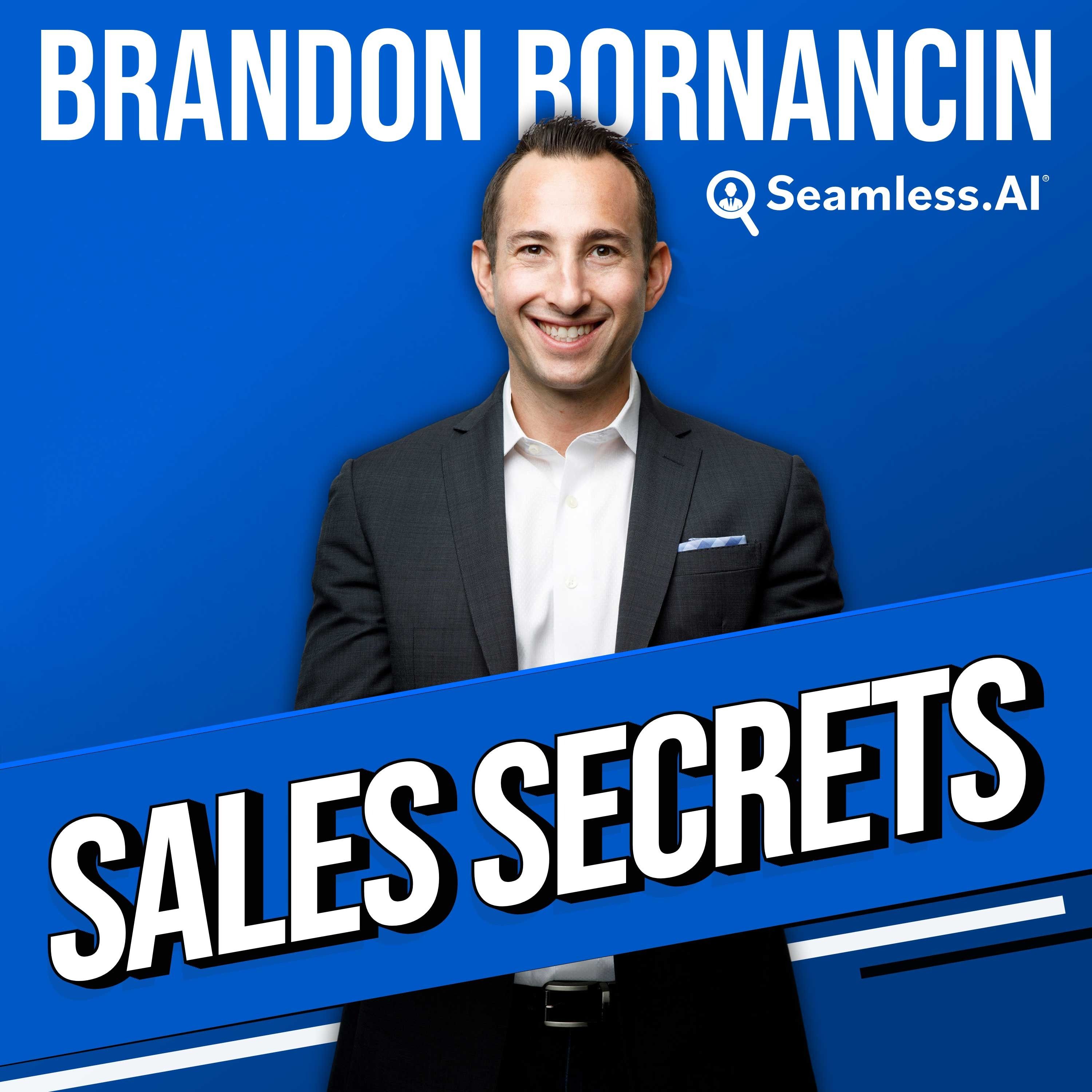
PODCAST · business
Sales Secrets
by Brandon Bornancin
Brandon Bornancin is a serial salesperson, entrepreneur, and Founder & CEO of Seamless.AI. He has interviewed the world’s biggest and brightest business experts (including Kevin Harrington, Jordan Belfort, Ryan Serhant, Bob Burg, and many more) to uncover actionable strategies, tips, and insights that you can use to generate more revenue and accelerate your business. Ready to learn exclusive secrets from top sales, business, and entrepreneurs from around the world? Then Sales Secrets From The Top 1% is the place to find them.
-
600
You’ll Never Get Great at Sales From the Sidelines | #1429
In this episode, Brandon covers:Why consuming more sales content does not automatically make you better at sellingThe difference between knowing a sales framework and executing it under pressureWhy sales should be treated like a sport or performance skillHow repetition creates pattern recognition and better judgmentWhy bad calls, objections, and lost deals are valuable learning opportunitiesThe difference between repetition and deliberate practiceThe Do → Review → Adjust → Repeat learning loopWhy the market is ultimately the best sales trainerHow great reps learn when to follow the script and when to leave itWhy sales managers should coach specific behaviors instead of giving vague feedbackHow avoiding uncomfortable parts of sales keeps those skills weakWhy confidence usually comes after taking action, not beforeHow books, training, and coaching should support real-world reps rather than replace themThe metrics reps should focus on: conversations, pitches, objections, asks, wins, and lossesWhy the fastest path to becoming a better salesperson is getting back on the field
-
599
Chapter 46: Tech Stack, Tools To Turbocharge Sales | Scale Your Sales Audiobook
PART 6 SCALING: THE 4 PILLARS TO $100M + BEYOND Congratulations on already accomplishing what 99% of professionals never do. You’ve mastered the mindset and habits needed for success. You’ve learned how to deliver world-class pitches, overcome any objection thrown your way, and close deals like the top 1%. Now, Part 6 of this book is about building a scalable sales machine that grows with or without you. It focuses on the four essential pillars of scalable success: People, Data, Technology, and Playbooks. You’ll learn how to hire, train, and lead teams that execute at the highest level. You’ll discover how to track actionable data across every department. You’ll evaluate whether your tech stack is truly built for scale and how to integrate your systems for smooth operations. And lastly, you’ll learn how to build bulletproof playbooks and documentation so your business can scale predictably and sustainably. This is the final stretch, so stay with me! Part 6 is where good turns to great, and great turns into an unstoppable growth engine. People: Hire, train, manage, and empower high-performing teams to execute at scale. Data: Track and improve data to fuel smarter decision-making and growth. Technology: Integrate cutting-edge systems to streamline workflows. Playbooks: Develop playbooks to ensure consistency, alignment, and optimal results. P.S.) Once my team and I scaled the business to tens of millions of dollars in revenue, I didn’t have the expertise to scale it to $100’s of millions in revenue. That’s when we brought on a private equity firm that taught us how to grow to $100M+ and beyond. I share everything they taught me in this part of the book on scaling. Big shout out to one of the best PE Firms out there, Spectrum Equity, and one of the best managing partners out there, Mike Farrell. Thank you, Mike and Spectrum, for teaching us since day 1 how to build a repeatable and scalable architecture. We couldn’t have done it without you. When you reach $10M+ in revenue, consider reaching out to them for an investment at www.spectrumequity.com.
-
598
Chapter 45: Data, Measure What Matters | Scale Your Sales Audiobook
PART 6 SCALING: THE 4 PILLARS TO $100M + BEYOND Congratulations on already accomplishing what 99% of professionals never do. You’ve mastered the mindset and habits needed for success. You’ve learned how to deliver world-class pitches, overcome any objection thrown your way, and close deals like the top 1%. Now, Part 6 of this book is about building a scalable sales machine that grows with or without you. It focuses on the four essential pillars of scalable success: People, Data, Technology, and Playbooks. You’ll learn how to hire, train, and lead teams that execute at the highest level. You’ll discover how to track actionable data across every department. You’ll evaluate whether your tech stack is truly built for scale and how to integrate your systems for smooth operations. And lastly, you’ll learn how to build bulletproof playbooks and documentation so your business can scale predictably and sustainably. This is the final stretch, so stay with me! Part 6 is where good turns to great, and great turns into an unstoppable growth engine. People: Hire, train, manage, and empower high-performing teams to execute at scale. Data: Track and improve data to fuel smarter decision-making and growth. Technology: Integrate cutting-edge systems to streamline workflows. Playbooks: Develop playbooks to ensure consistency, alignment, and optimal results. P.S.) Once my team and I scaled the business to tens of millions of dollars in revenue, I didn’t have the expertise to scale it to $100’s of millions in revenue. That’s when we brought on a private equity firm that taught us how to grow to $100M+ and beyond. I share everything they taught me in this part of the book on scaling. Big shout out to one of the best PE Firms out there, Spectrum Equity, and one of the best managing partners out there, Mike Farrell. Thank you, Mike and Spectrum, for teaching us since day 1 how to build a repeatable and scalable architecture. We couldn’t have done it without you. When you reach $10M+ in revenue, consider reaching out to them for an investment at www.spectrumequity.com.
-
597
Chapter 44: People Hire Top Performers | Scale Your Sales Audiobook
PART 6 SCALING: THE 4 PILLARS TO $100M + BEYOND Congratulations on already accomplishing what 99% of professionals never do. You’ve mastered the mindset and habits needed for success. You’ve learned how to deliver world-class pitches, overcome any objection thrown your way, and close deals like the top 1%. Now, Part 6 of this book is about building a scalable sales machine that grows with or without you. It focuses on the four essential pillars of scalable success: People, Data, Technology, and Playbooks. You’ll learn how to hire, train, and lead teams that execute at the highest level. You’ll discover how to track actionable data across every department. You’ll evaluate whether your tech stack is truly built for scale and how to integrate your systems for smooth operations. And lastly, you’ll learn how to build bulletproof playbooks and documentation so your business can scale predictably and sustainably. This is the final stretch, so stay with me! Part 6 is where good turns to great, and great turns into an unstoppable growth engine. People: Hire, train, manage, and empower high-performing teams to execute at scale. Data: Track and improve data to fuel smarter decision-making and growth. Technology: Integrate cutting-edge systems to streamline workflows. Playbooks: Develop playbooks to ensure consistency, alignment, and optimal results. P.S.) Once my team and I scaled the business to tens of millions of dollars in revenue, I didn’t have the expertise to scale it to $100’s of millions in revenue. That’s when we brought on a private equity firm that taught us how to grow to $100M+ and beyond. I share everything they taught me in this part of the book on scaling. Big shout out to one of the best PE Firms out there, Spectrum Equity, and one of the best managing partners out there, Mike Farrell. Thank you, Mike and Spectrum, for teaching us since day 1 how to build a repeatable and scalable architecture. We couldn’t have done it without you. When you reach $10M+ in revenue, consider reaching out to them for an investment at www.spectrumequity.com.
-
596
Chapter 43: Unresponsive Prospects | Scale Your Sales Audiobook
PART 5 CLOSING: TURN MORE CONTACTS INTO CONTRACTS You’re almost through this incredible 6-part journey. Now that you’ve mastered how to overcome the most common sales objections, you’re equipped to find, pitch, and close any prospect, no matter the situation. Closing is the most important part of the sales process. It’s when all your hard work finally pays off. At the close, everything comes together. This is the critical exchange point where all the value you’ve built and the trust you’ve earned come together. Success in business and life boils down to your ability to close the sale. The difference between those who thrive and those who struggle isn’t luck or talent; it’s closing the sale when it matters most. Every conversation is a sale, whether you’re negotiating a multimillion-dollar contract or persuading a client to take the next step. In this part of the book, you’ll learn how to become a top closer and why closing is a crucial life skill to improve your revenue and the quality of your life. In this section, you’ll learn the top closing strategies that separate the top 1% from the rest. Lessons span: Value-Added Follow-Up: The money is in the follow-up. Plan out how to keep nurturing the prospect and getting everyone on the buying committee to sign the deal. Close or Lose – Nothing Else Matters: Understand why closing is a non-negotiable and how mastering this skill is the key to your success. Yes, Your Prospect Is Ready to Buy!: Get strategies to lock in the sale and close the deal. If you can’t close, you can’t win. Master the art of closing and you’ll unleash your success. Re-engage Unresponsive Prospects: Use these strategies to re-engage prospects who have gone silent.
-
595
Chapter 42: Yes, I'm Ready To Buy | Scale Your Sales Audiobook
PART 5 CLOSING: TURN MORE CONTACTS INTO CONTRACTS You’re almost through this incredible 6-part journey. Now that you’ve mastered how to overcome the most common sales objections, you’re equipped to find, pitch, and close any prospect, no matter the situation. Closing is the most important part of the sales process. It’s when all your hard work finally pays off. At the close, everything comes together. This is the critical exchange point where all the value you’ve built and the trust you’ve earned come together. Success in business and life boils down to your ability to close the sale. The difference between those who thrive and those who struggle isn’t luck or talent; it’s closing the sale when it matters most. Every conversation is a sale, whether you’re negotiating a multimillion-dollar contract or persuading a client to take the next step. In this part of the book, you’ll learn how to become a top closer and why closing is a crucial life skill to improve your revenue and the quality of your life. In this section, you’ll learn the top closing strategies that separate the top 1% from the rest. Lessons span: Value-Added Follow-Up: The money is in the follow-up. Plan out how to keep nurturing the prospect and getting everyone on the buying committee to sign the deal. Close or Lose – Nothing Else Matters: Understand why closing is a non-negotiable and how mastering this skill is the key to your success. Yes, Your Prospect Is Ready to Buy!: Get strategies to lock in the sale and close the deal. If you can’t close, you can’t win. Master the art of closing and you’ll unleash your success. Re-engage Unresponsive Prospects: Use these strategies to re-engage prospects who have gone silent.
-
594
Chapter 41: Close or Lose, Nothing Else Matters | Scale Your Sales Audiobook
PART 5 CLOSING: TURN MORE CONTACTS INTO CONTRACTS You’re almost through this incredible 6-part journey. Now that you’ve mastered how to overcome the most common sales objections, you’re equipped to find, pitch, and close any prospect, no matter the situation. Closing is the most important part of the sales process. It’s when all your hard work finally pays off. At the close, everything comes together. This is the critical exchange point where all the value you’ve built and the trust you’ve earned come together. Success in business and life boils down to your ability to close the sale. The difference between those who thrive and those who struggle isn’t luck or talent; it’s closing the sale when it matters most. Every conversation is a sale, whether you’re negotiating a multimillion-dollar contract or persuading a client to take the next step. In this part of the book, you’ll learn how to become a top closer and why closing is a crucial life skill to improve your revenue and the quality of your life. In this section, you’ll learn the top closing strategies that separate the top 1% from the rest. Lessons span: Value-Added Follow-Up: The money is in the follow-up. Plan out how to keep nurturing the prospect and getting everyone on the buying committee to sign the deal. Close or Lose – Nothing Else Matters: Understand why closing is a non-negotiable and how mastering this skill is the key to your success. Yes, Your Prospect Is Ready to Buy!: Get strategies to lock in the sale and close the deal. If you can’t close, you can’t win. Master the art of closing and you’ll unleash your success. Re-engage Unresponsive Prospects: Use these strategies to re-engage prospects who have gone silent.
-
593
Chapter 40: The Money Is In The Follow-Up | Scale Your Sales Audiobook
PART 5 CLOSING: TURN MORE CONTACTS INTO CONTRACTS You’re almost through this incredible 6-part journey. Now that you’ve mastered how to overcome the most common sales objections, you’re equipped to find, pitch, and close any prospect, no matter the situation. Closing is the most important part of the sales process. It’s when all your hard work finally pays off. At the close, everything comes together. This is the critical exchange point where all the value you’ve built and the trust you’ve earned come together. Success in business and life boils down to your ability to close the sale. The difference between those who thrive and those who struggle isn’t luck or talent; it’s closing the sale when it matters most. Every conversation is a sale, whether you’re negotiating a multimillion-dollar contract or persuading a client to take the next step. In this part of the book, you’ll learn how to become a top closer and why closing is a crucial life skill to improve your revenue and the quality of your life. In this section, you’ll learn the top closing strategies that separate the top 1% from the rest. Lessons span: Value-Added Follow-Up: The money is in the follow-up. Plan out how to keep nurturing the prospect and getting everyone on the buying committee to sign the deal. Close or Lose – Nothing Else Matters: Understand why closing is a non-negotiable and how mastering this skill is the key to your success. Yes, Your Prospect Is Ready to Buy!: Get strategies to lock in the sale and close the deal. If you can’t close, you can’t win. Master the art of closing and you’ll unleash your success. Re-engage Unresponsive Prospects: Use these strategies to re-engage prospects who have gone silent.
-
592
Chapter 39: Yes, I'm Interested | Scale Your Sales Audiobook
PART 4: SALES OBJECTIONS: TURN CONCERN INTO CLOSED WON DEALS When you master the objection, you win the sale. After delivering a strong pitch, one of the last steps in the sales process is addressing and overcoming sales objections. Sales objections are any reason, concern, hesitation, or excuse that a prospect gives for not buying. The objection is not the end of the sale. It is the moment that decides it. Every deal lives or dies in the few minutes after resistance appears. When a prospect says it is too expensive, they need to think about it, or they are looking at a competitor, the amateur gets defensive, discounts, or retreats. The closer leans in. Objections are buying signals wrapped in fear, uncertainty, and risk. If you cannot confidently control that moment, you cannot scale your income. Mastering objections means staying calm, asking the right questions, uncovering the real concern, and resolving it with certainty and proof. Handle it with precision and you earn trust, authority, and the signature. Handle it poorly and the deal disappears forever. In sales, you either close or you lose. The best closers and highest growth companies know that sales objections are a necessary part of the sales process. Objections are a signal that the prospect needs more information, clarity, or proof before committing. If you know how to overcome sales objections, you can sell anything to anyone. In this section of the book, I’ve broken down all the top sales objections and scripts into their own chapter: I’m not interested I’m already working with someone It’s too expensive Send me more information I’m not the right person I need to talk to my boss I need to think about it I don’t have time How much is it? Tell me more Who is this? Call me back later I’m in a meeting Yes, I’m interested Objections aren’t roadblocks. They are bridges you cross to win the sale. In this part of the book, I give you all the exact word-for-word scripts, strategies, frameworks, and playbooks to win over 51,036 customers and generate over $250 million in revenue. If you can prepare to overcome sales objections with confidence, you’ll drastically increase your close rates and move more prospects from “No” or “Maybe” to “Yes! Where do I sign?”
-
591
Chapter 38: I'm In A Meeting | Scale Your Sales Audiobook
PART 4: SALES OBJECTIONS: TURN CONCERN INTO CLOSED WON DEALS When you master the objection, you win the sale. After delivering a strong pitch, one of the last steps in the sales process is addressing and overcoming sales objections. Sales objections are any reason, concern, hesitation, or excuse that a prospect gives for not buying. The objection is not the end of the sale. It is the moment that decides it. Every deal lives or dies in the few minutes after resistance appears. When a prospect says it is too expensive, they need to think about it, or they are looking at a competitor, the amateur gets defensive, discounts, or retreats. The closer leans in. Objections are buying signals wrapped in fear, uncertainty, and risk. If you cannot confidently control that moment, you cannot scale your income. Mastering objections means staying calm, asking the right questions, uncovering the real concern, and resolving it with certainty and proof. Handle it with precision and you earn trust, authority, and the signature. Handle it poorly and the deal disappears forever. In sales, you either close or you lose. The best closers and highest growth companies know that sales objections are a necessary part of the sales process. Objections are a signal that the prospect needs more information, clarity, or proof before committing. If you know how to overcome sales objections, you can sell anything to anyone. In this section of the book, I’ve broken down all the top sales objections and scripts into their own chapter: I’m not interested I’m already working with someone It’s too expensive Send me more information I’m not the right person I need to talk to my boss I need to think about it I don’t have time How much is it? Tell me more Who is this? Call me back later I’m in a meeting Yes, I’m interested Objections aren’t roadblocks. They are bridges you cross to win the sale. In this part of the book, I give you all the exact word-for-word scripts, strategies, frameworks, and playbooks to win over 51,036 customers and generate over $250 million in revenue. If you can prepare to overcome sales objections with confidence, you’ll drastically increase your close rates and move more prospects from “No” or “Maybe” to “Yes! Where do I sign?”
-
590
Chapter 37: Call Me Back Later | Scale Your Sales Audiobook
PART 4: SALES OBJECTIONS: TURN CONCERN INTO CLOSED WON DEALS When you master the objection, you win the sale. After delivering a strong pitch, one of the last steps in the sales process is addressing and overcoming sales objections. Sales objections are any reason, concern, hesitation, or excuse that a prospect gives for not buying. The objection is not the end of the sale. It is the moment that decides it. Every deal lives or dies in the few minutes after resistance appears. When a prospect says it is too expensive, they need to think about it, or they are looking at a competitor, the amateur gets defensive, discounts, or retreats. The closer leans in. Objections are buying signals wrapped in fear, uncertainty, and risk. If you cannot confidently control that moment, you cannot scale your income. Mastering objections means staying calm, asking the right questions, uncovering the real concern, and resolving it with certainty and proof. Handle it with precision and you earn trust, authority, and the signature. Handle it poorly and the deal disappears forever. In sales, you either close or you lose. The best closers and highest growth companies know that sales objections are a necessary part of the sales process. Objections are a signal that the prospect needs more information, clarity, or proof before committing. If you know how to overcome sales objections, you can sell anything to anyone. In this section of the book, I’ve broken down all the top sales objections and scripts into their own chapter: I’m not interested I’m already working with someone It’s too expensive Send me more information I’m not the right person I need to talk to my boss I need to think about it I don’t have time How much is it? Tell me more Who is this? Call me back later I’m in a meeting Yes, I’m interested Objections aren’t roadblocks. They are bridges you cross to win the sale. In this part of the book, I give you all the exact word-for-word scripts, strategies, frameworks, and playbooks to win over 51,036 customers and generate over $250 million in revenue. If you can prepare to overcome sales objections with confidence, you’ll drastically increase your close rates and move more prospects from “No” or “Maybe” to “Yes! Where do I sign?”
-
589
Chapter 36: Who Is This | Scale Your Sales Audiobook
PART 4: SALES OBJECTIONS: TURN CONCERN INTO CLOSED WON DEALS When you master the objection, you win the sale. After delivering a strong pitch, one of the last steps in the sales process is addressing and overcoming sales objections. Sales objections are any reason, concern, hesitation, or excuse that a prospect gives for not buying. The objection is not the end of the sale. It is the moment that decides it. Every deal lives or dies in the few minutes after resistance appears. When a prospect says it is too expensive, they need to think about it, or they are looking at a competitor, the amateur gets defensive, discounts, or retreats. The closer leans in. Objections are buying signals wrapped in fear, uncertainty, and risk. If you cannot confidently control that moment, you cannot scale your income. Mastering objections means staying calm, asking the right questions, uncovering the real concern, and resolving it with certainty and proof. Handle it with precision and you earn trust, authority, and the signature. Handle it poorly and the deal disappears forever. In sales, you either close or you lose. The best closers and highest growth companies know that sales objections are a necessary part of the sales process. Objections are a signal that the prospect needs more information, clarity, or proof before committing. If you know how to overcome sales objections, you can sell anything to anyone. In this section of the book, I’ve broken down all the top sales objections and scripts into their own chapter: I’m not interested I’m already working with someone It’s too expensive Send me more information I’m not the right person I need to talk to my boss I need to think about it I don’t have time How much is it? Tell me more Who is this? Call me back later I’m in a meeting Yes, I’m interested Objections aren’t roadblocks. They are bridges you cross to win the sale. In this part of the book, I give you all the exact word-for-word scripts, strategies, frameworks, and playbooks to win over 51,036 customers and generate over $250 million in revenue. If you can prepare to overcome sales objections with confidence, you’ll drastically increase your close rates and move more prospects from “No” or “Maybe” to “Yes! Where do I sign?”
-
588
Chapter 35: Tell Me More | Scale Your Sales Audiobook
PART 4: SALES OBJECTIONS: TURN CONCERN INTO CLOSED WON DEALS When you master the objection, you win the sale. After delivering a strong pitch, one of the last steps in the sales process is addressing and overcoming sales objections. Sales objections are any reason, concern, hesitation, or excuse that a prospect gives for not buying. The objection is not the end of the sale. It is the moment that decides it. Every deal lives or dies in the few minutes after resistance appears. When a prospect says it is too expensive, they need to think about it, or they are looking at a competitor, the amateur gets defensive, discounts, or retreats. The closer leans in. Objections are buying signals wrapped in fear, uncertainty, and risk. If you cannot confidently control that moment, you cannot scale your income. Mastering objections means staying calm, asking the right questions, uncovering the real concern, and resolving it with certainty and proof. Handle it with precision and you earn trust, authority, and the signature. Handle it poorly and the deal disappears forever. In sales, you either close or you lose. The best closers and highest growth companies know that sales objections are a necessary part of the sales process. Objections are a signal that the prospect needs more information, clarity, or proof before committing. If you know how to overcome sales objections, you can sell anything to anyone. In this section of the book, I’ve broken down all the top sales objections and scripts into their own chapter: I’m not interested I’m already working with someone It’s too expensive Send me more information I’m not the right person I need to talk to my boss I need to think about it I don’t have time How much is it? Tell me more Who is this? Call me back later I’m in a meeting Yes, I’m interested Objections aren’t roadblocks. They are bridges you cross to win the sale. In this part of the book, I give you all the exact word-for-word scripts, strategies, frameworks, and playbooks to win over 51,036 customers and generate over $250 million in revenue. If you can prepare to overcome sales objections with confidence, you’ll drastically increase your close rates and move more prospects from “No” or “Maybe” to “Yes! Where do I sign?”
-
587
Chapter 34: How Much Is It | Scale Your Sales Audiobook
PART 4: SALES OBJECTIONS: TURN CONCERN INTO CLOSED WON DEALS When you master the objection, you win the sale. After delivering a strong pitch, one of the last steps in the sales process is addressing and overcoming sales objections. Sales objections are any reason, concern, hesitation, or excuse that a prospect gives for not buying. The objection is not the end of the sale. It is the moment that decides it. Every deal lives or dies in the few minutes after resistance appears. When a prospect says it is too expensive, they need to think about it, or they are looking at a competitor, the amateur gets defensive, discounts, or retreats. The closer leans in. Objections are buying signals wrapped in fear, uncertainty, and risk. If you cannot confidently control that moment, you cannot scale your income. Mastering objections means staying calm, asking the right questions, uncovering the real concern, and resolving it with certainty and proof. Handle it with precision and you earn trust, authority, and the signature. Handle it poorly and the deal disappears forever. In sales, you either close or you lose. The best closers and highest growth companies know that sales objections are a necessary part of the sales process. Objections are a signal that the prospect needs more information, clarity, or proof before committing. If you know how to overcome sales objections, you can sell anything to anyone. In this section of the book, I’ve broken down all the top sales objections and scripts into their own chapter: I’m not interested I’m already working with someone It’s too expensive Send me more information I’m not the right person I need to talk to my boss I need to think about it I don’t have time How much is it? Tell me more Who is this? Call me back later I’m in a meeting Yes, I’m interested Objections aren’t roadblocks. They are bridges you cross to win the sale. In this part of the book, I give you all the exact word-for-word scripts, strategies, frameworks, and playbooks to win over 51,036 customers and generate over $250 million in revenue. If you can prepare to overcome sales objections with confidence, you’ll drastically increase your close rates and move more prospects from “No” or “Maybe” to “Yes! Where do I sign?”
-
586
Chapter 33: I Don't Have Time | Scale Your Sales Audiobook
PART 4: SALES OBJECTIONS: TURN CONCERN INTO CLOSED WON DEALS When you master the objection, you win the sale. After delivering a strong pitch, one of the last steps in the sales process is addressing and overcoming sales objections. Sales objections are any reason, concern, hesitation, or excuse that a prospect gives for not buying. The objection is not the end of the sale. It is the moment that decides it. Every deal lives or dies in the few minutes after resistance appears. When a prospect says it is too expensive, they need to think about it, or they are looking at a competitor, the amateur gets defensive, discounts, or retreats. The closer leans in. Objections are buying signals wrapped in fear, uncertainty, and risk. If you cannot confidently control that moment, you cannot scale your income. Mastering objections means staying calm, asking the right questions, uncovering the real concern, and resolving it with certainty and proof. Handle it with precision and you earn trust, authority, and the signature. Handle it poorly and the deal disappears forever. In sales, you either close or you lose. The best closers and highest growth companies know that sales objections are a necessary part of the sales process. Objections are a signal that the prospect needs more information, clarity, or proof before committing. If you know how to overcome sales objections, you can sell anything to anyone. In this section of the book, I’ve broken down all the top sales objections and scripts into their own chapter: I’m not interested I’m already working with someone It’s too expensive Send me more information I’m not the right person I need to talk to my boss I need to think about it I don’t have time How much is it? Tell me more Who is this? Call me back later I’m in a meeting Yes, I’m interested Objections aren’t roadblocks. They are bridges you cross to win the sale. In this part of the book, I give you all the exact word-for-word scripts, strategies, frameworks, and playbooks to win over 51,036 customers and generate over $250 million in revenue. If you can prepare to overcome sales objections with confidence, you’ll drastically increase your close rates and move more prospects from “No” or “Maybe” to “Yes! Where do I sign?”
-
585
Chapter 32: I Need To Think About It | Scale Your Sales Audiobook
PART 4: SALES OBJECTIONS: TURN CONCERN INTO CLOSED WON DEALS When you master the objection, you win the sale. After delivering a strong pitch, one of the last steps in the sales process is addressing and overcoming sales objections. Sales objections are any reason, concern, hesitation, or excuse that a prospect gives for not buying. The objection is not the end of the sale. It is the moment that decides it. Every deal lives or dies in the few minutes after resistance appears. When a prospect says it is too expensive, they need to think about it, or they are looking at a competitor, the amateur gets defensive, discounts, or retreats. The closer leans in. Objections are buying signals wrapped in fear, uncertainty, and risk. If you cannot confidently control that moment, you cannot scale your income. Mastering objections means staying calm, asking the right questions, uncovering the real concern, and resolving it with certainty and proof. Handle it with precision and you earn trust, authority, and the signature. Handle it poorly and the deal disappears forever. In sales, you either close or you lose. The best closers and highest growth companies know that sales objections are a necessary part of the sales process. Objections are a signal that the prospect needs more information, clarity, or proof before committing. If you know how to overcome sales objections, you can sell anything to anyone. In this section of the book, I’ve broken down all the top sales objections and scripts into their own chapter: I’m not interested I’m already working with someone It’s too expensive Send me more information I’m not the right person I need to talk to my boss I need to think about it I don’t have time How much is it? Tell me more Who is this? Call me back later I’m in a meeting Yes, I’m interested Objections aren’t roadblocks. They are bridges you cross to win the sale. In this part of the book, I give you all the exact word-for-word scripts, strategies, frameworks, and playbooks to win over 51,036 customers and generate over $250 million in revenue. If you can prepare to overcome sales objections with confidence, you’ll drastically increase your close rates and move more prospects from “No” or “Maybe” to “Yes! Where do I sign?”
-
584
Chapter 31: I Need To Talk To My Boss | Scale Your Sales Audiobook
PART 4: SALES OBJECTIONS: TURN CONCERN INTO CLOSED WON DEALS When you master the objection, you win the sale. After delivering a strong pitch, one of the last steps in the sales process is addressing and overcoming sales objections. Sales objections are any reason, concern, hesitation, or excuse that a prospect gives for not buying. The objection is not the end of the sale. It is the moment that decides it. Every deal lives or dies in the few minutes after resistance appears. When a prospect says it is too expensive, they need to think about it, or they are looking at a competitor, the amateur gets defensive, discounts, or retreats. The closer leans in. Objections are buying signals wrapped in fear, uncertainty, and risk. If you cannot confidently control that moment, you cannot scale your income. Mastering objections means staying calm, asking the right questions, uncovering the real concern, and resolving it with certainty and proof. Handle it with precision and you earn trust, authority, and the signature. Handle it poorly and the deal disappears forever. In sales, you either close or you lose. The best closers and highest growth companies know that sales objections are a necessary part of the sales process. Objections are a signal that the prospect needs more information, clarity, or proof before committing. If you know how to overcome sales objections, you can sell anything to anyone. In this section of the book, I’ve broken down all the top sales objections and scripts into their own chapter: I’m not interested I’m already working with someone It’s too expensive Send me more information I’m not the right person I need to talk to my boss I need to think about it I don’t have time How much is it? Tell me more Who is this? Call me back later I’m in a meeting Yes, I’m interested Objections aren’t roadblocks. They are bridges you cross to win the sale. In this part of the book, I give you all the exact word-for-word scripts, strategies, frameworks, and playbooks to win over 51,036 customers and generate over $250 million in revenue. If you can prepare to overcome sales objections with confidence, you’ll drastically increase your close rates and move more prospects from “No” or “Maybe” to “Yes! Where do I sign?”
-
583
Chapter 30: I'm Not The Right Person | Scale Your Sales Audiobook
PART 4: SALES OBJECTIONS: TURN CONCERN INTO CLOSED WON DEALS When you master the objection, you win the sale. After delivering a strong pitch, one of the last steps in the sales process is addressing and overcoming sales objections. Sales objections are any reason, concern, hesitation, or excuse that a prospect gives for not buying. The objection is not the end of the sale. It is the moment that decides it. Every deal lives or dies in the few minutes after resistance appears. When a prospect says it is too expensive, they need to think about it, or they are looking at a competitor, the amateur gets defensive, discounts, or retreats. The closer leans in. Objections are buying signals wrapped in fear, uncertainty, and risk. If you cannot confidently control that moment, you cannot scale your income. Mastering objections means staying calm, asking the right questions, uncovering the real concern, and resolving it with certainty and proof. Handle it with precision and you earn trust, authority, and the signature. Handle it poorly and the deal disappears forever. In sales, you either close or you lose. The best closers and highest growth companies know that sales objections are a necessary part of the sales process. Objections are a signal that the prospect needs more information, clarity, or proof before committing. If you know how to overcome sales objections, you can sell anything to anyone. In this section of the book, I’ve broken down all the top sales objections and scripts into their own chapter: I’m not interested I’m already working with someone It’s too expensive Send me more information I’m not the right person I need to talk to my boss I need to think about it I don’t have time How much is it? Tell me more Who is this? Call me back later I’m in a meeting Yes, I’m interested Objections aren’t roadblocks. They are bridges you cross to win the sale. In this part of the book, I give you all the exact word-for-word scripts, strategies, frameworks, and playbooks to win over 51,036 customers and generate over $250 million in revenue. If you can prepare to overcome sales objections with confidence, you’ll drastically increase your close rates and move more prospects from “No” or “Maybe” to “Yes! Where do I sign?”
-
582
Chapter 29: Send Me More Information | Scale Your Sales Audiobook
PART 4: SALES OBJECTIONS: TURN CONCERN INTO CLOSED WON DEALS When you master the objection, you win the sale. After delivering a strong pitch, one of the last steps in the sales process is addressing and overcoming sales objections. Sales objections are any reason, concern, hesitation, or excuse that a prospect gives for not buying. The objection is not the end of the sale. It is the moment that decides it. Every deal lives or dies in the few minutes after resistance appears. When a prospect says it is too expensive, they need to think about it, or they are looking at a competitor, the amateur gets defensive, discounts, or retreats. The closer leans in. Objections are buying signals wrapped in fear, uncertainty, and risk. If you cannot confidently control that moment, you cannot scale your income. Mastering objections means staying calm, asking the right questions, uncovering the real concern, and resolving it with certainty and proof. Handle it with precision and you earn trust, authority, and the signature. Handle it poorly and the deal disappears forever. In sales, you either close or you lose. The best closers and highest growth companies know that sales objections are a necessary part of the sales process. Objections are a signal that the prospect needs more information, clarity, or proof before committing. If you know how to overcome sales objections, you can sell anything to anyone. In this section of the book, I’ve broken down all the top sales objections and scripts into their own chapter: I’m not interested I’m already working with someone It’s too expensive Send me more information I’m not the right person I need to talk to my boss I need to think about it I don’t have time How much is it? Tell me more Who is this? Call me back later I’m in a meeting Yes, I’m interested Objections aren’t roadblocks. They are bridges you cross to win the sale. In this part of the book, I give you all the exact word-for-word scripts, strategies, frameworks, and playbooks to win over 51,036 customers and generate over $250 million in revenue. If you can prepare to overcome sales objections with confidence, you’ll drastically increase your close rates and move more prospects from “No” or “Maybe” to “Yes! Where do I sign?”
-
581
Chapter 28: It's Too Expensive | Scale Your Sales Audiobook
PART 4: SALES OBJECTIONS: TURN CONCERN INTO CLOSED WON DEALS When you master the objection, you win the sale. After delivering a strong pitch, one of the last steps in the sales process is addressing and overcoming sales objections. Sales objections are any reason, concern, hesitation, or excuse that a prospect gives for not buying. The objection is not the end of the sale. It is the moment that decides it. Every deal lives or dies in the few minutes after resistance appears. When a prospect says it is too expensive, they need to think about it, or they are looking at a competitor, the amateur gets defensive, discounts, or retreats. The closer leans in. Objections are buying signals wrapped in fear, uncertainty, and risk. If you cannot confidently control that moment, you cannot scale your income. Mastering objections means staying calm, asking the right questions, uncovering the real concern, and resolving it with certainty and proof. Handle it with precision and you earn trust, authority, and the signature. Handle it poorly and the deal disappears forever. In sales, you either close or you lose. The best closers and highest growth companies know that sales objections are a necessary part of the sales process. Objections are a signal that the prospect needs more information, clarity, or proof before committing. If you know how to overcome sales objections, you can sell anything to anyone. In this section of the book, I’ve broken down all the top sales objections and scripts into their own chapter: I’m not interested I’m already working with someone It’s too expensive Send me more information I’m not the right person I need to talk to my boss I need to think about it I don’t have time How much is it? Tell me more Who is this? Call me back later I’m in a meeting Yes, I’m interested Objections aren’t roadblocks. They are bridges you cross to win the sale. In this part of the book, I give you all the exact word-for-word scripts, strategies, frameworks, and playbooks to win over 51,036 customers and generate over $250 million in revenue. If you can prepare to overcome sales objections with confidence, you’ll drastically increase your close rates and move more prospects from “No” or “Maybe” to “Yes! Where do I sign?”
-
580
Chapter 27: I'm Already Working With Someone | Scale Your Sales Audiobook
PART 4: SALES OBJECTIONS: TURN CONCERN INTO CLOSED WON DEALS When you master the objection, you win the sale. After delivering a strong pitch, one of the last steps in the sales process is addressing and overcoming sales objections. Sales objections are any reason, concern, hesitation, or excuse that a prospect gives for not buying. The objection is not the end of the sale. It is the moment that decides it. Every deal lives or dies in the few minutes after resistance appears. When a prospect says it is too expensive, they need to think about it, or they are looking at a competitor, the amateur gets defensive, discounts, or retreats. The closer leans in. Objections are buying signals wrapped in fear, uncertainty, and risk. If you cannot confidently control that moment, you cannot scale your income. Mastering objections means staying calm, asking the right questions, uncovering the real concern, and resolving it with certainty and proof. Handle it with precision and you earn trust, authority, and the signature. Handle it poorly and the deal disappears forever. In sales, you either close or you lose. The best closers and highest growth companies know that sales objections are a necessary part of the sales process. Objections are a signal that the prospect needs more information, clarity, or proof before committing. If you know how to overcome sales objections, you can sell anything to anyone. In this section of the book, I’ve broken down all the top sales objections and scripts into their own chapter: I’m not interested I’m already working with someone It’s too expensive Send me more information I’m not the right person I need to talk to my boss I need to think about it I don’t have time How much is it? Tell me more Who is this? Call me back later I’m in a meeting Yes, I’m interested Objections aren’t roadblocks. They are bridges you cross to win the sale. In this part of the book, I give you all the exact word-for-word scripts, strategies, frameworks, and playbooks to win over 51,036 customers and generate over $250 million in revenue. If you can prepare to overcome sales objections with confidence, you’ll drastically increase your close rates and move more prospects from “No” or “Maybe” to “Yes! Where do I sign?”
-
579
Chapter 26: I'm Not Interested | Scale Your Sales Audiobook
PART 4: SALES OBJECTIONS: TURN CONCERN INTO CLOSED WON DEALS When you master the objection, you win the sale. After delivering a strong pitch, one of the last steps in the sales process is addressing and overcoming sales objections. Sales objections are any reason, concern, hesitation, or excuse that a prospect gives for not buying. The objection is not the end of the sale. It is the moment that decides it. Every deal lives or dies in the few minutes after resistance appears. When a prospect says it is too expensive, they need to think about it, or they are looking at a competitor, the amateur gets defensive, discounts, or retreats. The closer leans in. Objections are buying signals wrapped in fear, uncertainty, and risk. If you cannot confidently control that moment, you cannot scale your income. Mastering objections means staying calm, asking the right questions, uncovering the real concern, and resolving it with certainty and proof. Handle it with precision and you earn trust, authority, and the signature. Handle it poorly and the deal disappears forever. In sales, you either close or you lose. The best closers and highest growth companies know that sales objections are a necessary part of the sales process. Objections are a signal that the prospect needs more information, clarity, or proof before committing. If you know how to overcome sales objections, you can sell anything to anyone. In this section of the book, I’ve broken down all the top sales objections and scripts into their own chapter: I’m not interested I’m already working with someone It’s too expensive Send me more information I’m not the right person I need to talk to my boss I need to think about it I don’t have time How much is it? Tell me more Who is this? Call me back later I’m in a meeting Yes, I’m interested Objections aren’t roadblocks. They are bridges you cross to win the sale. In this part of the book, I give you all the exact word-for-word scripts, strategies, frameworks, and playbooks to win over 51,036 customers and generate over $250 million in revenue. If you can prepare to overcome sales objections with confidence, you’ll drastically increase your close rates and move more prospects from “No” or “Maybe” to “Yes! Where do I sign?”
-
578
Chapter 25: How To Overcome Any Sales Objection | Scale Your Sales Audiobook
PART 4: SALES OBJECTIONS: TURN CONCERN INTO CLOSED WON DEALS When you master the objection, you win the sale. After delivering a strong pitch, one of the last steps in the sales process is addressing and overcoming sales objections. Sales objections are any reason, concern, hesitation, or excuse that a prospect gives for not buying. The objection is not the end of the sale. It is the moment that decides it. Every deal lives or dies in the few minutes after resistance appears. When a prospect says it is too expensive, they need to think about it, or they are looking at a competitor, the amateur gets defensive, discounts, or retreats. The closer leans in. Objections are buying signals wrapped in fear, uncertainty, and risk. If you cannot confidently control that moment, you cannot scale your income. Mastering objections means staying calm, asking the right questions, uncovering the real concern, and resolving it with certainty and proof. Handle it with precision and you earn trust, authority, and the signature. Handle it poorly and the deal disappears forever. In sales, you either close or you lose. The best closers and highest growth companies know that sales objections are a necessary part of the sales process. Objections are a signal that the prospect needs more information, clarity, or proof before committing. If you know how to overcome sales objections, you can sell anything to anyone. In this section of the book, I’ve broken down all the top sales objections and scripts into their own chapter: I’m not interested I’m already working with someone It’s too expensive Send me more information I’m not the right person I need to talk to my boss I need to think about it I don’t have time How much is it? Tell me more Who is this? Call me back later I’m in a meeting Yes, I’m interested Objections aren’t roadblocks. They are bridges you cross to win the sale. In this part of the book, I give you all the exact word-for-word scripts, strategies, frameworks, and playbooks to win over 51,036 customers and generate over $250 million in revenue. If you can prepare to overcome sales objections with confidence, you’ll drastically increase your close rates and move more prospects from “No” or “Maybe” to “Yes! Where do I sign?”
-
577
Chapter 24: How To Define Next Steps To Close The Deal | Scale Your Sales Audiobook
PART 3 PITCHING: YOUR PATH TO CLOSING MORE SALES Congratulations on making it this far! By now, you’ve mastered the beliefs, habits, and operating principles from Part I. In Part 2, you explored the prospecting channels, strategies, and tools to keep your pipeline full and your calendar booked with qualified meetings. Now, Part 3 is all about the pitch. That critical moment when you have to pitch your product in full detail to a prospect. This part can make or break the deal. Becoming an expert at giving sales pitches and presentations is the difference between winning more deals and watching them slip through your fingers. It’s the bridge between all the time and energy you’ve invested in prospecting and the reward you will get from closing a deal if you do this right. The stakes couldn’t be higher, which is why mastering the sales pitch is a non-negotiable for scaling your sales. Over the years, my team and I have won over 51,036 customers and generated more than $250,000,000 in revenue. We’ve studied thousands of pitches from our sales team and interviewed hundreds of sales experts on what makes the most effective sales pitches. In this part of the book, I’ll share what works, what doesn’t, and how to put together a scalable pitching strategy. Over the next ten chapters, you’ll learn how to: Understand why people buy and identify the top buying triggers. Nail your introduction and set the agenda. Master the art of sales discovery. Deliver an engaging demo. Leverage social proof to build trust. Show your prospects the ROI you can deliver. Confidently present pricing and irresistible offers. Develop a Q&A database for your team. Navigate the decision-making process and the buying committee. Secure actionable next steps to keep momentum. I believe the insights in this section are a game-changer for growing your business. Get ready to perfect your pitch and scale your sales like never before.
-
576
Chapter 23: Selling To Buying Committees | Scale Your Sales Audiobook
PART 3 PITCHING: YOUR PATH TO CLOSING MORE SALES Congratulations on making it this far! By now, you’ve mastered the beliefs, habits, and operating principles from Part I. In Part 2, you explored the prospecting channels, strategies, and tools to keep your pipeline full and your calendar booked with qualified meetings. Now, Part 3 is all about the pitch. That critical moment when you have to pitch your product in full detail to a prospect. This part can make or break the deal. Becoming an expert at giving sales pitches and presentations is the difference between winning more deals and watching them slip through your fingers. It’s the bridge between all the time and energy you’ve invested in prospecting and the reward you will get from closing a deal if you do this right. The stakes couldn’t be higher, which is why mastering the sales pitch is a non-negotiable for scaling your sales. Over the years, my team and I have won over 51,036 customers and generated more than $250,000,000 in revenue. We’ve studied thousands of pitches from our sales team and interviewed hundreds of sales experts on what makes the most effective sales pitches. In this part of the book, I’ll share what works, what doesn’t, and how to put together a scalable pitching strategy. Over the next ten chapters, you’ll learn how to: Understand why people buy and identify the top buying triggers. Nail your introduction and set the agenda. Master the art of sales discovery. Deliver an engaging demo. Leverage social proof to build trust. Show your prospects the ROI you can deliver. Confidently present pricing and irresistible offers. Develop a Q&A database for your team. Navigate the decision-making process and the buying committee. Secure actionable next steps to keep momentum. I believe the insights in this section are a game-changer for growing your business. Get ready to perfect your pitch and scale your sales like never before.
-
575
Chapter 22: Q&A Bank, Never Get Stumped Again | Scale Your Sales Audiobook
PART 3 PITCHING: YOUR PATH TO CLOSING MORE SALES Congratulations on making it this far! By now, you’ve mastered the beliefs, habits, and operating principles from Part I. In Part 2, you explored the prospecting channels, strategies, and tools to keep your pipeline full and your calendar booked with qualified meetings. Now, Part 3 is all about the pitch. That critical moment when you have to pitch your product in full detail to a prospect. This part can make or break the deal. Becoming an expert at giving sales pitches and presentations is the difference between winning more deals and watching them slip through your fingers. It’s the bridge between all the time and energy you’ve invested in prospecting and the reward you will get from closing a deal if you do this right. The stakes couldn’t be higher, which is why mastering the sales pitch is a non-negotiable for scaling your sales. Over the years, my team and I have won over 51,036 customers and generated more than $250,000,000 in revenue. We’ve studied thousands of pitches from our sales team and interviewed hundreds of sales experts on what makes the most effective sales pitches. In this part of the book, I’ll share what works, what doesn’t, and how to put together a scalable pitching strategy. Over the next ten chapters, you’ll learn how to: Understand why people buy and identify the top buying triggers. Nail your introduction and set the agenda. Master the art of sales discovery. Deliver an engaging demo. Leverage social proof to build trust. Show your prospects the ROI you can deliver. Confidently present pricing and irresistible offers. Develop a Q&A database for your team. Navigate the decision-making process and the buying committee. Secure actionable next steps to keep momentum. I believe the insights in this section are a game-changer for growing your business. Get ready to perfect your pitch and scale your sales like never before.
-
574
Chapter 21: The Pricing Playbook, Turn Cost Into Value | Scale Your Sales Audiobook
PART 3 PITCHING: YOUR PATH TO CLOSING MORE SALES Congratulations on making it this far! By now, you’ve mastered the beliefs, habits, and operating principles from Part I. In Part 2, you explored the prospecting channels, strategies, and tools to keep your pipeline full and your calendar booked with qualified meetings. Now, Part 3 is all about the pitch. That critical moment when you have to pitch your product in full detail to a prospect. This part can make or break the deal. Becoming an expert at giving sales pitches and presentations is the difference between winning more deals and watching them slip through your fingers. It’s the bridge between all the time and energy you’ve invested in prospecting and the reward you will get from closing a deal if you do this right. The stakes couldn’t be higher, which is why mastering the sales pitch is a non-negotiable for scaling your sales. Over the years, my team and I have won over 51,036 customers and generated more than $250,000,000 in revenue. We’ve studied thousands of pitches from our sales team and interviewed hundreds of sales experts on what makes the most effective sales pitches. In this part of the book, I’ll share what works, what doesn’t, and how to put together a scalable pitching strategy. Over the next ten chapters, you’ll learn how to: Understand why people buy and identify the top buying triggers. Nail your introduction and set the agenda. Master the art of sales discovery. Deliver an engaging demo. Leverage social proof to build trust. Show your prospects the ROI you can deliver. Confidently present pricing and irresistible offers. Develop a Q&A database for your team. Navigate the decision-making process and the buying committee. Secure actionable next steps to keep momentum. I believe the insights in this section are a game-changer for growing your business. Get ready to perfect your pitch and scale your sales like never before.
-
573
Chapter 20: ROI Selling, How To Win More Deals With Business Cases That Close | Scale Your Sales Audiobook
PART 3 PITCHING: YOUR PATH TO CLOSING MORE SALES Congratulations on making it this far! By now, you’ve mastered the beliefs, habits, and operating principles from Part I. In Part 2, you explored the prospecting channels, strategies, and tools to keep your pipeline full and your calendar booked with qualified meetings. Now, Part 3 is all about the pitch. That critical moment when you have to pitch your product in full detail to a prospect. This part can make or break the deal. Becoming an expert at giving sales pitches and presentations is the difference between winning more deals and watching them slip through your fingers. It’s the bridge between all the time and energy you’ve invested in prospecting and the reward you will get from closing a deal if you do this right. The stakes couldn’t be higher, which is why mastering the sales pitch is a non-negotiable for scaling your sales. Over the years, my team and I have won over 51,036 customers and generated more than $250,000,000 in revenue. We’ve studied thousands of pitches from our sales team and interviewed hundreds of sales experts on what makes the most effective sales pitches. In this part of the book, I’ll share what works, what doesn’t, and how to put together a scalable pitching strategy. Over the next ten chapters, you’ll learn how to: Understand why people buy and identify the top buying triggers. Nail your introduction and set the agenda. Master the art of sales discovery. Deliver an engaging demo. Leverage social proof to build trust. Show your prospects the ROI you can deliver. Confidently present pricing and irresistible offers. Develop a Q&A database for your team. Navigate the decision-making process and the buying committee. Secure actionable next steps to keep momentum. I believe the insights in this section are a game-changer for growing your business. Get ready to perfect your pitch and scale your sales like never before.
-
572
Chapter 19: Social Proof, Let The Results Sell For You | Scale Your Sales Audiobook
PART 3 PITCHING: YOUR PATH TO CLOSING MORE SALES Congratulations on making it this far! By now, you’ve mastered the beliefs, habits, and operating principles from Part I. In Part 2, you explored the prospecting channels, strategies, and tools to keep your pipeline full and your calendar booked with qualified meetings. Now, Part 3 is all about the pitch. That critical moment when you have to pitch your product in full detail to a prospect. This part can make or break the deal. Becoming an expert at giving sales pitches and presentations is the difference between winning more deals and watching them slip through your fingers. It’s the bridge between all the time and energy you’ve invested in prospecting and the reward you will get from closing a deal if you do this right. The stakes couldn’t be higher, which is why mastering the sales pitch is a non-negotiable for scaling your sales. Over the years, my team and I have won over 51,036 customers and generated more than $250,000,000 in revenue. We’ve studied thousands of pitches from our sales team and interviewed hundreds of sales experts on what makes the most effective sales pitches. In this part of the book, I’ll share what works, what doesn’t, and how to put together a scalable pitching strategy. Over the next ten chapters, you’ll learn how to: Understand why people buy and identify the top buying triggers. Nail your introduction and set the agenda. Master the art of sales discovery. Deliver an engaging demo. Leverage social proof to build trust. Show your prospects the ROI you can deliver. Confidently present pricing and irresistible offers. Develop a Q&A database for your team. Navigate the decision-making process and the buying committee. Secure actionable next steps to keep momentum. I believe the insights in this section are a game-changer for growing your business. Get ready to perfect your pitch and scale your sales like never before.
-
571
Chapter 18: The Perfect Demo, Pitch Like A Pro | Scale Your Sales Audiobook
PART 3 PITCHING: YOUR PATH TO CLOSING MORE SALES Congratulations on making it this far! By now, you’ve mastered the beliefs, habits, and operating principles from Part I. In Part 2, you explored the prospecting channels, strategies, and tools to keep your pipeline full and your calendar booked with qualified meetings. Now, Part 3 is all about the pitch. That critical moment when you have to pitch your product in full detail to a prospect. This part can make or break the deal. Becoming an expert at giving sales pitches and presentations is the difference between winning more deals and watching them slip through your fingers. It’s the bridge between all the time and energy you’ve invested in prospecting and the reward you will get from closing a deal if you do this right. The stakes couldn’t be higher, which is why mastering the sales pitch is a non-negotiable for scaling your sales. Over the years, my team and I have won over 51,036 customers and generated more than $250,000,000 in revenue. We’ve studied thousands of pitches from our sales team and interviewed hundreds of sales experts on what makes the most effective sales pitches. In this part of the book, I’ll share what works, what doesn’t, and how to put together a scalable pitching strategy. Over the next ten chapters, you’ll learn how to: Understand why people buy and identify the top buying triggers. Nail your introduction and set the agenda. Master the art of sales discovery. Deliver an engaging demo. Leverage social proof to build trust. Show your prospects the ROI you can deliver. Confidently present pricing and irresistible offers. Develop a Q&A database for your team. Navigate the decision-making process and the buying committee. Secure actionable next steps to keep momentum. I believe the insights in this section are a game-changer for growing your business. Get ready to perfect your pitch and scale your sales like never before.
-
570
Chapter 17: Sales Discovery, Find The Pain To Unlock The Gain | Scale Your Sales Audiobook
PART 3 PITCHING: YOUR PATH TO CLOSING MORE SALES Congratulations on making it this far! By now, you’ve mastered the beliefs, habits, and operating principles from Part I. In Part 2, you explored the prospecting channels, strategies, and tools to keep your pipeline full and your calendar booked with qualified meetings. Now, Part 3 is all about the pitch. That critical moment when you have to pitch your product in full detail to a prospect. This part can make or break the deal. Becoming an expert at giving sales pitches and presentations is the difference between winning more deals and watching them slip through your fingers. It’s the bridge between all the time and energy you’ve invested in prospecting and the reward you will get from closing a deal if you do this right. The stakes couldn’t be higher, which is why mastering the sales pitch is a non-negotiable for scaling your sales. Over the years, my team and I have won over 51,036 customers and generated more than $250,000,000 in revenue. We’ve studied thousands of pitches from our sales team and interviewed hundreds of sales experts on what makes the most effective sales pitches. In this part of the book, I’ll share what works, what doesn’t, and how to put together a scalable pitching strategy. Over the next ten chapters, you’ll learn how to: Understand why people buy and identify the top buying triggers. Nail your introduction and set the agenda. Master the art of sales discovery. Deliver an engaging demo. Leverage social proof to build trust. Show your prospects the ROI you can deliver. Confidently present pricing and irresistible offers. Develop a Q&A database for your team. Navigate the decision-making process and the buying committee. Secure actionable next steps to keep momentum. I believe the insights in this section are a game-changer for growing your business. Get ready to perfect your pitch and scale your sales like never before.
-
569
Chapter 16: Pitch Intros And Agenda | Scale Your Sales Audiobook
PART 3 PITCHING: YOUR PATH TO CLOSING MORE SALES Congratulations on making it this far! By now, you’ve mastered the beliefs, habits, and operating principles from Part I. In Part 2, you explored the prospecting channels, strategies, and tools to keep your pipeline full and your calendar booked with qualified meetings. Now, Part 3 is all about the pitch. That critical moment when you have to pitch your product in full detail to a prospect. This part can make or break the deal. Becoming an expert at giving sales pitches and presentations is the difference between winning more deals and watching them slip through your fingers. It’s the bridge between all the time and energy you’ve invested in prospecting and the reward you will get from closing a deal if you do this right. The stakes couldn’t be higher, which is why mastering the sales pitch is a non-negotiable for scaling your sales. Over the years, my team and I have won over 51,036 customers and generated more than $250,000,000 in revenue. We’ve studied thousands of pitches from our sales team and interviewed hundreds of sales experts on what makes the most effective sales pitches. In this part of the book, I’ll share what works, what doesn’t, and how to put together a scalable pitching strategy. Over the next ten chapters, you’ll learn how to: Understand why people buy and identify the top buying triggers. Nail your introduction and set the agenda. Master the art of sales discovery. Deliver an engaging demo. Leverage social proof to build trust. Show your prospects the ROI you can deliver. Confidently present pricing and irresistible offers. Develop a Q&A database for your team. Navigate the decision-making process and the buying committee. Secure actionable next steps to keep momentum. I believe the insights in this section are a game-changer for growing your business. Get ready to perfect your pitch and scale your sales like never before.
-
568
Chapter 15: Why People Buy | Scale Your Sales Audiobook
PART 3 PITCHING: YOUR PATH TO CLOSING MORE SALES Congratulations on making it this far! By now, you’ve mastered the beliefs, habits, and operating principles from Part I. In Part 2, you explored the prospecting channels, strategies, and tools to keep your pipeline full and your calendar booked with qualified meetings. Now, Part 3 is all about the pitch. That critical moment when you have to pitch your product in full detail to a prospect. This part can make or break the deal. Becoming an expert at giving sales pitches and presentations is the difference between winning more deals and watching them slip through your fingers. It’s the bridge between all the time and energy you’ve invested in prospecting and the reward you will get from closing a deal if you do this right. The stakes couldn’t be higher, which is why mastering the sales pitch is a non-negotiable for scaling your sales. Over the years, my team and I have won over 51,036 customers and generated more than $250,000,000 in revenue. We’ve studied thousands of pitches from our sales team and interviewed hundreds of sales experts on what makes the most effective sales pitches. In this part of the book, I’ll share what works, what doesn’t, and how to put together a scalable pitching strategy. Over the next ten chapters, you’ll learn how to: Understand why people buy and identify the top buying triggers. Nail your introduction and set the agenda. Master the art of sales discovery. Deliver an engaging demo. Leverage social proof to build trust. Show your prospects the ROI you can deliver. Confidently present pricing and irresistible offers. Develop a Q&A database for your team. Navigate the decision-making process and the buying committee. Secure actionable next steps to keep momentum. I believe the insights in this section are a game-changer for growing your business. Get ready to perfect your pitch and scale your sales like never before.
-
567
Chapter 14: LinkedIn Social Selling | Scale Your Sales Audiobook
PART 2: PROSPECTING Prospecting is the lifeblood of sales. It’s how you find all the decision-makers you need to sell to, book qualified meetings with them, and then convert those meetings into closed-won deals. With the right prospecting strategies, you can build a predictable, scalable, and unstoppable growth engine for success. Part 2 covers everything to scale up your sales with prospecting: The Millionaire Sales Math: Understand how to reverse engineer hitting your number. I’ll give you metrics and a roadmap to drive predictable, exponential growth. Pick a Niche to Get Rich: Focus your efforts on the right market and target the most profitable prospects. Company List-Building: Identify the companies that fit your ideal customer profile (ICP) and prioritize those accounts in your outreach efforts. Contact List-Building: Get past the gatekeepers and find the decision- makers and influencers who actually drive buying decisions. Four Prospecting Plays: Boost your results by leveraging four proven prospecting strategies to launch high-impact campaigns. Multi-Channel Prospecting Campaigns: These chapters cover how to craft high-impact prospecting campaigns for multiple channels to maximize your reach. Write Sales Copy That Books Meetings: Write messages that capture attention, spark interest, and drive action. Cold Calling: Use cold calling to overcome resistance and book meetings over the phone. Voicemails: Leave messages that actually get callbacks and replies. Email Prospecting: Write email campaigns so good that prospects can’t ignore them. LinkedIn Social Selling: Use LinkedIn to build relationships and generate leads. Part 2 provides the ultimate prospecting playbook to help you consistently find and close high-quality leads at scale. Whether you’re a new SDR, a top account executive, a seasoned sales leader, or a veteran entrepreneur, mastering these prospecting strategies will help you fill your pipeline with qualified opportunities and supercharge your sales results to $100M and beyond. Are you ready to scale your sales and transform your results? Let’s do this!
-
566
Chapter 13: Email Prospecting That Actually Works | Scale Your Sales Audiobook
PART 2: PROSPECTING Prospecting is the lifeblood of sales. It’s how you find all the decision-makers you need to sell to, book qualified meetings with them, and then convert those meetings into closed-won deals. With the right prospecting strategies, you can build a predictable, scalable, and unstoppable growth engine for success. Part 2 covers everything to scale up your sales with prospecting: The Millionaire Sales Math: Understand how to reverse engineer hitting your number. I’ll give you metrics and a roadmap to drive predictable, exponential growth. Pick a Niche to Get Rich: Focus your efforts on the right market and target the most profitable prospects. Company List-Building: Identify the companies that fit your ideal customer profile (ICP) and prioritize those accounts in your outreach efforts. Contact List-Building: Get past the gatekeepers and find the decision- makers and influencers who actually drive buying decisions. Four Prospecting Plays: Boost your results by leveraging four proven prospecting strategies to launch high-impact campaigns. Multi-Channel Prospecting Campaigns: These chapters cover how to craft high-impact prospecting campaigns for multiple channels to maximize your reach. Write Sales Copy That Books Meetings: Write messages that capture attention, spark interest, and drive action. Cold Calling: Use cold calling to overcome resistance and book meetings over the phone. Voicemails: Leave messages that actually get callbacks and replies. Email Prospecting: Write email campaigns so good that prospects can’t ignore them. LinkedIn Social Selling: Use LinkedIn to build relationships and generate leads. Part 2 provides the ultimate prospecting playbook to help you consistently find and close high-quality leads at scale. Whether you’re a new SDR, a top account executive, a seasoned sales leader, or a veteran entrepreneur, mastering these prospecting strategies will help you fill your pipeline with qualified opportunities and supercharge your sales results to $100M and beyond. Are you ready to scale your sales and transform your results? Let’s do this!
-
565
Chapter 12: Voicemails Get More Callbacks And Replies | Scale Your Sales Audiobook
PART 2: PROSPECTING Prospecting is the lifeblood of sales. It’s how you find all the decision-makers you need to sell to, book qualified meetings with them, and then convert those meetings into closed-won deals. With the right prospecting strategies, you can build a predictable, scalable, and unstoppable growth engine for success. Part 2 covers everything to scale up your sales with prospecting: The Millionaire Sales Math: Understand how to reverse engineer hitting your number. I’ll give you metrics and a roadmap to drive predictable, exponential growth. Pick a Niche to Get Rich: Focus your efforts on the right market and target the most profitable prospects. Company List-Building: Identify the companies that fit your ideal customer profile (ICP) and prioritize those accounts in your outreach efforts. Contact List-Building: Get past the gatekeepers and find the decision- makers and influencers who actually drive buying decisions. Four Prospecting Plays: Boost your results by leveraging four proven prospecting strategies to launch high-impact campaigns. Multi-Channel Prospecting Campaigns: These chapters cover how to craft high-impact prospecting campaigns for multiple channels to maximize your reach. Write Sales Copy That Books Meetings: Write messages that capture attention, spark interest, and drive action. Cold Calling: Use cold calling to overcome resistance and book meetings over the phone. Voicemails: Leave messages that actually get callbacks and replies. Email Prospecting: Write email campaigns so good that prospects can’t ignore them. LinkedIn Social Selling: Use LinkedIn to build relationships and generate leads. Part 2 provides the ultimate prospecting playbook to help you consistently find and close high-quality leads at scale. Whether you’re a new SDR, a top account executive, a seasoned sales leader, or a veteran entrepreneur, mastering these prospecting strategies will help you fill your pipeline with qualified opportunities and supercharge your sales results to $100M and beyond. Are you ready to scale your sales and transform your results? Let’s do this!
-
564
Chapter 11: Cold Calling, From Cold To Sold | Scale Your Sales Audiobook
PART 2: PROSPECTING Prospecting is the lifeblood of sales. It’s how you find all the decision-makers you need to sell to, book qualified meetings with them, and then convert those meetings into closed-won deals. With the right prospecting strategies, you can build a predictable, scalable, and unstoppable growth engine for success. Part 2 covers everything to scale up your sales with prospecting: The Millionaire Sales Math: Understand how to reverse engineer hitting your number. I’ll give you metrics and a roadmap to drive predictable, exponential growth. Pick a Niche to Get Rich: Focus your efforts on the right market and target the most profitable prospects. Company List-Building: Identify the companies that fit your ideal customer profile (ICP) and prioritize those accounts in your outreach efforts. Contact List-Building: Get past the gatekeepers and find the decision- makers and influencers who actually drive buying decisions. Four Prospecting Plays: Boost your results by leveraging four proven prospecting strategies to launch high-impact campaigns. Multi-Channel Prospecting Campaigns: These chapters cover how to craft high-impact prospecting campaigns for multiple channels to maximize your reach. Write Sales Copy That Books Meetings: Write messages that capture attention, spark interest, and drive action. Cold Calling: Use cold calling to overcome resistance and book meetings over the phone. Voicemails: Leave messages that actually get callbacks and replies. Email Prospecting: Write email campaigns so good that prospects can’t ignore them. LinkedIn Social Selling: Use LinkedIn to build relationships and generate leads. Part 2 provides the ultimate prospecting playbook to help you consistently find and close high-quality leads at scale. Whether you’re a new SDR, a top account executive, a seasoned sales leader, or a veteran entrepreneur, mastering these prospecting strategies will help you fill your pipeline with qualified opportunities and supercharge your sales results to $100M and beyond. Are you ready to scale your sales and transform your results? Let’s do this!
-
563
Chapter 10: Write Sales Copy That Books Meetings | Scale Your Sales Audiobook
PART 2: PROSPECTING Prospecting is the lifeblood of sales. It’s how you find all the decision-makers you need to sell to, book qualified meetings with them, and then convert those meetings into closed-won deals. With the right prospecting strategies, you can build a predictable, scalable, and unstoppable growth engine for success. Part 2 covers everything to scale up your sales with prospecting: The Millionaire Sales Math: Understand how to reverse engineer hitting your number. I’ll give you metrics and a roadmap to drive predictable, exponential growth. Pick a Niche to Get Rich: Focus your efforts on the right market and target the most profitable prospects. Company List-Building: Identify the companies that fit your ideal customer profile (ICP) and prioritize those accounts in your outreach efforts. Contact List-Building: Get past the gatekeepers and find the decision- makers and influencers who actually drive buying decisions. Four Prospecting Plays: Boost your results by leveraging four proven prospecting strategies to launch high-impact campaigns. Multi-Channel Prospecting Campaigns: These chapters cover how to craft high-impact prospecting campaigns for multiple channels to maximize your reach. Write Sales Copy That Books Meetings: Write messages that capture attention, spark interest, and drive action. Cold Calling: Use cold calling to overcome resistance and book meetings over the phone. Voicemails: Leave messages that actually get callbacks and replies. Email Prospecting: Write email campaigns so good that prospects can’t ignore them. LinkedIn Social Selling: Use LinkedIn to build relationships and generate leads. Part 2 provides the ultimate prospecting playbook to help you consistently find and close high-quality leads at scale. Whether you’re a new SDR, a top account executive, a seasoned sales leader, or a veteran entrepreneur, mastering these prospecting strategies will help you fill your pipeline with qualified opportunities and supercharge your sales results to $100M and beyond. Are you ready to scale your sales and transform your results? Let’s do this!
-
562
Chapter 9: Multi-Channel Prospecting Campaigns That Convert | Scale Your Sales Audiobook
PART 2: PROSPECTING Prospecting is the lifeblood of sales. It’s how you find all the decision-makers you need to sell to, book qualified meetings with them, and then convert those meetings into closed-won deals. With the right prospecting strategies, you can build a predictable, scalable, and unstoppable growth engine for success. Part 2 covers everything to scale up your sales with prospecting: The Millionaire Sales Math: Understand how to reverse engineer hitting your number. I’ll give you metrics and a roadmap to drive predictable, exponential growth. Pick a Niche to Get Rich: Focus your efforts on the right market and target the most profitable prospects. Company List-Building: Identify the companies that fit your ideal customer profile (ICP) and prioritize those accounts in your outreach efforts. Contact List-Building: Get past the gatekeepers and find the decision- makers and influencers who actually drive buying decisions. Four Prospecting Plays: Boost your results by leveraging four proven prospecting strategies to launch high-impact campaigns. Multi-Channel Prospecting Campaigns: These chapters cover how to craft high-impact prospecting campaigns for multiple channels to maximize your reach. Write Sales Copy That Books Meetings: Write messages that capture attention, spark interest, and drive action. Cold Calling: Use cold calling to overcome resistance and book meetings over the phone. Voicemails: Leave messages that actually get callbacks and replies. Email Prospecting: Write email campaigns so good that prospects can’t ignore them. LinkedIn Social Selling: Use LinkedIn to build relationships and generate leads. Part 2 provides the ultimate prospecting playbook to help you consistently find and close high-quality leads at scale. Whether you’re a new SDR, a top account executive, a seasoned sales leader, or a veteran entrepreneur, mastering these prospecting strategies will help you fill your pipeline with qualified opportunities and supercharge your sales results to $100M and beyond. Are you ready to scale your sales and transform your results? Let’s do this!
-
561
Chapter 8: Four Prospecting Plays To Win More Customers | Scale Your Sales Audiobook
PART 2: PROSPECTING Prospecting is the lifeblood of sales. It’s how you find all the decision-makers you need to sell to, book qualified meetings with them, and then convert those meetings into closed-won deals. With the right prospecting strategies, you can build a predictable, scalable, and unstoppable growth engine for success. Part 2 covers everything to scale up your sales with prospecting: The Millionaire Sales Math: Understand how to reverse engineer hitting your number. I’ll give you metrics and a roadmap to drive predictable, exponential growth. Pick a Niche to Get Rich: Focus your efforts on the right market and target the most profitable prospects. Company List-Building: Identify the companies that fit your ideal customer profile (ICP) and prioritize those accounts in your outreach efforts. Contact List-Building: Get past the gatekeepers and find the decision- makers and influencers who actually drive buying decisions. Four Prospecting Plays: Boost your results by leveraging four proven prospecting strategies to launch high-impact campaigns. Multi-Channel Prospecting Campaigns: These chapters cover how to craft high-impact prospecting campaigns for multiple channels to maximize your reach. Write Sales Copy That Books Meetings: Write messages that capture attention, spark interest, and drive action. Cold Calling: Use cold calling to overcome resistance and book meetings over the phone. Voicemails: Leave messages that actually get callbacks and replies. Email Prospecting: Write email campaigns so good that prospects can’t ignore them. LinkedIn Social Selling: Use LinkedIn to build relationships and generate leads. Part 2 provides the ultimate prospecting playbook to help you consistently find and close high-quality leads at scale. Whether you’re a new SDR, a top account executive, a seasoned sales leader, or a veteran entrepreneur, mastering these prospecting strategies will help you fill your pipeline with qualified opportunities and supercharge your sales results to $100M and beyond. Are you ready to scale your sales and transform your results? Let’s do this!
-
560
Chapter 7: Contact List-Building | Scale Your Sales Audiobook
PART 2: PROSPECTING Prospecting is the lifeblood of sales. It’s how you find all the decision-makers you need to sell to, book qualified meetings with them, and then convert those meetings into closed-won deals. With the right prospecting strategies, you can build a predictable, scalable, and unstoppable growth engine for success. Part 2 covers everything to scale up your sales with prospecting: The Millionaire Sales Math: Understand how to reverse engineer hitting your number. I’ll give you metrics and a roadmap to drive predictable, exponential growth. Pick a Niche to Get Rich: Focus your efforts on the right market and target the most profitable prospects. Company List-Building: Identify the companies that fit your ideal customer profile (ICP) and prioritize those accounts in your outreach efforts. Contact List-Building: Get past the gatekeepers and find the decision- makers and influencers who actually drive buying decisions. Four Prospecting Plays: Boost your results by leveraging four proven prospecting strategies to launch high-impact campaigns. Multi-Channel Prospecting Campaigns: These chapters cover how to craft high-impact prospecting campaigns for multiple channels to maximize your reach. Write Sales Copy That Books Meetings: Write messages that capture attention, spark interest, and drive action. Cold Calling: Use cold calling to overcome resistance and book meetings over the phone. Voicemails: Leave messages that actually get callbacks and replies. Email Prospecting: Write email campaigns so good that prospects can’t ignore them. LinkedIn Social Selling: Use LinkedIn to build relationships and generate leads. Part 2 provides the ultimate prospecting playbook to help you consistently find and close high-quality leads at scale. Whether you’re a new SDR, a top account executive, a seasoned sales leader, or a veteran entrepreneur, mastering these prospecting strategies will help you fill your pipeline with qualified opportunities and supercharge your sales results to $100M and beyond. Are you ready to scale your sales and transform your results? Let’s do this!
-
559
Chapter 6: Company List-Building | Scale Your Sales Audiobook
PART 2: PROSPECTING Prospecting is the lifeblood of sales. It’s how you find all the decision-makers you need to sell to, book qualified meetings with them, and then convert those meetings into closed-won deals. With the right prospecting strategies, you can build a predictable, scalable, and unstoppable growth engine for success. Part 2 covers everything to scale up your sales with prospecting: The Millionaire Sales Math: Understand how to reverse engineer hitting your number. I’ll give you metrics and a roadmap to drive predictable, exponential growth. Pick a Niche to Get Rich: Focus your efforts on the right market and target the most profitable prospects. Company List-Building: Identify the companies that fit your ideal customer profile (ICP) and prioritize those accounts in your outreach efforts. Contact List-Building: Get past the gatekeepers and find the decision- makers and influencers who actually drive buying decisions. Four Prospecting Plays: Boost your results by leveraging four proven prospecting strategies to launch high-impact campaigns. Multi-Channel Prospecting Campaigns: These chapters cover how to craft high-impact prospecting campaigns for multiple channels to maximize your reach. Write Sales Copy That Books Meetings: Write messages that capture attention, spark interest, and drive action. Cold Calling: Use cold calling to overcome resistance and book meetings over the phone. Voicemails: Leave messages that actually get callbacks and replies. Email Prospecting: Write email campaigns so good that prospects can’t ignore them. LinkedIn Social Selling: Use LinkedIn to build relationships and generate leads. Part 2 provides the ultimate prospecting playbook to help you consistently find and close high-quality leads at scale. Whether you’re a new SDR, a top account executive, a seasoned sales leader, or a veteran entrepreneur, mastering these prospecting strategies will help you fill your pipeline with qualified opportunities and supercharge your sales results to $100M and beyond. Are you ready to scale your sales and transform your results? Let’s do this!
-
558
Chapter 5: Pick A Niche To Get Rich | Scale Your Sales Audiobook
PART 2: PROSPECTING Prospecting is the lifeblood of sales. It’s how you find all the decision-makers you need to sell to, book qualified meetings with them, and then convert those meetings into closed-won deals. With the right prospecting strategies, you can build a predictable, scalable, and unstoppable growth engine for success. Part 2 covers everything to scale up your sales with prospecting: The Millionaire Sales Math: Understand how to reverse engineer hitting your number. I’ll give you metrics and a roadmap to drive predictable, exponential growth. Pick a Niche to Get Rich: Focus your efforts on the right market and target the most profitable prospects. Company List-Building: Identify the companies that fit your ideal customer profile (ICP) and prioritize those accounts in your outreach efforts. Contact List-Building: Get past the gatekeepers and find the decision- makers and influencers who actually drive buying decisions. Four Prospecting Plays: Boost your results by leveraging four proven prospecting strategies to launch high-impact campaigns. Multi-Channel Prospecting Campaigns: These chapters cover how to craft high-impact prospecting campaigns for multiple channels to maximize your reach. Write Sales Copy That Books Meetings: Write messages that capture attention, spark interest, and drive action. Cold Calling: Use cold calling to overcome resistance and book meetings over the phone. Voicemails: Leave messages that actually get callbacks and replies. Email Prospecting: Write email campaigns so good that prospects can’t ignore them. LinkedIn Social Selling: Use LinkedIn to build relationships and generate leads. Part 2 provides the ultimate prospecting playbook to help you consistently find and close high-quality leads at scale. Whether you’re a new SDR, a top account executive, a seasoned sales leader, or a veteran entrepreneur, mastering these prospecting strategies will help you fill your pipeline with qualified opportunities and supercharge your sales results to $100M and beyond. Are you ready to scale your sales and transform your results? Let’s do this!
-
557
Chapter 4: The Millionaire Sales Math | Scale Your Sales Audiobook
PART 2: PROSPECTING Prospecting is the lifeblood of sales. It’s how you find all the decision-makers you need to sell to, book qualified meetings with them, and then convert those meetings into closed-won deals. With the right prospecting strategies, you can build a predictable, scalable, and unstoppable growth engine for success. Part 2 covers everything to scale up your sales with prospecting: The Millionaire Sales Math: Understand how to reverse engineer hitting your number. I’ll give you metrics and a roadmap to drive predictable, exponential growth. Pick a Niche to Get Rich: Focus your efforts on the right market and target the most profitable prospects. Company List-Building: Identify the companies that fit your ideal customer profile (ICP) and prioritize those accounts in your outreach efforts. Contact List-Building: Get past the gatekeepers and find the decision- makers and influencers who actually drive buying decisions. Four Prospecting Plays: Boost your results by leveraging four proven prospecting strategies to launch high-impact campaigns. Multi-Channel Prospecting Campaigns: These chapters cover how to craft high-impact prospecting campaigns for multiple channels to maximize your reach. Write Sales Copy That Books Meetings: Write messages that capture attention, spark interest, and drive action. Cold Calling: Use cold calling to overcome resistance and book meetings over the phone. Voicemails: Leave messages that actually get callbacks and replies. Email Prospecting: Write email campaigns so good that prospects can’t ignore them. LinkedIn Social Selling: Use LinkedIn to build relationships and generate leads. Part 2 provides the ultimate prospecting playbook to help you consistently find and close high-quality leads at scale. Whether you’re a new SDR, a top account executive, a seasoned sales leader, or a veteran entrepreneur, mastering these prospecting strategies will help you fill your pipeline with qualified opportunities and supercharge your sales results to $100M and beyond. Are you ready to scale your sales and transform your results? Let’s do this!
-
556
Chapter 3: Crush Your Limiting Beliefs | Scale Your Sales Audiobook
SCALE YOUR SALES AUDIOBOOK PART 1: OPERATING PRINCIPLES Scaling your sales starts here. In Part 1, learn the foundational habits, mindset, and operating principles you need to scale to $100 million in revenue and beyond. These are the non-negotiable building blocks for success and the backbone that supports every tactic, strategy, and playbook you’ll apply in your journey. Without them, even the best systems will fall short. After building multiple million-dollar companies and hiring over 1,000 sales professionals, the one thing that separates top performers from those who struggle is their mindset, daily habits, and principles. These are the behind-the-scenes drivers of consistent high performance. With the right mindset, challenges become opportunities. With disciplined habits, you can create unstoppable momentum. And with proven operating principles, you can make smarter decisions that align with your long-term goals. This section lays the groundwork for everything that follows. You’ll see possibilities in every obstacle and turn small daily actions into massive results. Get ready to build the ultimate framework for achieving extraordinary success.
-
555
Chapter 2: Success Habits | Scale Your Sales Audiobook
SCALE YOUR SALES AUDIOBOOK PART 1: OPERATING PRINCIPLES Scaling your sales starts here. In Part 1, learn the foundational habits, mindset, and operating principles you need to scale to $100 million in revenue and beyond. These are the non-negotiable building blocks for success and the backbone that supports every tactic, strategy, and playbook you’ll apply in your journey. Without them, even the best systems will fall short. After building multiple million-dollar companies and hiring over 1,000 sales professionals, the one thing that separates top performers from those who struggle is their mindset, daily habits, and principles. These are the behind-the-scenes drivers of consistent high performance. With the right mindset, challenges become opportunities. With disciplined habits, you can create unstoppable momentum. And with proven operating principles, you can make smarter decisions that align with your long-term goals. This section lays the groundwork for everything that follows. You’ll see possibilities in every obstacle and turn small daily actions into massive results. Get ready to build the ultimate framework for achieving extraordinary success.
-
554
Chapter 1: Everything In Life Is A Sale | Scale Your Sales Audiobook
SCALE YOUR SALES AUDIOBOOK PART 1: OPERATING PRINCIPLES Scaling your sales starts here. In Part 1, learn the foundational habits, mindset, and operating principles you need to scale to $100 million in revenue and beyond. These are the non-negotiable building blocks for success and the backbone that supports every tactic, strategy, and playbook you’ll apply in your journey. Without them, even the best systems will fall short. After building multiple million-dollar companies and hiring over 1,000 sales professionals, the one thing that separates top performers from those who struggle is their mindset, daily habits, and principles. These are the behind-the-scenes drivers of consistent high performance. With the right mindset, challenges become opportunities. With disciplined habits, you can create unstoppable momentum. And with proven operating principles, you can make smarter decisions that align with your long-term goals. This section lays the groundwork for everything that follows. You’ll see possibilities in every obstacle and turn small daily actions into massive results. Get ready to build the ultimate framework for achieving extraordinary success.
-
553
The First Check: What Early Belief Can Become
Rev1 Ventures was the first investor in Seamless. Their early investment later returned 52x. That return set a Columbus record for Rev1 outside of a nationwide hospital company. Brandon reflects on the importance of early investors who are willing to bet on entrepreneurs before the outcome is obvious. He also shares the reality that founders cannot depend on continued outside belief or follow-on capital to keep going. The main takeaway: early belief can start the journey, but execution is what compounds the outcome. Encouraging word: be grateful for every person who bets on you, but keep building with your own conviction.
-
552
The Moment You Stop Blaming, You Start Winning | #1427
Blame gives away power. Ownership creates control. Coachability keeps you improving. Adaptability turns change into advantage. Belief sets the ceiling for execution.
-
551
Motivation Fades, But Operating Principles Scale | #1426
Motivation fades, principles hold. Habits drive action. Mindset shapes perspective. Operating principles guide decisions. Big goals expose weak execution systems.
We're indexing this podcast's transcripts for the first time — this can take a minute or two. We'll show results as soon as they're ready.
No matches for "" in this podcast's transcripts.
Loading reviews...
ABOUT THIS SHOW
Brandon Bornancin is a serial salesperson, entrepreneur, and Founder & CEO of Seamless.AI. He has interviewed the world’s biggest and brightest business experts (including Kevin Harrington, Jordan Belfort, Ryan Serhant, Bob Burg, and many more) to uncover actionable strategies, tips, and insights that you can use to generate more revenue and accelerate your business. Ready to learn exclusive secrets from top sales, business, and entrepreneurs from around the world? Then Sales Secrets From The Top 1% is the place to find them.
HOSTED BY
Brandon Bornancin
CATEGORIES
Loading similar podcasts...
Frequently Asked Questions
How many episodes does Sales Secrets have?
Sales Secrets currently has 50 episodes available on PodParley. New episodes are automatically indexed when they're published to the podcast feed.
What is Sales Secrets about?
Brandon Bornancin is a serial salesperson, entrepreneur, and Founder & CEO of Seamless.AI. He has interviewed the world’s biggest and brightest business experts (including Kevin Harrington, Jordan Belfort, Ryan Serhant, Bob Burg, and many more) to uncover actionable strategies, tips, and insights...
How often does Sales Secrets release new episodes?
Sales Secrets has 50 episodes. Check the episode list to see recent publication dates and frequency.
Where can I listen to Sales Secrets?
You can listen to Sales Secrets on PodParley by clicking any episode. We provide an embedded audio player for direct listening, and you can also subscribe via your preferred podcast app using the RSS feed.
Who hosts Sales Secrets?
Sales Secrets is created and hosted by Brandon Bornancin.
URL copied to clipboard!