
PODCAST · business
SEA Weekly
by Tellers Network
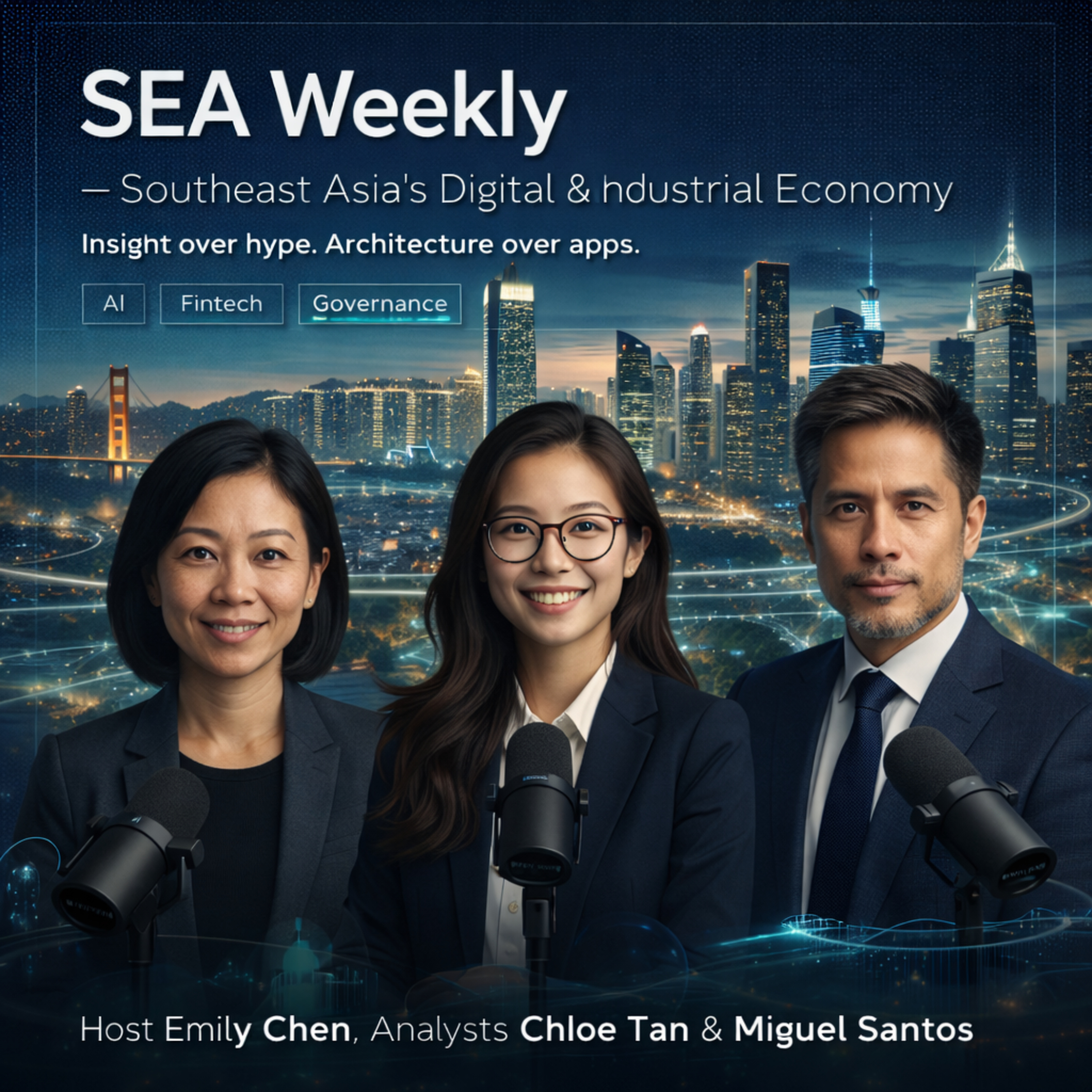
**SEA Weekly** brings you an audio version of the SEA Weekly newsletter by Chloe Tan and Miguel Santos, analyzing the major events and developments reshaping Southeast Asia's digital economy and industrial landscape each week. Rather than surface-level recaps, these episodes dig into the underlying patterns: the infrastructure being built beneath consumer apps, the supply chains powering regional manufacturing, the regulatory frameworks governments are writing, and the flows of capital and FDI reshaping Southeast Asia.Read the series at https://expertlinked.in/tags/southeast-asia/
Episodes
-
SEA Weekly: Ep 34: Household Resilience, Yogyakarta, and the Local-Language AI Test
Emily Chen talks with Chloe Tan about why ASEAN household resilience is being decided in queues, payroll cycles, utility access, and food routes - not at the announcement line. Most of the episode stays with Thailand's flood-admin gap, eldercare, small-firm cash flow, industrial utilities, and…
more -
SEAWeekly - Ep 33: Budget Credibility, Kota Kinabalu, and the AI Budget Signal
Emily Chen talks with Chloe Tan about why ASEAN budget season is now a credibility test at the funding line, not a competition in headline spending. Most of the episode stays with Malaysia, Indonesia, and the Philippines, before a shorter detour through Kota Kinabalu travel logic and enterprise...
-
SEAWeekly - Ep 32: Budget Trade-offs and ASEAN's October Credibility Test
Emily Chen sits down with Chloe Tan for a focused look at what October is really testing across ASEAN. The episode stays with the budget-allocation fight - Indonesia's rupiah warning, Malaysia's line-item test, the Philippines' reallocation choices, and Thailand's temporary household bridge. The...
-
SEAWeekly - Ep 31: Execution Risk, the October Policy Bridge, and ASEAN''s Narrower Winner Set
Emily Chen is joined by Chloe Tan for a month-end close on what September actually rewarded across ASEAN. Most of the episode stays with credit transmission, export execution, and bounded frontier capacity, then briefly steps out to Timor-Leste travel and the week's artificial intelligence...
-
SEAWeekly - Ep 30: Capital Access, Supplier Discipline, and ASEAN's Uneven September Economy
Miguel Santos joins Emily Chen for a week-three decision memo on what late September is actually rewarding across ASEAN. Most of the episode stays with the Saturday SEA Weekly thesis that capital access is now the filter for execution, then briefly steps out to the week's artificial intelligence...
-
SEAWeekly - Ep 29: Supplier Discipline, Trade Finance, and ASEAN's Demand-Quality Test
Chloe Tan joins Emily Chen for a week-two reset on what September demand is actually worth once trade finance, hedging, supplier discipline, and execution risk are priced honestly. Most of the episode stays with the Saturday SEA Weekly thesis, then steps out to Iloilo-Guimaras travel and ASEAN...
-
SEAWeekly - Ep 28 - ASEAN's Q4 Factory Execution Test and the Cost of Trust
Miguel Santos joins Emily Chen to map the part of ASEAN's factory story that sits below the announcement layer. This episode argues that fourth-quarter manufacturing wins now depend on who can keep finance, utilities, compliance, and shipment timing aligned at the same time. The conversation also...
-
SEAWeekly - Ep 27: August's Service-Margin Map and the Capital Flows Ahead
Week 4 of August brought the clearest read yet on what still holds pricing power across Southeast Asia. Chloe Tan joins Emily Chen to explain why the real signal is no longer the first fare, room rate, or allocation decision, but whether that first yes leads to a second purchase. Along the way,...
-
SEAWeekly - Ep 26: Reading ASEAN's Frontier Gap Through Capital Usability
Week 3 of August showed ASEAN's smaller markets no longer being judged by momentum alone. Miguel Santos joins Emily Chen to explain why the region's real divide now sits in capital usability: who can turn first access into repeat financing, repeat travel, and repeat trade. Along the way, they…
more -
SEAWeekly - EP 25: Reading ASEAN's H2 Momentum Across Rates, Wallets, and Fan Demand
Week 2 of August showed ASEAN no longer moving through one clean second-half cycle. Policy credibility, household spending, and live-event monetization are now telling different truths at the same time. Chloe Tan joins Emily Chen to explain why that split matters, and why this week's Siem Reap...
-
SEA Weekly - Ep 24: Reading ASEAN's H2 Risk Map Across Travel Margins, Consumer Demand, and Credit Conditions
Week 1 of August sharpened ASEAN's demand story instead of simplifying it. Travel yield is still clearing in premium lanes, but the harder read now sits underneath the glossy traffic numbers, in household trade-offs and in the buffers banks still refuse to release. Chloe Tan joins Emily Chen to...
-
SEA Weekly - Ep 23: How ASEAN Demand Quality Is Moving From Freight Signals to Tourism Yield and Services Margins
July taught ASEAN how expensive movement can be. The last week of the month added a sharper lesson: freight stress is still the floor, but the cleaner upside is starting to move toward services that can still price time, certainty, convenience, and trust. Chloe Tan joins Emily Chen to wrap the...
-
SEA Weekly - Ep 22: What's the Verdict on ASEAN Supply Chain Resilience as Q3 Trade Flows Reach Their Peak?
ASEAN's peak-quarter trade still looks busy, but Chloe Tan joins Emily Chen to explain why real resilience is now concentrated in the nodes that can price delay, orchestrate handoffs, and finance disruption without letting margins collapse. Full transcript and links are available at...
-
SEA Weekly - Ep 21: How ASEAN Corridor Competition Is Redrawing the Q3 Supply Chain Cost Map
ASEAN corridor competition in the third quarter is no longer being priced by nominal cheapness alone. Miguel Santos joins Emily Chen to explain why buyers are now paying for recovery time, predictable delivered cost, selective air-freight optionality, and auditability - and why that is already...
-
SEAWeekly - Episode 20: Why ASEAN Logistics and Freight Signals Are Emerging as the New Leading Indicators for H2 Growth
The Drewry World Container Index at four thousand six hundred and thirty-nine dollars is not just a supply-chain headline — it is a financial stress test sorting ASEAN economies by their logistics absorption capacity. Chloe Tan joins Emily Chen to explain why the differential response to the same...
-
SEA Weekly - Episode 19: How ASEAN Supply Chain Repricing Is Reshaping Q3 Trade and Cost Expectations
ASEAN supply chains are entering Q3 with freight at a 22-month high and still accelerating — but the damage will show up in corporate margins and balance sheets weeks before export volumes confirm it. Miguel Santos joins Emily Chen to work through the week's five articles: why the…
more -
SEA Weekly: Episode 18: Who Is Winning ASEAN Growth Repricing as H2 Strategies Lock In?
Three simultaneous repricing events settled ASEAN's H2 capital map this week. Chloe Tan joins Emily Chen to work through what the market was actually saying: Thailand's Delta Electronics became ASEAN's first US$100 billion company on the back of AI data centre infrastructure; Indonesia's MSCI...
-
SEA Weekly - Episode 17: How ASEAN Fintech and Industry Signals Are Converging into New Capital Flow Bets
**June 21, 2026** The ASEAN capital allocation question in H2 2026 isn't which markets are growing — it's which markets have built the fintech-industry integration that lets institutional money deploy, monitor, and exit on terms it can underwrite. Chloe Tan joins Emily Chen to map the…
more -
SEA Weekly - Episode 16: What's Driving ASEAN Supply Chain Risk Repricing Across Frontier Markets
**June 14, 2026** The best supply chain news ASEAN frontier markets have had all year landed on Friday night — a US-Iran peace deal that could unwind the Strait of Hormuz risk premium. But Miguel Santos argues the peace deal only fixes one axis. Governance risk — in Myanmar, Indonesia, Thailand,...
-
SEA Weekly - Episode 15: Why ASEAN Capital Flows are Rotating Toward Selective Growth Stories
ASEAN has not run out of capital, but it has run out of patience for undifferentiated stories. This week, Singapore posted 6% YoY growth driven by AI-linked manufacturing, while Vietnam's manufacturing PMI rebounded to 52.8. At the same time, Thailand recorded a US$7.6 billion current-account...
-
SEA Weekly - Episode 14: The Balance Sheet Is the Story
May 31, 2026 Indonesia intervened to support the rupiah, Thailand posted a US$7.6 billion current-account deficit for April, and Singapore commodity traders described active rerouting decisions driven by Middle East disruptions — all in the same 48-hour window. Meanwhile, Vietnam expanded its...
-
SEA Weekly - Episode 13: The Cost-of-Carry Premium
Southeast Asia's headline growth data still looks strong, but this week's operating evidence points to a tougher regional constraint: who can finance volatility without pausing investment. Thailand's airline fuel squeeze and tariff repricing, Vietnam's export acceleration with foreign-enterprise...
-
SEA Weekly Episode 12: Capital Without Capture
Vietnam's US$18.7 billion FDI surge, Thailand's first licensed virtual bank, and the Philippines' emergency energy intervention all point to the same harder regional problem: Southeast Asia can attract capital faster than it can localize resilience. Emily Chen hosts Miguel Santos and Chloe Tan…
more -
SEA Weekly Episode 11: The Corridor and the Cap
Indonesia's 8% ride-hailing commission cap, one week on, has produced a governance picture most coverage missed: Danantara's shareholding in Gojek is confirmed, golden-share language remains active in Grab-GoTo merger talks, and an entity controlling roughly 90% of Indonesia's ride-hailing market...
-
SEA Weekly - Episode 10: The 8% Decree — When the State Becomes Your Platform's Largest Stakeholder
Indonesia capped ride-hailing commissions at 8% on May Day — a 60% drop in platform revenue per trip — while sovereign wealth fund Danantara simultaneously holds stakes in the companies bearing the shock. The state that sets the price is also a co-owner of the business that has to live with it....
-
SEA Weekly - Episode 9: Infrastructure Was 'Done'. The BIS Sent a Memo.
Bangkok declared the infrastructure era over at Money20/20 Asia. The BIS published a stablecoin warning the day before the conference opened, questioning whether the dollar-denominated rails beneath that infrastructure carry ETF-like run risk. OCBC answered both arguments in the same week:...
-
SEA Weekly #08: When Energy Gets Expensive, Payment Friction Gets Political
Crude oil crossed a hundred dollars a barrel, the IMF cut growth forecasts for Asia's emerging economies, and Southeast Asia's governments reached for subsidy levers. The real story wasn't in the macro headlines — it was in the payment infrastructure layer quietly assembling beneath them. AMRO…
more -
SEA Weekly: The AI Agent Arrives at the Checkout
Mastercard just launched authenticated AI-agent payments in Singapore and Malaysia. Vietnam's MoMo — 30 million users, profitable, five years old since its last big raise — is seeking investors at roughly the same valuation. These facts belong in the same sentence. Follow me for weekly update on...
-
SEA Weekly: After Liberation Day — What Southeast Asia Built Instead
One year after Liberation Day tariffs hit Vietnam at 46% and Cambodia at 49%, the region's real response wasn't in the factories — it was in the fintech stack. Follow me for weekly update on Southeast Asia Chloe's article is available at...
-
SEA Weekly: Clearing the Field — Vietnam's Crypto Arrests, Grab's Governance Win, and the Stablecoin Layer Taking Shape
Vietnam arrests the ONUS team the same week it advances its crypto licensing framework; Grab posts a $400M buyback the day after its governance EGM; and Singapore's stablecoin settlement layer gets built from three directions at once. Follow me for weekly update on Southeast Asia Read Chloe Tan's...
-
SEA Weekly: The New Plumbing — When Southeast Asia's Digital Finance Rewired Its Rails
Thunes embeds stablecoins into Swift, Vietnam shortlists its first five licensed crypto exchanges, HSBC plans 20,000 AI-driven cuts, and DBS has a one-hour outage — all in the same week. Follow me for weekly update on Southeast Asia Read the article at...
-
SEA Weekly: Consolidation and Control — Southeast Asia's Digital Finance Enters a New Phase
Kredivo's acquisition of Vietnam's Timo, an IMF report crowning Thailand as ASEAN's digital payment leader, and Grab's voting rights restructure all point to the same underlying shift: Southeast Asia's fintech story is moving from growth to control. Follow me for weekly update on Southeast Asia...
-
SEA Weekly: Architecture Meets Accountability — Southeast Asia's Digital Economy Writes Its Own Rules
Vietnam's landmark AI law, a pivotal fintech industry report, and a major investment summit all converged this week to signal that Southeast Asia's digital economy is no longer just building — it's governing. Follow me for weekly update on Southeast Asia Read the article at...
-
SEA Weekly: From Apps to Architecture — Southeast Asia's Digital Finance Grows Up
DBS-Visa AI agent payments, the Philippines' dual IPO race, and Indonesia's new digital innovation hub all point to the same quiet shift: Southeast Asia is building financial infrastructure, not just fintech apps. Read the article at...
We're indexing this podcast's transcripts for the first time — this can take a minute or two. We'll show results as soon as they're ready.
No matches for "" in this podcast's transcripts.
No topics indexed yet for this podcast.
Loading reviews...
ABOUT THIS SHOW
**SEA Weekly** brings you an audio version of the SEA Weekly newsletter by Chloe Tan and Miguel Santos, analyzing the major events and developments reshaping Southeast Asia's digital economy and industrial landscape each week. Rather than surface-level recaps, these episodes dig into the underlying patterns: the infrastructure being built beneath consumer apps, the supply chains powering regional manufacturing, the regulatory frameworks governments are writing, and the flows of capital and FDI reshaping Southeast Asia.Read the series at https://expertlinked.in/tags/southeast-asia/
HOSTED BY
Tellers Network
CATEGORIES
Loading similar podcasts...
Frequently Asked Questions
How many episodes does SEA Weekly have?
SEA Weekly currently has 34 episodes available on PodParley. New episodes are automatically indexed when they're published to the podcast feed.
What is SEA Weekly about?
**SEA Weekly** brings you an audio version of the SEA Weekly newsletter by Chloe Tan and Miguel Santos, analyzing the major events and developments reshaping Southeast Asia's digital economy and industrial landscape each week. Rather than surface-level recaps, these episodes dig into the underlying...
How often does SEA Weekly release new episodes?
SEA Weekly has 34 episodes. Check the episode list to see recent publication dates and frequency.
Where can I listen to SEA Weekly?
You can listen to SEA Weekly on PodParley by clicking any episode. We provide an embedded audio player for direct listening, and you can also subscribe via your preferred podcast app using the RSS feed.
Who hosts SEA Weekly?
SEA Weekly is created and hosted by Tellers Network.
URL copied to clipboard!