
PODCAST · history
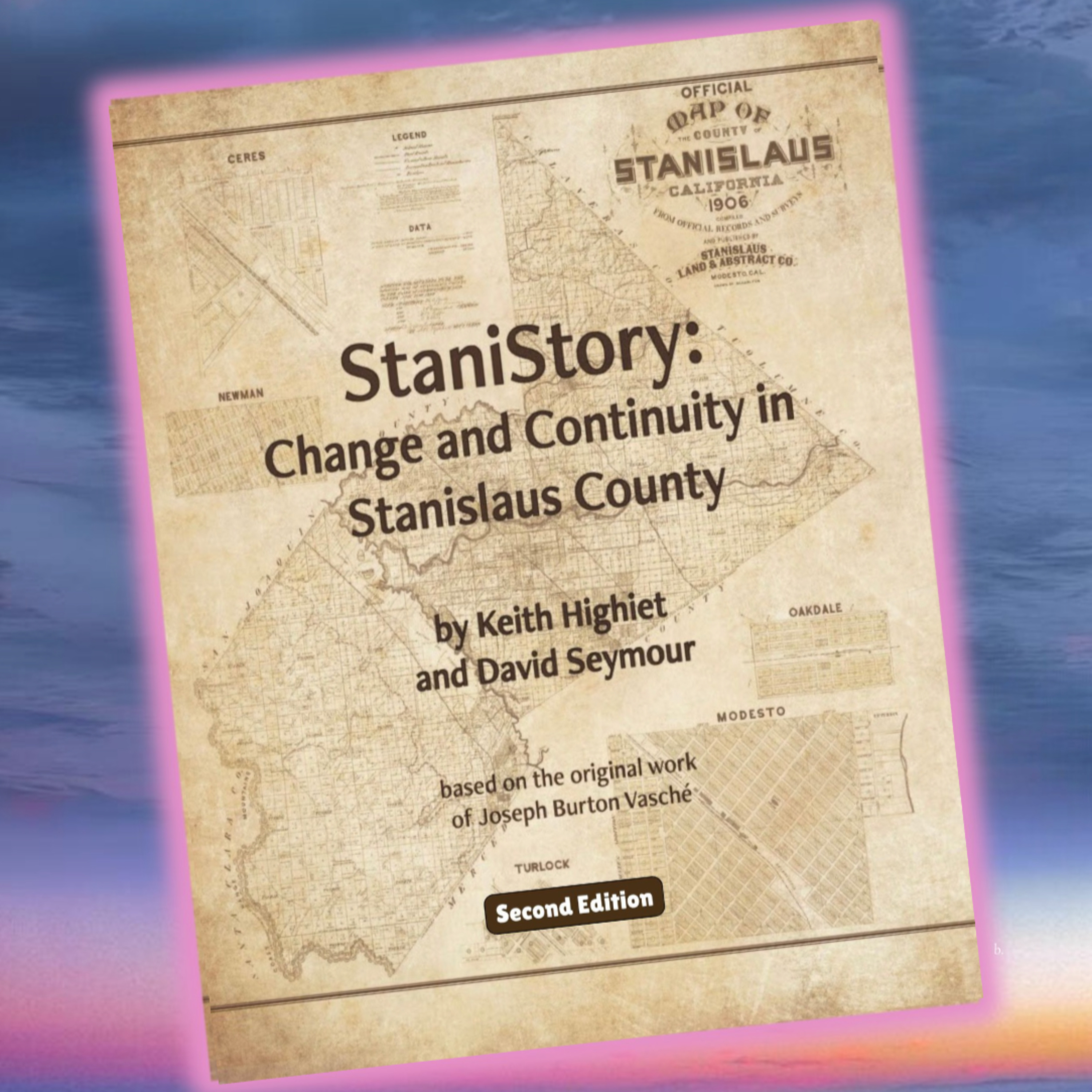
StaniStory: Change and Continuity in Stanislaus County
by McHenry Museum and Historical Society of Modesto, California
Authored by Keith Highiet and David Seymour for the McHenry Museum & Historical Society in 2025, "StaniStory: Change and Continuity in Stanislaus County" (2nd Edition) is an epic exploration into the history of Stanislaus County, California. Based on the original 1941 landmark book by Joseph Burton Vasché, this work updates local elementary history curriculum.The audio version of the book was recorded at Modesto Junior College's Music & Recording Lab under the direction of professor David Dow. Editing and post-production technical work was completed by Ben Hoover and Colby Gomes.
-
44
About the Book
Biographical information about the publisher McHenry Museum & Historical Society (McHenryMuseum.org, Est. 1965); authors Keith Highiet (metals recycler, ModestoJunk.com, Est. 1920) and David Seymour (history professor, MJC.edu, Est. 1921); and major benefactor Mary Stuart Rogers Foundation (Est. 1985), are shared here.
-
43
Towns and Other Communities
Read by Mary Lou Dieterich, details of these unincorporated places are summarized (in order of year founded): Knights Ferry, La Grange (French Bar), Grayson (Graysonville), Hills Ferry (Dutch Corners), Crows Landing, Roberts Ferry (Dickinson's Ferry), Westport (Westport Landing), Wood Colony, Salida (Murphy's Ferry, Murphy's Switch), Westley, Mountain View (Half Way House), Valley Home (Clyde, Thalheim), Hickman (Dallas), Montpelier (Montpellier), Eugene (28 Mile House), Empire, Orange Blossom, Denair (Elmwood Colony, Gratton), and Keyes.
-
42
Cities
Read by Mary Ann Sanders, details of these incorporated cities are summarized (in order of year founded): Riverbank (Islip, Burney's Ferry, Burneyville), Waterford (Bakersville), Modesto, Oakdale, Turlock, Ceres, Newman (center of the West Side / Westside), Hughson, and Patterson.
-
41
Some Early Towns Which No Longer Exist
Read by Betty Ustach, details of these places are summarized (in order of year founded): Adamsville, Crescent City, Tuolumne City, 26 Mile House, Buena Vista, Don Pedro Bar, Empire City, Heath and Emory, Mahoney's Landing, Langworth, Paradise City, and a trio of Sierra Railroad-founded sites: Cooperstown, Paulsell, and Warnerville. A "Fun Facts" item, 'The 1860s Luke Church House,' tells about Modesto's oldest home today (302 Burney Street).
-
40
Conclusion / How Do You Fit In?
Read by Mary Ann Sanders and Betty Ustach, Stanislaus County has changed much over time, and quite rapidly over the past two-hundred years. Yet, some things remain similar to the past. People have come from all over the world for a better life here, and the soil remains fertile.
-
39
Local Government
Read by Betty Ustach, local government in Stanislaus County is composed of people who are chosen by the local citizens to represent them. Nine communities in the county have incorporated themselves into official cities: Ceres, Hughson, Newman, Modesto, Oakdale, Patterson, Riverbank, Turlock, and Waterford.
-
38
Ann M. Veneman
Read by Mary Lou Dieterich, Ann M. Veneman was the highest ranking political official to come out of Stanislaus County.
-
37
Joan L. Mitchell
Read by Mary Ann Sanders, Joan L. Mitchell invented the JPEG file transfer system.
-
36
Odessa Johnson
Read by Betty Ustach, Odessa Johnson was the first African-American woman hired by Modesto High School in 1962.
-
35
Esto Broughton
Read by Mary Lou Dieterich, Esto Broughton was the first woman elected to the California State Assembly from Stanislaus County in 1919.
-
34
Luella Hughson / Grace Covell
Read by Mary Ann Sanders, learn about two women who were early Modesto Businesswomen.
-
33
Tomasa Perez Griffith
Read by Betty Ustach, Thomasa Perez Griffith was an immigrant woman who made her mark in Oakdale.
-
32
Extraordinary Women
Read by Betty Ustach, the impact of women in many areas locally has been profound: Tomasa Perez Griffith (businesswoman and social advocate), Luella Hughson and Grace Covell (businesswomen), Esto Broughton (attorney and politician), Odessa Johsnon (educational leader), Joan L. Mitchell (computer scientist and inventor), and Ann M. Veneman (government and human rights leader).
-
31
Highways and Freeways
Read by Mary Ann Sanders, the main roadways throughout Stanislaus County connect vehicle travelers from towns and cities both within and out of the county. This has influenced where houses and businesses have been built over time, and has led to a rise in the number of commuters living here.
-
30
Immigration and Cultural Diversity
Read by Betty Ustach, people from all over the world have come to call Stanislaus County their home. Many in particular have Mexican heritage; a large movement of immigration from that country to this area began when the U.S. created the Bracero Program in 1942 (during World War II).
-
29
Dust Bowl
Read by Mary Lou Dieterich, in the 1930s a drought combined with dry winds to cause major damage to U.S. Great Plains states. It was called the "Dust Bowl" and it caused over two million people to migrate from the area. Many settled in Stanislaus County, including Florence Owens Thompson. She became immortalized as the face of the time in one of the most famous photos in history; the photo is known as the "Migrant Mother," by photographer Dorothea Lange.
-
28
E & J Gallo Winery
Read by Mary Ann Sanders, brothers Ernest and Julio Gallo founded the E&J Gallo Winery in 1933. The operation would go on to become the largest-ever business in the county, and the largest family-owned winery in the world.
-
27
Animal Farming
Read by Betty Ustach, along with irrigated crops, animal farming also rose in greater importance in Stanislaus County. Some "Fun Facts" covering 'Food Firsts' in the area are included here too.
-
26
Irrigated Crops
Read by Mary Lou Dieterich, the bringing of irrigation to Stanislaus County allowed for farmers to grow higher value crops which require more frequent watering than what nature provides on its own locally.
-
25
Irrigation
Read by Mary Ann Sanders, damned rivers create man-made lakes as sources of water for irrigated canals to bring snow-melt from the Sierra mountains to otherwise-dry land throughout Stanislaus County.In fact, the residents of Modesto got together to elect Christopher Columbus "C.C." Wright to the California Assembly for him to enact the unanimously-passed landmark Wright Act of 1887. This legislation allowed for the creation of locally-controlled water districts across the state. As a result, the two oldest of such districts in California are both local to the county: Turlock Irrigation District and Modesto Irrigation District.Beginning in the 1920s, the water powered through the dams was began to also be used to create electricity!
-
24
The McHenry Family
Read by Betty Ustach, the McHenry's were a pioneer family who left an indelible mark on the city of Modesto.
-
23
Railroad and Modesto
Read by Mary Lou Dieterich, the Central Pacific Railroad selected a spot on their new north-south rail line in the Central Valley to be the site of Stanislaus Conty's first train depot: Modesto in 1871. It was originally offered to be named for silver scion and banking magnate, William "Chap" Ralston, but he "modestly" declined the offer. The name Modesto is the Spanish language version of the word, "modest."
-
22
Local Schools
Read by Mary Ann Sanders, the first public school in Stanislaus County was established in 1854 near the Orestimba Creek at a place called Newsome's Bridge. At around the same time, Knights Ferry established its first school. In 1874, the first major school building in the county was built in Modesto: the Fourteenth Street School. The county's first high school was established as Modesto High School in 1883; its first teacher and principal was Thomas Downey.
-
21
River "Steamer" Barges and Ferry Boats
Ready by Betty Ustach, harvested wheat was transported by horse and mule across Stanislaus County's rivers in flat-bottomed barges and in steamboats to the port city of Stockton in San Joaquin County, where it was shipped out all over the world.
-
20
Wheat
Read by Mary Lou Dieterich, the valley floor area of the county was found to be highly adaptable to growing wheat. Modesto and Stanislaus County were known as the "King of Wheat" in the 1860s and 1870s.
-
19
Stanislaus County
Read by Betty Ustach, Stanislaus County was formed 1854 as a carve-out of Tuolumne County. The northern triangular part of the county was added from San Joaquin County in 1860. The county seats were Adamsville, Empire City, La Grange, and Knights Ferry, before settling on Modesto in 1871.
-
18
La Grange
Read by Mary Lou Dieterich, the town of La Grange was settled by fifty men who came to mine for gold from France along the Tuolumne River in 1848 to 1849. A man named Bret Harte taught school near the town, and his first literary stories which were based on the area became the foundation of the Western genre in American literature. By the time the gold mining town had reached a population of 2,000, about half of its residents were Chinese immigrants.
-
17
Knights Ferry
Read by Mary Ann Sanders, Knights Ferry became an important river-crossing site for miners traveling from the port city of Stockton to the city of Sonora and the southern gold mines. A "Fun Facts" descriptor, 'Old Local Buildings,' highlights the two of the oldest structures in Stanislaus County: the "old adobe barn" (in La Grange), and California's oldest running general store (in Knights Ferry).
-
16
Gold Rush
Read by Betty Ustach, during the California Gold Rush of 1849, the towns of Knights Ferry and La Grange were the centers of gold mining activity on the land which would become Stanislaus County.
-
15
Mexican Travelers, Miners, and Legends
Read by Mary Lou Dieterich, men came to the area from the Sonora territory in now-northern Mexico to capture wild horses since the early 1800s. Their descendants and families were among the first to move into the gold-mining foothills in 1848, kicking off the California Gold Rush. The rise in notoriety of Joaquin Murrieta was the most famous product of this sequence of events.
-
14
Mexican-American War
Read by Mary Ann Sanders, Mexico and America went to war in 1846; Mexico lost the war and the area which would later become Stanislaus County was officially now part of the United States as of 1848.
-
13
New Hope / Stanislaus Prairie
Read by Betty Ustach, Mormon pioneers were the first Americans to settle land in the area (1846): on what is now Caswell State Park / Ripon in San Joaquin County, and crossing over the Stanislaus River into what is now Salida in Stanislaus County.
-
12
Ranchos
Read by Mary Lou Dieterich, large land grants were given out by the Mexican government to politically-connected Californios in the 1840s in the area which later became Stanislaus County: Pescadero, Del Rio Estanislao, Del Puerto, Orestimba y Las Garzas, and Thompson.
-
11
American Fur Trappers and Explorers
Read by Mary Ann Sanders, some of America's most famous frontiersman hunted for animals in Stanislaus County: Christopher "Kit" Carson, Thomas "Broken Hand" Fitzpatrick, and John C. Frémont.
-
10
Cucunuchi (Estanislao) and Yoscolo
Read by Betty Ustach, the namesake of Stanislaus County was a Yokuts man named Cucunuchi (who was later baptized as Estanislao). He and his co-warrior Yoscolo, are immortalized in American culture, as explained in "Fun Facts": 'Holy Batman!,' their lives partially inspired the creation of the popular fictional characters, Zorro and Batman.
-
9
Mexico Controls the Region (1821 - 1848)
Read by Mary Ann Sanders, Mexico controlled the land which is now Stanislaus County, California from 1821 to 1848.
-
8
Spain Claims the Region (1806 - 1821)
Read by Mary Ann Sanders, era of Spanish claim on the land which is now Stanislaus County, California lasted mainly from 1806 to 1821. The first western explorer to purposefully venture onto the land here was Gabriel Moraga and his group of Spanish soliders and Catholic missionary priests.
-
7
Yokuts
Read by Betty Ustach, the Indigenous Americans (American Indians, Native Americans) lived on the land of what is now Stanislaus County: primarily the Yokuts, and also a band of visiting Miwok tribe; "Fun Facts" tell the tale of 'The Legend of Lover's Leap.'
-
6
Natural Plants and Wildlife
Read by Mary Lou Dieterich, past and present flora and fauna of Stanislaus County, California includes the wild lupine, California poppy, valley oak tree, salmon, yellow-billed magpie, mountain lion, and tule elk.
-
5
Prehistoric Animals
Read by Mary Ann Sanders, learn about the animals which were in the area we now call Stanislaus County from more than 60 million years ago to as recent as 10,000 years ago.In 1936, a local teenager, Allan Bennison, found the skeleton fossil of a hadrosaur, and later a mosasaur, in the Diablo Mountains of Stanislaus County. Columbian mammoths and mastodons roamed in the area until just about 10,000 years ago. Wild horses even continued to roam here until the mid-1800s.
-
4
Climate and Landscape
Read by Betty Ustach, the weather in Stanislaus County is good for agricultural food production. It has a Mediterranean type of climate. "Fun Facts" include a detail of 'Volcanic Lava and Rock Walls' in the low, eastern foothills of the county.
-
3
Geography and Geology
Read by Mary Lou Dieterich, Stanislaus County is almost 1,500 square miles in size, stretching from the lower foothills of the Sierra Nevada across the San Joaquin Valley (part of the Central Valley) floor and deep into the Diablo Range (part of the Coast Ranges of California).The Stanislaus River and Tuolumne River flow east to west from the Sierra. They are tributaries to the San Joaquin River, which flows northward along the valley floor as it reaches the Delta.There are three large man-made reservoirs (lakes used as a source of water supply when it’s needed) on the eastern side of the county: Modesto Reservoir, Turlock Lake, and Woodward Reservoir.
-
2
Preface / Introduction / Overview
The mission of StaniStory (that’s a mash-up of the words “Stanislaus” and “history”) is to instill in students an appreciation of Stanislaus County's history and to help readers identify connections from their own lives to their larger community.As a resident of Stanislaus County, you are part of its storied local history. As you learn more about the area and its history, you may realize the different ways you fit in. You can also think about what kind of future impact you want to have here.Stanislaus County is an extraordinary place with a fascinating history. The area has been inhabited by plants and animals for about two million years. Indigenous Americans have lived on the land which is now Stanislaus County and its surrounding areas for more than 10,000 years. For the past 200 years, the primary use of this land has been for agriculture. More than 550,000 people live here today. The county seat is Modesto.A downloadable version of the book is available for free at StaniStory.org. Hardcover and softcover copies of the book can be ordered through the McHenry Museum & Historical Society.
-
1
Acknowledgments
Highlighting the people and organizations who helped make this book a reality, this also includes the first in a series of "Fun Facts": 'Stanislaus County's Connection to California Schools,' which details the unique connection of John Gage Marvin, California's first superintendent of public instruction, to Lakewood Elementary in Modesto.# # #Original work by Joseph Burton Vasché under the direction of Margaret L. Annear, superintendent of Stanislaus County Schools, in 1941. Reprinted in 1950.Revised by Peggy Mensinger of the Stanislaus County Historical Society, Heidi Warner of the Citizen’s Cultural Center Committee, and Gertrude Vasché of the Stanislaus County Department of Education in 1971.Updated by Harry Bakker, Barbara McCullough, Marsha Zellman, Nanette Olson, and V. Ruth Smith for the Stanislaus County Department of Education in cooperation with eleven local school districts in 1981.Expanded upon by Keith Highiet and David Seymour of the McHenry Museum & Historical Society in 2023. Special thanks to Dr. Jeffrey Buechler of Merced College, news journalist Elias Funez, McHenry Museum volunteer Marco Moreno, and professor Cecilia Hudelson of Modesto Junior College. Reviewed by Jose Marquez and Charles Taylor of the Stanislaus County Office of Education. Additional contributions were added by student reviewer Hunter Highiet (age 9). Edited by Lois Belt, Janet Lancaster (1935–2024), and Kristen Santos.Revised by Keith Highiet and David Seymour of the McHenry Museum & Historical Society in 2025 to meet California FAIR Education Act of 2012 requirements.Substantial printing support provided by the Mary Stuart Rogers Foundation. Significant contributions were also received from Ann M. Veneman, Beard Land Improvement Company, GALLO Giving Program, Piccinini Pesco Family Fund, and other community members.
We're indexing this podcast's transcripts for the first time — this can take a minute or two. We'll show results as soon as they're ready.
No matches for "" in this podcast's transcripts.
No topics indexed yet for this podcast.
Loading reviews...
ABOUT THIS SHOW
Authored by Keith Highiet and David Seymour for the McHenry Museum & Historical Society in 2025, "StaniStory: Change and Continuity in Stanislaus County" (2nd Edition) is an epic exploration into the history of Stanislaus County, California. Based on the original 1941 landmark book by Joseph Burton Vasché, this work updates local elementary history curriculum.The audio version of the book was recorded at Modesto Junior College's Music & Recording Lab under the direction of professor David Dow. Editing and post-production technical work was completed by Ben Hoover and Colby Gomes.
HOSTED BY
McHenry Museum and Historical Society of Modesto, California
CATEGORIES
Loading similar podcasts...
Frequently Asked Questions
How many episodes does StaniStory: Change and Continuity in Stanislaus County have?
StaniStory: Change and Continuity in Stanislaus County currently has 44 episodes available on PodParley. New episodes are automatically indexed when they're published to the podcast feed.
What is StaniStory: Change and Continuity in Stanislaus County about?
Authored by Keith Highiet and David Seymour for the McHenry Museum & Historical Society in 2025, "StaniStory: Change and Continuity in Stanislaus County" (2nd Edition) is an epic exploration into the history of Stanislaus County, California. Based on the original 1941 landmark book by Joseph Burton...
How often does StaniStory: Change and Continuity in Stanislaus County release new episodes?
StaniStory: Change and Continuity in Stanislaus County has 44 episodes. Check the episode list to see recent publication dates and frequency.
Where can I listen to StaniStory: Change and Continuity in Stanislaus County?
You can listen to StaniStory: Change and Continuity in Stanislaus County on PodParley by clicking any episode. We provide an embedded audio player for direct listening, and you can also subscribe via your preferred podcast app using the RSS feed.
Who hosts StaniStory: Change and Continuity in Stanislaus County?
StaniStory: Change and Continuity in Stanislaus County is created and hosted by McHenry Museum and Historical Society of Modesto, California.
URL copied to clipboard!