
PODCAST · business
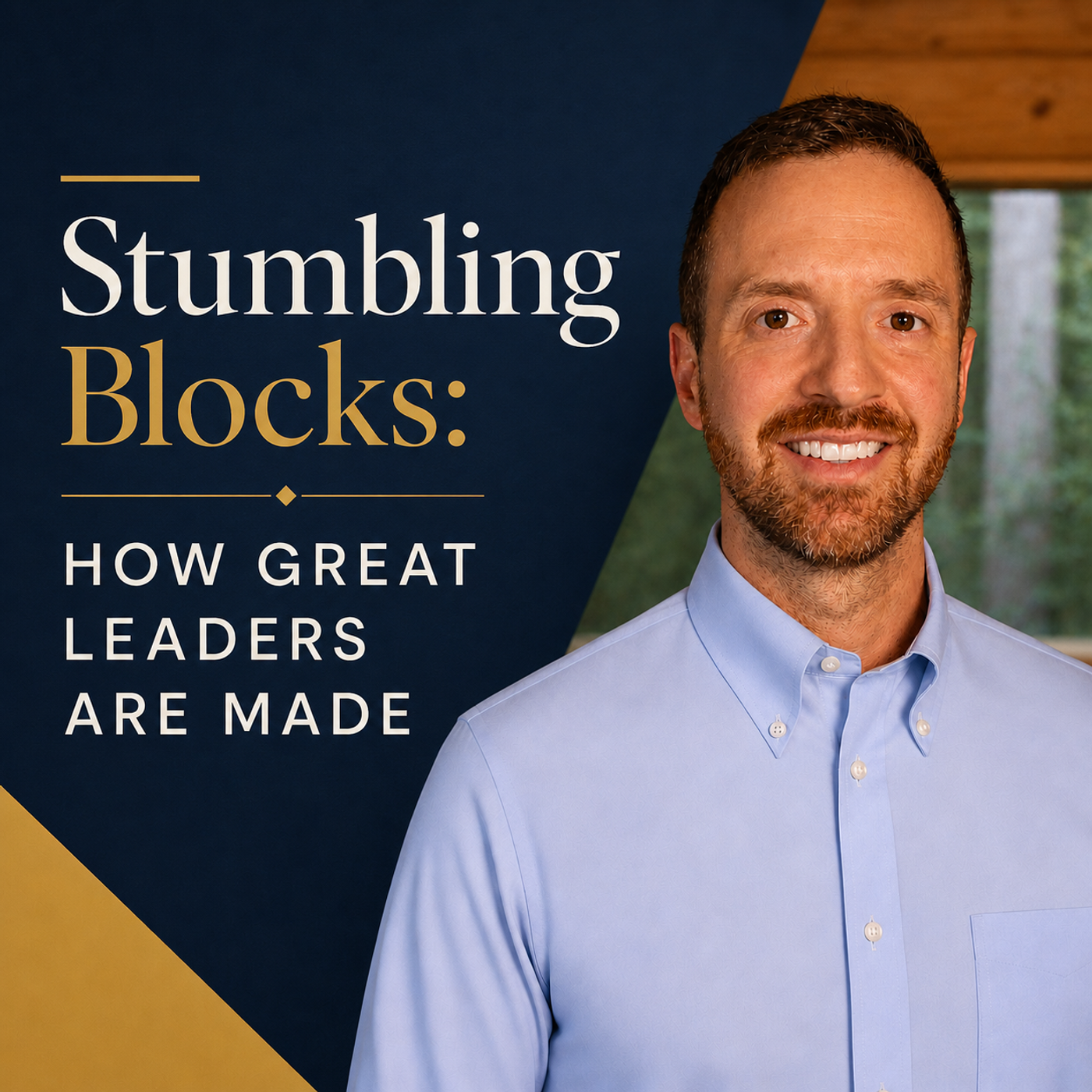
Stumbling Blocks: How Great Leaders Are Made
by Jonathan Block
Here, leaders share the moments along the way that have shaped them most deeply. Their stumbling blocks.You'll hear leaders as they really are: challenged, battered, and deeply flawed. And you'll see them picking back up, dusting themselves off, and leading again. Because if we let them, stumbling blocks make us better.Welcome to Stumbling Blocks: How Great Leaders are Made.I’m your host, Jonathan Block. I've spent the last 20 years studying leadership, and I ask leaders to take us back to the moments that aren't on highlight reel:• The day they got laid off.• The crisis that almost broke them.• The loss that re-shaped how they see the world.Join me to uncover the stumbles that make leaders great. Welcome to The Stumble.Subscribe today.Questions? Comments? Linkedin: <a rel="noopener noreferrer nofollow" href="http://www.linkedin.com/in/jonathanfblock" target="_blan
-
23
Jim Olson, Chief Communications Officer: How to Turn your Setback Story into your Comeback Legacy
Most crisis experts have never actually sat in the room when everything fell apart. Jim Olson has. He was head of communications at US Airways when Flight 1549 landed on the Hudson. He was at Starbucks when its flagship store in Jakarta was bombed. And he was at United Airlines the night Dr. David Dao was dragged off a plane and it became one of the first viral crises in business history.Then the crisis came for him. In 2024 Jim was diagnosed with stage 4 melanoma that had spread to his lung and his brain. During treatment he lost his eyesight. He is now legally blind. And he wrote a book about all of it called Tailwind.We talk about the 2am back pain that had no medical explanation and ended up saving his life. The "do hard things" tattoo he got a month before he went blind. And why he now prays in gratitude for the healing that's already happening instead of begging for the healing he wants.If you're carrying something heavy right now, this one is for you.In this episode:00:00 The monster storm none of us escapes00:25 Welcome to the Treehouse02:00 The Dr. David Dao crisis, from the comms chief's chair06:00 The fog of war, and why the first information is almost always wrong10:54 Inside the Good Morning America apology13:00 When your policies get in the way of your values14:30 Miracle on the Hudson and the three flight attendants nobody named18:36 The unsung heroes in Jim's own life20:53 The 2am back pain that saved his life25:00 Stage 4, and then the brain tumor29:00 Losing his sight33:30 "Cancer made me stronger. Blindness made my world brighter."35:00 Writing Tailwind blind, on short-term disability38:49 Ambition without purpose is a sailboat without a compass41:00 Why me? Oscar Munoz and the two kinds of patients44:49 Faith, gratitude, and a letter to God47:37 Praying for what's already being madeGet Jim's book, Tailwind: https://www.amazon.com/Tailwind-Compass-Turning-Setback-Comeback/dp/B0GXCCZ1QYHear the Oscar Munoz episode referenced throughout: https://podcasts.apple.com/us/podcast/oscar-munoz-ceo-united-airlines-why-its-never-too-late/id1849573843?i=1000744337146Stumbling Blocks explores the stumbles, crises, and formative moments that forge great leaders. Hosted by Jonathan Block and recorded at the Treehouse Studio.Questions? Comments? Email me: [email protected]
-
22
Kelli Arena, CEO, Nat'l Cryptologic Foundation: How I Helped NSA Find Its Voice
Kelli Arena spent her career at CNN telling the public what powerful people would rather keep quiet. She covered the Justice Department, won an Emmy, and reported the Moussaoui trial, the only 9/11 case tried in an American civilian courtroom.After Kelli left journalism, she went into another form of public service, serving as Chief of Communications for the National Security Agency, spending eight years helping the Agency find its voice.Kelli has remade herself across four worlds: journalism, academia, government, and now the nonprofit sector, where she just became President and CEO of the National Cryptologic Foundation.A few things she gets into, worth your time even if you never press play:She took six months of maternity leave, three separate times, as an on-air correspondent. Everyone said it would end her career. It didn't. Younger women in the newsroom started thanking her, because she'd quietly given them permission.She earned back America's trust at the NSA the boring way: Through Consistency. Relationships. A rule that every reporter got a callback within 30 minutes, even when the answer was "no comment."And her advice for anyone starting over: "Listen more than you speak. Every single time I have listened to others before making a decision, it has been a better decision."0:00:00 The Stumble that nearly ended my career0:01:33 Meet Kelli Arena0:02:52 A new chapter: President and CEO of the National Cryptologic Foundation0:03:25 What cryptology is, and 500,000 open cyber jobs0:05:30 AI's impact “can't be overstated”0:07:30 Who gets displaced, and how we reskill them0:08:40 Getting cyber smart as citizens0:10:05 Becoming CNN's justice correspondent, then 9/110:12:05 Six months of leave, and the warnings that proved false0:15:00 A day in the life: news as the ultimate team sport0:18:10 Inside the Moussaoui trial0:21:45 “I am Al Qaeda”: chaos in the courtroom0:23:35 Why the jury chose life over death0:25:16 Laid off: the 2009 budget cuts0:27:25 Reinvention: teaching journalists to hold power accountable0:30:15 The women who risked everything just to drive0:32:50 Advice to young reporters in a hostile climate0:35:20 A story Jonathan had never told on air0:38:05 Inside the NSA: secrecy meets a journalist0:42:00 Taking “no such agency” public0:43:45 Re-earning America's trust after Snowden0:48:00 Knowing when it's time to leave0:49:30 What she's most proud of0:51:30 Myron Kandel and the bag of work clothes0:55:10 The reinvention lesson: listen more than you speakNew here? Follow Stumbling Blocks so you don't miss what's next. A quick review is the best way to help other leaders find the show.
-
21
Shalene Gupta, Editor, Fast Company: The Manager's AI Survival Guide
Shalene Gupta, staff editor for Fast Company's Work Life and Leadership section, interviewed 35 middle managers at some of the biggest companies in the world for her piece "The Middle Manager's AI Survival Guide." What she found is that the contradictory headlines about AI at work aren't actually contradictory. There are two different worlds, and which one you're working in makes a world of difference.One idea sits under all of it, and it matches what I find in my own work. People will walk through almost any change, AI included, when they trust that their leader has their back.In this episode:0:00:00 The question every manager is asking0:01:20 The one-line takeaway from the AI Survival Guide0:02:30 Two universes: the AI race vs. where most of us work0:04:53 Ethan at Meta: "If you think they'll replace you, they probably will"0:06:07 The math: a person vs. $200 to $500 a month in tokens0:07:36 ClickUp's "100x more productive" memo0:08:40 Are we weighing the human cost? (Dimon at Davos)0:09:49 What it feels like to be a middle manager today0:11:48 What the excited managers had in common (and a Georgia-Pacific surprise)0:14:10 Advice for leaders taking teams through AI0:16:26 Advice for the rest of us0:17:07 My takeaway, and a look at next weekLinks:"The Middle Manager's AI Survival Guide" (Fast Company): https://www.fastcompany.com/91531056/the-middle-managers-ai-survival-guideThe Power of Trust, by Sandra Sucher and Shalene Gupta: https://amzn.to/4xdcxUKThe Cycle, by Shalene Gupta: https://www.amazon.com/Cycle-Confronting-Pain-Periods-PMDD/dp/1250882893Shalene Gupta: https://shalenegupta.comShalene Gupta is the staff editor for Fast Company's Work Life and Leadership section, co-author of The Power of Trust with Harvard's Sandra Sucher, and author of The Cycle.Stumbling Blocks: How Great Leaders Are Made is hosted by Jonathan Block, founder of Block Leadership Group, recorded in the Treehouse Studio in Georgia.If this was worth your time, follow the show and leave a review. It's the best way to help other leaders find it.Next week: Retired Vice Admiral Mark Harnitchek, who led the Defense Logistics Agency, on loss, grief, and leadership as a mirror. I'll see you then on The Stumble.
-
20
Dana Perino, White House Press Sec. & Bestselling Author: "Purple State" & Crossing Party Lines
Dana Perino's new book is called Purple State. It's a political romance novel set in a gerrymandered Wisconsin district, about three young women who discover that love and friendship don't stop at party lines.Coming from the 26th White House Press Secretary and co-host of The Five on Fox News (the most-watched show on cable news!), it's a book worth paying attention to. Especially as we find ourselves more divided than any time in recent history. Dana talks about the personal story behind the book: The time a dear friend said, "Do not pass up the chance to be loved." She almost didn't listen. Dana tells the story of sitting in the Oval Office with President Bush just before walking out to face a press corps hungry over a tell-all memoir from her predecessor. She was furious on his behalf. He told her something about forgiveness that changed her.Purple State is out now. Pick it up today here:* https://amzn.to/4tRzGcZCHAPTER MARKERS0:00:00 Welcome to the Treehouse Studio0:01:13 The 2007 Phone Call0:02:35 Life After the White House0:04:58 Purple State: The Book0:06:59 Why I Wrote a Novel0:10:42 Wearing Your Politics Lightly0:12:57 The Oval Office and the Forgiveness Lesson0:15:52 68% of Young People Won't Date Across Party Lines0:17:29 Do Not Pass Up the Chance to Be Loved0:19:00 Peter, the Proposal, and the Open-Ended Ticket0:20:05 Dinner With the Queen's Staff0:21:46 There Is Freedom in Being Disciplined0:23:41 Closing Thoughts on Purple State0:24:49 OutroKEYWORDS / TAGSDana Perino, Purple State, leadership, Fox News, The Five, White House Press Secretary, forgiveness, discipline, political fiction, women in leadership, Minute Mentoring, President Bush, Jonathan Block, Stumbling Blocks, career resilience, love, faith*Amazon affiliates receive a small commission from Amazon for purchases made through this link. Commissions do not impact editorial decisions.
-
19
Outtakes: Sue Gordon Meets My Parents
My parents were visiting me the day I interviewed Sue Gordon, former Deputy Director of National Intelligence. So they joined me in the Treehouse Studio to say a quick hello to her. Here's their conversation.
-
18
Sue Gordon, Deputy Director of US Intelligence: What America Needs From Its Leaders
Sue Gordon once oversaw 100,000 women and men of the U.S. intelligence community as Deputy Director of National Intelligence, the number two role in American spycraft. She briefed Presidents Reagan, HW Bush, Clinton, W Bush, Obama, and Trump. She managed a $100 billion budget. And in August 2019, she handed Vice President Pence her resignation letter with a handwritten note: "I offer this letter as an act of respect and patriotism, not preference. You should have your team. Godspeed, Sue."Since then, life has come at her hard. Both parents died. Her husband Jim, the love of her life for 43 years, died unexpectedly. She has faced two rounds with cancer, the second one far more deadly than the first.And she says she's the most blessed woman in the world.In this conversation, Sue goes deep on:The U.S. strikes on Iran and what she sees that most Americans don'tWhat the Epstein files actually reveal about how power protects itselfWhy she almost ran for PresidentWhy she quit the CIA with two weeks' notice to be a better momHow the Trump administration publicly excoriated a 40-year career civil servant, and what she chose to do instead of fighting backWhy she thinks America needs to fix a system the Founders never designed for this much speedWhat she wants every woman in a man's world to know, and what she wants the good men to finally do about itThe doorways of grief, and how to move through themThis is Sue Gordon in full: the spy, the mom, the widow, the patient, the patriot. Unfiltered. Funny. Occasionally heartbreaking. Always worth your time.Find her podcast, Understandable Insights here:https://podcasts.apple.com/us/podcast/understandable-insights-information-to-intelligence/id1827249845Books and Works Mentioned:A Severe MercyThe Price We PayAn Immense JourneySue's Resignation LetterIf this episode is worthy of your time, please share it and leave a review. It's how we grow.
-
17
Outtakes: The President's Advice I Didn't Want
A few times during my two-part interview with Judge and Rebecca Gonzales, they turned the tables on me. They listened. And they drew three stories out of me that I've rarely shared.The first is a story that never made it into the main episodes: the Oval Office advice I didn't want that... changed my life.The second is about what happens when your Quaker mother and your Jewish father sit down together at Hanukkah.The third is about what shaped my decision to work for Attorney General Gonzales as a political appointee.If you haven't heard Parts One and Two yet, start there. This bonus episode will mean more after you've heard their full story.Content warning: Like part 1, this episode touches on childhood trauma and may not be suitable for all listeners.If you'd like to support the show, please follow Stumbling Blocks on your favorite podcast app and leave a review. It's the best way to help other leaders like you.
-
16
Attorney General & Rebecca Gonzales, Pt 2: Leadership, Loss, and Love
Part 2 of this exclusive conversation with Attorney General Alberto Gonzales and his wife Rebecca. It is a conversation about love, political betrayal, faith, and what it means to keep going when the wilderness feels endless.Judge Gonzales describes the political firestorm that ended his time as the nation's top law enforcement officer. What followed were years Rebecca calls "the wilderness." The phone stopped ringing. Friends vanished. Job opportunities disappeared. And the pain was so deep they sat side by side in silence, because words wouldn't come.But strangers showed up in ways you won't expect. And President Bush wrote a handwritten note that says something every leader needs to hear. And eventually, it becomes clear where home is.It's a political love story unlike any you've heard before.If you missed Part 1, start there first: https://podcasts.apple.com/us/podcast/exclusive-attorney-general-alberto-gonzales-becky-gonzales/id1849573843?i=1000757588087Next episode: Sue Gordon, 30-year CIA veteran and former Deputy Director of National Intelligence.0:00:00 Introduction & Part 1 Recap 0:03:30 The U.S. Attorney Scandal 0:07:45 "People Will Do Anything to Get Power" 0:09:50 President Bush Defends His Attorney General0:11:45 The Call to Resign 0:15:30 The Phone Stopped Ringing 0:18:00 "We're Rich in Love" 0:22:15 President Bush's Handwritten Letter 0:27:30 The Wilderness Years 0:34:15 "It's Got to Work Out" 0:40:50 Finding Home in Nashville 0:45:35 Advice for Your Own Wilderness 0:51:00 Outro & Next Episode PreviewTAGS/KEYWORDS:leadership, resilience, Attorney General, Alberto Gonzales, George W. Bush, public service, marriage, faith, political crisis, Washington DC, wilderness, Belmont University, trust, Rebecca Gonzales
-
15
Outtakes: AG Gonzales on ICE ("unprecedented, dangerous") & Epstein ("A complete failure of DOJ")
Excerpts from Attorney General Gonzales and Rebecca Gonzales's interview with Stumbling Blocks on ICE Actions, Immigration, and the Epstein FilesExcerpted Quotes from Attorney General Gonzales On ICE Actions and ImmigrationBased on what I've observed… it seems like we're going through an unprecedented, dangerous time. I worry about what's going on in our country, and I think a lot of Americans are worried about it.The way that we're enforcing immigration today, to me, it sends a terrible message, not just to the American people. It sends a terrible message to people around the world, in terms of what America is today, as opposed to…talking about the value of immigrants and how much they've contributed and why we as a country are stronger and better because we have welcomed immigrants and they're part of the fabric of our society. I don't think that message is out there anymore, and I think that really does sadden me.I think that makes America weaker. I really do. And I think it emboldens our enemies.Hopefully the courts and hopefully Congress will take action and address it.___________________________Excerpted Quotes from Attorney General Gonzales On the Epstein FilesI think this whole episode is embarrassing. I think it's an embarrassment to this Administration, to the Department of Justice, a complete failure of the Department to abide by the law. That's the role of the Department of Justice — to enforce the law. And here we have a Department that's not doing that.But what appears to be, in some cases, selective redactions and the selective release of documents, drip, drip, drip process, it sends a terrible message.And I think it's legitimate for the American people to wonder, “what are you hiding?”It hurts the image of America, I think, around the world.The way that this has been handled from the very beginning has been a disaster. For the American people, certainly for this Administration, and for the victims.
-
14
Attorney General & Rebecca Gonzales, Pt 1: 9/11, Leading The War On Terror, & Going Broke
EXCLUSIVE: This is a story two decades in the making. For the first time since leaving office 19 years ago, Attorney General Alberto Gonzales and his wife Rebecca Gonzales sat down together for an interview. In Part 1, the Attorney General and Rebecca speak candidly about ICE, immigration, and the Justice Department's handling of the Epstein files.They talk about Al's rise from a two-bedroom house in Humble, Texas to the Oval Office, why he chose to make protecting kids from online predators a federal priority even during the global war on terror, and what it was like for Rebecca to navigate 9/11 alone with their boys while Al was at the White House.Underneath the headlines is a story about faith and love and what happens when the President calls and your comfortable life disappears.Part 2 drops next week.CHAPTERS: 00:00 - Introduction 02:00 - Belmont University and Rebecca's path to social work 04:51 - On ICE and immigration 08:07 - The Epstein files: a failure by the Justice Department 13:38 - Rebecca's upbringing: Jewish mother, Mormon father19:06 - Judge Gonzales' origins: son of migrant workers in Houston 22:53 - How Al and Rebecca met (and the Four Seasons bachelor pad) 25:27 - Governor Bush calls: leaving private practice behind34:21 - Why he still prefers to be called "Judge" 35:45 - Moving to Washington with President Bush 38:57 - Rebecca alone: December 26 to June 42:36 - September 11th: Rebecca's story 44:50 - September 11th: The Judge on the Oval Office porch 52:58 - How 9/11 changed their faith and their family 56:46 - "Put your uniform on": becoming Attorney General1:00:01 - Financial sacrifice and raising a family under pressure 1:04:31 - Project Safe Childhood: why he fought for kids1:07:21 - A personal note from your host 1:12:07 - What's coming in Part 2LINKS: Judge Gonzales' book, "True Faith and Allegiance: A Story of Service and Sacrifice in War and Peace": https://www.amazon.com/True-Faith-Allegiance-Service-Sacrifice/dp/071807887XProject Safe Childhood (U.S. Department of Justice): https://www.justice.gov/pscTAGS/KEYWORDS: leadership, Alberto Gonzales, attorney general, 9/11, Bush administration, immigration, faith, family, White House, Department of Justice, Project Safe Childhood, Epstein files, public service, resilience, Rebecca Gonzales
-
13
Conor Grennan, CEO, AI Mindset: Why AI is a Change Management Problem
Conor Grennan is CEO of AI Mindset and until recently, Chief AI Architect at NYU Stern School of Business. He's trained teams at Google, NASA, Microsoft, JP Morgan, and many more. He's a New York Times bestselling author, a MasterClass Instructor, co-host of the AI Applied podcast, and a recipient of the Dalai Lama's Unsung Hero of Compassion Award. Conor has become one of the most sought-after speakers and strategists in the AI space.But what's most interesting are the reinventions that brought Conor to AI: moving to Prague at 21 to avoid being ordinary, volunteering in a Nepali orphanage, going back when the children he cared for were re-trafficked, and writing a fantasy novel.We dig into Conor's contrarian take that AI is fundamentally a Change Management issue, not a tech issue. We also cover his best public speaking advice, what he would say with one final tweet, and the one simple thing any leader can do today to start using AI: "Just tell it."TIMESTAMPS:(04:33) Why honest reason Conor kept putting himself in interesting positions(06:23) Moving to Prague at 21(07:49) Going to Nepal for a pickup line(09:46) Why he went back(12:49) Seeing a need and filling it(13:30) Meeting the Dalai Lama(15:29) How "The Art of Happiness" changed everything — and why he was happiest with nothing(18:57) Coming back to America and what he couldn't bring with him(21:28) How Nepal changed his parenting(23:48) Writing fiction: The Hadley Academy and the introvert revelation(27:51) How NYU Stern's Dean of Students role found him(31:59) Public speaking: why making a small mistake might be the key to winning the audience(37:46) The AI framework that flipped everything(43:24) AI is like electricity, not a light bulb(46:42) AI: just tell it(48:16) One tweet left: "You don't have to do what everybody else does"(50:07) Jonathan's outro — what Conor's story means for leaders navigating reinvention, and a preview of the Attorney General Gonzales episodeLINKS:Conor's company — AI Mindset: https://www.ai-mindset.ai/Conor's podcast — AI Applied (with Jaeden Schafer): https://podcasts.apple.com/us/podcast/ai-applied-covering-ai-news-interviews-and-tools/id1669799110Conor's book — Little Princes: One Man's Promise to Bring Home the Lost Children of Nepal: https://a.co/d/00sGdmLPConor's book — The Hadley Academy for the Improbably Gifted: https://a.co/d/05icO15VABOUT:Jonathan Block is a leadership development and change management advisor who has helped hundreds of Fortune 500 leaders navigate C-suite succession, AI adoption, M&A, and organizational transformation. He launched and led PricewaterhouseCoopers' Trust Leadership Institute, reaching 14,000 Fortune 500 executives over 3 years, and driving $2 billion in influenced wins for PwC. He recently founded Block Leadership Group and hosts this podcast to quench his insatiable curiosity about the moments that change great leaders.More: www.blockleadershipgroup.com
-
12
Admiral Tim Ziemer, Chief, President's Malaria Initiative: How (and Why) I Saved 12 Million Lives
In this episode, I welcome Rear Admiral Tim Ziemer, the former chief of the President’s Malaria Initiative (PMI) and former CEO of World Relief. Admiral Ziemer explains how and why he saved 12 million people from death by malaria, and prevented another 2 billion cases of the disease.He reflects on a life of disciplined service bookended by tragedy, from the 1968 attack in Vietnam that killed his father and left his mother with 18 grenade wounds, to the sudden loss of his wife of 54 years, Jodi. From Admiral Ziemer, you'll learn these 3 things:1) The surprising note his mom gave him after she landed in an air ambulance at Andrews AFB2) What it took for him to say "yes" to the call from the White House3) How to design a lifeChapters00:00 – Introduction03:40 – Understanding the scale of the world's deadliest disease.08:31 – The "Decommissioning" of USAID12:56 – The Drill Instructor’s "Black Book"15:00 – A Childhood in a Leper Colony19:19 – Processing the murder of his dad and the capture of his mom.22:06 – A Note of Gratitude: The incredible moment on a medical transport plane.26:52 – Returning to Vietnam31:31 – "I Don’t Coordinate": Negotiating with the Bush White House for authority to get things done.40:06 – "Go Save Lives": A direct briefing in the Oval Office46:14 – Alone on Golden Pond: Navigating grief and finding purpose after the death of his wife.47:31 – The Final Challenge: Design a life around faithfulness.Links:KFF Research https://www.kff.org/global-health-policy/the-trump-administrations-foreign-aid-review-status-of-the-presidents-malaria-initiative-pmi/CDC Website: PMI Celebrates 15 Yearshttps://archive.cdc.gov/www_cdc_gov/globalhealth/stories/2020/celebrating-15-years.htmlNIH Report on PMIhttps://pmc.ncbi.nlm.nih.gov/articles/PMC8176495/Wheaton Magazine: Hope in the Healerhttps://magazine.wheaton.edu/stories/hope-in-the-healerRemarks upon Receiving the Roger E Joseph Prizehttps://www.rogerejosephprize.org/2015Jodi Ziemer Obituaryhttps://vacremationsociety.com/obituary/gene-joanne-jodi-ziemer/Admiral Tim Ziemer: Rallying the World to Defeat Malariahttps://medium.com/@PMIgov/rallying-the-world-to-defeat-malaria-4c2b63f231e2New York Times: The Malaria Fighterhttps://www.nytimes.com/2014/10/21/science/a-quiet-approach-to-bringing-down-malaria.htmlPHOTO BY GREG KAHN FOR THE NEW YORK TIMES
-
11
Steve Scherer, Bureau Chief, Reuters Canada: From Interviewing the Prime Minister to Driving an Uber
A conversation with former Reuters Canada Bureau Chief Steve Scherer on job displacement, the gig economy, and America’s identity crisis.Steve was once a high-level journalist, a Reuters Bureau Chief for Canada, who interviewed world leaders like Justin Trudeau and covered global financial markets. Then, a budget cut cost him his job, his work visa, and forced him to move his family out of Canada. Now, he’s driving for Uber to make ends meet. He chronicled his experience a viral Substack essay, "My Journey from Foreign Correspondent to Uber Driver in Trump's America."In this raw and honest conversation, Steven shares the story of his displacement and offers a powerful and humbling perspective on the economic anxieties, political divisions, and human needs that connect us all.Steve talks about what it is like to turn over the keys to a role that filled him with pride, gave him leverage, and provided a powerful platform... and slide into the driver's seat of an Uber.Timestamps[00:00] From Reuters Bureau Chief to Uber Driver: The viral essay and the shock of displacement.[02:54] How a high salary and a lost work permit forced Steven and his family to leave Canada.[09:41] The unexpected family move to Italy and why Steven's wife fears returning to "Trump's America."[12:30] The decision to drive for Uber: flexibility, low pay, and the surprising feeling of being "invisible."[16:25] Why returning to the U.S. after 28 years felt like coming home to a more divided country.[23:56] The roots of "politics as entertainment": covering Silvio Berlusconi[31:02] Steven's most moving story: Covering the deadliest migration route in the world from Libya to Italy and rescuing 530 people in a single day.[35:28] Connecting personal unemployment and loss of "leverage" to the desperation of migrants.See Steve's substack here:https://stevescherer.substack.com/p/my-journey-from-foreign-correspondent?utm_campaign=post-expanded-share&utm_medium=web&triedRedirect=trueSteve's Twitter Feed:https://x.com/SchererSteve
-
10
Brent Beshore, CEO, Permanent Equity: How Winning Made me Lose
Brent Beshore made his first million at 28. Visited the White House. Got ranked 28th on the Inc. 500. Got everything he wanted.And realized he had summited the wrong mountain.In this raw conversation, Brent—CEO of Permanent Equity, a private equity firm that owns 16 companies generating $400M in revenue with zero debt—goes places most CEOs do not.He talks about weighing 252 pounds while everything he ate tasted grey. About earning a million dollars but telling his wife he didn't love her. About being an ardent atheist who made fun of Christians before everything changed.This isn't your typical CEO interview. Brent breaks down why traditional private equity is broken, how his firm operates without debt or forced exits, and why treating people well isn't just nice—it actually delivers better returns.But the real lesson?"The lie is that money will make you someone else. The truth is that money only makes you more of what you already are."If you've ever felt like you're winning the wrong game, this conversation will hit hard.TIMESTAMPS:[01:27] What is Permanent Equity?[06:43] The two stakeholders traditional PE serves—and everyone it doesn't[08:04] The portfolio: 16 companies, $400M revenue, $50M free cash flow, zero debt[10:48] "We want to be a kind, generous, long-term owner"[20:24] 28 years old: First million, Inc. 500, White House advisor, and completely hollowed out[22:47] Climbing the wrong mountain[27:36] "I don't even know what love meant when we got married"[28:05] Why he never wanted kids (and why he wishes he had five more now)[29:32] "He who has the gold makes the rules" vs. "The meek shall inherit the earth"[32:23] "Do I own the things I create? No, of course not."[37:36] Living generously: Why they give away 25% before taxes[45:25] Good reasons to sell vs. bad reasons to sell[48:37] How long-term thinking changes everything—with investors, employees, and communities[50:55] The Main Street Summit: "You belong here. You're important. You matter."[53:38] Being known vs. being loved: The safeguard against blowing up your life[54:08] Addiction, affairs, and cutting corners: What happens when you're unknown[56:50] The "Brené Brown bullsh*t" review (his favorite)[58:06] The day everything changed: Dropping the performance and being authentic[1:03:49] We're all going to anonymity—so what really matters?[1:07:04] Advice for someone climbing the wrong mountain: You're not alone[1:09:09] "Study the greats—all the greats study Jesus"GUEST: Brent Beshore CEO, Permanent Equity Columbia, MissouriHOST: Jonathan Block Founder, Stumbling Blocks PodcastLINKS: https://www.permanentequity.com/linkedin.com/in/brentbeshorehttps://www.mainstreetsummit.com/If this conversation resonated, please pass it along.
-
9
Linda Rutherford, CAO, Southwest Airlines: How a Proxy Fight Led to Assigned Seating (Pt 2)
In this episode, I sit down with Linda Rutherford, former Chief Administration Officer of Southwest Airlines for the second half of our conversation. Linda, described as the "keeper of Southwest's corporate soul," provides a rare, behind-the-scenes look at how one of the world’s most iconic brands survived two of the most disruptive forces in its 50-year history: Winter Storm Elliott and the hostile takeover by Elliott Investment Management.The conversation explores the "Twin Elliotts"—the 2022 operational meltdown that stranded millions and cost the airline $1.2 billion; and the 2024 activist investor surge that forced a radical reinvention of the airline.From paying for a customer’s Craigslist car to the end of open seating, Linda discusses the high-stakes leadership required to maintain a company's heart while satisfying Wall Street's demands.Show Highlights & Timestamps[00:00] The First Storm: Winter Storm Elliott (2022) Linda recounts the unprecedented operational "brownout" during the 2022 holiday season. She explains how mismatched aircraft and crews led to 17,000 cancellations and a $1.2 billion recovery effort.[02:00] The Strategy Behind the Change Jonathan and Linda discuss the historic shift from open seating to assigned seating and the introduction of premium cabin options.[03:30] Keeping the Corporate Soul How do you maintain a "culture of love" (and the LUV ticker) through four CEO transitions? Linda explains her role in bridging the gap between founding legends Herb Kelleher and Colleen Barrett and the modern era.[13:26] The Vulnerability Playbook A deep dive into the "war room" during the meltdown. Linda discusses why Southwest chose radical transparency, including a public-facing checklist of operational fixes to earn back passenger trust.[17:38] The $1.2 Billion "Make-Good" The extraordinary measures taken to compensate 2 million displaced passengers, including refunding cruises and even a car purchased on Craigslist.[18:50] The Second Storm: Elliott Investment Management (2024) The arrival of activist investors. Linda details the "all-hands" internal response, the restructuring of the Board of Directors, and the pressure of a languishing stock price.[24:00] Going to School on Activism Linda describes the steep learning curve for the executive team as they engaged with activist demands for the first time in company history.[28:54] Leadership Advice: The Nitty-Gritty of Change Linda’s parting wisdom for leaders facing "disruptive reinvention": why a memo isn't enough and why psychological safety is the key to successful transformation.Key Takeaways for LeadersTrust is a Bank Account: Southwest’s Net Promoter Score (NPS) plummeted to single digits during the meltdown but stayed positive because of decades of "goodwill deposits."Reinvention vs. Transformation: Linda argues that Southwest isn't changing; it’s reinventing its business model to meet modern traveler expectations while protecting labor contracts.Change Management Matters: In a period of constant crisis, communication must move beyond "checking the box" to address the psychological needs and upskilling of the workforce.Questions? Guest Pitches? Shoot me an email at [email protected]
-
8
Linda Rutherford, CAO, Southwest Airlines: What Made Southwest So Successful?
In this episode, Linda Rutherford, the former Chief Administration Officer at Southwest Airlines, shares insights into the secret sauce that makes Southwest the 'LUV airline.' She discusses the legacy left by the airline's founding CEO, Herb Kelleher, and president, Colleen Barrett, as well as her role as a growth catalyst for the airline.Linda also reflects on her early life, resilience, and the impact of generosity and vulnerability on her leadership style. The conversation covers the power of vulnerability in building workplace relationships, Linda's early career and transition to Southwest Airlines, her experience working with legends Herb Kelleher and Colleen Barrett, the importance of shaping company culture, CEO transitions, and crisis management, and the role of Linda in preserving the heart and soul of Southwest Airlines: its culture.TakeawaysSouthwest's secret sauce is rooted in love and a unique cultureGenerosity and vulnerability are key qualities in effective leadership Vulnerability as a superpowerThe impact of Herb Kelleher and Colleen Barrett on company cultureChapters00:00 The Love Airline: Southwest's Secret Sauce15:54 The Power of Vulnerability25:28 Working with Legends: Herb Kelleher and Colleen Barrett30:29 Shaping Company Culture41:44 Keeping the Soul of Southwest
-
7
Oscar Munoz, CEO, United: How I Broke a 5 Year Union Stalemate and Why I Hired my Successor (Pt 2)
When Oscar Munoz stepped in as CEO of United Airlines, he didn't head for the executive suite. He headed for a Houston hangar at 2:00 AM to jump on a picnic table and listen to 500 angry aircraft mechanics.In part two of this deep-dive conversation, Oscar reveals why he threw out the "business school rule book" to save an airline with a broken spirit. We discuss:The Power of the Listening Tour: Why he told Wall Street "I don't know" and went to talk to the people who handle the bags, pour the coffee, and fly the planes.The 3 Ds: How he diagnosed a culture that was disenfranchised, disillusioned, and disengaged. And what he did about it.Hiring Your Rival: The calculated risk of bringing in Scott Kirby from American Airlines and why true leaders start planning their exit on their first day.The Sara Nelson Breakthrough: How a story about a $500 check and a "Siberian" meeting room ended a five-year union stalemate in just 10 weeks.Oscar concludes with a challenge for every leader: the "Common Denominator" math equation that forces each of us to take a hard look in the mirror.Oscar's Book: Turnaround Timehttps://www.amazon.com/Turnaround-Time-Uniting-Employees-Friendly/dp/0063284286#Leadership #Culture #UnitedAirlines #CEO #Transparency #Trust #Listening #EmployeeRelations #Union #ChangeManagement #Turnaround
-
6
Oscar Munoz, CEO, United Airlines: Why It's Never too Late to do the Right Thing (Pt 1)
The viral video that changed aviation—and the CEO who broke the rules to fix it.On April 9, 2017, United Airlines faced the world’s first truly global viral crisis when a passenger, Dr. David Dao, was forcibly dragged off a flight in Chicago. The internet exploded, calls for resignation mounted, and the airline’s initial response—calling the incident a "re-accommodation"—only poured gas on the fire.In this episode of Stumbling Blocks, I sit down with former United CEO Oscar Munoz to take you inside the war room during the company’s darkest hours.Oscar pulls back the curtain on the disaster, revealing:The "Insider" Reality: Why the facts of the incident were far more complex than the video showed.The Advice Trap: How legal fears and corporate mumbo-jumbo led to one of the worst apologies in corporate history.The Turning Point: The spiritual moment in the middle of the night—inspired by his grandmother—that convinced Oscar to stop listening to the experts and throw away the script.The Gamble: Why he threw away his prepared talking points on Good Morning America to take full blame on live TV.Special Feature: This episode features real-time breaking news audio from 2017, immersing you in the crisis exactly as it unfolded.Note: This is Part 1 of a 2-part conversation.Next Week: We explore the turnaround, the massive union negotiations, and the "Day 1" surprises.Follow the show now so you don’t miss the conclusion.Links:Oscar's Book, Turnaround Time: https://www.amazon.com/Turnaround-Time-Uniting-Employees-Friendly/dp/0063284286United Airlines: United.comCredits: ABC Nightly News with David Muir: https://www.youtube.com/watch?v=DdWe6I3hBxkGood Morning America: https://www.youtube.com/watch?v=90jSUe_vdhM&t=32sCBS Evening Newshttps://www.youtube.com/watch?v=GyHu76Ofp2YCNBChttps://www.cnbc.com/video/2017/04/11/united-airlines-faces-social-media-backlash-in-china.htmlQuestions? Ideas? Shoot me a note:[email protected]
-
5
Doug Conant, CEO, Campbell's: How I Transformed Campbell's Culture
If your team is disengaged, cynical, or burnt out—Doug Conant has been there before. As CEO of Campbell's Soup, he inherited a culture that consultants called "Swamp Water." But by putting honoring people at the center of his leadership dashboard, Doug turned the company around, both in terms of employee engagement and also in terms of financial performance. In this episode, the former CEO of Campbell’s Soup reveals the brutal reality of leadership. He opens up about being fired at 32 and going home to a "very large mortgage" with no plan. He talks about what it took to bounce back and become CEO 17 years later. We deconstruct his specific turnaround playbook:The "Swamp Water" Problem: Leading by giving your people chances to "Live, Love, Learn, and Leave a Legacy"The 30,000 Note Strategy: Doug wrote 10-20 handwritten notes every single day for a decade. We break down exactly why, how, and what the impact was.The "TouchPoint" Tactic: How to turn a 2-minute hallway conversation into a loyalty-building moment.Resources Mentioned:The Blueprint: 6 Practical Steps to Lift Your Leadership to New Heights – Amazon LinkTouchPoints: Creating Powerful Leadership Connections – Amazon Link[00:00] The Cold Open: "My career felt as if it was over in a snap..."[01:05] The Intro: From fired to Fortune 500 turnaround artist.[02:47] The "Noon" Deadline: The brutal details of the day Doug lost his job.[05:40] "Swamp Water": Measuring the toxic culture at Campbell's (and the 4 L's Framework).[07:56] The 30,000 Notes: Writing 20 notes a day in the back of a car for a decade.[12:41] The Only Way Out is In: Why you cannot lead until you know your own life story.[20:10] The CEO Bubble: Why nobody tells the CEO the truth (and how to fix it).[23:52] The ROI of Kindness: Why high-engagement cultures are 23% more profitable.[31:37] The "TouchPoint" Method: How to lead by listening in 2-minute increments.[35:32] Next Week: The CEO who had a heart transplant while leading an airline.
-
4
Pete Proimos, CEO, AP Emissions: Why I Decided to Share my Diagnosis (Pt 2)
Pete shares why he decided to tell the world his secret, what he did after finding what broke his heart, and what he'll do with the rest of his life after selling his company, AP Emissions Technology, to Berkshire Hathaway. He discusses how the Filotimo Foundation serves people with Cystic Fibrosis, what he would say to his 19 year old self, and giving back more than the disease will takeLinks: December 14, 2025 Lung Run https://filotimofoundation.org/lung-run-2025/ Filotimo Foundation: https://filotimofoundation.org/ Pete's Full ABC News Interview on ABC 11TogetherFilotimo Foundation Lung Run - ABC Interview Keywords Cystic Fibrosis, Family Business, Philanthropy, Health Journey, Immigrant Story, Personal Growth, Advocacy, Nonprofit, Adoption Support, Life Expectancy Takeaways, Adoption, Infertility, Lung Run, ABC News Raleigh NC, Berkshire Hathaway, AP Emissions Technology, Mergers, Acquisitions, M&A, Legacy, death sentence, secret
-
3
Pete Proimos, CEO, AP Emissions: Find the Thing that Breaks your Heart and Never Look Away (Pt 1)
Pete shares his remarkable journey from being diagnosed with cystic fibrosis, to hiding the disease as a CEO, to selling to Warren Buffett, to finding what broke his heart and refusing to look away. He discusses his family's immigration story, the evolution of their business, the challenges he faced growing up with a chronic illness, and the time his mom threatened to break a social worker's legs.Don't miss Part 2.Links: December 14, 2025 Lung Run https://filotimofoundation.org/lung-run-2025/ Filotimo Foundation: https://filotimofoundation.org/ Pete's Full ABC News Interview on ABC 11Togetherhttps://youtu.be/OwIr7_f9a9IKeywordsCystic Fibrosis, Family Business, Philanthropy, Health Journey, Immigrant Story, Personal Growth, Advocacy, Nonprofit, Adoption Support, Life ExpectancyTakeaways, Adoption, Infertility, Lung Run, ABC News Raleigh NC, ABC News, Blooper
-
2
Sandra Sucher, Harvard Business School: How to Apologize
In this conversation, Sandra Sucher, a professor at Harvard Business School and expert on trust, shares her unique journey from growing up in Detroit to teaching at Harvard. She discusses the importance of apologies in repairing trust, the nuances of moral leadership, and the challenges of navigating career paths. Through personal anecdotes and research-driven insights, Sandra emphasizes the significance of acknowledging responsibility, understanding the impact of actions, and the complexities of restoring trust in both personal and professional relationships.TakeawaysApologizing is a process that requires acknowledging responsibility, explaining the "why" (without being defensive!) and making an offer of repair.Trust can be regained but not fully restored to its original state.Moral leadership involves making intentional choices and understanding consequences.Career challenges are common, and taking charge of your own path is essential.Understanding the difference between intent and impact is crucial in trust-building.The process of making hard choices strengthens moral character over time.Restoring trust is like mending a translucent vase; cracks remain visible.Chapters00:00 The Importance of Apologies in Business14:27 Sandra's Journey: From Detroit to Harvard18:58 Navigating Career Transitions24:32 Moral Leadership and Missed Opportunities33:52 Restoring Trust: Can It Be Regained?38:31 Legacy and Impact: A Life Well SpentLinks: Sandra's Personal WebsiteSandra Sucher - Trust ResearcherAmazon: "The Power of Trust"Amazon.com: The Power of Trust: How Companies Build It, Lose It, Regain It: 9781541756670: Sucher, Sandra J., Gupta, Shalene: BooksAmazon: "The Moral Leader"Amazon.com: The Moral Leader: Challenges, Tools and Insights: 9780415400640: Sucher, Sandra J.: BooksResearch on Effective ApologiesAn Exploration of the Structure of Effective Apologies - Lewicki - 2016 - Negotiation and Conflict Management Research - Wiley Online LibraryKeywordstrust, apology, moral leadership, career challenges, Harvard, Sandra Sucher, business ethics, organizational behavior, personal growth, leadership lessons
-
1
Mark Farkas, Executive Producer, CSPAN: What I learned in the East Wing
We’ve all seen the White House from the outside. But what's it really like on the inside? Especially the East Wing?Mark Farkas knows. As the producer of the first-ever HD documentary on the White House, he spent 9 months filming in rooms most people will never see. The "stumbling block" was navigating the immense security and hidden protocols of the most secure building on Earth.Mark gives us an unprecedented virtual tour, from the private movie theater to the official White House Chocolate Shop. He offers behind the scenes anecdotes of the First Lady and the President. This is the human side of the People's House.Listen for these "insider" stories:The tense moment the Secret Service almost shut down filming on the Truman Balcony.What it was really like to interview President and Mrs. Bush in their private residence.The secrets of the (now-demolished) East Wing.Links to Mark's documentary are below.The White House Art and ArchitecturePresident Bush on Living in the White HouseWhite House Tour with Laura Bush
-
0
Admiral Mark Harnitchek, Director of DoD Logistics: How I Solved the Puzzle of Pakistan
What does it take to lead when the stumbling block is a Category 5 hurricane, a massive earthquake, or two global wars?Welcome to a masterclass in crisis leadership. Vice Admiral Mark Harnitchek (Retired) is one of the few people on Earth who truly knows.He served on nuclear-armed submarines, commanded the $46 billion Defense Logistics Agency, and was the military's "boots on the ground" leader for the US response to Hurricane Katrina, Hurricane Sandy, and the 2010 Haiti earthquake.In this gripping conversation, VADM Harnitchek gives Jonathan an unfiltered look at making impossible decisions under unimaginable pressure, and how to build a team that can handle anything.In this episode, you will learn:The #1 leadership lesson learned from the silent service of a nuclear submarine.How he managed the overwhelming logistics of two global wars.The lessons-learned from Hurricane Katrina that came in handy during Superstorm Sandy.How to lead with empathy and humanity...even in the toughest circumstances. Vice Admiral Harnitchek's Biography
-
-1
Charles Green, CEO, Trusted Advisor | Creator, Trust Equation: Selfishness is the Ultimate Stumble
What's the one thing that will destroy a team, a company, or a career faster than anything else?According to Charlie Green, creator of the Trust Equation, the answer is simple: self-orientation. It’s the single biggest "stumbling block" to effective leadership.In this episode, Charlie joins Jonathan to dismantle the idea that "if you can't measure it, you can't manage it." He makes a powerful case for why our ego is the enemy of trust, and how a relentless focus on the "human" side of business is the only real path to success.In this episode, you will learn:The four components of the Trust Equation (and the one that divides all the others).Why being "unselfish" is a concrete, strategic advantage, not just a soft skill.How to spot self-orientation in yourself and your team—and what to do about it.Links to Charlie's Work:Understanding The Trust Equation | Trusted Advisor
We're indexing this podcast's transcripts for the first time — this can take a minute or two. We'll show results as soon as they're ready.
No matches for "" in this podcast's transcripts.
No topics indexed yet for this podcast.
Loading reviews...
ABOUT THIS SHOW
Here, leaders share the moments along the way that have shaped them most deeply. Their stumbling blocks.You'll hear leaders as they really are: challenged, battered, and deeply flawed. And you'll see them picking back up, dusting themselves off, and leading again. Because if we let them, stumbling blocks make us better.Welcome to Stumbling Blocks: How Great Leaders are Made.I’m your host, Jonathan Block. I've spent the last 20 years studying leadership, and I ask leaders to take us back to the moments that aren't on highlight reel:• The day they got laid off.• The crisis that almost broke them.• The loss that re-shaped how they see the world.Join me to uncover the stumbles that make leaders great. Welcome to The Stumble.Subscribe today.Questions? Comments? Linkedin: <a rel="noopener noreferrer nofollow" href="http://www.linkedin.com/in/jonathanfblock" target="_blan
HOSTED BY
Jonathan Block
CATEGORIES
Loading similar podcasts...
Frequently Asked Questions
How many episodes does Stumbling Blocks: How Great Leaders Are Made have?
Stumbling Blocks: How Great Leaders Are Made currently has 25 episodes available on PodParley. New episodes are automatically indexed when they're published to the podcast feed.
What is Stumbling Blocks: How Great Leaders Are Made about?
Here, leaders share the moments along the way that have shaped them most deeply. Their stumbling blocks.You'll hear leaders as they really are: challenged, battered, and deeply flawed. And you'll see them picking back up, dusting themselves off, and leading again. Because if we let them, stumbling...
How often does Stumbling Blocks: How Great Leaders Are Made release new episodes?
Stumbling Blocks: How Great Leaders Are Made has 25 episodes. Check the episode list to see recent publication dates and frequency.
Where can I listen to Stumbling Blocks: How Great Leaders Are Made?
You can listen to Stumbling Blocks: How Great Leaders Are Made on PodParley by clicking any episode. We provide an embedded audio player for direct listening, and you can also subscribe via your preferred podcast app using the RSS feed.
Who hosts Stumbling Blocks: How Great Leaders Are Made?
Stumbling Blocks: How Great Leaders Are Made is created and hosted by Jonathan Block.
URL copied to clipboard!