
PODCAST · religion
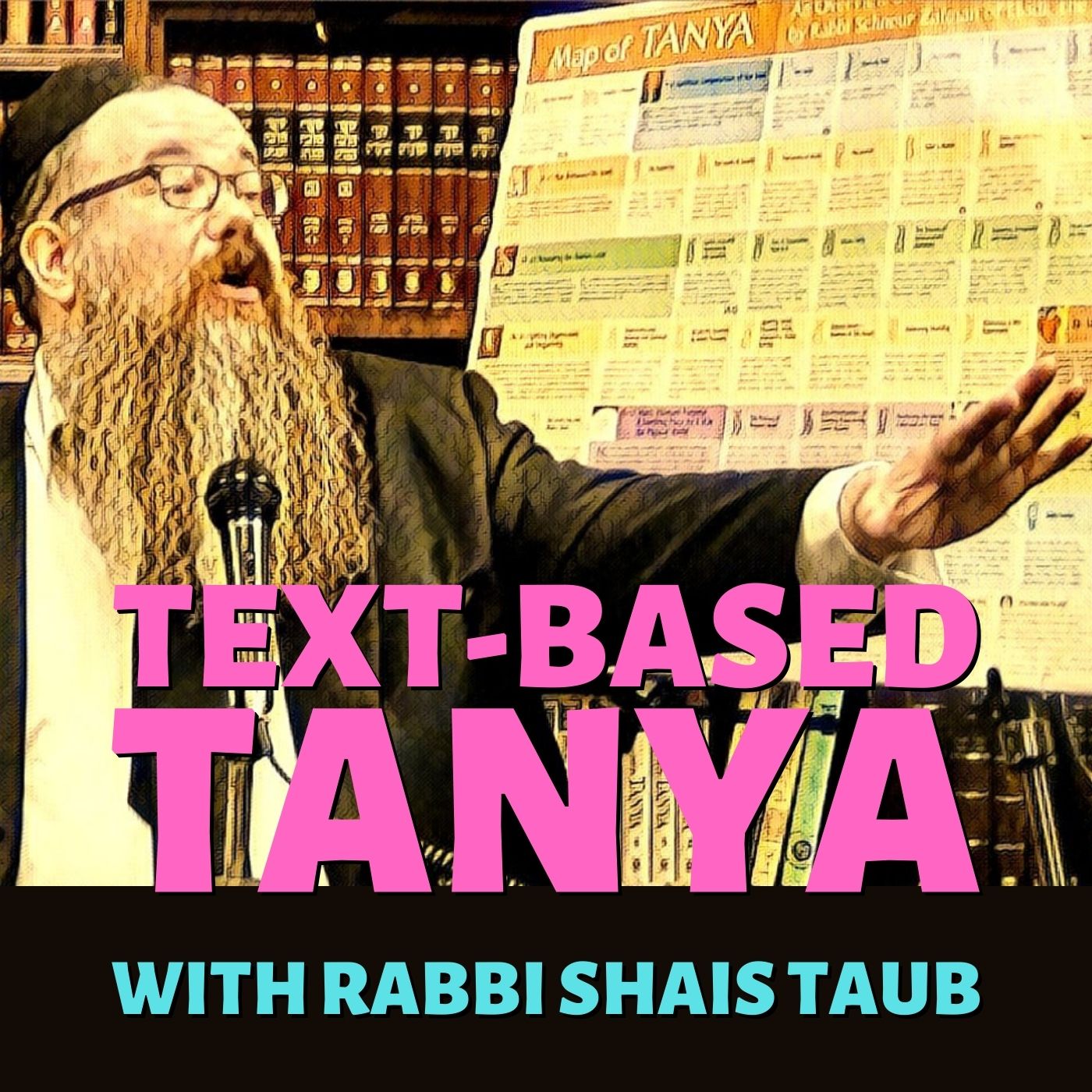
Text-Based Tanya
by Rabbi Shais Taub
Rabbi Shais Taub presents this text-based class of the original Tanya going word for word in Hebrew and explaining in clear, accessible English with contemporary examples and applications.
Episodes
-
Gate of Unity and Faith: Chapter 12—Reflections of the Light
The twenty-two letters are building blocks that through re-arrangements and substitutions, diminish the original power of the creative energy so that different creating beings can emerge. This diminishing effect may be likened to the sun's light reflected by the moon.
-
Gate of Unity and Faith: Chapter 11—Letters that Create
The Ten Utterances of creation are only rightly called such from the subjective perspective of the created beings.
-
Gate of Unity and Faith: Chapter 10—Luminary and Light
Using the metaphor of the sun and its rays, we come to better understand the nature of Hashem's attributes in relation to His essence. Just as the sun’s rays are relatively non-existent when compared to the sun itself, so too are the Divine attributes one with Hashem's essence.
-
Gate of Unity & Faith: Chapter 9—Beyond Description
The Essence of G-d cannot be described by even the loftiest attributes, so why do we speak of Hashem as "wise" or "compassionate" etc? In this chapter, the Alter Rebbe gives us context for understanding the proper usage of these terms.
-
Gate of Unity & Faith: Chapter 8—Simple Oneness
Having explained in chapters 1-7 how Hashem is the only true existence and that the worlds are not something "other" than Him, we now turn our attention to the oneness of Hashem in terms of Himself. Hashem is a simple oneness, not a composite of attributes.
-
Gate of Unity & Faith: Chapter 7—Surrounds All Worlds, Fills All Worlds
We conclude Ch. 7 with a further explanation of Tzimztum and how it is possible for Hashem to fill all worlds while simultaneously not being limited by them.
-
Gate of Unity & Faith: Chapter 7—Space, Time, and Tzimtzum
In Chapter 7, we explore the concept that despite Hashem's transcendence, He is present within space and time through His attribute of Malchus. Additionally, we examine the Alter Rebbe's interpretation of the Lurianic concept of Tzimtzum, clarifying that it does not imply Hashem literally…
more -
Gate of Unity & Faith: Chapter 7—No King Without a Nation
We begin Chapter 7 which introduces the idea of the Higher and Lower Unities (yichuda ilaah and yichuda tataah.) The first concept discussed is that it is Hashem's attribute of Malchus (corresponding to the Divine Name of A-D-N-I) that relates to the inherent limitations of time and space.
-
Gate of Unity & Faith: Chapter 6—There's No Other
In chapter 6, we are finally able to understand the statement in the verse with which we began chapter 1. "Know today and take it upon your heart that Hashem is Elokim; there is no other." Because the Divine Names of Hashem and Elokim are really one, therefore, even the concealment that makes...
-
Gate of Unity & Faith: Chapter 5—Is Creation Real?
Chapter 5 is very short but very challenging. Based on the Rebbe's explanations, we try to unpack the basic message of the chapter which is to obviate misunderstandings regarding tzimtzum that may arise from Chapter 4.
-
Gate of Unity & Faith: Chapter 4—The Power of Tzimtzum
Chapter 4 answers the question that was asked at the end of the previous chapter. How it is that creation is not nullified out of existence before Hashem? The answer is that Hashem's restraining power allows His creative power to conceal itself in a way that created beings can retain a sense of...
-
Gate of Unity & Faith: Chapter 3—Reality is Like a Sunbeam
In Chapter 3, the Alter Rebbe illustrates how, based on what we have learned in chs 1-2, it is a logical conclusion that all of created reality is non-existent relative to the Divine energy that constantly brings it in to being,
-
Gate of Unity & Faith: Chapter 2—Continuous Creation
In Chapter 2 of Shaar HaYichud VeHaEmunah, the Alter Rebbe uses the mechanics of the miraculous Splitting of the Sea to give us a logical way of understanding why creation must be constant and continuous.
-
Gate of Unity & Faith: Chapter 1—Letters that Create
Chapter 1 of Shaar HaYichud VeHaEmunah introduces the idea that all of created reality is composed of arrangements of the 22 letters of the Holy Tongue and that it is the Divine Speech that issues for these letters that causes all of creation to continue to exist rather than revert into nothingness.
-
Gate of Unity & Faith: Intro
We begin the second volume of Tanya known as The Gate of Unity and Faith (Shaar HaYichud Ve'HaEmunah) which explains the oneness and unity of Hashem. In this introduction, the Alter Rebbe explains why we need to understand this subject matter as it is the foundation to developing proper love and...
-
Lesson 88—Text Based Tanya
The final class of this series covers Ch. 53 of Tanya.
-
Lesson 87—Text Based Tanya
This lesson covers Ch. 52 in Tanya in which we further explain the concept of the "brain" of each plane of existence that was mentioned in Ch. 51.
-
Lesson 86—Text Based Tanya
Chapter 51 of Tanya takes us back to the discussion of the power of action that came up in Chapter 35 where mitzvos were compared to oil which fuels the flame of G-dly revelation. To better understand this, we ask a question: What does it mean that the Divine Presence rested in the Holy of […]
-
Lesson 85—Text Based Tanya
Concluding the theme of love and awe of Hashem begun in Ch. 41, a new type of love is introduced here in Ch. 50 that is in a whole different category from all previously discussed forms of love.
-
Lesson 84—Text Based Tanya
Finishing Ch. 49 of Tanya and the subject of "reciprocal love." In this class, we deal at length with the idea of Hashem "choosing" the Jewish people.
-
Lesson 82—Text Based Tanya
Chapter 48 of Tanya discusses the concept of Tzimtzum whereby the Infinite makes room for thew finite.
-
Lesson 81—Text Based Tanya
Chapter 47 of Tanya continues the theme of reciprocating love begun in Chapter 48. How to feel that the Exodus is happening right now.
-
Lesson 80—Text Based Tanya
Chapter 46 describes the mechanics of reciprocal love that can be channeled to reveal a love for Hashem in our hearts.
-
Lesson 79—Text Based Tanya
Chapter 45 of Tanya discusses the concept of arousing divine compassion on the plight of the soul as a method for generating love of G-d.
-
Lesson 78—Text Based Tanya
In Ch. 44 we encounter two new kinds of love--loving Hashem because He is our true life and loving Hashem even more than life because He is our father. Both of these types of love are based on inherited qualities that are automatically present within us but which we must amplify through meditation.
-
Lesson 77—Text Based Tanya
Chapter 43 describes two levels of awe and two levels of love as well as how each may be attained.
-
Lesson 76—Text Based Tanya
Concluding chapter 42, we speak about the idea that the vastness of the creation is merely a visual cure to remind us of the infinitely greater kingship of Hashem.
-
Lesson 75—Text Based Tanya
Continuing Ch. 42 and our discussion of awe of Hashem. The class gets off on a tangent but it's kind of interesting.
-
Lesson 74—Text Based Tanya
Continuing Ch. 42 and our discussion of meditations that bring on awe of Hashem.
-
Lesson 73—Text Based Tanya
Beginning Ch. 42 and the subject of the "internal Moshe Rabenu" that it makes it possible for us to relate to Hashem in a personal way.
-
Lesson 72—Text Based Tanya
Concluding Ch. 41, we focus on the idea of serving Hashem altruistically.
-
Lesson 71—Text Based Tanya
Continuing Ch. 41, we discuss the necessity for all mitzvos to be done with some level of awe of Hashem and what specific intentions qualify as this awe. Conversely, it is not enough to serve Hashem with awe alone; one must also serve with love.
-
Lesson 70—Text Based Tanya
Starting Ch. 41 of Tanya and the "awe meditation."
-
Lesson 69—Text Based Tanya
Chapter 40 of Tanya concludes our discussion of kavanah (intent) and its effect on our mitzvos.
-
Lesson 68—Text Based Tanya
Finishing Chapter 39 and the discussion of the various levels of intent and the worlds to which they correspond.
-
Lesson 67—Text Based Tanya
We begin Ch. 39 in which we continue our discussion about the different levels of kavanah (intent.) What is the difference between instinctive and intellectual emotions?
-
Lesson 66—Text Based Tanya
Concluding Ch. 38, we discuss the two levels of kavanah (intent) that may accompany a mitzvah. One level is referred to as "human" while the other is called "animal."
-
Lesson 65—Text Based Tanya
We begin Ch. 38 and our discussion of the importance of kavanah in performing mitzvos.
-
Lesson 64—Text Based Tanya
We conclude Ch. 37 and our discussion of the importance of physical action as the means for transforming the physical world into a home for Hashem.
-
Lesson 63—Text Based Tanya
Continuing Ch. 37 and the explanation of how our physical mitzvos transform the world. We come to understand that the soul did not come to this world for its own fixing but rather to fix the world. We also learn why tzedaka is the quintessential mitzvah.
-
Lesson 62—Text Based Tanya
We begin Chapter 37 of Tanya in which we begin to describe the precise mechanics whereby our mitzvos transform the physical world into a dwelling place for Hashem.
-
Lesson 61—Text Based Tanya
In Ch. 36 of Tanya we continue to impress upon the beinoni why physical action is so important by explaining that the whole purpose of creation lies within the physical.
-
Lesson 60—Text Based Tanya
Beginning of Chapter 36. The ultimate purpose for the creation of all worlds takes place on earth, not in heaven.
-
Lesson 59—Text Based Tanya
Please give to our yearly campaign! If you enjoy these Tanya classes, use this special link: charidy.com/rst/tanya In this class, we finish Ch. 35 and the discussion of the primary importance of action over emotion.
-
Lesson 58—Text Based Tanya
Beginning Ch. 35, we know focus on a new theme. What is the purpose of life? What is the point of the beinoni's struggle?
-
Lesson 57—Text Based Tanya
Chapter 34 of Tanya concludes the theme of joy that we began in Chapter 26. We take joy in providing a home for Hashem in this world through our Torah study and giving tzedakah.
-
Lesson 56—Text Based Tanya
Finishing Ch. 33. More about why Hashem gets such delight from us "letting Him in." Rabbi Taub shares an epiphany he had about the old Groucho joke "I would never want to be part of any club that would have someone like me as a member."
-
Lesson 55—Text Based Tanya
Chapter 33 continues the theme of JOY begun in Ch. 26. The specific form of joy that we focus on in this chapter is the unique happiness we feel when we feel close to Hashem.
-
Lesson 54—Text Based Tanya
Concluding Ch. 32 -the HEART of TANYA- we discuss how to love even those people who behave in ways that are objectively hateful.
-
Lesson 53—Text Based Tanya
Find out why Chapter 32 is the "heart of Tanya." How does the identity shift outlined in Chapter 31 lead to a radical change in our relationships with others.
We're indexing this podcast's transcripts for the first time — this can take a minute or two. We'll show results as soon as they're ready.
No matches for "" in this podcast's transcripts.
No topics indexed yet for this podcast.
Loading reviews...
ABOUT THIS SHOW
Rabbi Shais Taub presents this text-based class of the original Tanya going word for word in Hebrew and explaining in clear, accessible English with contemporary examples and applications.
HOSTED BY
Rabbi Shais Taub
CATEGORIES
Loading similar podcasts...
Frequently Asked Questions
How many episodes does Text-Based Tanya have?
Text-Based Tanya currently has 50 episodes available on PodParley. New episodes are automatically indexed when they're published to the podcast feed.
What is Text-Based Tanya about?
Rabbi Shais Taub presents this text-based class of the original Tanya going word for word in Hebrew and explaining in clear, accessible English with contemporary examples and applications.
How often does Text-Based Tanya release new episodes?
Text-Based Tanya has 50 episodes. Check the episode list to see recent publication dates and frequency.
Where can I listen to Text-Based Tanya?
You can listen to Text-Based Tanya on PodParley by clicking any episode. We provide an embedded audio player for direct listening, and you can also subscribe via your preferred podcast app using the RSS feed.
Who hosts Text-Based Tanya?
Text-Based Tanya is created and hosted by Rabbi Shais Taub.
URL copied to clipboard!