
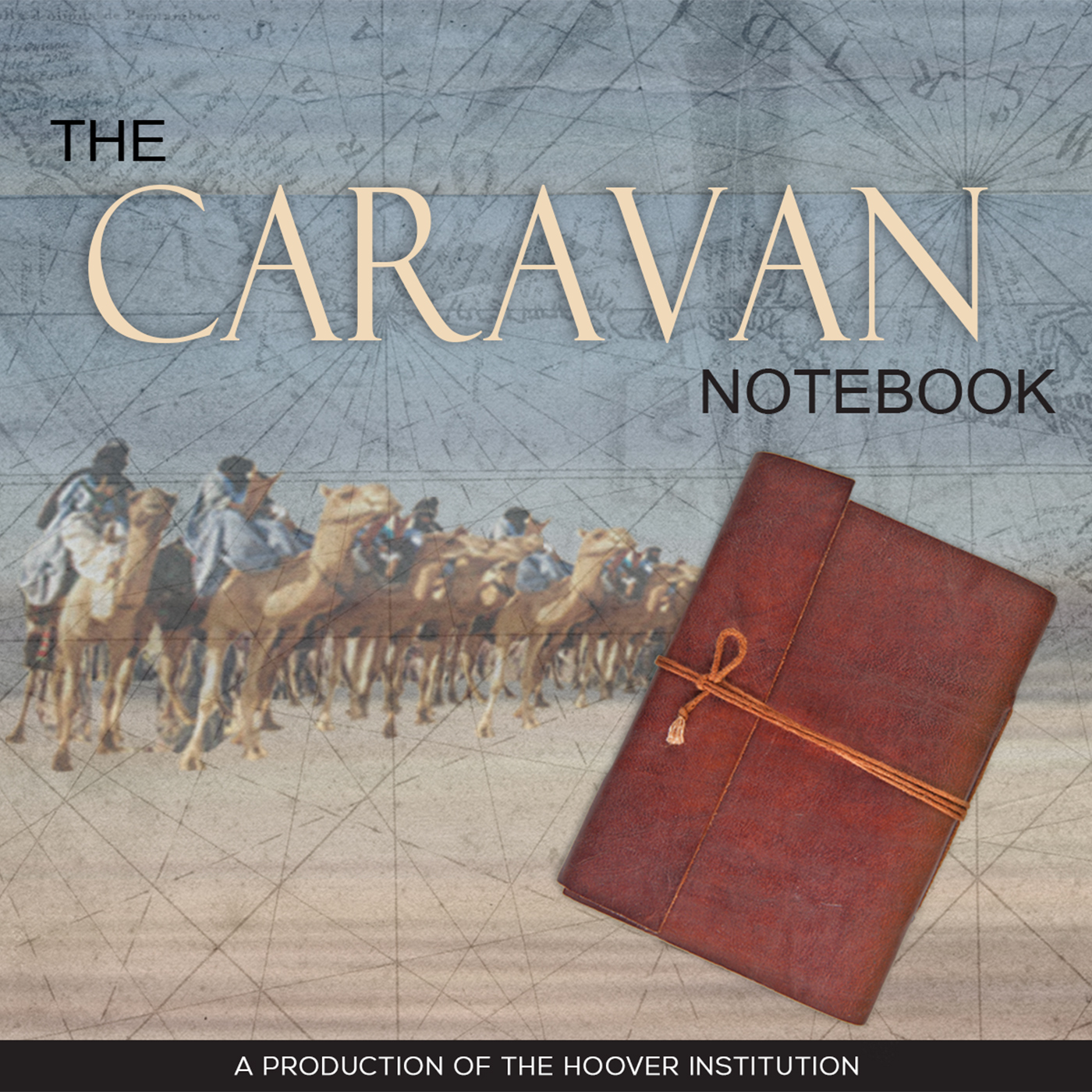
PODCAST · history
The Caravan
by Hoover Institution
The Caravan Podcast provides discussions of politics and culture in the Middle East and the Islamic World with regard to the challenges for American foreign policy.
Episodes
-
At the Cusp of Israeli-Saudi Normalization?
Talk of normalization between Saudi Arabia and Israel has been heating up in recent weeks, with American officials visiting Riyadh to hammer out the terms of an agreement and Saudi and Israeli leaders sounding optimistic. But how close to such a deal are we really? Joshua Teitelbaum, a professor…
more -
Degrading and Destroying the Islamic State
After the Islamic State seized large swathes of Syria and Iraq in 2013-14, the United States led a yearslong effort to roll back the group’s gains. Journalist and author Michael Gordon has written four books on the wars in Iraq, and in his latest, Degrade and Destroy, he takes us inside the war…
more -
Al-Qaeda’s Afflictions
The special forces raid that killed Osama bin Laden in May 2011 yielded a massive trove of documents never intended for publication, but in 2017 the CIA declassified them in their entirety. Nelly Lahoud, a scholar at New America, has written the first history of al-Qaeda based on a systematic...
-
The Saudi Climbdown and the Iranian Shakedown
Big things are shaping up in the Middle East as the Biden administration appears to be rethinking its get-tough policy on Saudi Arabia, even as it continues to hold out hope for a revived nuclear deal with Iran. Meanwhile, Russia looks poised to shut down a key humanitarian aid corridor in Syria,...
-
The Syria-Ukraine Nexus
In September 2015, Russia intervened militarily in Syria to save the regime of dictator Bashar al-Asad. President Obama predicted a “quagmire,” but that is not what followed. What is the nexus between the Russian intervention in Syria and the more recent Russian “special military operation” in...
-
ISIS Loses Its Leader, But the Group Lives On
On February 3, President Biden announced the death of Abu Ibrahim al-Hashimi al-Qurashi, the leader of the Islamic State, in a U.S. special forces raid on his hideout in northern Syria. The leader, better known as Hajji ‘Abdallah, had been the Islamic State’s so-called caliph since October 2019,...
-
The Diplomatic Failure of the Afghan Withdrawal
Journalist and author Steve Coll examines the debates and decisions in Washington, Kabul, and Doha preceding the collapse of the Afghan government and the return to power of the Taliban. In a recent article in the New Yorker, Steve and coauthor Adam Entous document a “dispiriting record of...
-
Henry Kissinger and the Problems of Middle East Peace
Ambassador Martin Indyk, a former diplomat and senior government official, discusses his new book Master of the Game: Henry Kissinger and the Art of Middle East Diplomacy. The book explores Kissinger’s diplomacy in the Middle East, focused as it was on achieving order and equilibrium in the…
more -
Repercussions of the Afghanistan Withdrawal
Tom Tugendhat was elected to Parliament in 2015, after military service in both Iraq and Afghanistan. He is the chair of the Foreign Affairs Committee. In August he delivered a widely reported speech critical of the US withdrawal from Afghanistan, insisting on the need for long-term patience of…
more -
The Banking Sector in Lebanon and the Roots of Corruption
Alain Bifani has had an insider's view of Lebanese politics for decades as Director General of the Ministry of Finance. In this discussion he explores the origins of the current crisis in Lebanon in the historical corruption of the banking sector. Entrenched interests, called "the cartel," have...
-
Yemen, al-Qaida, and the Jihadi Threat
Elisabeth Kendall, a scholar of Arabic and jihadism at Oxford University, joins the podcast to discuss the state of the jihadi threat in Yemen, a country she knows well. The local franchises of al-Qaida and the Islamic State are weakened but continue to pose a significant threat. As Kendall…
more -
The Syrian Crisis: A Focus on Daraa, ‘Cradle of the Revolution‘
Colonel (Ret.) Joel Rayburn knows the Middle East well. He served as Deputy Assistant Secretary for Levant Affairs and Special Envoy for Syria during the Trump administration, after tours of duty in Iraq and Afghanistan. He is also an accomplished historian, author of Iraq After America…
more -
The Return of the Islamic Emirate of Afghanistan: A Conversation with Asfandyar Mir
Asfandyar Mir, a noted expert on South Asia and terrorism, was in Kabul just weeks before the Taliban overran the country in mid-August. How did the Afghan government fall so fast and what will be the ramifications of the return of the Islamic Emirate of Afghanistan, the official name of the...
-
Lebanon: Between Economic Crisis and Sectarian Conflict
Paul Wood served as BBC foreign correspondent for twenty-five years and is now a columnist for the The Spectator magazine in London. He has reported from a wide range of locations across the broad Middle East: Afghanistan, Croatia, Bosnia, Macedonia, Chechnya, Libya, Algeria, and Sudan including...
-
Yemen and the Houthis: A Conversation with Bernard Haykel
In September 2014, the Houthis, a revolutionary Islamist movement, seized control of the Yemeni capital of Sanaa, precipitating a civil war in the country that continues to this day. Who are the main actors in the Yemen conflict? What is the role of the United States? What do the Houthis really...
-
Mohammed Bin Salman and Saudi Arabia
Ben Hubbard is the New York Times bureau chief in Beirut, Lebanon, and author of MBS: The Rise to Power of Mohammed Bin Salman (2020), a biography of the Crown Prince of Saudi Arabia. The conversation treats the Crown Prince's rise to power in the context of a Saudi Arabia marked by deeply...
-
Meeting Abu Muhammad al-Jawlani: A Conversation with Martin Smith
In February, Martin Smith traveled to Idlib, Syria, where he became the first Western journalist to conduct an interview with Abu Muhammad al-Jawlani, a U.S.-designated terrorist and the leader of the jihadi group Hay’at Tahrir al-Sham (HTS). Once an official branch of al-Qaida under a different...
-
Israel's Grand Strategy
Facing neighbors fundamentally hostile to its existence, Israel has developed a multidimensional grand strategy. Assaf Orion initially described the development of this strategy in a Hoover essay here and he expands on the topic in this podcast conversation. He begins with comments on the recent...
-
Iran’s Last Shah: A Conversation with Ray Takeyh
Muhammad Reza Shah reigned from 1941 to 1979, when the Iranian Revolution ushered in the era of the Islamic Republic. In his book The Last Shah, Ray Takeyh chronicles the period of last shah’s reign with a view to understanding the causes of the revolution. What role did the United States play in...
-
The Competition Between Saudi Arabia and Iran Since 1979
Prior to 1979, Saudi Arabia and Iran, two Muslim monarchies--one Sunni and one Shia--were allied with the US in the Cold War against Communism. The Iranian Revolution changed that, as did the Saudi response to the seizure of the Grand Mosque in Mecca. The two powers began to compete for regional...
-
America's War in Afghanistan: A Discussion with Wesley Morgan
Wesley Morgan, a journalist and expert on military affairs, discusses his new book The Hardest Place: The American Military Adrift in Afghanistan's Pech Valley, as well as prospects for Afghanistan and counterterrorism following U.S. withdrawal.
-
The Iran Deal and Germany: A Discussion with Matthias Kuentzel
Negotiations concerning a potential American return to the Iran Deal have opened in Vienna. The diplomacy is complex. While the JCPOA is generally treated as involving only the U.S. and Iran, it also includes Russia, China and three European countries: England, France and Germany. Germany is...
-
Lessons from an American Prisoner in Iran: A Discussion with Xiyue Wang
The Biden Administration is eager to reverse the Trump administration’s policy of “maximum pressure” on Iran and reenter the Iranian nuclear deal, or JCPOA. Xiyue Wang, who spent 40 months as a prisoner in Iran on false charges of espionage, shares his criticism of this approach. What is the…
more -
Human Rights in Saudi Arabia: A Discussion with Karen Elliott House
The Kingdom of Saudi Arabia is undergoing profound changes. With its young population, it faces a transition from a traditional, conservative society to one with greater rights, perhaps especially for women. The powerful young Crown Prince, Mohammed bin Salman, is driving some of these changes,...
-
Turkey and the United States: A Discussion with Michael Doran
U.S.-Turkish relations have hit a low point in recent years. Yet it is imperative, according to Michael Doran, that the United States and Turkey rediscover their common interests. What are the sources of conflict between the two countries? How should the United States see Turkey as it formulates...
-
Islamism and Islam: A Discussion with Elham Manea
Discussing her new book, The Perils of Non-Violent Islamism (Telos Press), Elham Manea describes her experience of a tolerant Islam in Morocco, the traditionalism of Yemen, and her own encounter with Islamist indoctrination. She explores the nuanced relationship between the politics of Islamism…
more -
Saudi Arabia, Reform, & U.S. Policy
Under Crown Prince Muhammad bin Salman, Saudi Arabia has undergone a dramatic transformation as it pursues unprecedented economic diversification and social liberalization. It has also moved toward greater authoritarianism and political repression. What is the outlook for these changes? How…
more -
The Arab Public and US Foreign Policy: A Discussion with Faisal Abbas
The Survey, conducted by YouGov and Arab News, shows how the Arab public was disappointed with Obama era policies. This result cautions against the Biden administration returning to them, especially with regard to Iran. Trump received greater support in the Gulf and the Levant than in North…
more -
Syria and US Foreign Policy
In Syria, American foreign policy faces an enormous humanitarian crisis and a political challenge to implement UN Security Resolution 2254, against the backdrop of competition from both Russia and Iran. A US return to "the Iran Deal" is likely to exacerbate conditions in Syria, while continued...
-
Al-Qaida and the Taliban at the Crossroads
In late February the United States and the Taliban reached an agreement over the withdrawal of U.S. forces from Afghanistan. The Taliban has pledged not to host al-Qaida or allow it to use Afghan soil "to threaten the security of the United States and its allies." The reaction in the world of...
We're indexing this podcast's transcripts for the first time — this can take a minute or two. We'll show results as soon as they're ready.
No matches for "" in this podcast's transcripts.
No topics indexed yet for this podcast.
Loading reviews...
ABOUT THIS SHOW
The Caravan Podcast provides discussions of politics and culture in the Middle East and the Islamic World with regard to the challenges for American foreign policy.
HOSTED BY
Hoover Institution
CATEGORIES
Loading similar podcasts...
Frequently Asked Questions
How many episodes does The Caravan have?
The Caravan currently has 30 episodes available on PodParley. New episodes are automatically indexed when they're published to the podcast feed.
What is The Caravan about?
The Caravan Podcast provides discussions of politics and culture in the Middle East and the Islamic World with regard to the challenges for American foreign policy.
How often does The Caravan release new episodes?
The Caravan has 30 episodes. Check the episode list to see recent publication dates and frequency.
Where can I listen to The Caravan?
You can listen to The Caravan on PodParley by clicking any episode. We provide an embedded audio player for direct listening, and you can also subscribe via your preferred podcast app using the RSS feed.
Who hosts The Caravan?
The Caravan is created and hosted by Hoover Institution.
URL copied to clipboard!