
PODCAST · society
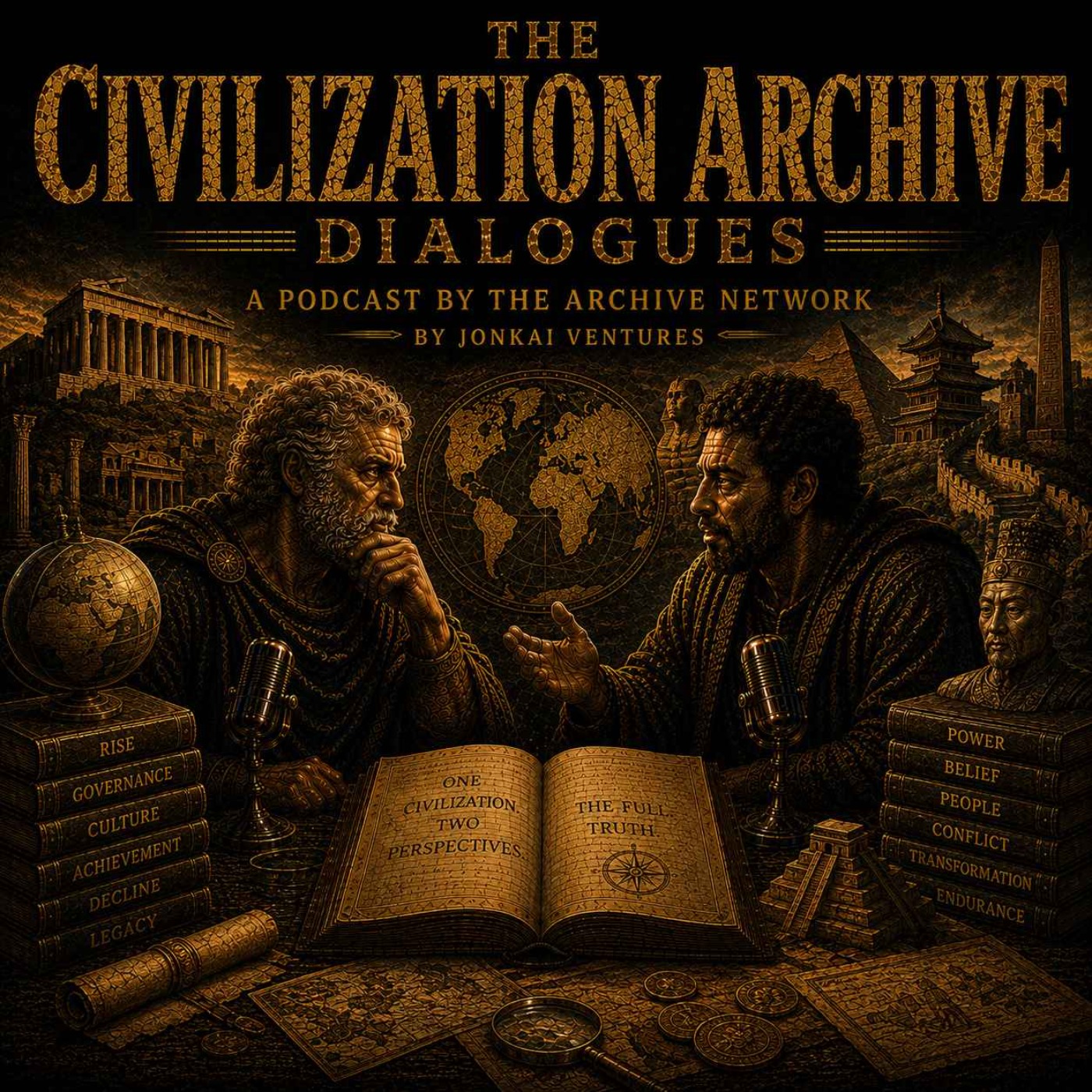
The Civilization Archive Dialogues
by The Archive Network
The Civilization Archive Dialogues is part of The Archive Network by Jonkai Ventures, a collection of podcasts dedicated to the stories that shaped our world. Every episode is a conversation. Aurelius and Malik, curators of The Civilization Archive, take a single civilization — the Abbasids, the Aztecs, Joseon Korea, the Songhai Empire — and follow it from first settlement to whatever came after. One traces what it built: the irrigation that fed a city, the bureaucracy that held a continent together, the ideas it kept exporting long after its armies stopped marching. The other presses on what that cost — who farmed the surplus, who was conquered to supply it, and why the collapse was often already visible during the golden age.These are not summaries. Each episode is one complete civilization, examined from both sides in a single sitting.The Archive Network is an independent, solo-run project. Every archive, podcast and documentary is free — no a
-
43
Breton Civilization
Imagine standing on a windswept promontory, granite cliffs rising behind you, the Atlantic roaring at your feet. Here, in this wild and ancient place, the seeds of a civilization are quietly being sown.Long before the name Brittany echoed in Europe, this land was already alive with stories, conflict, and hope. After Rome’s fading power left Western Europe in chaos, the Armorican peninsula—later called Brittany—became a world on the edge. Granite ridges towered above deep oak and beech forests. Jagged coastlines shaped the way people moved, traded, and survived. Archaeologists have found the remnants of early settlements perched above river valleys or clinging to rocky hills. These were the homes of the Veneti and Osismi tribes, Gallic peoples who adapted to both the bounty and brutality of land and sea. Their pottery, iron tools, and fortified enclosures tell us they lived with vigilance, ready for change and challenge.Aurelius and Malik take on this case in full — 5 chapters, 35 minutes, one complete story.Learn more at: https://thecivilizationarchive.com/civilization/breton-civilizationThe Civilization Archive Dialogues is part of The Archive Network by Jonkai Ventures. In every episode, curators Aurelius and Malik take one civilization and follow it from first settlement to what came after — one tracing what it built, the other pressing on what it cost.The Archive Network is an independent, solo-run project. Everything is free, with no ads and no paywalls. Support doesn't unlock anything; it simply keeps the work going: https://thearchivenetwork.com/support Explore this archive:https://thecivilizationarchive.comDiscover more archives and stories:https://thearchivenetwork.com Hosted on Acast. See acast.com/privacy for more information.
-
42
Amber Kingdom
Imagine standing in the shadow of ancient hills, where the very earth seems to whisper stories of a people who carved out life against all odds. In the rocky valleys of northwestern India, long before palaces and pageantry, something extraordinary was beginning.The origins of a civilization were quietly taking root among the ochre stones and wild acacia trees. The tale of the Amber Kingdom begins not with grand monuments, but with the hum of daily struggle in a harsh landscape. Early settlers, drawn by the promise of survival, left behind silent clues: shards of red pottery, charred grains, and stone foundations. These people faced the challenge of dry soils and unpredictable monsoons. Yet, they responded not with despair, but with ingenuity. Imagine the cool descent into a stepwell, its worn stairs echoing with generations fetching water from the deep. Tank embankments, built stone by stone, captured the fleeting rains. Every drop was precious, every effort communal. The air, thick with the scent of wild plants and dust, carried the sounds of donkeys braying and metal tools clanging across terraced fields. In this world, tools were forged, shrines were built, and terracotta figures—many in the shape of animals—were carefully shaped by hand, reflecting the central role of livestock in survival.Aurelius and Malik take on this case in full — 5 chapters, 35 minutes, one complete story.Learn more at: https://thecivilizationarchive.com/civilization/amber-kingdomThe Civilization Archive Dialogues is part of The Archive Network by Jonkai Ventures. In every episode, curators Aurelius and Malik take one civilization and follow it from first settlement to what came after — one tracing what it built, the other pressing on what it cost.The Archive Network is an independent, solo-run project. Everything is free, with no ads and no paywalls. Support doesn't unlock anything; it simply keeps the work going: https://thearchivenetwork.com/support Explore this archive:https://thecivilizationarchive.comDiscover more archives and stories:https://thearchivenetwork.com Hosted on Acast. See acast.com/privacy for more information.
-
41
Ancestral Puebloan Civilization
Aurelius and Malik take on this case in full — 5 chapters, 36 minutes, one complete story.The Civilization Archive Dialogues is part of The Archive Network by Jonkai Ventures. In every episode, curators Aurelius and Malik take one civilization and follow it from first settlement to what came after — one tracing what it built, the other pressing on what it cost.The Archive Network is an independent, solo-run project. Everything is free, with no ads and no paywalls. Support doesn't unlock anything; it simply keeps the work going: https://thearchivenetwork.com/support Explore this archive:https://thecivilizationarchive.comDiscover more archives and stories:https://thearchivenetwork.com Hosted on Acast. See acast.com/privacy for more information.
-
40
Aksumite Empire
The dawn breaks over the Ethiopian highlands, and the world is awash in colors—emerald and ochre hills, rivers winding through mist. In this remote, formidable landscape, an empire's roots begin to take hold. But how could a civilization rise from such a wild and isolated place?High in the northern plateaus of Ethiopia and Eritrea, the first seeds of Aksumite society were sown. Here, steep escarpments and fertile valleys shaped a people who learned to thrive where nature challenged them at every turn. Early settlements harnessed the gifts of volcanic soil and seasonal rains, cultivating teff, barley, and wheat on terraced fields. Imagine the scent of damp earth after a downpour, and the glow of sunrise on stone-bordered fields. Farmers and herders adapted to cycles of drought and plenty, finding resilience in the rhythm of the land. Pottery shards marked with careful patterns, obsidian blades, and grinding stones all whisper of skilled hands and daily ingenuity, bound to the cycles of sun and rain.Aurelius and Malik take on this case in full — 5 chapters, 32 minutes, one complete story.Learn more at: https://thecivilizationarchive.com/civilization/aksumite-empireThe Civilization Archive Dialogues is part of The Archive Network by Jonkai Ventures. In every episode, curators Aurelius and Malik take one civilization and follow it from first settlement to what came after — one tracing what it built, the other pressing on what it cost.The Archive Network is an independent, solo-run project. Everything is free, with no ads and no paywalls. Support doesn't unlock anything; it simply keeps the work going: https://thearchivenetwork.com/support Explore this archive:https://thecivilizationarchive.comDiscover more archives and stories:https://thearchivenetwork.com Hosted on Acast. See acast.com/privacy for more information.
-
39
Bactrian Civilization
Imagine standing in a valley where icy mountain streams tumble into fertile plains, a place where ancient rivers carry more than just water—they carry the very seeds of civilization. In the shadow of the Hindu Kush, on the banks of the Oxus, the story of Bactria begins long before its name would echo through the halls of kings and conquerors.Here, nature shaped destiny. The land of Bactria stretches between harsh, snow-capped mountains and the endless plains beyond the Oxus River, known today as the Amu Darya. Thousands of years ago, this landscape was a living crossroads. Archaeologists have uncovered the remains of Bronze Age villages and fortified towns, their mudbrick walls standing firm against bitter winter winds and scorching summers. Even then, people learned to work with the land’s rhythm—channeling the yearly floods, coaxing wheat and barley from the rich valley soil, tending herds of cattle and sheep on upland pastures. These early Bactrians didn’t just survive; they built a network of irrigation channels and collective granaries, laying the groundwork for something much greater.Aurelius and Malik take on this case in full — 5 chapters, 36 minutes, one complete story.Learn more at: https://thecivilizationarchive.com/civilization/bactrian-civilizationThe Civilization Archive Dialogues is part of The Archive Network by Jonkai Ventures. In every episode, curators Aurelius and Malik take one civilization and follow it from first settlement to what came after — one tracing what it built, the other pressing on what it cost.The Archive Network is an independent, solo-run project. Everything is free, with no ads and no paywalls. Support doesn't unlock anything; it simply keeps the work going: https://thearchivenetwork.com/support Explore this archive:https://thecivilizationarchive.comDiscover more archives and stories:https://thearchivenetwork.com Hosted on Acast. See acast.com/privacy for more information.
-
38
Baekje Civilization
Imagine a world where the river winds quietly through mist-shrouded hills, and ancient footsteps echo across fertile plains. In these valleys, something extraordinary was awakening—a civilization poised to shape the heart of a peninsula.The story of Baekje begins here, hidden among reeds and mountain shadows. The land that would become Baekje was no ordinary place. It was a landscape of contrasts—rolling plains, dense forests, and the meandering Han River weaving through everything like a living artery. Over four thousand years ago, people began to settle these valleys. Archaeological digs have uncovered their simple homes: timber and clay dwellings, thatched with reeds, perched on terraces above the floodplain. Imagine stepping into one of these houses, the scent of woodsmoke and warm earth filling the air as families huddled around sunken hearths to keep out the cold winter winds.Aurelius and Malik take on this case in full — 5 chapters, 34 minutes, one complete story.Learn more at: https://thecivilizationarchive.com/civilization/baekje-civilizationThe Civilization Archive Dialogues is part of The Archive Network by Jonkai Ventures. In every episode, curators Aurelius and Malik take one civilization and follow it from first settlement to what came after — one tracing what it built, the other pressing on what it cost.The Archive Network is an independent, solo-run project. Everything is free, with no ads and no paywalls. Support doesn't unlock anything; it simply keeps the work going: https://thearchivenetwork.com/support Explore this archive:https://thecivilizationarchive.comDiscover more archives and stories:https://thearchivenetwork.com Hosted on Acast. See acast.com/privacy for more information.
-
37
Akkadian Empire
In the cool mist of early morning, two rivers carve silent paths through a land waiting for greatness. Between the Tigris and Euphrates, a spark flickers—soon, it will ignite a force that changes history forever. Picture the world’s first empire before it even has a name.The story begins not with kings or armies, but with mud, water, and the will to survive. Imagine standing on the banks of a restless river, the scent of wet clay and smoke in the air. Here, scattered villages cling to the land, their people caught in the rhythm of seasons and floods. These are the earliest Akkadians—Semitic newcomers drawn by the promise of rich soil. They build with mudbrick, dig canals by hand, and trade grain for simple luxuries. In this world, every day is a wager against nature’s power. As the sun rises, you hear the lowing of cattle, the slap of river water against stone, and the hum of a distant market.Aurelius and Malik take on this case in full — 5 chapters, 35 minutes, one complete story.Learn more at: https://thecivilizationarchive.com/civilization/akkadian-empireThe Civilization Archive Dialogues is part of The Archive Network by Jonkai Ventures. In every episode, curators Aurelius and Malik take one civilization and follow it from first settlement to what came after — one tracing what it built, the other pressing on what it cost.The Archive Network is an independent, solo-run project. Everything is free, with no ads and no paywalls. Support doesn't unlock anything; it simply keeps the work going: https://thearchivenetwork.com/support Explore this archive:https://thecivilizationarchive.comDiscover more archives and stories:https://thearchivenetwork.com Hosted on Acast. See acast.com/privacy for more information.
-
36
Basque Civilization
In the shadowed valleys of the Pyrenees, an ancient people carved their lives into stone, their voices echoing across green hills long before Rome or Athens rose. Here, among whispering forests and swift rivers, secrets of a unique civilization waited in silence.The origins of the Basque people are hidden in the folds of the western Pyrenees, where mountains tumble toward the Bay of Biscay. Picture a world of thick oak and beech forests, mist winding through upland valleys, and the distant rush of rivers fed by snowmelt. It is a land both beautiful and harsh, shaping those who call it home. By one thousand BCE, communities had long settled these hills and valleys. Their story is written in dolmens and stone circles, in cave paintings hidden beneath the earth, and in the bones of wild horses once roaming the pastures. The smell of damp earth mixes with woodsmoke, and each season brings new rhythms of survival.Aurelius and Malik take on this case in full — 5 chapters, 36 minutes, one complete story.Learn more at: https://thecivilizationarchive.com/civilization/basque-civilizationThe Civilization Archive Dialogues is part of The Archive Network by Jonkai Ventures. In every episode, curators Aurelius and Malik take one civilization and follow it from first settlement to what came after — one tracing what it built, the other pressing on what it cost.The Archive Network is an independent, solo-run project. Everything is free, with no ads and no paywalls. Support doesn't unlock anything; it simply keeps the work going: https://thearchivenetwork.com/support Explore this archive:https://thecivilizationarchive.comDiscover more archives and stories:https://thearchivenetwork.com Hosted on Acast. See acast.com/privacy for more information.
-
35
Classical Athens
In the rugged landscape of Attica, a transformation is happening. Imagine the rocky plateau of Athens, crowned by the majestic Acropolis.For centuries, people have lived here, forging a life from the dry, dusty soil. But around the year 508 BCE, something extraordinary is set to unfold—a city-state with a distinct identity is about to emerge. From humble beginnings, Athens will rise to become a powerful force in the ancient world.Aurelius and Malik take on this case in full — 5 chapters, 35 minutes, one complete story.Learn more at: https://thecivilizationarchive.com/civilization/classical-athensThe Civilization Archive Dialogues is part of The Archive Network by Jonkai Ventures. In every episode, curators Aurelius and Malik take one civilization and follow it from first settlement to what came after — one tracing what it built, the other pressing on what it cost.The Archive Network is an independent, solo-run project. Everything is free, with no ads and no paywalls. Support doesn't unlock anything; it simply keeps the work going: https://thearchivenetwork.com/support Explore this archive:https://thecivilizationarchive.comDiscover more archives and stories:https://thearchivenetwork.com Hosted on Acast. See acast.com/privacy for more information.
-
34
Arakan Kingdom
Imagine a land where the mountains rise like green walls and tidal rivers snake through dense forests, meeting the restless waves of the Bay of Bengal. Fog drifts over ancient burial mounds, and the air carries the scent of rain-soaked earth and distant salt. This is the western edge of Myanmar, where the story of the Arakan Kingdom quietly begins.Beneath the forested ridges of the Rakhine Yoma, a unique civilization took root, shaped by both geography and the tides of history. Here, the land is a tapestry of rice paddies, mangrove forests, and alluvial plains, where rivers feed the soil and monsoons dictate the rhythm of life. For thousands of years, people have left their mark on this landscape. In the valleys of Lemro and Kaladan, rock shelters hold secrets from the Paleolithic and Neolithic ages—stone tools, fragments of pottery, and mysterious rock art. Burial mounds on the plains yield bronze ornaments and carnelian beads, evidence of ancient rituals and far-reaching trade. Picture the clang of bronze bells calling villagers, the metallic tang of oxidized relics in the damp soil, and the enduring sense of people adapting to a challenging, fertile world.Aurelius and Malik take on this case in full — 5 chapters, 35 minutes, one complete story.Learn more at: https://thecivilizationarchive.com/civilization/arakan-kingdomThe Civilization Archive Dialogues is part of The Archive Network by Jonkai Ventures. In every episode, curators Aurelius and Malik take one civilization and follow it from first settlement to what came after — one tracing what it built, the other pressing on what it cost.The Archive Network is an independent, solo-run project. Everything is free, with no ads and no paywalls. Support doesn't unlock anything; it simply keeps the work going: https://thearchivenetwork.com/support Explore this archive:https://thecivilizationarchive.comDiscover more archives and stories:https://thearchivenetwork.com Hosted on Acast. See acast.com/privacy for more information.
-
33
Akan Civilization
Imagine a land where rivers shimmer with hidden gold and ancient trees whisper stories of forgotten ancestors. In the dense forests of West Africa, a civilization is quietly taking root, its beginnings lost in mist and myth.Here, the Akan people are about to embark on a journey that will shape the destiny of a region and echo through centuries. Welcome to the genesis of the Akan civilization—a story told by the land itself. Picture the rain-soaked earth, rich with the scent of growing yams and woodsmoke. Along the banks of the Tano, Pra, and Ankobra Rivers, early communities cluster, their homes built from wattle and daub. These settlements, as revealed by archaeological digs at places like Begho and Bono Manso, are alive with everyday sounds: the thump of pestles, the laughter of children, the constant buzz of insects in the green canopy overhead.Aurelius and Malik take on this case in full — 5 chapters, 36 minutes, one complete story.Learn more at: https://thecivilizationarchive.com/civilization/akan-civilizationThe Civilization Archive Dialogues is part of The Archive Network by Jonkai Ventures. In every episode, curators Aurelius and Malik take one civilization and follow it from first settlement to what came after — one tracing what it built, the other pressing on what it cost.The Archive Network is an independent, solo-run project. Everything is free, with no ads and no paywalls. Support doesn't unlock anything; it simply keeps the work going: https://thearchivenetwork.com/support Explore this archive:https://thecivilizationarchive.comDiscover more archives and stories:https://thearchivenetwork.com Hosted on Acast. See acast.com/privacy for more information.
-
32
Baltic Civilization
Picture a world shrouded in mist, where ancient rivers cut through endless pine forests, and every hill and grove whispers the secrets of a forgotten people. Here, in a land shaped by water and shadow, the story of the Baltic civilization begins.The Baltic lands stretch from the deep green forests of what is now Lithuania, north to the river-woven plains of Latvia and Estonia. This is a place where rivers like the Daugava and the Nemunas carve through marsh and meadow, their banks thick with alder and birch. Imagine the ground soft with moss, the air heavy with peat smoke and the scent of wet earth. By the year five hundred, clusters of Baltic-speaking villages nestled on hills beside lakes and river bends. Timber longhouses, built of pine and oak, huddled together for warmth and defense. Inside, families gathered around hearths, protected from the chill of the northern climate, their lives bound to the rhythms of land and water.Aurelius and Malik take on this case in full — 5 chapters, 35 minutes, one complete story.Learn more at: https://thecivilizationarchive.com/civilization/baltic-civilizationThe Civilization Archive Dialogues is part of The Archive Network by Jonkai Ventures. In every episode, curators Aurelius and Malik take one civilization and follow it from first settlement to what came after — one tracing what it built, the other pressing on what it cost.The Archive Network is an independent, solo-run project. Everything is free, with no ads and no paywalls. Support doesn't unlock anything; it simply keeps the work going: https://thearchivenetwork.com/support Explore this archive:https://thecivilizationarchive.comDiscover more archives and stories:https://thearchivenetwork.com Hosted on Acast. See acast.com/privacy for more information.
-
31
Ahom Kingdom
Beneath the restless clouds and monsoon rains of Assam, a mystery lingered for centuries. Who first tamed these wild, fertile valleys, where elephants roamed and rivers vanished into mist? Listen closely—the story begins before the kingdom, in a land waiting for its people.Imagine a place where the Brahmaputra River winds through thick forests and rolling hills, its waters full of fish and promise. Here, before any great civilization rose, the air vibrated with the sounds of barter in riverside markets and the scent of burning wood drifted from stilted bamboo homes. Small communities—Kacharis, Chutiyas, Borahis—lived close to the earth, worshipping their own gods, trading salt and dried fish, and honoring their ancestors with offerings and ritual sacrifice. Archaeologists uncover traces of these early days: pottery shards, iron tools, and the burnt bones of feasts held under thatched shrines. The ground still holds memories of bustling markets and sacred gatherings, a world both inviting and dangerous, shaped by flood and forest.Aurelius and Malik take on this case in full — 5 chapters, 35 minutes, one complete story.Learn more at: https://thecivilizationarchive.com/civilization/ahom-kingdomThe Civilization Archive Dialogues is part of The Archive Network by Jonkai Ventures. In every episode, curators Aurelius and Malik take one civilization and follow it from first settlement to what came after — one tracing what it built, the other pressing on what it cost.The Archive Network is an independent, solo-run project. Everything is free, with no ads and no paywalls. Support doesn't unlock anything; it simply keeps the work going: https://thearchivenetwork.com/support Explore this archive:https://thecivilizationarchive.comDiscover more archives and stories:https://thearchivenetwork.com Hosted on Acast. See acast.com/privacy for more information.
-
30
American Civilization
Close your eyes and picture a land wild with possibility—a patchwork of forests, rivers, and bustling ports. In the year 1776, thirteen colonies stood at the edge of history, ready to defy an empire and imagine a new world.The air along the Atlantic coast was thick with the mingled scents of tobacco, sea salt, and the promise of change. Across these colonies, life was shaped by extremes. Settlers carved homes from dense forests, built meetinghouses from local timber, and learned to survive both bounty and hardship. Listen, and you can almost hear the creak of wooden pews and the murmur of debate by candlelight as neighbors gathered to decide their future. These early Americans faced constant threats—disease, famine, and conflict with Native nations. Burial grounds whispered stories of struggle and loss, but also of resilience. Over time, communities that began as scattered outposts started to see themselves as something more. They were bound by a growing sense of difference from the distant Old World, and by shared grievances against imperial authority.Aurelius and Malik take on this case in full — 5 chapters, 33 minutes, one complete story.Learn more at: https://thecivilizationarchive.com/civilization/american-civilizationThe Civilization Archive Dialogues is part of The Archive Network by Jonkai Ventures. In every episode, curators Aurelius and Malik take one civilization and follow it from first settlement to what came after — one tracing what it built, the other pressing on what it cost.The Archive Network is an independent, solo-run project. Everything is free, with no ads and no paywalls. Support doesn't unlock anything; it simply keeps the work going: https://thearchivenetwork.com/support Explore this archive:https://thecivilizationarchive.comDiscover more archives and stories:https://thearchivenetwork.com Hosted on Acast. See acast.com/privacy for more information.
-
29
Azuchi-Momoyama Period
Imagine walking through a land scarred by fire and ambition—where every hilltop holds a fortress and every market whispers secrets of war. Out of this chaos, something extraordinary begins to rise.The story of the Azuchi-Momoyama period does not start with peace or certainty. Instead, it emerges from the ashes of the Warring States era, a time when Japan was fractured and restless. For generations, power belonged to local warlords, their castles sprawling across the landscape, their armies clashing on muddy fields and narrow mountain passes. The remains of these castles still haunt the ridgelines of central Honshu, silent witnesses to the relentless struggle for control. In the heart of this transformation lies the Kinai region, where the gentle plains near Lake Biwa and the ancient city of Kyoto drew ambitious leaders like moths to flame. The soil here, rich from centuries of careful cultivation, supported villages and towns that rose and fell with each new conflict. Archaeologists uncover burnt timbers, shattered pottery, and the remains of fortifications—evidence of villages rebuilt time and again. These scars in the earth speak of people who endured cycles of hope and devastation, always adapting, always waiting for something better to come.Aurelius and Malik take on this case in full — 5 chapters, 35 minutes, one complete story.Learn more at: https://thecivilizationarchive.com/civilization/azuchi-momoyama-periodThe Civilization Archive Dialogues is part of The Archive Network by Jonkai Ventures. In every episode, curators Aurelius and Malik take one civilization and follow it from first settlement to what came after — one tracing what it built, the other pressing on what it cost.The Archive Network is an independent, solo-run project. Everything is free, with no ads and no paywalls. Support doesn't unlock anything; it simply keeps the work going: https://thearchivenetwork.com/support Explore this archive:https://thecivilizationarchive.comDiscover more archives and stories:https://thearchivenetwork.com Hosted on Acast. See acast.com/privacy for more information.
-
28
Achaemenid Persian Empire
Beneath vast, endless skies, the Iranian plateau rolls in waves of ochre and stone. Wind lashes the rugged land, and ancient rivers cut through mountains. Here, on the edge of survival, the first whispers of a future empire stir in the dust and echo through time.Imagine standing where winter snow feeds mountain streams, then watching as summer scorches the valleys below. In this land of extremes, generations of people learned to adapt, to survive, and to thrive. This is the birthplace of the Persians—the Parsa—one tribe among many, whose ingenuity and determination would one day shape the world. But long before kings and palaces, there were only scattered villages and stories etched in pottery, stone, and memory. Let’s journey back to a time when the seeds of empire were just beginning to take root.Aurelius and Malik take on this case in full — 5 chapters, 35 minutes, one complete story.Learn more at: https://thecivilizationarchive.com/civilization/achaemenid-persian-empireThe Civilization Archive Dialogues is part of The Archive Network by Jonkai Ventures. In every episode, curators Aurelius and Malik take one civilization and follow it from first settlement to what came after — one tracing what it built, the other pressing on what it cost.The Archive Network is an independent, solo-run project. Everything is free, with no ads and no paywalls. Support doesn't unlock anything; it simply keeps the work going: https://thearchivenetwork.com/support Explore this archive:https://thecivilizationarchive.comDiscover more archives and stories:https://thearchivenetwork.com Hosted on Acast. See acast.com/privacy for more information.
-
27
Aboriginal Australian Civilizations
Imagine arriving on a continent no human has ever seen. The land shifts beneath your feet, wild and untouched, its mysteries hidden in ochre-stained caves and the echo of ancient song.This is not just a story of survival—it's the dawn of a civilization older than any city, older than any empire. Before the pyramids of Egypt or the ziggurats of Mesopotamia, the ancestors of Australia’s First Peoples set out on a journey that would change the world. Archaeology tells us their arrival dates back at least sixty-five thousand years. At Madjedbebe in Arnhem Land, stone tools and red ochre reveal the earliest traces. These people were among the world’s first seafarers, crossing treacherous seas and shifting land bridges to reach Sahul—the ancient supercontinent that once linked Australia, New Guinea, and Tasmania.Aurelius and Malik take on this case in full — 5 chapters, 37 minutes, one complete story.Learn more at: https://thecivilizationarchive.com/civilization/aboriginal-australian-civilizationsThe Civilization Archive Dialogues is part of The Archive Network by Jonkai Ventures. In every episode, curators Aurelius and Malik take one civilization and follow it from first settlement to what came after — one tracing what it built, the other pressing on what it cost.The Archive Network is an independent, solo-run project. Everything is free, with no ads and no paywalls. Support doesn't unlock anything; it simply keeps the work going: https://thearchivenetwork.com/support Explore this archive:https://thecivilizationarchive.comDiscover more archives and stories:https://thearchivenetwork.com Hosted on Acast. See acast.com/privacy for more information.
-
26
Ajuran Sultanate
Imagine standing where the arid plains of the Horn of Africa meet the winding lifelines of the Jubba and Shebelle rivers. Here, in a land where dry winds carry dust and the rains arrive with sudden, overwhelming force, a civilization began to take shape.The Ajuran Sultanate did not rise in easy country—it was carved from a landscape where every drop of water mattered, and every harvest was a triumph. The story of the Ajuran Sultanate begins with geography. The Somali peninsula is harsh and unforgiving, but along the riverbanks, ancient people found a way to thrive. Archaeologists have uncovered pottery shards and stone tools, silent witnesses to the river’s importance. Settlements clustered on the floodplains, their survival tied to the rhythms of seasonal rains and the ever-present threat of drought. Early communities learned to harness the rivers, digging canals, building wells, and carving terraces into the land. These innovations weren’t just about survival. They laid the groundwork for something greater—a new, more complex society.Aurelius and Malik take on this case in full — 5 chapters, 34 minutes, one complete story.Learn more at: https://thecivilizationarchive.com/civilization/ajuran-sultanateThe Civilization Archive Dialogues is part of The Archive Network by Jonkai Ventures. In every episode, curators Aurelius and Malik take one civilization and follow it from first settlement to what came after — one tracing what it built, the other pressing on what it cost.The Archive Network is an independent, solo-run project. Everything is free, with no ads and no paywalls. Support doesn't unlock anything; it simply keeps the work going: https://thearchivenetwork.com/support Explore this archive:https://thecivilizationarchive.comDiscover more archives and stories:https://thearchivenetwork.com Hosted on Acast. See acast.com/privacy for more information.
-
25
Austrian Empire
Picture this: Vienna in the early 1800s, the air thick with uncertainty. The world as people knew it was crumbling. Old kingdoms faded, and a new force was sweeping across Europe. In this charged moment, a new empire would rise from the ashes of the past.The story of the Austrian Empire begins not in quiet peace, but amid fire, fear, and the thunder of distant cannons. The Habsburg Monarchy, with its roots deep in Europe's medieval soil, found itself at a crossroads as the nineteenth century dawned. Napoleon's armies marched relentlessly across the continent, tearing apart the ancient order. In Vienna, the imperial court moved quickly and decisively. The creation of the Austrian Empire in eighteen-oh-four was not just a name change. It was a desperate act of survival and a bold statement to the world. The old Holy Roman Empire, which the Habsburgs had ruled for centuries, was destroyed in eighteen-oh-six. Suddenly, familiar structures vanished. Panic swept through Vienna's palaces and streets. Could the Habsburgs hold their lands together? Could the empire survive the storm?Aurelius and Malik take on this case in full — 5 chapters, 36 minutes, one complete story.Learn more at: https://thecivilizationarchive.com/civilization/austrian-empireThe Civilization Archive Dialogues is part of The Archive Network by Jonkai Ventures. In every episode, curators Aurelius and Malik take one civilization and follow it from first settlement to what came after — one tracing what it built, the other pressing on what it cost.The Archive Network is an independent, solo-run project. Everything is free, with no ads and no paywalls. Support doesn't unlock anything; it simply keeps the work going: https://thearchivenetwork.com/support Explore this archive:https://thecivilizationarchive.comDiscover more archives and stories:https://thearchivenetwork.com Hosted on Acast. See acast.com/privacy for more information.
-
24
Avestan Civilization
Picture a vast, endless plain under a sky streaked with gold and dust. Out here, the only constants are the wind, the river, and the distant crackle of sacred fire. This is where the story of the Avestan Civilization begins—at the edge of survival, where every sunrise is both a challenge and a promise.Imagine standing beside the slow-moving Amu Darya river as the wind scatters dust across the grasslands and the foothills. Here, around fifteen hundred years before the common era, the first seeds of Avestan society take root. Indo-Iranian-speaking people arrive from the north, bringing horses that graze alongside sheep and cattle. Their lives are a delicate balance—caught between the threat of drought and the hope offered by fertile river valleys and rare oases. The air is alive with the sounds of animals, the rhythm of farming tools, and the distant calls of cranes overhead.Aurelius and Malik take on this case in full — 5 chapters, 32 minutes, one complete story.Learn more at: https://thecivilizationarchive.com/civilization/avestan-civilizationThe Civilization Archive Dialogues is part of The Archive Network by Jonkai Ventures. In every episode, curators Aurelius and Malik take one civilization and follow it from first settlement to what came after — one tracing what it built, the other pressing on what it cost.The Archive Network is an independent, solo-run project. Everything is free, with no ads and no paywalls. Support doesn't unlock anything; it simply keeps the work going: https://thearchivenetwork.com/support Explore this archive:https://thecivilizationarchive.comDiscover more archives and stories:https://thearchivenetwork.com Hosted on Acast. See acast.com/privacy for more information.
-
23
Angkor Empire
Imagine standing in a land where water shapes everything. The rivers rise and fall with the monsoon, carving life into the earth and sometimes sweeping it away. In these lush, unpredictable plains, a civilization is about to awaken.Picture the steamy air thick with the smell of wet earth, the hiss of insects, and the distant rumble of water. This is the cradle of the Angkor Empire—a place where nature’s bounty and danger are tightly entwined. Here, people learned to master the land, to coax rice from flooded fields and build homes beside restless rivers. But how did these early settlers become the architects of one of Southeast Asia’s greatest civilizations? To answer that, we travel back to the first millennium before the Common Era. The ancestors of the Khmer worked the alluvial plains, planting rice where the rivers deposited their fertile silt. Their world revolved around the monsoon. Rains brought life, but floods could erase entire villages. Archaeologists have found broken pottery, charred rice, and the outlines of ancient houses buried beneath the soil. Each discovery reveals a people adapting to nature’s whims—shaping their lives to the rhythms of water and forest.Aurelius and Malik take on this case in full — 5 chapters, 35 minutes, one complete story.Learn more at: https://thecivilizationarchive.com/civilization/angkor-empireThe Civilization Archive Dialogues is part of The Archive Network by Jonkai Ventures. In every episode, curators Aurelius and Malik take one civilization and follow it from first settlement to what came after — one tracing what it built, the other pressing on what it cost.The Archive Network is an independent, solo-run project. Everything is free, with no ads and no paywalls. Support doesn't unlock anything; it simply keeps the work going: https://thearchivenetwork.com/support Explore this archive:https://thecivilizationarchive.comDiscover more archives and stories:https://thearchivenetwork.com Hosted on Acast. See acast.com/privacy for more information.
-
22
Ahmednagar Sultanate
Imagine standing atop the rugged Deccan plateau, where dark basalt hills rise from ochre earth, shaped by centuries of wind and monsoon rains. In this wild landscape, something extraordinary is about to begin—a civilization destined to leave its mark on South Asia.The air is thick with dust, cattle, and the wood smoke of distant fires. Traders shout in the distance, and the rumble of caravans echoes across the land. Here, at the crossroads of trade and culture, the story of the Ahmednagar Sultanate is about to unfold. The Deccan plateau is more than just a setting—it's a living character in this tale. Its semi-arid stretches, river valleys, and volcanic hills have shaped the people who live here. Ancient irrigation channels and traces of old settlements tell us that, long before the rise of any sultan, hardy communities learned to thrive in this challenging terrain. Over centuries, the plateau became a corridor of movement and exchange. Traders brought spices, textiles, and horses. Coins and ceramics from far-off places reveal connections to Gujarat, Malwa, and the distant Arabian Sea. The area buzzed with languages and faiths, ambitions and secrets. The stage was set for transformation.Aurelius and Malik take on this case in full — 5 chapters, 37 minutes, one complete story.Learn more at: https://thecivilizationarchive.com/civilization/ahmednagar-sultanateThe Civilization Archive Dialogues is part of The Archive Network by Jonkai Ventures. In every episode, curators Aurelius and Malik take one civilization and follow it from first settlement to what came after — one tracing what it built, the other pressing on what it cost.The Archive Network is an independent, solo-run project. Everything is free, with no ads and no paywalls. Support doesn't unlock anything; it simply keeps the work going: https://thearchivenetwork.com/support Explore this archive:https://thecivilizationarchive.comDiscover more archives and stories:https://thearchivenetwork.com Hosted on Acast. See acast.com/privacy for more information.
-
21
Adena Culture
Close your eyes and picture a landscape draped in morning mist—rolling river valleys, ancient trees, and, rising quietly from the earth, mysterious mounds. In the heart of what we now call the American Midwest, a civilization was stirring, reshaping the land and sowing the seeds of a cultural tradition that would echo for centuries.Welcome to the beginning of the Adena Culture. Imagine standing beneath towering sycamores and oaks, the air heavy with the scent of woodsmoke and earth. It is around one thousand BCE, and these valleys and forests are alive with purposeful activity. Here, communities are forming, no longer wandering but settling, drawn to the fertile soils and the rich bounty of rivers teeming with fish and birds. Archaeological discoveries reveal houses clustered around hearths, woven mats pressed into the earliest pottery, and the rhythm of daily life—pounding seeds, laughter echoing, oars splashing on winding waterways. This is not a forgotten wilderness, but a tapestry of human ingenuity and adaptation.Aurelius and Malik take on this case in full — 5 chapters, 35 minutes, one complete story.Learn more at: https://thecivilizationarchive.com/civilization/adena-cultureThe Civilization Archive Dialogues is part of The Archive Network by Jonkai Ventures. In every episode, curators Aurelius and Malik take one civilization and follow it from first settlement to what came after — one tracing what it built, the other pressing on what it cost.The Archive Network is an independent, solo-run project. Everything is free, with no ads and no paywalls. Support doesn't unlock anything; it simply keeps the work going: https://thearchivenetwork.com/support Explore this archive:https://thecivilizationarchive.comDiscover more archives and stories:https://thearchivenetwork.com Hosted on Acast. See acast.com/privacy for more information.
-
20
Ainu Civilization
Mist curls through ancient forests. The scent of wet earth and birch hangs in the air. Imagine standing at the edge of an icy river, where the first embers of a unique civilization begin to glow.In the far north of the Japanese archipelago, a world unlike any other was coming to life. The land that would become Hokkaido, along with the Kuril Islands, southern Sakhalin, and northern Honshu, was wild and untamed. Dense oak and birch forests stretched across volcanic slopes. Rivers ran cold and clear, teeming with salmon. Winters were long and brutal, demanding resilience from anyone who called this place home. By the thirteenth century, these lands had already become home to communities whose way of life set them apart from the rice farmers further south.Aurelius and Malik take on this case in full — 5 chapters, 34 minutes, one complete story.Learn more at: https://thecivilizationarchive.com/civilization/ainu-civilizationThe Civilization Archive Dialogues is part of The Archive Network by Jonkai Ventures. In every episode, curators Aurelius and Malik take one civilization and follow it from first settlement to what came after — one tracing what it built, the other pressing on what it cost.The Archive Network is an independent, solo-run project. Everything is free, with no ads and no paywalls. Support doesn't unlock anything; it simply keeps the work going: https://thearchivenetwork.com/support Explore this archive:https://thecivilizationarchive.comDiscover more archives and stories:https://thearchivenetwork.com Hosted on Acast. See acast.com/privacy for more information.
-
19
Abbasid Civilization
Picture a land where ancient rivers cut through fields of green, where caravan bells echo in crowded markets, and where whispers of rebellion drift beneath the shadows of date palms. Here, in the heart of Mesopotamia, a hidden movement begins to stir—one that will shape the destiny of the Islamic world.The story of the Abbasids does not begin with palaces or armies, but with hope and longing in the alleys and marshes along the Tigris. Travel back to the mid-eighth century. The region is alive with history. Persian, Arab, Syriac, and Greek traditions blend in the bustling cities and fertile floodplains of Iraq and Iran. The Umayyad caliphs rule from Damascus, but beneath their marble halls, unrest is growing. Discontented Persian converts, sidelined Arab tribes, and ambitious scholars all yearn for change. Along the winding canals near Kufa and Basra, the Abbasid family—descendants of al-Abbas, the Prophet Muhammad’s uncle—carefully weave alliances among these diverse groups. In smoky houses lit by oil lamps, revolutionary poems are recited and plans are whispered. The scent of spices, leather, and burning oil fills the air as merchants, artisans, and visionaries gather in crowded suqs. The land itself demands resilience. The sharp contrast between lush riverbanks and arid steppe has taught communities to master irrigation and adapt with determination. These early Abbasid supporters build strong, resourceful settlements, learning skills that will soon serve a larger cause.Aurelius and Malik take on this case in full — 5 chapters, 33 minutes, one complete story.Learn more at: https://thecivilizationarchive.com/civilization/abbasid-civilizationThe Civilization Archive Dialogues is part of The Archive Network by Jonkai Ventures. In every episode, curators Aurelius and Malik take one civilization and follow it from first settlement to what came after — one tracing what it built, the other pressing on what it cost.The Archive Network is an independent, solo-run project. Everything is free, with no ads and no paywalls. Support doesn't unlock anything; it simply keeps the work going: https://thearchivenetwork.com/support Explore this archive:https://thecivilizationarchive.comDiscover more archives and stories:https://thearchivenetwork.com Hosted on Acast. See acast.com/privacy for more information.
-
18
Adal Sultanate
Imagine a place where the wind sings through sun-baked stone, where ancient footsteps press into the dust of caravan trails, and ships bob on a restless, salt-laced sea. This is not just a crossroads of trade, but the forge of a new civilization.In the Horn of Africa, the story of the Adal Sultanate is about to begin, rising from the shifting sands and basalt highlands to command the attention of history. The birth of the Adal Sultanate unfolds along the meeting points of trade and tradition. Picture the coastal city of Zeila, where the markets overflow with goods from distant lands. The air is thick with the scent of incense and livestock. Traders from the Somali plains, Afar valleys, Harari hills, and distant Arabian ports mingle in a lively blend of languages and customs. The land itself is harsh in places, generous in others—arid plains giving way to sudden green valleys. Here, irrigation channels cut through the dry earth, hinting at ingenuity and adaptation. Coral-built mosques stand over the sea, their stones weathered by centuries of sun and spray. Archaeologists have uncovered evidence of imported ceramics and glass beads, revealing a world plugged into global commerce.Aurelius and Malik take on this case in full — 5 chapters, 34 minutes, one complete story.Learn more at: https://thecivilizationarchive.com/civilization/adal-sultanateThe Civilization Archive Dialogues is part of The Archive Network by Jonkai Ventures. In every episode, curators Aurelius and Malik take one civilization and follow it from first settlement to what came after — one tracing what it built, the other pressing on what it cost.The Archive Network is an independent, solo-run project. Everything is free, with no ads and no paywalls. Support doesn't unlock anything; it simply keeps the work going: https://thearchivenetwork.com/support Explore this archive:https://thecivilizationarchive.comDiscover more archives and stories:https://thearchivenetwork.com Hosted on Acast. See acast.com/privacy for more information.
-
17
Anglo-Saxon Civilization
Imagine a land shrouded in fog, where silent forests stretch to the horizon and the ruins of a vanished empire crumble into the earth. From these mists, new settlers arrive—not as conquering armies, but as families, kin, and hopeful wanderers. Their footsteps and fires begin to shape the wild land of post-Roman Britain.The story of the Anglo-Saxons begins not with thunder, but with the quiet persistence of migration. As the last Roman soldiers departed, Britain stood exposed to the winds and tides of change. Over decades, groups from across the North Sea—Angles, Saxons, and Jutes—landed along the ragged coastline. They brought with them distinct customs, burial rites, and crafts. Archaeologists still find their traces: timber houses nestled in river valleys, clusters of simple grave goods, and pottery stamped with new patterns.Aurelius and Malik take on this case in full — 5 chapters, 35 minutes, one complete story.Learn more at: https://thecivilizationarchive.com/civilization/anglo-saxon-civilizationThe Civilization Archive Dialogues is part of The Archive Network by Jonkai Ventures. In every episode, curators Aurelius and Malik take one civilization and follow it from first settlement to what came after — one tracing what it built, the other pressing on what it cost.The Archive Network is an independent, solo-run project. Everything is free, with no ads and no paywalls. Support doesn't unlock anything; it simply keeps the work going: https://thearchivenetwork.com/support Explore this archive:https://thecivilizationarchive.comDiscover more archives and stories:https://thearchivenetwork.com Hosted on Acast. See acast.com/privacy for more information.
-
16
Byzantine Empire
Imagine a city where the scent of incense drifts above bustling harbors, and the thunder of chariots echoes between limestone hills. Here, at the crossroads of continents, history is about to turn.Beneath the marble-paved streets of what would become Constantinople, Greek colonists and Roman soldiers left their mark in pottery shards and faded inscriptions. The air carried the voices of traders from Egypt, Syria, and beyond, their goods filling the markets with colors and smells from across the known world. The city's location was no accident. Perched between the Golden Horn and the Sea of Marmara, it controlled the gateway between Europe and Asia. For centuries, armies, merchants, and migrants funneled through these narrow straits, giving rise to a city both cosmopolitan and fiercely strategic.Aurelius and Malik take on this case in full — 5 chapters, 35 minutes, one complete story.Learn more at: https://thecivilizationarchive.com/civilization/byzantine-empireThe Civilization Archive Dialogues is part of The Archive Network by Jonkai Ventures. In every episode, curators Aurelius and Malik take one civilization and follow it from first settlement to what came after — one tracing what it built, the other pressing on what it cost.The Archive Network is an independent, solo-run project. Everything is free, with no ads and no paywalls. Support doesn't unlock anything; it simply keeps the work going: https://thearchivenetwork.com/support Explore this archive:https://thecivilizationarchive.comDiscover more archives and stories:https://thearchivenetwork.com Hosted on Acast. See acast.com/privacy for more information.
-
15
Mongol Empire
Imagine standing on the vast, windswept Mongolian steppe. The horizon stretches endlessly, a ribbon of blue sky meeting golden grass. Here, under an eternal, watchful heaven, a unique civilization took root. Their lives were a constant, grueling dance with nature. This harsh, beautiful land would ultimately forge an empire that changed the world.For millennia, nomadic tribes called these grasslands home. Their survival depended on movement, adaptation, and an intimate knowledge of their environment. They followed the rhythm of the seasons. Their herds migrated across immense distances. Their homes were felt-covered yurts, easily dismantled and moved in a single day. Their world was one of perpetual motion. Today, we journey back to these ancient origins. We explore the deep roots of the Mongol civilization. We uncover how this challenging landscape shaped a culture unlike any other. This is the story of their remarkable beginnings.Aurelius and Malik take on this case in full — 5 chapters, 33 minutes, one complete story.Learn more at: https://thecivilizationarchive.com/civilization/mongol-empireThe Civilization Archive Dialogues is part of The Archive Network by Jonkai Ventures. In every episode, curators Aurelius and Malik take one civilization and follow it from first settlement to what came after — one tracing what it built, the other pressing on what it cost.The Archive Network is an independent, solo-run project. Everything is free, with no ads and no paywalls. Support doesn't unlock anything; it simply keeps the work going: https://thearchivenetwork.com/support Explore this archive:https://thecivilizationarchive.comDiscover more archives and stories:https://thearchivenetwork.com Hosted on Acast. See acast.com/privacy for more information.
-
14
Indus Valley Civilization
In the heart of South Asia, along the winding Indus River, a story begins. This is a tale of resilience and ingenuity.Picture fertile plains, nourished by the river’s fickle embrace. Here, the seeds of civilization took root against a backdrop of challenges. As early as 7000 BCE, small groups of Neolithic farmers settled along the river.Aurelius and Malik take on this case in full — 5 chapters, 35 minutes, one complete story.Learn more at: https://thecivilizationarchive.com/civilization/indus-valley-civilizationThe Civilization Archive Dialogues is part of The Archive Network by Jonkai Ventures. In every episode, curators Aurelius and Malik take one civilization and follow it from first settlement to what came after — one tracing what it built, the other pressing on what it cost.The Archive Network is an independent, solo-run project. Everything is free, with no ads and no paywalls. Support doesn't unlock anything; it simply keeps the work going: https://thearchivenetwork.com/support Explore this archive:https://thecivilizationarchive.comDiscover more archives and stories:https://thearchivenetwork.com Hosted on Acast. See acast.com/privacy for more information.
-
13
Ottoman Empire
Imagine a time, late in the 13th century. The air in Anatolia carries the scent of pine and distant campfires. Here, on a rugged frontier, amidst fragmented lands, a new story begins. It’s a tale born from migration, resilience, and the quiet ambition of a small group of people.This is the story of the Ottoman Empire. We begin our journey in the wild borderlands of northwestern Turkey. For centuries, this region was a dynamic crossroads. It was a place where cultures met and empires faded. We will explore how semi-nomadic Turkic peoples, driven by a changing world, laid the very first stones of a civilization that would reshape history. We will discover their daily lives, their unique approach to governance, and the humble origins of an empire that would soon cast a colossal shadow.Aurelius and Malik take on this case in full — 5 chapters, 34 minutes, one complete story.Learn more at: https://thecivilizationarchive.com/civilization/ottoman-empireThe Civilization Archive Dialogues is part of The Archive Network by Jonkai Ventures. In every episode, curators Aurelius and Malik take one civilization and follow it from first settlement to what came after — one tracing what it built, the other pressing on what it cost.The Archive Network is an independent, solo-run project. Everything is free, with no ads and no paywalls. Support doesn't unlock anything; it simply keeps the work going: https://thearchivenetwork.com/support Explore this archive:https://thecivilizationarchive.comDiscover more archives and stories:https://thearchivenetwork.com Hosted on Acast. See acast.com/privacy for more information.
-
12
Viking Civilization
Imagine a place where the land is carved by glaciers, where endless forests meet icy seas, and every winter feels like an eternity. Here, in the far north of Europe, the story of the Vikings truly begins. Their world was raw, wild, and forged by nature’s fiercest challenges. But out of hardship, something remarkable took root.Welcome to Scandinavia—where the wind howls through deep fjords and the forests press close around small, scattered villages. If you could stand on those ancient shores, you’d hear the crash of waves, smell smoke from peat fires drifting between timbered longhouses, and see the first signs of a civilization about to awaken. The people of this land, ancestors of the Vikings, faced brutal winters and fleeting summers. They learned to work with what the earth and sea could give. These weren’t yet the raiders or explorers you might expect. Instead, they were farmers, hunters, and skilled craftsmen, building lives in a landscape that was both enemy and provider. Over centuries, these northern communities would grow, connect, and change—laying the foundation for a world that would soon send shockwaves across Europe.Aurelius and Malik take on this case in full — 5 chapters, 34 minutes, one complete story.Learn more at: https://thecivilizationarchive.com/civilization/viking-civilizationThe Civilization Archive Dialogues is part of The Archive Network by Jonkai Ventures. In every episode, curators Aurelius and Malik take one civilization and follow it from first settlement to what came after — one tracing what it built, the other pressing on what it cost.The Archive Network is an independent, solo-run project. Everything is free, with no ads and no paywalls. Support doesn't unlock anything; it simply keeps the work going: https://thearchivenetwork.com/support Explore this archive:https://thecivilizationarchive.comDiscover more archives and stories:https://thearchivenetwork.com Hosted on Acast. See acast.com/privacy for more information.
-
11
Sumerian Civilization
Imagine a land born of mud and relentless sun. A place where two mighty rivers carved a fertile, yet dangerous, crescent. Here, over six thousand years ago, amidst swamps and shifting channels, a tenacious people faced the raw power of nature. They didn't just survive. They began to build.Welcome to "The Civilization Archive Podcast." Today, we journey back to the very dawn of human history. We explore ancient Sumer, nestled between the Tigris and Euphrates rivers in what is now modern Iraq. This was a challenging land. It was also a land of immense promise. We will uncover how small groups of settlers transformed this wild landscape. They laid the foundations for the world's first true civilization.Aurelius and Malik take on this case in full — 5 chapters, 36 minutes, one complete story.Learn more at: https://thecivilizationarchive.com/civilization/sumerian-civilizationThe Civilization Archive Dialogues is part of The Archive Network by Jonkai Ventures. In every episode, curators Aurelius and Malik take one civilization and follow it from first settlement to what came after — one tracing what it built, the other pressing on what it cost.The Archive Network is an independent, solo-run project. Everything is free, with no ads and no paywalls. Support doesn't unlock anything; it simply keeps the work going: https://thearchivenetwork.com/support Explore this archive:https://thecivilizationarchive.comDiscover more archives and stories:https://thearchivenetwork.com Hosted on Acast. See acast.com/privacy for more information.
-
10
Aztec Civilization
Imagine a world where mountains cast long shadows over shimmering lakes, and where the very air carries the scent of anticipation. In the Valley of Mexico, amid volcanic peaks and reed-filled marshes, the first sparks of the Aztec story begin to glow.This is not the tale of a mighty empire—yet. Instead, it is the story of a people who were strangers in a strange land, struggling to survive and searching for a sign that would change their fate forever. Picture the Valley of Mexico in the late thirteenth century. The landscape is a patchwork of lakes, floating vegetation, and tiny islands. Into this world, the Mexica arrive—outsiders, speaking the Nahua tongue, their origins steeped in myth and hardship. They are not welcomed. The valley is already crowded with powerful city-states like Culhuacan and Texcoco. For the Mexica, finding a place to settle means squeezing into the swampy margins, building reed shelters on the edge of Lake Texcoco. Archaeologists have uncovered the remains of these early homes, humble and temporary.Aurelius and Malik take on this case in full — 5 chapters, 36 minutes, one complete story.Learn more at: https://thecivilizationarchive.com/civilization/aztec-civilizationThe Civilization Archive Dialogues is part of The Archive Network by Jonkai Ventures. In every episode, curators Aurelius and Malik take one civilization and follow it from first settlement to what came after — one tracing what it built, the other pressing on what it cost.The Archive Network is an independent, solo-run project. Everything is free, with no ads and no paywalls. Support doesn't unlock anything; it simply keeps the work going: https://thearchivenetwork.com/support Explore this archive:https://thecivilizationarchive.comDiscover more archives and stories:https://thearchivenetwork.com Hosted on Acast. See acast.com/privacy for more information.
-
9
Inca Civilization
High in the Andes, the story of the Inca civilization begins. Imagine valleys shrouded in mist, where communities cling to the mountainsides, carving out a life in one of the most challenging environments on earth.The Urubamba Valley became a cradle for Andean society. Small kin-based groups known as ayllus organized around shared ancestry and mutual labor. Their lives revolved around the rhythms of agricultural cycles and religious rituals.Aurelius and Malik take on this case in full — 5 chapters, 34 minutes, one complete story.Learn more at: https://thecivilizationarchive.com/civilization/inca-civilizationThe Civilization Archive Dialogues is part of The Archive Network by Jonkai Ventures. In every episode, curators Aurelius and Malik take one civilization and follow it from first settlement to what came after — one tracing what it built, the other pressing on what it cost.The Archive Network is an independent, solo-run project. Everything is free, with no ads and no paywalls. Support doesn't unlock anything; it simply keeps the work going: https://thearchivenetwork.com/support Explore this archive:https://thecivilizationarchive.comDiscover more archives and stories:https://thearchivenetwork.com Hosted on Acast. See acast.com/privacy for more information.
-
8
Maya Civilization
Imagine standing in a mist-shrouded jungle. Ancient trees tower above you. The air is thick with humidity and the calls of unseen creatures. Here, in this wild heart of Mesoamerica, something extraordinary began to stir. It was the dawn of a civilization that would defy the jungle itself.Today, we journey to the very roots of the Maya civilization. We explore the lands of southern Mexico, Guatemala, Belize, Honduras, and El Salvador. By two thousand BCE, small villages already dotted these vast landscapes. Their people were learning to live with the rhythm of wet and dry seasons. They were agricultural pioneers. They cultivated maize, beans, squash, and chili peppers. These crops would feed their descendants for thousands of years. Early morning smoke rose from their hearths. It blended with the jungle mist. Families ground maize into masa, the very heartbeat of Maya life.Aurelius and Malik take on this case in full — 5 chapters, 35 minutes, one complete story.Learn more at: https://thecivilizationarchive.com/civilization/maya-civilizationThe Civilization Archive Dialogues is part of The Archive Network by Jonkai Ventures. In every episode, curators Aurelius and Malik take one civilization and follow it from first settlement to what came after — one tracing what it built, the other pressing on what it cost.The Archive Network is an independent, solo-run project. Everything is free, with no ads and no paywalls. Support doesn't unlock anything; it simply keeps the work going: https://thearchivenetwork.com/support Explore this archive:https://thecivilizationarchive.comDiscover more archives and stories:https://thearchivenetwork.com Hosted on Acast. See acast.com/privacy for more information.
-
7
Ancient Greek Civilization
Beneath a sky as blue as lapis lazuli, where wild thyme perfumes the air and rocky hills tumble toward the restless Aegean, something remarkable is stirring. In this land of harsh mountains and hidden valleys, the seeds of a civilization are quietly taking root.Imagine standing on a windswept hill, the sound of goat bells echoing in the morning, as the first Greeks begin to shape their world. This is not yet the Greece of marble temples and epic poets. Here, in scattered villages and smoky hearths, a new chapter in human history is about to begin.Aurelius and Malik take on this case in full — 5 chapters, 35 minutes, one complete story.Learn more at: https://thecivilizationarchive.com/civilization/ancient-greek-civilizationThe Civilization Archive Dialogues is part of The Archive Network by Jonkai Ventures. In every episode, curators Aurelius and Malik take one civilization and follow it from first settlement to what came after — one tracing what it built, the other pressing on what it cost.The Archive Network is an independent, solo-run project. Everything is free, with no ads and no paywalls. Support doesn't unlock anything; it simply keeps the work going: https://thearchivenetwork.com/support Explore this archive:https://thecivilizationarchive.comDiscover more archives and stories:https://thearchivenetwork.com Hosted on Acast. See acast.com/privacy for more information.
-
6
Roman Empire
Imagine the winding Tiber River. It snakes through central Italy. This land was both fertile and dangerous. The city of Rome slowly rose from this landscape. Seven low hills were ringed by dense oak groves and rocky bluffs. Early settlements appeared on these hills by the eighth century BCE.Their mud-brick huts were simple. Their timber palisades marked a humble beginning. Yet, this was the start of an imperial colossus. Excavations on the Palatine and Capitoline hills reveal their first dwellings. We find postholes and hearths. These are mixed with refuse pits and livestock enclosures. It shows a society changing. It moved from nomadic life to settled farming. The earliest Romans were Latin-speaking tribes. They were not alone. Etruscan and Greek neighbors pressed in from north and south. They brought art, religion, and city planning ideas. Burial sites from this time hold grave goods. We find bronzework, imported pottery, and amulets. These hint at trade across the Mediterranean. The Tiber River was navigable. It was also unpredictable. It brought both commerce and conflict. It was a lifeline and a boundary.Aurelius and Malik take on this case in full — 5 chapters, 34 minutes, one complete story.Learn more at: https://thecivilizationarchive.com/civilization/roman-empireThe Civilization Archive Dialogues is part of The Archive Network by Jonkai Ventures. In every episode, curators Aurelius and Malik take one civilization and follow it from first settlement to what came after — one tracing what it built, the other pressing on what it cost.The Archive Network is an independent, solo-run project. Everything is free, with no ads and no paywalls. Support doesn't unlock anything; it simply keeps the work going: https://thearchivenetwork.com/support Explore this archive:https://thecivilizationarchive.comDiscover more archives and stories:https://thearchivenetwork.com Hosted on Acast. See acast.com/privacy for more information.
-
5
Ancient Egyptian Civilization
Beneath the blazing North African sun, a single river slices through endless sand. Each year, its waters rise and fall, turning desert into a living tapestry of green. Here, on the banks of the Nile, the first whispers of civilization begin—not with stone, but with hope and survival.Picture a time before the pyramids, before the pharaohs’ names echoed through history. Along the Nile’s winding path, small bands of people gather, drawn by the river’s lifeblood. As the climate grows ever harsher and lakes dry to dust, these early Egyptians seek safety and sustenance in the shadow of the river. Villages of mudbrick rise from the floodplains, homes clustered in tight circles for kinship and protection.Aurelius and Malik take on this case in full — 5 chapters, 33 minutes, one complete story.Learn more at: https://thecivilizationarchive.com/civilization/ancient-egyptian-civilizationThe Civilization Archive Dialogues is part of The Archive Network by Jonkai Ventures. In every episode, curators Aurelius and Malik take one civilization and follow it from first settlement to what came after — one tracing what it built, the other pressing on what it cost.The Archive Network is an independent, solo-run project. Everything is free, with no ads and no paywalls. Support doesn't unlock anything; it simply keeps the work going: https://thearchivenetwork.com/support Explore this archive:https://thecivilizationarchive.comDiscover more archives and stories:https://thearchivenetwork.com Hosted on Acast. See acast.com/privacy for more information.
We're indexing this podcast's transcripts for the first time — this can take a minute or two. We'll show results as soon as they're ready.
No matches for "" in this podcast's transcripts.
No topics indexed yet for this podcast.
Loading reviews...
ABOUT THIS SHOW
The Civilization Archive Dialogues is part of The Archive Network by Jonkai Ventures, a collection of podcasts dedicated to the stories that shaped our world. Every episode is a conversation. Aurelius and Malik, curators of The Civilization Archive, take a single civilization — the Abbasids, the Aztecs, Joseon Korea, the Songhai Empire — and follow it from first settlement to whatever came after. One traces what it built: the irrigation that fed a city, the bureaucracy that held a continent together, the ideas it kept exporting long after its armies stopped marching. The other presses on what that cost — who farmed the surplus, who was conquered to supply it, and why the collapse was often already visible during the golden age.These are not summaries. Each episode is one complete civilization, examined from both sides in a single sitting.The Archive Network is an independent, solo-run project. Every archive, podcast and documentary is free — no a
HOSTED BY
The Archive Network
Loading similar podcasts...
Frequently Asked Questions
How many episodes does The Civilization Archive Dialogues have?
The Civilization Archive Dialogues currently has 39 episodes available on PodParley. New episodes are automatically indexed when they're published to the podcast feed.
What is The Civilization Archive Dialogues about?
The Civilization Archive Dialogues is part of The Archive Network by Jonkai Ventures, a collection of podcasts dedicated to the stories that shaped our world. Every episode is a conversation. Aurelius and Malik, curators of The Civilization Archive, take a single civilization — the Abbasids, the...
How often does The Civilization Archive Dialogues release new episodes?
The Civilization Archive Dialogues has 39 episodes. Check the episode list to see recent publication dates and frequency.
Where can I listen to The Civilization Archive Dialogues?
You can listen to The Civilization Archive Dialogues on PodParley by clicking any episode. We provide an embedded audio player for direct listening, and you can also subscribe via your preferred podcast app using the RSS feed.
Who hosts The Civilization Archive Dialogues?
The Civilization Archive Dialogues is created and hosted by The Archive Network.
URL copied to clipboard!