
PODCAST · society
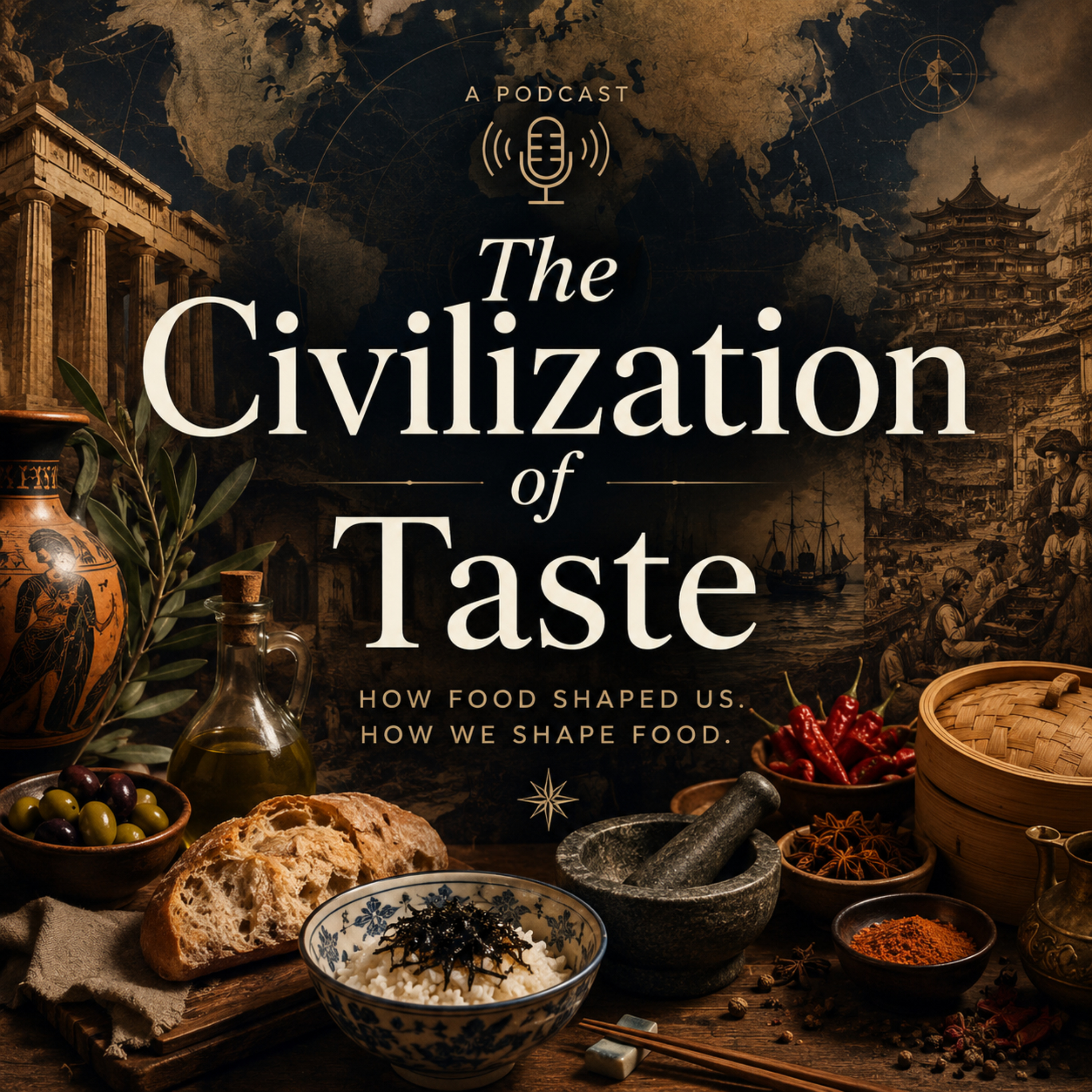
The Civilization of Taste
by Nemone AIM
The Civilization of Taste explores the intersection of food, culture, technology, and human civilization.Through stories of coffee, beer, bread, spices, sugar, fermentation, and global trade, we uncover how food has shaped societies, economies, and the human experience throughout history.A podcast for anyone interested in food history, gastronomy, cultural history, and the evolution of taste.https://www.youtube.com/@MatMatch | https://nemoneai.com | A fruitful use of your time
-
32
19. The Secret Map of Meat: How Kebab Conquered the World
Imagine a simple skewer of meat traveling thousands of miles, crossing imperial borders, and reinventing itself in every city it touches. In this episode of The History of Taste, we trace the fascinating 500-year journey of the Kebab—a dish that is much more than just grilled meat; it is a living map of human migration.We dive into how the Ottoman expansion spread this nomadic staple across continents, and how it evolved into distinct local legends:The Balkans: How the Ottoman skewer met Slavic traditions to create the finger-shaped, minced Cevapi.Iran: The art of precision in the Kubideh Kebab, where saffron and technique elevate simplicity to a spiritual level.The Levant: The birth of Shawarma, the ultimate street food designed for the fast-paced merchant hubs of the Mediterranean.Berlin: How 1970s Turkish immigrants transformed the traditional meal into a global fast-food icon, the Döner Kebab.Join us as we explore how food doesn't just move—it adapts, blends, and survives. Discover why eating a kebab is actually taking a bite out of world history.
-
31
18. A Universe in a Bowl: Why Jeonju is the World's Ultimate Gastronomy Capital
While San Sebastian turned gastronomy into a "lifestyle" and Bologna perfected it through "time," Jeonju, South Korea, speaks of "community" and "balance" through its food.Jeonju is more than just a city with delicious food. it is the place that defines the very standard of how Korean food should be prepared and enjoyed.Experience a city where the dignity of the Joseon Dynasty—the birthplace of the royal family—coexists with the scientific wisdom found in the everyday meals of its citizens.We explore the harmony of Bibimbap, where 30 different ingredients come together in perfect unity, and the practical brilliance of Bean Sprout Soup, a dish as scientifically sound as it is comforting.Discover the aesthetics of the "Han-sang" (Full Table Culture)—a symphony of fermentation, aging, and dozens of side dishes that create a perfect balance of flavor. This is where the true philosophy of Korean cuisine comes to life."The most local is the most global." We proudly present the flavors of Jeonju, a name etched firmly on the world’s culinary map.📌 Timestamps 00:00 Opening: Why Jeonju is the Capital of Korean Gastronomy 01:20 The Royal Table: The Heritage of Joseon and the Philosophy of Five Colors 03:40 The Art of Bibimbap: A Dish Completed by the Diner 06:30 Bean Sprout Soup: The Scientific Wisdom of the People's Food 10:00 The Science of "Han-sang": The Harmony of Contrast and Balance 12:30 The Power of Fermentation: Depth Created by Microbes and Time 14:00 Ending: Why Jeonju Stands as a Global Gastronomy Landmark3. Hashtags Jeonju,KFood,KoreanCuisine,Bibimbap,Gastronomy,UNESCOCityofGastronomy,KoreanFoodCulture,FoodPhilosophy,TravelKorea,HealthyEating,FermentedFood,HanSang
-
30
17. Why the Japanese retreat into narrow alleys after work: Shedding 'Tatemae' to find 'Honne'
[Intro] Imagine 9 PM on a Friday in Tokyo. A wave of grey and black suits pours out of Shinjuku Station. Tens of thousands of people move like a giant machine, but soon, this flow is sucked into narrow alleys lit by red lanterns. You smell charcoal and soy sauce. Inside, people sit alone at the counter, not talking to one another. Why has Japan developed such a sophisticated culture of drinking alone?[What’s in this audio] In this audio, we explore the 'Izakaya'—which has become a spiritual sanctuary for the Japanese beyond just being a pub.Izakaya as a 'Place to Be': We look into the etymology of Izakaya (居酒屋)—a place to "stay" rather than just a place to buy—and its historical roots in the Edo period.The Science of Umami: Why are the snacks so small? We share the secret of 'Umami synergy' that maximizes the flavor of alcohol and is optimized for solo dining.Shedding the Social Mask: Using the concepts of 'Tatemae' (social face) and 'Honne' (true heart), we analyze how Izakayas serve as a space for individuals to reset their energy.Aesthetics of Narrow Alleys: We discuss why tiny alleys like Shinjuku Golden Gai remain beloved, providing 'anonymity within the bustle'.From Nomikai to Hitori Nomi: We track the shift from forced company dinners (Nomikai) to the modern 'Hitori Nomi' (solo drinking) trend for self-recharge.[Outro] While Irish pubs exist for the community, Tokyo's Izakayas exist for the individual. Experience the art of being alone to live better together, and feel the 'Hodoyoi' (just right) temperature that Izakayas offer to the city of Tokyo.3. Search Keywords Izakaya, Japan Travel, Tokyo Food, Solo Drinking Culture, Hitori Nomi, Japanese Psychology, Tatemae, Honne, Shinjuku Golden Gai, Omoide Yokocho, Yakitori, Umami, Savory, Japanese Culture, Humanities Travel, City Read Through Taste, Japanese Pub, Edo Period History, Noren, Japanese Work Culture, Reset, Lonely City Dwellers, Tokyo Night, Alcohol Culture Comparison, Japanese Food Philosophy
-
29
16. The Secret Language of History’s Most Influential Tables
What if your dinner plate wasn't just about hunger, but about dominion? In this series, we explore how the world’s most powerful figures used food as a weapon of political theater. From Louis XIV, whose 'Grand Couvert' turned every meal into a public performance of absolute power, to Roman Emperors who signaled their control over the globe by dining on flamingo tongues and peacock brains. We dive into why Henry VIII’s massive physique was a deliberate symbol of abundance, and how Julius Caesar’s legendary restraint was actually a sophisticated show of self-mastery. Join us as we uncover how the 'language of the table' still shapes our modern obsession with social media food trends and celebrity diets today.
-
28
15. The Manhattan Trade: Why the Dutch Swapped New York for Nutmeg 🗽🌰
Imagine being offered a choice between a desolate, underdeveloped island and the exclusive rights to the world’s most expensive spice—a commodity worth its weight in gold. In the 17th century, the Dutch made their choice, and they didn’t choose the island we now call Manhattan.[Context] In this episode of The Flavor Thieves, we dive into the high-stakes world of the 17th-century spice trade. We explore how Nutmeg, now a common kitchen staple, was once a miraculous medicine believed to ward off the Black Death and a symbol of ultimate social status for European elites.[The Story] Discover the rise of the VOC (Dutch East India Company)—the world’s first "monster corporation" with its own army and the power to declare war. Learn about the brutal struggle for the Banda Islands and the tiny Island of Run, a speck of land that was once more valuable than the heart of modern capitalism.[The Climax] We break down the Treaty of Breda (1667), where the Dutch officially traded New Amsterdam (Manhattan) to the British in exchange for a monopoly on nutmeg. It was a perfectly rational decision at the time, but as history shows, value is a fleeting thing.[Closing] Join us as we trace the journey from a bloody monopoly in Indonesia to the skyscrapers of New York City. Because history isn't just about dates—it’s about the flavors that changed the world.
-
27
14. Why We Crave: The Evolution and Empire of Sugar
Ever wondered why there’s always room for dessert, even after a heavy meal? It’s not just a lack of willpower—it’s a survival signal from our ancestors roaming the savannah. In this episode of The Civilization of Taste, we dive into the epic and often dark history of sugar, the "white gold" that reshaped the world.[Key Highlights]The Power of Display: Discover why King Louis XIV used massive sugar sculptures at Versailles—not to eat, but as a bold declaration of absolute power.A Bitter Legacy: We trace the tragic connection between our craving for sweetness and the transatlantic slave trade, where millions of lives were sacrificed for the sake of European tea tables.Fueling the Revolution: Learn how sugar wasn't just a luxury but the literal fuel for the Industrial Revolution, keeping factory workers going with the quick energy of sweetened tea.A Tale of Two Worlds: Why are Western desserts so intensely sweet compared to the subtle flavors of the East? We explore how history and geography, rather than just preference, dictated the "standard" of sweetness.[Conclusion] From the dopamine circuits in our brains to the bloody history of Caribbean plantations, sugar is more than just a seasoning; it is a footprint of human desire, exploitation, and evolution. Join us as we uncover the story behind the white powder sitting on your kitchen table.[Tags] History of Sugar, Food History, Evolution of Taste, Dopamine and Sugar, Atlantic Slave Trade, Industrial Revolution, Louis XIV Versailles, Sidney Mintz, Sweetness Culture, Global History Podcast, Human Civilization, Culinary History, White Gold.
-
26
13. Choose K-Diet Over Mediterranean": Why Global Nutritionists are Eyeing the Korean Table (The Miracle of K-Diet)
For decades, the Mediterranean diet has reigned supreme as the world's healthiest way of eating. But recently, a powerful challenger has emerged to threaten its throne: the 'K-Diet' (Korean Diet). This isn't just about cultural pride—it's backed by rigorous science. Discover the incredible power of Korean food as proven by the prestigious journal Nutrients and international researchers!Key Highlights:Outperforming the Numbers: In clinical trials, the K-Diet showed a more dramatic reduction in total cholesterol and "bad" LDL cholesterol levels compared to a standard Western diet.The Secret Weapon, 'Fermentation': Beyond simple side dishes, the probiotics in Kimchi and fermented pastes (like Weissella and Coprococcus) fundamentally transform your gut environment and help prevent metabolic diseases.The Power of Gluten-Free: Did you know that the rice-based Korean diet can be more advantageous for digestive health and immunity than the whole wheat found in the Mediterranean diet?The Secret to the World's Longest Life Expectancy: With South Korea projected to have the longest life expectancy globally, the power of the 'K-Diet' is now being recognized as the ultimate longevity secret."Your everyday meal was actually the world's best medicine." Why not celebrate with a proud, healthy Korean meal tonight?#KDiet #KoreanFood #MediterraneanDiet #Superfood #FermentedFood #HealthyLifestyle #LongevitySecret #CholesterolControl
-
25
12. The Art of Controlled Decay: Why Time is the Secret Ingredient in Jamón Ibérico
What makes a single slice of ham worth hundreds of dollars? It’s not just meat; it’s a masterpiece sculpted by time, nature, and human history.In this episode, we journey into the heart of the Spanish Dehesa to uncover the secrets of Jamón Ibérico de Bellota. We explore the fascinating biochemistry of how a diet of acorns transforms pig fat into heart-healthy oleic acid, allowing it to literally melt on your tongue at body temperature.From its Roman origins as a survival food to its role as a symbol of religious identity during the Reconquista, we trace how this ham became the soul of Spanish culture,. We also reveal a surprising connection to Korea’s Gwamegi, discovering a universal human wisdom in the "art of controlled decay" and the power of natural aging.Join us as we go beyond the plate to understand the science, the ritual, and the 2,000-year legacy behind the world’s most expensive ham. Because when you understand the story, it tastes completely different.🔍 Search KeywordsJamón Ibérico, Spanish Food, Food Science, Culinary History, Gastronomy, Iberico Pig, Dehesa, Acorn-fed Ham, Oleic Acid, Food Documentary, Slow Food, Spanish Culture, Cured Meat, Artisanal Food, Umami, Food Philosophy, Aging Process, Gwamegi, Culinary Arts, Mediterranean Diet.
-
24
11. The "Real" Reason Southeast Asian Food is So Spicy and Intense (It's Not Just a Preference) 🌶️🍋
From your first bite of Pad Thai in Bangkok, Pho in Hanoi, or Laksa in Kuala Lumpur, the flavors are undeniably intense—a powerful strike of spicy, sour, and salty notes followed by pungent herbs. While we often assume this is simply a matter of "taste," the truth is far more fascinating: it was a matter of survival.With average temperatures between 25-30°C and humidity reaching 70-90%, Southeast Asia presents a "danger zone" where food can spoil in just hours. In the era before refrigeration, preventing the growth of deadly bacteria was a life-or-death struggle. The people of this region developed a brilliant strategy: using spices as antibacterial weapons and sourness as an environmental control.Compounds like allicin in garlic and capsaicin in chilies act as natural inhibitors against food poisoning. Similarly, the acidity from lime and tamarind creates a low-pH environment where bacteria cannot thrive. Unlike East Asia, which utilized the changing seasons for slow fermentation, the constant tropical heat of Southeast Asia required "intensity" for immediate food safety.This video explores how these bold flavors are actually a thousand-year-old wisdom of survival. Discover the incredible history and science behind the world's most addictive flavors!🔍 Search Keywords (Tags) Civilizational History of Taste, Southeast Asian Food, Pad Thai, Pho, Laksa, Spices, Antibacterial Properties, Food and Climate, Food Poisoning Prevention, Garlic Allicin, Chili Capsaicin, Lime, Tamarind, History of Food, Fermentation Culture, Survival Strategy, Culinary Explorationfrom NEMONE AIM
-
23
10. From Survival Fermentation to Global Gourmet | The Civilization of Taste: Eastern Europe
Winter in Eastern Europe is a brutal, frozen season lasting from November until as late as April—five long months of ice. In the days before refrigerators, failing to preserve the autumn harvest meant facing the very real threat of famine.In this audio, we dive into the secrets of "preservation" that allowed Eastern Europeans to survive extreme cold. We explore the fascinating science behind three core techniques: Salting, Fermentation, and Smoking/Drying, which halted decay and turned survival into an art form.We also share the incredible historical story of Sauerkraut (fermented cabbage) and its role in Captain James Cook's Pacific voyage during the 18th century. Learn how this humble dish's remarkable Vitamin C preservation saved entire crews from the deadly disease, scurvy.Discover how food originally designed to strip away moisture and ferment for survival evolved into a global gourmet sensation filled with deep umami. We also compare the climatic survival strategies of the world: Southeast Asia’s battle against the heat versus Eastern Europe’s war against the cold. Watch now to see how history, climate, and taste converge in every bite![Recommended Keywords for Search Optimization]Eastern Europe, Eastern European Food, Fermented Food, Food Preservation, Sauerkraut, Pickled Cabbage, Smoked Sausage, Kielbasa, History of Food, Food Civilization, World History, Scurvy, James Cook, Culinary Science, Survival Food, Gastronomy, European Cuisine, Umami, Food Documentaryfrom NEMONE AIM
-
22
9. Sliced in the Kitchen (East) vs. Cut at the Table (West)
Have you ever wondered why Western restaurants always set the table with a knife, while our tables only have spoons and chopsticks?In East Asia, meat is sliced into bite-sized pieces in the kitchen before it ever reaches the table. In contrast, European dining often features large cuts of meat served whole, requiring the diner to slice it themselves., This simple difference in "where the knife is placed" reveals a deep-seated history of resources, culture, and the fundamental philosophy of "who decides the final form of the meal."In this audio, we explore how the location of the knife—staying on the cutting board or moving to the dining table—completely transformed the culinary civilizations of the East and West!📌 Highlights🔥 3 Reasons why East Asia pre-cuts food: Efficiency with limited fuel (small pieces cook faster), the development of chopsticks, and the Confucian culture of hospitality where the chef prepares everything for the guest.,⚔️ The history of knives on European tables: From medieval knight culture, where knives were symbols of status and personal protection, to the tradition of large oven roasting that preserves juices in whole cuts.,🥩 How size changes the taste (The Science): The Maillard reaction and the difference between the uniform flavor of thinly sliced meat (Bulgogi) versus the temperature gradient of a thick steak.🤔 Who completes the dish?: Is it the "Harmony" finalized by the chef, or the "Individual Completion" performed by the guest at their own plate?,It’s not about which way is better—it’s about how they are beautifully different. Join us as we uncover the "Civilization of Taste" built through centuries of different tools and traditions!from NEMONE AIM
-
21
8. The Mystery of British Cuisine: How Fish and Chips Ruined (and Saved) British Food
The Betrayal of Fish and Chips: Iconic Symbol or Gastronomic Disaster?"The British Empire was created as a result of looking for better food than what was available in Britain."Have you heard this painful joke? It perfectly summarizes the global reputation of British cuisine. While Britain is a cultural powerhouse that produced Shakespeare and the Beatles, why does its food face such harsh criticism? Many experts look for answers in history, and at the center of this mystery lies Britain’s most iconic dish: Fish and Chips.🔥 The Birth and Historical Necessity (The Arrival of the 'Suspect')Fish and chips emerged in the 19th century, in the heart of the Industrial Revolution. For millions of workers living in urban poverty, food wasn't a luxury—it was "fuel" to keep them moving through 12-hour workdays. They needed something fast, cheap, and high in calories.The dish was born from a fateful encounter: 'Fried Fish' (Pescado Frito) brought by Jewish immigrants from Spain and Portugal, and 'Chips' made from the hardy potatoes that grew well in the British climate. In 1860, Joseph Malin, a Jewish immigrant in London, began selling them together, and a national staple was born. Thanks to the expanding railways and a mass supply of cheap vegetable oil, fish and chips shops, or 'Chippies,' soon filled the streets of Britain.❌ Accused of Sabotaging GastronomyIronically, the overwhelming popularity and affordability of fish and chips cast a shadow over British gastronomy. This addictive "fried and greasy" flavor profile became the standard for the British palate, leaving little room for more delicate or complex cuisines. Furthermore, when fish and chips was crowned a 'National Icon' in the 20th century, it overshadowed other traditional dishes, reinforcing the simple (and often negative) formula: 'British Food = Fish and Chips.'This dominance was possible because the foundation of British culinary culture was already fragile. The Puritan Revolution of the 17th century had labeled fine dining as a 'sin,' the upper class preferred French cuisine over their own, and the working class simply lacked the time to cook.🛡️ The Savior of a Hard-Pressed EraHowever, fish and chips was more than just a culinary 'traitor.' Author George Orwell once noted that such "cheap luxuries" might have actually prevented a revolution by providing comfort to the oppressed working class.During both World Wars, fish and chips was a 'strategic material' exempt from rationing to maintain national morale. Winston Churchill famously called it the 'Good Companions.' It was the "soul food" that sustained the belly and the spirit of the British people through their darkest hours.Ultimately, fish and chips carries a paradoxical destiny—it is both the 'betrayer' and the 'savior' of British cuisine.👇 Do you think Fish and Chips was a traitor to British gastronomy, or a hero that saved the era? Share your thoughts in the comments!from NEMONE AIM
-
20
7. The Breath of the Wok and the Soul of the Oven: A Tale of Two Fires
"Why does East Asia explode with heat while Europe waits for the simmer?"Join us in this episode of The Civilization of Taste as we explore how the simple act of controlling fire created two entirely different culinary worlds.We dive deep into the concept of "Open Fire" in East Asia—represented by the high-velocity, 300-degree heat of the Chinese wok and the elusive "Wok Hei" (breath of the wok). Contrast this with the "Closed Fire" of the European oven and heavy cast-iron pots, where heat is captured to transform tough ingredients into tender masterpieces over hours of patient waiting.Beyond the kitchen, we examine how these different approaches to heat influenced architecture, social communities, and even the way we sit around a dining table. From the Maillard reaction that sears a Korean BBQ to the slow collagen-to-gelatin transformation in a French Boeuf Bourguignon, discover the fascinating intersection of science, culture, and history.Is fire a tool to preserve the essence of an ingredient, or a medium to transform it into something new? Tune in to find out how the speed of fire defines the rhythm of our livesfrom NEMONE AIM
-
19
6. A Masterpiece Crafted by Wind and Soil: Why You Must Experience Jeju Black Pork on the Island
"Why does Jeju Black Pork taste so exceptionally savory and deep?"It’s not just a feeling. The island of Jeju itself created this difference. The unique volcanic soil formed 1.8 million years ago, the sea breezes that never stop blowing, and the centuries-old traditional farming philosophy known as 'Tongsi' have all shaped the genetic blueprint of this pig.In this audio, we explore the science and humanities hidden behind the flavor of Jeju Black Pork:✅ The Science of Fat: Why doesn't black pork fat feel greasy? The secret lies in its high 'Oleic Acid' content—the same main component found in olive oil.✅ The Taste of Time: Why Black Pigs, which grow twice as slowly as regular white pigs, possess a much denser and superior muscle texture.✅ Terroir (The Taste of Place): Why the unique flavor of Jeju can never be replicated elsewhere, even with the same breed,.✅ The Aesthetics of Cooking: The absolute trust in the ingredient that requires nothing more than fire and salt.To eat food is to consume the place and time from which it came. We invite you to the world of Jeju Black Pork—the finest ingredient crafted by the island of Jeju over a long period of time.#JejuBlackPork #FoodHumanities #CivilizationOfTaste #Terroir #MaillardReaction #JejuFoodfrom NEMONE AIM
-
18
5. Butter for the West, Oil for the East? The Millennia-old Secret in Your Kitchen
When you turn on your stove, do you reach for the cooking oil or grab a stick of butter from the fridge? This simple, everyday choice actually hides the history of land, climate, and agriculture that each continent has experienced over thousands of years.In a Cantonese kitchen, chefs pour vegetable oil with a high smoke point into a wok heated to over 200°C, creating an explosive Maillard reaction known as "Wok Hei" (breath of the wok) in just 30 seconds,. Meanwhile, in a French kitchen, chefs use a technique called "mijoter" (simmering), slowly melting butter over low heat to create a delicate nutty aroma (beurre noisette) and smooth emulsified sauces.Why did East Asia choose high-heat vegetable oil, while Europe favored low-heat animal butter? The answer lies in the "fields," not just the kitchen. In East Asia, high population density necessitated intensive agriculture where land was used to grow protein-and-oil-rich soybeans rather than raising large herds of cattle. Conversely, Europe’s cool, damp climate was perfect for vast pastures, leading to a thriving dairy culture where butter became a vital, high-calorie energy source.The difference in fat wasn't a matter of wisdom, but a matter of the land. Each culture made the most rational choice to create the most delicious food with what they had. Join us as we explore the fascinating history of taste and human ingenuity!👉 Coming Next: The same wheat, but two different worlds. Why did China make noodles while France baked baguettes? We explore how the presence of an oven split the staple food cultures of East and West!from NEMONE AIM
-
17
4. You thought it was just Turkish? The shocking reason why Kebabs are found everywhere in the world 🥙
From the narrow alleys of Istanbul and late-night stalls in Berlin to riverside spots in Cairo and food trucks in the heart of Seoul—wherever you go, you can smell the irresistible scent of meat roasting over fire.While many associate kebabs solely with Türkiye, they exist in diverse forms across continents: 'Koobideh' in Iran, 'Cevapi' in the Balkans, and even 'Chicken Tikka Masala' in the UK. How did this single dish manage to take root in so many distant cultures?The secret lies in the "non-stop life" of nomads who roamed the vast steppes of Central Asia thousands of years ago. For them, survival meant constant movement, which fundamentally changed how they cooked. They needed a method that required no heavy pots, minimal water, and very little fuel.In today’s episode of The History of Taste, we track the incredible journey of how this practical survival food spread across the globe following human migration. We also explore how it evolved into a sophisticated imperial cuisine within the grand courts of the Ottoman Empire.If you enjoyed this journey through history, please Subscribe and Like! In our next episode, we’ll dive deeper into how the Ottoman Empire transformed this simple tool for survival into a refined language of gastronomy.[⏳ Timeline] 00:00 From Istanbul to Seoul: The scent that captivated the world 02:00 Are kebabs only Turkish? (From Iran and the Balkans to the UK) 04:30 A dish born from the restless life of Central Asian nomads 07:30 No kitchen required! The power of simplicity: Skewers and Fire 10:00 Crossing continents: The history of migration and the spread of kebabs 12:30 From a survival tool to the magnificent court cuisine of the Ottoman Empire 14:00 The real reason kebabs became a universal human foodfrom NEMONE AIM
-
16
3. The Hidden Philosophy of Greek Food: Why "Balance" Beats "Flavor"
The "Mediterranean Diet" is prescribed by doctors and praised by nutritionists worldwide. But when you look at the heart of it—Greek food—it’s surprisingly humble, even "plain." While Italian food is intense and Turkish food is rich, Greek food remains rustic and simple. Why did one of the world's oldest civilizations leave behind such a modest table?In this audio, we go beyond simple recipes to explore the fascinating humanities and history behind the Greek plate:Built on Scarcity: How a mountainous land with no plains forced Greeks to turn scarcity into health.The Miracle of Olive Oil: Why liquid gold was more than just an ingredient—it was a survival tool and a natural preservative.The Philosophy of 'Metron': How the ancient Greek concept of "moderation" defined the balance of their flavors.The Crossroads of Empires: The 400-year influence of the Ottoman Empire that blurred the lines between Greek and Turkish cuisine.The Philoxenia Spirit: Why Greek food is designed to be eaten slowly, turning a meal into a bridge between strangers.Greek food isn't about adding more; it's about finding the perfect balance with exactly what is needed. Discover why this "poverty diet" survived for thousands of years to become the gold standard of modern health.from NEMONE AIM
-
15
2. From "Trash" to "Truffle": How Animal Intestines Became the World's Finest Delicacies (feat. Gopchang, Tacos, Andouillette)
Imagine the savory aroma of Gopchang in Seoul, the pungent scent of Andouillette in Paris, and the crispy Tacos de Tripa in Mexico City. Though these three dishes seem worlds apart, they share a single historical starting point: "We ate them because we couldn't afford to waste them."Intestines are one of the most difficult ingredients to handle—they spoil rapidly and possess an overwhelming odor. However, humanity did not give up. Instead, different civilizations developed brilliant and creative solutions tailored to their specific environments and cultures:East Asia: 'Removal' – Using garlic, ginger, and soybean paste to wash and boil away the smell.Europe: 'Enhancement' – Adding herbs, spices, and fermentation to layer and reinterpret the natural scent.Mexico: 'Reprocessing' – Utilizing intense heat to sear the meat and lime to add acidity, creating entirely new textures.Southeast Asia: 'Mixing' – Blending the scent with lemongrass, coconut milk, and star anise to make it part of a complex aromatic profile.This audio explores the "Civilization History of Offal," tracking its journey from a survival food of the lower classes to a masterpiece of sophisticated culinary technique celebrated by top chefs today. Discover the incredible human creativity hidden behind the smell of food and how a biological byproduct became a symbol of authentic heritage!from NEMONE AIM
-
14
1. Why Humans Started Eating Pain — Civilizational History of Taste: The Spiciness Edition
Why do we seek out spicy food despite the sweat and tears? We even pay extra to make our dishes even hotter.In fact, spiciness is not a flavor that the human tongue can perceive. Capsaicin in chili peppers binds to pain receptors (TRPV1) in the mouth, tricking the brain into receiving signals akin to being on fire. Yet, the reason we crave it is that the brain releases endorphins—natural painkillers—to soothe the perceived pain, creating a sense of pleasure. Evolutionary biology calls this phenomenon of enjoying pain in a safe environment "Benign Masochism".Since the Columbian Exchange in 1492, chili peppers from the Americas have spread across the globe. Interestingly, the same chili pepper evolved into five distinct "philosophies of spiciness" based on the climate and survival needs of each region.🇰🇷 Korea (Fermentation): A deep, complex spiciness aged over time to endure long winters.🇨🇳 Sichuan, China (Numbing): "Mala" spiciness that combines with Sichuan pepper (Huajiao) to deconstruct the senses and combat humid climates.🇹🇭 Southeast Asia (Multilayered Balance): A spiciness that prevents food spoilage in hot weather and balances with sour and sweet notes.🇮🇳 India (Design): A medicinal spiciness combined with various spices based on thousands of years of Ayurvedic tradition.🇲🇽 Mexico (Understanding the Material): A spiciness that approaches the pepper itself as a core ingredient, varying flavors based on treatment methods.The next time you face a spicy dish, take a moment to ask: what kind of "pain" is this, and what land and reasons gave birth to it?⏱️ Timeline 00:00 Opening: Why do we pay to eat pain? 02:00 Spiciness is a "burn," not a taste 04:30 Capsaicin tricks the brain: Benign Masochism 07:00 Chili peppers, mistaken for black pepper, take over the world 09:00 The same pepper, five completely different philosophies 12:30 Food differences are about survival, not superiorityfrom NEMONE AIM
We're indexing this podcast's transcripts for the first time — this can take a minute or two. We'll show results as soon as they're ready.
No matches for "" in this podcast's transcripts.
No topics indexed yet for this podcast.
Loading reviews...
ABOUT THIS SHOW
The Civilization of Taste explores the intersection of food, culture, technology, and human civilization.Through stories of coffee, beer, bread, spices, sugar, fermentation, and global trade, we uncover how food has shaped societies, economies, and the human experience throughout history.A podcast for anyone interested in food history, gastronomy, cultural history, and the evolution of taste.https://www.youtube.com/@MatMatch | https://nemoneai.com | A fruitful use of your time
HOSTED BY
Nemone AIM
CATEGORIES
Loading similar podcasts...
Frequently Asked Questions
How many episodes does The Civilization of Taste have?
The Civilization of Taste currently has 19 episodes available on PodParley. New episodes are automatically indexed when they're published to the podcast feed.
What is The Civilization of Taste about?
The Civilization of Taste explores the intersection of food, culture, technology, and human civilization.Through stories of coffee, beer, bread, spices, sugar, fermentation, and global trade, we uncover how food has shaped societies, economies, and the human experience throughout history.A podcast...
How often does The Civilization of Taste release new episodes?
The Civilization of Taste has 19 episodes. Check the episode list to see recent publication dates and frequency.
Where can I listen to The Civilization of Taste?
You can listen to The Civilization of Taste on PodParley by clicking any episode. We provide an embedded audio player for direct listening, and you can also subscribe via your preferred podcast app using the RSS feed.
Who hosts The Civilization of Taste?
The Civilization of Taste is created and hosted by Nemone AIM.
URL copied to clipboard!