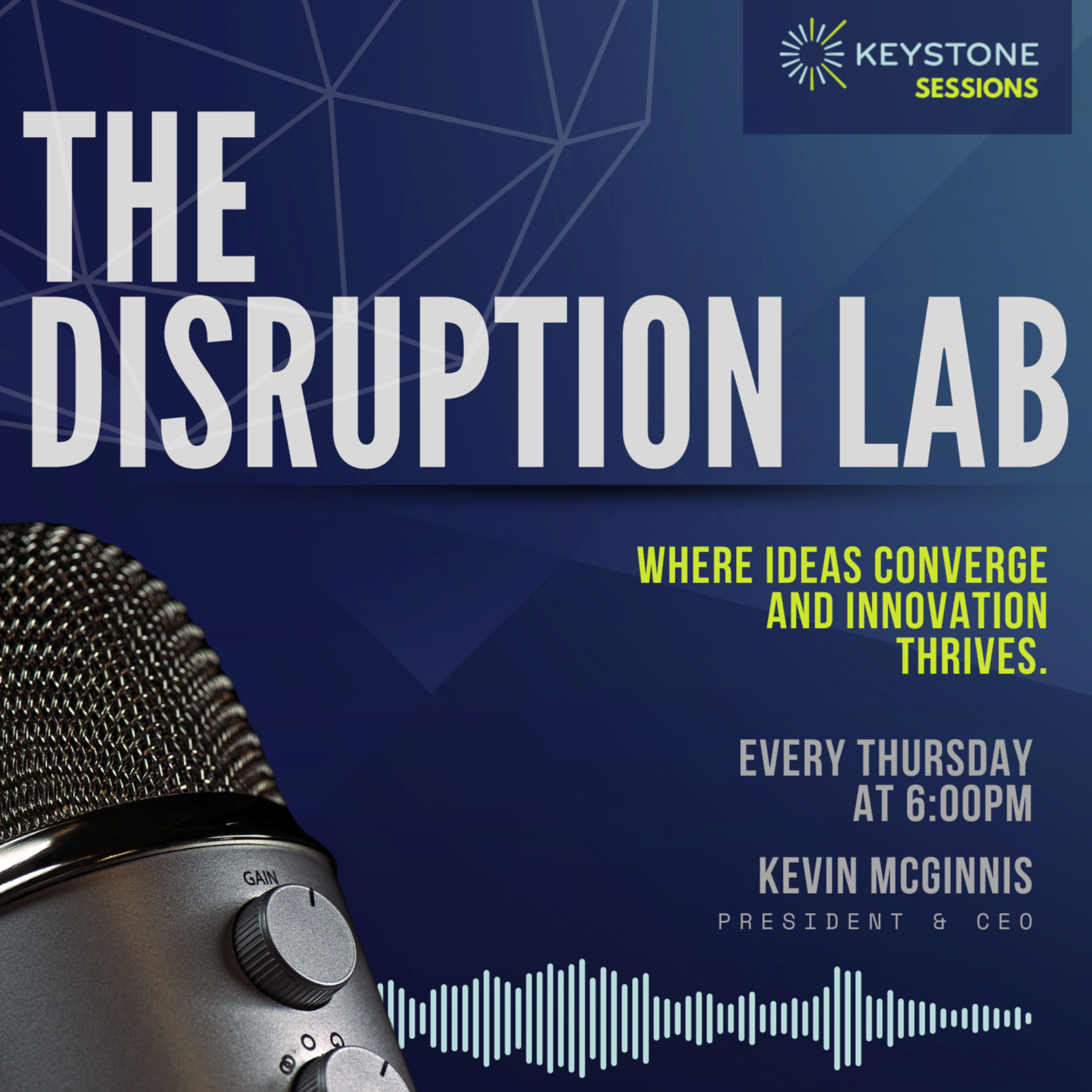
The Disruption Lab podcast artwork

PODCAST · society

The Disruption Lab

Step into the world of innovation with The Disruption Lab live podcast, where groundbreaking ideas and strategic insights come to life. Hosted by Kevin McGinnis and filmed in front of a live studio audience at Keystone Sessions, each episode brings you face-to-face with the visionaries reshaping industries and pioneering new paths in entrepreneurship.Whether you’re an entrepreneur, innovator, or professional eager to fuel your growth and unlock strategic collaboration, The Disruption Lab delivers the tools, stories, and wisdom from top industry disruptors and founders. Join us as we explore the minds of industry leaders to inspire and equip the next wave of disruptors.

Publisher-supplied feed metadata · PodParley refreshed Jun 13, 2026 · Source feed

  1. 70

    How Kansas City Won a World Cup It Wasn't Supposed to Get

    Kansas City is the 33rd-largest metro area in America. It was competing against host cities ranked in the top fifteen nationally and it won anyway. Then FIFA told them they had redefined what a host city does. Cliff Illig, co-founder of Cerner and majority owner of Sporting Kansas City, explains how a decade of deliberate infrastructure investment, not luck, turned Kansas City into a World Cup host. He breaks down the difference between hosting a moment and building sustained economic advantage, why design intentionality shaped everything from stadium architecture to fan experience, and what comes next for a city that no longer has to prove it belongs.

  2. 69

    The New Geography of Growth

    Every era of economic growth organized around a connectivity infrastructure — water, rail, air, compute. The cities at the nodes captured generational value. Data centers are the ports of the AI economy. And in Kansas City, the infrastructure is not arriving — it has already landed ($11B+ announced from Google alone, Meta operating, the KC Star press building becoming a 100MW AI facility). The question is design, not attraction. The smartest regions solve the problems the infrastructure creates — and export the solutions.

  3. 68

    The Labor Shortage Is a Lie: How Two Immigrant Founders Built a 96% Retention Company

    Reda came to Kansas City from Egypt with almost no English and a fear of heights and took a roofing job anyway. Elvis, a Nigerian immigrant and former R&D chemist, walked away from a corporate career to join him. Together they built what is now Amina Design Build (formerly RK Contractors), a construction company where 81% of the workforce is immigrants, refugees, and second-chance citizens and where retention sits at 96%, an almost unheard-of number in the industry. In this episode of the Social Venture Studio Founder Series, Reda and Elvis unpack the difference between "giving access" and actually powering people: interest-free car loans, same-day emergency support, English lessons on the clock, and a wage ladder that's taken workers from $14.84 to $25 an hour. They also dig into Reda's next invention: a construction material made from recycled plastic, and what it means to build a company on trust instead of contracts, then have to learn contracts anyway.

  4. 67

    She Ran a $14M Beauty Department, Then Watched It Shut Black Founders Out

    Montré Moore spent years managing a $14 million prestige cosmetics department at Neiman Marcus watching brand founders get shut out by red tape, gatekeeping, and unspoken rules about who gets shelf space. Then a night out in downtown LA, searching for a single hair product she couldn't find within 45 minutes of a major metro area, became the moment that changed everything. That search became AMP Beauty, a platform working to democratize retail access for underrepresented beauty founders. What started as a marketplace and evolved into something more fundamental: a data and technology company that tells brands exactly what "retail-ready" means, and gets them there. In this conversation, Montré breaks down what it actually costs to launch a beauty brand, why chemical safety is a structural issue and not a marketing choice, the pivot that 6X'd AMP's revenue, and why she chose Kansas City, not LA, as the next chapter of AMP's growth. This is a story about access, infrastructure, and what it takes to change who gets to be seen on the shelf.

  5. 66

    You Can't Eat IRR: Why Venture Capital's Economics Are Broken

    Venture capital loves to talk about returns, but what happens when the returns stop coming? Johnny, a venture investor who has deployed capital inside a $20 billion corporate fund, a top-quartile independent fund, and now a first-time fund backed by a $500 million Kansas City real estate platform, has seen the industry from every angle. And he's not afraid to say the quiet part out loud: many fund vintages aren't returning capital to their investors, and "you can't eat IRR." In this conversation, Johnny breaks down why he's betting on pre-seed startups instead of chasing the mega-rounds making headlines, how AI is compressing the cost and time it takes to build a company, and why he thinks the venture industry's own structure: more funds, more capital, more competition, may be working against it. He also gets candid about what founders get wrong when raising money, why rejection from an investor is rarely personal, and why "not all money is good money." This episode blends hard-won portfolio strategy with a bigger question about what's broken in how startups get funded and what a more grounded, founder-first model could look like, built not from Silicon Valley, but from Kansas City.

  6. 65

    She Grew Up Homeless in Lykins. Now She's Building Homes There

    Rosana grew up in Kansas City's Lykins neighborhood, where she experienced housing insecurity as a single mother working double shifts to keep her kids afloat. Today, she's going back to that same neighborhood, this time to build on it. Through her nonprofit Embrace Your Shine and its development arm, Micro Living Midwest, she's converting shipping containers into affordable housing for young adults, those couch-surfing, living in cars, or in storage units while working or in school facing "hidden homelessness". In this conversation, she opens up about blowing up her finances as a day trader, the accidental path into real estate development, securing project-based vouchers with the Housing Authority of Kansas City, and why she's building toward 500 homes in the next decade. It's a conversation about lived experience becoming infrastructure and what it takes to convince a system built for scale to make room for community.

  7. 64

    Easy To Work With

    The difference between having standards and settling. Ecosystem building looks like collaboration from the outside everyone aligned, everyone winning together. This episode is about the part nobody discusses.

  8. 63

    How One Attorney Turned a Broken Divorce System Into an Operating System for Families

    Trina spent nearly two decades as a foster care social worker, then an attorney, watching families get "finalized" by the court system and then abandoned to figure out co-parenting alone. So she built BEH2O: an operating system for divorced families, borrowed straight from entrepreneurship frameworks like EOS. Then she went further, training an AI on her own decision-making process to build BeAligned Pro. This conversation is about more than a startup. It's about funding a nonprofit through years of legal-practice debt, getting turned down by the same accelerator three times before getting in, and the moment a dying father and a grieving mother finally saw each other in her office because the system gave them no other way to.

  9. 62

    The Chemical Keeping Your Fridge Cold Just Got Banned; Here's What Happens Next

    There's a chemical in nearly every building, car, and grocery store in America and the world just agreed to phase it out. On this episode of The Disruption Lab, host Kevin McGinnis sits down with Tony and Casey from EARTH, an NSF Engineering Research Center led by the University of Kansas, to unpack the massive, mostly invisible transition happening in refrigerants and cooling technology. They dig into why 90% of refrigerants leak into the atmosphere, why the industry is racing toward a 2029 supply cliff, and why captured refrigerant has become one of the most smuggled substances in the country. Along the way, Tony and Casey explain how a consortium of universities and industry giants like Chemours, Carrier, and Trane are working to close the gap between lab discovery and market impact, and what it will actually cost consumers when their AC breaks down. It's a conversation about climate policy, supply chains, and innovation infrastructure hiding in plain sight.

  10. 61

    The Judge and the Data Scientist Rebuilding Justice From the Inside

    Courtney hears 200 domestic violence cases a day. She has six months to work with, structurally, the maximum sentence her municipal court can impose, and she's spent over a decade building intervention programs, wellness courts, and a first-of-its-kind Fathers for Change program inside that constraint. Then she co-founded a startup with a data scientist. Thaddeus built data systems at Amazon, Cerner, and CVS Health before joining Courtney to build MAGIS: a platform combining speech recognition, AI analysis, outcome tracking, and grant management for courts. In this episode of The Disruption Lab, part of the Social Venture Studio Founder Series, Kevin McGinnis talks with Courtney and Thaddeus about what it takes to build technology inside one of the most cautious, high-stakes systems in the country: the courts. They dig into racial bias in AI risk-assessment tools, what it actually means to sell software to a judge, and what changes for the person standing in front of the bench when the system finally has the data to see them. This is a conversation about power, trust, and what happens when the people inside a system decide to rebuild it from within.

  11. 60

    85% Want Help. 5% Get It. This Founder Duo Is Closing the Gap.

    Brandon has survived 12 strokes. Lindsay has been his care partner for 15 years. Together, they're the founders of Beyond This — a company that didn't exist 90 days ago and is already reshaping how the healthcare system handles disability, intimacy, and relationships. In this episode of the Social Venture Studio Founder series, Kevin McGinnis talks with Brandon and Lindsay about losing and rebuilding identity, the five years it took Brandon to hug his wife again, and a staggering gap in care: 85% of people leaving therapy want help with relationships or sexual health, but only 5% ever get it from a therapist. Between 60 and 80% of relationships don't survive a disability. Beyond This is built to change that math — using a workbook, a certification model, and a metaphor framework called "Levels of Spice" to help couples rebuild connection after a life-altering injury. This is a conversation about grief, love, co-founding with your spouse, and building something that found you before you found it.

  12. 59

    11 Years and Counting: The Creative Chief Who Outlasted His Own Rule

    After building some of advertising's most iconic campaigns — Sonic's "two guys," Southwest's "Now Free to Move" — Brian walked away from agency life to become the client. Eleven years later, he's still there, having built Garmin's 110-person in-house creative team from the ground up inside a famously engineering-led company. This conversation goes past the campaign highlight reel into the real tension of in-housing: how to stay creatively hungry without an agency's survival pressure, how to earn trust from an organization that didn't believe in emotional storytelling, and why "thank you, Ecuador" became his go-to line for managing feedback from 20 people on a call. Brian also gets candid about AI's place in creative work, why authenticity is non-negotiable at Garmin, and the simple magazine flip-through that led to one of his favorite campaigns. A rare inside look at what it actually takes to build — and defend — a creative culture inside a product company.

  13. 58

    From Haute Couture to Kombucha: How One Founder Is Growing the Future of Fashion

    Nadia trained in haute couture at the Paris American Academy, the kind of centuries-old, precision-driven craftsmanship the fashion world has run on for generations. Then she came home and started growing textiles out of algae and kombucha. On this episode of The Disruption Lab, host Kevin McGinnis talks with the founder of Biospoke about the unlikely path from traditional tailoring to biomaterial innovation, and what it actually takes to build a company at the intersection of science, sustainability, and craft. Nadia opens up about teaching herself through YouTube and late nights of trial and error, the greenwashing she sees plaguing the sustainable fashion industry, and why she believes changing consumer mindset matters more than shaming fast fashion. She also shares the reality of running three ventures as a solo founder: Biospoke, community workshops, and Lumo, a mapping app for textile waste, while relocating her business to a brand-new city. A conversation about material, mission, and what it means to build something the industry hasn't figured out how to scale yet.

  14. 57

    The Innovation Nobody Can Measure

    Why do the most promising innovation programs inside big companies keep getting killed — even when they're working? Host Kevin McGinnis shares the story of Hack Friday, a hackathon program he helped build inside Sprint that grew in popularity month after month, only to be shut down for not producing a "shippable" solution fast enough. In this solo episode, Kevin argues that story isn't unique — it's a symptom of how corporations structure innovation itself. He draws on research from sociologist Ronald Burt, author Frans Johansson, and the economic concept of absorptive capacity to explain why proximity to new ideas, not a defined ROI, is what actually drives breakthroughs. He closes with four practical shifts leaders can make to protect innovation from getting measured to death before it has a chance to compound. A candid, research-backed look at why innovation keeps getting killed for the wrong reasons — and what to do instead.

  15. 56

    The Logistics Hub Hiding in Plain Sight: How Kansas City Quietly Powers America

    Most people hear "Kansas City" and think warehouses and highways. That's about 10% of the real story. In this episode, Kevin sits down with Chris Gutierrez, President of KC SmartPort, who has spent 23 years building the case for why Kansas City is one of the most strategically positioned regions in North America — five Class I railroads, all four modes of freight transportation, and the only single-line railroad connecting Canada to Mexico, running straight through downtown. They dig into how the CPKC merger reshaped the region overnight, why foreign trade zones are quietly driving billions in trade, and how nearshoring is pulling manufacturing back from overseas. But the conversation goes deeper than logistics — into automation, robotics, and the AI-driven data center boom creating an entirely new category of jobs nobody's training for yet. This is a story about infrastructure, yes. But it's really a story about what gets built when a region stops waiting to be noticed.

  16. 55

    AI Broke the Grid; Nuclear Is How We Fix It

    Everyone keeps saying nuclear is "having a moment." But Kevin McGinnis has heard that before — and this time, the pressure isn't coming from where you'd expect. In this live taping of The Disruption Lab, Kevin sits down with Jason Pottorff of Deep Fission, the company drilling reactors a mile underground outside Parsons, Kansas, and Dr. Amir Bahadori, who rebuilt Kansas State's nuclear engineering program from a handful of students into one of the fastest-growing programs in the country. Together they unpack what's actually different this time: the staggering electricity demand created by AI and data centers, a workforce gap that requires tripling the entire sector by 2050, and a public-trust problem that decades of safety still haven't solved. Jason explains why putting a small reactor under a mile of water makes a meltdown nearly impossible — and why "innovation, not invention" is the real strategy. Amir makes the case that the hardest engineering problem in nuclear isn't technical at all. It's communication. This is a conversation about systems change: how a 70-year-old technology gets a second chance, what an emerging "nuclear corridor" across Kansas and Missouri could mean, and the one thing both guests admit could send the whole industry backward overnight.

  17. 54

    Designed, Not Counted

    What if the thing everyone agrees we need more of is the thing that matters least? In this solo episode of The Disruption Lab, host Kevin McGinnis turns a critical eye on his own field — the world of innovation economies and entrepreneurial ecosystems. The diagnosis is always the same: more programming, more access, more capital. Kevin argues we've been measuring the wrong thing almost entirely. The companies that actually reshape a region were mostly built before they ever reached a program — outside of it, or beneath what we bother to count. Which raises a harder question than anyone usually asks: does any of it cause the outcome, or does it simply select the companies that were going to win anyway, then stand close enough to take the credit? This is a clear-eyed reckoning with selection versus causation — and what an honest scoreboard would actually have to measure. Growth, Kevin believes, is designed, not accidental. But design is not the same as counting.

  18. 53

    Ideas Are Cheap; This Is What Actually Builds a City

    Jeff spent fifteen years inside one of America's most celebrated startup ecosystems. Then he left Austin for Kansas City — to run a program handing out $20,000 grants. On paper, a step back. In practice, a bet on a different way of building. In this live taping of The Disruption Lab, host Kevin McGinnis sits down with the new steward of Digital Sandbox KC — the 13-year-old program that's turned early proof-of-concept funding into more than $243 million in follow-on capital. They trace an unlikely path: a 4,500-mile charity bike ride from Texas to Alaska, building cancer-care software at Epic, founding companies of his own, and arriving at a conviction that the coasts don't own the blueprint for innovation. The conversation moves from the culture of how cities build, to what actually separates fundable founders from everyone else, to why deep domain expertise is quietly overtaking raw technical skill in the age of AI. It's a clear-eyed look at community, capital, and the systems that decide whose ideas get built — and whose don't. Society. Business. Technology. One founder rethinking where the next wave of companies gets made.

  19. 52

    Doing Well by Doing Good: The Lesson That Took 15 Years to Land

    This is a different kind of episode. Every solo I've done has been about a framework — a thesis, a system, an argument. This one is about a person. Dan Hesse was my CEO at Sprint and became my mentor. He taught me that business and community are not separate things. I understood it as a value. It took me fifteen years to understand it as a design principle. This is the story of what I watched Dan build, what happened when it was taken away, and how losing it shaped everything I'm building now — from Keystone to the Social Venture Studio. The written version lives in my Field Note on Substack. https://substack.com/@kevinmcginnis101/note/p-199455241?utm_source=notes-share-action&r=539sc6

  20. 51

    The Kids Who Never Got to Practice: How VR Is Teaching Social Skills Schools Forgot to Teach

    For decades, social skills training in schools meant one thing: a teacher singling out a student in front of their peers to practice something they don't yet know how to do. Dr. Amber Rowland spent over a decade building a better answer. VOISS — a virtual reality and simulation platform developed at the University of Kansas — gives students with autism and social-emotional learning needs a private, low-stakes space to practice the skills that determine whether they'll get a job, keep a relationship, and navigate the world. No audience. No humiliation. Just repetition, confidence, and data. In this episode, host Kevin McGinnis sits down with Dr. Rowland and co-founder Paul Epp to explore what happens when a decade of peer-reviewed research collides with the brutal realities of commercialization — ed-tech procurement cycles, university IP licensing, the race against a ticking tech-transfer clock, and the challenge of turning $11-in-savings-per-dollar outcomes into a business that can actually scale. This is a conversation about dignity, systems change, and what it really takes to get life-changing research out of the lab and into the hands of the kids who need it most.

  21. 50

    The Hidden Influencers: What Analysts Know, What AI Just Changed, and What It Really Costs to Build Something Worth Stepping Away From

    Andrew Hsu spent more than a decade building Spotlight, a market intelligence and analyst relations firm that helped some of the most recognized names in enterprise technology figure out how to be understood, not just seen, in the markets they were trying to shape. But this conversation isn't about the company. It's about the systems behind the company: the hidden infrastructure of industry analysts who quietly dictate which technologies win, how AI is rewriting the rules of market influence in real time, and what it costs, personally and strategically, to build something worth stepping away from. Andrew and host Kevin McGinnis dig into why the most dangerous thing a founder can do is get distracted, what the correlation between your Glassdoor score and your stock price tells us about leadership, and why the 50-year-old version of Andrew understands something the 32-year-old version refused to believe: that listening is a strategy, not a weakness. This episode is for founders, operators, and anyone who has ever wondered who actually shapes what the market believes and whether that system is about to change forever.

  22. 49

    The Corporate Antibody: How Big Companies Kill Innovation (And What Actually Works)

    Every Fortune 500 company says they want to work with startups. Almost none of them actually can. The problem isn't intention. It's infrastructure. When a corporation scales, it builds immune systems—legal, compliance, IT, procurement—designed to protect the core business. Those same systems treat startups like viruses. A startup can build a prototype in the time it takes a corporation to schedule the meeting to discuss building one. The corporate entry point is procurement. The startup's frame is survival. The risk profiles don't align. The cadences don't match. And after 25 years of watching this pattern repeat, the infrastructure to make it work simply doesn't exist. Until now. In this episode, Kevin McGinnis sits down with a corporate innovation veteran who spent years inside Sprint driving open innovation strategy, building accelerator programs, and watching promising startup relationships die in legal review. But more importantly: he's spent the last several years designing the actual infrastructure that makes corporate-startup alignment work at scale. He reveals why "sponsored happy hours" and "innovation challenges" fail. Why the entry point matters more than the intention. And why one structural change—a reverse pitch, where corporations bring real problems instead of startups pitching solutions—completely transforms engagement from transactional to transformational. This is systems design thinking applied to one of the region's biggest untapped opportunities: corporations and startups learning to work together.

  23. 48

    The Quiet Revolution: Why Animal Health Is America's Overlooked Superpower

    Most people don't realize that the food on their table and the medicine keeping their pets alive flow through a system few understand. Kim Young, President of KC Animal Health Corridor, has spent 15 years at the center of that system building Kansas City's Animal Health Corridor into a $90 billion global industry hub while the rest of America wasn't looking. Animal health isn't about farmers or veterinarians. It's about infrastructure, capital allocation, regulatory strategy, and how disruption actually spreads through systems that have existed for over a century. It's about innovation that touches AI, biotech, satellite technology, and protein security—all while competing against a region obsessed with whatever's shiny and new. In this episode, Kim reveals why the most sophisticated biotech companies in America are clustering in Kansas City—not Silicon Valley. She explains the consolidation reshaping the industry, the venture capital blind spot that's leaving early-stage founders underfunded, and why the next generation of talent doesn't want to work in animal health because no one's told them it exists. But more importantly: she makes the case for why Kansas City's greatest economic advantage isn't what we're chasing—it's what we're taking for granted.

  24. 47

    The Growth That Counts

    Why high-growth entrepreneurship is a different kind of economic infrastructure — and why most regions don’t have a strategy for it. I recently published an essay arguing that every startup is a headquarters. The data behind that claim is compelling — young firms create virtually all net new jobs, innovation-economy wages run double the national median, and every one of those jobs generates five more in the surrounding community. But data doesn’t tell you what the distinction between high-growth and small business entrepreneurship actually feels like from inside an ecosystem. This episode goes deeper into the pattern I keep seeing: we talk about entrepreneurship as one thing, fund it as one thing, and measure it as one thing. It isn’t. And until we design for the difference, we’ll keep underbuilding the part that drives regional economies.

  25. 46

    They Were Wrong by 50% Every Time — Inside the Invisible Crisis Running America's Food Supply Chain

    Across agriculture, mining, and construction, billion-dollar supply chains still run on a phone call and a guess. Someone walks outside, eyeballs a pile of feed, and tells the truck dispatcher what they think is left. They're wrong by 30 to 50 percent — and that error ripples into spoiled inventory, empty feedlots, and hundreds of thousands of dollars in losses. Warren Wang and his co-founder Cole built Rebulk to fix that. Using lidar, computer vision, and edge-connected hardware, they're giving operators real-time inventory visibility for bulk materials that have never fit inside a barcode or a box. Their first proof of concept? Packing peanuts from Office Depot dumped on the ground. In this episode, host Kevin McGinnis sits down with Warren to trace the arc from a failed social media transcription startup to a Y Combinator-backed company with Cargill as a pilot customer — all while raising their pre-seed entirely from Kansas City investors. Warren opens up about the identity crisis that nearly derailed the pivot, what it took to build trust inside a tech-skeptical industry, and why he and Cole chose to come back to the Midwest instead of staying in San Francisco. Recorded on the same day Warren became a U.S. citizen, this conversation is about more than supply chain software. It's about conviction, belonging, and building something generational.

  26. 45

    From the Capitol to the Startup: Why a State Senator Quit Politics to Fund Founders

    Travis Fitzwater spent 12 years in the Missouri legislature building the policy infrastructure behind the state's innovation economy — the Right to Start Act, the Office of Entrepreneurship, STEM workforce mandates. Then, instead of running for reelection, he walked away from the chamber to lead the Missouri Technology Corporation, the state-backed venture fund he once helped govern from a board seat. In this live taping of The Disruption Lab, host Kevin McGinnis sits down with Fitzwater to unpack the tension between building systems from the outside and operating them from the inside. They explore why entrepreneurship remains one of the most bipartisan policy issues in the country yet still struggles to compete for attention against corporate recruitment incentives and tax credit packages. Fitzwater talks honestly about what it means to invest taxpayer dollars in startups, why MTC's thesis looks different from a traditional VC, and how a $95 million federal infusion creates both opportunity and urgency for long-term sustainability. The conversation also gets personal — from a five-way primary where every ally disappeared, to the Friday pizza nights that keep his family grounded, to a leadership philosophy rooted in service over self. Whether you're a founder navigating the ecosystem, a policymaker thinking about economic development, or someone trying to understand how innovation actually gets funded in middle America, this one's worth your time.

  27. 44

    The Mayor Who Refuses to Play Small: Rebuilding Trust in an Underestimated City

    What does it take to lead a community that's spent decades being treated like a stepchild? In this episode of The Disruption Lab, host Kevin McGinnis sits down with Mayor Christal Watson — the first Black woman to lead Kansas City, Kansas and Wyandotte County — for a candid conversation about trust, resilience, and the quiet work of rebuilding institutions from the inside. Recorded in front of a live studio audience, Mayor Watson opens up about inheriting a city wrestling with fractured trust and an "imposter syndrome" she's determined to dismantle. She shares the unfiltered reality of walking into the job mid-Chiefs stadium negotiation with no playbook, why she believes small business is infrastructure, and how outdated technology is quietly holding local government back. From faith and family to data-driven decisions and regionalism, Mayor Watson brings an energy and honesty that cuts through political performance — and a rare look at what it takes to change culture inside a system built to resist it.

  28. 43

    Inside the Food Access Model Cities Are Getting Wrong: Corner Stores, Redlining, and Feeding a City

    Most people who see a broken food system either accept it or complain about it. Max Kaniger did something different — he walked into 70 corner stores and got told no by every single one before finding a partner willing to take a chance on fresh produce. Today, Kanbe's Markets operates in 125 locations across the Kansas City metro, covers 260 square miles, and rescued 1.7 million pounds of food last year. And the model wasn't built on new infrastructure — it was built on trust, existing ecosystems, and a Google Sheet that eventually hit 700,000 lines before it broke. In this episode, host Kevin McGinnis sits down with Max to unpack what happens when federal safety nets disappear overnight, why cities keep getting food access wrong, and how a consignment model designed to eliminate risk for store owners created something most grocery chains never could — real community buy-in. They go deep on the operational complexity behind a four-tier produce sorting system, the personal cost of walking away from a seven-figure contract, and why food as medicine might be the next wave — if nonprofits can move fast enough to outrun the for-profit players circling the space. This is a conversation about systems, survival, and what it actually takes to feed people.

  29. 42

    Stop Calling It Charity. Affordable Housing Is Infrastructure.

    What if everything you think you know about homelessness is wrong? Forty to fifty percent of people experiencing homelessness in America are employed. They're working. They're contributing. And they still can't afford a place to live. That single fact dismantles most of the narratives we tell ourselves about who this crisis affects — and who's responsible for solving it. Jarrod Sanderson is the Executive Director of The Way Home, a Kansas City-based organization working at the connective layer between developers, funders, city systems, and community — not to run programs, but to redesign the conditions that keep affordable housing stuck in small-ball thinking.   In this episode, Jarrod challenges the framing that has quietly defined this issue for decades: that affordable housing is a charitable cause. His argument is more urgent and more disruptive — it's economic infrastructure. And until we treat it that way, the people who actually make cities function — teachers, nurses, city workers, first responders — will keep getting priced out of the places they serve. This is a conversation about systems, capital, coordination, and what it actually takes to build a city that works for everyone — not just the people who can already afford it.

  30. 41

    The Money Isn’t the Problem

    Everyone assumes that underinvested communities, early-stage ecosystems, and emerging innovation hubs need more money. More grants. More venture. More philanthropic dollars. But the evidence from 50+ conversations on this show tells a different story. The communities and companies that are actually building durable growth aren’t the ones that raised the most capital. They’re the ones where the capital was designed — with the right governance, the right accountability, and the right timeline.

  31. 40

    From Grammy Stages to Kansas City Creative Economy

    Jo Blaq left Kansas City because the infrastructure for a music career didn't exist. He went to LA, built one anyway — Grammy nominations, Ariana Grande, Justin Bieber, private jets — and then came back. Now he's building what he calls ground zero for creatives, a multimedia creative hub in the Crossroads designed to change the equation: world-class tools, real career pathways, and a community built to keep Kansas City's talent home instead of exporting it. This is creative infrastructure as economic development — and Jo believes Kansas City is ready. https://www.distrkct.com/home  

  32. 39

    The Bottleneck Is Never What You Think It Is

    After 50+ conversations on The Disruption Lab, one pattern keeps surfacing: the thing that slows down innovation is almost never the technology. It’s the invisible friction — trust gaps, procurement processes, cultural resistance, systems not designed to absorb change at the speed it arrives. In this solo episode, Kevin McGinnis connects threads across the show’s catalog — from clinical trials to community development to AI-driven workforce transformation — and names the structural problem nobody wants to talk about. We don’t have an innovation shortage. We have an absorption problem.

  33. 38

    95% of It Goes Through China — And We Can't Do Anything About It

    The U.S. offshored its critical minerals processing decades ago. Now 95% of the world's nickel runs through China — regardless of where it comes out of the ground. Jamie Andes and William Highsmith from Critical Materials Crossroads break down what that dependency actually means, why Kansas City has the infrastructure and history to lead the reshoring effort, and what a $160 million NSF Engines grant could catalyze for a region sitting on $3-4 billion in economic potential. This is supply chain as national security — and the clock is running.

  34. 37

    The #1 Bottleneck in Drug Development Isn’t Science

    Why do new drugs and medical breakthroughs take so long to reach real people? In this episode of The Disruption Lab, we sit down with Kyle McAllister, founder of trially, an AI-driven clinical trials company, to unpack the uncomfortable truth: the biggest bottleneck in clinical trials isn’t innovation — it’s patient recruitment. And in many hospitals, that process still looks like teams of research staff manually reading patient charts line-by-line to find eligible participants. Kyle shares how his “lived experience” inside electronic health records (EHRs) and hospital data systems pushed him to build a company that helps research teams identify qualified trial candidates faster — and then actually engage them through AI-powered calling, texting, and email outreach that can screen patients using complex clinical criteria. But this isn’t a hype episode. We talk about the real friction: trust, data security, procurement, and the fear of change in one of the most regulated industries on the planet. Kyle also gets personal about the emotional whiplash of entrepreneurship, learning not to take rejection personally, and why founder fellowship (and Kansas City’s ecosystem) matters more than people realize. If you’re interested in AI in healthcare, clinical trials innovation, health tech startups, or how founders sell into high-risk enterprise systems, this conversation will give you a real behind-the-scenes look at what it takes to modernize medicine without breaking trust. In this episode, you’ll learn: Why patient recruitment is the #1 reason clinical trials move slowly How AI can scan millions of patient records to match trial eligibility criteria What hospitals struggle to believe when an AI startup claims it can “do it faster” Where AI helps most — and where precision and error margins still matter How to build trust in healthcare tech (because “healthcare builds at the speed of trust”) The founder lessons: feedback, faster decision-making, and imposter syndrome 🎧 Listen now and see why the future of clinical trials might depend less on laboratories… and more on better systems.

  35. 36

    The Overlooked Mental Health Barrier No One Talks About: Pets, Trauma & A 100% Return-Home Solutionn

    What if one of the biggest barriers to escaping abuse or entering mental health treatment wasn’t money, fear, or access? In this live episode of The Disruption Lab, we sit down with the co-founders, Matt Krentz and Andy Bond, of BestyBnB, a fast-growing social impact startup that’s tackling one of the most overlooked barriers in domestic violence, behavioral health, substance use recovery, and houselessness: pet ownership during crisis. Here’s the staggering truth: Up to 50% of domestic violence survivors who call a hotline hang up when they learn they can’t bring their pet. And it doesn’t stop there. Across mental health services, substance use treatment programs, veterans services, and housing agencies, pets are quietly preventing people from accessing care. So what’s the solution? Besty BnB built a HIPAA-compliant, highly confidential marketplace platform — often described as an “Airbnb for pets” — that connects crisis service providers with vetted community foster homes. The result? People can enter treatment knowing their pets are safe, anonymous, and guaranteed to be returned. In this conversation, we explore: Why pet ownership is a major but underreported barrier to mental health treatment and domestic violence escape How technology can bridge the gap between human social services and animal welfare The complexity of building a two-sided marketplace in trauma-informed systems Why fresh eyes can lead to breakthrough social innovation How this platform is achieving a 100% return-to-owner rate The impact on treatment completion, behavioral health outcomes, and shelter systems What it really takes to build a profitable, mission-driven social enterprise We also dive into the emotional realities of building a company that operates at the intersection of trauma response, animal welfare, and crisis care — and how purpose-driven entrepreneurship fuels resilience. This episode is for: ✔ Social entrepreneurs ✔ Behavioral health leaders ✔ Domestic violence advocates ✔ Animal welfare professionals ✔ Startup founders building marketplace models ✔ Anyone interested in innovation that actually saves lives If you care about mental health access, domestic violence prevention, crisis care reform, or scalable social impact technology, this conversation will completely shift how you think about barriers to care. Because sometimes the smallest overlooked barrier is the one keeping people from safety.

  36. 35

    Building in Public: How Radical Transparency Is Changing Real Estate, Cities, and Power

    What if the fastest way to build better cities wasn’t behind closed doors—but out in the open? In this episode of The Disruption Lab, we sit down with Zach Molzer, Founder of Molzer Development, who is challenging every traditional rule of development by building in public—documenting projects in real time, sharing wins and failures openly, and inviting the community into the process instead of shutting them out. From revitalizing historic buildings to navigating city approvals, investor trust, and public scrutiny, this conversation explores how transparency can become a strategic advantage—not just in real estate, but in entrepreneurship, leadership, and civic innovation. We unpack: Why most developers avoid transparency—and why building in public actually reduces risk How storytelling creates trust with cities, investors, and communities before projects open What happens when development is done with neighborhoods instead of to them How startup-style thinking can transform legacy industries like real estate The real trade-offs founders make when moving fast, staying visible, and leading in public This episode is for founders, developers, city leaders, and anyone curious about how openness, accountability, and community-first thinking can accelerate progress and reshape power dynamics. If you’ve ever wondered whether transparency slows things down—or speeds everything up—this conversation might change how you build.

  37. 34

    What Happens to Work When AI Knows Almost Everything? (And What That Means for You)

    What happens to work, dignity, and human purpose in a world where AI can write, diagnose, advise, and automate faster than most people ever could? In this episode, we sit down with Ed, a longtime social enterprise leader and Goodwill CEO, to unpack one of the most urgent questions of our time: How do we prepare people for the future of work without leaving the most vulnerable behind? Drawing from his lived experience as a Hurricane Katrina survivor, social entrepreneur, and workforce development leader, Ed shares why AI isn’t just a technology shift — it’s a human reckoning. We explore: Why AI literacy is becoming as essential as financial and digital literacy How Goodwill is using AI to expand agency, not eliminate jobs What “work” means when expertise is democratized Why co-creation matters more than top-down tech adoption The ethical lines we shouldn’t cross — even if we can How AI can restore time, dignity, and mobility for people facing poverty, disability, or reentry after incarceration This conversation goes far beyond hype. It’s about real people, real systems, and the responsibility leaders have when technology moves faster than policy, culture, or ethics. If you’re a: Workforce or nonprofit leader Entrepreneur navigating AI disruption Educator or policymaker Professional wondering how AI will affect your career Or simply trying to understand what the future holds This episode will change how you think about AI, work, and what it means to be human. Because AI isn’t coming. It’s already here — and the choices we make now matter.

  38. 33

    Building Autonomy and AI for National Security in Kansas City

    Artificial intelligence and autonomy are no longer future concepts in national security—they’re shaping real-world decisions, operations, and outcomes today. But while AI technology is advancing rapidly, the real challenge lies in data, culture, trust, and speed of adoption. In this special episode of The Disruption Lab, we explore Building Autonomy and AI for National Security in Kansas City, featuring leaders from the U.S. military, academia, advanced manufacturing, and the AI industry. Together, they offer an inside look at how AI and autonomous systems are being developed, tested, and deployed across defense and intelligence—and what’s still holding progress back. This conversation brings together: COL Dave Wright, Chief Data Officer, U.S. Army Combined Arms Command at Fort Leavenworth Col. Chris Hogan, Commander of the 184th Intelligence, Surveillance, and Reconnaissance Group, Kansas Air National Guard at McConnell AFB Matthew Hizer, Director of Operations, Global Security at the Kansas City National Security Campus (KCNSC / Honeywell FM&T) Dr. Michael J. Pritchard, PhD, Senior Faculty in Machine Learning & Autonomous Systems at Kansas State University Salina Aerospace & Technology Campus Jon Kramer, Chief Technology Officer at Torch.AI Throughout the episode, the panel discusses: Why AI in defense is fundamentally a data and systems integration problem How autonomy is changing intelligence, manufacturing, and battlefield decision-making The cultural and organizational barriers slowing AI adoption The importance of human trust, human-in-the-loop systems, and risk tolerance What the U.S. can learn from global competitors and real-world conflicts like Ukraine This special episode was presented by AFCEA Kansas City, with a special thank-you to our moderator Molly Christie, Public Sector leader at Unstructured.io, for leading a thoughtful and timely discussion. If you’re interested in AI in defense, national security innovation, autonomous systems, military AI, or the future of warfare, this episode offers a rare, behind-the-scenes perspective from those building and deploying these systems today.

  39. 32

    If Your Team Isn’t Listening, It’s Not Them—It’s This One Leadership Mistake

    We have more ways to communicate than ever… so why does it feel like nobody is actually hearing each other? In this live episode of The Disruption Lab, Kevin sits down with communication strategist and executive coach Eric Morgenstern to break down what’s really going wrong in leadership communication—and how to fix it fast. From workplace trust issues to pitch coaching for startup founders, Eric shares the frameworks he’s used with hundreds of leaders to help them get clearer, sound more confident, and move people to action. You’ll hear why great communication isn’t about what you want to say—it’s about what the other person needs to hear. Eric explains why listening is the skill most leaders are losing, how trust has shifted in the last 10–15 years, and what it takes to sound authentic when your online presence meets your in-person presence. Plus: practical tools you can use immediately—like the “What / So What / Now What” message structure, the three magic feedback questions, and the simple word swaps that remove “wimpy language” without coming off arrogant. If you’re a leader, founder, manager, or anyone who needs to communicate clearly in a noisy world—this episode will change how you show up. In this episode, we cover: Why listening (not talking) is the leadership superpower Recipient-oriented communication: how to say it so they can actually hear it How to build trust in a world where trust is low by default Why your written voice and spoken voice must match (or people don’t believe you) “What / So What / Now What”: the simplest way to explain any initiative The “wimpy words” that quietly destroy credibility—and what to say instead A clean feedback framework: what went great, what went poorly, what was missing Perfect for: leaders, entrepreneurs, startup founders, corporate teams, pitch competition contestants, and anyone trying to communicate with clarity and confidence.

  40. 31

    The Truth About Gentrification: Can Development Help Without Displacement?

    What if gentrification isn’t the real problem? In this episode of The Disruption Lab, host Kevin McGinnis sits down with Erik Murray, founder of Eastside Innovations, to unpack how we can invest in historically overlooked “east side” communities without pushing people out. From Kansas City, Kansas to Oakland, California, Erik traces how industrialization, segregation, and policy decisions created “east side disparity”—and how clean energy, innovation districts, and community-led development can turn that into east side prosperity. If you’ve ever wondered how to do real estate development, impact investing, or community revitalization in a way that actually benefits local residents, this conversation is a masterclass. In this episode, you’ll learn: Why “east side communities” exist in so many cities (East Oakland, East Palo Alto, East Kansas City, etc.) and how industrial smokestacks, redlining, and segregation shaped them. How to invest in underserved neighborhoods without fueling displacement—and why Eric believes everyone deserves “nice stuff,” not just luxury zip codes. What a P4 model (public–private–philanthropic partnership) is and how blending capital can reduce risk for investors and create better outcomes for communities. How clean energy and sustainable housing can lower total cost of living, not just rent—think no electric bills, better construction, lower insurance, and access to transit. Why not all money is good money and how Eric uses a strict “no asshole rule” to choose investors and partners aligned with community-first values. Erik also shares real stories from projects like Indian Springs / Midtown Station in KCK, his decade in Oakland learning from Black Panther leaders and social justice organizers, and the hard lessons from deals that fell apart—COVID-era hotels, bad capital partners, and policy shifts that pulled millions away from East Side communities. Whether you’re a developer, impact investor, policymaker, startup founder, or community leader, this episode answers big questions like: How do you de-risk community development projects for private capital? Can impact investing still deliver competitive returns? What does prosperity actually look like for East Side neighborhoods? How can clean energy and innovation districts be tools for equity, not exclusion? If you care about city-building, inclusive innovation, and the future of our neighborhoods, you won’t want to miss this one.

  41. 30

    From Grants to Growth: How KC GIFT Is Rewriting the Rules of Economic Development

    What happens when community capital and culture move in lockstep? In this live episode of The Disruption Lab, we sit down with Brandon Calloway to unpack how KC GIFT is revitalizing Kansas City’s East Side by funding Black-owned businesses—and how his creative venture, Blurred Media, is rewriting who gets represented in anime and manga. It’s a masterclass in practical impact: passion meets logic, storytelling meets metrics, and neighborhood change happens with residents, not to them. You’ll hear how KC GIFT’s focused model works—51% Black-owned in the target area, at least 3 months of revenue, a clear plan for growth and job creation—plus the rigorous backend: legal and accounting hygiene, quarterly reporting, and a full year of bookkeeping, coaching, and marketing support. We also dive into the power of narrative (“storytelling is our stock price”) and why real economic development is algebra—sometimes even calculus. Along the way: the Troost Avenue 20-mile walk that turned into citywide buzz, the rise of individual giving as a modern philanthropy engine, and what leaders learn when they scale without losing trust. Why listen (and share): Proven outcomes: ~$1.96M granted to 79 businesses, 153 new jobs, and ~209% average revenue growth a year after funding. Playbook you can copy: A repeatable grant + services model that ties dollars to jobs—not just headlines. Capital x Culture: How media representation and access to capital fight the same systemic barriers. Actionable leadership: Saying no, building systems, integrating AI into small-biz ops, and keeping focus. Perfect for founders, funders, ecosystem builders, and anyone serious about inclusive economic development, entrepreneurship in Kansas City, and creative industries that move markets.

  42. 29

    AI Isn’t Killing Us—We Are: How to Use Robots Without Losing Your Mind (or Your Community)

    Are robots and AI actually making us smarter—or just outsourcing our brains? In this conversation with John McElligott, we unpack why technology isn’t the story—people are. From the first “tech” (domesticated wolves) to today’s cognitive offloading to phones and ChatGPT, we explore how to adopt AI, robotics, and automation without erasing what makes us human: wisdom, empathy, and culture. You’ll hear how “Artificial Western Intelligence” bakes in our online conflict, why fear stalls innovation in mid-America, and how to flip the script with human-centered automation that creates jobs, connection, and real outcomes. We get practical—covering quick-win community pilots (like an AI art challenge that quietly teaches NLP), the data center jobs myth (and what to negotiate instead), and the next leap: real-time translation that must include cultural context, not just words. What you’ll learn (answer targets): How to spot when tech is using you—and how to reset it as a partner Why fear vs. incentive messaging should change by community—and when to use each What “Artificial Western Intelligence” means and how to build values-aware AI The truth about data centers: low jobs, high leverage—what to demand locally Simple pilots to teach AI skills fast (without jargon) and build public buy-in If AI is racing ahead, our empathy has to keep pace. This episode shows how to design for human connection at scale—so we don’t automate ourselves out of a future worth having.  

  43. 28

    The Power of People: How Benny Lee Built Global Companies—and a Legacy of Giving

    What does it take to build a life — and a legacy — from scratch? In this live episode of The Disruption Lab, Kevin McGinnis sits down with Benny Lee, engineer, entrepreneur, and philanthropist, to explore his remarkable journey from Taipei to Kansas City, where he turned bold ideas into thriving businesses and transformed success into community impact. Benny shares how relationships, resilience, and ethical leadership shaped every step of his career — from his early startup struggles to supporting world-class musicians through Park University’s International Center for Music. He opens up about his biggest failures, what resilience really means, and the philosophy that one success can outweigh ten setbacks. Whether you’re an entrepreneur, innovator, or dreamer, this episode offers a masterclass in perseverance, purpose, and giving back. You’ll walk away inspired to rethink what success looks like — and how your own story can make a lasting difference. 🎧 Tune in to learn: How Benny built multiple companies from the ground up — starting with nothing but grit and connection. The role of ethics, humility, and trust in sustainable leadership. Why failure isn’t the opposite of success — it’s part of the equation. How Kansas City became an unexpected hub for innovation and entrepreneurship. Why Benny believes giving back is the ultimate form of success.

  44. 27

    Smart Cities 101: How Tech, Safety & Equity Are Redefining Urban Life

    What if a city could completely reimagine how technology shapes daily life—not just for convenience, but for public safety, economic growth, and citizen trust? In this episode of The Disruption Lab, we sit down with Mike Grigsby to uncover how Kansas City became a national model for smart city innovation—from the groundbreaking Google Fiber launch to the streetcar project that redefined what technology can mean for a community. You’ll hear how public-private partnerships, smart infrastructure, and digital equity programs are reshaping the way governments serve their people. We explore: The surprising story of how digital exclusion affects more than just low-income families Why body-worn cameras and smart safety tech require careful trust-building with citizens How cities can avoid being reactive and start investing in long-term innovation Why the future of connected communities depends on collaboration across every department Whether you’re a civic leader, entrepreneur, or just curious about how tech will change the way you live in your city, this episode reveals the behind-the-scenes of building smarter, safer, and more connected communities.

  45. 26

    Inside the Nation’s First Wellness Court - From Punishment to Possibility

    What if “public safety” didn’t start with punishment—but with support? In this episode, Judge Courtney pulls back the curtain on how a municipal court in Kansas City is flipping the script with Wellness Court, alternative dockets, and a totally different mindset: rehabilitation over incarceration. From walk-in dockets and evening hours to community resource fairs and elective programming (yes—yoga, knitting, cooking with family, and gym memberships), you’ll hear how small design choices rebuild trust, reduce barriers, and actually change outcomes. We also dig into data and AI—how better note-capture and analytics can finally measure success beyond recidivism, unlock grants, and spotlight real progress like stability, sobriety, and employment. If you’ve ever thought “the system is too rigid to change,” this conversation will challenge that belief—and give you a front-row look at what modern, human-centered justice can be. You’ll learn: What a Wellness Court is and how it merges drug + mental health courts to serve real people, not case numbers. Why jail time doesn’t deliver true public safety—and what does. How alternative dockets (DV compliance, diversion, community court) tailor accountability without fear. How trust-building tactics (no-custody walk-ins, evening access) boost court appearance rates. Practical ways courts can use AI + data to track outcomes that matter (not just reoffense). The vision for a Community Resource Center that co-locates services next to the courthouse. If you’re a policymaker, practitioner, or just curious about justice system innovation, this episode shows what’s working—and how any city can start.

  46. 25

    The Viral Razor from Shark Tank: How Go Nuts Is Changing Men’s Grooming Forever

    What happens when you take a taboo topic, flip the script, and turn it into a global lifestyle brand? In this episode of The Disruption Lab, Craig Moore sits down with Landon McKinnis, founder of Go Nutz, the spherical razor that landed him a deal with Daymond John on Shark Tank and is now shaking up the men’s grooming industry. Landon shares how he spotted an underserved market, designed a safer electric razor that cuts out pain and risk, and built a brand around humor, innovation, and lifestyle. From going viral on social media to struggling with inventory, from speaking his vision into existence to chasing legacy status alongside giants like Gillette and Wahl—this is the real story behind disrupting an industry nobody wanted to touch. You’ll learn: How letting competitors go first can actually set you up to win. Why humor and branding can break down taboo barriers in marketing. The ups and downs of going viral (and why Shark Tank came at the right time). What it takes to balance self-doubt with an unshakable “why.” If you’ve ever wondered what it really takes to go from side idea to household name—or how to build a product people can’t stop talking about—this conversation will pull back the curtain.

  47. 24

    Turning 381 Million Tons of Plastic Waste Into Fashion: The Salubata Story

    Can sneakers really solve plastic pollution? In this episode of The Disruption Lab, guest host Craig Moore sits down with Yewande Akinse, co-founder and COO of Salubata, the startup turning recycled plastic waste into modular, fashion-forward sneakers. You’ll hear how her lived experience with flooding in Lagos inspired a global mission, what it took to transform a failed prototype into nearly $1M in revenue, and why modular shoe design is shaking up an industry dominated by Nike and Adidas. We’ll explore: The biggest myths about sustainable fashion (and how Salubata is breaking them) How one imperfect prototype unlocked grants, investors, and Techstars Why innovation is survival in the legacy footwear market What’s next: athletic shoes, kids’ lines, and even carbon-capturing sneaker technology If you’ve ever wondered how sustainability, style, and entrepreneurship collide—or what it takes to truly disrupt a legacy industry—this episode delivers the answers.

  48. 23

    The Future of Voting: Can Civic Tech and AI Save Democracy?

    Can technology actually rebuild trust in democracy—or is it just making things worse? In this episode of The Disruption Lab, we sit down with Mychal Shaw, founder of Uwazi, a civic tech platform using AI to cut through misinformation, improve civic literacy, and make everyday engagement in democracy simple, clear, and accessible. We explore: Why voter apathy and civic illiteracy are bigger threats than low turnout. How AI can provide clarity on policies, elections, and even misinformation from TikTok and social media. The idea of “trust as infrastructure” and how transparency can close participation gaps. How civic tech can empower the next generation of voters before they even turn 18. What it takes to build a sustainable, mission-driven startup in one of the hardest spaces—politics and government. If you’ve ever wondered whether technology can actually heal polarization—or if AI can create smarter, more confident voters—this conversation will challenge how you think about democracy’s future.

  49. 22

    From Wall Street Dreams to Regenerating Cities: How Capital Can Heal Communities and the Planet

    This week on The Disruption Lab, we dive into the question: What if money could do more than just make profit? What if it could restore communities and ecosystems at the same time? Our guest, Brian Weinberg, Managing Director at Foundation for Regeneration, shares his powerful journey from chasing a Wall Street career to living in South America, where firsthand exposure to poverty shifted his worldview forever. That experience sparked a lifelong mission to use capital differently — first through microfinance, then impact investing, and now through place-based regeneration in Kansas City’s Blue River Valley. In this episode, you’ll discover: Why witnessing poverty in South America changed Brian’s path forever. How microfinance and impact investing paved the way for modern regeneration models. The untapped billion-dollar opportunities in the circular economy. Why Kansas City’s Blue River Valley is ground zero for testing regenerative development. The hardest leadership lesson Brian learned (and why resilience is everything). Whether you’re an entrepreneur, investor, policymaker, or simply someone curious about creating a future where business, community, and ecology thrive together — this conversation will challenge how you think about capital and impact.

  50. 21

    The Startup Taking On the Autism Resource Crisis (And Winning)

    When Antoinette’s children were diagnosed with autism—four years apart—she was handed the same outdated “resource packet” both times. Nothing had changed. Instead of waiting for the system to improve, she decided to build the solution herself. In this episode of The Disruption Lab, recorded live with an audience, Antoinette shares how she went from zero tech background to launching Nru, a digital health platform designed to connect the dots between medical, educational, and therapy resources for families of neurodivergent children. You’ll hear how she’s tackling fragmented systems, why she built mental-health-focused features like daily “inch stone” journaling, and how she balances sharing her family’s story without compromising their privacy. We also dig into the surprising role community programs and mentors played in accelerating her journey, and what it really takes to design technology with empathy. Whether you’re a parent, caregiver, educator, or founder, this conversation offers an unfiltered look at turning lived experience into lasting impact—and why the autism resource gap might finally have a solution.

Type above to search every episode's transcript for a word or phrase. Matches are scoped to this podcast.

Searching…

We're indexing this podcast's transcripts for the first time — this can take a minute or two. We'll show results as soon as they're ready.

No matches for "" in this podcast's transcripts.

Showing of matches

No topics indexed yet for this podcast.

Loading reviews...

ABOUT THIS SHOW

Step into the world of innovation with The Disruption Lab live podcast, where groundbreaking ideas and strategic insights come to life. Hosted by Kevin McGinnis and filmed in front of a live studio audience at Keystone Sessions, each episode brings you face-to-face with the visionaries reshaping industries and pioneering new paths in entrepreneurship.Whether you’re an entrepreneur, innovator, or professional eager to fuel your growth and unlock strategic collaboration, The Disruption Lab delivers the tools, stories, and wisdom from top industry disruptors and founders. Join us as we explore the minds of industry leaders to inspire and equip the next wave of disruptors.

HOSTED BY

Kevin McGinnis

Frequently Asked Questions

How many episodes does The Disruption Lab have?

The Disruption Lab currently has 50 episodes available on PodParley. New episodes are automatically indexed when they're published to the podcast feed.

What is The Disruption Lab about?

Step into the world of innovation with The Disruption Lab live podcast, where groundbreaking ideas and strategic insights come to life. Hosted by Kevin McGinnis and filmed in front of a live studio audience at Keystone Sessions, each episode brings you face-to-face with the visionaries reshaping...

How often does The Disruption Lab release new episodes?

The Disruption Lab has 50 episodes. Check the episode list to see recent publication dates and frequency.

Where can I listen to The Disruption Lab?

You can listen to The Disruption Lab on PodParley by clicking any episode. We provide an embedded audio player for direct listening, and you can also subscribe via your preferred podcast app using the RSS feed.

Who hosts The Disruption Lab?

The Disruption Lab is created and hosted by Kevin McGinnis.
URL copied to clipboard!