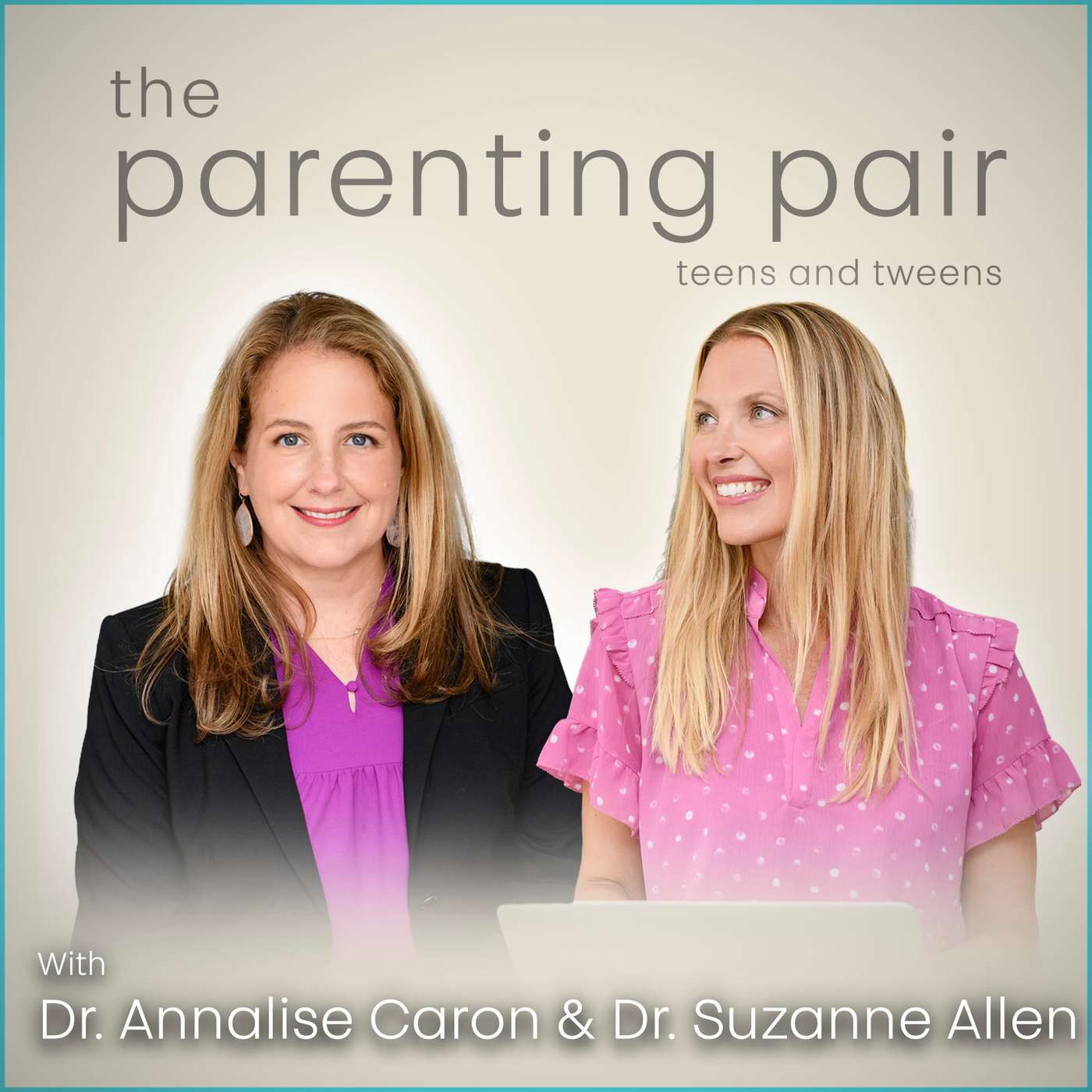
The Parenting Pair Podcast podcast artwork

PODCAST · kids

The Parenting Pair Podcast

The Parenting Pair Podcast | Expert Guidance for Parents of Teens and TweensAre you raising a teen or tween and looking for real, compassionate guidance from people who actually get it?Welcome to The Parenting Pair Podcast — hosted by Dr. Annalise Caron and Dr. Suzanne Allen, two licensed child and adolescent clinical psychologists and moms of teens and tweens themselves.After years of answering questions in our offices, at the bus stop, and on the sidelines, we created this podcast to bring evidence-based mental health guidance directly to parents who need it — without the jargon, and without the judgment.Every week we tackle the topics parents of teens and tweens are actually navigating: teen anxiety, depression, ADHD, motivation, communication, emotional regulation, resilience, self-harm, sports betting, gratitude, and so much more. We also bring in expert guests — specialists, clinicians, and researchers — to go deeper on the topics that matter most to your family.Whether

Publisher-supplied feed metadata · PodParley refreshed Jun 13, 2026 · Source feed

  1. 59

    Medical Anxiety in Kids & Teens: How to Help Them Cope | Pediatric Medical Trauma

    Medical challenges can affect far more than your child's physical health.Whether it's a routine shot, bloodwork, a frightening trip to the ER, surgery, an injury, or managing a chronic medical condition, medical experiences can bring fear, anxiety, avoidance, stress, and sometimes even medical trauma.And for parents, these situations can be overwhelming too. Suddenly you're managing appointments, medications, insurance, specialists, school, siblings, and your child's emotional needs—all while trying to figure out how to help your child cope.In this episode of The Parenting Pair Podcast, Dr. Annalise Caron and Dr. Suzanne Allen sit down with Dr. Meghan Marsac, a pediatric psychologist and Division Chief of Psychology at the University of Kentucky Pediatrics Department, to talk about how parents can support children and teens through medical challenges. Dr. Marsac brings extensive expertise in pediatric medical trauma and shares practical, evidence-based strategies for helping families navigate difficult medical experiences while protecting connection, autonomy, and the rest of a young person's life.In This Episode, We Discuss:How medical challenges can affect children's mental and emotional health — and why physical and mental health shouldn't be treated as completely separate.Medical anxiety and medical trauma — from everyday procedures like shots and bloodwork to more significant medical events and chronic illness.Why validation matters — and how acknowledging that something is difficult for your child can strengthen connection rather than making the fear worse.Parent vs. caregiver — how chronic illness or injury can shift parents into a caregiving role and unintentionally change the parent-child relationship.Protecting your teen's independence during medical challenges — including finding ways to preserve friendships, activities, school, and the other parts of life that matter to them.Supporting siblings when one child's medical needs require more attention from the family.How parents can advocate within complex medical systems — including asking questions, gathering information, communicating between providers, and making sure important information doesn't get lost.Helping teens become more involved in their own medical care — gradually giving them opportunities to ask questions, advocate for themselves, and take more leadership.The COACH approach — a framework Dr. Marsac and her coauthor developed to help parents break down challenging medical situations and choose strategies that fit their child.Planning ahead for medical appointments and procedures — including determining how much information your child wants and when they want to receive it.Why your child's medical condition shouldn't become their entire identity — and how families can continue to make room for the many other parts of who they are.Chapters:00:00 | Medical Challenges: Why Planning Ahead Works00:29 | Today’s Topic: Medical Challenges With Teens and Tweens01:17 | Meet Meghan Marsac, Pediatric Psychologist02:48 | Why Meghan Marsac Wrote Afraid of the Doctor05:20 | The Connection Between Medical Trauma and Emotional & Behavioral Struggles08:44 | Considering Medical Challenges in the Context of a Child’s Whole Life13:43 | Why Validation Is So Important14:50 | The Role of a Parent vs. a Caregiver18:20 | How to Address a New Medical Reality With Siblings21:13 | When the Parent Becomes the Leader of the Medical Team24:20 | The COACH Approach: What It Means29:20 | How Parents Can Cope Ahead With Medical Anxiety32:59 | Recommendations for Parents Facing Medical ChallengesImportant TakeawaysOne of the most powerful ideas in this conversation is that a child is more than their medical condition.As Dr. Marsac explains, families can become understandably focused on appointments, medications, treatments, and medical care—particularly when a child has a chronic condition. But it's also important to keep seeing the whole person: their friendships, activities, interests, school, family relationships, independence, and the things that bring them joy.Medical care matters. So does the rest of their life.The conversation also emphasizes that parents don't have to navigate complex medical systems perfectly. Asking questions, requesting clarification, writing things down, and advocating for your child are all legitimate parts of supporting them.And if a particular strategy doesn't work for your child, that doesn't mean you've failed. Dr. Marsac emphasizes that different strategies work for different children—and parents know their own children better than any professional does.If you're parenting a child or teen through a medical challenge, we hope this conversation helps you feel more informed, more confident, and a little less alone.💬 What part of your child's medical journey has been hardest to navigate as a parent?🔔 New episodes every Wednesday.✉️ Newsletter: https://drscaronandallen.com  📱 Instagram: @theparentingpair 💬 Questions you want answered on future episodes or topic suggestions: [email protected] Mentioned In This EpisodeAfraid of the Doctor: Every Parent's Guide to Preventing and Managing Medical Trauma By Dr. Meghan Marsac and Melissa Hogan.https://www.afraidofthedoctor.com/The Cellie Coping kithttps://www.celliecopingkit.org/About Dr. Meghan MarsacDr. Meghan Marsac is a pediatric psychologist and Division Chief of Psychology at the University of Kentucky Pediatrics Department. She is a tenured professor at the University of Kentucky's College of Medicine, an Affiliate Research Scientist at the Center for Injury Research and Prevention at Children’s Hospital of Philadelphia (CHOP), an Affiliate at the Center for Violence Prevention at CHOP, and Division Chief of Psychology in the Department of Pediatrics at the University of Kentucky.DISCLAIMER: The Parenting Pair Podcast is designed for informational and educational purposes only. Do not rely on the information presented in this podcast as a substitute or replacement for professional -- psychological or medical -- advice, diagnosis, or treatment. If you have concerns about you or a family member's well being, please contact a licensed mental health professional or physician.

  2. 58

    How to Raise a Teen Who Makes Good Decisions (Even When You're Not Watching)- Re-release

    How do you raise a teen who makes good decisions on their own — even when you're not there to guide them? In this episode, child and adolescent psychologists Dr. Suzanne Allen and Dr. Annalise Caron tackle a question every parent of a tween or teen asks at some point: my child wants more freedom, but can they actually handle it?They break down exactly how to raise responsible, independent teens without swinging to either extreme — permissive parenting on one end, helicopter parenting on the other. Using real examples and a simple framework parents can start using today, they explain the three types of independence every teen needs to develop: the ability to make their own choices, the ability to think through problems on their own, and the ability to trust their own feelings and judgment.You'll learn:How to raise a teen who can think for themselves and problem-solve without youThe difference between authoritative parenting and authoritarian parenting — and why it matters for raising a responsible teenA real-life role-play example (a teen who got a D on a test) showing exactly what to say — and what not to say — to help your teen make good decisionsWhy asking "what do you think?" before offering advice builds better decision-makersThe "get out of their way" coaching lesson that applies directly to parenting tweens and teensWhat decades of research from Dr. Joseph Allen's lab at the University of Virginia reveals about how this kind of parenting shapes teens' decision-making, relationships, and choices well into adulthoodPlus, book recommendations for parents who want to go deeper: The Self-Driven Child by William Stixrud PhD and Ned Johnson, How to Raise an Adult by Julie Lythcott-Haims, and Age of Opportunity by Laurence Steinberg.If you're raising a teen who wants more freedom, a tween pushing back on rules, or you're simply wondering how to raise a responsible teen who makes good choices — this episode gives you a practical, research-backed place to start.🔔 New episodes every Wednesday.✉️ Newsletter: https://drscaronandallen.com  📱 Instagram: @theparentingpair 💬 Questions you want answered on future episodes or topic suggestions: [email protected]: The Parenting Pair Podcast is designed for informational and educational purposes only. Do not rely on the information presented in this podcast as a substitute or replacement for professional -- psychological or medical -- advice, diagnosis, or treatment. If you have concerns about you or a family member's well being, please contact a licensed mental health professional or physician.

  3. 57

    Sexual Assault Awareness: College Red Zone Conversation Guide for Parents and Teens (Re-release)

    It's move-in week — and this episode is a timely one for parents of teens heading to college, a new social scene, or just more unsupervised time with friends.In this episode of The Parenting Pair Podcast, Dr. Suzanne Allen and Dr. Annalise Caron have a clear conversation about sexual assault prevention — for teens and young adults of any gender, not just those heading off to college. They talk through how to bring up a hard topic without lecturing, what actually helps reduce risk at parties and social gatherings, and how teens can look out for each other and step in when something feels off.This episode is for parents who want to prepare their teen without over-scaring them — and for teens themselves, since it's built to be shared directly with them.Dr. Allen and Dr. Caron cover:Why open, low-pressure conversations about safety matter more than one big talkHow to talk about prevention without implying it's ever the victim's faultThe role alcohol and parties can play in risk — and practical ways to reduce itFive concrete strategies teens can use to stay safer in social settingsWhat healthy bystander intervention looks like, including for teens who worry about misreading a situationHow this conversation applies well beyond college — to high school, new friend groups, and beyondHere are some highlights from this episode:00:00 – College parties can be fun and risky at the same time 03:08 – How Dialectical Thinking helps parents handle tough topics with teens 05:10 – Campuses tend to be very safe, except for sexual assaults 09:00 – Five strategies a teen can do to minimize risk 10:43 – The importance of protecting your drink and how to do so 12:15 – What healthy peer support looks like 14:42 – Teaching teens to speak up and step in 16:28 – How to protect friends and peers, safely 18:33 – Recap of 5 strategies to decrease risk of sexual assault 19:48 – Sexual assault prevention starts at home 21:32 – Dialectical thinking helps parent-teen communication and problem solving 23:15 – Acknowledging difficult subjects when feeling unpreparedIf you've ever worried about your teen being vulnerable in college or social settings, this episode will give you actionable tools to keep them safe and empowered.🧰 Resources & Tools Mentioned in This Episode:Drink safety products — spill-proof drink covers, drink-spiking test strips, and water bottles with flip-top lids or built-in straws can add an extra layer of protection at parties or barsSelf-defense classes — many towns, community organizations, and universities offer beginner-friendly courses; a great option to look into before heading to campusCampus safety resources — most colleges have blue light emergency phones and call/escort services; encourage your teen to locate these during orientation⬇️ For downloadable resources for teens/young adults and parents, based on this episode:📝 Tip Sheet for Parents 📝 Tip Sheet for Teens/Young Adults🔔 New episodes every Wednesday.✉️ Newsletter: https://drscaronandallen.com  📱 Instagram: @theparentingpair 💬 Questions you want answered on future episodes or topic suggestions: [email protected]: The Parenting Pair Podcast is designed for informational and educational purposes only. Do not rely on the information presented in this podcast as a substitute or replacement for professional -- psychological or medical -- advice, diagnosis, or treatment. If you have concerns about you or a family member's well being, please contact a licensed mental health professional or physician.

  4. 56

    I Yelled at My Teen. Now What? How to Repair Your Relationship (Re-Release)

    Did you lose your temper with your teen this summer? Wondering how to reconnect after an argument?Conflict is part of every family—especially during the unstructured days of summer, vacations, and the transition back to school. The good news? Relationships aren't strengthened by never making mistakes. They're strengthened by repairing them.  In this episode of The Parenting Pair Podcast, clinical psychologists Dr. Annalise Caron and Dr. Suzanne Allen explain why a genuine apology is one of the most powerful ways to rebuild trust with your teenager or tween. You'll learn why apologizing doesn't weaken your authority—it actually strengthens your relationship—and how a few common mistakes can unintentionally make an apology less effective.Whether you recently yelled, overreacted, or simply wish you had handled a parenting moment differently, this episode offers practical, evidence-based strategies to help you reconnect with your child and model the kind of healthy relationships you hope they'll build throughout their lives.In this episode, you'll learn:• Why apologizing actually increases your teen's trust and respect for you • The three biggest apology traps parents fall into—and how to avoid them • How to repair your relationship after an argument without giving up your authority • Why "I'm sorry, but..." almost always backfires • How to apologize without expecting your teen to apologize back • Why relationship repair is one of the greatest gifts you can give your childEpisode Highlights00:00 – Why relationship repair matters more than getting parenting "right" 02:50 – Does apologizing make parents lose authority? What the research—and experience—actually shows 05:20 – The three apology traps: losing authority, "tit for tat," and "double dipping" 11:51 – How to make an apology feel genuine instead of manipulative 17:22 – When it's not too late to apologize—and why timing matters less than sincerity 18:42 – How repairing conflict teaches your teen to build healthier future relationships 21:00 – Simple, effective ways to apologize that teens and tweens are more likely to hear 27:00 – What your teenager learns when they see you own your mistakes 33:00 – This week's parenting takeaway: Progress over perfectionIf you've ever searched "I yelled at my teenager," "How do I reconnect after an argument with my teen?" or "How do I repair my relationship with my child?", this episode is for you.Because parenting isn't about being perfect. It's about showing your children what healthy relationships look like—even after things go wrong.If you found this episode helpful, please share it with another parent, subscribe to The Parenting Pair Podcast, and leave us a review. Your support helps more families discover practical, evidence-based parenting advice.🔔 New episodes every Wednesday.✉️ Newsletter: https://drscaronandallen.com  📱 Instagram: @theparentingpair 💬 Questions you want answered on future episodes or topic suggestions: [email protected]: The Parenting Pair Podcast is designed for informational and educational purposes only. Do not rely on the information presented in this podcast as a substitute for professional psychological or medical advice, diagnosis, or treatment. If you have concerns about your own or a family member's well-being, please contact a licensed mental health professional or physician. 

  5. 55

    Raising Confident, Independent Kids With Food Allergies | Tamara Hubbard

    Food allergies don't just affect what your child  or teen eats—they can shape your family's entire experience of school, friendships, and independence. In this episode, therapist and author of May Contain Anxiety Tamara Hubbard joins Dr. Annalise Caron and Dr. Suzanne Allen to talk about food allergy anxiety in kids and teens, and how parents can build trust instead of fear.Together, they explore how parents can balance vigilance with confidence, help children gradually build independence, and avoid letting anxiety shrink their family's world. Tamara shares practical, evidence-based strategies for navigating food allergy anxiety while maintaining a strong parent-child relationship and preparing tweens and teens to safely manage their allergies as they grow.Whether your child was recently diagnosed or is preparing for college, this episode offers compassionate guidance to help your family move from fear toward confidence.In This Episode You'll Learn:Why food allergy anxiety is common—and when it becomes problematicHow to balance safety with quality of lifeThe difference between food allergy anxiety and food allergy social anxietyHow to help tweens and teens gradually build independenceThe 6 "allergy parenting traps" that quietly increase anxiety over timeWhy trust is essential when preparing teens to manage allergiesHow to respond when your teen isn't taking allergies seriouslyThe power of curiosity instead of lecturesHow Acceptance and Commitment Therapy (ACT) principles can help parentsWays family and friends can better support children with food allergiesPractical strategies for reducing anxiety while keeping kids safeHere are some highlights from the episode:00:00 How to Raise Independent Kids With Food Allergies00:30 Food Allergies: Today's Topic 01:10 Meet Tamara Hubbard, MA, LCPC, Therapist & Author of "May Contain Anxiety" 02:18 Coping With Food Allergy Anxiety 06:01 Building Confidence Through Skill Development 08:40 Why Professional Guidance Matters 10:30 Living by Your Values, Not Your Anxiety 13:18 Teaching Kids With Food Allergies to Self-Advocate 16:39 Food Allergy Anxiety vs. Food Allergy Social Anxiety 17:54 How Parents and Kids Experience Food Allergy Anxiety Differently 20:43 Less Lecturing, More Understanding 23:44 Common Anxiety Thinking Traps 27:42 When Burnout Becomes a Wake-Up Call 29:02 Food Allergy Support Groups: Benefits and Drawbacks 31:55 How Others Can Better Support Kids With Food Allergies 33:59 How to Connect With Tamara HubbardResources Mentioned📘 May Contain Anxiety: Managing the Overwhelm of Parenting Children with Food Allergies — by Tamara Hubbard, MA, LCPC🌐 Food Allergy Counselorhttps://www.foodallergycounselor.comEducational resources, articles, and support for families.🏥 Academy of Food Allergy Counselinghttps://www.foodallergycounseling.orgDirectory of allergy-informed mental health professionals and clinician education.👩‍⚕️ Tamara Hubbard's Private Practicehttps://www.tamarahubbard.com(Illinois, Ohio & Florida via telehealth)📱 Follow Tamara HubbardInstagram: @FoodAllergyCounselorFacebook: Food Allergy CounselorKey Takeaways✔️ Anxiety is common for families managing food allergies—but it doesn't have to define family life.✔️ The goal isn't eliminating all risk—it's learning to accurately assess risk while maintaining quality of life.✔️ Building trust through gradual skill development helps teens become confident, independent allergy managers.✔️ Parents often help most by replacing lectures with curiosity and open-ended conversations.✔️ Sometimes the most supportive question anyone can ask a family managing food allergies is simply: "How can I be helpful?"👍 If you found this episode helpful, please leave us a rating or review — it helps other parents find the show.🎙️ Hosted by Clinical Psychologists, Dr. Annalise Caron and Dr. Suzanne Allen.🔔 New episodes every Wednesday — subscribe so you never miss one.✉️ Newsletter: https://drscaronandallen.com 📱 Instagram: @theparentingpair 💬 Questions you want answered on future episodes or topic suggestions: [email protected]: The Parenting Pair Podcast is for informational and educational purposes only and is not a substitute for professional psychological or medical advice, diagnosis, or treatment. If you have concerns about your or a family member's wellbeing, please contact a licensed mental health professional or physician.

  6. 54

    Say Less: The Parenting Strategy That Gets Teens to Listen

    Have you ever noticed that the more you remind, explain, lecture, or give advice… the less your teen seems to listen?In this episode of The Parenting Pair Podcast, Dr. Annalise Caron and Dr. Suzanne Allen explore one of the simplest—but most powerful—communication strategies for parents of tweens and teens: saying less.As parents, it's natural to want to help by offering reminders, solutions, opinions, and guidance. But sometimes our well-intentioned words can overwhelm our children, make them feel controlled, or unintentionally shut down communication.Instead, learning to pause, listen more, and create space can strengthen trust, encourage independence, and help teens develop confidence in solving their own problems.In this episode, you'll learn:Why "saying less" actually helps teens communicate moreHow over-explaining can unintentionally damage connectionThe difference between supporting and over-directingHow to encourage independence without withdrawing emotionallyPractical ways to reduce conflict and increase cooperationWhy silence can become one of your most effective parenting toolsEpisode Highlights:00:00 Want Your Kids to Trust You More?00:35 Say Less: A Simple Parenting Strategy That Works 00:59 What Does "Say Less" Really Mean? 02:34 Why Saying Less Builds Stronger Connections 05:26 Raising Independent and Confident Kids 06:38 The Benefits of Talking Less as a Parent 08:41 When Can Parents Practice Saying Less? 11:49 Final Thoughts: Small Changes, Big ImpactIf you're parenting a tween, teenager, or young adult, this episode offers clinically-informed strategies that can improve communication and strengthen your relationship.💬 We'd love to hear from you: What is one situation where you could try "saying less" this week?👍 If you found this episode helpful, please leave us a rating or review — it helps other parents find the show.🎙️ Hosted by Clinical Psychologists, Dr. Annalise Caron and Dr. Suzanne Allen.🔔 New episodes every Wednesday — subscribe so you never miss one.✉️ Newsletter: https://drscaronandallen.com 📱 Instagram: @theparentingpair 💬 Questions you want answered on future episodes or topic suggestions: [email protected]: The Parenting Pair Podcast is for informational and educational purposes only and is not a substitute for professional psychological or medical advice, diagnosis, or treatment. If you have concerns about your or a family member's wellbeing, please contact a licensed mental health professional or physician.

  7. 53

    Why Making Friends Is Harder Than It Looks (And How to Help Your Teen) | Deirdre Flores

    Is your teen struggling to make friends, maintain friendships, or navigate their social world?Many parents worry when their tween or teen seems lonely, has difficulty connecting with peers, misses social cues, or struggles to maintain friendships. But social communication is a complex set of skills—and many young people need support learning them.In this episode of The Parenting Pair Podcast, clinical psychologists Dr. Annalise Caron and Dr. Suzanne Allen welcome Deirdre Flores, M.S., CCC-SLP, founder of The Teen SLP, to discuss the social communication skills that help tweens, teens, and young adults build meaningful relationships.Together, they explore:✔️ What social communication skills actually are✔️ Why making friends is harder for some teens than others✔️ The connection between executive functioning, ADHD, and friendships✔️ How parents can provide support without taking over✔️ Why social struggles are often about skills, not shyness✔️ Ways to coach teens around texting, planning hangouts, and maintaining friendships✔️ Why clubs, hobbies, jobs, and shared interests matter so much socially✔️ How to reduce shame and build confidence in socially struggling teensHere are some highlights from the episode:00:00 Social Communication Is Built on Executive Functioning00:57 Meet Deirdre Flores, Speech-Language Pathologist02:49 What Does a Speech-Language Pathologist Do?04:52 Why Social Communication Skills Matter05:44 The Link Between Executive Functioning and Communication10:15 Breaking the Stigma Around Social Skills Coaching13:18 Why Speech-Language Pathologists Play a Critical Role15:52 Understanding the Emotions of Both Parents and Teens17:14 How Parents Can Gradually Remove the Scaffolding20:59 The 4-Week Rule, Volunteering, and Part-Time Jobs28:13 How to Connect with Deirdre FloresSocial skills are life skills. The ability to communicate, connect, and maintain relationships affects friendships, dating, college success, and future careers. The good news? These skills can be learned and strengthened.If you're parenting a tween, teen, or young adult who is struggling socially, this conversation offers practical, compassionate, and expert-informed guidance.Where to find Deirdre Flores, M.S., CCC-SLP:https://theteenslp.com/https://www.instagram.com/theteenslp/👍 If you found this helpful, subscribe to The Parenting Pair Podcast and share this episode with another teen or tween parent.🎙️ Hosted by Clinical Psychologists, Dr. Annalise Caron and Dr. Suzanne Allen.🔔 New episodes every Wednesday — subscribe so you never miss one.✉️ Newsletter: https://drscaronandallen.com 📱 Instagram: @theparentingpair 💬 Questions you want answered on future episodes or topic suggestions: [email protected]: The Parenting Pair Podcast is for informational and educational purposes only and is not a substitute for professional psychological or medical advice, diagnosis, or treatment. If you have concerns about your or a family member's wellbeing, please contact a licensed mental health professional or physician.

  8. 52

    Re-Release: Stop Spiraling: How to Catch the Thoughts That Stress You Out as a Parent

    We're re-releasing this episode because the topic keeps coming up — over and over again — in our work with parents. How we think matters. It shapes how we feel, how we act, and how we show up in our relationships with our teens. Parenting isn't only about our kids — our own well-being, our own thought patterns, and our own mental health matter too. If you caught this one when it first aired as Episode 13, we think it's worth a second listen. And if you're new here, this is a great place to start.Do you ever catch yourself thinking your teen "should" have done something differently — or spiral from one bad moment straight to imagining the worst? You might be stuck in a 'thinking trap.'In this episode, Dr. Suzanne Allen and Dr. Annalise Caron break down three of the most common thinking traps parents of tweens and teens fall into, and share simple, practical ways to shift your thinking so you can show up calmer, clearer, and more connected.What we cover:"Should" thinking — why this one word quietly cranks up frustration and how to swap it outMental filter — when you zoom in on everything going wrong and tune out everything that's going rightJumping to conclusions — how one moment with your teen can send your brain spiraling into worst-case scenariosOne powerful question — "What else could be true?" — that works for all three trapsWhether you're navigating daily friction or a more serious situation with your teen, these tools will help you pause the spiral and respond with more patience and perspective.Timestamps: 00:00 – Are You Spiraling About Your Teen? 01:00 – What Are Thinking Traps & Why They Matter 03:00 – Dr. Allen's Checkout Line Moment 05:24 – Trap #1: "Should" Thinking 09:34 – Trap #2: Mental Filter 16:26 – Trap #3: Jumping to Conclusions 20:23 – One Question to Reframe Everything👍 If you found this helpful, subscribe to The Parenting Pair Podcast and share this episode with another teen or tween parent.🎙️ Hosted by Clinical Psychologists, Dr. Annalise Caron and Dr. Suzanne Allen.🔔 New episodes every Wednesday — subscribe so you never miss one.✉️ Newsletter: https://drscaronandallen.com 📱 Instagram: @theparentingpair 💬 Questions you want answered on future episodes or topic suggestions: [email protected]: The Parenting Pair Podcast is for informational and educational purposes only and is not a substitute for professional psychological or medical advice, diagnosis, or treatment. If you have concerns about your or a family member's wellbeing, please contact a licensed mental health professional or physician.

  9. 51

    Screens All Summer? How to Avoid Constant Fights With Your Tween or Teen

    Summer break is supposed to be relaxing—but for many parents of tweens and teens, it quickly turns into a battle over screens, video games, YouTube, and endless hours indoors.In this episode of The Parenting Pair Podcast, clinical psychologists Dr. Annalise Caron and Dr. Suzanne Allen tackle a question many parents are asking right now:"What do I do if my teen wants to spend the entire summer gaming or watching TV?"Whether your child is too old for traditional summer camps, too young for a job, or simply facing weeks of unstructured time, it can be incredibly stressful to watch screens become the default activity. Parents often find themselves worrying that they're failing, arguing constantly about technology, or wondering if their child is missing out on important developmental experiences.In this practical and compassionate conversation, Annalise and Suzanne discuss how parents can approach summer differently—moving away from power struggles and toward collaboration, curiosity, and realistic expectations.You'll learn:✔️ Why many parents feel guilty about summer screen time✔️ How anxiety and catastrophizing can make screen conflicts worse✔️ Ways to collaborate with your tween or teen when planning summer activities✔️ How to shift from pessimism to possibility-focused thinking✔️ Why video games don't have to be the enemy✔️ The concept of creating a balanced "summer diet" of activities✔️ How to encourage independence, social connection, and exploration without constant battles✔️ Practical resources and ideas for families navigating long, unstructured summer daysChapters:00:00 -  Introduction: Expanding Your Teen's Summer Possibilities00:44 - Summer Break & Screen Time: Helping Teens Balance Free Time02:36 - Four Key Areas to Consider This Summer03:05 - 1. Common Parenting Thinking Traps Around Summer Screen Time07:42 - 2. How to Collaborate With Your Teen Instead of Fighting Them09:57 - 3. Questions That Help Teens Explore New Summer Opportunities13:53 - 4. Resources for Evaluating Games, Apps & Media ContentIf you're worried your teen will spend the entire summer on YouTube, Xbox, TikTok, or their phone, this episode offers guidance to help you reduce conflict and create a more balanced summer experience.Useful resources discussed in this episode: Common Sense Media:https://www.commonsensemedia.org/Family Media Plan: https://www.healthychildren.org/english/fmp/pages/mediaplan.aspx?_gl=1*cx15ma*_ga*MTcxNzk0OTc3MC4xNzgxNzk3NzUw*_ga_FD9D3XZVQQ*czE3ODE3OTc3NTAkbzEkZzEkdDE3ODE3OTc4MzEkajQ2JGwwJGgw💡 Remember: the goal isn't perfection. It's helping your child build a summer that includes connection, growth, rest, and fun.👍 If you found this helpful, subscribe to The Parenting Pair Podcast and share this episode with another teen or tween parent.🎙️ Hosted by Clinical Psychologists, Dr. Annalise Caron and Dr. Suzanne Allen.🔔 New episodes every Wednesday — subscribe so you never miss one.✉️ Newsletter: https://drscaronandallen.com 📱 Instagram: @theparentingpair 💬 Questions or topic suggestions: [email protected]: The Parenting Pair Podcast is designed for informational and educational purposes only. Do not rely on the information presented in this podcast as a substitute or replacement for professional -- psychological or medical -- advice, diagnosis, or treatment. If you have concerns about you or a family member's well being, please contact a licensed mental health professional or physician.

  10. 50

    The Real College Conversation: What Every Parent Needs to Know Before (and After) Freshman Year

    Starting college is exciting—but it can also be overwhelming for both young people and parents.In this episode of The Parenting Pair Podcast, clinical psychologists Dr. Annalise Caron and Dr. Suzanne Allen are joined by clinical psychologists and college transition experts, Dr. Liz Seidler and Dr. Sarah Olivo to discuss what really happens when teens leave home and begin living on their own.From homesickness and making friends to executive functioning, self-advocacy, managing emotions, and navigating newfound independence, they share practical, evidence-based strategies to help families prepare for one of life's biggest transitions.Whether your child is heading off to a dorm, moving away for the first time, or simply preparing for college life, this conversation offers actionable advice that can reduce stress and set both parents and students up for success.In this episode, you'll learn:🎓 How to prepare teens for the transition to college🏠 Common challenges students face when living independently💬 Why self-advocacy is one of the most important college skills🧠 How executive functioning impacts college success❤️ Ways parents can support without becoming overinvolved📚 Practical tips for fostering resilience and confidenceHighlights from this episode:00:00 Why Meaningful Connection Is All Your College Student Needs01:05 Meet Dr. Liz Seidler & Dr. Sarah Olivo01:42 Helping Teens Transition to College Independence04:44 The Biggest Challenges Students Face During Freshman Year08:44 How Parents Can Best Support Teens Starting College10:07 4 Ways Parents Can Help: Mind the Story You Tell About College12:13 4 Ways Parents Can Help: Ask Better Questions & Invite Conversation15:39 4 Ways Parents Can Help: Create an Emotional Plan Before Move-In18:42 4 Ways Parents Can Help: Listen Before You Problem-Solve22:12 Parent Group Chats: Helpful Resource or Hidden Pitfall?26:35 What College Students Actually Find Most Helpful28:46 Why Meaningful Campus Connections Matter for Student Success31:44 Listen to the “College Is Fine, Everything's Fine" PodcastIf you're getting ready to send your child to college or you have a college student who has just returned home, this episode is one you won't want to miss.To learn more about Dr. Liz Seidler and Dr. Sarah Olivo, please visit their “College is Fine, Everything’s Fine” podcast website, YouTube channel or individual practice websites:Listen to “College Is Fine, Everything's Fine” Podcast here: https://www.collegeisfinepodcast.com/“College is Fine, Everything's Fine” YouTube Channel here: https://www.youtube.com/@CollegeIsFinePodcastDr. Liz Seidler’s website:  https://www.cbtridgefield.com/Dr. Sarah Olivio’s website: https://www.drsaraholivo.com/Additional Resources Discussed in this episode:Mental Health in College: What Research Tells Us About Supporting Students by Alexis Reddinghttps://www.amazon.com/Mental-Health-College-Research-Supporting/dp/B0FQ9HXNB6👍 If you found this helpful, subscribe to The Parenting Pair Podcast and share this episode with another parent preparing for college season.🎙️ Hosted by Clinical Psychologists Annalise Caron and Suzanne Allen.🔔 New episodes every Wednesday — subscribe so you never miss one.✉️ Newsletter: https://drscaronandallen.com 📱 Instagram: @theparentingpair 💬 Questions or topic suggestions: [email protected]: The Parenting Pair Podcast is designed for informational and educational purposes only. Do not rely on the information presented in this podcast as a substitute or replacement for professional -- psychological or medical -- advice, diagnosis, or treatment. If you have concerns about you or a family member's well being, please contact a licensed mental health professional or physician.

  11. 49

    Why Women Struggle With Sleep: From Adolescence to Menopause | Dr. Shelby Harris

    Sleep problems are incredibly common among women—but they're often misunderstood.In this episode of The Parenting Pair Podcast, clinical psychologists Annalise Caron and Suzanne Allen sit down with renowned sleep expert and board certified behavior sleep medicine specialist Dr. Shelby Harris to explore why women experience unique sleep challenges throughout their lives, from adolescence and parenthood to perimenopause and menopause.Together, they unpack the biological, hormonal, emotional, and lifestyle factors that contribute to insomnia and sleep disruption, while offering practical, evidence-based strategies to improve sleep quality and overall well-being.Whether you're a parent struggling with sleep, supporting a teen with sleep challenges, navigating midlife hormonal changes, or simply wondering why a good night's rest feels so elusive, this conversation is filled with actionable insights and hope.In this episode, we discuss:✔️ Why insomnia is more common in women✔️ Hormones, sleep, and life transitions✔️ The impact of stress, anxiety, and caregiving responsibilities✔️ Sleep challenges during pregnancy, parenthood, perimenopause, and menopause✔️ Common misconceptions about insomnia✔️ Evidence-based strategies for improving sleep✔️ When to seek professional supportHighlights from this episode:00:00 Introduction: Why Women Struggle With Sleep00:46 Meet Dr. Shelby Harris, clinical psychologist and Diplomate in Behavioral Sleep Medicine03:10 Book Recommendation: The Women's Guide to Overcoming Insomnia03:52 How Women's Sleep Changes Across the Lifespan07:31 How Sleep Differs Between Women and Men09:04 Trouble Sleeping? Why You Should Get Evaluated09:39 What Insomnia Really Is (And What It Looks Like)13:56 Why Women Often Delay Seeking Help for Sleep Problems14:56 When and Where to Get Your Sleep Evaluated20:53 CBT-I Explained: The Gold Standard for Insomnia Treatment24:47 Sleep Apnea and Weight: Are They Related?27:02 Sleep Apnea in Women: What the Research Shows32:20 Revenge Bedtime Procrastination or "Momsomnia"38:15 Follow Dr. Shelby Harris for More Sleep Tips40:26 Dr. Shelby Harris's Top Recommendations for Better SleepSleep affects every aspect of our lives—from emotional regulation and mental health to parenting, relationships, and physical health. Understanding how sleep changes across the lifespan can help you make informed decisions and develop healthier habits.Resources discussed in this episode:Where to find Dr. Shelby Harris: https://www.drshelbyharris.com/@sleepdocshelbyThe Women's Guide to Overcoming Insomnia, Dr. Shelby Harrishttps://wwnorton.com/books/9780393711615The Essential Guide To Children's Sleep: A Tired Caregiver's Workbook for Every Age and Stage, Dr. Andrea Roth, Dr. Allison Shele & Dr. Shelby Harrishttps://www.apa.org/pubs/books/essential-guide-childrens-sleepThe Parenting Pair Podcast: Why Teens Don't Sleep (and What Parents Can Do About It)https://drscaronandallen.com/podcast/episode/why-teens-dont-sleep-and-what-parents-can-do-about-it/The Parenting Pair Podcast: Sleep Struggles in Tweens and Teens: Insomnia, Nightmares and When Parents Should Seek Helphttps://drscaronandallen.com/podcast/episode/sleep-struggles-in-tweens-and-teens-insomnia-nightmares-and-when-parents-should-seek-help/ If you found this episode helpful, please like, subscribe, and share it with someone who could benefit from this conversation.🎙️ Hosted by Clinical Psychologists Annalise Caron and Suzanne Allen.🔔 New episodes every Wednesday — subscribe so you never miss one.✉️ Newsletter: https://drscaronandallen.com 📱 Instagram: @theparentingpair 💬 Questions or topic suggestions: [email protected]: The Parenting Pair Podcast is designed for informational and educational purposes only. Do not rely on the information presented in this podcast as a substitute or replacement for professional -- psychological or medical -- advice, diagnosis, or treatment. If you have concerns about you or a family member's well being, please contact a licensed mental health professional or physician.

  12. 48

    Why Your Teen Is Always Late: Time Blindness, ADHD, and What Helps

    Does your teen constantly run late, underestimate how long tasks will take, or seem completely unaware of how much time has passed? It might be time blindness.In this episode of The Parenting Pair Podcast, clinical psychologists Dr. Annalise Caron and Dr. Suzanne Allen explore time blindness — a common but often misunderstood executive functioning challenge that affects tweens, teens, and young adults. Many parents interpret these struggles as laziness, avoidance, or irresponsibility. But for many teens, time blindness is connected to real differences in brain functioning, ADHD, and executive functioning.In this episode, we cover:What time blindness actually isWhy some teens genuinely struggle to "feel" time passingHow ADHD and executive functioning are connected to time blindnessWhy lateness triggers panic, frustration, and family conflict"Waiting mode" and why teens get stuck before tasksWhy shame and punishment often backfirePractical strategies parents can use at home — timers, visual calendars, clocks, task chunking, and moreHighlights from this episode:00:00 — What Time Blindness Really Feels Like01:36 — What Is Time Blindness? Signs Parents Should Know06:06 — How Time Blindness Impacts Family Life06:14 — Why Teens With Time Blindness Are Often Late08:14 — The Big Emotions Behind Time Blindness: Panic, Stress & Frustration09:36 — “Waiting Mode” and Why Teens Get Stuck13:07 — Time Blindness Is a Brain-Based Challenge, Not a Character Flaw14:48 — Practical Strategies That Help With Time Blindness15:04 — Strategy 1- Building Understanding and Compassion at Home16:01 — Strategy 2- How Alarms Can Support Teens With Time Blindness17:28 — Strategy 3- Why Visible Clocks Matter More Than You Think18:11 — Strategy 4- Using Countdown Timers to Improve Time Awareness18:23 — Strategy 5- Visual Calendars That Actually Help Teens Stay Organized19:22 — Strategy 6- Why Start Timers Help Teens Begin Tasks19:54 — Strategy 7- Time Tracking and “Backing Out” of Time Explained21:28 — Strategy 8- Why Teens Need Scheduled “Free Brain Time”23:32 — Strategy 9- Breaking Big Tasks Into Smaller Daily Steps24:12 — Can ADHD Medication Help With Time Blindness?25:03 — Final Thoughts: Supporting Teens With Time BlindnessWhether you're parenting a tween, teen, or college student, this conversation offers practical, compassionate guidance grounded in adolescent psychology.🔔 New episodes every Wednesday — subscribe so you never miss one.✉️ Newsletter: https://drscaronandallen.com 📱 Instagram: @theparentingpair 💬 Questions or topic suggestions: [email protected]: The Parenting Pair Podcast is designed for informational and educational purposes only. Do not rely on the information presented in this podcast as a substitute or replacement for professional -- psychological or medical -- advice, diagnosis, or treatment. If you have concerns about you or a family member's well being, please contact a licensed mental health professional or physician.

  13. 47

    Why Teen Breakups Feel So Intense — And How Parents Can Help

    Teen breakups can feel overwhelming, heartbreaking, and all-consuming — not only for teens, but for parents watching their child struggle through intense emotions for the first time. In this episode of The Parenting Pair Podcast, Dr. Annalise Caron and Dr. Suzanne Allen explore what first heartbreaks are really like for tweens, teens, and young adults, and how parents can respond in ways that build trust, resilience, and ultimately healing.We discuss why teen relationships matter so deeply, how heartbreak can deeply impact teenagers, and what supportive parenting looks like during emotional crises. From validating emotions without escalating them, to knowing when to step in if your teen becomes stuck in rumination or distress, this conversation offers practical and compassionate guidance for parents navigating one of the most emotionally charged parts of adolescence.We also explore:Why teen heartbreak should not be minimizedHow grief and loss show up after a breakupWhat helps teens emotionally recoverWhen boundaries may be necessaryHow to avoid accidentally dismissing your teen’s painSigns your teen may need additional mental health supportIf you are parenting a tween, teen, or college-aged child through friendship loss, rejection, or a relationship breakup, this episode will help you better understand their emotional world — and how to support them through it.Here are some highlights from the episode:00:00 — Teen Breakups: When First Love Feels Devastating00:41 — Helping Your Teen Through a Painful Breakup02:21 — Teen Heartbreak + School, Friends & Social Pressure04:01 — What Parents Can Do: Supporting the Grief Without Fixing It06:38 — Why “Doing” Can Help More Than Talking After a Breakup08:16 — When Teens Get Stuck in Heartbreak and Rumination10:54 — When Parents Should Step In to Stop the Overthinking Spiral16:16 — When Boundaries Are Necessary After a Teen Breakup18:10 — Signs Your Teen May Need Extra Mental Health Support19:48 — Final Thoughts: Helping Teens Heal After Heartbreak🔔 New episodes every Wednesday — subscribe so you never miss one.✉️ Newsletter: https://drscaronandallen.com 📱 Instagram: @theparentingpair 💬 Questions or topic suggestions: [email protected]: The Parenting Pair Podcast is designed for informational and educational purposes only. Do not rely on the information presented in this podcast as as a substitute or replacement for professional -- psychological or medical -- advice, diagnosis, or treatment. If you have concerns about you or a family member's well being, please contact a licensed mental health professional or physician.

  14. 46

    How to Support a Grieving Teen or Child | Parenting Through Loss

    Grief can look very different in children, tweens, and teens — and many parents are left wondering how to best support their child while navigating their own loss at the same time.In this episode of The Parenting Pair Podcast, Dr. Annalise Caron and Dr. Suzanne Allen sit down with grief expert Dr. Julie Kaplow to discuss how grief shows up in adolescents and families, what healthy grieving can look like, and how parents can respond with compassion, flexibility, and support.Together, they explore:How grief presents differently in kids, tweens, and teensWhy there is no “right way” or timeline for grievingWhen therapy may or may not be necessaryHow parents can support grieving children while managing their own emotionsWhat happens when family members grieve differentlyWhy some teens hide their distress to protect their parentsCommunity grief and collective traumaSigns a child or teen may need additional mental health supportHelpful coping strategies and grief resources for familiesHighlights from this episode:00:00 — Everyone Grieves Differently: Understanding Loss as a Family00:25 — Parenting Through Grief: Supporting Kids After Loss01:07 — Meet National Grief Expert and clinical psychologist Dr. Julie Kaplow02:04 — How Grief Shows Up in Children, Tweens, and Teens04:43 — Does Every Grieving Child Need Therapy?06:43 — How Parents Can Support Kids Through Grief and Loss09:55 — Practical Ways to Help Children Cope With Grief12:33 — When Family Members Grieve on Different Timelines15:01 — Letting Go of Pressure During the Grieving Process17:15 — When Parents Are Grieving Too: Supporting Your Child While Struggling Yourself20:23 — Healthy Coping Strategies for Grieving Children and Teens22:17 — Why Teens May Hide Their Grief From Parents27:15 — Navigating Community Grief and Collective Loss29:35 — Signs a Grieving Child or Teen May Need Extra Support31:37 — Helpful Grief Resources for Parents and Families33:46 — What If You Feel Like You Handled Grief “Wrong”?This conversation offers practical parenting guidance, emotional reassurance, and evidence-based insight for families coping with loss, grief, trauma, and major life transitions. Whether your family is navigating the death of a loved one, community tragedy, divorce, illness, or another profound loss, this episode aims to help parents feel more supported and less alone.Resources discussed in this episode:TAG Center Virtual Learning Library- contains a number of free webinars and resources for parents (including the Power of Parenting series designed to help parents support their children after various types of deaths): https://mmhpi.org/work/trauma-grief-center/virtual-learning-library/Lucine Center for Trauma and Grief- provides teletherapy to children and adolescents who have experienced trauma or loss: https://lucinecenter.com/The Meadows Mental Health Policy Institute works at the intersection of policy and programs to create equitable systemic changes so all people in Texas, the nation, and the world can obtain the health care they need.https://mmhpi.org/The Hackett Center’s mission is to provide independent, non-partisan, and trusted policy and program guidance in Greater Houston and the Gulf Coast region to improve services and systems so that all Texans can obtain effective mental health care.https://mmhpi.org/work/the-hackett-center/🔔 New episodes every Wednesday — subscribe so you never miss one.✉️ Newsletter: https://drscaronandallen.com 📱 Instagram: @theparentingpair 💬 Questions or topic suggestions: [email protected]: The Parenting Pair Podcast is designed for informational and educational purposes only. Do not rely on the information presented in this podcast as as a substitute or replacement for professional -- psychological or medical -- advice, diagnosis, or treatment. If you have concerns about you or a family member's well being, please contact a licensed mental health professional or physician.

  15. 45

    Parenting Through Tattoos, Piercings & Teen Identity Changes

    Why do tweens and teens suddenly want tattoos, second piercings, dramatic hair changes, or other appearance changes? And how should parents respond without overreacting, shutting down communication, or creating conflict?In this episode of The Parenting Pair Podcast, Dr. Annalise Caron and Dr. Suzanne Allen explore why appearance becomes such an important part of identity development during adolescence and how parents can approach these moments with curiosity, boundaries, and connection.The conversation covers:Why appearance matters so much during the tween and teen yearsThe developmental drive for identity and independenceHow to respond when your child wants a tattoo, piercing, or other changeThe importance of considering age, permanence, and safetyWhy curiosity works better than immediate judgmentHow parents can stay connected while still holding limitsWhy these conversations don’t have to become power strugglesWhether your tween wants a second piercing or your teen is asking for a tattoo, this episode offers practical, compassionate parenting guidance rooted in clinical psychology and adolescent development.If you’re parenting tweens, teens, or college-age kids, this episode will help you navigate appearance changes with more confidence, calm, and connection.Here are some highlights from the episode:00:00 — Teens Want to Change Their Appearance - Now What?01:37 — Why Appearance Feels So Important in Adolescence02:59 — Middle School & Identity: When Independence Begins05:21 — Get Curious About the Change07:44 — 3 Things Parents Should Consider First08:00 — 1) Consider Your Teen’s Age & Development10:04 — 2) Temporary vs Permanent Appearance Changes13:04 — 3) Safety Concerns Parents Should Think About18:41 — How to Talk to Your Teen About Appearance Changes19:31 — Leading With Curiosity Instead of Judgment21:01 — Using Delay as a Parenting Tool22:40 — Final Thoughts: It Doesn’t Have to Be All or Nothing🔔 New episodes every Wednesday — subscribe so you never miss one.✉️ Newsletter: https://drscaronandallen.com 📱 Instagram: @theparentingpair 💬 Questions or topic suggestions: [email protected]: The Parenting Pair Podcast is designed for informational and educational purposes only. Do not rely on the information presented in this podcast as as a substitute or replacement for professional -- psychological or medical -- advice, diagnosis, or treatment. If you have concerns about you or a family member's well being, please contact a licensed mental health professional or physician.

  16. 44

    Why Your Teen Won't Open Up (And What Actually Helps)

    What if the key to better communication with your teen… isn’t having the right answers, but asking better questions?In this episode of The Parenting Pair Podcast, Dr. Annalise Caron and Dr. Suzanne Allen explore the power of curiosity in parenting—and why becoming genuinely interested in your teen’s inner world can transform your relationship.Many parents find themselves jumping to conclusions, offering advice too quickly, or reacting from their own anxiety or fear. But these patterns—while well-intentioned—can unintentionally create distance.Instead, Dr. Caron and Dr. Allen introduce a different approach: one rooted in wondering, openness, and connection.In this episode, you’ll learn:Why curiosity is one of the most powerful parenting toolsThe common barriers that block connection (assumptions, judgment, urgency to teach, parental anxiety)The “I wonder” reframe What curiosity looks like in real-life conversationsHow to ask questions in a way that feels safe and respectfulHow to be firm AND curious when your teen won't engageWhy giving your teen space can actually strengthen your relationshipYour teen doesn't need you to have all the answers — they need to feel genuinely understood. This episode shows you how to build that curiosity muscle in small everyday moments, so it's there when you need it most.Here are some highlights from the episode:00:00 The Power of Curiosity in Parenting02:22 What It Really Means to Be Curious as a Parent05:07 Assumptions That Block Connection with Your Teen06:21 Judgments That Get in the Way of Understanding07:45 The Urge to Teach (And Why It Backfires)09:39 How Parental Anxiety Impacts Curiosity10:48 What Curiosity Looks Like in Real Life Parenting14:17 How to Ask Questions Without Triggering Defensiveness16:53 Why Giving Your Teen Space Matters17:17 How to Be Both Firm and Curious as a Parent20:01 Final Takeaways: Building Curiosity Into Your Parenting🔔 New episodes every Wednesday — subscribe so you never miss one.✉️ Newsletter: https://drscaronandallen.com 📱 Instagram: @theparentingpair 💬 Questions or topic suggestions: [email protected]: The Parenting Pair Podcast is designed for informational and educational purposes only. Do not rely on the information presented in this podcast as as a substitute or replacement for professional -- psychological or medical -- advice, diagnosis, or treatment. If you have concerns about you or a family member's well being, please contact a licensed mental health professional or physician.

  17. 43

    When Your Teen Becomes Physically Aggressive: What Parents Need to Know and Do

    What should parents do when a teen becomes aggressive — or even physically threatening?In this episode of The Parenting Pair Podcast, Dr. Annalise Caron and Dr. Suzanne Allen address one of the most difficult and rarely talked-about experiences in parenting: feeling afraid of your own child. They break down why explosive or aggressive behavior can emerge in teens, and how parents can respond in ways that prioritize safety, de-escalation, and long-term connection.In this episode, you'll learn: ✔️ Why teen aggression can happen — from brain development to individual vulnerabilities ✔️ The difference between isolated incidents and genuinely concerning patterns ✔️ Key warning signs parents should not ignore ✔️ How to de-escalate intense situations safely (and what not to do) ✔️ When to involve a trusted adult, therapist, or support system ✔️ How to create a simple, realistic safety plan for your family ✔️ When it may be necessary to call mobile crisis or 911 ✔️ How to reconnect and move forward after a difficult incidentWhether this has happened once or is becoming a pattern, this episode offers clear, compassionate, and practical guidance — and reminds parents: you are not alone.📺 Chapters00:00 How Common Is Teen Aggression? What the Research Shows01:38 A Parent's Real Question: "I'm Afraid of My Own Son"03:15 Safety is Paramount04:03 Why This Happens: The Teenage Brain Explained04:58 Why This Happens: ADHD, Anxiety & Other Contributing Factors06:13 Why This Happens: Environment, Stress & Triggers06:54 Isolated Incident or Pattern? How to Tell the Difference08:11 Warning Signs: Red Flags Parents Shouldn’t Ignore11:22 What to Do in the Moment of Violent Behavior12:07 De-Escalation Strategies That Actually Work14:31 When to Involve a Trusted Adult or Support System16:46 Safety Planning: How to Prepare Ahead of Time19:45 When to Call 911 or Mobile Crisis Services21:14 What to Do After a Violent Incident28:01 What Now? Next Steps for Parents🔔 New episodes every Wednesday — subscribe so you never miss one.✉️ Newsletter: https://drscaronandallen.com 📱 Instagram: @theparentingpair 💬 Questions or topic suggestions: [email protected]: The Parenting Pair Podcast is designed for informational and educational purposes only. Do not rely on the information presented in this podcast as as a substitute or replacement for professional -- psychological or medical -- advice, diagnosis, or treatment. If you have concerns about you or a family member's well being, please contact a licensed mental health professional or physician.

  18. 42

    Breaking the Cycle of Parenting Anxiety: How to Raise Resilient Kids Without Reinforcing Avoidance

    What does it really mean to raise a resilient child in a culture that tells us to protect them from discomfort at all costs?In this episode of The Parenting Pair Podcast, Dr. Annalise Caron and Dr. Suzanne Allen are joined by clinical psychologist and author Dr. Meredith Elkins to unpack the growing pressure of intensive parenting—and why, despite our best intentions, it may be increasing anxiety in both parents and kids.Drawing from her book Parenting Anxiety: Breaking the Cycle of Worry and Raising Resilient Kids, Dr. Elkins explores the powerful shift toward authoritative parenting, and how we can support our children without over-accommodating their fears.Together, they dive into:Why intensive parenting can backfireHow avoidance fuels anxiety in kids and teensWhat it actually looks like to “avoid avoidance” in everyday parentingThe role of validation—and where parents can get stuckHow to model courage while still feeling anxiousWhy addressing your own anxiety as a parent mattersThe concept of psychological flexibility and how it supports long-term resilienceThis episode offers practical, compassionate guidance for parents navigating anxiety—both their child or teen’s and their own—while staying grounded in what truly helps kids grow.If you’ve ever wondered how to support your child or teen through discomfort without “fixing” everything, this conversation will give you a clear and reassuring path forward.Here are some highlights from the episode:00:00 Intensive Parenting vs. Authoritative Parenting: Key Differences00:55 Book Spotlight: Parenting Anxiety – Breaking the Cycle of Worry and Raising Resilient Kids01:51 What Is Intensive Parenting—and Why It Can Backfire03:39 Modern Parenting Pressure: Cultural Messages Shaping Parents Today05:36 Dr. Elkin’s story – How Irish Stepdance Inspired This Book10:25 Authoritative Parenting: Why It Matters for Raising Resilient Kids11:59 How Avoidance Fuels Anxiety in Kids and Teens14:31 Validating Anxiety: Why It Matters (and When It Goes Too Far)19:44 What “Avoiding Avoidance” Looks Like in Parenting22:55 Supportive Statements: What to Say to an Anxious Child or Teen24:44 Modeling Courage: How to Be Brave While Feeling Nervous28:26 When Parents Need Support: Addressing Your Own Anxiety30:34 3 Key Developmental Markers to Watch Across the Lifespan32:08 Psychological Flexibility Explained for Parents36:12 There’s No One “Right” Parenting Choice: Embracing UncertaintyFor more information about Dr. Meredith Elkins or to purchase her book please visit her at https://www.meredithelkinsphd.com/ or on instagram @drmeredithelkins🔔 New episodes every Wednesday — subscribe so you never miss one.✉️ Newsletter: https://drscaronandallen.com 📱 Instagram: @theparentingpair 💬 Questions or topic suggestions: [email protected]: The Parenting Pair Podcast is designed for informational and educational purposes only. Do not rely on the information presented in this podcast as as a substitute or replacement for professional -- psychological or medical -- advice, diagnosis, or treatment. If you have concerns about you or a family member's well being, please contact a licensed mental health professional or physician.

  19. 41

    What To Do If Your Teen’s Friend Is Self-Harming | A Parent’s Guide

    What would you do if your teen came to you and said, “My friend is hurting themselves…”?This is a moment many parents are unprepared for—yet it’s one that requires both sensitivity and clarity.In this episode of The Parenting Pair Podcast, Dr. Annalise Caron and Dr. Suzanne Allen walk you through how to respond when your child or teen shares that a friend may be engaging in self-injury. They break down what self-injury is (and what it isn’t), why teens often confide in peers instead of parents, and how to support your own child while also ensuring the safety of another teen.You’ll learn:What self-injury can signal emotionally and behaviorallyHow to respond in a way that keeps your teen open and trustingWhen and how to involve other adults (parents, schools, resources)How to balance empathy with appropriate actionWhy this moment matters deeply for your relationship with your childThis conversation offers practical guidance grounded in clinical expertise, while also helping parents feel more confident, calm, and supported in navigating a complex and emotional situation.If you’ve ever wondered how to handle this kind of disclosure—or want to be prepared if it happens—this episode is essential listening.Here are some highlights from the episode:00:00 What People Get Wrong About Self-Injury 01:08 When Your Teen’s Friend Is Self-Injuring01:44 What Teens Tell Friends (But Not Parents)03:16 Understanding Self-Injury: 3 Key Areas Every Parent Should Know04:23 What Is Self-Injury?05:29 Self-Injury & Emotion Regulation: Understanding Both Sides06:45 How Self-Injury Can Be a Way to Communicate Distress09:21 What To Do If Your Teen Shares a Friend Is Self-Injurying09:32 Step 1: Acknowledge Your Teen for Sharing10:25 Step 2: Recognize Your Teen May Be Affected Too11:46 Step 3: How to Support Both Teens Safely13:46 Why Validating Your Teen Matters in These Moments14:25 Option 1: Reaching Out to the Other Parent14:37 Option 2: When (and How) to Involve the School15:17 How to Approach the Other Parent About Self-Harm17:59 What Is 211? A Resource Every Parent Should Know18:47 Checking In With Your Teen Afterwards🔔 New episodes every Wednesday — subscribe so you never miss one.✉️ Newsletter: https://drscaronandallen.com 📱 Instagram: @theparentingpair 💬 Questions or topic suggestions: [email protected]: The Parenting Pair Podcast is designed for informational and educational purposes only. Do not rely on the information presented in this podcast as as a substitute or replacement for professional -- psychological or medical -- advice, diagnosis, or treatment. If you have concerns about you or a family member's well being, please contact a licensed mental health professional or physician.

  20. 40

    Emotional Validation: What It Really Is (And What It Isn’t)

    Emotional validation is everywhere right now—especially online. But what does it actually mean to validate your teen? And are we getting the full picture?In this episode of The Parenting Pair Podcast, Dr. Annalise Caron and Dr. Suzanne Allen take a closer look at how emotional validation is often portrayed on social media—and how that differs from what it truly looks like in real-life parenting.Validation is one of the most powerful tools parents have for building connection and trust with their teenagers. But it's also one of the most commonly misunderstood. Many parents worry that validating emotions means agreeing with their teen, removing discomfort, or letting go of boundaries entirely. It doesn't — and this episode clears that up.In this conversation, we explore:How emotional validation is often simplified or misrepresented onlineThe difference between validation and agreementThe common traps parents fall into when trying to validate their teensWhy validation can feel so difficult in emotionally charged momentsWhat teens actually need from us when they’re strugglingHow validation helps build trust, connection, and emotional resilienceHere are some highlights from the episode:00:00 — Introduction: What we're getting wrong about emotional validation 00:37 — How validation is being portrayed on social media01:56 — Why the online framing of validation is incomplete03:31 — The urge to fix, reassure, or remove discomfort — and why it backfires04:41 — What Emotional Validation Actually Is05:53 — What parents worry about with their teens07:18 — What genuine validation actually feels like in the moment08:40 — The most common trap parents fall into when validating09:56 — Validation vs. invalidation — what the difference looks like11:38 — What our job actually is when our teen is struggling12:30 — Why Validation Can Be So Hard14:39 — Another Challenge Parents Face17:41 — Final Thoughts on Validation19:48 — What to take away from this episodeThis episode offers a more grounded and realistic understanding of validation—one that allows parents to show up with empathy while still holding boundaries and perspective.If you've ever wondered "am I doing this right?" — this conversation will help you feel more confident, clear, and connected.🎧 Search The Parenting Pair Podcast on Spotify & Apple Podcasts 🔔 New episodes every Wednesday — subscribe so you never miss one✉️ Newsletter: https://drscaronandallen.com 📱 Instagram: @theparentingpair 💬 Questions or topic suggestions: [email protected]: The Parenting Pair Podcast is designed for informational and educational purposes only. Do not rely on the information presented in this podcast as as a substitute or replacement for professional -- psychological or medical -- advice, diagnosis, or treatment. If you have concerns about you or a family member's well being, please contact a licensed mental health professional or physician.

  21. 39

    Trailer — Welcome to The Parenting Pair Podcast

    Are you raising a teen or tween and looking for real, compassionate guidance from people who actually get it?Welcome to The Parenting Pair Podcast — hosted by Dr. Annalise Caron and Dr. Suzanne Allen, two licensed child and adolescent clinical psychologists and moms of teens and tweens themselves.Every week we tackle the topics parents of teens and tweens are actually navigating: teen anxiety, depression, ADHD, motivation, communication, emotional regulation, resilience, self-harm, sports betting, gratitude, and so much more. We also bring in expert guests — specialists, clinicians, and researchers — to go deeper on the topics that matter most to your family.Whether you're dealing with a mental health crisis, trying to figure out how to talk to your teen, navigating the college process, or just looking for reassurance that you're not alone — you're in the right place.New episodes every Wednesday. Subscribe so you never miss one.Do you have a parenting question or topic that you would love for us to discuss?  Reach out on instagram @theparentingpair or at [email protected].  We personally read every message, question and review so please reach out! DISCLAIMER: The Parenting Pair Podcast is designed for informational and educational purposes only. Do not rely on the information presented in this podcast as as a substitute or replacement for professional -- psychological or medical -- advice, diagnosis, or treatment. If you have concerns about you or a family member's well being, please contact a licensed mental health professional or physician.

  22. 38

    Cannabis: What Parents Need to Know About Teen Weed Use (Marijuana 2.0)

    Cannabis use among teens is becoming more common and more normalized — but today's marijuana is very different from what most parents remember. With dramatically higher THC levels, vaping, edibles, and now lacing with fentanyl, the risks for the developing teenage brain are significant and specific.In this episode of The Parenting Pair Podcast, Dr. Annalise Caron and Dr. Suzanne Allen are joined by Dr. Amy Swift, addiction psychiatrist and Deputy Chief Medical Officer at Silver Hill Hospital, to break down what parents need to know about teen cannabis use today.From shifting perceptions to dramatically increased potency, modern marijuana (cannabis/weed) is not the same substance many parents were exposed to decades ago. And while it’s often compared to alcohol, the risks, effects, and long-term impact on adolescents can be very different—especially for the developing brain.This episode is not about fear. It's about facts — and giving parents the knowledge and language to have these conversations with confidence.In this conversation, we explore:Why cannabis (marijuana/weed) is not the same as alcohol for teensCommon misconceptions about marijuana and anxiety reliefThe real risks of teen cannabis use, including effects on mental healthTHC potency, vaping, and edibles—what’s different todayWhy experiences like paranoia and panic from weed should not be dismissedHow marijuana affects the adolescent brainWhat parents can do if they suspect their teen is using weedHow to talk to middle schoolers and teens about cannabisGuidance for parents who use marijuana themselvesHarm reduction strategies, including conversations about NarcanThis episode offers a balanced, research-informed perspective to help parents move beyond fear or avoidance—and toward informed, effective conversations.If you’re worried about marijuana use (cannabis/weed use) in your teen, this episode will help you better understand today’s landscape and feel much more equipped to respond.If you or someone you know is struggling with substance use, call or text 1-800-662-4357 (SAMHSA National Helpline) for free, confidential support 24/7.🎧 Search The Parenting Pair Podcast on Spotify & Apple Podcasts 🔔 New episodes every Wednesday — subscribe so you never miss one✉️ Weekly newsletter: https://drscaronandallen.com (scroll to bottom of page to signup)📱 Instagram: @theparentingpair 💬 Questions or topic suggestions: [email protected]:00:00 — Cannabis / Marijuana Isn’t Like Alcohol 01:47 — Teen & Tween Cannabis (Weed) Use Today 02:31 — Is Weed Safer Than Alcohol? 03:34 — Risks of Marijuana Use in Teens 05:17 — Does Cannabis Help With Anxiety? 07:07 — When Weed Causes Paranoia 08:59 — What to Do if Your Teen Is Using Weed 13:32 — Parenting a Teen Who Uses Marijuana 15:02 — Alcohol vs. Cannabis: Parenting Differences 18:11 — Parents Who Use Weed: What to Consider 21:43 — Talking to Middle Schoolers About Marijuana 26:17 — Alcohol vs. Weed: Key Differences 28:43 — Why Today’s Cannabis Is Stronger (THC) 31:24 — Should You Have Narcan at Home?DISCLAIMER: The Parenting Pair Podcast is designed for informational and educational purposes only. Do not rely on the information presented in this podcast as as a substitute or replacement for professional -- psychological or medical -- advice, diagnosis, or treatment. If you have concerns about you or a family member's well being, please contact a licensed mental health professional or physician.

  23. 37

    Is My Teen Ungrateful? How to Teach Gratitude Without Forcing It

    Do you ever feel like your teen doesn’t notice – or appreciate – anything you do? Do you wonder if your teen is becoming ungrateful?You're not imagining it. And you're not alone. But clinical psychologists Dr. Annalise Caron and Dr. Suzanne Allen say what looks like ingratitude in teenagers is often something else entirely — and understanding what's actually happening developmentally can change how you respond to it and how you feel about it.In this episode of The Parenting Pair Podcast, they explore how gratitude develops during adolescence, why it often appears to disappear during the teen years, and what parents can actually do to nurture it — without forcing it or making it a source of conflict.Rather than something we either have or don’t have, gratitude is both a feeling and a practice. It’s something that can be cultivated through small, consistent behaviors and perspectives.In this conversation, we discuss:Why teens aren’t necessarily becoming ungrateful—they’re developing their identities and growing independenceWhy feeling less appreciated is a common experience for parents of adolescentsThe difference between gratitude as an emotion and gratitude as a practiceHow our brains are wired to notice problems more easily than positivesThe powerful role of modeling gratitude in parentingSimple daily practices that help build gratitude over timeWhy gratitude isn’t about forcing positivityHere are some highlights from the episode:00:00 — Gratitude: What We Feel and What We Do to Build It01:38 — The First Day of Spring Perspective03:22 — Seeing Through a Positive Lens: The Echo Effect05:42 — How We Feel When Our Teen Points Out Our Mistakes07:19 — Is My Teen Ungrateful?08:46 — Teens Aren’t Ungrateful — They’re Growing Up10:43 — When Teens Grow Apart: Feeling Less Valued as a Parent12:26 — Reminder: Change Behavior for Yourself, Not for Appreciation14:40 — Gratitude Can Be Developed Over Time15:42 — What Gratitude Really Is16:40 — How Our Brain Works18:25 — The Power of Gratitude21:39 — Modeling Gratitude to Teach It26:16 — Exercise: Taking a Few Seconds to Be Thankful28:27 — Gratitude Isn’t About Forcing ItWe also share a simple exercise that parents can use to intentionally notice small moments of appreciation in everyday life.Teaching gratitude isn’t about demanding thankfulness—it’s about modeling a way of seeing the world.If you’re parenting a tween, teen, or college student and wondering how to nurture appreciation without lecturing or forcing it, this episode offers thoughtful, practical guidance.🎧 Search The Parenting Pair Podcast on Spotify & Apple Podcasts 🔔 New episodes every Wednesday — subscribe so you never miss one✉️ Weekly newsletter: https://drscaronandallen.com (scroll to bottom of page to signup)📱 Instagram: @theparentingpair 💬 Questions or topic suggestions: [email protected]: The Parenting Pair Podcast is designed for informational and educational purposes only. Do not rely on the information presented in this podcast as as a substitute or replacement for professional -- psychological or medical -- advice, diagnosis, or treatment. If you have concerns about you or a family member's well being, please contact a licensed mental health professional or physician.

  24. 36

    What to Say to Your Teen After a College Rejection

    Your teen just found out they didn't get in. You're watching them fall apart — and you're not sure whether to say something, give them space, or quietly panic yourself.This episode is for exactly that moment.In this episode of The Parenting Pair Podcast, clinical psychologists Dr. Annalise Caron and Dr. Suzanne Allen walk you through how to support your teen through college rejection — and more broadly through any major disappointment — in a way that validates their pain, builds their resilience, and keeps your relationship intact.You'll learn:What to say (and not say) in the first hours after a rejectionWhy pushing perspective too quickly backfires — and what to do insteadHow to support a teen who doesn't want to talk at allWhen sadness after rejection is normal — and when to seek helpHow social media makes college comparison so much harder for teensWhy community college and alternative pathways are worth an honest conversationHow to manage your own parental anxiety so it doesn't spill onto your teenWhy one admissions decision does not define your child's futureDisappointment is not the end of the story. Your teen's path is bigger than one admissions decision.00:00 — Introduction: Why college rejection hits so hard00:50 — What teens are actually feeling right now02:14 — How parents can show up without making it worse03:34 — Why we don't have to be afraid of pain and suffering07:04 — How to support a teen who doesn't want to talk10:11 — The case for a mental health day12:20 — What's a normal reaction — and when to get help17:31 — The cultural pressure surrounding college decisions18:48 — There is more than one path to a great life21:49 — How social media intensifies the comparison spiral24:17 — Community college and alternative pathways26:49 — One moment does not define your teen's future27:33 — Why teens sometimes need to hear it from someone else30:50 — Helping your teen accept disappointment as part of life🎧 Search The Parenting Pair Podcast on Spotify & Apple Podcasts. Watch on youtube here🔔 New episodes every Wednesday — subscribe so you never miss one.📱 Instagram: @theparentingpair 🌐 theparentingpair.comDISCLAIMER: The Parenting Pair Podcast is designed for informational and educational purposes only. Do not rely on the information presented in this podcast as as a substitute or replacement for professional -- psychological or medical -- advice, diagnosis, or treatment. If you have concerns about you or a family member's well being, please contact a licensed mental health professional or physician.

  25. 35

    When There Is No Fix: How to Support Your Child Through Suffering and Life’s Challenges

    What do you do as a parent when there is no solution to offer?In this deeply meaningful episode of The Parenting Pair Podcast, Dr. Annalise Caron and Dr. Suzanne Allen are joined by special guest Dr. Taryn Allen, a clinical psychologist with extensive experience working with children and families facing chronic and terminal illness in at the National institute of Health.Together, they explore one of the hardest realities of parenting: supporting your child through pain, uncertainty, and suffering when you cannot “fix” what is happening whether that is related to physical illness, emotional pain, or life events.Dr. Taryn Allen shares powerful clinical insight and practical tools such as:Why acknowledgment of pain and suffering is often the most important first stepHow to create a home environment that feels emotionally safeThe “backpack” metaphor for carrying life’s hard realitiesWhat it means to “be the buffalo” and lean into the storm rather than run from itLetting go of the pressure to end every conversation on a high noteHow to adjust psychological support for kids with chronic or terminal illnessHere are some highlights from the episode:00:00 — When There’s No Solution: The One Step You Can Still Take02:25 — Adjusting Psychological Support for Chronic or Terminal Illness08:11 — The First Step: Acknowledgment09:24 — Be the Buffalo: What It Means11:36 — Leaning In: How Action Creates Space13:56 — How to Support a Child or Teen Facing a Difficult Situation17:46 — Shifting the Frame Away from “An Easy Life”18:35 — The Wider Path Perspective21:28 — Supporting Parents Managing High Anxiety in Tough Situations24:33 — Creating a Safe Home Environment for Hard Conversations26:41 — It’s Okay to Just Be Present29:05 — The Backpack Metaphor31:53 — Letting Go of the Need to End on a High Note36:00 — Becoming More Comfortable with Discomfort39:14 — Internal Statements Parents Can PracticeThis episode reframes the goal of parenting from creating an “easy life” to helping children build the capacity to walk a wider path — even when it’s painful.If you are parenting a child navigating serious illness — or simply trying to support your teen through a difficult season — this conversation offers grounded, compassionate, research-informed guidance on how to show up.Sometimes the most powerful thing we can do is stay present.Watch this episode here on YouTube🔔 Follow us @theparentingpair for more information on raising confident, resilient tweens, teens, and young adults.DISCLAIMER: The Parenting Pair Podcast is designed for informational and educational purposes only. Do not rely on the information presented in this podcast as as a substitute or replacement for professional -- psychological or medical -- advice, diagnosis, or treatment. If you have concerns about you or a family member's well being, please contact a licensed mental health professional or physician.

  26. 34

    Feeling Embarrassed: What an Online Call-Out Taught Us About Teen Avoidance

    What happens when we are the ones who feel exposed, judged, or embarrassed?In this deeply relatable episode of The Parenting Pair Podcast, Dr. Annalise Caron shares a personal story about being publicly called out on a Facebook share site — and how that moment triggered embarrassment, fear of judgment, and a strong urge to avoid taking action.Instead of immediately “doing the right thing,” she noticed something familiar: avoidance.And that’s where the powerful parallel emerges.As parents, we often struggle to understand why our teens won’t send the email, return the item, fix the mistake, or address a situation directly. But when we pause and reflect on our own emotional experiences — especially moments of public embarrassment or fear of being judged — we begin to see it differently.In this episode, Dr. Caron and Dr. Allen explore:What embarrassment feels like in adulthoodThe emotional experience of being publicly exposedWhy avoidance is such a natural response to shame or judgmentHow we may misinterpret our teens’ hesitation or withdrawalThe question to ask: “What else might be true?”How the Opposite Action tool can help both parents and teens move forwardHere are some highlights from the episode:00:00 — What We Think When Our Teens Make a Mistake or Avoid Something01:13 — Last Episode Recap: The Dog Teeth Cleaning Story04:16 — The Commitment Made Around the Cleaning Wipes05:45 — The Message From the Administrator on the FB Share Site06:21 — When You Feel Exposed: The Emotional Experience07:47 — The Worry08:05 — The Appropriate Thing to Do08:49 — Embarrassment, Fear of Judgment, and Being Denied: Reasons We Avoid Taking Action10:59 — Understanding Our Teens’ and Tweens’ Emotions Through Our Own Experiences13:42 — Our Teens Feel the Same Emotions We Do14:24 — Why Embarrassment Is a Big Deal for Teens15:48 — Practicing a More Compassionate View Toward Our Teens16:14 — When Embarrassment Has Real Consequences in Teen Life17:22 — Acknowledging That We Sometimes Misinterpret Our Kids’ Behavior18:15 — What Else Might Be True?19:11 — The Opposite Action Tool RecommendationAdolescence amplifies emotions. But the core emotional experience? It’s deeply human.This conversation is an invitation to practice empathy — not by imagining what teens feel, but by recognizing it in ourselves.Because sometimes the best way to understand our kids… is to remember what it feels like to be human.To listen to the “Opposite Action” episode that Dr. Allen and Dr. Caron referenced in this episode, click here: Listen here or watch here on YouTube:  Watch here 🎙️ Subscribe for thoughtful, research-informed parenting support for tweens, teens, and college students.DISCLAIMER: The Parenting Pair Podcast is designed for informational and educational purposes only. Do not rely on the information presented in this podcast as as a substitute or replacement for professional -- psychological or medical -- advice, diagnosis, or treatment. If you have concerns about you or a family member's well being, please contact a licensed mental health professional or physician.

  27. 33

    You’re Not Failing — You’re Human | Letting Go of Perfection in Parenting

    Parenting is hard. Being human is hard. And sometimes the most important reminder is this: we are all just doing the best we can.In this episode of The Parenting Pair Podcast, clinical psychologists Dr. Annalise Caron and Dr. Suzanne Allen step away from theory and lean into humanity. Through personal (and very relatable) stories — from accidentally hitting a grocery truck after a distracted moment to signing up for a pet dental subscription only to later learn the dog needed some of his teeth removed — they reflect on what it means to make mistakes, laugh at ourselves, and accept that we don’t always have everything under control.This conversation isn’t about perfect parenting strategies. It’s about self-compassion, perspective, and remembering that even highly trained psychologists are still human. They encourage us to stop comparing ourselves to others and lean into reality:  Life is busy. We get distracted. We misjudge things. We react imperfectly. And none of that means we’re failing.If you’ve ever felt pressure to hold it all together — at home, at work, or as a parent — this episode offers a powerful reminder: doing the best you can in the moment is enough – even if it means you run into a delivery truck, your dog loses their teeth or you just aren’t sure what the next best step is for your teen!  Be kind to yourself.  Be patient with yourself.  No one has it “all together” all of the time.  And when you can, allow yourself to laugh a bit.  Life is stressful enough without the parenting comparison trap and pressure for perfection. Here are some highlights from the episode:00:00 — We Do the Best We Can02:33 — The Truck Incident – Suzanne hits a delivery truck 06:58 — Feeling Out of Control07:45 — Sometimes It’s Just Hard Being Human08:18 — The Pet Teeth-Cleaning Anecdote – Annalise’s dog’s dental decline10:46 — The Running Late Story13:19 — The Importance of Laughter14:06 — Let’s Be Real and Take the Pressure OffWatch this episode here on YouTube🔔 Subscribe to The Parenting Pair Podcast for more science-based conversations on raising confident, resilient tweens, teens, and young adults.✉️ Sign up for our monthly parenting newsletter (scroll to the bottom of our webpage):https://drscaronandallen.com/DISCLAIMER: The Parenting Pair Podcast is designed for informational and educational purposes only. Do not rely on the information presented in this podcast as as a substitute or replacement for professional -- psychological or medical -- advice, diagnosis, or treatment. If you have concerns about you or a family member's well being, please contact a licensed mental health professional or physician.

  28. 32

    Sleep Struggles in Tweens and Teens: Insomnia, Nightmares and When Parents Should Seek Help

    Sleep problems are one of the most common—and most stressful—concerns parents bring up when raising tweens and teens. From bedtime battles and nighttime anxiety to insomnia, nightmares, and middle-of-the-night visits to a parent’s bedroom, sleep challenges can leave families exhausted, worried, and unsure of what’s normal.In this episode of The Parenting Pair Podcast, clinical psychologists Dr. Annalise Caron and Dr. Suzanne Allen welcome back Dr. Andrea Roth and Dr. Allison Shale to talk about sleep challenges in tweens and teens, including insomnia, parasomnias, nightmares, and ongoing sleep disruptions. They break down how chronic sleep difficulties can impact emotional regulation, anxiety, depression, and daily functioning—while also explaining what’s developmentally typical and what deserves closer attention.  This conversation also addresses teens seeking comfort in a parent’s bedroom at night, sleep differences in neurodivergent kids, and how parents can respond without increasing shame or fear. Dr. Roth and Dr. Shale offer clear guidance on sleep hygiene, clinical red flags, and how to find qualified behavioral sleep specialists when additional support is needed.  This episode offers clarity, reassurance, and practical guidance for parents navigating sleep challenges while supporting their child’s emotional and mental well-being.Here are some highlights from the episode:00:00  Why Sleep Matters for Kids and Teens  01:30  What Insomnia Really Is  02:41  How Insomnia Affects Daily Functioning  05:47  How Chronic Sleep Problems Impact Mental Health  06:54  When Teens Still Go to Their Parents’ Bedroom  09:26  How to Address Clinical Sleep Concerns  11:35  When to Seek Medical Advice About Sleep Concerns and Bed Wetting 12:42  Common Parasomnias in Tweens and Teens  14:40  When Should Parents Be Concerned About Behaviors like Sleep Walking or Talking?  16:28  Nightmares During the Middle School Years  18:13  Sleep Hygiene Explained by Two Experts  20:44  Sleep in Neurodivergent Kids (e.g., ADHD, Autism): What It Can Look Like 27:19  How to Find a Behavioral Sleep Specialist  31:26  Book Recommendation: The Essential Guide to Children’s SleepIf your child is struggling with sleep—and you’re feeling unsure about what’s normal or what to do next—this episode provides expert insight, reassurance, and actionable guidance.Prefer Video?  Watch this episode Here on YouTube.✉️ Sign up for our monthly parenting newsletter (scroll to the bottom of our webpage):https://drscaronandallen.com/🔔 Subscribe to @theparentingpair for more science-based conversations on parenting tweens, teens, and college-aged kids.DISCLAIMER: The Parenting Pair Podcast is designed for informational and educational purposes only. Do not rely on the information presented in this podcast as as a substitute or replacement for professional -- psychological or medical -- advice, diagnosis, or treatment. If you have concerns about you or a family member's well being, please contact a licensed mental health professional or physician.

  29. 31

    My Teen Thinks School is Pointless: How Do I Help?

    When kids start saying school feels pointless, parents are often left wondering how to respond without lecturing, minimizing, or making things worse. How we respond in those moments can either shut kids down—or help them re-engage with learning and with us.In this episode of The Parenting Pair Podcast, Dr. Annalise Caron and Dr. Suzanne Allen explore what’s really happening when tweens and teens lose interest in school. They unpack why disengagement is so common during these developmental years, how pressure and “motivational speeches” often backfire, and what actually helps kids feel understood and supported.Drawing from clinical psychology, developmental science, and years of work with families, Dr. Caron and Dr. Allen walk parents through a clear, compassionate framework for responding when kids say they don’t care about school anymore. They discuss why validation is not the same as agreement, how curiosity opens the door to connection, and how parents can offer perspective and boundaries without escalating conflict.Together, they explore:Why kids disengage from school and learningWhat validation really looks like (and what it’s not)How curiosity builds trust and keeps conversations goingA powerful analogy for understanding effort and growthBalancing empathy with realistic expectationsWhen it may be time to involve professional supportHow to move from frustration to collaborative problem-solvingHere are some highlights from the episode:00:00  The Last Thing Kids Want to Hear When School Feels Pointless01:09  POV: Your Child Is Losing Interest in School04:57  Step 1: Validate How Your Child Feels06:35  What Validation Really Means07:42  How Validation Builds Curiosity and Openness08:04  Step 2: The Mr. Miyagi Analogy Explained12:27  Offering a New Perspective on School and Learning13:31  Step 3: Why Learning Isn’t Supposed to Be Easy15:39  The Role of Effort and the Satisfaction of Accomplishment16:44  Finding the Sweet Spot Between Support and Challenge17:08  What Parents Need to Watch for Along the Way19:38  When It’s Time to Check In With a Professional21:03  How to Offer a Gentle Reality Check22:26  Giving Kids Information to Make Better Decisions25:42  Next Steps: Moving Into Problem-Solving Together28:17  Holding Boundaries While Still Being SupportiveIf you’re parenting a child or teen who seems checked out, discouraged, or resistant around school—and you’re not sure how to help without damaging your relationship—this episode offers grounded, practical guidance to help you respond with clarity, confidence, and care.Watch this episode here on YouTube🔔 Subscribe to The Parenting Pair Podcast for more science-based conversations on raising confident, resilient tweens, teens, and young adults.✉️ Sign up for our monthly parenting newsletter (scroll to the bottom of our webpage):https://drscaronandallen.com/DISCLAIMER: The Parenting Pair Podcast is designed for informational and educational purposes only. Do not rely on the information presented in this podcast as as a substitute or replacement for professional -- psychological or medical -- advice, diagnosis, or treatment. If you have concerns about you or a family member's well being, please contact a licensed mental health professional or physician.

  30. 30

    Opposite Action: A DBT Tool For Big Emotions

    Strong emotions can powerfully shape how parents and teens react—but following every emotional urge doesn’t always lead to the outcomes we want. In this episode of The Parenting Pair Podcast, we discuss a practical, evidence-based way to respond differently when emotions are steering us toward behaviors that actually make things worse.Clinical psychologists Dr. Annalise Caron and Dr. Suzanne Allen explore the Opposite Action skill, a core concept from Dialectical Behavior Therapy (DBT). They explain how emotions naturally come with action urges—like withdrawing when we feel sad, lashing out when we’re angry, or avoiding situations that trigger anxiety—and why those urges are not always helpful or aligned with our goals.Dr. Caron and Dr. Allen walk parents through how Opposite Action works, when it’s appropriate to use, and how it can be applied both in parenting moments and in teens’ everyday lives. They discuss how choosing an action that goes against an emotional urge—when that urge isn’t serving us—can reduce emotional intensity over time and support healthier coping, connection, and decision-making.Together, they explore:How emotions drive automatic behaviorsWhy “doing what you feel like doing” can sometimes backfireWhat Opposite Action is and when to use itReal-life examples for parents, teens, and familiesHow modeling Opposite Action helps teens build emotional skillsHere are some highlights from the episode:00:00  The Urge That Follows Emotion  00:50  There Are No Quick Fixes  01:21  Simple Tools to Hold Onto in Tough Moments  01:40  What Is the Opposite Action Tool?  03:44  When to Use Opposite Action  04:45  How the Opposite Action Tool Works  06:29  Different Ways to Practice Opposite Action  11:24  Building Awareness in the Moment  14:15  Remembering You Have This Option  15:39  How Opposite Action Builds a Sense of Empowerment  15:54  How Parents Can Share This Tool With Their Kids  16:28  Joining Your Child When They’re Struggling  19:08  Change Happens Over Time  20:15  We Use Opposite Action More Than We Realize  23:04  Our Emotions Don’t Always Have to Be in Charge  If you’re trying to help your teen manage big emotions—or working on your own emotional responses as a parent—this episode offers clear, practical guidance for choosing actions that support growth, regulation, and long-term well-being.Watch this episode here here on YouTube🔔 Subscribe to @theparentingpair for science-based parenting guidance on teens, tweens, emotional regulation, and parent-teen communication—hosted by two clinical psychologists and parents.✉️ Sign up for our monthly parenting newsletter (scroll to the bottom of our webpage):https://drscaronandallen.com/DISCLAIMER: The Parenting Pair Podcast is designed for informational and educational purposes only. Do not rely on the information presented in this podcast as as a substitute or replacement for professional -- psychological or medical -- advice, diagnosis, or treatment. If you have concerns about you or a family member's well being, please contact a licensed mental health professional or physician.

  31. 29

    Before You React: How to Respond When Your Teen Tells You Something Shocking

    What should you say when your teen tells you something shocking, upsetting, or hard to hear?For many parents of tweens and teens, these moments trigger fear, anger, or panic—and even well-intended reactions can accidentally shut down communication and damage trust. What you do in the first few moments often determines whether your teen keeps talking… or stops sharing altogether.In this episode of The Parenting Pair Podcast, clinical psychologists Dr. Annalise Caron and Dr. Suzanne Allen walk parents through a calmer, more effective way to respond when teens share difficult or concerning information.Using adolescent brain science and years of clinical experience, they explain:Why teens often don’t share everything right awayHow judgment (even subtle) quickly shuts teens downWhy staying emotionally regulated gives parents more influence—not lessHow listening first actually leads to better decision-makingAt the heart of the episode is a simple, research-informed 3-step framework parents can use to slow down before reacting and respond in ways that protect connection while still addressing real concerns.You’ll learn how to:Keep communication open when emotions are highRespond without lecturing, fixing, or overreactingBuild trust so teens are more likely to come to you againRepair the relationship—even if the conversation doesn’t go perfectlyThe 3 steps include:1️⃣ Acknowledge the telling—even when what you hear is upsetting2️⃣ Ask for your teen’s perspective first before offering opinions3️⃣ Ask if they want your help instead of jumping straight into fixingIf you’ve ever frozen, panicked, or reacted strongly after hearing something unexpected from your teen, this episode offers clear, practical guidance to help you respond with intention, regulate your own emotions, and stay connected during the hardest parenting moments.The two prior episodes of The Parenting Pair Podcast mentioned in this episode:  Episode 2, “Making Sense of our Teens’ Mistakes:” Click Here for YouTubeEpisode 27: “How Do I Stay Calm When I’m about to Lose It with my Teen or Tween?”  Click here for YouTube⏱️ Episode Highlights00:00 Why Your Reaction Matters When Teens Share Shocking Information00:43 The Moment Most Parents Fear02:00 How Your Response Shapes What Happens Next02:39 Why Parents Often Learn Things Later Than They Expect03:21 Why Teens Need Space to Figure Things Out05:15 Why Teens Shut Down When They Feel Judged05:52 What to Watch for When Your Teen Opens Up06:48 Why Teens Share More With Less Judgment07:12 Related Podcast Episodes to Explore07:53 Helping Teens Decide What to Do Next09:18 A 3-Step Framework for Responding Calmly09:37 Step 1: Acknowledge That They Told You10:57 Step 2: Ask for Their Perspective First12:04 What You Learn When You Truly Listen13:59 Step 3: Ask If They Want Your Help17:13 When and How to Share Your Concerns19:51 When Teens Don’t Appreciate Your Efforts (And Why That’s Okay)22:46 Repair Matters: You Can Always Apologize and ReconnectWatch this episode here on YouTube🔔 Subscribe to @theparentingpair for science-based parenting guidance on teens, tweens, emotional regulation, and parent-teen communication—hosted by two clinical psychologists and parents.✉️ Sign up for our monthly parenting newsletter (scroll to the bottom of our webpage):https://drscaronandallen.com/DISCLAIMER: The Parenting Pair Podcast is designed for informational and educational purposes only. Do not rely on the information presented in this podcast as as a substitute or replacement for professional -- psychological or medical -- advice, diagnosis, or treatment. If you have concerns about you or a family member's well being, please contact a licensed mental health professional or physician.

  32. 28

    Teen Mental Health Crisis: How to Support Families When a Child Is Struggling

    When a teen or tween is experiencing a mental health crisis—such as depression, anxiety, or suicidal thoughts—parents and caregivers often feel scared, exhausted, and increasingly isolated.In this episode of The Parenting Pair Podcast, clinical psychologists Dr. Annalise Caron and Dr. Suzanne Allen explore how to truly show up for families navigating a teen mental health crisis. They discuss a painful and often unspoken reality: families in crisis are frequently left out of social gatherings, receive fewer invitations, and feel increasingly alone—not because others don’t care, but because people don’t know what to say or how to help.This conversation explores why that withdrawal happens and how it can unintentionally deepen stress, shame, and disconnection for parents already under immense emotional strain. Dr. Caron and Dr. Allen offer practical, compassionate guidance for friends, extended family members, and communities who want to support families without overstepping, fixing, or offering unwanted advice.Together, they explore:Why parents of teens in a mental health crisis often feel isolated, excluded, and forgottenHow uncertainty and discomfort cause people to pull away—even with good intentionsWhat meaningful support actually looks like during a mental health crisisHow to communicate care without minimizing, judging, or problem-solvingSimple ways to stay connected with families navigating teen mental health challengesWhy presence, consistency, and patience matter more than saying the “right” thingHere are some highlights from the episode:00:00  How to Support Families Dealing With a Teen’s Mental Health Crisis  01:12  Mental Health Crises vs. Medical Crises: Why Responses Differ03:09  Why Families in Crisis Often Feel Isolated  04:49  The Invisible Stress Parents Carry 05:29  What Actually Helps Families Feel Less Alone  06:40  Practical Ways to Show Up 06:53  1) Keep Showing Up, Even When It’s Uncomfortable  10:05  2) Let Families Know They Still Matter10:48  3) Listen Without Trying to Fix 13:06  4) Keep Invitations Open Without Pressure  14:11  5) Handle Shared Information With Trust and Care  17:07  The Difference You Can Make 19:06  Why Kindness Takes CourageIf you care about a family parenting a teen or tween through depression, anxiety, or a mental health crisis—and want to support them without increasing pressure or distance—this episode offers clear, compassionate guidance.Watch this episode Here on YouTube or 💬 Have a story or question? Email [email protected] — we love hearing from you!🔔 Subscribe to @theparentingpair for evidence-based conversations on parenting teens, mental health, and family well-being. ✉️ Sign up for our monthly newsletter (scroll to the bottom of our webpage): https://drscaronandallen.com/DISCLAIMER: The Parenting Pair Podcast is designed for informational and educational purposes only. Do not rely on the information presented in this podcast as as a substitute or replacement for professional -- psychological or medical -- advice, diagnosis, or treatment. If you have concerns about you or a family member's well being, please contact a licensed mental health professional or physician.

  33. 27

    When Motivation Vanishes — How Parents Can Help Without Pushing

    Middle school is often the point where parents notice a sudden drop in motivation—and it can be confusing, frustrating, and even worrying to watch a once-engaged child seem checked out or uninterested. Sometimes what looks like “laziness” or a lack of effort is often something very different beneath the surface.In this episode of The Parenting Pair Podcast, Dr. Annalise Caron and Dr. Suzanne Allen unpack what’s really going on when teens appear unmotivated. They explore how developmental changes, school demands, emotional overwhelm, and fear of failure can all impact motivation during the middle and high school years—and why traditional approaches like pressure, rewards, or repeated reminders often backfire.The conversation focuses on how parents can respond in ways that support confidence, autonomy, and emotional safety, rather than increasing resistance or shutdown. Dr. Caron and Dr. Allen explain how motivation is closely tied to a child’s sense of competence, connection, and being understood—and how small shifts in parenting language and expectations can make a meaningful difference.Together, they discuss:Why kids usually already feel bad when they’re falling behindHow control, pressure, and repeated advice can reduce motivation over timeThe importance of respect and autonomy in maintaining engagementMoving from a “director” role to a “mentor” role as kids growWhy punishment doesn’t build motivation—and what has a better chance of successSimple environmental shifts that can support effort and follow-throughHere are some highlights from the episode:00:00 — When Your Child Struggles: Parent Support is What Truly Matters00:47 — Understanding Motivation in Middle School: How Parents Can Help02:16 — Why Interest in Anything Is a Positive Sign05:14 — Kids Usually Know When They’re Struggling05:29 — Why Control and Constant Suggestions Can Backfire07:03 — Why Teens Value Feeling Respected07:44 — Shifting From “Director” to “Mentor” as a Parent09:26 — The Hard Truth: You Can’t Make Your Teen Do Anything11:31 — Two Very Different Ways to Talk About the Same Issue13:26 — Book Recommendation: 10 to 25 — The Science of Motivating Young People14:47 — Practicing Radical Acceptance of Different Paths and Timelines16:39 — Why Punishment Does Not Create Motivation18:17 — Holding High Expectations While Still Believing in Your Child20:00 — Protecting the Parent–Child Relationship Above All26:05 — Kids Do Best When Motivation Comes From Within27:01 — Small Environmental Changes That Can Support Motivation31:15 — When It’s Time to Seek Additional SupportIf you’re parenting a tween or teen who seems disengaged, resistant, or discouraged—and you’re not sure how to help without making things worse—this episode offers compassionate, developmentally informed guidance to help you support motivation while protecting your relationship.Resources that we mentioned in this episode:The Explosive Child by Dr. Ross Greene https://drrossgreene.com/the-explosive-child.htm10-25 The Science of Motivating Young People: A Groundbreaking Approach to Leading the Next Generation and Making Your Own Life Easier by Dr. David Yeager https://www.simonandschuster.com/authors/David-Yeager/200441584The Parenting Pair Podcast, Episode 32 Stop Relying on Willpower: Tips on Teen Motivation and Behavior Change (the make it easy, make it hard strategy). https://drscaronandallen.com/podcast/episode/stop-relying-on-willpower-tips-on-teen-motivation-and-behavior-change/Find us on our websitewatch this episode here on Youtube or follow us @theparentingpair on Instagram💬 Have a story or question? Email [email protected] — we love hearing from you!🔔 Subscribe to @theparentingpair for more expert insights on raising confident, resilient kids and teens.DISCLAIMER: The Parenting Pair Podcast is designed for informational and educational purposes only. Do not rely on the information presented in this podcast as as a substitute or replacement for professional -- psychological or medical -- advice, diagnosis, or treatment. If you have concerns about you or a family member's well being, please contact a licensed mental health professional or physician.

  34. 26

    Re-Release: Making Sense of Our Teens' Mistakes

    Why do our teens keep messing up — and why do we sometimes lose our cool? 😫In this episode, we dig into why mistakes are a normal part of adolescence — because teens are human just like us! We explore how their curiosity, need for independence, and brain development lead to errors, and why that’s actually healthy for their growth.We also talk about how our reactions as parents can often be driven by stress and fear, and how taking a moment to pause and breathe can transform those moments into opportunities for connection and understanding.Here are some highlights from the episode:00:00 — A New Year Reframe: “Being” Something Instead of “Doing” Something08:16 — “Why Does My Teen Keep Messing Up?”09:09 — Why Parents Get So Worried When Kids Make Mistakes10:16 — The Real Reason Parents Overreact10:37 — Why Teens Mess Up More Often Than We Expect10:40 — Reason 1: Kids Are Human Too10:43 — Reason 2: Development Is Still in Progress17:23 — Why Pushing Limits Is a Normal Part of Adolescence17:35 — Why the Conclusions We Jump To Are Often Wrong18:04 — Possibility A: Your Teen May Be Doing Something Developmentally Normal18:12 — Possibility B: Putting the Behavior in Context18:23 — Possibility C: The Behavior May Be a Reaction18:56 — How Challenging Behaviors Can Reflect Positive Intentions19:24 — Possibility D: When Behavior Signals a Skills’ Deficit20:56 — Shifting the Lens: Choosing to Look for the Good22:49 — Why Parents Are More Likely to Lose It26:06 — How to Pause and Avoid Overreacting27:33 — The Cost of Parenting From Anxiety29:43 — “Staying Here”: A Powerful Parenting Mantra31:18 — Book Recommendation: Eight Setbacks That Can Make a Child a SuccessJoin us as we share real stories, practical tips, and a fresh perspective on handling mistakes with curiosity rather than overreaction. Because when we see their missteps as part of normal development, we can stay calmer, more compassionate, and build stronger relationships.🎧 Tune in now — because parenting teens doesn’t have to feel like a constant battle. Let’s navigate these tricky moments together, with patience and a little humor.Find us on our websitewatch this episode here on Youtube or follow us @theparentingpair on Instagram💬 Have a story or question? Email [email protected] — we love hearing from you!DISCLAIMER: The Parenting Pair Podcast is designed for informational and educational purposes only. Do not rely on the information presented in this podcast as as a substitute or replacement for professional -- psychological or medical -- advice, diagnosis, or treatment. If you have concerns about you or a family member's well being, please contact a licensed mental health professional or physician.

  35. 25

    Re-Release: How To Stop Caring What Other Parents Think: 5 Mindset Shifts

    Do you ever find yourself second-guessing your parenting decisions… not because they feel wrong, but because you’re worried what other parents might think?Yeah — us too.In this episode of The Parenting Pair Podcast, Dr. Suzanne Allen and Dr. Annalise Caron dive into five powerful mindset shifts to help you stop spiraling and start parenting from a place of confidence, clarity, and calm.You’ll learn:✔️ How to connect with your best self as a parent✔️ Why judgment is unavoidable — and fleeting✔️ How to stop wasting energy trying to mind-read other parents✔️ Why “your family, your call” is the healthiest mantra you can adopt✔️ The power of showing kindness to other families — and yourself🎯 Whether you’ve been side-eyed at the pickup line, judged over a playdate rule, or just feel pressure to “get it all right,” this episode is a breath of fresh air.🧠 You’ll leave with practical tools, real-world examples, and permission to parent with confidence — even when your approach looks different.⏱️ Chapters:00:00 Connecting With Your Best Self as a Parent01:55 Why parents feel judged—and why it matters06:07 Mindset Shift #1: Reconnect with your best parenting self08:40 Mindset Shift #2: Accept that judgment is fleeting09:43 Mindset Shift #3: You’re not a mind reader11:48 Mindset Shift #4: Your family, your call14:48 Mindset Shift #5: Extend kindness to other parents15:25 Reflection: How these shifts can help17:03 What now: Modeling confidence for your teen📩 Got a question for a future episode?  Email us at [email protected] us on our websitewatch this episode here on Youtube or follow us @theparentingpair on Instagram🔔 Subscribe for more expert parenting insights on raising confident, resilient teens.DISCLAIMER: The Parenting Pair Podcast is designed for informational and educational purposes only. Do not rely on the information presented in this podcast as as a substitute or replacement for professional -- psychological or medical -- advice, diagnosis, or treatment. If you have concerns about you or a family member's well being, please contact a licensed mental health professional or physician.

  36. 24

    Re-release: A New Way to Think About ADHD For Parents of Teens and Tweens

    In this episode of The Parenting Pair Podcast, Dr. Suzanne Allen and Dr. Annalise Caron dive into the complex world of parenting children and teens with ADHD. They explore common parent feelings—from exhaustion and frustration to dark thoughts—and emphasize the importance of self-compassion and understanding.Together they discuss:● How ADHD symptoms can look different during puberty and adolescence, especially in girls● The difference between knowing what to do and being able to do it, with relatable stories and insights● Practical ways to support your child's growth, resilience, and self-understanding● The significance of parent self-care, seeking support, and fostering a compassionate mindset● Tips for managing societal judgments and building a supportive communityHere are some highlights from the episode:00:00 — Using Stories to Understand ADHD02:49 — Metaphors That Help Explain What ADHD Feels Like04:00 — The “Race Car Brain” Explained06:14 — Why “Pressing the Gas” Can Be So Hard With ADHD08:10 — The Two Sides of Having a Race Car Brain08:59 — Why Sharing These Metaphors Helps Others Understand ADHD09:56 — Why ADHD Is Hard: It’s Often Invisible11:34 — ADHD Can Feel Like Sailing Without Wind15:00 — Common Misconceptions About Kids With ADHD16:38 — Why Teens Have Lower Dopamine Levels17:23 — Why Motivation Is Harder for Kids With ADHD18:17 — Practical Recommendations Moving ForwardThis episode offers empathetic guidance and real-world advice for parents, caregivers, and anyone supporting a young person with ADHD. Remember, you're not alone—support, understanding, and patience can make a world of difference.Tune in now to learn how to nurture your child's potential while taking care of yourself along the way. And don't forget to share this episode with friends or family who might find it helpful!Find us on our websitewatch this episode here on Youtube or follow us @theparentingpair on Instagram🔔 Subscribe for more expert parenting insights on raising confident, resilient teens.DISCLAIMER: The Parenting Pair Podcast is designed for informational and educational purposes only. Do not rely on the information presented in this podcast as as a substitute or replacement for professional -- psychological or medical -- advice, diagnosis, or treatment. If you have concerns about you or a family member's well being, please contact a licensed mental health professional or physician.

  37. 23

    How to Survive Holiday Family Gatherings With a Teen Who Has Anxiety, ADHD, or Depression

    The holiday season is meant to be joyful and connecting—but for many families, it can quickly become overwhelming. Between big gatherings, clashing personalities, differing expectations, and the emotional needs of teens and tweens (especially those with ADHD, depression, or other challenges), parents often feel stretched thin and unsure how to navigate it all.In this grounding episode of The Parenting Pair Podcast, Dr. Annalise Caron and Dr. Suzanne Allen break down how to manage holiday stress, communicate clearly with extended family, protect your child’s emotional needs, and set realistic expectations so the season feels more peaceful and less pressured.They explore the emotional realities families face—when relatives don’t understand your teen’s behavior, when unsolicited advice makes things worse, when expectations clash, and when you feel caught in the middle trying to keep everyone happy. Through practical strategies and compassionate guidance, they offer tools that help parents approach the holidays with more clarity, connection, and confidence.Together, Dr. Caron and Dr. Allen unpack:Why holidays can feel overwhelming for teens—especially those with ADHD, depression, or anxietyHow to help extended family understand your teen’s needs without oversharingWhat to do when relatives intervene in ways that worsen the situationCommunication strategies that reduce tension and increase supportWhy a single “family ally” can shift the whole dynamicHow to set boundaries and roles with kindness and clarityThe power of adjusting expectations—and why it protects your wellbeingWhen it might be healthier to modify traditions (and why that’s okay)How to approach holiday plans when you feel judged, stressed, or stretched thinHere are some highlights from the episode:00:00 — Why the Holidays Can Feel Stressful for Families (Especially With Teens)01:32 — The Holiday Season Can Be Fun and Stressful02:11 — Stress and Family Management Strategies for the Holiday Season02:26 — Tip 1: Don’t Assume Others Understand Your Child’s Needs04:46 — Helping Family Members Understand Your Child’s Experience08:03 — Tip 2: Considering Other Perspectives Within the Family10:05 — Tip 3: Being Clear About What Helps and What Doesn’t13:05 — Why Sometimes You Only Need One Supportive Ally15:05 — Aligning Your Expectations With Reality During the Holidays17:10 — Redefining Family Traditions When NeededIf your holidays often feel chaotic, emotionally loaded, or hard to predict, this episode offers evidence-based, compassionate tools to help your family feel more grounded—so you can focus on what truly matters.Find us on our website watch us here on Youtube or follow us @theparentingpair on Instagram🔔 Subscribe for more expert parenting insights on raising confident, resilient teens.DISCLAIMER: The Parenting Pair Podcast is designed for informational and educational purposes only. Do not rely on the information presented in this podcast as as a substitute or replacement for professional -- psychological or medical -- advice, diagnosis, or treatment. If you have concerns about you or a family member's well being, please contact a licensed mental health professional or physician.

  38. 22

    Stop Relying on Willpower: Tips on Teen Motivation and Behavior Change

    Behavior change doesn’t happen just through willpower—as many people actually think. In this episode, we explore how shaping the environments around teens can make healthy habits more likely — and success more achievable.In this episode of The Parenting Pair Podcast, Dr. Annalise Caron and Dr. Suzanne Allen unpack one of the most powerful concepts in behavioral science: how to make the behaviors you want to see easier, and the behaviors you want to avoid harder. Instead of relying on motivation alone—something that naturally fluctuates—they explore concrete tools parents can use to shift habits for themselves and their kids.They discuss why environment design matters more than willpower alone, how friction and ease can shape habits automatically, and why families often get stuck when change feels too big, too vague, or too effortful. Through relatable examples and practical insights, Dr. Caron and Dr. Allen guide parents on how to use behavioral principles to reduce conflict, build consistency, and set their children and teens up for success.Together, they explore:Why behavior change is affected by context, not just characterHow to make your preferred or goal actions easier, faster, and more automaticHow to increase friction around impulsive, unwanted, or unhelpful behaviorsHow parents can model this motivational approach in their own livesHow to talk to your tween or teen about increasing their motivation and making behavior change easier for them tooHere are some highlights from the episode:00:00 — Behavior Change Is Not Just About Willpower01:21 — Why Discipline Feels So Difficult01:54 — Common Thoughts We Have About Behavior Change02:31 — Is It Really a Lack of Willpower or Self-Control?03:16 — Motivation Comes After Behavior Change04:02 — The “Make It Easy or Make It Hard” Strategy04:23 — How to Make Hard Tasks Easier to Do06:09 — Strategies to Make Unwanted Behaviors Harder08:21 — The Importance of Habits in Daily Life10:19 — The Downside of Telling Teens Exactly What to Do11:39 — Kids and Teens Often Have Great Ideas13:10 — Why Letting Kids Generate Their Own Solutions Works14:40 — When to Take the Next Step and Seek Extra Help16:30 — Shifting From Motivation to Design17:08 — A Fun Activity for Parents to “Make it Easy” or “Make it Hard”If you’ve ever felt stuck trying to help your child or teen follow through—or wanted to change your own habits but didn’t know where to start—this episode offers science-backed, achievable tools to make change smoother, simpler, and far more likely to last.Previous Podcast on Teen Autonomy that Suzanne mentioned in this episode:watch here on Youtubeor listen here on Apple or here on Spotify🔔 Subscribe for more expert parenting insights on raising confident, resilient kids and teens. @theparentingpairDISCLAIMER: The Parenting Pair Podcast is designed for informational and educational purposes only. Do not rely on the information presented in this podcast as as a substitute or replacement for professional -- psychological or medical -- advice, diagnosis, or treatment. If you have concerns about you or a family member's well being, please contact a licensed mental health professional or physician.

  39. 21

    Why Teens Lie — And How Parents Can Respond with Connection Instead of Fear

    Lying is one of the behaviors parents fear most—but in most cases, it’s far less alarming than it feels in the moment. This episode matters because understanding why kids and teens lie can help parents respond with calm, empathy, and connection instead of panic and shutdown.In this episode of The Parenting Pair Podcast, Dr. Annalise Caron and Dr. Suzanne Allen take a grounded, myth-busting look at lying across childhood and adolescence. Drawing from clinical experience and real-life examples, they explain why lying is developmentally common, what it does not mean about your teen’s character, and how parents can keep the relationship strong while still holding boundaries.They explore the emotional, social, and developmental drivers behind lying—like avoiding judgment, seeking independence, protecting friendships, embarrassment, and the desire for privacy. The conversation also highlights how ADHD, depression, memory gaps, and low activation can lead to misunderstandings that look like lies but aren’t intentional at all.Most importantly, Dr. Caron and Dr. Allen share practical strategies for staying regulated, listening more effectively, reducing lecturing, and creating a home environment where honesty feels safer. They also outline when chronic or risky lying warrants additional support.Together, they help parents understand:The real developmental reasons kids and teens lieWhy lying is usually not malicious or manipulativeHow to respond without catastrophizing or damaging trustWhat to do when you can anticipate lyingHow ADHD and depression can affect truth-tellingWhen patterns of lying may signal deeper concernsHow modeling honesty (even imperfectly) supports teensWhat you can do this week to help your teen feel safe telling the truthHere are some highlights from the episode:00:00 — When Kids Lie: Understanding Normal Childhood Behavior01:26 — Why Does My Teen Lie? Common Parenting Concerns03:29 — Two Typical Reasons Kids and Teens Lie07:04 — What Parents Often Think When Their Kids Lie08:22 — Additional Reasons Teens May Lie11:33 — How Keeping an Open Mind Leads to Better Understanding12:48 — Helpful Ways to Approach Lying15:09 — The Power of Simply Listening16:18 — What to Do When You Can Predict the Lie18:28 — The Importance of Modeling Honesty as Parents19:51 — When Lying Becomes Something to Pay Attention To20:39 — Why Kids With ADHD May Lie More Often23:56 — Other Motivations Behind Lying24:24 — Reflecting on What You’d Like to Approach Differently as a ParentIf you’ve ever worried that your teen’s lying means something is “wrong,” this episode will help you breathe, zoom out, and use these moments to strengthen connection instead of fear.🔔 Subscribe to The Parenting Pair Podcast for more expert guidance on raising emotionally healthy, connected kids and teens.📲 Connect with us:Instagram: /theparentingpairFacebook: /TheParentingPairDISCLAIMER: The Parenting Pair Podcast is designed for informational and educational purposes only. Do not rely on the information presented in this podcast as as a substitute or replacement for professional -- psychological or medical -- advice, diagnosis, or treatment. If you have concerns about you or a family member's well being, please contact a licensed mental health professional or physician.

  40. 20

    Re-release: How Online Sports Betting Hooks Teens & College Kids: What Parents Can Do about It

    Online sports betting has become one of the fastest-growing risks for teens and tweens—often long before parents realize it’s on their child’s radar. This episode matters because parents today are navigating an entirely new digital landscape where gambling is marketed as entertainment, built into sports culture, and accessible 24/7 from a phone. Understanding how to educate our children and teens as well as how to respond—calmly, clearly, and effectively—can make all the difference.In this episode of The Parenting Pair Podcast, Dr. Annalise Caron and Dr. Suzanne Allen break down the rise of youth online gambling and sports betting, why adolescents are uniquely vulnerable to addictive platforms, and what parents can do before, during, and after concerns arise. Drawing from clinical experience and current research, they explain how gambling behaviors intersect with developmental impulsivity, social pressure, and mental health—and how parents can respond without shame or panic.Dr. Caron and Dr. Allen also discuss why early conversations about risk, money, and digital habits are essential protective factors.  Together, they explore:How recent legal changes and the proliferation of betting apps have made gambling more accessible to teens and young adults.Why online sports betting is uniquely appealing and can be dangerous for teensHow adolescent brain development increases gambling vulnerabilityThe ways gambling and loot boxes in video games create habits that can lead to problematic behavior.Warning signs to watch for, such as increased irritability, money loss, or withdrawal from activities.What to say—and what not to say—if you learn that your child or teen is gamblingWhy understanding these behaviors with compassion can help reduce shame and foster healthier choices.Key moments from this episode:00:00 — Why Online Sports Betting Is Becoming a Major Risk for Teens05:10 — How Teens Get Exposed to Gambling Without Parents Realizing08:54 — How to Start the Conversation About Online Gambling With Your Child11:45 — Communication Strategies That Foster Openness and Honesty14:33 — How Gambling Trends Shifted After the Pandemic16:53 — Understanding the Highs and Lows That Gambling Involves21:15 — How Teens Access Betting Through Apps and Digital Platforms24:15 — Video Games: How They May Introduce Gambling-Like Behaviors to Kids29:14 — Using “Delay Practice” to Set Boundaries Around Gaming30:16 — What Intermittent Reinforcement Is—and Why It Keeps Anyone Hooked33:03 — Why the Teen Brain Is Especially Vulnerable to Gambling Apps34:36 — Early Warning Signs of Gambling-Related Problems in Teens37:29 — What Parents Should Do When They Suspect a Gambling ProblemIf you’ve been worried about relentless gambling ads, your teen’s sports-betting exposure, or how to address risky online behavior without damaging trust, this episode will give you research-informed, practical steps to guide your family with clarity and confidence.Furthermore, if you have concerns that you or a family member may have a gambling problem or addiction, you or your loved one can call or text 1-800-GAMBLER for private and confidential information and support.🔔 Subscribe for more expert parenting insights on raising healthy, resilient kids and teens.DISCLAIMER: The Parenting Pair Podcast is designed for informational and educational purposes only. Do not rely on the information presented in this podcast as as a substitute or replacement for professional -- psychological or medical -- advice, diagnosis, or treatment. If you have concerns about you or a family member's well being, please contact a licensed mental health professional or physician.

  41. 19

    Why Teens Don't Sleep (and What Parents Can Do About It)

    Why do so many teens and tweens struggle with sleep—and what can parents actually do to help? In this insightful episode of The Parenting Pair Podcast, Dr. Annalise Caron and Dr. Suzanne Allen sit down with clinical psychologists, Dr. Allison Shale and Dr. Andrea Roth, to unpack the science and psychology behind adolescents’ sleep challenges.They explore why biological shifts, technology use, and academic pressure make it harder for teens to fall asleep—and how family routines, communication, and environmental changes can make a big difference.Together, they discuss:The biological changes in sleep patterns during adolescenceHow school schedules and technology affect sleep qualityWhy “catching up” on weekends doesn’t really workWays to relate to your teens regarding realistic bedtime expectations How to talk about sleep without power strugglesPractical strategies to support better sleep hygiene for the whole familyHere are some highlights from the episode:00:00 – Be Kind to Yourself: Supporting Your Teen’s Sleep Without Guilt03:09 – Recommended Reading: The Essential Guide to Children’s Sleep04:20 – How Much Sleep Do Teens and Tweens Really Need?05:59 – Expert Advice for Parents Struggling With Teen Sleep Challenges07:43 – The Hidden Anxiety about Sleep Deprivation in Teens08:09 – Biological Changes That Disrupt Teen and Tween Sleep Patterns10:46 – Should You Let Your Teen Sleep In on Weekends?14:12 – Understanding Sleep Inertia and “Social Jet Lag” in Adolescents17:48 – Can Morning Sunlight Help Teens Reset Their Sleep Cycles?20:34 – Why Parents Should Acknowledge Their Own Sleep Struggles21:39 – When to Seek Professional Help for Your Teen’s Sleep Issues25:27 – Why Teens May Listen Better to Other Adults Than Their Parents26:42 – Why Melatonin Shouldn’t Be the First Solution for Teen Sleep31:37 – Behavioral Strategies to Help Teens Improve Their SleepIf you’ve ever found yourself worrying about your teen staying up too late—or being exhausted and moody the next morning—this episode offers both reassurance and research-based tools to help your family rest easier.  Additionally, you can check out Dr. Roth and Dr. Shale's new book, with Dr. Shelby Harris, The Essential Guide To Children's Sleep: A Tired Caregiver's Workbook for Every Age and Stage or you can find them on instagram at @essentialkidsleep.And as always, share this episode with fellow parents who may find it helpful—because caring for our family's sleep is essential for good mental and physical health.🔔 Subscribe to The Parenting Pair Podcast for more expert guidance on raising resilient, healthy teens.Watch on YouTube:  The Parenting PairConnect with us:📩 Email: [email protected]📱 Instagram: @‌theparentingpairDISCLAIMER: The Parenting Pair Podcast is designed for informational and educational purposes only. Do not rely on the information presented in this podcast as as a substitute or replacement for professional -- psychological or medical -- advice, diagnosis, or treatment. If you have concerns about you or a family member's well being, please contact a licensed mental health professional or physician.

  42. 18

    Does My Child Have OCD? What Parents Need to Know While Waiting for Answers

    If your child has been showing signs of anxiety, repetitive behaviors, or intrusive thoughts — and you're not sure whether what you're seeing is typical or something more — this episode is for you.In this episode of The Parenting Pair Podcast, clinical psychologists Dr. Suzanne Allen and Dr. Annalise Caron walk parents through everything they need to know about OCD in kids and teens — from recognizing the signs, to navigating that difficult waiting period before a diagnosis, to understanding why well-meaning reassurance can sometimes make things worse.If you're living in that in-between space of not having answers yet, this episode will help you feel less alone and more equipped to support your child right now.You'll learn:- The signs that may indicate OCD in children and teenagers- What parents can do — and what to avoid — while waiting for a diagnosis- How to support your child without accidentally reinforcing anxiety patterns- What family accommodations are — and when they start working against your child- How to protect your relationship with your teen during a really difficult season- When and how to seek professional help- Why acknowledging small wins matters enormously in OCD recoveryHighlights from this episode:00:00 — Introduction: When your child's behavior leaves you with more questions than answers02:26 — When OCD behaviors get misread as defiance or stubbornness03:36 — What to do when you first notice something seems different04:03 — What OCD actually is — and what it isn't05:40 — Common intrusive thoughts in children and teens06:42 — What compulsions are and why they provide temporary relief07:38 — How OCD gains strength over time — and why early support matters08:57 — The "not quite right" feeling — a lesser known OCD experience10:49 — What parents can do during the uncertain waiting period11:22 — Communication strategies that protect your relationship11:45 — Tip 1: Stay on the same team as your child12:25 — Tip 2: Repair misunderstandings before they become disconnection14:09 — Tip 3: Working together to help your child get unstuck14:49 — Tip 4: Naming the OCD — why language matters15:56 — Family accommodations — when helping starts to hurt16:35 — How to gradually reduce accommodations without adding stress18:42 — Why family understanding and teamwork are essential in OCD care20:13 — How to approach treatment once a diagnosis is confirmed23:07 — The power of celebrating small wins in OCD recovery🎧 Search The Parenting Pair Podcast on Spotify & Apple Podcasts🔔 New episodes every Wednesday — subscribe so you never miss one✉️ Weekly newsletter: https://drscaronandallen.com📱 Instagram: @theparentingpair💬 Questions or topic suggestions: [email protected]: The Parenting Pair Podcast is designed for informational and educational purposes only. Do not rely on the information presented in this podcast as as a substitute or replacement for professional -- psychological or medical -- advice, diagnosis, or treatment. If you have concerns about you or a family member's well being, please contact a licensed mental health professional or physician.

  43. 17

    How Do I Stay Calm When I’m About to Lose It With My Teen or Tween? (DBT Skills for Parents)

    Every parent hits that moment—the one where stress takes over, patience runs out, and it feels like you’re about to lose it. What you do in that moment matters, not just for your child, but for you.In this supportive episode of The Parenting Pair Podcast, Dr. Suzanne Allen and Dr. Annalise Caron unpack what’s really happening when parents feel emotionally overwhelmed. They explain how stress hijacks our nervous system, why even the most mindful parents lose their cool, and what science-backed tools can help you regulate and reset in real time.Dr. Allen and Dr. Caron share four practical strategies every parent can use when distress hits hard—plus a simple, evidence-based approach called the TIPP skill from Dialectical Behavior Therapy (DBT) that can quickly bring your body back to baseline.Together, they explore:Why losing your temper doesn’t make you a bad parentHow your body signals that you’re nearing the edgeThe 4 steps to reduce distress and recover calmHow to use the TIPP skill to cool down your stress responseWhy regulating yourself helps your child feel safe and secureHere are some highlights from the episode:00:00 — How it Feels When You’re About to Lose It01:32 — The Double Pressure: Caring for Kids and Aging Parents at the Same Time02:38 — Tip #1: A Simple Way to Cope with Parenting Stress and Overwhelm04:25 — The Power of Self-Compassion for Parents Under Stress06:13 — Tip #2: Ditching the Comparison Trap in Modern Parenting07:23 — Tip #3: Finding Supportive Friendships to Ease Parenting Overwhelm11:45 — Tip #4: Letting Go of Unrealistic Expectations13:49 — Understanding Dialectical Behavior Therapy (DBT) and Its Benefits for Parents14:18 — Using the TIPP Skill: A Proven DBT Technique for Crisis Moments15:19 — How the “Temperature” Technique Helps Reset Your Emotional State16:55 — How “Intense Exercise” Calms the Body During Stress18:28 — “Paced Breathing”: A Science-Backed Way to Find Calm Fast20:19 — “Progressive Muscle Relaxation”: Releasing Tension to Regain BalanceIf you’ve ever found yourself on the verge of snapping—and wished you had a reset button—this episode will give you the tools, mindset, and compassion you need to stay grounded when parenting feels hardest.🔔 Subscribe to @theparentingpair for more science-based strategies and expert insights on parenting, stress, and emotional wellbeing.DISCLAIMER: The Parenting Pair Podcast is designed for informational and educational purposes only. Do not rely on the information presented in this podcast as as a substitute or replacement for professional -- psychological or medical -- advice, diagnosis, or treatment. If you have concerns about you or a family member's well being, please contact a licensed mental health professional or physician.

  44. 16

    Hormonal Health From Puberty to Perimenopause: What Every Parent and Teen Needs to Know

    What do a 13-year-old getting her first period and a 47-year-old navigating perimenopause have in common? More than most people realize — and understanding the connection can change how parents and teens talk about bodies, moods, and health.  In this episode of The Parenting Pair Podcast, we explore hormonal health across the female lifespan — from puberty and adolescence through the perimenopause years. Dr. Suzanne Allen and Dr. Annalise Caron welcome back Dr. Sophia Yen -board certified pediatrician and adolescent medicine specialist- to discuss the key milestones in hormonal health across a woman’s lifespan. From understanding the signs of early puberty in children and teens to the role nutrition plays in healthy development, this episode offers parents and caregivers a science-based guide to supporting their kids through crucial transitions.Dr. Yen also shares surprising insights about how hormonal birth control — often associated with contraception — can play a powerful role in managing perimenopausal symptoms and the health benefits of Hormone Replacement Therapy (HRT) during menopause. The conversation sheds light on how hormones influence mood, bone health, and long-term wellbeing, and how informed medical choices can improve quality of life at every stage.Whether you're trying to help your daughter understand what's happening in her body, or you're a parent navigating your own hormonal changes while raising a teen, this episode is for you.  You'll learn: • What's actually happening hormonally during teen puberty — and why mood swings are real • How to talk to your daughter about her cycle without shame or awkwardness • The hormonal changes of perimenopause and how they affect parenting • Why mothers and teenage daughters sometimes clash hormonally at the same time • The link between nutrition and healthy hormonal development• Resources and conversations worth having with your doctor  Here are some highlights from the episode:00:00 – Science and Medicine Can Improve Life for People with a Uterus02:19 – When Puberty Typically Begins for Girls and Boys04:54 – Supporting Children Through Early Puberty06:25 – When to See a Doctor If Puberty Hasn’t Started08:14 – Puberty in the Age of Social Media: What Parents Should Know12:14 – How to Talk to Kids About Weight Gain During Puberty15:24 – Is Diet Soda Really a Problem?18:07 – The Benefits of Sleeping & Turning Off Screens After 2 hours20:32 – Helping Teens Build Healthier Eating Habits Without Shame23:38 – Hormone Replacement Therapy: Is It Advisable?26:22 – The Impact of Estrogen Decline on Women’s Health33:21 – Learn More About Pandia Health34:26 – Use of Birth control vs. HRT:  Perimenopause vs. MenopauseIf you’ve ever wondered whether your child’s puberty timing is typical — or how to best support your own hormonal health through perimenopause — this episode provides practical, compassionate, and evidence-based insights every parent and woman can benefit from.🔔 New episodes every Wednesday  🔔 Subscribe to @theparentingpair for more expert conversations on parenting, health, and emotional wellbeing through every stage of life.🌐 Visit https://www.theparentingpair.com to listen and learn more.DISCLAIMER: The Parenting Pair Podcast is designed for informational and educational purposes only. Do not rely on the information presented in this podcast as as a substitute or replacement for professional -- psychological or medical -- advice, diagnosis, or treatment. If you have concerns about you or a family member's well being, please contact a licensed mental health professional or physician.

  45. 15

    Should Teens Skip Their Period? What Parents Need to Know About Menstrual Suppression

    More and more teens (and parents) are asking: is it safe — or even beneficial — to skip periods altogether? This is one of the most common questions in adolescent health right now, and the answers might surprise you.  In this episode of The Parenting Pair Podcast, Dr. Suzanne Allen and Dr. Annalise Caron sit down with Dr. Sophia Yen -a board certified pediatrician and adolescent medicine specialist- to unpack the growing conversation around menstrual suppression—the medical option to safely reduce or eliminate periods through hormonal contraception. They explore why this approach is often misunderstood, the science behind it, and how it can empower women and teens to make informed decisions about their reproductive and physical health.Dr. Yen discusses the multiple benefits—from reducing menstrual pain and mood swings to supporting mental health, reducing the risk of certain cancers, and overall quality of life—while addressing the myths and cultural stigma that often surround the topic. The conversation also provides parents with clear, evidence-based information you need to have an informed conversation with your daughter and her doctor.  You'll learn: • What menstrual suppression actually is and how it works • Which teens might genuinely benefit from it • The most common myths parents and teens believe (and the truth) • What questions to ask your teen's doctor • How to talk to your daughter about her options without adding pressure  Here are some highlights of the episode:00:00 – The Real Reason Women Have Monthly Periods02:32 – What If Periods Could Be Optional?04:10 – To Bleed or Not to Bleed: Understanding the Risk–Benefit Balance05:03 – The Hidden Health Risks of Monthly Periods07:32 – Menstruation and Anemia: A Common Connection11:04 – Does Birth Control Make It Harder to Get Pregnant Later?14:02 – How Birth Control Pills Can Support Fertility and Hormonal Health15:07 – When Birth Control Pills Aren’t Recommended17:50 – The Unexpected Benefits of Making Periods Optional20:00 – Dr. Yen’s Algorithm for Choosing the Right Birth Control Pill22:53 – Why Estrogen Plays a Key Role in Bone Health26:49 – When to Consider Birth Control as a Health ToolIf you’ve ever wondered whether skipping periods is safe—or how to help your teen navigate menstrual health decisions—this episode offers clear, evidence-based insights that empower both parents and young women to make informed choices.For additional information regarding #PeriodsOptional please watch Dr. Sophia Yen’s TEDX Talk at the link below:Making Periods Optional | Sophia Yen | TEDxBerkeleyYou can also follow Dr. Yen on Instagram, Tiktok, Facebook, Twitter and Youtube or connect with her company Pandia Health (where you can access the birth control algorithm):https://www.pandiahealth.com/about/https://www.instagram.com/pandiahealth/https://www.tiktok.com/@drsophiayenhttps://www.facebook.com/pandiahealth/https://twitter.com/pandiahealth🔔 New episodes every Wednesday-  subscribe for more expert conversations on parenting, health, and raising confident, well-informed teens.🌐 Visit https://www.theparentingpair.com to listen and learn more.DISCLAIMER: The Parenting Pair Podcast is designed for informational and educational purposes only. Do not rely on the information presented in this podcast as as a substitute or replacement for professional -- psychological or medical -- advice, diagnosis, or treatment. If you have concerns about you or a family member's well being, please contact a licensed mental health professional or physician.

  46. 14

    Why Reassurance Can Make Teen Anxiety Worse — and What to Do Instead

    Why does your teen or tween keep asking for reassurance—and why doesn’t it actually help in the long run? In this episode of The Parenting Pair Podcast, Dr. Annalise Caron and Dr. Suzanne Allen unpack reassurance seeking as a safety behavior that often signals underlying anxiety.They explore why offering repeated reassurance may calm kids momentarily but ultimately can reinforce and even increase their worry. Instead, Drs. Caron and Allen focus on how parents can respond in ways that foster independence, resilience, and emotional growth.Together, Dr. Allen and Dr. Caron explore:What reassurance seeking looks like in teens and tweensWhy reassurance often makes anxiety worse over timeHow parents can distinguish typical questions from anxious patternsPractical ways to shift from giving answers to building confidenceHow to set boundaries around reassurance without damaging trustStrategies for fostering independence and coping skills in anxious teensHere are some highlights from this episode:00:00 – Reassurance Seeking in Teens Often May Signal Anxiety01:09 – Inside Dr. Caron’s & Dr. Allen’s Anxious Brains: Personal Anecdotes04:28 – Understanding Safety Behaviors and Their Impact06:31 – What Reassurance Seeking Sounds Like in Teens and Tweens07:01 – When Parents Should Pay Attention to Safety Behaviors07:55 – The Challenge of Being the Person Providing Reassurance09:46 – Why Reassurance Brings Short-Term Relief but Fuels Long-Term Anxiety11:08 – How Parents Can Respond to Reassurance Seeking12:31 – Teaching Teens to Tolerate Uncertainty14:01 – Naming and Calling Out Anxiety: A Helpful Strategy15:26 – Focusing on Small Wins to Deal with Anxiety16:44 – Reassurance: Short-Term Comfort, Long-Term CostIf you’ve ever worried about whether answering “one more question” is helping—or wondered why your child keeps asking the same things again and again—this episode will give you research-based insights and actionable strategies to respond with empathy while breaking the cycle of reassurance seeking.👉 Subscribe for more expert parenting insights on raising confident, resilient teens.Follow us on instagram @theparentingpairVisit www.theparentingpair.com to learn more.DISCLAIMER: The Parenting Pair Podcast is designed for informational and educational purposes only. Do not rely on the information presented in this podcast as as a substitute or replacement for professional -- psychological or medical -- advice, diagnosis, or treatment. If you have concerns about you or a family member's well being, please contact a licensed mental health professional or physician.

  47. 13

    To Set a Curfew… or Not? Parenting Teens and Boundaries

    Should parents set a curfew for their teens—or is it better to allow for more flexibility? And if setting a curfew, what is the “right” time for teens to be home?  In this episode of The Parenting Pair Podcast, Dr. Suzanne Allen and Dr. Annalise Caron unpack one of the most common questions parents face about raising teenagers: when, why, and how to set curfews.They discuss the benefits of curfews—providing structure, ensuring safety, and helping teens develop responsibility—while also considering the challenges, including power struggles, and the ability for teens to call and text ready to negotiate. The episode also dives into what parents should do when teens repeatedly break curfew, and how to use these moments as opportunities to teach accountability instead of fueling endless confrontations.Together, Dr. Allen and Dr. Caron explore:The crucial elements for raising a teenWhy curfews can support safety and responsibilityHow to make a curfew work for your family and teenBalancing independence with structure as teens growHow to handle repeated curfew-breakingUsing curfews as a tool for communication and care, not controlHere are some highlights from this episode:00:00 – Should Parents Set Curfews for Teens… or Not?03:20 – Building the Foundation of a Healthy Parent–Teen Relationship04:34 – What Curfews Are Really About05:24 – The Key Benefits of Setting Curfews07:41 – Thinking About Curfews as a Helpful Guideline08:48 – When Teens Push Back Against Boundaries10:48 – Do Curfews Actually Work for Every Teen?11:32 – Why Parenting Is Never One-Size-Fits-All12:22 – Practical Tips for Setting a Teen Curfew15:26 – The Importance of Clear Expectations17:07 – Flexibility in Parenting: Loosening or Tightening Limits17:29 – What to Do When Teens Break Curfew21:42 – How to Respond If Curfew Is Broken Repeatedly23:14 – What If Your Teen Refuses to Follow Curfew?26:51 – One Crucial Step to Check Before Setting a CurfewIf you’ve ever questioned whether curfews really work—or worried about how to enforce one without damaging your relationship—this episode will give you practical, research-based strategies to set boundaries while keeping trust and connection strong.👉 Subscribe for more expert parenting insights on raising confident, resilient teens.Follow us on instagram @theparentingpairVisit www.theparentingpair.com to learn more.DISCLAIMER: The Parenting Pair Podcast is designed for informational and educational purposes only. Do not rely on the information presented in this podcast as as a substitute or replacement for professional -- psychological or medical -- advice, diagnosis, or treatment. If you have concerns about you or a family member's well being, please contact a licensed mental health professional or physician.

  48. 12

    Why One Moment Doesn't Define Your Teen's Future: Two Psychological Concepts to Help Parents Stay Grounded and Raise Resilient Teens and Tweens

    Setbacks and tough decisions can feel overwhelming when they affect your child’s or teen’s path—but it’s key to bear in mind: they don’t define their future.In this episode of The Parenting Pair Podcast, Dr. Suzanne Allen and Dr. Annalise Caron discuss how parents can navigate challenges without falling into common traps like catastrophizing or comparing their kids to others.They introduce two powerful concepts—multifinality (different outcomes from the same starting point) and equifinality (different paths leading to similar outcomes)—to help parents reframe setbacks and keep perspective when times feel uncertain. The conversation also highlights why being a steady, supportive presence matters more than rushing in to fix everything.Together, they consider:Why setbacks and struggles don’t dictate your teen’s destinyHow multifinality and equifinality can reframe your perspectiveThe risks of catastrophizing when your teen strugglesWhy comparing your child to others creates unnecessary anxietyThe importance of being steady and present as a parentOne thing you can control during tough parenting seasonsHere are some highlights from the episode:00:00 – Painful Experiences Don’t Define Your Teen’s Future00:56 – Why Setbacks Trigger Anxiety for Parents01:47 – Hopeful Aspect of 2 Key Psychological Concepts01:54 – Understanding Multifinality in Teen Development02:16 – Understanding Equifinality in Teen Development03:46 – Why Parents Jump to Conclusions Too Quickly06:08 – Catastrophizing: A Common Trap When Kids Struggle07:06 – Clarifying Your True Role as a Parent07:36 – Being a Calm Presence While Raising Teens10:49 – Why Comparing Your Teen Creates More Harm Than Good12:23 – Why Development Is Never One-Size-Fits-All14:06 – A Practical Tip for Supporting Your Teen Through Struggles15:18 – The One Thing Parents Can Control in Hard TimesIf you’ve ever felt anxious about your teen’s setbacks or worried about their long-term path, this episode offers practical insights and reassurance to help you parent with confidence and perspective.To learn more about the “thinking traps” mentioned in this episode, click here for our podcast on Three Common Thinking Mistakes Parents Make and What to Do Instead: https://share.transistor.fm/s/3a9b4ec3👉 Subscribe for more expert conversations on raising resilient, confident teens.Follow us on instagram @theparentingpairVisit www.theparentingpair.com to learn more.DISCLAIMER: The Parenting Pair Podcast is designed for informational and educational purposes only. Do not rely on the information presented in this podcast as as a substitute or replacement for professional -- psychological or medical -- advice, diagnosis, or treatment. If you have concerns about you or a family member's well being, please contact a licensed mental health professional or physician.

  49. 11

    Is My Teen Depressed — Or Just a Teenager? How to Tell the Difference

    Your teen is sleeping more, withdrawing, and seems uninterested in everything they used to love. You're wondering — is this typical teenage behavior, or is something more going on?In this episode of The Parenting Pair Podcast, clinical psychologists Dr. Suzanne Allen and Dr. Annalise Caron help parents answer that question with clarity and confidence — and walk through exactly what to do when they're concerned.You'll learn:The FID framework — Frequency, Intensity, and Duration — the clinical tool for distinguishing normal moodiness from depressionWhat anhedonia is and why it's so often mistaken for laziness or attitudeWhy motivation comes after doing the thing — not before — and how this changes your approachThe brain boost vs. brain drain framework and how to teach your teen to use itHow to encourage your teen toward behavioral activation without damaging your relationshipWhen it's appropriate to push a little harder — and how to frame it as loveWhy parental self-care during this season is essential — not optionalThis episode is for every parent who has stood outside their teenager's bedroom door and wondered what to do next.Key highlights from this episode:0:00 – A Key Symptom of Depression02:17 – FID: A Strategy to Recognize Depression in Teens & Tweens05:29 – Understanding Anhedonia07:48 – Why Action Creates Motivation, (not the other way around)08:23 – Behavioral Activation to Combat Depression09:38 – Understanding the Difficulty Behind Depression10:52 – Does this Boost or Drain your Teen? 11:40- Helping Teens Notice Boosts and Drains for Themselves14:00 – Moving Beyond Curiosity- What To Do Now15:00 – Parents’ Key Role 16:42 – Validate Feelings and Encourage Activation (with options)19:04 – Protecting the Parent-Teen Relationship22:41 – Irritability as a Symptom of Depression & the Impact on Parents23:01 – Daily Strategies for Parents’ Self Care🎧 Search The Parenting Pair Podcast on Spotify & Apple Podcasts 🔔 New episodes every Wednesday✉️ Newsletter: https://drscaronandallen.com 📱 Instagram: @theparentingpairDISCLAIMER: The Parenting Pair Podcast is designed for informational and educational purposes only. Do not rely on the information presented in this podcast as as a substitute or replacement for professional -- psychological or medical -- advice, diagnosis, or treatment. If you have concerns about you or a family member's well being, please contact a licensed mental health professional or physician.

  50. 10

    Understanding & Supporting the Teen You Have- Autism & Adolescence with Dr. Lauren Turner Brown

    Raising a teen on the autism spectrum often means balancing worries, hopes, and the constant pull of “shoulds.”  In this episode of The Parenting Pair Podcast, Dr. Annalise Caron and Dr. Suzanne Allen sit down with Dr. Lauren Turner Brown, an autism expert, to unpack the pressures of parenting a neurodivergent child, especially the weight of all the “shoulds” parents carry—the belief that our kids should be more independent, should socialize in certain ways, or should want the same things as their peers. Instead, she invites parents to pause, notice whose expectations are at play, and instead lean into what actually suits and supports a teen's unique path.Together, they explore:Why transitions aren’t always what we think they are.How to reframe transitions as opportunities for growth and stability.Why “social success” looks different for every child, and how to honor your teen’s own goals.The power of clear, explicit communication for daily tasks and relationships.How relationships are two-sided, and the adjustments parents and siblings can make to improve connection.The importance of prioritizing life skills alongside academics.Whether your teen is autistic, neurodivergent, or simply facing the ups and downs of adolescence, this episode offers grounded, compassionate strategies for navigating the complexities of adolescence, letting go of unrealistic “shoulds” and building stronger, more supportive connections at home and at school.Highlights from this episode:00:00 – Autism & Back-to-School: A Fresh Perspective02:15 – Parenting Pressure: Letting Go of the “Shoulds”03:21 –  Autism and Transitions05:18 – Strategies to Help Kids Manage School Breaks With Less Structure07:23 – Autism and Friendships: Navigating Social Life11:00 – How Interest Based Activities Can Promote Social Interactions11:51 – Is This Lower Social Interest or a Sign of Depression?14:08 – When to Promote Social Skills in Autistic Teens17:15 – The Benefits of Neurodivergent Friendships 18:13 – How to Think about Independence & Teens with Autism21:25 – From Abstract to Concrete: Language That Helps24:08 – What Autistic Teens Wish Adults or Parents Understood 26:27 – Guidance That Helps Parents Support Neurodivergent Kids👉 Subscribe for more expert conversations on parenting teens with clarity, compassion, and confidence.https://www.instagram.com/theparentingpair 🎬. Watch on our YouTube channelhttps://www.youtube.com/@TheParentingPair🌐 Visit https://www.theparentingpair.com to listen and learn more.DISCLAIMER: The Parenting Pair Podcast is designed for informational and educational purposes only. Do not rely on the information presented in this podcast as as a substitute or replacement for professional -- psychological or medical -- advice, diagnosis, or treatment. If you have concerns about you or a family member's well being, please contact a licensed mental health professional or physician.

Type above to search every episode's transcript for a word or phrase. Matches are scoped to this podcast.

Searching…

We're indexing this podcast's transcripts for the first time — this can take a minute or two. We'll show results as soon as they're ready.

No matches for "" in this podcast's transcripts.

Showing of matches

No topics indexed yet for this podcast.

Loading reviews...

ABOUT THIS SHOW

The Parenting Pair Podcast | Expert Guidance for Parents of Teens and TweensAre you raising a teen or tween and looking for real, compassionate guidance from people who actually get it?Welcome to The Parenting Pair Podcast — hosted by Dr. Annalise Caron and Dr. Suzanne Allen, two licensed child and adolescent clinical psychologists and moms of teens and tweens themselves.After years of answering questions in our offices, at the bus stop, and on the sidelines, we created this podcast to bring evidence-based mental health guidance directly to parents who need it — without the jargon, and without the judgment.Every week we tackle the topics parents of teens and tweens are actually navigating: teen anxiety, depression, ADHD, motivation, communication, emotional regulation, resilience, self-harm, sports betting, gratitude, and so much more. We also bring in expert guests — specialists, clinicians, and researchers — to go deeper on the topics that matter most to your family.Whether

HOSTED BY

Dr. Annalise Caron & Dr. Suzanne Allen

Frequently Asked Questions

How many episodes does The Parenting Pair Podcast have?

The Parenting Pair Podcast currently has 50 episodes available on PodParley. New episodes are automatically indexed when they're published to the podcast feed.

What is The Parenting Pair Podcast about?

The Parenting Pair Podcast | Expert Guidance for Parents of Teens and TweensAre you raising a teen or tween and looking for real, compassionate guidance from people who actually get it?Welcome to The Parenting Pair Podcast — hosted by Dr. Annalise Caron and Dr. Suzanne Allen, two licensed child and...

How often does The Parenting Pair Podcast release new episodes?

The Parenting Pair Podcast has 50 episodes. Check the episode list to see recent publication dates and frequency.

Where can I listen to The Parenting Pair Podcast?

You can listen to The Parenting Pair Podcast on PodParley by clicking any episode. We provide an embedded audio player for direct listening, and you can also subscribe via your preferred podcast app using the RSS feed.

Who hosts The Parenting Pair Podcast?

The Parenting Pair Podcast is created and hosted by Dr. Annalise Caron & Dr. Suzanne Allen.
URL copied to clipboard!