
PODCAST · business
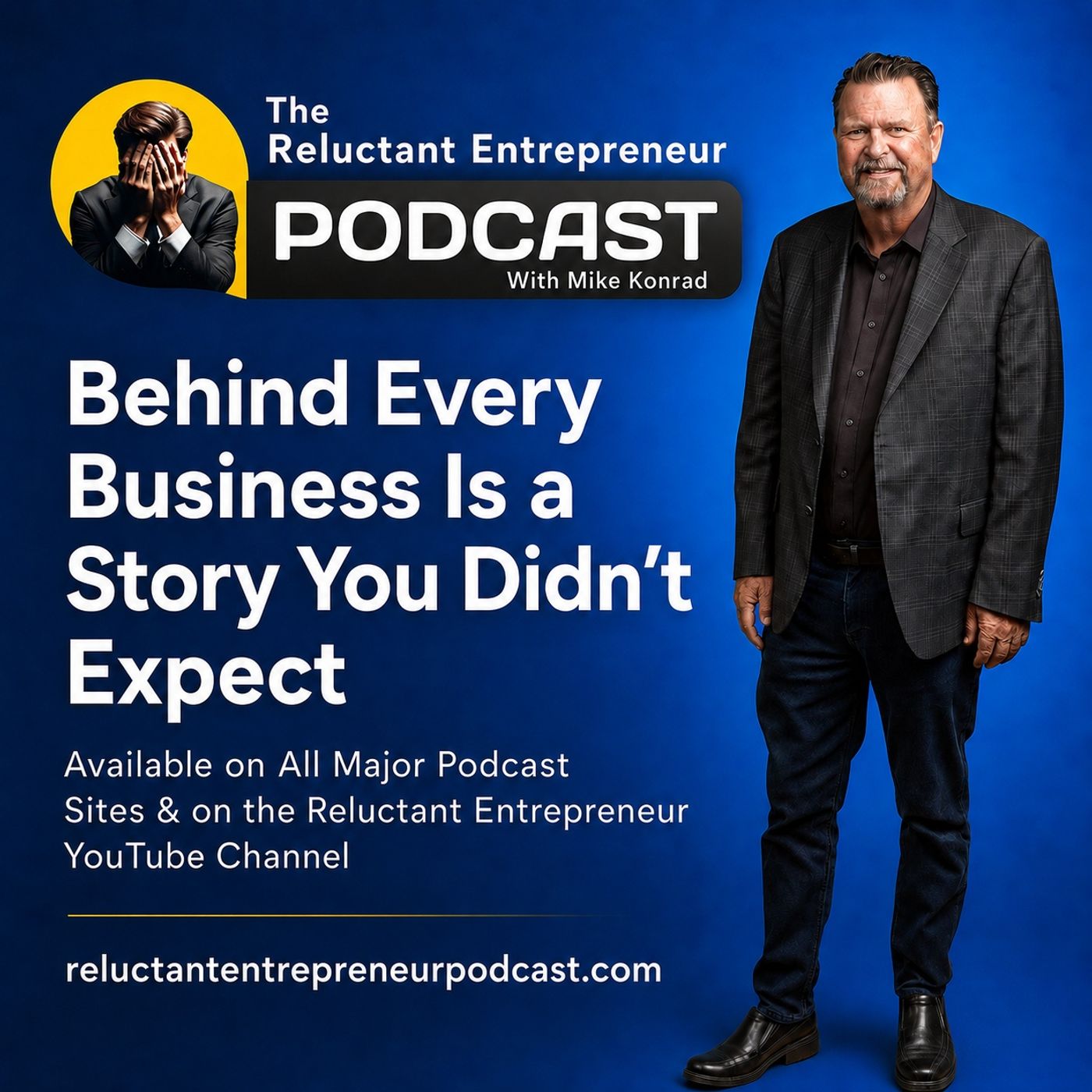
The Reluctant Entrepreneur Podcast
by Mike Konrad
I’m your host, Mike Konrad, the author of The Reluctant Entrepreneur - Anatomy of a Business Start-Up - From Uncertainty to Unstoppable, available on Amazon as a paperback, e-book, and an audible book, and I’m excited to share real stories that reveal the many paths people take to build their own businesses. Whether you stumbled into entrepreneurship or you’ve always known it was your calling, this podcast is for you.Let’s start with what it means to be a reluctant entrepreneur. Many entrepreneurs don’t set out with a grand plan to build a business. Maybe you worked for a company that didn’t value your vision, and one day you thought, “I could do this myself”, that was my story. Or maybe life pushed you in an unexpected direction—losing a job, facing a personal crisis, or discovering a passion that grew into a business. Reluctant entrepreneurs often find themselves starting a business not because they always dreamed of it, but because it was the best
-
94
The Fall of Theranos: Big Promises, Bigger Lies
Theranos promised to revolutionize healthcare.The company claimed it could perform a wide range of blood tests using just a few drops of blood from a finger prick. No large needles. No multiple vials. No long waits. It was a powerful idea, and people wanted to believe it.Hundreds of millions of dollars were invested. The company was valued in the billions. Elizabeth Holmes became a Silicon Valley icon, appeared on major stages, attracted glowing press coverage, and surrounded Theranos with powerful supporters, including high-profile investors and board members such as Henry Kissinger and George Shultz.Then it all collapsed.The company disappeared, investors lost hundreds of millions of dollars, patients were put at risk, and Holmes and former Theranos president Sunny Balwani were sentenced to prison.In this episode of Reluctant Lessons, we look beyond the headlines and examine the deeper business failure behind Theranos. This is not simply a story about fraud. It is a lesson in what happens when vision outruns verification, when credibility replaces proof, and when the story becomes bigger than the truth.
-
93
Fueling Growth Without Outside Capital - Eliot Vancil on Discipline, Leadership, and Letting Go
Most entrepreneurs dream about building a business that grows. But growth creates its own problems. More customers, more employees, more complexity, and eventually, a very uncomfortable question: is the business really scaling, or am I simply working harder?Today, I’m joined by Eliot Vancil, CEO of Fuel Logic, a nationwide mobile fuel delivery company serving commercial customers across all 48 states. Fuel Logic delivers diesel, gasoline, off-road diesel, DEF, and generator fuel directly to fleets, job sites, remote equipment, and other commercial operations.But Eliot’s story did not begin in fuel. Before Fuel Logic, he spent two decades building and exiting companies in the technology and IT services space. His entrepreneurial journey includes many of the challenges founders eventually face: doing too much himself, making leadership mistakes, building teams, rebuilding teams, and making the difficult shift from operator to CEO.We’ll talk about why he entered a business many people might overlook, how he built Fuel Logic without outside capital, why he refuses to compete only on price, and what it takes to build a company that does not depend entirely on the founder.Fuel Logichttps://www.fuellogic.net
-
92
Steady Growth in a Chaotic Business - How Ari Pirutinsky Built an Agency Around Process & Boundaries
What if the secret to scaling a business is not answering faster, working later, or being available every moment of the day?My guest today, Ari Pirutinsky, has built his career in a field where urgency is everywhere: paid media, client results, attribution, data, revenue, and growth. He is the founder and CEO of Steady Growth Partners, a firm focused on sustainable growth through paid search, paid social, performance creative, and better attribution systems.But what makes Ari especially interesting is not just that he understands growth. It is that he has built his business around the idea that growth should be steady, intentional, and sustainable, not chaotic, frantic, or all-consuming.He has helped scale an agency from two people to nearly seventy, worked with demanding B2B clients, and developed a clear philosophy around client trust, proactive communication, and building cultures where mistakes become learning opportunities rather than reasons for fear.And through all of that, Ari has been intentional about protecting the things that matter most: family, faith, and boundaries.So today, we are going to talk about growth, but not the reckless kind. We’re going to talk about scaling a business without losing yourself in the process.Steady Growth Partnershttps://steadygrowth-partners.com/#home
-
91
From Filmmaker to Founder: Christopher Weiher on Building a Creative Business That Cuts Through the Noise
What if the very thing you love doing creatively is the one thing standing between you and building a scalable business?A lot of creatives wrestle with that tension. They love the craft. They love the art. But the idea of turning that art into a company, managing clients, building systems, pricing services, hiring people, that is a completely different skill set.Today’s guest has lived at that intersection.My guest today is Christopher Weiher, founder of CLEAVER Creative, a video production and animation agency that helps companies transform complex ideas into compelling visual stories. Chris has spent more than two decades in filmmaking and video production, and over that time he made the leap from creative professional to business owner.In the first segment of today’s conversation, we will explore Chris’s entrepreneurial journey. What prompted him to start his own company? What surprised him about running a business? And what did he have to learn the hard way about turning creativity into revenue?In the second segment, we shift gears and talk about what he does best: storytelling through video. In a world drowning in content, how do you actually create video that drives engagement, builds authority, and produces measurable business results? And how should entrepreneurs be thinking about video today, especially in the age of AI and short attention spans?If you are a creative professional, a founder trying to build authority, or someone wondering how to use storytelling more strategically in your business, this episode is for you.Cleaver Creates website:https://www.cleavercreates.com
-
90
100 Episodes Later: Why the Reluctant Entrepreneur Still Matters - Episode 100
In this special 100th episode of The Reluctant Entrepreneur Podcast, Mike Konrad steps away from the interview format to reflect on the mission behind the show, the stories shared over the first 99 episodes, and the personal entrepreneurial journey that inspired it all.Mike shares why he started the podcast, what it means to be a “reluctant entrepreneur,” and why honest conversations about business matter more than polished success stories. He also reflects on his own path from founding Aqueous Technologies in 1992 to learning, often the hard way, that passion alone isn’t a business strategy.This episode is also a thank-you to the guests, listeners, entrepreneurs, and business owners who have been part of the journey. Mike also introduces the growing role of Reluctant Lessons, a series that looks at companies that rose, stumbled, collapsed, or lost their way, and asks what today’s entrepreneurs can learn from those stories.It’s a milestone episode about gratitude, humility, hard-earned wisdom, and the real story behind entrepreneurship.Podcast Website:https://www.reluctantentrepreneurpodcast.com
-
89
Reluctant Lessons: When the Mission Statement Couldn’t Pay the Rent
WeWork: When the Mission Statement Couldn’t Pay the RentWeWork had a simple business at its core: lease office space, make it attractive, and rent it back out to people and companies that wanted flexibility.But that wasn’t the story WeWork told.The story was bigger. Much bigger. WeWork wasn’t just offering desks and conference rooms. It was selling community, connection, a new way to work, and even a mission to “elevate the world’s consciousness.”For a while, the world bought the story. Investors poured in hundreds of millions of dollars, and eventually billions more. The press followed the hype. Customers filled stylish offices around the world. At its peak, WeWork reached a valuation of $47 billion.Then came the IPO.What was supposed to be the company’s coronation became an autopsy. Investors looked closer and saw massive losses, long-term lease obligations, questionable governance, and a founder whose ambition had grown far beyond the business beneath it.In this episode of Reluctant Lessons, we look at the rise and fall of WeWork, a company with a useful idea, a powerful brand, and a mission statement that became larger than reality.This is a story about hype, hubris, valuation, leadership, and the danger of confusing investment with validation.Because in the end, the mission statement couldn’t pay the rent.
-
88
The Business of Being Useful - Nathan Gwilliam on Adoption.com & Entrepreneurial Purpose
Most entrepreneurs don’t start with a fully formed company. Sometimes they start with a problem they can’t stop thinking about.My guest today, Nathan Gwilliam, is a serial entrepreneur, podcaster, and platform builder. He is widely known as the founder of Adoption.com, a company that grew from a deeply personal mission to use the internet to help children and families through adoption.Nathan’s story is especially interesting because it sits at the intersection of purpose, technology, and entrepreneurship. Adoption.com was not just another website. It was an early example of using the internet to connect people, solve a deeply human problem, and build trust online at a time when the internet itself was still new to many people.But Nathan’s entrepreneurial journey didn’t stop there. Today, he is the founder and CEO of PodUp, an all-in-one podcasting platform designed to help entrepreneurs and creators create, grow, and monetize their shows. Rather than forcing podcasters to stitch together separate tools for recording, editing, websites, marketing, and monetization, PodUp brings many of those functions together into a single platform.Nathan is also behind Podcasting Secrets, where he interviews successful podcasters and experts and shares strategies for using podcasting to build credibility, authority, audience, and revenue.That idea is especially important today. Many entrepreneurs spend years building visibility on rented platforms, such as social media sites or video channels they don’t control. Nathan’s work challenges business owners to think differently: not just about getting attention, but about building an audience, a message, and a platform that can create lasting value.So today we’ll talk about the journey behind Adoption.com, what it takes to build a company around a mission, how Nathan moved from adoption advocacy into podcasting technology, and why he believes podcasting can be one of the most powerful tools for entrepreneurs who want to build trust, authority, and a platform they truly own.Podup:https://podup.comPodcasting Secrets: Grow Your Podcast:https://www.youtube.com/@podcasting-secrets
-
87
The Fall of Borders: Big Stores, Big Revenue, Bigger Mistakes
On this episode of Reluctant Lessons - Where Businesses Go Wrong:At its peak, Borders was one of the most recognizable names in bookselling, with more than 1,200 Borders and Waldenbooks locations and annual revenue exceeding $4 billion. It was not just a bookstore. It was a destination where customers browsed books, music, movies, magazines, and gifts while spending time in a comfortable retail environment.But just a few years later, Borders filed for bankruptcy. The company that once helped define the big-box bookstore experience was gone.So what went wrong?In this episode of Reluctant Lessons, we look at the rise and fall of Borders, including one of the most consequential strategic decisions in retail history: outsourcing its online business to Amazon. At the time, it may have looked like a practical move. Borders could focus on its stores while Amazon handled online commerce.But e-commerce was not just another sales channel. It was the future of the customer relationship.This episode explores how Borders lost momentum, failed to build critical digital capabilities, underestimated changing customer behavior, and gave a future competitor access to the very space where the next generation of bookselling was being built.The lesson is bigger than books.Your current strength can become your future weakness. And if you hand someone else the keys to where your customers are going, you may not get them back.
-
86
The Prosperity Mindset Shift - Randy Gage on Breaking Limiting Beliefs and Scaling Success
Most people think success is about playing it safe. Get the degree. Build the resume. Avoid the big risks.But what if that thinking is exactly what keeps people stuck? What if in today’s world… safe is actually the riskiest move you can make?Today’s guest has spent decades challenging conventional thinking around success, wealth, and entrepreneurship. Randy Gage is a New York Times bestselling author, a Hall of Fame speaker, and someone who has spoken to more than two million people across over 50 countries. But what makes his story especially compelling isn’t just the success.It’s where he started.As a teenager, Randy was arrested and served time in juvenile detention. From there, he rebuilt his life, eventually becoming a successful entrepreneur, author of more than a dozen books, and a global voice on prosperity and critical thinking. He’s best known for books like Risky Is the New Safe and Mad Genius, where he challenges the traditional rules of business and argues that in a rapidly changing world, the biggest risk is standing still. In this episode, we’re going to explore that idea from two angles.First, Randy’s journey, from early struggles and setbacks to building a global platform and influencing millions.Then, we’ll dive into his current work and perspective on what it really takes to succeed today, including how entrepreneurs need to think differently about risk, opportunity, and the future of business.Randy's Website:https://randygage.com
-
85
Turning Business into a Game Creatives Can Understand - With Gamify Business's Paul Pape
There are many entrepreneurs who start with a business plan, a market analysis, and a carefully mapped-out strategy. And then there are the rest of us.We start with a skill, a product, a craft, or an idea. We get good at making something, solving something, or creating something. Then one day we realize that being good at the work and being good at the business of the work are two very different things.My guest today understands that difference firsthand.Paul Pape is an artist, designer, maker, creative business strategist, and founder of Gamify Business. After more than 20 years building a creative business, including custom work connected with major entertainment brands, Paul began helping other creative professionals understand business in a language that actually makes sense to them.His approach uses gaming concepts, RPG language, and creative frameworks to explain pricing, marketing, client relationships, planning, and growth. In other words, he helps creative entrepreneurs stop feeling like they are playing someone else’s game and start building a business that fits the way they think.Gamify Businesshttps://gamifybusiness.com
-
84
When the Day Goes Off the Rails - Mridu Parikh on Focus, Systems, and Getting the Right Things Done
We all start the day with good intentions. Then the emails arrive. The phone rings. A customer needs something. A team member has a question. A small problem becomes urgent, and before you know it, the work you planned to do never gets done.For entrepreneurs, that’s more than frustrating. It can be dangerous. Because the most important work in a business is often the easiest work to postpone.Today, I am joined by Mridu Parikh, founder of Life Is Organized. Mridu is a productivity coach, speaker, host of the Productivity on Purpose podcast, and author of Accomplish It: 7 Simple Actions to Get the Right Things Done and Achieve Your Goals. She’s also a Ted X speaker (I can feel the envy running through my veins!)She is also known as The Stress Squasher, helping busy professionals and entrepreneurs take control of their demands, distractions, and priorities so they can focus on the work that matters most. In this conversation, we’ll talk about her entrepreneurial journey, how she built her business, and then we will get very practical. We’ll discuss how to reset when the day goes off the rails, how to create a to-do list that actually works, how to manage distractions, and how entrepreneurs can make time for revenue-generating work without sacrificing their own well-being.https://lifeisorganized.comhttps://www.dearfoundher.comMridu's Book:Accomplish It: 7 Simple Actions to Get the Right Things Done and Achieve Your Goalshttps://tinyurl.com/mv44ndh3
-
83
Salvatore Tirabassi on The Financial Mistakes That Kill Growing Companies
Most entrepreneurs think they understand their numbers.Revenue. Profit. Cash flow. But the reality is, many businesses fail not because they don’t grow… But because they don’t understand what their numbers are actually telling them.Today’s guest has spent decades on both sides of that equation.As an investor…As a CFO…And now as an entrepreneur helping companies turn financial data into strategy.Today’s guest is Salvatore Tirabassi, Managing Director of CFO Pro+Analytics. Sal brings over 25 years of experience across venture capital, private equity, and executive financial leadership. He has raised over $400 million in capital, participated in multiple acquisitions, and now works as a fractional CFO helping companies scale through better financial strategy and analytics. https://cfoproanalytics.com
-
82
Jack Oujo on Pressure, Decisions, & Trust Lessons From the Baseball Field and Business
Everyone sees the success.The career. The title. The outcome.What they don’t see is what happens when the path you committed your life to suddenly ends.Not gradually. Not on your terms.Just… over.And in that moment, all the discipline, all the effort, all the sacrifice… doesn’t disappear. But it no longer has a place to go. That’s where the real story begins.Today’s guest, Jack Oujo has lived that reality at a very high level, through a career that required a complete reinvention.He spent eight years as a professional baseball umpire, rising to Triple-A, one step away from the major leagues, and was even recognized as one of the top prospects in the minor leagues. And then, it ended. No major league call-up. No gradual transition. Just the reality that the path he had committed to was no longer there.What followed wasn’t immediate success. It was starting over, rebuilding identity, and figuring out how to apply years of discipline and decision-making in an entirely new arena. That next arena was financial services. Starting with no built-in client base, no brand, and no safety net, Jack went on to build one of the nation’s largest tax-focused wealth management firms, managing hundreds of millions in assets and earning recognition as one of the top advisors in the country. But what makes his story especially relevant isn’t just the success. It’s how he got there. Preparation. Emotional control. Making decisions under pressure. Earning trust over time, not expecting it up front.The same skills required to call a game when everyone is watching and everyone has an opinion.He’s also the author of the book Too Smart to Be an Umpire, which explores what happens when the original plan falls apart and what it really takes to rebuild something meaningful in its place.In the first part of our conversation, we’ll talk about that transition. What it feels like when a career ends abruptly, and how to begin again when there is no clear path forward.In the second part, we’ll shift into his work today. We’ll talk about leadership under pressure, building credibility, and how to guide people through uncertainty when the stakes are high.If you’ve ever faced a setback, a pivot, or a moment where things didn’t go as planned, this is a conversation you’re going to connect with.https://toosmarttobeanumpire.com
-
81
EA Clarke on How Founders Get Hiring Wrong -And What to Do Instead
Entrepreneurship is often portrayed as a talent problem. Find the right people, build the right team, and everything else falls into place.But what if the real problem isn’t talent at all? What if the problem is that most companies have no idea how to attract the right people in the first place? Because hiring isn’t just a process. It’s a story. And most companies are telling the wrong one.Today’s guest, EA Clarke, has spent more than 30 years inside the recruiting world, not just observing it, but breaking it.As the founder of Pivot + Edge, he’s built a company designed to challenge traditional recruiting by flipping the model entirely, shifting from transactional hiring to a marketing-driven, story-led approach. He’s not just a recruiter. He’s a serial entrepreneur who has built and exited early-stage companies, raised capital, and experienced firsthand what it actually takes to scale a team when you don’t yet have the brand, the systems, or the playbook. In the first part of our conversation, we’ll talk about that journey. The reality of building companies without a roadmap, the hiring mistakes that almost every founder makes, and what he learned the hard way about scaling beyond your immediate network.Then in the second part, we’ll shift to what he’s focused on today. Why traditional hiring is fundamentally broken, how storytelling has become one of the most powerful tools in attracting top talent, and how founders can compete for high-impact people without simply throwing more money at the problem.If you’ve ever struggled to hire the right people, or wondered why great candidates seem just out of reach, this is a conversation that will challenge how you think about building a team.https://www.pivotandedge.com
-
80
The Camera Changed Everything - Anthony Prichard on Video, Trust, and Small Business Growth
Most entrepreneurs are told they need better marketing, better sales, better funnels, and better technology. But sometimes the most powerful business tool is much simpler: a camera, a clear message, and the willingness to be useful before asking for the sale.Today, we are talking with Anthony Prichard, a former general contractor who moved from construction and corporate sales into video marketing, YouTube strategy, SEO, and digital growth for small businesses. Anthony helps business owners use short educational videos to build trust, get found, and generate leads without relying entirely on traditional sales tactics.In the first part of our conversation, we’ll talk about Anthony’s entrepreneurial journey, including the shift from construction to video marketing and the challenges of building a business in an industry that never stops changing. In the second part, we’ll discuss how entrepreneurs can use video more effectively, why many businesses still avoid it, and how a simple one-minute video can become a serious business development tool.https://anthonyprichard.com
-
79
From Setbacks to Swag Stores - Jay Sapovits on Entrepreneurship, Recovery, and Rebuilding
Most entrepreneurs are told they need a world-changing idea. But what if that is the wrong goal? What if the better goal is to build something that changes your world?My guest today is Jay Sapovits, founder of Ink’d Stores, a branded merchandise, custom apparel, promotional products, and online store company.Jay’s path was not built around a perfect plan or a Silicon Valley-style breakthrough. In fact, Jay makes a powerful point: the idea is usually not the business. Execution is the business. Courage is the business. Seeing a problem, offering a solution, and taking action is the business. Jay has experienced reinvention, public failure, financial pressure, and the difficult process of rebuilding. He’s also built a company he loves, in an industry where no one was waiting for one more competitor to show up.This is a conversation about being scared to stay, scared to leave, finding courage through desperation, learning from failure, and building a business that may not change the world, but can absolutely change your world.https://inkdstores.com
-
78
The Prosperity Mindset Shift - Randy Gage on Breaking Limiting Beliefs and Scaling Success
Most people think success is about playing it safe. Get the degree. Build the resume. Avoid the big risks.But what if that thinking is exactly what keeps people stuck? What if in today’s world… safe is actually the riskiest move you can make?Today’s guest has spent decades challenging conventional thinking around success, wealth, and entrepreneurship. Randy Gage is a New York Times bestselling author, a Hall of Fame speaker, and someone who has spoken to more than two million people across over 50 countries. But what makes his story especially compelling isn’t just the success.It’s where he started.As a teenager, Randy was arrested and served time in juvenile detention. From there, he rebuilt his life, eventually becoming a successful entrepreneur, author of more than a dozen books, and a global voice on prosperity and critical thinking. He’s best known for books like Risky Is the New Safe and Mad Genius, where he challenges the traditional rules of business and argues that in a rapidly changing world, the biggest risk is standing still. In this episode, we’re going to explore that idea from two angles.First, Randy’s journey, from early struggles and setbacks to building a global platform and influencing millions.Then, we’ll dive into his current work and perspective on what it really takes to succeed today, including how entrepreneurs need to think differently about risk, opportunity, and the future of business.https://randygage.com
-
77
The Magic Is Not Magic: Vance Morris on Disney Systems, Bankruptcy, and Building Back
For many entrepreneurs, the journey does not begin with a business plan. It begins with a problem, a setback, or sometimes a job they never imagined would shape the rest of their career.My guest today, Vance Morris, has taken one of the more unusual paths into entrepreneurship. He went from working as a security guard in a birth control factory, to a decade in Disney management, to bankruptcy, to building a successful brick-and-mortar service business, and then helping other business owners create better customer experiences.Vance is known for taking lessons from Disney and translating them into practical systems that small businesses can actually use. Not theory. Not magic. Systems.https://vancemorris.comhttps://www.deliverservicenow.com/
-
76
When the Founder Becomes the Bottleneck - Charlie Birch on Building a Brand That Can Grow Beyond You
For many entrepreneurs, the business starts as an extension of the founder.Their instincts.Their values.Their voice.Their judgment.Their way of making decisions.And in the early days, that can be one of the company’s greatest strengths.The founder sees things others do not see. The founder protects the customer experience. The founder knows what feels right, what feels wrong, and what the brand is supposed to stand for.But what happens when the business starts to grow?What happens when the team expands, the decisions multiply, and every important question still has to run through the founder? At some point, the very thing that helped launch the company can become the thing that limits its growth.Today, we’re talking about founder dependency, brand identity, and how entrepreneurs can build companies that remain human, authentic, and aligned without requiring the founder to personally hold every piece together.My guest today is Charlie Birch, founder of Humaniz Collective. Charlie helps founder-led businesses turn instinct into clarity, personality into purpose, and founder vision into a brand that can be understood, shared, and protected by the entire organization.https://www.humanizcollective.com
-
75
More Content Is Not Always the Answer - Rachel Allen on the Copy That Actually Builds Connection
Most entrepreneurs think their marketing problem is a visibility problem. They believe they need more posts, more emails, more funnels, more content, more noise.But what if the real problem is not that people do not know you exist? What if the real problem is that your words are not building enough trust?Today, I’m joined by Rachel Allen, founder of Bolt from the Blue Copywriting. Rachel describes her work as “data-driven, human-centered marketing for good people doing hard work that matters.” She has run a marketing business for 16 years, worked with clients in more than 21 countries, and written for businesses ranging from major names in entrepreneurship to brick-and-mortar companies, influencers, and nonprofits. Today, we’ll talk about her entrepreneurial journey, what it takes to build a marketing business over the long term, and why authentic, human-centered communication may matter more than ever in an increasingly automated world.https://www.boltfromthebluecopywriting.com
-
74
The Alignment Problem That Slows Down Companies - Fixing What's Beneath the Surface with Carly Pepin
There’s a common belief in business that if something isn’t working, the answer is to change the strategy. Adjust the plan. Work harder. Push faster. But what if the real problem isn’t the strategy at all?What if the bottleneck… is the person leading it?Today’s guest, Carly Pepin, works at the intersection of business growth and human behavior. She helps founders and leadership teams scale their companies, not just by improving systems and processes, but by addressing the underlying patterns in decision-making, communication, and alignment that often determine whether a business moves forward… or stalls out.In the first part of the conversation, we’ll explore Carly’s journey. How she got into this space, the challenges she faced early on, and the moments that shaped her perspective on leadership and growth.In the second part, we’ll dig into her work. What alignment really means inside an organization, why so many scaling efforts break down, and what leaders may be overlooking when they try to take their business to the next level.If you’ve ever felt like your business should be further along than it is… this conversation may challenge how you think about why. https://www.westcoastgrowthadvisors.com
-
73
Tanya Brody on How to Think Like Your Customer Before You Write a Single Word - Episode 84
Let me start with a simple question. Why do so many businesses create content… and still fail to generate real demand? Because content alone doesn’t convert. Messaging does.Today’s guest, Tanya Brody, has built her career around understanding exactly what makes people take action. She’s a persuasive web and SEO copywriter, a conversion specialist, and a marketing consultant who has worked with both major companies and small businesses to turn words into measurable results. But her path wasn’t linear. From performing as a professional musician to losing a traditional job and launching her own freelance business, Tanya’s journey is a real-world example of what happens when necessity meets opportunity. In the first part of our conversation, we’ll explore that journey… the risks, the pivots, and what she learned making the leap into entrepreneurship.In the second half, we’ll dig into her expertise in copywriting and conversion… what businesses get wrong, and how to fix it.Tanya's website:https://tanyabrodycopywriter.com
-
72
Chris Anderson on Turning Listeners Into Leads - A Smarter Approach to Podcasting - Episode 83
Most entrepreneurs believe that if they just create enough content, something good will eventually happen• More posts• More videos• More podcastsBut for many, nothing actually changes• No new clients• No meaningful growth• No real return on the time investedSo the question becomes "What if the problem isn’t how much content you’re creating, but why you’re creating it in the first place?"What if content, by itself, isn’t the strategy?What if the real objective isn’t content at all, but demand?Today’s guest, Chris Anderson, has built his business around that exact ideaChris is the founder and CEO of Elevate Media Group, where he works with entrepreneurs to turn podcasting and content into a client acquisition engine.In the first segment of the episode, we’ll explore Chris’s entrepreneurial journeyWhat led him to start his business, the challenges he faced early on, and what he learned along the way.In the second part of the show, we’ll dive into the real topic at hand:Why most content fails to deliver results and how to shift from simply creating content… to actually creating demand. Because in the end, content doesn’t build a business, demand does. Chris's Company:Elevate Mediahttps://elevate-media-group.comChris'sElevate Media Podcast:https://www.youtube.com/@UCP61IwNOb5WWUYAp7ypc49A
-
71
Rocky Lalvani: Why So Many Businesses Run Out of Cash. Profit on Paper Doesn't Mean Cash in the Bank - Episode 82
Most people assume that if your business is growing, you’re winning. But the reality is, growth without profit can quietly destroy even the most promising companies.Today’s guest, Rocky Lalvani, has built his career helping business owners solve one of the most common and misunderstood problems in entrepreneurship: cash flow.Rocky is the founder of Profit Comes First and serves as a Chief Profitability Advisor, helping business owners rethink the way they manage money and prioritize profit. In the first half of this episode, we’ll explore Rocky’s entrepreneurial journey, including the lessons he learned along the way.In the second half, we’ll dig into the Profit First philosophy and how business owners can take control of their finances, improve cash flow, and actually keep what they earn.Rocky's Company:Profit Comes First:https://profitcomesfirst.comRocky recommended the following book:Islands of Profit in a Sea of Red Ink: Why 40 Percent of Your Business Is Unprofitable and How to Fix Ithttps://tinyurl.com/3z2febkrRocky is offering a free copy of his book:The Profit Blueprinthttps://tinyurl.com/yc4jz342
-
70
Building a Brand Without Big Retail: Kate Assaraf's Main Street Strategy - Episode 80
Let me start with a question.If you were building a consumer brand today and someone told you that the fastest way to grow was to sell on Amazon, partner with big retailers, and pour money into influencer marketing, would you do it?Most founders would say yes. In fact, many would say those steps are almost unavoidable. But what if you decided to do the exact opposite?My guest today did exactly that.Kate Assaraf is the founder and CEO of DIP, a sustainable haircare brand that has grown into a seven-figure business built primarily through Shopify and a loyal community of customers. But what makes Kate’s story so interesting is not just the growth of the company. It is the path she chose to take to get there.Kate made the intentional decision not to sell on Amazon, not to rely on venture capital, and not to chase the typical influencer-driven growth strategies that dominate the direct-to-consumer world.Instead, she built a brand centered on values, storytelling, and something that many ecommerce founders overlook: the survival of small, local retailers.In fact, Kate sometimes directs customers away from her own website and toward independent refill shops and neighborhood boutiques across the country. Her belief is that the future of retail is not either ecommerce or Main Street. It is both working together.Kate has been recognized as NJ Mompreneur of the Year, is a member of the Forbes Business Council, and her brand DIP has been recognized by Oprah as Curly Hair Brand of the Year.Today, she’s becoming a leading voice in a growing conversation among founders: how to build a successful business without selling out your mission, your margins, or your values. And how do you do that? Stick around, we’ll find out together.DIP:https://dipalready.com
-
69
Growing the Founder: Andrew Poles on the Leadership Gap in Entrepreneurship - Episode 79
Many people believe that the hardest part of starting and growing a business is coming up with the right idea, finding customers, or raising capital. But according to today’s guest, the most difficult challenge entrepreneurs face may be something far more personal: becoming the leader their company needs them to be.Decisions become more complex. Teams get larger. The stakes get higher. And the skills that helped someone start the business are often not the same skills required to lead it at scale.My guest today, Andrew Poles, has spent more than two decades working with entrepreneurs and executives who are navigating exactly that challenge. As an executive coach and multi-time founder, Andrew focuses on helping leaders grow into the role their companies demand of them. He has worked with thousands of founders and executives to help them manage the pressure of leadership, build stronger teams, and scale their businesses without sacrificing their health, their relationships, or their sanity.Today we’re going to talk about the leadership gap many founders encounter, the pressure that comes with scaling a business, and why growing yourself may be the most important part of growing your company.Andrew's Website:'https://andrewpoles.comLinkedIn:https://www.linkedin.com/in/andrewpoles/
-
68
Thinking Beyond Borders: How Bobby Casey Helps Entrepreneurs Build Global Businesses - Episode 78
Many entrepreneurs build businesses within the systems they know, the tax structures they understand, and the borders they grew up in. But today’s guest has spent his career helping founders think much bigger than that.I guess today, Bobby Casey has started, bought, or sold more than a dozen companies while living in ten different countries and traveling through more than eighty others. Along the way he developed deep expertise in international tax strategy and global business structuring, eventually founding Global Wealth Protection to help entrepreneurs protect their assets, minimize taxes, and design businesses that are truly portable.What makes Bobby especially interesting is that he combines technical expertise with firsthand entrepreneurial experience. He understands both the legal complexity and the real-world challenges founders face when they try to scale, expand internationally, or simply build a life with more freedom.In the first part of our conversation we will explore Bobby’s entrepreneurial journey. Then in the second half we will dive into how entrepreneurs can think differently about taxes, global opportunity, and building businesses that are resilient in a changing world.Business Anywherehttps://businessanywhere.ioGlobal Wealth Protectionhttps://globalwealthprotection.com
-
67
Entrepreneurship Without Borders: Brian Samson's Nearshoring Revolution - Episode 77
You know, many entrepreneurs start businesses because they’ve always dreamed of building a company. Others stumble into it almost by accident. But sometimes, the spark for entrepreneurship comes from something much simpler… curiosity about the world.Imagine visiting another country, falling in love with the culture, the people, and the possibilities, and realizing there might be an entirely new way to build businesses across borders. That’s exactly what happened to today’s guest.Brian Samson is the founder of Plugg Technologies, a company that helps U.S. businesses scale by connecting them with highly skilled tech talent across Latin America. His entrepreneurial journey took an unexpected turn after traveling to Argentina, where he discovered both the energy of the region and a massive untapped pool of technical talent. That experience eventually led him to build a company focused on nearshore staffing and global teams. Brian is also the host of The Nearshore Cafe Podcast, where he interviews founders, executives, and innovators about global hiring, remote teams, and the evolving tech ecosystem across the Americas. Today we’ll talk about Brian’s journey from traveler to entrepreneur, what he learned building companies across borders, and why the future of entrepreneurship might be far more global than many founders realize. Plugg Technologies:https://plugg.techThe Nearshore Cafe Podcasthttps://www.nearshorecafepodcast.com
-
66
From Startup and Sale to M&A Advisor: Marty Fahncke’s Journey - Episode 76
Most entrepreneurs think about growth in one way. Sell more products, add more customers, hire more people. But what if there was another way to grow your business dramatically without having to sell more “stuff”? My guest today says there is.Joining me today is Marty Fahncke, a seasoned marketer and mergers and acquisitions advisor with more than 30 years of experience growing and scaling businesses, and over 20 years of experience in M&A. Over the course of his career, Marty has helped companies scale to more than one billion dollars in total revenue and has executed more than $450 million in mergers and acquisitions transactions. Interestingly, Marty’s introduction to acquisitions came early when a business he co-launched with friends was acquired for seven figures after just 18 months. That experience launched a career helping entrepreneurs buy businesses, sell businesses, and grow through acquisition.Today Marty is a Certified Merger and Acquisition Advisor and a partner at Westbound Road, where he helps founders navigate the complex process of buying and selling companies.In this episode we’re going to talk about two topics every entrepreneur should understand:How acquisitions can be used to grow a company dramatically, and how to position your business so that when the time comes, you can sell it for maximum value.Marty's Website:WESTBOUND ROAD, LLChttps://www.westboundroad.com
-
65
Seven Books and 5 Million Listeners: Dr. Lee Baucom’s Platform-Building Journey - Episode 75
You know, when people think about entrepreneurship, they often imagine someone who set out from the very beginning to build a business. They picture a clear plan, a strategy, maybe even a five-year roadmap. But the reality is that many entrepreneurs never planned to become entrepreneurs at all. They simply followed a problem they wanted to solve, a message they felt compelled to share, or an idea that refused to leave them alone.My guest today is a great example of that kind of journey.Dr. Lee Baucom is a marriage therapist who started with a simple mission: helping couples navigate difficult relationships. But along the way, that mission expanded. Lee began writing books. In fact, he has now written seven of them. He launched podcasts, including the Save The Marriage Podcast, which has amassed more than 5.5 million downloads and tens of thousands of active listeners. And over time, he discovered something that many authors eventually realize. A book is rarely the end of the journey. Often, it is the beginning.That realization led Lee to build programs, resources, and tools designed to help people take the ideas in their books and turn them into something larger. Something that creates real impact. Something that reaches people who need it.In many ways, Lee’s path reflects what we talk about so often on this podcast. Entrepreneurship is not always about chasing a business opportunity. Sometimes it grows naturally from expertise, experience, and a desire to help people.In our conversation today, we’re going to talk about Lee’s journey from therapist to author to entrepreneur. We’ll discuss how writing a book can open unexpected doors, how platforms and audiences are built over time, and why many entrepreneurs discover that the thing they thought was the destination was really just the starting point.Lee's Books:How To Save Your Marriage In 3 Simple Steps: Even If Only YOU Want To!https://tinyurl.com/4rfwyukzRecovering From The Affair: Your Guide To Saving Your Marriage After Emotional Or Physical Infidelityhttps://tinyurl.com/mrysn5hjThe Thrive Journal: Your Daily Journal for Building a Thriving Lifehttps://tinyurl.com/mw7wvxhrThrive Principles: 15 Strategies For Building Your Thriving Lifehttps://tinyurl.com/yjxh5uxyMarriage Fail Point: Why Your Marriage Is Failing and How To Turn It Aroundhttps://tinyurl.com/2k35zw4zBeyond The 3 Barriers: Why Your Spouse Can’t See A Way Forward And How You Can Helphttps://tinyurl.com/rz67c92uThe Forgive Process: A Little Book on Forgiving and Letting Gohttps://tinyurl.com/4xc5z3dzLee's Website:The Book-To-Business Blueprinthttps://booktobusinessblueprint.comThe Save The Marriage Podcasthttps://www.iheart.com/podcast/256-the-save-the-marriage-podc-31102118
-
64
The Dog Days of Startup Life: How Courtney Honda and Slava Borisov Built Pupte - Episode 81
You know, sometimes the best business ideas don’t start with spreadsheets, market research, or a carefully written business plan. Sometimes they start with something much simpler. A passion. A community. Or in today’s case… a love of dogs.Now the pet industry is enormous. In the United States alone it’s well over a hundred billion dollars a year. But despite that massive market, many pet businesses still look pretty much the same. Retail shelves, products on hooks, and a checkout counter.But what if a pet business wasn’t just a place to buy things for your dog? What if it was a place designed around the relationship between dogs and their humans? A place built around community, experiences, and connection.That’s exactly the idea behind Puptqe.Today I’m joined by Courtney Honda and Slava Borisov, the founders of Puptqe, a fast-growing brand that’s rethinking what a pet business can be. Instead of focusing only on products, they’ve created a space where dog lovers gather, socialize, attend events, and celebrate the bond we share with our four-legged companions.But like most entrepreneurial stories, the road from idea to reality wasn’t perfectly straight. It required risk, creativity, and a willingness to build something new in a very competitive industry.So today we’re going to talk about how Puptqe came to life, what it takes to build a brand around community, and what Courtney and Slava have learned along the way as founders.Puptqehttps://puptqe.com
-
63
The Toy Store That Became a Case Study: Toys "R" Us and Where It Went Wrong - Episode 7
At one point, Toys "R" Us wasn’t just a retailer. It was the retailer in its category.For decades, it dominated toy sales, influenced which products succeeded, and created an experience that defined childhood for millions. Its stock climbed to roughly $45 per share, reflecting complete confidence in its future.Then, slowly… things changed.In this episode of Reluctant Lessons: Where Businesses Go Wrong, I take a closer look at what really happened to Toys "R" Us. This isn’t a story about a single bad decision. It’s about how a highly successful business model, one built on scale, selection, and physical presence, struggled to adapt as the market evolved.We explore:• How Toys "R" Us became the gatekeeper of the toy industry• Why supplier relationships were both a strength and a vulnerability• The strategic decisions that shaped its trajectory, including its approach to e-commerce• The impact of shifting consumer behavior and rising competition from companies like Walmart and Amazon• And how a leveraged buyout changed the company’s ability to respond at a critical momentThe lesson isn’t just about retail. It’s about what happens when a dominant company assumes the system that made it successful will continue to work… even as the environment around it changes.Success can create momentum. But it can also create inertia. And when the market shifts, that inertia can become a liability.
-
62
Growing the Founder: Andrew Poles on the Leadership Gap in Entrepreneurship - Episode 79
Many people believe that the hardest part of starting and growing a business is coming up with the right idea, finding customers, or raising capital. But according to today’s guest, the most difficult challenge entrepreneurs face may be something far more personal: becoming the leader their company needs them to be.Decisions become more complex. Teams get larger. The stakes get higher. And the skills that helped someone start the business are often not the same skills required to lead it at scale.My guest today, Andrew Poles, has spent more than two decades working with entrepreneurs and executives who are navigating exactly that challenge. As an executive coach and multi-time founder, Andrew focuses on helping leaders grow into the role their companies demand of them. He has worked with thousands of founders and executives to help them manage the pressure of leadership, build stronger teams, and scale their businesses without sacrificing their health, their relationships, or their sanity.Today we’re going to talk about the leadership gap many founders encounter, the pressure that comes with scaling a business, and why growing yourself may be the most important part of growing your company.Andrew's Website:'https://andrewpoles.comLinkedIn:https://www.linkedin.com/in/andrewpoles/
We're indexing this podcast's transcripts for the first time — this can take a minute or two. We'll show results as soon as they're ready.
No matches for "" in this podcast's transcripts.
No topics indexed yet for this podcast.
Loading reviews...
ABOUT THIS SHOW
I’m your host, Mike Konrad, the author of The Reluctant Entrepreneur - Anatomy of a Business Start-Up - From Uncertainty to Unstoppable, available on Amazon as a paperback, e-book, and an audible book, and I’m excited to share real stories that reveal the many paths people take to build their own businesses. Whether you stumbled into entrepreneurship or you’ve always known it was your calling, this podcast is for you.Let’s start with what it means to be a reluctant entrepreneur. Many entrepreneurs don’t set out with a grand plan to build a business. Maybe you worked for a company that didn’t value your vision, and one day you thought, “I could do this myself”, that was my story. Or maybe life pushed you in an unexpected direction—losing a job, facing a personal crisis, or discovering a passion that grew into a business. Reluctant entrepreneurs often find themselves starting a business not because they always dreamed of it, but because it was the best
HOSTED BY
Mike Konrad
CATEGORIES
Loading similar podcasts...
Frequently Asked Questions
How many episodes does The Reluctant Entrepreneur Podcast have?
The Reluctant Entrepreneur Podcast currently has 33 episodes available on PodParley. New episodes are automatically indexed when they're published to the podcast feed.
What is The Reluctant Entrepreneur Podcast about?
I’m your host, Mike Konrad, the author of The Reluctant Entrepreneur - Anatomy of a Business Start-Up - From Uncertainty to Unstoppable, available on Amazon as a paperback, e-book, and an audible book, and I’m excited to share real stories that reveal the many paths people take to build their own...
How often does The Reluctant Entrepreneur Podcast release new episodes?
The Reluctant Entrepreneur Podcast has 33 episodes. Check the episode list to see recent publication dates and frequency.
Where can I listen to The Reluctant Entrepreneur Podcast?
You can listen to The Reluctant Entrepreneur Podcast on PodParley by clicking any episode. We provide an embedded audio player for direct listening, and you can also subscribe via your preferred podcast app using the RSS feed.
Who hosts The Reluctant Entrepreneur Podcast?
The Reluctant Entrepreneur Podcast is created and hosted by Mike Konrad.
URL copied to clipboard!