
PODCAST · business
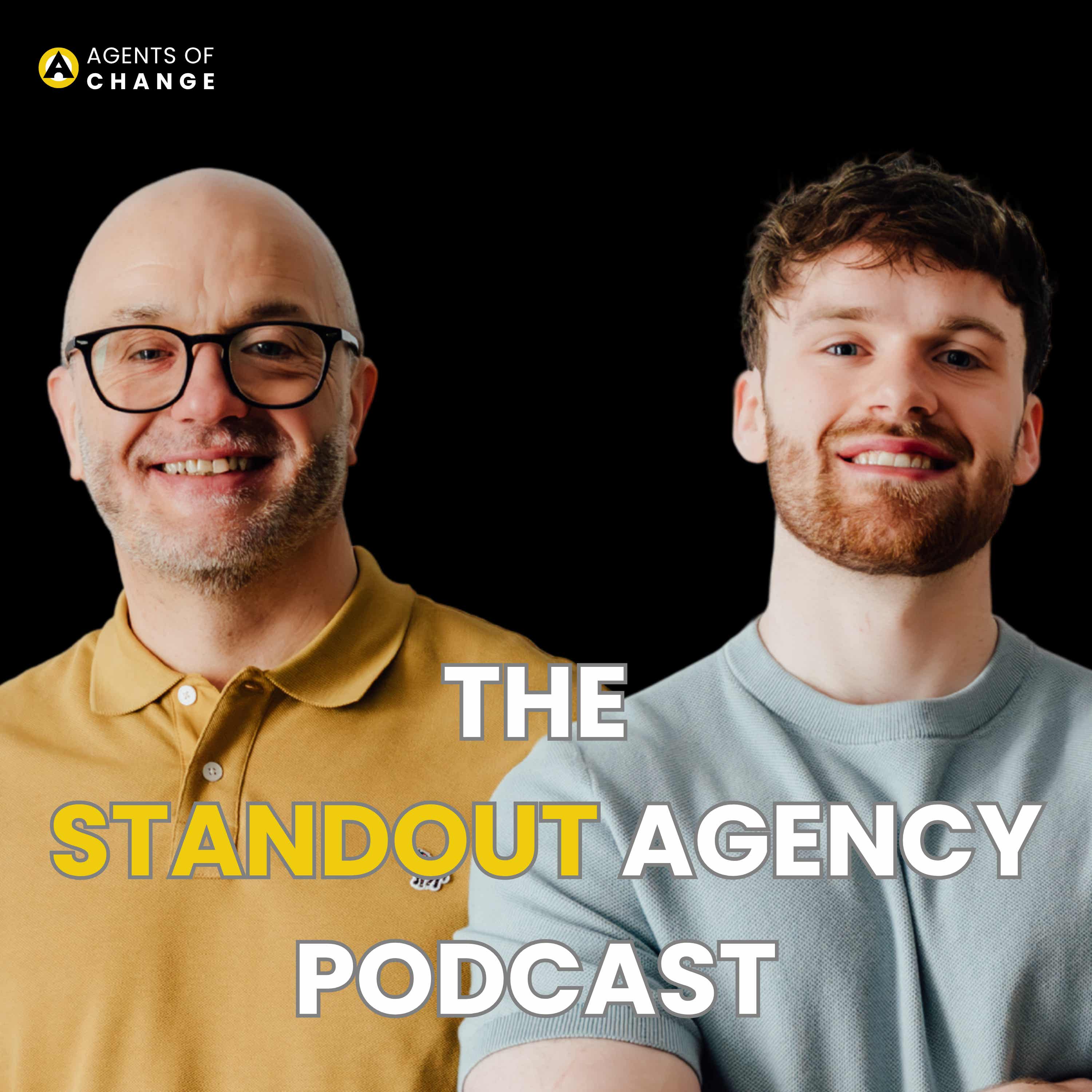
The STANDOUT Agency Podcast
by Gareth Healey & Callum Healey - Agents of Change
The Standout Agency Podcast is where father-son advisors Gareth and Callum discuss what it really takes to build a differentiated, well-run marketing agency - Gareth on strategy, operations and growth, Callum on AI and where it's actually changing the game. Sharp, practical conversation for agency owners who want to build something that stands out and lasts. thestandoutagencypodcast.substack.com
-
11
EPISODE 9: Nobody Wants Your Agency Services
Nobody wakes up in the middle of the night wishing they had more design. Nobody wants a website, or SEO, or a retainer. They want what those things get them - more customers, more sales, a business that’s easier to find and easier to trust. Which is obvious, and yet almost nobody in the industry sells that way.In episode 9, Callum puts Gareth in the hot seat on why the standard agency model - a list of services offered out into a market already full of near-identical lists - is under threat, and why the answer is to stop selling services and start selling named, fixed-scope, outcome-led products.It’s a conversation that takes in a plumbing leak, a pitch day, and a workshop Gareth ran this week that surprised the agency in the room.In this episodeThe business model is under threat, not just the marketing. Thousands of agencies, more added every day, all offering the same services under the same names. Add AI doing work that only people could do a few years ago, and skills that were once opaque (design, before Canva) now open to anyone. Differentiation is part of the answer, but Gareth’s point is wider than that: it’s a different way of working.Nobody wants the diagnosis. They want it fixed. Callum on his own STANDOUT AI audit: nobody wants the audit, and they don’t really want AI implementation either. They want more margin, more growth or more control. Gareth’s version is the plumber. When the leak appeared he didn’t want a plumber, he wanted the leak fixed, and wouldn’t have cared who or what did it. A plumber sells an urgent need and never has to dress it up. Agencies solve needs just as real - falling market share, not enough customers - but the need is latent rather than urgent, so it has to be made visible.Hard to sell, and harder to buy. Every brief gets scoped from scratch. Meanwhile the client is looking at thousands of agencies listing the same services, without fully understanding what those services do or in what order they need them. The pitch day exists because clients are trying to de-risk a decision they can’t otherwise make.Why vague offers get priced down. A callback to episode 3, Nobody Agreed the Height of the Wall. If the offer is vague, the client compares on price and the agency spends more unbillable time to earn the same money. Callum sees it in estimation: a blank page every time, and every hour of it eroding margin. AI, usefully, forces the issue - you can’t use it to estimate until the service is defined well enough for it to know what it’s estimating. He’s working with a client on exactly that, tiering new projects against the data from old ones.What a productised service actually is. Not a new service. The skills you already have, packaged around the outcome for the client rather than the service itself: a name, a defined scope, a fixed price, a stated timeframe, and clarity on what the client gets and how it’s delivered. The service still sits at the core. But a client can say “I can buy that” and know their commitment and their risk - rather than signing a retainer whilst quietly thinking “let’s see how it goes”. And it gets better every time you sell it: run the same product three or four times and you can see what worked, what was missing and where the effort was wasted.Name the problem, not the deliverable. Gareth’s caution: this is not tweaking a few words on the website, it’s a shift in how the business runs. And a productised service has to solve a client problem, so “Brand Identity Sprint” is the wrong name for something whose real job is telling the market who you are, what you stand for and why they should pay. The headline is the problem. The method comes after.Three types of productised service. The productised service proper - your existing skills, packaged. The technology or AI product - a tool or skill the client uses directly, no human in the loop. And the hybrid in the middle, where technology does the work but you still guide the client through it. The test is whether the client interacts with the technology or whether it’s your internal tool. Two things trip agencies up on the hybrid route: hourly pricing (do it faster, invoice less) and the absence of standard operating procedures - which is an episode of its own, coming soon.What Gareth wants listeners to do this week. Get your senior people in a room and list the problems your work solves, not the services you offer. Gareth did this with an agency this week and everything on the whiteboard fell into four clusters - and the highest-value clusters weren’t the bulk of the work. Being fast and nice to work with doesn’t count; those are hygiene factors. The value is commercial. Then build the product backwards from that. This is a public episode. If you would like to discuss this with other subscribers or get access to bonus episodes, visit thestandoutagencypodcast.substack.com
-
10
EPISODE 8: Where NOT to use AI in your agency.
Ask anyone selling AI into agencies whether it’s coming for people’s jobs, and you’ll get the same reassuring line every time. Ask them what AI still can’t do - even after swallowing an entire book, framework and philosophy whole - and the answers get a lot more interesting.In episode 8, Gareth puts Callum in the hot seat to unpack why 300,000 years of human wiring can’t be replicated from a training set, why the right analogy for AI isn’t a robot takeover but a calculator, and the paradox sitting underneath every agency quietly handing its junior-level work to a machine: if AI does the reps that used to build an expert, where does the next expert actually come from?It’s a candid, occasionally self-implicating conversation (not least because Callum promotes AI adoption for a living, and still doesn’t want to be replaced either).In this episodeWhy Callum trusts AI less the more he learns about it. He’s a genuine advocate, blown away by its utility, and yet the more he understands how it actually works, the less he trusts it unsupervised. The simplest illustration: AI hallucinates because it’s mathematically predicting the next most likely word, not looking anything up — and it’s trained to guess rather than admit it doesn’t know. Even 99% certainty is a bad number for a business to run on.The apprenticeship paradox. Judgment has always been built through reps - the boring calls, the repetitive spreadsheet trawling, the meetings nobody wanted to sit in. That’s precisely the category of work AI is best at, and precisely why agencies hand it over first. Which raises the real structural question: if a machine is doing the reps that used to turn a junior into a senior, what replaces the apprenticeship as the way judgment gets built at all?Through AI, not from AI. Gareth and Callum’s answer isn’t to protect the boring work - it’s to make sure senior team leaders build AI systems that actually contain their knowledge and workflow, so juniors are learning the system a senior built, filtered through AI, rather than learning from AI directly with nobody senior in the loop.Why the felt half of a decision can’t be delegated. AI can read the facts of a situation but not the room. Two people can sense tension, know when to soften something, feel what’s coming.Calculators didn’t retire mathematicians. Callum’s pushback to the obvious “but shouldn’t AI keep learning too?” challenge: a calculator changed what a mathematician spent their time on, it didn’t replace the maths. But you still need to know the maths to use the calculator well - which is exactly why schools taught mental arithmetic and calculator use as two separate skills. Same split now applies to specialism and AI.The STANDOUT or Die test, turned on its own author. Feed the entire STANDOUT framework into an AI system and it will recite it back fluently - word for word, on demand. It has never sat in a room, watched a face go quiet, or felt a deal nearly die. A framework in an AI system is a starting point for consistency. It is never a substitute for someone who has actually been in the room.The line they land on. AI does the arithmetic - finds the hours, calculates the cost, spots the pattern. That part isn’t up for debate; it’s faster and better at it than any person. Humans still do the judgment: what that number means for this client, this relationship, this risk, right now.What Callum wants listeners to do this week. Write down what your business believes and doesn’t, what it does and doesn’t do - then use AI to pressure-test decisions against that. Never to make the decision itself. This is a public episode. If you would like to discuss this with other subscribers or get access to bonus episodes, visit thestandoutagencypodcast.substack.com
-
9
EPISODE 7: Why Your Agency Marketing is stuck in Shawshank Prison
Most agency owners know their own marketing could be better and most people think more time is the answer. In episode 7, Callum puts Gareth in the hot seat to unpack why Morgan Freeman’s character in the movie The Shawshank Redemption explains the agency marketing problem better than any busyness excuse ever will, why hiring a marketing manager can create more problems for the founder that it fixes, and the one brief every agency owner needs to write for their own business before anything changes. It’s a practical, occasionally uncomfortable look at why agencies that are brilliant at client work go quiet the moment nobody’s asking them to be.In this episodeWhy a scene from The Shawshank Redemption, of all things. Gareth’s hook for the episode is Red - the character who spends so long in prison needing permission for everything that, once free, he still can’t use a work toilet without asking the manager first. The bars are gone. The habit isn’t. That’s what Gareth thinks is actually happening to agency owners and their own marketing.It’s almost never about time. Ask ten owners why their marketing gets neglected and nine say they’re too busy - but the same owner will drop everything for a pitch at two days’ notice. Gareth’s point: capacity shows up the moment something outside the building demands it, which proves the excuse was never really about hours in the day.The four things client work always has, that your own marketing never does. A brief written by someone else, a budget signed off by someone else, a deadline set by someone else, and a person at the other end you want to impress. Take all four away at once and the work has nothing telling it to start.What agencies have actually been institutionalised by. Years of receiving a brief, interpreting it, making something, presenting it and getting judged builds real skill at responding to someone else’s requirement but no muscle at all for generating your own. Gareth argues that’s a missing permission structure, not a missing capability.The harder truth underneath it. Marketing yourself properly means genuine narrowing (committing publicly to a type of client and turning down enquiries you’re capable of servicing). Easy advice to give a client. Much harder when it’s your own revenue, and your own bank account feeling a quiet quarter.Most owners already agree but do nothing anyway. It’s rarely that owners don’t understand the diagnosis. What’s missing is the discipline to actually deploy the fix.Briefing yourself, in the exact format you’d demand from a client. Who it’s for, what it costs, who signs it off, when it lands, and - the piece almost always missing - who it actually gets presented to. Gareth argues that last one is what forces the rest of it to happen.Why hiring a marketing manager doesn’t solve it. Most owners think they’ve fixed “who owns it” the moment they’ve hired someone to run marketing. Gareth pushes back: that devolves the execution, not the accountability. Someone still has to occupy the client role - briefing it, expecting it, reviewing it - or the work stalls exactly the same way.What Gareth actually wants listeners to do this week. Not a demand to build the whole system overnight, just to acknowledge that this is genuinely the issue in their own business, and commit to changing it. This is a public episode. If you would like to discuss this with other subscribers or get access to bonus episodes, visit thestandoutagencypodcast.substack.com
-
8
EPISODE 6: AI Governance for Agencies
Shadow AI is already costing agencies real money and real clients - and most leadership teams don’t know it’s happening under their noses. In episode 6, Gareth puts AI governance specialist Callum in the hot seat to unpack why free and personal AI plans are an agency’s biggest hidden liability, the real story of a marketing agency hit with a massive insurance claim after a data leak, and why “all or nothing” AI connectors can expose everything from client contracts to confidential leadership conversations. It’s a practical, occasionally uncomfortable guide to building the governance foundations that let agencies actually use AI without putting the business - or their jobs - on the line.In this episodeWhat AI governance actually means. Callum frames it simply: using AI to benefit the agency while mitigating risk — ideally getting it down to no risk at all, so adoption feels safe rather than reckless.Shadow AI is still the biggest problem. Callum still sees agency staff using free or personal AI plans for company work without leadership’s knowledge. Free plans in particular can use chat data to train models, and without UK GDPR agreements in place, providers can theoretically do what they like with it. The fix is blunt: abolish free and personal plans for business use entirely, move everyone onto paid team/enterprise plans, and reflect the tool and its data obligations in client MSAs.The horror story. An agency lost a marketing client’s sensitive campaign data after an employee uploaded it into a free AI plan - the data surfaced elsewhere, the client traced the breach back to the agency, and the agency was hit with a massive insurance claim. A personal plan is never a legal “get out” for the business; the client comes to the agency’s door regardless of who used what.Architecture isn’t enough - you need compliance too. Callum audited a 60-person agency with genuinely excellent AI governance: enterprise Gemini, model training off, updated contracts, a formal tool-approval process. Yet analytics showed two-thirds of the team weren’t using the sanctioned platform at all - still on personal ChatGPT. The lesson: policy without education and enforcement doesn’t change behaviour. Callum’s view is that breaching a “no personal plans” policy should be treated as a fireable offence, given how severe the fallout can be if data leaks.Give people the “why”, don’t just give them rules. The whippet analogy: you can train a dog to follow a command without it understanding why, but people can understand the reasoning — and will comply far more reliably if they grasp the scale of what’s at stake, rather than experiencing it as leadership being controlling.Connectors are all-or-nothing - scope them properly. Turning on a connector (Office 365, Google Workspace, etc.) grants the AI everything that the connecting login can see. If that’s the founder’s login, the AI can see financial data, HR records, even confidential leadership meeting transcripts. The fix: work with the agency’s IT provider to create a dedicated, scoped login for the AI tool, starting with access to nothing and adding data in only as it’s needed — bottom-up, not top-down.Client data needs explicit permission. Don’t connect AI to client data unless the client has confirmed they’re comfortable with third-party AI processing, regardless of what UK GDPR compliance the AI plan itself offers.Client conflicts of interest are a real, distinct risk. Unlike a human team member, AI won’t discriminate between competing clients’ data if it has access to both — so access needs to be separated by client team, not just by role.A real cautionary tale. An agency on a free Gemini plan hadn’t locked down its Google Workspace. An employee facing an internal grievance searched their own name and surfaced unfavourable meeting transcripts about themselves - which they then used against the company. A direct consequence of an ungoverned connector plus a free plan retaining data it shouldn’t have.Exports are the blind spot no connector scope can fix. Even with a perfectly scoped connector, anyone can manually export a file and drag it into an AI chat, bypassing every access control in place. The only real defence is policy and communication - “if it’s not already in your AI environment, don’t drag it in” - backed longer-term by IT-side file classification.For highly regulated clients, start internal-only. With a health comms client holding regulated patient data, Callum’s approach was to leave client-data connectors off entirely and instead build safe, high-value automations on strictly internal data - timesheet processing was the live example, scoped so the AI could only ever see one folder.Plugins as governance and future-proofing. Packaging an agency’s context and workflows into a version-controlled “plugin” (Callum hosts his on GitHub) creates a single source of truth, stops workflow version-sprawl, and - critically - keeps the agency’s real asset (its context and data) portable if an AI vendor changes terms or hikes prices. The goal is to stay tool-agnostic: the AI is just the processor, the context is the value.Governance comes first, always. In every roadmap Callum builds, governance is month one - sometimes week one - before any efficiency or ROI work. The analogy: build the house on solid foundations, not sand. Skip it, and agencies risk discovering months into a build that a client never actually consented to AI use on their data, burning significant time and money.The unexpected upside. Beyond AI safety, the governance process forces agencies - often unstructured, fast-moving businesses with little formal process - to build real structure and documented ways of working, benefiting the whole business, not just AI adoption. This is a public episode. If you would like to discuss this with other subscribers or get access to bonus episodes, visit thestandoutagencypodcast.substack.com
-
7
EPISODE 5: The Founder Dependency Trap
Every agency founder starts as the engine: the seller, the doer, the one everyone depends on. But the skills that get an agency from zero to £1m and a dozen people are exactly the skills that stop it going further. This week Callum asks Gareth about his own experience of running an agency and why agency founders find it so hard to let go. They unpack four intertwined barriers, from simple resourcing to something far more personal, that keep founders stuck being indispensable. If you've ever wondered if you're the reason your agency can't grow, this one's for you. This is a public episode. If you would like to discuss this with other subscribers or get access to bonus episodes, visit thestandoutagencypodcast.substack.com
-
6
EPISODE 4: Making AI Work For Your Agency
Your AI sounds clever, but Callum's argument is blunter: it doesn't understand a word it says. It's a prediction machine - and without your agency's context, it can easily predict the wrong things.In this Episode, Gareth and Callum discuss the mechanics behind that claim, the demand amongst agencies for a "company brain”, and why most agencies are simply not set up to feed their brain the information it needs. They then explore the unglamorous Monday-morning starting point: a folder of markdown files.If you've ever pasted a brand doc into a chat window and called it AI adoption, this one's for you. This is a public episode. If you would like to discuss this with other subscribers or get access to bonus episodes, visit thestandoutagencypodcast.substack.com
-
5
EPISODE 3: Nobody Agreed the Height of the Wall
Gareth wrote a Substack post recently about a garden wall — inspired by a pricing conversation on one of Callum's client projects where nobody, not the agency, not the client, had actually agreed what they were building. That's this episode's strange title, and the starting point for a much bigger problem in how agencies price their work.In this episode Gareth and Callum unpack why marketing agencies have stayed hooked on hourly billing for decades, why AI is finally forcing the issue, and what it actually takes to move to value-based pricing — clarity on the brief, clarity on the outcome, and clarity on what that outcome is actually worth to the client. They get into why hourly pricing quietly punishes agencies for getting faster, and how AI itself can be used to interrogate your own service delivery and surface the value you're not currently charging for. This is a public episode. If you would like to discuss this with other subscribers or get access to bonus episodes, visit thestandoutagencypodcast.substack.com
-
4
EPISODE 2: Why the AI Guy Wants Your Timesheets
Callum has noticed a pattern to some of his recent AI engagements with agencies. It’s a surprising one and hardly glamorous - digging meaningful data out of their timesheet system. In this episode Gareth, a 30-year timesheet veteran, interviews Callum on why the AI lead, of all people, wants agencies to keep recording time - and why ‘AI means we don’t need timesheets’ is exactly the wrong lesson to draw. They get into what that timesheet data is actually extracted for, where AI genuinely will make time recording irrelevant, and why an agency with no data on its biggest cost line - human hours - is starting its AI journey from the worst possible place. This is a public episode. If you would like to discuss this with other subscribers or get access to bonus episodes, visit thestandoutagencypodcast.substack.com
-
3
EPISODE 1: Standstill to STANDOUT: What Actually Separates the Two?
Welcome to The STANDOUT Agency Podcast, brought to you by Agents of Change. Each week, Gareth and Callum get into what actually separates agencies that plateau from agencies that build something that lasts - Gareth drawing on decades of running agencies and advising agency founders on strategy, operations and growth, Callum on where AI is genuinely changing how agencies work. No theory for theory’s sake, just sharp, practical conversation built on real advisory work with real agencies. This is episode one, and it starts where the whole idea began.Buy the book STANDOUT or Die here.Learn more about the STANDOUT Agency System and the eight pillars here. This is a public episode. If you would like to discuss this with other subscribers or get access to bonus episodes, visit thestandoutagencypodcast.substack.com
We're indexing this podcast's transcripts for the first time — this can take a minute or two. We'll show results as soon as they're ready.
No matches for "" in this podcast's transcripts.
No topics indexed yet for this podcast.
Loading reviews...
ABOUT THIS SHOW
The Standout Agency Podcast is where father-son advisors Gareth and Callum discuss what it really takes to build a differentiated, well-run marketing agency - Gareth on strategy, operations and growth, Callum on AI and where it's actually changing the game. Sharp, practical conversation for agency owners who want to build something that stands out and lasts. thestandoutagencypodcast.substack.com
HOSTED BY
Gareth Healey & Callum Healey - Agents of Change
CATEGORIES
Loading similar podcasts...
Frequently Asked Questions
How many episodes does The STANDOUT Agency Podcast have?
The STANDOUT Agency Podcast currently has 9 episodes available on PodParley. New episodes are automatically indexed when they're published to the podcast feed.
What is The STANDOUT Agency Podcast about?
The Standout Agency Podcast is where father-son advisors Gareth and Callum discuss what it really takes to build a differentiated, well-run marketing agency - Gareth on strategy, operations and growth, Callum on AI and where it's actually changing the game. Sharp, practical conversation for agency...
How often does The STANDOUT Agency Podcast release new episodes?
The STANDOUT Agency Podcast has 9 episodes. Check the episode list to see recent publication dates and frequency.
Where can I listen to The STANDOUT Agency Podcast?
You can listen to The STANDOUT Agency Podcast on PodParley by clicking any episode. We provide an embedded audio player for direct listening, and you can also subscribe via your preferred podcast app using the RSS feed.
Who hosts The STANDOUT Agency Podcast?
The STANDOUT Agency Podcast is created and hosted by Gareth Healey & Callum Healey - Agents of Change.
URL copied to clipboard!