
PODCAST · news
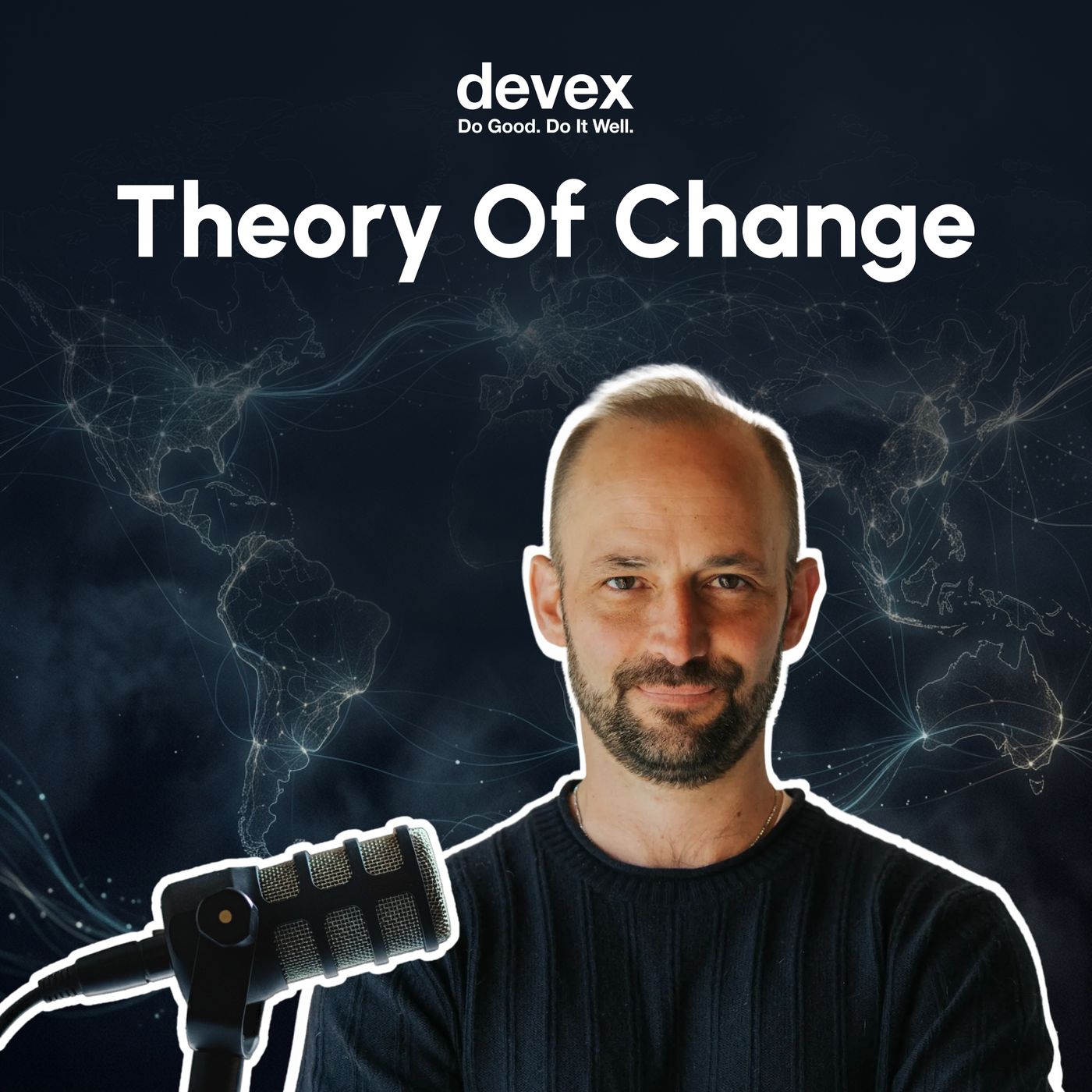
Theory of Change
by Devex
Theory of Change is a podcast about the future of global development — and the people trying to reshape it.Hosted by Devex Senior Reporter Michael Igoe, the show features candid conversations with leaders in philanthropy, foreign policy, technology, finance, media, and humanitarian aid about the forces transforming how global change actually happens: power, politics, money, influence, and ideas.Not a panel. A conversation with a real person.Episodes are published every Tuesday.Subscribe to our YouTube channel:https://www.youtube.com/@devexThe podcast is produced by Devex Associate Editor Thomas Cserép and Mai Ylagan.
-
2
Is the global humanitarian system collapsing?
In an interview on Devex's Theory of Change podcast, Alight CEO Jocelyn Wyatt warned that the traditional humanitarian business model is facing structural failure.Following the collapse of the U.S. Agency for International Development and the transition of U.S. foreign aid programs to the U.S. State Department, organizations are having to rely on more rigid grants from United Nations agencies that typically cap overhead at 7%, leaving virtually no resources for operational leadership, compliance, or innovation, Wyatt said.Global humanitarian assistance fell by roughly 30% between 2022 and 2025, with 13 of the 20 largest donors cutting relief aid in 2025, according to the latest State of the Humanitarian System report, released last week.Wyatt highlighted how structural defects and funding restrictions in the traditional framework actively undermine long-term progress:The misallocation problem: Private donor funding floods highly publicized, geopolitical conflicts (such as Ukraine), while long-term, acute humanitarian disasters (such as Sudan) receive virtually no private support due to public narrative fatigue, donor bias, and political media coverage.Survival over solutions: With institutional funds shrinking, remaining aid is strictly funneled into immediate lifesaving care, stripping away funding for education, job training, and economic development that actually helps people transition out of displacement.Failing durable pathways: The three traditional solutions for refugees — returning home, integrating locally, or third-country resettlement — have largely stalled or collapsed under political and financial strain.“This world order and these systems that were developed post-World War II have seemed like they're hitting their expiration date, and they will need to be reinvented. But that is not happening in 2026 or 2027, probably 2028. So in the interim, we need to find ways to help people be able to provide for themselves and their families,” Wyatt said.To survive the breakdown of the traditional model, Wyatt argues that humanitarian organizations must pivot toward financial self-reliance and market-driven solutions.“Let's actually put our resources to social enterprise models where we can recycle capital, where we can help people start businesses. Let's actually train people and connect them with employers so that they can get jobs and make money for themselves,” she said.“To think that governments are going to be the continuous providers of financial support to refugees ... I think is just a fallacy at this point,” she added.
-
1
Is it OK to take 'tainted money'?
In the latest episode of the Theory of Change podcast, human rights activist Kavita Nandini Ramdas discussed the deep systemic contradictions of modern philanthropy, its uneasy relationship with grassroots activism, and why nonprofit organizations must stop playing quiet to keep elite funding.Ramdas, currently a senior strategic adviser at the International Planned Parenthood Federation, has spent years fighting both inside and outside major philanthropy — including as a close adviser to some of the world’s most prominent foundation leaders.What she sees today is a philanthropic sector that is “running afraid from Trump” and recipient organizations that rarely challenge their funders.“It’s really as though we’ve gone back to the medieval ages and Lady Bountiful is riding on her white horse and throwing crumbs to the masses below and we're scurrying around saying, ‘Thank you so much, thank you so much,’” she said. “It’s as though we’ve gone back to feudal times.”The argument: Nonprofits must replace groveling with accountability. “Take the money, but have the damn courage to stand up and say, ‘This action was racist. This intervention is not acceptable,’” Ramdas said. Taking elite funding creates a direct “obligation to voice” — not a mandate for silence.On the Gates Foundation: Ramdas directly called out Bill Gates over his foundation’s agricultural strategy in Africa during a meeting. She pointed out that the Green Revolution had already been an environmental disaster in India — destroying topsoil and drying up aquifers in Punjab — and asked why they were selling the exact same flawed model to Africa. As a result, they brought her in as an adviser.On Adele Simmons, former head of the MacArthur Foundation: “Here she was, this extraordinary person with three young kids — and what she had to deal with, this casual sexism that I saw thrown at her.”On Darren Walker, former head of the Ford Foundation: He told Ramdas that “culture eats strategy for breakfast” — a truth she applies now to philanthropy, noting that no matter how progressive a foundation’s strategy claims to be, it is constantly swallowed by the surrounding patriarchal and capitalist culture.
-
0
Can communities help refugees where governments fail?
In the latest episode of the Theory of Change podcast, Nazanin Ash, CEO of Welcome.US, discussed how community-driven sponsorship could revolutionize refugee resettlement, bypass political gridlock, and offer a scalable alternative to overburdened government systems.Global forced displacement is at an all-time high, and standard, bureaucratic response models are failing to keep pace. Ash argued that mobilizing local communities rather than relying solely on government aid can unlock massive potential and provide orderly, human-centered pathways for newcomers.The problem: Traditional global systems are built for short-term, state-versus-state displacement, but modern conflicts — predominantly civil wars — are protracted, lasting decades on average. As a result, massive, unmanaged crises crowd out long-term development funds.“Civil wars burn forever. They’re really tough to resolve. And our international tools for conflict resolution are really bad at solving them,” Ash said.By the numbers: By shifting the focus from a government-managed process to direct community sponsorship, Ash said that Welcome.US demonstrated unprecedented scale during recent crises such as the war in Ukraine:800,000 newcomers welcomed by American communities in under three yearsFour times as many individuals resettled through private sponsorship than through formal U.S. government pathways over the same timeframe$7 billion in time and money leveraged directly by local sponsors to pay for travel, housing, and integration2 million Americans across 26,000 zip codes participated in sponsoring displaced individuals“The appetite for doing this is so strong. The capacity to do it is so real,” Ash said.Unlike formal government systems that assign refugees to fixed locations based on strict physical requirements, Ash said that private matching platforms allow newcomers to exercise choice and retain dignity.“If you know something about humanitarian crises and forced displacement … what you experience most acutely is the loss of choice and the loss of agency. And of course, nothing about our traditional systems lets you have that choice or agency,” she said.Meanwhile, community members who sponsored families have become active advocates, filing lawsuits, lobbying Congress, and defeating hundreds of anti-immigrant state bills.“Proximity changes what you protect,” Ash said.What to watch: Welcome.US currently operates in the United States, and Ash said the organization has plenty of work on its plate. “But we did purchase the rights to Welcome.world,” she added.
-
-1
What does 'country ownership' really mean?
What is “country ownership,” really? And what gets in the way of making it a reality?Against a backdrop of historic cuts to development assistance by many of the world’s largest donors, the chorus of voices calling for national governments to set — and finance — their own development agendas is growing louder.Yemi Osinbajo, the former vice president of Nigeria and co-chair of the Future of Development Cooperation Coalition, has seen firsthand what happens when international donors and national development priorities are aligned — or not.Osinbajo joined the Devex Theory of Change podcast to challenge the myths and misconceptions around state capacity, corruption, and international finance."Forget about giving cash or aid. Let's focus on systemic changes that can release the resources that African countries need for their development,” Osinbajo says.That means targeting markets and value chains that currently disadvantage lower-income countries, through systemic partnerships rather than one-off handouts, he says.It also means being honest about who is complicit in propping up systems that are plagued by corruption, or biased against regions perceived as risky, whether they truly are or not.
-
-2
How Jacqueline Novogratz invests for global change
Twenty-five years ago, when Jacqueline Novogratz founded the impact investing nonprofit Acumen, she still had to prove that markets and entrepreneurship could work for people living in poverty — and help lift them out of it.In the years since, that has moved from a relatively fringe approach to fighting poverty, to the center of global development efforts. Development finance institutions, philanthropies, and asset managers are all looking for investable opportunities — and speaking the language of impact.But something else has happened to — or hasn’t happened — Novogratz said on Devex’s Theory of Change podcast. The institutions and individuals who could provide critical “patient capital” in the early, riskier phases when it is most effective, are not jumping in as needed.For Novogratz, it points to a needed reckoning for a social impact sector that has grown up, but still hasn’t realized its potential.“The capital that is available, and there's a lot of capital, is too expensive, it’s too risk averse, and as a result, we see a lot of talk and a lot of hand-wringing when we could be structuring that capital under the rubric of impact investing and really creating impact,” she says.
-
-3
Mark Dybul says this was never the plan for PEPFAR
For over two decades, the U.S. government has been a lynchpin in the global fight against HIV, pouring billions of dollars into treatment, prevention, and health systems strengthening through initiatives like the U.S. President’s Emergency Plan for AIDS Relief, or PEPFAR.Then came Elon Musk, the foreign aid freeze, and a disruptive set of reforms to U.S. global health programs under President Donald Trump’s “America First” Global Health Strategy. Against the backdrop of this tumultuous moment, the question remains: Was the old framework built to sustain solutions, or merely to sustain itself?Mark Dybul, who led PEPFAR from 2006 to 2009, joined the Theory of Change podcast to deliver a blunt assessment of the legacy and current trajectory of foreign assistance. Reflecting on the evolution of former President George W. Bush’s signature global health initiative, Dybul addressed the sharp criticisms now driving a broader push for reform.While acknowledging the lifesaving impact of past initiatives, Dybul pointed to a fundamental failure in long-term strategy: The shift toward true local ownership never fully materialized. In Dybul’s view, Musk’s Department of Government Efficiency surfaced uneasy truths about how the U.S. government has worked with countries to end the AIDS epidemic — and the opportunities that were missed along the way."The diagnosis was correct. That indictment was correct. I mean, to be honest, it turned my stomach that 25 years later we were spending the same amount of money as when I walked out the door. That wasn't the plan."He also pushed back on projections that PEPFAR funding cuts could cause thousands of deaths, arguing that these underestimate governments’ ability to protect health programs — as well as opportunities for greater efficiency.As global health systems undergo a rapid overhaul, Dybul argues that the next 12 to 18 months represent a critical window. They must either adapt to a model centered on country sovereignty, local innovation, and mutual economic partnership, or risk watching the entire architecture collapse.
-
-4
How Kakenya Ntaiya turned pain into progress
Philanthropists and global development donors have made a lot of promises about supporting local leaders and community-based organizations. But their insistence on finding scalable models might be getting in the way of a simpler achievement: helping people.Kakenya Ntaiya is a one-woman case study in persistence. As a girl in southwestern Kenya, she underwent the traditional Masaai practice of female genital mutilation — a precursor to marriage and motherhood.But she negotiated with her father to stay in school, secured a scholarship to attend college in the United States, and used her education to scrutinize the very cultural practices that she — and the other women in her village — were born into.As the founder of Kakenya’s Dream, a nonprofit organization, Ntaiya has returned to Kenya to open up spaces for discussion of cultural taboos — and educational opportunities for thousands of girls. Ntaiya joined the Theory of Change podcast to share her experiences navigating complex community politics, pushing for cultural change, and confronting the blind spots in modern international philanthropy that get in the way of improving people’s lives.
-
-5
Jim Richardson believes we can still agree about US foreign aid
U.S. foreign aid advocacy groups are soul-searching in the wake of the Trump administration’s dismantling of the U.S. Agency for International Development and deep cuts to U.S. foreign assistance.Bipartisan support for U.S. aid programs crumbled quickly in the face of Elon Musk’s attack on the agency via the Department of Government Efficiency, and USAID’s legacy is now viewed through a starkly polarized political lens.In the aftermath of that collapse, advocacy organizations are trying to regain their footing — including by hiring conservative political veterans into key roles.Jim Richardson, a longtime congressional staffer and former aide to Mike Pompeo, coordinated one of the largest reorganization efforts in USAID’s history during Trump’s first term. He recently joined the U.S. Global Leadership Coalition — one of the most influential “soft power” advocacy groups in Washington, D.C. — as national outreach director.He joined the Theory of Change podcast to discuss the future of U.S. development advocacy — and what it will take to rebuild support for aid programs."We have to really go back to the basics,” he said. “Where does the U.S. government have a comparative advantage? What does the power of international assistance do? What can it do?”
-
-6
Ebere Okereke believes global health is about power
Global health is entering a period of profound upheaval. As governments reassess foreign aid, donors rethink decades-old models, and African leaders push for greater ownership of their health systems, one question looms over the sector: Who should hold the power to shape global health?Dr. Ebere Okereke is a prominent voice in that conversation. She joins Theory of Change for a wide-ranging conversation with Devex Senior Reporter Michael Igoe about the risks and opportunities of this massive global health shakeup."Everything's about power. Everything is about politics. But it's also about understanding what power you have," Okereke says.She reflects on the consequences of the dismantling of the U.S. Agency for International Development, the rise of bilateral health agreements, the promise of the Accra Reset, and why African governments must play a far greater role in defining and financing their own priorities. At the same time — with disease outbreaks still testing national response systems — she cautions against retreating from global collaboration, arguing instead for a model that is "locally owned, regionally anchored, but remain[s] part of a global architecture."
-
-7
Why Rachel Kyte doesn't listen to climate polls
Rachel Kyte has spent decades shaping global climate change policy — from the World Bank to the United Nations to the United Kingdom. More than a decade since the signing of the Paris climate agreement, Kyte — the U.K. special representative for climate — is both inspired by how much has been done to tackle the climate crisis, and clear-eyed about the fact that it is not enough."It's joyful, tinged with deep sadness and regret,” she told Devex Senior Reporter Michael Igoe on the latest episode of Theory of Change.Against the backdrop of a sweltering London Climate Action Week, Kyte outlined her vision for “financing climate.” That is a vision that stretches well beyond the narrower realm of “climate finance,” to include bolder transformations of trade, international relations, and public services."People want affordable electricity, they want clean air, they want clean water, they want protection against extreme heat, and they want flood control,” Kyte said."We have to be much better at taking the message to people and speaking with optimism and hope about why this is good for them,” she added.
-
-8
William Easterly still believes development is freedom
Development economist William Easterly famously does not mince words about the disappointments of anti-poverty megaprojects and far-fetched foreign aid plans.For much of his career, Easterly has taken aim at experts who export their visions onto other people’s countries and communities — drawing from his own experience as one of those very experts.In his latest book, “Violent Saviors: The West’s Conquest of the Rest,” Easterly unearths the long history of what he calls “the development right of conquest,” a worldview that has sacrificed individual rights and agency at the altar of material gain. He traces the long-standing tension between those who pushed for development at all costs and the dissenting voices who resisted them.In the fourth episode of Theory of Change, Easterly unpacks the implications of that history for contemporary development efforts. He reflects on what alternative approaches to improving human well-being might look like — and what role aid institutions should play in pursuing them.“There’s this technocratic illusion that you can reduce development to just technology and effectiveness of achieving measurable gains and these technical indicators of well-being,” he tells Devex Senior Reporter Michael Igoe. “I think we all realize deep down the fantasy of keeping things purely technocratic is really a fantasy, that there really is a whole other dimension,” Easterly says.
-
-9
Gayle Smith on the next fight for foreign aid
U.S. foreign aid is undergoing one of the most tumultuous transformations in its history.The Department of Government Efficiency’s dismantling of USAID and transfer of its remaining programs to the State Department upended the U.S. global development industry. But it’s much more than a question of organizational charts and institutional responsibilities.At stake are fundamental questions about America’s national interests, how the well-being of people in other countries should influence economic and trade policy, and the nature of public support for a long-term vision of development investment.Gayle Smith has faced those questions from a variety of vantage points — senior director for development and democracy on the White House National Security Council, USAID administrator, CEO of the ONE Campaign.In this episode of Theory of Change, she shares a candid assessment of where the fight for U.S. leadership in global development should go from here — and who should lead the charge.
-
-10
Seth Berkley has seen our pandemic future
Much of Seth Berkley's career has been an attempt to answer the question: How do you get vaccines to people who aren’t well-served by an inequitable global health system?When the COVID-19 outbreak exploded in early 2020, that question took on new urgency — along with a mind-spinning slew of political, economic, technological, and cultural complications.Berkley, then the CEO of Gavi, the Vaccine Alliance, had a pretty good idea what was coming. As early as February 2020 he was warning publicly that if researchers were successful in developing a COVID-19 vaccine, lower-income countries would struggle to access them.That is exactly what happened. It is also what led Berkley to help launch COVAX, the global initiative to deliver COVID-19 vaccines around the world.In the wake of the pandemic, the relationships between politics, society, and vaccines have only grown more fraught. One example: Secretary of Health and Human Services Secretary Robert F. Kennedy Jr. has personally intervened to block U.S. funding to Gavi.Berkley, a physician and infectious disease epidemiologist, joined Devex’s Theory of Change podcast to discuss the lessons of the COVID-19 response, the long and complicated history of humanity’s relationships with vaccines, the incredible potential of new technologies — and the deeply troubling risks that some of them pose.His new book is called “Fair Doses: An Insider's Story of the Pandemic and the Global Fight for Vaccine Equity.”
-
-11
How Alexander Berger weighs the world’s biggest problems
Coefficient Giving, one of the world’s largest effective-giving funders, is about to go even bigger.On the heels of its biggest funding year ever in 2025 — in which it channeled over $1 billion to highest-impact causes — the organization formerly known as Open Philanthropy and funded by Facebook cofounder Dustin Moskovitz and his wife Cari Tuna is eyeing annual growth upward of 50% and bringing on more staff to get it done.The person behind that vision is Alexander Berger, Coefficient Giving’s cofounder and CEO. Berger is in charge of turning Facebook wealth — and, increasingly, funds from other donors — into as many lives saved and improved as possible. The organization is a major funder in global health and development, catastrophic risk, research and innovation, and even farm animal welfare.Last week, Coefficient Giving launched a new pooled fund to tackle Group A Streptococcus — an easily treated disease that is still responsible for nearly 700,000 deaths a year — a cause that reflects the organization’s framework for tackling problems that are important, neglected, and tractable.In a rare, in-depth interview with Devex Senior Reporter Michael Igoe, Berger sheds light on Coefficient Giving’s rapid growth plans, its strategy for choosing high-impact causes, the rise of artificial intelligence philanthropy, and his own approach to affecting change in an uncertain world.This is the first episode of Theory of Change, a new podcast series from Devex featuring candid interviews with leaders shaping the future of global development.
We're indexing this podcast's transcripts for the first time — this can take a minute or two. We'll show results as soon as they're ready.
No matches for "" in this podcast's transcripts.
No topics indexed yet for this podcast.
Loading reviews...
ABOUT THIS SHOW
Theory of Change is a podcast about the future of global development — and the people trying to reshape it.Hosted by Devex Senior Reporter Michael Igoe, the show features candid conversations with leaders in philanthropy, foreign policy, technology, finance, media, and humanitarian aid about the forces transforming how global change actually happens: power, politics, money, influence, and ideas.Not a panel. A conversation with a real person.Episodes are published every Tuesday.Subscribe to our YouTube channel:https://www.youtube.com/@devexThe podcast is produced by Devex Associate Editor Thomas Cserép and Mai Ylagan.
HOSTED BY
Devex
CATEGORIES
Loading similar podcasts...
Frequently Asked Questions
How many episodes does Theory of Change have?
Theory of Change currently has 14 episodes available on PodParley. New episodes are automatically indexed when they're published to the podcast feed.
What is Theory of Change about?
Theory of Change is a podcast about the future of global development — and the people trying to reshape it.Hosted by Devex Senior Reporter Michael Igoe, the show features candid conversations with leaders in philanthropy, foreign policy, technology, finance, media, and humanitarian aid about the...
How often does Theory of Change release new episodes?
Theory of Change has 14 episodes. Check the episode list to see recent publication dates and frequency.
Where can I listen to Theory of Change?
You can listen to Theory of Change on PodParley by clicking any episode. We provide an embedded audio player for direct listening, and you can also subscribe via your preferred podcast app using the RSS feed.
Who hosts Theory of Change?
Theory of Change is created and hosted by Devex.
URL copied to clipboard!