
PODCAST · health
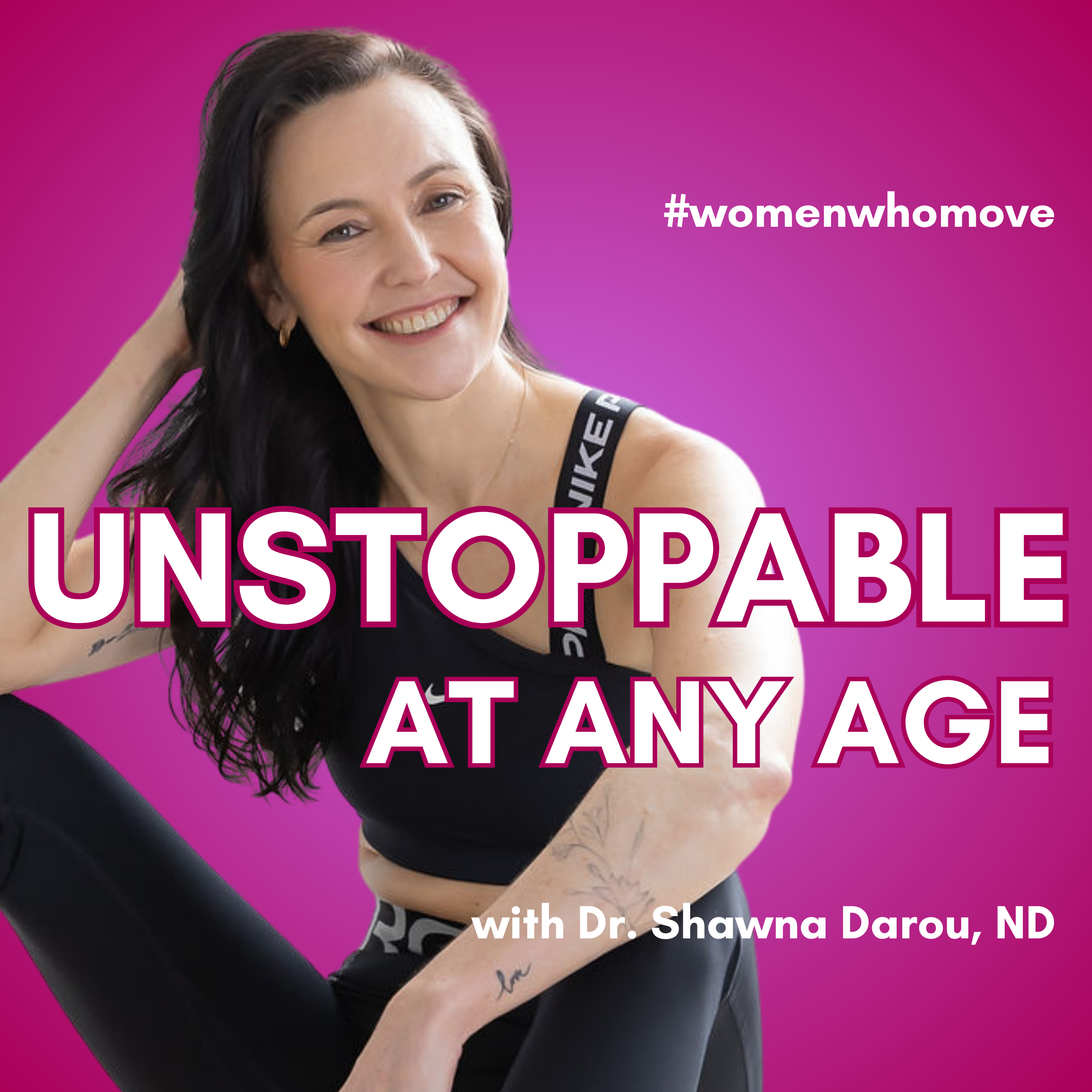
Unstoppable At Any Age
by Dr. Shawna Darou, ND
Inspiring stories and science-backed insight from women who continue to build strength, performance, and possibility with age.Hosted by Dr. Shawna Darou, ND, Unstoppable at Any Age is the voice of Women Who Move - a global movement grounded in one belief: how we move today determines how we live tomorrow.Each episode features conversations with athletes, scientists, founders, and leaders who are expanding what is possible in their 40s, 50s, 60s, and beyond. These women are training, competing, leading, and building lives defined by strength, independence, and momentum.
-
13
12. Too old at 30. olympian at 52.
What happens when someone tells you you're too old at 30?For Claudia Riegler, that moment could have ended her athletic career.Instead, it became the beginning of one of the most remarkable stories in sport.In this episode, I sit down with Austrian Olympic snowboarder Claudia Riegler, who recently competed in her fifth Olympic Games at age 52. She was also the oldest female athlete competing at the Games.What makes Claudia's story so powerful isn't just her longevity in elite sport.It's the mindset behind it.At 30 years old, she was told she was too old and was removed from her national team. Twenty-two years later, she was still competing against the best athletes in the world.This conversation is about resilience, belief, intuition, and learning how to trust yourself when the world tells you to stop.• What it takes to qualify for five Olympic Games• Being the oldest female athlete at the Olympics• The mindset that helped Claudia continue after being told she was "too old" at 30• How visualization helped her become World Champion at 41• Why listening to your body becomes more important with age• The role of intuition in decision-making and performance• How coaches can either limit or expand what's possible• The connection between thoughts, emotions, and physical performance• Why age-related beliefs are often more limiting than aging itself• How to keep pursuing big goals when others don't understand themOne of my favourite moments from this conversation was when Claudia said:"Everything is possible at any time."That belief has carried her through five Olympic Games, a World Championship title, multiple setbacks, injuries, and decades of elite competition.It's a message every woman needs to hear.Join my free community → #womenwhomoveDownload my free guide → Fueling for Hormones & Metabolic HealthReminder: Nothing in this podcast is a substitute for medical advice. Always consult your own healthcare provider.Subscribe, rate, and review to help more women rethink what's possible in midlife and beyond.
-
12
11. The fastest woman in the world at 71
What if aging isn’t about slowing down — but continuing to build strength, purpose, and possibility?In this episode, I sit down with masters sprinter Wendy Alexis, who recently became the fastest woman in the world in the 70–74 age category in the 60m sprint.At 71 years old, Wendy is still training, lifting, sprinting, competing internationally, and chasing new goals.What makes this conversation so powerful isn’t just the world record.It’s the way she talks about movement, community, aging, and what happens when women stop limiting themselves based on age.Wendy didn’t return to the track until age 50.She started with one race. One practice. One decision to try.And that decision completely changed the course of her life.In this episode, we explore:• Why Wendy returned to sprinting at age 50• What it felt like to become the fastest woman in the world in her age category• The role coaching, community, and support play in performance• Why masters sports are accessible to everyone — not just elite athletes• How movement changes physical and mental health as we age• The joy and freedom of sprinting• Why women continue getting stronger, faster, and more capable later in life• The importance of setting meaningful goals at every age• How sport creates friendship, purpose, and confidence in midlife and beyond. One of the biggest takeaways from this conversation:You are never “too old” to begin.Sometimes one decision changes everything.If you’re looking for support around movement, healthy aging, and community:Join my free community → #womenwhomove Download my free guide → Fueling for Hormones & Metabolic Health. Reminder: This podcast is for educational purposes only and is not a substitute for personalized medical advice.Subscribe, rate, and review to help more women rethink what’s possible as they age.
-
11
10. Why women get faster after 50 with Paula Wiltse
What if your best performances aren’t behind you?In this episode, I sit down with masters runner and coach Paula Wiltse to talk about training, recovery, speed, and what’s actually possible for women in their 40s, 50s, and beyond.I first learned about Paula when I was training for my first Boston Marathon.At the time, she was the Canadian marathon record holder in her age category after running a 2:58 marathon at 50 - and she had also run her fastest marathon at 46.That completely changed what I believed was possible.This conversation explores what masters training actually looks like, how it changes with age, and why women can continue improving long after they’ve been told they should slow down.In this episode, we explore:• Why speed work matters even more as we age• The role of strength training in injury prevention and performance• How recovery changes after 50• Why comparing yourself to other runners can hold you back• The impact of perimenopause and menopause on training• How HRT helped Paula with joint pain and recovery• Why women need individualized training approaches• The importance of continuing to set big goalsOne of the biggest takeaways from this conversation:Your body changes with age.That doesn’t mean your potential disappears.If you’re looking for support around movement, hormones, and healthy aging:Join my free community → #womenwhomove (https://drshawnadarou.com/start-here) Download my free guide → Fueling for Hormones & Metabolic Health (https://drshawnadarou.com/fueling-for-health) Reminder:This podcast is for educational purposes only and is not a substitute for personalized medical advice.Connect with Paula:Instagram: @wiltsepaulaWebsite: www.unfinishedmiles.comSubscribe, rate, and review to help more women rethink what’s possible in midlife and beyond.
-
10
9. What every woman needs to know about metabolic health
Menopause is not just a hormone transition. It’s a metabolic transition too.In this solo episode, I’m breaking down one of the most important - and most overlooked - conversations in women’s health: metabolic health.This is something I’ve focused on in my practice for over 20 years, but honestly, I didn’t fully understand how profound these changes were until I experienced menopause myself.What I see over and over again is women blaming themselves because their old strategies suddenly stop working.Energy crashes. Brain fog. Poor sleep. Weight gain around the abdomen. More inflammation. Worse recovery from exercise.And many women assume it’s “just hormones.”Hormones are part of the story.Metabolic health is the other piece.In this episode, I explain how blood sugar regulation, insulin sensitivity, muscle mass, sleep, stress, and movement all interact during perimenopause and menopause - and why understanding this changes everything.In this episode, we explore:• What metabolic health actually means • Why blood sugar affects energy, mood, sleep, and cravings • The connection between estrogen and insulin resistance • Why women often gain abdominal weight in menopause • The role of muscle in metabolic health and longevity • How strength training protects your brain, bones, and metabolism • Why walking after meals makes such a difference • What I learned from wearing a continuous glucose monitor myself • Why extreme dieting and cutting carbs usually backfires • The habits that actually improve metabolic health long-termOne of the biggest takeaways from this episode:Your body didn’t suddenly “stop working.”Your physiology changed - and your strategy needs to change with it.If you want support learning how to improve your metabolic health:Join my free community → #womenwhomove https://drshawnadarou.com/start-hereDownload my free guide → Fueling for Hormones & Metabolic Healthhttps://drshawnadarou.com/fueling-for-healthLearn more about my Metabolic Mastery program → https://go.drshawnadarou.com/metabolic-masterclass-495105Reminder: This podcast is for educational purposes only and is not a substitute for personalized medical advice.Subscribe, rate, and review to help more women understand what’s actually happening in their bodies.
-
9
8. MS, movement, and rebuilding a life you love with Dr. Teri Jaklin, ND
“You’re never too old. You’ve never had your condition too long. And you’re never too advanced to make positive change.”This conversation stayed with me long after we stopped recording.In this episode, I sit down with naturopathic doctor Teri Jaklin to talk about what it means to keep choosing life - even after being handed a diagnosis that could have easily defined her future.Teri was diagnosed with multiple sclerosis in her twenties.One neurologist told her to go home and get her affairs in order. Another told her to “run along and have a good life.”She chose to believe the second one.More than 40 years later, she’s still rebuilding, adapting, moving, gardening, working, creating, and finding ways to fully participate in her life.This conversation is about much more than MS.It’s about mindset. Neuroplasticity. Movement. Identity. And the role our beliefs play in shaping what happens next.In this episode, we explore:• How mindset influences healing and resilience• Why movement is one of the most powerful tools for the brain• The connection between neuroplasticity and intentional movement• How to adapt your body and environment instead of giving up• Why nutrition and cooking real food matter more than most people realize• The importance of building a healthcare team that believes in you• What it means to live beyond a diagnosisOne of the biggest takeaways from this conversation:Your diagnosis is information.It does not have to become your identity or your future.If you’re looking for support around movement, hormones, and healthy aging:Join my free community → #womenwhomove (https://drshawnadarou.com/start-here) Download my free guide → Fueling for Hormones & Metabolic Health (https://drshawnadarou.com/fueling-for-health) Reminder:This podcast is for educational purposes only and is not a substitute for personalized medical advice.Connect with Teri: Website: https://www.transform.ms/ Facebook: https://www.facebook.com/DrTeriJaklin Subscribe, rate, and review to help more women rethink what’s possible at any age.
-
8
7. Your running shoes weren’t made for your body with Lindsay Housman
Your running shoes weren’t designed for your body.And most women have no idea.In this episode, I sit down with Lindsay Housman, founder of a female-specific performance footwear company Hettas, to talk about something that comes up constantly - foot pain.Heel pain.Achilles issues.Forefoot pain.Plantar fasciitis.Losing toenails.So many women assume this is just part of being active.It isn’t.What’s often missed is this:Most athletic shoes have been designed, tested, and built based on male anatomy.Even the ones marketed to women.This conversation explains why that matters - and how it directly impacts injury, comfort, and long-term performance.In this episode, we explore:• Why women experience more foot pain during perimenopause and beyond• How hormonal changes affect ligaments, tendons, and foot structure• The difference between male and female biomechanics (and why it matters)• Why most “women’s shoes” are just smaller versions of men’s• Common issues like plantar fasciitis, metatarsalgia, and Achilles pain• What actually makes a shoe supportive for a female body• How footwear impacts your ability to stay active long-termOne of the biggest takeaways:A lot of what you’ve been told is “normal” isn’t actually normal.It’s a mismatch between your body and what you’re putting on your feet.If you are trying to stay active through this stage of life, and want some support:Join my free community → #womenwhomove (https://drshawnadarou.com/start-here) Download my free guide → Fueling for Hormones & Metabolic Health (https://drshawnadarou.com/fueling-for-health) Reminder:This podcast is for educational purposes only and is not a substitute for personalized medical advice.Connect with Lindsay & Hettas:Website: www.hettas.com Instagram: @wear_hettasSubscribe, rate, and review to help more women understand what’s actually possible in their bodies.
-
7
6. The mistake most women make with training after 40 with Phaedra Kennedy
You don’t need a perfect training plan.You need a plan that actually works with your body.In this episode, I sit down with Phaedra Kennedy - endurance coach and athlete - for a conversation about what really changes when you’re training through perimenopause and menopause.This is a topic that comes up constantly.Women feel like their body isn’t responding the way it used to.Workouts that once worked… stop working.Recovery takes longer.Injuries show up more easily.And the default response is often to do more.Push harder. Add more sessions. Try to force progress.This conversation takes a different approach.Phaedra shares her own experience of moving through menopause while training - including the physical changes, the mental challenges, and the unexpected loss of motivation that can come with it.We talk about what actually works now, and what needs to change.In this episode, we explore:Why more training is not always betterHow recovery becomes the foundation of performanceWhat “flexible consistency” looks like in real lifeWhy strength training is essential - even for endurance athletesHow to fuel properly (and why carbs matter more than you think)The role of sleep, stress, and nervous system regulationHow to adapt your training without losing your goalsOne of the biggest takeaways:You don’t need to follow your plan perfectly.You need to learn how to adjust based on what your body is telling you.If you want support navigating this stage of life:Join my free community → #womenwhomove Download my free guide → Fueling for Hormones & Metabolic Health Reminder: This podcast is for educational purposes only and is not a substitute for personalized medical advice.Connect with Phaedra:Instagram: @coach.p.k Website: www.pkperformancecoaching.comSubscribe, rate, and review to help more women understand what’s actually possible.
We're indexing this podcast's transcripts for the first time — this can take a minute or two. We'll show results as soon as they're ready.
No matches for "" in this podcast's transcripts.
No topics indexed yet for this podcast.
Loading reviews...
ABOUT THIS SHOW
Inspiring stories and science-backed insight from women who continue to build strength, performance, and possibility with age.Hosted by Dr. Shawna Darou, ND, Unstoppable at Any Age is the voice of Women Who Move - a global movement grounded in one belief: how we move today determines how we live tomorrow.Each episode features conversations with athletes, scientists, founders, and leaders who are expanding what is possible in their 40s, 50s, 60s, and beyond. These women are training, competing, leading, and building lives defined by strength, independence, and momentum.
HOSTED BY
Dr. Shawna Darou, ND
Loading similar podcasts...
Frequently Asked Questions
How many episodes does Unstoppable At Any Age have?
Unstoppable At Any Age currently has 7 episodes available on PodParley. New episodes are automatically indexed when they're published to the podcast feed.
What is Unstoppable At Any Age about?
Inspiring stories and science-backed insight from women who continue to build strength, performance, and possibility with age.Hosted by Dr. Shawna Darou, ND, Unstoppable at Any Age is the voice of Women Who Move - a global movement grounded in one belief: how we move today determines how we live...
How often does Unstoppable At Any Age release new episodes?
Unstoppable At Any Age has 7 episodes. Check the episode list to see recent publication dates and frequency.
Where can I listen to Unstoppable At Any Age?
You can listen to Unstoppable At Any Age on PodParley by clicking any episode. We provide an embedded audio player for direct listening, and you can also subscribe via your preferred podcast app using the RSS feed.
Who hosts Unstoppable At Any Age?
Unstoppable At Any Age is created and hosted by Dr. Shawna Darou, ND.
URL copied to clipboard!