
PODCAST · government
Unwritten Law
by New Civil Liberties Alliance
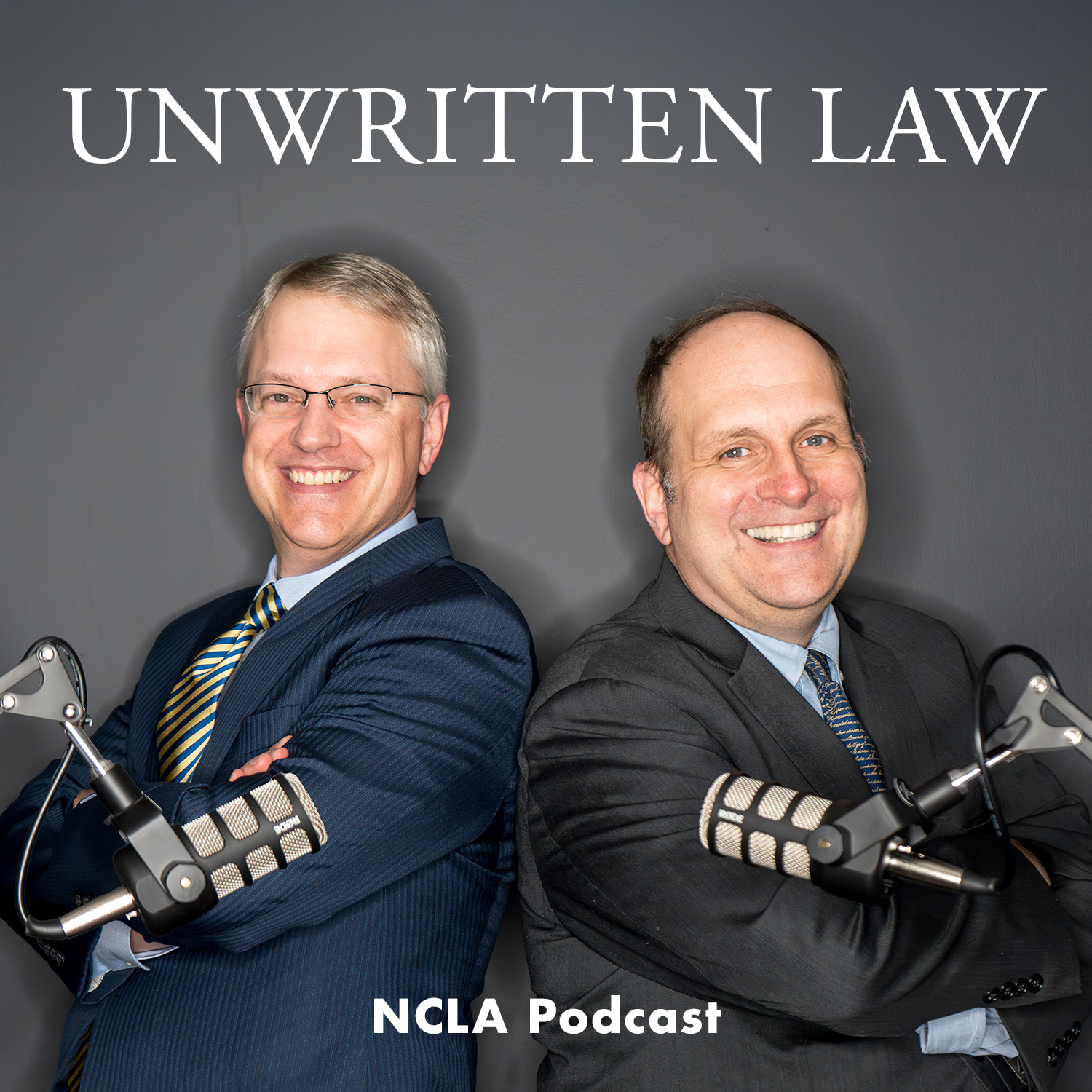
Unwritten Law is a podcast hosted by Mark Chenoweth and John Vecchione, brought to you by the New Civil Liberties Alliance (NCLA). This show dives deep into the world of unlawful administrative power, exposing how bureaucrats operate outside the bounds of written law through informal guidance, regulatory “dark matter,” and unconstitutional agency overreach.
-
113
Can the Government Escape Accountability for Censorship?
In this episode of Unwritten Law, NCLA President and Chief Legal Officer Mark Chenoweth and Senior Litigation Counsel John Vecchione are joined by Litigation Counsel Casey Norman to discuss NCLA's appeal in Dressen v. Flaherty, a case challenging alleged government-induced censorship during the COVID-19 pandemic.The plaintiffs include individuals who say they were censored after sharing their personal experiences with COVID-19 vaccine injuries or questioning official public health narratives. Casey explains why NCLA alleges that federal officials, working alongside outside organizations and social media platforms, pressured private companies to suppress constitutionally protected speech.The discussion focuses on the district court's dismissal of the case on standing and personal jurisdiction grounds, despite detailed allegations drawn from thousands of pages of discovery produced in Missouri v. Biden. Casey explains why NCLA believes plaintiffs should at least be allowed to conduct discovery before their claims are dismissed, and why courts should not require impossible levels of proof at the pleading stage.Mark, John, and Casey also examine the Fifth Circuit appeal, the role of the Stanford Internet Observatory and the Virality Project, Section 1985(3), and why this case could determine whether Americans have any meaningful judicial remedy when government officials allegedly pressure private platforms to censor speech.
-
112
Can Agency Commentary Increase Your Prison Sentence?
In this episode of Unwritten Law, NCLA President and Chief Legal Officer Mark Chenoweth and Senior Litigation Counsel John Vecchione are joined by Litigation Counsel Casey Norman to discuss Beaird v. United States, a Supreme Court case that could reshape federal criminal sentencing.At issue is Stinson deference, a doctrine requiring courts to defer to the U.S. Sentencing Commission’s commentary interpreting the federal sentencing guidelines. Unlike the guidelines themselves, that commentary is never approved by Congress and never goes through notice-and-comment rulemaking—yet it can dramatically increase a defendant’s prison sentence.Casey explains why the case follows naturally from the Supreme Court’s recent decisions limiting administrative deference, including Kisor v. Wilkie and Loper Bright. The discussion explores why courts—not agencies—have the constitutional duty to interpret the law, why due process requires fair notice before liberty is taken away, and why the rule of lenity weighs against expanding criminal punishment through agency interpretation.Mark, John, and Casey also examine Article III, judicial independence, and why Beaird could become the Court’s next major administrative law decision.
-
111
SCOTUS Special (Part 4): Title IX Means Sex
In this episode of Unwritten Law, NCLA President and Chief Legal Officer Mark Chenoweth and Senior Litigation Counsel John Vecchione are again joined by NCLA Staff Attorney Andreia Trifoi to discuss the Supreme Court’s opinion in West Virginia v. B.P.J.The Court held that neither Title IX nor the Equal Protection Clause prevents states from organizing school sports teams based on biological sex. Andreia explains why the Court looked to the ordinary meaning of “sex” when Title IX was enacted in 1972 and why the statute’s original purpose was to expand athletic opportunities for women.The discussion also focuses on Justice Gorsuch’s concurrence and NCLA’s amicus argument under the Spending Clause. Because Title IX conditions federal funding on compliance with certain requirements, states must receive clear notice of those conditions before accepting the money. Andreia explains why states agreeing to Title IX in 1972 could not have understood “sex” to include gender identity decades later.Mark, John, and Andreia also discuss the history and practical effects of Title IX, the Biden Administration’s unsuccessful attempt to expand the statute through regulation, and why federal agencies cannot rewrite the terms of Congress’s spending programs after states have already accepted them.
-
110
SCOTUS Special (Part 3): A Major Win for Digital Privacy
In this episode of Unwritten Law, NCLA President and Chief Legal Officer Mark Chenoweth and Senior Litigation Counsel John Vecchione are joined by NCLA Staff Attorney Andreia Trifoi to discuss the Supreme Court's landmark Fourth Amendment decision in Chatrie v. United States.The Court held that the government's collection of cell phone location history through a geofence warrant constitutes a Fourth Amendment search—a significant victory for digital privacy and one of the Court's most important Fourth Amendment decisions since Carpenter v. United States.Andreia explains how geofence warrants work, why they can sweep millions of people's location records into a single investigation, and why the Court concluded that this type of dragnet surveillance implicates constitutional protections.The discussion also explores the relationship between Chatrie and Carpenter, the future of automatic license plate reader (ALPR) litigation, Justice Gorsuch's property-based concurrence, and what the decision could mean for emerging surveillance technologies.For anyone concerned about privacy in the digital age, Chatrie represents an important reaffirmation that constitutional protections must evolve alongside modern technology.
-
109
SCOTUS Special (Part 2): The Federal Reserve Exception?
Part 2 of our Supreme Court Special.In this episode of Unwritten Law, NCLA President and Chief Legal Officer Mark Chenoweth and Senior Litigation Counsel John Vecchione are joined by NCLA Senior Litigation Counsel Jacob Huebert to examine the Supreme Court's decision in Trump v. Cook and what it means for the Federal Reserve and presidential removal power.Although the Court's decision in Trump v. Slaughter significantly expanded the President's authority to remove executive officers, Trump v. Cook stopped short of applying that reasoning to the Federal Reserve. Jacob explains why the Court emphasized the Federal Reserve's unique historical role, how Chief Justice Roberts relied on history and tradition, and why the Justices treated monetary policy differently from other executive functions.The discussion explores the government's arguments, standing, the Court's emergency-docket analysis, Justice Thomas's separate writing, and why Myers, Humphrey's Executor, and the First and Second Banks of the United States all played an important role in the Court's reasoning.Mark, John, and Jacob also discuss what constitutional questions remain unresolved, whether the Federal Reserve's regulatory powers could still face future challenges, and why Trump v. Cook may not be the final word on presidential control over independent agencies.
-
108
SCOTUS Summer Series (Part 1): The End of Humphrey's Executor
In this special Supreme Court edition of Unwritten Law, NCLA President and Chief Legal Officer Mark Chenoweth and Senior Litigation Counsel John Vecchione are joined by NCLA Of Counsel Margot Cleveland to discuss the Supreme Court's landmark decision in Trump v. Slaughter.The Court's decision effectively ends Humphrey's Executor, the 1935 precedent that limited the President's authority to remove leaders of independent agencies such as the Federal Trade Commission. Margot, who authored NCLA's amicus brief supporting the President's position, explains why the decision represents one of the Court's most significant separation-of-powers rulings in decades.The discussion explores how the Court built on earlier decisions such as Seila Law, why Chief Justice Roberts described Myers v. United States as the foundational precedent for presidential removal authority, and what the decision means for the future of the administrative state.Mark, John, and Margot also examine Justice Gorsuch's concurrence, severability, the unresolved questions surrounding the Federal Reserve and the civil service, and why the Court appears to be methodically restoring presidential control over executive officers.The episode concludes with a look ahead at the next constitutional battles likely to follow in the wake of Trump v. Slaughter.
-
107
Justice Thomas's Warning to Federal Agencies
In this episode of Unwritten Law, NCLA Senior Litigation Counsel John Vecchione is joined by Staff Counsel Christian Clase to discuss a remarkable concurrence by Justice Clarence Thomas in a recent Supreme Court case involving Roundup, pesticide regulation, and federal preemption.Although the Court's decision focused on whether federal law preempts state-law failure-to-warn claims, Justice Thomas used his concurrence to highlight a much broader set of constitutional concerns. His opinion raises questions about Congress's Commerce Clause authority, the constitutionality of broad delegations of power to administrative agencies, and whether federal agency actions should be capable of preempting state law at all.John and Christian examine Thomas's critique of modern administrative governance, including his concern that agencies can effectively create rules carrying civil and criminal consequences while exercising powers traditionally reserved to Congress.The discussion also explores Thomas's argument that agency action does not fit neatly within the Constitution's Supremacy Clause, why he views administrative preemption as constitutionally suspect, and how his opinion may serve as a roadmap for future constitutional challenges.The episode offers a deep dive into one of the most important administrative law concurrences of the term and what it could mean for the future of agency power.
-
106
SCOTUS Rejects Hawaii's Gun Rights Workaround
In this episode of Unwritten Law, NCLA Senior Litigation Counsel John Vecchione is joined by Litigation Counsel Jacob Huebert to discuss the Supreme Court's decision in Wolford v. Lopez, a significant Second Amendment case arising from Hawaii.After the Supreme Court's landmark decision in Bruen, Hawaii enacted a law making it a crime to carry a firearm on private property open to the public unless the property owner expressly consented. The Supreme Court recently rejected that approach, concluding that Hawaii's law lacked historical support and effectively undermined the right to carry recognized in Bruen.John and Jacob discuss the Court's reasoning, Justice Alito's concurrence, the debate over historical analogues such as Reconstruction-era Black Codes, and why constitutional rights cannot vary based on what one court called the "spirit of aloha."The conversation also explores what the decision could mean for NCLA's challenge to Illinois' Firearm Owner's Identification (FOID) card system in Laurent v. Kelly. Jacob explains why Illinois similarly flips the normal presumption of constitutional rights by requiring citizens to obtain government permission before possessing a firearm—even in their own homes.The episode highlights the Supreme Court's renewed attention to Second Amendment cases and why recent decisions may strengthen challenges to laws that condition constitutional rights on prior government approval.
-
105
The SEC Case That Could Expand Jury Trial Rights
In this episode of Unwritten Law, NCLA Senior Litigation Counsel John Vecchione is joined by Senior Litigation Counsel Russ Ryan to discuss Smith v. SEC, a case raising fundamental questions about jury trial rights, administrative adjudication, and constitutional exhaustion requirements.The case began more than a decade ago when FINRA initiated an investigation into George Smith. After years of proceedings before FINRA and the SEC, Smith challenged the process itself, arguing that he was entitled to have his case heard in an Article III court before a jury rather than through an administrative enforcement system.Russ explains how a Sixth Circuit panel recently suggested that Smith's constitutional arguments may have substantial merit—but nevertheless ruled against him on the ground that he failed to raise those arguments before the SEC itself.The discussion explores why agencies lack expertise and authority to resolve constitutional questions, how recent Supreme Court decisions such as Axon, Cochran, and Free Enterprise Fund bear on the issue, and why forcing litigants to exhaust constitutional claims before agencies creates a procedural trap.John and Russ also discuss the amicus briefs supporting rehearing, including filings from the Pacific Legal Foundation, the New Civil Liberties Alliance's allies in the administrative law space, and a brief submitted on behalf of entrepreneur Mark Cuban.The episode highlights broader questions about due process, administrative power, and whether Americans can truly be said to have "waived" constitutional rights by failing to raise them before agencies that have no power to grant relief.
-
104
Why Is the SEC Tracking Every Stock Trade?
In this episode of Unwritten Law, NCLA Senior Litigation Counsel John Vecchione is joined by Senior Litigation Counsel Peggy Little to discuss the SEC's Consolidated Audit Trail (CAT)—a massive government database that collects information on virtually every securities transaction made by American investors.The conversation centers on a new SEC request for public comments on the future of the CAT system, including the possibility of eliminating it altogether. Peggy explains why NCLA has long challenged the CAT, arguing that it creates serious constitutional, privacy, cybersecurity, and separation-of-powers concerns.The discussion explores how the CAT differs from traditional investigative tools such as the SEC's "blue sheet" process, why the database contains sensitive information about millions of Americans, and how cybersecurity breaches at government agencies raise concerns about concentrating so much financial information in a single location.John and Peggy also examine questions surrounding the CAT's funding mechanism, the role of self-regulatory organizations, and why NCLA believes Congress never authorized the SEC to create such a sweeping surveillance system in the first place.The episode concludes with a discussion of the SEC's public comment process and how ordinary Americans can make their voices heard on the future of the CAT.
-
103
The Fight Over Who Decides Constitutional Claims
In this episode of Unwritten Law, NCLA President and Chief Legal Officer Mark Chenoweth and Senior Litigation Counsel John Vecchione are joined by Senior Litigation Counsel Alana Black to discuss NCLA's amicus brief in Johnson v. United States Congress, a case asking whether constitutional challenges to federal statutes must be heard by Article III courts.The case involves a disabled veteran challenging a federal law affecting veterans benefits. Rather than allowing his constitutional claims to proceed in federal district court, lower courts relied on the Supreme Court's Thunder Basin and Elgin precedents to route the dispute through an administrative review process.Alana explains why NCLA believes those precedents are inconsistent with Congress's longstanding practice of ensuring that constitutional challenges to federal laws receive direct judicial review. Drawing on more than a century of statutory history, she shows how Congress repeatedly treated constitutional challenges as a special category of cases deserving heightened judicial attention—not administrative adjudication.The discussion also explores the relationship between Thunder Basin, Axon, Cochran, Loper Bright, and Relentless, as well as broader questions about separation of powers, judicial authority, and whether administrative tribunals should play any role in deciding constitutional claims.
-
102
Did the SEC Repeal Its Gag Rule to Avoid SCOTUS?
In this episode of Unwritten Law, NCLA President and Chief Legal Officer Mark Chenoweth, Senior Litigation Counsel John Vecchione, and Senior Litigation Counsel Peggy Little discuss NCLA's reply brief in Powell v. SEC, the case challenging the SEC's decades-old gag rule.Although the SEC recently rescinded the rule that prohibited settling defendants from publicly denying the agency's allegations, Peggy explains why the case is far from over. Thousands of existing gag orders remain in place, courts may still enforce them, and future administrations could reinstate similar restrictions at any time.The discussion explores the legal doctrine of voluntary cessation, why agencies should not be able to evade judicial review by temporarily changing course, and why NCLA believes the Supreme Court should still hear the case. Peggy also highlights a surprising development: shortly after the SEC repealed its rule, the CFTC repealed its nearly identical gag rule as well.Mark, John, and Peggy examine the broader implications for free speech, government accountability, and the First Amendment rights of Americans who settled with regulators but remain unable to publicly challenge the allegations against them.With the case scheduled for Supreme Court conference on June 25, the episode offers an inside look at one of the most important First Amendment battles involving the administrative state.
-
101
Can Congress Let EPA Pick Winners and Losers?
In this episode of Unwritten Law, NCLA President and Chief Legal Officer Mark Chenoweth, Senior Litigation Counsel John Vecchione, and General Counsel Zhonette Brown discuss NCLA's recently filed reply brief in Choice Refrigerants v. EPA, a case asking the U.S. Supreme Court to revisit the nondelegation doctrine.The conversation focuses on a fundamental constitutional question: Can Congress hand an agency virtually unlimited discretion to decide which companies receive valuable market allocations—and which do not?Zhonette explains why the government's response brief and supporting industry briefs point to different alleged "intelligible principles," highlighting what NCLA argues is the complete absence of any meaningful statutory guidance. The discussion also explores why notice-and-comment rulemaking is not a substitute for legislative accountability and why decisions affecting entire industries should be made by Congress—not unelected administrators.Mark, John, and Zhonette also compare the case to other recent Supreme Court administrative law decisions, discuss the support of 21 states and numerous public-interest organizations, and explain why they believe Choice Refrigerants presents an ideal vehicle for the Court to strengthen the nondelegation doctrine.With the petition scheduled for the Supreme Court's June 18 conference, the episode offers an inside look at one of NCLA's most significant constitutional cases.
-
100
A Tale of Two Judicial Discipline Cases
Why did one federal judge receive only a reprimand after engaging in sexual activities in her chambers, while Federal Judge Pauline Newman remains sidelined after more than three years — with no judicial review of her suspension, despite no findings of misconduct and passing 3 mental fitness tests from 3 different doctors?In this episode of Unwritten Law, Mark Chenoweth and John Vecchione discuss a recent judicial misconduct case that has prompted new scrutiny of the federal judiciary's internal disciplinary process.The discussion explores:A federal judge who received a private reprimand after misconduct findingsWhy the judge was allowed to continue hearing casesHow that outcome compares to Judge Pauline Newman's ongoing suspensionThe role of judicial councils in disciplining federal judgesConcerns about transparency, accountability, and consistencyWhy legal commentators across the ideological spectrum have questioned the resultMark and John also examine what these cases reveal about administrative processes within the judiciary and whether reforms may be needed to restore public confidence.
-
99
The Licensing Board That Ignored Due Process
In this episode of Unwritten Law, NCLA President and Chief Legal Officer Mark Chenoweth and Senior Litigation Counsel John Vecchione are joined by Litigation Counsel Casey Norman to discuss Kurtin v. South Carolina Department of Labor, a case challenging an extraordinary series of procedural abuses by a state licensing board.NCLA is challenging the South Carolina Real Estate Board’s unlawful sanctions against certified residential appraiser Joseph Kirton.Casey explains how the board pursued charges based on standards it had not yet adopted, introduced new allegations during the hearing itself, relied on a substitute investigator who had no involvement in the original investigation, refused access to key documents, and claimed that statutes of limitations did not apply to its proceedings.The discussion also explores broader constitutional issues raised by administrative licensing boards, including notice, fairness, retroactive enforcement, jury trial rights, and the danger of allowing agencies to serve as investigator, prosecutor, and adjudicator all at once.Mark, John, and Casey examine why this case could have implications far beyond South Carolina and why professionals across the country should pay attention.
-
98
The SEC Repealed the Gag Rule. While It's a Victory for Free Speech and NLCA, It's Not Over.
In this episode of Unwritten Law, NCLA President and Chief Legal Officer Mark Chenoweth, Senior Litigation Counsel John Vecchione, and Senior Litigation Counsel Peggy Little discuss a major development in Powell v. SEC: the SEC has formally rescinded its decades-old gag rule.The rule prohibited settling defendants from publicly denying the SEC's allegations against them, often leaving individuals silenced for years—or even decades—after their cases ended. The repeal marks a significant victory for free speech and follows years of litigation, advocacy, and a Supreme Court petition filed on behalf of NCLA clients including Thomas Powell.But is the fight over?Peggy explains why thousands of existing gag orders may still remain in place, why future SEC officials could potentially revive similar restrictions, and why NCLA believes the Supreme Court should still hear the case and issue a definitive ruling on the constitutionality of government-imposed settlement gags.The discussion also examines the role of 16 amicus briefs supporting Supreme Court review, the SEC's reasoning for repealing the rule, and the broader implications for free speech, administrative power, and government accountability.
-
97
Can Illinois Require Permission to Touch a Gun?
In this episode of Unwritten Law, NCLA President and Chief Legal Officer Mark Chenoweth and Senior Litigation Counsel John Vecchione are joined by Litigation Counsel Jacob Huebert to discuss a newly filed federal lawsuit challenging Illinois’ Firearm Owner’s Identification (FOID) card system.The case, Laurent v. Kelly, argues that Illinois unconstitutionally requires residents to obtain government permission before they may possess, use, or even touch a firearm in their own homes. NCLA contends that the law violates both the Second Amendment and the Due Process Clause of the Fourteenth Amendment by forcing citizens to seek approval from the government before exercising a fundamental constitutional right.Jacob explains how the FOID system works, why delays and administrative hurdles can prevent law-abiding citizens from exercising self-defense rights for months at a time, and how the law compares to unconstitutional “prior restraints” in the First Amendment context.The episode also examines the experiences of the lawsuit’s plaintiffs, including a Navy veteran and Chicago residents who object to the idea that constitutional rights should depend on government permission slips. Mark, John, and Jacob further discuss the implications of the Supreme Court’s Bruen decision and why this challenge could have consequences beyond Illinois.
-
96
Loper Bright Keeps Reshaping Agency Power
In this episode of Unwritten Law, NCLA President and Chief Legal Officer Mark Chenoweth and Senior Litigation Counsel John Vecchione discuss developments in the Supreme Court’s landmark Loper Bright and Relentless (2024) decisions overturning Chevron deference.Mark and John explain the unusual procedural developments following the Supreme Court’s decision, including remand proceedings in the First Circuit, negotiations over holding the case in abeyance, and why the federal government may now be reconsidering the legality and practicality of the rule.The episode also explores broader implications of Loper Bright: why agencies can no longer rely on Chevron deference to expand statutory authority, why removing unlawful rules matters beyond any one administration, and how regulatory power can continue to affect industries long after political leadership changes.
-
95
Can EPA Decide Who Stays in Business?
In this episode of Unwritten Law, NCLA President and Chief Legal Officer Mark Chenoweth and Senior Litigation Counsel John Vecchione are joined by NCLA General Counsel Zhonette Brown to discuss the federal government’s response brief in Choice Refrigerants v. EPA, a case asking the U.S. Supreme Court to revisit the nondelegation doctrine.The discussion focuses on whether Congress unconstitutionally handed the EPA broad authority to determine how shrinking refrigerant allowances are allocated under the AIM Act—effectively deciding which companies can continue operating and which may be pushed out of the market.Zhonette explains why the case is not simply about environmental regulation, but about who controls market share and economic liberty in America. The conversation explores the “gaping hole” in the statute identified by NCLA: while Congress specified detailed chemical formulas, phase-down schedules, and military-use carveouts, it failed to explain how the EPA should allocate allowances among competing businesses.The episode also examines the practical consequences for small businesses like Choice Refrigerants, whose owner developed replacement refrigerants without the resources of major industry players. Mark, John, and Zhonette discuss how the EPA created new entrant carveouts, reshuffled market allocations, and exercised broad discretion that NCLA argues belongs to Congress—not federal agencies.The conversation further explores broader constitutional themes raised by the case, including preemption, federalism, economic liberty, and the Supreme Court’s recent signals that it may be willing to revive meaningful limits on congressional delegation of legislative power.
-
94
How Loper Bright Is Changing the Courts
In this episode of Unwritten Law, NCLA President and Chief Legal Officer Mark Chenoweth and Senior Litigation Counsel John Vecchione discuss the growing real-world impact of the Supreme Court’s landmark decisions in Loper Bright and Relentless—the cases that ended Chevron deference and restored the judiciary’s independent role in interpreting federal statutes.As the two-year anniversary of the decisions approaches, Mark and John examine several major lower-court rulings already shaped by the new legal framework. The discussion focuses on a recent Eighth Circuit decision striking down an FCC rule on “digital discrimination” in broadband access, where the court held that the agency exceeded the authority Congress actually granted in statute.The episode also explores another FCC dispute involving a proposed media merger and the agency’s attempt to avoid judicial review while allowing the merger to proceed. Mark and John explain how courts are increasingly applying Loper Bright to ensure agencies follow the text Congress enacted—not policy preferences agencies wish Congress had adopted.The conversation highlights how the end of Chevron deference is reshaping administrative law across industries, why the effects are not limited to any one political party or industry, and how the decisions are restoring courts to their constitutional role in deciding what the law means.
-
93
Government Doesn’t Appeal NCLA’s Victory in Labor Rule Case
In this episode of Unwritten Law, NCLA President and Chief Legal Officer Mark Chenoweth and Senior Litigation Counsel John Vecchione discuss a major victory in Flint Ave. LLC v. U.S. Department of Labor, after the federal government decided not to move forward with its appeal.The case challenged a Department of Labor rule that dramatically increased the salary threshold for employees classified as exempt from overtime and minimum wage requirements under the Fair Labor Standards Act. NCLA argued that the rule unlawfully elevated salary level over the actual duties employees perform—contrary to the statute Congress enacted.John explains how the district court permanently set aside and vacated the rule nationwide, why the government’s appeal remained pending for more than a year, and what it means now that the Department of Justice has agreed to dismiss the appeal.The discussion also explores the practical consequences of the rule for businesses and workers who rely on flexible schedules, including part-time managers and employees who prioritize flexibility over rigid salary structures. Mark and John explain why the decision represents both a major victory for their client, Flint Ave. LLC, and an important reaffirmation that agencies cannot rewrite statutes through regulation.
-
92
Judges Rally Behind Judge Newman at SCOTUS
In this episode of Unwritten Law, NCLA President and Chief Legal Officer Mark Chenoweth and Senior Litigation Counsel John Vecchione are joined by Litigation Counsel Andy Morris to discuss new developments in Newman v. Moore, an NCLA case asking the U.S. Supreme Court to decide whether Judge Pauline Newman has a right to judicial review after being sidelined from the Federal Circuit for more than three years.The conversation focuses on a series of newly filed amicus briefs supporting Supreme Court review, including briefs from retired federal judges, former Federal Circuit clerks, legal scholars, and the D.C. Bar. Andy explains why many attorneys have been reluctant to publicly support Judge Newman despite widespread concern within the legal community, and why several amici argue the case raises profound questions about judicial independence and separation of powers.The episode examines claims that internal judicial administrative processes have been used to effectively remove an Article III judge from active service without impeachment or meaningful judicial review. Mark, John, and Andy also discuss the unusual refusal to transfer the matter to another circuit, concerns about secrecy and selective disclosure, and the argument that Judge Newman’s removal has had a chilling effect on dissent within the Federal Circuit.The discussion also highlights Judge Newman’s continued public appearances, her extensive record of influential dissents, and why amici argue the Supreme Court should intervene to clarify the constitutional limits of internal judicial disciplinary power.
-
91
Sztrom v. SEC and Your Right to a Jury Trial
In this episode of Unwritten Law, NCLA President and Chief Legal Officer Mark Chenoweth and Senior Litigation Counsel John Vecchione are joined by Senior Litigation Counsel Russ Ryan to discuss Michael Sztrom and David Sztrom v. SEC, a case raising fundamental questions about administrative power and the right to a fair hearing.After settling an SEC enforcement action in federal court, the Sztroms were subjected to a second, follow-on administrative proceeding that could bar them from the securities industry—based on the same underlying allegations. Russ explains NCLA’s amicus brief supporting their appeal and why the case challenges the structure of SEC enforcement.The discussion focuses on whether individuals are entitled to an Article III court and jury trial when the government seeks to impose severe penalties such as industry bans—even when those penalties are labeled “non-monetary.” The episode also explores how SEC settlement practices limit defendants’ ability to challenge allegations, effectively precluding meaningful defense in subsequent proceedings.Mark, John, and Russ examine how this case builds on recent Supreme Court precedent, why agency adjudication raises serious constitutional concerns, and what’s at stake if courts allow administrative prosecutions to proceed without full judicial safeguards.
-
90
16 Amicus Briefs Back Challenge to SEC Gag Rule
In this episode of Unwritten Law, NCLA President and Chief Legal Officer Mark Chenoweth and Senior Litigation Counsel John Vecchione are joined by Senior Litigation Counsel Peggy Little to discuss new developments in Powell v. SEC, a case asking the U.S. Supreme Court to review the SEC’s long-standing gag rule.The discussion focuses on a wave of 16 amicus briefs filed in support of Supreme Court review, representing a broad coalition of organizations, legal scholars, and former SEC attorneys. Peggy walks through the key arguments raised across the briefs, including claims that the gag rule constitutes prior restraint, compelled speech, and an unconstitutional condition on settlement.The episode explores how the rule prevents individuals from ever publicly disputing the SEC’s allegations—even after settlement—while allowing the agency to control the narrative. The conversation also highlights the real-world consequences: reputational harm, career disruption, and the reality that most defendants settle not because they are guilty, but because they cannot afford the cost of fighting the government.Mark, John, and Peggy examine why the rule has persisted for decades, why it stands out as an outlier among federal agencies, and why this case could provide the Supreme Court with an opportunity to address a long-standing tension between administrative enforcement and the First Amendment.
-
89
When the SEC Takes a Decade to Decide
In this episode of Unwritten Law, NCLA President and Chief Legal Officer Mark Chenoweth and Senior Litigation Counsel John Vecchione are joined by Senior Litigation Counsel Russ Ryan to discuss Lek Securities Corp. v. SEC, a case highlighting extreme delays in administrative adjudication.The case involves a nearly decade-long delay by the SEC in resolving an appeal from a New York Stock Exchange disciplinary action—raising serious constitutional and statutory concerns. Russ explains how the delay implicates due process, the Administrative Procedure Act’s requirement that agencies act within a reasonable time, and even the SEC’s own internal deadlines.The conversation explores why such delays matter: individuals and firms can be effectively punished long before a final decision is issued, facing reputational harm, business disruption, and prolonged uncertainty. Mark, John, and Russ also discuss potential remedies, including whether courts should set aside agency actions when delays become egregious.The episode highlights broader structural concerns about administrative adjudication, including lack of accountability, limited access to judicial review, and incentives that allow agencies to delay decisions without consequence.
-
88
21 States Back Challenge to EPA Power: SCOTUS Push
In this episode of Unwritten Law, NCLA President and Chief Legal Officer Mark Chenoweth and Senior Litigation Counsel John Vecchione are joined by NCLA General Counsel Zhonette Brown to discuss new developments in Choice Refrigerants v. EPA, a case asking the U.S. Supreme Court to revisit the nondelegation doctrine.The conversation focuses on a wave of amicus briefs filed in support of Supreme Court review, including a brief led by West Virginia and joined by 20 other states, as well as submissions from organizations such as Americans for Prosperity Foundation, Cato Institute, Manhattan Institute, and Southeastern Legal Foundation.Zhonette explains the key arguments raised in those briefs, including how broad delegations of power to federal agencies can undermine federalism by displacing state authority, why doctrines like the “major questions” rule may not be sufficient to protect the separation of powers, and how shifting regulatory interpretations can create instability for businesses.The episode also examines arguments that delegation must be grounded in the Necessary and Proper Clause, concerns about courts and agencies effectively supplying their own “intelligible principles,” and why this case is viewed as a strong vehicle for the Supreme Court to take up the nondelegation issue.Mark, John, and Zhonette close by discussing the road ahead, including the timeline for responses and when the Court is expected to decide whether it will hear the case.
-
87
Standing, Security, and the “Trump Ballroom”
In this episode of Unwritten Law, NCLA President and Chief Legal Officer Mark Chenoweth and Senior Litigation Counsel John Vecchione break down a recent decision from the U.S. Court of Appeals for the D.C. Circuit involving plans to construct a ballroom at the White House.The case—brought by the National Trust for Historic Preservation—sought to halt construction, raising questions about historic preservation, executive authority, and whether private organizations have standing to challenge government building decisions on aesthetic grounds. The D.C. Circuit ultimately remanded the case to the district court, questioning the basis for an earlier injunction.Mark and John explore the key legal issues, including whether the plaintiffs have standing, the scope of statutory authority allowing the President to “improve” the White House grounds, and how national security considerations factor into the analysis—particularly regarding underground security features tied to the project.The episode also examines the practical realities of the case, including the fact that the original structure has already been demolished, raising questions about what relief is even possible at this stage of litigation.
-
86
Birthright Citizenship at the Supreme Court
In this episode of Unwritten Law, NCLA President and Chief Legal Officer Mark Chenoweth and Senior Litigation Counsel John Vecchione break down Trump v. Barbara, a closely watched case before the U.S. Supreme Court addressing the scope of birthright citizenship under the Fourteenth Amendment.John shares firsthand insights from attending oral argument, where the Court considered whether the Constitution guarantees citizenship to all children born in the United States or whether limits may apply to the children of illegal immigrants and temporary visitors. The case stems from an executive order directing federal agencies to reinterpret the Citizenship Clause—raising both constitutional and administrative law questions.The discussion explores the historical understanding of the Fourteenth Amendment, the role of allegiance and jurisdiction, and key precedents such as United States v. Wong Kim Ark. Mark and John also examine competing arguments presented at oral argument, including concerns about retroactivity, congressional authority, and the practical consequences of altering long-standing interpretations of citizenship.The episode also highlights commentary from legal scholars, including an article by Philip Hamburger, and explains why the Court’s decision—expected later this term—could have major implications for immigration policy, constitutional law, and the separation of powers.Philip Hamburger's article in Law & Liberty: Allegiance, Birthright, and Citizenshiphttps://lawliberty.org/allegiance-birthright-and-citizenship/
-
85
State Department Admits First Amendment Violations
In this episode of Unwritten Law, NCLA President and Chief Legal Officer Mark Chenoweth, Senior Litigation Counsel John Vecchione, Senior Litigation Counsel Peggy Little, and Of Counsel Margot Cleveland discuss a major settlement in The Daily Wire, The Federalist, and the State of Texas v. U.S. Department of State.The case challenged a years-long effort in which State Department funds were routed through third-party organizations and technologies—such as the Global Disinformation Index and NewsGuard—to suppress and demonetize certain media outlets. According to the settlement, the government acknowledged that aspects of these activities violated the First Amendment and involved unlawful conduct.The episode explains how the alleged “boomerang effect” allowed the government to work through foreign and private intermediaries to impact domestic speech, the investigative work that uncovered the scheme, and the discovery that revealed the scope of coordination across agencies, nonprofits, universities, and technology platforms.Peggy and Margot walk through the key terms of the settlement, including restrictions on government coordination with censorship technologies, limits on grant funding tied to domestic speech, training and compliance requirements, and long-term oversight provisions designed to prevent similar conduct in the future.The discussion also highlights the role of journalists, plaintiffs willing to challenge the government, and the court in bringing the case forward—and why the outcome may have significant implications for free speech, government accountability, and the limits of federal power.
-
84
Who Gets to Decide What’s a Crime?
In this episode of Unwritten Law, NCLA Senior Litigation Counsel John Vecchione is joined by NCLA Litigation Counsel Casey Norman to discuss Pheasant v. United States, a case asking the U.S. Supreme Court to consider whether Congress can delegate the power to create criminal laws to federal agencies.The case began when a man riding a dirt bike on Bureau of Land Management land was charged with a criminal offense—not because Congress passed a law making his conduct a crime, but because a federal agency created the regulation and attached criminal penalties to it. NCLA filed an amicus brief supporting Supreme Court review, arguing that allowing agencies to define criminal conduct raises serious constitutional concerns.The discussion explains the nondelegation doctrine, the “intelligible principle” test, and why criminal law raises special due process concerns when agencies—not Congress—decide what conduct can lead to fines or prison time. The episode also explores how modern courts interpret delegation differently than earlier courts and why this case could have major implications for the separation of powers.
-
83
The Massachusetts Phone Spyware Case
Did the government install tracking software on people’s phones without permission?In this episode of Unwritten Law, Mark Chenoweth and John Vecchione are joined by NCLA Senior Litigation Counsel Peggy Little to discuss Wright v. Goldstein, a case challenging Massachusetts’ use of COVID contact-tracing technology that was allegedly installed automatically on Android phones without users’ knowledge or consent.The lawsuit argued that the program violated the Fourth Amendment, the Fifth Amendment, and computer intrusion laws by forcing software onto private phones and collecting sensitive data, including location and health information. The case resulted in a settlement requiring the state to delete the data and agree not to use similar technology for five years.This episode explains the case, the constitutional issues, and why the settlement could have nationwide implications for digital privacy and government surveillance.
-
82
The Inside Story of Murthy v. Missouri: How the Government Pressured Social Media
In this episode of Unwritten Law, NCLA Senior Litigation Counsel John Vecchione and NCLA General Counsel Zhonette Brown discuss their work on Murthy v. Missouri, one of the most significant First Amendment cases in recent years.They explain how the case began, the discovery battles that revealed government “back-channel” communications with social media companies, the preliminary injunction, the Supreme Court’s standing decision, and the consent decree that followed. They also discuss what the government agreed to in the settlement and what it could mean for free speech and government involvement with online platforms in the future.This conversation offers a behind-the-scenes look at how the case unfolded over several years—and why its outcome could shape First Amendment law in the years ahead.
-
81
Judge Newman and the Right to a Day in Court
In this episode of Unwritten Law, NCLA President Mark Chenoweth and Senior Litigation Counsel John Vecchione are joined by NCLA Litigation Counsel Andy Morris to discuss Newman v. Moore, a case asking the U.S. Supreme Court to decide whether a federal judge can be effectively removed from hearing cases without meaningful judicial review.Judge Pauline Newman of the U.S. Court of Appeals for the Federal Circuit has been barred from hearing new cases for years under the Judicial Conduct and Disability Act—despite never being impeached and despite medical evaluations finding her fit to serve. The courts so far have refused to review the merits of her case, citing precedent that treats these actions as internal court administration.The petition asks the Supreme Court to decide whether courts must be able to review actions that go beyond temporary administrative measures and effectively remove an Article III judge from the bench. The case raises major constitutional questions about judicial independence, separation of powers, and whether “court administration” can be used in a way that avoids judicial review altogether.Mark, John, and Andy explain the legal issues, the procedural hurdles, and why the case is about more than one judge—it’s about whether there are limits on internal judicial power and whether federal courts must be open to hear constitutional claims.
-
80
The First Amendment vs. the SEC Gag Rule
In this episode of Unwritten Law, NCLA President Mark Chenoweth and Senior Litigation Counsel John Vecchione are joined by Senior Litigation Counsel Peggy Little to discuss Powell v. SEC, case that NCLA is asking the U.S. Supreme Court to review the SEC’s long-standing “gag rule.”The rule prohibits individuals who settle with the SEC from ever publicly denying the agency’s allegations—even if they believe those allegations are false. Peggy explains why the case presents a major First Amendment question involving prior restraint, viewpoint discrimination, and unconstitutional conditions.The conversation also explores the real-world consequences of the rule: how it silences defendants, prevents journalists from reporting both sides of enforcement actions, distorts market information, and allows agencies to expand their power through settlements that most people cannot afford to fight.The episode discusses key Supreme Court precedents, the Ninth Circuit’s ruling, and why this case could have major implications not just for the SEC, but for government settlement practices across the administrative state.
-
79
Geofencing, Google Data, and the Fourth Amendment
In this episode of Unwritten Law, NCLA Senior Litigation Counsel John Vecchione is joined by NCLA Staff Attorney Andreia Trifoi to discuss a major Fourth Amendment case before the U.S. Supreme Court involving the use of geofence warrants.Geofence warrants allow law enforcement to obtain location data from companies like Google identifying every device within a specific area during a defined period of time—potentially sweeping in dozens or even hundreds of people with no connection to any crime. Andreia explains how these warrants work, why they often capture innocent bystanders, and how they were used in a bank robbery investigation in Virginia.The conversation focuses on the constitutional question at the heart of the case: whether geofence warrants are modern-day general warrants, the very abuse that helped inspire the Fourth Amendment. The discussion also explores how the Supreme Court’s decision in Carpenter v. United States applies to modern location tracking, the challenges courts face when adapting older doctrines to new technology, and the growing tension between privacy rights and expansive digital surveillance.John and Andreia also examine the fractured opinions in the Fourth Circuit, the role of the good-faith exception, and why this case could shape the future of Fourth Amendment protections in the digital age.
-
78
Disparate Impact and the Limits of Agency Power
In this episode of Unwritten Law, NCLA President Mark Chenoweth and Senior Litigation Counsel John Vecchione welcome Caitlin Moyna, Senior Litigation Counsel at the New Civil Liberties Alliance, to the podcast for the first time.The conversation focuses on the controversial “disparate impact” liability rule in housing law and HUD’s effort to rescind it. The rule allows liability for housing practices that unintentionally affect one group more than another—even when there is no intent to discriminate.Caitlin explains how this doctrine emerged from a series of Supreme Court cases, beginning with Griggs v. Duke Power and later extending into the housing context through Texas Department of Housing and Community Affairs v. Inclusive Communities Project. The discussion explores how disparate impact liability shifted discrimination law away from intentional conduct and toward statistical outcomes.The episode also examines how agency interpretations and judicial deference helped expand this doctrine over time—and why recent Supreme Court decisions curtailing agency deference may put its legal foundations into question.Mark, John, and Caitlin discuss the implications of HUD rescinding the rule, why private lawsuits could still continue under the statute, and what a broader reevaluation of disparate impact liability could mean for housing, employment, lending, and other areas of federal regulation.
-
77
Can Congress Hand EPA the Power to Pick Winners?
In this episode of Unwritten Law, NCLA President Mark Chenoweth and Senior Litigation Counsel John Vecchione are joined by NCLA General Counsel Zhonette Brown to discuss a petition for certiorari asking the U.S. Supreme Court to take up a major separation-of-powers case involving the Environmental Protection Agency.The case, Choice Refrigerants v. EPA, challenges how the agency implemented Congress’s AIM Act, which created a cap-and-trade system to phase down certain refrigerants. According to the petition, Congress provided virtually no guidance on how market allowances should be distributed—leaving EPA with sweeping discretion to decide which companies would keep their market share and which would lose it.Zhonette explains why this case presents a “clean vehicle” for the Supreme Court to revisit the nondelegation doctrine, which holds that Congress cannot hand over its legislative power to executive agencies without providing meaningful direction. The discussion explores the “intelligible principle” test, the D.C. Circuit’s reasoning, and why the Court may finally confront the limits of congressional delegation after nearly a century without striking down a statute on nondelegation grounds.The episode also highlights the real-world stakes for small businesses like Choice Refrigerants, founded by entrepreneur Ken Ponder, whose patented refrigerant products were affected by EPA’s allocation decisions.
-
76
The Supreme Court Slaps Down Presidential Tariff Power
In this episode of Unwritten Law, NCLA Senior Litigation Counsel John Vecchione and NCLA President Mark Chenoweth are joined by Andy Morris to discuss the Supreme Court’s 6–3 decision rejecting the claim that the President has unilateral authority to impose, raise, or lower tariffs under the International Emergency Economic Powers Act (IEEPA).The conversation unpacks Chief Justice Roberts’s majority opinion, which relies on careful textual analysis to reaffirm that tariff authority belongs to Congress—not the Executive. John, Mark, and Andy explain why the statute’s language does not authorize revenue-raising measures, how the Constitution’s prohibition on export taxes reinforces that conclusion, and why decades of practice confirm that “regulating importation” does not mean imposing tariffs.They also examine the dissents, including Justice Kavanaugh’s reliance on prior cases like Algonquin, the role of the Major Questions Doctrine, and why emergency powers do not justify bypassing Congress’s exclusive taxing authority. The episode closes with a broader discussion of separation of powers, the dangers of discretionary tariff regimes, and why this decision represents a major win for constitutional limits on executive power.
-
75
Does SEC Disgorgement Require Investor Harm?
In this episode of Unwritten Law, NCLA Senior Litigation Counsel John Vecchione is joined by NCLA Senior Litigation Counsel Kara Rollins to discuss Sripetch v. SEC, a securities law case scheduled to be argued before the U.S. Supreme Court in April.The case asks a critical question: must the Securities and Exchange Commission prove that investors suffered actual financial harm in order to obtain disgorgement in a civil enforcement action? John and Kara explain how recent Supreme Court decisions, including Kokesh and Liu, narrowed the SEC’s disgorgement authority while leaving this issue unresolved.
-
74
The Supreme Court’s Emergency Docket Turns Ten
In this episode of Unwritten Law, NCLA President Mark Chenoweth and Senior Litigation Counsel John Vecchione mark the ten-year anniversary of what’s often called the Supreme Court’s “emergency docket”—sometimes labeled the “shadow docket”—and examine how it has reshaped constitutional litigation.Mark and John explain what the emergency docket is, how it differs from merits decisions, and why its modern form is often traced to the Supreme Court’s 2016 decision to stay the Obama Administration’s Clean Power Plan. They discuss why emergency relief can be critical to preventing irreversible “fait accompli” outcomes when executive action races ahead of judicial review.The conversation also explores debates sparked by critics of the emergency docket, the confusion it can create for lower courts, and whether decisions issued without full opinions should bind judges below. Along the way, Mark and John reflect on the legacy of Justice Antonin Scalia—whose final vote played a key role in the Clean Power Plan stay—and how his jurisprudence continues to influence debates over judicial power, originalism, and the proper limits of the administrative state.
-
73
Student Loan Pauses, Standing, and Lost Subsidies
In this episode of Unwritten Law, NCLA President Mark Chenoweth and Senior Litigation Counsel John Vecchione are joined by Russ Ryan to discuss a recent oral argument before the U.S. Court of Appeals for the Sixth Circuit challenging the federal government’s student loan payment and interest pause.The case, Mackinac Center for Public Policy v. U.S. Department of Education, focuses on the executive branch’s decision—under both the Trump and Biden administrations—to extend a moratorium on student loan payments and interest accrual long after Congress’s limited authorization expired. Russ explains why those unilateral extensions wiped away billions of dollars in interest without statutory authority.The discussion zeroes in on standing: how nonprofit public-interest employers benefit from Congress’s Public Service Loan Forgiveness program, why administrative action that reduces outstanding student debt can unlawfully diminish that congressionally granted subsidy, and how Supreme Court precedent—most notably Clinton v. City of New York—supports the theory that loss of a subsidy is a concrete injury.Mark, John, and Russ also unpack the judges’ questions at oral argument, the Sixth Circuit’s prior rulings, and why this case could clarify when organizations may challenge executive actions that override Congress’s spending decisions.
-
72
The SEC’s Stock Surveillance and the Fourth Amendment
In this episode of Unwritten Law, Mark Chenoweth and John Vecchione are joined by NCLA Of Counsel Margot Cleveland to discuss one of NCLA’s most consequential ongoing cases: Davidson v. Adkins, a constitutional challenge to the SEC’s Consolidated Audit Trail (CAT).The CAT requires broker-dealers to collect and transmit detailed data on virtually every stock trade in the United States, creating a massive government-accessible database of Americans’ financial activity. Margot explains why recent changes announced by the SEC—such as removing names but retaining identifying numbers—do not cure the Fourth Amendment problem, and why suspicionless, warrantless searches of stock-trading data resemble the general warrants the Constitution was designed to forbid.The episode also examines the SEC’s repeated requests for delays while the program continues to operate, the lack of congressional authorization or appropriation for CAT, related rulings from the Eleventh Circuit, and the broader dangers of mass financial surveillance for privacy, free association, and constitutional limits on agency power.
-
71
Can DOE Regulate Water Use Without Congress?
In this episode of Unwritten Law, NCLA President Mark Chenoweth and Senior Litigation Counsel John Vecchione discuss John’s recent oral argument at the U.S. Court of Appeals for the Fifth Circuit in Word v. Department of Energy.Bill Word and David Daquin both own a dishwasher and a washing machine that they want to replace. The U.S. Department of Energy has imposed regulations in 2012 and 2024 illegally limiting how much water dishwashers and washing machines can use. The appliances Word and Daquin want to buy use more water than those regulations allow. But under the amended Energy Policy and Conservation Act of 1975, the Department of Energy can only regulate water use in “faucets, showerheads, water closets and urinals”.The conversation also explores a key procedural question: where regulated parties can seek meaningful relief when an agency repeatedly issues unlawful rules, and whether district courts must be able to issue injunctions to stop ultra vires agency action. Along the way, Mark and John reflect on the Fifth Circuit’s prior rulings, post-Loper Bright limits on agency power, and why congressional action—not bureaucratic improvisation—is the proper way to regulate.
-
70
Seven Amicus Briefs, One Big Question After Loper Bright
In this episode of Unwritten Law, NCLA Senior Litigation Counsel John Vecchione and NCLA President Mark Chenoweth discuss a major development in NCLA’s challenge to a federal rule requiring fishermen to pay for government monitors placed on their boats—despite no clear statutory authorization.After a district court upheld the rule using a theory that conflicts with the Supreme Court’s decision in Loper Bright, NCLA appealed to the First Circuit. Now, seven separate amicus briefs—from across the legal and ideological spectrum—have weighed in, each highlighting a different flaw in the district court’s analysis.John and Mark walk through the most compelling arguments from the amici, including post-Loper Bright de novo review, the misuse of “necessary and appropriate” authority, clear-statement rules, the Major Questions Doctrine, constitutional limits on agency power, and why reviving Chevron-era reasoning under new labels is not permissible.
-
69
Cross-Deputized—and Above the Law?
What happens when a state or local police officer violates someone’s constitutional rights—and courts say there’s no practical way to sue?In this episode of Unwritten Law, NCLA President Mark Chenoweth and Senior Litigation Counsel John Vecchione are joined by Casey Norman to discuss Mohamud v. Weyker (No. 25-760), now at the U.S. Supreme Court.NCLA’s amicus brief explains that multiple courts have recognized Officer Heather Weyker (a St. Paul police officer) abused her authority by fabricating allegations against Hamdi A. Mohamud and at least 30 other people—conduct the brief describes as “framing” that led to Mohamud’s incarceration for over two years. Yet the Eighth Circuit held Mohamud cannot sue Weyker under 42 U.S.C. § 1983 because Weyker was also cross-deputized for a federal task force—treating the conduct as federal in nature and shutting the courthouse door.The episode also explains why this accountability gap is especially dangerous after Egbert v. Boule, which largely eliminated Bivens remedies for most plaintiffs—making § 1983 often the only viable path for damages when cross-deputized officers violate constitutional rights.
-
68
Trump v. Cook: Can a President Fire a Fed Governor “For Cause”?
In this episode of Unwritten Law, Mark Chenoweth and John Vecchione break down the Supreme Court’s oral argument in Trump v. Cook, a case that puts presidential power, Federal Reserve independence, and the meaning of “for cause” removal squarely before the Court.The discussion explores why the Justices appeared unusually skeptical of the government’s position, how the case arrived on the emergency docket, and whether a president must provide notice or a hearing before removing a Federal Reserve governor. Mark and John examine the distinction between the Fed’s interest-rate authority and its regulatory power, debate whether pre-appointment conduct can justify removal, and unpack the broader separation-of-powers implications.If the Court limits the president here, does it invite a direct constitutional challenge to “for cause” protections? And what does this case signal about how the Court views executive control over independent agencies? A lively, substantive conversation about one of the most surprising Supreme Court arguments of the term.
-
67
The SEC’s Massive Surveillance Database: Davidson, et al. v. Atkins
In this episode of Unwritten Law, Mark Chenoweth and John Vecchione are joined by Peggy Little, Senior Litigation Counsel at NCLA, to discuss one of the most consequential cases in the organization’s docket: Davidson, et al. v. Atkins, a constitutional challenge to the SEC’s Consolidated Audit Trail (CAT).The CAT is a massive nationwide database that collects and stores every stock trade made by every American investor, without suspicion, clear statutory authorization, or congressional appropriation. Peggy explains why this dragnet surveillance raises serious Fourth and Fifth Amendment concerns, threatens the security of Americans’ financial data, and unlawfully shifts billions of dollars in costs onto investors.The discussion covers:Why the SEC lacks statutory authority to create and operate the CATHow mass financial data collection implicates constitutional privacy protectionsThe dangers of delaying judicial review while unconstitutional conduct continuesWhy agencies cannot be allowed to “think about fixing” violations while rights are being infringedThis episode explains why Davidson, et al. v. Atkins is not just about securities regulation, but about the constitutional limits of agency power — and why courts must intervene.
-
66
Can Agencies Force You to Fund Your Own Regulation?
In this episode of Unwritten Law, John Vecchione and Mark Chenoweth unpack the latest chapter in Relentless, Inc. v. Department of Commerce, a case that sits at the crossroads of administrative power, statutory interpretation, and life after Chevron deference.The conversation focuses on whether federal agencies can require regulated parties — here, commercial fishermen — to pay for government-mandated monitors placed on their boats, even when Congress never clearly authorized those costs. John explains why a Rhode Island district court relied on a so-called “default norm” to uphold the rule, and why that reasoning conflicts with the Supreme Court’s rejection of Chevron in Loper Bright.Mark and John walk through the Magnuson-Stevens Act, highlighting where Congress explicitly authorized industry-funded observers — and where it did not. They also explore the constitutional stakes: who decides who pays, why funding power belongs to Congress, and what happens when agencies effectively fund themselves through regulation.The episode offers a clear look at how unelected bureaucrats expand power, why statutory text still matters, and what this case could mean for administrative law after Chevron.
-
65
When Agencies Hold the Keys: FTC Investigations and the Right to Go to Court
In this episode of Unwritten Law, Mark Chenoweth and John Vecchione are joined by Peggy Little, Senior Litigation Counsel at NCLA, to discuss NCLA’s amicus brief in Media Matters v. Federal Trade Commission, currently before the U.S. Court of Appeals for the D.C. Circuit.The conversation focuses on the FTC’s use of civil investigative demands (CIDs) and a fundamental constitutional question: must individuals and organizations have access to an independent court before complying with sweeping agency demands? Peggy explains why allowing agencies to issue broad investigative orders without meaningful judicial review threatens First Amendment rights of speech and association.Drawing on Supreme Court precedents including NAACP v. Alabama, Americans for Prosperity Foundation v. Bonta, Axon Enterprise v. FTC, and SEC v. Jarkesy, the episode examines why constitutional challenges cannot be forced through agency-controlled processes. The hosts also discuss the dangers of agencies “holding the keys to the courthouse,” the structural bias built into self-review, and how repeated investigative demands can be used to pressure or dismantle organizations without ever filing charges.
-
64
An Accidental Landmark? How VanDerStok Could Revive Deference to the Administrative State
Chevron deference may be gone—but is the Supreme Court quietly laying the groundwork for something even worse?In this episode of Unwritten Law, Mark Chenoweth and John Vecchione examine a recent Supreme Court decision that could dramatically reshape administrative law. Drawing on analysis by Will Yeatman, they discuss how the Court’s handling of VanDerStok risks giving agencies a powerful new shield by treating challenges to regulations as “facial” attacks—making them nearly impossible to win.The conversation dives into why this approach departs from traditional administrative-law principles, how lower courts may use it to avoid meaningful judicial review, and why this decision could become a dangerous tool for future administrations—regardless of political party.If you care about limits on bureaucratic power, the future of post-Chevron litigation, or the proper role of courts in reviewing agency action, this episode explains why VanDerStok is an issue worth watching closely.
We're indexing this podcast's transcripts for the first time — this can take a minute or two. We'll show results as soon as they're ready.
No matches for "" in this podcast's transcripts.
No topics indexed yet for this podcast.
Loading reviews...
ABOUT THIS SHOW
Unwritten Law is a podcast hosted by Mark Chenoweth and John Vecchione, brought to you by the New Civil Liberties Alliance (NCLA). This show dives deep into the world of unlawful administrative power, exposing how bureaucrats operate outside the bounds of written law through informal guidance, regulatory “dark matter,” and unconstitutional agency overreach.
HOSTED BY
New Civil Liberties Alliance
CATEGORIES
Loading similar podcasts...
Frequently Asked Questions
How many episodes does Unwritten Law have?
Unwritten Law currently has 50 episodes available on PodParley. New episodes are automatically indexed when they're published to the podcast feed.
What is Unwritten Law about?
Unwritten Law is a podcast hosted by Mark Chenoweth and John Vecchione, brought to you by the New Civil Liberties Alliance (NCLA). This show dives deep into the world of unlawful administrative power, exposing how bureaucrats operate outside the bounds of written law through informal guidance,...
How often does Unwritten Law release new episodes?
Unwritten Law has 50 episodes. Check the episode list to see recent publication dates and frequency.
Where can I listen to Unwritten Law?
You can listen to Unwritten Law on PodParley by clicking any episode. We provide an embedded audio player for direct listening, and you can also subscribe via your preferred podcast app using the RSS feed.
Who hosts Unwritten Law?
Unwritten Law is created and hosted by New Civil Liberties Alliance.
URL copied to clipboard!