
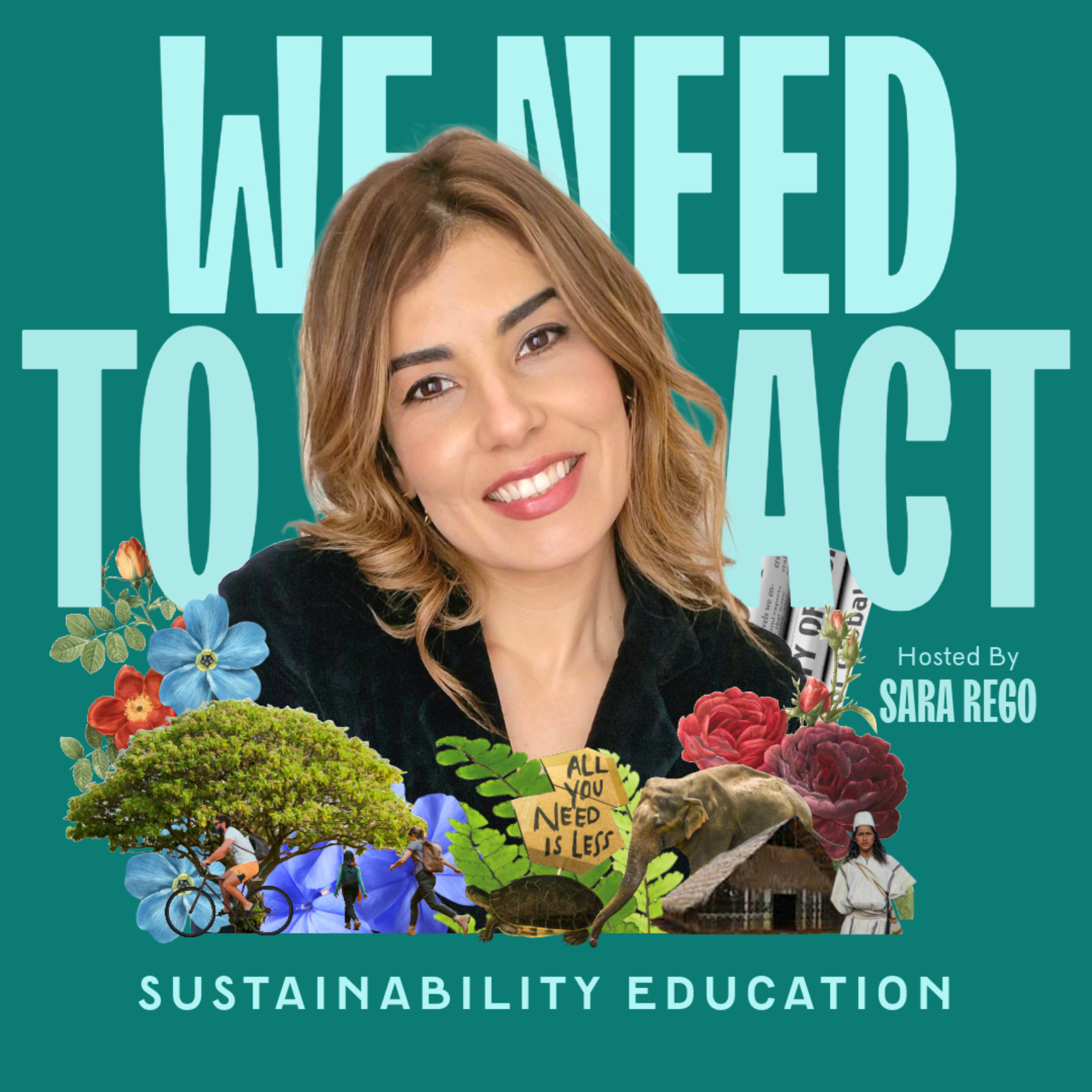
PODCAST · education
We Need to Act
by Sara Rego
We Need to Act, hosted by Dr. Sara Rego, dives into the biggest questions shaping our planet’s future. From climate change and biodiversity loss to social justice and environmental degradation, each episode unpacks what sustainability really means. Through candid conversations with activists, scientists, Indigenous leaders, entrepreneurs, and policymakers, we explore the roots of today’s crises—and the bold actions needed to build a just, resilient, and regenerative world.
-
66
Our Lands Are Who We Are: Indigenous Science, Ecological Grief and Decolonising Research with Dr. Jessica Hernandez
What happens to your sense of self when the lands that define you are taken away?Dr. Jessica Hernandez is an Indigenous environmental scientist, author, and founder of Earth Daughters — an Indigenous-led collective supporting indigenous women and youth through mutual aid and climate justice initiatives. Of Binnizá and Ch'orti' Maya heritage, displaced from her ancestral homelands in Oaxaca and Central America, Jessica has spent her career doing what Western academia rarely allows: putting indigenous communities in charge of their own research.In this conversation with Sara, Jessica speaks candidly about the dualities she navigates daily — as a displaced Indigenous woman, as a scientist trained in Western methods who refuses to extract knowledge from communities, as an advocate who must resist the individualistic mindset embedded in academia. She talks about ecological grief — the profound sadness that comes when lands are desecrated, even by well-intentioned renewable energy projects built without indigenous consent. She talks about the milpa — the communal agricultural system that embodies everything capitalism has erased. And she talks about Earth Daughters, which began as a mutual aid effort after an earthquake devastated Oaxaca in 2020 and has since grown into a nonprofit running projects from Bolivia to Guatemala to Colombia."Our lands are who we are, who we become, and what we hold."In this episode:What displacement does to identity — and why the longing to return never leavesWhy Western research is often extractive — and how to do it differentlyThe hardest part of bridging indigenous knowledge and Western science in academiaEcological grief: what happens to your soul when the lands are takenHow colonisation erased indigenous histories — and how education can help break the cycleThe milpa: an indigenous agricultural system that embodies communal livingEarth Daughters: from earthquake mutual aid to nonprofit projects across Latin AmericaA call to action: pay attention to what is happening in the US — and advocate globallyAbout Dr. Jessica Hernandez:Dr. Jessica Hernandez is an Indigenous environmental scientist of Binnizá and Ch'orti' Maya heritage, author of Fresh Banana Leaves and Growing Papaya Trees, and founder of Earth Daughters — an Indigenous-led nonprofit supporting indigenous communities through mutual aid, climate justice, and community-led research projects in Bolivia, Guatemala, and Colombia.We Need to Act is a podcast about the people, ideas, and movements shaping a better now.
-
65
The Fashion Industry Is Broken And Ghana Is Paying the Price with Yayra Agbofah
What does your wardrobe have to do with a beach in Ghana covered in discarded clothing?Yayra Agbofah grew up trading secondhand garments at Kantamanto Market in Accra — one of the largest secondhand clothing markets in Africa, where millions of garments arrive every single week. He saw firsthand what happens to the ones that don't sell: they end up in rivers, in landfills, on beaches. He also saw something else: extraordinary creativity. Tailors transforming discarded fabric. Traders extending the life of damaged clothes. Communities practicing circularity long before it became a sustainability buzzword.In 2018, Yayra founded The Revival — a community-driven upcycling initiative that transforms textile waste into products, education, and opportunity. Named one of TIME magazine's 100 Most Influential Climate Leaders of 2025, he has since redirected an estimated 12 million garments from landfill, reduced CO2 emissions by more than 12,000 metric tons, and built free online courses so communities around the world can learn from the knowledge developed at Kantamanto.In this conversation with Sara, Yayra makes the case that fashion's crisis is not just environmental — it is a story of inequality, colonialism, and extraction, where the Global South pays the price for the Global North's overconsumption. He talks about what the future of fashion could look like, why synthetic materials need to go, and why the most important question a consumer can ask is: where is this garment going to end up?"It has always been dignity over charity. We're not trying to save communities — we're trying to build together with them."In this episode:How Ghana became the epicentre of global textile waste — and who pays the real priceWhy Kantamanto Market is not a dumping ground but a space of innovation and resilienceWhat the Global South actually needs from the fashion industry — not charity, but accountabilityThe Revival: upcycling, education, job creation, and free online courses from AccraWhy fast fashion is a story of extraction — of labour, resources, and now wasteWhat the future of fashion should look like: slower, more local, more honestWhy synthetic materials are the driving force of fast fashion — and need to be abolishedA call to action: think about where every garment ends up before you buy itAbout Yayra Agbofah:Yayra Agbofah is the founder and creative director of The Revival, a community-driven sustainable fashion initiative based in Accra, Ghana. Named one of TIME magazine's 100 Most Influential Climate Leaders of 2025, he has spent over seven years working at the intersection of textile waste, circular economy, and community empowerment. The Revival has diverted an estimated 12 million garments from landfill and reduced CO2 emissions by more than 12,000 metric tons.https://www.therevival.earth/We Need to Act is a podcast about the people, ideas, and movements shaping a better now.
-
64
Environmental Law and Climate Change: Why Collective Action Is Our Most Powerful Tool with Daniel Farber
What happens to environmental law when the federal government turns its back on climate action?Dan Farber is the Sho Sato Professor of Law at UC Berkeley and one of the most respected voices in US environmental and constitutional law. A former law clerk to Justice John Paul Stevens of the US Supreme Court, he has spent decades at the intersection of environmental policy, democracy, and justice.In this conversation with Sara, Dan offers a clear-eyed and surprisingly hopeful assessment of where we are. He talks about why simply limiting emissions is no longer enough — and why we need to think seriously about what we are going to build in place of the fossil fuel world. He talks about the role of state governments as the real drivers of durable climate action in the US, and about why California and other states are effectively doing the lab work for the federal government. He speaks about environmental justice — who is most exposed to risk, who is most vulnerable, and why those two things are not always the same. And he addresses political polarisation head-on, arguing that climate change was never and should never be a left-right issue.But the most important message he leaves is this: change is not all or nothing. Every ton of carbon we stop emitting makes the world a little bit better. And collectively — in communities, in states, in cities — we are far more powerful than we feel.In this episode:What environmental law actually is — and why companies won't act without itWhy limiting emissions alone is not enough — the case for investment-led climate policyHow the war in the Middle East is accelerating the global energy transitionWhy state and local governments are the real engine of durable climate action in the USEnvironmental justice: who is most exposed, who is most vulnerable — and why these aren't the samePolitical polarisation and climate change — how we got here and how we get past itWhy democracy, despite its slowness, produces more durable climate solutions than authoritarianismWhat ordinary citizens can actually do — from voting with their wallet to writing to their state legislatorsWhy community is the antidote to powerlessnessAbout Dan Farber:Dan Farber is the Sho Sato Professor of Law at the University of California, Berkeley, where he leads two research centres focused on law, energy, environment, and democracy. A former law clerk to Justice John Paul Stevens of the US Supreme Court, he is a member of the American Academy of Arts and Sciences and the author of several influential books including Eco-Pragmatism and Contested Ground: How to Understand the Limits on Presidential Power.We Need to Act is a podcast about the people, ideas, and movements shaping a better now.
-
63
Six Years Without Salmon: Sámi, Europe's Only Indigenous People on Climate Change with Áslat Holmberg
What does it mean to watch the river that shaped your entire life fall silent?Áslat Holmberg is a former member of the Sámi Parliament of Finland and former President of the Saami Council — a salmon fisher, teacher, and holder of a master's degree in indigenous studies whose work expertise includes human rights, culture, indigenous knowledge, and environmental policy. He grew up in Njuorggán, the northernmost village in Finland, fishing salmon in the Teno River from the age of two. Today, that river is in its sixth consecutive year of complete salmon fishery closure — with stocks at roughly 1% of a healthy population. In this conversation with Sara, Áslat shares what it means to be part of Europe's only indigenous people — a community of around 100,000 people largely invisible in European institutions, rarely taught in European schools, and yet holding some of the most profound ecological knowledge on the continent. He talks about the dramatic changes the Arctic is undergoing: collapsing salmon stocks, reindeer herding disrupted by rain in January, and insects arriving all at once. And he talks about the Sami worldview — the tradition of asking permission before entering a place, the rule of leaving it exactly as you found it, and the understanding that humans are not above other species, but simply one among many.This is a conversation about identity, self-sufficiency, indigenous rights, and what Europe still has to learn from the people who have lived in the north for thousands of years.In this episode:Who are the Sami — Europe's only indigenous people — and why are they so little known?Six consecutive years of complete salmon fishery closure — and what that means for a communityHow climate change is transforming reindeer herding across the ArcticThe Sami worldview: asking permission, leaving no trace, humans as one species among manyThe gap between Sami rights on paper and real decision-making power in practiceWhy protecting the human rights system and protecting the environment are the same struggleAbout Áslat Holmberg:Áslat Holmberg is from Njuorggán, situated on the banks of the great river Deatnu at the border between Finland and Norway. He has worked for over a decade with Sámi and indigenous issues through NGOs, activism, and academia. He is a former President of the Saami Council and former member of the Sámi Parliament of Finland. He is a salmon fisher and teacher and holds a master's degree in indigenous studies. His work expertise includes human rights, culture, indigenous knowledge, and environmental policy.
-
62
Do Not Try to Save the Earth - The Earth Is Here to Save You with Paul Hawken
What if the climate narrative itself is the problem?Paul Hawken is one of the world's most influential environmentalists, entrepreneurs, and authors. Founder of Project Drawdown and Project Regeneration, and New York Times bestselling author of nine books — including The Ecology of Commerce, Drawdown, Regeneration, and his latest, Carbon: The Book of Life (2025) — he has spent over 50 years working at the intersection of ecology, commerce, and regeneration.In this conversation with Sara, Paul challenges the very language of the climate movement — the word "sustainability," the phrase "climate crisis," the idea that we can "fix" the Earth. He argues that treating nature as something "out there" to be saved or managed — what he calls "othering" — is not just intellectually wrong. It is why, after 50 years of knowing exactly what to do, less than 1% of the world is doing anything about it on a daily basis.He talks about carbon not as a villain but as the source of all life itself — present in 10 billion molecules in every cell of your body. He speaks about indigenous languages as the deepest ecological teaching humanity has ever produced. He introduces the Parliament of Earthlings — the idea that there are 3.9 trillion voices on this planet, most of which we never listen to. And he shares the Alliance for Earth, a new global platform connecting regenerative communities across 105 languages.But beneath all of it runs one conviction: that the largest movement in human history is already arising — quietly, everywhere, in small communities dedicated to restoring life. And it closes with a line that will stay with you long after the episode ends."Do not try to save the Earth. The Earth is here to save you."In this episode:Why the climate narrative has failed — and what "othering" nature really meansWhy carbon is not a villain but the source of all life — and what we lost by demonising itWhy "sustainability" is a meaningless word — and what to say insteadHow Western noun-based languages keep us separate from the living world — and what indigenous verb-based languages teach usWhy capitalism cannot deliver regeneration — and what natural capital would actually look likeThe Parliament of Earthlings: what it means to listen to 3.9 trillion voicesElephants communicating through concrete walls, and mother bats naming their childrenThe Alliance for Earth: connecting regenerative communities across 105 languagesWhy the largest movement in human history is already happening — and why we can't see itAbout Paul Hawken:Paul Hawken is a renowned environmentalist, entrepreneur, and author committed to the regeneration of nature and humanity. Founder of Project Drawdown and Project Regeneration, he is the author of nine books — six of them New York Times bestsellers — including The Ecology of Commerce, Blessed Unrest, Drawdown, Regeneration, and his latest, Carbon: The Book of Life (Viking/Penguin, 2025). He has received six honorary doctorates and lives in the Cascade Creek watershed with his wife Jasmine — alongside coyotes, foxes, bobcats, ravens, red-tail hawks, and pileated woodpeckers.We Need to Act is a podcast about the people, ideas, and movements shaping a better now.
-
61
Abejas Meliponas: Ciencia e Identidad en la Amazonía Peruana con Ornella Muñoz, ARI
Aquí está:¿Sabías que las abejas meliponas polinizan hasta el 80% de la flora amazónica — y que la mayoría de la gente ni sabe que existen?Ornella Muñoz creció en Dos de Mayo, a orillas del río Ucayali, en la Amazonía peruana. Desde pequeña se preguntaba de dónde venía el aire fresco, cómo los árboles hacían posible la vida y por qué su comunidad dependía tanto de la naturaleza. Esa curiosidad se convirtió en vocación. Hoy es ingeniera forestal e investigadora en Amazon Research International, donde trabaja en la conservación de las abejas nativas sin aguijón y en la investigación forestal en Loreto, Perú.En esta conversación con Sara, Ornella nos lleva al corazón de la Amazonía: a las comunidades remotas, a las colonias de abejas meliponas que sostienen la regeneración del bosque, y a los jóvenes investigadores indígenas que están transformando la relación de sus comunidades con la ciencia.Hablamos de meliponicultura, conocimiento indígena, deforestación, y de dónde encontrar esperanza cuando la Amazonía sigue demostrando una capacidad de resiliencia extraordinaria."La conservación no es responsabilidad exclusiva de investigadores, gobiernos u organizaciones. Es una tarea colectiva."We Need to Act es un podcast sobre las personas, ideas y movimientos que están construyendo un presente mejor.
-
60
Whales Are Our Ancestors - Dr. Mere Takoko on Legal Personhood for Whales
What if whales are not just animals — but ancestors?Dr. Mere Takoko is a Māori Ocean and Climate conservationist from Aotearoa New Zealand and one of the leading voices behind the movement to grant whales legal personhood across the Pacific. A descendant of Māui and Paikea — the ancestor who arrived in New Zealand on the back of a whale — Mere holds what she describes not as a job, but an inherited sovereign duty: to protect her ancestors and rebuild the relationship between people and nature.In this conversation with Sara, Mere explains why whales are the ocean's greatest climate engineers — each one capable of storing the carbon equivalent of over a thousand trees — and why restoring one million whales to the Pacific is not just an ecological goal, but a cultural and spiritual one.She talks about authoring He Whakaputanga Moana, the declaration that confers legal personhood on whales under customary law, signed by paramount chiefs across Polynesia and championed by the late Māori King. She speaks candidly about the rise of "blue colonialism" — large conservation organisations moving into the Pacific and absorbing resources that rarely reach the Indigenous communities doing the actual work. And she shares her quiet concern about artificial intelligence falling into the wrong hands in the race to "communicate" with whales.But beneath the critique is something rarer: a genuinely different way of seeing. Not nature as resource. Not whales as biomass. Kinship. Ancestry. A 22-generation-old covenant still being honoured today.In this episode:Why whales are the ocean's most powerful climate engineers — and what industrial whaling really cost the planetThe whale fall, the whale pump, and the science behind whale-driven carbon captureHe Whakaputanga Moana: the declaration granting whales legal personhood across the PacificThe Āvei Moana voyage — a two-year, 6,000-mile expedition to protect ancestral sea roads"Blue colonialism": why conservation finance rarely reaches the Indigenous communities doing the workThe concerns Pacific communities have about AI being used to "communicate" with — or control — whalesWhy Mere believes restoring the relationship between people and nature is the real climate solutionAbout Dr. Mere Takoko:Dr. Mere Takoko is a Māori conservationist of Ngāti Porou, Te Whānau-a-Apanui, and Rongowhakaata descent, and Executive Trustee of the Moananui Sanctuary. She is the author of He Whakaputanga Moana, the declaration granting legal personhood to whales across the Polynesian triangle, and Chief Executive of the Pacific Whale Fund, where she is leading efforts to establish a US$100 million biodiversity blue bond for marine conservation. A descendant of Māui and Paikea, Mere leads a global effort to recover one million whales across the Pacific.
-
59
The Golden Age of Sustainability Hasn't Happened Yet with John Elkington
What does the godfather of the global sustainability movement think is coming next?John Elkington has been working at the intersection of business, environment, and society for over 50 years. He coined the Triple Bottom Line. He wrote the Green Consumer Guide. He conceived the Green Swan. He has advised governments, corporations, and movements across the world. And after all of that — after five decades of watching the system from the inside — he is, unexpectedly, more optimistic than he has been in a very long time.In this conversation with Sara, John doesn't pull his punches. He talks about capitalism not surviving more than a decade or two in its current form. About the UN becoming obsolete. About democracy being under existential threat. About a major financial crash coming. About the very real possibility of nuclear weapons being used.And yet — through all of it — he keeps returning to one conviction: the golden age of sustainability hasn't happened yet. It's still ahead of us. And the people alive today will be part of building it.This is a conversation for anyone who has ever wondered whether the people who have worked longest in this field still believe change is possible. John's answer, at 76, with a seven-year-old grandson, is a clear and considered yes.In this episode:The origin of the Triple Bottom Line — and why John chose "profit" over "prosperity" deliberatelyWhy the TBL Venn diagram was never John's idea — and how he would have mapped it differentlyWhy capitalism cannot survive more than a decade or two in its current form — and what comes nextChina, the Global South, and the new geopolitical order taking shape around usWhy the UN will likely disappear in the next 10-15 years — and what needs to replace itThe Green Swan: exponential solutions for exponential problemsWhy green consumers alone will never drive systemic change — and what actually willIntergenerational working: why older generations can't just hand this to young peopleWhere John finds hope — and why he envies the younger generationAbout John Elkington:John Elkington is one of the world's most influential voices in sustainability. Often described as the godfather of the global sustainability movement, he coined the Triple Bottom Line in 1994 and has spent over 50 years advising businesses, governments, and civil society organisations. He is the author of more than 20 books, including Green Swans and The Green Consumer Guide. He is co-founder of Volans and SustainAbility, and continues to work at the frontier of systems change, business innovation, and regenerative futures.
-
58
Coal Kills: How Young Ghanaians Stopped a Power Plant and Built a Movement with Portia Adu-Mensah
What does it take to stop a coal plant from being built in your community — when you're young, when the government is pushing it, and when the promises of jobs and opportunity are pulling people the other way?For Portia, the answer was relationships, strategy, and an unshakeable belief that there is always an alternative.A grassroots climate advocate, royal native of Asuom in Ghana's Eastern Region, founder of Dreamhunt, and member of 350 Ghana, Portia has spent over a decade working at the intersection of climate justice, renewable energy, and community empowerment. In this conversation with Sara, she shares the story of the Coal Kills campaign — how a group of young people took on the fossil fuel industry, engaged ten chiefs in their local dialects, used the media as their most powerful tool, and won.But this episode goes far beyond one campaign. Portia talks about what it really means to work with communities — not for them. About why climate finance is failing the Global South. About the women in the Savannah region living without electricity in the 21st century. About why, for an African, just energy transition is not just energy — it's food, shelter, and clothing.And about hope. Not the abstract kind, but the kind you build by showing up with solar panels and staying long enough to see the light come on.In this episode:The Coal Kills campaign: how young Ghanaians stopped a coal plant through community organising, media strategy, and nonviolent advocacyWhy greenwashing and broken promises made community engagement the hardest part of the fightWhat the Global South really needs from climate finance — and why loans are not the answerThe Women in Renewable Energy project and what it means to bring real-time solutions to communities without electricityDreamhunt: raising young environmental advocates through tree planting, recycling, school gardens, and climate-smart agricultureWhat indigenous and royal identity means for grassroots advocacy — and why you never enter a community without meeting the chief firstWhy putting people before profits is not a slogan but a survival strategy"Just energy transition to an African is not just energy — it's food, shelter, and clothing"About Portia:Portia is a climate justice advocate, founder of Dreamhunt, and member of 350 Ghana. A royal native of Asuom in Ghana's Eastern Region, she works at the intersection of renewable energy, community empowerment, and climate finance advocacy. With a background in banking and finance, she brings both grassroots experience and policy-level understanding to the fight for a just and sustainable future.Available on: SpotifyApple PodcastsYouTubewww.weneedtoact.org
-
57
There Is No Environment: Māori Philosophy, Interconnection, and the Roots of the Ecological Crisis with Carl Mika
What if the environmental crisis is really a crisis of worldview? In this episode, Sara sits down with Professor Carl Mika — Professor of Māori and Indigenous Philosophies, and Head of School of Aotahi: School of Māori and Indigenous Studies, University of Canterbury — for a conversation that goes straight to the roots of how we see ourselves in relation to everything else.Carl challenges some of the most taken-for-granted assumptions in Western thought: that the self is separate from the world, that knowledge is something to be accumulated, that sustainability is "out there" to be managed. Drawing from Māori philosophy and his own work at the intersection of indigenous thought and academia, he invites us to sit with what we can't fully know — and to find that discomfort deeply instructive.Together, Carl and Sara explore how colonization didn't just reshape land and bodies, but also language, academic structures, and the very way we relate to each other and to the Earth. They talk about the Māori concept of te kore and te pō — nothingness and darkness — not as absence or failure, but as vital and ever-present dimensions of existence that our optimism-obsessed culture desperately tries to escape.This is a conversation about what sustainability could mean if we stopped treating nature as "out there" — and started recognizing, as Carl puts it, that "the environment is not the environment. There is no such thing as environment."Expect philosophy, provocation, and a reminder that the most radical act might just be to sit with someone over coffee — no agenda, no formal structure — and simply get to know them.In this episode:Why cultural appropriation of the haka and Māori symbols misses the most important thing: the lived daily experience they come fromHow colonization wounded the colonizer too — and why that question rarely gets askedThe limits of the word "sustainability" and why one indigenous leader said "today it is sustainability, yesterday it was life"Two (or three) forms of interconnection in Māori philosophy — and why the most radical one unsettles the foundations of Western institutionsHow academic writing is itself a colonized form — and what it would mean to write differentlyTe kore and te pō: why Māori cosmology holds nothingness and darkness not as the past, but as permanently presentWhat Māori relational practices can teach us about connecting beyond formal collaboration structuresAbout Carl Mika:Professor Carl Mika is a philosopher and Head of School at the University of Canterbury, Aotearoa New Zealand. Of Tūhorangi and Ngāti Whānauapiti descent, his work sits at the intersection of Māori philosophy, indigenous studies, and the philosophy of language. He holds a background in law and a PhD in German Studies, and his writing explores how indigenous thought can fundamentally challenge — and enrich — Western intellectual traditions.Available on: SpotifyApple PodcastsYouTubewww.weneedtoact.org
-
56
Nature’s Last Dance: Falling Back in Love with the Natural World with Natalie Kyriacou
What does it actually take to make someone fall in love with nature? Not lecture them, not overwhelm them with data, but genuinely make them fall in love?That’s the question driving everything Natalie Kyriacou does. Environmentalist, author, storyteller, and founder of My Green World, Natalie has spent over a decade building games, education programs, and now a sweeping new book - Nature’s Last Dance: Tales of Wonder in an Age of Extinction - all in service of one mission: helping people feel the wonder of the natural world before it’s too late.In this conversation with Sara, Natalie brings her trademark blend of warmth, urgency, and radical honesty. She talks about the 12-year-old forest defender who made a promise to an endangered owl. She talks about the economy as the root cause of our ecological crisis - an incentive structure that “make more money off humans and nature being sick.” She talks about the alarming rise of AI as an amplifier of destruction, the need for better models of human behaviour and leadership, and why the degrowth movement just needs a better name.But beneath all of it runs a single thread: the belief that most people are fundamentally good, that they care, and that what’s missing is not willpower but connection - to nature, to community, to each other.This is an episode for anyone who has ever felt the weight of environmental news and wondered whether hope is still a reasonable thing to feel. Natalie’s answer is a clear, grounded, and deeply human yes.In this episode:• How a childhood spent camping, reading, and running around with frogs shaped a lifelong environmentalist• Why Natalie wrote Nature’s Last Dance for people who would never pick up a nature book, and what makes it different• The story of Gracie: the 12-year-old who made a promise to an endangered owl and is now dedicating her life to protecting them• Why our economy is fundamentally incompatible with human and environmental health, and what changing it would look like• Natalie’s frank take on AI: not a tool for good, but an accelerant of destruction, and why she’s deeply alarmed• The rise of toxic masculinity and its ripple effects on people, politics, and the planet• Why degrowth is brilliant economics with a terrible name, and needs a rebrand• Simple first steps to reconnect with nature: go outside, look up, watch a birdAbout Natalie Kyriacou:Natalie Kyriacou is an environmentalist, author, and the founder of MyGreen World, a wildlife and environmental charity that has reached hundreds of thousands of young people through award-winning apps and education programs. She is Director at the Foundation for National Parks and Wildlife and an Ambassador for the Australian Conservation Foundation. Her debut book, Nature’s Last Dance: Tales of Wonder in an Age of Extinction, is out now in Australia and launching in the UK and Europe.
-
55
Goldman Prize 2026: defender el agua desde el corazón de Colombia con Yuvelis Morales Blanco
Yuvelis Morales tiene 25 años, creció pescando en el Río Magdalena y hoy es la voz más joven y potente de la lucha antifracking en Colombia. Ganadora del Premio Goldman de Medio Ambiente 2026, el reconocimiento más importante del activismo ambiental en el mundo, Juve nos habla desde el corazón del Valle Medio colombiano.En este episodio descubrirás:→ Qué significa ser "gente del río" y por qué el Magdalena no es un recurso sino una madre→ Por qué Colombia es el país más peligroso del mundo para los defensores ambientales, y cómo Juve convirtió el miedo en herramienta→ El papel de América Latina y del Sur Global en la transición energética justa→ Qué está en juego en las próximas elecciones colombianas para el medioambiente→ El rol de las mujeres en la defensa de la naturaleza: rebeldes, fieras y con voz propia→ Un mensaje de esperanza para las juventudes del mundoUna conversación sobre resistencia, comunidad, territorio y la construcción del nuevo mundo libre de combustibles fósiles.weneedtoact.org@weneedtoactpodcastApóyanos mostrando tu interés de las siguientes maneras:🎧 Escucha y suscríbete al podcast We Need to Act en Spotify o Apple Podcasts.☕ Apoya a nuestro trabajo comprándonos un café. 📲 Únete a nuestra comunidad en Instagram, LinkedIn, y YouTube📬 Suscríbete a nuestro boletín informativo en nuestra página web.
-
54
We Are Kapwa: How We Forgot to Belong and How to Remember with Lana Jelenjev
What does it mean to truly belong - not as an individual seeking acceptance, but as part of an interconnected whole?In this episode, Sara Rego speaks with Lana Jelenjev, a Filipina facilitator and systems thinker based in the Netherlands, whose work sits at the intersection of nervous system literacy, belonging, and organizational transformation.Lana introduces us to kapwa - the Filipino value of seeing our shared humanity - and pakikiramdam, the practice of deep sensing and empathy. She explores why so many of our modern systems were built on trauma responses, and what it would look like to build for flourishing instead.Together, Sara and Lana discuss:• Why belonging is not something we need to find - it's something we need to remember• How ancestral grief and intergenerational trauma shape our nervous systems and our institutions• The "sandwich generation" navigating between hyper-individualism and collective roots• Healing-centered responses: stop, soften, flock, flow, and surrender - as alternatives to fight or flight• What the Filipino concept of kapwa can teach us about building life-centered organizationsIf you've ever felt the weight of living in a world that moves too fast and connects too little, this conversation offers both a diagnosis and a path forward."Settled bodies settle bodies." - Lana JelenjevIf you want to learn more about Lana's work, please visit her website. Please show us your support by...Tune in and subscribe to the We Need to Act podcast via Spotify or Apple Podcasts.Support our show by buying us a coffee.Join our page on Instagram and LinkedIn Subscribe to our newsletter on our website
-
53
Intentional Communities: A Path to Connection and Belonging with Cynthia Tina
In this episode of We Need to Act, Sara Rego speaks with Cynthia Tina, intentional community expert, author of Intentional Community, and founder of CommunityFinders and Ecovillage Tours, about how intentional communities and ecovillages are reshaping housing, health, and happiness.With experience visiting 200+ intentional communities worldwide and living in a Vermont ecovillage, Cynthia explores how community living can help address the loneliness crisis, social isolation, and the growing need for sustainable housing solutions. She explains how eco-villages are built around shared values, cooperation, and belonging, helping people reconnect with nature, purpose, and each other.The conversation dives into how intentional communities support better housing models, improved well-being, and more sustainable lifestyles through permaculture, shared housing, and cooperative living. Cynthia also shares who is joining these communities today, from young adults and families to retirees, and how people can join or even start their own community-led housing projects.They also discuss sustainable tourism and ecovillage tours, showing how travel to intentional communities can directly support local sustainability efforts while offering immersive, real-world learning experiences.Key points discussed:What intentional communities and eco-villages areHow community living addresses loneliness and social disconnectionWhy shared values and cooperation are central to ecovillagesWho joins intentional communities todayHow ecovillages support sustainable housing and wellbeingThe role of permaculture and cooperative livingHow Ecovillage Tours and CommunityFinders support global community buildingThe impact of sustainable tourism on local communitiesPlease show us your support by...Tune in and subscribe to the We Need to Act podcast via Spotify or Apple Podcasts.Support our show by buying us a coffee.Join our page on Instagram and LinkedIn Subscribe to our newsletter on our website
-
52
Arte y Naturaleza: El Poder del Asombro con Carolina Castro Jorquera
En este episodio conversamos con Carolina Castro Jorquera, artista e investigadora chilena, sobre el arte como una forma de vida, de conocimiento y de conexión profunda con la naturaleza.Desde el Valle del Aconcagua, Carolina nos invita a repensar el arte más allá de los objetos, como una práctica que cultiva la atención, el cuidado y la sensibilidad. Exploramos cómo el arte puede abrir espacios de escucha, transformar nuestra percepción y ayudarnos a reconstruir la relación con los territorios, especialmente en un contexto de crisis climática y desconexión con lo natural.Hablamos sobre el vínculo entre arte, espiritualidad y conciencia, así como su potencial para acompañar procesos de sanación, memoria y resistencia, especialmente en comunidades afectadas por el extractivismo y la pérdida de identidad.También reflexionamos sobre el papel de lo femenino, la maternidad y la educación en tiempos de incertidumbre, y cómo recuperar el asombro puede ser clave para reconectar con la vida.Un episodio que es, sobre todo, una invitación a habitar el mundo con más atención, más cuidado y más conciencia.Puntos clave• El arte como forma de conocimiento y no solo de creación• La crisis ambiental como crisis de relación• El poder de la atención y el asombro• Arte, naturaleza y sanación• Reconectar con lo local y lo esencialApóyanos mostrando tu interés de las siguientes maneras:🎧 Escucha y suscríbete al podcast We Need to Act en Spotify o Apple Podcasts.☕ Apoya a nuestro trabajo comprándonos un café. 📲 Únete a nuestra comunidad en Instagram, LinkedIn, y YouTube📬 Suscríbete a nuestro boletín informativo en nuestra página web.
-
51
Why We Ignore Climate Change (and How to Fix It) with George Marshall
Most climate communication has failed to inspire the urgent climate action we need. What if the key to environmental change is not just science but how we talk, connect, and resonate emotionally with each other? In this episode, we explore how effective climate communication can motivate real behavior change and strengthen community engagement.Our guest, George Marshall, a leading climate communication expert and author of the book "Don't Even Think About It: Why Our Brains Are Wired to Ignore Climate Change", explains why our brains often ignore climate change despite overwhelming evidence. You will learn how social psychology, identity, trust, and values shape perceptions and why traditional awareness campaigns often fall short. The episode reveals practical strategies to turn climate action into a shared identity, harness community values, and engage people through storytelling that inspires purpose and belonging.We also discuss the future of climate messaging in a fragmented digital landscape. How can we overcome disinformation, polarization, and distrust to build collective action? Why is local, community-based dialogue essential and how can messages be tailored to different cultural and faith groups? George shares proven methods to foster inclusive conversations that ignite hope, agency, and meaningful environmental change.This episode shows that climate communication is not just about spreading facts. It is about transforming how people see themselves in relation to the planet. With insights from psychology, sociology, and activism, you will discover how to raise awareness, inspire hope, and motivate real climate action in your community.For anyone committed to making a difference, this conversation is essential listening. Learn how to use storytelling, empathy, and evidence-based strategies from George Marshall to lead with impact and drive environmental change.Please show us your support by...Tune in and subscribe to the We Need to Act podcast via Spotify or Apple Podcasts.Support our show by buying us a coffee.Join our page on Instagram and LinkedIn Subscribe to our newsletter on our website
-
50
Turning the Tide: From Corporate Career to Ocean Activism with Fynn Hedrich
In this special episode of We Need to Act, Sara joins Podcasthon, the world’s largest podcast charity initiative, to spotlight a cause that affects us all: protecting our oceans.Today’s guest is Fynn Hedrich, entrepreneur and founder of Ocean Pulse. After building a successful career in the meat industry, Fynn made a life-changing decision to step away and pursue more purpose-driven work. His journey led him to travel, adopt a vegetarian lifestyle, and develop a deep connection to the ocean through kite surfing—an experience that opened his eyes to the devastating impact of marine pollution.In this conversation, Fynn shares the pivotal moments that shaped his transition, the realities of ocean degradation, and how Ocean Pulse is working to create tangible, lasting impact. Together, we explore the systems behind ocean pollution, the power of individual and collective action, and what it truly means to align your career with your values.If you’re looking for inspiration, practical insight, and a reminder that change is possible, this episode is for you.Don’t forget to subscribe, share, and join us in taking action for a better now.Follow Ocean Pulse on InstagramPlease show us your support by...Tune in and subscribe to the We Need to Act podcast via Spotify or Apple Podcasts.Support our show by buying us a coffee.Join our page on Instagram and LinkedIn Subscribe to our newsletter on our website
-
49
Rebuilding the Future with Feminine Values and Indigenous Wisdom with Osprey Orielle Lake
In this powerful conversation, Osprey Orielle Lake—founder of the Women’s Earth and Climate Action Network (WECAN)—shares her personal journey into climate activism and the deeper values that guide her work. Drawing from decades of advocacy and her latest book, The Story is in Our Bones, Lake explores how the climate crisis is not only an environmental issue but also a reflection of deeper systemic problems rooted in greed, disconnection, and the loss of our relationship with nature.Throughout the discussion, she highlights the critical role of women’s leadership and indigenous knowledge systems in shaping meaningful climate solutions. Lake argues that many of the answers to today’s ecological challenges can be found in indigenous worldviews that emphasize reciprocity, stewardship, and a deep sense of belonging within the natural world.The conversation also explores how reconnecting with nature—and with our ancestral roots—can help individuals and communities rediscover purpose, resilience, and responsibility. From the importance of collective action to the power of localized communities, Lake calls for a transformation in how we see ourselves and our place on Earth.Ultimately, this episode is a reminder that while the challenges are immense, everyone has agency. By listening to the wisdom of women leaders, honoring indigenous rights, and rebuilding our relationship with the natural world, we can begin creating the just and sustainable future our planet needs.Episode HighlightsThe climate crisis requires urgent and collective action.Women are leading many of the most impactful climate solutions worldwide.Indigenous knowledge provides essential guidance for sustainable living.Greed-driven systems and disconnection from nature are at the root of many global crises.Reconnecting with nature can support both personal and societal healing.Localization and community resilience are crucial in a globalized world.Understanding our ancestral roots can help guide meaningful transformation.Everyone has a role and the agency to participate in climate solutions.Please show us your support by...Tune in and subscribe to the We Need to Act podcast via Spotify or Apple Podcasts.Support our show by buying us a coffee.Join our page on Instagram and LinkedIn Subscribe to our newsletter on our website
-
48
Unmasking Greenwashing: How Companies Mislead And What Can You Do with John Pabon
In this episode of the We Need to Act podcast, we welcome John Pabon, greenwashing expert, author of The Great Greenwashing, consultant, and speaker. John unpacks how greenwashing evolved from fossil fuel misinformation into a sophisticated global system of climate deception involving corporations, governments, NGOs, and even billionaires. We discuss the difference between accidental and deliberate greenwashing, why responsibility has been shifted onto individuals, and why the real climate debate is “up vs. down” — not left vs. right.We also explore AI as a new amplifier of misinformation, the current state of greenwashing regulation, and how companies can communicate sustainability honestly without resorting to greenhushing.Episode HighlightsJohn Pabon on his journey from the United Nations to exposing greenwashingThe difference between accidental greenwashing and deliberate corporate deceptionHow fossil fuel companies pioneered climate misinformationWhy consumers are smarter — but still up against billion-dollar influence machinesThe shifting of climate responsibility onto individuals through recycling and carbon footprintsUltra-wealthy emissions, private jets, and the “up vs. down” climate debateThe current state of greenwashing regulation in the EU, Australia, and the U.S.The rise of AI as a potential amplifier of climate misinformationWhy companies must embrace transparency instead of greenhushingA reminder that you don’t have to be a perfect environmentalist — just an honest and engaged onePlease show us your support by...Tune in and subscribe to the We Need to Act podcast via Spotify or Apple Podcasts.Support our show by buying us a coffee.Join our page on Instagram and LinkedIn Subscribe to our newsletter on our website
-
47
Amar, Cuidar y Transformar: Hacia una Nueva Economía con Diego Isabel la Moneda
En este episodio conversamos con Diego Isabel La Moneda, cofundador y director de la Fundación Foro NESI, sobre la urgencia de transformar el modelo económico para que vuelva a estar al servicio de las personas y del planeta.Desde una vocación temprana marcada por la idea de dejar el mundo mejor de como lo encontramos, Diego reflexiona sobre los límites del sistema actual, el falso dilema entre crecimiento y decrecimiento, y la necesidad de repensar cómo producimos, consumimos y vivimos. Hablamos de economía de proximidad, comunidad, salud mental, polarización política y del valor de pensar con libertad en un mundo cada vez más fragmentado.También exploramos el papel clave de los territorios, la conexión entre lo local y lo global, y la importancia de dar voz a las nuevas generaciones para construir futuros más justos y sostenibles. Una conversación profunda y esperanzadora sobre cómo dirigir el cambio hacia modelos económicos más humanos, regenerativos y colaborativos.Porque el cambio es inevitable. La pregunta es hacia dónde decidimos dirigirlo.Puntos clave del episodio: La idea de dejar el mundo mejor de como lo encontramos como motor vital y profesional.Por qué muchas de las crisis actuales tienen su origen en un modelo económico agotado.El falso dilema entre crecimiento y decrecimiento: cómo, dónde y para qué crecer.La “obesidad económica”: más consumo y producción, pero menos bienestar y relaciones.La importancia de la economía de proximidad y la comunidad frente a la soledad urbana.Datos que conectan grandes ciudades, salud mental y pérdida de vínculos sociales.La pérdida de libertad de pensamiento en un mundo cada vez más polarizado.Local y global no son opuestos: hacia una globalización de la localización.El papel clave de jóvenes, educación y liderazgo en la transformación social.El trabajo de Foro NESI y la construcción de consensos como base del cambio sistémico.Un mensaje final: amar, cuidar y enriquecer el alma como base de una nueva economía.Apóyanos mostrando tu interés de las siguientes maneras:🎧 Escucha y suscríbete al podcast We Need to Act en Spotify o Apple Podcasts.☕ Apoya a nuestro trabajo comprándonos un café. 📲 Únete a nuestra comunidad en Instagram, LinkedIn, y YouTube📬 Suscríbete a nuestro boletín informativo en nuestra página web.
-
46
Voices from the Arctic: Inuit Leadership in Global Change with Dr. Sara Olsvig
In this episode of the We Need to Act podcast, we are honored to welcome Sara Olsvig, Chair of the Inuit Circumpolar Council (ICC), representing around 180,000 Inuit across Alaska, Canada, Greenland, and Russia.Sara shares her experience leading the global Inuit voice in international forums such as the United Nations, the Arctic Council, and the International Maritime Organization. She explains why Inuit and Indigenous peoples must be at the center of decisions about the Arctic, climate change, biodiversity, and resource governance — guided by the principle “nothing about us without us.”The conversation explores the Inuit relationship with nature, climate change impacts in the Arctic, environmental protection versus resource extraction, and the human rights dimensions of pollution and biodiversity loss. Sara also addresses current geopolitical tensions surrounding Greenland, the legacy of colonization, self-determination, and why there is “no such thing as a better colonizer.”Finally, she reflects on resilience, hope, and the importance of multilateral cooperation, Indigenous knowledge, and respect for Arctic peoples in shaping a just and sustainable future.🎧 A powerful and eye-opening conversation on climate justice, Indigenous rights, and the future of the Arctic.Episode HighlightsSara Olsvig, Chair of the Inuit Circumpolar Council, on representing Inuit across Alaska, Canada, Greenland, and RussiaThe Arctic as a lived environment, not an empty ice desertWhy Inuit and Indigenous peoples must be part of all decisions affecting their lands and watersThe Arctic warming three to four times faster than the global averageClimate change and pollution as human rights issuesTensions between environmental protection, resource extraction, and Indigenous livelihoodsGreenland, self-determination, and resistance to renewed colonial narrativesThe role of international cooperation and multilateral institutionsInuit resilience, adaptation, and hope for the futurePlease show us your support by...Tune in and subscribe to the We Need to Act podcast via Spotify or Apple Podcasts.Support our show by buying us a coffee.Join our page on Instagram and LinkedIn Subscribe to our newsletter on our website
-
45
Indigenous Agriculture: Lessons From The Hopi Tradition with Michael Kotutwa Johnson
In this episode of We Need to Act, host Sara Rego sits down with Michael Kotutwa Johnson, a 250th-generation Hopi farmer and Assistant Professor at the University of Arizona, to explore how Indigenous knowledge can help address today’s climate and food crises.Michael explains why industrial agriculture—not climate change alone—is driving soil degradation, biodiversity loss, and water scarcity worldwide. Drawing from thousands of years of Hopi farming traditions, he shares how ancestral seeds, place-based agriculture, and reciprocal relationships with the land create resilience in even the harshest environments.The conversation also explores food sovereignty, the health impacts of losing traditional diets, the role of women in matrilineal food systems, and the Hopi Prophecy Rock—offering a powerful reflection on the choice humanity still has between excess and balance.This episode is a call to rethink how we grow food, care for the land, and shape our collective future.Episode Highlights• Indigenous agricultural knowledge offers real solutions to today’s climate and food crises• Why industrial agriculture — not climate change alone — is accelerating soil and ecosystem collapse• How Hopi ancestral seeds have adapted over generations to thrive in arid environments• The role of small, place-based farms in feeding the majority of the world’s population• The connection between the loss of traditional diets and rising health crises in Indigenous communities• What food sovereignty really means — and why it matters now• How matrilineal systems create balance in agriculture and community life• The Hopi Prophecy Rock and the choice humanity still has between excess and sustainability• Why faith, hope, and planting anyway are acts of resistance and resiliencePlease show us your support by...Tune in and subscribe to the We Need to Act podcast via Spotify or Apple Podcasts.Support our show by buying us a coffee.Join our page on Instagram and LinkedIn Subscribe to our newsletter on our website
-
44
Empowering Minds: The Role of Education in Sustainability with Prof. Jonathan Jansen
In this enlightening conversation, Professor Jansen discusses his journey from aspiring biochemist to a dedicated educator, emphasizing the importance of teaching as a vocation. He reflects on the impact of colonialism on education and the urgent need for climate change education. The discussion also covers climate justice, the role of AI in education, and the importance of empowering communities through knowledge. Jansen encourages listeners to take local action to create meaningful change in the world.Professor Jonathan Jansen is a distinguished professor of education at Stellenbosch University and a former president of the Academy of Science of South Africa. Educated at the University of the Western Cape, Unisa, Cornell University, and Stanford University, he is an internationally recognized scholar and leader in education. A prolific author of over 30 books, including Leading for Change and The Decolonization of Knowledge, Professor Jansen has made seminal contributions to education research, leadership, and public engagement over four decades. His work on race, leadership, and human rights has earned him major international honors, including induction into the American Academy of Arts and Sciences and multiple lifetime achievement awards.TakeawaysEducation is a privilege and a calling.Teaching should inspire joy and connection.Climate change education is essential across all subjects.Local actions can lead to global impacts.Empower communities through education and knowledge sharing.Colonialism still affects education systems today.Climate justice requires global responsibility and action.AI can enhance education if used wisely.Knowledge production is a collaborative effort.We must not be overwhelmed by the challenges we face.Please show us your support by...Tune in and subscribe to the We Need to Act podcast via Spotify or Apple Podcasts.Support our show by buying us a coffee.Join our page on Instagram and LinkedIn Subscribe to our newsletter on our website
-
43
Hope Is Something We Build | Reframing Sustainability: Our 2025 Wrap-Up & the Road to 2026
As we close out 2025 and step into 2026, this episode is a moment to pause, reflect, and look ahead.In this special year-end wrap-up of We Need to Act, host Sara reflects on the conversations, voices, and lessons that shaped our understanding of sustainability in 2025 — and why sustainability must be reframed if we are serious about creating just, regenerative futures.From Indigenous wisdom and ancestral knowledge to climate justice, regenerative systems, biodiversity, rewilding, and collective responsibility, this episode explores why incremental change is no longer enough. Sustainability is not a trend or a buzzword — it is about people, justice, ecosystems, and action.This episode asks:What did 2025 teach us about sustainability and systems change?Why hope is not something we wait for, but something we build through actionWhat 2026 demands of us: community-led solutions, restoration, rewilding, and technology in service of lifeHow individual choices, local action, and collective responsibility create real impactFeaturing reflections inspired by conversations with Indigenous leaders, activists, educators, system thinkers, and culture keepers, this episode is an invitation to listen deeply, challenge assumptions, and choose courage over comfort.Because we don’t just need to talk about change.Together, we need to act.Please show us your support by...Tune in and subscribe to the We Need to Act podcast via Spotify or Apple Podcasts.Support our show by buying us a coffee.Join our page on Instagram and LinkedIn Subscribe to our newsletter on our website
-
42
Entre Poesía y Tierra: Manteniendo la Cultura Mapuche con María Isabel Lara Millapan
Este episodio es una conversación íntima con la poeta mapuche María Isabel Lara Millapán sobre memoria, lengua y territorio en tiempos de desconexión acelerada. Hablamos de cómo el mundo se ha vuelto más rápido y orientado al “hacer” más que al “ser”, y de lo que perdemos cuando nos alejamos de la naturaleza y de nuestras raíces.María Isabel comparte cómo su poesía nace de la infancia, del duelo y de la espiritualidad, y cómo también se ha convertido en una voz de denuncia frente a las heridas de la colonización y las amenazas actuales que viven las comunidades mapuche. Exploramos el poder del mapuzungun como “la lengua de la tierra”, la importancia de las lenguas ancestrales para sostener una cosmovisión y el rol de las nuevas generaciones y la tecnología en los procesos de revitalización cultural.María Isabel Lara Millapán es poeta mapuche, hablante nativa de mapuzungun, nacida en el lof de Chihuimpilli (comuna de Freire, Región de La Araucanía, Chile), y Doctora en Didáctica de la Lengua y la Literatura por la Universidad Autónoma de Barcelona. Actualmente es académica del Campus Villarrica de la Pontificia Universidad Católica de Chile e investigadora asociada del Centro de Estudios Interculturales e Indígenas (CIIR). Es además autora de una obra poética que entrelaza espiritualidad, territorio y resistencia.Un episodio para quienes sienten la urgencia de frenar, escuchar a los pueblos originarios y recordar que la naturaleza, la memoria y el diálogo son claves para construir un futuro más justo y humano.Capítulos: Introducción y desconexiónComienza en 0:00El camino de María Isabel hacia la poesíaComienza en 3:00La importancia del mapuzungunComienza en 6:00Conexiones culturales y espiritualesComienza en 9:00Desafíos y luchas contemporáneasComienza en 12:00Revitalización y nuevas generacionesComienza en 15:00Sabe más sobre el trabajo de María Isabel Lara Millapan en https://www.escritoresindigenas.cl/lara-millapanApóyanos mostrando tu interés de las siguientes maneras:🎧 Escucha y suscríbete al podcast We Need to Act en Spotify o Apple Podcasts.☕ Apoya a nuestro trabajo comprándonos un café. 📲 Únete a nuestra comunidad en Instagram, LinkedIn, y YouTube📬 Suscríbete a nuestro boletín informativo en nuestra página web.
-
41
From Global to Local: Redefining Progress with Helena Norberg-Hodge
In this episode of We Need to Act, host Sara Rego speaks with Helena Norberg-Hodge—one of the world’s most influential voices on localization and the new economy movement.Helena Norberg-Hodge, linguist, author, filmmaker, and pioneer of the global localization movement, is the founder and director of Local Futures and the convenor of World Localization Day and the Planet Local Summit. She is the author of the classic Ancient Futures and Local Is Our Future, and producer of the award-winning documentaries The Economics of Happiness, Planet Local, and Closer to Home. She also founded the International Alliance for Localization and co-founded both the International Forum on Globalization and the Global Ecovillage Network. Her work has been recognized with the Alternative Nobel Prize, the Arthur Morgan Award, and the Goi Peace Prize for her contributions to cultural and biological diversity and the strengthening of local communities worldwide.Together, Sara and Helena explore how globalization undermines well-being, why local economies create happier and healthier societies, and what we can do to restore community, meaning, and democratic power. They discuss the importance of feminine values in healing our fractured world, the dangers of centralized technological systems, and the joy that comes from rebuilding relationships—with each other and with nature.A hopeful, human-centered conversation about reclaiming our future through localization and the economics of happiness.Please show us your support by...Tune in and subscribe to the We Need to Act podcast via Spotify or Apple Podcasts.Support our show by buying us a coffee.Join our page on Instagram and LinkedIn Subscribe to our newsletter on our website
-
40
Transformando el Dinero para la Justicia Ambiental con Isabel Felandro (Cool Earth) y Carlos Adrián Pérez (Equal Right)
En este episodio, nos asociamos con Cool Earth, una organización cuya misión es proporcionar dinero y datos directamente a las personas que viven en la selva tropical para que puedan hacer lo que mejor saben hacer: protegerla. También hablamos con Equal Right, la organización socia de Cool Earth en el proyecto Income for Peace with Nature en Colombia.Nuestros invitados, Isabel Felandro, Directora de Programas en Cool Earth, y Carlos Adrián Pérez, Director para América Latina en Equal Right, discuten el potencial transformador de la renta básica para las comunidades indígenas en el Amazonas, particularmente en Colombia y Perú. Exploran cómo el apoyo financiero puede empoderar a estas comunidades para proteger su entorno mientras se abordan las desigualdades sociales.La conversación destaca la importancia de la colaboración, la confianza y la educación en la implementación de estas iniciativas, así como los desafíos de navegar en contextos políticos y culturales complejos. También reflexiona sobre los resultados de la COP16 y la defensa continua de la financiación climática dirigida a los pueblos indígenas.Puntos claveEl problema no es el dinero en sí, sino su redistribución.La renta básica puede ayudar a reducir la dependencia de las industrias extractivas.Las alianzas con organizaciones indígenas son cruciales para el éxito.El monitoreo es esencial para garantizar un impacto positivo en la comunidad.La renta básica puede mejorar el bienestar y la felicidad de las comunidades.La educación es clave para fomentar la conciencia social y la responsabilidad.La renta básica debe verse como un derecho, no como un subsidio.La defensa de la financiación climática debe priorizar a las comunidades indígenas.La interconexión de las comunidades es vital para el progreso.La COP16 proporcionó una plataforma para la colaboración y futuras iniciativas.Capítulos00:00 Transformando el dinero para la justicia ambiental03:02 Lecciones desde Perú: ampliando la renta básica a Colombia05:55 Construyendo confianza y colaboración con comunidades indígenas08:28 Renta básica: una herramienta para el impacto ambiental y social10:52 Desafíos y oportunidades en la implementación de la renta básica12:55 Monitoreo del impacto y asegurando el bienestar comunitario15:53 El papel de la educación en la formación de la conciencia18:05 Navegando desafíos políticos y culturales19:40 Defensa de la financiación climática y derechos indígenas21:57 Reflexiones sobre la COP16 y direcciones futurasApóyanos mostrando tu interés de las siguientes maneras:🎧 Escucha y suscríbete al podcast We Need to Act en Spotify o Apple Podcasts.☕ Apoya a nuestro trabajo comprándonos un café. 📲 Únete a nuestra comunidad en Instagram, LinkedIn, y YouTube📬 Suscríbete a nuestro boletín informativo en nuestra página web.
-
39
Transforming Money for Environmental Justice with Isabel Felandro (Cool Earth) and Carlos Adrián Perez (Equal Right)
In this episode, we partner with Cool Earth, an organization whose mission is to provide cash and data directly to people living in the rainforest so they can do what they do best — protect it. We also speak with Equal Right, Cool Earth’s partner organization in the Income for Peace with Nature project in Colombia.Our guests, Isabel Felandro, Head of Programmes at Cool Earth, and Carlos Adrián Pérez, Director for Latin America at Equal Right, discuss the transformative potential of basic income for Indigenous communities in the Amazon, particularly in Colombia and Peru. They explore how financial support can empower these communities to safeguard their environment while addressing social inequalities.The conversation highlights the importance of collaboration, trust, and education in implementing such initiatives, as well as the challenges of navigating complex political and cultural landscapes. It also reflects on the outcomes of COP16 and the ongoing advocacy for climate finance directed towards Indigenous peoples.Takeaways • Money itself is not the problem; it's the redistribution.• Basic income can help reduce dependency on extractive industries.• Partnerships with indigenous organizations are crucial for success.• Monitoring is essential to ensure positive community impact.• Basic income can improve well-being and happiness in communities.• Education is key to fostering social consciousness and responsibility.• Basic income should be viewed as a right, not a subsidy.• Advocacy for climate finance must prioritize indigenous communities.• The interconnectedness of communities is vital for progress.• COP16 provided a platform for collaboration and future initiatives.Chapters00:00 Transforming Money for Environmental Justice03:02 Lessons from Peru: Expanding Basic Income to Colombia05:55 Building Trust and Collaboration with Indigenous Communities08:28 Basic Income: A Tool for Environmental and Social Impact10:52 Challenges and Opportunities in Implementing Basic Income12:55 Monitoring Impact and Ensuring Community Well-being15:53 The Role of Education in Shaping Consciousness18:05 Navigating Political and Cultural Challenges19:40 Advocacy for Climate Finance and Indigenous Rights21:57 Reflections on COP16 and Future DirectionsPlease show us your support by...Tune in and subscribe to the We Need to Act podcast via Spotify or Apple Podcasts.Support our show by buying us a coffee.Join our page on Instagram and LinkedIn Subscribe to our newsletter on our website
-
38
Hawaiian Wisdom on Sustainability with Kimokeo Kapahulehua
"Yesterday the word was not sustainability. Yesterday the word was life. And today we have to learn how to be life." - Uncle KimokeoIn this episode, we welcome a very special guest from Hawai‘i: Kimokeo Kapahulehua — respected kūpuna, cultural practitioner, paddler, and founder of the Kimokeo Foundation.Uncle Kimokeo has dedicated his life to preserving and perpetuating Hawaiian culture, language, and traditions through community work, education, land stewardship, and outrigger canoeing. He also co-founded Paddle for Life, supporting cancer care through traditional voyaging.In this inspiring conversation, Uncle Kimokeo shares ancestral wisdom on sustainability and our kuleana (responsibility) to care for the ocean, land, and one another. We explore the profound role of storytelling, spiritual connection to nature, cultural healing, and how traditional Hawaiian practices offer guidance for the challenges of today. His message is clear: to care for Mother Earth is to become good ancestors for future generations.Key TakeawaysSustainability is rooted in learning from and maintaining balance with natureAncient practices provide solutions for modern environmental challengesKuleana is shared responsibility and actionLanguage and education protect cultural heritageHealing requires expression and continuity of traditionsStorytelling sustains indigenous knowledgeSpiritual connection to nature supports well-beingThe Hawaiian moon calendar guides sustainable livingWe are one family connected through the earthCaring for Mother Earth benefits future generationsChapters00:00 — Returning to Ancient Wisdom06:11 — Cultural Connection to the Ocean09:04 — Understanding Kuleana12:26 — Preserving Hawaiian Culture Through Education13:52 — Healing & Reconciliation in Hawai‘i16:37 — The Power of Indigenous Storytelling20:50 — Spiritual Connection to Nature22:15 — Becoming Good AncestorsPlease show us your support by...Tune in and subscribe to the We Need to Act podcast via Spotify or Apple Podcasts.Support our show by buying us a coffee.Join our page on Instagram and LinkedIn Subscribe to our newsletter on our website
-
37
Voces de los Andes: un viaje de defensa de los derechos indígenas en el Perú con Tarcila Rivera Zea
“Yo vengo de una comunidad que hasta ahora trata de no depredar lo que tiene; entonces, cuida. Cuida la vida de las personas, pero también cuida la vida de su entorno. Para nosotros, la sostenibilidad significa justamente usar lo que tenemos alrededor de modo racional, sin depredar, sin exterminar.” - Tarcila Rivera Zea Hoy nos acompaña Tarcila Rivera Zea, activista quechua de Ayacucho y una de las voces indígenas más reconocidas del Perú y del mundo. Desde hace más de 25 años, lidera la defensa de los derechos de los pueblos indígenas a través de CHIRAPAQ, organización que fundó y preside, así como desde diversas redes internacionales.🎧 Destaques de la conversaciónIntroducción y contextoAborda el recorrido de Tarcila y el contexto de su trabajo. (Inicio)Sostenibilidad y perspectivas indígenasExplora el enfoque indígena hacia la sostenibilidad y la gestión de los recursos. (Aprox. 03:00)Empoderamiento y preservación culturalSe centra en el empoderamiento de las mujeres indígenas y en la importancia de preservar el patrimonio cultural. (Aprox. 09:00)Incidencia global y desafíosDescribe la participación de Tarcila en foros internacionales y los desafíos que enfrentan las comunidades indígenas. (Aprox. 15:00)Sabiduría intergeneracional y perspectivas futurasAnaliza la importancia de transmitir el conocimiento tradicional y de abordar los desafíos del futuro. (Aprox. 21:00)🔗 Más información sobre el trabajo de Tarcila en chirapaq.org.pe🎧 Dale play al episodio y no olvides seguir el podcast para no perderte las próximas conversaciones sobre sostenibilidad. Apóyanos mostrando tu interés de las siguientes maneras:🎧 Escucha y suscríbete al podcast We Need to Act en Spotify o Apple Podcasts.☕ Apoya a nuestro trabajo comprándonos un café. 📲 Únete a nuestra comunidad en Instagram, LinkedIn, y YouTube📬 Suscríbete a nuestro boletín informativo en nuestra página web.
-
36
The Power of Place: Insights on Land and Identity with Professor Anne Poelina
"We, in terms of Indigenous people, come from a holistic society. We don't come from a dichotomous society that cuts everything out. So land, water, people, environment, and non-human kin are all intrinsically entwined because they make up what we say the balance and the peace and the harmony for good life."In this episode, we sit down with Prof. Anne Poelina, a Nyikina Warrwa woman from the Kimberley region of Western Australia — a community leader, filmmaker, and advocate for human and earth rights.Prof. Poelina shares powerful insights into how Indigenous wisdom and modern science can come together to guide us toward a more harmonious relationship with the Earth. We explore the deep connections between culture, consciousness, and environmental stewardship, and discuss how collective action and community can shape a sustainable future.Tune in for an inspiring conversation that will expand your perspective on what it means to care for Country — and for one another.Chapters00:00 Introduction and Acknowledgment of Indigenous Wisdom02:54 The Importance of Community and Collective Care06:04 Interconnectedness of Nature and Human Existence08:53 Clash of Values: Indigenous vs. Western Perspectives12:01 Unlearning Colonial Mindsets15:01 The Role of Indigenous Knowledge in Environmental Stewardship18:04 The Impact of Climate Change on Indigenous Lands20:52 The Future of Development and Economic JusticePlease show us your support by...Tune in and subscribe to the We Need to Act podcast via Spotify or Apple Podcasts.Support our show by buying us a coffee.Join our page on Instagram and LinkedIn Subscribe to our newsletter on our website
-
35
Eco-Action: Transforming Sustainability with Play and Creativity with Katie Patrick
"Behavioral psychology is key to effective sustainability programs. Understanding the psychology of people is crucial to communicate and manifest change in them."In this episode, I’m thrilled to welcome Katie Patrick, an environmental engineer, climate action designer, and author of How to Save the World and Zerowastify. Katie brings a unique fusion of environmental science, behavioral psychology, and game design to tackle climate change, creating tools like apps and campaigns that inspire real-world action.She’s worked with organizations like NASA JPL, Google, UNEP, and Stanford, and co-founded Energy Lollipop and Urban Canopy to reduce CO₂ emissions from the electricity grid. Through her podcast and projects like The Imagine Project,Katie champions the power of creativity, optimism, and evidence-based design in shaping a sustainable future.Key topicsThe Role of Play in SustainabilityMotivating Change Beyond Environmental CallsGamification and Community EngagementChildren as Agents of ChangeThe Importance of Behavioral Psychology in SustainabilityChapters 00:00- Introduction and Katie's Background00:03 - The Role of Play in Sustainability00:09 - Challenges and Sacrifices in Environmental Action00:15 - Motivating Change: Beyond Environmental Calls00:21 - Gamification and Community Engagement00:27 - Working with Children and Eco-Imagination 00:33 - Current Projects and Future Plans00:39 - Final Thoughts and Call to ActionPlease show us your support by...Tune in and subscribe to the We Need to Act podcast via Spotify or Apple Podcasts.Support our show by buying us a coffee.Join our page on Instagram and LinkedIn Subscribe to our newsletter on our website
-
34
Derecho ambiental: qué es y su importancia para el planeta y la sociedad con Mauricio Madrigal
"El derecho que tenemos todas las personas a vivir en un ambiente sano, y para poder vivir en ese ambiente sano, necesitamos —llamémoslo— un desarrollo normativo: una serie de normas y principios que configuren y materialicen esa garantía del derecho a un ambiente sano. Por eso, la relación entre el derecho humano a un ambiente sano que tenemos todas las personas, como un núcleo para una vida digna en términos ambientales, se desarrolla y se complementa con el derecho ambiental." — Mauricio MadrigalHoy les traigo a un invitado muy interesante para hablarnos sobre el derecho ambiental. Mauricio Madrigal es abogado ambiental en Colombia y México, especialista en derecho ambiental, magíster en derecho y doctor en derechos humanos. Además, es profesor universitario y especialista en democracia ambiental y derechos humanos en WWF Colombia.Capítulos Introducción al Derecho AmbientalLa interconexión entre los Derechos Humanos y el Derecho AmbientalDesafíos en el Derecho Ambiental y los Derechos HumanosEl papel de los Pueblos Indígenas y el Pluralismo JurídicoEl Acuerdo de Escazú y los Defensores AmbientalesAbordar las Injusticias Históricas en el Derecho AmbientalEl Reconocimiento de los Derechos de la NaturalezaEl Cambio Filosófico en la Relación con el Medio AmbienteEl Papel de la Educación en la Conciencia AmbientalColaboración y Co-creación en los Esfuerzos AmbientalesFuturos Caminos del Derecho AmbientalConclusión y Llamado a la Acción🎧 Dale play al episodio y no olvides seguir el podcast para no perderte las próximas conversaciones sobre sostenibilidad. Apóyanos mostrando tu interés de las siguientes maneras:🎧 Escucha y suscríbete al podcast We Need to Act en Spotify o Apple Podcasts.☕ Apoya a nuestro trabajo comprándonos un café. 📲 Únete a nuestra comunidad en Instagram, LinkedIn, y YouTube📬 Suscríbete a nuestro boletín informativo en nuestra página web.
-
33
Breaking the Illusion: How Indigenous Systems Thinking Can Awaken Us with Tyson Yunkaporta
"When we remove freedom from people, it's a social death. We are killing them. We are killing their relatedness to the world because we are closing them off from their relations." In today’s episode, I’m joined by a very special guest: TysonYunkaporta. He’s an Aboriginal academic, thinker, and founderof the Indigenous Knowledge Systems Lab at Deakin University in Melbourne. He is a member of the Apalech Clan from Far North Queensland, and you might know him as the author of Sand Talk, Right Story, Wrong Story, and most recently, Snake Talk. Tyson’s work centers on using Indigenous methods of inquiry to address global existential threats and develop regenerative responses to crisis.I first read Sand Talk: How Indigenous Thinking CanSave the World some time ago, and it sparked a deep curiosity about Tyson’s work and the relevance of Indigenous knowledge systems to today’s global challenges. That curiosity led to this conversation, which I’m really excited to share with you. Let’s dive in.Key Highlights• Our thinking should be shaped by creation, not the other way around.• Wealth isn't inherently bad, but linking it to power can be dangerous.• The binary of good and evil oversimplifies complex realities.• Disconnection from nature leads to a distorted understanding of our place in the world.• Colonialism is not a thing of the past; it continues to shape our realities.• Indigenous knowledge systems can provide valuable insights for modern challenges.• AI has the potential to be a relational tool, not just a utility.• Tools should be integrated into our communities and lives as relatives.• Storytelling is a powerful way to convey complex ideas and values.• We must learn to think like a fox to navigate our relationships and environments.Chapters00:00 The Wrong Side of the Story03:01 Wealth, Power, and Freedom05:48 The Illusion of Separation from Nature08:11 Complexity vs. Simplicity in Human Systems11:11 Religion and the Human-Nature Divide14:08 Colonialism and the Narrative of Progress16:59 Indigenous Knowledge and Modern Challenges22:49 Creating a Complex Ecosystem of Investments24:13 The Importance of Dialogue in Cultures25:28 Exploring Serpent Stories and Their Wisdom26:52 The Ten Commandments of the Serpent Law29:10 The Connection Between Women and Snakes32:47 Navigating Relationships with Invasive Species34:59 The Impact of AI on Human Intellect and Community39:42 The Role of Tools in Community and Relationships40:38 Storytelling as a Means to Convey WisdomPlease show us your support by...Tune in and subscribe to the We Need to Act podcast via Spotify or Apple Podcasts.Support our show by buying us a coffee.Join our page on Instagram and LinkedIn Subscribe to our newsletter on our website
-
32
A Woman in Tech’s Journey: From Silicon Valley to Leading Nature Analytics with Megan Pillsbury
Can technology save us from the environmental crisis? For Megan Pillsbury—engineer, entrepreneur, and innovation leader—the answer is more complex than a simple yes. In this episode, Megan explores the role of tech in solving environmental challenges, while urging a more holistic, humble approach.Founder and CEO of Dunya Analytics, Megan brings rich experience in tech, sustainability, and finance. After years in Silicon Valley, she now helps companies measure their environmental impact and shift toward a nature-positive economy.Tune in for a thoughtful conversation on innovation, biodiversity, and building a more sustainable future.Highlights from the episode: Career Shift and Inspiration: Megan Pillsbury shares her journey from being an electrical engineer in Silicon Valley to founding a nature tech company, inspired by the book "Natural Capitalism."Sustainability and Business: Megan emphasizes aligning social and environmental outcomes with financial goals, discussing her efforts to create sustainability roles and pursue business education.Role of Technology: While acknowledging technology's role in environmental challenges, Megan advocates for a holistic approach that includes Indigenous knowledge and humility.Gender and Leadership: Megan discusses the challenges and opportunities for women in tech and sustainability, highlighting the importance of diverse perspectives for equitable solutions.Eco-Entrepreneurship: Megan describes eco-entrepreneurship as developing businesses that address environmental problems or reinventing processes to be regenerative.Empowerment and Hope: Megan shares an inspiring message about the power of individual contributions and encourages listeners to pursue their passions and make a difference.Please give us your support by...Tune in and subscribe to the We Need to Act podcast via Spotify or Apple Podcasts.Support our show by buying us a coffee.Join our page on Instagram and LinkedIn Subscribe to our newsletter on our website
-
31
De la Desconexión a la Armonía: Explorando los Vínculos Bioculturales con Tomás Ibarra
Ante las crisis ambientales que enfrentamos, todavía hay mucho que desconocemos sobre nuestra relación simbiótica con la naturaleza y el impacto positivo que esta puede tener en nuestras vidas. A lo largo de los siglos, nos hemos ido alejando de nuestro entorno natural, como resultado de procesos de colonización, creencias religiosas, urbanización y modelos económicos que priorizan la explotación de los recursos. En el episodio de hoy, les invito a escuchar a Tomás Ibarra, desde Chile, profesor y experto en temas socioecológicos.Tomás es Profesor Asociado en la Pontificia Universidad Católica de Chile e Investigador Principal en el CentroInternacional Cabo de Hornos para Estudios del Cambio Global y Conservación Biocultural (CHIC). También colabora con otros centros de investigación enfocados en ecología, desarrollo local e interculturalidad. Vive en el sur de Chile, donde combina investigación, docencia y acción socioecológica. Desdehace más de 15 años lidera un trabajo transdisciplinario que integra ciencias naturales, sociales, humanidades y saberes locales para fortalecer la resiliencia de territorios complejos, especialmente en bosques, montañas y sistemas agroecológicos a pequeña escala.Apóyanos mostrando tu interés de las siguientes maneras:🎧 Escucha y suscríbete al podcast We Need to Act en Spotify o Apple Podcasts.☕ Apoya a nuestro trabajo comprándonos un café. 📲 Únete a nuestra comunidad en Instagram, LinkedIn, y YouTube📬 Suscríbete a nuestro boletín informativo en nuestra página web.
-
30
From Breakdowns to Breakthroughs: the Path to Thriving with Prof. Wayne Visser
We are living in a polycrisis with multiple interconnected crises converging into a complex situation that is difficult to resolve. From environmental issues to political instability, is there a way out? Today's guest, Professor Wayne Weiser, a globally recognized pracademic, a rare combination of academic and practitioner, proposes an innovation agenda to turn our biggest global societal challenges into opportunities to thrive. He's a fellow at the University of Cambridge and professor of practice at Católica Porto Business School. With experience working in over 80 countries with more than 250 clients, and author of 44 books, including the bestseller Thriving, Wayne combines deep academic insight with hands-on expertise. He's also a sought-after speaker, podcast host, and thought leader on systems thinking, sustainable innovation, and proposal-driven leadership, having received numerous honours, including the Global CSR Excellence and Leadership Award, the Emerald Literati Outstanding Author Contribution Award, and the Warwick MBA Outstanding Teacher Award. Please give us your support by...Tune in and subscribe to the We Need to Act podcast via Spotify or Apple Podcasts.Support our show by buying us a coffee.Join our page on Instagram and LinkedIn Subscribe to our newsletter on our website
-
29
The vital role of wetlands for biodiversity and climate change with Alexander Kornelsen
Did you know that approximately 6% of the Earth's land surface is covered by wetlands? These vital ecosystems are under threat, yet many people are unaware of what wetlands are and the benefits they provide in mitigating climate change, preserving biodiversity, and maintaining water systems. Today, we welcome Alexander Kornelsen from Mission to Marsh, an organization doing amazing work, which is committed to ensuring that wetlands can once again provide an Earth worth living on in the future.Alexander is the director and co-founder of Mission to Marsh. With a background in marketing and storytelling, he combines his passion for visual communication with a deep commitment to making global environmental issues tangible. Together with his partner Ann Christin, a peatland scientist, he developed the idea for a documentary road movie that uniquely blends science and emotion. His goal is not only to inform people but to inspire them to take action – for wetlands, for the climate, and for our shared future.Learn more about Mission To Marsh - https://missiontomarsh.org/Please give us your support by...Tune in and subscribe to the We Need to Act podcast via Spotify or Apple Podcasts.Support our show by buying us a coffee.Join our page on Instagram and LinkedIn Subscribe to our newsletter on our website
-
28
Construyendo Resiliencia Frente al Cambio Climático con Marcia Toledo
Vivimos graves crisis ambientales que nos colocan en situaciones extremas, como el aumento de las temperaturas y de desastres como sequías, inundaciones, terremotos o huracanes, para los cuales nuestros sistemas humanos y naturales no están preparados. Además de poder mitigar esta situación con acciones como la reducción de emisiones de gases de efecto invernadero, se vuelve cada vez más urgente iniciar procesos de adaptación que aumenten los niveles de resiliencia de las poblaciones, especialmente de aquellas más vulnerables.Hoy tenemos como invitada a Marcia Toledo , Directora de Adaptación y Resiliencia en los High-Level Climate Champions, quien nos explicará la importancia de estos temas. Originaria del Perú y actualmente residente en Alemania, Marcia Toledo trabaja con los Campeones de Alto Nivel para el Clima de la ONU para catalizar la acción de adaptación climática y movilizar financiamiento en colaboración con empresas, entidades financieras, organizaciones de la sociedad civil y comunidades locales.Con más de 30 años de trayectoria impulsando acciones transformadoras hacia un mundo resiliente, positivo para la naturaleza y con emisiones netas cero, Marcia fue recientemente la arquitecta principal de la Agenda de Adaptación de Sharm el-Sheikh, donde diseñó e implementó un marco global pionero para acelerar la adaptación climática mediante una transformación sistémica.Apóyanos mostrando tu interés de las siguientes maneras:🎧 Escucha y suscríbete al podcast We Need to Act en Spotify o Apple Podcasts.☕ Apoya a nuestro trabajo comprándonos un café. 📲 Únete a nuestra comunidad en Instagram, LinkedIn, y YouTube📬 Suscríbete a nuestro boletín informativo en nuestra página web.
-
27
We are Nature Itself with Casey Camp-Horinek
We are all natives to some land, but Indigenous peoples have long been stewards of Nature, protecting her rights and preserving their cultural ways of living. Despite enduring horrific colonial practices, which continue to affect them, they play a crucial role in addressing modern environmental challenges. Their deep respect and connection with Mother Earth fosters a sense of oneness with nature.In today’s episode, we are grateful to welcome Casey Camp Horinek and celebrate her life as she completes another turn around the sun. She is an Environmental Ambassador of the Ponca Nation, a Traditionalist, Wisdom Keeper, speaker, author, actor, and Drumkeeper of the Ponca PaThaTa Women’s Scalp Dance Society. Casey is also an elder of the Ponca Nation of Oklahoma and has been at the forefront of the global Indigenous Rights of Nature Movement for over a decade. She has been instrumental in drafting the International Indigenous Women’s Treaty, which protects the Rights of Mother Earth, and in the adoption of the first Rights of Nature and Rights of Rivers statutes by a Tribal Nation in Turtle Island. Casey firmly believes that Indigenous solutions are the answer to climate chaos.In this enlightening conversation, Casey Camp-Horinek discusses her lifelong commitment to Indigenous rights and environmental justice, reflecting on the changes and continuities since the 1970s. She emphasizes the importance of recognizing Nature as a source of life rather than a mere resource, critiques the impact of colonialism, and advocates for a return to Indigenous wisdom in addressing modern environmental challenges. Casey calls for collective action and responsibility to create a sustainable future for generations to come. “We have to honor the natural laws. We have to realize that we are not protecting nature. We ARE Nature Protecting itself” - Casey Camp-Horinek. Follow Casey on Social Media: Instagram: @caseycamphorinekFacebook: Casey Camp-HorinekPlease give us your support by...Tune in and subscribe to the We Need to Act podcast via Spotify or Apple Podcasts.Support our show by buying us a coffee.Join our page on Instagram and LinkedIn Subscribe to our newsletter on our website
-
26
Conservation, messaging, and the power of social movements to drive change with Charlie Gardner
How critical is it to recognise the interconnectedness of climate change and biodiversity loss? How does our economic system struggle to identify the true value of nature? And how can we shift the narrative to improve messaging around conservation, normalizing climate conversations, and harnessing the power of social contagion to drive collective action? These questions and more are explored in today's episode with Charlie Gardner, conservation scientist, writer, and activist from the UK. He spent a decade in Madagascar and completed a PhD on management of the country's protected areas, and has since shifted his career to refocus more on climate change. He researches the implications of climate change for conservation approaches and is a member of the scientists for Extinction Rebellion. Please give us your support by...Tune in and subscribe to the We Need to Act podcast via Spotify or Apple Podcasts.Support our show by buying us a coffee.Join our page on Instagram and LinkedIn Subscribe to our newsletter on our website
-
25
Innovar para la Acción Climática con Ignacio Chanzá Bango
En este episodio, hablamos sobre los desafíos urgentes del cambio climático con Ignacio Chanzá Bango, quien destaca la importancia de la innovación, la colaboración entre los sectores público y privado, y el papel de la inteligencia artificial para abordar los riesgos climáticos. Exploran cómo el cambio sistémico es necesario para un futuro sostenible, subrayando la necesidad de involucrar a la comunidad y desarrollar estrategias a largo plazo para adaptarse a los impactos climáticos.ConclusionesLa colaboración entre los sectores público y privado es esencial para lograr un cambio sistémico.La innovación no debe ser solo tecnológica, sino también sistémica y cultural.La inteligencia artificial puede mejorar la evaluación y gestión de riesgos climáticos.El compromiso comunitario es crucial para una acción climática eficaz.La sostenibilidad requiere un compromiso a largo plazo y pensamiento estratégico.La adaptación al cambio climático es una necesidad urgente.Invertir en medidas preventivas puede mitigar los riesgos climáticos.Se necesita un enfoque audaz para acelerar la acción climática.La educación y la concienciación son clave para fomentar prácticas sostenibles.El futuro de nuestro planeta depende de la acción colectiva y una visión compartida.Apóyanos mostrando tu interés de las siguientes maneras:🎧 Escucha y suscríbete al podcast We Need to Act en Spotify o Apple Podcasts.☕ Apoya a nuestro trabajo comprándonos un café. 📲 Únete a nuestra comunidad en Instagram, LinkedIn, y YouTube📬 Suscríbete a nuestro boletín informativo en nuestra página web.
-
24
Biophilic Design and how to incorporate it into your living spaces with Dr. Fiona Gray
We have transformed our cities into vast concrete jungles,designing nature literally out of our lives. How can architecture and urban design bring us back into harmony with the natural world? Today, we are going to discuss how biophilic design can be used as a tool to incorporate elements of nature into the built environment to enhance well-being and promote a sense ofconnection with Dr. Fiona Gray, a leading expert in the subject. She is a registered Australian architect and Principal of Bioliving by Design, a consultancy focused on biophilic and healthy building design. Fiona serves on advisory panels for the Living Future Institute of Australia and the Australian Institute of Architects. Her career spans roles such as City Design Lead,Adjunct Associate Professor at Deakin University, and CEO of Renew, a non-profit advancing climate-resilient homes. Widely published and award-winning, Fiona is dedicated to creating sustainable, healthy, and equitable built environments.Learn more at https://www.biolivingbydesign.com.au/Please give us your support by...Tune in and subscribe to the We Need to Act podcast via Spotify or Apple Podcasts.Support our show by joining our membership on our Patreon page.Join our page on Instagram and LinkedIn Subscribe to our newsletter on our website
-
23
Sustainable Development, symbiosis, and regenerative futures with Marc Buckley
Are Sustainable Development Goals achievable and why are we failing to reach them? How can we regenerate our world and what will be next on the sustainability agenda from 2030 to 2050? From the collapse of ancient hierarchical civilization models to symbiosis as the way forward, in today’s episode, we explore future possibilities with Marc Buckley, a leading regenerative development expert focused on combating climate change and shaping sustainable futures.About Marc Buckley: he has over 30 years of experience and has contributed to high-level international initiatives, including the UN-SDG Manifesto and the UNFCCC, attending every COP since COP1. As a member of the EU ESG Taxonomy PSF Commission, Marc influences global environmental policies and advocates for regenerative agriculture and sustainable built environments.He is a Global Food Reformist, working to transform the agriculture and food industries, and hosts the Inside Ideas podcast, discussing sustainability and innovation. Marc is a board member of the Dubai Future Foundation and chair of the UNFCCC Innovation Hub, with a vision to empower humanity through ecological and regenerative principles.Find out more about Marc Buckley: Org URL: https://www.alohas.bio/LinkedIn: https://www.linkedin.com/in/buckleymarc/Instagram: https://www.instagram.com/marcearth/Tik Tok: https://www.tiktok.com/@marcearthPodcast: https://www.insideideas.org/Please give us your support by...Tune in and subscribe to the We Need to Act podcast via Spotify or Apple Podcasts.Support our show by joining our membership on our Patreon page.Join our page on Instagram and LinkedIn Subscribe to our newsletter on our website
-
22
¿Cómo afecta nuestra dieta al cambio climático? con Nico Muzi
¿Cómo afecta nuestra dieta al cambio climático? ¿Cuál es elimpacto del consumo de carne en las emisiones globales y por qué es tan difícil el cambio? ¿Qué acciones más conscientes podemos tomar como individuos y consumidores? Estos y otros temas en el episodio de hoy.Nico es hijo de un ganadero argentino y ha ha estadorealizando campañas y comunicando sobre cuestiones climáticas durante alrededor de 20 años. Antes de fundar Madre Brava, dirigió la destacada campaña europeasobre carne para Mighty Earth. Antes de eso, fue Director Senior de Comunicaciones y Campañas de Transport & Environment, la principal ONG de Europa para el transporte limpio.Nico codirigió el documental galardonado FronteraInvisible, sobre comunidades indígenas y campesinas en Colombia que se organizan para proteger su tierra y a su gente de las peligrosas políticas de biocombustibles.Apóyanos mostrando tu interés de las siguientes maneras:🎧 Escucha y suscríbete al podcast We Need to Act en Spotify o Apple Podcasts.☕ Apoya a nuestro trabajo comprándonos un café. 📲 Únete a nuestra comunidad en Instagram, LinkedIn, y YouTube📬 Suscríbete a nuestro boletín informativo en nuestra página web.
-
21
Restoring our relationship with Earth through regenerative systems change with Ryan (Ra) James
How is our relationship with Earth? Are we honoring the gifts we've received and taking responsibility to reciprocate? Currently, we exist in a hierarchical relationship with Nature, and we find ourselves in a transitional phase. How can we acknowledge that our humanity derives from more than just human beings? From indigenous knowledge to restoring relationships and the role of technology, I invite you to explore this topic in the latest episode of the We Need to Act podcast.In today’s episode, I am excited to welcome Ryan James, also known as Ra. He is a trailblazer in regenerative systems change, working to shift business worldviews and mindsets to embody the transformative changes our future requires. He transcends conventional business practices and integrates various disciplines, including linguistics, animism and kinship, ecological economics, neuroscience, evolutionary biology, and traditional Indigenous knowledge systems. Together, we will explore post-anthropocentric approaches to systems change. If you want to learn more about Ryan's work, you can visit:https://rajames.co/https://www.rebiz.io/Please give us your support by...Tune in and subscribe to the We Need to Act podcast via Spotify or Apple Podcasts.Support our show by joining our membership on our Patreon page.Join our page on Instagram and LinkedIn Subscribe to our newsletter on our website
-
20
¿Qué es la ecoansiedad y cómo combatirla? con Francisco Cáceres
Cada vez más personas se ven afectadas por la ecoansiedad,pero ¿qué significa esto? ¿Cómo podemos entender estas emociones? ¿Y qué se puede hacer para reducir este tipo de ansiedad?Hoy tenemos como invitado a Francisco Cáceres, unpsicólogoclínico y filósofo chileno con experiencia en salud mental, justicia social e innovación educativa. Su trabajo desafía lo establecido, integrando pensamiento crítico y acción para transformar realidades. Ve la crisis climática y la salud mental como urgencias ineludibles y las aborda con una perspectiva ética, colaborativa e innovadora. Convencido de que el bienestar no es un privilegio sino un derecho, impulsa soluciones que fortalecen comunidades y abren camino hacia un futuro más justo y consciente.Sigue su trabajo en Instagram @ansiedadclimatica. Apóyanos mostrando tu interés de las siguientes maneras:🎧 Escucha y suscríbete al podcast We Need to Act en Spotify o Apple Podcasts.☕ Apoya a nuestro trabajo comprándonos un café. 📲 Únete a nuestra comunidad en Instagram, LinkedIn, y YouTube📬 Suscríbete a nuestro boletín informativo en nuestra página web.
-
19
Find a purposeful career through regenerative worklife with Alisa Murphy
The concept of regeneration is gaining momentum nowadays in various fields, but have you ever thought about a regenerative career? How does it connect to sustainability?What impact does it have in people’s lives on the search for a meaningful purpose?On today’s episode, we have Alisa Murphy. She is a regenerative career coach, helping purpose-driven professionals break free from the corporate grind to build meaningful careers rooted in nature, climate, and community. After fulfilling a childhood dream by training as an actor at the Royal Academy of Dramatic Art, she shifted her career to the start-up world with great success. But despite theachievements, she felt a pull toward something deeper—a desire to live and work in closer harmony with nature and community, which led her to walk this path. Please give us your support by...Tune in and subscribe to the We Need to Act podcast via Spotify or Apple Podcasts.Support our show by joining our membership on our Patreon page.Join our page on Instagram and LinkedIn Subscribe to our newsletter on our website
-
18
Community, behavior change and communication with Katelan Cunningham
What power does the community have in helping us make informed decisions and change behaviors? How can we make our message more relevant to people and inspire action?In today's episode, we have Katelan Cunningham, a climate communicator driven by the power of community. She's also the host of the Second Nature podcast and Director of Content at Commons, a sustainable lifestyle app.Please give us your support by...Tune in and subscribe to the We Need to Act podcast via Spotify or Apple Podcasts.Support our show by joining our membership on our Patreon page.Join our page on Instagram and LinkedIn Subscribe to our newsletter on our website
-
17
Agricultura regenerativa con Mauricio Castro Schmitz
Nuevo año, nuevo episodio y más conocimiento sobre el tema de la sostenibilidad y cómo alcanzarla. Vivimos tiempos desafiantes con problemas como el cambio climático y la pérdida de biodiversidad, resultado de prácticas insostenibles como la agricultura y ganadería industriales, que degradan nuestros suelos y nuestra salud.En el episodio de hoy, recibimos a Mauricio Castro Schmitz, Director de Estrategia de Agricultura y Ganadería Regenerativa (R2A) para América Latina en The Nature Conservancy, para hablar sobre lo que está pasando con nuestros suelos y cómo las prácticas regenerativas pueden ayudar.Apóyanos mostrando tu interés de las siguientes maneras:🎧 Escucha y suscríbete al podcast We Need to Act en Spotify o Apple Podcasts.☕ Apoya a nuestro trabajo comprándonos un café. 📲 Únete a nuestra comunidad en Instagram, LinkedIn, y YouTube📬 Suscríbete a nuestro boletín informativo en nuestra página web.
We're indexing this podcast's transcripts for the first time — this can take a minute or two. We'll show results as soon as they're ready.
No matches for "" in this podcast's transcripts.
No topics indexed yet for this podcast.
Loading reviews...
ABOUT THIS SHOW
We Need to Act, hosted by Dr. Sara Rego, dives into the biggest questions shaping our planet’s future. From climate change and biodiversity loss to social justice and environmental degradation, each episode unpacks what sustainability really means. Through candid conversations with activists, scientists, Indigenous leaders, entrepreneurs, and policymakers, we explore the roots of today’s crises—and the bold actions needed to build a just, resilient, and regenerative world.
HOSTED BY
Sara Rego
CATEGORIES
Loading similar podcasts...
Frequently Asked Questions
How many episodes does We Need to Act have?
We Need to Act currently has 50 episodes available on PodParley. New episodes are automatically indexed when they're published to the podcast feed.
What is We Need to Act about?
We Need to Act, hosted by Dr. Sara Rego, dives into the biggest questions shaping our planet’s future. From climate change and biodiversity loss to social justice and environmental degradation, each episode unpacks what sustainability really means. Through candid conversations with activists,...
How often does We Need to Act release new episodes?
We Need to Act has 50 episodes. Check the episode list to see recent publication dates and frequency.
Where can I listen to We Need to Act?
You can listen to We Need to Act on PodParley by clicking any episode. We provide an embedded audio player for direct listening, and you can also subscribe via your preferred podcast app using the RSS feed.
Who hosts We Need to Act?
We Need to Act is created and hosted by Sara Rego.
URL copied to clipboard!