
PODCAST · science
Written in the Ocean
by Juan David Escorcia
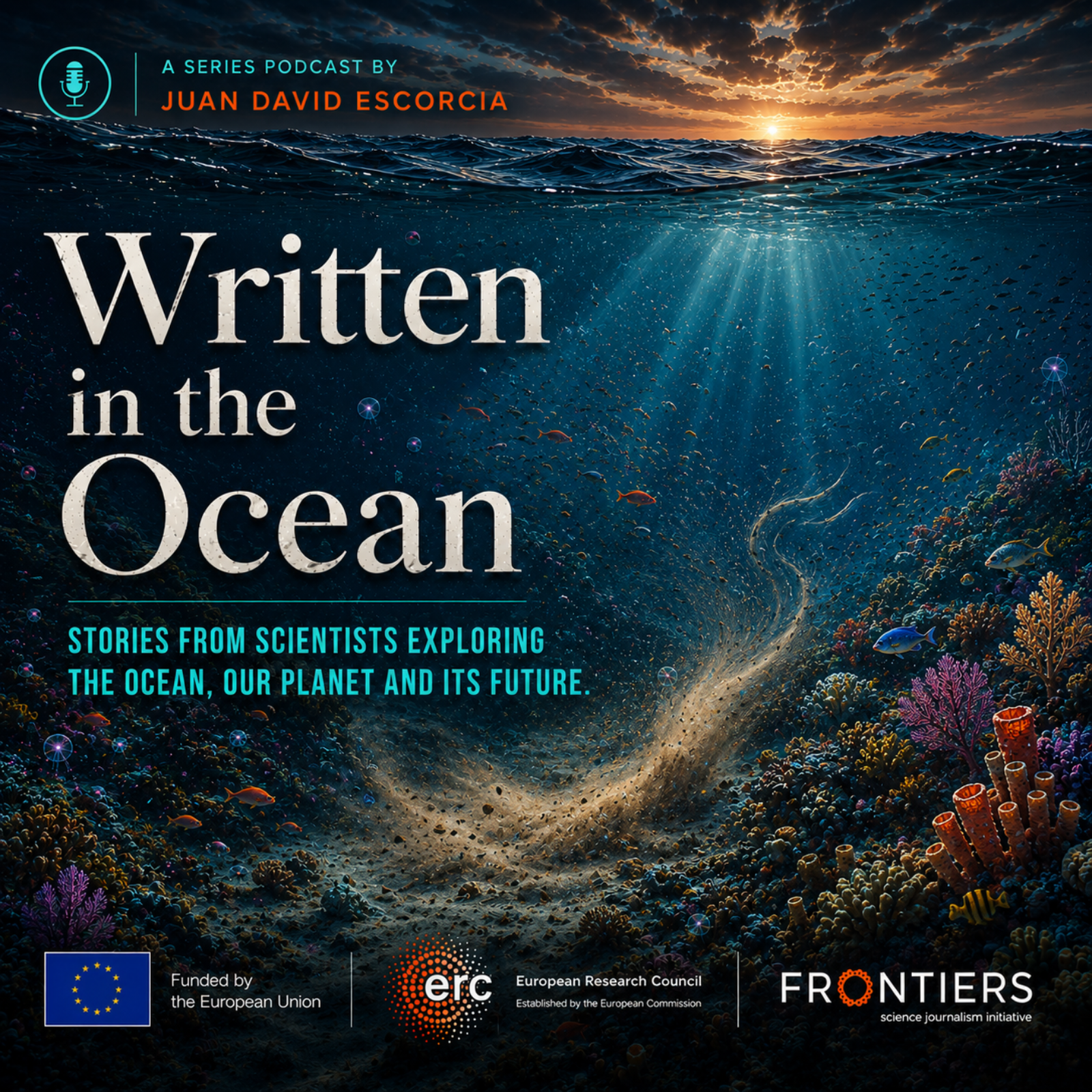
What if everything we need to understand the climate emergency is already written in the ocean?Written in the Ocean is a science journalism podcast series about the ocean and its role in the climate emergency. Through conversations with marine scientists, the series explores the carbon cycle of the ocean, the sediment archives that preserve the climate history of our planet, the invisible processes that keep our atmosphere in balance, the dynamics of glaciers and ice sheets, and the pioneering research that is expanding the boundaries of what we know about the deep sea.Each episode is built around one question: what is the ocean telling us, and are we listening?This podcast was produced as part of the FRONTIERS Science Journalism Fellowship, funded by the European Research Council under the European Union's Horizon Europe research and i
-
1
The Ocean we don't see
What if the most important things happening in the ocean are the ones we cannot see?Half of every breath you take comes from the ocean. But what happens inside that system — at a microscopic level — is almost entirely invisible to us.This episode takes us to three places from everyday life: a kitchen and a concert hall. Each one is a window into a different invisible process happening right now in the ocean.Doctor Christina Roggatz, researcher at the CONCENTRATE Collaborative Research Center at MARUM, studies the sugar molecules that algae produce during photosynthesis — and why bacteria don't always eat them. The answer to that question could reshape how we understand carbon storage in the deep ocean.Doctor Luz María Mejía-Ramírez studies microscopic algae called coccolithophores — single-celled organisms that produce tiny calcite shells, sink to the ocean floor when they die, and carry in their chemistry a record of past ocean temperatures. She is the first scientist to apply clumped isotope analysis to these organisms, opening a new window into the climate history of our planet.The ocean is working for us every day. This episode explains how, and why it matters more than ever.Written in the Ocean was produced as part of the FRONTIERS Science Journalism Fellowship, funded by the European Research Council under the European Union's Horizon Europe research and innovation programme. Info.The residency was carried out at MARUM, Center for MArine ENvironmental Sciences at the University of Bremen. Info.Disclaimer: The background image was generated using Leonardo.ai. All other design elements, including text and layout, were created using conventional editing tools.
-
0
CO₂ Emissions and the ocean's limits
What happens to the CO₂ we release into the atmosphere every day, from our cars, our factories, and even from wars? A significant part of it ends up in the ocean. But how does the ocean absorb it, store it, and process it? And how long can it keep doing that? In this episode, we speak with two scientists at MARUM, the Center for Marine Environmental Sciences at the University of Bremen, who are trying to answer those questions, each from a very different angle. Doctor Matthias Zabel, head of the Sediment Geochemistry Group, studies the ocean as the largest carbon reservoir on Earth and reads the climate history of our planet through sediment archives that go back 300,000 years. Doctor Enno Schefuß, group leader in Molecular Paleoclimatology, works like a forensic detective, isolating individual carbon molecules from sediment cores to trace where carbon comes from, where it goes, and how old it is. Together, they reveal something unsettling: the speed at which CO₂ is increasing in the atmosphere today has no precedent in the geological record. And a natural experiment preserved in the sediments of the Mediterranean — the cold case of the Nile — suggests that the models we use to project our climate future may be underestimating what happens to carbon when the planet warms. Written in the Ocean was produced as part of the FRONTIERS Science Journalism Fellowship, funded by the European Research Council under the European Union's Horizon Europe research and innovation programme. The residency was carried out at MARUM, Center for MArine ENvironmental Sciences at the University of Bremen.
-
-1
Planet Glacier
Welcome to Episode 3: Planet GlacierWhat do we really know about the ice that is disappearing from our planet? We think we understand glaciers. We have seen the images: ice collapsing into the sea, polar bears stranded on shrinking platforms, ecosystems disappearing. The story seems simple. It is not. In this episode, Professor Ben Marzeion: climate scientist at the University of Bremen and associated with MARUM, Center for MArine ENvironmental Sciences at the University of Bremen, breaks down what we actually know about the world's 215,000 glaciers. What he has found after years of research is both surprising and unsettling: even if humanity stopped emitting CO₂ today, 40% of the ice in the world's mountains would still melt. The glaciers are responding to what we did decades ago, and that response has only just begun. But why does this matter for the ocean? Because glacier melt is fresh water entering a saltwater system, and that changes everything: salinity, circulation, ecosystems, and the carbon cycle that keeps our atmosphere in balance. This episode also includes a reading from a UNESCO report on the voices of indigenous peoples in the Andes, who have lived alongside glaciers for generations and are now watching them disappear. This podcast was produced as part of the FRONTIERS Science Journalism Fellowship, funded by the European Research Council under the European Union's Horizon Europe research and innovation programme.The residency was carried out at MARUM, Center for MArine ENvironmental Sciences at the University of Bremen.
-
-2
Beneath the sea floor
What if there is fresh water hidden beneath the ocean floor?In September 2025, scientists confirmed for the first time the existence of vast reserves of fresh water beneath the seafloor off the coast of New England, in the United States. The water, collected during Expedition 501 of the International Ocean Discovery Program, turned out to be far fresher than anyone expected — reaching levels close to safe drinking water limits.The discovery took more than twenty years from the first proposal to reality.In this episode, we enter the laboratories of MARUM, Center for MArine ENvironmental Sciences at the University of Bremen, where forty scientists from thirteen countries are working against the clock to analyze 718 sediment cores collected during the expedition. We speak with Doctor Brandon Dugan, from the Colorado School of Mines, and Doctor Rebecca Robinson, from the University of Rhode Island — the two co-chiefs of Expedition 501 — about what they found, what surprised them, and what questions this discovery opens for the future.The episode also confronts a larger question: in a world where global water use has increased sixfold in the past hundred years, where water infrastructure is being targeted in conflicts, and where demand from artificial intelligence alone could reach the equivalent of Spain's annual water consumption by 2027 — could the ocean floor become part of the answer?The scientists are careful: much more research is needed before this can be considered an accessible resource. But the fact that it exists, and that it can be studied, is itself a milestone.This podcast was produced as part of the FRONTIERS Science Journalism Fellowship, funded by the European Research Council under the European Union's Horizon Europe research and innovation programmeThe residency was carried out at MARUM, the Center for Marine Environmental Sciences at the University of Bremen, Germany.Graphic design was supported by Leonardo.ai.
-
-3
MARUM's Core Repository
What if the answer to the climate crisis has been buried at the bottom of the sea for millions of years?At MARUM, the Center for Marine Environmental Sciences at the University of Bremen, there is a place that holds more than 200 kilometers of material drilled from the ocean floor. More than 350,000 core pieces. Collected over 55 years of scientific expeditions across the Atlantic, the Arctic, the Mediterranean, and the Black Sea. One of only three places like it in the world.This is the Bremen Core Repository. And it is, in the words of the scientist who has guarded it for more than three decades, an Earth history book.In this episode, we meet Doctor Ursula Röhl — Ula — the head of the Bremen Core Repository Group, who has witnessed the development of this archive from its foundation in 1994. She is joined by Doctor Thomas Westerhold, whose 66-million-year climate record was built entirely from these cores; Doctor Matthias Zabel, who reads the carbon signals buried in the sediment to understand how the ocean responds to our emissions; Doctor Enno Schefuß, who tracks individual molecular fingerprints inside the cores to reconstruct the climate history of entire continents; and Doctor Verena Hoyer, who has sailed on multiple drilling expeditions and discovered life in places where no one expected to find it.Through their voices, we discover what is hidden inside kilometers of gray mud: the rhythm of the planet, the record of past climate changes, and the evidence that will help us understand where we are going.This podcast was produced as part of the FRONTIERS Science Journalism Fellowship, funded by the European Research Council under the European Union's Horizon Europe research and innovation programme. The residency was carried out at MARUM, the Center for Marine Environmental Sciences at the University of Bremen, Germany. Graphic design was supported by Leonardo.ai.
We're indexing this podcast's transcripts for the first time — this can take a minute or two. We'll show results as soon as they're ready.
No matches for "" in this podcast's transcripts.
No topics indexed yet for this podcast.
Loading reviews...
ABOUT THIS SHOW
What if everything we need to understand the climate emergency is already written in the ocean?Written in the Ocean is a science journalism podcast series about the ocean and its role in the climate emergency. Through conversations with marine scientists, the series explores the carbon cycle of the ocean, the sediment archives that preserve the climate history of our planet, the invisible processes that keep our atmosphere in balance, the dynamics of glaciers and ice sheets, and the pioneering research that is expanding the boundaries of what we know about the deep sea.Each episode is built around one question: what is the ocean telling us, and are we listening?This podcast was produced as part of the FRONTIERS Science Journalism Fellowship, funded by the European Research Council under the European Union's Horizon Europe research and i
HOSTED BY
Juan David Escorcia
Loading similar podcasts...
Frequently Asked Questions
How many episodes does Written in the Ocean have?
Written in the Ocean currently has 5 episodes available on PodParley. New episodes are automatically indexed when they're published to the podcast feed.
What is Written in the Ocean about?
What if everything we need to understand the climate emergency is already written in the ocean?Written in the Ocean is a science journalism podcast series about the ocean and its role in the climate emergency. Through conversations with marine scientists, the series explores the carbon cycle of the...
How often does Written in the Ocean release new episodes?
Written in the Ocean has 5 episodes. Check the episode list to see recent publication dates and frequency.
Where can I listen to Written in the Ocean?
You can listen to Written in the Ocean on PodParley by clicking any episode. We provide an embedded audio player for direct listening, and you can also subscribe via your preferred podcast app using the RSS feed.
Who hosts Written in the Ocean?
Written in the Ocean is created and hosted by Juan David Escorcia.
URL copied to clipboard!