
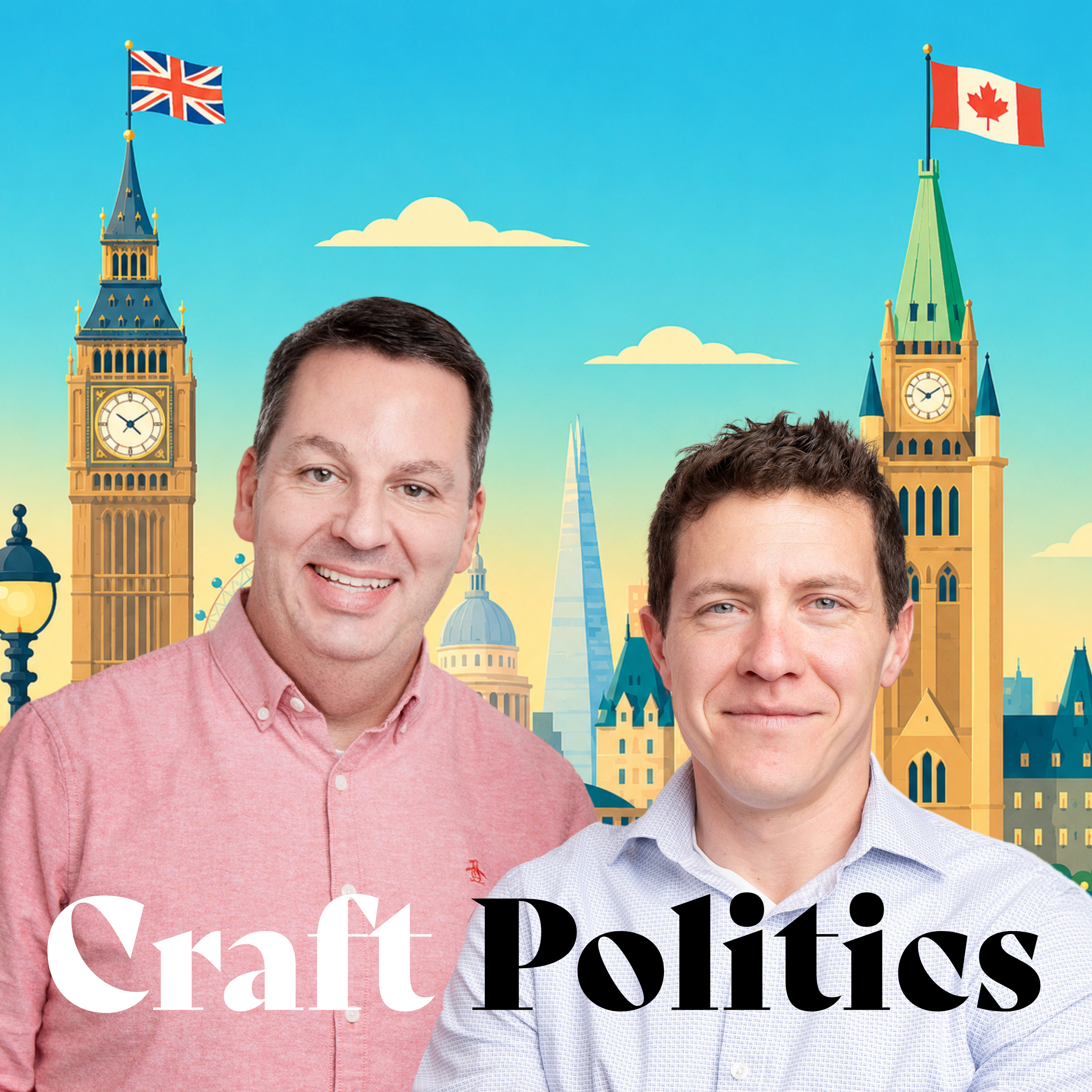
PODCAST · news
Craft Politics
by Joseph Lavoie and Andrew Percy
Craft Politics is a cross-border political podcast, which sounds grander than it is. Mostly it's two friends — Joseph Lavoie, a Canadian public affairs strategist who used to work in a Prime Minister's Office, and Andrew Percy, a former UK Conservative MP — asking the experts who'd know the answer to one sharp political question. Canadian listeners get the UK context they're missing. British listeners get a Canadian lens on their own politics. Everyone comes away slightly better informed.
-
69
Kyla Ronellenfitsch on the Conservatives' brand problem
For forty years, the Conservative Party owned cost of living. Not anymore — and Kyla Ronellenfitsch has the polling to prove it.This week on Craft Politics: pollster and data scientist Kyla Ronellenfitsch joins Joseph Lavoie to answer whether the CPC has quietly lost its forty-year brand on the economy, with new data showing Mark Carney's Liberals now lead Pierre Poilievre's Conservatives on managing the cost of living.We discuss:Why the Liberals lead the Conservatives by five points on managing the cost of living, and what that means for a forty-year Conservative brand assetThe favourability ladder and why its order matters more than the horse raceWhy Poilievre's rebrand kept snapping back to attack mode, and whether the Davos speech quietly locked in Carney's brandThe narrative reset on young Canadians — the CPC has gone from +35 to +5 with young men in sixteen monthsChapters:0:00 — Joseph admits he's been wrong on cost of living1:23 — Is cost of living still Canada's top issue?5:54 — The +5 disaster: how the Liberals took the CPC's brand11:15 — Carney halo vs Poilievre bad vibes14:42 — The Davos speech that wouldn't quit17:29 — The favourability ladder, top to bottom20:25 — Why Poilievre's rebrand snapped back24:41 — Stop saying young Canadians are conservative29:53 — The elder millennial sweet spot35:30 — Avi Lewis and the anti-corporate lane the NDP keeps missing40:42 — The single number to watch in twelve monthsFind Kyla on Substack: https://relaywithkyla.substack.comListen to her podcast Culture Lab on Air Quotes Media—Craft Politics is a cross-border political podcast where Canadian and British experts come on to answer one political question per episode. Co-hosted by Joseph Lavoie (former senior advisor in a Canadian Prime Minister's Office) and Andrew Percy (former UK Conservative MP).Listen on Apple Podcasts: https://podcasts.apple.com/ca/podcast/craft-politics/id1790715962Listen on Spotify: https://open.spotify.com/show/3Zaw8zZHe7qiFYIby7lKRBWeb: https://www.craftpolitics.fmJoseph Lavoie on LinkedIn: https://www.linkedin.com/in/josephlavoie/Andrew Percy on LinkedIn: https://www.linkedin.com/in/andrew-percy-b996b431a/Guest inquiries: [email protected]#CraftPolitics #CanadianPolitics #Polling #PoliticalAnalysis #PoliticalResearch
-
68
Rudy Husny Breaks Down Quebec's Political Landscape
We brought in Rudy Husny — former senior advisor to Ed Fast at International Trade, two-time federal Conservative candidate in Outremont, 2020 Conservative leadership contender, and one of the most thoughtful federal Conservative voices on Quebec politics — to make sense of what has happened in the last 10 weeks.What we got into:Why the CAQ is inching back. New premier Christine Fréchette is quietly stealing votes from the Liberals without really announcing anything. The "Fréchette as Mark Carney" framing is everywhere — Rudy explains why it's lazy.Charles Milliard's Bill 96 stumble. Three clarifications on the notwithstanding clause in one week. Rookie error or structural problem? (Probably both.)PSPP's doubling-down problem. He'd gain eight points by dropping the referendum promise. He won't. Even Lucien Bouchard has told him to walk it back. Rudy on why the rigidity actually matters.The Bill 21 wildcard. A Supreme Court decision is pending and could drop during the campaign. Why the outcome matters to every province, not just Quebec.Caucus management as stock exchange. Rudy's best line of the episode: when you're high in the polls, invest in your caucus — that's when you'll need the return later. A warning for Carney, and a post-mortem on Poilievre.The federal Conservative puzzle. Why Quebec keeps breaking the CPC's heart, and whether Dan Robertson's radical idea — stop running Conservative candidates in Quebec entirely — has any merit.Also discussed: why Quebec staffers are quitting cabinet jobs now rather than six months from now (we've both been there), why "Premier of the West Island" isn't the same as Premier of Quebec, and how Fréchette showed up in Ottawa, demanded answers from Sean Fraser on the notwithstanding clause, and walked out looking like the strong woman in the room.Three scenarios, minority government most likely, and the CAQ and the PCQ are both still very much wildcards.Find Rudy on his French-language podcast https://www.youtube.com/@Danslescouloirs
-
67
Majority Rules
Carney has his majority — 174 seats after sweeping all three by-elections. First time a Canadian minority has become a majority through floor-crossings and by-elections. But the bigger story is the Conservative collapse underneath: worst by-election losses in a decade, per Eric Grenier at The Writ. The last time results looked this bad? 2014 — the year before Harper lost.We dig into what the majority actually unlocks (committees, not just vibes), whether Carney governs like he has a new mandate, and what the by-election numbers really tell us about where the Conservatives stand.Then across the Atlantic: UK May elections are three weeks out. Reform projected to control 60 councils. Labour bracing for historic losses in England, Scotland, and Wales. Andrew breaks down what four-party politics actually looks like on the ground.Plus: Orbán loses Hungary, and Quebec's October election just got a lot more interesting — the PQ is fading, the Liberals are surging under Charles Milliard, and the CAQ just chose Christine Fréchette as their new leader.A deeper Quebec dive with a guest expert is coming soon.Eric Grenier's analysis at The Writ: https://substack.com/home/post/p-193964435
-
66
Everyone won apparently
Everyone has a story about winning, and almost none of them hold up.First up, the Iran ceasefire. After nearly six weeks of Operation Epic Fury, the US and Iran agreed to a two-week pause in the fighting — announced on Truth Social less than two hours before Trump's own deadline, the one where he threatened to send Iran "back to the stone ages." Both sides declared total victory. The problem is the Strait of Hormuz is still largely closed, over 400 tankers remain anchored in the Persian Gulf, and Iran is now demanding tolls for ships passing through what used to be an international waterway. Joseph and Andrew break down what the stated war aims actually were, whether any of them were achieved, and why Trump's inability to set modest goals — and stick to them — has handed the Iranian regime a survival story it will tell for decades. Andrew puts it plainly: if you're going to take on a despotic regime, you have to do it from the moral high ground. Threatening to wipe out a civilization is not that.Then, the floor crossings. Conservative MP Marilyn Gladu became the fifth MP to cross to the Liberals since last April's election, bringing Carney's seat count to 171 — one short of a majority. With three byelections on April 13th in Scarborough Southwest, University–Rosedale, and Terrebonne, a Liberal majority is now a question of when, not if. What makes Gladu's crossing so striking isn't just the number — it's who she is. An MP who aggressively challenged the COVID response, pushed back on vaccine policy, fought the conversion therapy ban, and voted to restrict abortion is now a Liberal. Joseph and Andrew credit Fred Delorey for the framing: what we're seeing isn't just Conservative dysfunction — it's Mark Carney operating as a ruthless political player. The whole caucus is now available for picking, not just the red Tory wing. And for Pierre Poilievre, Andrew draws the parallel nobody wants to hear: Jeremy Corbyn nearly won in 2017, and by 2019 the public had moved on. Moments pass.Finally, Hungary. On April 7th — five days before the election — US Vice President JD Vance flew to Budapest, stood on stage with Viktor Orbán, called Trump on his phone so the crowd could hear "I love Hungary and I love Viktor," and told voters to stand with Orbán at the polls. He did all of this on the same day he called EU behaviour "one of the worst examples of foreign election interference I have ever seen." Andrew doesn't mince words on the hypocrisy — and draws on his own experience as a British MP who did Council of Europe election monitoring to explain just how extraordinary Vance's visit actually was. Joseph flags the Russia angle: the Financial Times has reported a Kremlin-linked operation flooding Hungarian social media to boost Orbán — and now you have the US and Russia aligned on the same side of a European election. Andrew's line: the MAGA obsession with strongmen is being used by Putin like a useful idiot.The Hungarian election is April 12th. Independent polls have Tisza up 16 to 19 points. We'll see.
-
65
The Nothing Burger Address
Last night, President Trump addressed the nation for the first time since launching Operation Epic Fury against Iran on February 28. Joseph and Andrew break down a speech that offered no new information, no clear exit strategy, and no plan for the Strait of Hormuz — 32 days into a war that's sent gas prices past $4 a gallon and oil past $100 a barrel.They cover Trump's complete inversion of the standard wartime communications playbook — waiting a month to make his case while public support eroded beneath him. They dig into the regime change contradiction: Trump encouraged Iranians to rise up in the first days of the war, now says regime change was never the goal, and claims the remaining leadership is "less radical." Joseph and Andrew aren't buying it.The conversation turns to the Strait of Hormuz, where Iran's IRGC is running a de facto toll booth — charging ships $2 million to pass, with China potentially assisting in the collection. Trump says the Strait will "open up naturally." Andrew argues the conflict isn't over until it's resolved, and that if the U.S. and Europe both refuse to secure it, Iran has no incentive to give up its leverage.Andrew offers a provocative thought: the endgame might look remarkably similar to the Obama-era Iran nuclear deal that Trump tore up. And both hosts question whether Western leaders — Starmer, Carney, and others — have anything resembling a plan to deal with the economic fallout hitting consumers at the pump and the grocery store.
-
64
Nationalizing Groceries and Drilling the North Sea
Avi Lewis won the federal NDP leadership on the first ballot in Winnipeg with 56% of the vote. He's a documentary filmmaker, former CBC and Al Jazeera host, co-creator of the Leap Manifesto, and — as Andrew helpfully notes — a complete loon politically, though surely a lovely chap.His platform: nationalize groceries, nationalize telecoms, build a million public homes, do banking through Canada Post, slap a wealth tax on the rich, tax oil and gas exports, and invest 2% of GDP in climate action. It's the most aggressively left federal platform in recent memory, and it won over about 40,000 NDP members who apparently liked what they heard.Joseph and Andrew debate whether this is a stroke of genius or a spectacular miscalculation. The Corbyn comparison gets a full workout — and the part people forget is that Corbyn nearly won before he got crushed. Provincial NDP leaders started running for the exits within minutes. And the question nobody can answer yet: is there actually a market for left-wing populism in Canada, or has the NDP just made itself irrelevant to everyone except degree-educated urbanites who were already voting for them?Story 2: "Go Get Your Own Oil"Coming UpTrump told the UK — by name — to either buy American oil or "build up some delayed courage" and secure the Strait of Hormuz. Hegseth mocked the Royal Navy for good measure.Andrew walks through the UK's North Sea drilling fight: Labour banned new exploration licences, Energy Secretary Ed Miliband won't budge, and the Conservatives and Reform are hammering the government with a simple question voters understand — why won't you let us use our own oil? The economics say it wouldn't move prices much. The politics say it doesn't matter.Joseph and Andrew find common ground on the deeper problem: Western allies spent more energy punching Trump than engaging with the opportunity to confront Iran, and now everyone's paying for it — literally, at the pump. The conversation gets frank about what Europe and Canada left on the table.Part two drops later this week with a full breakdown of the war in Iran once Trump has addressed the nation. Joseph and Andrew are also lining up future episodes on Australia's populist wave and the post-war regional power rebalancing.
-
63
Tim Kiladze: What Alabama Can Teach Canada and Britain
Tim Kiladze is a financial reporter and columnist at the Globe and Mail. His recent long-form feature — "Out of nowhere, Canada became poorer than Alabama" — went viral with over five million views on X and triggered a debate about Canadian competitiveness. Tim joined us to walk through what he actually found on the ground in Alabama, why the piece touched a nerve, and what Canada and the UK should take from it.What We CoveredTim explains why the piece almost didn't happen — the Canada-Alabama GDP comparison first circulated in 2024, then got buried by the trade war and federal election. He'd always wondered whether the stat was real, pitched the story, and the editors sent him south.What he found in Huntsville didn't match any Canadian stereotype of Alabama. The city sits in the foothills of the Appalachians, looks like Vermont from the mayor's office, and the dominant car in the biotech research park parking lot was a Subaru Outback. Mayor Tommy Battle, a real estate guy turned politician, has spent years rebranding the city as "Huntsville: a smart place" — complete with lapel pins.Tim walks through Alabama's economic transformation, starting with Mercedes-Benz arriving in 1993 and triggering a cascade of auto manufacturers — Honda, Hyundai, Mazda, Toyota — that now produce nearly as many vehicles as Ontario. He met Greg Canfield, the state's former commerce secretary, who candidly acknowledged that Alabama's early tax incentives were unsustainably generous and had to be reformed. The key insight from Canfield: speed to market matters more than anything. Companies putting capital at risk want to earn it back fast, and Alabama let them build quickly.That led to a discussion about Canada's regulatory environment. Joseph flagged the Enbridge pipeline refusal — the same week the piece came out, Enbridge said it wouldn't participate in the proposed Alberta-to-Pacific pipeline. Tim went further, noting that even people involved with major Canadian projects told him privately, in the last couple of weeks, that they don't know if their projects will get built. The variable nobody talks about enough, he said, is the courts — duty to consult rulings, judicial reviews, and First Nations groups that have learned to use legal processes to slow or stop development.Andrew drew parallels to the regeneration of Greenville, South Carolina and northwestern Arkansas, and raised a critical constraint: the bond markets. The US can run a nearly $2 trillion annual deficit because of the dollar's reserve status. Canada and the UK simply can't play that game — as Britain learned during the Liz Truss mini-budget. Andrew also pushed back on the idea that southern US strategies are directly transferable, noting that lower union protections, weaker worker rights, and minimal safety nets are politically unacceptable in the UK and Canada regardless of which party is in power.Tim acknowledged all of this but kept returning to a central point: Canada hides behind its morals. Public healthcare and public education are things he firmly believes in — but his kids' school in Toronto looks like a bomb shelter, and when he tried to get a wall painted through the parent council, he hit union rules and red tape. The healthcare system has the same problem: COVID exposed that the bottleneck was nurses and ICU beds, and years later, the nursing crisis persists.The conversation closed on the question of what's actually learnable. Tim's answer: use tax policy selectively, build a brand again, and stop expecting investment to come to us. Andrew's answer: get past the reflexive anti-Americanism that prevents honest assessment of what's working south of the border.
-
62
Lord Walney: Iran's hidden networks of influence in Britain
Lord Walney joins the show to discuss his new 100-page report, Undue Influence, which documents a network of as many as 30 charities, cultural centres, and religious institutions in Britain with alleged ties to the Iranian regime. The report examines 10 charities in depth — eight of which are under active Charity Commission investigation — and argues that the network has avoided serious scrutiny because regulators and officials feared being accused of racism. Walney walks through the evidence, including a charity whose governing document required a trustee appointed by Iran's Supreme Leader, and explains why the UK's failure to proscribe the IRGC leaves the regulatory system unable to address the core problem. The conversation also covers the UK government's newly announced Charity Commission powers and the risks posed by a proposed definition of anti-Muslim hostility.Walney's report identifies a network of Iranian-aligned organisations operating as registered charities in the UK. Four of the 10 charities examined qualify for Gift Aid — three of those are under active investigation.The Islamic Centre of England is described as a "central node" in the network. Until recently, its governing document required a trustee appointed by Iran's Supreme Leader.A former Charity Commission chair admitted that fear of racism allegations made the regulator reluctant to pursue investigations into these organisations.The Charity Commission's framework focuses on governance and compliance — not ideological alignment with hostile states — creating what Walney calls a "compliance trap."The UK government announced new Charity Commission powers to tackle extremism, timed closely with the report's release. Walney welcomes the announcement but says political leadership and culture change are needed to make it meaningful.The UK still has not proscribed the IRGC — unlike Canada, the US, the EU, Sweden, Bahrain, and Saudi Arabia. Walney argues proscription would make it significantly easier to shut down related activity.A new UK government definition of anti-Muslim hostility risks compounding the chilling effect that has already prevented action on Islamist extremism, though Walney notes efforts have been made to protect freedom of speech within it.00:00 — Introduction and context: the Iran conflict and Walney's report01:29 — Andrew introduces Lord Walney03:39 — What does the Iranian charity network actually do?06:16 — Charities on the front line of pro-regime protests07:25 — Why has nobody dealt with this?11:22 — Political leadership and the tools gap at the Charity Commission13:16 — The Islamic Centre of England as "central node"15:04 — How embedded is the regime's influence?17:50 — The double standard: Islamist vs. far-right extremism19:38 — University links, IRGC recruitment, and the proscription gap22:46 — Response to the report: legal threats and personal risk27:45 — New Charity Commission powers: enough or window dressing?31:10 — The proposed anti-Muslim hostility definition and its risks37:30 — Why charity networks matter when drones are hitting British bases40:49 — Defending democracy: final reflections
-
61
When did this war start?
The war in Iran is 11 days old and the picture is shifting fast. A new supreme leader, an oil blockade threat, and Trump calling the whole thing a "little excursion" — Joseph and Andrew unpack why the conversation about international law feels so one-sided. Plus: the EU quietly drops a protectionist bombshell that nobody seems to want to call by its name, and Carney's Indo-Pacific tour delivers billions in announcements but can any of it replace what's at stake with the US? The guys close with the latest Canadian polling — and why the Liberals might regret winning back their majority.The Iran war didn't start on February 28. The regime has been at war with its own people — and with the West — for 47 years. Treating the US-Israeli strikes as Day 1 skips a step.International law is being selectively invoked. Nobody marched when Hamas crossed a sovereign border. Nobody marched when the regime massacred tens of thousands of its own citizens in January. The outrage only shows up when the West acts.The opposition from the right (isolationism, cost) is different from the opposition on the left (the regime as victim). Both are wrong, but for very different reasons.Carney's initial statement was the right call — clear, decisive, among the most hawkish of any world leader. His walkback was driven by caucus management, not conviction.Starmer's response was embarrassing. A mix of lawyerly caution, Iraq hangover, and pandering to sectarian politics after a by-election loss to the Greens. It damaged the special relationship at exactly the wrong moment.The EU's Industrial Accelerator Act is tariffs by another name. Macron called Trump's tariffs destructive. Now the EU is doing the same thing and calling it resilience. Everyone's a hypocrite on trade.Carney's Indo-Pacific tour was impressive in presentation and announceables. But none of it replaces the US trade relationship — it's points of a percent versus multiple points of GDP.The Liberal lead over the Conservatives has grown to 14 points. Poilievre's tone is evolving, but he's fighting a caricature that won't shift overnight — especially with Trump in the White House as a contrast.00:00 — Welcome back!00:30 — Iran: new supreme leader, oil weaponised, Trump's mixed signals02:57 — Andrew on the regime's 47-year war and the hypocrisy of international law04:48 — Nobody invoked international law on October 706:07 — Right-wing isolationism vs. left-wing moral inversion07:41 — The regime as imperialist — anti-imperialists supporting imperialism08:00 — Andrew on the hierarchy of evil and the hard left's blind spots11:33 — The domestic threat: IRGC activity in Canada, FBI warnings13:01 — Regime change vs. containment — what's the realistic outcome?15:40 — Can the Iranian people actually overthrow the regime?17:23 — Intelligence infiltration and psychological damage to the regime18:07 — Carney's flip-flop and Starmer's embarrassing response19:04 — Andrew on Starmer: Iraq hangover, sectarian politics, and the special relationship24:29 — Was Carney's walkback driven by Liberal caucus pressure?25:21 — Andrew's rant: we can't bring ourselves to say taking out this regime is a good thing27:30 — Story 2: The EU's "Made in Europe" Act — protectionism dressed up as policy30:25 — Andrew: everyone's a hypocrite on trade33:13 — Why anti-Trump framing lets the EU get away with it34:17 — Should the UK try to get in on Made in Europe?35:44 — Story 3: Carney's Indo-Pacific tour — India, Australia, Japan37:13 — Andrew: great announceables, but it doesn't replace the US39:37 — The real test is what happens with trade south40:24 — Chart of the week: Liberals lead Conservatives by 14 points43:03 — Poilievre's evolving tone — is it too late?45:29 — Andrew: Canadians want a contrast to Trump, not a copy46:50 — The NDP leadership race nobody's watching47:55 — Wrap
-
60
What's Really Driving Canada's Political Polarization?
A new report from Digital Public Square and Abacus Data surveyed 2,250 Canadians on polarization — and the findings challenge some assumptions. Two-thirds of Canadians place themselves in the political centre. But when asked how they feel about people on the other side, the picture shifts dramatically. We dig into why the left is better at disliking the right than vice versa, why younger Canadians are more open to leaders who bend the rules, and what can actually be done about it.Key TakeawaysCanada's polarization problem is primarily affective — Canadians aren't far apart on the spectrum, but they've developed strong negative feelings toward the other side. Even one step left or right of centre triggers in-group/out-group dynamics.The hostility is asymmetrical. Slightly left-of-centre Canadians view the right more negatively than slightly right-of-centre Canadians view the left.The far right is more likely to believe their views represent the majority. When elections don't reflect that, it feeds a sense of injustice and conspiratorial thinking.The "Civic Optimists" — Canadians most satisfied with democracy — skew heavily 55+. Younger Canadians are more cynical, more right-leaning, and more open to illiberal tactics. But they're also the strongest defenders of minority rights.Digital Public Square has been testing interventions that correct misperceptions about the other side, with early experimental evidence showing it builds empathy.Chapters00:00 — Cold open00:33 — Introduction: polarization in Canada and the UK02:14 — Affective vs. ideological polarization05:42 — The shifting definition of "the middle"08:13 — Political identity beyond politics: culture, sports, media12:28 — Who Canadians blame for polarization13:40 — Why the left is better at disliking the right16:24 — The far right's majority perception problem21:12 — The six segments: Frustrated Pessimists, Civic Optimists, and more27:20 — Young Canadians and the appetite for rule-bending leaders30:10 — What actually works: DPS interventions and evidence36:19 — Electoral reform debate — and Andrew's European pushback43:51 — Put the phone down and go to the pubLinksFull report: digitalpublicsquare.orgDPS Substack: dpsorg.substack.com
-
59
Introducing Masters in Public Affairs
This week on Craft Politics, a sneak peek from Joseph's new show, Masters in Public Affairs.Episode 3 goes deep on Frank Luntz's Words That Work — the book that argues your message doesn't matter nearly as much as what your audience does with it after it leaves your mouth.In this episode:- Why Henry Kissinger's biggest regret was a word he didn't chooseThe core principle: communication is determined by the receiver, not the sender- How single-word changes moved public opinion by double digits- Four mental models for designing messages that actually land- Where practitioners misread Luntz — and the honest limits of language- How this connects to Lippmann and McRaney from earlier in the seriesAbout Masters in Public Affairs:A new show where Joseph goes deep on one foundational book per episode, extracts the durable ideas, and translates them into mental models public affairs practitioners can use. If you enjoy this episode, subscribe wherever you get your podcasts.
-
58
Canada's Election Clock Just Changed
The week started with breaking news: CPC MP Matt Jeneroux crosses the floor to join the Liberal caucus — the third Conservative to do so in recent months. Joseph and Andrew unpack what it means for the Liberals' path to a majority, whether it takes a 2026 election off the table, and why Mark Carney keeps defying conventional political logic. Then, Canada's new defence industrial strategy gets the full treatment: half a trillion dollars in procurement, 70% Canadian content targets, and the messy gap between announcements and delivery. The episode closes across the pond, where Keir Starmer has now executed over a dozen major U-turns — including reversing a plan to delay local elections, days after promising no more reversals. Joseph and Andrew compare approval ratings that tell two very different stories about what non-politician leaders look like when they work, and when they don't.Key Takeaways- Matt Jeneroux's floor crossing puts the Liberals within striking distance of a one-seat majority, pending three outstanding by-elections — one of which was previously decided by a single vote.- With a potential majority in reach and strong polling, the political case for a 2026 snap election is weaker than it was a week ago; Carney appears more interested in building a track record than capitalizing on a polling window.- Canada's new defense industrial strategy earmarks over $500B in procurement, aims to hit NATO's 2% GDP target ahead of schedule, and sets a goal of 5% by 2035 — but the real test is whether a new procurement agency can cut through decades of dysfunction.- Carney's appointment of Janice Charette as chief trade negotiator with the U.S -- we're big fans.- Starmer's approval rating has hit record lows — negative 47% — worse than any sitting British prime minister in polling history; the contrast with Carney's numbers is striking and worth understanding.- The local elections U-turn is particularly damaging because it came days after Starmer explicitly ruled out more reversals; Reform UK forcing the government's hand via a legal challenge compounds the optics.Chapters0:00 — Welcome back + Alberta deep dive reaction1:30 — Matt Jeneroux crosses the floor: what it means and why the Liberals wanted him5:00 — Updated election outlook: is 2026 still happening?8:30 — Mark Carney's governing style and why he keeps defying political convention10:30 — Janice Charette named Canada's chief U.S. trade negotiator14:00 — Canada's defense industrial strategy: half a trillion dollars and 70% Canadian procurement19:30 — Keir Starmer reverses course on local elections — U-turn number 12+23:30 — Approval ratings compared: Carney vs. Starmer29:00 — Tumbler Ridge, partisan unity, and a moment worth noticing32:00 — Wrap-upKeywordsMatt Jeneroux floor crossing, Canadian federal politics 2026, Mark Carney majority, Liberal caucus, Canadian defense procurement, NATO spending Canada, Janice Charette, trade negotiator, Canada-US relations, Keir Starmer U-turns, UK local elections 2025, Starmer approval ratings, Reform UK, Craft Politics podcast
-
57
Alberta’s Separation Referendum — Who’s Going to Stand Up for Canada?
Alberta may be heading toward a citizen-initiated referendum on independence from Canada. Dave Cournoyer — who has covered Alberta politics for over two decades — joins Joseph and Andrew to unpack how the province's separatist movement evolved from a fringe cottage industry into an organized force embedded within the governing United Conservative Party. The conversation covers the deep historical grievances between Alberta and Ottawa, how opposition to COVID-19 public health measures became the organizing catalyst for today's separatist groups, Premier Danielle Smith's increasingly difficult balancing act, and the urgent question at the centre of it all: who is going to lead the pro-Canada campaign — and do they even have the infrastructure to win?Takeaways- Alberta separatism isn't new, but this iteration is different. The current movement organized around opposition to COVID-19 public health measures, spent years building grassroots networks in rural Alberta, and has now embedded itself within the governing UCP's riding associations and activist base.- Pollster Janet Brown identifies three groups of Albertans on separation: roughly a quarter to a third who support it, a third who are unhappy with Ottawa but don't want to leave, and a quarter to a third who are firmly pro-Canada.- The Alberta Prosperity Project needs approximately 178,000 signatures by May to trigger a referendum. The pro-Canada Forever Canadian campaign collected 456,000 signatures — but a signature campaign and a referendum campaign are very different things.- Danielle Smith's "sovereign Alberta within a united Canada" positioning has worked so far, but a binary referendum question will force her to choose a side.- Three potential pro-Canada leaders have emerged — Thomas Lukaszuk, Jason Kenney, and Naheed Nenshi — but their relationships are fraught and there is no unified campaign infrastructure.- Andrew draws direct parallels to Brexit and Scotland's independence referendum: the leave side runs an aspirational campaign, the stay side gets trapped in "project fear," and a referendum legitimizes the question regardless of outcome.- Foreign interference is a serious wildcard. Separatist leaders have claimed meetings with the US State Department, and senior US officials have publicly commented on Alberta separatism.- Dave's assessment: a referendum held today would lose decisively. A referendum held 10 months from now, in an unpredictable campaign environment, is a different story entirely.Chapters00:00 Introduction to Alberta's Political Landscape02:50 Historical Grievances and Alberta's Identity05:42 The Trudeau Legacy and Its Impact on Alberta08:10 The Rise of Alberta Separatism11:11 The Role of the Alberta Prosperity Project13:46 Current Political Dynamics and the UCP16:47 Referendums as a Political Tool19:13 Future Implications for Alberta's Governance26:56 The Dangers of Referenda30:00 Legitimizing Separatism31:47 The Pro-Canada Campaign Challenge35:46 Key Figures in the Pro-Canada Movement39:59 Foreign Interference and Its Implications44:46 The Future of Alberta's Political Landscape
-
56
Everyone knows how this ends
Holly's out this week. Andrew claims she's started a rival podcast called "Raft Politics." We soldier on anyway.What We CoveredUK: Starmer's crumbling premiership. The Mandelson crisis has triggered a cascade — chief of staff gone, comms director gone, cabinet secretary potentially next. Scottish Labour's leader publicly called for Starmer to resign. The leadership contest seems to be happening already; Starmer just hasn't recognized he's toast. Andrew's take from the halls of Westminster: Labour MPs are depressed. Turns out governing is hard.Canada: Poilievre's leadership math problem. He secured 87.4% at the leadership review — no surprise. But his personal approval keeps dropping while party polling stays stable. Six in ten Canadians say they're satisfied with Carney. The question now: can Poilievre close that gap before Carney calls an election?Chart of the week: Polymarket on election timing. 44% chance of a Canadian election by June 30th — and trending up. We debate whether the Liberals should go early while the numbers look good, or whether snap elections have a way of backfiring spectacularly. (See: UK 2017.)
-
55
Quebec Deep Dive with Kevin Paquette
Quebec represents 23% of Canada's population and 20% of GDP. If it separated — which is back on the table for the first time in a generation — it would be like the UK losing Scotland, except with a larger economy.The last referendum in 1995? The "no" side won by 54,288 votes. Half a percent. Thirty years later, the separatist Parti Québécois is leading the polls with a commitment to hold another referendum by 2030.We brought in Kevin Paquette, a colleague at Crestview who was president of the CAQ youth wing during the party's rise, to make sense of what's actually happening.What We CoveredThe collapse of the third way. François Legault's CAQ offered Quebec nationalists a deal: protect the French language, get more autonomy, skip the referendum drama. The party went from 90 seats in 2022 to polling at near-extinction today.Support for the PQ doesn't mean support for sovereignty. Roughly 30% of current PQ voters would vote no in a referendum. People are parking votes with the PQ because they're fed up with everyone else.The Montreal-regions divide. Elections aren't won in Montreal. They're won in the francophone regions where people feel increasingly disconnected from a metropolitan core that doesn't share their lived experience.The Supreme Court wildcard. The upcoming decision on Bill 21 and the notwithstanding clause could hand the PQ a narrative that writes itself: we tried to make Canada work, and Canada said no.Key InsightKevin's prediction: minority government, regardless of who wins. Both the CAQ and Liberals are picking new leaders months before the October 2026 election while the separatists cruise in the polls. A third referendum loss would end Quebec's leverage game with Ottawa permanently — which means nationalists may not actually want a referendum they might lose.GuestKevin Paquette — public affairs consultant at Crestview Strategy, former CAQ youth wing president (2017–2019), and sharp observer of Quebec's regional-urban divide.
-
54
Big Daddy Carns
This week the team dissects Prime Minister Mark Carney's headline-grabbing Davos speech, Trump's inflammatory comments about NATO allies in Afghanistan, the Labour Party's decision to block Andy Burnham from standing in a by-election, and the continuing exodus of Conservative MPs to Reform UK. Plus: a deep dive into Trump's collapsing poll numbers across key demographics.Topics Covered1. Carney's Davos Speech — A "Rupture, Not a Transition"Mark Carney delivered a major address at the World Economic Forum arguing the post-Cold War rules-based order is no longer functioning. He urged middle powers to band together, warning "if you're not at the table, you're on the menu." The speech earned a rare standing ovation and continues making headlines a week later. Andrew draws parallels to the pre-WWI environment: militarism, alliances, imperialism, nationalism, and significant individuals.2. Trump Rewrites Afghanistan HistoryTrump claimed NATO allies "stayed a little back, a little off the front lines" in Afghanistan — a statement contradicted by the 457 British and 158 Canadian deaths in the conflict. The hosts note Article 5 has only ever been invoked once: by the United States after 9/11, with allies responding. The King reportedly reached out, and Trump has since walked back the comments.3. Andy Burnham Blocked from By-ElectionLabour's NEC prevented Greater Manchester Mayor Andy Burnham from standing in the Denton and Gorton by-election, citing the cost of a mayoral by-election. The hosts see it as a convenient mechanism to keep a potential Starmer rival out of Parliament — but note Labour may now lose the seat to Reform anyway.4. Suella Braverman Defects to ReformFormer Home Secretary Suella Braverman became the third Conservative MP in a week to join Reform UK, following Robert Jenrick and Andrew Rosindell. Holly notes her defection speech was notably polished and felt "authentic" given her long-held positions.5. Trump's Polling CollapseJoseph shares data showing Trump losing support across nearly every demographic since 2024 — particularly among non-white voters and 18-29 year-olds. The hosts speculate whether the Minneapolis ICE retreat signals the first time Trump has recognized his base moving away from him on an issue.Word of the Week: "Big Daddy Carns"Coined during the 2025 campaign when a woman heckled Carney with "Lead us, Big Daddy!" — now shorthand for his blend of "cheeky, charming competence."Notable Quotes"The rules-based order has been dead for quite a while now... we've finally accepted it.""We're trying to rationalize something that's irrational. Disorder reigns.""The only time Article 5 has been used was in Afghanistan — by the United States."
-
53
This Greenland Crisis is Getting Out of Hand
Plus, Carney's pivot on China, and more Tory defections in the UK.The gang is back after a winter break—and they’re diving headfirst into the chaos that kicked off 2026. Joseph, Holly, and Andrew cover the escalating crisis over Trump’s Greenland obsession, a wave of Tory defections to Reform UK, Canada’s pivot to China, and some economic mood swings that don’t line up with the data. 🔥 In This Episode🧊 The Greenland Crisis Escalates- Trump threatens tariffs, floats military use, and posts AI images claiming US ownership- Is NATO broken beyond repair?- Why Canada and Europe may now have to act like middle powers—for real- “Trump always chickens out” or “this time it’s real”?🇨🇦 Canada’s Pivot to China- Mark Carney strikes a historic tariff deal with China- EVs and canola in, geopolitical certainty… TBD- What it signals about the new world order—and how Doug Ford feels about it🏛 UK Defections & Tory Discipline- Robert Jenrick and Andrew Rosindell jump ship to Reform- Kemi Badenoch clamps down: decisive leadership or brand dilution?- What this means for the future of Reform—and the shape of the Conservative Party📉 Vibes vs. Reality- Consumer confidence is up among younger voters—while older voters are gloomier than ever- Is this a vibescession or just a new kind of political identity?⸻🧠 Quick HitsWord of the Week:Vibescession — The economic slowdown that exists mostly in public perception.Number of the Week:$125 million — The estimated cost of renaming the US Department of Defense to the Department of War. Because priorities.🎙 Featuring:Joseph LavoieHolly Mumby-CroftAndrew PercyPhoto by Visit Greenland on Unsplash
-
52
Predictions, trivia, and beer porn
It’s our final episode of 2025 — and we’re going out with a bang (and a beer). Joseph, Holly, and Andrew reunite after a winter bug-induced hiatus to bring you our first-ever year-end special. We make bold predictions (that we’ll surely regret), hand out highly scientific year-end awards, play games, roast each other’s beer tasting notes, and toast to the chaos that was.It’s everything you’d expect from Craft Politics — unfiltered, occasionally insightful, and always a bit ridiculous.🗳 Rapid-Fire Reflections:One word to sum up the political year? Fruitless, chaotic… and a bit shit.The story everyone thinks they understood?Doug Ford’s World Series adTrump’s tariffsLabour’s tax strategy — and still nobody gets it.What we’re all pretending won’t matter in 2026, but will?Alberta separatismUK house pricesdefence spending… and apparently, Andrew’s age.🔹 Serious Predictions:Canada heads to the polls — and the Conservatives win (Joseph)Conservative leadership could change… in Canada (Andrew)Reform UK will peak in spring… then fade (Holly)🌶 Spicy Predictions:The Parti Québécois doesn’t win in Quebec — CAQ makes a surprise comeback (Joseph)Zack Polanski’s meteoric Green Party rise hits a bump (Holly)Something very spicy happens in Labour ranks (Andrew… vaguely)🕵️♀️ Quiet Shifts to Watch:Canada’s election becomes about chaos vs. controlDoug Ford and Donald Trump become unlikely friendsJoseph steps down from the podcast due to… “an incident”📊 Real Headline or Fake?Doug Ford on The Amazing Race?Signal-gate?Andrew Percy in the Lords?Let’s just say, trust no one — especially Grockipedia.🗣️ Who Said It?“I don’t particularly want to wipe someone’s bum”“The best is yet to come… get the bungee harness ready”“I originally saw AI as an efficiency gain. I was wrong.”(Many of your favourites are quoted, willingly or not.)🍺 Beer Notes or Erotic Fiction?Andrew and Holly put Joseph’s Untappd beer reviews under the microscope.Did he really say a beer had a “beautiful head”? Yes.Did he really sneak one into a soccer match? Also yes.Did any of it make sense? You be the judge🏆 Year-End AwardsMost Predictable Surprise: Angela Rayner resignsBest Attempt at Spin: Signal-gateWorst Use of a Chart: Lib Dems still doing Lib Dem thingsPhrase We Never Want to Hear Again: “Looks gorgeous. Tastes like a marvel.”
-
51
Broken Promises
The team is back in London — Joseph is enjoying the rare British sunshine, while Holly and Andrew are soaking up the political chaos. This week, we unpack the Labour government’s tough week of headlines and hard truths: from a post-budget messaging mess to a controversial shake-up of the UK justice system — and a surprise pipeline agreement in Canada.📉 Labour’s Budget Blunders: ‘Did She Mislead the Public?’We revisit last week’s autumn budget after a week of unravellingRachel Reeves is under pressure over whether she misrepresented the fiscal headroomCommunications have spiralled into a defensive posture: “Did she lie?” becomes the only storyHolly shares her three-day rule: every budget turns to chaos within 72 hours — and this one delivered⚖️ Trial Without Jury? The Justice Reform Turning HeadsDavid Lammy’s proposal to remove jury trials for offences under 3 years sparks a major backlashCritics say it’s an attack on a centuries-old principle — and unlikely to solve case backlogsAndrew questions whether judges are being politicized, while Holly warns of a “slippery slope”Joseph notes this is another Labour announcement suffering from poor rollout and zero preconditioning🇨🇦 Alberta’s Pipeline Deal with Ottawa: Real Progress or Political Cover?Joseph breaks down the new MOU between Alberta and the federal governmentThe deal sets the stage for a new west coast pipeline — without consulting BCPremier Eby is furious, Carney is betting big, and Danielle Smith is walking a tightropeAndrew and Holly react to whether this kind of high-stakes, nation-building compromise could ever work in UK politicsWe almost had a new entry for “Lipstick on a Gerbil” — our regular feature on political spin — but in the spirit of seasonal generosity, Andrew suggests giving UK ministers a break…for now.
-
50
UK Budget Day Breakdown: Tax Hikes, Child Poverty, and Kemi’s Big Moment
With Celia McSwaine & Christine QuigleyThe Labour government dropped its first full budget — and everyone’s claiming victory… or crying foul. This week, Joseph and Andrew are joined by Celia McSwaine (former Treasury SpAd) and Christine Quigley (Labour strategist) to unpack what it all means: from fiscal drag and frozen thresholds to the abolition of the two-child benefit cap and Kemi Badenoch’s show-stealing rebuttal.We cover the politics, the process, and the problems still ahead.💸 In This Episode:📊 Labour’s Balancing Act • “A budget where everyone gets something… and everyone pays for it.” • Massive welfare spend, frozen tax thresholds, and the return of fiscal drag • Why the OBR, not the Commons, may be in charge now👶 The Two-Child Benefit Cap Is Gone • Labour says it will lift 450,000 children out of poverty • Critics say it penalizes middle earners and disincentivizes work • Is this Labour morality — or Labour survival?🎭 Budget Theatre: Kemi’s Big Moment • Rachel Reeves made history — and played it safe • Kemi Badenoch’s “call and response” rebuttal caught fire on social media • From “mansplaining” to broken promises: who landed the bigger punch?🧮 Behind the Curtain: How Budgets Get Made • Celia McSwaine shares what it’s really like crafting a UK budget • Why Rachel Reeves leaked everything • And how “death by a thousand cuts” might come back to bite⸻🗞 Headlines of the Week: • The Sun: “Benefit Street Budget” • The Telegraph: “A Spiteful Raid on Middle England” • The Mirror: “A Budget with a Labour Heart” • The Daily Star: “The Budget That Stole Christmas”
-
49
You’re Not in Reagan’s America Anymore: Mapping the New U.S. Right
With special guest Alex MuirIn this week’s interview edition, Joseph Lavoie and Andrew Percy sit down with Canadian-American pollster and strategist Alex Muir to map out the real factions driving the MAGA movement — and why Canada is dangerously unprepared for a second Trump administration.Muir doesn’t pull punches.“The America we grew up with doesn’t exist anymore. In the same way that the Canada I grew up in doesn’t exist anymore.”⸻🔥 In This Episode📌 The Seven MAGA FactionsAlex walks us through the internal tribes of the America First movement — including: • MAGA Populists • Institutional MAGA • Traditional Business Conservatives • Tech Libertarians • Christian Nationalists • Isolationists & Neocons • The Family Court (Trump’s inner circle)🧠 Shared Beliefs That Bind ThemFrom the branding genius of Make America Great Again to the cultural rage at a world that “disrespects” America, Alex explains:“Foreigners need to know their place.”🧊 The Chilling Truth for CanadaDespite trade, shared security, and years of goodwill:“Canada doesn’t have leverage. It has convenience value.”🇨🇦 What Canada Gets Wrong • Canadian politicians assume a return to “normal” is inevitable • The embassy lacks deep MAGA relationships • Most outreach is happening in the wrong cities (DC, NY, LA)“They don’t care about Canada. They don’t think they need to.”⸻🎯 Hard Truths About Trump 2.0Unlike the first time: • They’re ready to govern • They’ve written executive orders in advance • They’ve mapped out personnel, departments, and state-level pipelines“Trump is no longer isolated in Washington.”And if you think this all ends when Trump does:“The next thing will be more ideological, more effective — and worse for Canada.”⸻💡 A Strategic Wake-Up CallAlex shares a clear message for Canada:“Want the Trump administration’s attention? Have you considered buying $100 million of his crypto?”…And why the work to build relationships must start now, especially with: • CPAC • Heritage Action • Turning Point • The Danube Institute • Texas & Florida power bases
-
48
UK's Hokey-Cokey Budget
This week’s episode runs the gamut: from house prices in freefall, to Labour’s immigration U-turn, to what the hell is going on in Parliament (again). We also say a bittersweet goodbye to one U.S. Congressman — and welcome a rare, almost-sincere apology from Marjorie Taylor Greene in our Lipstick on a Gerbil segment.Pour a pint and let’s get into it.⸻🏠 1. UK Housing Market WobblesNew data shows UK house prices down 1.8%, the steepest drop for this time of year in over a decade. But why is it happening?We discuss: • How Labour’s leak-heavy pre-budget chaos is rattling consumer confidence • Stamp duty, council tax rumours, and interest rate anxiety • Whether this is just a London story — or a warning for the rest of the UKIt’s either a sh*t sandwich, or a sh*t sandwich they’re not even going to eat. Either way, the market smells it.⸻🧾 2. Immigration Reform… or Reform Panic?Labour has unveiled sweeping immigration changes, including: • Temporary refugee status with 2.5-year reviews • A 20-year path to permanent residency • Faster deportations for failed asylum claims — including familiesBut within 24 hours, Labour backbenchers revolted, and critics from all sides questioned the policy’s credibility and intent.We ask: • Is this a strategic pivot to undercut Reform UK? • Will voters believe Labour means it? • Or does it just look like panic from a party still at war with itself?They’ve got a huge majority, and still… no one’s buying it.⸻🇺🇸 3. Burnout in the House: Jared Golden Steps DownCongressman Jared Golden (D-ME) announced his retirement, citing growing incivility and toxicity in American politics.We reflect on: • The real mental health toll of public office • Why more good people are leaving • How algorithmic outrage and polarization are reshaping political discourseWe’re not losing just politicians — we’re losing the ones we actually need to stay.⸻💄 Lipstick on a Gerbil: Marjorie Taylor Greene Says Sorry… Sort OfIn a surprising CNN interview, Rep. Marjorie Taylor Greene issued a rare apology for her years of toxic rhetoric.We debate: • Is this a real change — or just a rebrand now that she’s on the receiving end? • Can former provocateurs actually help de-escalate politics? • And does a Southern accent make it sound more sincere?🧴 1 Coat Across the BoardIt’s a start. But let’s see if she keeps the room tidy for six months.
-
47
The BBC Implodes, Carney Spends Big, and Doug Ford Becomes Holly’s Roman Empire
This week, we tackle the institution that’s cracking (the BBC), the leader who’s spending (Mark Carney), and the conservative premier who’s somehow breaking hearts and polling records (Doug Ford).Also, Prince Harry makes a surprise appearance… in our Lipstick on a Gerbil segment.🏚 1. BBC on the BrinkWe break down the resignation of BBC’s Director-General, Tim Davie, following a firestorm of scandals — including:A Panorama edit that deceptively spliced Trump’s speechAllegations of editorial bias on the Middle East and trans issuesA crushing internal report that reveals the public broadcaster has lost trust across the political spectrumWe debate whether the BBC has become the UK’s next great institutional casualty — and ask:Is this the moment it becomes the CBC of British politics?“You don’t just lose public trust with bias — you lose it with smugness.”💸 2. Canada’s Budget Gets Derailed by… Polievre?It was supposed to be the biggest budget in a generation — but you wouldn’t know it based on the political headlines.Instead, the story has been:Two MPs leave Pierre Poilievre’s caucusAllegations his office used oppo research to threaten MPsA leadership review coming in January“The budget is a footnote in a week of internal Conservative chaos.”We ask:Does this damage Poilievre’s image as a PM-in-waiting?Why is no one talking about the record-breaking deficit?And is anyone in Canadian politics actually focused on cost of living?📈 3. Doug Ford: Ontario’s Unshakeable PremierDespite Ontario’s controversial World Series ad (which British Columbia has since scrapped), Doug Ford’s numbers haven’t budged — still holding at 51% in the polls.Holly calls him “a retail politician with Riz.” Andrew rolls his eyes. Joseph asks why more federal conservatives aren’t learning from him.“He’s my Roman Empire.” – HollyWe ask:What explains his Teflon approval rating?Has Ford actually cracked the political code — or is the bar just really low?💄 Lipstick on a Gerbil: Prince Harry’s Baseball ApologyWhen Prince Harry wore an LA Dodgers cap during a Jays game, Canada had questions. His response?Self-deprecating charm. Bald jokes. And a gentle “go Jays.”3 coats across the board.“Sometimes we forget: not every controversy needs a communications war room.”
-
46
Oops! I Did It Again
Budget Season, Housing Scandals & Populist SnapbacksJoseph’s in a bad mood. Andrew’s six minutes late. Holly’s podcasting from a cow-filled Cumbrian farm. And somehow, this chaotic start perfectly mirrors the week in politics we’re about to unpack.In this week’s Issue Scan, we tackle three big stories⸻💸 1. Carney’s Budget of Austerity (Without Saying “Austerity”)We preview Prime Minister Mark Carney’s first federal budget, which the Liberals are billing as transformational — but may look a lot like a cutback budget with better PR. • Spending cuts to government operations• Big promises on defense, trade and climate • An electorate with zero patience and plummeting expectations“It’s starting to feel like Canadians don’t want change — they want certainty.”We debate: • Is this a red-tinted version of David Cameron’s ‘Age of Austerity’? • Will progressive voters tolerate fiscal discipline? • And what happens if the elbow-throwing on trade still doesn’t land a deal with Trump?🏘 2. Rachel Reeves’ Rental Row: A Crisis of DetailThe UK Chancellor has a problem: two letters, one missed license, and a husband who didn’t “sort it.”We break down: • The timeline of the scandal • What it reveals about Labour’s growing housing PR headache • And why this is more than just “admin error”Lipstick on a Gerbil Score: 🧴 1 coat — “She said she took responsibility. But mostly blamed everyone else.”“If this were a Tory, Labour would have eaten them alive. But now? Just more letters on Starmer’s desk.”🇳🇱 3. Dutch Election Surprise: Populists Rejected?Andrew brings us a European update as the Dutch electorate gives populism a timeout — rejecting Geert Wilders and rewarding centrist parties. • What went wrong for the populists this time? • Is this a snapback to the centre or a one-off? • And what could it mean for Farage-style politics elsewhere?Populists won power, disappointed voters, and got punished. So what comes next?”
-
45
The Dumbest $75M Ad Ever? Or Genius Strategy?
From the UK’s disastrous week under Labour to a major trade gaffe (or not?) in Canada, and Doug Ford’s surprising turn as global spokesman for tariffs and Reaganomics — we unpack a week of political faceplants, media spin, and near perfect lipstick jobs.⸻🧨 1. A Week in the Life of a Labour PMOne tweet said it all.Six political scandals. One week. And a mounting sense that Keir Starmer’s government is spiralling: • Botched handling of the Maccabi fan ban • Immigration failures (again) • Rape gang inquiry collapses • Labour loses its own seat in Wales • Starmer caught in a China fib • An Epping sex offender goes AWOLWe ask: Is this just governing as usual? Or has Labour lost the plot just one year into its mandate?“This feels like third-term fatigue… but it’s only year one.”⸻🗳 2. Labour Gets Wrecked in WalesA shock by-election in Caerphilly saw Labour collapse to 11%.Plaid Cymru won, Reform surged to second — and Farage is claiming “main challenger” status.We break down: • What the Welsh result tells us about progressive alliances • Whether Reform has a hard ceiling • And why Labour MPs are already talking like they’ve lost“They’ve only got the cards they’ve got — and we’ve seen what’s in that deck.”⸻🇨🇦 3. Ontario’s World Series Ad Bombs Trade TalksPremier Doug Ford ran a $75M ad campaign during the World Series — using Ronald Reagan’s words to shame Trump’s tariffs.Trump responded by escalating tariffs. Negotiations collapsed. The Reagan Foundation called it misinformation.We debate: • Was this political genius… or tactical self-sabotage? • Who was the ad really for — Trump or Ontarians? • And did Mark Carney know it was coming?“It smells like genius… but I’m not smart enough to understand why.”⸻💄 Lipstick on a Gerbil: Doug Ford Defends the AdIn our favourite comms segment, we rate Ford’s CNN appearance defending the ad.Was he playing 4D chess, or just trying to out-Trump Trump?Our verdict:🧴🧴🧴 Three coats — Warm, confident, and weirdly likeable.⸻📩 Subscribe or listen at craftpolitics.fm🎧 Available on Spotify, Apple Podcasts, YouTube & Substack
-
44
Fan Bans, Brexit Blame & Trump vs. Rudd
🧨 1. Maccabi Tel Aviv Fan Ban: Judenfrei by Policing?When Aston Villa banned Israeli fans from attending their upcoming UEFA fixture, citing security risks, it sparked outrage — and raised serious questions.Why did local UK officials capitulate to pressure from anti-Israel campaigners?How did Birmingham end up, as Andrew puts it, “effectively declared Judenfrei”?What does this mean for sport as a safe and unifying space?“If you threaten violence, you win. That’s the message. It’s shameful.”🇬🇧 2. Blaming Brexit — Labour’s Budget Pre-SpinAhead of the UK’s autumn budget, Chancellor Rachel Reeves claims Brexit, austerity, and productivity slumps have created a deep funding hole.We debate:Is this a smart preconditioning move — or a dangerous misread of voters?Are Labour making Reform’s case for them?And how long can you keep blaming decisions from eight years ago?“They’re telling voters they were stupid. Farage couldn’t have scripted it better.”🇨🇦 3. Poilievre’s RCMP Blunder — Just Off the Cuff?Pierre Poilievre is on cleanup duty after comments he made accusing the RCMP of covering up Trudeau-era scandals. He says it was aimed at former commissioner Brenda Lucki — not the force itself. But the damage may already be done.Was it an off-the-cuff moment of honesty or a Trump-style overreach?Is it alienating swing voters just when the Tories should be widening their appeal?And what does it say about how Poilievre handles comfort-zone media?“He needs to be most careful when he’s most comfortable.”💄 Lipstick on a Gerbil: Penny Wong Defends Trump’s Takedown of Kevin RuddIn our favourite comms segment, we rate Australia’s Foreign Minister as she tries to explain away Donald Trump’s brutal dismissal of Ambassador (and ex-PM) Kevin Rudd:Our rating?🧴 One coat — Barely concealed, pivoted well, but we’re not buying it.“I don’t like him… and I probably never will.”
-
43
Three Ways Conservatives Can Win Again
Guest: Dan Robertson, former Conservative strategist & founder of ORB AdvocacyThis week, Joseph and Holly are joined by long-time conservative strategist Dan Robertson, who has an unconventional set of ideas: Canada’s Conservative Party can’t out-campaign a system rigged against it.Dan’s solution? Structural reform. In a recent op-ed, he outlines three controversial but compelling ideas to level the playing field—and maybe even turn the Tories into a true national contender again.1. Proportional RepresentationWhy the “first past the post” system doesn’t actually benefit conservativesHow PR could eliminate the Liberals’ advantage in voter efficiencyAnd why Canada’s system keeps millions of centre-right votes from counting at all“I’d love to see conservatives champion competition everywhere—except in politics. It makes no sense.”2. Mandatory VotingWhy the right underperforms in low-turnout electionsA civic case for participation as a duty of citizenshipAnd what Australia can teach Canada about centre-right success in a compulsory voting system“This is the bare minimum of civic service. If we believe in responsibility, this is a no-brainer.”3. A New Strategy for QuebecDan proposes the unthinkable: Fold the federal Conservative brand in QuebecInstead, back a CAQ-style provincial-federal hybrid partyAnd model a new electoral coalition—just like the CDU–CSU in Germany.“In Quebec, we’re foreigners. It’s not ideological. It’s tribal. We need to rethink everything.”🎧 Plus:Could these reforms actually help turnout?Why voter apathy might be structural, not culturalAnd how to build a cross-partisan case for political reform, even on the right
-
42
Can Carney Land a Deal? Gaza, Green Strategy & Canada’s Trade Reset
Joseph is back, Andrew has a cold, Holly has green tea — and the Craft Politics crew takes on three major stories reshaping the political map: peace in Gaza, Canada’s economic pivot, and Britain’s inflation problem.🧭 What’s Inside:🇮🇱 20 Hostages Freed — Can Trump Deliver Peace in Gaza?All living hostages have been returned after 738 days in captivityTrump takes centre stage in the peace process — with the kind of leverage few global leaders can summonHolly, Andrew, and Joseph debate whether this moment is a turning point or a temporary pause in a brutal conflict“Let’s not underestimate what Trump has already achieved in returning the hostages. That’s a phenomenal and important win.”🌍 Canada’s Climate Pivot & the India ResetOttawa hints at a climate competitiveness strategy focused on jobs over targetsCarney’s Liberals soften the climate line, downplay emissions caps, and seek Alberta buy-inAt the same time, Canada and India agree to reset diplomatic relations after a two-year rupture“You can feel the contrast with the Trudeau era. There’s a shift toward pragmatism—jobs, trade, and economic security.”💸 Britain’s Inflation Warning: Highest in the G7 (Again)IMF says UK inflation will outpace every other G7 country through 2026Food, hospitality, and taxes are driving the pressureKemi’s Tories pitch tax relief and spending restraint — but will anyone buy it?“You’re paying more tax but getting worse services. That’s why inflation feels higher than it is.”💄 Lipstick on a Gerbil: Melanie Joly Spins the Stalled Trump TalksCanada’s Industry Minister tries to explain what the second visit to the White House has produced — and comes up short.“One and a half coats. Solid performance, but there’s only so many times you can say we’re still talking.”
-
41
Inside the Tory Conference: A Wake, a Reset, or Just Really Bad Gossip?
With Andrew Percy, Holly Mumby-Croft & guest roving reporter Antony HigginbothamJoseph’s away, so the adults are off-duty — and the former MPs are in charge.In this special Tory Party Conference edition, Andrew and Holly are joined by their old colleague (and flatmate) Antony Higginbotham — back from the ground in Manchester with gossip, grit, and grim assessments of where the Conservative Party stands post-election.🧭 What’s Inside:🚪 Low turnout, low energy, lower expectationsThis year’s Tory conference felt like a wake: fewer lobbyists, fewer ministers, and… fewer rumoursSome MPs showed up to mourn; others showed up to rebuildShadow ministers name-dropped Kemi, but were they really rallying around her?“If the Tory Party has stopped producing good gossip… that may be the most dangerous sign yet.”💥 Still relevant? Or a brand waiting to be rebought?Antony offers a brutal but honest diagnosis:The party may be down — but if the Woolworths model holds, it’s still salvageable. Eventually.“No one trusts the policies or the people—but the brand still has residual value.”📉 A generational void and the candidate droughtToo few safe seats to attract serious talentToo many 2024 losers who only want to return if they get a guaranteeA pipeline problem for any future right-of-centre government“We’ll need to form a government with people who aren’t even MPs yet — and that’s a problem.”💬 The reform shadow, Kemi’s moment, and leadership gossipMay’s local elections could be the breaking pointBut scar tissue from years of churn might delay any internal revoltAnd reform continues to absorb “the laziest defectors” — in Anthony’s words — without a clear plan to use them
-
40
Dan Hannan on the Right: Brexit, Reform, and What Comes Next
This week, we’re joined by Lord Daniel Hannan, one of the most thoughtful — and globally fluent — conservative voices in politics.We go deep on the future of the right across the Anglosphere:🇬🇧 Is the British Conservative Party dead or just regenerating?🇺🇸 Has the U.S. abandoned the world it built?🇨🇦 Why is Canadian conservatism still the sanest?🗳 And is the UK heading toward a merger moment like Canada’s in 2003?🧭 What We Cover1. The Anglosphere’s Conservative CrisisHow lockdown changed the role of the stateWhy “Trumpism” is reshaping the right in every country — including IcelandAnd why Canada may be the only place where centre-right politics still feel normal“Preserving the sanity and civility of Canadian politics is no small prize.” — Hannan2. Can Reform and the Tories Work Together?Hannan lays out the most detailed case yet for a non-merger, non-coalition electoral pact — and explains why time is running out.He also draws a direct line from Farage’s playbook to Canada’s 1993-2003 Reform-Conservative story — and suggests it may all play out again, faster than we think.“If we were all Dr. Spock from Star Trek, we’d have done this by now.”3. The Long History of ToryismDaniel is writing the first comprehensive history of the Conservative Party — from the 1600s onward.He reminds us why old parties shouldn’t be underestimated… and why “Toryism” might survive even if the Tory party doesn’t.4. On Brexit: Not a disaster — just underusedWe close the episode by tackling the narrative around Brexit’s so-called failure.“Brexit didn’t make you richer or poorer. It gave you back the right to make different choices. Whether you succeed or fail depends on what you do next.”🎧 This is one of our favourite episodes of the season. Whether you’re a political junkie, a student of history, or just trying to make sense of where the right goes next — don’t miss it.
-
39
Trump's Gaza Plan, Labour Conference, and a Postal Strike
We’re back with another Issue Scan — and we’ve got a full lineup:🌍 A 20-point postwar plan for Gaza🇬🇧 Labour’s conference drama (or lack thereof)📬 And a Canada Post strike that’s gone… oddly unnoticed?Joseph, Andrew, and Holly break down the headlines with just enough disagreement to keep things honest — and just enough beer to keep things friendly.
-
38
Canada and UK Recognize Palestinian Statehood
We had intended to explore this major foreign policy shift with a former G7 foreign minister, but unfortunately, schedules got in the way. Percy and Joseph share their thoughts on what is an incredibly sensitive topic.The conversation delves into the recent recognition of Palestine at the UN, contrasting Canadian foreign policy, and the implications of the October 7th attacks. We discuss the roles of Hamas and the Palestinian Authority, the two-state solution debate, and the rising antisemitism in the context of the Israeli-Palestinian conflict. We explore the military strategy of Israel post-October 7th, its diplomatic isolation, and the political motivations behind the recognition of Palestine. The discussion concludes with a hopeful note for peace amidst ongoing conflict.
-
37
State Visits and Diplomatic U-Turns
We’re back with another Issue Scan — and somehow, the world got messier again.This week, we covered everything from Trump’s sudden about-face on Ukraine, to Keir Starmer’s high-stakes state visit with the same man, to Ed Davey’s surprisingly jazzy Lib Dem conference. And yes, we finally got Andrew back — fresh from California and full of strong beer opinions.We also welcomed some new (and critical!) listeners. One thinks our intro banter is interminable. Sorry critics, the useless banter is not going anywhere.Here’s what’s inside:🌍 Trump’s Big Pivot on Ukraine“He gave Putin the red carpet—and got played. That’s personal for Trump.”🇺🇸 After months of hedging, Donald Trump now says Ukraine can win back all its territory🤔 Is this a genuine shift or just Trump being Trump?🧠 The team debates whether U.S. aid policy is really changing — or just being rebranded⚠️ Why NATO should be paying close attention to the timing, tone, and implications🇬🇧 Trump’s UK State Visit“Success these days is: no Epstein questions and no one got deported.”👑 Red carpets, royal banquets, and a tech prosperity pact🎩 Starmer survives the visit unscathed—just barely💥 Trump praises Britain by day, blasts Europe at the UN by night🧾 Did any of it actually matter? Or was the goal simply to avoid disaster?🇬🇧 Lib Dems vs Reform UK“If you’re trying to win back Tory moderates… they may not exist anymore.”🎺 Ed Davey leads a marching band into conference season (literally)📣 40+ references to Nigel Farage in one speech — is this strategy or desperation?🧠 The crew dissects whether the Lib Dems are targeting the wrong voters in their anti-Reform push(But don’t worry, we’ll have more maple-flavoured content next week.)🇨🇦 Canada Skipped This Week…💄 Lipstick on a Gerbil “When you’re picking up your bag before the interview ends… it’s not a great sign.”🎙 This week’s entry: Liz Kendall dodges every hard question on immigration with a smile✅ Did she defend an unworkable “one-in-one-out” policy? Not really.🧃 Did she charm the press and survive the interview? Absolutely.
-
36
Starmer's Scandals Pile Up
This week on Craft Politics, we kick off our latest Issue Scan with a Prime Minister in crisis, a Conservative Party in retreat, and a Canadian housing announcement that somehow manages to add more bureaucracy to solve… bureaucracy.Plus, our favourite comms segment—Lipstick on a Gerbil—features an impossible task: defending Peter Mandelson.With Percy mostly frozen on screen (literally), Joseph and Holly carry the show. Here’s what’s inside:🇬🇧 UK: Mandelson, Epstein, and the Labour Meltdown❌ Peter Mandelson is sacked as UK ambassador to the US after emails surface linking him to convicted sex offender Jeffrey Epstein🧨 Starmer’s judgment under fire—did he know more than he admitted during PMQs?🗳 Backbench muttering begins. Is May 2026 the unofficial deadline for a leadership change?📉 Labour infighting, ministerial fatigue, and growing pressure from Andy Burnham🔁 Meanwhile, the Conservatives lose… to Reform🧍♂️ MP Danny Kruger defects to Reform UK, declaring: “The Conservative Party is dead.”🤷♀️ Holly isn’t so sure: is this the start of a cascade, or just posturing between conferences?🇺🇸 US: The Shooting of Charlie Kirk💥 A high-profile act of political violence rocks the U.S.—and spreads globally📱 The power (and danger) of social media virality in shaping public fear🛑 What it means for public office, political recruitment, and the future of civil discourse🇨🇦 Canada: The PM’s Housing Blitz🏘 Mark Carney launches Build Canada Homes, a new federal agency with a $13B mandate📈 Goal: 4,000 factory-built homes across 6 sites, using federal land and Canadian materials🏗 But is launching a new bureaucracy really the best way to fight bureaucracy?💄 Lipstick on a Gerbil: The Matt Tapp Clip🎤 Labour Minister Matt Tapp sent out to defend Peter Mandelson’s appointment… hours before the sacking🐽 Did he even try to apply lipstick? Or did he wisely avoid putting his fingerprints on the mess?
-
35
Ginny Roth on What’s Next for the Conservatives
When we last had Ginny Roth on the show, everyone assumed Pierre Poilievre would be Canada’s next Prime Minister. Much has changed in seven months. This week, we ask Ginny:🔄 Rebuilding the narrative: What should Poilievre say (and not say) in Question Period to shift the political terrain?💸 Cost of living, crime, and immigration: Ginny argues that these remain the three most potent issues for Conservatives—and where Carney is most vulnerable.🧠 Tone, authenticity & voter math: Is it a “likeability” problem—or a coalition problem? Ginny breaks down what the real issue is.🧨 The TFW announcement: Why Poilievre’s stance on temporary foreign workers matters more than it looks.⚖️ Keeping the base AND growing the tent: Can the Conservatives do what no other right-of-centre party has managed in the West—hold both the traditional right and new right together?Poilievre faces a leadership review vote in Calgary this January. We ask:Is there a credible alternative if he stumbles?And what issues should the Conservatives own to change the math before 2026?🎧 This is a must-listen episode for political observers looking to understand the next phase of Conservative strategy, and the dynamics reshaping Canadian politics.🎙 Featuring:Joseph LavoieAndrew PercySpecial Guest: Ginny Roth🧠 Key insights from Ginny Roth:“No one cares if you say ‘I told you so.’”“Poilievre’s real risk isn’t likability—it’s losing the disaffected voters he brought into the tent last time.”“The federal NDP and Western NDP are essentially two different parties.”
-
34
The Great Shuffle: When Resets Don’t Reset
Plus: Canada’s economic blues, France’s fourth PM in four years, and Farage dodges a lipstick.Joseph, Andrew, and Holly return with another Issue Scan—three stories, three jurisdictions, and one increasingly depressing outlook on the Western political economy. But don’t worry, we offset the doom with solid banter, questionable French pronunciation, and beer reviews.🧭 Here’s what’s inside this week’s scan:🇬🇧 UK: The Reshuffle That Changes NothingAngela Rayner is out as Deputy PM. David Lammy is in. Yvette Cooper moves to Foreign Secretary. And still, Starmer’s government looks… wobbly.🤔 Does reshuffling help when the fundamentals remain unchanged?🎯 Are Labour’s backbenchers already preparing for war?🧨 Holly and Andrew reflect on just how hard it is to govern—even when the adults are in charge.🇨🇦 Canada: The Economic Squeeze TightensThe latest numbers are grim:GDP down 1.6%Unemployment at 7.1% (highest since 2016)Youth unemployment? A staggering 14.5%Export plunge led by a 25% drop in passenger vehicle sales💸 Prime Minister Carney tries to counter with $5B in tariff relief and a freeze on EV mandates—but will any of it matter if affordability keeps getting worse?🇫🇷 France: Chaos, AgainThe curse of Craft Politics strikes again. Since last week’s episode:The French government collapsed.Macron appointed Sébastien Lecornu as the new Prime Minister.That makes four PMs in four years.🔁 But with populists on both flanks and public debt ballooning, we ask:Can France actually govern itself out of this mess?What happens when the #2 economy in the Eurozone teeters on instability?“You can change the nurse, but the medicine stays the same.”🐹 Lipstick on a GerbilThis week’s contender: Nigel Farage, dodging questions about a town mayor’s 600% pay raise.Does he spin? Deflect? Or just do Farage things?🍺 Beer NotesJoseph: Burdock Helles Lager (Crisp. Clear. Happy-making.)Holly: M&S-bought Vocation IPA (She brought a glass!)Percy: Buxton Axe Edge IPA (Fine. Not his favourite. Would still take sponsorship.)
-
33
Is the attention economy killing democracy?
With Andrew MacDougall, former Director of Communications to Prime Minister Stephen HarperThis week, we’re joined by Andrew MacDougall, a fellow Harper PMO alum and one of the sharpest communications minds in the business. His latest paper for the Macdonald-Laurier Institute makes a bold case: that the attention economy, powered by Big Tech platforms, is actively undermining Western democracy—and that we’re letting it happen.In this episode:📱 What is the attention economy—and why it’s designed to addict, distract, and divide🧠 Why today’s tech platforms are built to exploit your brain’s dopamine pathways💥 Free speech vs. free reach: why more speech doesn’t mean better speech🗞 How the collapse of traditional media business models is breaking political accountability🗳 Why politicians like Trump and Farage thrive—and leaders like Harper and Starmer struggle—in today’s media environmentAlso in this episode:🧃 “The vegetable is the news, the dessert is content—and nobody’s eating their vegetables”🧨 Why platforms like YouTube and TikTok aren’t neutral—they actively reward the worst takes🤳 Why even good communicators struggle to compete with rage bait and algorithmic triggers📊 What happens when every push notification must compete with Kim Kardashian, a war in Ukraine, and your local school boardAnd don’t miss:🧾 Andrew’s proposal for an engagement-based tax to discourage addictive platform design📉 How banning smartphones for kids—and showing users their “attention cost”—could help🔌 What would happen if we unplugged the internet for just a month (hint: less Trump, more sanity)Plus:😬 Percy tries to warn us about AI-generated ‘80s nostalgia reels📵 Joseph tries not to check his phone for a full 45 minutes (he fails)💡 A very serious policy discussion… followed by a confession that we’re all still putting the clips on TikTok
-
32
We’re back with a new season, a new co-host, and a government in crisis
It’s back-to-school, back-to-politics, and back to your feeds with Season Two of Craft Politics — now with a brand new format and a new co-host.We’re thrilled to welcome Holly Mumby-Croft, former UK Member of Parliament, to the pod. She’ll join Percy and I each week for our Tuesday Issue Scan episode, adding deep political insight and a healthy counter-weight to Percy...In this episode:🇬🇧 Labour’s economic mess: Starmer sidelines Reeves, reshuffles advisors, and still can’t land the message📉 Reform UK leads the polls—now ahead of Labour and the Conservatives combined🏴 National flag protests, economic confusion, and the risk of a populist summer boil-over🇨🇦 Canada’s Trump problem continues: no deal, no clarity, and no end in sight📊 Carney’s super honeymoon: how long can he ride high on sky-high approval ratings?🇫🇷 Why France’s looming debt crisis could become everyone’s problem💸 What happens when both the left and the right promise unsustainable spending?🚨 A special new segment: “Lipstick on a Gerbil” — where we rate the worst political comms moments of the week. This week we look at Angela Rayner’s stamp duty dodge and Stephen Kinnock’s weasel-worded defenceAnd of course:🍺 Joseph and Percy drink one of BC’s finest Pilsners🍷 Holly sips Ribena
-
31
Trade Turbulence, Tariff Fatigue, and Our Last Pint Before Summer
Our cheeky half before we break for AugustIt’s our final episode before a short summer break—and we’re closing it out with a cheeky half pint and a big-picture scan of the trade and political chaos unfolding across Canada, the US, and the UK.In this episode:🇨🇦 Carney concedes “tariff-free” deal with Trump is unlikely • What the PM’s first public walk-back says about expectations management • Does accepting some tariffs help or hurt Canada’s leverage? • And what is a “win” supposed to look like?🇺🇸 US inflation hits 2.7% as tariffs bite • Will Trump’s economic strategy come back to haunt him before the holidays? • Why tariffs are a slow burn—but a real one • And how Trump’s goldfish memory makes planning impossible📉 White House calls for interest rate cuts while raising consumer prices? • We discuss the economic contradiction—and why it’s eroding confidenceAlso in this episode:📊 The super honeymoon continues: Carney approval hits 58%, Liberals lead by 13🧠 What the Conservatives need to ask themselves about the Poilievre playbook🔄 Can Carney hold his coalition together if Trump fades as the ballot question?🚫 NDP leadership race kicks off—with a $100,000 entry fee. Is that populist?Across the pond:🇬🇧 Labour faces a new challenge—from the left • A hard-left breakaway party is forming. Could it fracture Labour’s already unstable coalition? • Why UK politics remains a mess—despite a massive Labour majority • And why the Conservative Party still doesn’t know what it stands forWe close with:🍺 Tasting notes from our final craft beer of the season🤦 Percy gets mistaken for a 30-year-old’s father🔥 And a conversation about political anger, violent rhetoric, and the lines we should never cross🔊 Listen now to wrap your week—and the political season—with insight, irreverence, and a few sips of lemon meringue beer.
-
30
What Really Happened in the 2025 Election?
With Hunter KniftonWe revisit the 2025 Canadian federal election—not with hot takes, but with hard data.Our guest is Hunter Knifton, the analyst behind the Charting Canada Substack, who’s challenging two of the most commonly accepted narratives about the election.In this episode:🗳 The myth of the “NDP-to-Conservative switcher”: why it’s not supported by the numbers📉 Why the collapse of the PPC—not a working-class revolt—may explain Conservative gains in key ridings👥 Who actually switched votes—and where? A closer look at new voters, older swing voters, and Carney Conservatives🔄 Why the left didn’t just coalesce around the Liberals—and why the right’s coalition might be more stable than it looksPlus:🧭 Hunter breaks down his five-part typology of Carney’s voter base—from downtown professionals to rural commuters🧱 What the suburban and rural wins say about the Liberals’ long-term potential🔍 Are the Conservatives targeting the wrong voters with their union strategy?And don’t miss:🔮 Could Carney’s voter coalition outlast the crisis that built it?🧠 What Pierre Poilievre’s team might need to rethink before the next election📊 A sneak peek at Hunter’s next analysis: are we entering a permanent two-party system—or was 2025 a one-off?🔊 Listen now if you want a clearer picture of what actually happened in the last election—and why most of us probably got it wrong.
-
29
Mark Carney’s First Six Months—Crisis Manager or Political Novice?
With Bridget Howe and Sarina RehalIt’s been six months since Mark Carney smashed through the wall of Canadian politics and declared, “This is a crisis.”He’s been elected. He’s governing. And he’s moving fast.But how far can a technocrat push before political gravity kicks in?To take stock of Carney’s first chapter as Prime Minister, we’re joined by Bridget Howe and Sarina Rehal—two Liberal insiders with deep experience in government, campaigns, and caucus dynamics. They give us an unvarnished read on the Carney style, the risks ahead, and what might break first.In this episode:🧭 How Carney governs—and why it’s a sharp break from Trudeau⏱ The pace of change: real momentum or just top-down theatrics?🧠 Why he’s (so far) been a political novice in name only🤝 Caucus management, cabinet churn, and how long his honeymoon can actually lastPlus:🇺🇸 Can Carney hold the coalition together once Trump fatigue sets in?💸 From scrapping the carbon tax to cutting the digital services tax—how is Carney going to pay for this?🧯 Is he raising expectations faster than government can meet them?And don’t miss:📉 Why Liberals aren’t missing Pierre Poilievre—or Justin Trudeau⚔️ Can Carney avoid a BC-style fracture over major projects and pipelines?💬 Why Bridget and Sarina disagree on who the Liberals really want to lead the ConservativesAlso in this episode:📊 What Carney needs to deliver by fall to prove this isn’t just business as usual🔮 Is he in it for the long haul—or just the crisis?
-
28
Sam Coates: Starmer’s Tightrope—Trump, Welfare, and the Trouble Inside Labour
With Sam Coates, Deputy Political Editor, Sky NewsThis week, we’re joined by Sam Coates, co-host of Politics at Sam and Anne and one of the UK’s sharpest political analysts, to make sense of a government struggling to hold the line—on foreign policy, economic discipline, and party unity.In this episode:🇮🇷 Why the UK backed the ends but not the means of Trump’s strike on Iran⚖️ How Starmer’s deference to legal advice is reshaping UK foreign policy—and what it reveals about his break from Blairism🇺🇸 What it means when the UK is the only country warned in advance of a US strike📉 And why the transatlantic relationship may be less stable than it seemsThen we go domestic:💷 Labour’s looming rebellion on welfare reform: • Over 100 Labour MPs openly defying the PM • A government with a 165-seat majority on the verge of losing a key vote • And no clear plan for what comes next🧨 Starmer’s political gamble: alienating his base to keep markets calm—and failing to please either🗳 Could this trigger a leadership challenge? And don’t miss:📈 Reform UK’s surge: is Prime Minister Farage still far-fetched—or suddenly plausible?🗺 The open question: what is the relationship between Reform and the Conservatives heading into 2028?Also on the radar:⚖️ Assisted dying and abortion: the social policies no one campaigned on—but that may define this Parliament
-
27
Israel, Iran, and the moral clarity we need with Shuvaloy Majumdar
With Shuvaloy Majumdar, MP for Calgary HeritageThis week, Israel launched one of the most significant military operations of our time—decimating Iranian nuclear infrastructure, IRGC command, and ballistic capabilities. The West? Mostly quiet.We go deep with Shuvaloy Majumdar, MP, former advisor at Foreign Affairs, and one of the sharpest, clearest voices on Middle East geopolitics today.In this episode:🔥 What Operation Rising Lion tells us about the new era of warfare🧠 Why Iran isn’t just a regional threat—but a global one🇮🇱 Why we should be thanking Israel🛰 How Israel’s campaign could reshape the Middle East—and what it means for Iranian dissidents🛑 And why “de-escalation” may be the most dangerous word in Western diplomacy right nowPlus:🌍 Canada, the UK, and France: how the West is failing to lead🎯 Why China and Russia are (for now) staying quiet💡 The power vacuum inside Iran—and the once-in-a-generation opportunity it presentsAnd don’t miss:🇨🇦 Our domestic lens: • How Iran’s reach extends into Canada’s real estate and political networks • Why we should prepare for increased domestic extremism • And why the response from Canada’s government has been morally bankruptAlso in this episode:📉 UK economy contracts 0.3%—we talk tax, talent, and the politics of non-doms🚨 G7 trade wins: UK car tariffs down, UK-Canada security pact brewing, and a possible Carney–Trump deal in 30 days🎖 Canada’s $9B defence announcement: long overdue, or spending set to burn?🇺🇸 Trump’s departure from the G7 and ominous remarks on Iran: “It’s much bigger than a ceasefire…”🔊 Listen now for the clearest, most sobering breakdown of the Israel–Iran conflict—and why it’s a hinge moment for the future of the West.
-
26
Can You Spend $9 Billion on Defence Without Lighting It on Fire?
This week, we crack open a UK import—Hawkstone Lager from Jeremy Clarkson’s farm—and break down Canada’s biggest defence spending announcement in decades.PM Mark Carney has committed to meeting NATO’s 2% target this year, nearly a decade ahead of Trudeau’s original pledge. That’s over $9 billion in new spending—including raises for CAF members, $2B in military aid to Ukraine, and major procurement commitments. But can it all be spent wisely?In this episode:🇨🇦 Why this announcement matters—and why it hits close to home for Joseph💸 The risks of rushing defence procurement (and why it’s rarely done well)🇬🇧 What the UK’s new Strategic Defence Review signals for joint defence priorities🤝 Why now might be the right time for a Canada–UK security compactPlus:🧨 Labour’s massive U-turn on winter fuel benefits: smart politics or panic move?🎯 Is there still room in politics for a sensible, fiscally responsible conservative party?🇺🇸 Trump sends the Marines to California—why it may be a turning point. Or not.📉 Canada’s jobless rate rises—are we seeing the limits of the Carney honeymoon?And don’t miss:🍺 Beer of the week: Hawkstone Lager • Andrew tastes a biscuit-forward Italian Pilsner with a crisp finish • Joseph declares it “a Helles lager met an Italian Pilsner and the two had a baby”
-
25
Why Can’t We Build? The Real Villain Behind Canada’s Housing Crisis
With Chris Spoke, developer and host of the Hogtown podcastEvery party says they want to fix the housing crisis. But on the ground, very little changes. Why?This week on Craft Politics, we go deep with Chris Spoke—Toronto-based developer, housing policy advocate, and host of the Hogtown podcast. Chris isn’t just talking about the housing crisis. He’s trying to build through it.In this episode:🏘 Why zoning—not greed or foreign buyers—is the real problem📉 Why the incentives in municipal politics make it nearly impossible to build🗳 Why “local democracy” might be the biggest obstacle to affordability📊 What a well-designed federal housing policy should look like—and why Trudeau’s version was better (in theory) than Poilievre’s🧠 How to bring communities onside (hint: it’s not by yelling “YIMBY”)Plus:🌇 Why Canada’s post-WWII housing model doesn’t apply in 2025🏗 The case for radical deregulation—and how Japan and New Zealand did it📉 The wild stat about how few people it actually takes to block development💥 The rise of “BANANAs” (Build Absolutely Nothing Anywhere Near Anything)And don’t miss:🚫 Chris’s worst NIMBY moment🧠 Rapid fire round: worst myth, best policy idea, and his favourite urbanist thinker🧱 Why landlords aren’t to blame for high rents (but policy might be)We wrap with:🍺 This week’s tasting notes: Percy drinks a Christmas tree in a can, and Joseph finds his go-to BBQ lager.🔊 Listen now if you want to understand why the system isn’t working—and what a serious housing fix actually looks like.
-
24
What Will It Take for Conservatives to Win Urban Canada?
With Karen Stintz, former Toronto city councillor and 2025 federal candidateWhat happens when Conservatives run a strong urban campaign, knock on thousands of doors, and still fall short by 1.4%?This week on Craft Politics, we sit down with Karen Stintz, a political veteran who nearly flipped Eglinton–Lawrence, one of the toughest ridings in the country for Conservatives to crack. She brings the hard-earned lessons from the 2025 campaign trail—and they’re ones the entire movement needs to hear.In this episode:🗳 What Karen’s close race reveals about urban voters’ shifting priorities📉 Why the collapse of the NDP didn’t lead to a Conservative win🏙 The myth that urban voters “just don’t get” conservatism—and how to break it📺 The power of legacy media in big cities (and why it still shapes the ballot question)🤝 Why it’s time for Conservatives to stop fighting and start making friends and alliesPlus:🚨 We debate the missed opportunity for compassionate conservatism on homelessness and addiction🇨🇦 Karen delivers a stinging critique: “How did we let patriotism slip away from us?”🧱 Should the rebuilding of urban conservatism start at the municipal level?And don’t miss:🎤 A surprise drop-in from Andrew Percy, live from being eaten alive by Ottawa’s mosquitoes after attending the King’s Speech🦝 Joseph’s failed political dreams of running a raccoon-free campaign for Mayor of Toronto📰 An issue scan covering: • Charles III’s parliamentary visit • Carney’s single mandate letter • Reform UK’s lurch leftward to challenge Labour • And why CEO turnover is a sleeper political story🔊 Listen now if you want to understand why urban ridings are still so hard to win—and what it’s going to take to change that.
-
23
Did Brexit Just Make Britain More European?
This week on Craft Politics, we untangle the landmark UK–EU trade and defense deal that’s being hyped as the biggest reset since Brexit. But is it a meaningful shift—or just another half-step wrapped in headlines?To sort it all out, we’re joined by our colleague Christine Quigley, a seasoned political strategist and proud Remainer, who brings sharp insight and sharper opinions. Together with Andrew Percy (our resident Brexiteer) and Joseph Lavoie (your foreigner), we dive into:🇬🇧 What this new agreement actually includes (yes, British sausages are back on the EU menu)⚖️ The political balancing act Keir Starmer must pull off between urban Europhiles and working-class Brexit voters🌍 Why this deal matters for Canada—and how it might complicate future trade with the UK🎯 The growing Reform Party threat and what it says about voter trust in mainstream politics🧠 And a spicy take: Has Brexit ironically made Britain more European?Plus:🥊 Christine and Andrew trade polite jabs across the Brexit divide🇨🇦 Joseph explains why Canadians love the idea of being European—but not the trade-offs🧀 And we ask: What is Canada willing to give up to strike new trade deals? Spoiler: probably not dairy.🔊 Listen now if you’re curious about where Britain fits into the world post-Brexit, what lessons it holds for Canada, and why every serious trade deal comes down to the same question: What are you willing to give up to get what you want?
-
22
The Reform Earthquake—Is the Tory Party Still on the Field? With Ben Houchen
With Ben Houchen, Mayor of Tees Valley and Member of the House of LordsBritish politics just had its vibe checked—and the result? Reform UK is on the rise, the Tories are reeling, and Labour can’t seem to land a punch. So we called in one of the few Conservatives still winning elections to help us make sense of it all: Ben Houchen, the three-time elected Mayor of Tees Valley and a straight-talker from the Red Wall.Joined by co-hosts Andrew Percy and Joseph Lavoie, this episode breaks down:Why Reform’s surge feels like Brexit 2.0How Labour can win the headlines but still lose the voteWhether we’re heading for a three-party system—or a Tory wipeoutThe realignment that’s reshaping British (and Canadian) conservatismWhat it’ll take to rebuild a competitive Conservative Party—from the vibes upPlus:🏗 Ben argues the future of the Conservative Party lies in blue-collar realignment, not home counties nostalgia.🚨 Why a non-aggression pact with Reform is a non-starter—and what that means for the Tory path back.📣 And Andrew tells the infamous story of (almost) endorsing Ben’s Labour opponent on live TV.If you’re trying to decode the future of right-of-centre politics on both sides of the Atlantic, this is your must-listen episode.
-
21
Carney visits the White House, UK signs a big trade deal
After losing a chunk of our life to technical issues trying to interview our Australian colleagues, we gave up and came at you with a cheeky half from a suspicious hotel room. We cover:1. Carney White House Visit2. UK/India Trade Deal3. UK Local ElectionsAnd on tap, we enjoy a Boréale IPA du Nord-Est with Krush Hops
-
20
The 42% Ceiling, Urban Conservatism, and What Carney Inherits Next with Sean Speer
In this deep-dive episode, we welcome The Hub’s Sean Speer for a sweeping post-election conversation that looks well beyond the seat count. Together, we unpack what the results signal about Canada’s shifting political map—and the governing challenges that come next.We cover:Why Canada may be settling into a two-party system—and what that means for the NDP and voter coalitionsThe trap of 42%: Why Conservatives need to stop relying on vote splits and start expanding their baseIs tone the final frontier? Why Pierre Poilievre’s ceiling may be more cultural than ideologicalThe Conservative Party’s urban problem—and why cracking cities like Toronto and Vancouver may be the next big projectWhether Carney’s coalition—ranging from Bay Street to campus leftists—is governable, not just winnableWhat a Trump second term could mean for Canadian sovereignty on trade, tariffs, and foreign policyAnd how regional tensions, from Western alienation to a resurgent Parti Québécois, could define the next chapterGuest: Sean Speer – Editor-at-Large, The Hub
We're indexing this podcast's transcripts for the first time — this can take a minute or two. We'll show results as soon as they're ready.
No matches for "" in this podcast's transcripts.
No topics indexed yet for this podcast.
Loading reviews...
ABOUT THIS SHOW
Craft Politics is a cross-border political podcast, which sounds grander than it is. Mostly it's two friends — Joseph Lavoie, a Canadian public affairs strategist who used to work in a Prime Minister's Office, and Andrew Percy, a former UK Conservative MP — asking the experts who'd know the answer to one sharp political question. Canadian listeners get the UK context they're missing. British listeners get a Canadian lens on their own politics. Everyone comes away slightly better informed.
HOSTED BY
Joseph Lavoie and Andrew Percy
Loading similar podcasts...
URL copied to clipboard!