
PODCAST · religion
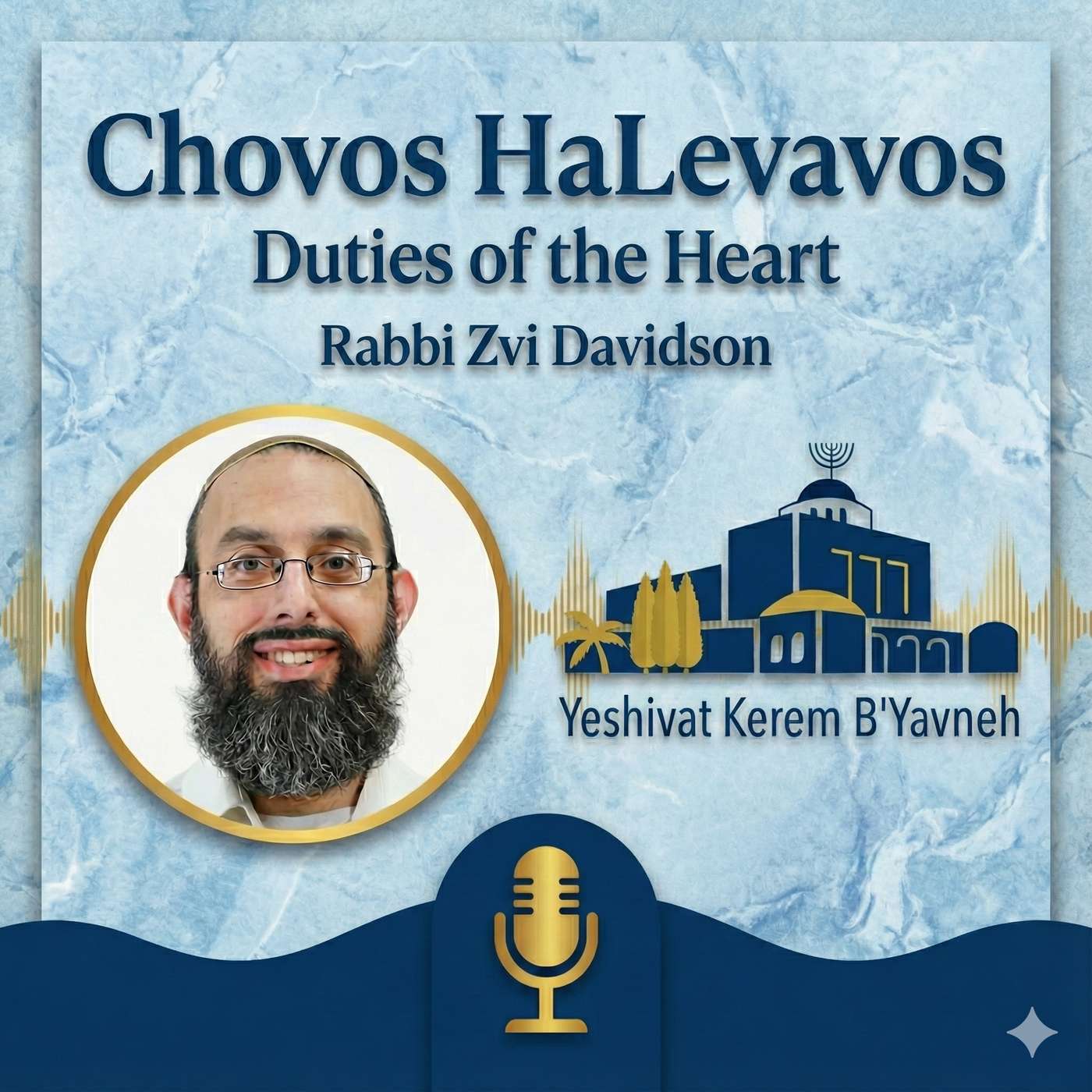
Chovos HaLevavos | Rabbi Zvi Davidson (Yeshivat Kerem B'Yavneh)
by Yeshivat Kerem B'Yavneh
Shiurim by Rav Davidson in KBY.Enjoyed? Your feedback means a lot to us. Click here to email us: https://tinyurl.com/thanksENDonations: https://www.kby.org/english/support-us/?id=46
-
48
Big Question on Earth, Simple Answer in Heaven
AI-Generated Summary (AI can be inaccurate. Check important information): 1. Divine compassion in labor — Hashem mercifully occupied man with physical work to prevent him from pursuing unnecessary or harmful distractions. 2. Preventing sinful idleness — The exertion required for parnassa (livelihood) serves as a kosher outlet for physical energy, fulfilling the principle that yegiat shneihem meshachachat avon (toil in both Torah and work makes one forget sin). 3. Balanced mental tranquility — A person needs menuchat hanefesh (tranquility of the soul) to pursue spirituality, but too much free time leads to inappropriate desires and irrelevant philosophical inquiries. 4. Irrelevant inquiries discouraged — Hashem made life demanding so that man would not waste his limited intellectual capacity on things like what preceded the world's creation, which have no nafka mina (practical difference). 5. Practical vs. theoretical — While learning hilcheta d’meshicha (laws of the Messianic era) is valuable as it demonstrates longing for the Beit HaMikdash, purely abstract philosophy that does not lead to yirat shamayim (fear of Heaven) is a waste of time. 6. Exemption for the dedicated — A person who is completely "locked in" to avodat Hashem and has mastered his middot (character traits) may be released by Hashem from the grueling toil of livelihood. 7. Higher level of Hashgacha — Those fully dedicated to Torah merit a special level of hashgacha pratit (divine providence), whereas turning toward work for unnecessary comfort may shift one into the realm of hashgacha klalit (general providence). 8. The sign-off principle — Just as a student teacher who naturally masters the classroom is "signed off" from their staj (internship), a person who has already achieved the spiritual goals of the "test of work" no longer requires the struggle. 9. Mystery of the suffering Tzaddik — The reason why some tzaddikim suffer while reshaim (wicked) prosper is not a single answer, but a personalized calculation known only to Hashem. 10. Questions without worldly answers — Many "bomba" kashas (difficult questions) about life's unfairness are based on a limited "map" of reality; in the next world, these questions simply dissipate as the full picture is revealed. 11. The Ramban’s student — A famous story illustrates that what seems like a tragic question on earth becomes a non-issue once the soul experiences the clarity of the olam ha’emet (world of truth). 12. Perfect Divine Justice — We must trust that Hatzur tamim poalo (the Rock, His work is perfect), recognizing that every hardship is part of a precise and logical plan.
-
47
Earning Kosher Money
AI-Generated Summary (AI can be inaccurate. Check important information): 1. Developing the Soul — The primary goal of life is not mere physical survival or comfort, but the spiritual elevation of man through constant avodah. 2. Purpose of Trials — HaKadosh Baruch Hu orchestrated the challenges of parnassah to serve as tests of loyalty and character. 3. Divine Strength Provided — A person is never placed in a difficult environment, such as a business trip, without being granted the inner strength to maintain their kedushah. 4. Halachic Financial Boundaries — True parnassah can only be earned through the permitted channels of halacha, specifically Choshen Mishpat; money gained dishonestly was never destined for the individual. 5. Blessing of Connection — The concept of birkas Hashem refers primarily to a spiritual closeness to the Creator and seeing success in one's chinuch and learning, rather than just a bank balance. 6. Maintaining Emunah in Loss — If a person loses money due to keeping Shabbos or being honest, that money was never theirs to keep; the kirvas Hashem gained is the true profit. 7. Tzedakah as a Built-in Obligation — Resources given to tzedakah or ma'aser are part of the Divine plan for a person's funds and will not result in a net lack of what they truly need. 8. Dependency Breeds Connection — Physical needs and hunger are designed to make us feel chaser, forcing us to turn to Hashem and develop a constant relationship with Him. 9. Curse of Autonomy — Providing for the snake's needs through afar was a curse because it removed the snake’s need to ever speak to or depend on Hashem. 10. Activity Prevents Sin — Labor and engagement with the physical world (derech eretz) are necessary to prevent the boredom and stagnation that lead to aveiros. 11. Practical Torah — For Torah to endure, it must be combined with a sense of productivity and application in the real world, as theoretical study alone may not suffice to guard against temptation. 12. The "Call-in" System — Hashem prefers that we "call in" regularly for our needs rather than receiving an automatic "direct deposit," because the resulting kesher is the entire point.
-
46
Life is a Process, Don't Be Afraid
AI-Generated Summary (AI can be inaccurate. Check important information): 1. Dual causality — Every event in the world results from two factors: the Divine decree and the natural means (emtza'im) sent to execute it. 2. Hidden Divine will — We often only recognize hashgacha pratis (Divine providence) when things go our way, but true faith recognizes that even when plans fail, it is "what Hashem wants." 3. Levels of causality — Divine tools range from direct "first causes" (gorem rishon) to complex, multi-stage processes involving many intermediate factors (beinayim). 4. Plan B is also God's will — Using the example of the Nuns in the Torah, we see that when "Plan A" (direct entry to the land) failed, the forty-year desert trek was no less a part of the Divine plan. 5. From One to Seventy — Moshe Rabbeinu's struggle with the seventy elders represents the shift from seeing Hashem's oneness directly to seeing His light filtered through a complex process (hishtalshelut). 6. The World of Process — We live in a reality where needs are met through many steps (like the 39 melachot of food), which tests whether we can still see Hashem behind the complexity. 7. The Goal of Testing — Hashem made man needy not as a "bug" in the system, but as a deliberate "feature" to test our loyalty through the struggle for parnassa. 8. Internalizing the Test — A test (mivchan) is not just to prove knowledge to Hashem, but to build internal strength and achieve kirvat Hashem (closeness to God). 9. Bitachon vs. Circumstance — True bitachon (trust) is proven in poverty or failure, as seen in the story of Moshe Reichman, who viewed losing his fortune as a chance to grow. 10. Sanctity within the process — The test of the world is whether we pursue our needs while remaining loyal to the halacha, such as observing Shabbat despite financial pressure.
-
45
What Will You Sacrifice for Hashem?
AI-Generated Summary (AI can be inaccurate. Check important information): 1. Reciprocal relationship required — True bitachon necessitates a commitment to halacha, as one cannot expect Divine assistance while actively disregarding the Creator's will. 2. Alignment of wills — By making Hashem's will our own, we invite Him to align His actions with our needs, as taught in the Mishnah (Avot 2:4). 3. The Hashgacha spectrum — Divine providence ranges from hashgacha klalit (general laws of nature) to hashgacha pratit (intimate, individual care) based on one's level of trust and closeness. 4. Authentic faith vs. flattery — Trusting only when in need while living a "double life" is described as the way of a chaneph (hypocrite) and is ineffective in securing salvation. 5. Sacrifice for salvation — Receiving a yeshua often requires a personal kabbala (resolution) or sacrifice in one's religious practice to create a "vessel" for the blessing. 6. Active belief in redemption — Historical examples, such as the exodus from Mitzrayim, show that only those who actively believe in and desire the geulah merit participating in it. 7. Trust and Action — The pasuk "Trust in Hashem and do good" (Tehillim 37:3) teaches that bitachon is inseparable from proactive avodat Hashem. 8. Individual mission focus — Under hashgacha pratit, a person becomes a "minister" in Hashem's plan, where life events are precisely tailored to their spiritual mission.
-
44
You Plan, Hashem Plans Better
AI-Generated Summary (AI can be inaccurate. Check important information): 1. Exclusive reliance on God — True bitachon requires trusting in Hashem alone and not partnering Him with any human agents or natural forces. 2. Human agents as messengers — Doctors, armies, and employers are merely shlichim (messengers) and conduits for Hashem's blessing, rather than independent powers. 3. Danger of dual trust — Trusting in both Hashem and a human force simultaneously diminishes one's faith, as it suggests God requires "help" to succeed. 4. Necessary effort (Hishtadlut) — While we must take action in the physical world, these actions are intended to activate the shefa (divine flow) that Hashem desires to give. 5. Prayer during action — Engaging in hishtadlut, such as taking medicine, must be accompanied by recognizing Hashem as the true healer (the Rofe Chinam). 6. Avoiding rigid outcomes — We must not "lock" Hashem into a specific result or plan; true trust means accepting that God knows the best path to our goals. 7. Identity of inner values — Focus your prayers on the underlying value or mission you wish to achieve, rather than a specific house, job, or spouse. 8. Mutual but independent obligation — Our commitment to Hashem's service is absolute and should remain steadfast regardless of our current circumstances. 9. Reciprocity in relationship — While we serve Hashem unconditionally, a wholehearted relationship involves us doing our part and trusting He is doing His. 10. The long-term perspective — Apparent setbacks, like the story of the bicycle puncture after learning, are often viewed differently when seen through the lens of eternity.
-
43
Vision for the Future
AI-Generated Summary (AI can be inaccurate. Check important information): 1. Illusion of causality — One must realize that immediate causes are merely tools; focusing on them is like a dog biting the stick instead of recognizing the man holding it. 2. Weakness of means — Natural factors are inherently weak and lack the power to effect change; all outcomes result solely from the gezeirah (decree) of the Creator. 3. The wheat's miracle — The fact that a single seed produces thousands of grains proves that nature is merely a vehicle for a Divine plan beyond simple logic. 4. Purified effort only — Human hishtadlut (effort) should be limited to what is necessary; exceeding this without a holy purpose suggests a lack of trust in Hashem. 5. Two roots of worry — Excessive labor stems from either doubting Hashem's constant awareness or failing to believe that His providence is always for our good. 6. Wealth as a means — Being wealthy is not a goal in itself; it is only valuable if used to increase Torah, mitzvot, and avodat Hashem. 7. Intergenerational vision — True bracha in a family often comes from living a balanced or average lifestyle rather than one defined by excessive luxury. 8. Trust the experts — Just as one provides funds without dictating to a Rosh Yeshiva, we must provide our effort while leaving the "management" of the world to Hashem. 9. Divine perspective — Life's events, from war to peace, follow a plan we cannot yet grasp; like a child learning complex formulas, we will only understand the "math" later. 10. The open line — Hashem is constantly "on the line," hearing our innermost thoughts; we must strive for tocho kevaro (internal and external consistency). 11. Internalizing Bitachon — Authentic bitachon (trust) is not a verbal declaration but a deep internal state that matches one's speech. 12. Authentic forgiveness — Just as a Tzaddik ensures his heart matches his words of forgiveness, our trust in Hashem must be a true reflection of our inner reality.
-
42
Sphere of Influence
AI-Generated Summary (AI can be inaccurate. Check important information): 1. Divine boundaries — Every creation and event in the world has a specific gvul (limit) regarding its quantity, quality, time, and place. 2. Sphere of influence — While we have free will, our ability to affect change is restricted to a specific arena defined by Hakadosh Baruch Hu. 3. Internalizing calm — Understanding that others cannot exceed the power granted by Hashem allows a person to remain calm and avoid frustration. 4. Master plan — Free choice exists, but it operates within a "Master Champion's" game plan where the ultimate outcome is guaranteed. 5. Precise timing — Events like shidduchim or historical movements only come to fruition at the exact moment decreed in Shamayim. 6. No misplaced anger — People are often merely "actors" or pawns fulfilling a role in a larger timeline directed by Hashem. 7. Appropriate effort — We must put in hishtadlut (effort) without claiming to know Hashem's specific plan before the result is clear. 8. Historical shifts — The failure of great people in previous eras, such as the Ba'alei Tosafot or Ramban, was often a matter of timing, not worthiness. 9. Revelations of wisdom — Scientific discoveries and Torah insights descend into the world only when the specific ha'arah (illumination) is permitted. 10. Testing the waters — Since we don't know the decree, we must constantly try; successes serve as a siman (sign) of Divine favor.
-
41
Constant Connection
AI-Generated Summary (AI can be inaccurate. Check important information): 1. Divine accessibility — We must avoid equating Hashem with human leaders; while a Rebbi might find small requests beneath him, nothing is too petty or "small" for the Creator. 2. Infinite care — Based on the Chazon Ish in Emunah u-Bitachon, even a snapped shoelace is worth a tefillah, as there is nothing beneath the honor of Ha-Kadosh Baruch Hu. 3. Sharing personal mundane — Following the Ohr HaChaim Hakadosh, sharing personal, everyday details—even those Hashem already knows—is the mechanism for building a deep, felt relationship and nochachus (presence). 4. Relief from social pressure — Realizing that all people are merely shlichim (messengers) and pawns in Hashem's hand frees a person from the need to immorally "find favor" in the eyes of human bosses. 5. Fearless Kiddush Hashem — As demonstrated by the story of Rabbi Yaakov Herzog, one who knows that only Hashem grants benefit or harm will not be intimidated by powerful antisemites or social repercussions. 6. Unconditional love — The choice of Avraham Avinu in the Torah appears without prior merit to teach that Hashem's love is a nedavah (gift) not dependent on our behavior or His needs. 7. Trust beyond merit — A Jew can always have bitachon because Hashem's kindness is eternal and irrational; even if we feel unworthy, His chesed remains constant.
-
40
Ultimate Trust
AI-Generated Summary (AI can be inaccurate. Check important information): 1. The Designer's knowledge — As the Creator of humanity, HaKadosh Baruch Hu understands our nature and needs far better than we understand ourselves. 2. Beyond "Mario" perspective — We navigate life like a player in a game who doesn't see the full map, while Hashem is the "Programmer" who knows exactly where every challenge and opportunity is placed. 3. Guidance through Halacha — When facing major life decisions, the halacha serves as a direct communication of Hashem's will, ensuring we are on the most beneficial path. 4. Internalizing rebuke — Difficulties in life should be viewed not as a rejection from Hashem, but as the loving rebuke of a father who is deeply engaged with His child. 5. The need for security — Humans have an innate psychological need for security (bitachon), which can lead people to mistakenly trust even their captors or abusers if no better alternative is perceived. 6. Stockholm Syndrome insight — The phenomenon where hostages align with their captors stems from the desperate need to trust the only power currently controlling their survival. 7. The IDF contrast — Unlike those who fall into Stockholm Syndrome, the hostages in Aza did not need to trust their captors because they knew the IDF and the Jewish people were standing behind them. 8. Ultimate Power — The third condition of bitachon is recognizing that Hashem is stronger than all powers, and His decrees cannot be nullified by any human being. 9. Creation from nothing — While human "creators" only reshape existing materials, Hashem created both matter and form yesh me'ayin (from nothing), making Him the only truly reliable source of trust. 10. Responsibility in decisions — True emunat chachamim involves using the Torah's guidelines to think through decisions responsibly, rather than outsourcing all personal responsibility to mystical figures.
-
39
Broadening Your Vision
AI-Generated Summary (AI can be inaccurate. Check important information): 1. Broadening spiritual vision — Real bitachon requires looking beyond personal convenience to see the vastness of Hashgacha Pratis (Divine Providence) acting upon the entire world and the Jewish nation. 2. National vs. Personal miracles — While personal stories of finding lost items are valid, recognizing the supernatural survival and flourishing of Am Yisrael is a higher level of Kiddush Hashem. 3. The "Coach" perspective — Challenges are not necessarily punishments; like a sports coach, Hashem pushes us through hardships because he knows that "no pain, no gain" leads to our greatest growth. 4. Growth over comfort — True "good" is not defined by ease or air-conditioned limousines, but by the accomplishment of overcoming the hurdles Hashem places in our path. 5. Esther's personal tragedy — The story of Esther Hamalka teaches that an individual may experience personal hardship for the sake of a greater national salvation, which is also a form of Divine benefit. 6. No room for complaining — A true ma'amin (believer) praises Hashem for both the "cup of salvations" and the "trouble and sorrow," knowing both stem from the same loving Source. 7. The Source of all love — Every ounce of compassion or love we feel from a human being is actually a direct expression of Hashem's love channeled through them. 8. Seven conditions of trust — Practical bitachon is built on internalizing that only the Creator possesses the seven essential traits (mercy, power, wisdom, etc.) required to be a worthy object of trust. 9. Reliving love as a tool — To tangibly feel Hashem’s love, one can identify a moment of deep human love they experienced and recognize Hashem as the ultimate source of that feeling. 10. Reframing life events — Once a person realizes Hashem loves them more than any human can, they can re-interpret even "bad" events as purposeful acts of a loving Father.
-
38
Learning From the Pain
AI-Generated Summary (AI can be inaccurate. Check important information): 1. Seven Pillars of Trust — While humans may possess the first few qualities necessary for trust, only Hakadosh Baruch Hu possesses all seven perfectly and eternally. 2. Divine Love (Chesed) — Trust begins with knowing the Creator loves us with an ahava she'eina teluya badavar (unconditional love) and always "has our back." 3. Eternal Watchfulness — Unlike humans, the Shomer Yisrael (Guardian of Israel) never sleeps or slumbers, ensuring He never ignores or abandons His creations. 4. Infinite Wisdom — True bitachon requires acknowledging that Hashem is the Chacham (Wise One) who knows what is truly for our benefit better than we do. 5. Absolute Sovereignty — No human power can defeat or stand against the Will of the Almighty, as He is the ultimate Gibor (Mighty One). 6. Cradle to Grave — Divine providence accompanies a person from the womb until the end of life, a consistency no human parent or benefactor can provide. 7. Human Limitations — Earthly power is fleeting; even the wealthiest or most influential person can die or change their mind, whereas Hashem is eternal. 8. Message over Malice — When facing opposition, a person with bitachon sees the antagonist as a shaliach (messenger) of Hashem meant to spark personal growth. 9. Growth without Victimhood — Recognizing Divine orchestration allows one to move from a "victim mindset" to a "growth mindset," asking "What is the message for me?" 10. Justice vs. Anger — One can pursue legal justice or protect themselves from harm without feeling personal hatred or agitation, realizing the event was Divinely ordained.
-
37
Hashem Got Your Back
AI-Generated Summary (AI can be inaccurate. Check important information): 1. Life-long guidance — True trust requires a provider who has been with you from conception through old age, ensuring constant care at every stage of development. 2. Beyond location friends — Unlike human friends who are often limited by time or place ("location friends"), the object of true bitachon must be present in every situation. 3. Exclusive power source — Total reliance is only possible on one who possesses absolute control, where no other human can ultimately help or harm without their decree. 4. Unconditional love (Ahava she'eina tluyah bedavar) — The most essential factor for trust is knowing the provider's kindness is constant, extending even to those who may be unworthy. 5. Hearing the Father's Voice — Suffering is bearable when we recognize it comes from a loving Father; without that connection, the same "words" of life's difficulties become overwhelming. 6. Attachment and stability — Emotional health and bitachon are deeply linked to a sense of belonging ("Makom"); feeling you have a place in God's world is the foundation of faith. 7. Parental responsibility in Chinuch — Parents serve as the primary model for God; by showing unconditional love alongside discipline, they teach children how to relate to Hashem. 8. Correcting the lens — Many struggles with emunah are actually projections of past trauma; healing involves cleaning the "lens" through which we view Hashem's providence.
-
36
Someone You Can Trust
AI-Generated Summary (AI can be inaccurate. Check important information): 1. Faith before trust — True bitachon (trust) can only be built upon a foundation of emunah (faith), which is the theoretical belief that Hashem is involved and all-powerful. 2. Action versus theory — While emunah is the intellectual grasp of faith, bitachon is the practical application that brings calm when facing challenges in parnassah (livelihood) or health. 3. The 'Universe' fallacy — Modern trends like the "Happiness Index" or books claiming "The Universe Has Your Back" reflect a deep human need for bitachon that is being misdirected away from Hashem. 4. Love and compassion — The first condition for trust is ahava v'chemla (love and compassion); you must believe the one you trust truly cares for your well-being. 5. Proactive execution — Trust requires a guardian who is not lazy or distracted, but rather someone who actively strives to fulfill your needs through hishtadlus (effort). 6. Willpower and ability — A person might love you but lack the kochos (strengths) or resources to help; total trust requires a being with the absolute ability to execute their will. 7. True benefit — For trust to be complete, the guardian must know what is emhet (truthfully) good for you, rather than just what appears good on the surface. 8. Personalized guidance — True trust is only possible with someone who understands your unique soul and potential, rather than someone who offers generic advice with an external agenda.
-
35
Seeing the Bigger Picture
AI-Generated Summary (AI can be inaccurate. Check important information): 1. Peace of mind through trust — The essence of bitachon is menuchat hanefesh, a deep inner tranquility that comes from relying on Hashem to do what is best. 2. Divine benevolence over self-interest — Realizing that Hashem cares for our needs and chooses what is truly beneficial for us far better than we could ever choose for ourselves. 3. Broadening the perspective — Suffering often stems from a narrow, self-centered view (prat); broadening one's perspective to the collective (klal) or a longer timeline reveals the hidden good. 4. Humility in the face of mystery — True bitachon requires the humility to acknowledge that Hashem has an "advanced calculus" beyond human understanding, and we shouldn't expect to grasp every event. 5. The dentist analogy — Just as a mother lovingly holds her child down in a dentist's chair for their long-term health, Hakadosh Baruch Hu sometimes puts us through pain for our ultimate benefit. 6. Faith vs. Trust — While emunah is the theoretical study of Hashem's providence, bitachon is the practical application and emotional calm manifested in daily life and business. 7. Trust as a human faculty — Everyone has the capacity for trust; the spiritual work lies in redirecting that innate koach from transitory things like money or power toward the Borei Olam. 8. Three conditions for trust — For trust to be valid, the subject must possess three qualities: complete knowledge of the situation, the power to act (kol yachol), and the desire to help. 9. The security guard parable — Trust fails if a guard is malicious (lacks will), weak (lacks ability), or blind (lacks knowledge); only Hashem perfectly fulfills all three criteria. 10. The track record of love — Trust is built on recognizing Hashem's past kindness; knowing He loves us allows us to accept current challenges as "coaching" for our personal growth.
-
34
Being Rooted, Not Letting the Wind Blow You Away
AI-Generated Summary (AI can be inaccurate. Check important information): 1. Inner peace and joy — Trusting in Hakadosh Baruch Hu brings menuchat halev, a heart at rest from worldly anxieties and constant physical desires. 2. Resilience through preparation — Developing bitachon before challenges arise allows one to handle life's difficulties with composure, like a person warned of a prank ahead of time. 3. Deep-rooted stability — A baal bitachon is compared to a tree planted by water (Yirmiyahu 17:8); even in a heatwave or a year of drought, its leaves remain fresh. 4. Emotional independence — One who relies on Hashem is not linked to external "currencies" or arbitrary factors like the stock market or sports results for their happiness. 5. Halachic grounding — Being "connected to the ground" (rooted in faith) prevents one from being mekabel tumah, symbolizing a spiritual permanence that isn't easily shaken by impurity. 6. Travel with purpose — Trust in Hashem saves one from panicky, aimless wandering in search of parnassah, allowing for a calm and focused life. 7. Integrity in business — A person with bitachon maintains yashrus (uprightness) and never sacrifices halacha for financial gain, knowing that success comes only from Hashem. 8. Rejecting rationalizations — One must avoid the ruach shtus (spirit of folly) that suggests one can "bribe" Hashem with tzedakah to excuse dishonest business practices. 9. Strategic career choices — Choosing a profession should be based on what allows for the fulfillment of Torah obligations and menuchat hanefesh, rather than just status or maximum wealth. 10. The Twenty-Year Plan — Inspired by Dr. Tuvia Meister, a person should plan their life and career around the goal of becoming a true talmid chacham over the long term. 11. Primary vs. Secondary — A Jew must view their parnassah as a necessary hishtadlus (effort) that is secondary to their primary life mission of avodat Hashem. 12. Divine decree — Since one's income is already decreed from Shamayim, excessive toil or compromising values will not increase what is ultimately destined for them.
-
33
Being Hashem's Banker
AI-Generated Summary (AI can be inaccurate. Check important information): 1. Wealth as a test — While poverty is a physical struggle, wealth is a spiritual challenge (nisayon) of the soul (nefesh). 2. Money as a deposit — A person with bitachon (trust in God) views their wealth as a pikadon (deposit) from Hashem, not a personal possession. 3. Identity vs. Externalities — One must never define their self-worth or identity by their money; doing so makes one fragile and prone to crisis. 4. Resisting spiritual rebellion — Success often leads to be'itah (rebelling or kicking), where an individual forgets their dependence on Hashem. 5. Altruism without debt — Giving to others should be seen as fulfilling a duty to the Creator, not as creating a personal debt for the recipient. 6. Publicizing achievements correctly — Sharing spiritual successes like a siyum (completion of a tractate) is vital if it inspires others to learn. 7. Acceptance of loss — When money is lost, a person of faith thanks Hashem for the time it was in their possession rather than falling into despair. 8. Avoiding petty comparisons — Finding comfort in the fact that others also suffered losses is a sign of a lack of bitachon.
-
32
Making Money to Live, Not Living to Make Money
AI-Generated Summary (AI can be inaccurate. Check important information): 1. Effort vs. Source — Realize that hishtadlut (personal effort) is merely a trigger, while HaKadosh Baruch Hu remains the true source of all parnassah. 2. The Forge Analogy — Working without bitachon is compared to an alchemist trying to turn copper into gold; it is a deception if one believes their own hands create the wealth. 3. Triggering the Flow — Put in the necessary hishtadlut in one direction, and Hashem may choose to send the shefa from an entirely unexpected source. 4. Internal Transformation — True trust must move from the potential to the actual (mehakoach el hapoel), becoming a visible part of a person's character. 5. Universal Influence — Growing in bitachon makes a person a source of blessing for their entire community, much like Lot saved the city of Tzoar. 6. Wealth as Mission — View wealth not as ownership but as a shlichut (mission) from Hashem to serve Klal Yisrael and fulfill the Divine will. 7. Freedom in Simplicity — Recognize that having less can be a blessing, as it frees a person from the heavy obligations and da'aga (worry) that come with managing property. 8. The Chofetz Chaim's Choice — Choose life values over luxury; the Chofetz Chaim famously opted for a simple life to ensure his Torah learning remained undisturbed. 9. Fragmented Soul Danger — Avoid pizur hanefesh (fragmentation of the soul), where a person's energy and identity are scattered across too many material concerns. 10. Integrated Identity — Strive for an integrated self where every role—father, worker, student—is simply a different external expression of the same internal Eved Hashem. 11. Ideal Sufficiency — Understand that the ideal financial state is having exactly what one needs to fulfill their specific role, as more leads to unnecessary anxiety. 12. Peaceful Sleep — Prioritize the "sweet sleep of the worker" over the restless nights of the rich who are consumed by their many possessions and investments.
-
31
Having the Right Priorities
AI-Generated Summary (AI can be inaccurate. Check important information): 1. Accessibility of wealth — A person relying on their own finances may possess great wealth but find it inaccessible or useless in times of crisis, travel, or famine. 2. Boundless divine providence — One who trusts in Hashem is never lacking, as they are not limited to a specific "system" or business model for their sustenance. 3. Calmness vs. breakdown — True bitachon prevents a nervous breakdown when a source of income disappears, because the believer knows Hashem can provide through any channel. 4. Freedom of place — Unlike a businessman who must constantly move to protect secrets or chase markets, the boteiach can settle in a community that serves his spiritual needs. 5. Prioritizing the spiritual — When choosing a place to live, a person with bitachon prioritizes his family’s education and his own Torah environment over higher-paying job opportunities. 6. Integration of values — Success in life is measured by how one's work serves their higher purpose of avodat Hashem, preventing the "midlife crisis" of those who work solely for money. 7. The reward follows — While physical wealth remains in this world after death, the merit and relationship built through bitachon accompany a person into Olam Ha-Ba. 8. Prayer as business — One’s most effective "business move" is tefillah, acknowledging that success is entirely dependent on Hashem rather than personal effort. 9. The power of helplessness — Turning to Hashem in moments of total speechlessness or lack of preparation (using Hashem sefasai tiftach) can lead to success beyond one's natural abilities.
-
30
Spiritual Force Field
AI-Generated Summary (AI can be inaccurate. Check important information): 1. Freedom from anxiety — While the professional is plagued by the fear of overproduction or sudden shortages, the boteach (one who trusts) remains calm, making logical decisions without emotional stress. 2. Divine sustenance in infancy — Trust in Hashem is rooted in the reality that He provides for those who cannot help themselves, such as a fetus in the womb or a chick within an egg. 3. Internalized prosperity — The verse "those who seek Hashem shall not lack any good" (Tehillim 34:11) means that even in physical poverty, the seeker does not perceive their situation as "bad," because they are connected to the Source of Good. 4. Resilience against abandonment — A tzaddik (righteous person) is never "forsaken," meaning they never feel ignored by the Creator, even when facing extreme hardship or starvation. 5. Activating spiritual protection — Trusting in Hashem creates a spiritual "force field"; Hashem relates to us middah kineged middah (measure for measure) based on the level of our reliance on Him. 6. Confidence deters harm — Much like a bully is deterred by a confident person, negative spiritual and physical forces are less able to "attach" themselves to one who possesses firm bitachon. 7. Religious interpretation of suffering — When illness or setbacks occur, the person with bitachon avoids frustration by viewing the challenge as kaparat avonot (atonement) or an opportunity for eternal reward.
-
29
Trust in Hashem, Stress Free Life
AI-Generated Summary (AI can be inaccurate. Check important information): 1. Internalizing Hishtavut (Equanimity) — True bitachon means viewing all outcomes as equal, realizing that perceived "bad" events are ultimately for one's benefit. 2. Stress-free Hishtadlut — While a person must still perform hishtadlut (effort), the botayach (truster) works with menuchat hanefesh (peace of mind) rather than anxiety. 3. Safety and Divine Protection — One who trusts in Hashem is shielded from the constant fear of occupational hazards, knowing that harm only occurs if it is the Divine will. 4. Eliminating Professional Jealousy — A person with bitachon does not fear competitors or "secrets of the trade" because he knows his parnassah (livelihood) is predetermined by Heaven. 5. Helping Others Succeed — Like the story of the printing press in Bnei Brak, a botayach can actively assist his competitors, knowing no man can touch what is destined for another. 6. Accepting Divine Signs — Financial setbacks are often a siman (sign) from Heaven to take a new path, and accepting this with faith leads to greater ultimate success. 7. Sincere Emunah Temimah — Miraculous outcomes result from simple, pure faith (emuna temima) and doing chesed for its own sake, not from performing actions as a "transaction" for reward. 8. Managing Inventory with Faith — The botayach avoids the constant panic regarding supply and demand, trusting that the results of his business decisions are in Hashem's hands.
-
28
Money Comes and Goes But Faith Lasts Forever
AI-Generated Summary (AI can be inaccurate. Check important information): 1. Mindset of trust — Practical bitachon means that when the mind wanders during idle moments, it naturally returns to thoughts of avodat Hashem rather than worldly anxieties. 2. Authentic vs. temporary peace — While a professional might feel calm because of their skills, only the boteach (one who trusts) possesses a peace that is independent of external circumstances. 3. The danger of external reliance — Relying on skills, tools, or market conditions is precarious; if the external factor fails or the "machinery" is lost, the person's internal world collapses. 4. Adaptability and flexibility — A true ba’al bitachon can adapt to any situation, such as transitioning from wealth to poverty, because their connection to Hakadosh Baruch Hu is the unchanging ruach (spirit). 5. Deeper Emunah — Real emunah is not just believing "everything will be fine" by our own definition, but accepting that the current moment is exactly what Hashem wants. 6. Divine provision everywhere — The lesson of the man (manna) teaches us that parnassah is not limited to specific means; Hashem can provide through any medium at any time. 7. Regret-free living — At the end of life, people rarely regret lack of financial success; they regret not living according to their values, a trap avoided by those who prioritize bitachon. 8. Generosity through trust — True bitachon allows a person to be happy for others' success and even encourage competition, knowing that one person's parnassah never touches what is designated for another.
-
27
Your Money Comes from Hashem, Not Others
AI-Generated Summary (AI can be inaccurate. Check important information): 1. Wealth as a barrier — If material success leads to self-reliance instead of bitachon, it can become a barrier to our relationship with Hashem. 2. Enjoyment requires Divine permission — Even if a person possesses great wealth, they cannot truly benefit from it unless Hashem grants them the ‘peace of mind’ to do so. 3. Health is a gift — We must recognize that our physical well-being is a constant, moment-to-moment gift from Hashem, rather than just a result of our own efforts. 4. Freedom from people — True bitachon liberates a person from the need to flatter or rely on others, allowing one to live with total integrity and emes. 5. Financial independence and leadership — Maintaining independence from those we serve, such as a community or family, ensures our spiritual decisions remain pure and unbought. 6. Concentration in Avodah — Trusting Hashem with our future allows us to quiet distracting thoughts during tefillah and learning, knowing that He has everything under control. 7. The poor mindset — A person without bitachon might remain mentally 'poor' and anxious even while wealthy, while a person with trust remains 'rich' in spirit.
-
26
Arrogance Causes Anguish
AI-Generated Summary (AI can be inaccurate. Check important information): 1. Universal trust requirement — A human being is never truly independent of trust; the choice is only whether to place that bitachon in Hashem or in something else. 2. Removal of providence — When one trusts in their own wisdom or wealth, Hashem may remove His hashgacha (providence) to clear the "barrier" preventing a direct relationship with Him. 3. Bar Kochva's lesson — History teaches that even the strongest leaders fall when they claim they don't need divine assistance, as seen in the Midrash regarding Bar Kochva. 4. Gratitude preserves blessings — Acknowledging that success is a gift from Hashem creates nachas ruach (divine satisfaction) and encourages the continuation of those blessings. 5. National recognition — On a national level, recognizing miracles like Kibbutz Galuyot (the ingathering of exiles) is a basic obligation that brings the Moshiach closer. 6. Misplaced arrogance — Relying solely on hishtadlus (effort) without prayer often leads to failure, as Hashem desires us to turn to Him in all endeavors.
-
25
Be Lazy(In the Right Context)
AI-Generated Summary (AI can be inaccurate. Check important information): 1. *Strategic procrastination* — Delaying an *aveirah* by even five minutes is a significant success and demonstrates that one is the master over their *yeitzer hara*. 2. *Harnessing laziness* — The trait of *atzlut* (laziness) should be redirected toward physical desires (*ta'avot habehemiyot*) and worldly vanities that ultimately lead to regret. 3. *Environment and preparation* — To overcome natural laziness in *avodas Hashem*, one should prepare *sefarim* or a *bentcher* ahead of time to minimize the physical effort required to perform the *mitzvah*. 4. *Zrizus vs. Behala* — True *zrizus* (alacrity) requires pausing to clarify the right path first; acting fast without thinking is merely *behala* (confusion/recklessness). 5. *The lesson of Chipazon* — On *Pesach*, the *chipazon* (haste) was possible only after a year of the *eser makos* had clarified the people’s *emuna*, teaching that swift action must follow intellectual clarity. 6. *Capturing the initial point* — One must act immediately upon a pure desire to do a *mitzvah* before the "ego" or "witchcraft" of secondary calculations (*cheshbonos*) can expand and corrupt the intent. 7. *The Chametz/Matzah distinction* — The tiny difference between the letters *ches* and *hay* represents the split second between a pure act of *matzah* and the "rising" ego of *chametz*. 8. *Divine assistance* — If a person demonstrates a sincere, honest desire to follow the *derech hayeshara* (straight path), *Hashem* in His mercy will assist them in reaching their spiritual goals.
-
24
Buying Everything You Need
AI-Generated Summary (AI can be inaccurate. Check important information): 1. *Calculated affection* — Showing *ahava* (love) is the general rule for every Jew, but one must withhold the outward expression of love when facing someone defiantly violating *halacha* to avoid validating their actions. 2. *Beyond the minimum* — Proper *nedivut* (generosity) means matching the standard you set for yourself; the *Chofetz Chaim* taught that if you buy luxury for yourself, you should not settle for the bare minimum when giving *tzedakah*. 3. *Parental stability* — Educators and parents should provide a sense of *shefa* (abundance) so children feel secure and view *Hashem* as an infinite provider, rather than feeling a constant lack due to financial stress. 4. *Value-based boundaries* — Using *kamtzanut* (stinginess/restriction) with children is necessary for discipline, but it should be based on values and logic rather than simply saying something is "too expensive." 5. *The "Tithing" of time* — Just as one gives *ma’aser* from money, *Rav Moshe Feinstein* is quoted as saying one should dedicate ten percent of their time to *kiruv* or teaching others *Torah*. 6. *Stewardship of resources* — One must view money and knowledge not as personal possessions, but as a *zekhut* (privilege) and a deposit from *Hashem* to be used for the benefit of others. 7. *The necessity of "Tough Love"* — *Kamtzanut* is required when dealing with those acting foolishly or destructively; being "too nice" can sometimes prevent a person from correcting their negative behavior.
-
23
Fighting Heritcs and Trusting Hashem's Plan
AI-Generated Summary (AI can be inaccurate. Check important information): 1. *Situational character application* — One must discern when to employ *anava* (humility) and when to utilize *ga'avah* (pride), as the holiness of a trait depends entirely on the context of the situation. 2. *Pride against heresy* — When facing *kofrim* (heretics) or those who disparage the Torah, it is a duty to use *ga'avah* and *gova ha-lev* (lofty heartedness) to ensure one does not appear to validate corrupt ideologies. 3. *Passive agreement risk* — Remaining silent or humble in the face of public attacks on Jewish values can inadvertently imply consent to the premise of the attacker, potentially allowing the *kefira* (heresy) to take root in one's own heart. 4. *Internal rejection techniques* — If one cannot safely or productively speak out against evil—such as when hearing it on the radio—one must at least perform an internal or symbolic act of rejection, like the *Chasidishe Rebbe* who would spit into a bucket to maintain his spiritual integrity. 5. *Proper targets of humility* — Humility is the correct response when interacting with a *tzaddik* (righteous person), a *chacham* (scholar), or anyone who has performed *chesed* (kindness) for you. 6. *Humility before Hashem* — True *anava* toward the Creator involves accepting *gezeirot* (Divine decrees) with love and *emunah pshuta* (simple faith), even when His ways transcend human understanding. 7. *The limits of logic* — Just as a citizen should not expect a government to reveal all military secrets, a person must realize that *Hashem* has "secrets"—depths of wisdom—that are simply beyond human comprehension. 8. *Sanctified hatred* — While the world often preaches universal love, the Torah teaches *Ohavai Hashem sin’u ra* (Those who love *Hashem* must hate evil), emphasizing that there is a time and place for *sinah* (hatred) toward those who embody cruelty and anti-Torah values.
-
22
Shalom Bies Fund
AI-Generated Summary (AI can be inaccurate. Check important information): 1. *The Middot Spectrum* — Human character traits, or *middot*, exist on a spectrum where neither extreme is healthy; the ideal is to remain adaptable and act appropriately based on the specific situation. 2. *Constructive Anger* — While generally discouraged, *ka’as* (anger) has a holy application when used to stand up for *emeth* (truth) and justice against those who promote falsehood. 3. *Productive Contentment* — Being easygoing, or *svirat haratzon*, is a virtue when it prevents petty arguments over honor or small amounts of money, but it becomes a vice if it leads to complacency in the face of evil. 4. *The Shalom Bayit Fund* — Setting aside a dedicated *kuppah* (fund) to cover financial losses that cause household friction can prevent *machloket* (dispute) and preserve peace between spouses and friends. 5. *Principled Leadership* — A true leader, following the example of *Rav Shlomo Aviner*, prioritizes *shalom* (peace) over Being "right" in monetary disputes, even paying out of pocket to end a conflict. 6. *Emotional Mastery* — As seen in the life of *Pinchas*, one must be capable of both fierce zealotry (*kana’ut*) and calm mediation (*gishur*) depending on what the moment requires for the sake of Heaven. 7. *Discerning Mercy* — True *rachmanut* (mercy) is directed toward the poor, the sick, and the brokenhearted, while "cruelty" (*achzariyut*) is sometimes necessary when dealing with the unrepentant or those whose addictions would only be fueled by misplaced kindness. 8. *Silent Support* — Drawing from the *halachot* of *Nichum Avelim* (comforting mourners), simply being present with someone in pain without speaking is often the most profound form of sensitivity.
-
21
Healthy Shame and Sticking with Halacha
AI-Generated Summary (AI can be inaccurate. Check important information): 1. *Neutrality of character* — Every *middah* (character trait) is essentially neutral; it is neither inherently good nor bad, but its value is determined by how one uses their *da’at* (intellect/wisdom) to apply it. 2. *Healthy vs. unhealthy shame* — Healthy *bushah* (shame) occurs when a person acknowledges their mistake and uses that feeling to draw closer to *Hashem* for *tikkun* (rectification), whereas unhealthy shame leads to self-loathing, despair, and distancing oneself from the Creator. 3. *Productive humility* — True humility is represented by the phrase *Elokai boshti* ("My G-d, I am ashamed"), where the embarrassment of sin results in an honest apology and an attempt to rebuild the relationship, much like a husband reconciling with his wife. 4. *Assertiveness for Truth* — The trait of *azut* (boldness or brazenness) is correct and necessary when one must rebuke the wicked, testify to the truth of the *Torah*, or encourage others to perform acts of *chesed* (kindness). 5. *Resisting social pressure* — A Jew must be *azei panim* (brazen-faced) in their commitment to *Halacha*, standing firm in their principles even when they are unpopular or socially awkward, which ultimately earns the respect of others. 6. *Defending the faith* — When faced with *apikorsus* (heresy) or misconceptions, one must be assertive and question the assumptions of the speaker to prevent a *chillul Hashem* (desecration of G-d's name). 7. *Overcoming natural disposition* — Whether a person is naturally a *bayshan* (shy person) or naturally assertive, they are required to develop the capacity for both traits and use them as the situation demands, regardless of their personality.
-
20
-
19
-
18
-
17
-
16
-
15
-
14
-
13
-
12
-
11
-
10
-
9
-
8
-
7
-
6
-
5
-
4
-
3
-
2
-
1
We're indexing this podcast's transcripts for the first time — this can take a minute or two. We'll show results as soon as they're ready.
No matches for "" in this podcast's transcripts.
No topics indexed yet for this podcast.
Loading reviews...
ABOUT THIS SHOW
Shiurim by Rav Davidson in KBY.Enjoyed? Your feedback means a lot to us. Click here to email us: https://tinyurl.com/thanksENDonations: https://www.kby.org/english/support-us/?id=46
HOSTED BY
Yeshivat Kerem B'Yavneh
CATEGORIES
Loading similar podcasts...
Frequently Asked Questions
How many episodes does Chovos HaLevavos | Rabbi Zvi Davidson (Yeshivat Kerem B'Yavneh) have?
Chovos HaLevavos | Rabbi Zvi Davidson (Yeshivat Kerem B'Yavneh) currently has 48 episodes available on PodParley. New episodes are automatically indexed when they're published to the podcast feed.
What is Chovos HaLevavos | Rabbi Zvi Davidson (Yeshivat Kerem B'Yavneh) about?
Shiurim by Rav Davidson in KBY.Enjoyed? Your feedback means a lot to us. Click here to email us: https://tinyurl.com/thanksENDonations: https://www.kby.org/english/support-us/?id=46
How often does Chovos HaLevavos | Rabbi Zvi Davidson (Yeshivat Kerem B'Yavneh) release new episodes?
Chovos HaLevavos | Rabbi Zvi Davidson (Yeshivat Kerem B'Yavneh) has 48 episodes. Check the episode list to see recent publication dates and frequency.
Where can I listen to Chovos HaLevavos | Rabbi Zvi Davidson (Yeshivat Kerem B'Yavneh)?
You can listen to Chovos HaLevavos | Rabbi Zvi Davidson (Yeshivat Kerem B'Yavneh) on PodParley by clicking any episode. We provide an embedded audio player for direct listening, and you can also subscribe via your preferred podcast app using the RSS feed.
Who hosts Chovos HaLevavos | Rabbi Zvi Davidson (Yeshivat Kerem B'Yavneh)?
Chovos HaLevavos | Rabbi Zvi Davidson (Yeshivat Kerem B'Yavneh) is created and hosted by Yeshivat Kerem B'Yavneh.
URL copied to clipboard!