
PODCAST · society
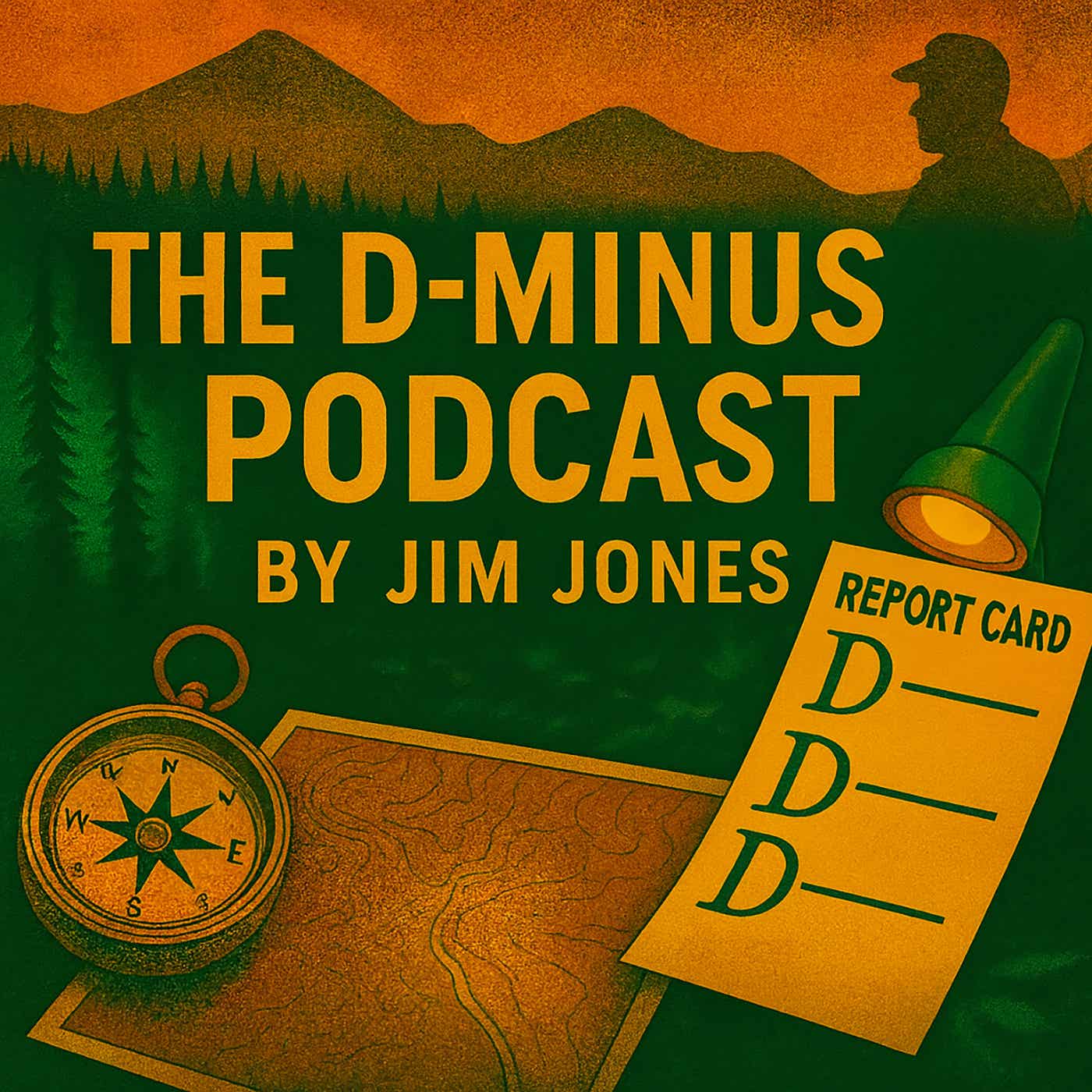
D-Minus Diaries Podcast
by Jim Jones Writes
Life changes one small step at a time. Sometimes we walk alone, sometimes with others, and sometimes we feel completely lost in a crowded room. But no matter where we stand, our stories matter — yours and mine. And somewhere between them is the truth we’re all trying to figure out.The D-Minus Diaries is a place for anyone learning, stumbling, rebuilding, or pushing forward when life refuses to give clear instructions. No topic is off limits.We talk about self-reliance, critical thinking, forgiveness, humor, failure, resilience, how politics shapes us, getting screwed over, and the life lessons that show up uninvited. Some stories are funny, some sting, and some remind us how thin the line is between chaos and clarity.I share experiences from an adopted kid in the Appalachian mountains with a D-minus average who went from bag boy to the Coast Guard, to Special Forces, to decades as a senior civil servant supporting America’s most elite units and its veterans.This podcast isn’t just
-
29
The Great Migration
D-Minus Diaries Episode 25: The Great Migration dives into why so many Americans are packing up and heading to Tennessee in search of lower taxes, greater freedom, and a different way of life. From Tennessee’s frontier roots and fierce independence to modern migration, politics, culture shock, and the growing tension between preserving tradition and managing explosive growth, this piece explores what happens when people flee one system only to risk rebuilding it somewhere new. If you’ve ever wondered why Tennessee is booming, and what newcomers should understand before arriving, this one’s for you. This is a public episode. If you would like to discuss this with other subscribers or get access to bonus episodes, visit dminusdiaries.substack.com
-
28
The Pew
In this D‑Minus Diary, I start in the back of an MH‑53 on a dark training night and end in an old church pew. Along the way, I look at stress, loss, childhood faith, and why sometimes being grounded is better than falling apart. This is a public episode. If you would like to discuss this with other subscribers or get access to bonus episodes, visit dminusdiaries.substack.com
-
27
Voting 2026 Style
As we approach the midterm elections, I use storytelling to show why elections matter and why they often feel confusing by design. Between primaries, media noise, and now AI-driven influence, most voters never get a clear picture of what’s really at stake. In this piece, I break down how the system works, why local races matter more than you think, and how to cut through the noise to understand who is really asking for power over your life. Because in the end, it all comes down to one vote… and whether you show up. This is a public episode. If you would like to discuss this with other subscribers or get access to bonus episodes, visit dminusdiaries.substack.com
-
26
Created in Our Image (Part 2)
What happens when the tools we create start to look, think, and act like us? In Part 2 of Created in Our Image, Jim Jones moves from a simple Appalachian conversation about distance into a much bigger question about identity, technology, and purpose. From the early days of robotics to today’s rapidly evolving AI, this piece explores the moment when machines stop being tools and start becoming reflections. As comfort increases and responsibility fades, we are left with a deeper question: are we building something to serve us, or something that may one day replace what makes us human? This is a public episode. If you would like to discuss this with other subscribers or get access to bonus episodes, visit dminusdiaries.substack.com
-
25
Created in Our Image (Part 1)
Created in Our Image (Part 1) by Jim Jones, D-Minus Diaries. What started as an argument about whether something was “over by” Krispy Kreme turned into something much bigger. Somewhere between donut shop directions and a simple AI question, my wife and I realized something has changed. We are no longer just using technology, we are starting to relate to it. We name it, we talk to it, and we trust it. And maybe, without even realizing it, we are beginning to replace something human with something easier. This is Part 1 of a series exploring where AI is today, how we got here, and why it already feels more real than most people think. Part 2 asks the harder question… what happens when it gets a body? If this makes you think, follow D-Minus Diaries. This is a public episode. If you would like to discuss this with other subscribers or get access to bonus episodes, visit dminusdiaries.substack.com
-
24
Other People’s Problems
Other people’s drama is costing you peace you can’t afford.In this D-Minus Diaries entry, I break down “Other People’s Problems,” how emotional fires start and spread, and why learning to say “not my problem” might be the most important survival skill you develop this year. This is a public episode. If you would like to discuss this with other subscribers or get access to bonus episodes, visit dminusdiaries.substack.com
-
23
The Walt Rule (Maxim Part III)
Regret doesn’t shout, it whispers. It sounds like “I’ll go next time,” “when things slow down,” or “maybe next year.” I learned the hard way that one day, the invitations stop. This is a story about a missed dive, a hard lesson, and the rule that changed how I live. Say yes… while you still can. This is a public episode. If you would like to discuss this with other subscribers or get access to bonus episodes, visit dminusdiaries.substack.com
-
22
From Eden to Tehran
From Eden to Tehran, I trace how ancient religious divides, oil, and Shia theocracy converge on one frontline: the bodies and lives of Iranian women and girls. If Epstein turns your stomach, wait until you see what’s written into Iran’s laws. This is a public episode. If you would like to discuss this with other subscribers or get access to bonus episodes, visit dminusdiaries.substack.com
-
21
Messy Democracy
“Messy Democracy” isn’t a typical D‑Minus story; it’s a rant about war, protests, and what we choose to be outraged about. From a fight behind a grocery store to Iran’s decades of “Death to America,” paid protest industries, AI‑polished outrage, and the quiet risk of fishermen and soldiers, this piece asks a hard question: in a world where others chant for our death, why are we screaming at the people who volunteered to stand between us and that reality? This is a public episode. If you would like to discuss this with other subscribers or get access to bonus episodes, visit dminusdiaries.substack.com
-
20
When Grief Feels Like Fear
In this D-Minus Diaries piece, I explore how grief and fear are often confused, and how that confusion shapes us mentally, spiritually, and physically. When loss or change hits, the body reacts before the mind understands. What feels like anxiety may actually be grief for what is shifting in our lives.Sometimes the tight chest, restless sleep, and unsettled thoughts are not signs of danger, but signs that something meaningful has changed.We do not get unlimited time. We get today. This is a public episode. If you would like to discuss this with other subscribers or get access to bonus episodes, visit dminusdiaries.substack.com
-
19
Part 3: For What It’s Worth
Part 3 of “For What It’s Worth” zooms in on the other side of the counter at Jim’s Donut Shop: wages. Jim is caught between rising minimums, benefit rules, and AI‑driven cost pressures, all of which quietly push donut prices higher while squeezing his payroll decisions. Through Worker A, Worker B, and returning characters Bob, Susie, and Larry, the episode shows how minimum wage can act as both floor and ceiling, how automation creeps in when human hours get expensive, and how Trump’s new “no tax on tips” rules make Jim’s tip sharing feel even more like real money for his crew. In the end, Jim is walking a tightrope where one small shop’s failure ripples through workers, customers, landlords, and the local economy, and listeners are challenged to treat their own skills and value as the real defense against a rigged wage and price system. This is a public episode. If you would like to discuss this with other subscribers or get access to bonus episodes, visit dminusdiaries.substack.com
-
18
Part 2: For What it’s Worth
If Part 1 exposed the hidden costs bending the economy, Part 2 explains why the squeeze feels personal.In this second half of the D-Minus Diaries series, we step back inside Jim’s Donut Shop and follow the money through AI pricing, digital surveillance, tipping screens, subscription creep, credit card interest, and the quiet friction that turns a simple donut into a financial lesson. This episode isn’t about headlines. It’s about behavior, incentives, and the small decisions that quietly move us left or right on the number line.By the end, you may realize the economy hasn’t disappeared. It has evolved. And whether you win or lose depends less on slogans and more on the choices you make at the register. This is a public episode. If you would like to discuss this with other subscribers or get access to bonus episodes, visit dminusdiaries.substack.com
-
17
Part 1: For What It’s Worth
Why does the economy look “great” on paper while your wallet says otherwise?In Part 1 of this two-part D-Minus Diaries series, I walk through the hidden costs that have quietly worked their way into our wallets, largely without being reported. Using Jim’s Donut Shop as a guide, we start at the penny and follow the trail through inflation, cards, fees, and convenience. By the end of the series, my hope is that you will be able to see what I am seeing, and realize that the math does not add up. This is a public episode. If you would like to discuss this with other subscribers or get access to bonus episodes, visit dminusdiaries.substack.com
-
16
When Right Is Wrong
A small group of officers stood watch as civilians gathered nearby. The civilians insulted the officers and began throwing snowballs, ice, and debris. In the chaos, one officer was struck and either slipped or was jostled, causing his weapon to discharge. Other officers, believing a firing order had been given, fired into the crowd. Five civilians were killed. Several others were wounded.This was not Minnesota.It was Boston, 1770. The officers were British soldiers guarding the Custom House. The civilians were colonists. No one is entirely sure whether the first shot was accidental or reflexive, but once it cracked, the situation no longer belonged to reason or rights. Other soldiers fired. Colonists fell. What history would later call the Boston Massacre was born not from a plan, but from fear, confusion, and a loss of footing.Five people died that night.The legal arguments came later.The funerals came first.What happened next mattered as much as what happened in the street. Patriot leaders quickly seized on the incident and turned it into a powerful propaganda tool. Samuel Adams and Paul Revere portrayed the event as a deliberate “bloody massacre,” stripping away the confusion, the crowd’s role, and the uncertainty surrounding the first shot. Engravings, pamphlets, and speeches simplified the story into villains and victims, using the deaths to inflame public anger and rally support against British authority. The narrative hardened. What began as a chaotic street encounter became a symbol, and that symbol helped push the colonies closer to open revolt.The point is not really about British tyranny or colonial innocence. It is about how quickly a lawful presence, a hostile crowd, and a chaotic moment can turn deadly. It is about how fear compresses time, how judgment narrows, and how a single uncontrolled second can end lives. And it is about what happens next: how confusion hardens into narrative, how tragedy becomes a tool, and how facts blur, emotions stick, and a moment in the street is repurposed into something much larger than the people who fell there.Today, we have the Constitution, which protects the right to protest through the First Amendment. That amendment guarantees freedom of speech and of the press, and the right of the people to peaceably assemble and to petition the government for redress of grievances. In practical terms, that means citizens may gather in public places, express opposition, chant, hold signs, and record government officials, so long as they do so peacefully and within reasonable time, place, and manner rules.What the Constitution does not protect is obstruction, violence, or physical interference with law enforcement. The right to assemble is explicitly tied to being peaceable, and courts have consistently held that once a protest crosses into blocking arrests, surrounding officers, disobeying lawful orders, or using bodies or objects to impede government action, constitutional protection ends, and criminal law begins. The First Amendment protects expression, not interference.That history lesson did not stay in Boston. It is on the move again.Fast forward 256 years to another winter street, another crowd, another set of uniforms, and again, icy ground.This time, the name is Alex Pretti, a federal employee working as an intensive care nurse for the Department of Veterans Affairs, with a permit to carry a gun, who carried that gun—and who came as a protester.After the videos went viral online, Mr. Pretti was, depending on who you listened to, a nurse helping veterans, a peaceful protester, a man directing traffic in the middle of a law enforcement action, and a bystander trying to help a woman up after she was shoved by agents in the street.Days later, new videos surfaced showing Mr. Pretti in a prior confrontation with federal agents: he is seen moving toward them, spitting on them, and then kicking out the taillight of their SUV as it is leaving a scene. The agents stop, take him to the ground in a brief struggle, and then let him go. Although the footage is not crystal clear, it appears he may have had a gun in the same position on his belt during this encounter, but the officers still released him, and reports say he suffered a broken rib and went to a hospital for treatment afterward.About a week later, reports indicate that an encrypted group chat alerted members to an active federal operation at a specific location, and some accounts say Pretti was in that orbit. Whether the alert reached him directly through that channel or indirectly through someone else, the effect was the same: a call goes out, people show up. He responded.This time, he arrived with a cell phone in one hand and a concealed pistol on his belt. Federal agents may have known who he was and that they had already encountered him. In one video, within roughly fifty‑five seconds of Alex Pretti walking into the middle of the street with his phone out, he was dead.Just seconds earlier, two women protesters were on the sidewalk, a woman associated with a nearby vehicle was in the street, and six to eight federal agents were left standing in the roadway, likely trying to understand what had just happened. Every life in that moment was permanently altered.In the case of Mr. Pretti, there is much we do not know. We do not have his video. We do not have body‑camera footage from the multiple agents. We do not know precisely how he learned the time or location of the operation. We do not know where the agents’ eyes were focused. We do not know what they could actually hear amid the whistles, yelling, and horns. We do not know whether every officer on scene had prior knowledge of his earlier altercation. There is a lot we do not know.Legally and practically, this is where clarity matters. You have the right to protest, but when an officer determines that you are interfering with their duties and starts telling you what to do, the situation just changed. At that point, if the officer gives you a lawful order to move back, you have an obligation to move. When an officer tells you to stop, you have an obligation to stop. If an officer directs you to stop blowing your whistle because it is interfering with an arrest or other lawful duties, you are on far safer ground complying in the moment and contesting that order later in court, in the media, or at the ballot box. Refusing to comply during an active arrest, especially around federal officers, is exactly how you slide from protected protest into potential obstruction or resisting charges, and into a situation where officers are primed to see you as a rapidly growing threat.For anyone thinking about going to these protests, especially while armed, that is the brutal takeaway. You can believe the operation is wrong. You can lawfully carry. You can film. But the moment you ignore clear commands and physically insert yourself into an arrest space with a gun on your belt, you are walking into felony territory and into a chaotic environment where one bad second can get you killed, even if the law later finds you were in the right.I learned this decades ago.When I was eighteen, I joined the Coast Guard. After basic training, I went to a ship and then to a shoot‑or‑don’t‑shoot school. It was one of the most nerve‑racking experiences of my life. We ran scenario after scenario under dark conditions, with confusion by design.The rule was drilled into us relentlessly. You do not draw a weapon unless you see a threat. Not a hunch. Not fear. A threat.In one scenario, I worked a nighttime roadblock. A man jumped out of a car and reached into his jacket. My brain screamed gun. I drew my weapon. He pulled out a wallet. I did not shoot him. But almost simultaneously, a woman emerged from another angle and shot me.Training round.Lesson learned.We were taught never to shoot until a weapon was pointed at us. In another scenario, we were boarding a ship and clearing compartments. I opened a door and was met instantly with the barrel of a shotgun.I was dead.Afterward, the instructor told us something I will never forget. In real life, situations never repeat. The rule that saves you in one moment may kill you in the next. You are not training for perfection. You are training to survive chaos.Years later, during a concealed‑carry class, someone asked whether you should draw a gun to break up a fight. The instructor answered immediately. Never. You do not know who those people are. One of them could be an undercover officer. If you insert yourself with a gun, you may be shot, and the shooting may be legally justified.Carrying a firearm does not give you authority. It gives you responsibility and almost no margin for error. It is not the law to use common sense, but it is the law of survival, and survival runs on instinct.Television makes arrests look easy. Reality is different. Getting handcuffs on someone who is resisting is hard. Add icy pavement. Add winter clothing. Add gloves. Add noise so loud you cannot hear commands. At that point, you are not executing a clean arrest. You are managing a physics problem under stress.While I was in Special Forces, after Columbine, the local sheriff asked us to help train his deputies. During an exercise, a sniper fired on a man being handcuffed because he thought he saw movement toward an officer’s weapon.We were dealing with a disgruntled employee who was holding hostages. I usually played the bad guy. I told the building owner I would release him after negotiations started. Part of the procedure was to handcuff anyone leaving the building to prevent the criminal from escaping. Officers moved on him when he exited the building and were in the process of putting him in cuffs when a blank round was fired. A sniper from 150 yards away later said he thought he saw the man trying to get his hand on another officer’s gun.That is how thin the margin is.One angle.One perception.One second.Minnesota found itself in that margin.Rather than cooling the situation, state leadership encouraged people to peacefully protest, document ICE operations, and push back against federal enforcement. Activist groups told people they were not protesters at all, but observers or documenters, urging them to film, alert others, and use whistles.The lieutenant governor went further, telling people to “put your bodies on the line.” Important to who? Those are not words of symbolic dissent. They are a call for physical risk—maybe physical harm—by putting your body in the street to move a line they cannot move themselves.Once leaders move from speech into rhetoric about bodies in the street, the line shifts. Words do not stay on podiums. They travel downhill into crowds.A protester may follow a federal officer in public. They may watch. They may record from a reasonable distance. They may speak and criticize. Those actions are protected.What they may not do is put a hand on a federal officer. Not a finger. Not a shoulder. Not a piece of gear. They may not block vehicles, surround agents, step into arrests, or physically interfere in any way. Once physical interference begins, the First Amendment is no longer the controlling issue. Obstruction is.Courts have been clear. Federal officers are given wide latitude to complete their mission and protect themselves when faced with interference.Observer.Documenter.Peaceful protester.Those labels mean nothing once the line is crossed.A badge is worn on an officer’s chest. People fixate on that piece of metal. They argue about the person wearing it. What they forget is what stands behind it.Behind a badge is the full weight of the United States government. Courts. Prisons. Inter‑agency cooperation. Federal statutes. Career consequences. Use‑of‑force doctrine. The government’s monopoly on lawful force.When people move closer, block vehicles, or physically insert themselves into an arrest, they are not engaging in dialogue; they are confronting the state. When state leaders encourage that behavior, they are not supporting protest. They are challenging the federal government directly. And the federal government does not absorb challenges. When diplomacy fails, it responds with law, force, and permanence.Protesters think they are making a difference by blowing a whistle. What they are really doing is identifying who can be mobilized for funding, votes, and future actions. The government is taking notes, too.The current anti‑government movement may have a sophisticated alert network, funding, and a chain of command. The government has something bigger: data. If you drive to a protest, you pass cameras and license‑plate readers. If you carry a smartphone, your location history can be obtained through warrants, including geofence warrants. Video is everywhere: security cameras, body cameras, livestreams, phone footage. Add facial recognition, tips, and transaction records obtained through legal process, and you get the modern reality.When governors, state and local officials, or group leaders instruct you to get there with your cars, phones, and cameras, they are setting you up, so smile for the camera.This is not new. This is not about Trump. These systems, techniques, and tactics have been evolving since 9/11 and were accelerated by the Patriot Act. They are the same kinds of tools deployed after January 6, including in investigations of Trump’s allies, and they are used in ordinary policing—from traffic stops to tracking cars and phones across a city, a state, or the country. And that only covers what we know. Governments do not advertise the full extent of their capabilities, but you can be sure agencies use them to expand their reach, reinforce those already in power, and remind everyone that “big brother” is always closer than you think.The difference between intelligence and evidence is the moment of an event. In 2026, information moves at near the speed of light, and once a line is crossed, accountability arrives just as fast.Not everyone gets good instruction in life. That is one reason I write now. The First Amendment matters. The Second Amendment matters too. But a gun comes with a hell of a lot more responsibility than slogans ever admit. You have to know where you are. You have to know the laws where you go. You need to know exactly what to do if you are pulled over. You have to know the law and be competent with the weapon you carry. But most of all, you have to use common sense. And you damn well better know what to do if you find yourself anywhere near a protest. Better yet, do not walk into something you may not be able to walk out of.That is not a threat. It is a description.People obsess over round counts and calibers. It misses the point. My cousin asked me why they shot him so many times. I told her, “Does it matter?” After one well‑placed bullet, your funeral has already started.I do not think it matters whether you are killed by one round or ten. Dead is dead.Some people today openly talk about wanting a “new revolution” or even a new Constitution, and it is not just rhetoric. They are frustrated with how the current system works and see crisis and chaos as an opportunity to rewrite the rules from the ground up. Some want to strip power away from Washington and lock in tighter limits on government; others want to overhaul institutions such as the Electoral College, the Senate, or the judicial system because they believe those institutions no longer reflect the people they govern. Part of the pressure comes from the growing gap between urban and rural America: big cities and small towns live under the same Constitution, but often want very different things from government. Some reformers argue the current system gives rural areas too much power, while others believe cities already dominate the culture and the economy. Different agendas, same instinct: take a bloody, confusing moment in the street and turn it into a symbol big enough to justify changing who holds power and how.Every story I have told has the same lesson. Rights do not make moments safe. Good intentions do not cancel chaos. And sometimes, on slippery ice, in the noise, under pressure, right becomes wrong before anyone can stop it. That is not politics. That is physics, fear, and blood. In every age, there are people who see chaos and blood not just as tragedy, but as opportunity—a chance to push for a “second revolution” or a new constitutional order. They turn messy human moments into clean symbols, just as Patriot leaders did after the Boston Massacre. The hard question is whether any single killing, any protest that flirts with that edge, is ever really worth the price paid by the person who dies. Sometimes, you can be right and still be wrong.Boston taught us this once already: when chaos takes over the street, rights become footnotes. History does not remember who was right in the moment, who had the biggest sign, or who blew the loudest whistle. It remembers who was left standing when the noise stopped.-Author’s noteIt was not my intention to keep writing about current events, but in the last few pieces the stakes have been high and the emotions even higher. I was working on a new article about money, and it shifted into this because the urgency felt greater—and because if a few people share this, it may help them see more at play than video clips and talking points.When the first videos and reactions to Alex Pretti’s death appeared, I found myself immediately on the offensive on his behalf. I also heard the government’s talking points and assumed the truth was probably somewhere in the middle. As more information has come out, a fuller picture is emerging: a man who seems by all accounts to have been kind and committed to service, but also someone with a fire in him that, in this moment, turned into anger, into a violent protester, and maybe into a man looking for a fight. That mix is not unique to him; a lot of us live on that same edge without ever stepping over it.Writing about fast‑moving events as a one‑man shop is hard. That is not your problem; it is mine. I write for myself and am grateful to put in the work and share it. It is hard for all of us to make sense of an incomplete picture in real time, in a world of biased reporting, fluid information, and a sad state of affairs where what you “know” at noon may be wrong by dinnertime. I do my best to be fair, to correct my own assumptions as facts develop, to be both educational and entertaining, and to keep the focus on what readers can actually learn and use.Thank you for sticking with me through that. Your time, attention, and patience mean more than you know.I would love to hear your thoughts!If this resonated with you, please like the heart button, subscribe, and share it with a friend.Thank you!Jim (D-Minus) Jones This is a public episode. If you would like to discuss this with other subscribers or get access to bonus episodes, visit dminusdiaries.substack.com
-
15
Multipliers and Dividers (Maxim Part II)
Multipliers and Dividers (Maxim Part II) — D-Minus Diaries, Episode ElevenSome decisions multiply what we build. Others quietly divide it. In this episode, Jim Jones looks at how choices in life, relationships, work, and community compound over time, and why doing nothing is never neutral. The math doesn’t rush, but it always adds up. This is a public episode. If you would like to discuss this with other subscribers or get access to bonus episodes, visit dminusdiaries.substack.com
-
14
Burning Bridges
What happens when the paper meant to restrain power begins to tear?This episode starts with a single word—traitor—and follows it across American history, from the frontier experiments of East Tennessee to the fault lines forming in modern Minnesota. Along the way, it examines how law, legitimacy, and restraint break down when political conflict shifts from paper to force.From the Watauga Association and the Overmountain Men to Civil War bridge-burning and today’s debates over federal authority, this episode explores a recurring lesson: once legitimacy collapses, control becomes expensive, and history starts sharpening its scissors.This isn’t about taking sides.It’s about understanding what happens when words harden into posture—and posture turns into force.Supportive Links:‘Enough Is Enough’: Tim Walz Unleashes On Trump, Noem After ICE Fatally Shoots Woman In Minneapolis:https://youtu.be/R8kudoi9H8Q?si=l9CE5z7ERtWBwctaGovernor Tim Walz video (YouTube):):https://youtu.be/VHydH4-alLASen. Doron Clark / Defend 612 video (Instagram):https://www.instagram.com/reel/DTQh88uDu9f/Background reporting on ICE monitoring networks (Wall Street Journal):https://www.wsj.com/us-news/inside-minneapoliss-sprawling-network-of-ice-watchers-2c286b6d This is a public episode. If you would like to discuss this with other subscribers or get access to bonus episodes, visit dminusdiaries.substack.com
-
13
The Silence After Victory
Title: The Silence After VictorySubtitle: When actions speak louder than warningsWhat happens after the speeches end?In this episode of The D-Minus Diaries, Jim Jones looks at what happens after victory, when the cameras turn off and silence reveals more than speeches ever could.The episode examines a November 18, 2025, video in which six members of Congress warned the U.S. military, the Intelligence Community, and federal civil servants to refuse unlawful orders. Weeks later, the military executed a precise operation capturing Venezuelan President Nicolás Maduro with no American casualties.So where were the refusals?And where were the voices that promised, “We have your back”?Drawing on 33 years in Special Operations, Jim contrasts rhetoric with discipline, performance with professionalism, and political theater with service.When history asks, “Who will go?” some choose microphones. Others answer, “Send me.”If this resonated, tap the heart, subscribe, and share. This is a public episode. If you would like to discuss this with other subscribers or get access to bonus episodes, visit dminusdiaries.substack.com
-
12
WHAT A FOOL I WAS!
One bad decision. One flying apple.This episode dives into why we choose fast over wise and how strong leaders slow down when it matters most.🎧 What A Fool I Was💬 What decision would you take back? This is a public episode. If you would like to discuss this with other subscribers or get access to bonus episodes, visit dminusdiaries.substack.com
-
11
A Christmas Gift From Me to You
Greetings,I didn’t write a Christmas story this year, so I’m offering music instead.Over the years, I’ve recorded various Christmas songs in my home studio. This piece brings some of those together. I hope you enjoy it, and share it if you’d like.Thank you for following me and for helping me as this new journey begins. My prayer is that you and your family have a Merry Christmas and a Happy New Year!. This is a public episode. If you would like to discuss this with other subscribers or get access to bonus episodes, visit dminusdiaries.substack.com
-
10
The Discovery
“Energy is contagious.” In this episode of The D Minus Diaries, Jim Jones walks through a lifetime of discovery—adoption, family secrets, war stories, violence, faith, and the power of a single question: “Tell me something good.”In this story you’ll hear:How a tangled family tree, quiet secrets, and a late revelation about his “real” parents shaped Jim’s early view of the world.How Cain and Abel, a woman caught in adultery, and modern violence all point to the same danger: knowledge without mercy, discovery without discipline.A shocking story of a young man whose throat was cut “from ear to ear,” and what it revealed about justice, fear, and how fragile life really is.Why fear has become a currency in America—and how negative reactions spread like shrapnel through our families and communities.How one small shift in greeting—“Tell me something good”—can interrupt the default to bad news and start changing the energy in your little corner of the world. This is a public episode. If you would like to discuss this with other subscribers or get access to bonus episodes, visit dminusdiaries.substack.com
-
9
Epstein and You: The Wilderness of Mirrors
Epstein and You: The Wilderness of MirrorsThe D-Minus DiariesThis episode isn’t really about Jeffrey Epstein. It’s about you, me, us, and all Americans.It’s about how quickly reputations are destroyed, how public judgment replaces due process, and what happens when justice becomes entertainment. It’s about the court of public opinion, emotional triggers, media obsession, and why this story unsettles people far beyond the crimes themselves.In this episode, I explore:What “innocent until proven guilty” is supposed to meanHow perp walks, mugshots, and headlines can become verdictsWhy this case spanned multiple presidential administrationsHow emotional triggers and clickbait shape public reactionThe difference between accountability and a witch huntWhy, if even part of this story reaches beyond crime, it raises national security concernsAnd ultimately, why this story is really about all of usThis is not a defense of crime.It’s a reflection on justice, restraint, responsibility, and what we risk losing when we abandon due process.🎧 Listen to the PodcastYou can listen to this episode for free on all major platforms:- Substack- Apple Podcasts- Spotify- YouTube- Overcast- Pocket CastsPrefer to read instead? The full essay is available right here on Substack.💬 Join the ConversationBefore you move on, think about this:Have you or someone you love ever been falsely accused of something?A child. A parent. A friend. A coworker.If you’re willing, share your experience in the comments. Your story might remind someone else to slow down before judging the next stranger. This is a public episode. If you would like to discuss this with other subscribers or get access to bonus episodes, visit dminusdiaries.substack.com
-
8
THE SECRET TO LIFE
DEC 02, 2025🌌 A Childhood Under the StarsThe Secret to Life?Note: This episode is a repost from The D-Minus Diaries, which aired on December 2, 2025. We’re sharing it again as we’ve expanded the show to all major podcast platforms.In this episode, Jim takes you back to a quiet cow pasture and a childhood friendship with Dwayne Letterman, lying under the stars and wondering how big the universe really is. What started as a boyhood curiosity turns into a reflection on survival, wonder, and the razor-thin line that keeps us alive.From desert skies to open oceans, Jim explores how fragile the human body really is and why life depends on maintaining a delicate balance. Along the way, he shares hard-earned lessons from the military, survival training, and real-world experience that remind us how quickly nature can decide our fate.This episode asks a simple but profound question:Is the secret to life something grand… or something as small as 98.6 degrees?🎧 Listen on Major Podcast PlatformsYou can now listen to The D-Minus Diaries wherever you get your podcasts:• Apple Podcasts• Spotify• YouTube• Overcast• Pocket Casts: This is a public episode. If you would like to discuss this with other subscribers or get access to bonus episodes, visit dminusdiaries.substack.com
-
7
Courage and The Board, Switch, and Belt (Maxim Part I)
Courage and the Board, Switch, and Belt (Maxim Part I)Note: This episode is a repost from a Substack post dated November 18, 2025. It’s being reshared now that The D-Minus Diaries podcast is available on all major podcast platforms.In this episode, Jim Jones takes listeners back to the first hard lesson that shaped his life. Long before leadership courses, military training, or professional success, there was a classroom, a lie, and a wooden paddle with holes drilled through it.What follows is a raw, honest story about discipline, fear, consequences, and the moment a childhood mistake turned into a lifelong rule. Jim reflects on how early correction, uncomfortable as it may be, helped forge character, courage, and clarity later in life. From old-school teachers and Appalachian parenting to biblical wisdom and modern cultural shifts, this episode explores where discipline ends, where abuse begins, and why the two are often confused today.This episode includes an audio version with added sound effects, bringing the story to life and placing listeners back in the classroom, the hallway, and the living room, where the lessons landed hard and stayed forever.If you grew up in an era where boundaries were firm and lessons were unforgettable, or if you wonder why kids are out of control and some adults end up in what Jim calls the house of bad decisions, this episode is for you. And if you didn’t grow up that way, it may make you think twice about what correction, courage, and love really look like.🎧 Listen to the PodcastYou can listen to this episode for free on all major platforms:- Substack- Apple Podcasts- Spotify- YouTube- Overcast This is a public episode. If you would like to discuss this with other subscribers or get access to bonus episodes, visit dminusdiaries.substack.com
-
6
Locking Horns
This episode is a repost from Substack, originally published on November 2, 2025. I am reposting it here as The D-Minus Diaries is now available across all major podcast outlets.A look at how America ended up in another shutdown and what it reveals about leadership, pride, and the people caught in the middle. Inspired by two bull elk locking antlers, Jim Jones breaks down the crisis and offers practical Green Beret tips for getting through hard times.🎧 Listen to the PodcastYou can listen to this episode for free on all major platforms:- Substack- Apple Podcasts- Spotify- YouTube- Overcast- Pocket CastsPrefer to read instead? The full essay is available right here on Substack. This is a public episode. If you would like to discuss this with other subscribers or get access to bonus episodes, visit dminusdiaries.substack.com
-
5
Little Things Mean Everything
This episode is a repost of a written piece originally published on Substack on November 10, 2025, and is being shared again now that The D-Minus Diaries is available on all major podcast platforms, including Apple Podcasts, Spotify, and YouTube.November 10 marked the anniversary of the sinking of the Edmund Fitzgerald. In this episode, Jim Jones reflects on that tragedy through a personal story from U.S. Coast Guard basic training, where one untied shoe triggered a lesson that would last a lifetime.From a chaotic morning inspection in Cape May to later experiences in Army Special Forces, this episode explores why small details matter, how discipline is built under pressure, and why survival, leadership, and even everyday life often hinge on the things we overlook.This is not a history lesson. It’s a reminder.A reminder that little things become big things.That attention is a form of respect.And that in the middle of the storm, there is no 911.You are the 911.🎧 Listen to the PodcastYou can listen to this episode for free on all major platforms:- Substack- Apple Podcasts- Spotify- YouTube- Overcast This is a public episode. If you would like to discuss this with other subscribers or get access to bonus episodes, visit dminusdiaries.substack.com
-
4
Welcome to The D-Minus Diaries
If you’ve ever hit a tough moment and thought, “What now?” this show is for you. The D Minus Diaries is about moving forward, one honest story at a time.In this first episode, Jim Jones shares the heart behind the project. From growing up in East Tennessee to serving in the Coast Guard and Special Forces, to rebuilding more than once, his life proves that resilience is built, not gifted. These stories aren’t self-help formulas. They’re real experiences meant to help you when life hands you a fork in the road.Listen while you drive, ride, roam, or drone. If something here helps you take the next step, that’s the whole point.Read the D-Minus Diaries hereIf it resonates, hit the heart, subscribe, and share it with a friend. This is a public episode. If you would like to discuss this with other subscribers or get access to bonus episodes, visit dminusdiaries.substack.com
We're indexing this podcast's transcripts for the first time — this can take a minute or two. We'll show results as soon as they're ready.
No matches for "" in this podcast's transcripts.
No topics indexed yet for this podcast.
Loading reviews...
ABOUT THIS SHOW
Life changes one small step at a time. Sometimes we walk alone, sometimes with others, and sometimes we feel completely lost in a crowded room. But no matter where we stand, our stories matter — yours and mine. And somewhere between them is the truth we’re all trying to figure out.The D-Minus Diaries is a place for anyone learning, stumbling, rebuilding, or pushing forward when life refuses to give clear instructions. No topic is off limits.We talk about self-reliance, critical thinking, forgiveness, humor, failure, resilience, how politics shapes us, getting screwed over, and the life lessons that show up uninvited. Some stories are funny, some sting, and some remind us how thin the line is between chaos and clarity.I share experiences from an adopted kid in the Appalachian mountains with a D-minus average who went from bag boy to the Coast Guard, to Special Forces, to decades as a senior civil servant supporting America’s most elite units and its veterans.This podcast isn’t just
HOSTED BY
Jim Jones Writes
Loading similar podcasts...
Frequently Asked Questions
How many episodes does D-Minus Diaries Podcast have?
D-Minus Diaries Podcast currently has 26 episodes available on PodParley. New episodes are automatically indexed when they're published to the podcast feed.
What is D-Minus Diaries Podcast about?
Life changes one small step at a time. Sometimes we walk alone, sometimes with others, and sometimes we feel completely lost in a crowded room. But no matter where we stand, our stories matter — yours and mine. And somewhere between them is the truth we’re all trying to figure out.The D-Minus...
How often does D-Minus Diaries Podcast release new episodes?
D-Minus Diaries Podcast has 26 episodes. Check the episode list to see recent publication dates and frequency.
Where can I listen to D-Minus Diaries Podcast?
You can listen to D-Minus Diaries Podcast on PodParley by clicking any episode. We provide an embedded audio player for direct listening, and you can also subscribe via your preferred podcast app using the RSS feed.
Who hosts D-Minus Diaries Podcast?
D-Minus Diaries Podcast is created and hosted by Jim Jones Writes.
URL copied to clipboard!