
PODCAST · leisure
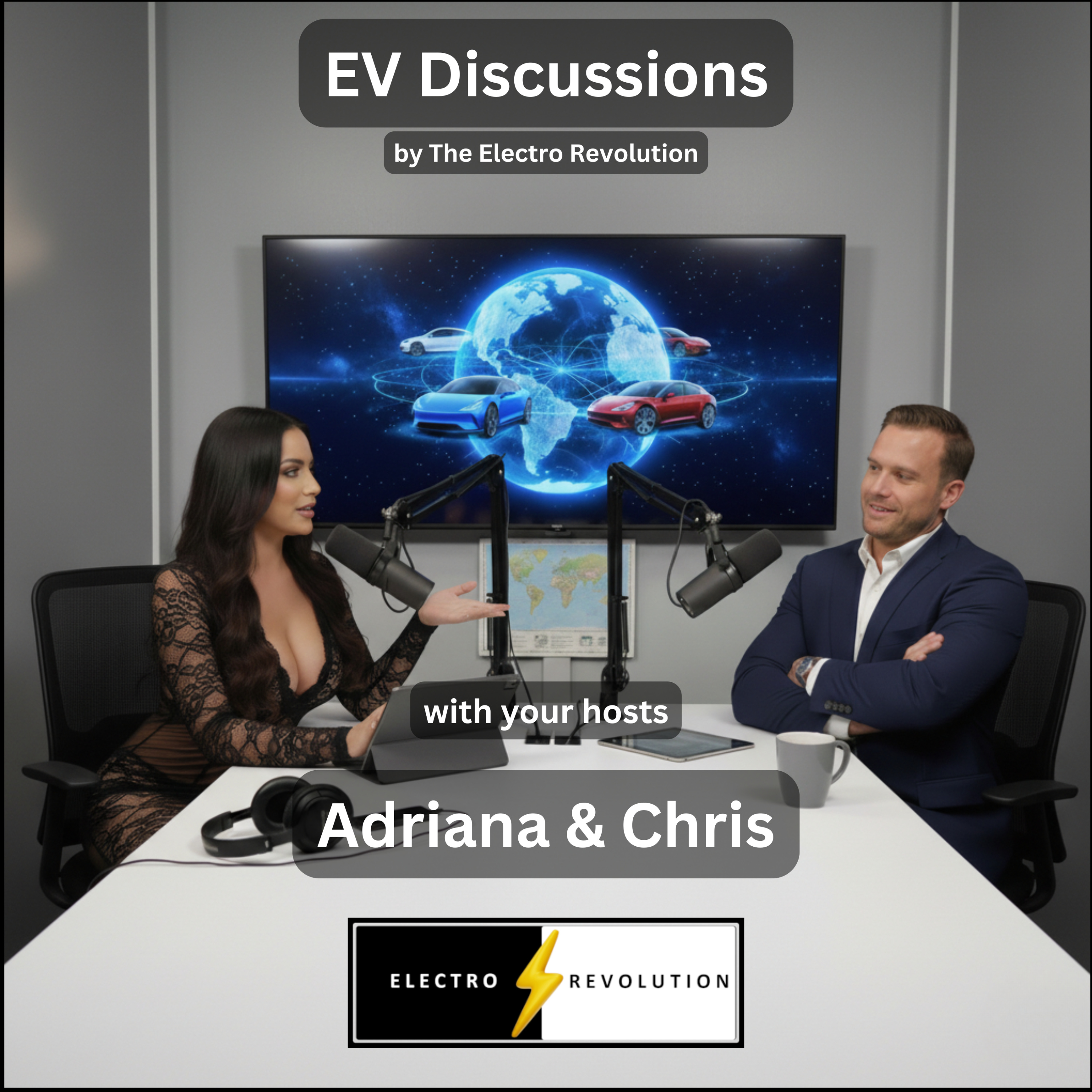
EV Discussions by The Electro Revolution — with your hosts — Jess and James, Adriana and Chris
by The Electro Revolution
Welcome to the Electro Revolution EV Discussions Podcasts — Providing detailed podcast overviews of EV discussions for episodes on the Electro Revolution YouTube channel.You can find us on:Spotify Channel: https://tiny.cc/TheER-EV-Discussions-sptyApple Channel: https://tiny.cc/TheER-EV-Discussions-applYouTube Channel: https://www.youtube.com/@TheElectroRevolution
-
43
EV Discussions Podcast — S2Ep31 — Mel to Syd EV Road Trip – BYD Electric Bus Encounter, Home & Costs
YouTube video related news: https://youtu.be/a5MD5mkJ22IYouTube video podcast: https://youtu.be/f18DJWMd2kkIn this final episode of the EV road trip series, we complete our journey from Sydney to Melbourne and back and share one of the most unexpected highlights of the trip — a chance encounter with a BYD electric bus on the way home.While stopping to charge, we met Steve, who was driving a brand-new BYD battery electric bus from Melbourne back to Sydney. He generously allowed us to film the bus, explore the interior, and even sit in the driver's seat. We also learned some fascinating details about Australia’s growing fleet of electric buses, including the massive 382 kWh battery pack, the use of BYD blade batteries, and how these commercial EVs charge compared to electric cars.This episode also covers the final charging stops of the trip, including:⚡ A 350 kW EV charger in Tarcutta⚡ The Tesla Supercharger station in Goulburn⚡ A quick look at a nearby Chargefox charging stationDuring the return journey we also experienced an unexpected power outage at a charging station, which forced us to stop charging at 90%. This gave us a good opportunity to compare different charging strategies and demonstrate why charging an EV to 100% on road trips is usually not the most efficient option.This episode, from The Electro Revolution YouTube channel, documents the final leg of an electric vehicle road trip from Sydney to Melbourne. The host, Michael, shares a chance meeting with a bus driver named Steve, providing a detailed look at a BYD electric bus and its specialized blade battery technology. Beyond this encounter, the narrative focuses on the logistical realities of long-distance EV travel, including stops at Tarcutta and Goulburn. Michael evaluates the efficiency of various charging networks, comparing the costs and speeds of rapid chargers against slower alternatives. The source concludes with a data-driven analysis of trip expenses, offering practical advice on balancing travel time with charging budgets. Ultimately, the text serves as a real-world guide for EV owners navigating Australia’s charging infrastructure.Chapters:00:00 EV Road Trip Intro: Melbourne to Sydney Return Leg02:00 Surprise Encounter: BYD Electric Bus Charging04:12 Inside the Engineering of a 382kWh Electric Bus06:28 Fleet Charging Reality: Slow Speeds & Depot Charging09:23 EV Road Trip Strategy: Stop Charging to 100%11:08 Charger Blackout: Infrastructure Reality Check12:08 Goulburn Stop: Tesla Superchargers vs Slower Chargers13:34 Final Drive Data: Distance, Efficiency & Elevation14:40 EV Road Trip Costs: Fast Chargers vs Slower Networks17:01 The Key Insight: Match Charger Speed to Break Time
-
42
EV Discussions Podcast — S2Ep30 — Mel to Syd — Ampol, EV & BP Pulse Charging Costs
YouTube video related news: https://youtu.be/e8iFemDKXeYYouTube video podcast: https://youtu.be/Pz7fWDbLNoUIn this episode, we continue the return journey from Melbourne to Sydney in the BYD Seal Premium. This is Part 3 of the road trip series, covering the first three charging stops on the way home — complete with real-world charging data, costs, efficiency figures, and charger reliability insights.Originally, I planned just three charging stops for the return leg. However, unexpected charger outages (including a full site failure at BP Pulse) meant adapting in real time.In this episode, we cover:• Ampol AmpCharge 150kW session• Unplanned EVIE 150kW top-up• BP Pulse 150kW charge to 100%⚡ Charging Performance & Costs BreakdownTotal distance covered: 265.6 km (165 miles)Total energy added: 101.472 kWhTotal charging time: 1 hour 37 minutesTotal cost: $74.57 AUDAverage charging cost: 76c per kWhReal-world efficiency (highway driving): 23.65 kWh/100kmWe also look at charging curve behavior — including how the Seal tapers from 120kW down to ~79kW as state-of-charge increases. This is critical for understanding optimal stop strategy and time efficiency on long-distance EV travel.This episode follows Michael, a motoring enthusiast, as he documents the initial segment of his electric vehicle road trip from Melbourne to Sydney. Driving a BYD Seal, he recounts the challenges of navigation, including encountering a completely offline charging station that forced a detour to an Ampol site.The narrative highlights the practicalities of using different charging applications and monitoring the car's fluctuating power intake during three specific stops. Detailed financial and technical statistics are provided, comparing the cost and efficiency of various network providers like BP Pulse and EV.Ultimately, the source serves as a real-world guide to long-distance EV travel, emphasizing the importance of flexibility and data tracking.Chapters:00:00 EV Road Trip Begins Melbourne to Sydney00:57 Starting at 40% Battery Strategy Explained02:01 Broken BP Pulse Chargers Infrastructure Anxiety02:56 Plan B AmpCharge Stop and Smooth Setup03:38 BYD Seal Charging Curve Explained05:24 First Charge Results Time Speed and Cost06:00 Opportunity Charging Coffee Stop Strategy06:56 Surprise 150kW Charger and Quick Top Up08:08 Strategic 100% Charge to Skip Next Stop09:57 Trip Data Costs Efficiency and Highway Reality
-
41
EV Discussions Podcast — S2Ep29 — Syd to Mel EV Road Trip – Costs, 831km Stats & BP Pulse Test
YouTube video related news: https://youtu.be/ZlzCmMNttnYYouTube video podcast: https://youtu.be/AqnhOO04C7wThis episode focuses on our final charging stop at BP Pulse Glenrowan South and the complete trip statistics — including charging speeds, total costs, energy consumption, and time added for charging.We previously charged at the massive Tesla Supercharger site in Goulburn (300kW) and the 350kW EVIE charger at Ampol. In this episode, we test the 150kW BP Pulse charger before completing the final leg into Melbourne Showgrounds for the EV event.⚡ Charging Highlights:🔹BP Pulse 150kW charger (real-world ~120kW peak)🔹75c per kWh charging cost🔹41.7kWh added in 37 minutes🔹Final top-up to 100% before Melbourne📊 Full Trip Statistics (Sydney → Melbourne):🔹Total Distance: 831.6km🔹Total Energy Added: 120kWh🔹Average Charging Cost: 78c per kWh🔹Total Charging Time: 1h 52m🔹Total Charging Cost: $117.64🔹Consumption: 20.05kWh/100km🔹Highway speeds: 110km/h🔹Ambient temperature: 33°CWe also compare this trip to our previous Sydney to Phillip Island EV road trip, where slower chargers resulted in significantly lower overall costs — proving that charging strategy matters just as much as vehicle efficiency.If you’re considering long-distance EV travel in Australia, especially between Sydney and Melbourne, this detailed breakdown will help you understand real-world charging speeds, network pricing differences, and how highway driving impacts consumption in the BYD Seal.This episode from, The Electro Revolution, documents a 831-kilometre road trip from Sydney to Melbourne in a BYD Seal Premium, performed by our reviewer Michael. The content focuses on the practicalities of long-distance electric vehicle travel, specifically detailing the performance of various charging networks such as Tesla, BP Pulse, and Evie. Michael provides a comprehensive breakdown of total costs, charging speeds, and energy consumption, noting that his trip cost approximately $117.64 over nearly two hours of plug-in time. He also compares these results to a previous journey, concluding that while ultra-fast chargers offer convenience, they significantly increase the overall expense compared to slower alternatives. The narrative concludes with a preview of his return journey, highlighting the diverse state of Australian EV infrastructure.Chapters:00:00 Electro Revolution EV Podcast Intro00:32 Sydney To Melbourne EV Road Trip Hume Highway Test01:38 Glenrowan South BP Pulse 150kW Charging In 33°C Heat03:29 BYD Seal Screen Dimming Issue Under Australian Sun04:43 Highway Speed Aerodynamics 110kmh Energy Impact05:36 EV Charging Costs Breakdown Tesla Ampol BP Pulse06:27 Tesla Supercharger Goulburn Non Member Pricing Explained08:20 Real World EV Efficiency 20kWh Per 100km Analysis10:04 Total Trip Cost $117 Sydney To Melbourne In A 2024 BYD Seal Premium12:54 Fast Vs Slow Charging Two Tier EV Travel Future
-
40
EV Discussions Podcast — S2Ep28 — Sydney to Melbourne EV Road Trip | Tesla & 350kW Fast Charging
YouTube video related news: https://youtu.be/8O1Q2nADZAIYouTube video podcast: https://youtu.be/r0dPPSVPauwWelcome to the Electro Revolution channel.In this episode, I take the 2024 BYD Seal Premium on a real-world 800km+ EV road trip from Sydney to Melbourne — testing Australia’s high-speed charging infrastructure along the Hume Highway.This time, I committed to using ultra-rapid DC chargers only, learning from my previous Sydney to Phillip Island journey. The goal? Minimise downtime, maximise charging speeds, and evaluate total cost efficiency when relying on premium fast charging networks.🔌 Charging Stops in This Episode:🔹Tesla Supercharger (20-stall site) – Goulburn, NSW🔹Ampol / EVIE Networks 350kW charger – Tarcutta🔹Next episode: BP Pulse before arriving in MelbourneThis was my first time fast charging the BYD Seal at Tesla’s largest Southern Hemisphere Supercharger site in Goulburn. I walk through:🔹Using the Tesla app to initiate charging🔹Real-world charging speeds at different state-of-charge levels🔹How charging tapers above 70–80%🔹Infrastructure quality, lighting, and site layout🔹Government co-funding requirements and SLA implications🔹Cost breakdown per stop⚡ Key Observations:🔹Charging speeds reduced significantly above 70–80% SOC🔹Tesla Supercharger performance vs EVIE 350kW hardware🔹Practical long-distance EV planning at 2:00 AM departure⚡Total charging cost comparison for first two stops:Stop 1: $26.88Stop 2: $35.95I also demonstrate trip computer tracking strategy (Trip A vs Trip B) to monitor segment efficiency vs total distance travelled (386km covered by episode end).Chapters:00:00 Electro Revolution EV Podcast Introduction & Sydney to Melbourne Road Trip Overview00:21 Sydney to Melbourne EV Road Trip Stress Test in a 2024 BYD Seal Premium01:23 2:16AM Departure Strategy, 100% Battery & Data Logging Setup03:16 Goulburn Tesla Supercharger Test Open Access for Non-Tesla EVs05:48 BYD Seal Charging Curve Explained 79kW at High State of Charge07:32 Tarcutta 350kW Ultra Rapid Charger Real-World Speed vs Marketing Claims09:17 100% Charging, Cell Balancing & Why EV Charging Slows at 99%10:53 EV Fast Charging Costs $62 to Travel 386km Sydney to Tarcutta12:39 EV Infrastructure Reliability vs Battery Physics Limits14:09 Should You Charge to 80% or 100%? Optimising Long Distance EV Road Trips
-
39
EV Discussions Podcast — S2Ep27 — Everything Electric 2025 – Full Tour | New EVs, Solar & Tech!
YouTube video related news: https://youtu.be/9egVaFzSSZ4YouTube video podcast: https://youtu.be/QBto_fi8qy8Welcome back to the Electro Revolution channel! Michael here — your car and tech enthusiast — continuing our full walkthrough of the Everything Electric EV Show Melbourne 2025, held between 14–16 November at the Melbourne Showgrounds.👉 In this episode we dive deeper into the stands, tech, service providers, EV conversions, mobility options, and many brands that often fly under the radar.🚗 Brands & Vehicles Featured in This Episode🔹 Xpeng (XiaoPeng / Xiaopeng / Xping)🔹 Alfa Romeo Junior EV & e-Bike🚓 Kia & Tesla Model Y police editions🔹 Deepal E07 Multi-TruckA unique, ultra-compact utility EV making its way into the Australian market — great for businesses requiring small cargo solutions.🔹 Fiat & JeepFiat 500eJeep AvengerAbarth electrics🔹 Lotus & McLaren EVs🔹 Mercedes-Benz G580 Electric G-Class & Others🔹 Smart #1 and Smart #3🔹 Cadillac Lyriq🔹 Savic Electric MotorcyclesA standout Australian-built electric motorbike.Powerful. Stylish. And proudly homegrown.🔹 VW Electric VansID. Buzz CargoID. Buzz GTXe-Transporter🔧 Conversions, Mobility & Specialized Vehicles🔹 Revival & Extra Volted EV Conversions🔹 Mobility SolutionsAstreea mobility scootersKyburz electric delivery vehicles (like those used by Australia Post)Unique high-powered mobility designs🔌 Charging, Solar & Home Energy Providers🔹 GoodWe Solar & Charging SolutionsSolar storage, EV charging, and solar carports — increasingly common at Woolworths, Coles, and shopping centres.🔹 Alspec Solar CarportsAn Australian-owned and operated company offering single, double, and triple solar carport structures (5kW–7.4kW).Weather-tested for hail and ideal for homes or businesses.🔹 RevCharge (Bidirectional Charging)Featuring the Atto 3 (one of the few V2G capable vehicles) and showcasing the future of EVs powering homes.🔹 Charge Next DoorA community-based charging service allowing EV owners to share private home chargers with others.🔹 ElussoOffering EV battery diagnostics, certification, and EV membership benefits including giveaways, events, and community activities.🔹 Zeco EnergyPromoting home energy storage, solar, EV-to-grid and electrified home systems.🎬 Final ThoughtsThank you for joining me for Part 2 of the Everything Electric Melbourne 2025 tour. I hope you discover something useful — perhaps a product, service, or company you didn’t know existed. That’s the beauty of events like these.This episode provides a detailed walkthrough of the Everything Electric EV Show held in Melbourne during November 2024. The narrator highlights a diverse range of battery electric vehicles, including mainstream models from Tesla and Kia, luxury options like Cadillac and Lotus, and unique electric motorcycles. Beyond cars, the source explores essential infrastructure such as solar carports, bi-directional charging systems, and community-based power sharing apps. Significant attention is given to Australian companies offering niche services, specifically the conversion of vintage petrol cars into modern electric ones. The overview also covers battery diagnostics and sustainable home solutions, emphasizing the growth of the green technology sector in Australia. Ultimately, the source serves as an educational guide to the latest innovations and service providers shaping the future of electric mobility.Chapters:00:00 Podcast Intro01:01 XPeng X9 Alfa Romeo Junior & EV Bikes02:10 E07 Electric Truck Aussie-Only Design02:49 Jeep EV Water Test & Off-Road Confidence03:12 VW ID Buzz Cadillac Lyriq & Interior Space04:08 Luxury EVs Mercedes G-Class Lotus McLaren04:37 Retro EV Conversions & the 1995 Rule06:34 Police EVs Postie Bikes & Micromobility08:02 Solar Carports Home Energy & Charging10:27 Battery Health V2G Community & Final Takeaways
-
38
EV Discussions Podcast — S2Ep26 — Everything Electric 2025 – Exhibitor Walkthrough & EV Highlights!
YouTube video related news: https://youtu.be/TGBo32PVyiYYouTube video podcast: https://youtu.be/DIrEh1LsW9gWelcome back to the Electro Revolution channel! Michael here — your EV and tech enthusiast — and in this exciting episode we’re diving into Part 1 of the Everything Electric Show held at the Melbourne Showgrounds from 14–16 November 2025.This wasn’t just an auto show… it was a massive celebration of electric vehicles, renewable energy, home tech, charging solutions, electric trucks, e-mobility and more. Whether you’re an EV driver, a tech lover, or someone interested in the future of clean energy, this walkthrough covers the standout exhibitors and innovations shaping Australia’s electric future.⭐ What’s in Episode 1?🔌 MyEnergi – Zappi & LibbiWe kick off with MyEnergi’s well-known Zappi smart charger and their new Libbi home battery system, now available in Australia. Since I personally use a Zappi at home, I spend some extra time looking at how Libbi integrates into a renewable home setup.🚗 ZEEKR Stand – 7GT, 7X, X & 009ZEEKR showed off upcoming EVs ahead of their 2026 Australian arrival, including the stylish ZEEKR 7GT, 7X, the compact ZEEKR X, and the luxury 009 MPV.🚙 Leapmotor – C10, REEV & B10A look at Leapmotor’s hybrid and battery-electric range, including the C10, REEV, and B10 — fresh options for the Australian EV market.⚡ BP PulseCharging infrastructure is expanding fast, and BP Pulse showcased giveaways, upcoming network improvements, and Wild Bean Café offerings for road trippers.🚐 Renault Mégane (Commercial EVs)A mix of compact electric commercial vehicles, demonstrating the growth of EVs in the logistics and trade sectors.🧰 Farizon (Van Fit-outs)This stand showed modular van conversions, interior layouts, and work-ready EV-friendly retrofits — both competitively priced and customisable.🛻 Omoda – 9 and J7We revisit Omoda after reviewing them at the Sydney EV show. The Omoda 9 made another appearance, and we also checked out the J-series vehicles and even a stripped-down EV transmission motor demo.🏍️ Electric Motorbikes & MobilityA showcase of 100% electric bikes, scooters, and lightweight transport, highlighting the rise of small-format EV mobility.🚚 Volvo Electric TrucksA crowd favourite — Volvo’s massive electric truck, proving heavy-duty transport is shifting to zero emissions.🚗 Polestar StandThe Polestar 2 was on display with strong interest from attendees.🔋 EV NRG – Charging HardwareHigh-quality EV charging systems for home and business use, built with durability and safety in mind.🔵 Tesla – FSD Supervised & Model 3Tesla presented their vehicles along with Full Self-Driving (Supervised) now available in Australia. Leasing options were also showcased.🔵 BYD StandOne of the biggest stands at the show:🔹 BYD Seal Lion 6 Hybrid🔹 BYD Shark 6 (hugely popular)🔹 BYD 2 (newly priced, fresh release)🔹 BYD Sea Lion 7 full EVChapters:00:00 Podcast Intro & Why Melbourne 2025 Matters01:07 Road Trip to Melbourne in a BYD Seal02:07 Tesla Superchargers Open to Non-Tesla EVs03:26 More Than Cars The Full Electric Ecosystem04:06 Home Energy Batteries Solar & Smart Charging05:00 Electric Vans Lifestyle & Commercial Use05:37 BYD Tesla MG Big Brands Return in Melbourne07:02 BYD Shark 6 A Warning Shot to Ute Rivals07:40 Tesla FSD Zeekr Leapmotor & Future EV Tech10:34 Electric Trucks Bikes Chargers & Final Takeaways
-
37
EV Discussions Podcast — S2Ep25 — The 2025 Sydney EV Show! Ferrari, McLaren, Lamborghini, Lotus!
YouTube video related news: https://youtu.be/VGcT2nB3_H0YouTube video podcast: https://youtu.be/RfJcF8Ovzc8In this exciting and energy-packed episode, Michael and Trevor take you deep inside the 2025 International Sydney EV Show, held at the iconic ICC Sydney. This three-day event brings together the latest innovations in electric mobility, from cutting-edge hypercars to luxury EVs and the next generation of sustainable vehicle tech.This is Day 1 of the Sydney EV Show — and the energy is electric! 🔋 We’re kicking things off by exploring the most talked-about vehicles on display and giving you a genuine, up-close look at what the future of driving looks like. Whether you’re a car enthusiast, EV advocate, or just curious about what’s next in the automotive world, this walkthrough will keep you captivated from start to finish.🚗 Highlights from this episode:🔹 Porsche Taycan – A modern classic redefining luxury EV performance. Its futuristic interior, spiderweb-inspired wheels, and impeccable detailing make it one of the standouts of the show.🔹 McLaren Artura – A plug-in hybrid supercar that blends raw power with sustainability. We get an up-close look at its compact design, incredible engine layout, and unmistakable McLaren styling.🔹 Ferrari SF90 & 296 GTP – Pure Italian performance and innovation. With hybrid systems that push boundaries, these Ferraris combine art, aerodynamics, and electrified engineering in breathtaking fashion.🔹 Rolls-Royce Spectre – The future of ultimate luxury has arrived. The Spectre’s bold design, silent powertrain, and stunning craftsmanship make it one of the most elegant EVs ever made.🔹 Lamborghini Revuelto – The “Raging Bull” returns with a hybrid heart! We explore this low-slung powerhouse that blends electric assistance with iconic Lambo aggression.🔹 Lotus Eletre – The surprise of the show! This all-electric performance SUV features dual motors with up to 675 kW, a massive 112 kWh battery, and 0–100 km/h in just 2.9 seconds. It’s not just fast — it’s redefining what an EV SUV can be.This episode video introduces the inaugural day of the 2025 Sydney International EV Show, hosted by the presenters of the Electro Revolution YouTube channel. The creators explore a wide array of luxury electric and hybrid vehicles, offering first impressions of high-performance models from brands like Ferrari, McLaren, and Lamborghini. Throughout their tour, they highlight specific design details, such as futuristic aesthetics, interior luxury, and wheel specifications, while occasionally critiquing functional aspects like rear passenger space. Beyond the hypercars, the hosts examine the Lotus Eletre and mention various upcoming electric technologies from manufacturers like Zeekr and Leapmotor. The overview concludes by listing the specific high-end models showcased, serving as an introduction to a broader series of upcoming vehicle reviews.Chapters:00:00 Sydney EV Show 2025 First Look00:29 Hypercars vs Everyday EVs00:59 Standout Design Zeekr 7X01:16 Missing Brands What BYD Absence Signals01:43 Hypercar Market Shift to Hybrids02:00 Porsche Taycan Design Performance Trade-offs03:16 McLaren Artura and Hybrid Supercars03:41 Ferrari SF90 Alien Tech and Price Reality05:07 Lamborghini Ferrari Rolls-Royce Luxury Extremes07:10 Lotus Eletre SUV Power Space and Specs
-
36
EV Discussions Podcast — S2Ep24 — NIO Hits 90 Million Battery Swaps! Impact on Australia’s EV Future
YouTube video related news: https://youtu.be/kFIZtya582YYouTube video podcast: https://youtu.be/DwDyvz5tT1IToday we’re diving into one of the biggest milestones in the EV world.NIO, the Chinese electric vehicle giant, has just completed its 90 millionth battery swap, a mind-blowing achievement that’s turning heads around the world — and yes, it could soon reshape the EV landscape in Australia too. 🇦🇺🔋 What You’ll Discover in This EpisodeIn this deep dive, we explore:🔹 What NIO’s 90 million battery swaps really mean for the EV industry🔹 How battery swapping works and why it’s faster than charging🔹 The rise of NIO’s Firefly sub-brand coming to Australia🔹 The economics behind Battery as a Service (BaaS) — and how it makes EVs cheaper🔹 Why battery swapping could fix issues like degradation, recycling, and cost🔹 The global expansion from China → Europe → Australia🔹 And how this technology could change the way we charge EVs foreverThis episode, from The Electro Revolution, highlights Nio’s significant achievement of completing 90 million battery swaps, demonstrating the rapid scaling and reliability of this technology. By offering Battery as a Service (BaaS), the company allows drivers to exchange depleted batteries for fresh ones in mere minutes, bypassing the long wait times associated with traditional charging. This model significantly lowers the initial purchase price of electric vehicles and ensures that drivers always have access to well-maintained, up-to-date battery hardware. Furthermore, the source discusses Nio’s international expansion, including its upcoming entry into the Australian market through its Firefly sub-brand. The video also suggests that centralising battery management provides benefits for grid stability and simplifies the recycling process for aged units. Finally, the creator advocates for industry-wide standardisation of swapping systems to accelerate global electric vehicle adoption.Chapters:00:00 EV Deep Dive Battery Swapping Explained00:56 Why NIO Rejected Fast Charging Arms Race01:52 90 Million Swaps The Acceleration Story02:43 Infrastructure Scale Highways China Europe03:13 Three Minute Battery Swap vs Fast Charging04:11 Who Battery Swapping Really Benefits04:48 Battery as a Service BaaS Business Model06:26 Battery Upgrades Health and Ownership Anxiety07:49 Software Diagnostics and Reduced Downtime08:20 Grid Optimisation Recycling and Energy Markets09:32 Australia Entry Strategy and the Future of Swapping
-
35
EV Discussions Podcast — S2Ep23 — EV Charging Costs Explained — How Much Does It Really Cost?
YouTube video related news: https://youtu.be/JV6Ye5KmuwIYouTube video podcast: https://youtu.be/fD8MEYVM1Jg⚡In this episode, Michael dives deep into one of the most important questions for current and future EV owners — how much does it actually cost to charge an electric vehicle (EV) in 2025.Whether you’re in Australia, the UK, or anywhere in the world, the charging cost principles remain the same. Michael breaks down the real-world costs of EV charging, from home solar setups and off-peak plans to public fast chargers and Tesla Superchargers.Learn how to get the most out of your charging setup, save hundreds every year, and understand why EVs are still far cheaper to run than petrol or diesel vehicles — even when using high-speed DC chargers.💡 Key Takeaways:🔹 Home charging (especially with solar) is the cheapest — sometimes completely free🔹 Off-peak energy rates can be as low as 8¢ per kWh🔹 Public fast chargers can cost up to $1 per kWh, but are great for long trips🔹 Smart scheduling and solar self-use maximize your savings🔹 Even when fast-charging, EVs still cost less to run than petrol vehiclesThe episode, from The Electro Revolution, outlines the various methods and costs associated with electric vehicle (EV) charging. It emphasises that home charging is the most economical approach, particularly when integrated with rooftop solar or off-peak electricity rates. The source categorises charging into three levels, ranging from standard household plugs to high-speed public DC chargers, which offer convenience at a higher price point. Practical advice is offered regarding battery health, such as maintaining a charge between 20% and 80%, and using mobile apps to locate chargers. Ultimately, the text asserts that while public infrastructure is essential for long trips, EVs consistently offer lower running costs than traditional petrol vehicles. This overview serves as a guide for prospective owners to navigate the logistical shift from internal combustion engines to sustainable transport.Chapters:00:00 EV Charging Costs Explained01:08 Do EVs Really Save Money01:31 Home Charging vs Petrol Costs02:21 Off-Peak Power and Free Charging03:15 Solar Charging Zero Cost Driving03:47 EV Energy Use and Battery Sizes04:15 Level 1 vs Level 2 Home Charging05:48 Level 3 DC Fast Charging Explained07:06 The Public Charging Cost Trap10:14 Smart Charging Tips and EV Future
-
34
EV Discussions Podcast — S2Ep22 — Can P-Platers Drive Electric Cars in Australia State-by-State EV Rules Explained
YouTube video related news: https://youtu.be/JUR0wbfWOYQYouTube video podcast: https://youtu.be/CPbkx392RZkAre P-platers in Australia allowed to drive electric cars? The answer isn’t as simple as you might think! ⚡ In this video, Michael from Electro Revolution breaks down the state-by-state rules for provisional (P1 and P2) drivers across Australia — including New South Wales, Victoria, Queensland, South Australia, ACT, Northern Territory, Western Australia, and Tasmania.Find out:✅ Which EVs are legal for P-platers in each state✅ Why some Teslas and dual-motor EVs are banned✅ How to check your vehicle’s eligibility online before you buy✅ What to consider as a parent or new driver shopping for your first EVThis episode outlines the varying legal restrictions for provisional drivers operating electric vehicles across different Australian regions. While the ACT, Northern Territory, Western Australia, and Tasmania impose no power-to-weight limits, other states enforce a strict maximum of 130 kW per tonne. In jurisdictions like New South Wales, Victoria, Queensland, and South Australia, many popular dual-motor or high-performance EVs are prohibited for novice motorists. The guide emphasizes that single-motor models are generally the safer choice for compliance, though specific state-run databases should be consulted to verify a car's status. Ultimately, the source serves as a compliance guide to help new drivers and their families avoid fines and legal issues when purchasing modern electric transport.Chapters:00:00 EVs and P-Platers Australia Explained01:06 The 130 kW per Tonne Rule02:39 Why EV Power Breaks Old Laws04:45 States With Strict EV Limits05:02 New South Wales EV Rules06:18 Victoria’s Zero Tolerance Policy07:35 Queensland and South Australia Rules10:03 States With Full EV Freedom11:51 Financial Risks for Families13:16 Final Verdict for EV Buyers
-
33
EV Discussions Podcast — S2Ep21 — Vehicle Hot Hacks — Maintaining your vehicle in Summer
YouTube video related news: https://youtu.be/LBJuJkM3YUoYouTube video podcast: https://youtu.be/kFDlSVohUJI🔥 Hot weather means hot cars — and that’s not always a good thing!Welcome back to Electro Revolution, I’m Michael — your car and tech enthusiast. In today’s episode, we’re diving into essential summer car care tips to help your vehicle survive (and shine) through Australia’s scorching heat.☀️ From tire pressure and tread checks to coolant levels, air conditioning servicing, and protecting your paint from UV rays — this video covers everything you need to keep your car safe, efficient, and looking great all summer long.💡 Whether you drive an EV or ICE vehicle, these easy maintenance tips will help prevent costly damage, improve performance, and make your summer road trips smoother and cooler.⚙️ Quick Summary:🔹 Check tire pressure and tread every few weeks🔹 Keep coolant, oil, and fluids topped up🔹 Service your A/C every 2 years🔹 Use UV-blocking tint and interior protectants🔹 Wash off salt and sand after beach trips🔹 Protect your car with covers or gazebos when parked in direct sunIn this episode, Michael from The Electro Revolution, provides essential guidance on protecting vehicles during harsh summer conditions. He emphasises the importance of tyre maintenance, advising drivers to monitor air pressure and tread depth frequently to ensure safety and prevent uneven wear. The source also highlights the necessity of servicing air conditioning systems and checking critical engine fluids to avoid mechanical failure in high temperatures. To combat cosmetic and structural damage, the author suggests using UV-blocking films and protective coatings for both the interior and exterior of the car. Additionally, he recommends rinsing off salt and sand after beach trips and using specialized mats to keep the cabin clean. Ultimately, the guide suggests that proactive care and simple preventative measures will preserve a car's value and ensure a smoother driving experience.Chapters:00:00 Summer Vehicle Stress Explained01:19 Tire Heat Damage and UV Protection02:13 Summer Tire Pressure Strategy03:34 TPMS Alerts and Even Tire Wear04:01 3mm Tread Rule and Hydroplaning Risk05:28 Cooling Systems ICE vs EVs06:38 EV Battery Thermal Management07:46 AC Systems and Range Efficiency08:50 UV Protection Paint Interior Screens10:59 Sand Salt and Summer Adventure Damage
-
32
EV Discussions Podcast — S2Ep20 — Is this legal or illegal — Driving with Foggy Windows & The Fix
YouTube video related news: https://youtu.be/rQy922Fdpp0YouTube video podcast: https://youtu.be/kg4M9V_SyncToday, we’re tackling a common but dangerous issue – driving with foggy windows.In this video, you’ll learn:✅ What causes foggy windows (the science of condensation)✅ Why it’s dangerous and how it affects your vision and reaction time✅ Quick fixes to clear your windscreen and windows instantly✅ Long-term prevention tips (humidity control, antifog sprays, clean filters, etc.)✅ The exact laws, fines, and demerit points in each Australian state & territory✅ What to do if you’re fined – including tips on disputing a ticketThis episode explores the legal and safety consequences of driving with foggy windows, focusing on how condensation forms due to temperature differences inside and outside a vehicle. In Australia, drivers can face significant monetary fines and demerit points for having an obstructed view, as this impairment dangerously reduces reaction times and visibility of pedestrians. To ensure compliance with the law, the presenter suggests using air conditioning demisters, keeping windows clean, and applying anti-fog treatments to the glass. Additionally, maintaining cabin air filters and removing wet items like umbrellas can prevent excess humidity from building up in the car. By following these practical maintenance tips and driving with unobstructed vision, motorists can avoid legal penalties and enhance overall road safety.Chapters:00:00 EV Podcast Deep Dive Introduction00:19 Why Foggy Car Windows Are a Safety Risk01:00 The Science of Condensation and Dew Point01:44 How Air Conditioning Removes Moisture02:55 Foggy Windows in EVs vs ICE Vehicles03:58 EV Range Impact and Smart Preconditioning04:14 Fogged Windscreens and Traffic Law Fines05:28 Real-World Vision Loss and Accident Risk07:56 Quick Fixes to Clear Fogged Windows09:08 Preventative Maintenance and Anti-Fog Strategies
-
31
EV Discussions Podcast — S2Ep19 — Is this legal or illegal — Eat, Drink or Smoke while Driving in Australia
YouTube video related news: https://youtu.be/uhobxucB-NQYouTube video podcast: https://youtu.be/K4GkaKt80OMWe break down the laws across every Australian state and territory, exploring the surprising differences in fines, demerit points, and penalties you could face if you lose control of your vehicle while performing these activities.👉 What you’ll learn in this video:🔹 The national rule: why eating, drinking (non-alcoholic), smoking, or vaping isn’t technically illegal.🔹 The catch: how losing proper control of your vehicle changes everything.🔹 State-by-state penalties for “driving without proper control,” including NSW’s $2,200 fines, Queensland’s strict rules with penalties up to $6,600 (or even jail), and South Australia’s more lenient approach.🔹 Extreme fines for smoking with minors in the car, with penalties as high as $8,000 in the ACT.🔹 Why small distractions like snacks, coffee, or makeup could cost you far more than you think.💡 Key takeaway:While it’s not illegal to eat, drink, smoke, or vape while driving, the risks are huge if it distracts you or causes loss of control. Every state has different rules, but all have serious penalties for endangering others or driving carelessly.This episode, from The Electro Revolution, outlines the legalities surrounding eating, drinking, and smoking while operating a vehicle in Australia. While these activities are not strictly prohibited by national law, drivers can face substantial fines and demerit points if such actions lead to a loss of vehicle control or careless driving. The source details how penalties vary significantly across different states and territories, with some jurisdictions imposing thousands of dollars in fines or even imprisonment. Additionally, the content highlights that smoking or vaping with a minor present is a specific offense carrying extreme financial penalties nationwide. Ultimately, the presenter advises motorists to park safely before engaging in distractions to ensure they maintain full focus on the road.Chapters:00:00 Eating and Drinking While Driving Australia00:53 Is It Legal to Eat or Drink Behind the Wheel01:27 Proper Control Law Explained02:16 Mobile Phones Comparison and Key Legal Trigger03:10 Why Fines Vary by Australian State03:41 NSW and Victoria Distracted Driving Penalties05:12 Queensland Extreme Fines and Jail Risk06:38 SA WA Tasmania and Territory Comparisons09:25 Smoking or Vaping with Children Heavy Penalties11:56 Final Advice Avoid Distraction and Pull Over
-
30
EV Discussions Podcast — S2Ep18 — Is this legal or illegal — Lane Splitting & Filtering, Safety
YouTube video related news: https://youtu.be/W5ZyE5Bn6IcYouTube video podcast: https://youtu.be/F05r8GTITRMHave you ever seen a rider weave through traffic and wondered, “Can they actually do that?” 🤔Well, it turns out — yes, they can (under certain conditions)!🛣️ What You'll Learn:✔️ The difference between lane filtering and lane splitting✔️ The safety and traffic benefits of allowing riders to filter through cars✔️ State-by-state laws across Australia (NSW, VIC, QLD, WA, SA, NT, TAS, ACT)✔️ How other countries like the USA (California, Utah, Arizona, etc.) handle motorcycle filtering✔️ Why it’s not “cheating” — it’s legal, efficient, and often safer📊 Interesting Stats & Studies Covered:🔹 Belgium study: Replacing 10% of cars with motorbikes reduces congestion by 40%🔹 UC Berkeley: Lane filtering lowers the risk of rear-end collisions🔹 NSW 2013 trial: No crashes, faster travel times, and neutral impact on congestionThis episode, from The Electro Revolution, explores the legality and benefits of lane filtering and lane splitting for motorcyclists, specifically within the context of Australian road laws. The source distinguishes between these two practices, noting that filtering occurs in stationary traffic while splitting happens between slow-moving vehicles. According to the creator, these manoeuvres are nationally legal in Australia under specific conditions, such as maintaining speeds below 30 km/h and being a fully licensed rider. The video highlights that these actions significantly reduce traffic congestion and improve rider safety by lowering the risk of rear-end collisions. Research and regional trials are cited to demonstrate how such laws foster smoother traffic flow and shorter travel times for all road users. Finally, the content provides a state-by-state breakdown of regulations to help Australian drivers and riders navigate the roads legally and safely.Chapters:00:00 Lane Filtering Myths and Traffic Frustration00:41 Are Lane Splitting and Filtering Legal in Australia01:29 Lane Splitting vs Lane Filtering Explained02:40 How Motorcycles Improve Traffic Flow03:37 The 40 Percent Congestion Reduction Study04:27 Traffic Waves and Why Bikes Break Them05:08 Safety Benefits and Rear End Crash Reduction06:43 How Australia Legalised Lane Filtering07:44 Speed Limits Licensing and No Go Zones09:35 Global Comparison Australia vs US Laws
-
29
EV Discussions Podcast — S2Ep17 — Road User Charge Arguments — EV Drivers already pay taxes
YouTube video related news: https://youtu.be/UtiVEtGMTaEYouTube video podcast: https://youtu.be/EgmWi7ZmxqcFor this fifth and final episode of my road user charges series, we dive into one last key point: EV drivers already pay significant taxes.Throughout the first four episodes, we covered nine important arguments for and against EV-related road user charges, touching on national security, climate impacts, public health, and fairness. In this closing episode, I focus on the tax debate — breaking down what EV owners contribute compared to drivers of petrol and diesel vehicles.This episode examines the debate surrounding road user charges specifically targeting electric vehicle (EV) owners in Australia and beyond. The creator argues that EV drivers already contribute significantly to public funds through GST on electricity and higher luxury car taxes compared to internal combustion engine vehicles. A central point of the discussion is that the only missing contribution is the fuel excise, which the author equates to a carbon tax that non-polluting vehicles should not be forced to pay. Furthermore, the source highlights that heavy vehicles, such as trucks, are responsible for the vast majority of road damage, yet the proposed tax reforms often unfairly target passenger cars. Ultimately, the speaker advocates for a uniform tax system for all road users based on usage and weight, rather than penalising sustainable transport choices.Chapters:00:00 EV Road User Tax Debate Overview01:16 Fuel Excise and Revenue Gaps02:00 EV Taxes: GST and LCT Explained04:01 Counterarguments for Road Charges05:04 Heavy Vehicles Cause Most Damage06:01 The Power of Four Principle07:48 Uniform Road User Charge Proposal08:35 Rethinking Fuel Excise as Carbon Tax09:03 Tax Fairness and Corporate Exemptions10:33 Key Takeaways and Policy Implications
-
28
EV Discussions Podcast — S2Ep16 — Road User Charge Arguments — EVs & National Security, RoboTaxis
YouTube video related news: https://youtu.be/ZBMJUNsg14oYouTube video podcast: https://youtu.be/EllZSFESEwEIn Episode 4 of the Electro Revolution series, we continue the discussion on road user charges and explore three powerful arguments surrounding electric vehicles (EVs):🔹 EVs and National Security – Michael explains how Australia’s heavy dependence on imported oil makes the nation strategically vulnerable. He outlines how EV adoption, supported by renewable energy, can strengthen Australia’s energy independence, shield the economy from global fuel shocks, and enhance long-term national security. Comparisons are made with countries already running on 100% renewable energy, demonstrating that a clean energy grid is not only possible but practical.🔹 Australia’s Climate Leadership – As one of the world’s highest per-capita emitters, Australia carries both a moral and strategic responsibility to lead global climate efforts. Michael highlights that Australia contributes 1.2% of global emissions despite having only 0.3% of the world’s population. With world-class solar and wind resources, Australia is in a unique position to reduce emissions, electrify transport, and even become a global exporter of zero-carbon technologies.🔹 Autonomous EVs and City Congestion – Michael explores the future of robo-taxis and autonomous EVs. While the potential benefits include reduced parking demand, cheaper transport, and improved mobility services, he also discusses uncertainties, safety concerns, and the reality that large-scale adoption may take decades. Future infrastructure planning—including smart traffic systems and even new traffic light designs—is already under consideration.Across these three themes, we make the case that EVs are more than just cars: they’re tools for energy security, climate responsibility, and urban transformation.This episode, from The Electro Revolution, explores the multi-faceted arguments surrounding the adoption of electric vehicles (EVs) in Australia. The presenter emphasizes how transitioning away from fossil fuels could significantly bolster national security by reducing a dangerous reliance on imported oil. Furthermore, the source argues that Australia has a moral and strategic obligation to lead global climate change efforts due to its high per-capita emissions and vast renewable energy potential. The discussion also examines the future of autonomous driving, weighing the economic benefits of robo-taxis against current technological uncertainties. Ultimately, the video suggests that while infrastructure challenges exist, shifting to electric transport offers a path toward economic independence and environmental sustainability.Chapters:00:00 EV Road User Charge Deep Dive01:03 EVs and National Security Benefits02:01 Reducing Oil Dependence Risks03:08 Renewable Energy Feasibility04:00 V2L, V2H, V2G Explained04:38 Climate Leadership and Australia’s Role06:05 Road User Taxes and EV Trucks06:47 Autonomous EVs and Future Cities08:15 Smart Roads and Traffic Innovation09:17 Strategic Investment vs Short-Term Tax Debate
-
27
EV Discussions Podcast — S2Ep15 — Road User Charge Arguments — Reducing Climate Change Emissions
YouTube video related news: https://youtu.be/HThH-2p0kTMYouTube video podcast: https://youtu.be/Vgm295YgWak🌱 This is Episode 3 in our Road User Charges series, so if you missed Episodes 1 & 2, be sure to check them out first as today builds on those discussions.🚘 In this episode, we dive deep into the statement: “EV drivers help reduce climate-damaging emissions.”We look at the facts, myths, and misconceptions around EVs and climate impact:🔋 History of EVs – Did you know electric vehicles were invented in the 1830s, long before petrol cars? By the early 1900s, a third of cars in the US were EVs.🌍 EVs vs ICE emissions – Yes, EVs require more energy upfront to mine and process battery materials, but after the first 1–2 years, EVs dramatically outperform petrol and diesel cars over their lifetime by producing far fewer emissions.🏙 Local health impact – Unlike ICE vehicles, EVs produce no tailpipe emissions in our suburbs and cities, where pollution directly harms human health.📉 Depreciation & insurance myths – EVs do depreciate faster due to rapid tech updates, but the common claim that EV insurance is always higher than ICE is not backed by fact. In my own experience with multiple EVs, premiums were the same—or even cheaper.⚡ Charging & clean energy – With over 4 million solar-powered homes in Australia, many EV drivers already charge primarily from renewable energy. Even when grid-charged, EVs still cut lifecycle CO₂ emissions by 30–50%. Research from the ICCT shows EVs emit up to two-thirds less CO₂ than petrol cars in countries transitioning to renewables.🌞 Australia’s opportunity – With abundant solar, we have the ability to make EVs one of the cleanest transport solutions globally while also improving public health.This episode, from The Electro Revolution, discusses the environmental and economic arguments surrounding electric vehicles (EVs) compared to internal combustion engine (ICE) vehicles. The source asserts that while battery production is resource-intensive, EVs ultimately produce significantly lower life-cycle emissions, especially as electricity grids shift toward renewable energy. The author addresses common criticisms by arguing that higher depreciation is a result of rapid technological advancement, while also using personal experience to dispute claims of inflated insurance premiums. Furthermore, the text highlights the historical longevity of electric transport and emphasizes the health benefits of removing tailpipe pollutants from urban areas. Ultimately, the source advocates for EV adoption as a critical tool for reducing national carbon output and improving public safety.Chapters:00:00 EV Road User Charge Debate Overview01:00 EVs Are Older Than Petrol Cars02:02 Battery Mining Emissions Explained03:26 EV Emissions Break Even Point04:09 Dirty Grid Myth and Efficiency Reality05:00 Pollution Location Cities vs Power Plants05:53 Transport Emissions Australia 19 Percent06:04 EV Depreciation Technology Obsolescence07:11 EV Insurance Cost Myth Tested08:30 Solar Charging and Lifetime CO2 Cuts09:47 Why EVs Get Cleaner Over Time
-
26
EV Discussions Podcast — S2Ep14 — Road User Charge Arguments — Public Health and ADAS Technology
YouTube video related news: https://youtu.be/7iIQBsyf16cYouTube video podcast: https://youtu.be/J0l4-Hcf3BwIn this episode, we dive deeper into two key topics:👉 🌱 EVs & Public Health🔹 How EVs reduce harmful tailpipe emissions that cause asthma, COPD, lung cancer, cardiovascular disease, and thousands of premature deaths every year in Australia.🔹 Statistics from the World Health Organization, the Electric Vehicle Council, and Asthma Australia showing billions in healthcare costs and productivity losses caused by air pollution.🔹 Why shifting to EVs means cleaner air in our cities and suburbs, fewer hospital visits, and relief for our Medicare system.🔹 The difference between pollution from petrol cars in our neighbourhoods versus power plant emissions located far away from urban areas.🛡️ EVs & Road Safety (ADAS Technology)🔹 How EVs come standard with advanced driver-assistance systems (ADAS) such as autonomous emergency braking, adaptive cruise control, lane keeping assist, blind spot monitoring, and 360° cameras.🔹 Evidence from crash data: up to 50% fewer front-to-rear crashes with AEB, 21% fewer injury crashes with lane departure warnings, and 14% fewer lane-change crashes with blind spot monitoring.🔹 The structural safety advantages of EV battery packs, lower rollover risk, and over-the-air updates that keep safety features up to date without costly dealer visits.🔹 The huge $30 billion annual cost of road crashes in Australia — and how EV safety tech helps reduce this.This episode, from The Electro Revolution, discusses the societal benefits of electric vehicles, specifically focusing on public health and road safety. The presenter argues that transitioning to EVs could significantly reduce respiratory and cardiovascular diseases by eliminating urban tailpipe emissions, potentially saving the Australian economy billions in healthcare costs. Additionally, the video highlights how standard Advanced Driver Assistance Systems (ADAS) in electric cars decrease the frequency and severity of accidents. By utilizing structural battery packs for stability and over-the-air updates for safety improvements, EVs are framed as superior to traditional internal combustion engines. Ultimately, the source advocates for fairer tax policies that recognise these positive contributions to the community rather than penalising EV owners.Chapters:00:00 EV Road User Charge Debate Explained00:44 EVs Public Health and Road Safety Focus01:00 Air Pollution and 1,800 Deaths Per Year01:52 PM2.5 Pollution Why Tailpipes Kill03:08 EVs Shift Pollution Away From Cities04:00 $6.2 Billion Health Cost of ICE Vehicles05:05 Why Taxing EVs Misses the Health Savings05:25 EVs Standard ADAS Safety Advantage06:14 AEB Crash Reduction Real World Evidence08:01 EV Safety Design OTA Updates and $36B Savings
-
25
EV Discussions Podcast — S2Ep13 — Road User Charge Arguments — Fair Share, Fuel Excise, Free Roads
YouTube video related news: https://youtu.be/2O2aTw6BeFoYouTube video podcast: https://youtu.be/CSuxLyLJ-jgIn this episode, we dive into one of the most hotly debated topics in the EV world right now — the Road User Charge (sometimes called the Road User Tax).🚗⚡ This issue has stirred up conversations across Australia and beyond, and today I’ll break down the facts, myths, and misconceptions around it. Whether you’re an EV driver, ICE car owner, or just curious about how road funding really works, this episode lays it all out clearly.This episode examines the debate surrounding road user charges in Australia, specifically addressing the fairness of taxes for electric vehicle (EV) owners. The speaker refutes the claim that EV drivers avoid their responsibilities, noting they still contribute via registration fees and local rates while bypassing the fuel excise. A critical point is made that fuel excise revenue is often diverted into general government funds rather than being fully reinvested into road infrastructure. To resolve these inconsistencies, the source proposes a universal road user charge that would replace the fuel excise for all vehicles. This transition is framed as a sustainable solution for a future where combustion engines are phased out and environmental health becomes a priority. Ultimately, the text argues for tax reform to ensure that transport levies are transparently and effectively used for maintaining national roads.Chapters:00:00 EV Road User Charge Debate Explained01:26 Road User Charge vs Road User Tax02:10 Do EV Drivers Pay Their Fair Share02:29 Where Fuel Excise Really Goes03:21 Fuel Excise Revenue vs Road Spending04:44 Who Actually Pays for Road Maintenance06:39 EV Registration Discounts and Public Health08:30 Why Fuel Excise Is Unsustainable11:15 Universal Road User Charge Proposal13:57 Ring-Fenced Road Funding and Transparency
-
24
EV Discussions Podcast — S2Ep12 — FREE EV Charging for your EV — PlugShare, Charge@Large, all Free
YouTube video related news: https://youtu.be/A2V6q37deDIYouTube video podcast: https://youtu.be/PnurEs2BW50In this episode, we wrap up our Free EV Charging series (Episode 4) by diving deep into the two most important mobile apps you can use to find free EV charging stations across Australia — and potentially in your country too!🚘 What we cover in this episode:✅ A full walkthrough of PlugShare – filters, plug scores, user reviews, and how to spot truly free charging points.✅ Real examples of free charging locations (with lighting, Wi-Fi, and parking details).✅ The Charge@Large app by the Electric Vehicle Council – how it complements PlugShare and reveals hidden free charging spots not listed elsewhere.✅ Why you actually need both apps to maximize your access to free charging.✅ Extra tips on safe charging, etiquette (don’t hog spots!), and making the most of free Wi-Fi while you top up.This episode features a car and technology enthusiast explaining how to locate complimentary electric vehicle charging stations using two specific mobile applications. The presenter first demonstrates PlugShare, highlighting how to use filters for free power and community-rated plug scores to ensure station reliability. He then introduces Charge@Large, an Australian-specific tool provided by the Electric Vehicle Council to find active, accessible chargers across the country. Key advice includes checking for amenities like Wi-Fi and lighting for safety, as well as the necessity of carrying a personal charging cable. Ultimately, the source emphasizes that utilizing these digital resources allows drivers to significantly reduce their transportation costs compared to traditional fuel vehicles.Chapters:00:00 Free Public EV Charging Explained01:00 Why Free Charging Beats Peak Power Prices02:10 Overnight EV Charging vs Free Public Charging02:30 PlugShare App Free Charging Filters03:00 Type 2 and CCS2 Free Charger Strategy04:15 PlugShare Scores and Community Reliability05:40 Safety, Lighting and Night Charging Risks06:10 Shopping Centre Free EV Charging Finds07:20 EV Charging Etiquette and Time Limits07:30 Charge at Large App Hidden Free Chargers09:30 Is Free EV Charging Worth the Time
-
23
EV Discussions Podcast — S2Ep11 — FREE EV Charging for your EV — Tips 5, 6, 7 and 8. JOLT, Apps
YouTube video related news: https://youtu.be/NQqTxz__vYMYouTube video podcast: https://youtu.be/1Y5DZ6b7QoAIn this episode, we continue our deep dive into the world of free EV charging. This is Episode 3 of the Free EV Charging series — so if you haven’t seen Episodes 1 and 2 yet, I recommend starting there to catch all the tips so far.🚗 In this video, you’ll learn 4 new ways to charge your EV for free: Tip 5: JOLT Charging Network → How Jolt, supported by the NSW Government, gives drivers 7 kWh free every day (10 kWh for members). That’s up to 50 km of free range daily! Available in Sydney, across NSW, and expanding globally. Tip 6: Workplace Charging → Many employers are starting to offer free EV charging at the office, with some already providing employee-only chargers. Tip 7: EV Purchase & Lease Offers → How companies like Pepper Money and EV Networks include free charging packages (up to 2,000 kWh) when you buy or lease an EV — saving you months of charging costs. Tip 8: Mobile Apps → Why PlugShare is a must-have for finding community-listed free chargers, and how the EV Council of Australia app reveals hidden 22 kW chargers not listed elsewhere.This episode, from The Electro Revolution, highlights various strategies for electric vehicle owners to access cost-free charging solutions. The source details how specific networks like Jolt provide daily energy allowances for free, alongside the potential for workplace charging and promotional incentives from vehicle vendors. It also emphasises the importance of using mobile applications such as Plugshare and the EV Council of Australia's app to locate these utilities. By filtering for complimentary power and contributing to community-driven data, drivers can significantly reduce their transportation expenses. Ultimately, the guide serves as a practical resource for those looking to maintain an EV without incurring high utility costs.Chapters:00:00 Free EV Charging Advanced Strategies01:40 Jolt Government Backed Free Charging03:00 7kWh Daily Free EV Charging Explained04:21 22kW AC Chargers Fast Free Top-Ups05:12 50km Free Daily EV Commuting06:10 Workplace EV Charging as an Employee Perk07:52 Vendor and Lease Free Charging Deals08:26 2000kWh Free Charging Lease Bundles10:25 Best Apps to Find Free EV Chargers11:44 Hidden 22kW Free Council Chargers
-
22
EV Discussions Podcast — S2Ep10 — FREE EV Charging for your EV — Tips 2, 3 and 4, Car Parks, Hotels
YouTube video related news: https://youtu.be/dMYzH6Rhn84YouTube video podcast: https://youtu.be/N0r-wljjSpsIn this second episode of our Free EV Charging series, we continue exploring how EV owners (and future EV buyers) can power their cars without paying a cent.🚗 In this video, you’ll learn: Tip 2: Council car parks → Where to find free charging in New South Wales and beyond, and why you’ll need your own Type 2 cable. Tip 3: Hotels, tourist locations & universities → How resorts, tourist hotspots, and even uni campuses offer free EV charging — perfect for holidays, study trips, or weekends away. Tip 4: Road trip freebies → The history of NRMA’s free charging rollout and how initiatives like the Queensland Electric Superhighway still provide completely free charging along major routes.This episode, from The Electro Revolution, highlights various ways drivers can access free electric vehicle charging across Australia. Host Michael identifies local council car parks as a key resource, though he notes that users often need to supply their own Type 2 cables. The guide further suggests utilising complimentary charging facilities at universities, hotels, and tourist information centres during daily commutes or holidays. Regarding long-distance travel, the video discusses road trip freebies, such as the Queensland Electric Super Highway, which currently offers cost-free power along major coastal routes. While some providers like the NRMA have transitioned to paid models, the source emphasises that strategic planning can still significantly reduce ownership costs for EV enthusiasts.Chapters:00:00 How to Find Free EV Charging01:02 Zero-Cost Charging Strategy Explained01:32 Council Car Parks Free EV Charging02:35 7kW AC Chargers What to Expect03:52 Bring Your Own Type 2 Cable05:09 Destination Charging at Universities06:00 Free Hotel and Resort EV Charging07:07 Tourist Centres Charging While You Explore07:42 Road Trip Freebies NRMA Network09:54 Queensland Electric Super Highway Free Charging
-
21
EV Discussions Podcast — S2Ep9 — FREE EV Charging for your EV — Tips, Type 2 Connectors, Speeds
YouTube video related news: https://youtu.be/KmZlN6P_Y_YYouTube video podcast: https://youtu.be/19IZWKl9ygQIn today’s episode, we explore one of the best-kept secrets in EV ownership — free EV charging. That’s right, charging your electric car without paying a cent is more common than many people realise.🚗 What you’ll learn in this video: How free charging compares to “free fuel” for ICE vehicle owners. Real-world examples of using resort charging on road trips to save hundreds of dollars. How solar panels at home can provide nearly 100% free charging for EVs. Inspiring stories of EV owners living with completely free charging — including a Tesla Model 3 owner who hasn’t paid for electricity in months.This episode, from The Electro Revolution, explores the practical ways electric vehicle owners can utilise free charging infrastructure to eliminate travel costs. The creator highlights that many shopping centres and holiday resorts provide complimentary power to encourage patronage, often requiring drivers to bring their own Type 2 connectors. By sharing personal anecdotes of long-distance road trips and friends living in apartments, the source demonstrates that solar panels are not a necessity for affordable EV ownership. The video also clarifies the technical aspects of charging speeds, noting that while free units are typically slower AC stations, they are sufficient for daily needs if managed effectively. Ultimately, the content serves as a guide for motorists to optimise their finances by locating and using accessible, zero-cost energy sources.Chapters:00:00 Free EV Travel Explained01:10 Zero Cost EV Road Trip Case Study01:42 Free Destination Charging at Resorts02:52 Long EV Trips Mixing Paid and Free Power03:40 Home Solar EV Charging 99 Percent Free04:00 Solar Diverter Chargers Explained05:11 Apartment Living Free EV Charging06:43 Shopping Centre Free EV Charging Strategy08:19 Type 2 Cable Required for Free Charging09:24 CCS2 Connectors and AC vs DC Charging
-
20
EV Discussions Podcast — S2Ep8 — Australian EV Charging Network - 20-stall Charging Station, Fixes
YouTube video related news: https://youtu.be/VZTWLnVDk04YouTube video podcast: https://youtu.be/lghSUDzPGjIIn today’s episode, we deep dive into the state of Australia’s public EV charging network — its progress, challenges, and future opportunities.🚗 Key topics in this video:🔹 Tesla’s brand-new 20-stall supercharging site in Goulburn, NSW – the largest in Australia and the Southern Hemisphere.🔹 Why Tesla’s network still sets the global standard with 99.95% uptime.🔹 How Australia’s public charging compares, with 13% of sites unavailable in a recent study.🔹 A look at Evie Networks, their government funding conditions, and their 98% uptime mandate.🔹 Polestar Australia’s call for national charging standards, inspired by the UK’s 99% reliability laws.🔹 First-hand road trip experiences, including lessons learned from the BYD 2,000 km road trip series.🔹 The imbalance between EV growth (675% increase) and charging infrastructure (121% increase).🔹 Why interoperability, simple payments, and more ultra-fast chargers are essential for Australia’s EV future.🔹 The National EV Strategy, government responses, and state-level investments like NSW’s $41 million rollout of ultra-fast chargers.This episode, from The Electro Revolution, discusses the current state and future challenges of Australia’s electric vehicle (EV) charging infrastructure. While highlighting Tesla’s opening of the Southern Hemisphere’s largest charging station, the source contrasts Tesla’s high reliability with the lower uptime and inconsistent standards of other local providers. The presenter notes that EV adoption is significantly outpacing infrastructure growth, leading to calls for UK-style government legislation to mandate performance transparency and universal payment systems. Personal anecdotes regarding failed chargers and app fragmentation illustrate the need for better industry collaboration and increased government investment in ultra-fast charging networks. Ultimately, the source argues that standardizing and expanding the network is essential for maintaining consumer confidence as the nation transitions away from internal combustion engines.Chapters:00:00 Australia’s EV Charging Problem Explained00:58 BYD Road Trip Reveals Charging Reality01:36 Tesla Goulburn Sets New Infrastructure Benchmark02:29 Tesla vs Non-Tesla Pricing Divide03:25 Why Drivers Pay More for Reliability03:38 Tesla’s 99.9% Uptime Explained04:46 Australia’s Public Charger Failure Rates05:47 Why Regulation Improves Charger Reliability06:45 Real-World Failures Capacity and Broken Chargers07:27 Mandatory Standards and the UK Model
-
19
EV Discussions Podcast — S2Ep7 — Road User Charges for Drivers - NZ RUC, Australia RUTs, Comparisons
YouTube video related news: https://youtu.be/KawQ9z84PkgYouTube video podcast: https://youtu.be/0SolBJPOhb0This episode highlights the different strategies used by New Zealand and Australia to fund transportation infrastructure through taxing motorists. New Zealand has implemented a Road User Charge (RUC) for electric and diesel vehicles based on distance traveled, with plans to eventually replace the traditional fuel excise entirely for all cars. The author explains that New Zealand’s system is more direct because the revenue is exclusively dedicated to road maintenance and development.In contrast, Australia still relies primarily on fuel taxes that go into a general fund, though the speaker notes that individual states have faced legal obstacles when attempting to introduce their own mileage-based fees. The video ultimately advocates for a transparent taxing model where the money collected from drivers is guaranteed to be reinvested back into the transport network. Under the proposed New Zealand model, plug-in hybrids would pay a reduced mileage rate to avoid unfair double taxation alongside petrol duties.Chapters:00:00 EV Road Funding Crisis Explained01:23 New Zealand vs Australia EV Tax Models01:32 New Zealand Road User Charge Goes Live02:34 EV and Hybrid Road User Charge Rates03:31 Fuel Excise and Tax on Tax Explained04:13 Why NZ Road Taxes Are Fully Dedicated05:33 Australia Fuel Excise General Fund Problem06:42 Only 26% of Australian Road Tax Hits Roads08:17 Constitutional Barriers to EV Road Taxes11:08 Future EV Road Funding Models Compared
-
18
EV Discussions Podcast — S2Ep6 — Battery Warranties — V2H or Overloading, Neglecting Maintenance
YouTube video related news: https://youtu.be/dJOE8XmVmyYYouTube video podcast: https://youtu.be/BhAj0CaEgu8EV battery warranties can be confusing, and many owners don’t realise what’s actually included until it’s too late. In this episode, we take a closer look at: The key parts of your EV battery that are covered under warranty - Common exclusions and fine print you need to know - How battery health is measured (and what counts as a fault) - Tips for maximising battery life and staying within warranty conditions - Real-world examples of how different carmakers handle warranty claimsThis episode highlights essential practices for preserving electric vehicle battery warranties, emphasizing that certain common activities can unintentionally invalidate coverage. While using a car to power a home is a growing technological trend, frequent use for this purpose is often classified as misuse by manufacturers and can lead to a rejected claim.Additionally, exceeding towing limits or failing to install software updates may result in a voided warranty because these factors directly influence battery health and longevity. Most brands also require strictly following scheduled maintenance, though some specific manufacturers offer more leniency regarding service visits. Ultimately, owners are encouraged to use approved charging equipment and avoid unauthorized repairs to ensure their high-voltage battery remains protected.Chapters:00:00 EV Battery Warranty Risks Explained00:15 Why Battery Warranties Matter Most00:52 Misuse vs Neglect What Voids Coverage01:20 Vehicle to Home V2 Use Warranty Risks02:27 Stationary Battery Misuse Explained03:36 Emergency V2 Use vs Daily Abuse03:57 Towing Limits and Battery Heat Damage05:41 Overloading Logs Manufacturers Track06:02 Servicing Rules That Affect Warranty06:52 Software Updates and Battery Protection
-
17
EV Discussions Podcast — S2Ep5 — Battery Warranties — Improper Practices, Unauthorised Repairs
YouTube video related news: https://youtu.be/vSWE2pN_e8cYouTube video podcast: https://youtu.be/s0M4clJpz8MEV battery warranties sound simple — but the reality is much more complex. In Episode 2, we go beyond the basics to uncover what manufacturers really mean when they talk about coverage.In this video, you’ll learn:✅ How different carmakers structure their battery warranties✅ What “capacity retention” clauses actually mean for you✅ Why some warranties focus on years vs. kilometres driven✅ Common grey areas that can lead to denied claims✅ Practical tips to make sure you stay coveredThis episode details the specific behaviours and actions that can lead to an electric vehicle battery warranty being cancelled. To maintain coverage, owners must avoid unapproved charging equipment and refrain from excessive DC fast charging or frequent deep discharging, which can damage internal components. Michael emphasises that unauthorised physical tampering or repairs by non-certified technicians will likely result in a denied claim. Additionally, the installation of unsupported software or the use of third-party diagnostic tools can provide manufacturers with grounds to void a warranty. To protect their investment, drivers are encouraged to consult the manufacturer before making any modifications and to adhere strictly to recommended charging practices. Overall, the guide highlights how meticulous maintenance and professional servicing are vital for preserving long-term battery protection.Chapters:00:00 EV Battery Warranty Risks Explained01:00 Three Ways Owners Void EV Warranties01:12 Charging Mistake Using Non-Approved Gear02:00 Charger Handshake and Battery Damage03:03 Fast Charging to 100% in Extreme Heat04:41 Lithium Plating and Permanent Degradation05:41 The 0% Battery Trap and Deep Discharges06:11 Conditioning Charges vs Daily Misuse07:01 DIY Battery Repairs and Coolant Tampering10:45 Software Hacks and Diagnostic Tool Risks
-
16
EV Discussions Podcast — S2Ep4 — Battery Warranties — Why, Foundation, Modifications or Damage
YouTube video related news: https://youtu.be/X1o2Zpv8Pr8YouTube video podcast: https://youtu.be/guCaxdCVJrwEver wondered what’s really covered under your EV’s battery warranty? In this episode, we break down what you need to know – from coverage details and common exclusions to tips on protecting your battery’s lifespan. Whether you’re driving electric now or considering the switch, this guide will help you understand how warranties actually work in the real world.This episode, from The Electro Revolution, outlines essential strategies for electric vehicle owners to maintain their battery warranty coverage. This guide highlights that manufacturers typically only honour claims if battery capacity drops below 70% or 80%, distinguishing between unexpected failure and normal degradation. To avoid expensive out-of-pocket costs, drivers must refrain from unauthorised modifications, such as altering the suspension or body, which change the car's intended use. Additionally, the source warns that physical damage from accidents or driving on unsuitable terrain can lead to rejected claims. Ultimately, the video encourages users to treat high-value EV batteries with the same rigorous documentation and care as one would for an insured home appliance.Chapters:00:00 EV Battery Warranties Explained00:39 Why Battery Claims Face Heavy Scrutiny02:08 EV Battery Costs and Long Warranty Risks02:49 Battery Degradation vs Warranty Failure03:28 The 70% Capacity Rule That Matters04:24 Mods That Can Void Your Battery Warranty05:45 Default Use and Misuse Risks Explained06:57 Crash Damage and the Insurance Trap08:48 How to Protect Your Warranty After Repairs10:20 Charging Habits to Avoid Needing a Claim
-
15
EV Discussions Podcast — S2Ep3 — 1 in 5 Drivers Disable Safety Features — Analysis, Recommendations
YouTube video related news: https://youtu.be/waVWgfZDuVoYouTube video podcast: https://youtu.be/msbqbWiD3xcIn this episode of Electro Revolution, Michael dives into a fascinating new report from AAMI Insurance — the Crash Index, released in July 2025. This study, based on over 480,000 insurance claims and a survey of 2,000 drivers, reveals surprising insights into how Australians are using (and disabling) their ADAS – Advanced Driver Assistance Systems.🚗 What you’ll learn in this video: Who AAMI and Suncorp Group are, and why their data matters. The role of ADAS features in both EVs and petrol cars. Why 1 in 5 Australian drivers disable safety features like lane assist, adaptive cruise control, and parking assist. The top 3 ADAS systems people switch off most often. The pros and cons of keeping these systems active. Michael’s personal experience using ADAS on long road trips vs city driving.This episode explores why many motorists choose to disable advanced driver-assistance systems despite evidence that these features significantly reduce the risk of collisions. While experts and insurers argue that technology like automated emergency braking prevents common accidents, drivers often find the alerts intrusive or unpredictable. The presenter suggests that customising alert volumes and sensitivity can alleviate frustration without compromising safety. To build trust in these automated tools, owners are encouraged to seek dealership guidance and practice using the features in low-stress environments. Ultimately, the source emphasises that thoroughly understanding vehicle technology allows drivers to balance personal comfort with essential road safety.Chapters:00:00 ADAS Safety Paradox Explained01:02 One in Five Drivers Disable Safety Tech01:28 Expert Verdict Why ADAS Should Stay On01:53 How to Reduce Alerts and Driver Frustration02:58 AAMI Crash Data 480,000 Claims Analyzed03:27 Rear-End Crashes and AEB Effectiveness04:18 How ADAS Prevents Chain-Reaction Collisions05:10 Phantom Braking and Trust Breakdown05:53 Lane Keep Assist Steering Conflicts07:16 Education, Customisation and Driver Control
-
14
EV Discussions Podcast — S2Ep2 — 1 in 5 Drivers Disable Safety Features — AEB, FCW, Why turn off?
YouTube video related news: https://youtu.be/EY_ObDmI4bUYouTube video podcast: https://youtu.be/s9mjY0M7SxY🚗⚡ In this episode, we continue unpacking the AAMI Crash Index Report, which revealed that 20% of drivers disable key safety systems in their vehicles.This episode explores an insurance company report revealing that one in five motorists chooses to deactivate their car's safety assistance systems. The host focuses specifically on Automatic Emergency Braking and Forward Collision Warning, noting that while these tools can prevent accidents, their performance varies significantly between vehicle brands. Many drivers find these features too sensitive or distracting, often citing unnecessary braking or persistent alerts as reasons for turning them off. Additionally, some motorists believe their own advanced driving skills make the technology redundant, while others simply lack trust in the automated systems. The source concludes that while software updates are improving the user experience, the aggressive nature of some safety corrections remains a primary frustration for car owners.Chapters:00:00 Electro Revolution EV Discussions Podcast00:16 AAMI Report Why Drivers Disable Safety Tech00:49 AEB and Forward Collision Warning Explained01:59 Real-World AEB Saves Lives and Fails03:54 Why ADAS Annoys Drivers05:27 Lane Assist and Over-Aggressive Systems06:03 Driver Ego vs Human Limits07:41 Trust Issues Automation and ADAS09:12 Poor Software Makes Safety Features Useless09:40 Should Insurers Rethink Safety Ratings10:35 Where to Find Electro Revolution
-
13
EV Discussions Podcast — S2Ep1 — 1 in 5 Drivers Disable Safety Features — Assistance Systems
YouTube video related news: https://youtu.be/2jm0p5iWXZMYouTube video podcast: https://youtu.be/h6IzPrdWnwgIn this episode of Electro Revolution, Michael dives into a fascinating new report from AAMI Insurance — the Crash Index, released in July 2025. This study, based on over 480,000 insurance claims and a survey of 2,000 drivers, reveals surprising insights into how Australians are using (and disabling) their ADAS – Advanced Driver Assistance Systems.This video transcript examines a report from the Australian insurer AAMI, which reveals that one in five drivers deactivate their vehicle's advanced driver assistance systems (ADAS). The source details how features such as lane keep assist and parking sensors are frequently turned off because drivers find the constant auditory alerts and warnings irritating. While these technologies are essential for achieving high safety ratings, the presenter notes a significant disconnect between regulatory requirements and actual user experience. The content highlights that lane departure warnings are the most commonly disabled feature, despite their intended role in preventing accidents. Ultimately, the source provides a balanced look at how modern car technology aims to improve safety but can often result in driver frustration.Chapters:00:00 Introduction: EV Safety Deep Dive00:32 The July 2025 Crash Index Report01:50 Double AMI Study Scope & Data03:25 Shocking Driver Behavior: Disabling Safety Systems05:00 Lane Keep Assist: The Most Disabled Feature06:34 Adaptive Cruise & Parking Assist Insights08:02 Why Drivers Reject ADAS Systems09:11 Context Matters: Motorway vs City Use10:48 Implementation vs Safety: Key Takeaways12:01 Provocative Questions: Balancing Safety & User Experience
-
12
EV Discussions Podcast — S1Ep12 — 2000 km Road Trip — Sydney to Phillip Island | 6 Recommendations
YouTube video related news: https://youtu.be/LEGmuNyAV4EYouTube video podcast: https://youtu.be/UJ0CD4ggA3sIn this episode, we wrap up our epic electric vehicle journey from Sydney, NSW to Phillip Island, VIC and back. If you’ve missed Episodes 1–6, I highly recommend checking them out first to get the full story of our real-world EV road trip adventure.In this final installment, I dive deep into the lessons learned, unexpected challenges, and practical recommendations for both EV drivers and charging infrastructure providers. Whether you're an Aussie EV owner or tuning in from abroad, these insights are universally relevant.This episode details the real-world experiences and logistical challenges faced by an enthusiast during a 2,000-kilometre electric vehicle road trip between Sydney and Phillip Island. The author highlights a significant contrast between a seamless weekday journey and a difficult return trip plagued by faulty equipment and long queues at charging stations.Key recommendations include the necessity of rigorous trip planning, the importance of verifying Tesla Open Charger availability, and the convenience of utilizing hybrid vehicles for those who frequently travel long distances. Furthermore, the source criticises the lack of infrastructure in Australia, specifically pointing out the frustration caused by requiring multiple smartphone apps and the insufficient number of charging bays at major rest stops. Ultimately, the creator provides a candid assessment of current EV limitations while offering practical advice for drivers navigating the transition from petrol to electric power.Chapters:00:00 Electro Revolution EV podcast introduction00:06 Harsh realities of long-haul EV travel explained00:24 2,000km Sydney–Phillip Island BYD Seal road trip overview01:16 Weekday vs weekend EV charging experience contrast03:27 Why meticulous planning is non-negotiable for EV trips04:46 EVs excel in city driving but struggle on long haul routes05:12 When a plug-in hybrid makes more sense than a full EV07:28 Faulty chargers and unreliable network status data09:49 Too few chargers and the problem of weekend queues10:18 App overload, payment friction, and Tesla network lessons
-
11
EV Discussions Podcast — S1Ep11 — 2000 km Road Trip — 350 kW Evie Charging, Summary of costs
YouTube video related news: https://youtu.be/UrDfwXfsCZkYouTube video podcast: https://youtu.be/URxQhGJitqgIn this episode:🔋 We tackle the last charging stop of the trip – a powerful 350 kW Ampol charger in Tarcutta.🚗 Arriving with just 26% battery left, I explain why a smaller Evity top-up earlier was essential to make it here.⚡ Despite the station being busy (with queues and limited bays), I manage a full 100% charge in under an hour – recording the Seal’s fastest-ever charging speed at 151 kW.📱 Some tech hiccups: the charger’s screen wasn’t working, so I had to rely on the mobile app to start and monitor the session.💰 Full transparency: I share the charging bill – $60.84 AUD for 77 kWh, plus a breakdown of total charging costs across the whole trip.📊 Finally, I compare the trip up vs trip back – time spent charging, total kWh added, average cost per kWh, and why the return leg was more challenging (school holidays, queues, and one faulty charger).This episode, from The Electro Revolution YouTube channel, documents the final stage of a 2,000-kilometre electric vehicle road trip between Sydney and Phillip Island. The creator, Michael, evaluates the performance of a BYD vehicle, specifically highlighting the efficiency and speed of 350 kW ultra-fast chargers encountered during the return journey. Throughout the account, he provides a detailed breakdown of charging costs, energy consumption, and the logistical challenges of finding functional infrastructure during busy periods. He notes that while the total expense was significantly lower than that of a petrol car, the trip required more meticulous planning and longer rest breaks. Ultimately, the source serves as a practical guide for EV owners, contrasting the ease of weekday travel with the difficulties of holiday weekend congestion. The narrative concludes with a comparison of EV and hybrid technologies, suggesting that while long-distance electric travel is viable, it remains a developing experience in Australia.Chapters:00:00 Setting up the 2,000km EV cost deep dive00:31 Final low-battery push toward Sydney01:26 Peak 350kW charger and 151kW speed burst02:48 Tapering to 70kW and real-world slowdown03:34 Forty-minute queue and broken charger screen04:41 Cost of fast charging: 55min for 77kWh05:33 Slow 50kW stop vs fast-charge efficiency06:43 Total trip stats: 4h16m charging, $172 cost07:58 Peak-time congestion and Sunday travel impact08:53 Final verdict: EV savings vs time cost trade-off
-
10
EV Discussions Podcast — S1Ep10 — 2000 km Road Trip — Challenges, Holidays, Faulty chargers
YouTube video related news: https://youtu.be/ZzULhffvmwgYouTube video podcast: https://youtu.be/l3fc1nZcbDoIn this episode:🚗 We arrive at a BP Pulse hub in Wangaratta – a popular location with 150 kW chargers, restaurants, and family facilities. Unfortunately, it’s the weekend of the school holidays, and every charger is full of a queue of EVs waiting.🤝 While waiting, I meet another EV owner driving a Tesla Model X – my first time seeing one up close. A great chat, but the long queue (1.5+ hours) plus charging time wasn’t realistic for our trip.🔄 We move on to the next planned fast charger in Wodonga (Wonga), expecting better luck. But on arrival, we discover the charger is faulty. Despite showing as “available” on the app, it has actually been out of service for 3 days. With only ~26% battery left, this quickly turned into a stressful situation.📞 After calling support, we’re directed to an alternative 22 kW “Evity” charger nearby. Slow compared to the 50–150 kW units we’d planned for, but at this point it was our only option.⚡ Using the Evity app, we start charging just enough to continue our journey. While the location was basic (set in an industrial area with no facilities), it provided the emergency backup we needed to keep moving.This video transcript details the real-world logistical challenges encountered during a long-distance road trip between Sydney and Phillip Island in a BYD electric vehicle. The creator, Michael, documents his frustrations with charging infrastructure, specifically focusing on high demand during school holidays and the unreliability of fast-charging stations. After finding a major charging hub overcrowded, he attempted to use a secondary station in Wodonga, only to discover it was malfunctioning despite being listed as operational on his app. With low battery levels, he was forced to use a significantly slower 22 kW emergency charger in an industrial area just to reach his next destination. Ultimately, the source serves as a cautionary guide, emphasizing the necessity of proactive planning and the current limitations of the Australian EV network compared to traditional petrol vehicles.Chapters:00:00 EV road-trip chaos begins00:31 Switching from slow 50kW to fast-hub strategy01:47 BP Pulse Wangaratta congestion nightmare02:37 Two-hour wait forces major reroute03:23 Skipping the hub and pushing to Wonga04:34 Critical 26% battery and total charger failure05:29 App shows “OK” despite 3-day outage06:24 Emergency pivot to 22kW industrial charger07:57 Charging to 43% just to escape the dead zone08:59 Key lessons: congestion, reliability, backup planning
-
9
EV Discussions Podcast — S1Ep9 — 2000 km Road Trip — Change of mind travelling between Stops
YouTube video related news: https://youtu.be/Z5tkzOYlnxIYouTube video podcast: https://youtu.be/6TnzCt6ZnTAIn this episode:🌅 We begin the morning at Phillip Island, fully charged thanks to the resort’s complimentary EV charging – a huge bonus that felt like they were paying for my “petrol.”🛣️ We reset the trip computer, plan the return journey, and set up charging stops using the in-car trip planner.🔋 The plan suggested three charging stops, but as always, real-world driving meant adapting.🚏 After driving for several hours, we needed a rest stop earlier than planned and diverted to Benalla, where we found a 50 kW EV charger.⚡ Charging speeds at Benalla peaked around 48 kW, slower than hoped, but enough to top up before moving on.🛑 After ~29 minutes, we stopped charging at 52% SOC (adding 23 kWh) and decided to continue to a faster BP Pulse 150 kW charger, just 28 km away, to save time on the trip.In this episode, a car enthusiast documents the return leg of a 2,000-kilometre road trip between Sydney and Phillip Island in a BYD electric vehicle. The creator highlights the convenience of destination charging, noting that his resort provided complimentary power that covered all his local sightseeing. As he begins the trek home, he demonstrates how to reconfigure a trip planner to reduce unnecessary stops by adjusting the desired battery level upon arrival. The narrative focuses on the unpredictable nature of travel, as the driver decides to divert from his original plan to find a rest stop and charger sooner than intended. Although he encounters a slower 50 kW charging station in Benalla, he eventually chooses to move on to a high-speed BP Pulse unit to optimise his journey time. Ultimately, the source serves as a real-world guide to managing range and charging infrastructure during long-distance electric transit.Chapters:00:00 EV road‑trip return journey setup00:37 Free 100% resort charge and trip reset01:18 Planner predicts three stops to Sydney01:47 Reducing arrival buffer from 38% to 15%02:33 Human needs override the digital plan03:24 Forced detour to 50kW charger in Benalla04:48 Single‑plug anxiety and slow 48kW reality06:14 Charging to 52% then aborting the session07:58 Driving 28km to reach 150kW fast charger09:50 Flexibility vs speed: core EV trip lesson
-
8
EV Discussions Podcast — S1Ep8 — 2000 km Road Trip — Sydney to Phillip Island - 3rd Stop
YouTube video related news: https://youtu.be/3EQQ_MQogd0YouTube video podcast: https://youtu.be/cP07dCBVFtEIn this episode, we:🔋 Stop at our final charging station before reaching Phillip Island, using a BP Pulse 72kW charger.⚡ Walk through the charging process – from plug-in, charging speeds, and peak output (around 67–72 kW).🗺️ Use the in-car trip planner to calculate range, required charge levels, and arrival state of charge.📊 Compare charging options – whether to leave after 10 minutes at 52% or stay longer to reach 80%.🏨 Arrive at the resort, where we discover free EV charging on site – saving money and eliminating any range anxiety for the return journey.This episode follows Michael from The Electro Revolution as he completes the third stage of a 950-kilometre electric vehicle road trip from Sydney to Phillip Island. The video focuses on his experience using a BP Pulse charging station, where he evaluates the efficiency and power output of the hardware compared to its advertised speeds. While charging, Michael demonstrates how the vehicle's trip planner calculates the remaining distance and determines the necessary battery percentage for a safe arrival. He decides to conclude the session early upon learning that his destination offers free on-site charging, highlighting the financial benefits of strategic stops. Ultimately, the source illustrates how careful route planning and destination amenities can effectively eliminate range anxiety for long-distance drivers.Chapters:00:00 Final‑leg EV road‑trip setup00:31 32% charge with 179km remaining01:14 BP Pulse charger real‑world performance02:22 67kW vs 75kW expectations03:35 Why arrival‑charge settings matter04:24 Michael’s 30% arrival‑buffer strategy05:38 Planner recommends 10‑minute top‑up06:33 Stopping early at 55% after confirming destination charging07:55 Free resort charging removes range anxiety09:00 Key EV road‑trip lessons and takeaways
-
7
EV Discussions Podcast — S1Ep7 — 2000 km Road Trip — 2nd Stop, Charging at 150kW
YouTube video related news: https://youtu.be/6uLHh87tkzIYouTube video podcast: https://youtu.be/P7GT6lgqosA🚗⚡In this second episode of our Sydney → Phillip Island EV Road trip series, we make it to Wodonga, Victoria for our second charging stop – and it’s a big one.For the very first time, I test the BYD Seal Premium on a 150 kW DC fast charger, pushing the car to its maximum charging capability. Along the way, I’ll share real charging data, graphs, and comparisons so you can see how the Seal performs at high power charging.This episode, from The Electro Revolution YouTube channel, documents a specific stage of a long-distance road trip from Sydney to Phillip Island using a BYD Seal Premium. The creator, Michael, focuses on his experience at a 150 kW ultra-rapid charging station located at a service centre in Wodonga. He provides a detailed analysis of the charging curve, noting how the vehicle’s LFP battery manages power intake as it nears a full charge. Beyond technical data, the video highlights the practicalities of EV travel, such as using integrated trip planners and choosing stops with quality amenities for meal breaks. Ultimately, the source serves as a real-world test of electric vehicle efficiency and the growing accessibility of charging infrastructure in Australia.Chapters:00:00 Introduction: Long-Haul EV Charging01:12 Michael’s 950km BYD Seal Trip Overview02:00 Charging Infrastructure Reality Check03:01 Cost vs Confidence: Choosing a Fast Charger04:01 Plug-In: Initial SOC & Charging Goal04:33 Ramp-Up: Achieving Near-Peak 144 kW05:51 LFP Battery Taper: When Speed Drops06:44 Strategic Downtime: Charging During a Meal07:01 Full Charge Outcome & Range Gained08:02 Efficiency Trade-Offs: 70% vs 100% SOC09:07 Key Takeaways: Plan, Battery & Speed
-
6
EV Discussions Podcast — S1Ep6 — 2000 km Road Trip — Overall Trip and Trip Planner, 1st Stop
YouTube video related news: https://youtu.be/LEGmuNyAV4EYouTube video podcast: https://youtu.be/lkaW1FQ8l9M🚗⚡! In this brand-new series, we take you along on an epic EV road trip from Sydney, NSW all the way down to Phillip Island, Victoria – a journey of over 950 km (590 miles) one way.In this first episode, we cover the trip planning stage and our very first charging stop on the long drive.In this episode, from the The Electro Revolution YouTube channel, host Michael documents the initial leg of an extensive electric vehicle road trip from Sydney to Phillip Island. He provides a detailed demonstration of the BYD Seal's integrated trip planner, explaining how customisable settings for battery safety margins and charging preferences influence the suggested route. The narrative highlights the practicalities of long-distance EV travel, including the necessity of early departures and the difference between standard mapping tools and vehicle-specific software. Michael specifically details his first charging experience at an NRMA station, where he utilised the downtime for rest while monitoring the car's charging speeds and efficiency. Ultimately, the source serves as a practical guide for enthusiasts interested in the real-world performance and logistical management of modern electric cars during inter-state travel.Chapters:00:00 Introduction: Long-Haul EV Journey01:04 Trip Planning: Sydney to Philip Island02:27 Limitations of Google Maps for EVs02:54 BYD Seal Trip Planner Overview03:59 Custom Charger Exclusions05:01 Charge Window & Efficiency Trade-Offs06:26 Arrival Battery Percentage Strategy08:19 Early Departure & First Charging Stop10:12 Strategic Rest During Charging12:14 Key Takeaways: Customization & Energy Management
-
5
EV Discussions Podcast — S1Ep5 — Polestar's Great Idea for Pre-Owned Vehicles | EV Resale
YouTube video related news: https://youtu.be/erNc-KyJfbMYouTube video podcast: https://youtu.be/plavuoDj0hQIn this episode we go through the Polestar pre-owned program and the benefits of it.🚗 Thinking of buying or selling a used EV? This deep dive into the Polestar 2 Certified Pre-Owned Program might just change the way you see secondhand electric vehicles.In this video, we break down Polestar's innovative approach to the used EV market — a program I believe sets a new industry standard. I have no affiliations with Polestar, but after reading about their pre-owned program, I knew I had to share it with fellow EV enthusiasts.This episode, from The Electro Revolution, a YouTube channel hosted by a car enthusiast named Michael, discusses Polestar’s certified pre-owned vehicle programme. This initiative aims to solve common concerns regarding electric vehicle resale values and battery health by offering independent inspections and transparent reporting. The creator highlights how the manufacturer uses a 112-point check and digital logbooks to provide buyers with certainty about a car's maintenance history and remaining battery life. Beyond technical details, the source argues that such certified schemes could revolutionise the secondhand market by offering factory-backed warranties that build consumer trust. The speaker ultimately encourages other major EV brands to adopt similar transparency standards to support owners looking to upgrade their vehicles.Chapters:00:00 Introduction: EV Resale & Battery Concerns00:51 The Trust Problem in Used EV Sales02:04 Battery Health: User Behavior & Cycle Impact03:51 Comparing Battery Lifespan Scenarios04:44 Resale Challenges Without Transparency04:59 Polestar Pre-Owned Program Overview06:19 Inspection & Certification Process07:12 Warranties & Satisfaction Guarantees08:14 Limited Supply & Market Impact09:00 Key Takeaways: Standardizing Trust in EVs
-
4
EV Discussions Podcast — S1Ep4 — EV vs ICE — Environmental Impact, Arguments for and Against
YouTube video related news: https://youtu.be/erNc-KyJfbMYouTube video podcast: https://youtu.be/NA1xV-HS824🌍⚡ In this episode, we dive deep into one of the most important and often misunderstood topics in the EV vs ICE debate — the environmental impact of cars, plus we address some of the most common arguments against EVs head-on. After covering performance, safety, costs, and range in earlier episodes, this time we explore what really matters for the planet and future generations. I also share my personal experiences as someone who has owned both EVs and ICE cars, explaining how my perspective has shifted over time.The episode outlines a detailed comparison between electric vehicles (EVs) and internal combustion engine (ICE) cars, focusing on their environmental footprints and overall ownership experiences. While acknowledging the high impact of battery mineral mining, the source highlights that newer LFP and sodium technologies are reducing ecological damage and improving recyclability. The author argues that electric cars offer superior lifecycle sustainability, lower running costs, and modern features like over-the-air updates that traditional vehicles lack. Common criticisms regarding limited range and slow charging are addressed by pointing to rapidly advancing infrastructure and faster-charging battery capabilities. Ultimately, the source suggests that the transition to electric transport is inevitable, as EVs provide a quieter, smoother, and more efficient alternative to fossil-fueled transport. The narrative concludes that initial resistance to this technology often stems from emotional attachments or outdated information rather than current facts.Chapters:00:00 Introduction: EV Shift & Episode Context00:45 Environmental Impact: Battery Production Myths01:50 LFP Batteries & Ethical Material Sourcing03:00 Lifecycle Emissions & Renewable Charging04:10 Noise Reduction & Quality of Life Benefits04:40 End-of-Life Battery Recycling & Black Mass Value06:02 Total Cost of Ownership: Fuel & Maintenance Savings07:13 Range Anxiety & Rapid Charging Innovations08:24 EV Capability: Towing, Off-Road & Performance09:28 Driving Experience: Comfort, Convenience & AdoptionCorrection:09:24 Slight problem with the audio here.
-
3
EV Discussions Podcast — S1Ep3 — EV vs ICE — Driving Range and Anxiety, Safety and Fire Risk
YouTube video related news: https://youtu.be/H9Y8pydh0ooYouTube video podcast: https://youtu.be/s1sKhkuIyyU⚡🚗 Sharing my real-world experiences owning both EVs (electric vehicles) and ICE (internal combustion engine) cars.In Episode 3 of my EV vs ICE comparison series, we dive into three of the most important topics for car ownership: driving range, vehicle safety (including fire risks), and long-term maintenance costs. Having owned two EVs (since 2023 and 2024) and an ICE vehicle (since 2017), I share not just the numbers, but also my personal experiences—road trips, costs, and how these cars feel in real life.This episode features a tech enthusiast comparing his personal experiences driving electric vehicles and combustion engine cars. The source explores operational range, noting that while traditional cars offer easier long-distance travel, electric models provide significant fuel savings and require more pre-trip planning. Regarding passenger safety, the author argues that modern battery-powered cars often boast superior crash protection and lower rollover risks despite common fears about battery fires. Finally, the narrative highlights the financial benefits of electric ownership, specifically focusing on reduced maintenance due to fewer moving parts and simpler mechanical systems. Overall, the text presents a case for the modern efficiency and enhanced security of newer automotive technologies compared to older petrol alternatives.Chapters:00:00 Introduction: Real-World EV Ownership00:27 The Big Three: Range, Safety, Costs01:29 Range & Driving Style: EV vs ICE03:07 Road Trip Insights & Range Confidence04:56 Safety Advantages: Structure & Tech06:02 Fire Risk Comparison: EV vs Petrol07:11 Long-Term Costs & Maintenance Savings08:36 Battery Warranties & Ownership Peace of Mind09:24 Parts, Tires & Real-World Experience10:03 Key Takeaways: Value, Safety & Cost Benefits
-
2
EV Discussions Podcast — S1Ep2 — EV vs ICE — Efficiency and Emissions, Fuel distribution, EV systems
YouTube video related news: https://youtu.be/ACxHsjMIOkUYouTube video podcast: https://youtu.be/avyIjFKrl90🌍⚡ In this episode, we explore the real-world differences between EVs (electric vehicles) and ICE (internal combustion engine) cars.In Episode 2 of my EV vs ICE comparison series, we dive deep into one of the most important topics when choosing between the two: efficiency and emissions. Having owned two EVs (since 2023 and 2024) and an ICE vehicle (since 2017), I share not just the theory, but also my personal experiences driving and living with both.This episode highlights the substantial efficiency and environmental advantages of electric vehicles compared to traditional combustion engines. The author explains that electric motors convert a significantly higher percentage of energy into movement, whereas petrol engines lose the majority of their potential power to excessive heat. While critics point to the emissions involved in electricity production, the source argues that EVs offer a path to truly clean transport when paired with renewable sources like home solar. In contrast, petrol-powered cars require a resource-heavy supply chain involving extraction, refining, and transport, all of which generate additional pollution. Innovative technologies like regenerative braking and advanced suspension systems further enhance the energy-saving capabilities of electric models. Ultimately, the speaker notes that switching to electric power provides both significant cost savings and a personal sense of responsibility regarding public health.Chapters:00:00 Introduction to EV Efficiency & Emissions00:40 Life Cycle Analysis: Beyond Tailpipe01:04 Mechanical Efficiency: EV vs IC Vehicles02:03 Combustion Engine Energy Loss Explained03:01 EV Engineering Advantage & Emissions03:28 Zero Tailpipe Emissions & Local Air Quality04:00 Power Plants & Upstream Emissions04:33 Home Solar & Zero-Emission Charging09:24 Auxiliary Systems, Regenerative Braking & Energy Recovery11:44 Key Takeaways & EV Adoption with Residential Renewables
-
1
EV Discussions Podcast — S1Ep1 — EV vs ICE — Introductions, My History, Performance, Instant Torque
YouTube video related news: https://youtu.be/njlyxxdEihwYouTube video podcast: https://youtu.be/QpWK-lm3sWM🚗⚡ In this very first episode of my EV vs ICE comparison series, I share my personal journey into the world of cars, how I became an EV owner, and why I think now is the perfect time to look at how electric vehicles stack up against traditional internal combustion engine (ICE) cars.In this episode, a car enthusiast named Michael, introduces a series comparing electric vehicles (EVs) to traditional internal combustion engine (ICE) cars based on his personal ownership. He clarifies the technical distinctions between battery electric vehicles, which rely solely on motors, and hybrid models that still utilise petrol. The creator shares his transition from a childhood fascination with mechanical engines to a modern interest in sustainable transportation and renewable technology. A primary focus is placed on performance, specifically how the instant torque of an electric motor provides superior acceleration compared to the delayed response of gas engines. However, the source also notes that while EVs excel in urban responsiveness, traditional cars often maintain an advantage in top speed and long-distance high-speed endurance. Ultimately, the author uses his own fleet to provide an unbiased evaluation of how these two automotive technologies differ in daily operation.Chapters:00:00 Welcome to the EV Performance Deep Dive00:27 Michael’s IC vs EV comparison framework01:10 Defining EV: battery electric vs hybrids02:00 Parallel ownership: 2 EVs and 1 IC car02:50 Childhood car story: fascination with engines04:03 Paradigm shift: IC vehicles to battery electric04:14 Performance metrics: torque over horsepower05:03 Instant torque explained: EV responsiveness06:56 High-speed trade-offs and battery limits09:25 Practical verdict: EVs for daily driving
We're indexing this podcast's transcripts for the first time — this can take a minute or two. We'll show results as soon as they're ready.
No matches for "" in this podcast's transcripts.
No topics indexed yet for this podcast.
Loading reviews...
ABOUT THIS SHOW
Welcome to the Electro Revolution EV Discussions Podcasts — Providing detailed podcast overviews of EV discussions for episodes on the Electro Revolution YouTube channel.You can find us on:Spotify Channel: https://tiny.cc/TheER-EV-Discussions-sptyApple Channel: https://tiny.cc/TheER-EV-Discussions-applYouTube Channel: https://www.youtube.com/@TheElectroRevolution
HOSTED BY
The Electro Revolution
CATEGORIES
Loading similar podcasts...
Frequently Asked Questions
How many episodes does EV Discussions by The Electro Revolution — with your hosts — Jess and James, Adriana and Chris have?
EV Discussions by The Electro Revolution — with your hosts — Jess and James, Adriana and Chris currently has 43 episodes available on PodParley. New episodes are automatically indexed when they're published to the podcast feed.
What is EV Discussions by The Electro Revolution — with your hosts — Jess and James, Adriana and Chris about?
Welcome to the Electro Revolution EV Discussions Podcasts — Providing detailed podcast overviews of EV discussions for episodes on the Electro Revolution YouTube channel.You can find us on:Spotify Channel: https://tiny.cc/TheER-EV-Discussions-sptyApple Channel:...
How often does EV Discussions by The Electro Revolution — with your hosts — Jess and James, Adriana and Chris release new episodes?
EV Discussions by The Electro Revolution — with your hosts — Jess and James, Adriana and Chris has 43 episodes. Check the episode list to see recent publication dates and frequency.
Where can I listen to EV Discussions by The Electro Revolution — with your hosts — Jess and James, Adriana and Chris?
You can listen to EV Discussions by The Electro Revolution — with your hosts — Jess and James, Adriana and Chris on PodParley by clicking any episode. We provide an embedded audio player for direct listening, and you can also subscribe via your preferred podcast app using the RSS feed.
Who hosts EV Discussions by The Electro Revolution — with your hosts — Jess and James, Adriana and Chris?
EV Discussions by The Electro Revolution — with your hosts — Jess and James, Adriana and Chris is created and hosted by The Electro Revolution.
URL copied to clipboard!