
PODCAST · education
KSC Dharma Wisdom Treasury - The Three Vehicles of Buddhism: The First Turning
by Kagyu Sukha Chöling
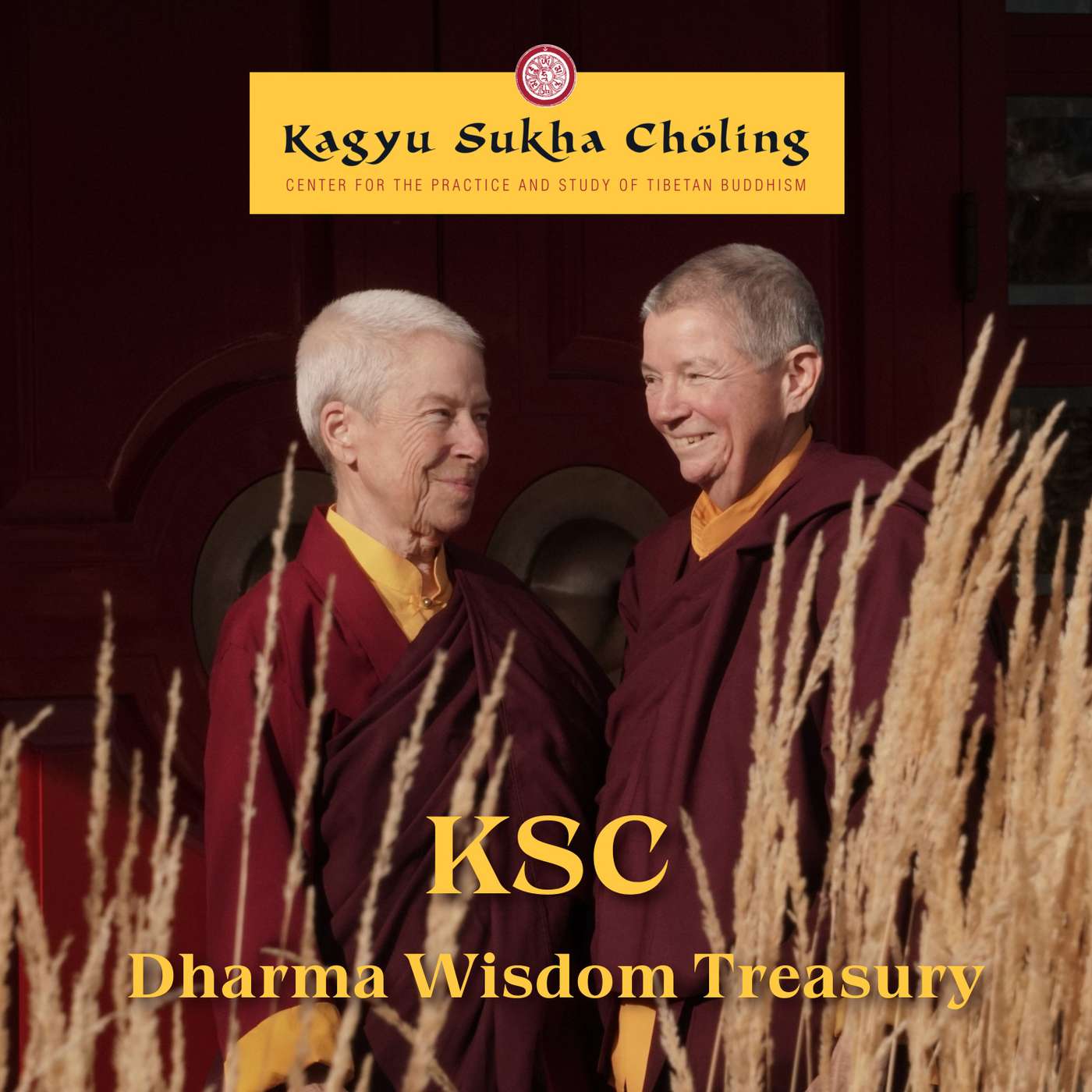
A Living Archive of Kagyu Sukha Chöling's Dharma Teachings with Lamas Yeshe Parke and Pema Clark, The KSC Dharma Wisdom Treasury is the digital home for teachings offered at the KSC Dharma Center in Ashland, Oregon — preserved, restored, and shared for the benefit of all beings. This collection brings together foundational and transformative teachings from KSC's Lamas beginning with "The Three Vehicles of Buddhism". The episodes within each turning: first, second and third, are labeled for continuity. It is suggested to begin with the first episode of the first turning and listen through the second and third in succession.This evolving treasury invites you to deepen your understanding of the Dharma and engage with practices that support a life of compassion, clarity, and awakening.May these teachings be of benefit to your path.
-
19
The Third Turning: Ancient Wisdom for Modern Minds
Lama Yeshe gives an overview the first and second turnings of the Dharma, recalling the Four Noble Truths and the Eightfold Path from the first turning and and the Six Paramitas from the second turning. In preparation for the third turning, she reinforces key teachings of the first two that will lead naturally into the third and final turning of the Dharma.Key Takeways:• **Genuine happiness originates from within the mind, not external circumstances** — Buddhist philosophy teaches that our mental state, rather than our life conditions, determines our well-being, challenging the common assumption that external success brings contentment.• **Mindfulness reveals reality as it actually is, free from our mental projections** — The practice teaches us to observe experience directly rather than through the filter of our interpretations and assumptions, fundamentally changing how we perceive the world.
-
18
From Precepts to Bodhisattva Vows: Building a Spiritual Path That Serves All Beings
Finding Balance Between the Everyday and the InfiniteWhat if ancient Buddhist teachings could help you navigate modern life without forcing you to choose between worldly responsibilities and spiritual depth? That tension sits at the heart of this rich exploration of Buddhist practice and its relevance today.This teaching unpacks the Paramitas, showing how they build progressively from generosity and ethical conduct toward wisdom and understanding emptiness. The Five Precepts, covering commitments around killing, stealing, lying, sexual misconduct, and intoxication, are presented not as restrictions but as serious foundations for lay practitioners who cannot abandon family life.From the first turning to the second turning of the Dharma, the teachings shift meaningfully. In the first turning, teachers serve as precise transmitters of sutras. The second turning introduces a warmer model, where teachers become spiritual friends embodying compassion and altruism. This distinction feels surprisingly relevant for anyone navigating spiritual community today. Bodhicitta, the awakening of heart and mind, becomes central, with bodhisattvas serving as models of selfless service.The Lamas hold both perspectives without conflict, encouraging practitioners to meet daily challenges with integrity while maintaining awareness of interdependence and impermanence. The ego need not dominate our approach to the world.**Listen to this episode** to discover how these layered teachings can genuinely deepen your practice and your life.Key Takeaways:• **The Five Precepts offer a viable spiritual path**. Lay practitioners don't need monastic ordination to accelerate their spiritual journey; combining the Five Precepts with meditation and the Eightfold Path creates genuine transformation within everyday life.• **Two Buddhist traditions emphasize different spiritual ideals**—the first turning prioritizes individual liberation through arhats, while the second turning prioritizes bodhisattvas who delay their own enlightenment to serve all beings, reflecting fundamentally different motivational frameworks.• **Relative and ultimate perspectives can coexist without contradiction**—practitioners can simultaneously navigate daily ethical challenges with integrity while understanding interdependence and emptiness, rather than viewing these as opposing worldviews.
-
17
The Perfection of Wisdom: Seeing Reality as It Truly Is
What does it actually mean to see things as they are rather than as they appear?Prajna, the perfection of wisdom, sits at the heart of this class. Lama Pema introduces three distinct levels of wisdom: mundane wisdom (think everyday social conduct), inner wisdom through Dharma study and meditation, and ultimate wisdom that frees us from dualistic thinking entirely. Each level builds on the last, each level preparing the ground for the next.The Buddha delayed this teaching on emptiness, first establishing impermanence and interdependence as foundations. Without that groundwork, the idea that nothing exists independently or substantially would seem simply outrageous.A striking metaphor emerges: generosity, ethics, patience, diligence, and concentration are the legs of the journey toward enlightenment, while wisdom is our eyesight.Tune in to explore how releasing the burden of maintaining ego might bring unexpected joy.Key Takeaways:**Wisdom has three distinct levels—not just intellectual understanding**: Mundane wisdom (social conduct), inner wisdom (study and meditation), and ultimate wisdom (direct realization of emptiness) are progressively deeper, with only the third level freeing us from aggression and dualistic thinking.**The concept of "self" cannot be found under investigation**: When you examine whether you are your body, mind, or name, this "solid, singular entity" dissolves—and rather than causing distress, this realization brings relief from the exhausting burden of constantly maintaining an ego.**The Buddha strategically withheld emptiness teachings until students were ready**: Some highly realized listeners left in shock when first hearing these radical teachings, and others reportedly had heart attacks, revealing why foundational concepts like impermanence must precede teachings on emptiness.
-
16
Three Types of Diligence: Buddhist Practices for Overcoming Laziness and Finding Lasting Joy
Laziness doesn't stand a chance against the three forms of diligence rooted in Tibetan Buddhist tradition.In this exploration of spiritual practice, Lama Pema how armor-like diligence begins with a profound pledge to practice until all beings achieve awakening (creating mental protection against discouragement). Diligence in action involves overcoming conflicting emotions to develop tranquility, compared to a lion's unshakeable calm in the jungle. The third form manifests through developing virtue and perseverance, encouraging practitioners to respect themselves for engaging in wholesome practice.Drawing on teachings from masters like Trungpa Rinpoche, this teaching explains how meditation addresses a fundamental truth: our thoughts control us, not the reverse. We foolishly seek permanent happiness through temporary forms like material possessions or worldly success, when everything is inherently impermanent. What if the remedy lies simply in recognizing ourselves and the world as they actually are?The practical path involves calm-abiding meditation and regular solitude. Interestingly, solitude need not be elaborate; closing your door for two or three hours creates meaningful time for stabilizing the mind. This mental stability serves as the foundation for genuine compassion toward others.Listen to discover how five minutes of daily meditation can transform your relationship with suffering and happiness.Key Takeaways:• **Diligence has three distinct forms** — it's not just effort, but includes armor-like commitment to others' awakening, emotional mastery through action, and virtuous practice rooted in self-respect, making it a comprehensive spiritual framework rather than simple willpower.• **Material pursuits create a fundamental delusion** — we chase temporary possessions expecting lasting happiness, when understanding impermanence reveals this strategy is inherently doomed, shifting the entire basis of what's worth pursuing.• **Solitude and meditation reduce pride and fear simultaneously** — contrary to the assumption that spiritual practice increases detachment, cultivating transcendent virtues actually makes practitioners more humble and joyful while decreasing the ego defenses that typically isolate us.
-
15
Tonglen and the Courage to Care
How do we remain compassionate when faced with suffering, conflict, or helplessness? In this teaching, Lama Yeshe explores the transformative practice of Tonglen, the Buddhist meditation of breathing in suffering and breathing out relief. Far from being an abstract spiritual exercise, Tonglen offers a practical method for meeting our own pain and others' with openness, courage, and compassion.The teaching examines patience as an antidote to aggression and reactivity, showing how genuine transformation begins when we pause before acting on habitual patterns. Through stories, examples, and guided reflection, listeners are encouraged to move beyond judgment and develop a deeper understanding of the struggles carried by others. Tonglen becomes a way to transform helplessness into meaningful action and compassion into lived experience.The episode also explores diligence, the third paramita, and the obstacles that prevent spiritual growth. From discouragement and attachment to comfort to the busyness that consumes modern life, Lama Pema explains how practitioners can cultivate joyful effort and steady perseverance. Like the patient work of bees and ants, spiritual transformation unfolds gradually—one breath, one moment, and one act of compassion at a time.Key Takeaways:** Tonglen transforms suffering into compassion by teaching us to meet pain with openness rather than resistance.**** Patience begins with the simple act of pausing, creating space between habitual reactions, and wise responses. **** Genuine diligence is joyful effort, not grim discipline, and develops through consistent practice, one step and one breath at a time. **
-
14
Emptiness, Interdependence, and the Art of Patience: Finding Freedom Through Buddhist Practice
Struggling with the emptiness principle? There's no shame in initial confusion. During this teaching session, Lamas Yeshe and Pema emphasize relaxing your mind and gradually building confidence in interdependence. They discuss how everything's dependence on other things reveals lack of solidity. Understanding the three spheres of emptiness (giver, action, and receiver) prevents you from being overwhelmed by suffering. By recognizing Buddha nature in all beings, you develop optimism and avoid being consumed by the illusion that suffering is permanent.The discussion draws on a conversation between the Dalai Lama and Desmond Tutu about maintaining joy amid hardship. One participant shares their struggle with emotional overwhelm while working with opioid addiction cases. The key is balancing "relative bodhicitta"—warmth and care for others' suffering—with "ultimate bodhicitta", which recognizes the potential and non-fixedness of all circumstances.Through shamatha practice and deeper understanding of mind, can you develop freedom from being limited by appearances while remaining compassionate? The Lamas explore patience as a response to aggression, explaining that the true enemy isn't the person causing harm but their uncontrolled anger.For homework, observe aggression in yourself and others, and practice Tonglen meditation (a technique that welcomes suffering and transforms it into kindness).Listen to discover how Buddhist teachings on emptiness and patience can transform your relationship with difficulty.Key Takeaways:• **Confusion about emptiness is a natural starting point, not a failure** — understanding that feeling lost initially is expected and valuable helps practitioners approach this fundamental concept without discouragement or shame.• **True richness comes from within through intentional giving, not accumulation** — practicing generosity with the three spheres of emptiness (giver, action, receiver) reveals that minimalism and detachment create genuine abundance rather than material possessions.• **Patience transforms anger by recognizing emotions as impermanent events, not truths to act upon** — responding to harm with compassion and the courage to reconcile addresses anger at its root rather than through suppression or retaliation.
-
13
The Threefold Purity: Emptiness, Generosity, and Universal Awakening
Understanding Emptiness to Give More FreelyIn Mahayana Buddhism, the paramita practices reach their peak when practitioners grasp a profound truth: the giver, the gift, and the recipient all lack inherent solidity. This "threefold purity" reveals that everything exists through interdependence rather than fixed essence. When you combine this ultimate view of emptiness with relative bodhicitta (the compassionate wish to help others), something remarkable happens—attachment to outcomes dissolves, and resistance to giving simply falls away.Lama Pema uses Mathieu Ricard's rainbow metaphor to illustrate how all phenomena are temporary illusions formed by interdependent causes and conditions. Our bodies, possessions, and relationships included. While all beings are inherently enlightened, they suffer because they don't realize this fundamental truth. (Why do we cling to what's already dissolving?)Here's where it gets practical: even sharing a piece of cake becomes transformative when dedicated to universal awakening. By expanding beyond poverty mentality and recognizing no limitations in giver, recipient, or action, we can dedicate all activities toward establishing all beings in enlightenment. (This prevents spiritual impoverishment, by the way.) This combination of ultimate wisdom and compassionate action allows practitioners to help others more effectively while remaining open, spacious, and free from territorial constraints.Discover how small acts become profound spiritual contributions through understanding interconnectedness.Key Takeaways:• **All beings are already enlightened** — suffering stems not from lack of enlightenment but from failing to recognize the enlightenment that already exists within us.• **Emptiness enables more effective giving** — understanding that the giver, action, and recipient lack fixed essence paradoxically makes compassion more powerful and less constrained by attachment or outcome.• **Small acts become universal** — modest offerings dedicated to all beings' awakening can transcend ordinary limitations and create boundless spiritual benefit through the power of perspective and intention.
-
12
The Paramitas: Unveiling Virtue Through Generosity, Discipline, and Compassion
The Lotus and the Muddy Water: Buddhist Ethics as Natural JoyRarely does a spiritual teaching reframe discipline not as restriction but as a return to simplicity and delight. In this episode, Lama Yeshe unpacks the second of the six paramitas, exploring how ethics in Buddhist practice is less about rigid rules and more about natural, harmonious conduct. The idea is worth sitting with: discipline is a homecoming, a return to what already exists within us.Through vivid examples, including **Trungpa Rinpoche's** teaching on mindfully making tea for a friend, the speaker shows how everyday actions become expressions of ethical, disciplined living. What does it actually mean to act from basic goodness rather than manufacture it? Lama Yeshe draws on the Shaker hymn "Tis a Gift to Be Simple" and the image of a lotus rooted in muddy water yet blooming upward, to illuminate how genuine ethics emerges from recognizing the kindness already within us (not from guilt or self-criticism). Tonglen practice and breath-focused meditation are offered as concrete tools for this path.Because discipline shapes character through balance and humor, this conversation feels both grounded and genuinely encouraging. Come listen and let these teachings land somewhere new.Key Takeaways:• **Discipline isn't about rigid rules—it's mindful attention to ordinary acts** like making tea, revealing that ethical conduct emerges naturally from awareness rather than imposed restrictions.• **The heart's capacity to give is literally unlimited**, symbolized by Tara's vase of generosity, suggesting that constraints on our generosity are mental constructs rather than actual limitations.• **Virtue already exists within us and only needs to be revealed**, not manufactured—meaning authentic ethical action comes from recognizing our inherent goodness rather than striving to become virtuous.
-
11
Opening Your Hand: Generosity as Transformative Practice
Opening Your Hand: Generosity as Transformative PracticeThis teaching reframes how we see everything we own and everything we give. Lama Pema's exploration of generosity, rooted in the Buddhist concept of *dana* (Sanskrit) and *jinpa*(Tibetan), reveals how true giving dissolves the boundary between self and other.What does it really mean to open your hand without expecting anything in return?Simply put, generosity here is not about wealth. The teaching is clear: a poverty mentality blocks spontaneous sharing far more than an empty wallet ever could. Drawing on Chögyam Trungpa's teachings, generosity is described as communication rooted in fundamental goodness, not religious obligation. This shifts everything. Giving becomes an expression of wakefulness rather than duty.The episode moves through three categories of giving: material gifts, offering fearlessness (connecting with our own courage to comfort others), and giving Dharma wisdom directly and authentically, like drinking whiskey "neat" rather than diluted. (That comparison alone is worth the listen.)A friend helping a widow sort through her late husband's possessions sparked a practical "Too Much Stuff" project with Lama Yeshe, asking honestly how many coffee cups any person truly needs. Giving and receiving are both honored here. Tune in to hear this generous, grounded teaching in full.Key Takeaways:• **True generosity doesn't require material wealth**—it's about releasing a "poverty mentality" and recognizing your own fundamental abundance, allowing you to spontaneously share what you have, whether resources or wisdom.• **Generosity includes three distinct forms: material gifts, giving fearlessness through courage and compassion, and offering authentic spiritual teachings**—each carries equal importance and transforms both giver and receiver.• **Wise giving requires discernment and understanding the recipient**—sometimes refusing a gift or offering "firmness" is the most generous act if it prevents enabling harmful behavior or ensures the gift truly serves long-term wellbeing.
-
10
Bodhicitta: Awakening the Heart to Compassion and Enlightenment
Bodhicitta: Awakening the Heart to Compassion and EnlightenmentEver wondered what happens when you stop running from your pain and actually turn toward it?At Vulture Peak in North-central India, the Buddha delivered teachings that would reshape spiritual practice forever. These profound instructions, known as the Prajnaparamita Sutras, form the foundation of Mahayana Buddhism and center on two essential qualities: transcendent wisdom and compassion. Lama Pema breaks down complex concepts like emptiness (shunyata) using everyday examples—like examining a watch to discover there's no fundamental "watchness" when you separate its parts. This isn't nihilism; it's recognizing that nothing exists independently, which actually reveals how deeply connected everything truly is.(Nagarjuna warned that grasping emptiness incorrectly is like seizing a poisonous snake.)The practical heart of these teachings lies in Tonglen meditation, a radical practice where you intentionally welcome your suffering into your heart, then offer yourself joy and strength in return. Lama Yeshe assigns homework: practice this self-directed generosity meditation three times weekly, working with your own difficulties for brief periods. By treating ourselves seriously, by treating our suffering with genuine compassion, we become better equipped to help others.Through recognizing that all beings share the same fundamental desire to be happy and free from suffering, we shift toward equality and authentic connection.Discover how contemplative practice creates ripples of benefit extending far beyond this moment.Key Takeaways:• **Embracing pain enables compassion** — Rather than avoiding suffering, Buddhist practice teaches that acknowledging our own vulnerability and pain is essential to genuinely connecting with and understanding others' suffering.• **Emptiness reveals interdependence** — Understanding that nothing exists independently or permanently paradoxically shows us profound interconnectedness with all beings, transcending the illusion of separation.• **Generosity overcomes scarcity mindset** — Simple acts of giving aren't just moral acts; they actively dissolve the internal belief in poverty and limitation, cultivating authentic kindness from within.
-
9
From Personal Liberation to Universal Compassion
Two Vehicles: From Personal Liberation to Universal CompassionSurprisingly, recognizing that your "self" isn't solid or consistent can actually make your spiritual journey easier, not harder. This episode explores how breath connects directly to mental state and introduces a Buddhist framework that values multiple spiritual paths—all leading toward the same destination of enlightenment.Lamas Pema and Yeshe walk through three distinct vehicles of practice. The first vehicle tackles personal liberation by understanding what causes your suffering and training your mind through calm abiding meditation. (You'll discover the seemingly unchanging self is actually empty of independence.) The second vehicle expands this work outward, adding compassion for all beings and investigating whether anything in reality is truly permanent or independent—spoiler: it isn't. The Lamas explain how detachment doesn't mean indifference but rather the ability to pause before reacting, which gradually reduces self-centered desires and their power over you.Using the metaphor of dreaming, they illustrate how everyday experiences feel tangible yet deeper investigation reveals nothing possesses lasting solidity. What makes phenomena truly solid and independent? Through loving kindness and philosophical inquiry, practitioners repeatedly awaken to reality's dreamlike, insubstantial nature, creating genuine liberation beyond just restraint and discipline.Key Takeaways: • **The self is not fixed but constantly changing and fundamentally empty** — challenging the common assumption that we have a solid, permanent identity that needs protecting.• **Compassion and liberation are interconnected practices** — rather than personal enlightenment being separate from helping others, genuine spiritual progress requires expanding awareness to all beings' suffering.• **Direct experience trumps intellectual understanding** — philosophical knowledge about reality's illusory nature only creates transformation when realized through lived practice, not just conceptual learning.
-
8
Buddhism's Path from Individual Practice to Bodhisattva Awakening
Buddhism's Path from Individual Practice to Bodhisattva AwakeningThis exploration of Buddhist practice reveals how meditation isn't just relaxation—it's the primary tool for training your mind toward genuine freedom. The teachings move from the Eightfold Path's foundation in mindfulness and ethical conduct through to the revolutionary Mahayana perspective, which emphasizes working for the benefit of all beings rather than just personal liberation.Here's what stands out: the three marks of existence (impermanence, suffering, and "egolessness" or "not-self") aren't abstract concepts but observable truths in your direct experience. Lama Yeshe explains how within milliseconds of sensory contact, feelings arise and mature into attachments, showing us exactly how we construct our reality through mental projections. Through practices like Calm Abiding meditation—just five minutes, three times weekly—you can observe this process yourself.The bodhisattva path takes things further, developing what's called *bodhicitta*, an awakened heart committed to all beings. Drawing on Trungpa Rinpoche's teachings, the Lama emphasizes cultivating affection for the world and facing discomfort with bravery rather than constantly pursuing comfort (which they describe as cowardly). True compassion operates from equality, not pity.The twelve links of interdependent origination illustrate how ignorance perpetuates suffering, yet through awareness, you can interrupt these patterns.Listen to discover how your practice benefits not just yourself but all beings.Key Takeaways:• **Mental constructs actively create suffering** — Rather than suffering being external, Buddhist practice reveals how our own thought patterns and interpretations generate distress, which can be interrupted through direct observation.• **Individual liberation and universal compassion are connected** — Ego reduction and self-discipline practices aren't selfish; they form the foundation for Mahayana Buddhism's Bodhisattva commitment to benefit all beings.• **Non-aggressive awareness is a path to enlightenment** — Buddhist practice emphasizes cultivating affection and gentleness toward the world rather than forceful striving, contrasting with more combative approaches to self-improvement.
-
7
From Prince to Awakening: Understanding Suffering and Finding Freedom Through Buddhist Practice
From Prince to Awakening: Understanding Suffering and Finding Freedom Through Buddhist PracticeEncountering death for the first time can completely reshape your worldview. That's exactly what happened to a sheltered prince in ancient India, setting him on a path that would eventually impact millions. This session welcomes both longtime practitioners and newcomers to explore how Buddhist teachings remain surprisingly relevant today—not just for monks, but for anyone navigating modern life's challenges.Lama Yeshe introduces foundational Buddhist concepts through the story of Prince Siddhartha, who abandoned his privileged existence after witnessing suffering. After years of extreme practices (which didn't work, by the way), he discovered the Middle Way—a balanced approach between self-indulgence and self-denial. Over forty-five years of teaching, the Buddha emphasized that all beings possess inner tools for transcendence.**What makes desire both a problem and a potential path to awakening?** The Four Noble Truths address this paradox: suffering exists; it stems from craving permanent happiness in an impermanent world. However, it can cease, and the Eightfold Path offers practical guidance. Rather than moral absolutes, these teachings encourage examining whether our actions genuinely benefit ourselves and others.• **Desire itself isn't the problem—attachment to permanence is.** Buddhism doesn't reject wanting things, but rather our expectation that happiness from those things will last forever in a constantly changing world.• **The Buddha's enlightenment was triggered by encountering suffering, not avoiding it.** His spiritual awakening came from directly confronting pain rather than remaining sheltered, suggesting difficulty can be a gateway to wisdom.• **Mental training, not external circumstances, is the primary tool for reducing suffering.** Rather than fixing outside situations, Buddhist practice emphasizes developing resilience and clarity through meditation and mindfulness to transform how we experience life.
-
6
Breaking the Wheel: Ancient Buddhist Wisdom for Modern Suffering
Breaking the Wheel: Ancient Buddhist Wisdom for Modern SufferingWhat if the path to freedom from suffering lies in recognizing a single moment before you reach for what you crave?This deep dive into Tibetan Buddhist iconography reveals how the Wheel of Life—held by Yama, the Lord of Death—maps our psychological patterns with startling precision. The twelve interdependent links trace a chain reaction beginning with ignorance, flowing through craving and clinging, ultimately binding us to cycles of suffering. (These aren't just abstract concepts, by the way.) The six realms manifest in everyday experience: jealousy among anti-gods, insatiable hunger in the spirit realm, and the endless grasping of modern abundance in contrast to the god realm's effortless satisfaction.Here's the revolutionary insight: at step nine, the moment of grasping becomes the critical juncture where conscious awareness allows us to halt destructive patterns. Rather than being passive victims, we actively script our existence through choices we make at these pivot points. The Buddha's original teachings democratized this knowledge, rejecting authority and official religious language in favor of direct personal experience—a pragmatic, therapeutic approach to ending suffering that remains accessible today.By recognizing harmful patterns before, during, or after they occur, we create space for wisdom and transformation.Listen to discover how ancient Buddhist psychology offers practical tools for breaking cycles of suffering in your own life.Key Takeaways:• **The six realms aren't literal afterlife destinations—they're psychological states you experience daily** (godly pride, animal instinct, hellish anger) rather than separate planes of existence.• **Step nine (grasping) is where you can actually break the cycle**, making it the practical intervention point rather than being trapped in an inevitable chain from birth to death.• **Ignorance at the chain's beginning isn't stupidity but misunderstanding interdependence**—the root cause of suffering is fundamentally about how we perceive reality's interconnected nature, not lack of information.
-
5
Breath, Impermanence, and the Art of Letting Go: Finding Peace Through Acceptance
Breath, Impermanence, and the Art of Letting Go: Finding Peace Through AcceptanceSurprisingly, the biggest obstacle in meditation isn't your racing thoughts—it's what you do with them afterward. This foundational practice reveals how elaborating on thoughts, not the thoughts themselves, creates suffering. Through breath awareness, you'll learn to observe without clinging, developing equanimity and mental clarity that won't diminish your ability to connect meaningfully with others.This session explores the three marks of existence, particularly impermanence. Using examples from a stubborn tire pressure light to the death of a beloved dog named Frida at Buckhorn Springs, Lama Pema illustrates how recognizing impermanence reduces suffering. (Even well-made watches eventually fail!) By practicing mindfulness of body, feelings, mind, and phenomena, you'll discover that our habitual interpretations color everything we experience. Listen to explore Buddha nature, wisdom clinging versus neurotic attachment, and why awareness itself is unchanging even as everything else transforms.Key Takeaways:• **Meditation obstacles stem from elaborating on thoughts, not from having thoughts themselves** — the problem isn't the thoughts but how we react to them, making the practice more about restraint than suppression.• **Accepting impermanence actively reduces suffering** — recognizing that all things (objects, relationships, experiences) are transitory paradoxically deepens our commitment and connection rather than diminishing it.• **Mindfulness of body, feelings, mind and phenomena bring us more into harmony with the marks of existence** — This aligns us more closely with reality, so that we can meet our challenges with more strength, courage, humor and connection with the common experience we have with fellow beings.
-
4
Anchored in the Body: Mindfulness Through Physical Sensation
Anchored in the Body: Mindfulness Through Physical SensationDiscovering calm begins with something surprisingly simple: paying attention to your body. This episode unpacks the foundational practice of mindfulness of the body, revealing how tuning into physical sensations can transform your meditation practice and daily life.Lama Pema dives into specific techniques—breathing awareness, noticing tension, tracking movement—that help practitioners develop present-moment awareness. By focusing on bodily experiences, you're essentially creating a bridge between mental and physical wellness. (It's like giving your mind an anchor it can actually feel.) This embodied approach offers something concrete to work with, making sustained attention more accessible than you might expect.What happens when you truly notice the physical sensations you've been ignoring all day? The discussion emphasizes how this practice cultivates deeper self-awareness and emotional regulation, giving you tools that extend far beyond the meditation cushion.Through present-moment awareness of physical sensations, practitioners gain a tangible entry point into inner peace. This isn't just about sitting still, it's about understanding how your body holds valuable information about your inner state. The approach to mindfulness explored here demonstrates that embodied awareness creates pathways to emotional regulation and sustained attention.Key Takeaways:• **The body is the primary gateway to meditation** — Rather than starting with abstract mental focus, anchoring awareness in physical sensations (breathing, tension, movement) provides a concrete, accessible entry point that makes sustained attention easier to develop.• **Bodily awareness directly regulates emotions** — Tuning into physical sensations doesn't just complement emotional regulation; it actively creates it, bridging what many assume are separate mental and physical processes into one integrated system.• **Present-moment body awareness creates measurable inner peace** — The podcast suggests that simply noticing physical sensations in real-time, rather than thinking about them, is sufficient to produce genuine calm and self-awareness without requiring additional techniques.
-
3
The Three Feeling Tones: How Mindfulness Breaks the Cycle of Suffering
The Three Feeling Tones: How Mindfulness Breaks the Cycle of SufferingHave you ever wondered why you can't shake that fear even when you're experiencing something pleasant? This teaching explores a startling Buddhist insight: suffering actually underlies all three primitive feeling tones—pleasure, pain, and indifference. Pleasure carries the fear of loss, pain creates aversion, and neutrality (which is actually quite rare) often masks discomfort or numbness.Lama Yeshe guides participants through mindfulness of feelings, building on earlier teachings about body awareness. Through a body scan meditation, listeners learn to observe sensations without attachment, witnessing how feelings naturally arise, persist briefly, and fade away.Here's where it gets interesting: by catching these primitive sensations *before* they mature into complex emotions, we create space for personal intervention. The Buddha taught there's a critical moment before emotions fully develop where we actually have more choice than we realize. The speaker assigns practical homework—mindfully witness pleasurable and unpleasant sensations as they arise, observing the feeling itself before thought labels it.**Listen to discover how this ancient practice can transform your relationship with pleasure, pain, and everything in between.**Key Takeaways:• **Pleasure inherently contains suffering** — The fear of losing pleasurable experiences is built into the sensation itself, meaning even positive feelings carry an underlying layer of distress we typically don't recognize.• **Neutrality is not peaceful** — What feels like indifference or emotional numbness actually masks discomfort; true neutral states require active mindful awareness to experience without suffering.• **There's a critical gap between sensation and emotion** — Complex emotions aren't automatic responses to bodily sensations; mindful awareness creates a choice point where we can interrupt conditioned reactions before they become emotional patterns.
-
2
Embodied Awareness: From Breath to Being Present in Life
Embodied Awareness: From Breath to Being Present in LifeThis practice isn't about chasing mystical visions or philosophical rabbit holes. Lama Pema guides participants through breath-focused meditation, emphasizing that our identity is deeply connected to our bodies—yet we routinely ignore our sensorial experiences. (It's remarkable how disconnected we can become from something so fundamental.)The real power lies in *mindfulness*—conscious awareness of experience without judgment or conceptual overlay. Through practical exercises like body scans and mindful eating, we deepen our sensory awareness. This isn't about withdrawing from life. This heightened presence allows our behavior to become increasingly responsive and conscious, grounded in direct personal experience rather than mental narratives.Listen to discover how embodied attention transforms everyday moments into genuine spiritual practice.Key Takeaways• **Mystical experiences aren't the goal—everyday sensory awareness is what matters spiritually.** Rather than chasing visions or altered states, true dharma practice involves deeply attending to ordinary moments like breathing and eating through embodied mindfulness.• **Vivid meditation experiences (colors, patterns) can actually be distractions.** Lama Pema cautions that these phenomena may indicate either mental distraction or dullness, and should be observed without attachment rather than pursued or analyzed.• **Mindfulness keeps you grounded in reality rather than lost in abstract thought.** Anchoring awareness in direct bodily sensations and present-moment experience prevents the mind from spinning into conceptual narratives and philosophical abstractions, making practice genuinely transformative.
-
1
The Five Skandhas and Mara: Understanding the Forces That Keep Us Stuck
The Five Skandhas and Mara: Understanding the Forces That Keep Us StuckThe Buddha's encounter with Mara wasn't just ancient mythology. According to Buddhist scholar Stephen Batchelor, Mara represents something we all face: reactivity itself. What if the obstacles blocking your awakening are actually showing you the path forward?The Buddha taught that we're composed of five skandhas—form, feeling, perception, concepts, and consciousness—which create the illusion of a permanent self. (We're actually just constantly changing processes.) Through examining these aggregates directly in your own experience, you can discover whether a solid, lasting self actually exists. The skandha tricks us into believing we're fixed identities that cannot change, while the "klesha" mara turns our emotions into afflictions we suppress rather than investigate.Here's the paradox: we fear death yet simultaneously rush to escape each present moment, seeking its "death." We cling desperately to pleasurable experiences, trying to recreate blissful meditation states.After completing a three-year retreat, one practitioner described how the world takes on "a lighter touch", suggesting that spiritual practice doesn't bring transcendence but rather a more relaxed, compassionate way of moving through life.Mindfulness creates pause between stimulus and response, interrupting reactivity and revealing glimpses of freedom.Listen to discover how understanding these obstacles transforms them into vehicles for awakening.Key Takeaways• **Mara isn't a demon but personified reactivity** — The traditional Buddhist "evil force" is actually your own habitual patterns and emotional reactions, not an external supernatural obstacle.• **Afflictions become awakening tools** — Rather than suppressing negative emotions, you transform them into catalysts for enlightenment through direct investigation and awareness.• **No permanent self exists** — What we experience as "I" is only constantly changing processes across the five skandhas, meaning the ego we defend is ultimately an illusion.
-
0
Buddhism's Path to Fearlessness and Freedom
Buddhism's Path to Fearlessness and Freedom**Can you really find a permanent self anywhere inside yourself?** This episode unpacks how Buddhist wisdom challenges our most fundamental assumptions about who we are.The Four Noble Truths aren't just philosophy (they're actually a practical toolkit for daily life). The speaker walks through how these ancient teachings shift our focus from self-concern toward recognizing universal suffering, while the Eightfold Path offers concrete methods for taming our restless minds through right speech, action, and livelihood. Like Buddha himself, who taught for 45 years, the message here is clear: experiment with these practices and keep only what actually works for you.Through the Three Marks of Existence—impermanence, suffering, and egolessness—the episode reveals how everything constantly changes, including ourselves. Drawing on poet Jane Hirshfield's insight that "Everything is connected. Everything changes. Pay attention," the speaker emphasizes that **mindful observation** helps us spot where our beliefs clash with reality. When we examine what we think defines us, we discover these characteristics aren't permanent at all.Meditation emerges as the training ground for fearlessness, teaching us to observe thoughts without attachment and awaken from ignorance.Tune in to discover how these timeless teachings can transform your relationship with yourself and the world around you.Key Takeaways:• **The self is not fixed but constantly changing** — contrary to our intuitive belief in a permanent identity, Buddhism teaches that we're composed of interconnected causes and conditions, meaning our core characteristics and beliefs are impermanent and can be consciously chosen or changed.• **Suffering stems from resisting impermanence** — the discomfort we experience comes from trying to create permanence in a universe where everything inherently changes, so accepting transience can paradoxically inspire hope rather than despair.• **Buddhism requires personal experimentation, not blind faith** — the teachings only become meaningful through direct personal experience and testing; even Buddha encouraged practitioners to discard what doesn't work for them rather than accepting doctrine passively.
-
-1
The Eightfold Path: Ethics, Meditation, and Liberation Through Mindful Awareness
The Eightfold Path: Ethics, Meditation, and Liberation Through Mindful AwarenessIn this episode, Lama Yeshe Parke unpacks the fourth noble truth and the eightfold path, revealing something unexpected about spiritual communication.The discussion moves beyond theory into practical territory. (You'll hear about watching mainstream American news as a meditation assignment.) Lama Yeshe explains how ethical conduct isn't about judging ourselves but observing our actual speech and actions, then deliberately choosing constructive behaviors. Three specific aspects of right speech get attention: speaking truthfully, directly, and at appropriate times while avoiding gossip and discord.Addressing compassion fatigue, Lama Yeshe introduces the concept of grief as the "near enemy of compassion"—when the gap between suffering we witness and our ability to help becomes overwhelming. The recommendation? Step back with self-compassion rather than burning out completely.Throughout the episode, impermanence emerges as a central teaching. Everything from caterpillars to friendships eventually dissolves, yet we instinctively resist this reality. **Our suffering arises not from impermanence itself, but from our denial of it.** Lama Yeshe stresses that Buddhist teachings aren't mandatory rules but concepts to test personally for validity, just as the Buddha himself taught.Listen to discover how meditative practice extends beyond formal sitting into daily life, transforming reactivity into awareness.Key Takeaways:• **Ethics precedes meditation** — Buddhist practice doesn't start with sitting quietly; it requires honest self-observation and deliberate ethical choices that benefit others first, creating the foundation for meditation to work.• **Freedom is internal, not circumstantial** — Liberation comes from escaping mental imprisonment through practice, not from changing external life circumstances, meaning your suffering's solution lies within your own mind.• **Small gaps of peace compound** — Regular meditation practice gradually creates moments of mental stillness that accumulate over time, progressively transforming the mind into something fundamentally calmer and more compassionate rather than requiring dramatic overnight change.
-
-2
The Four Noble Truths: Buddhist Wisdom for Understanding Suffering and Finding True Freedom
The Four Noble Truths: Buddhist Wisdom for Understanding Suffering and Finding True FreedomWhat if the path to happiness isn't about getting what you want, but about changing how you want?In Buddhist teaching, the Four Noble Truths reveal that suffering stems from seeking permanent happiness in temporary external things. (This might sound abstract, but it's actually deeply practical.) The Buddha investigated this suffering thoroughly and offered testable perspectives that ennoble those who practice them. While ordinary desires for food and shelter are natural, excessive craving and self-centeredness create afflictive emotions like anger, jealousy, and shame.Here's where things get interesting: the third truth promises that suffering can actually cease through genuine happiness independent of external conditions. The Eightfold Path provides practical guidance for this transformation, starting with higher training in ethics. This training emphasizes that our actions matter—that our actions truly matter—and encourages developing moral sensitivity by moving beyond ego-orientation.Through daily observation of how our behavior affects others, practitioners address the three poisons: aversion, greed, and ignorance. By avoiding destructive behaviors like killing, stealing, and breaking commitments, we naturally cultivate their opposites: preserving life, practicing generosity, and honoring vows.This inquiry cultivates personal integrity and intellectual honesty while revealing our inherent *nobility* in confronting life's difficulties. **Listen to discover how these ancient teachings offer freedom through transforming your relationship with desire itself.**Key Takeaways:• **Happiness is primarily determined by our mental response to circumstances, not external conditions themselves** — meaning two people in identical situations can experience vastly different levels of well-being based on how they mentally engage with those circumstances.• **Excessive craving and self-centeredness, rather than normal desires, are the actual sources of suffering** — the Buddha distinguishes between natural needs (food, shelter, relationships) and the problematic attachment to permanent external happiness that generates afflictive emotions.• **Ethical training works through observation and awareness rather than judgment** — practitioners simply notice how their actions affect others without self-condemnation, which naturally cultivates compassion and the opposites of destructive tendencies (greed, aversion, ignorance) rather than forcing moral compliance.
-
-3
Introducing The Four Noble Truths: Practical Tools for Reducing Everyday Suffering
Facing Suffering: The Buddha's Practical Path to FreedomWhat if the key to reducing your suffering lies not in fixing your circumstances but in transforming how you respond to them?The Buddha's Four Noble Truths aren't abstract philosophy—they're practical tools for examining how we live and choosing less harmful ways of thinking and acting. This isn't about passive acceptance. Through honest self-examination and trusted relationships, we can illuminate patterns we typically overlook in our daily experience. Suffering appears in subtle forms: disappointment, longing, anxiety, and aging. According to Buddhist teachings, it stems fundamentally from fear—particularly the fear of losing what we value. The Buddha taught three categories: all-pervasive suffering (that constant, barely noticed tension), the suffering of change (when circumstances shift unexpectedly), and the suffering of suffering (when problems compound).By developing wisdom through understanding our pain, we gain power to transform our experience. We perpetually chase permanent happiness in an impermanent world, but recognizing our inner responses—not just external events—gives us genuine choice. Through mindfulness and meditation practice, we learn to witness our reactions without judgment, cultivating compassion for ourselves and all beings who share similar struggles.Listen to discover how self-awareness becomes your path to freedom.Key Takeaways:• **Acknowledging suffering creates freedom** — Paradoxically, directly confronting pain and disappointment rather than avoiding them is the gateway to transformation and liberation, not a path deeper into despair.• **Suffering originates internally, not externally** — Our distress comes from our attachments and habitual reactions to circumstances, not from the circumstances themselves, meaning we have more control than we typically believe.• **Mindfulness reveals choice where we thought there was none** — By observing our patterns through honest self-reflection, we discover we can interrupt automatic responses and consciously choose how to react, fundamentally empowering our agency.
-
-4
The Life of the Buddha: Origins, Historical Context, and the Middle Way
The Buddha's Journey: From Palace to EnlightenmentWhat drives a prince to abandon everything? Born in 563 BCE into India's warrior-administrator caste, Prince Siddhartha lived a life of extraordinary privilege—educated, healthy, and deliberately shielded from suffering by his protective father. At twenty-nine years old, however, he encountered disease, death, and human aging for the first time, experiences that shattered his carefully constructed world.This unexpected confrontation with suffering launched an obsessive quest that would transform not just one man, but millions across centuries. Siddhartha studied with renowned teachers, mastered yoga and metaphysics, and practiced extreme asceticism with companions. Yet neither indulgence nor deprivation provided answers (a realization that came only after pushing his body to its limits).Through meditation and self-reflection, he discovered the Middle Way—a balanced path between excess and asceticism that emphasizes both worldly participation and discipline. For forty-five years, the Buddha shared these teachings, known as Dharma, with everyone regardless of caste, wealth, or gender. Before his death, he refused to name a successor, instead urging practitioners to rely on themselves, the teachings, and their Sangha—the community of fellow seekers.*The First Turning of the Wheel*, delivered at Deer Park in Sarnath, introduced foundational concepts including the Four Noble Truths and practices like shamatha and vipassana meditation designed to lessen attachment to self.Discover how ancient wisdom offers practical tools for understanding suffering today.KEY TAKEAWAYS:• **Buddha rejected both luxury and extreme self-denial** – Rather than choosing between indulgence and harsh asceticism, he discovered the "Middle Way," showing that spiritual enlightenment doesn't require suffering or material deprivation.• **His teachings were radically inclusive for ancient times** – Buddha welcomed followers of all castes and social classes, directly challenging the rigid hierarchical systems of his era by emphasizing that anyone could achieve enlightenment through their own effort.• **He emphasized self-reliance over blind faith** – Unlike many spiritual traditions, Buddha encouraged practitioners to test teachings through personal experience and critical inquiry rather than accepting them on authority alone.
We're indexing this podcast's transcripts for the first time — this can take a minute or two. We'll show results as soon as they're ready.
No matches for "" in this podcast's transcripts.
No topics indexed yet for this podcast.
Loading reviews...
ABOUT THIS SHOW
A Living Archive of Kagyu Sukha Chöling's Dharma Teachings with Lamas Yeshe Parke and Pema Clark, The KSC Dharma Wisdom Treasury is the digital home for teachings offered at the KSC Dharma Center in Ashland, Oregon — preserved, restored, and shared for the benefit of all beings. This collection brings together foundational and transformative teachings from KSC's Lamas beginning with "The Three Vehicles of Buddhism". The episodes within each turning: first, second and third, are labeled for continuity. It is suggested to begin with the first episode of the first turning and listen through the second and third in succession.This evolving treasury invites you to deepen your understanding of the Dharma and engage with practices that support a life of compassion, clarity, and awakening.May these teachings be of benefit to your path.
HOSTED BY
Kagyu Sukha Chöling
CATEGORIES
Loading similar podcasts...
Frequently Asked Questions
How many episodes does KSC Dharma Wisdom Treasury - The Three Vehicles of Buddhism: The First Turning have?
KSC Dharma Wisdom Treasury - The Three Vehicles of Buddhism: The First Turning currently has 24 episodes available on PodParley. New episodes are automatically indexed when they're published to the podcast feed.
What is KSC Dharma Wisdom Treasury - The Three Vehicles of Buddhism: The First Turning about?
A Living Archive of Kagyu Sukha Chöling's Dharma Teachings with Lamas Yeshe Parke and Pema Clark, The KSC Dharma Wisdom Treasury is the digital home for teachings offered at the KSC Dharma Center in Ashland, Oregon — preserved, restored, and shared for the benefit of all beings. This collection...
How often does KSC Dharma Wisdom Treasury - The Three Vehicles of Buddhism: The First Turning release new episodes?
KSC Dharma Wisdom Treasury - The Three Vehicles of Buddhism: The First Turning has 24 episodes. Check the episode list to see recent publication dates and frequency.
Where can I listen to KSC Dharma Wisdom Treasury - The Three Vehicles of Buddhism: The First Turning?
You can listen to KSC Dharma Wisdom Treasury - The Three Vehicles of Buddhism: The First Turning on PodParley by clicking any episode. We provide an embedded audio player for direct listening, and you can also subscribe via your preferred podcast app using the RSS feed.
Who hosts KSC Dharma Wisdom Treasury - The Three Vehicles of Buddhism: The First Turning?
KSC Dharma Wisdom Treasury - The Three Vehicles of Buddhism: The First Turning is created and hosted by Kagyu Sukha Chöling.
URL copied to clipboard!