
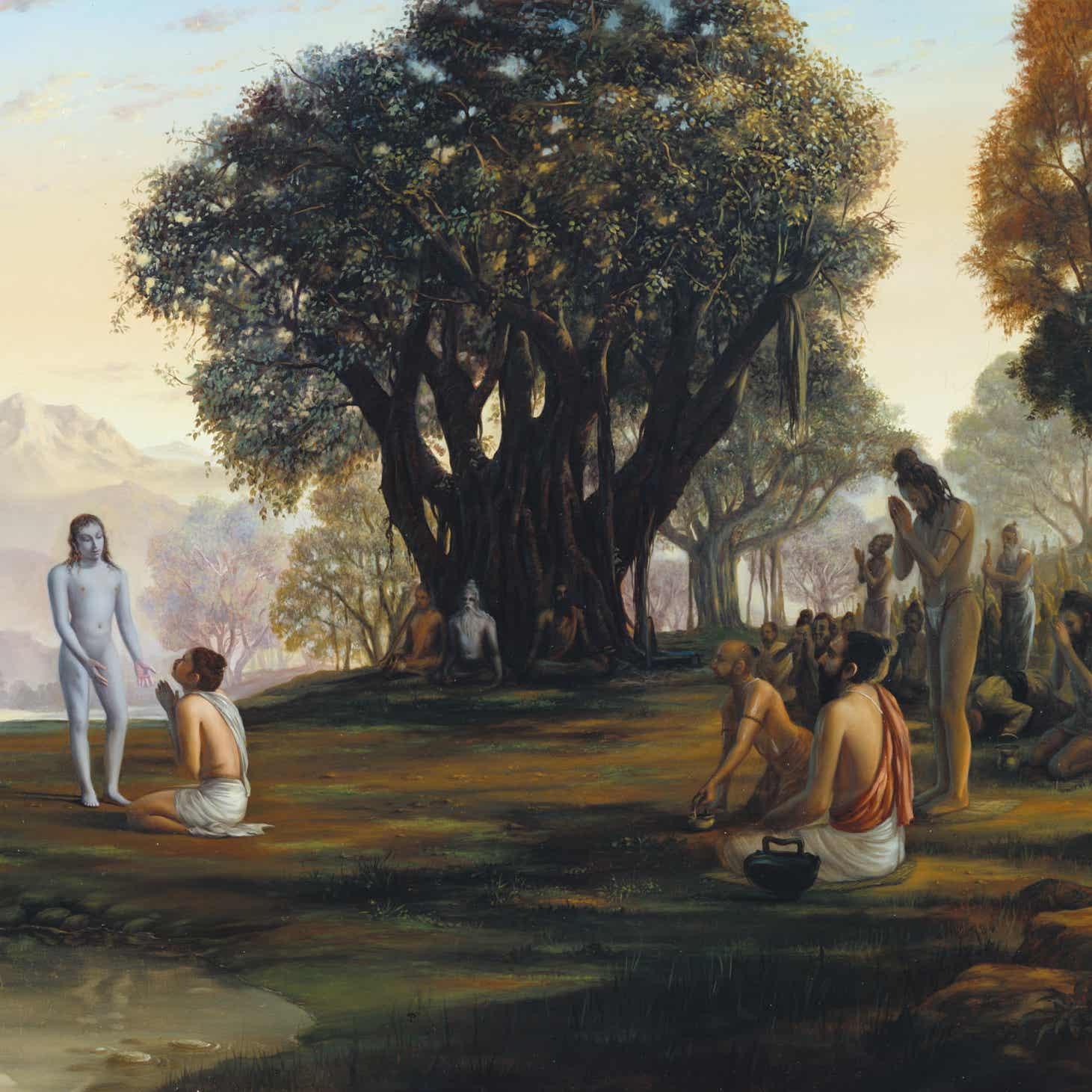
PODCAST · religion
Mysteries of the Vedas
by Caitanya Chandra Dasa
Deep insights and explanations on the Srimad Bhagavatam, Bhagavad-Gita, Vedanta-sutra, Upanisads, and other books that are part of the Vedas. www.ccdas.net
-
130
The lifestyle and opulence of the inhabitants of Jambūdvīpa (5th Canto #18)
The lifestyle and opulence of the inhabitants of Jambūdvīpa “On the side of Supārśva Mountain stands a big tree called Mahākadamba, which is very celebrated. From the hollows of this tree flow five rivers of honey, each about five vyāmas wide. This flowing honey falls incessantly from the top of Supārśva Mountain and flows all around Ilāvṛta-varṣa, beginning from the western side. Thus the whole land is saturated with the pleasing fragrance. The air carrying the scent from the mouths of those who drink that honey perfumes the land for a hundred yojanas around.” (SB 5.16.22-23)To the west, a complex of five rivers of celestial honey flows from the great kadamba tree situated on top of Supārśva Mountain. These five rivers flow around the whole Ilāvṛta-varṣa. The special characteristic of this honey is a very pleasing fragrance that perfumes not only the environment, but also the bodies of the inhabitants of these places. Instead of depending on artificial perfumes and cosmetics, they maintain their beauty in attractiveness by simply consuming the products of their celestial abode. “Similarly, on Kumuda Mountain there is a great banyan tree, which is called Śatavalśa because it has a hundred main branches. From those branches come many roots, from which many rivers are flowing. These rivers flow down from the top of the mountain to the northern side of Ilāvṛta-varṣa for the benefit of those who live there. Because of these flowing rivers, all the people have ample supplies of milk, yogurt, honey, clarified butter [ghee], molasses, food grains, clothes, bedding, sitting places and ornaments. All the objects they desire are sufficiently supplied for their prosperity, and therefore they are very happy.” (SB 5.16.24)The great banyan tree on top of Kumuda Mountain is the source of many rivers, which are described as “kāma-dughāḥ” (fulfilling all desires). The verse lists a long list of desirable items (milk, yogurt, honey, ghee, molasses, grains, clothing, bedding, seats, ornaments, etc.) that are directly connected with these rivers. This appears to indicate that these rivers are the direct source of all these objects, which are supplied for the happiness and prosperity of the inhabitants of Ilāvṛta-varṣa. In other words, these rivers are like kalpa-vṛkṣa trees that supply everything desirable. In this way, no one there has to work to obtain all the necessities of life… Get full access to Mysteries of the Vedas (Caitanya Chandra Dasa) at www.ccdas.net/subscribe
-
129
When service becomes too much
👆 I’m testing a new feature: an audio version of the article you can listen to. This is not an AI voice; it’s me reading the article and sometimes adding something. If you find it useful and would like to see it in other articles, leave a comment sharing your experience. Thanks! 🕉You can receive new articles directly in your inbox. Subscription is free; donations are welcome.Burnout is a problem that affects many devotees. It can lead to many negative symptoms, like irritation and impatience, headaches and other physical discomfort, depression, low self-esteem, and a feeling of impotence against what appear to be mounting and insurmountable difficulties. This physical and mental exhaustion leads to mechanical hearing and chanting, which can undermine the very foundation of our spiritual practice. It doesn’t really count when the body is there, but the mind is somewhere else.Once the foundation is impacted, other symptoms can appear, such as irritation, harsh speech, fault-finding, cynicism, and so on. Eventually, all of this combined can lead a devotee to conclude that he or she simply can’t continue, and that’s where many end up leaving the association of devotees or even spiritual practice altogether. It’s not difficult to understand why: in this case, instead of bringing bliss, spiritual practice registers in the mind as a painful experience, and even if one is very determined in the beginning, time makes the mind reject it. Once one stops, it is difficult to go back. Interestingly enough, devotees are, in general, more susceptible to burnout than regular people because we frequently have to combine our regular material obligations with work and family with our spiritual practice and service. It is easy to tell others that we need to be attentive while hearing and chanting, that we should be present, and so on. We all understand that. The question is that all of this demands energy, and it may be difficult to muster it after a journey of 16 hours of work, commuting, family problems, and other forms of pressure. Often, the pressure for being present, which is generally good advice, just adds to the problem. Ironically, the more a devotee is serious and determined to do more in spiritual life, the more he or she becomes susceptible to developing burnout. A devotee who wants to be serious in his spiritual practice frequently has to add 20 or even 30 hours of practice and service on top of responsibilities with work and family. This includes japa, listening to classes, online meetings with devotees, temple activities, book distribution, etc. For example, many devotees participate in weekend warrior programs, distributing books on weekends, often on both Saturday and Sunday. All included (commuting, organization, the distribution itself, and some meeting afterward), this may equal 16 hours of extra service per week. If one is the organizer, it can be more. Add this to 21 hours of weekly spiritual practice (japa, classes, etc.), 10 hours of temple and home programs, plus 40 hours of a regular job, 12 hours of commuting to work, 14 hours spent with family, etc. All of this under the pressure of being present and doing everything attentively. Is it even humanly possible? That’s exactly the point. Many devotees are not exactly “human” in the ordinary sense. They are in the stage of bhāva (if not beyond), impervious to the limitations of the material body and mind. One who is on such a high platform may effectively be able to maintain such a rhythm. The problem starts when it comes to regular mortals like us. In the Gītā (6.16-17), Kṛṣṇa directly alerts:“There is no possibility of one’s becoming a yogī, O Arjuna, if one eats too much or eats too little, sleeps too much or does not sleep enough. He who is regulated in his habits of eating, sleeping, recreation and work can mitigate all material pains by practicing the yoga system.”Spiritual practice is not a sprint. If we could obtain love of Godhead as we collapse after a year working 20 hours per day, this would surely be a tempting option, but unfortunately, that’s not how it works. Love of Godhead can be achieved only after a lifetime of service, performed with care and attention. The question then is how to maintain our physical and mental strength to be able to continue performing our spiritual practice with stability. How to hold enough back to be able to remain present during our hearing, chanting, and associating without being lazy. This is an art we must master to achieve success. We know philosophically that austerity is good for spiritual advancement. We hear many stories of great devotees who achieved perfection by performing great austerities, such as Dhruva Maharaja and the Six Goswamis, and thus the natural conclusion for many is that since austerity is good, the more austerity we can do, the more we will be able to advance. Although this simple logic sounds attractive, the reality is a little more complicated. The level of austerity we can perform, as well as the types of austerity that are more effective for our specific situation, are connected not just with our level of spiritual advancement but also with the constitution of our body and mind. The important point to understand is that everyone has their limits. We can’t perform austerities like Raghunātha Dāsa Goswami (or any other of the six Goswamis!) To perform more austerities, we can maintain is actually dangerous, because it makes us too exhausted, which can increase the influence of the mode of ignorance, leading to all kinds of problems. Too little austerity leads one to lenience and tama-guna, but interestingly enough, too much austerity can also increase the influence of the mode of ignorance because this is the natural result of becoming overly-tired when we are still in the material platform. That’s precisely the difference between pure devotees and ordinary mortals. Pure devotees don’t identify with the body and mind, and therefore they remain stable even under extraordinary loads. They can thus accept superhuman austerities or remain engaged in service much beyond any human limit, without any negative effect on their spiritual meditation. They remain perfectly connected with Kṛṣṇa regardless of the situation. The question is that we can’t imitate them without being on the same platform. If we are not transcendental to body and mind, we need to follow the rule of regulation that Kṛṣṇa gives in the Gītā, being regulated in our habits of eating, sleeping, recreation, and work, not being lazy but also not over-endeavoring. There is also another point we should be attentive to. In the Upadeśāmṛta (2), Śrīla Rūpa Gosvāmī explains:“One’s devotional service is spoiled when he becomes too entangled in the following six activities: (1) eating more than necessary or collecting more funds than required; (2) over-endeavoring for mundane things that are very difficult to obtain; (3) talking unnecessarily about mundane subject matters; (4) practicing the scriptural rules and regulations only for the sake of following them and not for the sake of spiritual advancement, or rejecting the rules and regulations of the scriptures and working independently or whimsically; (5) associating with worldly-minded persons who are not interested in Kṛṣṇa consciousness; and (6) being greedy for mundane achievements.”The critical point here is number two: over-endeavoring for mundane things that are very difficult to obtain.Not all service is transcendental. Often, we become attracted to performing different types of services as a form of material achievement, as a way to nourish our ego, or to impress others and achieve some form of prestige in the group. To become a great person in the world is very difficult, but to become prominent in the society of devotees, materially speaking, is not very difficult, and the mind can easily become attracted to the idea. This, however, leads to the most dangerous type of burnout. In the end, we need to be balanced enough to differentiate tolerance from self-harm. In the Gītā (2.14), Kṛṣṇa urges us to develop tolerance, getting out of lethargy: “O son of Kuntī, the nonpermanent appearance of happiness and distress, and their disappearance in due course, are like the appearance and disappearance of winter and summer seasons. They arise from sense perception, O scion of Bharata, and one must learn to tolerate them without being disturbed.”... On the other hand, He also urges restraint, like on 6.16-17, as already mentioned, and on 12.13-14: “One who is not envious but is a kind friend to all living entities, who does not think himself a proprietor and is free from false ego, who is equal in both happiness and distress, who is tolerant, always satisfied, self-controlled, and engaged in devotional service with determination, his mind and intelligence fixed on Me – such a devotee of Mine is very dear to Me.” We can see that in this and other passages, Kṛṣṇa gives the image of a balanced devotee who is kind to others and performs his services with determination, while at the same time being wise enough to avoid over-endeavoring and not being a workaholic. We must, thus, find his golden middle, a situation where we can perform all the important activities without, however, going beyond our limit.a) Basic spiritual practice, including japa and hearing, must be non-negotiable. There may be a day when we may have to sacrifice it because of some emergency, but this must be a one-time thing. If an emergency becomes a daily occurrence, it is not an emergency anymore; it is routine. b) There may also be some months when things become intense; this is part of life. The point is that after this, there should be a more peaceful period when we can recover. c) We are not kamikazes. We don’t defeat Māyā by performing banzai charges. We need to be able to honestly estimate how many hours of service per day or week we can do without sacrificing non-negotiable aspects, such as sādhana and family, avoiding suicide service. d) We should be able to watch for warning lights, such as irritation, sleep deprivation, resentment, depression, etc., and reduce the load before reaching a point of collapse.e) Isolation makes things worse. Reaching out to other devotees and finding non-judgmental support is also crucial. Both other devotees who can be supportive friends and seniors who can mentor us are valuable. The point, however, is to avoid judgmental people, or devotees who simply lack the proper realization to understand our situation. These can easily make things worse. In conclusion, spiritual life is not a sprint, but a marathon. It’s not about going on the fast line until we become exhausted and then collapse, but about keeping a steady pace of advancement during all our lives. For this, we need a lot of common sense and good guidance.If this post was useful for you, you may also be interested in the book that discusses our challenges in spiritual life more thoroughly: This is a publication for thoughtful readers who want to go deeper into Kṛṣṇa consciousness. I publish daily, trying to offer high-quality spiritual content, and all posts are available to free subscribers. If you wish, you can also choose a paid subscription to support this work. Subscribe to receive new posts by email:You can also receive the updates on WhatsApp or Telegram. If you would like to contribute further, you can find the donation links here. Get full access to Mysteries of the Vedas (Caitanya Chandra Dasa) at www.ccdas.net/subscribe
-
128
Understanding Jambūdvīpa, the central island of Bhū-mandala
All the measurements in the description of Śukadeva Goswami are given in yojanas, an ancient Vedic unit of distance used in Sanskrit texts. The length of the yojana can vary according to the context, but Prabhupāda concludes that the descriptions of the Śrīmad Bhāgavatam are based on a yojana of eight miles.Jambūdvīpa is described as being circular in form (round like the leaf of a lotus flower), with a length and breadth of 100,000 yojanas (800,000 miles), as confirmed in SB 5.20.2. It’s difficult to conceive something this size, but just for comparison, the equatorial circumference of our planet is about 24,901 miles, which is about 3,113 yojanas. If we do the math, Jambūdvīpa is 2,547 times larger than the entire surface area of earth!Jambūdvīpa is divided into nine varṣas, or tracts of land, separated by gigantic mountains, whose size is almost inconceivable for us. For example, there are four great mountains surrounding Mount Sumeru (Mandara, Merumandara, Supārśva, and Kumuda), which are 10,000 yojanas, or 80,000 miles high! For comparison, Mount Everest, the highest mountain on our planet, is about 5.5 miles (0.69 yojanas) high. Again, we are speaking about a difference of orders of magnitude. Get full access to Mysteries of the Vedas (Caitanya Chandra Dasa) at www.ccdas.net/subscribe
-
127
The Vedic Cosmology of the 5th Canto (5th Canto #16)
The Vedic Cosmology of the 5th Canto The first part of the Fifth Canto describes the descendants of Mahārāja Priyavrata (who ruled during the first Manvantara), including the description of the activities of Mahārāja Āgnīdhra, the pastimes of Lord Ṛṣabhadeva, the fall of King Bharata, and so on. The second part enters into details about Vedic cosmology, including the structure of Bhū-mandala, the orbit of the sun, the heavenly and hellish planets, and so on. One could question why such a description of the universe is necessary, since the main purpose of the Śrīmad-Bhāgavatam is to discuss spiritual topics, but the truth is that this description is far more important than it may look at firstThe view we have of the universe around us is very influential in our concept of identity. If I believe the universe is an empty wasteland governed by mechanical physical laws, where things happen by chance, I will be much more inclined to believe that there is no God, life comes from matter, and life serves no purpose apart from immediate gratification. Get full access to Mysteries of the Vedas (Caitanya Chandra Dasa) at www.ccdas.net/subscribe
-
126
A description for all of us: the final teachings of Jaḍa Bharata (The Fifth Canto #15)
A serious mistake we often make when studying transcendental literature is to study it as a spectator, seeing it as something that is applicable to the personalities involved, but not to us. When we do that, we miss the whole point. Just as the Bhagavad-gītā was not just spoken to Arjuna, all the discussions in the Śrīmad Bhagavad and other books are not just for others, but especially to ourselves. When we see these passages as mere objects of intellectual study or historical narrations, we miss the purpose. Just as Rahūgaṇa, we are currently immersed in the material tree, thinking that we are men or women, that we are the maintainers of our subordinates, and so on. These instructions from Jaḍa Bharata aim to take us out of this material concept and bring us to a platform of knowledge, from which we can gradually free ourselves from material illusion, and from there attain pure devotional service to the Lord. Get full access to Mysteries of the Vedas (Caitanya Chandra Dasa) at www.ccdas.net/subscribe
-
125
Material world: The place of ephemeral and temporary happiness (The Fifth Canto #14)
Material world: The place of ephemeral and temporary happiness “Sometimes, being defeated or plundered by a superior, powerful agent, a living entity loses all his possessions. He then becomes very morose, and lamenting their loss, he sometimes becomes unconscious. Sometimes he imagines a great palatial city in which he desires to live happily with his family members and riches. He thinks himself fully satisfied if this is possible, but such so-called happiness continues only for a moment.” (SB 5.13.7)In this world, everyone looks for happiness in relationships with friends, family, and society, but this happiness is insufficient to satisfy the needs of the soul, just as a drop of water in the desert. Worse still is that this happiness is temporary, and it depends to a large extent on one’s financial means. Sometimes a person may lose everything to a powerful enemy, government officials, or other unexpected situations. Often this also causes one to lose his or her family and circle of friends. In such situations, with all plans destroyed, one often falls into depression and loses all enthusiasm. This is yet another facet of material existence. The analogy of the gandharva-pura, or the illusory castle, is also deepened by Prabhupāda in this verse: Get full access to Mysteries of the Vedas (Caitanya Chandra Dasa) at www.ccdas.net/subscribe
-
124
The material world, as the great forest of enjoyment (The Fifth Canto #13)
The material world, as the great forest of enjoyment In chapter 13, Jaḍa Bharata further instructs King Rahūgaṇa, describing the features of this material world figuratively in his analogy of the material world as the great forest of enjoyment. Originally, this passage is quite cryptic, but the meaning is explained in detail in chapter 14, where the conversation goes back to Śukadeva Goswami and Parīkṣit Maharaja. The King enquires about the direct meaning of this analogy, leading Śukadeva Goswami to explain it more elaborately. The meaning is then further expanded by Śrīla Prabhupāda in his purports. Here, I combine the two chapters, merging the description of the forest from chapter 13 and the explanations of their meaning from chapter 14. One could question what is the necessity of Jaḍa Bharata coming back to a discussion about the material world after revealing that the ultimate goal is Kṛṣṇa, but the point is that fixing ourselves on the spiritual platform is not so easy. Even after attaining an advanced platform, like Bharata Maharaja, there is still the risk of falling into bad association. As long as we have a naive understanding of this material world, seeing it as a place of enjoyment, we will always remain attracted to it, and thus propense to fall back into bad association. Jaḍa Bharata thus describes different situations we experience at different points of our lives and their outcomes, helping us to develop a more realistic understanding of the struggles of materialistic life. This understanding can help us to disassociate ourselves from it. Get full access to Mysteries of the Vedas (Caitanya Chandra Dasa) at www.ccdas.net/subscribe
-
123
Mahārāja Rahūgaṇa inquires further, and Jaḍa Bharata deepens his teachings
After hearing these teachings, Rahūgaṇa again became repentant for his offenses to Jaḍa Bharata. He had completely disregarded him, forced him to carry his palanquin, and even threatened him. Now he understands the extent of his mistake. “King Rahūgaṇa said: O most exalted personality, you are not different from the Supreme Personality of Godhead. By the influence of your true self, all kinds of contradiction in the śāstras have been removed. In the dress of a friend of a brāhmaṇa, you are hiding your transcendental blissful position. I offer my respectful obeisances unto you.O best of the brāhmaṇas, my body is filled with dirty things, and my vision has been bitten by the serpent of pride. Due to my material conceptions, I am diseased. Your nectarean instructions are the proper medicine for one suffering from such a fever, and they are cooling waters for one scorched by the heat.” (SB 5.12.1-2)Rahūgaṇa addresses Jaḍa Bharata with the word avadhūta, accepting him in the highest stage of self-realization, even though he was behaving externally as an unqualified member of a brāhmana family who was neglecting the external rules and regulations. This is contrasted with Rahūgaṇa’s position, which identifies with a material body composed of revolting substances. In his purport, Prabhupāda notes the words kāraṇa-vigrahāya, which indicate that Jaḍa Bharata’s body emanates from the Supreme Person. Of course, everything emanates from the Supreme Person, but in the case of Jaḍa Bharata, this was literal, because in his previous life, as Bharata Maharaja, he was born from Lord Ṛṣabhadeva, who is the Lord Himself. “Whatever doubts I have about a particular subject matter I shall ask you about later. For the time being, these mysterious yoga instructions you have given me for self-realization appear very difficult to understand. Please repeat them in a simple way so that I can understand them. My mind is very inquisitive, and I want to understand this clearly.” (5.12.3)Rahūgaṇa couldn’t understand the instructions of Jaḍa Bharata, but he is following the right process, putting forward his questions, so the guru can instruct him. Get full access to Mysteries of the Vedas (Caitanya Chandra Dasa) at www.ccdas.net/subscribe
-
122
Jaḍa Bharata counters Rahūgaṇa’s arguments and offers a higher perspective
Rahūgaṇa’s logic is sound from a practical perspective, but it is based on the wrong perspective. He doesn’t see the soul as truly separated from the body, believing that body and soul are interconnected and that somehow the pains of the body factually affect the soul. Apart from that, he is still under the false ego, seeing himself as the king and others as his subjects. Jaḍa Bharata starts by chastising him for speaking on the bodily perspective, similar to how Kṛṣṇa chastised Arjuna at the beginning of the Bhagavad-gītā: “The brāhmaṇa Jaḍa Bharata said: My dear King, although you are not at all experienced, you are trying to speak like a very experienced man. Consequently you cannot be considered an experienced person. An experienced person does not speak the way you are speaking about the relationship between a master and a servant or about material pains and pleasures. These are simply external activities. Any advanced, experienced man, considering the Absolute Truth, does not talk in this way.” (SB 5.11.1)Rahūgaṇa tried to establish three ideas: a) The reality of material pain and pleasure (they are not false as claimed by Māyāvādis).b) The importance of the performance of mundane roles, such as father, husband, and king. c) The value of punishment as a way of compelling people to perform their duties. These ideas are correct, but only on the practical level of mundane and social behavior. Rahūgaṇa is imitating the vocabulary of great sages, speaking about ātmā (soul), sva-dharma (prescribed duties), etc., but he has no realized knowledge, being still in the bodily platform. In other words, he is out of his depth, trying to speak on topics that are above his understanding. This is similar to when we learn a few complicated Sanskrit words and try to fake erudition by discussing topics we don’t fully understand. Jaḍa Bharata immediately catches that and calls the king akovidaḥ (inexperienced). Get full access to Mysteries of the Vedas (Caitanya Chandra Dasa) at www.ccdas.net/subscribe
-
121
Jaḍa Bharata breaks his silence and scolds the king (The Fifth Canto #10)
King Rahūgaṇa considered himself a learned man, but his knowledge was actually very limited. He was in the bodily conception of life, and could not even speak coherently from a philosophical point of view. Śukadeva Goswami describes his words as abaddham (incoherent, illogical, nonsensical). He was speaking, but his ideas were incoherent. This contradiction was noted by Jaḍa Bharata, who decided to deliver his teachings to him. Superficially, Jaḍa Bharata may appear to show a little anger in some of these verses, but this is just a show of mercy. Just as Kṛṣṇa’s killing of a demon is actually meant for his deliverance, when a Vaiṣnava appears to be angry, that’s just a sign of benediction. As Prabhupāda explains in his purport… Get full access to Mysteries of the Vedas (Caitanya Chandra Dasa) at www.ccdas.net/subscribe
-
120
Understanding the reason for the fall of Bharata Maharaja (The Fifth Canto #09)
Get full access to Mysteries of the Vedas (Caitanya Chandra Dasa) at www.ccdas.net/subscribe
-
119
Bharata Maharaja becomes attached to a deer (The Fifth Canto #08)
Bharata Maharaja worships the Lord in the forest“That most exalted devotee, Mahārāja Bharata, in this way engaged constantly in the devotional service of the Lord. Naturally his love for Vāsudeva, Kṛṣṇa, increased more and more and melted his heart. Consequently he gradually lost all attachment for regulative duties. The hairs of his body stood on end, and all the ecstatic bodily symptoms were manifest. Tears flowed from his eyes, so much so that he could not see anything. Thus he constantly meditated on the reddish lotus feet of the Lord. At that time, his heart, which was like a lake, was filled with the water of ecstatic love. When his mind was immersed in that lake, he even forgot the regulative service to the Lord.” (SB 5.7.12)This description shows clearly that Bharata Maharaja was very advanced in the platform of devotional service. This is confirmed by Śrīla Prabhupāda in his purport: “When one is actually advanced in ecstatic love for Kṛṣṇa, eight transcendental, blissful symptoms are manifest in the body. Those are the symptoms of perfection arising from loving service to the Supreme Personality of Godhead. Since Mahārāja Bharata was constantly engaged in devotional service, all the symptoms of ecstatic love were manifest in his body.”At the same time, however, he somehow became attracted to a deer and fell from this platform. This is also mentioned by Prabhupāda in his purport to text 5.8.7: “Mahārāja Bharata was a great king very advanced in devotional service. He had almost reached the point of loving service to the Supreme Lord, but even from that platform he could fall down onto the material platform.” … Get full access to Mysteries of the Vedas (Caitanya Chandra Dasa) at www.ccdas.net/subscribe
-
118
The conclusion of the teachings of Rṣabadeva (The Fifth Canto #07)
The conclusion of the teachings of Rṣabadeva Seeing the mind as an untrustworthy person As a devotee advances in devotional service, one automatically develops the mystical perfections, just as advanced yogīs. However, because a devotee is interested in attaining spiritual perfection, he doesn’t become distracted by the material possibilities offered by mystic powers. Similarly, Ṛṣabhadeva possessed all mystic perfections, but He neglected them, refusing to exercise their powers. It was already established that Ṛṣabhadeva was completely renounced and free from the grasp of illusory energy. This brings us another question. It is understandable that a neophyte may avoid displaying mystic power in fear that they may distract him from his practice, but what is the need of a paramahaṃsa such as Ṛṣabhadeva to hide His opulences? Certainly, there was no risk for Him in falling back into illusion… Get full access to Mysteries of the Vedas (Caitanya Chandra Dasa) at www.ccdas.net/subscribe
-
117
The mood of a spiritual teacher (The Fifth Canto #06)
The mood of a spiritual teacher“As I have advised you, My dear sons, you should act accordingly. Be very careful. By these means you will be freed from the ignorance of the desire for fruitive activity, and the knot of bondage in the heart will be completely severed. For further advancement, you should also give up the means. That is, you should not become attached to the process of liberation itself.” (SB 5.5.14)In the Gītā (18.54), Krsna explains that “One who is thus transcendentally situated at once realizes the Supreme Brahman and becomes fully joyful. He never laments or desires to have anything. He is equally disposed toward every living entity. In that state, he attains pure devotional service unto Me.” This makes it clear that pure devotional service can only be attained when one is free from material contamination. First, we need to shed the material contamination by practicing the regulated process, and from this platform of purity, we can gradually come to a platform of pure devotional service. That’s why the artificial process used by sahajiyās doesn’t work: they try to reach the goal without using the stair that leads to it… Get full access to Mysteries of the Vedas (Caitanya Chandra Dasa) at www.ccdas.net/subscribe
-
116
Lord Ṛṣabhadeva instructs His sons (The Fifth Canto #05)
Lord Ṛṣabhadeva instructs His sons We come then to the central part in this section of the Śrīmad Bhāgavatam, describing the teachings of Ṛṣabhadeva to His sons:“Once while touring the world, Lord Ṛṣabhadeva, the Supreme Lord, reached a place known as Brahmāvarta. There was a great conference of learned brāhmaṇas at that place, and all the King’s sons attentively heard the instructions of the brāhmaṇas there. At that assembly, within the hearing of the citizens, Ṛṣabhadeva instructed His sons, although they were already very well-behaved, devoted and qualified. He instructed them so that in the future they could rule the world very perfectly. Thus he spoke as follows.” (SB 5.4.19)Prabhupāda defines these instructions as a description of bhāgavata-dharma, religious principles in devotional service that transcend religious principles for liberation and the mitigation of material misery. In other words, they transcend ordinary Vedic teachings, bringing the hearer directly to the platform of Krsna Consciousness. That’s the reason they are included in the Śrīmad Bhāgavatam. As Prabhupāda mentions, these instructions of Ṛṣabhadeva were not exactly meant for His sons, because they were already very advanced in knowledge. They were meant to elevate transcendentalists, especially those on the path of jñana, to the platform of devotional service to the Lord... Get full access to Mysteries of the Vedas (Caitanya Chandra Dasa) at www.ccdas.net/subscribe
-
115
The appearance of Lord Ṛṣabhadeva (The Fifth Canto #04)
The Lord is not a hungry man who is dependent on our offerings, or a beggar who needs us to build a house for His residence. As Prabhupāda elaborates, “We may construct a gorgeous temple and spend thousands of dollars, but such a temple is not required by the Lord. The Lord has many millions of temples for His residence, and He does not need our attempt. He does not require opulent activity at all.”If the Lord does not need our offerings, why do we endeavor to cook nice dishes and construct opulent temples for Him? This is precisely one of the challenges of devotional service. In material welfare, we work to satisfy the needs of people who have less than us, like the hungry and homeless. This gives us a sense of superiority, seeing ourselves as the providers and maintainers. This is part of the reason we are in this material world: we want to be the maintainers of others, the object of love and gratitude, which are positions that belong to the Lord. When we come to devotional service, we are confronted with the idea of serving someone who has everything and is not in need of our offerings. The Lord is already served by millions of gopis and goddesses of fortune, and has no need for our offerings. He has already His abode in the spiritual world, full of kalpa-vṛkṣa trees and cintāmaṇi stones, and has no need for a temple made out of bricks. Instead of offering something as a favor, to satisfy one’s need, we offer something to the Lord as a way to try to attract His attention for our own benefit. We have to get rid of our false ego and situate ourselves in a position of humility. In this spirit, we cook our offerings the best we can, and put all our attention and resources into building a house where we can invite the Lord to reside in the form of the deity. Not because He needs it, but because we are anxious for the opportunity to offer some service to Him. This is how devotional love is expressed.As Prabhupāda concludes, “If we engage our money in constructing a gorgeous temple, we are freed from the reactions of our endeavors. This is for our benefit. In addition, if we attempt to do something nice for the Supreme Lord, He is pleased with us and gives us His benediction. In conclusion, the gorgeous arrangements are not for the Lord’s sake but for our own. If we somehow or other receive blessings and benedictions from the Lord, our consciousness can be purified and we can become eligible to return home, back to Godhead.”The soul is eternally connected to the Lord in a bond of love. The key, however, is purification. To relate to the Lord, we need to become purified from material contamination, including the tendency to control. The process for becoming purified of these contaminations is serving the Lord in a humble spirit. In the platform of pure love, everything is possible. Sometimes the Lord becomes dependent on His devotee, and sometimes He is controlled by His devotee, but this is completely different from the contaminated material platform permeated by lust. Get full access to Mysteries of the Vedas (Caitanya Chandra Dasa) at www.ccdas.net/subscribe
-
114
Mahārāja Āgnīdhra is hunted by Pūrvacitti (The Fifth Canto #03)
Priyavrata transmitted the rule of Bhu-Mandala to his seven sons, led by Āgnīdhra. Each son became the king of one of the islands, with Āgnīdhra ruling over Jambūdvīpa, the principal amongst the islands, and being accepted as the chief ruler by his brothers. Āgnīdhra was a pious king who ruled based on religious principles and treated all citizens like his own sons. His protection was not just based on giving food, shelter, and security; he maintained the principles of varṇāśrama-dharma, training the citizens to live a progressive life, according to the principles of the Vedas, based on service to the Supreme Lord. Prabhupāda contrasts it with modern rulers, who just collect taxes without giving any real benefit to the citizens. Āgnīdhra, however, was not so serious about self-realization as his father. He was more attracted to the idea of being elevated to Pitṛloka, and for that end he worshiped Lord Brahmā in a valley of Mandara Hill, one of the great mountains of Jambūdvīpa (5.16.11), that was later used by the demigods and demons to churn the ocean of milk. The reason for his choice of this particular mountain appears to be that it’s a place apsarās regularly visit. It seems that, from the beginning, his idea was that, by the grace of Brahmā, he could meet one of these celestial ladies and beget a perfect son who would perform all religious duties after his departure and thus secure his position in Pitṛloka. Get full access to Mysteries of the Vedas (Caitanya Chandra Dasa) at www.ccdas.net/subscribe
-
113
Priyavrata’s family life: The perfect example of a saintly king (The 5th canto #02)
One could argue that since Priyavrata was free of material desire, why did he get married and get involved in sexual life? Why not just remain as a Brahmacārī king? Prabhupāda discusses this point in his purport:“Since Mahārāja Priyavrata was fully trained in transcendental knowledge, he could have returned home and conducted the business of government as a brahmacārī. Instead, however, when he returned to household life, he accepted a wife also. The principle is that when one becomes a gṛhastha he must live perfectly in that order, which means he must live peacefully with a wife and children. When Caitanya Mahāprabhu’s first wife died, His mother requested Him to marry for a second time. He was twenty years old and was going to take sannyāsa at the age of twenty-four, yet by the request of His mother, He married. “As long as I am in household life,” He told His mother, “I must have a wife, for household life does not mean staying in a house. Real household life means living in a house with a wife.”Many of the duties of a king can’t be performed by a celibate. A king has to perform many fruitive sacrifices that demand the presence of a wife, and he has to produce descendants that can continue the lineage. Because Priyavrata was so qualified, he didn’t need a wife for inspiration in performing his duties, like most men, but still, without a wife, he would not be properly situated in the āśrama. Vedic culture encourages us to be properly situated in one of the āśramas instead of trying to mix up their functions. By definition, a king is supposed to be a married man, and therefore, when he accepted the post, Priyavrata decided to also accept a wife and beget children... Get full access to Mysteries of the Vedas (Caitanya Chandra Dasa) at www.ccdas.net/subscribe
-
112
Priyavrata returns to reign over the Universe (The 5th canto #01)
Previously in the Śrīmad Bhāgavatam, it was explained that Svāyambhuva Manu had two very qualified sons, of whom Uttānapāda, the younger, inherited the throne. The reason was that the elder son, Priyavrata, had a strong tendency to renunciation and retired at a younger age, becoming a disciple of Nārada Muni. Uttānapāda was the father of Dhruva Maharaja, who succeeded him on the throne. Dhruva became the head of a great dynasty, which continued up to the Pracetas, who produced a single son through their wife, Marisa: Daksa (in his second birth). Daksa, however, was not interested in becoming a human king. His goal was to regain his original position as the principal Prajāpati. He thus practiced austerities for a very long time, and never ascended to the throne. With this, the lineage of Dhruva Maharaja was broken. There was, however, one descendant of Svāyambhuva Manu who was alive, and had never ascended to the throne: Priyavrata, his elder son. With the breakage of his brother’s dynasty, the duty of ruling would naturally fall on him... Get full access to Mysteries of the Vedas (Caitanya Chandra Dasa) at www.ccdas.net/subscribe
-
111
The conclusion of the 4th canto (Srimad Bhagavatam #78)
With this, we come to the end of the conversation between Vidura and Maitreya, which corresponds to most of the 3rd and 4th cantos of the Srimad Bhagavatam. By examining all of the important instructions we received in these two cantos, we can see how valuable they are and easily understand why Śukadeva Goswami chose to narrate them. Vidura heard from Maitreya many descriptions of kings who attained perfection at the end of life. Dhṛtarāṣṭra is also a great personality in a sense, for no common person could be born from the semen of a great sage such as Vyāsadeva and participate in the pastimes of the Lord, even if as an opponent. Vidura knew he had the determination to free himself of material contamination, even though it would be difficult for him to directly surrender to the Lord due to his many offenses. He thus engaged him in the practice of mystic yoga, so he could attain impersonal liberation. Śukadeva Goswami concludes the narration of the 4th canto, offering a blessing to all sincere readers. Get full access to Mysteries of the Vedas (Caitanya Chandra Dasa) at www.ccdas.net/subscribe
-
110
The Pracetas meet the Lord (Srimad Bhagavatam #77)
The Lord appeared on the shoulder of Garuḍa, in a form with eight arms, complete with all opulences. The Lord was satisfied with the Pracetas for their perfect recitation of the prayers of Lord Śiva, their dedication in the practice of devotional service, and many other factors, but the point he specifically mentioned when He met them was their sincere dealings with each other: "My dear sons of the King, I am very much pleased by the friendly relationships among you. All of you are engaged in one occupation — devotional service. I am so pleased with your mutual friendship that I wish you all good fortune. Now you may ask a benediction of Me." (SB 4.30.8) Get full access to Mysteries of the Vedas (Caitanya Chandra Dasa) at www.ccdas.net/subscribe
-
109
Going back to Godhead from family life (Srimad Bhagavatam #76)
Just as Rāhu, which is normally invisible, sometimes becomes visible in the presence of the full moon, all the material desires stocked in the mind, which are normally invisible until manifested, become visible at once when the devotee attains the constant association of the Lord. One can thus see his entire stock of desires at once and, simultaneously, see the Lord present before him. In the presence of the Lord, all these material desires look insignificant, and a devotee completely loses interest in them. With all material desires destroyed, there is no more obstacle in one going back home, back to Godhead. Get full access to Mysteries of the Vedas (Caitanya Chandra Dasa) at www.ccdas.net/subscribe
-
108
Nārada explains the allegory of King Purañjana (Srimad Bhagavatam #75)
For us, the allegory of Purañjana is quite understandable because of all the details included in the purports of Srila Prabhupada. However, for one with access to just the Sanskrit verses, the meaning of the allegory is not clear at all. That's a situation similar to the second chapter of the Bhagavad-Gītā, where Arjuna becomes confused by the meaning of the verses, while for us, the meaning is quite clear due to the purports. Some of the symbolism was already revealed by the Lord, speaking in the form of the Brāhmana on verses 56 to 58 of the previous chapter, but the king was still puzzled by many aspects of the allegory. Get full access to Mysteries of the Vedas (Caitanya Chandra Dasa) at www.ccdas.net/subscribe
-
107
The final conclusion on the "fall" of the Jīva (Srimad Bhagavatam #74)
At the beginning of our movement, disciples of Prabhupada had no doubts about our eternal relationship with Krsna and how the soul ends up in the material world, because the only source of information for them was the books of Srila Prabhupada, where the question is explained clearly. However, in the late 1970s, devotees coming in contact with other ideas transformed this point into a battleground. At some point, Prabhupada wrote an essay directly clarifying the topic to his disciple, Madhudvisa Prabhu, which I try to explain in detail here. Get full access to Mysteries of the Vedas (Caitanya Chandra Dasa) at www.ccdas.net/subscribe
-
106
The final explanation on the "fall" of the Jīva: Krsna reveals our original nature (Srimad Bhagavatam #73)
Some have the idea that Krsna doesn't care about the jīvas, sending some here and some to the spiritual world in a more or less random fashion. However, this idea is clearly dismissed in the Srimad Bhagavatam. Krsna is the friend of everyone, and the proof is that He follows each soul in its adventures in the material world, accompanying each soul as one goes from one material body to the other. No one can thus say that we are here due to the Lord's indifference. He wants us back; the question is just for us to accept His extended hand. Get full access to Mysteries of the Vedas (Caitanya Chandra Dasa) at www.ccdas.net/subscribe
-
105
Purañjana comes to the path of devotional service (Srimad Bhagavatam #72)
Just as in the first part of the allegory, Srila Prabhupada adds a completely new layer of understanding to the passage of Purañjana taking his next birth as a woman. From verse 4.28.29 to 4.28.34, Prabhupada shows how the allegory describes the spread of the cult of bhakti, and how Vaidarbhī became involved in it as a result of her short devotional practice in her previous life as Purañjana. This meaning was first revealed by Srila Baladeva Vidyābhūṣaṇa in his commentary, and Prabhupada further expanded it to our contemporary context. Get full access to Mysteries of the Vedas (Caitanya Chandra Dasa) at www.ccdas.net/subscribe
-
104
Purañjana is embraced by old age (Srimad Bhagavatam #71)
After being attacked by the forces of Caṇḍavega for many years, the defenses of the city of Purañjana are already worn out. This illustrates the period preceding old age, where one sees a great diminution of energy, and the body starts to give trouble. This is the age the scriptures recommend one retire from active family life and focus on one's self-realization. Purañjana, however, preferred to ignore the warnings, and now Kālakanyā, followed by Prajvāra and Yavana-rāja, will deliver the final blow. Get full access to Mysteries of the Vedas (Caitanya Chandra Dasa) at www.ccdas.net/subscribe
-
103
The vicious attack of time (Srimad Bhagavatam #70)
Every conditioned soul lives in a fort that is being constantly attacked by a powerful enemy, the irresistible force of time, which no one can stop. It is just a matter of time until the city falls, but still, Purañjana, the conditioned soul, continued to simply enjoy life together with the senses and desires, without caring for the future. Just like Purañjana, materialists prefer to ignore death until the last moment, believing that somehow or other, they will be able to avoid it. When the time comes, they are surprised. Just as a king collects taxes and thus enjoys life, we use the facilities of the body. There are billions of cells and other living entities in a human body, and they all perform their respective duties for the maintenance of the body. When we use this body to practice devotional service, they are all benefited, but when we misuse it for sinful activities, we have to face responsibility. We may think that it is our body and therefore we can do anything we want, but it is not like that. This attitude is similar to a king who just plunders the citizens instead of performing his duties. Get full access to Mysteries of the Vedas (Caitanya Chandra Dasa) at www.ccdas.net/subscribe
-
102
Purañjana abandons his intelligence and hunts in the forest (Srimad Bhagavatam #69)
Purañjana left his queen and went to hunt in the forest. This part of the allegory illustrates the situation of a man who abandons his good sense and goes to perform sinful activities guided just by his senses and the desires of the mind. In the allegory, the queen represents one's intelligence, which may be imperfect and propense to materialistic activities, but that at least offers a degree of piety, religiousness, and morals to guide these activities. Purañjana was already entangled in material life by following his intelligence, but now, without it he becomes busy in simply performing gross sinful activities. Get full access to Mysteries of the Vedas (Caitanya Chandra Dasa) at www.ccdas.net/subscribe
-
101
Purañjana enters the city of the body and becomes illusioned (Srimad Bhagavatam #68)
Affected by lust, a man sees a beautiful girl as the source of satisfaction for all his desires, and similarly, a woman sees a handsome man as the source of wealth, adventure, and satisfaction. Just as it is difficult for a man to resist the beauty of a young, attractive lady, it is very difficult for a woman to resist the advances of a handsome man who tries to seduce her. This is the very basis of material conditioning. The strategy of seduction may be different for the two genders, but the attraction is similar. Because of this mutual attraction, both men and women become attracted to material life, and this keeps us forgetful of our original spiritual nature. Even experienced transcendentalists can fall when an opportunity for material enjoyment appears, as in the case of many sages seduced by apasaras described in the scriptures. As in most romantic stories, Purañjana took the initiative, attracted by the beauty of the girl, and, seduced in this way, she eagerly accepted him. Get full access to Mysteries of the Vedas (Caitanya Chandra Dasa) at www.ccdas.net/subscribe
-
100
King Purañjana: The history of every conditioned soul (Srimad Bhagavatam #67)
Materialistic life is compared to a dark well, since once failing there, there is little possibility of escaping. If one somehow comes in contact with devotees who can pull him out, one should grab this opportunity with all his will, just as Prācīnabarhi did. As Prabhupada mentions in his purport to 4.25.6: "The King was very fortunate to be able to associate with Nārada, who enlightened him in spiritual knowledge. It is the duty of all saintly persons to follow in the footsteps of Nārada Muni and travel all over the world to every country and village just to instruct illusioned persons about the goal of life and to save them from the entanglement of karma-bandha, fruitive activity."The allegory of King Purañjana, which is nothing more than the story of the king himself, is crafted to make him understand his helpless condition and bring him to a platform of renunciation. Ultimately, this is the story of every conditioned soul, and if we study it attentively, it can have the same effect on us that it had on the king. After hearing it, Prācīnabarhi becomes self-realized. Get full access to Mysteries of the Vedas (Caitanya Chandra Dasa) at www.ccdas.net/subscribe
-
99
Lord Śiva explains the nature of universe and how we come here (Srimad Bhagavatam #66)
In the last part of his prayers, Lord Śiva reinforces that the Lord is the ultimate object of worship. What is the necessity of discussing this topic after the greatness and the personal qualities of the Lord have already been discussed? The point is that as conditioned souls, we always have a strong tendency to impersonalism. We can say that impersonalism is the default modus operandi for all conditioned souls. Unless we have a good philosophical foundation, we may eventually come to the idea that there is something else behind Krsna, and we are serving Him just to attain this impersonal unmanifest that is the ultimate origin. In the last verses, Lord Śiva clears this misconception, keeping us fixed in the proper understanding. Get full access to Mysteries of the Vedas (Caitanya Chandra Dasa) at www.ccdas.net/subscribe
-
98
Serving the transcendental form of the Lord (Srimad Bhagavatam #65)
In the second part of his prayers, Lord Śiva speaks about the transcendental form of the Lord. Hearing about the power and opulences of the Lord helps us to develop respect and appreciation for Him, but it is usually not enough to inspire an attitude of service. This comes when we hear about the form and personal qualities and attributes of the Lord. This meditation brings Him closer, and from this we develop an attitude of service to Him. Get full access to Mysteries of the Vedas (Caitanya Chandra Dasa) at www.ccdas.net/subscribe
-
97
The Rudra Gita: Lord Śiva instructs us on the process of devotional service (Srimad Bhagavatam #64)
Lord Śiva or Rudra is the controller of egotism, but he does so as a representative of the Lord; therefore, the Lord is the supreme controller of egotism. Under the influence of this false ego, we forget our eternal spiritual identity and accept temporary identities in this material world. It was already established that although the Supreme controller of everything, the Lord reciprocates our desire, therefore He will not remove our false ego until we sincerely desire it. Lord Śiva thus prays for our benefit, teaching us how we should pray to the Lord so that our false ego may be removed and our real ego as eternal servants of the Lord may be awakened. The practical process for removing false egotism is to be engaged both in thought and actions in devotional service, according to the directions of the scriptures, received through the spiritual master. If the Vedic vibration, or the instructions received, are pure, without adulteration, they lead to perfect knowledge and perfect activities. Perfect knowledge includes chanting the Mahā-mantra, which is the conclusion of all scriptures. In this way, our mind, senses, and words will all turn toward devotional activities. Again, Lord Śiva shows by his own example how we should pray. Get full access to Mysteries of the Vedas (Caitanya Chandra Dasa) at www.ccdas.net/subscribe
-
96
Pṛthu Maharaja goes back to Godhead (Srimad Bhagavatam #63)
The last lesson of any great spiritual teacher is how to face the ultimate test: death. After fulfilling all his other duties in his earthly pastimes, Pṛthu Maharaja had a last mission to accomplish, abandoning his material body in perfect consciousness and returning home, back to Godhead, leaving his example for all who would follow. The time of death is the most difficult, and therefore is the test for all the spiritual practice we performed during our lives. We practice with the goal of fixing our attention on Krsna, always remembering Him, and never forgetting Him, and this is tested at the time of death. If we can pass this ultimate test, our trip back to Godhead is guaranteed. Get full access to Mysteries of the Vedas (Caitanya Chandra Dasa) at www.ccdas.net/subscribe
-
95
Pṛthu Maharaja as the perfect king
With the māyāvādī misconceptions cleared away, Sanat-kumāra returns to the main point of elevating a person to the platform of devotional service. Because the soul is blissful by nature, it is very hard for jñānīs and yogīs to give up their material desires. However, when one comes to the platform of devotional service and experiences a higher taste in the transcendental service to the Lord, material sense gratification becomes tasteless and is automatically rejected. Devotional service is thus the ultimate process by which a soul entangled in this material world can quickly achieve the ultimate goal of life. Get full access to Mysteries of the Vedas (Caitanya Chandra Dasa) at www.ccdas.net/subscribe
-
94
The Govinda Bhasya of Baladeva Vidyabhusana (#01): athāto brahma-jijñāsā
The whole purpose of the material creation is to give a chance to the conditioned souls to revive their eternal nature. The Puranas explain that there are 8,400,000 forms of life in this universe, distributed amongst aquatics, plants, insects, lower animals, humans, and also higher beings, all the way up to Brahma. Before attaining the human form, the soul has to pass through an extremely long evolutionary process, going through the millions of different forms of plants and animals. In all these different species there is some degree of intelligence and something to be learned, but only human beings have the higher intelligence necessary to understand philosophical topics. In all the lower species of life, the soul is fully immersed in the assumption that one is the body, and thus works tirelessly just to maintain it. Only in the human form of life, there is the possibility of understanding our real nature as spiritual sparks transcendental to the body, starting the process of brahma-jijñāsā (inquiry into Brahman). Get full access to Mysteries of the Vedas (Caitanya Chandra Dasa) at www.ccdas.net/subscribe
-
93
How does the soul come to the material world? Sanat-kumāra's answer (Srimad Bhagavatam #61)
Sanat-kumāra makes the analogy of a lake drying up because of kuśa grass growing on its banks. If the grass is allowed to grow freely, it sucks the water until the lake completely dries up. In the same way, if material desires are allowed to grow, they progressively cover the original Krsna consciousness of the soul, up to the point where one can become a dog or a pig. Therefore, these columns of kuśa grass that are drying up our consciousness should be cut down from the beginning. We should understand the danger of unrestricted sense gratification and where it can lead us. Get full access to Mysteries of the Vedas (Caitanya Chandra Dasa) at www.ccdas.net/subscribe
-
92
The instructions of Sanat-kumāra (Srimad Bhagavatam #60)
Inquired by the King, the great Sanat-kumāra starts by glorifying the questions of Maharaja Pṛthu, who, even though already situated in the highest platform of devotion, is eager to hear about the process of devotional service, and always thinking about the welfare of others. The discussion happened in the view of all citizens; therefore, by asking these questions, the King guaranteed that they would receive spiritual instructions from the most exalted personalities. Get full access to Mysteries of the Vedas (Caitanya Chandra Dasa) at www.ccdas.net/subscribe
-
91
Pṛthu Mahārāja instructs the citizens and is visited by the four Kumāras (Srimad Bhagavatam #59)
Get full access to Mysteries of the Vedas (Caitanya Chandra Dasa) at www.ccdas.net/subscribe
-
90
Lord Vishnu appears in the sacrifice of Pṛthu Maharaja (Srimad Bhagavatam #58)
By stopping the performance of the last sacrifice and being content with the performance of 99 horse sacrifices, Pṛthu Maharaja attained the ultimate purpose of all sacrifices, that is to please the Supreme Personality of Godhead. Lord Vishnu personally appeared at the arena of sacrifice, even though the sacrifice had been stopped and there were no oblations being offered. This emphasizes that the ultimate purpose in all our activities should be to satisfy the Lord, and not to merely obtain a certain material objective. In fruitive performances, as well as in ordinary material activities, an incomplete performance does not yield results. Demigods reward the performers of fruitive sacrifice for correctly executing the rituals, and ordinary business transactions generate results only after concluded. One may bake a cake, but until it is delivered and paid for, one doesn't get any money for it. Service to the Lord, however, operates in a different dynamic. The Lord sees not just the effort, but the intention. One can thus advance even without completing an activity. In fact, one can advance even without starting it, as long as his intention is positive. Even though not completing his 100 sacrifices, Pṛthu Maharaja satisfied the Lord, and that's what counts. Get full access to Mysteries of the Vedas (Caitanya Chandra Dasa) at www.ccdas.net/subscribe
-
89
The final conclusions of the Mundaka Upaniṣad (#19)
The knowledge of the Muṇḍaka Upanisad was spoken by Angirasa to Śaunaka Rsi long ago, but this knowledge remains up-to-date and relevant, just as other vedic texts. It teaches supreme knowledge, brahma-vidya, which can lead us to perfection. This knowledge should be taught only to qualified students who have abandoned the path of fruitive activities and are now aiming for spiritual realization in devotional service. After being reinstated in his original Krsna Consciousness, the soul shines in his original spiritual qualities. Get full access to Mysteries of the Vedas (Caitanya Chandra Dasa) at www.ccdas.net/subscribe
-
88
Attaining the Supreme (Mundaka Upaniṣad #18)
Material intelligence can help us to make plans and act in this world, but it can't help us to realize the Lord. The Lord is completely free and independent and can be understood only by one who He chooses. Therefore, the process of mental speculation is not useful for understanding the Lord; He can be understood only by devotional service. We should thus abandon material attempts and try to become pure devotees of the Lord. When we sincerely practice the path of bhakti, starting from the observance of regulative principles, spiritual knowledge is revealed to us. Only when our senses become purified by constant devotional practice, the truth of the Lord's pastimes, form, qualities, etc. is revealed. Get full access to Mysteries of the Vedas (Caitanya Chandra Dasa) at www.ccdas.net/subscribe
-
87
Pṛthu Mahārāja Milks the Earth (Srimad Bhagavatam #57)
By the end of the reign of Vena, all sacrifices and religious performances had been stopped, the population had become irreligious, and all sorts of rogues multiplied. The regional kings who were supposed to maintain law and order in their respective places were also not performing their duties properly. As a result of all this impiety, Bhūmi withheld the production of grains, creating a famine.The population was thus in a very dangerous situation, attacked by the rogues and thieves on the one side, and famine on the other, all of this came as a result of the demoniac government of Vena. The production of grains had been stopped for so long that even the seeds themselves had deteriorated, making it impossible to resume agriculture. When Pṛthu came to power, the citizens immediately pleaded with him to somehow solve the situation. Compassionate to the citizens, Pṛthu started chasing Bhūmi, not exactly to punish her, but to make her compassionate to the needs of the citizens. With her surrender and readiness to cooperate with him, Pṛthu Maharaja performed his pastime of milking the Earth, extracting the grains that the citizens could use to restart their agricultural activities. By his example, Pṛthu Maharaja made the citizens again religious, and thus their prosperity was assured. By performing the Varṇāśrama system and the system of karma-yoga, performing their activities for the satisfaction of the Lord, they would gradually advance in spiritual understanding. In this way, Pṛthu performed the role of a perfect king. Bhūmi had assumed the form of a cow, and thus she proposed that Pṛthu Maharaja obtain the grains he desired by milking her. To milk a cow, three things are needed: a calf, which is tied close to the cow, making her willing to give milk due to affection, a milkman, and a pot where the milk is stored. Pṛthu thus used Svāyambhuva Manu as a calf, since the Earth was very affectionate to him as the first Manu, and acting as the milkman, Pṛthu personally milked the Earth, extracting from her the grains that he withheld in his own hands to give to the suffering citizens. Get full access to Mysteries of the Vedas (Caitanya Chandra Dasa) at www.ccdas.net/subscribe
-
86
Knowing the Lord (Mundaka Upaniṣad #17)
The Lord doesn't directly get in contact with the material energy, but at the same time, the whole material creation rests on Him. Everything depends on Him, but He doesn't depend on anything, therefore, He is the Supreme abode. He is situated in the spiritual sky and never comes in contact with matter, but at the same time, He becomes present through the reflection of His energy as Lord Garbhodakasayi Vishnu and Ksirodakasayi Vishnu, just as the sun reflected on a pot of water and then on the walls of a room.The infinite Lord can simultaneously permeate all material universes, while the infinitesimal soul can permeate just a single material body. Just as the Lord is present in the material world as a reflection, the pure devotee can see himself also present as a reflection of his original consciousness, reflected in the three divisions of the false ego and permeating the body, senses, and mind. Get full access to Mysteries of the Vedas (Caitanya Chandra Dasa) at www.ccdas.net/subscribe
-
85
The appearance of Pṛthu Maharaja (Srimad Bhagavatam #56)
By killing Vena, the Brāhmaṇas stopped his policy of suppressing sacrifices and the worship of the Supreme Lord. However, this led to another problem, which was the rise of thieves and criminals who started plundering the citizens unopposed. It is described that the running of all these thieves formed dust storms around the kingdom, suggesting they had organized themselves in large hordes and were systematically plundering and killing. The save the citizens, the Lord appeared as Pṛthu Maharaja.It was improper for the Brāhmaṇas to get involved in political affairs and start fighting these gangs, even if with curses, but at the same time, they couldn't just ignore the plea of the citizens. Get full access to Mysteries of the Vedas (Caitanya Chandra Dasa) at www.ccdas.net/subscribe
-
84
The Supreme Destination (Mundaka Upaniṣad #16)
One who follows the path of truth attains the Supreme destination. What is this Supreme destination? That's the Lord Himself, who is non-different from His abode.The Lord is a person, and His form is fully transcendental, beyond the reach of the material senses or intelligence. We can first conceive this unlimited, perfect form through the descriptions of the scriptures, and later by direct perception using our spiritual senses, as our spiritual consciousness awakens.Just as the Lord has a transcendental form, He has also transcendental activities. When we become situated in the transcendental platform, saturated with pure love, we can join these transcendental pastimes. Attaining this level of purity may appear inconceivable in our current state, but when the Lord is pleased by our service, we become endowed with all spiritual qualities. The Lord can take the soul out of material contamination and grant pure devotional service to anyone at any stage, but He does so only when one sincerely desires it. As long as this desire is not there, He respects the free will of the soul.The Lord is the ultimate giver of all benedictions, therefore everyone should engage in devotional service, whether full of material desires, or completely free from them, desirous to be elevated to higher planets, attaining the impersonal brahmajyoti, or attaining the supreme goal of love of Godhead. Get full access to Mysteries of the Vedas (Caitanya Chandra Dasa) at www.ccdas.net/subscribe
-
83
The descendants of Dhruva Mahārāja (Srimad Bhagavatam #55)
The Pracetās are descendants of Dhruva Maharaja, who lived later. The younger son of Dhruva, Vatsara, is the origin of a dynasty of great kings, which includes Aṅga, Pṛthu, and Prācīnabarhi, the father of the Pracetās. Nārada Muni witnessed the activities of his disciple and later described them to the Pracetās, glorifying their grand-grandfather. The words "ślokān satre ’gāyat pracetasām" in text 4.12.40 indicate the future, that Narada Muni spoke verses glorifying Dhruva to the Pracetās after he ascended to Dhruvaloka, but it does not mean it happened immediately. This is similar to the usage of the past perfect in English. Dhruva went to Dhruvaloka, and after an unspecified period, Narada visited the Pracetās. Both events happened long ago, in the first manvantara. "After observing the glories of Dhruva Mahārāja, the great sage Nārada, playing his vīṇā, went to the sacrificial arena of the Pracetās and very happily chanted the following three verses."At the beginning of chapter 4.13, Vidura asks about the descendants of Dhruva Maharaja, leading to the description of his dynasty, up to the Pracetas, leading to the other pastimes described in the 5th canto. Daksa, in his second birth, appears as their son. However, because Daksa doesn't have any descendants until the sixth Manvantara, the dynasty is broken, leading Priyavrata (the other son of Svāyambhuva Manu to assume the throne and start a new dynasty, which is described in the 5th canto. Get full access to Mysteries of the Vedas (Caitanya Chandra Dasa) at www.ccdas.net/subscribe
-
82
Becoming like the Lord: the real meaning of sameness
We may be right in front of someone, but if we are looking the other way, we will not see him or her. Similarly, the Lord is not only present everywhere, but He personally follows every soul, present inside the heart. As long as our attention is turned to material enjoyment, however, we don't see Him. When we finally turn our attention to the Lord by our practice of Krsna Consciousness, this eternal relationship is reestablished. The soul thus becomes just like the Lord, free from material contamination, and attains the Supreme destination. By reconnecting with the Lord, we become blissful in His association, and by sharing this with others, we become dear to Him.Sameness doesn't mean merging, but the similarity of qualities and interests, and living in the same location. This is explained in the Chandogya Upanisad, in the history of Śvetaketu and his father, Uddālaka. Mayavadis take the passage "tat tvam asi" as meaning that the soul and the Lord are one, but they are mistaken. Get full access to Mysteries of the Vedas (Caitanya Chandra Dasa) at www.ccdas.net/subscribe
-
81
Dhruva Maharaja Goes Back to Godhead
After receiving these instructions, Dhruva Maharaja immediately stopped fighting. The whole battle happened on the outskirts of Alakāpurī, the city of Kuvera, and thus, as soon as Dhruva stopped fighting, Kuvera heard the news and went to the spot to meet him.Although a demigod living in great opulence, Kuvera is a greatly enlightened person and a devotee of the Lord. He regularly hears about self-realization from Lord Shiva, and thus, he is highly advanced in knowledge. Although he is the ruler and father of the Yakṣas, he was well aware of the great achievements of Dhruva and his position as a pure devotee of the Lord, therefore, he didn't take his killing of the Yakṣas very seriously, understanding that they were also at fault.After concluding his allotted time as the king, Dhruva Maharaja installed his son on the throne and retired to Badarīkāśrama to dedicate himself fully to the practice of devotional service. By the mercy of the Lord, he had the opportunity to enjoy the experience of being a king, including the execution of different types of duties and satisfaction of all material desires. However, just like other saintly kings, he was not attached to his position. As soon as a qualified son was ready to take the post, he left, considering his palaces, gardens, and other dominions to be creations of the illusory energy.Dhruva desired to achieve a position superior to all his ancestors, and his achievement is unique: no one before in the history of the universe became the ruler of a Vaikuṇṭha planet as he did. This position is much superior to the position of Brahma, who rules an insignificant material universe and for just a short period. Get full access to Mysteries of the Vedas (Caitanya Chandra Dasa) at www.ccdas.net/subscribe
We're indexing this podcast's transcripts for the first time — this can take a minute or two. We'll show results as soon as they're ready.
No matches for "" in this podcast's transcripts.
No topics indexed yet for this podcast.
Loading reviews...
ABOUT THIS SHOW
Deep insights and explanations on the Srimad Bhagavatam, Bhagavad-Gita, Vedanta-sutra, Upanisads, and other books that are part of the Vedas. www.ccdas.net
HOSTED BY
Caitanya Chandra Dasa
CATEGORIES
Loading similar podcasts...
Frequently Asked Questions
How many episodes does Mysteries of the Vedas have?
Mysteries of the Vedas currently has 50 episodes available on PodParley. New episodes are automatically indexed when they're published to the podcast feed.
What is Mysteries of the Vedas about?
Deep insights and explanations on the Srimad Bhagavatam, Bhagavad-Gita, Vedanta-sutra, Upanisads, and other books that are part of the Vedas. www.ccdas.net
How often does Mysteries of the Vedas release new episodes?
Mysteries of the Vedas has 50 episodes. Check the episode list to see recent publication dates and frequency.
Where can I listen to Mysteries of the Vedas?
You can listen to Mysteries of the Vedas on PodParley by clicking any episode. We provide an embedded audio player for direct listening, and you can also subscribe via your preferred podcast app using the RSS feed.
Who hosts Mysteries of the Vedas?
Mysteries of the Vedas is created and hosted by Caitanya Chandra Dasa.
URL copied to clipboard!