
PODCAST · society
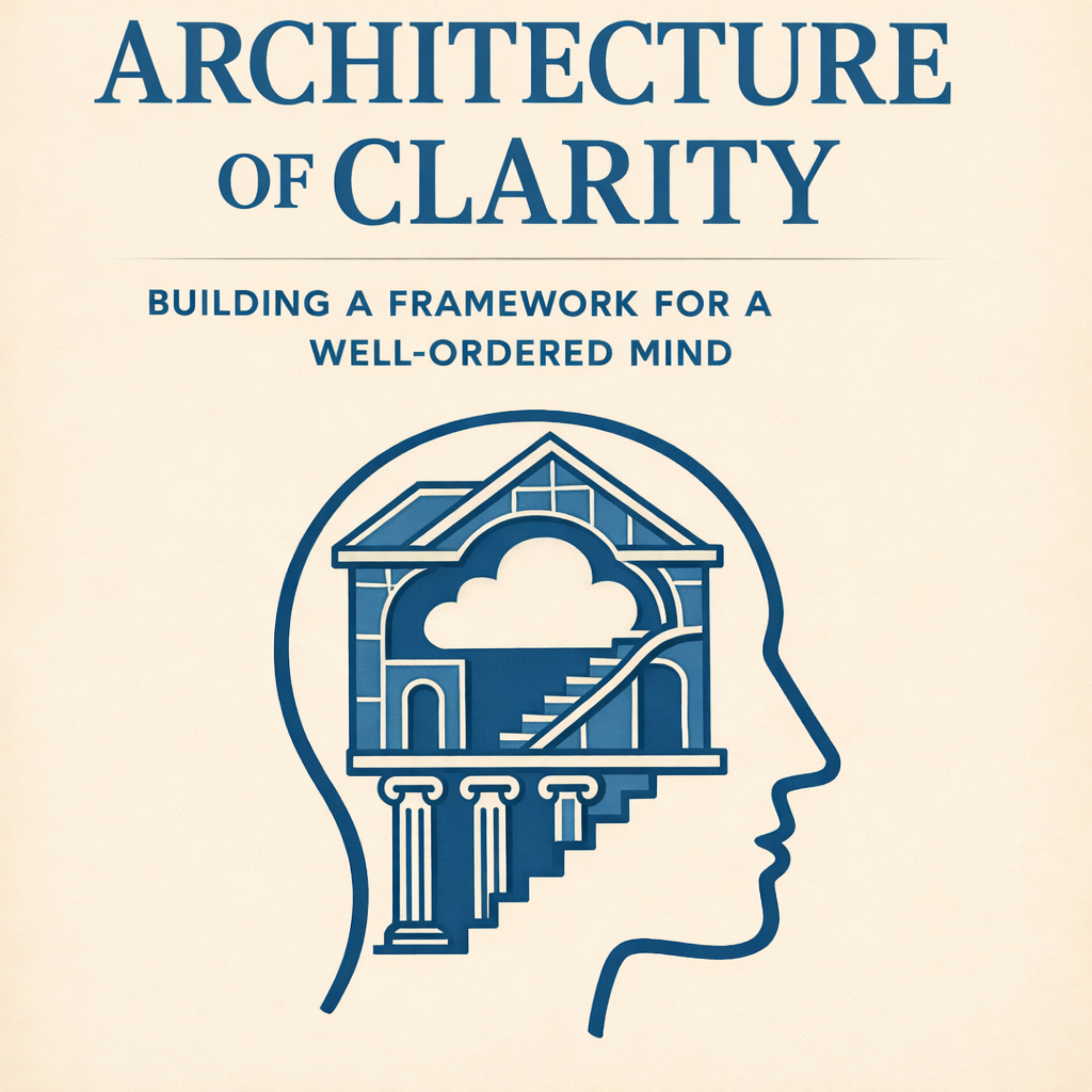
The Architecture of Clarity: Building a Framework for a Well-Ordered Mind
by Only Life After All
We live in an age of endless information and vanishing clarity. Ideas pile up, decisions fragment, and life is navigated reactively rather than deliberately. The Architecture of Clarity offers a blueprint for building a well-ordered mind—one grounded in principles, aware of its biases, and capable of adapting without losing its center. Drawing from philosophy, psychology, and lived experience, this book shows how to turn scattered insights into a coherent framework you can actually live by. Clarity isn’t found. It’s built.
-
16
Chapter 15 — The Self-Authored Life
Living by Your Own DesignIf this book has had one central message, it’s this:A coherent mental framework is not just a way of thinking—it’s a way of owning your life.Without it, you live by momentum, accident, and borrowed maps.With it, you live by choice, intention, and a design you can trust.This is the essence of the self-authored life:You are no longer a passive character reacting to the plot—you are the one shaping the narrative.Inheritance — You begin life carrying a framework handed to you by family, culture, and circumstance. It gives you starting coordinates, but it’s not truly yours.Examination — You question, test, and refine. You keep what aligns, discard what doesn’t, and add what’s missing.Authorship — You live from a framework you’ve chosen, tested, and aligned—one that adapts without losing its center.This book has been about moving decisively into stage three.Clarity: You know what you stand for and why.Consistency: Your choices match your principles across contexts.Resilience: You can adapt to change without losing yourself.Freedom: You’re no longer ruled by unexamined beliefs, emotional reflexes, or external approval.From CloudMind’s Have the Courage to Follow Your Heart and Intuition:“Your inner scorecard matters more than external applause.”Without authorship:You spend years pursuing goals that mean little to you.You defend beliefs that were never yours to begin with.You feel the friction of living in quiet contradiction—but never quite see why.Default living is the silent killer of potential.It replaces your voice with the voices of others until you can no longer tell the difference.When you live from a coherent, self-authored framework:Decisions become clearer and lighter, even when stakes are high.Your days align with your deepest values, making even effortful work feel meaningful.You measure success by internal alignment, not external noise.This doesn’t mean life becomes easy. It means you stop fighting yourself.Self-authorship doesn’t mean locking your framework forever.A truly self-authored life is one in which you remain the author—adding chapters, editing pages, rewriting arcs when new truths emerge.Rigidity belongs to ideologies.Authorship belongs to those who can evolve.You now have:Anchor Points to hold you steady.Tools to filter, connect, and test ideas.Practices to keep your framework alive.What you do next is up to you—but remember, a framework is not a monument. It’s a living structure. It grows in the soil of your daily choices.Imagine a life where your beliefs are examined, your values are clear, your choices are deliberate, and your actions align with who you’ve consciously chosen to be.That life is not a dream—it’s a discipline.It’s not something you wait to discover—it’s something you create, day by day, choice by choice.And no one else can author it for you.Final Takeaway: The self-authored life is the highest form of coherence—one where your principles, beliefs, awareness, and actions form a single, evolving whole. You are not just living—you are steering.The Three Stages of Mental SovereigntyWhy Self-Authorship MattersThe Risks of Living by DefaultThe Rewards of Living by DesignLeaving the Map OpenYour Next StepsClosing Reflection
-
15
Chapter 14 — From Framework to Practice
The Gap Between Knowing and DoingYou can design the most elegant mental framework in the world.It can be principled, well-connected, bias-aware, and reality-tested.But unless it’s put into regular practice, it’s just a well-decorated room you never enter.Coherence lives in application—in how you think, choose, and act every day.From CloudMind’s Confidence: The Quiet Force That Moves Us Forward:“Confidence is self-trust, built through clarity in action. Clarity comes not just from knowing, but from moving.”Your framework only earns your trust when you see it working in the real world.Repeated practice turns:Awareness into habit.Principles into reflexes.Frameworks into lived identity.These are short actions that keep you tethered to your principles in the flow of life:Morning Alignment Question: What matters most today, and how will I honor it?Midday Check-In: Pause and ask, Am I acting from my anchor points or from impulse?End-of-Day Reflection: Note one choice you’re proud of and one you’d handle differently.These zoom out from the daily view to catch trends:Review major decisions from the week. Were they aligned with your Spectrum of Engagement filter?Identify repeated friction points. Are they caused by untested beliefs, identity traps, or missing connections?Adjust the coming week’s commitments to better match your anchor points.These are deeper audits done monthly, quarterly, or yearly:Re-examine your anchor points. Do they still reflect your truest principles?Stress-test your framework with new or challenging scenarios.Seek outside perspectives from trusted, thoughtful voices to uncover blind spots.Visible RemindersKeep your core principles where you’ll see them—on your desk, in a notebook, in a phone note you check every morning.Default QuestionsTrain yourself to ask certain questions before decisions:Does this align with my anchor points?Is this Needed or just Wanted?What are the ripple effects over time?Trigger-Response RewiringIdentify situations where you often drift from your principles. Plan and practice a better default response.Ritual creates rhythm. When a practice is repeated at set times, it becomes easier to sustain:A Sunday evening framework review.A quarterly “Belief Audit Day.”An annual “Anchor Point Reset” aligned with a life milestone or new year.These rituals keep the framework alive without constant reinvention.The more you practice, the more you’ll notice:Your framework feels less like something you “refer to” and more like the way you naturally operate.Decisions that once took heavy thought become lighter and faster.You recover from drift more quickly, because you have clear re-alignment routines.You will drift. You will make choices you regret.Practice doesn’t eliminate mistakes—it makes the return path shorter and clearer.When you notice a slip:Name It — Identify which principle, belief, or process was bypassed.Understand It — Was it emotion? Bias? External pressure?Rehearse the Alternative — Mentally replay the moment with your framework in place.This way, even mistakes become part of the practice.Key Takeaway: A framework gains power only through repetition in real life. Daily, weekly, and periodic practices keep it from fading into theory and turn it into your default way of living.Why Application MattersThree Levels of Practice1. Daily Practices — Micro Alignment2. Weekly Practices — Pattern Awareness3. Periodic Practices — Structural MaintenanceEmbedding Your Framework into Daily LifeThe Role of RitualResilience Through PracticeWhen You Slip
-
14
Chapter 13 — Synthesis and Life Alignment
From Pieces to WholeUp to now, we’ve worked on individual components of your mental framework:Anchor Points — Your stable principles.Belief and Identity Awareness — Seeing how your convictions form and evolve.Self-Awareness — Observing your thinking and feeling in real time.Connection of Ideas — Linking principles, experiences, and knowledge.Engagement Spectrum — Separating what’s Wanted from what’s Needed.Systems and Time Thinking — Considering ripple effects and long arcs.Bias Detection — Spotting distortions in your lens.Testing and Adaptation — Keeping your framework reality-aligned.Each of these is powerful on its own.But coherence comes when they operate together—when your framework stops being a set of tools you “use” and becomes the natural way you live.Life alignment means that:Your principles are clearly defined and owned by you.Your decisions flow naturally from those principles.Your actions match your stated values even under pressure.Your results—over time—reflect the kind of life you’ve deliberately chosen.This is coherence in motion: no wasted energy from internal contradiction, no double life between belief and behavior, no quiet erosion of integrity.Anchor → Filter → ActAnchor points filter options before you act.Example: If Convert Time into Love is an anchor, you’ll say yes to time with people you value even when it’s inconvenient.Observe → Adjust → ReinforceSelf-awareness spots misalignment.Bias-checking reveals where your perception is skewed.Testing against reality shows whether your principles hold or need refining.Connect → Predict → ChooseLinking knowledge across disciplines helps you anticipate ripple effects.Systems thinking lets you predict both short- and long-term consequences.The Spectrum of Engagement clarifies which opportunities are worth your full investment.Alignment is not only intellectual—it’s emotional.Without emotional awareness, you risk performing your principles instead of living them.Without emotional investment, even a coherent framework can feel lifeless, like a perfectly balanced equation that no one cares about.The Guidepost Be Warm-Hearted AND Tough-Minded captures this balance: living with compassion while holding to your standards.Ask yourself regularly:Did my choices this week reflect my principles or my impulses?When did I feel most at peace with my decisions? When did I feel inner friction?If someone observed my life for a month, what would they conclude my true values are?Alignment isn’t about perfection—it’s about trajectory.The goal is a pattern of choices that consistently points toward your chosen life.Life will pull you off-course:Urgent demands will tempt you to trade Needed for Wanted.Social pressure will push you toward identity traps.Cognitive distortions will whisper comforting half-truths.That’s why alignment isn’t a one-time achievement—it’s an ongoing practice.The point is not to never drift, but to notice quickly and correct.When synthesis and alignment are in place:You trust yourself to make decisions under uncertainty.You’re less dependent on external approval.You adapt to change without losing your center.You experience fewer regrets, because your choices reflect who you’ve consciously decided to be.Key Takeaway: Synthesis turns your framework from a set of separate skills into a single way of living. Alignment is the ongoing practice of making your daily choices match your deepest principles, so your life consistently points in the direction you’ve chosen.Life Alignment: The Core IdeaThe Integration ProcessThe Emotional DimensionMeasuring AlignmentThe Challenge of ConsistencyLiving the Framework
-
13
Chapter 12 — Avoiding Ideological Rigidity
When Coherence Becomes a CageA coherent mental framework is meant to liberate you—giving you clarity, confidence, and adaptability.But without vigilance, that same coherence can harden into something dangerous: ideological rigidity.Rigidity happens when the framework stops evolving and starts defending itself at all costs.It resists feedback. It treats challenges as threats rather than opportunities for refinement. It demands loyalty instead of truth.Rigidity is seductive because:It feels safe — Certainty calms anxiety, even when the certainty is false.It feels coherent — No contradictions are visible because opposing evidence is filtered out.It feels virtuous — Standing firm is often mistaken for standing on principle.The trouble is, a rigid framework is only coherent inside its own bubble. Once reality changes—or expands beyond that bubble—it cracks.Closed LoopsEvery challenge is explained away using the same set of assumptions that created the framework in the first place.Defensiveness Over CuriosityNew information feels like an attack, not an opportunity.Identity FusionChanging a belief feels like losing yourself, because the framework has merged entirely with identity.Us/Them ThinkingPeople who share the framework are “right”; those who don’t are “wrong” or “lost.”From the Guidepost for Living Wisely:Avoid Extremely Intense Ideology — “Strength comes from clarity, not from refusing to adapt.”A rigid framework can’t integrate new truths, which means:It stops matching reality.It becomes brittle under stress.It eventually collapses when confronted with undeniable contradictions.Adaptive coherence means holding your anchor points firmly but holding everything else lightly.It’s the balance between:Principle (what doesn’t change easily)Method (what can and should change freely)This lets you keep your center while updating the way you apply it.Scheduled Re-examinationPeriodically review each principle and belief: Is it still aligned with reality and my values?Opposition InterviewsSeek out thoughtful people who disagree with you and listen without rebuttal.Context TestingAsk: Does this principle hold across different situations, or does it need conditions?Language CheckNotice if you’ve started saying “always” or “never” too often—these are rigidity red flags.It takes more courage to revise a framework than to defend it.Revision means:Admitting you were wrong or incomplete.Facing uncertainty while you integrate something new.Risking the loss of approval from those who share your current views.But the reward is a framework that stays alive, relevant, and reality-aligned.Maturity in thinking isn’t just about building a strong framework—it’s about keeping it strong by allowing it to change.Rigid structures eventually break. Flexible ones bend, adapt, and endure.Key Takeaway: A coherent framework is only valuable if it stays connected to reality. Avoiding ideological rigidity means holding principles firmly but keeping methods flexible—so your clarity grows stronger, not harder.The Comfort TrapSigns of Ideological RigidityWhy This Is a Framework KillerThe Antidote: Adaptive CoherencePractices for Staying FlexibleThe Courage to Loosen Your GripThe Test of Maturity
-
12
Chapter 11 — Testing Against Reality
The Illusion of CompletionIt’s tempting to think of your mental framework as something you “finish.”You’ve chosen your anchor points, organized your beliefs, learned to connect ideas, filtered wants from needs, and spotted your biases—so now you’re done, right?Not quite.A framework that isn’t tested against reality will slowly drift into irrelevance. It may look coherent on paper, but if it fails under real conditions, its apparent strength is an illusion.From CloudMind’s Make Mistakes Cheap, Not Rare reflection:“When the cost of mistakes is low, we can move fast and adapt. When the cost is high, we’re paralyzed with fear.”Testing your framework isn’t about proving you’re right—it’s about finding the weak points while the cost of correction is still low.Prevents RigidityWithout testing, you risk clinging to ideas that no longer fit the world as it is.Builds ConfidenceA principle that survives repeated testing becomes more than a belief—it becomes a trusted tool.Reveals Blind SpotsReality doesn’t care about your preferences. It will expose what your framework missed or misunderstood.Encourages AdaptabilityTesting builds the habit of revision without fear, so change feels like growth, not loss.SimulationPlay out scenarios mentally or in writing. Ask: If I apply this principle in X situation, what’s the likely outcome? What if the opposite happens?Small-Scale TrialsApply a new idea in a low-stakes context before committing fully.Example: Test a boundary-setting principle in a minor disagreement before using it in a critical relationship moment.Reality Feedback LoopsAfter making a decision, revisit it: Did this work as expected? If not, why?Contradiction SearchActively look for situations where your principles conflict and work through how you’d resolve them.A coherent framework is not built on stubbornness—it’s built on alignment with reality.If the evidence shows a principle works across contexts, keep it.If it consistently fails in real-world conditions, revise or replace it.If it works in some contexts but not others, refine its application rules.Testing isn’t a threat to your identity—it’s a service to your integrity.If your framework is part of who you are, letting it be wrong sometimes doesn’t make you wrong. It makes you honest.From Guideposts for Living Wisely:Avoid Extremely Intense Ideology — This keeps you open to evidence even when it challenges cherished ideas.Have the Courage to Follow Your Heart and Intuition — Sometimes testing reveals that data isn’t the only valid input; intuition can be tested, too.Reality tests can sting:You realize you’ve been wrong for years.You see harm caused by a principle you thought was virtuous.You notice that a belief served your ego more than your values.This pain is a sign that the framework is evolving. If you let the discomfort do its work, it will lead to a more grounded, resilient system.Your framework becomes truly yours not when it’s written down, but when it’s lived, tested, and adapted over time.Testing turns philosophy into practice, and practice into lived wisdom.Key Takeaway: A coherent framework earns its strength by surviving contact with reality. Testing isn’t about proving you’re right—it’s about making sure you’re ready for the world as it is, not as you wish it to be.Reality as the Ultimate JudgeWhy Testing MattersHow to Stress-Test Your FrameworkThe Role of EvidenceTesting Without FearWhen the Test HurtsFrom Theory to Field-Tested Wisdom
-
11
Chapter 10 — Spotting Cognitive Distortions
The Hidden Bends in the LensEven the clearest framework can be warped if the lens you’re using to see reality is distorted.Cognitive distortions are those subtle bends and twists in perception that make the world look different from what it actually is.Left unexamined, they can:Reinforce false beliefs.Pull actions out of alignment with anchor points.Create a false sense of coherence—where everything “fits” only because the distortion hides the contradictions.From CloudMind’s Mis-Cognition reflection (inspired by Charlie Munger’s ant analogy):Even complex brains can run simple programs so automatically that they misfire in novel situations.Like ants dragging a live ant out of the hive because it smells like a dead one, we can apply old rules to new contexts without noticing the mismatch.Add to that the insights from The Limits of Rationality and the Importance of the Unconscious Mind:We like to think our decisions are purely logical, but reason often justifies what emotion has already chosen.Our unconscious mind processes vast amounts of information, but it’s also where biases and heuristics quietly influence our choices.Confirmation Bias — Seeking only evidence that supports your existing beliefs.Availability Heuristic — Overestimating the importance of things that come easily to mind.Anchoring — Giving disproportionate weight to the first information you encounter.Black-and-White Thinking — Seeing situations in extremes rather than shades of gray.Projection — Attributing your own thoughts or feelings to others.Status Quo Bias — Favoring the current state simply because it’s familiar.They hide contradictions. If you only seek confirming evidence, you won’t see when two principles conflict.They create false urgency. Availability bias can make a vivid event feel more important than it is, leading to reactive choices.They entrench identity traps. Projection and confirmation bias make it harder to separate “I believe” from “I am.”Pause Before CertaintyWhen you feel unusually sure, ask: What would make me wrong here?Reverse the ArgumentTry to articulate the opposing view better than its proponents. If you can’t, you may be missing key evidence.Track Emotional SpikesStrong emotions—especially defensiveness—often signal a belief being protected by bias.Cross-Check with Time HorizonsDoes this conclusion still hold when you look at the medium- and long-term effects?Several Guideposts for Living Wisely double as distortion countermeasures:Be Open-Minded — Doubt and curiosity reduce the grip of certainty.Avoid Extremely Intense Ideology — Refusing totalizing worldviews keeps reality in play.Be Less Judgmental and More Forgiving — Loosens projection and emotional overreaction.Sometimes, biases are so ingrained you can’t catch them alone. That’s where:Dialogue with trusted others helps surface blind spots.Writing things out exposes fuzzy reasoning.Seeking disconfirming experiences forces a recalibration.A coherent mental framework isn’t just about feeling right—it’s about being right as far as reality allows.Spotting and correcting cognitive distortions is an act of integrity: you’re choosing to see things as they are, not as you wish them to be.Key Takeaway: Distortions bend the lens through which you see the world. Spotting them early keeps your framework aligned with reality—and reality is the only foundation that lasts.Why We’re All VulnerableCommon Cognitive DistortionsHow Distortions Threaten CoherenceSpotting the Distortions in ActionBias Antidotes in CloudMind PrinciplesWhen You Can’t See Your Own DistortionsAccuracy as a Form of Integrity
-
10
Chapter 9 — Thinking in Systems and Time Horizons
Why Linear Thinking Fails in a Complex WorldIt’s tempting to think of life as a series of single events:I do X → I get Y.If Y is good, do X again.But the world doesn’t work in straight lines.Choices interact. Consequences ripple. Feedback loops form.And often, the real effects of an action show up far later than the moment we act.If you want your mental framework to guide not just the next decision but the next decade, you need to think in systems and time horizons.Systems thinking is seeing the whole, not just the parts.It’s understanding that:Every action is part of a network of causes and effects.The same action can have different results in different contexts.Short-term benefits can lead to long-term costs (and vice versa).For example:Skipping rest to work longer hours might increase output this week but decrease your effectiveness next month.Avoiding a difficult conversation might keep peace today but erode trust over years.Your framework needs to operate on multiple time horizons simultaneously:Immediate — What happens today or this week?Medium-term — What’s the effect over months or a few years?Long-term — How will this matter—or not—over decades?Short-term thinking is not bad; it’s just incomplete. The danger comes when immediate benefits are chosen without regard for medium- or long-term consequences.When facing a choice, ask:System Impact — What else will this decision affect? Who or what will be influenced beyond the immediate target?Time Impact — How will the effects play out over days, years, and decades?Alignment — How does it connect back to my anchor points?For example:Decision: Say yes to a new partnership.System Impact: Could strengthen network, but may tie my reputation to another party’s behavior.Time Impact: Gains in the next 6 months; potential risk if values diverge in 3 years.Alignment: Matches my principle of Convert Time into Love only if it fosters meaningful collaboration.Several Guideposts for Living Wisely shine in this context:Know What Is More Than Enough — Avoid decisions that bloat the system with complexity you don’t need.Look the Reality of Life Straight in the Face, With Courage — Systems thinking forces you to see inconvenient truths early.Avoid Extremely Intense Ideology — Systems shift; rigid frameworks break when the context changes.Small, well-aligned actions—when repeated—can produce massive long-term results. This is the compound effect:Investing in relationships now compounds into trust, support, and shared opportunities later.Practicing self-awareness daily compounds into fewer reactive mistakes over decades.Consistently separating Wanted from Needed compounds into a life with fewer regrets.Event Fixation — Treating each choice as isolated instead of part of a system.Short-Term Blindness — Ignoring downstream consequences because the immediate benefit is too tempting.Overengineering — Building an overly complex framework that collapses under its own weight.When your framework integrates systems thinking and time horizons:You see patterns earlier than most people.You avoid being blindsided by predictable consequences.You create a life that is not just consistent with your principles, but resilient and scalable.Key Takeaway: A coherent framework must operate across systems and time. Every decision has ripple effects; every action is part of a longer arc. See the whole, think in layers, and let your principles guide you across timelines.What Is Systems Thinking?Time Horizons: The Lens of DurationBringing It Together: The Time-System MatrixCloudMind Principles in Systems and TimeThe Compound EffectAvoiding the Common TrapsStrategic Coherence
-
9
Chapter 8 — The Spectrum of Psychological Engagement
Not All Wants Are Created EqualImagine standing in front of a long buffet.Some dishes make your mouth water immediately. Others you’re curious about but not committed to. Some you could take or leave. A few, you know, would leave you feeling worse afterward.Life’s choices work the same way—except the “buffet” is endless, and the stakes can be far higher than a bad meal. Without a way to distinguish passing appetites from essential nourishment, we risk filling our plate with whatever is closest, loudest, or most tempting.The Spectrum of Psychological Engagement is a tool for noticing where you stand with any given option, opportunity, or idea. It runs from the lowest level of engagement to the highest:Unaware — You don’t yet know it exists.Uninterested — You’re aware, but it holds no appeal.Indifferent — You could engage, but feel no pull either way.Preferred — You like the idea but aren’t committed.Wanted — You actively desire it and would enjoy it.Needed — It’s essential because it aligns with your deepest values and supports your anchor points.This is where coherence sharpens:Wanted is about desire—something that would feel good to have or do.Needed is about alignment—something that sustains or advances your core principles.You can want cake and ice cream every day, but if your anchor point is Value Health Over Indulgence, you will often choose to pass.The difference is not willpower—it’s clarity about the gap between desire and value.When faced with a decision:Place the option somewhere on the spectrum.If it lands at Wanted, ask: Does it also qualify as Needed?If not, weigh whether satisfying the want supports or undermines your framework.Over time, this practice:Reduces impulsive choices that conflict with anchor points.Makes trade-offs visible before you commit.Builds the habit of aligning action with principle without constant internal wrestling.From CloudMind’s note:“Inner discipline creates separation between wanting and doing.”Without discipline, the urge to act on Wanted can overpower Needed.Discipline isn’t about denying all wants—it’s about creating the mental space to ask whether a want deserves to be elevated into a need this time.An option that was once Needed can shift to Preferred or even Uninterested as your life changes.Starting a business may feel essential in your 30s but optional in your 50s.A social group you once depended on for support may no longer align with your values.A coherent framework allows for these shifts without collapsing—because your anchor points stay stable while your strategies adapt.Mistaking urgency for importance — A time-sensitive offer can feel like a need when it’s only a want with a deadline.Letting others define your needs — If you adopt someone else’s priorities without reflection, your framework loses integrity.Clinging to outdated needs — A need that no longer serves your principles becomes a liability.The Spectrum of Psychological Engagement helps you walk through life’s buffet with purpose.You stop piling your plate with whatever’s closest and start choosing what nourishes both your principles and your future.Key Takeaway: Wants can be pleasant, but needs are sustaining. The spectrum helps you see the difference—so you can align your actions with what truly matters, not just what tempts you in the moment.From Unaware to NeededThe Critical Distinction: Wanted vs. NeededUsing the Spectrum as a FilterThe Role of Inner DisciplineWhen Needs ChangeAvoiding the PitfallsFrom Buffet to Balanced Plate
-
8
Chapter 7 — Connecting the Dots
From Piles to PatternsIf you walk into an unorganized workshop, you’ll see tools scattered across benches, raw materials stacked in corners, and projects half-complete. Everything you need might be there, but without order, it takes extra energy to find, decide, and act.Our minds can be the same.You may have meaningful principles, insightful experiences, and useful knowledge—yet if they sit in isolation, their value remains locked.Connecting the dots is the process of turning those scattered mental assets into a network, where each part reinforces and clarifies the others.A mental framework isn’t built from isolated facts—it’s built from relationshipsbetween facts, principles, and experiences.When ideas are connected:Meaning deepens — A principle like Convert Time into Love stops being abstract when linked to a personal memory of choosing a friend’s phone call over an extra work hour.Patterns emerge — You start noticing that your best decisions share certain conditions or thinking steps.Contradictions surface — When two beliefs are linked, it’s easier to see if they pull against each other.Learning accelerates — Each new insight has multiple “hooks” in your system, making it easier to remember and apply.Principle-to-ActionConnect your anchor points directly to real behaviors.Example: If you value Be Warm-Hearted AND Tough-Minded, write down what that looks like in practice when giving feedback, making a hiring decision, or setting boundaries with family.Experience-to-PrincipleLink life events—successes, failures, and turning points—to the principles they confirm or challenge.Example: The time you overcommitted and burned out becomes a reminder for Know What Is More Than Enough.Idea-to-IdeaConnect insights from different domains into a larger pattern.Example: Stoic acceptance of what you can’t control + modern psychology’s emphasis on locus of control = a reinforced mental habit of focusing on influence rather than frustration.CloudMind works because nothing exists in isolation:Guideposts for Living Wisely are linked to personal narratives.Psychological insights like Avoid the Identity Traps are tied to belief formation.Historical patterns are connected to present-day decision-making.The more links in the network, the more resilient the framework—because every idea has multiple points of support.Mind Map Your PrinciplesStart with one anchor point in the center. Radiate outward with experiences, related quotes, and supporting beliefs.Ask the Linking QuestionsWhat does this remind me of?Where have I seen this before?How does this confirm or challenge what I already believe?Cross-Pollinate DisciplinesDeliberately connect ideas from unrelated fields—history to psychology, art to strategy—to see patterns others miss.Keep a Connection JournalWhen a new idea clicks with something you already know, write down the link. Over time, this becomes a visible map of your framework.Not every link strengthens the framework.Be cautious of:Superficial similarities that mask important differences.Overgeneralization — stretching a principle beyond its context until it becomes meaningless.Confirmation chaining — linking only those ideas that already agree with each other, creating an echo chamber.When your framework is well-connected:A single new insight can improve multiple areas of your life.Confusion decreases because you can trace any idea back to its roots.Change feels less threatening because new information has a place to land.You stop navigating life as if each challenge is unrelated and start seeing everything as part of an integrated whole.Key Takeaway: Coherence comes from connection. Linking principles, experiences, and ideas turns isolated insights into a living network—one that strengthens with every new addition.
-
7
Chapter 6 — The Role of Self-Awareness
The Mirror You Carry EverywhereThere’s a mirror you can’t leave at home.It’s not for your face—it’s for your mind.It reflects not what you look like, but what you’re thinking, feeling, and believing whileyou’re doing it.This is self-awareness—the ability to observe your own mental and emotional processes in real time.Without it, you can’t see the state of your framework, let alone maintain it.From CloudMind’s Importance of Self-Awareness reflection:“Self-awareness is crucial for personal growth and achieving a fulfilling life… It is the foundation for understanding our values, motivations, and desires, allowing us to align our actions with what truly matters to us.”In the context of a coherent mental framework, self-awareness is what allows you to:Spot contradictions between your anchor points and your actual behavior.Notice when identity traps are steering your decisions instead of your principles.Catch cognitive biases in motion before they harden into faulty conclusions.See the influence of emotion on your reasoning—without having to suppress it.Reflective Awareness (after the fact)You look back on a decision, conversation, or action and ask:Why did I do that?Was it in line with my principles?What belief or feeling drove it?This is essential for learning and framework adjustment.Active Awareness (in the moment)You notice your own thoughts and feelings as they arise:“I’m feeling defensive—what belief is being challenged?”“I’m about to say yes, but is it for approval or alignment?”This is essential for applying your framework in real time.Without self-awareness, a framework can drift without you noticing.You may still speak your principles, but your decisions will start reflecting unconscious patterns, emotional impulses, or external pressures instead.With self-awareness, you can:Catch misalignment early.Course-correct before damage is done.Strengthen your framework by making conscious adjustments.Self-awareness is not a trait you either have or don’t—it’s a skill that can be cultivated.Practices that help:Journaling: Write not just what happened, but what you were thinking and feeling.Check-ins: Pause during the day to ask, What am I doing? Why?Third-Person Observation: Imagine watching yourself from the outside—what would you notice?Trigger Mapping: Identify situations where you consistently react strongly and examine the belief or value beneath the reaction.Self-awareness can be uncomfortable.It reveals gaps between who you think you are and how you actually act. It shows where fear, pride, or habit have been masquerading as principle.But this discomfort is productive—it’s the signal that you have an opportunity to realign.The most coherent frameworks aren’t built by people who always get it right. They’re built by people willing to see when they’ve gotten it wrong and adjust.Think of self-awareness as the quality control department of your mental architecture:Anchor points provide stability.Belief awareness keeps the structure honest.Self-awareness ensures the builders (you) follow the design in real time.Without it, you can design the most elegant framework on paper and still live in contradiction.With it, your framework stays alive, relevant, and truly yours.Key Takeaway: Self-awareness is the operating system of coherence. It lets you see your beliefs, feelings, and choices as they happen, so you can align them with your principles and keep your mental framework honest and alive.Why Self-Awareness Is the Master KeyThe Two Levels of Self-AwarenessSelf-Awareness and CoherenceBuilding the SkillThe Courage to See ClearlyThe Self-Aware Framework in Motion
-
6
Chapter 5 — The Nature of Belief and Identity
The Invisible Architecture of ThoughtOur anchor points may feel timeless, but the truth is that every principle we hold is shaped by a deeper, often invisible process: belief formation.Beliefs are the scaffolding on which our principles hang.They define what we think is true and how we think the world works—and because they form quietly, often without our consent, they can strengthen or sabotage our mental framework without us noticing.Absorption in Early LifeAs children, we accept most of what we’re told—by parents, teachers, culture—because survival depends on trust. Beliefs at this stage are often untested and unquestioned.Agreement Through RepetitionThe more often we hear something, especially from trusted sources, the more likely we are to believe it. This is how slogans, clichés, and cultural norms become part of us.Emotional ReinforcementBeliefs stick more deeply when tied to strong emotion—pride, fear, shame, belonging. The more a belief is tied to how we feel, the harder it is to challenge.Selective Evidence GatheringOnce we hold a belief, we tend to seek confirming evidence and ignore contradictions. This confirmation bias turns flexible ideas into rigid convictions.A belief may begin passively, but keeping it is an active choice.Every time you act in line with it, you reinforce it. Every time you explain it to someone else, you cement it further. This is why changing a belief often feels like tearing out part of your own structure—it requires not just new evidence, but a new pattern of living.Beliefs become even harder to change when they fuse with identity—when we stop saying I believe X and start saying I am the kind of person who believes X.At that point:Questioning the belief feels like questioning the self.Attacks on the belief feel like personal attacks.Evidence against it is met with emotional defense rather than open examination.From CloudMind’s Avoid the Identity Traps guidepost:“The twin dangers are trying to be someone else and expecting others to behave as we would.”In belief terms, identity traps look like:Over-identifying with a role (“I’m an optimist, so I can’t acknowledge risks”).Borrowed identities (“My group believes this, so I must too”).Fixed self-concepts (“I’m bad at numbers, so there’s no point in trying”).These traps shrink the range of beliefs you’re willing to examine, which shrinks the adaptability of your framework.Anchor points and identities can look similar from the outside—they both guide behavior—but they function differently:To prevent beliefs from undermining your framework:Separate “I believe” from “I am”Hold beliefs as tools, not as extensions of self. You can replace a tool without replacing who you are.Regularly Audit BeliefsAsk: Where did I get this belief? Is it still serving me? Is it aligned with my anchor points?Expose Beliefs to DissentSeek out opposing views, not to dismantle your beliefs, but to pressure-test them.Upgrade or ReleaseIf a belief no longer holds under scrutiny, update it or let it go—even if you’ve carried it for years.Anchor points keep your framework stable.Belief awareness keeps it honest.Without this vigilance, you risk building a structure on inherited or unexamined supports that look strong but crumble under real weight.In the next chapter, we’ll deepen the foundation by focusing on the self-observation skillthat makes all of this possible—self-awareness—so you can see not just what you believe, but how those beliefs operate in real time.Key Takeaway: Beliefs shape your framework, but identity can lock those beliefs in place beyond reason. Keep your beliefs as tools, not as definitions of who you are, so your framework stays adaptable and honest.How Beliefs FormBeliefs Are Choices We Keep MakingThe Identity ConnectionIdentity TrapsAnchors vs. IdentitiesKeeping Beliefs HealthyThe First Stress Test for Your Framework
-
5
Chapter 4 — Anchor Points: Your Core Principles
The Bedrock Beneath the StructureEvery structure—whether it’s a skyscraper, a bridge, or your mental framework—rests on something solid.If the foundation is weak, the whole thing shifts under pressure.In life, your foundation is made of core principles: the truths and values you choose to be non-negotiable.These are not preferences.They are the anchors you return to when choices are hard, when circumstances change, and when the noise of life threatens to drown out your own voice.They reduce decision fatigue.When you know your principles, you don’t have to rethink them for every situation—they pre-filter your options.They create consistency without rigidity.You can adapt details while still honoring your deeper commitments.They keep you centered under pressure.When emotions run high or external opinions pull hard, your principles keep you from drifting.They align your actions with the life you want.Without them, you risk working hard for things that don’t matter to you.Principles are not rules.A rule tells you what to do in a specific scenario: Don’t cross the street when the light is red.A principle tells you how to think in all scenarios: Value safety over haste.Rules can be broken or outdated. Principles evolve but rarely reverse—if they do, it’s because you’ve deeply re-examined and re-anchored them.Over years of reflection and refinement, CloudMind’s Guideposts for Living Wisely have emerged as a set of tested anchor points. Here are a few examples, ready for you to adapt:Live as You Will Have Wished to Have Lived When You Are DyingMortality as a compass. Make choices now that your future self will thank you for.Avoid the Identity TrapsDon’t imprison yourself in someone else’s definition—or expect others to live by yours.Have the Courage to Follow Your Heart and IntuitionYour inner scorecard matters more than external applause.Convert Time into LoveTime is life’s currency; spend it where it deepens connection and meaning.Be Warm-Hearted AND Tough-MindedKindness without naivety; strength without coldness.Avoid Extremely Intense IdeologyHold beliefs firmly but with open hands, ready to revise when reality demands.These aren’t commandments. They’re navigational stars. Your framework may include some of these, altered to your voice, and others entirely your own.Step 1 — Mine Your ExperienceThink of moments in your life when you felt most at peace with your choice, and most at war with it.What principle was honored in the first case? What principle was violated in the second?Step 2 — Distill the PrincipleStrip away the context until only the underlying value remains.Example: “I refused that opportunity because it would have meant lying” → Value truth over convenience.Step 3 — Test ItWould you still hold this principle if it cost you something significant?If not, it may be a preference, not an anchor.Most of us start with borrowed principles—from parents, culture, religion, or peers. That’s fine as a starting point. But coherence requires ownership. You must examine each one, keep what rings true, and release what doesn’t.Once you’ve identified your anchor points, they become the load-bearing pillars of your mental framework.They will guide how you interpret new information, resolve conflicts, and choose between competing goods.The work of building a coherent mental framework starts here—because without anchor points, all other parts of the structure float.Key Takeaway: Anchor points are the non-negotiable principles that form the bedrock of your framework. They are chosen consciously, tested in reality, and kept alive through deliberate practice.Why Anchor Points MatterPrinciples vs. RulesDrawing from the Guideposts for Living WiselyFinding Your Own AnchorsAnchors Are Chosen, Not InheritedYour Foundation, Your Future
-
4
Chapter 3 — Your Life as a System of Thought
Your Personal LibraryImagine walking into a library that contains everything you’ve ever learned, believed, or experienced.It’s all there—books representing life lessons, shelves for values, journals filled with memories, boxes stuffed with half-formed ideas.Now imagine the library is in complete disarray.The books are stacked in random piles. The most important principles are buried under trivia.There are duplicates of some ideas, each with slightly different wording. Some volumes contradict others without either being labeled as “obsolete” or “pending review.”This is how most minds operate—not from lack of intelligence, but from lack of organization.Your mind is not a static warehouse of facts. It’s a living, breathing system of thought.New experiences add to the collection.Old beliefs can be revised, archived, or removed.Principles can be promoted from footnotes to headlines as their importance becomes clear.Without conscious maintenance, the system becomes reactive and cluttered. With care, it becomes a personal knowledge architecture—a structure that supports clarity, resilience, and purposeful action.The Foundations — Core PrinciplesThese are your anchor points: the values and truths that remain steady even as details shift.Example: “Convert Time into Love” from the Guideposts for Living Wisely is more than a moral sentiment; it’s a priority filter. When faced with competing demands, it asks: Which choice turns time into genuine connection?The Structure — Organized KnowledgeThese are the patterns and categories that allow you to connect facts across domains.History and human nature inform decision-making.Psychology and philosophy explain behavior.Personal experience validates or challenges abstract ideas.The structure turns isolated insights into a network.The Flow — Tools and PracticesThis is how ideas move in and out of your system.Reflection and journaling to capture and clarify.Questioning and dialogue to test ideas.Updating and reorganizing to keep the framework alive.CloudMind itself is an example of such a flow—insights are collected, connected, and refined over time.The shift begins when you stop thinking of your mind as just you—and start thinking of it as something you can work on.Ask yourself:What’s my current filing system? Do I connect new knowledge to what I already know, or just store it loosely?Which ideas deserve “front-shelf” status? Which beliefs or values guide most of my actions, whether consciously or not?Where are the contradictions? Do any of my current principles quietly undermine each other?You will never have a perfectly complete or contradiction-free framework—and that’s the point. A living system grows through maintenance, not finality. You review, refine, and realign over time.Think of your mental framework as a garden:You plant (gather ideas and experiences).You prune (remove what no longer serves).You fertilize (connect and deepen what matters most).You harvest (apply insights in real life).A neglected garden becomes overrun by weeds. A tended one flourishes.Ultimately, this is not about having a beautiful intellectual archive. It’s about having a functional compass—a mental system that tells you, even in the fog of uncertainty, which direction is truest to you.By treating your mind as a system of thought:You reduce decision fatigue.You handle complexity with calm.You live more deliberately, because you know why you choose what you choose.Key Takeaway: Your mind is not just a container for knowledge—it’s a system you can design, maintain, and improve. The more coherent that system becomes, the more clearly you can navigate the complexity of life.The Mind as a Living SystemThree Layers of Your Mental SystemDesigning Your Own System of ThoughtMaintenance Over PerfectionFrom Library to Compass
-
3
Chapter 2 — What a Framework Is (and Isn’t)
The Blueprint in Your HeadEvery builder begins with a blueprint.It doesn’t tell them where every nail goes, but it provides the structure that determines where walls, doors, and windows belong. Without it, construction becomes guesswork—walls end up crooked, rooms misplaced, and the whole building unstable.Your mind also builds. Every belief you hold, every decision you make, every judgment you pass is like laying another brick in the structure of your understanding. But without a framework—a mental blueprint—the bricks pile up without form. The result can be impressive in size yet weak in stability.A coherent mental framework is not a list of facts. It’s the relationship between those facts, the underlying principles that connect them, and the methods you use to test, adjust, and apply them.It is:A System of PrinciplesYour non-negotiables—the truths, values, and commitments that remain steady even when the details shift.Example: From CloudMind’s Guideposts for Living Wisely, “Live as You Will Have Wished to Have Lived When You Are Dying” is more than a poetic thought. It’s a navigational principle—something you can return to when weighing two conflicting paths.A Way of Organizing KnowledgeFacts are stored in categories that link to each other—history connects to psychology, personal experience to philosophy. This allows you to see patterns and implications instead of isolated details.A Method for IntegrationNew information is not simply accepted or rejected; it is weighed, tested, and either incorporated into the structure or set aside. This keeps your thinking adaptable without becoming chaotic.A Decision FilterA framework allows you to assess choices against your principles quickly, without reinventing your criteria each time. This reduces decision fatigue and helps you act consistently.A Rigid IdeologyIdeologies resist contradiction at all costs, often bending reality to fit their pre-set conclusions. A healthy framework flexes—absorbing new truths even when they require rearranging old ones.CloudMind principle: “Avoid Extremely Intense Ideology” — strength comes from clarity, not from refusing to adapt.A Collection of SlogansMotivational phrases without deep integration fade quickly under pressure. “Stay curious” means little unless you’ve built a system where curiosity is rewarded and acted upon.A Map Someone Else Drew for YouBorrowed frameworks can be a starting point, but until you’ve tested them against your own experiences and values, they’re someone else’s scaffolding—not yours.Without this clarity, it’s easy to mistake consistency for coherence. You can be completely consistent in following a rigid, faulty ideology—but that’s not coherence. True coherence comes from the harmony between your principles, your knowledge, and your lived reality.A coherent framework lets you:Change your mind without losing your identity.Absorb challenges without collapsing.Integrate wisdom from multiple sources without contradiction.We’ll soon begin mapping your own framework using a blend of:Anchor Points from the Guideposts for Living Wisely (your core principles).Mechanics of Mind from CloudMind’s psychological insights (how beliefs form, how identity shapes choices, how mis-cognition works).Thinking Tools drawn from philosophy, history, and systems thinking.By the end, you’ll have not just a list of ideas, but a living structure—one that grows stronger each time you engage with it.Key Takeaway: A coherent mental framework is a living system, not a fixed creed. It is built on principles you trust, organized knowledge, and the capacity to integrate and adapt without losing your center.A Framework Is…A Framework Isn’t…Why This Distinction MattersThe Beginning of Your Framework
-
2
Chapter 1 — The Chaos Without a Framework
A Mind Without a MapImagine waking up in a strange city with no map, no phone, and no idea of the language.You start walking.Every street you take is a guess. Every choice feels urgent, because you have no broader view to guide it.At first, the chaos is exhilarating—every corner a surprise. But after a while, you realize you’re circling the same blocks, missing important streets, and occasionally wandering into dangerous alleys. You have no way to tell if you’re moving closer to your destination or further away.This is how most people navigate life: surrounded by an abundance of information and options, yet lacking a coherent framework to make sense of them. They respond to the loudest signal, the strongest emotion, or the most recent piece of advice—without noticing how often these directions contradict each other.If your thinking is a patchwork of unconnected ideas, certain symptoms will show up:Contradictory DecisionsYou hold two beliefs that cancel each other out—valuing freedom but agreeing to commitments that make you feel trapped; prizing honesty but telling yourself “small lies” to keep the peace.Without a unifying framework, these contradictions slide past unnoticed until they create tension.Reaction Over ReflectionWithout clear criteria for what matters most, you act in response to urgency rather than importance. The day becomes a series of small fires to put out rather than a purposeful movement toward a larger goal.Identity TrapsYou define yourself in ways that quietly limit your choices—believing you’re “not the type” to do certain things, or assuming others think and feel as you do. CloudMind calls these identity traps: invisible walls in your mental landscape.Overwhelm and IndecisionWhen every choice is made from scratch, decision fatigue sets in quickly. Without principles to narrow the field, you drown in options.The human mind evolved for survival in small, predictable environments, not for processing the relentless influx of information in modern life.When the flood of inputs exceeds our ability to integrate them, we default to:Short-term emotional signals (“I feel anxious, so it must be wrong”).Mimetic copying (adopting the choices and opinions of those around us without realizing it).Narrative patching (telling ourselves quick stories to make disjointed events seem connected, even when they aren’t).These shortcuts aren’t inherently bad—they’re just unreliable when left unchecked.Without a coherent mental framework, even the smartest, most well-intentioned people become vulnerable to:Persuasion without substance: You’re swayed by confident voices, regardless of whether their reasoning aligns with your values.Hidden contradictions: Your actions in one area quietly undermine your goals in another.Life drift: Years pass in which you work hard but not toward anything you truly chose.Perhaps most painfully, you may feel like you’re making progress, only to discover later that you’ve been walking in circles.This book begins here because the first step toward coherence is to recognize the cost of not having it. Just as a lost traveler becomes motivated to find or draw a map after too many wrong turns, you will feel the need for a framework most strongly when you can clearly see the friction, waste, and missed opportunities that arise without one.In the chapters that follow, we will:Clarify your anchor points so your decisions have a stable base.Understand the machinery of belief and identity so you can spot and dismantle your own blind spots.Learn to connect ideas across disciplines and timescales, making your thinking robust.Practice updating your framework without losing your center.A coherent mental framework will not remove uncertainty from life—but it will remove unnecessary uncertainty, allowing you to face the remaining unknowns with clarity and calm.
-
1
Prologue
We live surrounded by information yet starved for coherence. Knowledge piles up in fragments—quotes, lessons, experiences—but without a structure to hold them together, we drift, react, and repeat old patterns.The Architecture of Clarity offers a blueprint for building a well-ordered mind. Drawing on philosophy, psychology, history, and lived experience, it shows how to weave scattered insights into a living framework: a structure flexible enough to grow with you, strong enough to steady you, and clear enough to guide your choices with confidence.This is not a book of rules, but an invitation to design your own inner architecture. One that helps you:Distinguish what matters from what doesn’t.Align your values, beliefs, and actions.Withstand life’s uncertainty without losing your way.Because the most important map you will ever carry is the one you create for yourself.PrefaceThis book grew out of years of collecting, examining, and refining ideas—sometimes in the margins of books, sometimes in conversations, sometimes in the quiet pages of a private journal.Over time, these fragments began to form something more than a collection. They began to connect.I didn’t set out to write about mental architecture. I set out to understand my own thinking—why I made certain choices, why some seasons of life felt aligned and others scattered, why knowledge sometimes brought clarity and other times confusion.What I discovered is that information alone isn’t enough. Even wisdom, in scattered pieces, can leave you lost if it doesn’t connect into a usable whole.The turning point was the creation of CloudMind—my personal archive of principles, insights, and tested truths drawn from philosophy, psychology, history, and lived experience. Over time, CloudMind became more than a repository. It became a laboratory, a place where ideas were tested against each other, refined, and integrated into a living structure.This book distills that process. It is not a manual for adopting my framework, but a guide for creating yours. You will see examples drawn from my own principles—what I call the Guideposts for Living Wisely—but they are here to serve as models, not mandates.A well-ordered mind is not a rigid one. It is clear, adaptable, and grounded. My hope is that, as you move through these chapters, you will not only design a framework that serves you well, but also learn how to keep it alive for the rest of your life. Because the world will change. You will change. And the only way to navigate both with clarity is to carry a structure of thought that is both strong and flexible, principled and adaptive.This is your mind’s architecture. Let’s build it well.
We're indexing this podcast's transcripts for the first time — this can take a minute or two. We'll show results as soon as they're ready.
No matches for "" in this podcast's transcripts.
No topics indexed yet for this podcast.
Loading reviews...
ABOUT THIS SHOW
We live in an age of endless information and vanishing clarity. Ideas pile up, decisions fragment, and life is navigated reactively rather than deliberately. The Architecture of Clarity offers a blueprint for building a well-ordered mind—one grounded in principles, aware of its biases, and capable of adapting without losing its center. Drawing from philosophy, psychology, and lived experience, this book shows how to turn scattered insights into a coherent framework you can actually live by. Clarity isn’t found. It’s built.
HOSTED BY
Only Life After All
Loading similar podcasts...
Frequently Asked Questions
How many episodes does The Architecture of Clarity: Building a Framework for a Well-Ordered Mind have?
The Architecture of Clarity: Building a Framework for a Well-Ordered Mind currently has 16 episodes available on PodParley. New episodes are automatically indexed when they're published to the podcast feed.
What is The Architecture of Clarity: Building a Framework for a Well-Ordered Mind about?
We live in an age of endless information and vanishing clarity. Ideas pile up, decisions fragment, and life is navigated reactively rather than deliberately. The Architecture of Clarity offers a blueprint for building a well-ordered mind—one grounded in principles, aware of its biases, and capable...
How often does The Architecture of Clarity: Building a Framework for a Well-Ordered Mind release new episodes?
The Architecture of Clarity: Building a Framework for a Well-Ordered Mind has 16 episodes. Check the episode list to see recent publication dates and frequency.
Where can I listen to The Architecture of Clarity: Building a Framework for a Well-Ordered Mind?
You can listen to The Architecture of Clarity: Building a Framework for a Well-Ordered Mind on PodParley by clicking any episode. We provide an embedded audio player for direct listening, and you can also subscribe via your preferred podcast app using the RSS feed.
Who hosts The Architecture of Clarity: Building a Framework for a Well-Ordered Mind?
The Architecture of Clarity: Building a Framework for a Well-Ordered Mind is created and hosted by Only Life After All.
URL copied to clipboard!