
PODCAST · religion
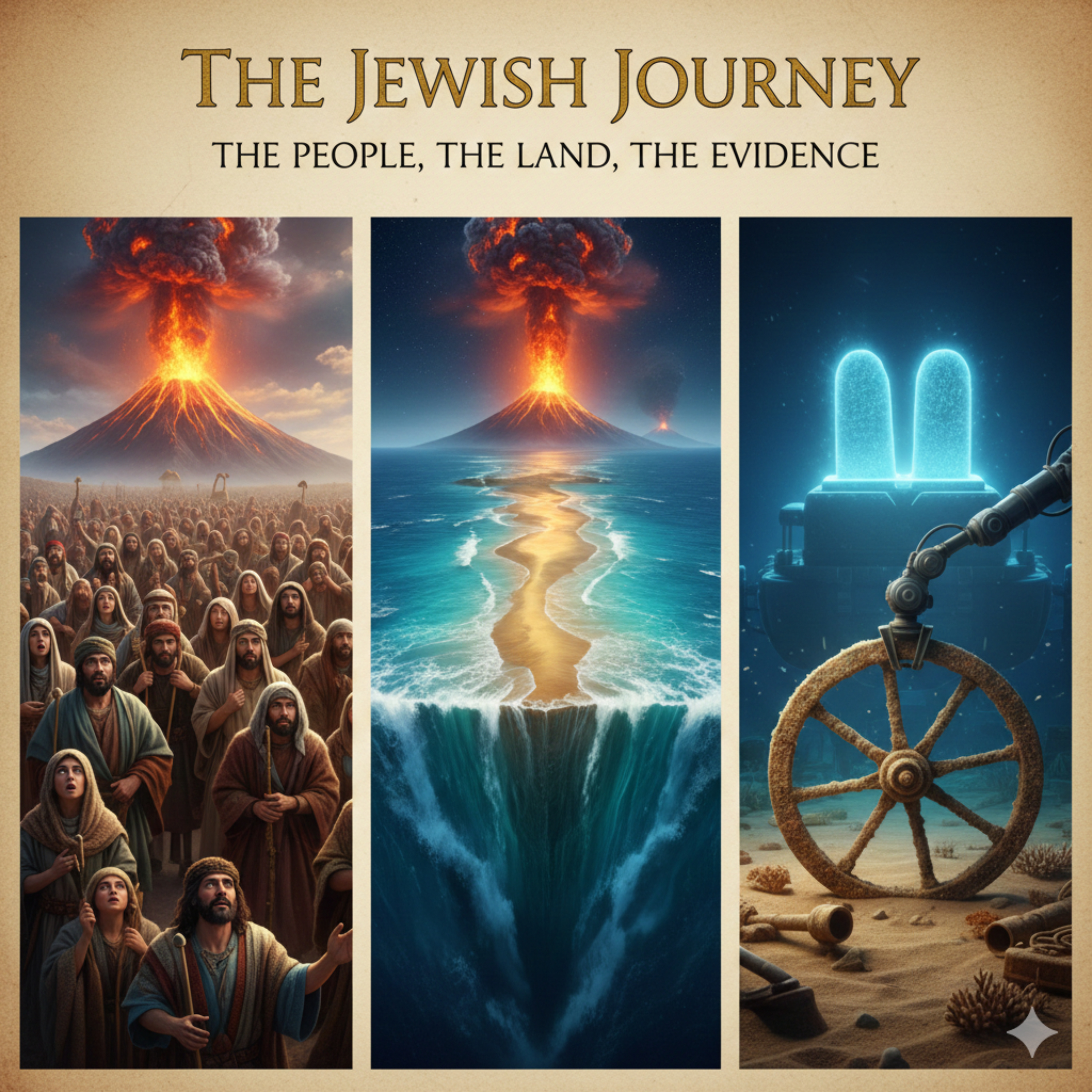
The Jewish Journey: The People, The Land, The Evidence
by Allen Kamrava, MD MBA FACS FASCRS
Using the power of AI to comb through dozens of texts, sources, and the Old Testament, this podcast begins with the story of Abraham. It progresses story by story through the impressively long and complex history of the Jewish nation. The narration is created through Google's Notebook LM, via dedicated prompts to discuss specific topics and time periods per episode.
-
41
Ice Water and Ecstasy: The Hasidic Rebellion
What happens when an elite society of scholars is suddenly challenged by a populist movement fueled by singing, dancing, and mystical ecstasy? In this episode, we dive into the bitter 18th-century civil war that tore Eastern European Jewry apart. On one side: the Hasidim, a joyful, grassroots rebellion that made God accessible to the uneducated masses. On the other: the Mitnagdim, the fiercely intellectual establishment led by the legendary Vilna Gaon—a genius who literally put his feet in ice water to study harder. From brutal excommunications to book burnings, we unpack how the battle between the mind and the heart permanently reshaped the Jewish world.
-
40
Beyond Fiddler: The Brutal, Brilliant Reality of the Shtetl
What was life actually like in the legendary Jewish market towns of Eastern Europe? Spoiler: It wasn't just fiddlers on roofs. In this episode, we strip away the nostalgia to dive into the true history of the shtetl. We explore the geographic prison of the Pale of Settlement, where a marginalized people built a vibrant, self-governing society amidst grinding poverty. From the terror of the Tsar's child-snatching armies to the joyful, musical rebellion of the Hasidic movement, we unpack the daily realities of this vanished world. Finally, we track the massive wave of immigration that brought two million refugees to America, closing the chapter on this unique "portable homeland."
-
39
The Messiah Who Converted: The Bizarre Tale of Shabbetai Zevi
In 1666, the global Jewish diaspora essentially packed its bags and waited for the end of the world. Why? Because a charismatic, deeply unstable rabbi named Shabbetai Zevi claimed he was the Messiah—and a brilliant young PR mastermind named Nathan of Gaza convinced the globe it was true.In this episode, we explore the anatomy of a mass historical delusion. From the severe trauma of the 1648 massacres that primed a population for a savior, to the viral spread of apocalyptic rumors, we unpack how an entire society lost its grip on reality. Finally, we discuss the ultimate historical anti-climax: the shocking moment the "Messiah" surrendered to the Ottoman Sultan and converted to Islam. Join us for a deep dive into trauma, mysticism, and the devastating fallout of a broken promise.This episode explores one of the wildest mass delusion events in human history: the rise and spectacular fall of the 17th-century false messiah, Shabbetai Zevi.The Trauma and the Spark: The episode sets the stage with the 1648 Khmelnytsky massacres, which devastated Eastern European Jewry and left a deeply traumatized population. In the wake of this tragedy, the mystical teachings of Lurianic Kabbalah, emphasizing cosmic repair (Tikkun), primed the masses to look for a savior.The Messiah and the PR Manager: Enter Shabbetai Zevi, a charismatic but deeply unstable rabbi from Smyrna (Izmir) known for bizarre, taboo-breaking behavior. In 1665, he meets Nathan of Gaza, a brilliant young scholar who becomes his "prophet" and public relations mastermind, declaring Shabbetai the long-awaited Messiah.The 1666 Global Hysteria: The movement goes viral, spreading rapidly across Europe, the Middle East, and North Africa. Caught in a wave of mass hysteria, Jews sell their homes and businesses, stop working, and prepare to return to the Holy Land in the apocalyptic year of 1666.The Anti-Climax and Conversion: Shabbetai travels to Constantinople to confront the Ottoman Sultan. Instead of handing over the empire, the Sultan imprisons him and offers a stark choice: convert to Islam or face death. Shockingly, the "Messiah" chooses to convert, taking an Islamic name and donning a turban.The Fallout: The conversion triggers a catastrophic psychological collapse and deep cognitive dissonance across the Jewish diaspora. While the vast majority abandoned the movement in shame, a radical fringe followed him into Islam, creating the secretive Dönmeh sect.
-
38
1492: The Inquisition and the Sephardic Exile
In 1492, Christopher Columbus sailed the ocean blue—but the exact same year, King Ferdinand and Queen Isabella issued an edict that destroyed the oldest, most prosperous Jewish community in Europe. In this episode, we unpack the terrifying rise of the Spanish Inquisition, the tragedy of the Alhambra Decree, and the massive refugee crisis that followed. Discover how the paranoia surrounding secret converts (conversos) led to state-sponsored terror, and how the exiled Sephardic Jews ultimately found a new golden age under the protection of the Islamic Ottoman Empire.
-
37
The Spice Merchant General: The Untold Golden Age of Islamic Spain
This episode shatters the misconception that the Middle Ages were a stagnant, dark monolith of religious hostility. Instead, it explores Andalusia (Islamic Spain) between the 10th and 12th centuries—a vibrant, merit-based cultural crucible where Jews, Muslims, and Christians actively collaborated.The hosts contrast the brutal, state-sponsored anti-Semitism of the 7th-century Visigoths with the relative tolerance of the Umayyad Caliphate (under Abd al-Rahman III). Under Islamic law, Jews held the status of Dhimmi (protected subjects). While still second-class, this system granted them religious freedom, security, and an environment where they could economically and intellectually thrive.Chazdai ibn Shaprut: A Jewish court physician who monopolized international diplomacy simply because he was fluent in Arabic, Hebrew, and Latin (a language the Arab nobility considered beneath them). He famously brokered a massive peace treaty by convincing Christian monarchs to travel directly into the Caliph's court.Samuel ibn Naghrela (Samuel HaNagid): A poor Jewish spice merchant whose flawless mastery of classical Arabic calligraphy and statecraft catapulted him to become the Grand Vizier and top military general of the Muslim Kingdom of Granada. Because he had no tribal backing or royal bloodline, he posed zero threat of a coup, making him the safest, most trusted commander for the Berber kings.Inspired by the Arabic obsession with linguistic purity, Jewish scholars reverse-engineered Hebrew grammar. Utilizing the Masora (vowel sign system), they democratized the language, moving it from a cryptic tongue for elites to a dynamic vehicle for an explosion of secular poetry, science, and mathematics.The episode concludes with the tragic story of Judah Halevi, a brilliant physician-poet who grew disillusioned with the temporary safety of courtly wealth. He wrote the Kuzari (a philosophical masterpiece defending faith over raw logic) and eventually abandoned his comfortable life for a perilous, ultimately fatal pilgrimage to a ruined Jerusalem—anticipating the brutal collapse of Andalusian tolerance under the fundamentalist Almohad invasion.What if a medieval society valued raw intellect over royal bloodlines? In this episode, we dive into Andalusia (Islamic Spain) to uncover an era where a Jewish spice merchant became the supreme general of a Muslim army, and a court physician dominated international diplomacy because he was the only one who bothered to learn Latin. We trace the dramatic shift from the brutal oppression of the Visigoths to a thriving cultural meritocracy that completely reverse-engineered the Hebrew language and birthed a poetic revolution. Finally, we explore the structural fault lines of this "Golden Age" through the eyes of Judah Halevi, whose longing for a forgotten homeland anticipated a devastating fundamentalist invasion.
-
36
Architects of Hatred: How Medieval Europe Built the Jewish Scapegoat
How does a society learn to systematically scapegoat its own neighbors? In this episode, we deconstruct the dark, historical architecture of anti-Semitism in medieval Europe. We track how Jewish communities transitioned from indispensable economic allies into institutionalized targets. From the financial greed driving the Rhineland Massacres of the First Crusade to the lucrative fabrications of the 1144 Blood Libel, and finally, the horrific economic purges disguised as plague panic during the Black Death, we uncover the terrifying mechanics of how conspiracy theories are built, monetized, and weaponized.This episode explores the systematic "architecture of hatred" in medieval Europe, tracing how the Jewish community went from vital economic partners to institutionalized scapegoats through a series of calculated historical pivots.Before the 11th century, Jewish communities served as the vital mercantile tissue of a fragmented Europe. Barred from land ownership, they specialized in commerce, literacy, and long-distance trade. They provided the liquidity and international connections that local European economies desperately needed to survive, enjoying a pragmatic, stable coexistence with their neighbors.The baseline shattered with the rise of Christian fundamentalism and the launch of the First Crusade. While the official target was Muslims in the Holy Land, crusading knights and peasants lacked the liquid cash required to fund their expeditions. Because local Jews were their primary creditors, crusaders flipped the theological narrative—labeling Jews as "enemies of God"—to justify attacking them internally. This allowed crusaders to physically destroy credit ledgers and wipe out their debts. Despite protection efforts by local bishops, rhineland massacres (such as in Worms and Mainz) resulted in unprecedented mass suicides and tragic localized resistance.Following the mysterious death of a young boy named William in Norwich, England, a monk named Thomas of Monmouth fabricated a graphic narrative claiming the boy was ritually crucified by Jews. While initially dismissed by local secular authorities, the myth was institutionalized by a new bishop who recognized its economic utility. A local martyr shrine attracted wealthy pilgrims, turning a baseless rumor into a lucrative church asset. Later, a convert named Theobald of Cambridge expanded this into a global conspiracy theory, claiming an international council of Jews selected target towns for ritual murder.When the bubonic plague decimated Europe, a terrified population lacking germ theory conceptualized it as a man-made plot. Under extreme torture at the Castle of Chillon, false confessions were extracted claiming Jews were poisoning public wells. This triggered a massive, organized economic purge. Working-class guilds used the well-poisoning panic as a smoke screen to overthrow patrician ruling classes, eliminate their Jewish creditors, and seize assets, resulting in the eradication of over 300 communities.1. The Pre-Crusade Baseline 2. The First Crusade (1095): Debt and Holy War 3. The Blood Libel (1144): Fabricating the Myth for Profi t4. The Black Death (1348): The Ultimate Purge
-
35
The 10th Century Silicon Valley: The Golden Age of Spain
Imagine a medieval world where writing a brilliant poem or charting the stars could land you a cabinet position in the government. Welcome to the Golden Age of Spain (900–1200 AD), an era of extraordinary cross-cultural tolerance where Jewish, Islamic, and Christian scholars didn't just coexist—they innovated together. In this episode, we unpack this historical anomaly and deep-dive into the life of Moses Maimonides: a refugee who became a royal physician, a pioneer of psychosomatic medicine, and a philosopher who jail-broke religious thought using pure logic. Turn up the volume and join the deep dive!The Silicon Valley of 711 ADThe Umayyad Dynasty: Starting in 711 AD, Muslim rule in Spain established an infrastructure of extraordinary cultural tolerance while much of Europe languished in the Dark Ages.Centers of Excellence: Cities like Córdoba, Granada, and Toledo became international beacons for shared intellectual exchange among Jewish, Islamic, and Christian thinkers.Hasdai ibn Shaprut: In the 10th century, the Caliph appointed this Jewish court doctor, who acted as a powerful magnet attracting the world's finest scholars and scientists to Córdoba.The Story of Moses: A captured Babylonian rabbi named Moses was sold as a slave in Córdoba and wandered into a local synagogue wearing tattered sackcloth.Yielding the Floor: After interjecting into a complex legal debate with staggering intellectual mastery, the presiding judge immediately stepped down and yielded his position to the tattered stranger.Skills-Based Status: Sephardic culture uniquely prioritized merit and secular skills—such as map-making, astronomical navigation, and linguistics—over traditional aristocratic bloodlines.Tax Farmers: Jews frequently worked as "tax farmers"—privatized revenue agents who relied on advanced mathematics, diplomacy, and deep agricultural knowledge to extract state wealth without triggering revolts.Poetry as a Flex: Composing flawless verse on the spot was the ultimate proof of a sharp, disciplined mind, signaling the cognitive competence required for high-stakes political treaties.Honoring the Divine: This society believed that unlocking the mechanics of the natural universe didn't compete with religion; it illuminated it.A Life Upended: Born in Córdoba in 1135 AD, Maimonides was forced into a multi-year flight across North Africa to Egypt at age 13 when the fundamentalist Almohad dynasty seized the city.An Exhausting Routine: To support his extended family, he became the court physician to Saladin’s vizier, working from dawn at the palace before treating packed crowds of local patients until late into the night.Psychosomatic Pioneer: He championed preventive medicine (diet, hygiene, exercise) and was centuries ahead of his time in recognizing that mental distress directly manifests as physical illness.The Guide for the Perplexed: His philosophical masterpiece harmonized Aristotelian logic with religious faith, famously introducing "negative theology"—the idea that human language can only describe what God is not.Historical Irony: By demanding that faith submit to rational proof, his work accidentally planted the foundational intellectual seeds for modern secularism.Sephardic Meritocracy & The Slave ScholarPoetry, Tax Farming, and Applied KnowledgeMoses Maimonides: The Ultimate Polymath
-
34
The Khazar Pivot: The Wildest Geopolitical Move in History
Forget everything you think you know about the Dark Ages. It wasn't just a world divided between the Cross and the Crescent. In this episode, we dive into the wild, true story of the Khazars—a massive, heavily armed nomadic empire in the Russian steppes that converted to Judaism just to keep the world’s superpowers off their backs. We also explore the daily realities of medieval life: how Byzantine laws forced Jews into the stinky profession of leather tanning, and how Islamic taxes accidentally created an international class of urban merchants. Turn up the volume and join the deep dive!
-
33
The Portable Homeland: How the Talmud Rebuilt a Nation
The Great Pivot (70 AD)The story begins with the Roman siege of Jerusalem, which shattered the Jewish political and religious infrastructure. Amidst the chaos, Rabbi Yohanan ben Zakkai recognized that military resistance was futile and staged a daring escape from the city in a coffin. He negotiated with the Romans to establish a small center for study in Yavneh, effectively shifting the focus of Judaism from a physical territory governed by kings to a borderless realm governed by scholars and books.By approximately 200 AD, Judah HaNasi compiled the Mishnah, the "core code" of Jewish life. To ensure the survival of Jewish identity, he organized all of human existence into six "orders":Zeraim (Seeds): Agricultural and moral laws regarding food.Moed (Festivals): The organization of time and holy days.Nashim (Women): Marriage, divorce, and family structure.Nezikin (Damages): A comprehensive civil and criminal legal code.Kodashim (Sacrifices) & Tohorot (Purities): Detailed records of Temple rituals and purity laws, intended to keep the memory of the Temple alive in the mind since the physical stones were gone.The discussion highlights the emergence of the Babylonian Talmud as the definitive "operating system" for global Judaism. In the academies of Sura and Pumbedita, a system of Cathadocracy (rule from the teacher’s chair) developed. This intellectual hierarchy was so powerful that the Geon (head scholar) could excommunicate the Exilarch (the secular Jewish leader), proving that in this society, intellectual mastery over the text trumped royal bloodlines and wealth.The podcast concludes by explaining how the Talmud breathes and adapts. The rabbis built "fences" around the law—additional strictures like Muktzah (not touching tools on the Sabbath) to prevent accidental violations. Conversely, they created legal workarounds like the Heter Iska (business dispensation), which allowed the community to thrive in a modern mercantile economy without violating biblical prohibitions against charging interest.Architecture of the Mind: The MishnahThe Babylonian "Cathadocracy"Fences and Workarounds
-
32
From Ashes to Academies: Yohanan ben Zakkai’s Radical Gamble
In 70 CE, the unthinkable happened: the Roman legions breached the walls of Jerusalem and reduced the Second Temple to a smoldering ruin. For the ancient Israelites, this wasn't just the loss of a building; it was the destruction of their sacred center and their primary means of connecting with God through sacrifice.In this episode, we explore the daring and controversial survival strategy of Rabban Yohanan ben Zakkai, the visionary leader who saw the writing on the wall before the city fell. We’ll recount:The Great Escape: The dramatic tale of how Ben Zakkai faked his own death and was smuggled out of besieged Jerusalem in a coffin to negotiate with the future Roman Emperor, Vespasian.A Pivot to Yavneh: Instead of begging for the Temple’s preservation, Ben Zakkai asked for a small academy in the city of Yavneh, transforming Judaism from a Temple-centered religion into one focused on study, prayer, and communal deeds.The Birth of Rabbinic Judaism: How the focus shifted from blood sacrifices at an altar to the "sacrifices of the lips"—the study of Torah and the acts of loving-kindness that allowed Judaism to survive in the Diaspora for two millennia.Join us as we analyze the "Yavneh Moment"—a masterclass in leadership, resilience, and the radical re-invention of a culture on the brink of extinction.
-
31
The Bar Kokhba Revolt -- Shattered Messianism: The Final Jewish Revolts Against Rome
The destruction of the Second Temple in 70 CE was not the end of the struggle for Judean independence; instead, it set the stage for even bloodier chapters in history. In this episode, we explore the explosive final revolts that fundamentally reshaped the Jewish world and the Roman Empire.We take a deep dive into:The Diaspora Erupts: The Kitos War under Emperor Trajan, where Jewish communities across the Roman Empire rose up in a massive, coordinated rebellion.The Bar Kokhba Revolt: The 132 CE uprising led by the charismatic Simon bar Kokhba, endorsed as a messianic figure by the legendary Rabbi Akiva.The Cost of Rebellion: The horrific Roman retaliation that resulted in hundreds of thousands of deaths, the complete exile of Jews from Jerusalem, and Emperor Hadrian’s decision to erase the name of Judea, renaming it Syria Palaestina.A Theological Pivot: How the catastrophic failure of military messianism led the Jewish people to turn inward, focusing on the survival of their culture and faith through Rabbinic study and the law, rather than the sword.Join us as we analyze the "Bar Kokhba Moment"—the tragic, final stand of a nation and the birth of a resilient, text-based Diaspora community.
-
30
The Great Revolt: The Zealots, the Siege, and the Ashes of Zion
Detailed Audio Outline1. The Spark and the Renegade (The Problem of Josephus)The Outbreak (66 AD): Briefly set the scene. The brutal rapacity of the Roman governor Florus and the massacres in Caesarea push the province over the edge. The Jews defeat the Roman general Cestius Gallus at Beth-horon, shocking the world and making full-scale war inevitable.Vespasian & Josephus: Nero sends his best general, Vespasian. The Jews place the defense of Galilee in the hands of Joseph (Josephus).The Surrender: Detail Josephus’s highly controversial surrender at Jotapata. Hiding in a cave, he survives a mass suicide pact with his men, surrenders to the Romans, and predicts Vespasian will become Emperor. The Debate: Discuss how history views him. To the Zealots, he was a despicable traitor; but without his subsequent writings, this entire history would be lost.The Three Factions: While the Romans methodically conquer the countryside, Jerusalem fills with desperate refugees and fierce Zealots. The city fractures into a bloody three-way civil war.The Ultimate Folly: Describe the madness of the infighting. While Rome marches on the city, these factions fight each other daily, wading through blood in the sacred courts, and in their madness, they burn each other's grain reserves—destroying the very food that could have allowed them to withstand a years-long siege.The Siege (70 AD): Vespasian becomes Emperor; his son Titus marches on Jerusalem with 80,000 men and surrounds the city with a wall of stone to starve them out.The Horrors of Starvation: Use Milman's grim details. The famine becomes so absolute that natural affection dies. People steal food from the mouths of their children. Tell the horrifying, infamous story of Mary of Bethezob, a wealthy woman who, driven mad by starvation, roasted and ate her own infant son, shocking even the hardened Zealots and Roman soldiers.The Crucifixions: Anyone caught sneaking out of the city to scavenge for food is crucified by the Romans. Up to 500 Jews a day are nailed to crosses before the walls, until the Romans literally run out of wood and space.The Breach: The Romans capture the Antonia Fortress and overlook the Temple. The daily sacrifice ceases forever because there are no animals left.The Conflagration: Titus (according to Josephus) wishes to spare the magnificent Temple, but the fury of the battle takes over. A Roman soldier, lifted on the shoulders of another, throws a blazing brand through a golden door. The fire spreads uncontrollably.The Slaughter: The Romans rush in, slaughtering everyone—Zealots, priests, and civilians. Blood literally flows down the Temple steps. John and Simon retreat to the Upper City but are eventually starved out and captured.The Ruin: Jerusalem is completely razed to the ground. Over a million perish; nearly 100,000 are sold into slavery or sent to the gladiatorial arenas.The Triumph: The episode closes in Rome. Vespasian and Titus celebrate a massive Triumph. The golden Menorah and the Table of Shewbread are paraded through the streets. Simon bar Giora is dragged with a halter around his neck and executed in the Forum. The Arch of Titus is built—a monument to Roman glory, and a permanent scar of Jewish tragedy
-
29
The Architect of Terror: King Herod’s Grand Design and Bloody Legacy
What happens when a visionary architect is also a textbook psychopath? In this episode, we peel back the layers of one of antiquity's most polarizing figures: King Herod the Great. From his rise to the throne in 37 BC to his grisly end in 4 BC, Herod managed to be both Judea’s greatest builder and its most terrifying tyrant.We take a deep dive into:The Impossible Port: How Herod’s engineers used revolutionary underwater concrete to turn a straight, windswept coastline into the massive maritime hub of Caesarea Maritima.Fortresses of Fear: A look at the "architectural paranoia" behind the artificial mountain of Herodium and the desert stronghold of Masada.The Crown Jewel: The staggering expansion of the Second Temple in Jerusalem—a building so bright it was said to blind travelers from miles away.A Family Slaughterhouse: The tragic narrative of Herod’s private life, including the cold-blooded murders of his beloved wife Mariamne, her brother Aristobulus, and eventually his own sons as his paranoia spiraled out of control.The Final Act: The historical context behind the Massacre of the Innocents and Herod's failed final command to ensure his people would mourn on the day he died.Join us as we explore the intersection of imperial grandeur and domestic carnage in the life of the man who tried to engineer loyalty in stone because he couldn't earn it in hearts.
-
28
A Throne of Ashes: The Civil War That Doomed Judea
What happens when you successfully fend off a massive empire to save your religion, only to destroy yourselves from the inside out a few generations later? In this episode, we unpack the tragic, chaotic, and often brutal downfall of the Hasmonean Dynasty—the Jewish kingdom established by the Maccabees.We trace how the descendants of pious freedom fighters transformed into power-hungry, Hellenized monarchs who were more interested in acquiring wealth, expanding territory, and acting like Greek kings than adhering to their faith. The episode dives into the violent civil wars between brothers, the ruthless purges of political enemies, and the desperate, ultimately fatal decision to invite the expanding Roman Empire to settle a family feud.We also explore the rise of King Herod the Great—a brilliant but paranoid architectural visionary who murdered his own family while simultaneously expanding the Second Temple into one of the wonders of the ancient world. Ultimately, we examine how the constant political bloodshed pushed the common people away from the corruption of the Temple elite, laying the quiet groundwork for the survival of Judaism long after the walls of Jerusalem fell.
-
27
To Save a Culture: The Violent Economic War Behind Hanukkah
When you think of Hanukkah, you probably picture a cozy winter holiday with menorahs, spinning dreidels, and a miraculous cruse of oil. But behind the greeting card version of the holiday is a brutal, high-stakes military and economic war for the survival of the Jewish people.In this episode, we trace the fallout of Alexander the Great's fragmented empire, leading to a catastrophic clash in 167 BCE when the Syrian-Greek King Antiochus Epiphanes decided to weaponize culture. He didn't just want political dominance; he wanted to eradicate Judaism completely by out-lawing circumcision, banning the Torah, and forcing the Jews to sacrifice pigs on their sacred altar in Jerusalem.We explore the fascinating (and horrific) intersection of ancient politics, religion, and money, as Antiochus used the Temple's treasury as a personal ATM and attempted to crush a society by destroying its core identity. But his brutal policies ignited the Maccabean Revolt—a fierce guerrilla war led by a family of zealots who chose death over assimilation.Tune in as we unpack the gritty, bloody history of Hanukkah, the desperate fight against forced Hellenization, and the profound tragedy of the Maccabees’ descendants, who ultimately fell victim to the very corruption and power-hunger they fought so hard to defeat.
-
26
A Civil War of the Mind: How Greek Culture Fractured Ancient Judea
What happens when you survive foreign invasion, exile, and centuries of empires... only to be conquered by an idea? In this episode, we explore the insidious and deeply psychological clash between ancient Judaism and the seductive, sophisticated, globalizing culture of Hellenism (Greek culture).Following the conquests of Alexander the Great, the Jewish people didn't face swords or siege engines; they faced a soft power takeover. We dive into the profound generational divide this caused, as Jewish elites rushed to embrace Greek philosophy, fashion, and even the gymnasium (where athletes competed naked, sparking the brutal practice of surgical epispasm to reverse circumcision). But when the aggressive Greek king Antiochus Epiphanes attempted to forcibly outlaw Judaism entirely, it triggered an explosive, grassroots rebellion.Tune in as we dissect the Maccabean Revolt, the fight for cultural survival, and the terrifying reality of a society fracturing from within, desperate to hold onto its soul in a rapidly changing world.
-
25
Title: Building Walls and Writing Laws: How Ezra and Nehemiah Rebuilt Zion
What does it take to physically and psychologically rebuild a nation from scratch? In this episode, we explore the monumental, fragile, and often brutal return of the Jewish exiles to a ruined Jerusalem. Armed with an imperial decree from the Persian King Cyrus, a traumatized remnant faces the seemingly impossible task of reconstructing a city and an identity that had been reduced to ashes for half a century.We break down the high-stakes logistics and political maneuverings of Nehemiah, the cupbearer to the Persian king who becomes a ruthless project manager to rebuild the city walls under constant threat of attack. We also examine the radical, controversial, and deeply painful social reforms of Ezra the Scribe—including his demand for mass divorce—as he uses the power of the written word to forge an indestructible "virtual" fortress around his people.Join us as we analyze how the sword and the scroll were used to pull a civilization back from the brink of extinction, permanently shifting the Jewish faith from a localized temple cult into a resilient, portable, text-based religion.
-
24
The Queen’s Gambit: Esther, Mordecai, and the Origins of Purim
What happens when you’re exiled in a foreign empire ruled by an unpredictable, ego-driven king, and you learn of a state-sponsored plot to annihilate your people? In this episode, we unpack the gripping political thriller that is the Biblical story of Esther. We explore the treacherous halls of the Persian Empire under King Ahasuerus (Xerxes I) and analyze the strategic brilliance of Mordecai and Esther as they navigate a deadly game of court intrigue. From the vanity of the king to the genocidal ambitions of Haman, we break down how the Jewish people narrowly escaped total destruction. Tune in to discover the historical roots of the festival of Purim—a celebration not just of survival, but of the profound psychological resilience required to turn the tables on your oppressors and transform the day of your planned execution into a permanent festival of joy.
-
23
How the Exiles Built a Portable Religion
What happens when the very foundation of your reality is reduced to ash? In this episode, we take a deep dive into one of human history's most profound pivot points: the Babylonian Exile of 586 BC.3When King Nebuchadnezzar and the Babylonian Empire conquered Judah and burned the Temple in Jerusalem to the ground, they didn't just destroy a building—they destroyed what the ancient Israelites believed to be the literal, singular house of God. By deporting the society's elite (the royals, priests, scribes, and skilled laborers) to Babylon, the empire initiated a psychological and cultural apocalypse, fully expecting this conquered people to fade into the dust of Mesopotamia.Instead, these exiles pulled off a radical, unprecedented survival strategy. Tune in as we explore:The Ultimate Long Game: How the Prophet Jeremiah shocked the devastated exiles by telling them to build houses, plant gardens, and integrate economically, all while maintaining their distinct identity.The Invention of the Synagogue: How the loss of the central Temple forced the creation of a decentralized, portable "app" for worship—the synagogue—proving that a faith could survive anywhere in the world.A Theological Revolution: How the prophet Ezekiel helped shatter the paralyzing belief in generational curses, introducing the empowering concept of individual accountability and personal repentance.The Rise of the Text: How unemployed priests turned to ancient scrolls, triggering the massive compilation, redaction, and democratization of the texts that would become the Hebrew Bible, completely shifting the power from the sword to the pen.Join us as we unpack how the ultimate tragedy—losing their physical homeland and temple—became the fiery crucible that forged modern, resilient, text-based Judaism.
-
22
The Ashes of Jerusalem: The Fiery Birth of a Portable Identity
What happens when a minor buffer state gets caught between ancient superpowers? In this episode, we explore the terrifying rise of the Babylonian Empire and the apocalyptic fall of Jerusalem in 586 BC. We track the geopolitical collapse of the Assyrians, the tragic rebellion of King Zedekiah, and the brutal Babylonian siege that reduced the First Temple to rubble. At the center of the chaos stands the Prophet Jeremiah, a whistleblower preaching a radical, highly unpopular idea: to survive the destruction of their physical world, the people must build an indestructible fortress in their minds. Tune in to discover how the ultimate historical tragedy sparked the fiery birth of a portable identity.
-
21
Bird in a Cage: Jerusalem’s Impossible Defiance of Assyria
How did a tiny, isolated mountain kingdom survive the total might of the first professional war machine in history? In this forensic episode of The Jewish Journey, we analyze the 701 B.C. siege of Jerusalem and the combination of engineering and prophecy that changed the course of Western history.In this episode, we unpack:The Assyrian Terror: A look at the brutal efficiency of the Assyrian war machine. We examine their innovative use of siege ramps and iron weaponry that had already erased the Northern Kingdom from the map.Hezekiah’s Engineering Masterpiece: The forensic details of the Siloam Tunnel, a 1,700-foot underground conduit carved through solid rock to hide Jerusalem’s water source from the invaders.Prophetic Diplomacy: Isaiah’s high-stakes spiritual counsel. We explore why Isaiah viewed the siege not just as a military problem, but as the ultimate test of the "God-people alliance" established at Sinai.The "Smoking Gun" of Sennacherib: Analyzing the Taylor and Sennacherib Prisms. We look at why the most powerful emperor on earth went home without taking his primary target, leaving behind a record of failure disguised as a boast.The Night of 185,000: Investigating the miraculous plague that decimated the Assyrian camp and why Jerusalem’s survival ensured that the Jewish identity—and the Word—would endure.Join us as we explore the intersection of ancient military technology, underground engineering, and the enduring power of a nation that refused to disappear.
-
20
The Assyrian Shadow: Justice and the Fate of the Ten Lost Tribes
What happens to a nation when it loses its moral compass and its borders at the same time? In this sobering episode of The Jewish Journey, we investigate the fall of the Northern Kingdom of Israel and the haunting legacy of the Ten Lost Tribes.In this episode, we unpack:The Social Fracture: Why the prophets Amos and Hosea viewed the widening gap between the ultra-wealthy and the poor as the true "internal rot" that invited foreign invasion.The Assyrian War Machine: A look at the first truly professional, multi-national military force. We examine the Assyrians' innovative and brutal use of siege warfare and iron weaponry.Identity Erasure: Analyzing the Assyrian policy of forced resettlement. We discuss how the deportation of the ten tribes was a calculated psychological move to destroy their connection to the land and their God.The "Lost" Tribes Mystery: Separating myth from forensic history. We explore where the northern tribes actually went and how they were eventually absorbed into the vast Assyrian machine.Judah’s Lesson: How the tragedy of the North served as a "firewall" for the Southern Kingdom, leading to a spiritual and legal consolidation that allowed the Jewish identity to survive future exiles.Join us as we explore the intersection of imperial conquest, social justice, and the birth of a nomadic, but enduring, national identity.
-
19
Prophet vs. Tyrant: Elijah and the War for Israel’s Soul
What happens when the "Word" stands alone against the absolute power of the State? In this explosive episode of The Jewish Journey, we investigate the forensic and theological details of the most dangerous showdown in ancient history: Elijah vs. King Ahab.In this episode, we unpack:The Architecture of Tyranny: A look at Ahab’s reign, supported by the strategic and ruthless Queen Jezebel, and how their military-industrial state attempted to erase the Mosaic Law through the forced worship of Baal.The Drought as Evidence: Analyzing the 1446 B.C. timeline of "environmental judgment." We discuss why the three-year famine was a direct forensic attack on Baal’s claim as a "storm god" who controlled the rain.Positional vs. Moral Authority: Examining the "Troubler of Israel" accusation. We look at how Elijah flipped Ahab's narrative, proving that the true source of national instability was the king's abandonment of the Covenant.Showdown at Mount Carmel: A forensic breakdown of the ritual contest. From the 850 pagan prophets to the water-drenched sacrifice, we examine the empirical evidence that vindicated the God of Israel.The Prophetic Firewall: How Elijah’s refusal to yield to institutional pressure created a new model of leadership that prioritized fidelity to God over political pragmatism.Join us as we explore the courage of a stateless prophet who used the Word of Yahweh to topple the strongest military dynasty of the Iron Age.
-
18
Bronze & Bondage: The Imperial Cost of Solomon’s Jerusalem
How did a tribal federation become a global superpower, and what was the true price of that glory? In this forensic episode of The Jewish Journey, we analyze the high-stakes political and economic engineering that defined the reign of King Solomon.In this episode, we unpack:The Military-Industrial Machine: Moving beyond the "wise king" image to see Solomon as a shrewd operative who turned Israel into a regional hub for trade and advanced military technology.Building the Temple: A look at the unprecedented scale of Solomon’s construction projects. We examine the logistics of the First Temple and why its creation required a massive system of domestic forced labor.The Phoenician Connection: Investigating the alliance with Hiram of Tyre and the influx of foreign skill, materials, and culture that transformed Jerusalem into a cosmopolitan capital.A New Kind of Bondage: The irony of a nation freed from Egyptian slavery instituting its own system of conscription and heavy taxation to maintain state grandeur.The Spiritual Collision: How the absolute rule of a king inevitably collided with the original "God-people alliance" established at Sinai, setting the stage for national fracture.Join us as we explore the ruthless calculations and monumental achievements that built Jerusalem but threatened the soul of a nation.
-
17
The Iron Crown: Anarchy, Technology, and the Rise of the Israeli State
How did a loose federation of twelve tribes survive the transition from the Bronze Age to the Iron Age? In this pivotal episode of The Jewish Journey, we investigate the brutal geopolitical realities that forced ancient Israel to trade its direct "God-people alliance" for the centralized power of a human king.In this episode, we unpack:The Failure of Tribal Anarchy: Why the 300-year "Era of the Judges" collapsed into a cycle of internal corruption and civil war, proving that a decentralized theocracy couldn't hold under pressure.The Philistine Technological Monopoly: A forensic look at the "Iron Curtain" of the ancient world. We examine how the Philistines’ mastery of iron smelting gave them a decisive military advantage that tribal militias could not overcome.The "Brutal Trade": Analyzing the people's desperate demand for a king "like all the nations" and the heavy price they paid in personal liberty, taxation, and conscription for the sake of national survival.David’s Political Masterstroke: How the "Shepherd King" used his experience as a professional mercenary to build a standing army and established Jerusalem as a neutral federal district to unify twelve jealous tribes.The Imperial Cost: The culmination of statecraft under Solomon, where the splendor of a global empire finally collided with the original spiritual purity of the Mosaic Law.Join us as we explore the ruthless calculations and world-changing consequences of Israel's transition from the wilderness to the throne.
-
16
The Iron Crown: The Rise of the Israeli Empire
How did a band of tribal refugees become the dominant superpower of the ancient Near East? In this deep dive of The Jewish Journey, we analyze the high-stakes political and military engineering that birthed the United Monarchy of Israel.In this episode, we unpack:David the Pragmatist: Moving beyond the "shepherd king" myth to examine David as a shrewd military operative who learned the secrets of Iron Age warfare while in exile among the Philistines.The Neutral Capital: Why David chose the non-Hebrew city of Jebus (Jerusalem) as his capital—a masterstroke of "federalist" planning designed to unite 12 fractured tribes.The Professionalization of Power: How David built a professional standing army of foreign mercenaries, creating a force loyal only to the crown and effectively ending the era of tribal militias.Solomon’s Global Machine: An analysis of the first "military-industrial state." We look at how Solomon used trade routes, heavy taxation, and strategic marriages to solidify an empire.The Cost of Grandeur: The inevitable collision between statecraft and theocracy. We examine the moral and religious compromises made to secure the nation’s place on the world stage.Join us as we explore the ruthless calculations and monumental achievements of the kings who built the house of Israel.
-
15
The Lost Timeline: Forensically Solving the Exodus Date
Note: This is a special one-off episode produced out of our regular chronological order in direct response to listener feedback and requests for a deep dive into the dating of the Exodus.For decades, the standard scholarly view has been that the Exodus never happened because the evidence doesn't exist in the time of Ramses II. But what if we've simply been looking at the wrong century? In this investigative special of The Jewish Journey, we apply a forensic lens to ancient chronologies to recover the "lost" timeline of the Israelites.In this episode, we unpack:The 1446 B.C. Anchor: How internal biblical markers and the ancient Seder Olam point to a specific, early date for the departure from Egypt.The Cartographic and Chronological Error: Why the popular "Ramses Theory" fails forensic scrutiny and how a 200-year inflation in Egyptian dating has obscured the historical Israel.The Amarna Smoking Gun: Examining the Amarna Letters—urgent diplomatic correspondence from Canaanite kings pleading for help against the invading "Habiru" at the exact moment the Bible places the Conquest.The Merneptah Stele: Analyzing the earliest extra-biblical mention of "Israel" as an established nation, and why its existence in 1209 B.C. makes a 13th-century Exodus impossible.Re-aligning History: How the New Chronology fixes the synchronization between the Egyptian Middle Kingdom’s collapse and the biblical arrival of Joseph and Moses.Join us as we solve the ultimate chronological riddle and place the Exodus back into its true historical context.
-
14
Anarchy & Iron: The Brutal Birth of the Israeli Monarchy
"In those days there was no king in Israel; every man did that which was right in his own eyes." In this gritty episode of The Jewish Journey, we investigate the 300-year collapse of the tribal theocracy and the high-stakes trade-off that led to the birth of the Israeli Kingdom.In this episode, we unpack:The Failed Theocracy: Why the idealistic "God-people alliance" established at Sinai devolved into a cycle of corruption, tribal isolation, and the devastating Civil War against Benjamin.The Philistine Iron Monopoly: A look at the ancient arms race. We examine how the Philistines used their secret knowledge of iron smelting to maintain a technological stranglehold over the Israelites.Misfit Heroes: An analysis of the charismatic but deeply flawed "Judges"—from the guerrilla tactics of Ehud to the tragic, isolated strength of Samson—and why individual heroism was no match for a centralized state.The Trade for Survival: The people’s desperate demand for a king "like all the nations" and why the prophet Samuel viewed this move toward centralization as a profound spiritual betrayal.Saul and the Reluctant State: The appointment of Saul as Nagid (Military Commander) rather than Melek (Sovereign King), and the beginning of the end for tribal autonomy.Join us as we explore the violent, world-changing transition from the era of the Word to the era of the Iron Crown.
-
13
Anarchy & Iron: The Brutal Trade for Israel’s First King
In those days there was no king in Israel; every man did that which was right in his own eyes." In this gripping episode of The Jewish Journey, we investigate the high-stakes evolution of a nation as it abandons a failed theocracy for the safety of a crown.In this episode, we unpack:The failure of the "God-People Alliance": How the visionary tribal system established at Sinai collapsed into a 300-year cycle of internal corruption and foreign invasion.The Philistine Iron Curtain: A look at the technological arms race of the ancient world. We examine why the Philistines' mastery of iron weapons and chariots kept the Israelites in a state of military subjection.Charismatic Chaos: An analysis of the "Judges"—charismatic but often deeply flawed leaders like Samson and Gideon—who provided local relief but could not stabilize a crumbling nation.The Demand for a King: Why the Israelites eventually demanded a king "like all the other nations," rejecting the unique direct rule of God for a centralized state that could field a professional army.Saul’s Tragic Rise: The transition to the monarchy under Saul, a man who physically fit the people's ideal but represented the heavy price of national survival.Join us as we explore the brutal reality of the Iron Age and the birth of the Kingdom of Israel.
-
12
Anarchy & Iron: The Violent Birth of the Israeli Monarchy
"In those days there was no king in Israel; every man did that which was right in his own eyes." In this gritty episode of The Jewish Journey, we investigate the brutal 300-year period known as the Era of the Judges—a time of internal collapse, foreign invasion, and the desperate search for a national identity.In this episode, we unpack:The Failure of the Theocracy: Why the idealistic "God-people alliance" established at Sinai devolved into a cycle of corruption, civil war, and tribal isolation.The Philistine Iron Curtain: Examining the technological gap between the Israelites and the Philistines. We look at the military impact of iron weapons and chariots, and why the Philistines' monopoly on blacksmithing kept Israel in a state of perpetual subjection.The Cycle of the Judges: A look at the charismatic but flawed leaders like Samson and Gideon—individuals who provided temporary relief but could not solve the underlying crisis of a decentralized nation.The Demand for a King: Why the people eventually rejected the tribal system, demanding a king "like all the nations" to provide the security and military organization needed to survive the Iron Age.Saul and the Reluctant Monarchy: The tragic transition from a divine theocracy to a human monarchy, setting the stage for the rise of a centralized Israeli state.Join us as we explore the violent, high-stakes transition from tribal anarchy to the established kingdom of Israel.
-
11
The Exodus Part 6: Jericho’s Falling Walls: The Forensic Proof of the Conquest
Did the walls of Jericho truly come tumbling down? In this forensic episode of The Jewish Journey, we move beyond the sunday school story to examine the hard archaeological evidence that supports the biblical account of the city’s destruction.In this episode, we unpack:The Chronological Anchor: Why the year 1406 B.C. is the non-negotiable date for the conquest, backed by ancient Jewish sources and the urgent pleas found in the Amarna Letters from Canaanite kings.Forensics of a Collapse: Examining the physical layout of Jericho’s double-wall system and the archaeological finding of mudbricks that fell outward to create a perfect ramp for an invading army.Pottery and Scarabs: Re-evaluating the 1950s conclusions of Kathleen Kenyon. We look at the unique Cypriot bi-chrome pottery and Egyptian scarabs that place the city's destruction squarely in the Late Bronze Age I.Evidence of a Short Siege: Why jars brimming with charred grain prove the city was taken quickly after the spring harvest, exactly as the text describes, rather than through a long, starvation-based siege.The Theological Stake: How the physical evidence of Jericho’s fall validates the transition from a wandering nation to a settled one, establishing the beginning of the Israelites' history in the Promised Land.Join us as we bridge the gap between ancient text and archaeological reality to see why the rocks of Jericho still speak today.
-
10
The National Witness: A Conspiracy of Millions
Can a religion be forensically proven? In this episode of The Jewish Journey, we dissect the "Sinai Standard"—the radical historical claim that the foundation of Jewish faith rests on a public, collective experience rather than a solitary visionary.In this episode, we unpack:The Evolution of Covenant: Tracing the journey from Adam’s dawn of moral consciousness to the individual "pilot programs" of Noah and Abraham, leading to the massive national scale-up at Sinai.The Anti-Conspiracy Logic: Why the decision to reveal the law to millions at once was a deliberate move to prevent the story from ever being dismissed as a fable or a private hallucination.The Power of Sound over Sight: How the "thick cloud" at Sinai intentionally obscured God's form, forcing an entire nation to rely on "the voice of words"—a shared auditory truth that is more difficult to fabricate than a visual one.Forensic Memory Aids: The role of the Ark of the Covenant and the Omer of Manna as physical specimens preserved specifically to bridge the gap between historical event and future generations.The Maimonides Firewall: Analyzing the 12th-century philosopher's argument that Moses' "unmediated" revelation established an absolute standard of truth that can never be challenged by later "private" visions.Join us as we explore how this unique national witness turned a group of former slaves into a community defined by intellectual commitment and the enduring weight of the Word.
-
9
The Exodus Part 4: Deep Sea Detectives: The Forensics of the Red Sea Crossing
In this episode, we move beyond the cinematic imagery of Hollywood to conduct a rigorous forensic investigation into the most famous escape in history: the crossing of the Red Sea. By re-examining ancient cartography and original Hebrew texts, we uncover a "blind spot" that has misled scholars for centuries and point toward a startlingly different location for this monumental event.In this episode, we unpack:The Cartographic Blind Spot: How early AD maps often omitted the Gulf of Aqaba, leading generations of scholars to wrongly focus on the shallow marshes of the Gulf of Suez.Linguistic Precision: Why the traditional "Red Sea" translation is likely a generic Greek error, and how the original term Yam Suph (Sea of Reeds) points toward the deep, terminal waters of the Gulf of Aqaba.The Nuweiba Landbridge: A look at the unique underwater geography of the Gulf of Aqaba, specifically the discovery of a shallow underwater landbridge at Nuweiba Beach that crosses a massive deep-sea trench.Forensic Deep-Sea Findings: Analyzing reports from deep-sea explorers of coral-encrusted chariot wheels, axles, and skeletal remains matching 18th Dynasty Egyptian military designs found at the bottom of the Gulf.Geopolitical Barriers: Why this evidence remains unverified by mainstream science due to the extreme depth of the site and the Saudi Arabian restrictions on deep-water exploration.The Midian Connection: Connecting the dots to Moses’ 40-year exile in Midian (modern-day Saudi Arabia), arguing that the crossing was a strategic journey toward a familiar sanctuary outside of Pharaoh's reach.Join us as we bridge the gap between ancient scripture and bathymetric data to reveal where the desert crossing truly occurred.
-
8
The Exodus Part 5: Will the Real Mount Sinai Please Stand Up?
This episode serves as a geographical and theological detective story, concluding that the traditional location of Mount Sinai in the Egyptian Sinai Peninsula is incorrect based on cartography, politics, and geology.The Map Error: For nearly 2,000 years, tradition has placed Mount Sinai at Jebel Musa (St. Catherine’s). However, the hosts explain that early geographers didn't recognize the Gulf of Aqaba as a distinct body of water. Once you acknowledge that "finger" of the sea, the "wilderness beyond the sea" is clearly modern-day Saudi Arabia, not the Sinai Peninsula.The Political Reality: The Sinai Peninsula was Egyptian territory (Ta Mefkat), filled with military garrisons and mines. Moses, fleeing for his life, would not lead a nation of escapees back into Pharaoh’s backyard; he would lead them to Midian, which was outside Egyptian control.The Moses Connection: Moses lived in Midian for 40 years. It is logical that he would lead the people back to the specific mountain where he had already found refuge and encountered the Burning Bush.Volcanic Evidence: The biblical description of Sinai—shaking, smoke like a furnace, fire reaching the heavens, and a loud trumpet-like roar—is a precise match for an active volcanic eruption.The Geological Gap: There are no volcanoes in the traditional Sinai Peninsula. However, Northwest Saudi Arabia (Midian) contains extensive volcanic fields that were active during the time of the Exodus.The "Pillar" GPS: The "Pillar of Fire and Cloud" is reinterpreted not as a small hovering mist, but as the volcanic plume of the mountain itself, visible from hundreds of miles away, acting as a massive beacon leading the Israelites toward Arabia.Survival as Sovereignty: Miracles like the quail and water from the rock are presented as Yahweh commanding nature to sustain His people.The Unmediated Truth: Philosophers like Maimonides used these events to argue that Moses had a unique, unmediated relationship with God, making the Law delivered at this "Mountain of Fire" an absolute divine decree.Conclusion: The Exodus was a "theological secession" from Egypt. By moving the mountain from Egypt to Arabia, the narrative establishes Yahweh’s total sovereignty over the physical world and a new cosmic order for the Israelites.The Core Argument: Sinai belongs in Arabia (Midian)The Scientific "Smoking Gun": The Volcano TheoryLogistics and Theology
-
7
Words vs. Idols: The Birth of a New Covenant
In this episode, we explore the radical sociological and theological transformation of the Israelites as they transition from property in Egypt to a self-governing nation defined by an invisible God and abstract ethics. We dissect the tension between the comforting immediacy of visible idols and the difficult demands of a religion rooted in the "Word."In this episode, we unpack:A Revolutionary Constitution: How the Mosaic Law provided a revolutionary break from ancient codes like Hammurabi’s by establishing class equality and prioritizing human life over material property.The Crisis of the Golden Calf: An analysis of the "Golden Calf" as a calculated theological regression toward familiar Egyptian deities like Apis or Hathor, and the shocking symbolic ritual Moses used to force the people to "ingest their own corruption".The Tabernacle as a Portable Cosmos: A look at the intricate architecture of the Tabernacle—from the "domesticated chaos" of the copper basin to the Menorah as the "Tree of Life"—and how it served as a symbolic restoration of the Garden of Eden.Enshrining the Word: Why the Ark of the Covenant, unlike the sacred chests of neighboring pagan cultures, contained no physical image of a deity, but only the written stone tablets of the law.Join us as we explore how the transition from the visual spectacle of Egypt to the abstract covenant at Sinai created a legacy of intellectual mastery and ethical accountability that redefined Western civilization.
-
6
The Exodus Part 3: The Plagues - How?
In this deep dive, we conduct a "forensic analytical investigation" into the Ten Plagues of Egypt. Moving beyond simple storytelling, we explore the research of physicists like Colin Humphreys and theologians like Brian Godawa to see if these events follow a logical, catastrophic ecological chain reaction.In this episode, we break down:The Biological Domino Effect: How a toxic red algae bloom in the Nile could have triggered a mass exodus of frogs, leading to an explosion of disease-carrying insects.The Meteorological Mystery: How an early spring hail storm—precisely dated by ancient agricultural cycles—set the stage for a devastating locust swarm.The Theological War: A look at "de-creation," where each plague serves as a direct assault on the Egyptian pantheon, from Hapy (the Nile god) to Raw (the Sun god).The Ghost of History: We examine the Ipuwer Papyrus, an ancient Egyptian lament that describes a nation in collapse with startling similarities to the Exodus account.The Supernatural Pivot: Why the tenth plague, the death of the firstborn, defies naturalistic explanation and marks the shift from natural phenomena to direct spiritual judgment.Join us as we bridge the gap between archaeology, biology, and ancient scripture to uncover the "how" and the "why" behind the fall of an empire.
-
5
The Exodus Part 2: The Empty Tomb and the 20,000: Digging for Joseph in Avaris
Did Joseph really wear a coat of many colors? In this episode, we uncover the "smoking gun" of Jewish history at Avaris. We explore the excavation of a Semitic palace with 12 tombs and a statue of a red-haired ruler in a multicolored coat—but the tomb was meticulously cleaned out. We solve the "Numbers Problem" using the research of Colin Humphreys, decoding the word Eleph to reveal a historically plausible Exodus of 20,000 people. From the Brooklyn Papyrus to mass burial pits, we find the physical anchors of the great departure.
-
4
The Exodus Part 1: Solving the "Cold Case"
If you dig for Moses in 1250 BC, the ground is empty. Scholars call the Exodus a myth—but are they looking in the wrong time? In this episode, we confront the "crisis of history" by shifting the timeline to the Middle Kingdom. Following scholars like Timothy Mahoney and Collin Humphreys , we uncover startling forensic markers: Hebrew slave names on the Brooklyn Papyrus, mass graves at Avaris, and the Ipuwer Papyrus—an Egyptian account of the Nile turning to blood. Discover the "smoking gun" that proves the Exodus isn't a myth, just misplaced in time.
-
3
The Pharaoh’s Vizier: Forensic Economics and the Bar Yussef
How did a Hebrew slave fundamentally restructure the Egyptian Empire? In this episode, we investigate the "forensic" evidence behind Joseph’s rise to power. We explore the 20-shekel price tag—a precise economic "carbon date" for the 18th century BCE—and the "Dream Manuals" that Joseph’s divine intuition defied. We also examine the Bar Yussef, a massive Middle Kingdom engineering feat that still bears his name today. Discover how a 20% tax and a national famine consolidated Pharaoh’s power and changed the course of history forever.
-
2
Jacob: The Wrestler and the Slave: Evidence from the Middle Bronze Age
Was Jacob’s life a simple family drama or a high-stakes legal battle? In this episode, we use the Nuzi Tablets to decode the ancient laws of adoption and inheritance that fueled the conflict between Jacob and Laban. We investigate Rachel’s theft of the household idols—not as a religious act, but as a bold grab for a legal title deed. Finally, we examine the sale of Joseph for 20 shekels, a precise economic "time stamp" that matches the market rate of the 18th century BCE. Join us as we trace the birth of a nation forged in struggle.
-
1
The Patriarchal Bridge: Isaac and the Irrevocable Contract
In the grand saga of Jewish history, Isaac often stands in the shadow of his visionary father, Abraham, and his transformative son, Jacob. But was Isaac’s "quiet" life actually the most critical period of all?In this episode of The Jewish Journey, we investigate the life of the second patriarch not as a passive figure, but as the quintessential administrator who secured the future of a nation. We move beyond the Sunday School stories to examine the high-stakes legal world of the Middle Bronze Age. By comparing the biblical text to archaeological discoveries from Nuzi, Mari, and the Code of Hammurabi, we uncover why a deathbed blessing was considered a legally binding, irrevocable contract that even deception could not undo.What you’ll discover in this episode:The Bridge of Stability: How Isaac’s role as a "sturdy bridge" prevented the Covenant from dissolving during a vulnerable generational handoff.The Legal Landscape: The startling evidence from ancient tablets that proves the patriarchal narratives align with the rigorous regional laws of the time.The Great Divorce: The immediate political and geographical split between Jacob and Esau following Isaac’s death at Mamre.The Crucible of Egypt: How internal family dissent and the betrayal of Joseph set the stage for the next 400 years of history.Join us as we examine the evidence behind the man who maintained the "Magnificent Promise" and paved the way for the tribes of Israel.
-
0
The Call of Abraham: From Ur to the Cave of Machpelah
We begin our 4,000-year investigation not with a myth, but with a man. Was Abraham merely a primitive nomad wandering the desert, or was he a wealthy chieftain leaving behind the sophisticated metropolis of Ur to reinvent himself?In this premiere episode of The Jewish Journey, we explore the radical transformation of the "First Jew." Drawing on the works of Paul Johnson and Rufus Learsi, we challenge the Sunday School image of the Patriarchs. We investigate Abraham as a warrior-prince in the "War of the Kings," analyze the terrifying moral crisis of the Binding of Isaac (the Akedah), and uncover the immense historical significance of the purchase of the Cave of Machpelah in Hebron—the precise moment the "stranger and sojourner" staked a permanent claim to the Land.
We're indexing this podcast's transcripts for the first time — this can take a minute or two. We'll show results as soon as they're ready.
No matches for "" in this podcast's transcripts.
No topics indexed yet for this podcast.
Loading reviews...
ABOUT THIS SHOW
Using the power of AI to comb through dozens of texts, sources, and the Old Testament, this podcast begins with the story of Abraham. It progresses story by story through the impressively long and complex history of the Jewish nation. The narration is created through Google's Notebook LM, via dedicated prompts to discuss specific topics and time periods per episode.
HOSTED BY
Allen Kamrava, MD MBA FACS FASCRS
CATEGORIES
Loading similar podcasts...
Frequently Asked Questions
How many episodes does The Jewish Journey: The People, The Land, The Evidence have?
The Jewish Journey: The People, The Land, The Evidence currently has 42 episodes available on PodParley. New episodes are automatically indexed when they're published to the podcast feed.
What is The Jewish Journey: The People, The Land, The Evidence about?
Using the power of AI to comb through dozens of texts, sources, and the Old Testament, this podcast begins with the story of Abraham. It progresses story by story through the impressively long and complex history of the Jewish nation. The narration is created through Google's Notebook LM, via...
How often does The Jewish Journey: The People, The Land, The Evidence release new episodes?
The Jewish Journey: The People, The Land, The Evidence has 42 episodes. Check the episode list to see recent publication dates and frequency.
Where can I listen to The Jewish Journey: The People, The Land, The Evidence?
You can listen to The Jewish Journey: The People, The Land, The Evidence on PodParley by clicking any episode. We provide an embedded audio player for direct listening, and you can also subscribe via your preferred podcast app using the RSS feed.
Who hosts The Jewish Journey: The People, The Land, The Evidence?
The Jewish Journey: The People, The Land, The Evidence is created and hosted by Allen Kamrava, MD MBA FACS FASCRS.
URL copied to clipboard!