
PODCAST · news
Elections 2010 (The Takeaway)
by GBH, PRX, WNYC Studios
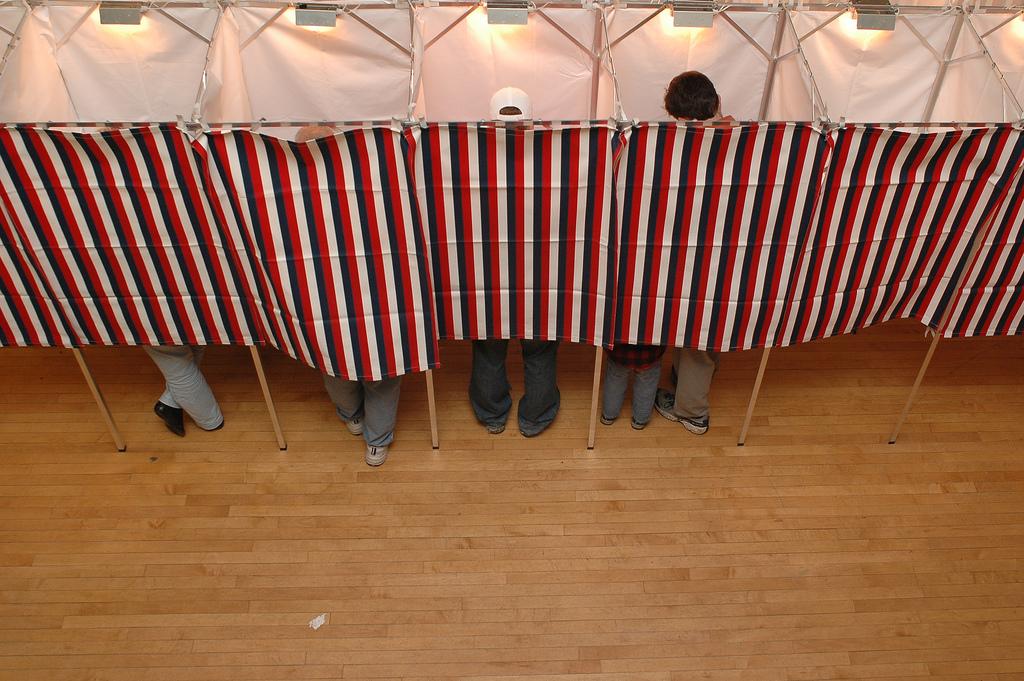
Capture the Mood on Election DayHelp capture the mood on the day you vote. On election day, report back to us from your polling place after you vote by text or by using the iPhone app. Don't know where to vote? When you sign up, you can get the exact location of your polling place texted to you. »Find out moreLive Video on Election NightCheck back to TheTakeaway.org on election night as Washington correspondent Todd Zwillich streams live video of the returns. He'll have a real-life map, cardboard cutouts and pie charts made out of real pie. You can join by text or video starting from 7 p.m. Eastern.
-
38
How Ethnicity Factored in the Midterms
Last night, Latinos carried Harry Reid to victory in Nevada, while more blacks voted for Republican candidates than ever before. Black Republicans made gains in the House, though in the Senate, there will no longer be a black presence. Andra Gillespie, assistant professor of political science at Emory University, and Theeda Skocpol look at how Latinos and blacks shaped yesterday's elections.
-
37
Political Ad Round-up
As election results continue to roll in, we look back at what went right and wrong in this year's races. One strong barometer of this year's contests were the torrents of negative, and sometimes even bizarre, political advertisements. Thom Mazloom joins the program to look back at the ads that helped candidates win and lose.
-
36
The Obama Factor: Presidential Visits and the Midterms
Was this race effectively a "recall" on President Obama? That depends on who turned out at the voting booths yesterday. John Zogby, president of the polling firm Zogby International, gives us a picture of who turned out to vote yesterday and what surprised him in this morning's results. Theda Skocpol, professor of political science at Harvard University and the author of a recent report out by the Russell Sage Foundation that looked at President Obama’s first two years in office, helps us pinpoint his effect on the elections and how the mid-terms will affect the next two years of his presidency.
-
35
GOP Takes House, Looks to Future
Republicans had major victories after Tuesday's elections, taking over control of the House and gaining several seats in the Senate. When the new Congress goes to work in Washington, D.C., the GOP will now be a mix of conservatives and Tea Party candidates. Pennsylvania turned from blue to red, electing Republicans Pat Toomey to the Senate and Tom Corbett as governor. We talk with Renee Amoore, deputy chair of the Pennsylvania Republican State Committee, about Tuesday's election and what it means for the future of the Republican party.
-
34
Americans Throw Out Party in Power for Third Consecutive Election
In the third election in a row where Americans threw out the party in power, Republicans won control of the House of Representatives on Tuesday, in part due to large discontent among voters who didn't want to see incumbents return to Washington. Though some races are still in play, the Republicans, with the help of Tea Party candidates, successfully captured 56 seats. The GOP also made great strides in the Senate, though Democrats will continue to hold the upper house of Congress. Rep. John Boehner of Ohio will become the next speaker of the House. In an emotional speech last night, Boehner said that the election is a rebuke to President Obama, with Americans telling him to "change course." Takeaway Washington correspondent Todd Zwillich and Jim Warren, Chicago based columnist for the Chicago News Co-Op and The New York Times, parse through last night's results.
-
33
Self-Financed Candidates Largely Fail
In American, can money buy you a Senate seat or a governorship? If you're billionaires like Meg Whitman, Carly Fiorina, or Linda McMahon, the answer this year was no. Of the 58 self-financed candidates that have run for the House or Senate this year, more than half were out before election day even came around. Todd Zwillich, Takeaway Washington correspondent, looks at the big money in this year's race.
-
32
Florida's Senate and Governor's Races Through the Eyes of Carl Hiaasen
Author Carl Hiaasen is not afraid to call a spade a "phony with a $134 haircut" — even when the man in question is the Senator-elect from Florida, Marco Rubio. Hiaasen is a Miami Herald columnist and novelist, has been praised for writing with "wit, style and an abiding sense of justice," and he brings that sensibility to tracking Florida's Senate and gubernatorial races. We take a look at Florida's Senate and gubernatorial results with Hiaasen.
-
31
What Will Historians See When They Look Back on 2010?
When future generations look back on this election, the first after President Obama's dramatic victory in 2008, will they see it as a repeat of the 1994 Gingrich Revolution? An unraveling of the Obama agenda? Or a chance for the president to rebrand himself? Douglas Brinkley, professor of history at Rice University and author of "The Wilderness Warrior" and "The Great Deluge," gives us his historical perspective. Todd Zwillich also has a few ideas.
-
30
Verdict is in on Tea Party: Between a Trickle and a Wave
For Tea Partiers, last night's race was a mixed bag. Tea Party candidates did well in states that were already red, like Kentucky, and South Carolina, but failed to make gains in bluer states like Delaware. In Nevada, Sharron Angle, one of the most notorious Tea Party Republicans, lost to Senate Majority Leader Harry Reid, the state's wildly unpopular Democratic Senator. Kate Zernike offers a national perspective. She's the author of "Boiling Mad: Inside Tea Party America," and writes for our partner The New York Times. Ian Mylchreest watched the race between Sharron Angle and incumbent Sen. Harry Reid through to Reid's squeaker victory. Mylchreest is the executive producer of KNPR's State of Nevada.
-
29
Voters' Voices from Around the Country
We hear from voters from around the country about their trip to the voting booth and how they feel on election day. Text DECIDE to 69866 to tell us your voting story (download the iPhone app). Find out more. Joel Shrock, 24 years old, voter in New York City Julie Matooz, voter in Michigan Pat Gallagher, voter in Louisville, KY Dallas Gunnels, voter in Oklahoma
-
28
Tight Races Could Lead To Recounts
On Tuesday, voters will cast their ballots, bringing mid-term election season to a close. Unless, of course, some races are too close to call. Polls show that close Senate and gubernatorial races in Nevada, Illinois, Pennsylvania, Washington, Wisconsin, Alaska, Colorado, Ohio and Florida could require recounts. It’s an anxiety-inducing thought — and could potentially leave the House and the Senate hanging in the balance while the chads (or the absentee ballots, or the broken machines) get sorted. We talk with Nate Persily, law professor at Columbia University, about the possibility of recounts after Tuesday's elections.
-
27
This Week's Agenda: Elections, Unemployment, and Asia
One day before the mid-term election and predictions are in. Todd Zwillich, The Takeaway's Washington correspondent, looks ahead to election day and forecasts the after-effects of its results. Voters head to the polls tomorrow, but non-political happenings continue apace: the Fed will meet to discuss what to do about interest rates and the economy. Charlie Herman, economics editor for The Takeaway and WNYC Radio, doesn't see the interest rate increasing, but sees the Fed pumping more money into the economy, to try and jumpstart it. Also, in a controversial move, President Obama is scheduled to leave for a trip through Asia, before official election results come in. Zwillich says this will give Republicans a lot of prime time to control the airwaves and push their message, after what looks to be a good night for them. October jobs numbers are set to be released three days post-election; Herman says they are not expected to look good.
-
26
Sanity Checking Last Minute Political Ads
Tomorrow is election day and candidates on both sides of the ballot are throwing their final pitch to voters. But are candidates trying to get away with throwing curve balls? We do a sanity check on various last-ditch ad campaigns with PolitiFact editor Bill Adair.
-
25
Gazing into Mid-Term Election's Crystal Ball
Four days away from the mid-term elections, there remain a few unpredictable Senate and Congressional races that could shift the national balance of political power. As the hours tick by, what will bring out the critical voters in states like Washington, West Virginia or Illinois? Political fortune teller, John Zogby, president and CEO of the Zogby polling firm, and Michael Shear chief political correspondent for the Caucus Blog with our partner The New York Times, analyze some of the closest state and national races.
-
24
Obama Voters from 2008 Revisit Their Choice
They voted for Obama in 2008. Two years later, things have changed. Pat Gallagher from Louisville, Alice Craft-Kerney from New Orleans, and Illya Davis from Atlanta join us to talk about their feelings about President Obama at the halfway mark of his first term.
-
23
With One in Three Voters Still Undecided, A Look at the 'Persuadables'
With just five days left until mid-term elections, Republicans and Democrats alike going to be making lots phone calls and knocking on lots of doors, trying to reach out and talk to undecided voters — or as they’re called in polling circles, “persuadables.” That little semantic shift that reveals how desirable these voters are and what lengths a campaign will go to in order to get them. But who are these persuadables? And what exactly do they need to be persuaded? Michael McDonald spends a lot of time asking those questions. He’s a professor at George Mason University, and runs the United States Elections Project. We’re also joined by Kerwin George. He’s one of the thirty percent of Americans who (according to an AP Poll out this week) are still undecided in this election.
-
22
Five Senate Races That Tell the Story of the 2010 Elections
With so many tight political races around the country, it can be hard to determine which are the bellwethers, which ones to watch. But there are a few Senate races whose dramatic stories have resonated across the country. Their outcome will not only change the actors on the political stage, but also the narratives taking place in Washington for years to come. Our Washington correspondent, Todd Zwillich, explains why Delaware, South Carolina, Pennsylvania, Wisconsin and Nevada tell the story of this election.
-
21
Can Black Voters Tip the Scales for the Democrats?
In 2008, African-American voters came out in record numbers to vote for Barack Obama. This week, President Obama began a media push to reach out to those same voters, appearing as a call-in guest on The Tom Joyner Show and the Al Sharpton Show, among others. But will it be possible to convince previously excited "Yes We Can" supporters to vote, even without Obama on the ballot? William Boone, professor of political science at Clark Atlanta University, says that while it's impossible to expect the same black voter turnout as 2008, it will still be higher than previous midterm elections.
-
20
Outside Groups Spend Big as Elections Approach
These mid-term elections are seeing massive amounts of money being raised and spent both left and right, from party committees to outside independent groups — much, much more money than the last mid-term elections in 2006. Over $260 million has been spent by outside groups, who have been able to remain largely anonymous since the Supreme Court ruling in Citizens United v. FEC, earlier this year. But what are contributors expecting in return for their millions of dollars? Paul Blumenthal, is a senior writer for The Sunlight Foundation. He says people like Karl Rove, who started the conservative political group American Crossroads to raise money for right-wing campaigns, is trying to maintain power in the Republican Party.
-
19
GOTV Operations in High Gear as Election Day Nears
It's Tuesday, and just seven days remain until mid-term elections. Republicans are looking to take control of the House, Democrats are desperately fighting to hold the Senate, and The Tea Party is looking to increase its political clout — and everyone is out on the ground trying to get out every last vote. The Takeaway's Washington correspondent, Todd Zwillich, has been monitoring Get Out The Vote operations each party is doing. Michael Shear, chief political reporter for The Caucus Blog at The New York Times, is following President Bill Clinton's attempts to help the Democratic Party on the campaign trail.
-
18
Young Voters Less Excited This Year
Two years ago, Barack Obama won the presidency in part by having inspired young people to come out and vote in record numbers. Early indicators say young voters aren't as excited about turning out this year. We hear from students from the University of Pennsylvania on how (and if) they plan to vote.
-
17
This Week's Agenda: Elections, Economy, and a Conference in Asia
We are just eight days away from election day, and Democrats and Republicans are campaigning at full throttle. First Lady Michelle Obama is on the West Coast, trying to win votes for Democrats in key Senate races in Washington and California. Marcus Mabry, associate national editor for The New York Times, sees things clearing up by the end of the week on who has the advantage heading into next Tuesday. A number of key economic numbers are also set to be released this week, heading into the elections, starting with home sale numbers and ending with third quarter GDP. Charlie Herman, economics editor for The Takeaway and WNYC Radio, looks at those numbers and how they will affect us and the election. Meanwhile, leaders from south-east and east Asia are meeting today in Hanoi, Vietnam to start a combined meeting of the Association of Southeast Asia and the East Asia Summit. Marcus sees this as a sign of things to come as China makes it clear that they are in charge.
-
16
Is 'Mean Girls' Misogynist?
Earlier this week, we spoke to Gail Sheehy of The Daily Beast about what she and Maureen Dowd have labelled the "mean girls" in this election — Republicans like Linda McMahon, Sharron Angle, and the "Mama Grizzly" herself, Sarah Palin. But is that term fair? Or does it just show that the political, mud-slinging political playing field has been leveled? With us to weigh in on how female candidates and voters are changing is Rebecca Traister, senior writer at Salon.com and author of "Big Girls Don't Cry: The Election That Changed Everything for Women."
-
15
Political Ads of the 2010 Midterms: More Expensive, Negative
Politicians and their advocates will spend upwards of $4 billion on ads in this mid-term election cycle, according to Thom Mazloom, founder of the M Network, a communications and branding company. So is that such a big deal? There will be 20 to 25 percent more in ad spending than in the midterms of 2006. Besides getting big sooner, the ad campaigns have gone negative much faster. John Dennis' "Wizard of Oz" ad targeting Speaker of the House Nancy Pelosi Rep. Alan Grayson's "Dan Webster Taliban" ad targeting Daniel Webster Jack Conway’s "$2000 Deductible" ad targeting Rand Paul Below, watch Republican candidate for U.S. Senate in Delaware, Christine O'Donnell's first major political ad.
-
14
On the Internet, All Politics Are National
With November's mid-term elections only weeks away, many candidates have begun rounds of debates in a final effort to win over voters. In California's gubernatorial race, Republican Meg Whitman lost some points in polls when her opponent, Democrat Jerry Brown, accused Whitman of employing an illegal immigrant. Hours before last night's debate between Republican Linda McMahon and Democrat Richard Blumenthal in Connecticut, McMahon released an attack ad telling voters Blumenthal lied about his war service. We talk with Michael Shear, chief political reporter for The Caucus Blog at The New York Times about the importance of the debates and their potential impact on undecided voters.
-
13
Both Political Parties Eye California Races
The conventional wisdom is that Christine O’Donnell’s primary win for Senate in Delaware took another state out of play for the GOP, who hope to win back control of the Senate in November. That puts a lot of weight on the remaining states in play for both parties. Until recently, polls showed the California Senate race between Democratic incumbent Senator Barbara Boxer and her Republican challenger, ex-HP CEO Carly Fiorina, a toss-up. Now that Boxer is pulling ahead – in some polls by as much as 8 points – the race is gaining national attention from Democrats, Republicans and the Tea Party backed PAC, FreedomWorks. Yesterday, both candidates participated in a debate that aired on KPCC, Southern California Public Radio. We speak with one of the co-moderators of yesterday’s debate, Patt Morrison, about the debate, the race, and the national attention being paid on California politics. Patt is a longtime columnist for the Los Angeles Times and host of “Patt Morrison” on KPCC 89.3, Southern California Public Radio.
-
12
California Political Rivals Face Off in Debates
The California governor's race kicked off last night in the first of three debates. Billionaire political novice Meg Whitman, a Republican, faced off against her Democratic rival, former governor and current Attorney General Jerry Brown. Bruce Cain, professor of political science at U.C. Berkeley, joins us for some post debate analysis. He'll also preview tonight's debate in California's other closely watched race, the Senate contest between incumbent Barbara Boxer and Republican challenger Carly Fiorina.
-
11
Reid-Angle Faceoff Intensifies in Nevada
Our partners at the BBC traveled to Searchlight, Nevada to speak with voters about the upcoming election for the U.S. Senate. Incumbent Senator Harry Reid is facing off against Tea Party-backed Sharon Angle. As in some other races across the country, Democrats are facing an uphill battle, trying to distance their candidate from Washington and the Obama agenda.
-
10
Republicans' New Policy Agenda Revealed Today
House Republicans unveil the blueprint of their new policy agenda, to be used in the next Congress if they win back a majority in November's elections. It's the first time the GOP has released a political agenda of this nature since 1994's "Contract With America." The new plan consists of a 21-page document entitled “Pledge to America.” (The text can be found on Taegan Goddard's Political Wire.) Some of the key issues addressed are, not surprisingly, taxes, defense and a plan to “repeal and replace the government takeover of health care with common-sense solutions…” Soren Dayton, a Republican consultant and activist, worked for John McCain's presidential campaign. He joins us to help unpack this much-anticipated Republican agenda. Dayton is also the co-founder of the blog, thenextright.com.
-
9
Pennsylvania Voters Talk Midterm Elections
President Obama is in Pennsylvania today, campaigning for Democratic Senate candidate Joe Sestak. Two years ago, our own Andrea Bernstein, director of WNYC’s Transportation Nation project, visited Pennsylvania in a series we called “Counties that Count.” The series looked at the issues motivating voters in counties that could hold powerful sway in highly contested states, back in the 2008 presidential election. Bernstein who returned to Wilkes-Barre, Pennsylvania, a city and state very much in play this midterm election, to understand what’s driving voters this time around.
-
8
Alaska Senator Lisa Murkowski To Run As Write-In Candidate
Lisa Murkowski, the Republican senator from Alaska, may have lost the bid for nomination in the Republican primary, but that fact hasn't seemed to dampen her plans to continue her campaign for November's general election. Murkowski announced on Friday that she plans to run as a write-in candidate against Tea Party-backed Joe Miller, who won the Republican nomination. Ever since her announcement, however, Murkowski has received a great deal of backlash from Republican officials. Washington correspondent Todd Zwillich joins us to discuss whether this negative reaction by Republicans is warranted, and how Murkowski's decision may affect Alaska's senate elections in November.
-
7
House Minority Whip Eric Cantor on Mid-Term Election Strategy
Every state save for Hawai'i has been to the primary polls, and the ballots for November are nearly set. In a few states we saw surprising results: results that might lead to changed strategies in the general election. Fox News contributor and former GOP strategist Karl Rove declared on-air that Tea Party candidate Christine O’Donnell's primary win in Delaware spells nearly certain doom for at least one Senate seat the GOP was hoping to take in November. Does this gloomy forecast hold true for other states that saw Tea Party backed candidates unseat the traditional party players? For the Republican reaction to Tuesday’s primary returns, we speak with House Minority Whip Eric Cantor, Republican Representative from Virginia.
-
6
Party, Politicians Sliding Along Political Spectrum
It has been a successful primary season thus far for The Tea Party, especially with a surprising victory for Christine O'Donnell over former two-term governor and nine-term Congressman, Mike Castle, to win the Republican nomination for the Senate race in Delaware, Tuesday night. What do these Tea Party wins mean for the Republican Party, and is the GOP shifting on the political spectrum? Kate Zernike is a reporter for The New York Times, and the author of Boiling Mad: Inside Tea Party America. We also want to know from you: Are you moving along the political spectrum this election season? Are you finding yourself moving further left or further right this year? Let us know in the comments or text it to 69866 with the word TAKE. Responses by text message: Don't know, but I do love the way the T.P.'s win by purporting NOT to be Republicans, but then as soon as they win, the $ can't come quick enough from Repubs—Pontiac, MI I'm an independent, and all this anger-driven rhetoric and negativity has only pushed me further left. Pablo/florida—Hollywood, FLNope. The Tea Party is not "moving" the GOP. Rather it's fracturing it. Blame Gingrich and the Contract With America that urged people that govt = "evil"—Pontiac, MI I think the tea party represents a group of far weather republicans. I don't hear anything different from them vs far right republicans.—Jonathan, Columbia, SC No strict Dem ticket 4 me.—Allan, Woonsocket, RITo the left, to the left—Miguel, Hialeah, FL
-
5
Uncertainty for the GOP After Tea Party Candidates Win Big In Primaries
Last night's primary elections set the stage for the nation's general elections with seven states and the District of Columbia heading to the polls. Once again, the viability of the Tea Party was the central question in several races on the Eastern seaboard.. While several Republican insurgent candidates won big last night, their victories over establishment candidates muddle the G.O.P.'s chances of retaking the Senate in November. Last night's biggest Tea Party upset came from Delaware, where long-shot Sarah Palin-endorsed candidate Christine O'Donnell beat long-time incumbent candidate Mike Castle for the Republican Senate nomination; but, that wasn't the only surprising result in last night's tally. In the New York Republican gubernatorial race, Carl Palidino, a pugnacious billionaire and party outsider, beat establishment candidate Rick Lazio. The results are still too close to call in a Senate primary in New Hampshire where fiscal and social conservative Ovide Lamontagne is expected to win. It wasn't all good news for the Tea Party candidates. In Maryland, former Governor Robert Ehrlich will have a chance to get his old job back after beating Sarah Palin favorite Brian Murphy. For analysis and insight into the results, and a look ahead to the general election strategy of both party's candidates, we speak with Takeaway Washington Correspondent Todd Zwillich.
-
4
Taking the Political Temperature of the Sunshine State
Our political coverage of the midterms turns to Florida. The Sunshine State has been in the international limelight for weeks, following Pastor Terry Jones’ threats to publicly burn Korans. With the bonfire cancelled and the 9/11 anniversary past, we talk this morning about a state full of voters whose opinions range the gamut on the Koran burning issue and the three-way race for U.S. Senate that’s been heating up for months. Farai Chideya, host of WNYC’s three-part series “Pop and Politics," visited Florida over the weekend.
-
3
Tea and Taxes in Delaware's Senate Primary
As one of the last states to hold primary elections, Delaware has been the focus of a lot of national political attention. In a recent interview with Fox's Sean Hannity, Sarah Palin flexed her political clout and officially endorsed Tea Party Express-backed candidate Christine O’Donnell. But what does a Palin endorsement mean for GOP Rep. Mike Castle, the veteran Congressman and former Delaware governor, as he bids for the same senate nomination? We speak to Takeaway Washington correspondent Todd Zwillich, who visited Delaware over the weekend, and spoke with some of the people and candidates involved in tomorrow’s primary.
-
2
A Country Divided: Midterm Elections Preview
Across the country, there are only nine political primaries left this season, and the race for November’s midterm elections is coming into full swing. Two members of our political team discuss the upcoming races and what to expect from our coverage. The Takeaway Washington correspondent, Todd Zwillich, describes the national chessboard between the Dems, GOP and Tea Party-backed candidates; and correspondent Farai Chideya joins us to describe her new WNYC project: "Race, Rage and Reconciliation," a three part special on the midterm elections.
-
1
Inside Arizona's Primaries: Gov. Jan Brewer, John McCain Up for Re-Election
Voters will be heading to the polls to cast their votes in Arizona's primaries tomorrow. We'll finally get a look at how voters feel about Gov. Jan Brewer as she seeks re-election. The governor has been closely watched since she signed the controversial immigration bill, SB-1070 into law. After she signed the immigration bill, her poll numbers sky-rocketed, according to Mark Brodie, reporter and host at KJZZ in Arizona. And he does not see this primary being a problem for her. He also does not predict any problems for Sen. John McCain, who will likely face his toughest challenge on the road to re-election. But the most interesting race lies in the Congressional 3rd District, where Ben Quayle, son of former Vice President Dan Quayle, and nine other candidates are seeking the Republican nomination, in what has turned into a very nasty and cut-throat race.
No matches for "" in this podcast's transcripts.
No topics indexed yet for this podcast.
Loading reviews...
ABOUT THIS SHOW
Capture the Mood on Election DayHelp capture the mood on the day you vote. On election day, report back to us from your polling place after you vote by text or by using the iPhone app. Don't know where to vote? When you sign up, you can get the exact location of your polling place texted to you. »Find out moreLive Video on Election NightCheck back to TheTakeaway.org on election night as Washington correspondent Todd Zwillich streams live video of the returns. He'll have a real-life map, cardboard cutouts and pie charts made out of real pie. You can join by text or video starting from 7 p.m. Eastern.
HOSTED BY
GBH, PRX, WNYC Studios
CATEGORIES
Loading similar podcasts...
URL copied to clipboard!