
PODCAST · business
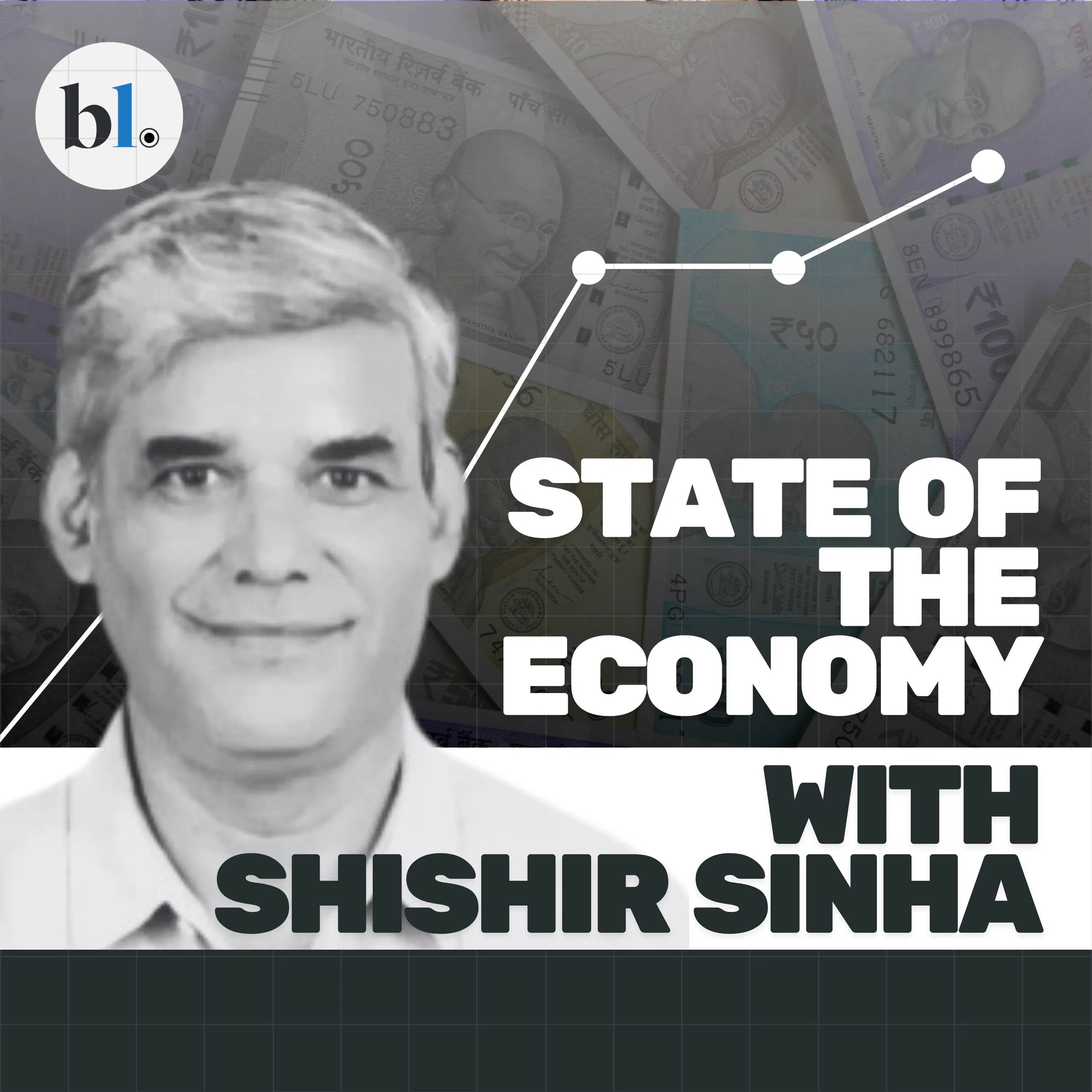
State of the Economy podcast with Shishir Sinha
by The Hindu businessline
India’s economy has been hailed as the bright spot amid the general gloom that seems to have enveloped the rest of the world. But several of its sectors still stutter about even while others seem set to fire on all cylinders. To help you make sense of the bundle of contradictions that the country is, Shishir Sinha helps decode the Indian Economy and high frequency economic indicators. Tune in!
-
9
GST strong, consumption faces headwinds as risks mount
In this episode of State of the Economy, Shishir Sinha speaks with Ranen Banerjee, Leader, Economic Advisory Services at PwC India, on what the latest high-frequency indicators reveal. April’s record GST collections are increasingly driven by imports, pointing to softer domestic demand. The Podcast looks at the impact of tariffs and Middle East tensions on exports, input costs and MSMEs, and why consumption is likely to weaken through Q1. Inflation may stay near recent levels for now, but risks remain if fuel costs are passed through. Banerjee also explains why fiscal stress may not show up immediately, but could emerge later in the year. The episode examines the resilience in auto sales — supported by rural demand and premiumisation — and whether that can hold as broader headwinds build. (Host: Shishir Sinha, Producer: Siddharth Mathew Cherian
-
8
Supply shocks and fiscal math: How the war is stress-testing India’s economy
In this episode of Businessline’s State of the Economy, host Shishir Sinha speaks with Kanika Pasricha, Chief Economic Advisor at Union Bank of India, to decode the early economic impact of geopolitical disruptions through high-frequency indicators. From the sharp dip in manufacturing PMI driven by cost escalation and supply-side shocks, to why retail inflation remains capped—for now—the discussion offers a nuanced view of stress points and resilience in the economy. The episode also examines GST collection trends, fiscal deficit arithmetic amid base-year revisions, GDP growth risks, and what to expect from the upcoming RBI monetary policy meeting as uncertainty continues to shape policy choices.
-
7
Post-COVID catch-up: Is 7–8 per cent GDP growth enough for India?
In this episode of State of the Economy podcast, host Shishir Sinha talks to Yuvika Singhal, Economist at QuantEco, on India’s post-COVID growth prospects and GDP revisions. Singhal highlights stable growth of 7 per cent and over, methodological improvements, and fiscal implications. They discuss how rising crude prices and geopolitical events could influence growth and inflation, while GST and PMI data underscore the strength of domestic demand driving manufacturing momentum.
-
6
How India plans to stay competitive amid global turbulence | CEA V Anantha Nageswaran explains
In this episode of State of the Economy podcast, host Shishir Sinha speaks with V Anantha Nageswaran, Chief Economic Adviser to the Government of India, on how India is navigating an increasingly uncertain global economic environment. Anantha Nageswaran acknowledges the headwinds confronting the global economy—geopolitical tensions, shifting trade patterns, and excess manufacturing capacity abroad—but argues that these challenges can serve as catalysts for reform rather than constraints. He outlines why a coordinated response is critical: governments must provide policy clarity and expand trade partnerships, businesses must invest in innovation and competitiveness, and households must focus on skill development and resilience. The conversation also explores the idea of Swadeshi beyond slogans. Anantha Nageswaran explains why indigenisation is essential in a world of weaponised supply chains, while cautioning against permanent protectionism that shelters inefficiency. On PLI schemes and exports, he underlines that incentives are only one tool among many, with structural cost reforms and free trade agreements playing a crucial role. 🎧 Listen in to the full podcast for more details.
-
5
India’s economy: GST trends, fiscal pressures and the road ahead
In this episode of the State of the Economy Podcast, Shishir Sinha speaks with Upasna Bhardwaj, Chief Economist at Kotak Mahindra Bank, to decode the latest high-frequency indicators and their implications for growth, inflation, and government finances. The discussion opens with the GST collection figure. Although the monthly rise is only 0.7 per cent, Bhardwaj notes that the number must be viewed in the context of GST rate cuts implemented from late September. A strong festive-season surge in retail sales across consumer durables, electronics and automobiles has helped offset the expected dip in revenue, leaving collections broadly flat. The conversation covers whether this trend is strong enough for the government to meet its budget projections. “My sense is inflation is so benign, and likely to remain so for the next few months, that the RBI should use this opportunity to go ahead with rate cuts… We are pencilling in a 25-basis-point cut for the December meeting,” says Upasna regarding inflation and rate cuts. The focus then turns to the fiscal deficit, the weakness in direct tax collections, and the heavy front-loading of capital expenditure. Bhardwaj explains how savings in revenue spending and a larger-than-budgeted RBI dividend could help the government hold the deficit at 4.4 per cent, though softer nominal GDP growth adds pressure to the overall fiscal position. Listen in!
-
4
Tiptoe or treadmill: How fast are Indians spending?
In this episode of the State of the Economy podcast, host Shishir Sinha speaks to Professor Anil Sood, co-founder of the Institute for Advanced Studies in Complex Choices, Hyderabad, about the latest high-frequency economic indicators. They discuss GST collections, fiscal deficit management, capital expenditure trends, private investment, retail inflation, and the broader growth outlook for India.
-
3
GST refunds gathers pace, but does this translate to healthier working capital?
In this episode of State of the Economy, host Shishir Sinha speaks with Anitha Rangan, Chief Economist at RBL Bank. The conversation covers various high-frequency economic indicators and what they reveal about the current state of the economy. They also discuss the short-term and medium-term economic outlook, exploring key trends and potential challenges ahead.
-
2
Can India keep the growth engine warm, or will tariffs and inflation stall the ride?
In this episode of State of the Economy, host Shishir Sinha speaks with Madan Sabnavis, Chief Economist at Bank of Baroda. The conversation covers the impact of GDP deflators, the possible effects of new US tariffs, concerns around MSME sector employment, and the upcoming GST rate rationalisation. They also touch on the inflation outlook and the likelihood of an RBI rate cut in the coming months.
-
1
Trade tensions or slowing demand—what’s India’s bigger challenge?
In this episode of State of the Economy with Shishir Sinha, economist Debopam Chaudhuri joins Shishir Sinha to unpack the contrasting signals coming from India’s economy. While headline indicators such as GST collections and manufacturing PMI suggest solid momentum, deeper layers of the data tell a more complex story. “There is a lot of conflicting information that is coming out from the high-frequency data set. So, on one hand, we see GST numbers holding up, the PMI at a 16-month high… But on the other hand, we are seeing inflation being slightly elevated, the fiscal deficit slightly widening... So, it is typical of an economy which is yet to come out of the woods,” said Debopam Chaudhuri, Chief Economist, Piramal Group. He explained that while India's economy is not in crisis, the post-pandemic recovery remains incomplete. Real, sustained growth over the long term is essential—not just one-off quarterly highs. “In order to completely come out of it, we need to ensure a growth rate of at least 7.5 to 8% real growth rate on a sustained basis for at least 8 to 10 years,” he said, underlining the scale of the challenge The discussion shifts to global trade tensions, particularly the upcoming US tariff regime expected from August. While acknowledging short-term risks for Indian exporters, Chaudhuri remains optimistic, citing India’s growing self-reliance and active trade negotiations with the UK, EU, and Japan. But a bigger concern lies closer to home—urban consumption. While rural demand remains relatively stable, consumption in cities has softened due to inflation, higher borrowing costs, and job market uncertainty. Chaudhuri anticipates two more interest rate cuts in FY26, most likely in October and February, rather than August, as the RBI waits to assess the impact of earlier rate reductions. Softer rates, paired with easing food inflation, could support discretionary spending during the festive season. Finally, he reflects on inflation dynamics. While headline CPI may tick up slightly due to seasonal food prices, core inflation remains under control—suggesting underlying stability. The sharp fall in rural inflation does not necessarily indicate distress for farmers, he said, since price corrections have largely occurred in seasonal and volatile commodities. (Host: Shishir Sinha, Producers: Rowan Philip Barnett; Siddharth Mathew Cherian)
No matches for "" in this podcast's transcripts.
No topics indexed yet for this podcast.
Loading reviews...
ABOUT THIS SHOW
India’s economy has been hailed as the bright spot amid the general gloom that seems to have enveloped the rest of the world. But several of its sectors still stutter about even while others seem set to fire on all cylinders. To help you make sense of the bundle of contradictions that the country is, Shishir Sinha helps decode the Indian Economy and high frequency economic indicators. Tune in!
HOSTED BY
The Hindu businessline
CATEGORIES
Loading similar podcasts...
URL copied to clipboard!